viewpoint: Ministry of defence – ‘Bad’ is putting it mildly Page 11
`55.00 (India-based buyer only)
SP’s
mai An SP Guide Publication
Vol: 6 Issue 1-2 ❚ January 1-31 • 2016
www.spsmai.com
ONLY Fortnightly on Military aerospace internal security
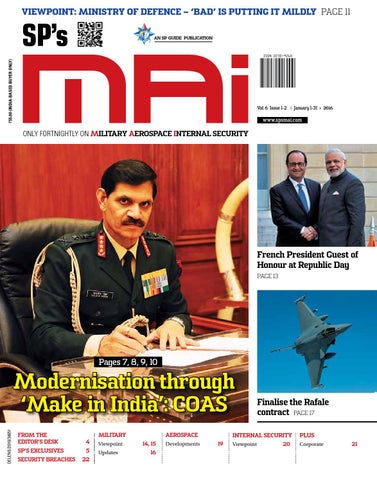
French President Guest of Honour at Republic Day PAGE 13
Pages 7, 8, 9, 10
DELENG/2010/34651
Modernisation through ‘Make in India’: COAS From the editor’s DESK
4
sP’s exclusives
5
security breaches 22
military Viewpoint Updates
INTERNAL security
Aerospace 14, 15 16
Developments
Finalise the Rafale contract PAGE 17
19
Viewpoint
20
PLUS Corporate
21
spotlight VIEWPOINT: MINISTRY OF DEFENCE – ‘BAD’ IS PUTTING IT MILDLY PAGE 11
`55.00 (INDIA-BASED BUYER ONLY)
President of India at Mceme Convocation
SP’s
mai AN SP GUIDE PUBLICATION
www.spsmai.com
Cover:
P
French President invited – Chief guest at Republic Day PAGE 13
Pages 7, 8, 9, 10
Modernisation through ‘Make in India’: COAS DELENG/2010/34651
ranab Mukherjee, the President of India, was the chief guest at the 88th Convocation Ceremony of the Military College of Electronics and Mechanical Engineering (MCEME), Secunderabad. It was a rare honour for the officers of the 96th Degree Engineering (DE) & 24th Technical Entry Scheme (TES) course to receive their awards from the Supreme Commander of the Armed Forces. Speaking on the occasion, the President said: “I urge you to set yourself a befitting goal and having done so, utilise your technical threshold and dedicated hardwork to realise it.” Pranab Mukherjee is the third President to visit MCEME since its raising. Prior to him, Dr Rajendra Prasad and Dr S. Radhakrishnan had visited the college in 1955 and 1964, respectively. However, this is
Vol: 6 Issue 1-2 ❚ January 1-31 • 2016
ONLY FORTNIGHTLY ON MILITARY AEROSPACE INTERNAL SECURITY
FROM THE EDITOR’S DESK
4
SP’S EXCLUSIVES
5
SECURITY BREACHES
1_SP's MAI Cover 1&2-2016.indd 1
22
MILITARY Viewpoint Updates
Developments
36 Rafale jets – A mirage or reality? PAGE 17
INTERNAL SECURITY
AEROSPACE 14, 15
19
Viewpoint
20
Cover images: Indian Army, PIB, Dassault Aviation
PLUS Corporate
During the annual Army Day media interaction, the Chief of the Army Staff General Dalbir Singh talked at length about the security challenges the Army is facing and its modernisation process.
21
16
21/01/16 3:45 PM
Publisher And Editor-in-Chief
Jayant Baranwal Assistant Group editor
R. Chandrakanth SR Technical Group EditorS
Air Marshal B.K. Pandey (Retd) Lt General Naresh Chand (Retd) Lt General V.K. Kapoor (Retd) R. Adm S.K. Ramsay (Retd) SPECIAL Contributor
Lt General P.C. Katoch (Retd) Chairman & Managing Director
Jayant Baranwal planning & business development
Executive Vice President: Rohit Goel ADMIN & COORDINATION
Bharti Sharma design & LAYOUT
Creative Director: Anoop Kamath Designers: Vimlesh Kumar Yadav, Sonu Bisht Research Assistant - Graphics: Survi Massey
Photograph: PIB
SALES & MARKETING
the first time when the President was the chief guest for the convocation ceremony. The ceremony was attended by a host of dignitaries including E.S.L. Narasimhan, Governor of Andhra Pradesh & Telangana; Lt General P.M. Hariz, GOC-in-C, ARTRAC; Lt General K.J. Singh, Director General of Electronics and Mechanical Engineers; and many other senior army and civilian officers. MCEME, an ISO 9001 certified institution, was established in 1946. Over the years the college has developed into a premier training institution of the Indian Army. MCEME conducts courses ranging from basic level to M.Tech level for training human resource of Corps of EME in various disciplines like mechanical engineering, electronics and communication, microwave technology, aeronautical engineering, IT and computer science. SP
Director: Neetu Dhulia General Manager Sales: Rajeev Chugh
SP’s websites
Sr Web Developer: Shailendra P. Ashish Web Developer: Ugrashen Vishwakarma © SP Guide Publications, 2016 Subscription/ Circulation
Annual Inland: `1,320 • Foreign: US$ 325 E-mail: subscribe@spguidepublications.com subscribe@spsmai.com LETTERS TO THE EDITOR
editor@spsmai.com
FOR Advertising details, contact:
advertise@spsmai.com neetu@spguidepublications.com rajeev.chugh@spguidepublications.com SP GUIDE PUBLICATIONS PVT LTD
A-133 Arjun Nagar (Opposite Defence Colony) New Delhi 110003, India.
Tel: +91 (11) 24644693, 24644763, 24620130 Fax: +91 (11) 24647093 E-mail: info@spguidepublications.com Representative Office
204, Jal Vayu Vihar Kalyan Nagar Bengaluru 560043 Tel : +91 (80) 23682204 MOSCOW, RUSSIA
LAGUK Co., Ltd, Yuri Laskin Krasnokholmskaya, Nab., 11/15, app. 132, Moscow 115172, Russia. Tel: +7 (495) 911 2762, Fax: +7 (495) 912 1260
Owned, published and printed by Jayant Baranwal, printed at Kala Jyothi Process Pvt Ltd and published at A-133, Arjun Nagar (Opposite Defence Colony), New Delhi 110003, India. All rights reserved. No part of this publication may be reproduced, stored in a retrieval system, or transmitted in any form or by any means, photocopying, recording, electronic, or otherwise without prior written permission of the Publishers.
www.spguidepublications.com Issue 1-2 • 2016 SP’S MAI 3
From the
Editor’s Desk
Security environment is fragile, need to be on guard always
T
he recent terror strike on Pathankot Air Force base by elements from across the border has left many of us wondering how these terrorists loaded with weapons got facile entry into the airbase. Thankfully the air assets remain intact, but seven lives were lost. The question, however, that keeps cropping up is how fragile is our border and how security ‘gaps’, the word used by the Defence Minister Manohar Parrikar, exist. The latest misadventure carried out by members of the Jaishe-Mohammed of Pakistan has cast a shadow on the peace talks between the two nations. Air Marshal B.K. Pandey (Retd) opines that the foreign policy perspective of the NDA Government with regard to this hostile and intransigent neighbour comes under the scanner. It is such misadventure that the Chief of the Army Staff, General Dalbir Singh, in an exclusive interaction with our Senior Technical Editor, Lt General V.K. Kapoor (Retd) talked about. The General stated that the contemporary security environment is dynamic and poses challenges across the entire spectrum of conflict to include both conventional and unconventional scenarios. These range from traditional ‘Land-Centric Threat’ along our borders to ‘Asymmetric Threats’ including proxy war and its manifestations. There are also emerging challenges in information dimension and space domain as well, besides cyberspace which is all encompassing. The Chief assured that the armed forces were ever ready and alert to take on all challenges. To ensure its strike capability, the Army has embarked upon a massive modernisation programme, including taking the route of ‘Make in India’ and the General mentioned that a large number of procurement cases of major equipment and ammunition were moving ahead. He was lucid when stating that the approach of acquisition would be both Buy and Make (Indian) if it is critically needed and that ‘Make in India’ would take some time. The question applies to all defence acquisitions and keenly to be watched will be the Rafale purchase, whether it will be signed or not when the French President François Hollande will be in India 4 SP’S MAI Issue 1-2 • 2016
as guest of honour at the Republic Day parade. There is every reason for Indo-French relations to grow stronger and it is hoped that the Rafale deal will come through as any delay in the acquisition is going to compromise on combat capabilities of the Indian Air Force (IAF). The IAF will need to induct at least another 15 squadrons of the Rafale jets or combat aircraft of the same or next-generation and with similar or better capability if it has to maintain some sort operational edge over its inimical neighbours. In his forthright column, Lt General P.C. Katoch (Retd) has cited the Comptroller and Auditor General of India (CAG) on the operational capabilities of the IAF and the Army Aviation Corps, focus being on the poor serviceability of the Sukhoi-30MKIs and AWACS, besides the obsolete Cheetah/Chetak helicopter fleets. He squarely blames the Ministry of Defence (MoD) for this crisis and concludes that unless the MoD is manned by military professionals, not much improvement should be expected and that we will continue to drift. Happy reading!
Jayant Baranwal
Publisher & Editor-in-Chief www.spsmai.com
SP’s Exclusives By SP’s Special Correspondent
Army gets taste of Airbus A400M
T
he Indian Army is getting its first taste of the Airbus A400M multi-role transport aircraft at Jaisalmer air force base, with the French Army contingent for Exercise Shakti 2016 arriving in one of type. The 56 personnel of 35th Infantry Regiment of 7th Armoured Brigade, led by Major Thibaut De Lacoste Lareymondie, are at the Mahajan Field Firing Range in Rajasthan for the exercise spanning from January 8-16, 2016. While the exercise doesn’t involve an airborne component, SP’s can confirm that this is the first time an A400M has landed in India and is the first time Indian troops will get a comprehensive inside view
Photograph: Airbus Defence & Space
Saras headed for project cancellation?
S
ix years after a fatal crash of the second prototype aircraft, the Saras light civil aircraft programme could be headed for closure if sources are to be believed. After several stops and starts, it is likely that the prototypes may still fly, though the future of the project is almost definitely sealed. After a six-year grounding following a devastating March 2009 crash that killed its three-man Indian Air Force (IAF) test crew, the National Aerospace Laboratory (NAL),
of the new generation military transport aircraft currently deployed with France, and on order with a number of nations. Airbus has also made it clear that it is in dialogue with the Indian Government on the A400M as a possible procurement for the Indian Air Force (IAF) or other agencies. The A400M has also been pitched as a special missions aircraft. The IAF, as is well known, is currently committed to the Avro replacement programme being serviced by Tata and Airbus with the C-295, along with the multi-role transport aircraft with Russia. Airbus believes the A400M would fit in with an elevated capability that the IAF could well require now and in the future. SP
in coordination with the IAF’s Aircraft & Systems Testing Establishment (ASTE), have failed to muster enough confidence to put the aircraft back in the air. As reported earlier by SP’s, the ASTE had begun ground trials of the modified PT1N platform around December last 2013, and has undergone a rigorous routine of ground handling, turning and taxi trials, including static systems trials. Former NAL chief and aerospace guru Professor Roddam Narasimha recently spoke out about the various programmes, and said that the proposed regional transport aircraft (RTA) could spearhead a much needed new wave
in Indian capabilities alongside the Saras. “It should be a turboprop aircraft, executed in a public-private partnership (PPP) mode, preferably as part of a global consortium, and should be viewed as a common ‘civilmilitary’ platform that would also address the transport aircraft needs of the IAF in terms of the Avro and An-32 replacements, thus generating the numbers and associated economic viability needed to make it successful,” he said. The Saras technologies, however, could be infused into other programmes including the regional transport aircraft and national civil aircraft. SP Issue 1-2 • 2016 SP’S MAI 5
SP’s Exclusives By SP’s Special Correspondent New assault rifle push for IAF Garud squads
T Indian Army for new 30mm ammunition for infantry vehicles
I
n what could be one of the largest recent stock procurements of new generation ammunition, the Indian Army has published fresh interest. As part of a drive to beef up its mechanised forces and infantry, the Indian Army is planning to undertake procurement of new generation ammunition to replace the existing ammunition being fired by 30mm cannon gun fitted on BMP-2/2K. The ammunition is required for all the BMP-2/2Ks held with the Indian Army (approximately 2,900 vehicles). With a view to identify probable vendors who can manufacture the said ammunition in India, the original equiment
PhotographS: PIB, SP’s Special Correspondent, SP Guide Pubns
Stealthy push for nonstealth drones at DRDO
W
ith the Defence Research and Development Organisation’s (DRDO) Rustom-II MALE UAV still to take to the air, work is currently gathering pace to provide the platform with greater low-observability features. “The main function of the landing gear is safe take-off and landing of UAV under various environmental and operational scenarios 6 SP’S MAI Issue 1-2 • 2016
manufactures (OEMs)/Vendors have been requested to rapidly forward information on the product which they can offer. The ammunition is intended to be fired from the existing 30mm cannon gun (2A42) mounted on BMP-2/2K being employed in varied climatic and terrain conditions varying from extreme hot and dusty desert conditions to extremely cold high altitude regions. The Army specifically is concerned over whether new ammunition types will involve any increase in the overall weight of BMP-2/2K due to the ammunition being offered replacing the existing ammunition, types of ammunition being offered, i.e. AP, APFSDS, HE, Incendiary, Proximity, Plastic or Practice, etc. Unless absolutely necessary, the Army would like to totally avoid any changes in the existing sighting system on its BMPs. SP
with the support of external pilot. A tricycle type retractable landing gear system with a steerable nose wheel consists of major subsystems, viz. Hydrogas Shock Absorber Strut, Hydraulic Actuation System with Sensors, Wheel & Brake and Nose Wheel Steering System and Mechanical Linkages. Interested development partners need to have expertise and wide experience in the area of high precision manufacturing of systems and components for aerospace application and operate full-fledged manufacturing facilities from medium precision to high precision to cater for manufacture of landing gear systems and components. In addition to this, firm must have experience to carry out assembly and limited testing. The DRDO has faced several delays in putting the more capable Rustom-II into the air despite assurances to the IAF and Army that demonstrations would take place in 2015. In all likelihood, the first flight of the Rustom-II will take place in mid-2016 from an airstrip near Bengaluru. SP
he Indian Air Force (IAF) is learnt to have pegged up interest in its threeyear hunt for new assault rifles for its special units (Garud), that should be compact, foldable, easy to carry, handle, operate, simple to maintain and with high range. The requirement joins a raft of tenders already active for other weapons including assault rifles for the Army, sniper rifles for special units (including the MARCOS), 9mm small arms for the Army, etc. The Army is also in the process of replacing the INSAS rifle in ser-
vice. The Garud commando force of the IAF currently operates with the INSAS and AK-47, and the new tender appears to be a move towards replacing those arms with new generation weapons in line with the other two special units of the other two services. The procurement of new small arms for the Indian forces is also in line with the overarching doctrinal move towards lighter, smaller arms with modular architecture allowing a greater number of accessories and easier storage, less maintenance (with possibility of simple on-field maintenance) and part replacement. The Pathankot terror attack has provided the IAF with margin to push for speedier acquisitions and equipment, though a detailed case linking the requirement to the attack is yet to be made out. for more information, log on to:
www.spsmai.com
www.spsmai.com
MILITARY Interview
Lt General V.K. Kapoor (Retd) presenting a copy of SP’s Military Yearbook 2015-2016 to Chief of the Army Staff General Dalbir Singh
‘Our security response system needs to encompass the entire spectrum of conflict’
Photograph: Indian Army
On January 6, 2016, Lt General V.K. Kapoor (Retd), Senior Technical Group Editor of SP’s M.A.I., interviewed the Chief of the Army Staff General Dalbir Singh in his office in South Block. In a free and frank atmosphere, this highly decorated and widely experienced Chief of the Indian Army spoke about the roles and modernisation status of the Indian Army. He elaborated on the professional and institutional ethos which make the Indian Army one of the most potent fighting forces in the world whose professional competence, courage, valour and sacrifices for the country are legendary. SP’s M.A.I. (SP’s): How do you perceive the current global and regional security environment? What kind of challenges do they pose for India? Chief of the Army Staff (COAS): The contemporary security environment is dynamic and poses challenges across the entire spectrum of conflict to include both conventional and unconventional scenarios. These range from traditional ‘Land Centric Threat’ along our borders to ‘Asymmetric Threats’ including proxy war and its manifestations. There are emerging challenges in information dimension and space domain as well, besides cyberspace which is all encompassing. We are keeping ourselves ready and alert to take on all challenges accordingly.
The apex National Security Establishment as well as the armed forces are fully engaged in maintaining operational readiness and enhancing capabilities, including in collaboration with like-minded friendly countries, to deter and defeat threats across the entire spectrum, if and when they manifest. SP’s: The fight against terrorism has become a priority among all nations. The ISIS in Iraq and Syria, the largest terror group in the world, aims to create an Islamic caliphate across the world. In our neighbourhood Pakistan is virtually a factory for training terrorists and is indulging in state-sponsored terrorism. Additionally a large number of professional terror groups are available for hire. Issue 1-2 • 2016 SP’S MAI 7
MILITARY Interview How is the growth of terrorism and other related forms of asymmetric warfare going to affect India in the future and what steps would the Army like to take to prepare for this type of conflict? COAS: The recent massacre at San Bernardino, California, on December 2, 2015, whose perpetrators can be traced back to Pakistan and who had pledged allegiance to the Islamic State are indicative of the growing footprints of ISIS, particularly in the Af-Pak. No part of the world can remain insulated from this looming threat and their sponsors in our neighbourhood. We have taken proactive steps to institutionalise intelligence sharing with like-minded countries and develop cogent response mechanism to thwart their designs. The likely ‘spillover effect’ of terrorism from Af-Pak remains our immediate concern as Taliban had demonstrated the potency of its resurgence in the capture at Kunduz on September 28, 2015. Regionally, we are shoring up the capability of Afghan National Security Forces (ANSF) to combat this threat through training and in advisory capacity. Jammu and Kashmir is most vulnerable to the nefarious designs of ISIS/Pak, be it radicalisation of youth or ‘lone wolf’ attacks motivated by its divisive ideology. We are constantly monitoring these developments in concert with other security and intelligence agencies and are fully prepared to meet the growing threat of asymmetric warfare being waged by forces inimical to India’s interests. SP’s: Three additional commands were to be raised, namely the Cyber Command, Special Forces Command and the Aerospace Command. What is the current status of these projects? In light of the growing challenge of international terror groups should Special Forces Command be given the priority for raising? COAS: The security environment in India’s neighbourhood is complex and in a state of constant turmoil/evolution. Threats and challenges are multidimensional, thus our security response system needs to encompass the entire spectrum of conflict. Info warfare, cyber warfare and weaponisation of space are an emerging dimension of threat. While certain capabilities in the Cyber, Special Forces and Aerospace domains already exist, these are to be jointly built upon by the Services in keeping with the national security requirements. As a first step, we are presently considering raising of tri service agencies for each of these domains, as part of a ‘Phased Adaptive Approach’. SP’s: In April 2015, the Defence Ministry decided to downsize the 90,000-strong Mountain Strike Corps that was announced by UPA to act as a counter to the expanding Chinese military capabilities and intrusions. It was to be raised over seven years at a budget of `64,478 crore. Now, it seems that the force will have 35,000 soldiers and the cut has been attributed to “severe fund shortage”. What is the status of raising of the Mountain Strike Corps? COAS: In consonance with our perspective planning with reference to capability development along northern borders, the Cabinet Committee on Security (CCS) in July 2013 had sanctioned accretions for the Indian Army which includes the Mountain Strike Corps. As far as raising of the force is concerned, I can assure you that it is progressing as per approved schedule. Creation of desired capability to mitigate the threats being faced by nation is a priority for the armed forces as well as for the government. The sanctioned raisings will be completed in the desired time frame. Immediate equipping and arming of these forces has been done from the existing stocks held with the Indian Army and indents have been initiated to make up these depleted stocks. The government is committed to recuperate these stocks at the earliest. Resolute steps are being initiated to ensure that there is no depletion of stocks and necessary financial support is provided for the sustenance of new raisings as well as modernisation plans of the Indian Army. 8 SP’S MAI Issue 1-2 • 2016
SP’s: Effective surveillance and reconnaissance are an essential part of current and future capabilities at unit and formation level? UAVs are critical to this requirement. What is the concept of Indian Army in this respect and where are we at present? COAS: An integrated Battlefield Surveillance System, with mutually complementary sensors at all levels, provides the required combat information to the decision makers. UAVs are the only aerial means of ISR and target acquisition available to the Field Commander for employment of his long-range vectors to engage targets in depth, hence are a potent force multiplier. In order to afford comprehensive and gap free surveillance all along the borders, there is a need to augment the present holding of UAVs. The requirement of additional UAVs has been included in the Long-term Integrated Perspective Plans (LTIPP) and their procurement is being pursued expeditiously. SP’s: What is the current policy on entry of women into the armed forces, Permanent Commission for Women Officers (WOs) and what is the Army’s stand on women being enrolled in the combat arms such as the armoured corps and the infantry? COAS: The Permanent Commission has already been extended to women officers in AEC & JAG and at present Indian Army is holding 54 Permanent Commission WOs. Issues related to granting of Permanent Commission to Women Officers in Technical and Combat Support Arms are being studied. SP’s: The ratio of revenue to capital budget in the Army’s portion of the defence budget leans heavily in favour of the former in view of the larger manpower. This leaves a relatively smaller sum in capital budget for new procurements and modernisation. What can be done to improve this situation? COAS: The force level of the Indian Army is based on the overall threat perception for both existing and perceived threats in the current and future scenarios. Currently the strength of standing Army is approx 1.23 million wherein, mostly, the ‘soldier’ himself is a weapon system. This accounts for relatively higher amounts being allocated to revenue head accounting for salaries and sustenance purposes. Thus leading to a perception of skewed ratio of funds, being heavily in favour of revenue at the cost of capital. I must point out that capital acquisition and modernisation of the Army gets due priority. The modernisation/capital budget is separate from the revenue (salary and sustenance) budget. The capital budget is not based on the expenditure/allocation for revenue budget but on requirements projected, prioritised and sanctioned by a collegiate involving the CCS, Ministry of Finance, Ministry of Defence and Army HQ. The onus of procurements rests on all the stakeholders. The capital modernisation budget over the years has been in sync with the absorption capabilities of the various organisations involved. SP’s: What tactical concepts should the Army adopt in view of the stated position of the Pakistan Army with regard to the use of tactical nuclear weapons on the battlefield? COAS: As we all know Pakistan has been a revisionist state, which has, thus far, attempted to balance its conventional asymmetry through proxy war against India. I would emphasise that our nuclear doctrine is comprehensive and unambiguous and India possesses credible deterrence against any nuclear threat. Measures to prepare the Indian Army to fight in such conditions in terms of doctrine, training and equipment are in place. Upgrades of existing equipment are being addressed at highest level on priority. SP www.spsmai.com
MILITARY Report
Modernisation through ‘Make in India’: COAS The acquisition process has been prioritised and has been divided into three categories: First is Critical, second is Important and third is Essential [ By Ranjeet Kumar ]
T
he traditional annual Army Day media interaction of the Chief of the Army Staff General Dalbir Singh was hijacked by the issue of terror attacks on Pathankot airbase and the role played by Army along with other security agencies. However, the Chief of the Army Staff (COAS) did talk at length about the security challenges the Army is facing and its modernisation process. Regarding modernisation, the Army Chief revealed that the acquisition process has been prioritised and has been divided into three categories: First is Critical, second is Important and third is Essential. According to the Chief, the Army Headquarters has made provisions for seven items under Critical, 17 systems under Important and rest in Essential category. “We are focusing on the critical and important areas in last two years,” said the Army Chief. The artillery guns and upgradation of
air defence guns like Schilka have been included in the Critical list, which are being upgraded regularly. In this list, we are also giving priority to the SRSAM and MRSAM system acquisitions and all are moving in desired manner. The acquisition of self-propelled towed guns and other categories of guns are moving in right directions. The upgradation of the mechanised forces is also going on,” said the Army Chief. The Defence Acquisition Council has also cleared third-generation missile systems. Akash missile has also been inducted in the Army. We are totally focusing on modernisation. The COAS revealed that “the Vice Chief keeps a track on the modernisation process on a daily basis and I take a look at it on a weekly basis. ‘Make in India’, I feel, is critical. Many systems we have to buy immediately and then there are systems to be acquired through the transfer of technology.” The Army Chief rejected media reports that the decision to set up the Mountain Strike Corps has been curtailed substantially. He
Chief of the Army Staff General Dalbir Singh answered to SP’s on Army Day Press Conference
Photograph: SP Guide Pubns
SP’s M.A.I.: Quick questions Jayant Baranwal: What are the new security challenges? COAS: The dynamics of security challenges keep changing with time, the environment prevailing not only in India but in our neighbourhood and across. The new security challenges that have now emerged, one is cyber threat which is a main challenge that we have to counter. We are taking certain steps towards this, whether it is creation of firewalls, the number of layers that we are creating, the age gap between the computers, the education of people on ground and also sensitising the environment. We have a cyber group here at the Army Headquarters and there are establishments created, certain organisations at the formation level which are looking into this aspect. Also, we carry out a cyber audit periodically to ensure that the security of this aspect is taken care of. This is one basic area, otherwise asymmetric threat has only increased. Every time you find the answer to one, another comes up. Baranwal: Are we equipped enough today to handle any kind of conflicts or we are still stuck with the point where General Malik had said during Kargil “We shall fight with what we have”?
COAS: There are areas where there has been very little progress or no progress. For example, the acquisition of artillery guns. For the last 28 years, we have not got a single piece added to our inventory, so there are certain deficiencies of that kind. But there has been substantial progress, at least in the last year-and-a-half, on this account. Very large number of clearances have been given on major procurement cases. Talking about Arty itself, 814 guns were cleared. Whether it is Vajra or Dhanush, they are at various stages of procurement. So a large number of procurement cases of major equipment and ammunition are definitely moving ahead. It will take some time. I think in the near future we will start feeling the effect. Baranwal: Will fast-tracked modernisation process keep the ‘Make in India’ on side to meet the immediate and critical requirements? COAS: For both the critical and important projects, we will Buy and Make (Indian), because if it is critical, it is immediate and ‘Make in India’ will take some time. We will straight away provide what is minimum required, thereafter, through the transfer of technology we will make the balance quantity. SP
Issue 1-2 • 2016 SP’S MAI 9
MILITARY Report
Akash medium-range mobile surface-to-air missile defence system developed by DRDO and BEL; (Right) Tata’s future infantry combat vehicle (FICV)
emphatically rebutted media reports that the Mountain Strike Corps will not be set up in its original plan due to funds crunch. The Army Chief asserted that it is going as per plan and the Corps will be raised as per schedule by 2021. He also repudiated media reports that there has been instructions from certain quarters to slow down the raising of the Corps. He asserted that there has been no budgetary cuts. Talking about Army’s role in national security the Chief said that the Indian Army and media play a crucial role in national security. It is this convergence and synergy of efforts that plays a vital link in national security and society. He complimented the media for their support to the Indian Army which has been a force multiplier in nation-building efforts. In Indian context the challenges the Army is facing is to preserve national interests against internal and external threats. Referring to disputes on the line of control (LoC) and line of actual control (LAC) and ceasefire violations and insurgency in the Northeast, the Army Chief asserted that the Army is ever ready to face any challenges thrown to them. He said that effective management of undemarcated LAC on northern borders, consolidation of internal security situation in the Northeast remains an ongoing commitment. Regarding the ongoing proxy war in Jammu and Kashmir and insurgency in the Northeast, the Chief said that the national security challenges continue to pose serious threats. To effectively meet all these challenges this gives inherent primacy to land forces. Apart from the traditional economic threats we have the existing external and internal threats and regional security dynamics.
PhotographS: Anoop Kamath, SP Guide Pubns
Army Design Bureau
The Army Chief said that a large number of measures have been initiated to expedite the induction of modern hardware and systems. The acquisition of systems will be done through the Defence Procurement Procedure (DPP) which should be getting promulgated very soon. This will surely ensure probity and transparency, and greater accountability in defence acquisitions. The Army Chief said that no nation can aspire to acquire a great power status without indigenous research and development and defence production base. In line with the ‘Make in India’ programme of the Government of India, the Indian Army is pursuing an ambitious indigenisation programme to meet the modernisation target. Our advances in this domain have been substantive. General Dalbir Singh said that he would like to share that maximum acceptance of necessity for the Army has been accorded in the category of Buy and Make (Indian). He also claimed that 50 per cent of the procurement contracts have been issued to the Indian industry. In the past two years, 55 per cent of our modernisation budget has been spent on indigenous 10 SP’S MAI Issue 1-2 • 2016
industry to meet long-term needs of the Indian Army. In line with the ‘Make in India’ programme the Indian Army is pursuing indigenous programme. In last five years we have cleared 63 per cent of procurement contracts with Indian industry. In terms of value, 55 per cent of Indian budget has been spent on indigenous programme. The Army Headquarters has also set up the Army Design Bureau to provide technical inputs to the Defence Research and Development Organisation (DRDO) along with the relevant manufacturing agencies. The Army thus would find it easier to help in ‘Make in India’ programme. Despite the technological advances it is the man behind the machine, but it is the machine that counts. Under ‘Make in India’ scheme the future infantry combat vehicle (FICV), upgrades of BMP, future ready combat vehicle (FRCV) will be handed over to the Indian private sector for long-term needs of the Indian Army. Workshops have recently been conducted in Delhi and planned in major industrial hubs like Bengaluru and Ahmedabad. And we also occasionally organise meetings with the Indian industry. The Army Design Bureau is being set up to concentrate on design expertise and to provide technical inputs and expertise to DRDO and will also help in the ‘Make in India’ programme. All of these initiatives are designed to enhance domestic capabilities. Emphasising the importance of maintaining the high morale of the men, the Army Chief said that it is vitally important to maintain the human resource. He assured the nation that Army is highly motivated and fully ready to respond to threats. In response to a question by SP Guide Publications, the Army Chief said that “the security challenges keep changing in a dynamic environment. We focus on cyber threats and also carry out cyber audit. Besides, the asymmetric threat is on rise. There are areas in which there has been very little progress or no progress. For example, the acquisition of artillery guns as we have not got the guns for 28 years. However, we have seen progress in recent years. The acquisition of artillery guns has been cleared. Large number of procurement cases have been cleared. These are in various stages of implementation. The government has cleared the acquisition of 814 guns. The Vajra and Dhanush are in various stages of procurements and trials. As far as procurement of bullet proof jackets is concerned the acquisition process of about 1,86,000 bullet proof jackets is under way. First trials have been completed and the second trials are on. The Army has also issued new General Staff Qualitative Requirements (GSQR) for 60,000 bullet proof jackets.” SP To watch the complete video of COAS addressing the Army Day Press Conference, log on to: http://www.spsmai.com/army-chief
www.spsmai.com
MILITARY Viewpoint
Photograph: SP Guide Pubns
Lt General P.C. Katoch (Retd)
MoD is directly and wholly responsible for the pathetic state of the governmental defenceindustrial complex and adverse state of military equipping because MoD holds ‘all’ cards of decision making
MoD – ‘Bad’ is putting it mildly
DRDO developed MBT Arjun MKII
M
edia recently ran a headline titled “The Ministry of Defence is a bad organisation with no accountability: General V.P. Malik”, publishing an interview with the former Army Chief. Replying to questions raised by the reporter, the General made the following points: We have not been able to develop technology and he had told the parliamentary committee that we are lagging behind on the aspect of selfreliance. Importing 70 per cent of our sophisticated weapons systems from abroad gives leverage to those countries. During Kargil conflict we were short of spares for Bofors guns and parts for naval helicopters and
without proper gun locating radars and surveillance devices along the line of control (LoC). There still is little awareness towards filling technology gap in armed forces and procurement is still lagging albeit pursuit of ‘Make in India’ is a good beginning. The Defence Reserch and Development Organisation (DRDO) has not been able to meet military requirements and is unaccountable. DRDO must focus on core issues interacting with national resource of technical expertise and must meet deadlines rather than infinite extension, one example being Arjun tank development taking 25 years. Lifespan of weapon systems from 25-30 years has come down to 10-15 years due to fast-changIssue 1-2 • 2016 SP’S MAI 11
MILITARY Viewpoint ing technology but the DRDO-DPSUs-OF are quite happy not to change and the military is forced to buy from them. The Ministry of Defence (MoD) is a bad organisation with zero accountability and responsible for the defunct state of DRDO. DPSUs too need to be taken out of MoD since joint secretary of MoD gets privileges from them. The Comptroller and Auditor General of India (CAG) audit is like a CA but he does not check what is the level of military capability. While the General has stated the obvious, public comments on the news item are interesting, two of them noteworthy. One of them reads “Clearly even today we stand in the same (or maybe worse) position with respect to China as in 1962.” That this very comment was given in an article by a former ambassador when in 2013 a letter from the then Army Chief, General V.K. Singh to Prime Minister Manmohan Singh was leaked to the media combined the years of non-performance by A.K. Antony as Defence Minister is significant. The second comment in context of the present media report reads: “Why he is raising the issue now? Was it not his responsibility as Chief of Army Staff to raise his concern when he was serving the nation...”. Latter is a category that has little knowledge or is writing on behalf of the mafia. This category sits mum when letter as mentioned above gets exposed, even unaware that successive Service Chiefs and Chairman COSC wrote similar letters to Prime Ministers in the past besides the hierarchy is briefed about criticalities during periodic Army Commanders and Combined Commanders Conferences, aside from monthly reports to the effect. They are grossly unaware of military regulations that prohibit going public while serving. When General Malik, then Army Chief, stated during Kargil conflict: “We will fight with what we have”, the purport should have been crystal clear other than to the naive. The fact is that the rot in MoD started from Independence itself with Prime Minister Jawaharlal Nehru’s distaste for the military, erstwhile ICS (that looked down upon the military from British era) forming the bureaucracy of MoD in avatar of IAS, and above all the despicably corrupt and inefficient Defence Minister V.P. Krishna Menon initiating corruption in MoD with the Jeep scandal and bringing shame on the country in 1962, yet not charged and punished. The fact is that there is deadly virus resident in MoD and in governmental defence-industrial complex that has been feeding on the military and national security. This mafia perforce takes police on board because by virtue of manning intelligence agencies like the Central Bureau of Investigation (CBI), Intelligence Bureau (IB), Research and Analysis Wing (R&AW), etc latter have full knowledge of what the mafia is doing. So while Nehru wanted to do away with the military, successive governments have let the military be systemically downgraded progressively. That is why the 7th CPC has taken the unprecedented step of equating the military with the CAPF (tell me one other country that has done so) and Chairman Mathur is only commenting on the difference of the IAS and non-IAS. That is why during rule of UPAII, their spokesman says on national TV that “nationalism is a concept not relevant to India”. The joint secretaries of MoD and DoPD are on all boards of the DRDO-DPSUs-OF, not only getting privileges (as General Malik says) but obviously in receipt of monthly pay packets. The fact is MoD is directly and wholly responsible for the pathetic state of the governmental defence-industrial complex and adverse state of military equipping because MoD holds ‘all’ cards of decision making. Defence Secretaries and DGs Acquisition sign contracts making sure cuts have reached intended destinations. Despite scores of massive defence scams, no bureaucrat has been punished or even questioned. On the contrary even those who signed contracts in proven scams are rewarded with subsequent lucrative appointments. Look at the clout of the mafia, in synch with media, hounding General V.K. Singh even as Army Chief, and even now, because he stopped the pipeline going to MoD and beyond to Prime Minister’s Office (PMO). 12 SP’S MAI Issue 1-2 • 2016
Look at the canard of an army coup spread by a journalist who lives way beyond his means and remains untouched. Look at the way Defence Minister George Fernandes was charged with the ‘Coffin Gate”, now proved false. That the mafia did not permit integration of HQ IDS with MoD is another example of the power it yields. Krishna Menon was rewarded with a road named after him in the capital. Instead of punishing Antony for bringing the military to 1962 level, UPA-II issued a statement glorifying his so-called achievements. Coming to current times, why is Lok Sabha satisfied to DRDO’s explanation on the alleged expenditure of `5 crore for making a silver chariot for a temple by saying “Making of Rath was not just a devotional activity but also an interesting technical task” since it was battery operated. DRDO might as well be converted into a battery operated toys factory! Why has the government still not issued the new Defence Procurement Procedure (DPP) despite 19 months in office – with billions of dollars worth projects “cleared” without any follow-up? Why is the decision of moving Defexpo 2016 to Goa still not reversed despite numerous drawbacks? How is it that the lie of General V.K. Singh appointed to mediate on One Rank One Pension (OROP) between government and veterans has been inserted in the media? The example of Arjun tank given by General Malik is but one example among hundreds, be it Tejas, Nishant, Kaveri, you name it. Why is it that to produce the Dhanush gun DRDO sat on Bofors technology transferred to India for 30 years? Why is the Akash AD system being trumpeted as with “improved manoeuvrability” when Army is still forced to use it in static role? Why are the DRDO produced night vision devices inferior to their imported counterparts despite 100 per cent infrared tubes still being imported? The narrative is endless but what the Prime Minister should acknowledge is that perfunctory changes cannot work anymore where major surgery is required. The need of the hour despite mafia stonewalling is: Replace MoD with a Department of Defence (DoD) manned by military professional either directly under the Prime Minister, with a Secretary of Defence (with military background) overseeing the DoD or a Defence Minister with military background, merging HQ IDS completely with DoD. Appoint a CDS with full operational powers instead of the bureaucratic ploy of having a permanent Chairman COSC sans operational powers. Task DoD to define a National Security Strategy and oversee a Comprehensive Defence Review headed by the CDS—both periodically reviewed. The Secretary of Defence should speedily implement the much needed Revolution in Military Affairs (RMA) under directions of the Prime Minister. Shift DRDO-DPSUs-OF under the Ministry of Commerce & Industry. Refocus DRDO completely to R&D including future technologies leapfrogging time. Production and commercialisation for export should be done through the private industry and DPSUs, Restructure DRDO-DPSUs-OF completely by bringing in users (military professionals) at levels of conceptualisation and decision making, not just advisors. Adopt the US system of letting the Theatre Commanders (in our case the Service Chiefs) and Commander SOCOM (we have none) present annually to a Congressional Committee (in our case Parliamentary Committee) what existing operational capability their Service has, what budget they seek and if allotted what will be the rise in operatioanal capability – this should be standard procedure at least one-two months before the annual defence budget is announced. Is Prime Minister Narendra Modi listening? SP The views expressed herein are the personal views of the author. www.spsmai.com
MILITARY Viewpoint
Lt General P.C. Katoch (Retd)
F
French President Guest of Honour at Republic Day France is one of the largest suppliers of nuclear fuel to India and a major supplier of military equipment including Mirage 2000 fighter aircraft and Scorpene submarines.
rench President François Hollande will arrive in New Delhi later this month. He is to be the chief guest at the Republic Day parade on January 26. He will be the fifth time a French dignitary and fourth time a French President will be the Chief Guest at this event; earlier occasions being Prime Minister Jacques Chirac (1998), President Valéry Giscard d’Estaing (1980), President Jacques Chirac (2006) and President Nicolas Sarkozy (2008). French Defence Minister Jean-Yves Le Drian is scheduled to arrive January 18 to oversee conclusion of the inter-governmental agreement for direct purchase of 36 Rafale fighter jets and clear the path for signing the final agreement. However, delays occurred due to differences over offsets, unit price, changes sought in configuration, plus the offset clause requiring companies investing 30 per cent of value back in the country for defence deals over `300 crore. As per media reports, a workaround has already been agreed upon. In November last year, Prime Minister Narendra Modi visited Paris to attend the UN Climate Change Conference, where he and President Hollande invited over 100 world leaders to join the ISPA (International Agency for Solar Policy and Applications). France and India enjoy excellent relations with the India-France Strategic Partnership having been signed in 1998, the bilateral relationship has been strengthening steadily. The strategic partnership has resulted in extensive cooperation in the domains of aerospace, civil nuclear energy, science and technology cooperation and deep-rooted cultural ties, besides military matters. Indo-French defence partnership and cooperation goes back to Carnatic Wars. Indian participation in both World Wars included battles on French soil. An Indian military contingent (400 strong) led the Bastille Day parade in 2009 for which the Prime Minister of India was the chief guest. This year a French military contingent will participate in our Republic Day parade. Indo-French Naval Exercises, Indo-French Air Force Exercises and Indo-French Army Exercises are held periodically. France is a major participant in the International Fleet Review being hosted by India this year. As part of ongoing defence cooperation, issues are progressed periodically through institutionalised forums like the High Level Committee for Defence Cooperation (HCDC) at the level of Defence Secretaries, Joint Working Group (JWG) on Counter-terrorism, Indo-French Research Forum (IFRF), etc. High level military exchanges have also been taking place, as well as ship visits. France and India have also instituted a Strategic Dialogue at the level of National Security Advisors.
France is one of the largest suppliers of nuclear fuel to India and a major supplier of military equipment including Mirage 2000 fighter aircraft and Scorpene submarines. As for trade and investment, President Hollande announced an investment of €2 billion in India during Prime Minister Narendra Modi’s visit to Paris last year. Simultaneously, Prime Minister Modi has invited French companies to pump in money in technology in the fastest growing economy – India. France is the ninth largest foreign investor in India with a cumulative investment of approximately €1.5 billion already. The Joint Committee for Economic and Technical Cooperation has been meeting periodically. French companies have been looking for 10 per cent growth in their investments in India amidst growing ties between the two countries. The Indo-French CEOs Forum, formed in 2009, has been tasked to identify new avenues for cooperation and take initiatives to facilitate business links between both countries. The Indian Space and Research Organisation (ISRO) and French National Space Agency have an agreement since 1993, under which joint missions have been successfully developed and launched. The Indo-French Centre for Promotion of Advanced Research (CEFIPRA) is the nodal framework for promoting bilateral scientific cooperation in fundamental and applied research, frontier technologies and exchange of scientists and post-doctoral researchers. While India has been battling foreign-sponsored terrorism for over three decades, France was hit twice last year through terror strikes by the ISIS, resulting in French air strikes on ISIS. The need for closer cooperation in counter-terrorism draws the two countries still closer. The Indian Ocean region (IOR), which together with Asia-Pacific forms the Indo-Pacific region, is of concern to both India and France. It stands to reason the issue would be part of the Indo-French Strategic Dialogue considering that the region is fast drawing towards becoming the centre of gravity of future conflict. France maintains a medium military presence in the Persian Gulf region, with air, naval and ground forces in Abu Dhabi, as well as in the Horn of Africa in Djibouti. France also is for a strong maritime India for strategic equilibrium in the area. France and India’s interests in the IOR are closely aligned, with matching core values and common aims to preserve stability of the region; maintaining the freedom of global commons and in monitoring threats to security of sea lines of communication. There is every reason for Indo-French relations to grow stronger. SP The views expressed herein are the personal views of the author. Issue 1-2 • 2016 SP’S MAI 13
MILITARY Viewpoint
Lt General P.C. Katoch (Retd)
C
Critical skies – Anyone bothered? CAG’s stinging indictment should serve as a much-needed wake-up call for the politico-bureaucratic combine as well as armed forces to undertake long-term strategic planning to build military capabilities in a systematic and cost-effective manner, with timely decision making and proper follow-through.
lose on the warning last year by the BJP MP Major General B.C. Khanduri-led Parliamentary Committee on Defence that the situation of the equipping of the Indian Air Force (IAF) was very grim and national security was being compromised with IAF down to just 25 fighter squadrons against a sanctioned strength of 42, now comes the admonishing through the Comptroller and Auditor General of India (CAG) report tabled in Parliament pointing out several criticalities in operational capabilities not only of the IAF but also the Army Aviation Corps (AAC), focus being on the poor serviceability of the Sukhoi-30MKIs and AWACS, plus the obsolete Cheetah/Chetak helicopter fleets. 3 AWACS inducted during 2009-11 at a cost of $1.1 billion were having 43 per cent shortfall against established annual task of 1,500 flying hours due to poor planning and serviceability. Similarly, serviceability of over 210 Sukhoi30MKIs of 272 jets contracted from Russia for over $12 billion is just around 55-60 per cent against minimum 75 per cent despite the first such fighter 19 years ago. The high unserviceability rate is due to lack of spares, non-availability of adequate repair facilities and frequent snags in fly-by-wire systems and deficient radar warning receivers, among others. As for AAC, the fact that 30 military helicopters have crashed claiming 50 lives since 2010 alone is proof of the grave situation. A group of Army wives complained to Defence Minister Manohar Parrikar in March 2015 about the high crash rate of these helicopters. Ironically over the last decade, import of 197 light-utility helicopters (LUH) has been scrapped thrice because of allegations of corruption and technical deviations. With 129 of 182 Cheetah/Chetak helicopters of AAC over 30 years old and 32 per cent deficiency in authorised strength further reducing effective operational availability to 40 per cent of authorisation, CAG has rightfully slammed the Ministry of Defence (MoD) albeit this is hardly the first time. As reported by media, IAFs 14 MiG squadrons are to be progressively retired while serviceability of 10 Sukhoi squadrons is down to 55-60 per cent and four more Sukhoi squadrons are to be induced by 2020. Induction of 36 Rafale is to commence in two to three years but considering that the deal has still not been inked, when actual induction will begin is anybody’s guess. According to media reports, the first 20 Tejas are to be inducted by 2018 and another 100 by 2018-26 which again is raising false hopes. The Tejas Mk I still has to undergo 43 improvements out of the 57 weaknesses detected in its maintainability to ensure it can land and take-off again within an hour, which will take another three years at the very least. So the first Tejas at best can only induct earliest in 2019-20 and with the current Hindustan 14 SP’S MAI Issue 1-2 • 2016
Aeronautics Limited (HAL) capacity at eight per year, induction of 120 Tejas should perhaps be looked at in period 2020-35 given the track record of HAL that commenced development of Tejas in 1983. The military needs 1,200 helicopters in next 10-15 years as replacements including 147 LUH to replace the Cheetah/Chetak helicopters (259 for the Indian Army, 125 for IAF and 100 for the Indian Navy). IN also requires 147 multi-role and anti-submarine helicopters. Presently what is in the pipeline are 22 Apache helicopters and 15 heavy-lift helicopters for IAF under a $3.1-billion deal signed in September 2015 with induction possibly commencing 2018-19. India and Russia are reportedly going in for a $1-billion deal to manufacture 200 Kamov Ka LUH under ‘Make in India,’ but what happens in the interim period to the helicopter fleet in this category already gone very critical? As per an article in the media, CAG’s stinging indictment should serve as a much-needed wakeup call for the politico-bureaucratic combine as well as armed forces to undertake long-term strategic planning to build military capabilities in a systematic and cost-effective manner, with timely decision-making and proper follow-through. Link this with Prime Minister Narendra Modi’s recent address to the Combined Commanders Conference onboard INS Vikramaditya wherein the Prime Minister amongst other things said that armed forces and the government need to do more to reform beliefs, doctrines, objectives and strategies, defining aims and instruments for the changing world. But the fact is that military can only do so much when it has little say in security policy formulation and all the cards are held by the MoD that is devoid of required military expertise? If import of 197 LUHs was scrapped thrice over the last decade without alternatives, should MoD not take the blame? Did not the military need these replacements critically even then—which has now gone up exponentially? On whose hands is the blood of 50 pilots killed in 30 helicopter crashes since 2010? Isn’t the situation akin to the sinking of INS Sindurakshak and Sindhuratna due to gross intransigence at MoD level, which was conveniently glossed over by Antony quickly accepting the resignation of the then CNS Admiral D.K. Joshi, while the MoD that sat on the file for 15 months to sanction submarine batteries available within the country went scot-free. Shouldn’t the Prime Minister and the CAG hold MoD directly responsible for successively bringing down the operational capabilities of the Indian military? The bottom line is that unless MoD is manned by military professionals, not much improvement should be expected – we will continue to drift. SP www.spsmai.com
MILITARY Viewpoint
Air marshal b.k. pandey (Retd)
Terrorist attack at Pathankot For Prime Minister Narendra Modi, the latest terrorist attack at Pathankot has emerged as a major challenge to his initiative to revive dialogue with Pakistan
T
he unscheduled visit by Prime Minister Narendra Modi to Lahore on Christmas day while on his way back to Delhi from Kabul just to greet Prime Minister Nawaz Sharif on his birthday served to generate a fresh wave of optimism about the possibility of success in the efforts by the NDA Government to bring about some change in the perpetually troubled relations with Pakistan. However, the brazen attack by Pakistan-based terrorists on January 2 on the Indian Air Force base at Pathankot barely eight days after Prime Minister Modi’s sojourn in Lahore has once again cast an ominous shadow on the future of relations between the two nations. This latest misadventure carried out by members of the Jaish-e-Mohammed of Pakistan has also raised serious doubts about the foreign policy perspective of the NDA Government with regard to this hostile and intransigent neighbour. Personally for Prime Minister Narendra Modi, this episode has emerged as a major challenge to his initiative to revive dialogue with Pakistan. It has also provided the opposition parties with fresh ammunition to target the Prime Minister and his policy towards Pakistan. Keeping relations between India and Pakistan on even keel has been a major challenge as well as a dilemma that successive governments in India have been confronted with and have consistently failed to make any headway. The question that has often been raised is whether terror and dialogue can go together. Policy challenges before successive governments in India in dealing with Pakistan have so far proved to be daunting and have been rendered more complex by the multiplicity of power centres existing in that country. In Pakistan today, there are five distinct power centres, namely the President, the Prime Minister, the Pakistan Army, the InterServices Intelligence (ISI) and the religious fundamentalists which consists of the various terrorist groups that have evolved over the years and have sustained the terror campaign against India and particularly in the state of Jammu and Kashmir. Each of these five power centres has its own agenda and the internal dynamics of the mutual relationship amongst them in the fractured society in Pakistan are variable, unpredictable and not clearly defined. In accordance with international diplomatic protocol, the Indian political leadership would be expected to communicate and interact with the political leadership in Pakistan and has indeed been making efforts to do so. Unfortunately, the efforts of the Indian Government have been neutralised each time by militant action by the terrorist groups designed to frustrate the efforts by both governments at the diplomatic and political levels. It should be quite obvious that while the elected government in Pakistan is in office, it is certainly not in power. Real power in Pakistan today is exercised by the mili-
tary, the ISI and the terrorist groups either singly or in combination which varies depending on the context or the situation. This successfully frustrates efforts at dialogue between the two nations at the diplomatic and political levels. The problem fundamentally lies with the Indian security establishment including the Indian armed forces that today are in a considerably emasculated state. This should be evident from the fact that despite the size of India, its population of 1.3 billion and its global economic status, the nation’s armed forces and other security agencies are unable to serve as an effective deterrent to the proxy war being waged against India by even a tiny country such as Pakistan that has often been described as a “failed state”. Any political or diplomatic dialogue with Pakistan can be effective only if conducted from a position of strength. Given the much degraded operational capability of the Indian armed forces, no dialogue with Pakistan can be expected to yield tangible results. The fact that the Indian armed forces are not equipped well enough to fight a full-scale twofront war is not a closely guarded secret. As Pakistan is also not in a position to launch a large-scale offensive against India, it finds the option of a proxy war to be more expedient. Thus for the nation to deter Pakistan from misadventure against India that has been witnessed for decades by way of cross-border violations and terrorist attacks even deep inside the country, it would be necessary to provide the Indian armed forces with the equipment, technology, competent human resource and the required degree of freedom to not only deliver swift and devastating blow to the enemy when warranted but also take on both Pakistan and China in a full-scale war. A terror war can only be neutralised by brutal response and not by dialogue. Unfortunately, as of today, the military neither has the capability nor is backed by political will to take on Pakistan and given the chaotic political situation in the country, prospects for the future appear somewhat distressing. In this regard India has a lot to learn from Israel. At the outset, there is a need to hasten the process of procurement of military hardware and provide the armed forces with cutting-edge technologies. In this respect the record of the Indian Government has been dismal especially in recent times. For example, the tender for 126 Rafale jets was cancelled after eight years of effort and the contract to procure 36 aircraft through an inter-governmental agreement entered into in April 2015 is yet to be inked. In stark contrast, Egypt initiated a case for the purchase of 24 Rafale jets from France in February 2015 and the first three aircraft were delivered to the Egyptian Air Force in July 2015. India certainly has a long way to go! SP Issue 1-2 • 2016 SP’S MAI 15
MILITARY updates Amendments to offset guidelines
T
he Ministry of Defence (MoD) has initiated various policy measures to address the concerns of the industry for ease of doing business. Provisions have now been made with an intent to provide greater flexibility to the vendors in offset contracts and reinstatement of services as an avenue for discharge of offset obligations and level playing field to Indian vendors in capital acquisitions. Vendors had been expressing difficulty to upfront provide specific description of products and their work share, supporting documents to establish eligibility of Indian Offset Partners (IOPs) and yearly discharge schedule. This is primarily due to the time lag between submission of technical offset offers and finalisation and subsequent implementation of offset contracts. As a result there were frequent contract amendment requests from vendors. Accordingly, a two-pronged approach for mitigating perceived bottlenecks during pre- and post-contract stage has been evolved through recent amendments to offset guidelines. At pre-contract stage option has been given to the vendors to submit detailed offset proposals at a later stage. The vendor can finalise his IOPs and offset product details one year prior to the intended offset discharge, or can even undertake the offset activity and submit claims thereafter. This will facilitate vendors to finalise a more realistic offset offer. Orders in this regard were published by MoD on August 5, 2015. At the post-contract stage, enabling provisions have been made in the offset guidelines for change in IOP/component and re-phasing
Commissioning of INS Kadmatt
of offset schedule, thereby giving complete flexibility to the vendor. The standard operating procedure (SOP) will now make it possible to address requests from vendors to change their IOP or their offset component as per requirement during the period of the contract. Necessary orders in this regard have been issued by the Ministry vide MoD ID No. 1(6)/D (Acq)/13-Vol.-II dated 11.12.2015. The Defence Procurement Procedure (DPP) has a provision for foreign original equipment manufacturers (OEMs) to discharge their offset obligations through ‘Services’. This provision had been kept under abeyance with effect from May 23, 2013, due to absence of any regulatory oversight mechanism for Services. However, there was a persistent demand from the industry (both domestic and foreign) for allowing Services as a valid avenue for discharge of offset obligations. Based on several interactions and inputs, received from industries most of the ‘Services’ which were in abeyance have been reinstated with checks and balances following a Ministry of Defence order in this regard on December 7, 2015. Orders have been published vide MoD ID No. DOMW/OP/GEN/03/2015/01 dated 7.12.2015. Indian vendors participating in ‘Buy Global’ cases were at a disadvantageous position in terms of fulfilling offset obligations. In order to promote ‘Make in India’, a level playing field has been provided and an Indian vendor has been brought at par with the foreign OEM in terms of fulfilling offset obligations through orders issued by the Defence Ministry on December 11, 2015. Orders have been published vide MoD ID No. 1(6)/D (Acq)/13-Vol.II dated 11.12.2015. SP
Admiral R.K. Dhowan, Chief of the Naval Staff, said that Commissioning of INS Kadmatt marks yet another milestone in our journey towards self-reliance and ‘Make in India’. Regarded as a very prestigious acquisition, INS Kadmatt is one of the most potent warships to have been constructed in India. The ships of P28 class have been constructed using high-grade steel (DMR 249A) produced in India. With a displacement of 3,300 tonnes, the sleek and magnificent ship spans 109 metres in length and 13.7 metres at the beam and is propelled by four diesel engines to achieve speeds in excess of 25 knots with an endurance of 3,450 nm. Some of the advanced stealth features have been incorporated in this ship. SP
Successful conduct of LRSAM firing by Indian Navy
Photograph: Indian Navy
T I
NS Kadmatt, second ship of Project 28 (P28) class anti-submarine warfare (ASW) corvettes, was commissioned into the Indian Navy by the Chief of Naval Staff at Naval Dockyard, Visakhapatnam. The event marks the formal induction into the Navy of the second of the four ASW corvettes, indigenously designed by the Indian Navy’s in-house organisation, Directorate of Naval Design and constructed by the Garden Reach Shipbuilders and Engineers Limited, Kolkata.
16 SP’S MAI Issue 1-2 • 2016
he Indian Navy has achieved a significant milestone in enhancing its anti-air warfare capability with the maiden firing of its newly developed long-range surface-to-air missile (LRSAM). The firing was undertaken on the Western Seaboard by INS Kolkata, wherein the missile successesfully intercepted an aerial target at extended ranges. Apart from the missile, the system includes a multi-functional surveillance and threat alert radar (MFSTAR) for detection, tracking and guidance of the missile. The firing trial of the LRSAM has been jointly carried out by the Indian Navy, DRDO and Israel Aerospace Industries. The successful conduct of the test has been the result of sustained efforts by all stakeholders over the years, DRDL, Hyderabad, a DRDO Lab, has jointly developed this missile in collaboration with Israel Aerospace Industries. The LRSAM has been manufactured by the Bharat Dynamics Limited. These surface-to-air missiles are the fitted onboard the Kolkata class destroyers and would also be fitted on all future major warships of the Indian Navy. SP www.spsmai.com
aerospace Report
air marshal b.k. pandey (Retd)
Finalise the Rafale contract
Induction of 36 Rafale jets (two squadrons) will provide only partial relief to the combat fleet of IAF
Photograph: Dassault Aviation
Delay in conclusion of the contract for Rafale jets will only lead to delay in the delivery schedule of the aircraft which in turn will aggravate problems for the IAF
B
ased on a review of the combat fleet carried out at the Air Headquarters (Air HQ) in 2001, the Indian Air Force (IAF) had assessed that it would need to induct at least six squadrons of lightweight fighter aircraft for the air defence role as the fleet of MiG-21 (Type 77), whose induction had begun in the mid-1960s, was fast approaching the end of its technical life and would have to be retired from service in the near future. However, it took six years and several major modifications to the Staff Qualitative Requirements (SQRs) drawn up by Air HQ before the proposal for the procurement of 126 not lightweight but heavier weight platform described as medium multi-role combat aircraft (MMRCA) was finalised. Proposal to procure the aircraft from foreign sources was accepted by the Ministry of Defence (MoD) after which the request for proposal (RFP) was floated in
August 2007. Out of the six contenders who had responded to the RFP, the Rafale from Dassault Aviation of France was identified by the IAF on January 31, 2012, as the preferred platform. However, the insurmountable roadblocks that were encountered during the contract negotiations proved to be the nemesis for the efforts by the IAF to sustain the operational potential of its combat fleet.
Breaking the Logjam
In April 2015, Prime Minister Narendra Modi broke the logjam when on a formal visit to France, in place of the troubled deal for 126 MMRCA, he personally engineered a $4.3-billion deal directly with the Government of France for the purchase of 36 Rafale jets in a flyaway condition. Soon after this came the announcement by the MoD that the tender for 126 Rafale MMRCA was cancelled. The Issue 1-2 • 2016 SP’S MAI 17
Photograph: PIB
aerospace Report got prolonged on account of differences primarily over two issues, namely the value of the contract and the level of offset obligations. Taking into account all the requirements projected by the IAF with regard to avionics, weapons integration as well as maintenance and product support packages, the cost of the deal is reported to have hit `65,000 crore ($10 billion) or more then `2000 crore per aircraft. This figure was the originally estimated value of the contract for 126 Rafale jets. As the negotiations in the MMRCA tender progressed, it is understood that the value of the deal for 126 Rafale jets had escalated to over $27 billion making it somewhat unaffordable for the nation. The second issue relates to offset obligations which as per the MoD ought to be fixed at 50 per cent of the value of the contract as was stipulated for the MMRCA tender for 126 aircraft. The French Government is reluctant to accept this level of offsets and would prefer it to be restricted to 30 per cent. A report in the media dated January 14 has Prime Minister Narendra Modi with the President of France François Hollande in Paris on April 10, 2015 quoted the French Defence Minister Jean-Yves Le Drian as saying that the deal is yet to be finalised. The only inference from this statement is trauma the IAF suffered on account of the failed tender for 126 aircraft that the differences between the two sides still persist and the time was only partially alleviated by the inter-governmental agreement for frame for completion of the contract negotiations continues to the direct purchase of 36 Rafale jets. Against the requirement pro- remain uncertain. The chances for the contract being inked on the jected by Air HQ one-and-a-half decades ago for six squadrons of the eve of Republic Day when the French President will be in Delhi, are Rafale MMRCA, the IAF will now have to settle for just two squadrons. therefore rather slim. Delay in conclusion of the contract will only lead to delay in the delivery schedule of the aircraft which will only serve to aggravate problems for the IAF. Contract Negotiations for 36 Rafale Jets Since the new NDA Government came into power just over oneand-a-half years ago, initiation and finalisation of deals pertaining Consequences of Delay to military hardware during visits by the Prime Minister of India In the last 15 years, there has been radical change in the situation appears to have become a pattern. Apart from the initiation of the insofar as the combat fleet of the IAF is concerned. With the ineviinter-governmental deal for 36 Rafale jets, finalisation of deals for table phasing out of the MiG-21, MiG-27 and Jaguar fleets over the the 22 AH-64E Apache attack helicopters and 15 of the CH-47F Chi- next few years and presuming that the induction of 272 Su-30MKI nook heavy-lift platforms as also for the manufacture in India of will be completed by 2019, the IAF will be left with just 25 squad200 of the Kamov Ka-226T, were finalised during the visit of Prime rons of combat aircraft as against the newly authorised strength Minister Modi to the US and Russia respectively. It was therefore of 42. Of these, the Mirage 2000 and the MiG-29 fleets, even with logical to expect that the contract for the 36 Rafale jets would be the ongoing upgrades, will be a generation behind and will not be inked during the high profile visit of François able to serve as true frontline fighters. Besides, Hollande, President of France, to India as the these fleets would have to be phased out in a chief guest during the Republic Day parade at decade or so. Induction of the 36 Rafale jets— The IAF will need to Delhi on January 26 this year and the related two squadrons—however, will provide only functions. There has been considerable specuinduct at least another partial relief to the combat fleet which is headlation in the media about this possibility and a ing for a distressful situation as by the end of the 15 squadrons of the report to this effect appeared as recently as on current decade, the IAF is expected to be defiDecember 26 last year. cient by 15 squadrons or around 270 combat Rafale jets or combat As early as in May last year soon after Prime platforms. It goes without saying that the IAF aircraft of the same Minister Modi broke the logjam in the MMRCA will need to induct at least another 15 squadtender and settled for direct purchase of 36 rons of the Rafale jets or combat aircraft of the or next-generation Rafale jets instead, the two sides decided to set same or next-generation and with similar or up teams to work out the details in a time bound better capability if it has to maintain some sort and with similar or manner to facilitate signing of the contract as operational edge over its inimical neighbours. better capability if early as possible. However, no time frame was With the pace at which the light combat aircraft defined for the completion of contract negotia(LCA) Tejas Mk I programme is progressing, the it has to maintain tions. Eight months have gone by since the conIAF would be hesitant to bank on this platform some sort operational to pull its combat fleet out of the woods, assurtract negotiations for 36 Rafale jets commenced, but the final word is yet to be said. From reports ances in this regard notwithstanding. Undoubtedge over its inimical in the media it appears that while a number of edly, the IAF is in serious difficulty and the chalissues have been resolved, the negotiations have lenges confronting it are daunting. SP neighbours 18 SP’S MAI Issue 1-2 • 2016
www.spsmai.com
Aerospace Developments Russia organising production of Ka-226T in India
A
fter over a decade of competitions, at least two of which were subsequently cancelled for irregularities, India has signed an agreement with Russia to co-produce at least 200 Kamov Ka-226T light helicopters. During the official visit to Moscow by the Indian Prime Minister Narendra Modi, an agreement was signed between India and Russia on cooperation in the field of helicopters. The document was signed in the presence of President Vladimir Putin and the Prime Minister of India. Under the agreement, the State Corporation Rostec will organise the production of the Russian Ka-226T and its variants in India, in not less than 200 units. The document also provides for the maintenance, operation and repair of helicopters and their technical support. “The agreement with India is the result of long work with our Indian partners. This is the first Russian-Indian high-tech project implemented by the Indian Government in the framework of the ‘Make in India’. The organisation of manufacture of helicopters provided by the creation in India of Russian-Indian joint venture, which includes holdings Rostec Rosoboronexport and Russian Helicopters, and from the Indian side the Hindustan Aeronautics Limited,” said General Director of the State Corporation Sergei Chemezov Rostec.
Air Marshal Bhadauria takes over as DCAS of Indian Air Force
Photographs: Russian Helicopters, IAF
A
ir Marshal Rakesh K u m a r Singh Bhadauria took over as Deputy Chief of the Air Staff recently. He is an alumnus of the National Defence Academy and was commissioned in the IAF in June 1980. Prior to taking over as DCAS, Air Marshal Bhadauria was Senior Air Staff Officer at Central Air Command of IAF. He is an Experimental Test Pilot, Cat ‘A’ Qualified Flying Instructor and Pilot Attack Instructor with over 4,200 hours of experience on over 25 types of fighter and transport aircraft. Air Marshal Bhadauria completed his Staff Course and Masters in Defence Studies from Command and Staff College, Bangladesh. Spanning over 35 years of his career, Air Marshal Bhadauria has commanded a Jaguar Squadron and a premier Air Force base in the South Western Sector. His important assignments include Commanding Officer of Flight Test Squadron at Aircraft &
“Production of the light Ka-226T in India is a big step forward in the development of business relations between the two countries,” says Alexander Mikheyev. “Through the implementation of this ambitious project, we plan to strengthen the position of the holding company in the strategically important South Asian market. I am confident that the project will be successful, and will open new prospects for cooperation between India and Russia.” SP
Systems Testing Establishment, Chief Test Pilot and Project Director of National Flight Test Centre on light combat aircraft (LCA) project, Air Attaché, Moscow and Assistant Chief of the Air Staff (Projects). He also commanded the prestigious National Defence Academy. Air Marshal Bhadauria is a recipient of Ati Vishisht Seva Medal and Vayu Sena Medal conferred in 2013 and 2002 respectively. SP
Central Air Command gets its new AOC-in-C
A
ir Marshal S.B.P. Sinha took over as Air Officer Commanding-inChief of Central Air Command on January 1, 2016. All the Principal Staff Officers (PSO) of Central Air Command along with spouses were present on the occasion. Air Marshal Sinha, AVSM VM, graduated from the National Defence Academy in June 1979 and was commissioned in the fighter stream on June 15, 1980. He was appointed as the Deputy Chief of the Air Staff on April 30, 2014. He is also the Com-
modore Commandant of 7 Sqn AF. He has flown the Hunter, MiG-21, Mirage 2000 and Su-30MKI fighter aircraft and has over 3,700 hours of flying. He is a ‘Cat A’ Flying Instructor, Instrument Rating Instructor and Examiner, and a graduate of the Defence Services Staff College. He has undergone ‘Operational Electronic Warfare Course’ in France and ‘Executive Course on Security Studies’ in USA. SP
Rafale contract in Qatar comes into force
T
he contract for the purchase of 24 Rafale aircraft by Qatar came into force on December 17, 2015. Signed in Doha on May 4, 2015, in the company of His Highness Sheikh Tamim bin Hamad Al Thani, Emir of the State of Qatar, and François Hollande, President of the French Republic, this contract represents a new milestone in the strategic partnership between Qatar and France. “In a demanding geopolitical context, Qatar wants to benefit from the Rafale’s qualities in the same way as it was able to do previously with those of the Mirage F1, Alpha Jet and Mirage 2000. Dassault Aviation and the 500 French companies associated with the Rafale programme are honoured by this demonstration of trust”, said Eric Trappier, CEO of Dassault Aviation. SP Issue 1-2 • 2016 SP’S MAI 19
internal security Viewpoint
Lt General P.C. Katoch (Retd)
Internal security – New department or ministry? Prime Minister Modi has viewed with concern the failure to act on specific intelligence input about a possible attack on the Pathankot airbase and appalled at the lack of coordination between various government agencies during the attack.
A
ccording to one media report Prime Minister Narendra Modi, following the terrorist attack on the Pathankot airbase, is considering a proposal to create a separate department or ministry of internal security on the lines of the Homeland Security apparatus in the United States. Though the report does not cite any government source, the mention of ‘department or ministry’ is intriguing because if only a department, it would possibly be within Ministry of Home Affairs (MHA) but under overall control of the Prime Minister’s Office (PMO), as was the case during the tenures of Rajiv Gandhi and P.V. Narasimha Rao as Prime Ministers. As per the report Prime Minister Modi has viewed with concern the failure to act on specific intelligence input about a possible attack on the Pathankot airbase and appalled at the lack of coordination between various government agencies during the attack. The announcement of the new structure for dealing with internal security is likely to be made very shortly. It is noteworthy though while during Rajiv Gandhi’s tenure P. Chidambaram was Minister for Internal Security, latter as Home Minister during UPA-II while projecting the case for National Counter Terrorism Centre (NCTC) had also recommended setting up a separate Ministry of Internal Security. The mere fact that such recommendation was made by the Home Minister himself who had also headed the Department of Internal Security earlier indicated: one, that the MHA with its vast responsibilities could not adequately counter the growing threats to homeland security, and; two, a Department for Internal Security may not be adequate. The idea of the Ministry of Internal Security was shelved at that time because it was felt it would give too much power to whoever was the Minister of Internal Security – the euphuism ‘too much power’ being on the same analogy as not appointing a Chief of Defence Staff (CDS) and keeping the military out of higher defence organisations including the Ministry of Defence (MoD) because of fears of the proverbial ‘army coup’. The NCTC which was required decades back was nipped in the bud due to the fear of its misuse by the Centre. That is why we are neither a ‘hard power’ nor a ‘soft power’ and despite being subjected to proxy wars over three decades, have done little to establish credible deterrence against irregular forces, even as both China and Pakistan have upped the ante. Chinese intelligence has put together nine north-eastern insurgent organisations under the United National Liberation Front of West, South, East Asia to keep our Northeast on the boil, aside from supporting and arming PLA of Manipur and the Maoists. The Pakistani proxy war narrative has been given fresh fillip with even foreign analysts acknowledging that Jaish-e-Mohammed has been revived by the 20 SP’S MAI Issue 1-2 • 2016
Pakistani military. Hafiz Saeed who has a $10 million US bounty on his head, roams freely. Pakistan’s ISI is notorious for its links with some 14 major terrorist organisations. It has always had firm links directly with Al Qaeda and Al Qaeda’s offshoot Haqqanis. Zakiur Rehman Lakhvi, one of the main 26/11 perpetrators, continues to be treated as royalty by the Pakistani administration by accounts in Pakistani media. That Pakistan continues to protect Dawood Ibrahim wanted by India is another issue. Pakistani national Mullah Asim Umar, head of AQIS, is also sheltered in Pakistan. Can we forget Musharraf rewarding Ilyas Kashmiri with `1 lakh for cross-border beheading? Whatever be the shape of the new organisation for looking after internal security, it needs to come up speedily. Establishment of the NCTC needs to be speeded up concurrent to combining intelligence agencies like National Investigation Agency (NIA), Research and Analysis Wing (R&AW), National Technical Research Organisation (NTRO), Defence Intelligence Agency (DIA), Aviation Research Centre (ARC), National Crime Record Bureau and the likes. Currently, the Multi-Agency Centre (MAC) has started functioning but its efficiency needs to be optimised by expanding it into the NCTC. Further, since irregular threats are borderless, defence intelligence too must be coopted into the NCTC/MAC. UHQs need to be established in all affected states – chaired by the Chief Ministers, with senior representatives of military (where applicable), CAPF, police, intelligence agencies, representatives of services intelligence, military advisor, ministers/representatives of public works, education, health, agriculture, irrigation, forests, mines, etc. Similar smaller UHQs should be replicated at district level. There is a need to evolve comprehensive Intelligence Acquisition Plans as also create State level State Counter Terrorism Centre (SCTC) under UHQ, linked to NCTC through the NATGRID. While planning resources, the importance of human intelligence (HUMINT) should not be lost; it is the best resource in CI and CT environment. Bottom-up intelligence should come through the SCTC to ensure a cohesive picture and negate one-upmanship. The closure of Army’s Technical Support Division (TSD) has been a major mistake, adverse effects of which are indicative from the narcotics mafia facilitating terrorist infiltration. NCTC and SCTCs require capacity building for automated intelligence collection (voice, data, video), automated analysis with an automated decision support system to undertake short, medium, long-term assessments and automated dissemination of real-time intelligence and common operational picture to concerned entities on need to know basis. Needless to reiterate that the new set up would need a functional operations room manned 24 x 7 by professionals. SP www.spsmai.com
CORPORATE News UTC appoints Robert Leduc as President of Pratt & Whitney
U
PhotographS: UTC, PIB
Chief Operating Officer in 2013 and its President in nited Technologies Corporation (UTC) 2014. Earlier in his career, he served in engineering recently announced the appointment and operations in positions of increasing responsibilof Robert Leduc as President of Pratt & ities. During his tenure, Paul has been instrumental Whitney. Leduc, who most recently served UTC in transforming Pratt & Whitney’s product portfolio as President of Sikorsky Aircraft prior to its sale, and operational footprint, positioning the business succeeds Paul R. Adams, who is retiring at the end for long-term sustainable growth. His leadership in of February. Adams and Leduc will work over the designing, developing, and certifying the new GTF next weeks to assure a smooth transition. Leduc product family, the F135 engine for the Joint Strike will report to UTC President and Chief Executive Fighter and the PWC800 for the Gulfstream G500/ Officer Gregory Hayes. G600 aircraft has positioned Pratt & Whitney with “It is a great pleasure to welcome Bob back the largest backlog since the 1980s. to Pratt & Whitney as its President,” Hayes said. “Under Paul’s leadership, Pratt & Whitney posi“Bob’s leadership was instrumental in the sucRobert Leduc tioned itself for a bright future,” Hayes said. “Paul cessful sale of Sikorsky Aircraft last year. His vision and experience in the aerospace industry his proven leader- led the development and certification of the game-changing GTF ship skills and his track record of executing complex development engine, which has met every single one of its key performance criprogrammes make him the right choice to lead Pratt & Whitney teria. With more than 7,000 engines including options currently on as we ramp up production of our exciting new PurePower Geared order, and the entry into service of the first GTF-powered A320neo aircraft expected shortly, Paul has helped establish the foundation Turbofan (GTF) engine.” During a UTC career spanning the last 35 years, Leduc, 59, has for many decades of growth at Pratt & Whitney. I thank him for his held numerous senior leadership roles in UTC’s aerospace busi- leadership and vision and wish him well.” UTC also announced that Dave Hess has been named UTC nesses – including Chief Operating Officer at Pratt & Whitney and President of its Large Commercial Engines business; President of Executive Vice President and Chief Customer Officer for AeroBoeing Programs and the Space Systems business at UTC Aero- space. Reporting to Hayes, Hess will work in close collaboration with Leduc and UTC Aerospace Systems President Dave Gitlin as space Systems; and, most recently, President of Sikorsky Aircraft. Adams retires after 17 successful years with United Technolo- the company continues its focus on delivering value to customers gies, all with Pratt & Whitney. Adams became Pratt & Whitney’s and partners. SP
Prime Minister lays foundation stone for HAL’s new helicopter manufacturing facility
T
he Prime Minister Narendra Modi laid the foundation stone for HAL’s new Helicopter Manufacturing Facility at Biderehalla Kaval, Gubbi Taluk, Tumakuru, about 100 km from Bengaluru recently.
“With this, the small village has come on the world map as it would be manufacturing machines that would protect the country. It is no ordinary facility as the world’s attention would be focused on it. I expect the indigenous helicopter under ‘Make in India’ to fly out by 2018. It is a gift from Government of India to the people of Karnataka, Tumakuru in particular. Nearly 4,000 families, direct or indirect will benefit from this largest ever investment of `5,000 crore in Tumakuru”, he said. The Prime Minister hoped that HAL would produce 600 helicopters in 15-year period and India’s defence forces would be the greatest beneficiary of this. “I want companies such as HAL to help the country reduce dependency on overseas suppliers”, he added. Modi congratulated HAL employees, past and present. “I believe that HAL has good manpower and technical know-how to fulfill the future needs”, he added. The Defence Minister Manohar Parrikar hoped that HAL will one day transform into a lead integrator and spearhead the development of aerospace ecosystem in India. The Tumakuru facility would meet the country’s massive requirements in the defence sector, he added. Chief Minister of Karnataka Siddaramaiah said that Karnataka has supported HAL all through since its inception and will continue to support by providing additional land for this project. He said the state is proud to have created conducive nvironment for the aerospace and defence sector with aerospace park at Devanahalli. HAL Chairman and Managing Director T. Suvarna Raju said HAL will continue to play a significant role in realising Prime Minister’s missions like ‘Make in India’, ‘Digital India’ and ‘Skill India’ to achieve self-reliance in the defence sector. SP Issue 1-2 • 2016 SP’S MAI 21
Internal Security Breaches Another intruder arrested at Chris Brown’s home
A
nother crazy fan has been arrested after invading Chris Brown’s $4.5-million mansion in Tarzana, Los Angeles, on December 22...making it the third home intrusion in 2015! According to reports, the unnamed woman was practically dragged out by the police after refusing to leave. Local law enforcement sources confirm that she’s 27 years old, and that she drove up to the front gate of Brown’s property, and waited for someone to leave before using the then open gate for her to drive onto his compound. The woman was immediately spotted by security and ordered to leave, but she refused. The police were then called to the scene, and the woman was arrested and charged with criminal trespass. Sources say, Brown was at home during the incident, but did not go outside or engage with the woman, who apparently has been spotted by his security staff on previous occasions. Sadly, this isn’t the first time Brown has had security issues at his home. Previously, Breezy’s mansion was robbed, and his aunt, who was in the home at the time, was held at gunpoint and locked in a closet last July. The intruders made off with $50,000 before his aunt had a chance to call police. Then in May, the singer came home from Las Vegas to meet a naked woman in his bed, who had been camping inside for several days. Brown posted a photo to Instagram of 21-year-old Amira Kodciya Ayeb and wrote, “I get home and find this crazy individual in my house. She had broken the hinges off the doors.” He also revealed in the post that she had cooked meals in his kitchen, spray painted her name on his cars and wrote “I love you” on walls throughout his home. SP
Police investigating security breach at JFK Airport
PHOTOGRAPH: www.chrisbrownworld.com
T
he Port Authority Police are trying to figure out who was behind a security breach at John F. Kennedy International Airport in December 2015. A man was able to gain access to the tarmac at the airport on Decemebr 13, and the key questions now are who did this and how, WCBS 880’s Peter Haskell reported. It’s believed the man went over an eight-foot fence near Terminal 8. An airport employee questioned the intruder, who then ran off, Haskell reported. Air traffic was held for 45 minutes while police searched the area. Port Authority Police report they’re questioning workers and reviewing security video, which shows a man climbing over the razor wire-topped fence. There are also questions about the response time. Congressman Gregory Meeks met with the Port Authority officials about the incident. He believes they need to do better. “A number of police officers who are patrolling the perimeters of the airport, but it’s not enough,” Meeks said. Meeks is concerned about the intruders’ motive. The Port Authority declined to comment on the meeting. According to the New York Post, there was a delayed response because a 911 call regarding the incident went to the NYPD, which then notified the Port Authority Police. According to a report released earlier this year, the security
22 SP’S MAI Issue 1-2 • 2016
perimeter at the JFK Airport has been breached at least four times in the past decade. SP
Celebrities’ e-mail accounts hacked
A
23-year-old Bahamian has been arrested and charged with hacking into the e-mail accounts of 130 celebrities and stealing the unreleased movie and TV scripts, sex tapes, explicit images and even the upcoming album of a famous A-List Celebrity in Manhattan, New York. The hacker named Alonzo Knowles contacted a famous radio host to sell the stolen scripts for the first six episodes of a hit television drama currently being filmed. The unnamed host informed about it to the Homeland Security that cooked up a sting operation and had the radio host put the hacker in touch with an undercover investigator posing as an interested buyer. The hacker was arrested in Manhattan, a day after arriving from the Bahamas to sell the agent 15 movies and TV shows scripts and the Social Security Numbers (SSNs) of a movie actress and two athletes for $80,000. Besides this, Knowles also showed the agent a sex tape, saying the sex tape is just a “sample of things [he] can get,” rather he had “more stuff along these [items] and can get more” if the undercover agent was interested. SP www.spsmai.com