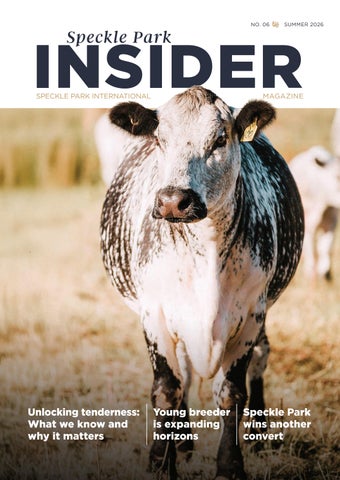
NO. 06
SUMMER 2026
INSIDER Speckle Park
SPECKLE PARK INTERNATIONAL
Unlocking tenderness: What we know and why it matters
MAGAZINE
Young breeder is expanding horizons
Speckle Park wins another convert
rudders.creek.52
strength quality & purpose Rudders Creek Speckle Park for nearly a decade, has forged a herd where power meets purpose.
We breed for premium carcase quality, resilience and real-world performance.
Our cattle thrive, endure and stand out. Every animal is a testament to our passion and an unwavering belief in the breed’s future .
Reach out to arrange a tour of our herd
Rudders Creek
speckle park BELLANGRY NSW 2446 CONTACT TINUS WAGNER
phone / 0416 590 330 email / tinus.wagner@twc.net.au
Quality begins in the paddock!
What’s inside
15
17
31
40 Publisher Speckle Park International Phone +61 2 5732 7166 Email communications@specklepark.org Website SpecklePark.org Editorial team marketing@specklepark.org Design / Advertising SquishCreative.com Front cover Speckle Park’s ability to perform in hard conditions has made a believer out of Wyndham farmer Murray Kennedy. See page 30
04
A vision for the future
06
Breeding Speckles that finish and perform in Australia’s north
08
Turning momentum into action for 2025–26
10
Unlocking tenderness: What we know, what we don’t and why it matters for Speckle Park
13
Strengthening the commercial case for Speckle Park
15
Elevating Speckle Park through quality, data and story
17
A weekend of learning, connection and exceptional eating quality
20
SPI takes the reins
21
Member Survey 2025: Insights, ambitions and a path forward
24
Making your data count by recording the right information at the right time
26
Single-Step BREEDPLAN: What it means for Speckle Park breeders
29
Speckle Park takes small operation forward
30
Speckle Park wins another convert
31
How one young breeder is expanding his Speckle Park horizons
33
Turning passion into purpose: How one young educator is shaping agriculture’s future
36
Performance, practicality and a commitment to quality
38
Eating quality that is easy to finish
40
Cattle Australia the united voice advocating for beef producers
43
Speckle Park Youth is shifting gears
44
Benefits of sexed semen for Australian beef producers
Disclaimer: While all reasonable care is taken, neither Speckle Park International Limited, its Directors, subcommittee members (collectively, ‘SPI’) or those involved in the production of this publication accept any responsibility for any errors or omissions or the contents of material prepared by third parties, SPI reserves right to amend any part of this publication as it sees fit. The views expressed in the contents of this publication are not necessarily the views of SPI. SPI expressly disclaims liability for any loss or damage sustained by any person as a result of or in connection with, the information contained in this publication, including any errors or omissions.
SUMMER 2026
3
A vision for the future Chairman report
As Chairman of Speckle Park
Seasonal conditions have improved
International (SPI), I am honoured to
across the southern regions, positively
have been re‑elected to the board for
influencing demand in all sectors, with
another three years. This opportunity
many members reporting stronger bull
allows me to continue working alongside our members and industry partners to strengthen the future of Speckle Park cattle. The next phase of growth presents
sales. As we enter the early part of 2026, demand for Australian beef is forecast
united community. Our vision is clear: to strategically position Speckle Park as a premium beef. This means identifying and promoting the key attributes that define the eating
to rise, driven by several contributing
experience—tenderness, flavour, and
factors. While increased cattle prices and
consistency—while fostering long‑term
heightened demand present encouraging
relationships across the entire value
many exciting opportunities, and I am
prospects, they also reinforce the
supply chain. By doing so, we ensure that
confident that together we can capitalise
importance of maintaining our momentum
Speckle Park beef continues to stand out
on them.
and continuing to push forward as a
in domestic and international markets.
Welcoming new board members This year, we are delighted to welcome new board members who bring exceptional expertise and passion to SPI:
4
JUSTIN DICKENS JAD Speckle Park
MICHAEL HASTINGS Whiteline Speckle Park
JASON BUTT Victory Cattle Co
Justin joins us with extensive knowledge of the beef industry, managing both large commercial and stud operations. His herd has achieved a 5‑star BREEDPLAN Completeness of
Michael brings a wealth of organisational development and administration experience. His herd also holds a 5‑star BREEDPLAN Completeness of Performance rating, and his skills will strengthen SPI’s governance and operational capacity.
Jason has been nominated for a board position after serving in a casual vacancy. His contributions as company secretary and board liaison to the Organisational Development Committee have already demonstrated the value of his skill set to SPI.
SPECKLE PARK INSIDER
Continuing board members Alongside our new members, we are fortunate to continue
Recently, the Extension subcommittee undertook a deep dive into
benefiting from the experience and commitment of Tim Weller,
the available Tenderness gene markers. As a result, over 1,200
Brooke Paff, Tim Bell and Mark Tiller. Their ongoing contributions
animals from 32 members have been gathered to retest for these
provide stability and depth to the board as we move forward.
markers. Neogen has now included the Igenity test of tenderness scores and genetic alleles within the SPI DNA registration bundle.
Office bearers and subcommittee leadership Office bearer positions remain unchanged, ensuring continuity in leadership: Vaughn Johnston, Chairman Tim Weller, Vice Chairman Jason Butt, Secretary Brooke Paff, Treasurer Board liaisons to SPI’s subcommittees are as follows: Organisational Development – Jason Butt
This initiative is a powerful example of connected collaboration across the Speckle Park community, giving us an invaluable opportunity to better understand the relationship between traits and genes. Equally important is our collective effort to build momentum in the supply chain. By championing success stories for Speckle Park in the commercial sector and by educating ourselves on the exceptional eating experience our breed delivers, we can ensure we use the correct terminology to communicate this value to chefs and processors. These actions highlight the strength of collaboration and the shared vision that drives our community forward.
Breed Development – Tim Weller
“As we reflect on another year of progress, it is clear that our
Marketing & Communication – Justin Dickens
strength lies in the unity of our community. Speckle Park breeders
Extension & Environmental – Michael Hastings
and enthusiasts across the globe continue to share knowledge,
Youth – Brooke Paff
genetics and passion, ensuring that our breed not only thrives but
Connected collaboration There are a number of new initiatives on the horizon aimed at elevating Speckle Park as a breed backed by data, science, and beef excellence. The Commercial Register has been a core focus for some time and we are pleased to be in a position to launch it in the near future (see page 13 for more information). This initiative will allow us to collect extensive data across multiple applications from research to commercial opportunities while increasing the accuracy of BREEDPLAN EBVs at a faster rate than originally forecasted. Tenderness research has already provided valuable insights into the eating qualities of Speckle Park, yet it is only scratching the surface of what is possible. These initiatives flow directly into the Signature Speckle Park Beef Challenge, which will take a whole
sets new benchmarks in quality and innovation. Together, we are building a legacy that will inspire generations to come.” In recent months, we have successfully transitioned to delivering all services in‑house, with Heather Apps continuing in her role as Member Services Officer and the addition of Maddie Brockhoff as Member Services Registrar. This expansion provides SPI with greater scope to ensure services remain efficient for members while enabling new opportunities to progress seamlessly. Our strengthened relationships with industry partners have further positioned SPI to make meaningful contributions to future research and development projects. I look forward to working with my fellow board members and the wider Speckle Park community as we continue to build a strong, sustainable future. The opportunities ahead are significant and with clarity of vision and commitment to excellence, Speckle Park International will thrive.
new approach to identifying the best Speckle Park beef (see page 15 for more information). By leveraging relationships with chefs, processors and industry partners, SPI will unlock new marketing opportunities and showcase the breed’s excellence in premium beef production.
Vaughn Johnston Chairperson, Speckle Park International
FROM THE CHAIRMAN | SUMMER 2026
5
Breeding Speckles that finish and perform in Australia’s north Perched above the deep red soils overlooking Lake Tinaroo, Beki Speckle Park Stud has grown into one of Far North Queenslands most determined and quietly influential programs. For owners Bill and Anne, the journey began far from their Tablelands home at Beef Australia 2018, where the Speckle Park breed first caught their eye.
The width, depth and overall presence of the cattle on display stood out and sparked a deeper interest in the breed. That curiosity soon turned into conviction. After moving to the Atherton Tablelands in 2019, Bill and Anne set out to find a bull that would cross well over Brahman infused herds and produce calves capable of finishing early in a tropical environment. In Speckle Park, they found a breed that exceeded expectations for both performance and potential. Their breeding philosophy is simple and underpins every decision they make. It’s the carcase that counts. Beki now runs across two neighbouring properties overlooking Lake Tinaroo, an area known for deep basalt soils, cropping versatility and high intensity grazing, as well as dry winters, wet summers, humidity, parasites and the constant pressure of tropical ticks. These conditions have shaped the type of cattle Bill and Anne aim to breed. Selection focuses on sleeker coats, dark skin under a light hide, sound temperament and early finishing ability, with cattle that can thrive rather than merely survive from August through to December. Genetic decisions are driven by the environment, with a strong
6
SPECKLE PARK INSIDER
Beki Speckle Park owners, Bill and Anne
emphasis on breeding bulls that lift the performance of Brahman and Brahmaninfused herds. If cattle can succeed in Far North Queensland, they can influence herds anywhere.
program itself. Each drop of heifers is closely scrutinised, as they represent the future direction of the stud. Beki does not participate in showing, choosing instead to focus on commercial
Like many emerging studs, Beki faced the challenge of proving their cattle in a competitive market. That validation came earlier this year when a couple operating a small abattoir north of Katherine in the Northern Territory made contact looking for bulls capable of producing domestic trade cattle at 460kg live. Their existing Senepol Brahman herd was not finishing early enough.
relevance. Each August, the gates are
They purchased every bull Beki had available and also selected several younger early maturing bulls to fill the truck. The result reinforced confidence in the program and confirmed that the cattle were meeting a genuine commercial need.
to high ethical standards. Females that
From the outset, genetic progress has been deliberate. Embryo transfer and AI were used extensively to build numbers and accelerate improvement from a modest foundation of purchased females. As the herd developed, the focus shifted to refinement. This year, select bloodlines were sold during the Tablelands Better Beef Open Days, allowing reinvestment into new females sourced from Hot Spot, Hillview and Alinjarra, which will be AI joined in the New Year.
reliably under commercial conditions and
With a relatively shallow gene pool across the breed, careful mating decisions are essential. The Mating Predictor is used to manage inbreeding, and AI programs are backed up with high quality natural service bulls to ensure every calf has the best possible chance to perform. A key milestone came with the first ET bred heifers calving to a bull bred within the
opened for the Tablelands Better Beef Open Days, with Facebook used to maintain contact with people who enquire, visit or inspect cattle privately. What consistently draws interest is the Far North Queensland born and tested approach. Buyers are looking for cattle raised in the same conditions they will work in, fully vaccinated, acclimatised and managed would not be retained within the herd are not sold as breeders and instead go directly to the meat works. Bulls are given time to adjust, with the expectation that after two years they should perform produce a quality calf every year. While Beki is now a recognised name in the region, the stud began as a semi retirement project. For more than six years, one or both of Bill and Anne worked casually off farm to support their growing investment in Speckle Park cattle. Only recently have the rewards of that commitment become visible. They are also quick to challenge assumptions about running Speckles in tropical environments. Ticks, flies and humidity are part of life in Far North Queensland, and cattle are managed accordingly. Most of the year they thrive, though January can be particularly tough on young calves or newly introduced stock. Health management is practical and preventative. Vaccination follows Immune
Ready standards, including protection against tick fever, Bovine Ephemeral Fever and Theileria. Experience has shown the cost of prevention is far outweighed by avoiding lost production or mortality, particularly as it is often the biggest and best animals that suffer most in unvaccinated herds. Temperament remains one of the most valued traits in the herd. From the beginning, Bill and Anne noticed how responsive their Speckles were, particularly around calving. Cows communicate clearly when something is wrong, whether a calf has strayed into the wrong paddock or assistance is needed during a difficult birth. While misrepresentations and breech calvings are the hardest moments, the rewards far outweigh the challenges.
North Queensland, the advice is frank. It is not for the faint hearted. Disease pressure, parasites and environmental extremes demand discipline and decisiveness. Early and consistent culling is essential, as is learning from others and avoiding insular thinking. That mindset, grounded, open and driven by quality, defines
Calving and weaning remain the highlights each year. Watching heifers raised within the program go on to produce calves of their own reinforces the long term focus of the operation.
Beki Speckle Park Stud. For Bill and Anne, breeding is not
For those considering starting a Speckle Park stud in Far
matters most. After all, it’s the carcase that counts.
about chasing trends or producing catalogue appeal. It is about building a herd that genuinely improves the cattle around it, stands up to the Tablelands environment and delivers where it
MPC PLUNDERER P196
Winners of RNA Paddock to Plate Carcase Awards every year 2016 to 2021, 2023. 2nd 2025 Purebred Herd of 160 Breeding Cows 14 Years of Breedplan Performance Recording Bulls & Heifers for Sale each Year Sales in May & September
BETTER CARCASES BETTER YIELDS FOR BETTER PROFITS
Minnamurra Speckle Park “Mount Mill”, 1170 Coolah Creek Rd, Coolah. NSW Dennis Power 0427 734 254 | www.minnamurra.com.au
BREEDER SPOTLIGHT | SUMMER 2026
7
Turning momentum into action for 2025–26
After a year of laying strong foundations, SPI’s subcommittees are now shifting from planning to delivery. The work reported at the AGM, together with insights from the recent Member Survey, has given SPI clear direction and confidence to move forward. With priorities now sharpened and momentum building, each subcommittee is focused on practical outcomes that strengthen the breed, the organisation and the member experience.
Breed Development subcommittee This subcommittee is progressing key projects that support informed and future focused breeding decisions. Finalising structural soundness guidelines and continuing development of the Commercial Register remain major priorities. Increased focus is also being placed on tenderness and carcase related traits, ensuring SPI continues to build robust evidence around eating quality. As outcomes from Gonadal Hypoplasia research become available, they will be integrated into breed improvement frameworks.
Extension and Environment subcommittee Education and applied learning remain central to the year ahead. New resources are being developed covering bull longevity, structural assessment and data recording, alongside broader training and extension materials. Tenderness and eating quality continue to underpin several projects, supported by ongoing research partnerships. Additional support for MateSel will assist breeders to plan balanced and sustainable matings, while industry collaboration remains a strong focus.
Marketing and Communications subcommittee Visibility, engagement and industry positioning are key priorities. Preparations for BEEF2027 are now underway, with the aim of delivering a polished and commercially relevant representation of the breed. The Speckle Park Insider magazine is transitioning to seasonal editions with a stronger industry focus. Communications continue to highlight Speckle Park’s strengths, particularly efficiency, carcase quality and eating quality, to both stud and commercial audiences.
Youth subcommittee The Youth subcommittee is developing meaningful and industry aligned opportunities for young people. Planning is progressing for the 2027 Speckle Park Youth Experience, a multi day event designed to connect genetics, production and processing in a practical and engaging way. In the lead up, the committee is supporting smaller learning activities and broader youth engagement. The Youth Canada Scholarship continues to expand, providing valuable international exposure and leadership development for emerging breeders.
Organisational subcommittee This subcommittee is focused on governance clarity and organisational alignment. Current work includes reviewing SPI’s Strategic Plan, Operational Plan, Constitution and Rules and Regulations. The goal is to ensure SPI remains contemporary, efficient and well structured, supporting strong decision making and coordinated delivery across all subcommittees.
8
SPECKLE PARK INSIDER
5th - 6th - 7th JUNE
Lindsay’s gap Road Garoo - 45km SOUTH OF TAMWORTH NSW
festival, forum and sale Proudly brought to you by Wattle Grove Cattle Co. • Free camping • Farm tours • Industry leading speakers & demonstrations • Marketing & selling seminar • Private treaty sale-Bulls, females, & genetics • Cattle Accreditation demos • Beef Tastings • Bonfire and Beef feast • Live Music
A 3 DAY EVENT JAM PACKED WITH SPECKLE PARK FESTIVITIES GREAT CATTLE - GREAT PEOPLE - GOOD TIMES For more information stay tuned to our socials & subscribe to our newsletter Dale: 0429 360 419 Bin: 0421 524 856 wattlegrovespecklepark.com.au
Unlocking tenderness: What we know, what we don’t and why it matters for Speckle Park Words by Lachy Woodcock SPI Extension Subcommittee
Lachy Woodcock
Tenderness has become one of the most talked about topics in the beef world and for good reason. It is one of the first qualities a consumer notices when they sit down to eat a steak. When the beef is tender, the experience is memorable for all the right reasons. When it is not, the eating experience falls flat.
Speckle Park breeders have long believed the breed delivers standout eating quality. Recent research, growing interest from processors and renewed focus across industry programs are bringing tenderness into sharper focus. The SPI Extension Subcommittee has been exploring where the science currently sits and what opportunities exist for the breed. While not every question has an answer yet, strong progress is being made. This article summarises the current knowledge and the work underway.
Why tenderness matters Tenderness describes how easily cooked beef is to bite and chew. It is measured post slaughter using the Warner Bratzler shear force test. A small sample of meat is cooked, then sliced with a controlled blade, and the force required to cut through the meat is recorded. The lower the force, the more tender the meat. The challenge is that shear force testing is destructive and can only be carried out once the animal has been slaughtered. That is where genetics comes in. If genetic markers linked to
POST-MORTEM TENDERNESS
TIMER 0 - 24 hours Rigor mortis sets in
TIMER 24 - 72 hours Calpain enzyme activated: proteins broken down Calpastatin is activated: inhibits calpain activity.
TIMER 3 - 21 days Carcase is hung: gravity stretches muscles, connective tissue softens Calpain enzyme breakdown declines.
Figure 1 CARET-RIGHT Simplified overview of the structural protein breakdown that occurs with the calpain-calpastatin system post slaughter
Different breeds or individuals produce different levels of calpain and calpastatin due to genetic variation.
10
SPECKLE PARK INSIDER
tenderness can be identified, tenderness
is to slow or block the calpain process,
in the calpastatin gene. Together, these
can be predicted in live animals, allowing
which usually results in tougher meat.
markers produce a score from one to ten,
breeders to make earlier and more informed selection decisions.
Animals differ in their natural levels of
with ten indicating the most tender result.
these enzymes, and these differences
Importantly, these markers are already
Tenderness is influenced by a range of
are genetically controlled. Tenderness is
included in both the 50K and 100K SNP
factors including breed, age, nutrition,
a polygenic trait, meaning many genes
genomic panels. This means all newly
handling and post slaughter processing.
influence the outcome. Early genetic
registered animals automatically receive
Genetics also play a significant role. The
research focused on mutations within
a tenderness score and genotype as part
trait has moderate heritability, meaning
the calpain and calpastatin genes
of routine DNA testing, at no additional
selective breeding can make real progress
because of their clear involvement in
cost. Tenderness results now display
over time.
post slaughter protein breakdown. These
within the SPII system for any animal
After slaughter, muscle stops receiving
markers formed the basis of the first
that has been tested.
oxygen, fibres tighten and the carcase
commercial tenderness tests released in
enters rigor mortis. As the meat ages,
the early 2000s.
Understanding the scores
The tests available and how they work
The Neogen Igenity TenderGENE test
Calpains are natural enzymes activated by
Two main commercial tests emerged from
beef naturally tenderises after slaughter.
calcium released from muscle cells after
that early research. GeneSTAR Tenderness
The test examines one marker in the
slaughter. They loosen the connections
and the Neogen Igenity TenderGENE test.
calpastatin gene and two in the calpain
between muscle fibres during ageing. In
SPI members currently have access to the
gene.
general, greater calpain activity results in
Neogen test.
it gradually becomes tender again. This process is largely driven by the balance between two enzyme systems that break down structural muscle proteins.
more tender beef. Calpastatin is the natural inhibitor. Its role
provides a score from one to ten based on three DNA markers that influence how
Calpain enzymes break down muscle
The Igenity test evaluates three specific
proteins during ageing, increasing
markers, two in the calpain gene and one
tenderness, while calpastatin slows this
Neogen Ingenity TenderGENE Test Example of three animals showing various combinations of SNPs at UoG-CASTl, CAPN316, CAPN4571 and the associated tenderness score. Data is from the validation study which used 1209 cattle from four sample populations (Brangus, Charolais x Angus cross, Red Angus and Brahman).
Figure 2 CARET-RIGHT
The combined genotype from the three sites produce a tenderness score from 1 - 10.
WORKSHOP UPDATE | SUMMER 2026
11
process and generally results in tougher meat. The score
sufficient data, the breed could develop its own research
alone, however, does not tell the full story. The genotype
breeding value for shear force or support the creation of a
becomes the critical piece of information when planning
more advanced breed specific tenderness test as genomic
matings.
tools evolve.
Animals with genotypes that increase calpain activity or reduce calpastatin activity receive higher tenderness scores. For example, animals with the most favourable genetic combination score a ten, while those with the least
Where to next for SPI The priority now is data. Building a large and representative
favourable combinations score a one.
dataset is essential to understand the current tenderness
There are 27 possible marker combinations but only ten
profile of the breed and how Speckle Park compares with
tenderness scores. This is why genotype matters. Different
other populations.
combinations can produce the same score but behave differently when mated. A low tenderness score does not mean an animal should be removed from a breeding program. Instead, it highlights where strategic mating can
SPI has recently circulated an expression of interest inviting breeders to submit animals for tenderness genotype analysis. This dataset will underpin validation work and help answer
be used to improve tenderness over generations. With the
the most important questions about how tenderness
right decisions, a line can move from a score of one to a ten
genetics can be used effectively within the breed.
within two generations.
The next phase of work will focus on determining whether
Tenderness does not replace EBVs or structural soundness.
the current test correlates with measured meat tenderness
It adds another layer of insight to support balanced and
in Speckle Park cattle, how score and genotype distributions
informed selection decisions.
compare with other breeds, and whether additional SNPs may be more relevant or accurate for Speckle Park. The
Breed differences and validation The original tenderness test was validated primarily on Bos Taurus and Bos indicus influenced populations, including Angus, Red Angus, Brangus, Charolais cross and Brahman
team is also considering options to validate results, including targeted shear force trials to ground truth the data. A key commercial question remains. If processors are not yet paying directly for tenderness, does improving it still matter?
cattle. Speckle Park cattle were not included in this
What we do know is that Speckle Park is recognised for its
reference group.
eating quality. If tenderness can be understood, selected
This matters because breed differences are significant. Brahman cattle, for example, naturally carry more
for and proven, it becomes one of the breed’s strongest commercial value propositions. A consistent tender eating
unfavourable tenderness alleles, which aligns with their
experience builds consumer trust, supports branded beef
tougher eating quality. These differences are also linked
programs and lifts the value of Speckle Park genetics in both
to adaptation. Tropical cattle may have evolved higher
domestic and global grass and grain fed markets.
calpastatin activity because it reduces metabolic heat load, which is advantageous in hot climates.
Tenderness is not the only component of eating quality, but it is a major one. As genomic tools continue to evolve, the
Understanding how Speckle Park fits into this picture
work underway now positions the breed ahead of the curve
is central to the next phase of work. The breed’s strong
and gives breeders greater confidence in long term selection
relationship to Angus provides confidence, but breed specific
decisions. This is an exciting space for Speckle Park. The
data is required to validate how accurately the current
journey is only beginning, and the data contributed today
markers predict tenderness in Speckle Park cattle.
will shape the breed’s eating quality credentials and market
Other breeds have explored tenderness as a marketing and
position for years to come.
selection tool. Red Angus and Belted Galloway have used distribution charts to highlight their average tenderness advantage. Angus Australia has progressed further, developing a research breeding value for shear force that genomic correlations continue to be refined.
Catch Lachy’s full presentation from the 2025 Speckle Park Internationals Workshop on our website:
For Speckle Park, this points to a future opportunity. With
specklepark.org > Member Resources > Video Library
combines shear force data, pedigree and genomics, although
12
SPECKLE PARK INSIDER
Strengthening the commercial case for Speckle Park
Words by Tim Weller SPI Vice Chairman/Breed Development Subcommittee Chair
In an era where verification, traceability and measurable performance are reshaping the beef industry, Speckle Park breeders are doubling down on objective data. As W Edwards Deming famously said, “Without data, you’re just another
Members indicated
83%
support developing research towards genomic breeding values for fat melting point.
new pathways for research and branded programs.
84%
support working towards adaption of an eating quality/tenderness genetic tool .
Speckle Park cattle have built a reputation for early maturity,
71-79%
person with an opinion.” This thinking sits at the heart of Speckle Park Internationals (SPI) next major step, the development of a Commercial Register. It’s a tool designed to strengthen genetic evaluation, increase market value and create
sustainable production and an ability to finish efficiently on
support the development of new EBVs, including Structure, Calving Ease, Frame Score, Docility and Tenderness point.
either grain or grass. Fertility, docility and moderate mature cow weights further support ease of management and adaptability across environments.
79%
support developing a test for identifying GH carriers.
Eating quality remains one of Speckle Park’s biggest advantages. Data from the SPI Technical Committee and recent JAD-driven research have reinforced the breed’s advantage, which many of us have seen in the chiller, favourable fat melting point and omega-3 composition that helps set the breed apart.
Across all categories, members showed clear alignment: the future of Speckle Park is driven by data, transparency and scientifically validated performance.
The Speckle Park Commercial Register (SPC) was presented for the first time at the SPI Workshop held in Melbourne. A video recording of the session is now available on the SPI website for members wanting to review the details in their own time.
A strong foundation , but more data is needed. The breed’s investment in genomic technology has been steady and strategic. Speckle Park EBVs were first released in 2018;
Breeders want more data, better tools and clear direction In the 2025 SPI Member Survey, members told us there is a
by 2023, BREEDPLAN’s Single-Step genomic system was incorporated, with Breed Indexes followed in 2024. Today, more than 23,000 animals carry 100K SNP genomic profiles.
strong appetite for deeper genetic insight. Breeders want more
However, like any evolving breed, EBV accuracy hinges on both
accuracy, more transparency and more investment in traits that
the volume and consistency of data submitted. At present around
matter commercially.
80 percent of calves are recorded for Birth Weight EBV, while
WORKSHOP UPDATE
| SUMMER 2026
13
EBV accuracy
80%
of calves recorded for Birth Weight EBV
28-35% <10% <1%
The Commercial Register: A strategic next step
have 200/400/600-Day Weight and Scanning Traits.
have Mature Cow Weight or Docility.
Net Feed Intake or carcase traits
The Speckle Park Commercial Register (SPC), set to be released in early 2026, is designed to close data gaps, provide pedigree validation and create value for commercial producers using Speckle Park genetics. It complements the Purebred Register (SPP), providing a structured home for Speckle-Park-infused cattle. Many breeds have taken this step already, including Angus, Wagyu, Shorthorn, Brangus and Limousin. Why? The reason is simple: commercial cattle are where scale and proof come from. For Speckle Park, the Commercial Register is about supporting the whole breeder community, not just seedstock herds. Under the SPC rules: A registered SPP Speckle Park sire or dam is required. Basic animal information (PIC, EID/NLIS, DOB, non-SPP breed content and raw data) is submitted. DNA is optional, but SPI may request the right to run parent verification. Males are only allowed in the SPC once a castration date has been recorded. Animals can transfer between registers (all SPI rules and regulations apply), allowing complete data collection across the herd.
» » »
only 28 to 35 percent have 200, 400 or 600 Day weights or scanning traits recorded. Fewer than 10 percent of animals have Mature Cow Weight or Docility data and less than 1 percent have Net Feed Intake or carcase traits captured.
The message is clear, we need more data around the traits we believe make Speckle Park stand out from the rest and drive the breed even further forward in those areas. Increased commercial data is central to lifting accuracy, especially for traits that influence eating quality, sustainability and profitability.
» »
The Commercial Register is not merely administrative— it’s a gateway to more accurate EBVs, expanded research opportunities, Crossbred analysis and future premium branded beef programs incorporating SPI-approved ear tags and traceability frameworks that build confidence throughout the supply chain. It can drive stronger demand for Speckle Park bulls as commercial producers recognise the power of proven, genetically recorded seedstock.
A data-driven future Everything points in the same direction. Survey responses, growing research investment, EBV enhancements and the development of the Commercial Register all tell the same story. Speckle Park breeders want more data, more accuracy and more tools to validate what we as Speckle Park breeders already know: this is the breed with exceptional eating quality, adaptability and commercial relevance. By aligning producers, researchers and technology providers, SPI is positioning itself ahead of the curve, strengthening the foundation for long term genetic improvement and unlocking new opportunities in both domestic and global beef markets. The Commercial Register is a practical step forward , helping breeders back their cattle with the data, confidence and visibility the modern beef industry expects.
Watch the full presentation from the 2025 Speckle Park Internationals Workshop on our website: specklepark.org > Member Resources > Video Library
14
SPECKLE PARK INSIDER
Image courtesy of the KickOn Group
Elevating Speckle Park through quality, data and story
Words by Vaughn Johnston
The global beef industry is changing rapidly.
eating quality. What the industry increasingly
SPI Chairman
Consumers are asking more informed
demands, however, is independent verification,
questions about where their food comes
data that supports these strengths and a clear
from, how it performs on the plate and how
story that connects paddock performance with
its production stacks up across sustainability,
consumer experience.
efficiency and integrity.
That is where the Speckle Park Signature Beef Challenge represents a timely opportunity for
As an association, Speckle Park International
our breed and our members.
must continue to evolve to ensure our members
This initiative is being developed as an
are not only well positioned to meet these
independently judged beef competition designed
expectations but to lead them.
to showcase eating quality, tenderness and
Our breed has never lacked quality. Across Australia and internationally, Speckle Park cattle consistently demonstrate strong carcase performance, early finishing ability and excellent
“ Speckle Park has always delivered quality. Our challenge now is to measure it, prove it and tell that story with confidence right through the supply chain placing Speckle Park where it belongs: on white tablecloth restaurant menus as a luxury eating experience.”
flavour across different feeding and production systems. Speckle Park International’s role is to provide a credible and transparent platform that treats all members fairly while collecting meaningful and comparable data to support future decision making. Beyond the competition itself, this initiative invites Speckle Park International and its members to embark on a journey of discovery, educating ourselves on how best to explain the Speckle Park eating experience. That includes understanding its mouthfeel, flavour profile and the cooking methods that allow it to perform at its best. This shared learning strengthens not only how we market Speckle Park beef but how confidently we speak about it with processors, chefs and consumers. Across Australia, branded beef competitions have
WORKSHOP UPDATE | SUMMER 2026
15
demonstrated the value of this approach.
optional MSA results supports long term
Programs run by breed societies and
genetic improvement. Combined with
major agricultural shows highlight how
sensory evaluation of tenderness, flavour
objective measurement and blind sensory
and juiciness, this information strengthens
evaluation can deliver value well beyond
our ability to position Speckle Park as a
the showring. They create benchmarks,
premium and efficient beef breed backed
strengthen industry relationships and
by evidence.
build confidence among processors, chefs, retailers and consumers.
access that benefit all members. Looking ahead, our aim is to work toward launching Australia’s first Speckle Park specific beef competition in 2026, underpinned by strong governance, food safety compliance and industry engagement. This will require
Equally important is the story this creates.
collaboration across the supply chain and
While other breeds have established
the Board is committed to progressing the
For Speckle Park producers, the benefits
premium narratives, Speckle Park has
concept transparently and responsibly.
are clear. A competition of this nature
its own to tell, one built on efficiency,
Doing nothing is, in itself, a risk. Other
provides valuable paddock to plate
versatility, early finishing and consistent
breeds are investing heavily in data driven
insight that helps inform breeding and
eating quality across both grain fed and
promotion and market positioning. If
production decisions. It allows us to better
grass fed systems. The Signature Beef
Speckle Park is to continue growing its
understand which traits influence eating
Challenge provides a platform to tell that
influence and commercial relevance, we
quality and profitability and how different
story clearly, consistently and credibly.
must be proactive in how we measure,
As Chairman, I want to emphasise that
present and promote our strengths.
this initiative is about advancing the breed
The Speckle Park Signature Beef Challenge
as a whole. Speckle Park International will
has the potential to become a cornerstone
remain breed focused and commercially
of breed promotion, connecting science,
neutral. Our objective is not to replace
story and eating quality in a way that
From a breed development perspective,
or compete with existing programs but
delivers real value for members today
the data collected including carcase
to create opportunities for recognition,
while positioning the breed strongly for
measurements, feeding information and
benchmarking, collaboration and market
the future.
systems affect performance. Participants would receive anonymised feedback, giving them a clearer picture of how their cattle compare within the broader industry.
16
SPECKLE PARK INSIDER
AGM 2025 member events
A weekend of learning, connection and exceptional eating quality The 2025 SPI AGM Member Events delivered far more than a formal meeting. Across two carefully curated days, members experienced Speckle Park from paddock to plate, exploring genetics, performance data, commercial outcomes and ultimately the eating quality that continues to set the breed apart.
Saturday 22 November
On farm learning: Data, discovery and commercial insight The weekend began with farm visits at Whiteline Speckle Park and HTR Speckle Park and Meade Agri, giving members the opportunity to see breeding programs and genetic decisions in action, and to connect those decisions back to commercial outcomes. At HTR Speckle Park and Meade Agri, members gathered for two in depth Net Feed Intake demonstrations delivered by Paul. The sessions focused on how NFI can be used as a practical tool to identify more efficient and profitable cattle. Members also viewed the Wagyu NFI trial currently underway, sparking discussion around efficiency, feed
From on farm learning to a standout food service experience and a deep dive into genomic technology, the weekend reflected the breadth of the Speckle Park community and the shared commitment to data, collaboration and continual improvement.
costs and long term herd improvement. The conversations were technical but grounded, centring on how performance data can be realistically integrated into breeding programs without losing sight of commercial realities. For many, the value was in seeing the data applied in a working system rather than discussed in isolation. The next stop at Whiteline Speckle Park shifted the lens to cattle bred and raised under commercial conditions. Members, agents, local producers and supply chain partners walked through the herd together, comparing progeny groups and discussing type, structure and overall performance. A light hearted element was added with a prize draw where attendees selected their favourite animals, encouraging close observation and open discussion. The atmosphere throughout the day was collaborative and forward looking, with a shared focus on improving productivity and strengthening the commercial case for Speckle Park genetics.
WORKSHOP UPDATE
| SUMMER 2026
17
A celebration of Speckle Park Dinner at The Doutta Galla
Saturday evening brought the group together for a Welcome Dinner at the newly opened Doutta Galla Hotel, part of the KickOn Group. What unfolded was far more than a formal meal. It was a confident statement about where Speckle Park sits in the modern beef landscape. Executive Chef Jake Furst and his team delivered an eight course menu built around Speckle Park beef supplied by Speckle Park Certified and Benbullen Speckle Park Meats. The room was filled with breeders, commercial producers and industry partners including Neogen, Greenham and Breedr, all sharing a relaxed but unmistakably purposeful dining experience. Rather than focusing on a single hero cut, the menu showcased the breed across a wide range of styles and applications. From raw preparations that highlighted texture, through slow cooked and braised dishes, to dry aged steaks and a final slider that let the natural fat profile shine, the progression told a clear story. This was beef that performs across techniques, cuisines and levels of complexity. For many in the room, this was Speckle Park as it is meant to be seen. A dependable, premium beef that performs across styles and settings, proving it belongs on white tablecloth menus without losing its connection to commercial production. Jake spoke during dinner sharing how he first encountered Speckle Park beef. What began with what he described as a random phone call from a very enthusiastic Paul Guy quickly escalated into whole carcases arriving at Cinder, dry ageing trials and eventually a Landline feature that sold out three months’ worth of beef in just fourteen days.
“ A great grass fed piece of meat that consistently eats this well is rare. When the product is this good, we want to push ourselves to do it justice,” Jake told the room. He spoke about Speckle Park’s strong performance in dry ageing and its growing appeal in food service. The opportunity, he said, lies in producers continuing to tell the Speckle Park story with confidence and consistency, backing quality with clarity.
18
SPECKLE PARK INSIDER
Sunday 23 November
Neogen Workshop: Genetics in focus Sunday shifted the focus from paddock and plate to genetics and technology, with a dedicated workshop hosted by Neogen Australasia. The session provided members with a practical introduction to modern genomic tools and how they can support smarter breeding decisions. Topics covered included parentage verification and genomic accuracy, genetic condition testing, meat quality traits such as tenderness, and how genomic information complements BREEDPLAN performance data. The workshop also explored how genomics can help improve herd consistency and long term profitability. The strength of the session lay in its clarity and relevance. Members valued the real world examples and the opportunity to ask questions specific to their own herds and breeding objectives. The discussion reinforced that while phenotype and performance remain critical, genomic insight is increasingly an essential part of informed decision making.
Looking Ahead
As Chairman Vaughn Johnston reflected, the 2025 AGM marked a renewed commitment to SPI’s mission to unite, educate and connect its members. Across two days, breeders engaged with every part of the supply chain, from genetics and data through to processors, chefs and consumers. With engaged collaborators such as Greenham, Breedr, Neogen and the KickOn Group, and with a premium product chefs are eager to champion, Speckle Park continues to build momentum both in the paddock and in the marketplace. The conversations sparked over the weekend made one thing clear. The opportunities ahead for the breed have never looked brighter.
Watch the full presentation from the 2025 Speckle Park Internationals Workshop on our website: specklepark.org > Member Resources > Video Library
WORKSHOP UPDATE | SUMMER 2026
19
SPI takes the reins Bringing services in-house for a stronger future
Maddie Brockhoff, SPI’s Member Services Registrar joined the team in September 2025.
For Speckle Park International, 2025 will be remembered as
back to member
a year of consolidation and confidence. After several years
priorities. All services
of growth, expanding programs and rising expectations from
previously delivered
members, SPI made a deliberate decision to bring all registry
externally are now
and member services fully in house.
handled directly by SPI. This includes animal registrations and transfers, DNA and genetic testing coordination, membership
It is a move that signals maturity. More than an operational change, it reflects an organisation stepping firmly into its next
administration, accounts and finance, breed promotion and communications, and the delivery of events and programs.
phase, with greater control, clearer accountability and a renewed
Bringing these services together under one structure gives SPI
focus on service, transparency and long term sustainability.
greater visibility and control, allowing systems to be refined over
The transition aligns closely with SPI’s Strategic Plan and key operational goals. It has also delivered meaningful cost efficiencies
time and feedback from members to be acted on quickly and consistently.
following the conclusion of the service agreement with PBB in
One of the most noticeable benefits has been stronger
early September, while giving SPI direct oversight of its systems,
relationships across the membership base. Managing services
communications and day to day member interactions.
internally has improved communication, strengthened
The shift to in house management was carefully planned and
accountability and enabled a more responsive approach to
phased to ensure continuity for members. SPI now employs two
member support.
staff directly, supported by a dedicated marketing contractor,
With the transition now complete, SPI is focused firmly on
strengthening internal capability across administration, registry services and communications.
the future. The priority is not simply maintaining services, but building on them, strengthening connections, expanding
Bringing these functions together has simplified how members
programs and supporting the continued development of Speckle
interact with the organisation. Rather than navigating multiple
Park both in Australia and internationally.
service providers, members now deal with a single, consistent SPI team that understands the breed, the rules and the broader strategic direction. From registrations and DNA coordination to accounts, communications and event support, managing services internally
Bringing services in house represents more than an administrative decision. It is a clear statement of intent that reflects SPI’s commitment to its members, its community and the long term success of the breed.
has streamlined processes, improved turnaround times and
Members are encouraged to contact the SPI office directly for all
created a more cohesive experience for members.
registration, membership and general enquiries. Contact details
An important outcome of the transition has been stronger alignment between the SPI office and its member led
and further information are available via the SPI website. specklepark.org
subcommittees. With services now managed internally, the organisation is better placed to support the work of the Breed Development, Extension and Environment, Marketing and Communications, Youth and Organisational subcommittees. The SPI office works closely with committee members to provide practical support, timely information and continuity as projects move from concept to delivery. This closer working relationship ensures initiatives are well coordinated and clearly connected
20
SPECKLE PARK INSIDER
“Member-driven, future-focused. Strengthening breed development and supporting sustainable growth for Speckle Park.”
Member Survey 2025: Insights, ambitions and a path forward Insights, ambitions and honest reflections from members across Australia and New Zealand.
The SPI board wishes to thank the Organisational Development subcommittee members who developed the survey and those members who took the time to complete it. The survey fulfills the commitment made by the board as outlined in the 2024 to 2029 Strategic Plan and provides excellent feedback on members’ thoughts on the breed and the industry. Increasing engagement with our members is key to our success and the success of the breed. The dedication of the members to providing their input, as well as those volunteers acting on the board and its subcommittees, is critical to our success.
Each year, Speckle Park breeders gain a clearer sense of where the breed is heading. As the breed matures, member expectations are rising alongside it. The 2025 Speckle Park Member Survey set out to understand what matters most to members, using a structured series of questions. With 88 responses across a wide range of herd sizes and production systems, the survey offers a clear snapshot of member priorities. It shows a membership focused on integrity, performance and building Speckle Park into a commercially relevant breed for the long term. The following pages break down what the survey revealed about the direction of the breed and the priorities of its members. When this feedback is viewed alongside SPI’s Strategic Plan, it helps guide decisions around future growth, budgeting and how we track progress on key areas such as breed integrity, commercial relevance and genetic advancement.
HERD GROWTH PROJECTIONS A breed in expansion mode Survey responses indicate confidence in continued growth of both stud and commercial cow numbers. While there have been reductions and dispersal sales in recently, members reported an overall expectation of steady, managed expansion. Stud herd projections 2026 - 2027 When asked about stud cow numbers over the next two years most expect to operate in the 11–30 cow range or to progress into higher brackets.
Figure 1 CARET-RIGHT Most respondents expect stud cow numbers to remain in the 11–30 cow range over 2026–2027, with many planning to grow into higher herd size brackets.
less than 10 cows
28%
25 responses
11–30 cows
33%
29 responses
20%
31–50 cows
11%
51-75 cows
18 responses 10 responses
over 151 cows
3%
3 responses (specific: 200, 250, 260)
Other
3%
3 responses
Looking three to five years ahead (2028–2030), more members anticipate moving into the 31–50 and 51–75 cow ranges, reflecting gradual expansion as herds stabilise and breeding programs are refined. These projections are consistent with a breed transitioning from its early foundation phase into a more established, commercially focused stage of development.
SPI UPDATES | SUMMER 2026
21
into a more established, commercially focused stage of development.
Figure 2 - strategic impact: These projections allow SPI to forecast growth in registration activity and membership services. Budget planning for marketing, registry system upgrades, staff resources, and event capacity can now be evidence-based rather than speculative.
Strategic Impact: These projections allow SPI to forecast growth in registration activity and membership services. Budget planning for marketing, registry system upgrades, staff reinforced the BREEDPLAN FOR A resources, and PARTICIPATION event capacity canAPPETITE now be evidence-based ratherWritten thanresponses speculative. Opportunities and more support
COMMERCIAL REGISTER
The survey showed an almost even split
A significant signal
for stud registration, protecting breed
between members who currently submit
One of the strongest signals from
integrity, and ensuring that cattle
not. This isn’t due to a lack of support for
Commercial Register. 40 per cent of
marketplace meet expectations. Feedback
performance recording. Instead, many
respondents indicated they would use
uncertainty about how BREEDPLAN fits
opportunities, tracking commercial
importance of maintaining high standards
data to BREEDPLANParticipation: and those who do the survey was member interest in a representing Speckle Park in the 2. BREEDPLAN Opportunities for Support and Improvement
also highlighted the need to address Themembers survey even split with between who submit performance data saidconfirmed practical factorsan can almost make such a register, a further members 36 per cent misrepresentation of Crossbred cattle and it hard to get started orand stay involved, more information. Members to BREEDPLAN those who wanting do not. Importantly, thisseeis notto aimprove rejection of performance understanding of the breed’s such as smaller herd sizes, time pressures, value in recognising Speckle Park–infused recording, but a reflection of practical constraints. attributes within the wider industry. limited access to weighing facilities and cattle, supporting premium marketing Other detailed comments indicated a
performance buildingherd credibility The most commonly cited barriers includeandsmall size, timeneed pressures, lacktraining of weighing for further member and with agents, processors, and end users. The results point to a strong willingness around how BREEDPLAN operates infrastructure, and uncertainty or delivers value. development, regional meetings, and At a time when commercial relevance is to do more. Members indicated they information Members identified that participation increase with simpler datasharing. submission processes, critical, would the development of a Commercial would be more likely to participate if the Register significant clearer practical training, andrepresents betterademonstration of commercial benefit. processguidance, was simpler, support was easier within their breeding program.
opportunity for the breed.
A COMMUNITY WILLING There is support for BREEDPLAN and performance recording,TObut members TAKE PART are seeking training, straightforward guidance and BREED IMPROVEMENT tools and education that make participation achievable and worthwhile. real-world examples were all highlighted to find and the benefits both on farm
and commercially were clearer. Practical
Research participation and education
as ways to make BREEDPLAN more
A strong call for science-backed tools
accessible. Overall, the message is
Support for objective, science-based
encouraging. Members recognise the value
genetic tools was strong across the survey.
of performance recording and are open
Members expressed clear expectations for
to greater involvement. With the right
continued development in areas such as
support and tools in place, BREEDPLAN
eating quality, feed efficiency, structural
a valuable opportunity to support
has the potential to work for a broader
soundness, calving ease, and docility.
reference populations, trait validation, and
range of Speckle Park breeders.
See Figure 3.
the ongoing development of genetic tools.
22
SPECKLE PARK INSIDER
priorities Almost half of respondents indicated a willingness to assist with SPI research projects or data collection. This represents
Figure 3: Strong support for objective, science-based genetic tools was evident across the survey, with members wanting continued progress in eating quality, feed efficiency, structural soundness, calving ease and docility.
% = Agree/Strongly Agree
100% 90% 80% 70% 60% 50% 40% 30% 20% 10% 0% Tenderness Genetic tool validation tenderness
Feed Efficiency Quant
Structural Calving Ease Frame Score EBVs EBVs EBVs
NFI EBVs
Docility EBVs
Tenderness EBVs
Members demonstrated interest across a wide range of education
engagement supports the ongoing integration of Speckle Park
topics. In many categories, more than 75% of members agreed or
into mainstream industry programs and strengthens the breed’s
strongly agreed they wanted training in:
commercial positioning.
» Herd health & vaccination programs » AI & ET breeding techniques » Feed efficiency evaluation & how it is measured » Understanding genomics & their role in breeding programs » On-farm structural assessment » Scanning processes & timing » Herd nutrition & feed management » Bull evaluation & program » Gate-to-plate case studies & considerations of taking meat from the farm to consumer
» Use of cooperatives to value-add product » Farm practices that impact the eating quality of animals » Quality assurance programs & existing branded programs available to beef producers
» On-farm recording programs
LOOKING AHEAD Turning insights into action The 2025 Member Survey offers a clear, unified message: Speckle Park breeders are ready for the next phase—driven by data, backed by science, and focused on commercial performance. The Board and its committees will use these insights to inform strategic and operational planning, including genetic development, BREEDPLAN support, assessment of a Commercial Register, education programs, and industry engagement. The survey also reinforces the value of ongoing member consultation, and it is intended that this process continue on an annual basis. To every member who shared their thoughts: thank you. Your voices are shaping SPI’s priorities for the coming years. The strength of Speckle Park lies not only in the cattle, but in the
There was also support for collaborating with existing industry
people behind them. This survey shows a membership that is
programs to leverage established expertise and avoid duplication.
passionate, united, and invested in building a breed with longterm commercial credibility, value, and opportunity.
INDUSTRY ENGAGEMENT
Together, through collaboration and foresight, we are building Speckle Park, and the future is bright.
MLA Reference Projects A significant proportion of respondents operate commercial herds and expressed interest in contributing to broader industry
Words by Jason Butt
initiatives, including MLA reference projects. This level of
SPI Secretary and Organisational Development Board Liaison
SPI UPDATES | SUMMER 2026
23
Making your data count by recording the right information at the right time Every animal tells a story from birth right through to maturity and BREEDPLAN helps translate that story into objective, comparable data. But like any good story, timing matters. Recording traits at the recommended stages of the production cycle ensures the system can extract the genetic signals that drive useful, reliable EBVs for Speckle Park breeders.
Across the year, there are several key windows where traits should be recorded. These moments align with what’s already happening in your management program, calving, weaning, joining, scanning, which means that making small tweaks to when you measure can significantly strengthen the reliability of your EBVs. And importantly: you don’t need to record everything. Recording the right traits at the right time has far more impact than trying to measure the world.
The production cycle: when to record what BREEDPLAN recommends performance data be collected at specific biological stages. Think of these as checkpoints in each animal’s development — moments when traits are most heritable, most comparable, and most useful for genetic evaluation. JOINING SETTING UP THE NEXT GENERATION What to record Mating program details AI/ET dates Pregnancy test results Bull breeding soundness Structural scores (if assessed pre-joining)
» » » » »
BIRTH THE FIRST SNAPSHOT What to record Calving date Birth weight Calving difficulty score Recipient dam information (ET)
» » » »
» » » »
BREEDPLAN’s recording resources are available at breedplan.une.edu.au/getting-started/performancerecording-timeline The full trait-by-stage chart can be viewed in the official Performance Recording Timeline.
SPECKLE PARK INSIDER
Why it matters Birth traits feed directly into calving ease, gestation length and early growth EBVs; traits buyers pay attention to and breeders rely on for herd efficiency.
WEANING (AROUND 200 DAYS) WHERE GROWTH AND MATERNAL PERFORMANCE MEET What to record 200-day weight Docility Flight time Mature cow weight (on the dam)
24
Why it matters Joining data underpins fertility assessments and strengthens pedigree accuracy and foundational elements for reliable EBVs.
Why it matters Weaning is one of the most influential check-in points, where a calf’s genetic potential, its dam’s maternal ability and your management system intersect. It is also the ideal time to record Mature Cow Weight (MCW), which plays a significant role in several breed indexes by helping balance growth with longterm efficiency. Recording cow weights at weaning provides BREEDPLAN with a consistent reference point, improving the accuracy of MCW and Milk EBVs. Because heavier cows require more feed to maintain, tracking MCW also allows breeders to monitor the efficiency and environmental impacts of increasing cow size across the herd.
YEARLING (AROUND 400 DAYS) A PRIME MOMENT FOR GROWTH AND EARLY CARCASE INSIGHT What to record 400-Day Weight Scrotal circumference Structural scores Ultrasound scanning (EMA, Fat, IMF)
» » » »
18 MONTHS (AROUND 600 DAYS)
CARCASE INSIGHT BEFORE THE HOOKS
What to record 600-Day Weight Ultrasound scanning: EMA, rib/rump fat, IMF%
Why it matters The 18-month stage offers another opportunity to collect carcase measurements, providing a more mature expression of EMA, fat and IMF. Scanning at 600 days is useful for production systems where animals are grown out longer or where finishing and carcase traits are expected to show later. BREEDPLAN accepts scanning at either the 400-day or 600-day stage, allowing herds to align data collection with their breeding objectives, market specifications and the age at which animals typically express the traits most relevant to their operation.
» »
MATURE COW INFORMATION
THE LONG GAME
What to record Mature cow weight Hip height Body condition score Disposal code
» » » »
A practical example: From birth to scanning. Imagine a calf born 10 September. AT BIRTH: You record weight, calving ease, and dam details. Quick, simple, valuable. LATE MARCH (WEANING): You take 200-day weights, docility scores and dam condition. This submission alone boosts the accuracy of several key EBVs.
Why it matters The yearling stage captures key information about growth rate, early reproductive development and structure. It’s also one of the points where ultrasound scanning can be collected. Some breeders choose to scan at the 400-day weight, particularly if their target market values carcase traits expressed earlier in an animal’s development or if turn-off age is younger. Early scanning helps identify animals with desirable carcase characteristics sooner and supports earlier selection decisions.
Why it matters Understanding cow size, longevity and body condition patterns helps balance growth with efficiency; something every breeder watches closely, regardless of herd size.
Record what matters, when it matters BREEDPLAN does not expect members to collect every trait. What matters most is consistent, well-timed data on the traits that:
» influence your breeding decisions » matter to your clients » reflect your herd goals
» measured consistently across animals
A single trait measured well, at the right time, contributes more than five traits measured inconsistently. SPI members submit data to BREEDPLAN on the 26th
For most herds, the high-impact traits
of every month. Submitting regularly
are Birth Weight, 200-Day and 400-Day
keeps EBVs up to date, avoids bottlenecks
Weights, Scrotal circumference (bulls),
around sale preparation, and ensures
EARLY JULY (YEARLING): Another
Docility and 18-month ultrasound scanning.
growth measure, plus scrotal, scanning
Many breeders choose to layer in extra
and structure — tightening the picture
traits (structure, cow weights, flight time)
of genetic potential.
as herd size or management sophistication
Performance recording isn’t about
JANUARY (18 MONTHS): A 600-day
grows. Timing matters more than volume.
creating extra work; it’s about capturing
weight and a scan for EMA, fat and IMF
BREEDPLAN adjusts for environment, age,
the moments that tell the story of your
give powerful carcase insights.
management and group effects. But the
cattle’s genetic potential. When data is
system can only do that if data is:
collected at the right points, BREEDPLAN
Four well-timed recording points, each overlapping naturally with your management calendar and the calf now has meaningful EBVs that speak to real, measurable performance.
» collected within the recommended age windows
» submitted in useful contemporary groups
the breed’s evaluation reflects current performance.
can turn everyday observations and routine measurements into reliable EBVs that support the long term progress of the Speckle Park breed.
EDUCATION | SUMMER 2026
25
Single-Step BREEDPLAN: What it means for Speckle Park breeders
Single-Step BREEDPLAN has brought big changes to how beef cattle genetics are evaluated. For Speckle Park breeders, this technology means more accurate Estimated Breeding Values (EBVs) and a better base for genetic progress. It’s important to understand what Single-Step is, how it was developed, and what it means for both EBVs and the breed as genomics becomes a bigger part of the evaluation process.
Words by Alastair Rayner ABRI Extension & Engagement Consultant
Bringing in Single-Step BREEDPLAN was a big advance for Speckle Park, putting it on par with other breeds that use this technology. Now, genomic data are fully included in every monthly evaluation, which makes EBVs more accurate and helps breeders get more value from genotyping. Traditional BREEDPLAN evaluations use pedigree, performance, and extra details like birth dates and management groups to compare animals fairly. Single-Step BREEDPLAN adds a fourth part: genomic information. This
Genomic information has been part of Speckle Park BREEDPLAN evaluations since mid-2023, when the breed adopted the Single-Step BREEDPLAN evaluation developed by the Animal Genetics and Breeding Unit (AGBU) and the Agricultural Business Research Institute (ABRI). The Single-Step methodology itself was originally developed by Professor Ignacy Misztal and colleagues in the United States and has since been adapted by AGBU for use within BREEDPLAN. The introduction of Single-Step marked a major advance for the breed, allowing pedigree, performance, and genomic data to be analysed together in each monthly evaluation. Single-Step BREEDPLAN uses software developed by AGBU, which is a partnership between the NSW Department of Primary Industries and the University of New England, with funding from Meat & Livestock Australia. This evaluation brings together pedigree, performance, and genomic information at the same time, which is why it’s called Single-Step. It considers each animal’s real genetic relationship with other genotyped animals, including those in the reference group. The reference group is made up of Speckle Park animals that have both genotype (SNP data) and performance records for important traits. This method covers all traits in the multi-trait model, including birth, growth, fertility, and carcase data. SNP information makes the results more accurate by showing the real genetic links between animals and connecting genotypes to measured performance. One important feature of Single-Step BREEDPLAN is its use of many high-density genotypes recorded by Speckle Park breeders, with strict quality checks to make sure only reliable SNP data are used.
26
SPECKLE PARK INSIDER
means DNA data are now directly combined with pedigree and performance records in one evaluation.
What is Single-Step BREEDPLAN?
Single-Step BREEDPLAN looks at pedigree, performance, and genomic data all together in one evaluation. In practice, this means SNP data from DNA tests are checked along with traditional records, which makes EBVs more accurate. The strength of Single-Step lies in its ability to use actual genetic relationships revealed by genomics rather than relying solely on pedigree assumptions. Under conventional systems, animals are assumed to share fixed proportions of DNA with relatives — 50% with each parent, 25% with each grandparent. In reality, these proportions vary, and genomics identifies whether individuals share more or less DNA with specific ancestors. By incorporating this level of precision, Single-Step ensures EBVs are calculated based on true genetic relationships, thereby improving accuracy and reliability.
How has Single-Step been developed?
Developing Single-Step BREEDPLAN has been a worldwide effort, with Australia leading the way. The first use was in 2017, and now more than a dozen breeds in Australia, New Zealand, the UK, Europe and North America use it. Each version relies on a large group of animals with both genomic and performance data, which connects DNA markers to real trait results. Today, Single-Step is seen as the gold standard for adding DNA to livestock genetic evaluations around the world.
“ Genomics doesn’t replace recording, it reinforces it. The most accurate EBVs come from DNA and performance data working together.”
Speckle Park was able to adopt Single-Step because more animals
EBVs now give a more complete and accurate view of their
were genotyped and there was a lot of trait data for growth,
genetic merit.
carcase, fertility, and maternal performance.
The greatest gains in accuracy occur in animals that have
The October 2025 analysis included 26,109 genotyped animals,
been genotyped but have limited performance information. For
showing both the depth of data and breeders’ strong commitment
example, those too young for trait measurement, or animals
to recording and genotyping.
from embryo transfer programs or small herds where limited
This technology has already made EBVs more accurate, especially for young animals and traits that are hard or expensive to measure directly.
group sizes restrict comparisons. When genomics is incorporated through Single-Step, these animals are evaluated in the context of the wider genotyped population, resulting in greater EBV accuracy than would be possible under traditional systems. Genomic data have greatly improved accuracy, but they don’t
What does Single-Step mean for EBVs?
replace the need for ongoing performance recording. EBVs are
One of the biggest changes with Single-Step is the shift in EBVs
most reliable when both DNA and performance records are
and their accuracy scores. When the first Single-Step results
used, and a strong reference group is still important. Breeders
came out, breeders noticed changes in EBVs. These changes
should keep recording key traits like growth, fertility, and carcase
didn’t mean the animals themselves had changed; instead, the
measures to keep the system strong.
Greenham NEVER EVER Beef Program The cattle program with premiums
The Greenham NEVER EVER Program was established in 2012 to source, certify and promote premium quality natural grass-fed beef from producers across southern Australia. Greenham makes it easy to become an accrediated supplier with support from Greenham buyers and program managers. Financial Premiums
Quick Payment 38 hour guarntee
Program Support
Marketed under premium brands
Marketed and sold around the world under premium brands.
Scan the QR code to contact one of our local cattle buyers today:
100% Australia-owed family business with six generations of trusted experience www.greenham.com.au
EDUCATION | SUMMER 2026
27
Benefits for Speckle Park breeders
Single-Step BREEDPLAN gives breeders clearer insights and more confidence when making selection decisions. Adding DNA data makes the connection between performance and genetic potential stronger, so EBVs better show real genetic differences. This is especially helpful when choosing young animals or comparing bloodlines from different herds, making it easier to find sires and females that will help the herd and improve market results. Single-Step also improves evaluations for small herds and embryo transfer programs, where limited data can make comparisons difficult. By connecting these animals to the larger genotyped population, Single-Step makes sure EBVs are not held back by herd size or management style. At the breed level, using Single-Step puts Speckle Park in line with international best practices. Many top beef breeds around the world now use Single-Step evaluations, and this helps Speckle Park stay competitive and respected in global markets. This is a big advantage for a breed that is growing internationally. For breeders, moving to Single-Step makes recording even more important, not less. Genomic data work best when combined with accurate performance records, since DNA markers only make sense when matched with measured traits. Keeping thorough records helps make sure genomics continue to improve EBV accuracy.
What it means for the breed
At the breed level, Single-Step BREEDPLAN improves both the accuracy and consistency of EBVs for Speckle Park cattle. Adding DNA data means more animals now have EBVs, even those from herds that didn’t record as much before. Over time, having more data builds trust in the evaluation and gives a better base for genetic improvement. As Single-Step keeps improving how genetic merit is measured, some animals may move up or down in EBV rankings. While these changes might be surprising, they show a more accurate picture of real genetic differences and help make sure the best animals are chosen for breeding programs. Single-Step also helps Speckle Park support broader industry goals for productivity and sustainability. By making it easier to measure traits that are expensive or hard to track, like fertility, carcase yield, or efficiency, the breed strengthens its reputation as a data-driven choice that can deliver both performance and profit for commercial producers. Bringing in Single-Step BREEDPLAN was a big step forward for Speckle Park. By combining pedigree, performance, and DNA data in one analysis, it gives EBVs that are more accurate, reliable, and useful for both seedstock and commercial producers. For breeders, this means making better selection decisions sooner, stronger marketing, and faster genetic progress. For the breed, it keeps Speckle Park leading in modern genetic evaluation and well-placed in both local and global markets. Two years after its launch, the main advice for breeders is still clear: keep recording, keep genotyping, and use the better EBV accuracy to guide your choices. This leads to a stronger, data-driven evaluation system that helps every breeder and supports the future of the Speckle Park breed.
28
SPECKLE PARK INSIDER
Speckle Park takes small operation forward Speckle Park fit right into Hawke’s Bay (New Zealand) sheep and beef farmer Rose Haynes’s philosophy of improving production and making direct-tocustomer sales exceptional.
Ms Haynes runs 300 black Merino cross ewes and 70 Shorthorn cross cows across 300 acres at Waihua Station. She recently added a Speckle Park bull to the operation and increased her cow numbers by acquiring SP Red Devon cross cows that were in calf to a Speckle Park bull. Thinking outside the box is key for such a small operation, she said. Ms Haynes calves early, with June-born calves giving her heavy weaners when it’s time to go to the yards. Her weaner bulls recently fetched $1580 for 309kg animals at the Matawhero yards in Gisborne, topping the sale for the best weaner price overall. As Speckle Park cattle are known for their exceptional growth rates, Ms Haynes hopes bringing the genetics into her herd will improve weight gain potential, and give her the option of finishing on farm. Ms Haynes also runs a farm shop and cafe, open to the public
on Sundays. The shop came about when Danish tourists staying at Waihua Station Cottage, her agri-tourism business, asked if they could dine on meat raised on the farm. Their query sparked a new business idea and Ms Haynes developed a website and managed to find kill space. She then had the idea of selling coffee to customers who bought meat at the shop. Next she thought “why not also sell pizzas”, so she imported a pizza oven from Italy. She now delivers farm-raised meat straight to customers, under the Hawke’s Bay Heifer and The Black Sheep brands. Speckle Park fits into her future plan for improving direct-to-customer sales. She chose Speckle Park to improve her herd’s ability to lay down intramuscular fat (IMF) and provide great eating. Organising kills for the farm shop is a big logistical undertaking, with transport, kill space and a butcher to consider. Stock is killed through Progressive Meat Limited in Hawke’s Bay, and picked up by Mat Aries, who owns the Organic Farm Butchery, who preps the meat for Ms Haynes into the cuts she needs. Ms Haynes has 12 to 15 lambs killed at a time, “and a couple of heifers”. She puts only heifers
through the shop, and finishes bull calves or sells them at the yards. Although all her animals are terminal, she will hold exceptional heifers back as replacements. All the mince she makes is spoken for by a local who makes burgers. A lot is sent to Mahia First Stop, with the remainder sold through the shop. Ms Haynes does fresh deliveries straight away, with stock not sold being available for purchase at the shop. She said locals like watching cattle grazing while they dine on farm-raised fare. “It’s a point of difference,” she said. Ms Haynes’s cows are placid, to such an extent that she calls them when it’s time to move, rather than having to muster. “I keep everything really quiet. I can walk through them when they’ve got their young calves on them, nothing’s going to chase me.” Her Speckle Park bull is also placid, never tussling with other bulls he shares a paddock with and allowing her to work in close quarters.
Speckle Park fits our future plans by giving us cattle that finish well and deliver the eating quality our direct-to-customer business relies on.
BREEDER SPOTLIGHT | SUMMER 2026
29
Speckle Park wins another convert Wyndham farmer Murray Kennedy THE ability of Speckle Park to thrive when conditions are tough has made a believer out of Wyndham farmer Murray Kennedy.
“Speckle Park can hold their condition in tougher periods, and are early maturing
but he believes this will change when
when conditions are unfavourable,” he said.
people understand there is a Speckle Park
“We’ve just come through a very wet spring. Kennedy manages 10,000 ewes and almost 1000 cattle between two properties in New Zealand. One is Jedburgh Station, where he is an equity partner with Tim Story, and the other is his own block at Tuturau, which with the help of wife Marcia and father Bruce, he trades 200 cattle and 4000-5000 store lambs, season dependent. Four years ago his conversion to a Speckle Park believer came about by chance. “We were sourcing cattle from Canterbury, mainly Angus or Hereford Angus x. I had space on the truck and was offered a line of Speckle Park x Friesian steers and heifers to make up the unit load.”
The Speckle Park calves’ ability to hold condition over that period was noticeable.” Kennedy said on Jedburgh Station sheep still dominate. However, with the
heavier than my traditional beef breeds when weaned.”
sheep and general increasing costs around
that other breeds in New Zealand can
sheep farming, they are considering a
boast, it is critical that farmers interested
switch to more beef than sheep. Murray
in Speckle Park get a bull number to
and Marcia see an opportunity with dairy
ensure their breeds are pure Speckles.
cross Speckles as the dairy industry
There are a lot of Speckle Park x bulls
has bobby calf issues and they see an
being used as sire that are harming the
opportunity to grow their own business
breed. He said Speckle Parks are a new
because of the availability of calves. With
breed, and he understands that in the past
Speckles in the paddock and their ability
some animals that should have been culled
to lay down intramuscular fat, Kennedy
due to temperament and feet were kept to
said they can tick the “great eating” and
ensure numbers were strong.
“The Speckle Parks left my other traditional breeds in the dust. I didn’t want to be a believer, but I had to take notice.”
SPECKLE PARK INSIDER
“On 100 calves my Speckles were 4700 kg
With Speckle Park lacking the numbers
added value boxes.
30
Parks also have superior eating quality.
combination of worm resistance issues in
Kennedy said he reluctantly filled the load with the SP cross cattle – and that it might have been one of the wisest decisions he ever made. A short time after the stock was delivered, Southland was hit by a dry spell and the average growth rate of stock on the farm decreased. The Speckle Park, however, excelled.
Kennedy said as he continued to investigate Speckle Park and acquired more trading cattle, he saw a pattern.
programme and premium, and the Speckle
Talking to Speckle breeders in NZ, there
On top of that Speckle Park have the
is a heavy emphasis on temperament, feet
ability to hold condition and constitution,
and structure moving forward. Kennedy
and are able to get in calf again. For his
reiterated that it is early days on his
beef breeds Kennedy aims for 1kg of
Speckle Park journey and that he has
weight gain per day – from birth weight, to
figures on only four Speckle bulls within
sale, to plate. At this stage of his Speckle
his dairy calf and dairy cross operation
Park journey he is recording 900g of
and has figures on only two bulls within
weight gain per day on dairy SP crosses,
his beef operation. But the bug has truly
and 103g per day on beef SP crosses. He
bitten him and he now runs a small herd
also runs Angus and Hereford on the farm.
of pure Speckles on his farm.
At the saleyards Kennedy is well aware the Angus and Angus x Hereford calves will fetch a premium over Speckle calves,
“I am not doing this because I wanted to move away from Angus and Hereford x cattle, but the Speckles have shown a real ability to outperform.”
How one young breeder is expanding his Speckle Park horizons Future leader
As one of Australia’s promising young cattle enthusiasts, Lachlan Litfin has quickly carved out his place within the Speckle Park community. His selection as the 2025 Speckle Park International Canadian Exchange Scholarship recipient marks an important milestone - one driven by curiosity, commitment and a genuine passion for the breed.
Lachlan Liftin at 2025 Ekka Show
Lachlan’s journey began in 2023 when he took on the opportunity to exhibit cattle for Hawthorn Speckle Park. What started as a practical role in the show team soon developed into a deeper connection with the breed. “Exhibiting those cattle opened my eyes to their impressive carcase traits and calm, workable temperament. The more time I spent with them, the more I appreciated their versatility both in the show ring and in a production setting.” That first encounter proved decisive, igniting an enthusiasm that has shaped his path in the cattle industry.
A scholarship of significance Being named the scholarship recipient is something Lachlan describes as both humbling and affirming. “It was an incredible honour. It’s one of those moments where you really see that hard work and dedication do pay off. To be recognised within an industry I’m passionate about is extremely motivating.” The scholarship is designed to support emerging young leaders within the Speckle Park breed, providing opportunities to learn directly from Canada’s top studs and industry events. Learning in the Home of the Breed As he prepares for his time abroad, Lachlan is eager to immerse himself in the home of Speckle Park cattle. “I’m really looking forward to extending my knowledge of the breed while I’m in Canada. There’s so much depth of experience over there, and I’m excited to learn from people who’ve been involved since the beginning.”
ACROSS CONTINENTS | SUMMER 2026
31
Expanding knowledge and industry insight A key focus for Lachlan will be observing how Canadian exhibitors approach fitting, grooming and show preparation - skills for which Canada is internationally recognised. His planned itinerary includes visits to major programs and events such as:
» KFC Speckle Park » Greenwood Speckle Park » River Hill Farm Speckle Park » Farmfair International » Canadian Western Agribition Each stop is an opportunity to absorb knowledge, refine skills, and compare management practices between countries. Beyond the show ring, Lachlan is eager to understand how feeding strategies and management systems
contribute to the exceptional meat quality for which Canadian Speckle Park cattle are known. “I’m really interested in the link between nutrition and carcase traits. Understanding how Canadian breeders approach feeding will be incredibly valuable when I come home.” He hopes to return with strengthened skills in showing, fitting, breeding, and performance evaluation - tools that will guide his own development and support the wider breed. Lachlan is determined to make the most of his exchange by sharing what he learns with others in the Australian Speckle Park community. “This scholarship will broaden my
knowledge in genetics, showing and overall breed development. I want to bring that back to help strengthen our programs in Australia and to support younger people coming through.” His passion extends beyond showing, with a keen interest in marketing, production and building a strong foundation for his own breeding herd. Encouraging other young people to get involved with the breed is also an important point for Lachlan. His emphasises is on the value of handson experience. “Join youth camps, attend shows, and don’t be afraid to have a go. And always ask questions - most Speckle Park breeders are more than willing to help, and you learn so much just by getting involved.”
PREMIUM DATA DRIVEN CARCASE QUALITY FIT FOR THE ENVIRONMENT, TRUSTED IN DELIVERING EXCELLENCE
EXCEL L ENCE CONS IS T E NT T RUST E D Ewyn Speckle Park breed premium, performancedriven cattle, combining superior genetics, carcase quality and practical type for both commercial and stud programs. Trusted for consistency, fertility and structural excellence. Vaughn Johnston 0408 304 526 David Kerber 0400 726 294
32
SPECKLE PARK INSIDER
Sunday February 8th, 2026 OPE N DAY On property ‘BLACKWOOD PARK’ Balhannah, Adelaide Hills Friday May 8th, 2026 THE B LUE PRIN T OPPORTUN ITY SALE On Property ‘JACKUNGAH’ Pine Lodge, Victoria
Turning passion into purpose: How one young educator is shaping agriculture’s future Claudia Humphries
From the show ring to the classroom, Claudia Humphries is carving out her own path as one of agriculture’s most
Claudia Humphries - future leader
passionate young educators. Growing up with cattle has shaped not just her skillset, but the way she connects with people across Australia and around the world.
Building global connections through cattle Claudia credits the cattle industry for giving her the confidence and communication skills that have shaped her personal and professional life. “Growing up and working with cattle has connected me with people from Canada, Brazil, Ireland, Wales - the list goes on,” she says. “We all share the same passion, so connecting with people is easy.” She believes these relationships have broadened her worldview and built the foundation for opportunities she never would have imagined.
“ An educated consumer is a great consumer, and that’s how we support Australian farmers.”
AgHeroes: Turning passion into purpose Launched in 2025, AgHeroes is Claudia’s education-focused business designed to bring food and fibre programs into classrooms across Australia. Driven by her dual love of agriculture and teaching, INSTAGRAM-SQUARE FACEBOOK-F theagheroes
Claudia wanted to address the gap she saw in students’ understanding of where food and fibre come from. “My goal is for AgHeroes to be used in schools nationwide. An educated consumer is a great consumer and that’s how we support Australian farmers.”
FUTURE LEADERS | SUMMER 2026
33
Through AgHeroes, Claudia hopes to empower both teachers and students, particularly in regional and remote areas with practical engaging ag-based learning.
Advice for tomorrow’s leaders As a teacher, Claudia is passionate about equipping young people for success. Her strongest message - Communication is everything. “Being able to communicate effectively will take you so far. Good conversations lead to opportunities, collaboration and great people skills - all things that make strong leaders.” She encourages young people to seek out diverse experiences, try new things, and step outside their comfort zones. The more varied the experiences, she says, the better prepared they’ll be for the future.
Leading youth projects & strengthening the breed Claudia has already made a major contribution to the Speckle Park Youth community, spearheading the Youth Exchange Program to Canada. Working collaboratively with the Canadian Speckle Park Youth Association, she helped create an opportunity for young members to learn internationally, gain hands-on experience and build lifelong connections. Looking ahead, she hopes to see more educational events, skill-building opportunities and collaboration between established breeders and up-and-coming youth. “Supporting young people gives them the confidence to carry the breed forward and that’s where the future success of Speckle Park lies.”
34
SPECKLE PARK INSIDER
Opportunities for the breed
What’s next for Claudia and AgHeroes
Claudia sees a bright future for Speckle Park, especially in premium markets and climateresilient production systems.
In 2026, Claudia will relocate to Dubbo to take up a role as a Distance Education Agriculture Teacher, further strengthening her skills in both teaching and ag.
She believes young people can play a pivotal role by combining genetics, education, innovation and leadership, helping the breed continue to expand its influence across the beef industry.
For AgHeroes, she’s aiming high - expanding her reach, partnering with major food and fibre organisations, and eventually delivering programs directly into schools.
“ I want to build resources for teachers and bring AgHeroes into classrooms myself. The goal is to create something that schools will use year after year.”
FUTURE LEADERS | SUMMER 2026
35
Established in 2016
From left, Brett Littler Carcase Judge, Alexander Downs Merriwa Feedlot Trial presenting Reserve Champion Carcase Ribbon to Rob Roy owners Bruce and Lynne Lewis.
Performance, practicality and a commitment to quality Rob Roy is a 550-acre property just
The decision proved pivotal. By 2016,
they assessed whether any were within
outside Gulgong, NSW, owned and
the Lewis’ formally established Rob Roy
the required 250–310 kg entry weight. Ten
operated by Bruce and Lynne Lewis.
Speckle Park, now running around 80
steers met the specifications, and from
Purchased in 1991, the farm originally
breeders made up of F1 and F2 Speckle
those they selected two teams of three to
ran Angus and Charolais cattle for
Park–Angus cows alongside a growing
represent Rob Roy. Each steer was chosen
the local trade.
Purebred nucleus. Robust culling
for structural correctness, temperament,
remains one of their most important
growth potential and known sire lines,
management tools, removing females
including both Purebred and Crossbred
Over the years the herd evolved, but one
with sub-par performance, fertility
Speckle Park genetics.
philosophy remained unchanged: breed
issues, poor udders or calving problems.
commercially focused cattle with quality,
This strict selection underpins the herd’s
structure and performance at the core.
consistency and contributes heavily to
In 2010, a small advertisement in The
their commercial success.
At the 79-day inspection, the early indicators were encouraging. Among 61 teams, Rob Roy’s steers were performing in 13th and 15th place for average daily
Land newspaper changed the trajectory
This year the Lewis’ took another step
gain. Against a trial average of 1.9 kg/day
of the operation. It promoted Australia’s
outside their comfort zone when they
across the 183 head, their steers achieved
first Speckle Park sale in Portland NSW,
decided - at the eleventh hour- to enter
strong gains of 1.95 to 2.13 kg/day. Their
sparking Lynne’s interest in the breed’s
the Alexander Downs Merriwa Feedlot
highest-performing steer at that stage was
growing reputation for feed efficiency,
Trial. With no previous experience in
a Purebred Speckle Park giving the Lewis’
commercial feedlot competitions, they
a valuable insight into how Purebred and
saw it as an opportunity to benchmark
Crossbred genetics compare in real-world
their cattle against other breeds and
commercial feeding environments.
carcase merit and hybrid vigour. After researching the breed, the Lewis’ attended the sale with their sights set on one young bull - Bunderra 26T Sailor Boy. Following a competitive bidding battle, they secured
validate their breeding program under independent, commercial conditions.
The final results, presented on 31 October, exceeded expectations. Rob Roy was
him and became early adopters of Speckle
The first challenge was eligibility. With
awarded Reserve Champion Carcase for
Park genetics in their region.
most of their young steers already sold,
an exceptional F1 steer sired by their
36
SPECKLE PARK INSIDER
The feedlot trial gave us independent proof that our Speckle Park cattle can compete on growth, carcase and eating quality in a truly commercial environment.
homebred bull, Rob Roy Sparkey BLL S93 (a son of Codiak Spencer). The program coordinators also acknowledged them as the only producer to have both teams finish in the top 10, with overall placings of 7th and 8th based on weight gain, dressing percentage, profitability, performance and carcase specifications. Another standout result came from their Purebred entry, which recorded a remarkable MSA eating quality score of 27.5 out of 30, outperforming both the F1 and F2 steers and reinforcing the eating quality strength of the Speckle Park breed. The experience has provided valuable insights into genetic performance, nutritional management and how their cattle stack up within a commercial feedlot setting. The Lewis’ say the trial has strengthened their confidence in their breeding direction, and they’ve already had positive feedback from industry contacts and fellow breeders who noted the consistency and carcase merit of their cattle. Rob Roy now looks toward entering the feedlot trial again next year, armed with new knowledge and even greater enthusiasm. For Bruce and Lynne, the goal remains unchanged: continue breeding structurally correct, efficient, high-value cattle backed by real data and to keep showcasing what Speckle Park genetics can achieve in commercial settings.
BREEDER SPOTLIGHT | SUMMER 2026
37
Eating quality that is easy to finish
Sixth-generation Ohariu Valley farmer Hamish Best says the high level of marbling that Speckle Parks lay down means discerning restaurant clients get only the finest meat from his farm.
Hamish and partner Caroline Flood farm 420 hectares of steep Class 6 hill country. Under the Conscious Valley brand, they also run a red meat retail business, selling fresh beef and lamb direct to consumers at farmers markets and into high end restaurants. Best runs a self-replacing herd of Angus x Speckle Park cows. All the cows are mated to Purebred Speckle Park bulls, with all the progeny retained to grow out into replacement cows and local trade beef. When selecting bulls, Best focuses on meat and carcase traits, favouring highyielding bulls that are also in the top bracket of the intramuscular fat spectrum of the breed. Best said Speckle Park have an exceptional ability to lay down intramuscular fat, making them a high eating quality animal, which is important for their boutique retail business. This is not only a benefit for the end product that he always keeps in mind, but fits right into his production system. “Because we have such steep hill country with limited finishing capabilities, it is really important to have an animal that can be easily finished on the farm.” He believes eating quality is closely linked to what the animal eats across its lifetime and that the type of forage, and how and where it is grown, has an impact on the final product. “Our meat benefits from the salt-laden breezes that sweep the Wellington coast, seasoning the diverse pastures our animals graze on. “This natural touch infuses our meat with a Wellington-grown flavour. “We have very mineral-rich, healthy pastures, that translates into flavour. Our hills get blasted by salt winds all year round. That also translates into a slightly different flavour of beef. “ I think the whole flavour profile, the terroir, is expressed on the farm” The steep hill country is no challenge for the Speckled Park. No wonder, said Best, if you look back to the origins of the breed – Short Horn, Angus and White Parks, all robust breeds. “For me it’s important to have a traditional breed that can handle hill country.
38
SPECKLE PARK INSIDER
“The cows need to be able to do it a little bit tough, but also be able to produce a big, healthy calf towards weaning time. Speckled Park animals are easy going, Best said. “Their temperament is fantastic and the cows are quiet. We yard wean all our young stock, they are also quiet, it’s important, it makes them more relaxed when they have human interactions.
Sixth-generation farmer, Hamish Best
“ If you want to produce meat and differentiate it from what’s sold across New Zealand, the Speckle Park breed is something that’s different, it’s not your traditional breed. It’s a real point of difference when we’re marketing our meat.”
BREEDER SPOTLIGHT | SUMMER 2026
39
Cattle Australia the united voice advocating for beef producers Words by Michael Thomson Cattle Australia: Media Enquiries
For Speckle Park breeders, both within Australia and overseas, Cattle Australia’s advocacy is critical for promoting open trade in international markets, demonstrating to consumers the environmental sustainability of our production systems, and securing greater investment in critical services such as biosecurity, genetic research, agtech development and beef marketing.
CA’s democratic structure means every levy-paying Speckle Park producer can become a CA member, while supply chain participants can show their support as associate members or as corporate sponsors. In 2026 Speckle Park producers have the opportunity to contribute their views on the cattle transaction levy, as CA leads the first review of the levy since 2009 to ensure it remains fit for purpose for funding industry good initiatives, such as animal health programs and chemical residue monitoring.
Cattle Connect 2025 in Dalby, Queensland, was also a celebration of all things beef, with celebrity chef Alistair McLeod and MLA corporate chef Sam Burke serving up an amazing meal to delegates.
Cattle Australia (CA) is the national peak body for the cattle industry, providing a visible, unified, and influential voice for producers. Its purpose is to be a powerful advocate representing the interests of cattle producers and beef lovers everywhere. To achieve this, CA provides clear leadership and direction for the cattle industry by developing and driving contemporary policy; guiding research, development, and adoption (RD&A) and marketing investment; and engaging on all matters important to the Australian cattle industry. CA aims to create business value for Australia’s cattle producers in areas where they cannot succeed by working alone, and is committed to advocating to create a sustainable industry for future generations. CA Chief Executive, Will Evans, said democratic structures were fundamental to the organisation’s ability to advocate on behalf of the industry, with producers from all parts of Australia able to participate in CA either as voting members, or as representatives on the Board or Regional Consultative Committee. “Although only three years old, CA is recognised by politicians, policy advisors and media as a rational, unified and tireless representative of the Australian beef industry,” Mr Evans said. “From this position of strength and unity, CA can hold to account the Federal Government and Meat & Livestock Australia (MLA) to ensure the decisions and investments they make are in the best interests of producers.”
40
SPECKLE PARK INSIDER
During 2025 CA delivered prominent
“This promised regular three-yearly review
and impactful advocacy on challenges
has not happened since then, which is why
including trade negotiations with the
CA is taking the initiative to instigate the
United States and the European Union,
process on behalf of producers,” Mr Evans
and achieved broad acknowledgement of
said.
the need for improved carbon and climate accounting systems.
“It is absolutely critical that the levy system is able to function effectively
CA Chief Executive Officer, Will Evans
The difficult trade negotiations with our
in supporting industry-good initiatives
valued export destination, the United
including research, development,
States, resulted in President Trump’s
marketing, biosecurity and residue
recent announcement of the removal of
monitoring programs. The levy system
the 10% tariff on Australian beef.
must remain producer-focused,
“In arguing our case for open international
transparent, and attuned to the long-term
media engagement.”
trading regulations, we took a strong
sustainability of our industry.
The seven NBL program participants will
stance that science-based biosecurity
“I urge all industry participants to join the
also join in CA activities, including meeting
standards are non-negotiable,” Mr Evans
discussion over the year ahead through
with Ministers and Government officials
said. “While trade conditions are solid at
our stakeholder consultation activities.”
at Parliament House and mentoring to
development, corporate governance and
the moment, CA is adamant the Federal
connect them to leading figures along the
Government must remain eternally
beef supply chain.
vigilant on biosecurity.” The hard work of CA in developing the industry’s Land Management
Developing beef’s future leaders
The 2025 National Beef Leaders are: Lewis Crothers, owner/director of
Seven passionate young cattle industry
Crothers Cattle Company, Matheson, NSW
Commitment (LMC), and our
participants have been selected to take
demonstration of compliance with
their careers to the next level with the
Liam Mowbray, research scientist at
Australia’s rigorous legislative frameworks
support of CA’s National Beef Leaders
Angus Australia, cattle veterinarian and
(NBL) program.
owner of Marlea Angus, Barrington, NSW.
CA Chief Executive Officer, Will Evans,
Tyla Comerford, central sales
said the NBL program was designed to
representative with StockLive,
industry by the likes of Woolworths,
attract and retain exceptional people and
Dubbo, NSW
Westpac and the European Union.
empower them to become leaders in their
Teagan Lawrence, extension officer
for environmental management and protection, paid dividends for the industry in 2025, with the public recognition of the sustainability credentials of the beef
chosen fields within the industry.
Cattle transaction levy review
(carbon) in Extensive Livestock Systems
“The calibre of applicants which our
team at the Department of Primary
panels were challenged to choose from
Industries, Charters Towers, Qld
In 2026 CA will lead a review of the cattle
shows the incredible depth of talent and
transaction levy and will be engaging
passion for the industry among the young
extensively with producers and industry.
people or rural and regional Australia,” Mr
The levy was last changed in 2006 and
Evans said.
Mia Doering, safety and welfare business partner, Consolidated Pastoral Company, Tansey, Qld Larry Farquhar, director and manager
it was declared at the time that the levy
“Those selected have already proven they
should be reviewed every three years to
are capable, focused and committed to the
ensure it continues to meet the changing
beef industry; the NBL program will help
needs of the industry. The last review
them take their careers to the next level
occurred in 2009 where it was determined
through a series of face-to-face training
Ben Reardon, station manager,
that no change was required.
workshops covering leadership, policy
Cloncurry, Qld
of Calco Qld, and manager of Eljay Droughtmasters stud and associated commercial herds, Rolleston, Qld
INDUSTRY VOICES | SUMMER 2026
41
National Beef Leaders: (from left) Lewis Crothers, Mia Doering, Larry Farquhar, Tyla Comerford, Liam Mowbray, Teagan Lawrence and Ben Reardon.
“ By developing the skills of these innovative young leaders, who will bring a fresh attitude to new challenges, CA is securing a strong and sustainable future for the beef industry,” Mr Evans said.
$10,000 to Black Dog Institute from CA Cup campdraft As well as tackling the big issues, CA’s Cattle Connect event was also an opportunity to celebrate all things great about the beef industry, including campdrafting, a sport unique to Australia. The inaugural CA Cup teams event was a huge success, attracting competitors from Queensland, NSW and the Northern Territory, while raising $14,000 for charity. The winning team of Rani Edwards, Joshua Herrmann and Jamie Grey represented JHL Cattle Co and chose the Black Dog Institute as the recipient of the $10,000 prize.
South Pine Speckle Park is located in South Riana on Tasmania's North-West Coast. Our cattle are raised on temperate pastures and are carefully selected and bred to produce a consistent, docile herd with a focus on fertility, structure, and longevity.
We achieve this through the use of both A.I. and E.T. reproduction programs, and by evaluating genetic and raw performance data alongside phenotype
Purebred females, bulls, embryos and semen available Animals at South Pine are:
Fully Breedplan recorded
Visitors always welcome
Progressive genetics for the future
Independently structurally assessed Pesti-Virus free & 7-in-1 vaccinated Semen tested Raised on pasture Greenham Never Ever and JBS Accredited
Resident Dor Cow: Thr-Way Sercret Angel M33
Cuent Herd Sire: Weerlou M25 Melt U82
Lachy Woodcock & Tamieka Pearce
0448 301 245 info@southpinefarm.com.au Kp an eye out for our purebred weaners e scrn in Autumn!
42
SPECKLE PARK INSIDER
Speckle Park Youth is shifting gears We’re not just about leading pretty cattle anymore. We’re building a clear pathway that takes young people from the show ring, through the beef supply chain and into leadership roles within the breed and the broader industry. If you love Speckles, or want to, this is your moment.
Over recent months, the Youth Committee has been listening closely. The message from survey responses was clear: paraders and junior judging still matter, but today’s youth want more. You want to understand how feedlots work. You want to see carcases graded on the rail. You want to learn about MSA, market specifications and performance data. And you want to
judging, herdsman skills and hands-on time in the yards alongside leadership development, mentoring and industry guest speakers. This isn’t just another youth camp. It’s a career-shaping experience designed to develop the next generation of Speckle Park leaders and reinforce SPI’s commitment to thinking and acting like beef producers.
In short, you don’t just want to be livestock producers. You want to be beef producers and future breed leaders. Rather than rushing a camp together, the Youth Committee has made a deliberate decision. Our flagship event will be the Speckle Park Youth Experience in 2027, and we’re taking the time needed to do it properly. This multi-day paddock-to-plate immersion will include visits to leading Speckle Park studs to explore genetics, performance
this, we are exploring a shorter 2026 paddock-to-plate industry tour linking a stud, a feedlot and a processor, giving participants a powerful first taste of the full supply chain and helping refine the major 2027 experience. SPI Youth hats have already proven popular, with hoodies now in development. Merchandise helps fund future events
understand how decisions at every stage impact the final product.
assistance and merchandise. Alongside
and scholarships while giving Youth
A global outlook: The youth Canada Scholarship
members a visible identity at shows, sales and field days. Most importantly,
Strong leaders also look beyond their own backyard. That’s why SPI Youth supports a scholarship for a young member to travel to Canada, experience the Canadian Speckle Park industry and bring those ideas and connections home. The scholarship offers exposure to world-class genetics and production systems, international industry networks, and personal growth and leadership development that benefits the entire breed.
SPI Youth is open and inclusive. We welcome juniors and students, young registered and commercial breeders, Crossbred producers, school agriculture teams and newcomers to the breed who are eager to learn. We’re building something meaningful and we want you involved. Whether you’re interested in attending, partnering, hosting or supporting the next generation, we’d love to hear from you.
recording and on-farm management, feedlot or backgrounding tours to see Speckle-influenced cattle on feed, and processor experiences where participants can watch carcases graded and link results directly back to breeding and nutrition. The experience will also include the classics we all value; paraders, junior
2026: Building the Launchpad We’re not waiting until 2027 to get moving. In early 2026, Hawthorne Speckle Park in south-east Queensland will again host their youth event, with SPI Youth supporting through promotion, on-ground
Speckle Park Youth is on the move. The 2027 Youth Experience starts now! GET IN TOUCH youth@specklepark.org admin@specklepark.org
FUTURE LEADERS | SUMMER 2026
43
A technical overview
Benefits of sexed semen for Australian beef producers Words by Aaron Wise Wise Repro CFO
Wise Repro CFO, Aaron Wise
Sexed semen is rapidly becoming one of the most influential reproductive tools available to Australia’s beef sector.
Accelerating genetic gain in stud and seedstock programs
For seedstock breeders, sexed semen enables rapid, targeted multiplication of elite genetics, whether the goal is expanding female numbers or producing
Recent advancements in sperm-sorting technology, semen processing protocols and synchronisation program design have improved performance and given both stud and commercial breeders the confidence to adopt the technology at scale. When applied strategically, it can accelerate genetic gain, sharpen market alignment and significantly enhance enterprise profitability.
additional sale bulls. Female-sorted semen
» More elite heifers from your highest-value cows » Greater selection intensity thanks to a larger pool of replacement females
» Faster genetic progress through quicker generational turnover Male-sorted semen
» Extra sale bulls on the ground for upcoming marketing windows » Increased sire numbers without oversupplying replacement heifers » Stronger alignment with terminal or feeder-focused programs
Female (X) and Male (Y) sorted semen Ability to sort both X and Y bearing sperm from the same ejaculate optimises production of high-value progeny for stud, seedstock or premium breeding markets.
Sexed semen delivers precision control, allowing producers to generate the highvalue calves targeted for stud, seedstock or premium markets while maximising the value of every mating decision. 44
SPECKLE PARK INSIDER
Commercial profitability: a strong case for steer-biased production For commercial operations, male-sorted sexed semen is delivering clear and
» Increased uniformity for feedlot or grass-finished markets.
» Maximise use of elite donor cows in IVF or MOET programs to multiply top genetics faster.
measurable economic benefits. Steers consistently outperform heifers across
This level of precision cannot be achieved
key production indicators, offering higher
with conventional semen or natural
weaning weights, superior feed efficiency,
mating. It allows producers to align
stronger grid pricing and higher carcase
breeding decisions with market targets,
weights and dressing percentages.
production goals and future herd direction.
These performance advantages translate directly into more substantial market
focused systems.
Improved technology = Improved conception reliability
Recent market trends highlight these
efficiency, extender formulation and
advantages: feeder steers averaging
production workflows have significantly
around $4.90/kg liveweight, while heifers
improved the performance of sexed semen.
returns, making male-sorted semen a compelling option for terminal and feeder-
Advances in flow cytometry, sorting
trade at a $0.50/kg discount (~$4.40/ kg lwt)*. A 400 kg feeder steer that is 30 over the female of the same age, delivers an additional $332 per head, a compelling argument for using male-sorted semen in terminal and feeder-focused systems. * Data from (MLA Feeder Indicators – November 2025).
Precision breeding to match your herd objectives
Sexed semen gives producers the power to nominate specific breeding outcomes with absolute precision, aligning genetics with business goals instead of leaving outcomes to chance. Whether the
Mr Ponneelan (Neel) Ganesan, Australian
priority is rebuilding females, tightening
Laboratory Operations Manager at
replacement numbers or lifting the
STgenetics (pictured above), notes:
semen provides a level of control that conventional semen and natural mating can’t match. The technology supports:
»
Faster and targeted herd rebuilding after a drought without slowing genetic progress.
» Select for Steer-dominant
“Well-managed FTAI programs typically achieve conception rates around 10–15% lower than programs using conventional semen.” A herd achieving 65% conception rates with conventional semen can generally expect to reach 55 – 58% with sexed
production for terminal programs,
semen. Ponneelan emphasises the
eliminating the need to spay heifers.
importance of working with reproduction
» Tight control of replacement
Sexed semen production is a highly timecritical process. Ejaculates must reach the sorting laboratory and begin processing with minimal time delay. Sires selected for sexed semen production are typically housed in specialised bull centres situated adjacent to sorting laboratories. This proximity allows for immediate evaluation of ejaculates, tighter process control, and rapid delivery to the sorting facility. STgenetics currently operates sex-sorting laboratories in Rockhampton, Queensland and Camperdown, Victoria, with a third facility opening in January 2026 at Ced Wise AB Services, Glen Aplin. The new southern Queensland laboratory will significantly expand capacity for beef producers across eastern Australia. Before commencing sexed semen processing, sires typically undergo a two to three week “clean-out” period where they are collected multiple times to improve sperm quality and remove aged or defective sperm. This is due to the sex-sorting process imposing greater physiological demands on the sperm compared with conventional production. For this reason, ejaculates prepared for sex-sorting must meet higher quality standards. Conventional semen may still be processed during this period if quality thresholds are met.
kg heavier and sells at a $0.50 premium
performance of future sale animals, sexed
Operational requirements and processing realities
technicians experienced in sexed semen
numbers to match long-term herd
protocols to ensure correct timing and
strategy.
handling procedures.
Sex-sorting is slower and more resourceintensive than conventional semen production. The number of active sorting heads ultimately determines sorting capacity at the sorting laboratory. STgenetics at the Glen Aplin, Queensland, sorting lab typically produces a maximum of 150 male-sexed straws during an eighthour sorting period. Female sorts typically yield 10-20% more straws than male sorts. Processing cost Primary-sex processing generally costs around $35 per straw, whilst if the producer also elects to process the secondary sex, the cost for the secondary sex is approximately 50% of the primary. Additional fees for semen collection, agistment and laboratory handling apply.
TECHNICAL UPDATE | SUMMER 2026
45
Sex options and purity levels
Sexed semen is available in multiple sort types and purity levels, giving producers the flexibility to match the semen choice with their preferred breeding strategies and program objectives. Select either the female sexed or male sexed as the primary sort and choose whether to process the secondary sex or discard. Fine-tune semen selection with far greater accuracy, ensuring each straw aligns with your program timing, donor value and commercial objectives. Sexed semen purity refers to the percentage of the primary sex sperm cells in a straw. STgenetics offers several purity options:
~95%
High Purity
~90%
Standard Purity
≥80%
4M Super Conventional
The 4M Super Conventional option allows semen from up to three sires to be combined into a single straw, which may enhance fertility by combining complementary motility profiles, reduce the risk of single-sire subfertility, and support sperm longevity and timing alignment with ovulation.
Performance in MOET/IVF embryo production and FTAI
To achieve a successful outcome from FTAI using sexed semen,
Sexed semen is now performing more consistently across
producers need to ensure they are using a synchronisation
advanced reproductive programs, with researchers and industry
program specifically designed for this type of product. Megan
laboratories reporting a narrowing gap between sexed and
Brown (Minitube Australia) explains.
conventional semen outcomes. Continued improvements in sorting accuracy, post-thaw viability, and extender formulations are supporting stronger results across both multiple-embryo production systems and FTAI programs. In IVF and MOET settings, the performance difference between sexed and conventional semen has become far smaller than it was even a few years ago. Marcelo Stiaque (IGT IVF, Brisbane) reports.
“ IVF embryo production from sexed semen is typically around 5% lower than from conventional semen, although this gap is narrowing as technology improves.” This slight reduction in embryo yield is now widely considered manageable given the benefits of predetermined calf sex, particularly for high-value donor cows and strategic herd rebuilding programs.
46
SPECKLE PARK INSIDER
“ Generally, insemination time is delayed by at least 6 hours due to the “capacitation-like” effect that the sexing process can have on the acrosome of the sperm. However, over time, the technology has improved, and the quality of the semen has improved alongside it, so we are seeing better outcomes with modern sexed semen products in these programs.”
Accurate timing is key. Technicians trained
Sexed semen has matured into a consistent,
specifically in sexed-semen protocols continue
high-performance reproductive technology
to deliver the most consistent conception
with demonstrated impacts on genetic gain,
outcomes. Collectively, these advances
herd structure, and system efficiency. For
are contributing to stronger performance
both seedstock and commercial producers, it
across all major reproductive programs and increasing producers’ confidence in using sexed semen in both elite stud and large-scale commercial breeding systems.
Single AI Use Provision
Due to the proprietary nature of sorting technology, STgenetics applies a Single AI Use Provision. This means that one straw may
offers clear advantages:
» Faster genetic gain » Improved profitability » Enhanced carcase outcomes » Greater herd uniformity » Strategic control of replacement rates » Precision alignment with market demands With continued technological innovation and
be used for only one insemination event in
expanded laboratory capacity including the
a naturally cycling or synchronised female. Exemptions apply to MOET and IVF when
new 2026 facility in Southern Queensland,
using an STgenetics-Authorised Embryo
sexed semen is positioned to play an even
Producer, which is typically accompanied by
greater role in driving productivity, efficiency
an additional fee of approximately US$5 per
and genetic advancement across the
embryo created.
Australian cattle industry.
TECHNICAL UPDATE | SUMMER 2026
47