
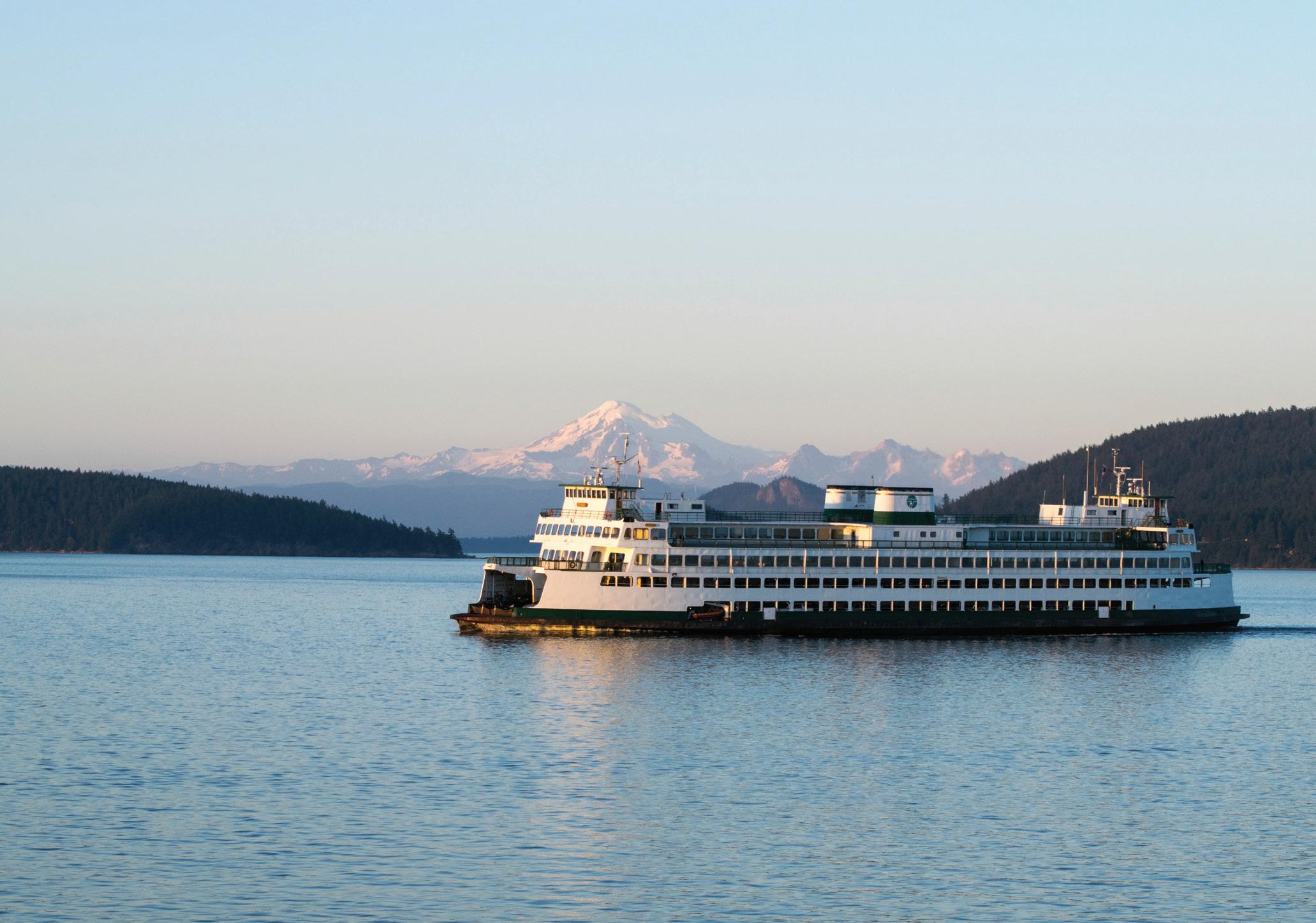
Inslee bets ferry replacement on Initiative 2117 failing this November
At Gov. Jay Inslee's insistence on electrifying the fleet, a plan to replace aging Washington ferries could get scuttled in November if voters approve Initiative 2117.
Inslee announced two years ago his plans to have future ferries added to the fleet be powered by electricity rather than diesel, while retrofitting some existing ferries to be electric.
Washington State Ferries has estimated it will cost a total of $4.4 billion to electrify the entire ferry system, which would include installing charging ports at terminals.
Much of that funding comes from the Climate Commitment Act, which generates state revenue through carbon auctions and can only be spent on environmental-related projects, such as transportation electrification.
The decision by Inslee to build electric ferries has proved contentious to the point where the governor has publicly defended the decision even as both gubernatorial candidates have expressed support for building diesel ferries.
While new diesel ferries would not require adding electric charging ports,
they will still require WSF to replace aging infrastructure such the 70-yearold Fauntleroy Terminal; WSF hopes to begin construction on the new terminal between 2027-2029.
Of $1.6 billion appropriated for five new electric ferries and the electrification of three terminals, $599 million comes from CCA revenue. WSF hopes to have the five electric ferries built by 2030 and eventually add 11 ferries to reach a total of 26 in the entire fleet.
The state agency earlier this year put out a request for proposal for a shipbuilder to construct a new electric vessel, and WSF says there are three interested shipbuilders, one of which is located in the state. The state agency has said it will need to have a new ferry built every year to reach their longterm goals.
However, CCA revenue source could be eliminated if voters approve Initiative 2117 in November, which would repeal the state law.
The loss of revenue was a source of discussion at the Washington State Transportation Commission’s Tuesday meeting, in which WSF officials addressed ways to improve the level of ferry service currently provided. When asked by commissioners about the impacts of I-2117's potential
passage, WSF External Relations
Senior Director John Vezina told the commission that “after I-695 passed in 1999….the Legislature set a level of service. So, the Legislature could change that level of service” if CCA is repealed.
Initiative 695 received 56.16% of the vote in 1999; it required future voter approval for tax increases, repealed existing fees and excise taxes for motor vehicles, and capped the annual license tab fee to $30. At the time, the motor vehicle excise tax funded a quarter of WSF’s budget, and between 2000-2010 no new ferries were built. The State Supreme Court ruled the initiative unconstitutional, but the state Legislature ultimately enacted it via legislation.
However, Vezina also told the WSTC that “in my conversations with them [the Legislature] and certainly the Governor's Office, this is the level of service that I think the public and the elected officials expect us to provide. We have regulated that with what we're able to provide, but there's definitely still the expectation we get back there with the new programs and the new vessel.”
Critics of the initiative have been more direct in their warnings, with No
Seattle Mayor Bruce Harrell released an update to his city growth plan proposal to bring down housing costs and boost housing choices.
The updated proposal, titled the "One Seattle Comprehensive Plan,” increases zoning capacity to more than 330,000 new housing units, which more than doubles the city’s current housing capacity.
The initial plan estimated that at least 112,000 new units of housing will be needed over the next 25 years.
The updates are a result of public feedback held since the initial plan was introduced this spring.
The first phase of Harrell’s proposal would implement House Bill 1110, which allows for a more broad range of middle housing types. This allows for duplexes, triplexes, and quadplexes across all neighborhood residential zones. HB 1110 was passed by the Legislature in 2023 and signed into law the same year.
The second phase would designate 30 neighborhood centers across that city, which intend to add increased housing close to existing businesses and amenities. That is an increase of six neighborhood centers from Harrell’s initial draft proposal.
It would also select arterial rezones along frequent transit routes to make public transit more accessible for residents.
Notably, Harrell’s plan includes an affordable housing bonus, which seeks to support 12 units on a typical 5,000-square-foot lot in residential areas if at least 50% of the units are affordable for low-income households.
Following future public comment meetings, the Seattle City Council will consider the first phase of the legislation in spring 2025.
The city council will consider the phase two legislation in summer 2025.
“As this plan moves forward, we will continue to advance our One Seattle housing agenda focused on lowering housing costs, ensuring families and workers can live in our city, preventing displacement, making it easier to build, and addressing root causes of our homelessness crisis,” Harrell said in a statement.
The Seattle Metropolitan Chamber of Commerce

By TJ Martinell
The Center Square
By Spencer Pauley The Center Square
ADOBE STOCK
FERRY, 4
Queen Anne & Magnolia Worship Services

Sunday Worship at 10am Live Streamed on our Facebook page and YouTube. Simply look for Magnolia Lutheran Church.
Twelfth Church of Christ, Scientist
In Person and Online Church Services
All are welcome & warmly invited to join these healing services
For best audio results, please join by clicking on the link from your computer or smartphone and choose “Call Over Internet”
All Zoom Services Meeting ID: 418 806 2637 https://us02web.zoom.us/j/4188062637
Sunday Services 11:00am – 12noon Pacific
Wednesday Testimonies 7:30pm – 8:30pm Pacific
Christian Science Quarterly Bible Lessons
Our weekly Bible Lesson Sermon may be found here: https://quarterly.christianscience.com/
Additional Healing Resources: ChristianScience.com CSWashington.com SeattleMetroReadingRoom.org
For additional assistance, please contact us at seattle12cs@gmail.com or 206.283.2300 ChristianScienceTwelfthSeattle.com
For a Healthier You CHIROPRACTORS
DENTISTS
Queen Anne Dental Group

Dr. Frank J. Calvo & Family
Cosmetic, Implant, & General Dentistry
400 Boston St. 206-284-7812 www.QADG.net





Chiropractic AND Massage Therapy
Darrell Gibson, D.C. • Sarah Gibson, D.C. Graeme Gibson, D.C.
David E. Goodall III, LMT
Sarah Rose Nottingham, LMT Lauren E. Traynor, LMT
SERVING THE FAMILIES OF QUEEN ANN E SINCE 1991 1905 Queen Anne Ave N • 206.282.8275 www.QueenAnneChiro.com
Savvy Senior: How to find a cheaper Medicare prescription drug plan
Dear Savvy Senior, What’s the easiest way to compare Medicare Part D prescription drug plans? My Part D premium is increasing again in 2025, so I would like to use the fall open enrollment to find and sign up for a cheaper plan.
Shopping Around
ear Shopping, I’m happy to hear you’re comparing your Medicare coverage options this fall! Research shows that many Medicare beneficiaries with Part D coverage can lower their prescription drug costs by shopping among plans each year during the open enrollment season, which runs Oct. 15 to Dec. 7.
There could be another Part D plan in your area that covers the drugs you take with fewer restrictions or with lower costs. You never know until you look.
You’ll also be happy to know that thanks to the Inflation Reduction Act, in 2025 annual out-of-pocket costs will be capped at $2,000 for all Medicare Part D beneficiaries.
Here are some tips and tools to help you shop and compare Part D plans.
PLAN FINDER TOOL
If you have internet access and are comfortable using a computer, you can easily shop for and compare all Medicare drug plans in your area and enroll in a new plan online, and it only takes a few minutes.
Just go to Medicare’s Plan Finder Tool at Medicare.gov/ find-a-plan. You can do a general search on the right side of the page, under the title “Continue without logging in.” If you wish to save your drugs and pharmacy information, you can log into or

create your Medicare account on the left side of the page.
Next, type in your ZIP code and choose the type of coverage you’re looking for, enter the drugs you take, choose the pharmacies you use, and indicate whether you are interested in a mail order option.
The plan finder will then display results for plans in your area. Be aware that a plan may not cover all the drugs you take, but it may cover alternatives. It will also tell you if the plan has a deductible and how much the monthly premium is.
Initially, the plans will be sorted by “lowest drug + premium costs.”
This is the closest estimate to what
you may pay out of pocket for your Part D coverage for the year. You can select “plan details” to find out more specifics about coverage, including any coverage restrictions that might apply to your drugs. Before enrolling, it is a good idea to call the plan directly to confirm any information you read on plan finder, as information may not be completely up to date.
If you need help, you can call Medicare at 800-633-4227 and they can do this for you over the phone. Or contact your State Health Insurance Assistance Program (SHIP), which provides free unbiased Medicare counseling. To find a local SHIP counselor call
877-839-2675 or see ShipHelp. org. Any changes to coverage you make will take effect Jan. 1, 2025. If you take no action during open enrollment, your current coverage will continue next year.
EXTRA HELP
If you’re lower-income and having a hard time paying your medication costs, you may be eligible for Medicare’s “Extra Help” program. This is a federal lowincome subsidy that helps pay Part D premiums, deductibles and copayments. To be eligible, your annual income must be under $22,590
Seattle raises street parking rates again; some streets to charge $6.50 per hour
By Spencer Pauley The Center Square
A quarter of Seattle streets will soon see an increase in hourly parking rates, with some reaching a new high of $6.50 an hour. The new parking rates will take effect on Tuesday. Parking rates in Seattle typically change three times a year, in the spring, summer and fall.
The Seattle Department of Transportation aims to have approximately one to two spaces available on each street block at any given time. This helps people more easily access local businesses and other destinations in the city.
Parking rates of $6 or more will be found in the Ballard core, the Fremont neighborhood, Columbia City during the evenings, and parts of the downtown area.
Revenue from on-street parking meters is forecast to be $35.4 million in 2024 and $37.4 million in 2025, a year-over-year increase of $2 million or 5.6%, according to Seattle Mayor Bruce Harrell’s 2025-2026 budget.
However, the 2025 forecast represents a drop of $1.8 million relative to the 2024 adopted budget. The reduction reflects lower than assumed increases in 2024 from rate changes compared to recent years, in addition lowered expectations for future rate increases. The 2024 adopted budget increased the

or $30,660 for married couples living together, and your assets (not counting your home, personal possessions, vehicles, life insurance policies or burial expenses) must be below $17,220 or $34,360 for married couples. For more information or to apply, call Social Security at 800-7721213 or visit SSA.gov/medicare/ part-d-extra-help.
Send your senior questions to: Savvy Senior, P.O. Box 5443, Norman, OK 73070, or visit SavvySenior.org. Jim Miller is a contributor to the NBC Today show and author of “The Savvy Senior” book.
Queen Anne’s fall wine walk will take place from 5-8 p.m. Saturday, Oct. 26.
Tickets are $35 in advance and $45 at the door. Tickets include 14 tasting tickets.
Queen Anne merchants will host pop-up tastings with local boutique Pacific Northwest wineries! Bring your friends, family, neighbors, and anyone else who wants to have fun while enjoying wonderful wines! Wine will be available for retail sale during the event, stock up for the holidays! Additional tasting tickets can be purchased at the event, 3 for $5. Tickets are non-refundable. The event is 21 and older. No pets. Check in at Bethany Presbyterian Church, 1818 Queen Anne Ave N., A portion of the proceeds of sales of bottles of wine will support the Queen Anne Farmers Market!
This is a collaboration between the Queen Anne Chamber of Commerce and Seattle Uncorked.
Seattle Public Utilities and WM announce recipients of 2024 ReThink Waste Grants
Seattle Public Utilities (SPU) and WM are teaming up for the sixth year in a row to invest $10,000 in innovative stewardship projects in Seattle. This year, funds are going to four local organizations. The purpose of the grant program is to help community-based organizations advance waste prevention, waste reduction, recycling, and composting. SPU and WM are pleased to announce the following recipients of the 2024 ReThink Waste Grants:
• Amigos de Seattle will receive $5,000 for in-person workshops and a live radio show to educate and engage the Latino and South Park communities in waste prevention.
Diaspora Cafe will receive $3,000 to promote a culture of reuse through reusable cups and bowls as well as a compost bin for their café garden.
• Switchback Repair will receive $1,500 to expand their outdoor gear repair service and gear maintenance education.
Citizen
• Sustainable Ballard will receive $500 for the Ballard Tool Library, to maintain shared tools supporting local edible gardens and RainWise yards.
“The grants are investments in local organizations to jump-start sustainability in the communities we service,” said Joe Camero, WM’s Public Sector Manager for Seattle. “This year’s recipients showcase the types of diverse waste prevention and waste reduction strategies available.”
"Seattle Public Utilities is proud to support community-driven efforts that champion waste prevention, reduction, and recycling,” said Jeff Fowler, Deputy Director of Solid Waste at SPU. “These local partnerships create a lasting and meaningful impact and together we're building a more sustainable future."
A selection committee including staff from SPU’s Residential Solid Waste Outreach and WM chose the recipients from entries submitted by Seattle businesses and non-profits in
WM’s service area.
WM is a leading provider of comprehensive recycling and environmental services in the Pacific Northwest and North America. WM provides innovative sustainability solutions and award-winning public outreach to educate and engage businesses and communities to reduce waste and improve recycling. To reduce emissions, WM uses the EPA’s Renewable Fuel Standard Program to allocate renewable natural gas (RNG) to WM trucks serving communities in Western Washington. For more information, go to wmnorthwest. com.
To learn more about WM and the company's sustainability progress and solutions, visit Sustainability.WM.com.
Seattle Public Utilities fosters healthy people, environment, and economies by partnering with our community to equitably manage water and waste resources for today and for future generations. Learn more at: https:// www.seattle.gov/utilities
panel recommends Washington lawmakers get 14% pay hike to $71K by 2026
By Carleen Johnson
FERRY
From page 1
on I-2117 sending out an email the day after the WSTC meeting that “if passed, I-2117 would devastate funding for the state’s ferry system.”
In the same email, Inlandboatmen’s Union of the Pacific Secretary-Treasurer Peter Hart noted “initiative 2117 is a direct threat to workers, commuters, and the wider community that relies on our ferry system to get to work, attend school, and keep medical appointments. I-2117 would slash millions for a ferry system that’s already in crisis.”
However, I-2117 backers dispute the connection between CCA and ferry service. In an email to The Center Square, Let’s Go Washington Director of Communications Hallie Balch wrote that “CCA funds are only intended to be used for electrification of existing ferries, the taxes taken from residents from the CCA don’t go into the operation side of the ferry system, so to say that services would be halted to delayed is a false connection. Ferry operation is funded through fares, Federal grants, and state gas taxes, not the CCA.”
HOUSING
From page 1
The Center Square and judges.
The Washington Citizens' Commission on Salaries for Elected Officials has recommended state lawmakers be given a 14% pay boost over the next two years. Commission members heard from several legislators during two days of hearings last week before finalizing recommendations that would also increase pay for statewide
offices
executive

Legislators currently earn $61,997 for what is considered a part-time job.
Under the proposed increase, that salary would climb to $66,411 in July 2025 and rise to $71,126 in July 2026.
Lt. Governor Denny Heck told commission members that current pay has fallen far behind the time commitment involved.
“The members of the Legislature are our board of directors for our 8 million citizens,” said Heck. “They pass operating budgets in excess of $70 billion dollars and that doesn’t include the transportation budget or the capital budget.”
Heck suggested dysfunction at the federal level in Congress has increased the importance of the role on state lawmakers.
“State legislative pay is not
commensurate with the magnitude of their responsibilities,” he observed.
Sen. Spencer Hutchins, R-Gig Harbor, told the commission the main reason he’s not seeking reelection after just two years in the Legislature is pay.
“It simply was not feasible for my family for me to seek reelection, financially and practically,” said Hutchins, who noted that doing the best job for his constituents would mean making the commitment full-time and year-round.
“The part-time nature of the Legislature is at best a misnomer,” he said.
Sen. Annette Cleveland, D-Vancouver, said the job has taken a toll on her over the years due to the divisive nature of politics.
“The job of a legislator has become PAY, 8
HAUNTS
at Magnuson CC Hosted at Woodland Park Zoo
recently released its quality-of-life survey that revealed 28% of respondents cite affordable housing and cost of living as the top issue for Seattle residents.
Seattle Metropolitan Chamber of Commerce CEO Rachel Smith voiced her support for Harrell’s updated proposal, saying that it lays the groundwork for more affordable housing across the city.
“This proposal has made it clear the city is committed to using land use tools to address affordability at a much larger – and needed –scale,” Smith said.
Seven in-person information sessions and two online sessions will be held by the city through Dec. 20 as city leaders considers further revisions based on public feedback.

STOUT 23770 SOUTHEAST 243RD STREET, MAPLE VALLEY, WA 98038 WENDY LEIGH
STOUT 23770 SOUTHEAST 243RD STREET, MAPLE VALLEY, WA 98038 by both first class and certified mail on April 22, 2024, proof of which is in the possession of the Trustee; and the Borrower and Grantor were personally served with said written Notice of Default or the written Notice of Default was posted in a conspicuous place April 19, 2024 on the real property described in Paragraph I above, and the Trustee has possession of proof of such service or posting. VII. The Trustee whose name and address are set forth below will provide in writing to anyone requesting it, a statement of all costs and fees due at any time prior to the sale. VIII. The effect of the sale will be to deprive the Grantor and all those who hold by, through or under the Grantor of all their interest in the above described property. IX. Anyone having any objections to this sale on any grounds whatsoever will be afforded an opportunity to be heard as to those objections if they bring a lawsuit to restrain the sale pursuant to RCW 61.24.130. Failure to bring such a lawsuit may result in a waiver of any proper grounds for invalidating the Trustees’Sale. X. Notice to Occupants or Tenants. The purchaser at the Trustee’s sale is entitled to possession of the property on the 20th day following the sale, as against the Grantor under the deed of trust (the owner) and anyone having an interest junior to the deed of trust, including occupants who are not tenants. After the 20th day following the sale the purchaser has the right to evict occupants who are not tenants by summary proceedings under chapter 59.12 RCW. For tenant-occupied property, the purchaser shall provide a tenant with written notice in accordance with RCW 61.24.060. Notice to Borrower(s) who received a letter under RCW 61.24.031: THIS NOTICE IS THE FINAL STEP BEFORE THE FORECLOSURE SALE OF YOUR HOME. Mediation MUST be requested between the time you receive the Notice of Default and no later than 90 calendar days BEFORE the date of sale listed in the Notice of Trustee Sale. If an amended Notice of Trustee Sale is recorded providing a 45-day notice of the sale, mediation must be requested no later than 25 calendar days BEFORE the date of sale listed in the amended Notice of Trustee Sale. DO NOT DELAY. CONTACT A HOUSING COUNSELOR OR AN ATTORNEY LICENSED IN WASHINGTON NOW to assess your situation and refer you to mediation if you might eligible and it may help you save your home. See below for safe sources of help. SEEKING ASSISTANCE Housing counselors and legal assistance may be available at little or no cost to you. If you would like assistance in determining your rights and opportunities to keep your house, you may contact the following: The statewide foreclosure hotline for assistance and referral to housing counselors recommended by the Housing Finance Commission: Telephone: (877) 894-4663 or (800) 606-4819 Website: www.wshfc.org The United States Department of Housing and Urban Development: Telephone: (800) 569-4287 Website: www.hud.gov The statewide civil legal aid hotline for assistance and referrals to other housing counselors and attorneys: Telephone: (800) 606-4819 Website: www. homeownership.wa.gov Dated: June 4 , 2024 MTC Financial Inc. dba Trustee Corps, as Duly Appointed Successor Trustee By: Alan Burton, Vice President MTC Financial Inc. dba Trustee Corps 606 W. Gowe Street Kent, WA 98032 Toll Free Number: (844) 367-8456 TDD: 711 949.252.8300 For Reinstatement/ Pay Off Quotes, contact MTC Financial Inc. DBA Trustee Corps Order Number 102886, Pub Dates: 10/23/2024, 11/13/2024, QUEEN ANNE & MAGNOLIA NEWS
TS No WA09000051-24-1 TO No 240281017-WA-MSI NOTICE OF TRUSTEE’S SALE PURSUANT TO THE REVISED CODE OF WASHINGTON CHAPTER 61.24 ET. SEQ. Grantor: RICHARD G. WHEELER, A SINGLE MAN Current Beneficiary of the Deed of Trust: HomeStreet Bank Original Trustee of the Deed of Trust: FIDELITY NATIONAL TITLE COMPANY OF WASHINGTON, INC. Current Trustee of the Deed of Trust: MTC Financial Inc. dba Trustee Corps Current Mortgage Servicer of the Deed of Trust: HomeStreet Bank Reference Number of the Deed of Trust: Instrument No. 20221026000449 Parcel Number: 3977630530 I. NOTICE IS HEREBY GIVEN that on November 22, 2024, 10:00 AM, at 4th Ave entrance King County Administration Building, located one block east of the Courthouse, 500 4th Ave, Seattle, WA, MTC Financial Inc. dba Trustee Corps, the undersigned Trustee, will sell at public auction to the highest and best bidder, payable, in the form of cash, or cashier’s check or certified checks from federally or State chartered banks, at the time of sale the following described real property, situated in the County of King, State of Washington, to-wit: LOT 53, LAGUNA HILLS, DIVISION NO. 4, ACCORDING TO THE PLAT THEREOF, RECORDED IN VOLUME 93 OF PLATS, PAGE(S) 37 AND 38, IN KING COUNTY, WASHINGTON.SITUATE IN THE COUNTY OF KING, STATE OF WASHINGTON. APN: 3977630530 More commonly known as 31902 162ND AVE SE, AUBURN, WA 98092 which is subject to that certain Deed of Trust dated October 21, 2022, executed by RICHARD G. WHEELER, A SINGLE MAN as Trustor(s), to secure obligations in favor of MORTGAGE ELECTRONIC REGISTRATION SYSTEMS, INC., as designated nominee for HOMESTREET BANK, Beneficiary of the security instrument, its successors and assigns, recorded October 26, 2022 as Instrument No. 20221026000449 and the beneficial interest was assigned to HomeStreet Bank and recorded May 29, 2024 as Instrument Number 20240529000446 of official records in the Office of the Recorder of King County, Washington. II. No action commenced by HomeStreet Bank, the current Beneficiary of the Deed of Trust is now pending to seek satisfaction of the obligation in any Court by reason of the Borrowers’ or Grantors’ default
on the obligation secured by the Deed of Trust/Mortgage. III. The default(s) for which this foreclosure is made is/are as follows: FAILURE TO PAY WHEN DUE THE FOLLOWING AMOUNTS WHICH ARE NOW IN AR-
REARS: DELINQUENT PAYMENT INFORMA-
TION From December 1, 2023 To July 17, 2024 Number of Payments 8 Total $10,981.28
LATE CHARGE INFORMATION December 1, 2023 July 17, 2024 $443.52 PROMISSORY
NOTE INFORMATION Note Dated: October 21, 2022 Note Amount $134,500.00 Interest Paid To: November 1, 2023 Next Due Date: December 1, 2023 Current Beneficiary: HomeStreet Bank Contact Phone No: 800.809.1377 Address: 601 Union Street, Ste. 2000, Seattle, WA 98101 IV. The sum owing on the obligation secured by the Deed of Trust is: The principal sum of $132,848.26, together with interest as provided in the Note or other instrument secured, and such other costs and fees as are due under the Note or other instrument secured, and as are provided by statute. V. The above described real property will be sold to satisfy the expense of sale and the obligation secured by the Deed of Trust as provided by statute. Said sale will be made without warranty, expressed or implied, regarding title, possession or encumbrances on November 22, 2024. The defaults referred to in Paragraph III must be cured by November 11, 2024, (11 days before the sale date) to cause a discontinuance of the sale. The sale will be discontinued and terminated if at any time before November 11, 2024 (11 days before the sale) the default as set forth in Paragraph III is cured and the Trustees’ fees and costs are paid. Payment must be in cash or with cashiers’ or certified checks from a State or federally chartered bank. The sale may be terminated any time after the November 11, 2024 (11 days before the sale date) and before the sale, by the Borrower or Grantor or the holder of any recorded junior lien or encumbrance by paying the entire principal and interest secured by the Deed of Trust, plus costs, fees and advances, if any, made pursuant to the terms of the obligation and/or Deed of Trust, and curing all other defaults. VI. A written Notice of Default was transmitted by the current Beneficiary, HomeStreet Bank or Trustee to the Borrower and Grantor at the following address(es): ADDRESS RICHARD G WHEELER 31902 162ND AVE SE, AUBURN, WA 98092 by both first class and certified mail on June 7, 2024, proof of which is in the possession of the Trustee; and the Borrower and Grantor were personally served with said written Notice of Default or the written Notice of Default was posted in a conspicuous place June 7, 2024 on the real property described in Paragraph I above, and the Trustee has possession of proof of such service or posting. VII. The Trustee whose name and address are set forth below will provide in writing to anyone requesting it, a statement of all costs and fees due at any time prior to the sale. VIII. The effect of the sale will be to deprive the Grantor and all those who hold by, through or under the Grantor of all their interest in the above described property. IX. Anyone having any objections to this sale on any grounds whatsoever will be afforded an opportunity to be heard as to those objections if they bring a lawsuit to restrain the sale pursuant to RCW 61.24.130. Failure to bring such a lawsuit may result in a waiver of any proper grounds for invalidating the Trustees’ Sale. X. Notice to Occupants or Tenants. The purchaser at the Trustee’s sale is entitled to possession of the property on the 20th day following the sale, as against the Grantor under the deed of trust (the owner) and anyone having an interest junior to the deed of trust, including occupants who are not tenants. After the 20th day following the sale the purchaser has the right to evict occupants who are not tenants by summary proceedings under chapter 59.12 RCW. For tenant-occupied property, the purchaser shall provide a tenant with written notice in accordance with RCW 61.24.060. Notice to Borrower(s) who received a letter under RCW 61.24.031: THIS NOTICE IS THE FINAL STEP BEFORE THE FORECLOSURE SALE OF YOUR HOME. Mediation MUST be requested between the time you receive the Notice of Default and no later than 90 calendar days BEFORE the date of sale listed in the Notice of Trustee Sale. If an amended Notice of Trustee Sale is recorded providing a 45-day notice of the sale, mediation must be requested no later than 25 calendar days BEFORE the date of sale listed in the amended Notice of Trustee Sale. DO NOT DELAY. CONTACT A HOUSING COUNSELOR OR AN ATTORNEY LICENSED IN WASHINGTON NOW to assess your situation and refer you to mediation if you might eligible and it may help you save your home. See below for safe sources of help. SEEKING ASSISTANCE Housing counselors and legal assistance may be available at little or no cost to you. If you would like assistance in determining your rights and opportunities to keep your house, you may contact the following: The statewide foreclosure hotline for assistance and referral to housing counselors recommended by the Housing Finance Commission: Telephone: (877) 894-4663 or (800) 606-4819 Website: www.wshfc.org The United States Department of Housing and Urban Development: Telephone: (800) 569-4287 Website: www.hud.gov The statewide civil legal aid hotline for assistance and referrals to other housing counselors and attorneys: Telephone: (800) 606-4819 Website: www.homeownership.wa.gov Dated: July 18 , 2024 MTC Financial Inc. dba Trustee Corps, as Duly Appointed Successor Trustee By: Alan Burton, Vice President MTC Financial Inc. dba Trustee Corps 606 W. Gowe Street Kent, WA 98032 Toll Free Number: (844) 367-8456 TDD: 711 949.252.8300 For Reinstatement/ Pay Off Quotes, contact MTC Financial Inc. DBA Trustee Corps Order Number 103890, Pub Dates: 10/23/2024, 11/13/2024, QUEEN ANNE & MAGNOLIA NEWS
An easy one-pot stew for a warming weeknight dinner
By Lynda Balslev
This 30-minute vegetarian-friendly soup is an easy, healthy dinner.
It's a welcome time-out meal that brims with nutrientrich ingredients and warms on a cool fall evening. Inspired by the Southwest with sweet potato, cumin and chile heat, it relies on sturdy protein-rich lentils for heft and body.
The soup comes together quickly, which helps to preserve the texture of the ingredients. The vegetables are simply cooked until al dente, and the lentils are cooked until tender without turning to mush. Ripped kale leaves are swirled into the soup right before serving, allowing for just enough time to soften and brighten without dulling in color or flavor.
SWEET POTATO, KALE AND LENTIL STEW
Active time: 30 minutes
Total time: 30 minutes
Yield: Serves 4 to 6
■ 1 tablespoon olive oil
■ 1 medium yellow onion, chopped
■ 1 medium sweet potato, peeled and diced
■ 1 carrot, diced
■ 1 poblano pepper, seeded and diced
■ 1 jalapeno pepper, seeded and finely chopped
■ 1 teaspoon kosher salt, or more to taste
■ 2 large plum tomatoes, coarsely chopped
■ 1 cup brown lentils, rinsed
■ 1 large garlic clove, minced
■ 1 teaspoon ground cumin
■ 1 teaspoon sweet paprika
■ 1/2 teaspoon dried thyme
■ 1 bay leaf
■ 4 cups vegetable stock (or chicken stock, for nonvegetarian
PAY
From page 4
increasingly difficult,” said Cleveland, who has held her seat for more than a dozen years.
Commission members also heard from Rep. Skyler Rude, RBenton County, who explained he was initially committed to being a legislator full time.
“When I first got this role, I committed to not having a second job so I could focus on being the best legislator I could,” Rude said. He, too, learned it that didn't pan out in the real world.
“This job could easily be eight hours a day, 40 hours a week,” Rude noted.
Under the proposal, statewide executives like the governor and attorney general would get a 3% pay bump for cost of living in July of next year and 2% more in July 2026.
State Supreme Court justices and district court judges would get a 4% increase next July and 3% the year after.

option)
■ 1/3 cup full-bodied red wine
■ 2 tablespoons balsamic vinegar
■ 1/2 teaspoon freshly ground black pepper
■ 2 cups torn Tuscan or curly green kale leaves
Heat the oil in a large pot over medium heat. Add the onion, sweet potato, peppers and carrot and season with the salt. Saute for 2 to 3 minutes to coat the vegetables and let them brighten in color. Stir in the tomatoes, lentils, garlic, cumin, paprika, thyme and bay leaf and continue to saute for about 2 minutes more to toast the lentils and spices. Add the stock and wine. There should be enough liquid to generously cover the vegetables. Add
more stock or water if not. Bring the soup to a simmer and cook over medium-low heat, partially covered, until the vegetables and lentils are tender but not mushy, about 25 minutes, stirring occasionally. If the soup is too thick, thin with additional stock or water. Stir in the balsamic vinegar and black pepper and taste for seasoning. Add more salt if needed. Before serving, stir in the kale leaves and simmer until bright in color and wilted, about 1 minute. Ladle into bowls and serve immediately.
Lynda Balslev is an awardwinning writer, cookbook author, and recipe developer based in northern California. Visit TasteFood at TasteFoodblog.com.

Supreme Court justices currently earn $251,861. Under the proposal, that would increase to $262,011 July 2025 and rise to $269,924 in July 2026.
Legislator salaries vary dramatically from state to state.
According to the National Conference of State Legislatures, lawmakers in Washington, D.C., make the most, with a salary of $161,000, with New York
legislators earning the second highest salary at $142,000.
New Hampshire lawmakers earn $100 dollars each day during session and legislators in New Mexico are paid nothing for their service.
The proposed salary schedule will be open for public comment until Feb 5. Once the commission approves the salary schedule, lawmakers and state office holders cannot make any changes.
COURTESY LYNDA BALSLEV