Y o m Ki ppur Serv ic e s October 1-2
NO TICKETS OR MEMBERSHIP REQUIRED
ChabadQueenAnne.com
YO M KI P PUR SE R V I CE S • Y I ZK OR • CHI L DR E N ' S PR OG R A M • BREAK FAS T
Serving Queen Anne & Magnolia Since 1919 www.QueenAnneNews.com
SEPTEMBER 24, 2025
VOL. 106, NO. 39
Multistate “One More Stop” Patrol to Honor Fallen WSP Trooper Marysville by a driver traveling more than 100 mph. Just before the crash, he had messaged fellow troopers that he would join them for a break after making “one more stop.” His final act of service was pulling over with the intent of stopping a speeding or impaired driver to prevent another tragedy.
The patrol begins at 4 p.m. Friday, Sept. 26, and runs through 5 a.m. Monday, Sept. 29. It is organized by WSP and the Washington Traffic Safety Commission (WTSC) to honor Trooper Gadd’s dedication to protecting motorists and to raise awareness about the dangers of impaired driving.
“This emphasis patrol is not just about enforcement, it’s about remembrance,” said WSP Chief John Batiste. “Trooper Christopher Gadd served this community with honor, courage, and an unwavering commitment to keeping others safe. As we take to the streets in his name, we do so with heavy hearts and clear purpose: to carry forward his memory and ensure that his sacrifice is never forgotten.”
Trooper Gadd, 27, died on March 2, 2024, when his patrol car was struck on I-5 north of
Shelly Baldwin, WTSC director, emphasized the role drivers play in preventing further loss. “Law enforcement officers work tirelessly to make our roads safer. We can honor them and keep them safe, too, by driving sober and following the speed limit. High-visibility patrols are an important reminder that we each have the power to keep ourselves and others safe on our roads.” In tribute to Trooper Gadd’s work ethic, troopers and officers across the region will take to the highways this weekend to make their own “one more stop.” The coordinated patrol aims to reduce impaired and dangerous driving behaviors and prevent further tragedies. Drunk and drug-impaired driving remains
Nature is Good for You
Want to Feel Better? Step Outside We need the tonic of wilderness. . . . We can never have enough of nature. —Henry D. Thoreau, Walden
M
ore of us live in cities today than ever before — and many of us spend most of our waking hours indoors. From house to car to office to grocery store, it’s possible to go a whole day without more than a few minutes under the open sky. But our bodies and minds need more than that: research shows we are wired for sunlight, fresh air, and greenery. Yet research is telling us that our bodies and minds not only crave but require exposure to sunlight and natural environments to thrive. Nature is proving to be a critical component to feeling good. Here are some of the reasons to get outside and some simple ways to do so. MORNING LIGHT = BETTER NIGHTS Stamford Neuroscientist Andrew Huberman, of the Huberman Lab podcast, is known for his morning protocol which prioritizes ten minutes of morning sunlight. Morning light resets your circadian clock, triggering cortisol to help you feel awake and melatonin later to help you fall asleep. Without the sun unlocking these cues, we can get out of sync – and being on our devices in the evening makes it even worse, disrupting our sleep. The strongest benefits are close to waking, but anytime in the morning is helpful. He
says looking through windows isn’t enough, but it’s fine to wear eyeglasses – don’t stare at the sun, of course. Bonus circadian points if you can also get some outdoor time near sunset. So: if you don’t have any outdoor space, or you’re in a hurry, spend a few minutes with your window open. If you have access to outdoor space, have your coffee on the balcony, or spend time with your garden Erica plants. Browne (They’ll thank you Grivas for it.) Get Growing This is a great reason to start that morning walk habit -even if you have to get up a little earlier than you’re used to. In my biased opinion, there are countless benefits to add a dog to your life if you can but having a reason to get outside 2-3 times a day even in Seattle winters, is a great one. NATURE AS STRESS RELEASE A breath of fresh air really can calm your nerves. There are so many ways nature acts as a balm to our frazzled nerves and balances our nervous systems, helping us lean away from “fight-or-flight” and into “restand-digest” mode. The American Psychiatric Association notes, “From a stroll through a city park to a PRSRT STD U.S. POSTAGE
PAID
SEATTLE, WA PERMIT 1271
a leading cause of fatal collisions in Washington, with more than half of all serious crashes linked to impairment. Organizers say the multistate participation underscores that Trooper Gadd’s sacrifice is remembered well beyond Washington. From urban freeways to rural highways, officers will carry forward his mission — one traffic stop at a time. For more information on traffic safety initiatives, visit wsp.wa.gov, wtsc.wa.gov, or togetherwegetthere.com.
day spent hiking in the wilderness, exposure to nature has been linked to a host of benefits, including improved attention, lower stress, better mood, reduced risk of psychiatric disorders, and even upticks in empathy and cooperation. Nature has been shown to improve attention, lower stress, and boost mood. It may even increase empathy and cooperation. Even looking at nature can help - studies have shown that patients with views of nature heal faster than those who don’t. A meta-analysis by Marc Berman and Kathryn Schertz described studies showing schoolchildren in greener neighborhoods performed better and had more self-regulation, and another showing that working memory and cognitive flexibility increased the most after nature exposure. The authors think these benefits spring from attention-restoration resulting from nature offering us a new perspective. Instead of our everyday top-down highfocused attention, nature invites bottom-up views, something called “soft fascination,” which reduces mental fatigue and recharges our top-down attention. Soft fascination happens when something gently holds your attention — a breeze moving through leaves, ripples on water — giving your busy brain a chance to rest and reset. Our focus diffuses, expanding into a multisensory experience, where you are processing the world very differently than when you are staring at a computer screen, or rushing down a hallway. PHYSICAL CHANNELS Nature works on us not just through what we see and hear — but through what we breathe in and touch. In addition to sunlight, we are literally absorbing our environment all the time. Outside we are breathing in not just scents, but microbes. You’ve probably heard that digging in the garden is good for your mood, thanks to bacteria in most soil that encourages serotonin production in your gut
COURTESY WASHINGTON STATE PATROL
L
aw enforcement agencies in Washington, Oregon, and Idaho will join forces this weekend for a multistate “One More Stop” emphasis patrol in memory of Washington State Patrol (WSP) Trooper Christopher Gadd, who was killed by an impaired driver last year.
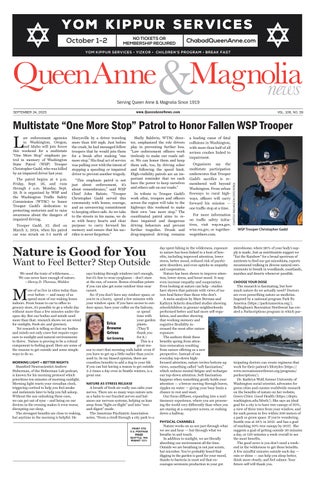
WSP Trooper Christopher Gadd
microbiome, where 90% of your body’s supply is made. Just as nutritionists suggest we “Eat the Rainbow” for a broad spectrum of nutrients to feed our gut microbiota, experts recommend walking in diverse natural environments to breath in woodlands, coastlands, marshes and deserts whenever possible. CHOOSE YOUR DOSE The research is fascinating, but how much nature do we actually need? Doctors are even prescribing nature as medicine. Inspired by a national program Park Rx America (https://parkrxamerica.org/), Bellingham’s Recreation Northwest has created a Parkscriptions program in which par-
ticipating doctors can create regimens that work for their patient’s lifestyles (https:// www.recreationnorthwest.org/programs/ parkscriptions/). Dr. Kathryn Wolf, former University of Washington social scientist, advocates for green cities and curates worldwide research on the benefits of nature on her website, Green Cities: Good Health (https://depts. washington.edu/hhwb/). She says an ideal goal for a city is to have tree canopy of 30%, a view of three trees from your window, and for each person to live within 300 meters of a park or green space. If you’re wondering, Seattle was at 28% in 2021 and has a goal of reaching 30% tree canopy by 2037. She suggests a goal of getting outside 20 minutes a day, or 120 minutes a week overall to see the most benefits. The good news is you don’t need a weekend in the wilderness to get these benefits. A few mindful minutes outside each day — rain or shine — can help you sleep better, think more clearly, and feel calmer. Your future self will thank you.