High Holiday Services
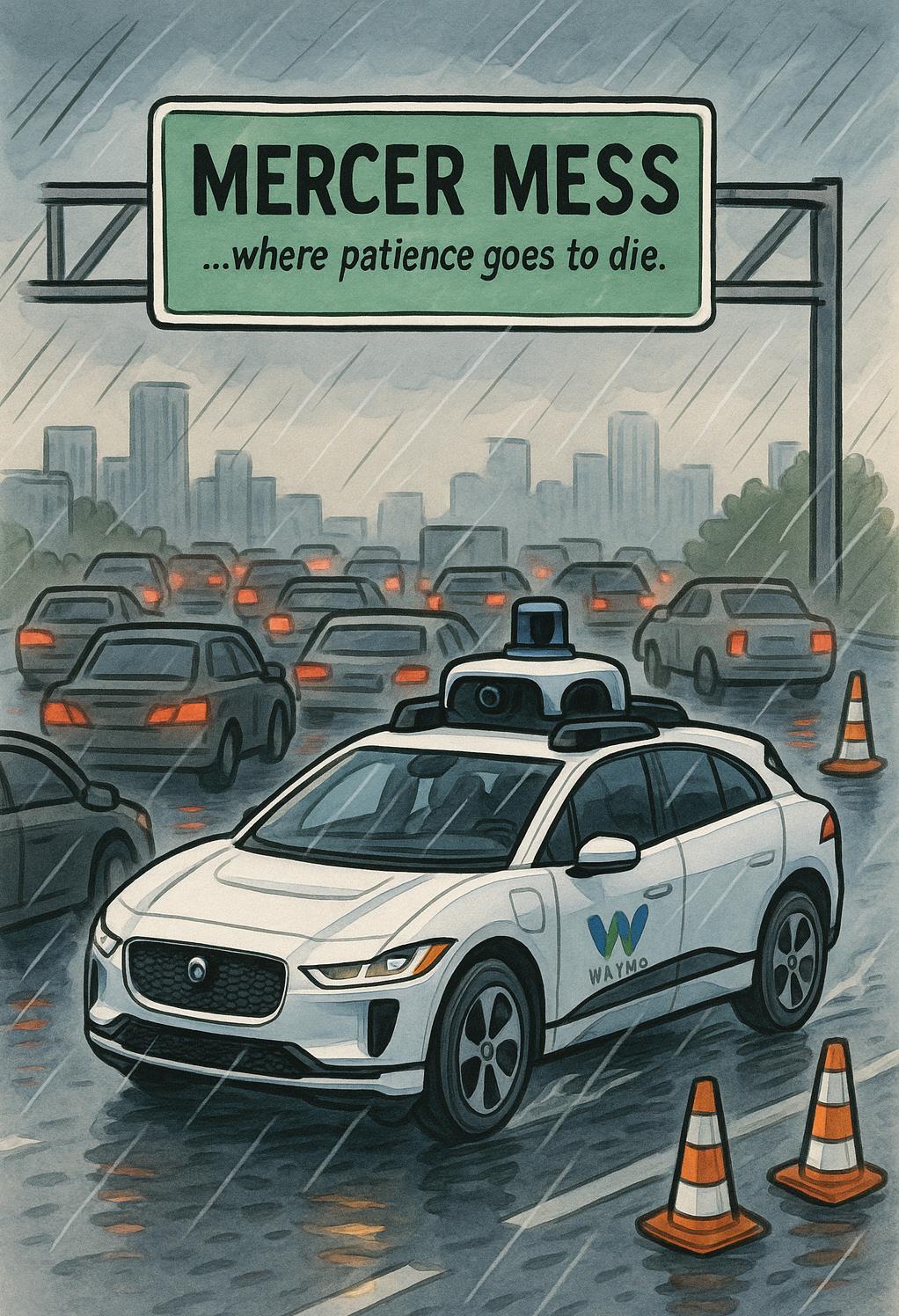
Mercer Street Wasn’t
Mercer Street Wasn’t
Seattle commuters may soon find themselves sharing the road—and eventually their rides—with cars that don’t have anyone in the driver’s seat. Waymo, the autonomous vehicle company owned by Alphabet (Google’s parent company), has announced plans to expand its driverless taxi service to the Seattle metropolitan area.
The company already operates in Phoenix, San Francisco, Los Angeles, and Austin, where customers can hail rides through the Waymo One app. Seattle, with its steep hills, wet weather, and famously passive-aggressive merges, will be one of the next testing grounds.
WHAT IS WAYMO?
Waymo began as Google’s self-driving car project in 2009 before becoming its own company under Alphabet. Its fleet of modified electric Jaguar SUVs look ordinary— until you notice the spinning sensor tower on top, like a futuristic disco ball. Each ve -
cars set to test in Seattle, where patience goes to die
hicle is packed with cameras, radar, and LIDAR sensors that build a 360-degree view of the world.
Trips are requested through a mobile app, just like Uber or Lyft. The difference: no driver asking if you’ve “heard of crypto” or turning up their side hustle playlist. Just you, your destination, and a car silently calculating everything around it.
WHY SEATTLE?
Seattle is a tough city for drivers—and that’s exactly why Waymo wants to be here. Rain, fog, sharp hills, narrow streets, and bridges that seem to open whenever you’re late provide a gauntlet of challenges. If the cars can master Capitol Hill’s festival traffic, Ballard’s four-way stops, and Mercer Street during rush hour, Waymo will have bragging rights no software demo could buy.
WHEN WILL SERVICE BEGIN?
Testing is expected to begin in 2025. The first cars will still have human “safety drivers” behind the wheel. Once regulators are satisfied and Waymo feels confident in
Seattle’s conditions, the service will shift to fully driverless rides. In other cities, the move from testing to public availability has taken anywhere from a few months to over a year.
Translation: don’t delete your bus pass or Uber app just yet.
“Apparently, robots prefer density over detours”
WHERE WILL IT OPERATE FIRST?
Waymo’s early coverage zones will likely include Downtown Seattle, Capitol Hill, The CID, and the University District. Bellevue and Kirkland are also part of the rollout. Neighborhoods like Magnolia, Queen Anne, and West Seattle may have to wait until later phases. Apparently, robots prefer density over detours.
By Daniel DeMay King County
Areport released Tuesday by the King County Auditor’s Office found instances of potential fraud by contractors and payments to unapproved entities in some Department of Community and Human Services (DCHS) contracts, known as community grants.
The audit looked at contract management across four locally funded youth programs – Family Intervention and Restorative Services, Liberation and Healing from Systemic Racism, Restorative Community Pathways, and Stopping the School-to-Prison Pipeline – during a period of dramatic expansion of grant-funded programs from DCHS; grant funding in 2019-2020 was $22
million and in 2023-2024 had grown to more than $1.5 billion.
With that significant growth in grant funding, DCHS was working to promote equity in contracting, reducing barriers for organizations that had limited government experience. But in so doing, the department exposed itself to greater financial risk. DCHS fell short on internal oversight, resulting in improper payments, including potential fraud, across multiple programs and contracts, auditors found.
“The Department of Community and Human Services took on a lot of risk with public money without putting in a safety net,” said King County Auditor Kymber Waltmunson. “By implementing our
recommendations – some as simple as providing anti-fraud training and creating contract monitoring checklists for staff to follow, DCHS will be better able to embed the county’s value of responsible financial stewardship into its culture. Doing so will help ensure that DCHS funds are used to provide the county’s most vulnerable residents with the quality services they deserve.”
Auditors noted that DCHS has taken positive first steps to begin strengthening its oversight of community grants by creating a contract monitoring workgroup last year and adding three new positions to its compliance team this year.
The audit also found:
• DCHS manages high-risk grants. In 2024, DCHS rated 48% of the 359 grant recipients it reviewed as high risk. DCHS assigns higher risk to entities that lack experience being funded or
monitored by federal, state, or local agencies as well as those with fewer financial staff.
• Auditors found potential fraud in which, for example, grantees likely altered documents to support expenses submitted for reimbursement.
• Auditors found payments made to unapproved entities and for expenses tied to cash withdrawals and other questionable support. DCHS lacks written policies and procedures and offers limited training on invoice review, reducing consistency and accountability.
• DCHS’s compliance team did not do in-depth reviews of grantees’ financial management as often as department policy required, delaying corrective action.
• Cause: DCHS’s compliance
team had several vacancies between 2022 and 2024 and faced difficulty hiring and retaining staff.
• Action by department: DCHS allocated three new positions to its compliance team in 2025 and provided training on a revised Contract Compliance Monitoring Policy to all divisions in June and July 2025.
• DCHS has not clearly communicated financial management requirements to grant recipients. In addition, grantees rarely sign up for free financial consulting, limiting the ability of the Best Starts for Kids capacity-building program to reduce financial risk to DCHS.
• Action by department: DCHS is developing an orientation for grantees and plans to launch it in the fall of 2025.
The audit made several recommendations, including:
• DCHS should strengthen financial management safeguards.
• DCHS should work with Public Health – Seattle & King County to identify efficiencies in the financial
Head lice is a year-round problem, but tends to peak when children return to the classroom. Lice are parasites that affect millions of children every year, says the U.S. Food and Drug Administration, particularly because of their close contact to others in school and day care settings.
Although lice are not known to spread disease, they attach to hair to feed on blood. This can cause itchy, irritated areas on the head that become uncomfortable. The best defense against lice is not getting them at all. These tips can help reduce the risk for lice infestation.
DISCOURAGE HEAD-TO-HEAD CONTACT
Children should be advised to avoid touching heads during play and other activities at school, home and elsewhere. If heads and hair come in contact with someone who actively has lice, the bugs are more readily spread to another person.
AVOID SHARING
Sharing is taught as good behavior, but there are some things children should not share with others. These include hats and other head coverings, over-the-head headsets/ headphones, scarves, helmets, towels, combs/brushes, hair accessories, and sports uniforms.

The Centers for Disease Control and Prevention says combs and brushes used by someone with head lice need to be soaked in hot water (at least 130 F) for five to 10 minutes to be disinfected.
WATCH THE ENVIRONMENT
Children and adults should not lie on beds, couches, pillows, carpets, or stuffed animals that have recently been in contact with a person with head lice.
CHANGE HAIRSTYLES
Children with long hair should consider wearing their hair in braids, tight buns or even in ponytails to reduce the risk of head lice. Despite myths that suggest head
lice are attracted to either clean or dirty hair, depending on the source, lice are attracted to a blood meal and will infest hair regardless of cleanliness.
EXPERIMENT WITH SPRAYS
Various products on the market are designed to repel head lice. Families can use their judgement on giving these items a try, many of which contain essential oils like lavender, peppermint and tea tree. All About Lice, a lice removal treatment center in Maine, indicates that hair spray is not a lice deterrent as some believe. Head lice is problematic at any time, but cases seem to climb when children return to school.
DSHS
From page 1
oversight of organizations funded by both departments.
• DCHS should ensure ongoing anti-fraud training for all staff.
•DCHS should effectively communicate to grantees their role in financial stewardship and ensure that they are supported and held accountable to that role.
• DCHS should develop, document, and implement clear and consistent policies and procedures and staff checklists for:
• Invoice validation
• Contract amendments
• Stipend payments
• Prepaid card logs
• Management of contract payments that exceed actual expenditures
• Contract termination
• Funding eligibility of for-profit businesses
• Documentation management
The King County Auditor’s Office was established in 1969. The King County Auditor’s Office is an independent agency within the legislative branch of King County. Its independence means the Auditor’s Office alone determines objectives, findings, and recommendations based on the evidence and without external interference or influence. The King County Council adopts the office’s biennial work program by motion. Auditors adhere to Generally Accepted Government Auditing Standards and are subject to a compliance evaluation every three years.
Seattle Women’s Chorus Opens Auditions for 2025–2026 Season
Seattle Women’s Chorus (SWC), one of the largest LGBTQ-identified choruses in the world, is welcoming new members for its 2025–2026 season. Auditions take place Tuesday, Sept. 30, from 6–9:30 p.m. and require advance online registration.
SWC rehearses Tuesday evenings, with additional Saturday sessions each concert cycle. More information and audition registration are available at seattlechoruses.org.
Submitted
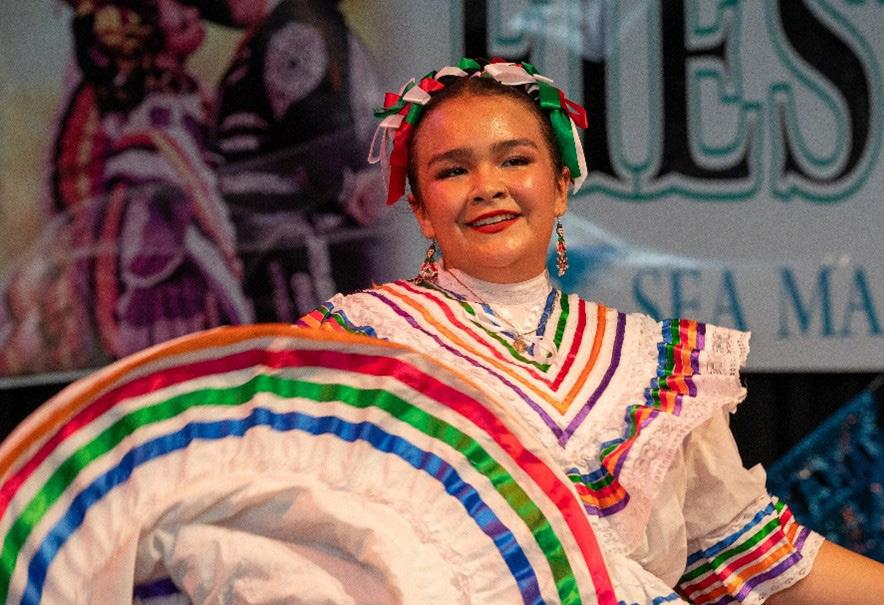
Seattle Center will come alive with the sights and sounds of Latin America September 13–14 as Sea Mar Fiestas Patrias returns for a weekend of music, dance, food, and community. The free, familyfriendly festival runs from 12 to 9 p.m. Saturday and 11 a.m. to 6 p.m. Sunday, filling the Armory Food & Event Hall and Fisher Pavilion with activity.
Now in its 25th year, Fiestas Patrias commemorates the independence of several Latin American countries, including Mexico, Costa Rica, Chile, El Salvador, Guatemala, Honduras, and Nicaragua. Many of these nations celebrate their na-
tional Independence Days in September, and the Seattle festival coincides with National Hispanic Heritage Month.
This year’s theme, “Nuestra Voz, Nuestra Fuerza” (Our Voice, Our Strength), emphasizes Latino heritage while calling for equality and justice.
Music, Dance, and Culture
The weekend begins with a colorful parade Saturday morning in South Park before the focus shifts to Seattle Center. Visitors can enjoy live performances by groups such as Bailadores de Bronce, Mariachi Guadalajara de Seattle, La Sonora
Dinamita, Los Reales del Norte, and many others.
Workshops invite festivalgoers to join the fun with Zumba, Caribbean, Hula, and Folklórico dance lessons. Families will also find children’s activities, an art exhibit, and a free health fair offering screenings and wellness resources. Local vendors will serve authentic Latin American cuisine throughout the weekend.
“Fiestas Patrias is a vibrant celebration of the Latino/a/x community and its contributions,” said organizer Angelica Barajas. “It embodies pride, unity, and resilience.”