Serving Queen Anne & Magnolia Since 1919 www.QueenAnneNews.com
SEPTEMBER 3, 2025
VOL. 106, NO. 36
GORDON BOWKER, 1943-2025 The modest inventor of Starbucks and Red Hook called Magnolia home By Ronald Holden
I
Seattle’s Waterfront Park is Officially Open Erica Browne Grivas fter a multi-million-dollar renovation and the removal of the Alaskan Way Viaduct, Seattle’s waterfront is ready for its closeup. As we reported in a 2022 feature on the design overseen by Field Operations, landscaping by Land Morphology leads the way in this 1.5-mile, 26-block park, punctuated by art installations, a recreated habitat beach, playgrounds, bike and running paths, and new connections between Pioneer Square, Pike Place, and the Aquarium—which now boasts a new wing. The park officially opened on July 25, with a full-day festival on September 6 to celebrate its opening in style. Once cut off by an elevated concrete roadway, the waterfront is now easily accessible by foot or bike, offering uninterrupted, glorious views of Elliott Bay. The design spans 20 acres, and each section’s plantings have a unique character, telling a differ-
WATERFRONT PARK, 4
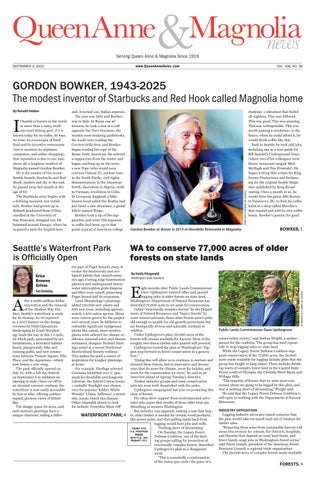
Gordon Bowker at dinner in 2014 at Mondello Ristorante in Magnolia.
students: a stimulant that fueled all-nighters. This was different. This was good. This was amazing. This was unforgettable. This was worth making a resolution: in the future, when he could afford it, he would drink coffee like this. Back in Seattle, he took odd jobs, including one as a tour guide for Bill Speidel's Underground Tours (where two of his colleagues were future restaurant moguls Mick McHugh and Tim Firnstahl). He began writing film scripts for King Screen Productions and freelancing for the original Seattle Magazine, published by King Broadcasting. Once a month or so, he would drive his green Alfa Romeo to Vancouver, BC, to feed his coffee habit at a shop called Murchie's that roasted and sold its own coffee beans. Bowker's passion for good
BOWKER, 5
WA to conserve 77,000 acres of older forests on state lands By Emily Fitzgerald Washington State Standard
E
ight months after Public Lands Commissioner Dave Upthegrove entered office and paused logging sales in older forests on state land, Washington’s Department of Natural Resources has identified 77,000 acres to set aside for conservation. Called “structurally complex forests” by the Department of Natural Resources and “legacy forests” by some conservationists, these older forests aren’t quite old enough to qualify for old-growth protections but are biologically diverse and naturally resistant to wildfire. Under Upthegrove’s plan, 29,000 acres of the forests will remain available for harvest. Most of the roughly two-dozen timber sales paused will proceed. Upthegrove touted the plan as Washington’s “biggest step forward in forest conservation in a generation.” “Doing this will allow us to continue to nurture and steward these forests, but in innovative and diverse ways that do more for climate, more for habitat, and more for the communities we serve,” he said in an interview ahead of signing Tuesday’s directive. Timber industry groups and some conservation activists were both dissatisfied with the order. Upthegrove campaigned last year on protecting this class of forests. His ideas drew support from environmental advocates who argue that swaths of these older trees are dwindling in western Washington. But industry was opposed, making a case that larger, older timber is needed for certain wood products, like power poles, and that pulling lands back from logging would hurt jobs and mills. ‘Nothing short of devastating’ PRSRT STD U.S. POSTAGE On Tuesday, the Legacy Forest PAID Defense Coalition, one of the leadSEATTLE, WA PERMIT 1271 ing groups calling for protection of structurally complex forests, described Upthegrove’s plan as a disappointment. “This is essentially a continuation of the status quo under the guise of a
PHOTO BY EMILY FITZGERALD
A
Get Growing
ent part of Puget Sound’s story. It evokes the biodiversity and ecological palette that existed centuries ago. Cutting-edge bioretention planters and underground stormwater interception grids disperse and filter toxic runoff, protecting Puget Sound and its ecosystem. Land Morphology’s plantings added 150,000 new plants and 800 new trees, including approximately 1,400 native species. Many were custom grown for the project over several years. In addition to culturally significant Indigenous plants like camas, more modern plants were selected for climate resilience, seasonal color, and disease resistance, designer Richard Hartlage noted at a recent Northwest Horticultural Society webinar. This makes the park a source of inspiration for tougher plantings at home. For example, Hartlage selected Camassia leichtlinii over C. quamash for durability and longevity. Likewise, the hybrid Cornus kousa × nuttallii ‘Starlight’ was chosen over the popular ‘Eddie’s White Wonder.’ Ulmus ‘Jefferson’, a newer elm, resists Dutch elm disease. Other adaptable plants to look for include: Forsythia ‘Show Off ’
PHOTO BY RONALD HOLDEN
f Seattle is known in the world as more than a rainy, medium-sized fishing port, if it is known today for its coffee, its beer, its wine, its cornucopia of fresh food and its inventive restaurants (not to mention its airplanes, computers, and online shopping), that reputation is due to one man above all, a longtime resident of Magnolia named Gordon Bowker. He is the creator of two iconic Seattle brands, Starbucks and Red Hook; modest and shy to the end, he passed away last month at the age of 82. The Starbucks story begins with a defining moment, not widely told. Bowker had grown up in Ballard, graduated from O'Dea, enrolled at the University of San Francisco, dropped out. He bummed around Europe, where he acquired a taste for English beer
and, it turned out, Italian espresso. The year was 1962 and Bowker was in Italy. In Rome one afternoon, he took a seat at a café opposite the Trevi Fountain; the tourists were studying guidebooks, the locals were reading the Corriere della Sera, and Bowker began reading his copy of the Rome Daily American. He ordered a cappuccino from the waiter and began catching up on the news: a new Pope (who would soon convene Vatican II), nuclear tests in the South Pacific, civil rights demonstrations in the American South, discontent in Algeria, strife in Vietnam, revolution in Cuba. In Liverpool, England, a little known band called the Beatles had just hired a new drummer, a genial fellow named Ringo. Bowker took a sip of the cappuccino, and wow! His exposure to coffee had been, up to that point, typical of American college
Public Lands Commissioner Dave Upthegrove conservation victory,” said Joshua Wright, a spokesperson for the coalition. The group has sued repeatedly to stop logging sales on state land. While the Legacy Forest Defense Coalition supports conservation of the 77,000 acres, the 29,000 acres made available for logging include plots that the group has fought to keep intact. These include shrinking tracts of complex forest land in the Capitol State Forest south of Olympia, the Chehalis River Basin and Willapa Hills. “The majority of forests that we were most concerned about are going to be logged by this plan, and that is nothing short of devastating,” Wright said. He said that the Legacy Forest Defense Coalition is still open to working with the Department of Natural Resources. INDUSTRY OPPOSITION Logging industry advocates raised concerns that the plan would take too much land out of rotation for timber sales. “Removing these acres from sustainable harvest will mean less revenue for schools, fire districts, hospitals, and libraries that depend on trust land funds, and fewer family-wage jobs in Washington’s forest sector,” said Travis Joseph, president of the American Forest Resource Council, a regional trade organization. The 29,000 acres of complex forests made available
FORESTS, 4