Serving Queen Anne & Magnolia Since 1919 www.QueenAnneNews.com
SEPTEMBER 2, 2026
VOL. 107, NO. 36
Seattle Says Slower Streets Are Safer. Seattle Drivers Didn’t Get the Memo. Schools Wilson’s new Vision Zero order promises safer streets, more cameras and Face Strike Mayor better coordination. But lowering the number on a sign and actually slowing traffic are two very different things. Deadline as Contract Talks Reach M Final Days Staff Report
Staff Report
T
he first day of school remains uncertain for Seattle Public Schools students as the district and Seattle Education Association enter the final days of contract negotiations. SEA members voted 91% to authorize a strike beginning Sept. 2 if a tentative agreement is not reached. The vote does not make a work stoppage inevitable: if the two sides reach an agreement before the deadline, educators would return and school could begin as scheduled. Negotiations became increasingly contentious over the weekend. SEA said Saturday that SPS walked away from the bargaining table after progress on smaller issues, while major disagreements
At issue is considerably more than pay. remained. Superintendent Ben Shuldiner said the district instead sought assistance from a state mediator after concluding SEA’s latest counterproposal moved the parties farther apart. At issue is considerably more than pay. SEA is seeking enforceable class-size limits that would eventually require additional staffing or reduced enrollment rather than relying solely on extra compensation for oversized classes. The union also wants caseload protections for specialists, protected educator planning time and additional training for paraprofessionals and office professionals. Special education remains a major point of contention. SEA is seeking staffing and scheduling protections as SPS moves toward more inclusive classrooms, including collaboration time for coteachers and safeguards intended to ensure students with disabilities have access to appropriately trained staff. SEA says the district has not moved sufficiently on its special-education proposal. Compensation remains another divide.
SEA, 5
ayor Wilson has issued a new executive order aimed at accelerating Seattle’s Vision Zero efforts, nearly 11 years after the city committed to eliminating traffic deaths and serious injuries by 2030. The order contains a little bit of everything: protected bike lanes, pedestrian head-start signals, better street lighting, intersection improvements, automated traffic cameras, safer city vehicles, an updated Vision Zero Action Plan, a new online dashboard and, because this is Seattle, an interdepartmental team to coordinate it all. Apparently, the missing ingredient in traffic safety may have been more meetings. Sarcasm aside, Seattle has a very real problem. Thirty people were killed and 221 were seriously injured in traffic collisions on Seattle streets in 2025, according to the mayor’s executive order. The order also says 93 percent of pedestrian fatalities occur on arterial streets, and that 80 percent of pedestrian fatalities occur on multilane arterials. Those numbers deserve something more substantial than another campaign telling everyone to please drive nicely. And, to Wilson’s credit, parts of the new order may provide exactly that. SDOT is being directed to accelerate safety upgrades at 19 high-collision locations, add pedestrian head-start signals at 40 intersections, improve visibility at intersections and move forward projects along notoriously dangerous corridors including Aurora Avenue North and Rainier Avenue South. Then there is Seattle’s old favorite: speed. Seattle lowered its default speed limits in 2016, dropping neighborhood streets from 25 to 20 mph and arterials from 30 to 25 mph unless otherwise posted. The logic is simple and scientifically sound: if a vehicle hits someone at a lower speed, the consequences are generally less severe. There is, however, an important step between posting a lower speed limit and getting people to actually drive slower. Seattle drivers may already be familiar with this distinction. Try driving exactly 25 mph down an arterial that still looks and feels perfectly comfortable at 30 or 35. Before long, there is a decent chance someone behind you will begin conducting a detailed inspection of your rear bumper. Then comes the impatient lane change, the burst of acceleration and the triumphant pass — frequently culminating in both vehicles meeting again at the same red light. Congratulations. You won Seattle traffic. It is tempting to dismiss that behavior as simply another driver breaking the law. Legally, that’s exactly what it is. From a traffic-engineering standpoint, however, there is a more interesting question: What happens when the speed a street communicates to drivers doesn’t match the speed printed on the sign? A 2018 peer-reviewed study examining roads in Montana found that drivers complied less with speed limits as the difference grew between the posted limit and the speed engineers would otherwise recommend. Roads posted 5 mph below the engineering recommendation saw safety benefits. But at locations posted 10 mph below the recommended limit, researchers found fewer
CITY OF SEATTLE, OFFICE OF THE MAYOR
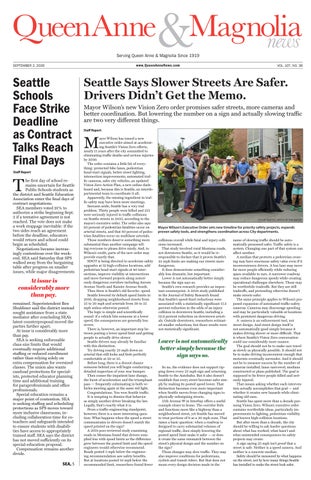
Mayor Wilson’s Executive Order sets new timeline for priority safety projects, expands proven safety tools, and strengthens coordination across City departments. collisions overall while fatal and injury collisions increased. That study involved rural Montana roads, not downtown Seattle, so it would be irresponsible to declare that it proves Seattle’s 25 mph limits are making our streets more dangerous. It does demonstrate something considerably less dramatic, but important: Lower is not automatically better simply because the sign says so. Seattle’s own research provides an important counterpoint. A 2024 study published in the Journal of Safety Research found that Seattle’s speed-limit reductions were associated with a statistically significant 17.2 percent reduction in the odds of an injury collision in downtown Seattle, including a 19.9 percent reduction on downtown arterials. Outside downtown, researchers estimated smaller reductions, but those results were not statistically significant.
Lower is not automatically better simply because the sign says so. So no, the evidence does not support ripping down every 25 mph sign and returning Seattle to the Autobahn. But it also doesn’t establish that every street becomes safer simply by making its posted speed lower. That distinction becomes even more important when Seattle moves from changing signs to physically redesigning streets. 15th Avenue W in Interbay offers a useful example closer to home. The corridor feels and functions more like a highway than a neighborhood street, yet Seattle has moved to treat portions of it as a 30 mph zone. That raises a basic question: when a roadway is designed to carry substantial volumes of regional traffic, does simply lowering the posted speed limit make it safer — or does it create the same mismatch between the street’s physical design and the number on the sign? Those changes may slow traffic. They may also improve conditions for pedestrians, cyclists and transit riders. But that does not mean every design decision made in the
name of slowing traffic should be automatically presumed safer. Traffic safety is a system. Changing one part of that system can affect another. A median that protects a pedestrian crossing may have enormous safety value even if it inconveniences drivers. A bus lane may move far more people efficiently while reducing space available to cars. A narrower roadway may reduce dangerous speeds while creating operational challenges elsewhere. Those may be worthwhile tradeoffs. But they are still tradeoffs, and pretending otherwise doesn’t make streets safer. The same principle applies to Wilson’s proposed expansion of automated traffic-safety cameras. Cameras may discourage speeding and may be particularly valuable at locations with persistent dangerous driving. A camera is an enforcement tool, not street design. And street design itself is not automatically good simply because it makes driving slower or more difficult. That is where Seattle’s Vision Zero conversation could use considerably more nuance. The goal should not be to make cars travel as slowly as physically possible. It should not be to make driving inconvenient enough that motorists eventually surrender. And it should not be to measure success by the number of cameras installed, lanes narrowed, medians constructed or plans published. The goal is supposed to be fewer people killed and seriously injured. That means asking whether each intervention actually accomplishes that goal — and whether it creates new hazards while eliminating old ones. Seattle has spent more than a decade pursuing Vision Zero. Wilson’s executive order contains worthwhile ideas, particularly improvements to lighting, pedestrian visibility and known high-collision locations. But after more than a decade, the city should be willing to ask harder questions about what has worked, what hasn’t and what unintended consequences its safety projects may create. A sign saying 25 mph isn’t proof that a street is safe. Neither is a speed camera. And neither is a concrete median. Safety should be measured by what happens on the street, not by how many things Seattle has installed to make the street look safer.