Serving Queen Anne & Magnolia Since 1919 www.QueenAnneNews.com
AUGUST 5, 2026
VOL. 107, NO. 32
Staff Report
T
here were no speeches. No podium. No program. Just a large crowd who came because sometimes the only thing left to do is show up for one another. At the International Fountain, handmade cards fluttered from the memorial trellises, while bouquets, candles, and other tributes surrounded the fountain and the memorial walls. Across the fountain, personalized memorial displays featuring blue hearts inscribed with the victims’ names were filled with handwritten notes and messages of love. The evening itself felt gentle, quiet music drifted through the crowd. Service dogs rested beside their handlers. Volunteers offered supplies for anyone who wanted to write a note, leave a flower, or simply stand in shared grief. Families cried. Friends embraced. News cameras documented the moment from a respectful distance, while firefighters, first responders, Seattle Center staff, community organizers, county employees, elected officials, and countless
volunteers stood together in support. It was a silent vigil, but it spoke volumes. Just days earlier, what should have been a joyful summer evening at the Bite of Seattle festival ended in tragedy. Three people were killed and four others, including a 2-year-old, were injured when gunfire erupted near the Seattle Center Armory during one of the city’s large annual celebrations. The investigation remains ongoing. Standing at the fountain on Wednesday evening, it was impossible not to think about the contrast: a place known for festivals, concerts, laughter, and wandering had become a place of mourning. State Representative Liz Berry, whose district includes Seattle Center, captured that feeling in a recent Instagram post, writing that “Seattle Center is the heart of my community” and reaffirming her commitment to advancing solutions to prevent gun violence because, as she wrote, “gun violence is preventable.” The vigil wasn’t about politics. It wasn’t about headlines. It was about remembering the people whose lives were taken,
LAURA MARIE RIVERA
Seattle Gathered in Silence.
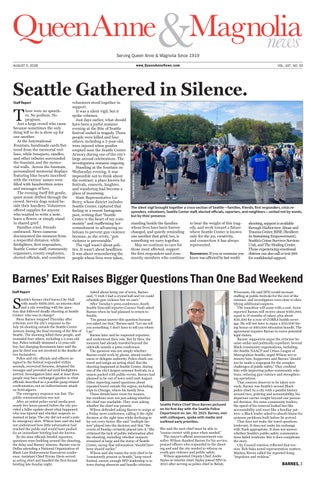
The silent vigil brought together a cross-section of Seattle—families, friends, first responders, crisis responders, volunteers, Seattle Center staff, elected officials, reporters, and neighbors—united not by words, but by their presence.
standing beside the families whose lives have been forever changed, and quietly reminding one another that grief, too, is something we carry together. May we continue to care for those most affected, support the first responders and community members who continue
to bear the weight of this tragedy, and work toward a future where Seattle Center is known only for the joy, creativity, and connection it has always represented. Resources: If you or someone you know was affected by last week’s
shooting, support is available through Harborview Abuse and Trauma Center, RISE (Resilient In Sustaining Empowerment), Seattle’s Crime Survivor Services Unit, and The Healing Center. Those experiencing emotional distress can also call or text 988 for confidential support.
Barnes’ Exit Raises Bigger Questions Than One Bad Weekend
S
eattle’s former chief leaves City Hall with nearly $600,000, an interim chief and a city wrestling with the question that followed deadly shooting at Seattle Center: who was in charge? Shon Barnes resigned Thursday after criticism over the city’s response to the July 26 shooting outside the Seattle Center Armory during the final evening of the Bite of Seattle. The shooting killed three people, and wounded four others, including a 2-year-old boy. Police initially detained a 15-year-old boy, but charging documents later said the gun he fired was not involved in the deaths of two bystanders. Police and city officials said officers assigned to the festival responded within seconds, recovered firearms, detained the teenager and provided aid until firefighters arrived. Investigators later said at least three people may have exchanged gunfire in what officials described as a possible gang-related confrontation, not an indiscriminate attack on festivalgoers. The emergency response was fast. The public communication was not. After an initial police social media post, nearly five hours passed before the city provided a fuller update about what happened, who was injured and whether suspects remained at large. The city did not send a public emergency alert. Wilson later said she had not understood how little information had reached the public and would have pushed for an immediate briefing had she known. By the time officials briefed reporters, questions were building around the shooting, the delay and Barnes’ absence. Barnes was in Dallas attending a National Organization of Black Law Enforcement Executives conference. Assistant Chief Tyrone Davis served as acting chief and handled the first formal briefing late Sunday night.
Asked about being out of town, Barnes said, “I wish I had a crystal ball and we could schedule gun violence but we can’t.” After Tuesday’s press conference, South Seattle Emerald reporter Connor Nash asked Barnes when he had planned to return to Seattle. “I’m gonna answer this question because you asked me that,” Barnes said. “Let me tell you something. I don’t have to tell you where I go.” Barnes later said he respected reporters and understood their role. But by then, the moment had already traveled beyond the sidewalk outside a press conference. The question was not simply whether Barnes could work by phone, attend conferences or delegate authority. Police chiefs can travel and assign an acting chief. But the shooting happened at Seattle Center, during one of the city’s largest summer festivals, in a season packed with public events. Barnes had planned to be out of town until mid-August. Other reporting raised questions about repeated travel outside the region, including trips to Chicago, where his family lives. Those details leave room for nuance, but residents were not just asking whether the chief was reachable. They were asking whether the chief was present. Wilson defended asking Barnes to resign at a Friday news conference, calling it the right decision at the right time while declining to lay out every factor. She said “multiple factors” played into the decision and that “the events of Sunday certainly played into it.” She criticized the lack of public information after the shooting, including whether suspects remained at large and the status of Seattle Center, saying that information “should have been shared earlier.” Wilson said she wants the next chief to be “consistently present in Seattle,” keep travel limited, ensure enough SPD leadership is in town during absences and handle criticism.
SEATTLE POLICE DEPARTMENT
Staff Report
Seattle Police Chief Shon Barnes pictured on his first day with the Seattle Police Department on Jan. 30, 2025. Barnes, met with colleagues, spoke with media and outlined early priorities. She said the next chief must be able to “course correct with grace when needed.” The mayor’s official announcement was softer. Wilson thanked Barnes for his service, praised officers who responded to the shooting and said the city needed to refocus on youth gun violence and public safety. Wilson appointed Deputy Chief Andre Sayles as interim chief. Sayles joined SPD in 2025 after serving as police chief in Beloit,
Wisconsin. He said SPD would increase staffing at public festivals for the rest of the summer, and investigators were close to identifying additional suspects. The transition will come with a cost. Axios reported Barnes will receive about $560,000, equal to 18 months of salary, plus about $30,300 for a year of COBRA health coverage. He will not have to repay a $50,000 hiring bonus or $60,000 relocation benefit. The agreement requires Barnes to waive potential legal claims. Barnes’ supporters argue the criticism became unfair and politically expedient. Several Black community organizations, including the Seattle NAACP and Urban League of Metropolitan Seattle, urged Wilson not to remove him. Supporters said Barnes “should not be made a scapegoat for the complex challenges of public safety.” They credited him with improving police-community relations, reducing gun violence and strengthening operations. That concern deserves to be taken seriously. Barnes was Seattle’s second Black police chief. In a city with a painful history around race, policing and accountability, his departure carries weight beyond one personnel decision. For some community leaders, the speed of his removal looked less like accountability and more like a familiar pattern: a Black leader asked to absorb blame for systemic problems built before he arrived. That does not make the travel questions irrelevant. It does not make his exchange with Nash appropriate. It does not answer whether Seattle’s public-safety communications failed residents. But it does complicate the story. City Council reaction reflected that tension. Rob Saka noted representation matters. Maritza Rivera called the reported firing “impulsive and reckless.”
BARNES, 3