Serving Queen Anne & Magnolia Since 1919 www.QueenAnneNews.com
JULY 15, 2026
VOL. 107, NO. 29
KCRHA Faces Major Downsizing
The regional authority will retain federal funding, data and coordination duties, while local governments prepare to take back homelessness-service contracts. A separate lawsuit alleges failures before the 2023 killing of Eina Kwon Staff Report
S
OFFICE OF THE MAYOR
eattle and King County are moving forward with a major restructuring of the King County Regional Homelessness Authority, sharply narrowing the agency’s role while stopping short of dissolving it. Seattle Mayor Katie B. Wilson and King County Executive Girmay Zahilay announced July 1 that city- and county-funded homelessness-service contracts will begin moving back to Seattle and King County in January 2027. Under the plan, KCRHA will continue operating as the region’s lead organization for federal homelessness funding, shared data systems and several countywide coordination functions. Direct administration of many shelter, housing, outreach and behavioralhealth contracts will return to the governments that originally transferred those duties to KCRHA. Wilson and Zahilay described the plan as a three-part effort to stabilize the agency’s finances, reduce its responsibilities and reconsider the future structure of the regional homelessness system.
CONTRACTS WILL RETURN TO LOCAL GOVERNMENTS
KCRHA currently administers approximately $200 million in local, state and federal homelessness funding and manages contracts with organizations providing housing, shelter, outreach and other services. Seattle and King County will develop a comprehensive transfer plan assigning city-funded contracts to the Seattle Human Services Department and countyfunded contracts to the Housing and Community Development Division of King County’s Department of Community and Human Services. The transfer plans are due to the Seattle and King County councils by Aug. 1. Contract-management responsibilities are scheduled to begin moving away from KCRHA in January 2027. Officials say service providers will be included in the planning process and that funding and services should continue during the transition. KCRHA has similarly said people experiencing homelessness, providers and community partners should not experience service disruptions because of the restructuring. Exactly how individual contracts will be divided, how many employees will be needed and how much money will remain under KCRHA’s control have not yet been finalized. KIRO 7 reported that Seattle and King County are expected to take back approximately $160 million in contracts. The station reported that KCRHA’s budget could decline by nearly $203 million, or almost 80 percent, but noted that the exact figure remains under development and will be addressed in the final plans.
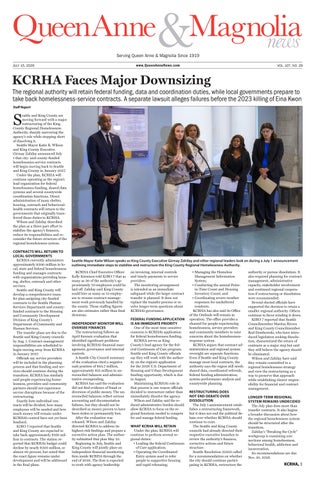
Seattle Mayor Katie Wilson speaks as King County Executive Girmay Zahilay and other regional leaders look on during a July 1 announcement outlining immediate steps to stabilize and restructure the King County Regional Homelessness Authority. KCRHA Chief Executive Officer Kelly Kinnison told KIRO 7 that as many as 30 of the authority’s approximately 70 employees could be laid off. Zahilay said King County could hire as many as 12 employees to resume contract-management work previously handled by the county. Those staffing figures are also estimates rather than final decisions.
INDEPENDENT MONITOR WILL OVERSEE FINANCES
The restructuring follows an April forensic evaluation that identified significant problems involving KCRHA’s financial management, governance and internal controls. A Seattle City Council summary of the evaluation cited a negative cash position of $44.7 million, approximately $13 million in unreconciled balances and administrative overspending. KCRHA has said the evaluation did not find evidence of fraud or diversion of public money. The unreconciled balances reflect serious accounting and documentation failures, but they should not be described as money proven to have been stolen or permanently lost. After the evaluation was released, Wilson and Zahilay directed KCRHA to address its highest-risk findings and prepare a corrective action plan. The authority submitted that plan May 22. Beginning in July, Seattle and King County will jointly place an independent financial monitoring firm inside KCRHA through the end of 2026. The firm is expected to work with agency leadership
on invoicing, internal controls and timely payments to service providers. The monitoring arrangement is intended as an immediate safeguard while the larger contract transfer is planned. It does not replace the transfer process or resolve longer-term questions about KCRHA’s governance.
FEDERAL FUNDING APPLICATION IS AN IMMEDIATE PRIORITY
One of the most time-sensitive concerns is KCRHA’s application for federal homelessness funding. KCRHA serves as King County’s lead agency for the federal Continuum of Care program. Seattle and King County officials say they will work with the authority on the region’s application for the 2026 U.S. Department of Housing and Urban Development funding opportunity, which is due in August. Maintaining KCRHA’s role in that process is one reason officials decided to restructure rather than immediately dissolve the agency. Wilson and Zahilay said the reduced administrative burden should allow KCRHA to focus on the regional functions needed to compete for and manage federal funding.
WHAT KCRHA WILL RETAIN
Under the plan, KCRHA will continue to perform several regional duties: • Leading the federal Continuum of Care application; • Operating the Coordinated Entry system used to refer people to supportive housing and rapid rehousing;
• Managing the Homeless Management Information System; • Conducting the annual Pointin-Time Count and Housing Inventory Count; and • Coordinating severe-weather responses for unsheltered residents. KCRHA has also said its Office of the Ombuds will remain in operation. The office provides a channel for people experiencing homelessness, service providers and community members to raise concerns about the homelessnessresponse system. KCRHA argues that contract administration and regional system oversight are separate functions. Even if Seattle and King County manage most local contracts, the authority says the region still needs shared data, coordinated referrals, federal funding administration, system-performance analysis and countywide planning.
RESTRUCTURING DOES NOT END DEBATE OVER DISSOLUTION
The July 1 announcement establishes a restructuring framework, but it does not end the political debate over whether KCRHA should continue to exist. The Seattle and King County councils had already directed their respective executive branches to review the authority’s finances, corrective actions and future structure. Seattle Resolution 32202 called for a recommendation on whether the city should continue participating in KCRHA, restructure the
authority or pursue dissolution. It also required planning for contract management, administrative capacity, stakeholder involvement and continued regional cooperation if restructuring or dissolution were recommended. Several elected officials have supported the decision to retain a smaller regional authority. Others continue to favor winding it down. KIRO 7 reported that Seattle Councilmember Maritza Rivera and King County Councilmember Rod Dembowski, who have introduced legislation seeking dissolution, characterized the return of contracts as a major step but said they still believe the agency should be eliminated. Wilson and Zahilay have said they remain committed to a regional homelessness strategy and view the restructuring as a way to preserve that approach while establishing clearer responsibility for financial and contract management.
LONGER-TERM REGIONAL SYSTEM REMAINS UNDECIDED
The July plan does more than transfer contracts. It also begins a broader discussion about how the regional homelessness system should be structured after the transition. Zahilay’s “Breaking the Cycle” workgroup is examining connections among homelessness, behavioral health, addiction and incarceration. Its recommendations are due Nov. 30, 2026.
KCRHA, 3