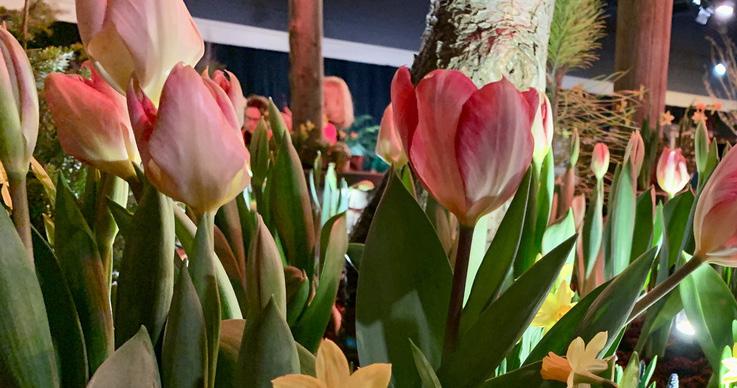
If you didn’t plant undulating carpets of snowdrops, crocus and early daffodils in Septem-ber, not to worry. Didn’t force any bulbs inside? It’s OK, read on. You can still enjoy some microdoses of oh-so-welcome flower power right now.
Queen Anne &Magnolia Queen Anne Queen Anne &Magnolia news
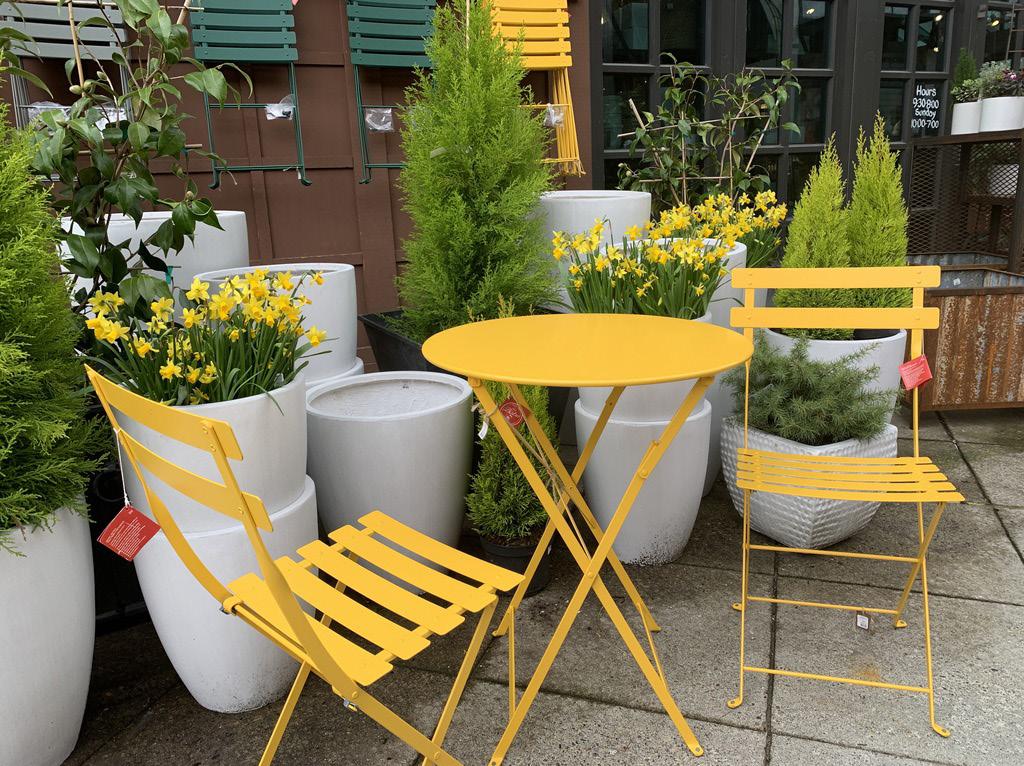
Happily, growers around the region did the growing and forcing for you, and supermarkets, florists and nurseries are beginning to glow with cheerful spring bulbs in pots. From small-est to largest, you’ll find tiny snowdrops with their dangling bells, upward-facing crocus, fragrant hyacinths, and narcissus (daffodils) from rockgarden-size “Tete a Tetes” to taller “February Gold” or “Thalia.” I love “Tete a Tetes” especially because they bloom for weeks and weeks, and their small size makes them easy to fit into borders without having to look at big gangly leaves after they bloom.
Winter containers
Feel free to dig these, pots and all into your outdoor containers for a winter reboot. If you need more, you’ll see primroses available in
every color, and some pansies, that make an excellent edgers around the bulbs. Other welcome supporting cast members would be per-ennials like hellebores and saxifrages, which will be blooming anon, which won’t need replacing next year.
There’s no reason you can’t fill an entire window box with spring bulbs for a fantastic display. Keep in mind, it will need changing out in a month or so.
Accentuate sleepy shrubs
Sure, shrubby dogwoods may be shining right now, and their bright winter stems make great adds to winter containers and arrangements, but other deciduous shrubs may not be looking their snazziest at the moment. (How do you look when you’re sleeping?) If you have a front-and-center hydrangea, ninebark (Physocarpus), or other sparse creature, why not add a skirt of bulbs at its feet? It won’t notice, and you’ll love the effect. This is a great location for permanent bulbs too.
Make a mass display
Get a collection of inexpensive terracotta pots or baskets to use as cachepots and display a curated field of bulbs anywhere you crave color – from your front steps to your dining table. The uniform containers will unify your collection.
Indoors, bulbs will probably finish blooming faster and will need to be planted outside ul-timately.
For the creatives with itchy fingers
Have you ever made a kokedama? The plant’s root ball and soil are rolled into balls and wrapped in sphagnum moss for hanging or table display. To secure
the moss, you typically use green florist’s wire or clear picture hanging filament. They are especially charming hung from trees. I recently saw British gardener @ lady_green_fingers create adorable kokedamas with spring bulbs, which really brings the flowers into view.
With their roots so close to the air, kokedama plants can dry out
more quickly, so be ready with a mister if rain is sketchy. You could also do this indoors temporarily but keep evenly moist.
Indoors
Likewise, you can make lovely table arrangements using potted spring bulbs inside. Consider
Business survey, report indicate good news for Washington state’s economy
By Brett Davis The Center Square
A recent survey by the Association of Washington Business shows cautious optimism among state employers, while a new study by WalletHub found that Washington employers aren’t struggling to find workers.
AWB’s most recent quarterly survey, based on 441 responses collected by email from busi-ness owners and operators across the state
from Jan. 16 through Jan. 30, hints at a more upbeat take on the economy.
According to the survey, 17% of respondents expect a recession in Washington in the next year, down from a quarter who said that a year ago. Almost half of respondents were opti-mistic that their businesses would see growth in the next six months.
However, respondents also said their five biggest challenges are government
regulations, the overall tax burden, inflation, the cost of health care and a lack of qualified workers.
The effects of the COVID-19 pandemic remain a concern as well, with 37% of respondents saying their business costs have gone up 21% to 30% since January 2021. More than 75% said their business had experienced rising energy costs in the past two years.
Manufacturers and agricultural producers were
asked about tariffs in light of President Donald Trump’s recent tariffs aimed at Canada, Mexico and China.
Trump says these tariffs will boost the U.S. economy and protect it from illegal immigration and the flow of drugs.
More than half – 54% – of respondents said they were concerned that potential tariffs or re-taliatory tariffs would negatively impact their business.
“Washington employers
are feeling slightly more confident about their businesses in the coming year, but it’s clear that rising costs remain a major concern,”
AWB President Kris Johnson said in a news release.
“Employers need certainty and predictability. We urge the Legislature to find ways to support businesses and grow the economy this year and not add to years of skyrocketing costs by passing new taxes and regulation.”
There was some more good news on Evergreen State’s economic front.
According to a new study by personal finance company WalletHub, Washington employers have the thirdsmallest hiring struggle in the U.S. Only California and Hawaii fared better than
Washington.
To see where employers are having the most trouble hiring new workers, WalletHub com-pared all 50 states and the District of Columbia based on the rate of job openings for both the latest month – January –and the last 12 months. The job openings rate in Washington during January was 3.8%, while the job openings rate in the past 12 months was 4.17%
“This suggests a relatively stable workforce with low turnover, which allows businesses to focus on growth rather than constant rehiring,” WalletHub analyst Chip Lupo told The Cen-ter Square in an email.
COURTESY
Queen Anne & Magnolia Worship Services
Twelfth Church of Christ, Scientist
In Person and Online Church Services
All are welcome & warmly invited to join these healing services
For best audio results, please join by clicking on the link from your computer or smartphone and choose “Call Over Internet”
All Zoom Services Meeting ID: 418 806 2637 https://us02web.zoom.us/j/4188062637
Sunday Services 11:00am – 12noon Pacific
Wednesday Testimonies 7:30pm – 8:30pm Pacific
Christian Science Quarterly Bible Lessons
Our weekly Bible Lesson Sermon may be found here: https://quarterly.christianscience.com/
For additional assistance, please contact us at seattle12cs@gmail.com or 206.283.2300 ChristianScienceTwelfthSeattle.com
Neighborhood Marketplace
Queen Anne Dental Group
Frank J. Calvo & Family Cosmetic, Implant, & General Dentistry
Boston St. 206-284-7812
SAVVY SENIOR
Service dogs can help seniors with disabilities
Dear Savvy Senior, What can you tell me about service dogs for seniors with disabilities? My 67-year-old father has chronic arthritis and Parkinson’s disease, and I’m wondering if an assistance dog could help make his life a little easier.
Dog Loving Leah
Dear Leah,
For people with disabilities and even medical conditions, service dogs can be fantastic help, not to mention they provide great companionship and an invaluable sense of security. But be aware that service dogs can be very expensive to purchase and the waiting list to get one can be long. Here’s what you should know.
While most people are familiar with guide dogs that help people who are blind or visually impaired, there are also a variety of assistance dogs trained to help people with physical disabilities, hearing loss and various medical conditions.
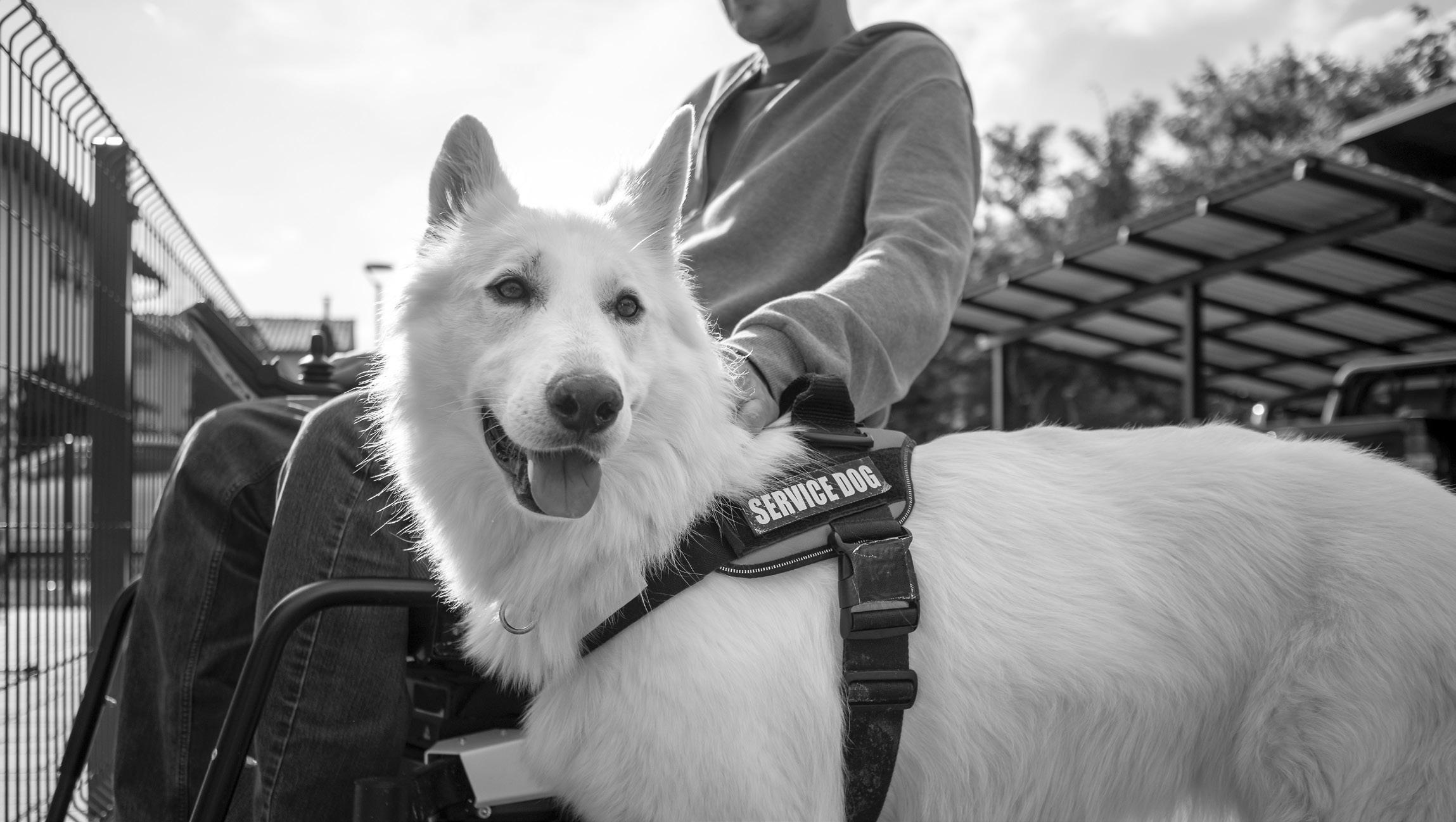
Unlike most pets, assistance dogs are highly trained canine specialists – often Golden and Labrador Retrievers, and German Shepherds – that know approximately 40 to 50 com-mands, are amazingly well-behaved and calm, and are permitted to go anywhere the public is allowed. Here’s a breakdown of the different types of assistance dogs and what they can help with.
Service dogs: These dogs are specially trained to help people with physical disabilities due to multiple sclerosis, spinal cord injuries, Parkinson’s disease, chronic arthritis and many other disabling conditions. They help by performing tasks their owner cannot do or has trouble doing, like carrying or retrieving items, picking up dropped items, opening and closing doors, turning light switches on and off, helping with balance, assisting with household chores, barking to indicate that help is needed and more.
Service dogs can also be trained to help people with medical conditions like epilepsy or other seizure disorders, autism, diabetes, PTSD and other psychiatric disabilities.
Guide dogs: For the blind and visually impaired, guide dogs help their owner get around safely by avoiding obstacles, stopping at curbs and steps, navigate shopping centers and buildings, find doors, seats, pedestrian crossing buttons and more.
Hearing dogs: For those who are deaf or hearing impaired, hearing dogs can alert their own-er to specific sounds such as ringing phones, doorbells, alarm clocks, microwave or oven timers, smoke alarms, approaching sirens, crying babies or when someone calls out their name.
a Dog
If your dad is interested in getting a service dog, contact some credible assistance dog train-ing programs. To find them, use the Assistance Dogs International website (Assistance-DogsInternational.org) which provides a listing of around 80 accredited members and 25 candidate programs in North America.
After you locate a few, you’ll need to either visit their website or call them to find out the types of training dogs they offer, the areas they serve, how long their waiting list is and what they charge. Most dog training programs charge anywhere from $10,000 to $40,000 or more for a fully trained service dog, however, most programs can assist with fundraising or grant applications for those in need. None of that cost is
covered by health insurance or Medicare.
To get an assistance dog, your dad will need to show proof of his disability, which his phy-sician can provide, and he’ll have to complete an application and go through an interview process. He will also need to go and stay at the training facility for a week or two so he can get familiar with his dog and get training on how to handle it. It’s also important to understand that assistance dogs are not for everybody. They require time, money, and care that your dad or some other friend or family member must be able and willing to provide. Send your senior questions to: Savvy Senior, P.O. Box 5443, Norman, OK 73070, or vis-it SavvySenior.org. Jim Miller is a contributor to the NBC Today show and author of “The Savvy Senior” book.
Building a connected community one lunch at a time
By Brooke Doyle
Iam frequently wowed by how connected our world is - you can push a button on your phone and have a quick video chat with someone across the world. I’m also stunned by the statistics that the Surgeon General published in his 2023 Advisory Our Epidemic of Loneliness and Isolation. Did you know that loneliness can harm our health as much as smoking 15 cigarettes a day? Fifteen cigarettes!
I was not surprised to learn that older adults are one of the groups experiencing the highest rates of social isolation, but I was shocked to learn that young adults are almost twice as likely to report feeling lonely than those over 65.
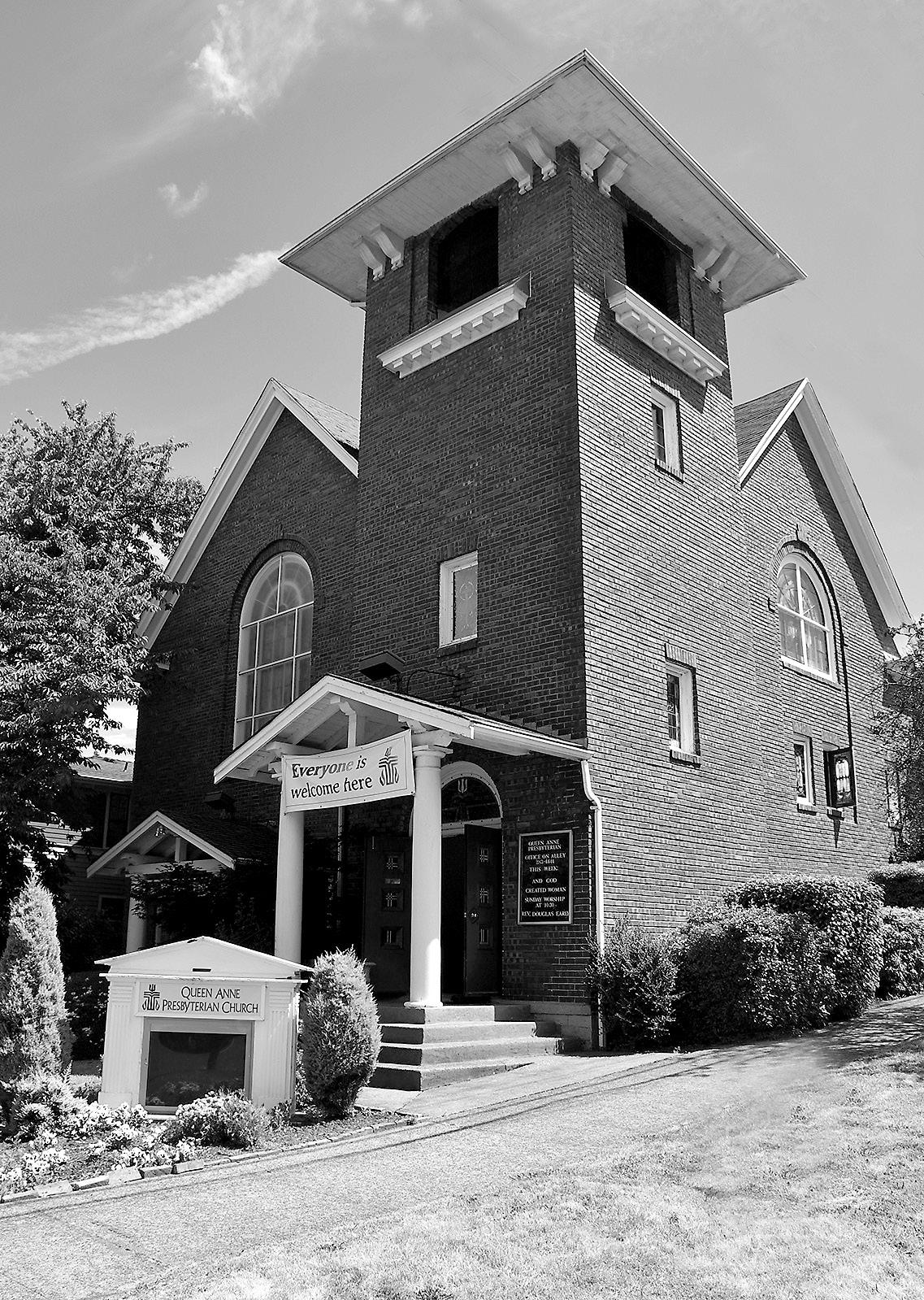
I am a member of Queen Anne Presbyterian Church, and we have been hosting a free lunch for senior citizens on Fridays since 1994. This Senior Gathering was started to help folks be connected, and the need remains. It’s a basic premise — provide a simple meal and an open door to join together for connection. While
the church has organized it, there is no religious component nor is there proselytizing. The point is to be a welcoming place for all.
Of course, we had to stop meeting during COVID. Churches came back slowly after the pandemic, and in 2021 we had not yet revived the Senior Gathering when one of the participants knocked on the door of one of our members and asked if we could just open up the building on Fridays to gather. She said they were just so lonely. Of course, we said yes. We opened the doors and welcomed back a small group. We didn't provide lunch at first but just had people bring their own. People were so thankful. Over the last year, we have put more energy into reimagining this gathering. In fact, we have been focused on centering the voices of the participants. The organizers, myself included, thought that the group might enjoy digital navigation services - that means having a person provide guidance in using technology. We were thinking the seniors could learn how to video call with their families and get groceries delivered. They were not interested! This was a good lesson
in making sure we were designing the program with the seniors, not for them. Instead, having free foot care was a real priority. We had offered this in the past, and our seniors saw this as a wonderful service. Marilyn Severson, longtime volunteer and participant, reflects, “The monthly foot care provided is a terrific service. The nurses who participate are welltrained and friendly. They answer questions, and each time my feet feel wonderful!”
Additionally, as our church members pitched in and assisted in re-energizing the Senior Gathering, our young adults said they were also feeling isolated and were interested in intentional connection. We have set up a program called “Adopt a Young Adult” where we match young adults with an older adult church member, and they have coffee or a meal every quarter or so to get to know each other.
Our long term vision for the gathering is that it's not just for seniors. It's for folks who want to connect over a midday meal on Fridays. That might be people working from home, stay at home parents, people who are
currently unemployed, seniors, etc. We are targeting seniors for now because we know they are an underserved population and they have been our focus since 1994. But we would like this gathering to be more intergenerational. We are located in a very
residential part of Queen Anne, and I like to imagine parents pushing strollers or remote workers walking their dog at lunch popping in for a meal and conversation on a Friday.
I would love our community to focus on building a culture of belonging. What would that look like? Perhaps reading a common book and having discussions at the library, Queen Anne Book Company, and in people’s homes? I noticed the Ballard branch of the Seattle Public Library had Board Game Sunday earlier this month. What a great, simple way to connect with others and reduce isolation! I’d love to hear your ideas. In the meantime, please stop in on Fridays at 11:30 a.m. at 414 W Howe St. to join us for lunch. Email qapcseniorgathering@gmail.com if you have questions or ideas!
Finding
ADOBE STOCK
COURTESY
Our serendipitous world
The first March I spent here there was so much rain.
One morning, as winter rain became spring rain, I lazed in bed wondering how I would do, what I would do, with all the hours ahead of me on a rainy day like this if I didn’t have my writing to see me through the hours? Someone who goes for a long walk through the neighborhood first thing in the morning instead of a few short steps to her desk?
And without missing a beat, I thought, I’m going to take the day off.
Why not? Who cares? It doesn’t mean I’m getting lazy. I know what’s likely for me (one morning away from my desk) and what isn’t (two). I threw off the covers and ignored my laptop, so there.
In minutes I was on the sidewalk. I walked to the bakery.
And there in a booth to my left were two women talking.
Two women talking are three of my favorite words.Two women talking with a wandering yet focused determination; two women talking seriously who manage to belly laugh at the same time; two women talking and probably not remembering everything that was said when they get home, just that everything was, well, these women tie the loose ends of me to the rest of me.
I stood in line pretending not to listen.
I listened.
Uneasy at first and then relieved to know I am not alone.
What are the odds of overhearing two women discuss a story so familiar? Because what one of the women said I know, and the next thing she said I know, and the rest of what she said, I know, I know, I know.
I faked a cough and stepped a little closer to the women.
In no time, I felt how much more fun it is to listen to a story about being so annoyed you are furious, than to be so annoyed you are furious. How much easier it is to listen to a woman trying to forgive herself than it is to forgive myself.
Basically, this is what I heard: One woman said her husband hadn’t remembered to pick up their
daughter after ballet class. Again. Again. That was key.
She was mad. After slamming the door, she drove off and kept driving until she ended up at Trader Joe’s. I could see it. That store is definitely the perfect de-fuming shopping spree destination. The wine aisle alone.
I liked her story. Not the tension of it so much, as what the telling of it meant for the telling of mine. Still, I could have just grabbed my coffee and gone for a walk instead of back to my desk to write . . . this: I don’t know about you, but I don’t often get invited to a formal dinner party.
So.
I bought a new dress. I bought a new shirt for my husband, one that is not a long-sleeved Hurley T-shirt. I found a bottle of wine that looked more expensive than it was and a wine bag with little dogs on it because I know the hostess loves dogs.
I put everything in a basket. I put everything is a basket because my husband was to pick me up after a bike ride I wanted to fit in before the party so that I could have seconds, have more wine, have desert, have more desert. All my husband had to do was remember to bring the basket.
I placed the basket by the front door. The door he had to exit to get out. When we met me at our designated pick-up spot, I was still wearing a bathing suit under a gauzy shift and flip-flops. (I’d also stopped by the pool to swim my laps because did I mention that the host made not one desert, but three?)
Oh no. Oh god. No.
Okay, I know you know what happens next. So did my sister. Who had the nerve to say, “It was really your fault. You should have put the basket in the car yourself.” (I love you anyway, sis.)
The look on his face said it all. “Um, I forgot, sorry.” And nothing else. Wait. Shouldn’t he say more than
nothing else? Shouldn’t he be sorry in a way that doesn’t sound like, ut oh, looks like I’m in the dog house. So I better say I’m sorry. There was major traffic; no time to return home for the basket.
My husband was quiet in the car. I was not even remotely quiet in the car. I said something that finally made him say something that made me say something that made him even quieter.
But not sorrier.
Part of me thought how could I act this way with the person in this world I love the most? The other part was thinking, I have not forgiven you yet, buddy, not even close.
It wasn’t so much that I had to go to a fancy dinner in a beach cover-up, or that my husband made a mistake. Who doesn’t make a mistake? It’s that his apology triggered something in me I have trouble explaining to him. I wish his apologies sounded like he cared more about what he was actually apologizing for. That’s the thing he doesn’t seem to get. But no matter how many times I’ve tried to explain this to him, his next apology sounds like, “Oh, gee, sorry.” This doesn’t excuse my anger but it does shed light on why my fuse has grown shorter.
At the party, everyone laughed at our “funny story.” On the way home, I don’t remember exactly what one of us said, maybe I told him what I’d read in another writer’s memoir, “we fight with our husbands so we won’t kill people,” but it was something that got us past the worst of us. And somehow we clicked back into place.
I forgave him. I forgave me. I still haven’t worn my new dress. Maybe to next Art Walk. Whenever I think of this story, I am reminded how listening to others (if a little sneakily) helps us to better know ourselves, and I am happy to say that I am a firm believer in a serendipitous world. Mary Lou Sanelli’s latest title is In So Many Words, nominated for a 2025 Washington State Book Award. A professional speaker and master dance teacher, she has written the “Falling Awake” column for Pacific Publishing’s Seattle newspapers for 17 years. For more information visit www.marylousanelli.com
Free tax help available at public libraries
By Seattle Public Library
The Seattle Public Library, United Way of King County (UWKC) and AARP are collaborating to offer free, in-person tax preparation service through mid-April at 12 Library locations. The Library is offering free drop-in tax help with UWKC at two locations and with AARP at 10 more locations.
Trained volunteers can answer questions and help you prepare your personal tax return. This service is free and available to individuals only. The service is not available for business tax returns. See the list of eligibility requirements and required documents you need to bring at spl.org/TaxHelp. You can also find an updated list of Tax Help sessions on our Tax Help calendar.
In 2024, the Library hosted 251 Tax Help sessions, which helped taxpayers file 4,514 returns through the Library.
TAX HELP AT THE CENTRAL LIBRARY AND SOUTH PARK BRANCH
UWKC Tax Help serves anyone who earned less than $80,000 in 2024. Drop-in help is availa-ble on a first-come, first-served basis. The last client will be taken 30-45 minutes before the end of Tax Help hours.
■ Central Library, 1000 Fourth Ave., Level 5 (through April 19) Mondays from 11 a.m. to 5 p.m. Tuesdays through Thursdays from 12:30 p.m. to 6:30 p.m. Saturdays and Sundays from 11 a.m. to 5 p.m.
■ South Park Branch, 8604 Eighth Ave. S. (through April 19) Saturdays from 11 a.m. to 5 p.m. Sundays from 11 a.m. to 5 p.m. Spanish support provided upon request.
TAX HELP AT 10 OTHER LOCATIONS
AARP offers both drop-in assistance is available on a first-come, first-served basis, and appointment-based assistance. Please note that you can make an appointment with AARP at their Tax Aide site.
■ Ballard Branch, 5614 22nd Ave. N.W. (through April 8)
Tuesdays from 11 a.m. to 3 p.m. (drop-in)
■ Broadview Branch, 12755 Greenwood Ave. N. (through April 14)
Mondays from noon to 3:30 p.m. (drop-in)
Wednesdays from 10 a.m. to 1:30 p.m. (drop-in)
■ Columbia Branch, 4721 Rainier Ave. S. (through April 11)
Fridays from 1 p.m. to 5 p.m. (appointment preferred)
■ Douglass–Truth Branch, 2300 E. Yesler Way, Seattle (through April 14)
Mondays from 12 p.m. to 4 p.m. (appointment preferred)
Saturdays from 12 p.m. to 4 p.m. (appointment preferred)
■ Greenwood Branch, 8016 Greenwood Ave. N. (through April 10)
Thursdays from 11 a.m. to 2:30 p.m. (drop-in)
■ NewHolly Branch, 7058 32nd Ave. S., Seattle (through April 12) Saturdays from noon to 4 p.m. (appointment preferred)
■ Northeast Branch, 6801 35th Ave. N.E. (through April 12) Saturdays from 11:30 a.m. to 3 p.m. (drop-in)
■ Queen Anne Branch, 400 W. Garfield St. (through April 13) Sundays from 11 a.m. to 2:30 p.m. (drop-in)
■ Southwest Branch, 9010 35th Ave. S.W. (through April 11) Fridays from 11 a.m. to 4 p.m. (appointment preferred)
■ West Seattle Branch, 2306 42nd Ave. S.W. (through April 12) Thursdays from 1 p.m. to 4 p.m. Saturdays from 11 a.m. to 3 p.m. (appointment preferred)
HOW
TO OBTAIN TAX FORMS
Most IRS forms, instructions and publications are available online at www.irs.gov. Due to federal budget cuts, the IRS is unable to provide the Library with certain tax forms and in-struction booklets. To ask the IRS to mail you forms and instructions, order online at www.IRS.gov/orderforms or call 1-800-829-3676.
You may make free black-andwhite prints of the forms from Library comput-ers: www.spl.org/
Mary Lou Sanelli
Pay-per-mile proposal draws praise, skepticism
By TJ Martinell The Center Square
A companion Senate bill to a House proposal setting Washington on a course toward a compulsory pay-per-mile program has generated similar skepticism over its ultimate form, including whether it would replace the state gas tax or simply become another source of transportation funding.
Like House Bill 1921, Senate Bill 5726, sponsored by Sen. Bill Ramos, D-Issaquah, would create a road usage charge program at 2.6 cents per mile, which would initially be voluntary. The program would then go on to make it mandatory for vehicles depending on their fuel efficiency; the program would apply to vehicles that weigh 10,000 lbs. or less, which means semitrucks would not be subject to the charge. The legislation allows for exemptions for certain types of vehicles, such as those publicly owned.
While the RUC revenue itself would be deposited into a state account that can only fund state highway projects, the bill imposes a separate 10% “assessment” of the total RUC charge a vehicle owner owes, which would be used for “multimodal transportation system purposes” such as transit.
The RUC is intended to act as a replacement for the state gas tax, which has experienced a decline in revenue that is only expected to continue moving forward due to a combination of higher fuel efficiency vehicles and an increase in the number of electric vehicles on the roadways. EVs currently pay an annual fee, and starting in 2035 it will be illegal for residents to register a new vehicle that runs on fossil fuels.
Ramos told colleagues at Tuesday’s Senate Transportation Committee public hearing that it’s “misinformation” for people to claim that “we’re going to have gas tax and road usage charts. It’ll be one or the other.”
He added that for those concerned about driver privacy, which has been a persistent source of apprehension by skeptics, the RUC can be paid simply by having the odometer reading checked during annual vehicle tab renewals. However, the bill does contain provisions related to data privacy protections, as the program would permit drivers to have more technically advanced ways of tracking their mileage.
However, Sen. Leonard Christian, RSpokane Valley, questioned whether the RUC would replace the gas tax based off remarks made during a work group presentation prior to the public hearing.
“I just can’t get that in my mind, that the two testimonies do not agree,” he said.
Ramos replied that the two will exist at the same time, and drivers who still pay the gas tax will be able to deduct it from any RUC they owe.
“That’s that piece that’s further out ... but it is an either/or, not both,” he explained.
Sen. Phil Fortunato, R-Auburn, argued that the real problem facing the state transportation budget isn’t declining gas tax revenue as much as inflation driving up costs.
“While this is nice for electric cars,” he said, “it’s not a solution to fully fund transportation to where we need.”
The bill drew support from officials from various transportation-related public entities and local government advocates, including the State Transportation
BULBS
From page A5
planting up a piece of bark or driftwood, or filling an urn, accessorized with lichen-covered branches and lots of moss. For inspiration, check out the work of florist Francoise Weeks (https://francoiseweeks.com/).
Care for next year
Once your potted bulbs are done blooming, you can replant in the garden (without its pot), adding some bulb fertilizer scratched into the soil surface. I’m not recommending planting in the container permanently because getting bulbs to overwinter in
SURVEY
From page A5
He went on to explain why Washington did so well in the survey.
“Washington’s high ranking reflects a better alignment between job openings and available talent, competitive wages, and
Commission, the Association of Washington Cities, and the Washington State Association of Counties.
Thurston County Commissioner Carolina Mejia, a board member of the County Road Administration Board, told the committee that “without a replacement for the motor vehicle fuel tax, CRAB will one day cease to exist, leaving the state’s 39 counties without a vital resource for infrastructure investment.”
“This is an opportunity to move forward toward a more sustainable and equitable system for funding our roads,” she said. However, others expressed skepticism that the bill would retain its existing form indefinitely.
Commercial trucker Richard Shilling told the committee that while the bill exempts his vehicle from the RUC, “this is clearly a bill just to establish a rate and work out the details later.”
“I will have to work 125 hours a year one month to pay for this tax,” he said. “That’s on top of the three months I work of work I have to do to pay federal tax.”
Jeff Pack with Washington Citizens Against Unfair Taxes told the committee that it “sounds like you’re just throwing something up against a wall and see if [is] sticks. [There’s] too many ‘we don’t know,’ or ‘to be implemented.’”
SB 5726 is currently not scheduled for further committee action.
containers can be tricky in our wet climate. Some bulbs are more likely to be perennial than others. Tulips are notoriously unpredictable, except for Darwin hybrids. Also, the bulbs may be tuckered out from being forced to bloom early, hence the bulb food. A return performance is not guaranteed, is what I’m saying. For best results, don’t trim the leaves – they help nourish the bulb to grow again another year. If you don’t have room for the bulbs, pass them along to a friend with a garden.
If you’re ready for more garden inspo, check out my new Substack newsletter, A Gardener’s Path https://ericabrownegrivas. substack.com/.
strong economic conditions that help retain workers,” Lupo said. “While hiring remains a challenge in some sectors, Washington’s labor market dynam-ics provide it with a competitive advantage, making it easier for businesses to fill positions compared to most other states.”