Serving Queen Anne & Magnolia Since 1919 www.QueenAnneNews.com
FEBRUARY 25, 2026
VOL. 107, NO. 9
Rain and All: Seattle Celebrates the Mayor Outlines First Winter by the Water Festival Priorities in First State of the City Address G Staff Report
S
OFFICE OF THE MAYOR
eattle Mayor Katie Wilson delivered her first State of the City address Tuesday at the Langston Hughes Performing Arts Institute, using the speech to outline her administration’s approach to public safety, homelessness, affordability, and preparation for potential federal actions affecting Seattle residents. Wilson opened by thanking performers Northwest Tap Connection and emcee Ben Hunter, along with city, county and community leaders in attendance. She noted the Langston Hughes institute’s long history as a community cultural resource and said she chose the venue intentionally, tying it to a message of learning from history and building coalitions to solve current challenges. Wilson also referenced Black History Month, the start of Ramadan and Lent, and Lunar New Year. She said the city is in a period when rights feel under threat nationally and that looking to history can help Seattle understand what progress has required in past difficult moments. Citing organizer Mariame Kaba, Wilson said, “Hope is a discipline,” describing it as something that requires practice, cleareyed realism, and consistent effort. PUBLIC SAFETY AND GUN VIOLENCE Wilson acknowledged recent violence in Seattle, including the killing of two Rainier Beach High School students who were shot while waiting for a bus after school. She also referenced recent deadly shootings in the Chinatown International District and Pioneer Square. She said her administration coordinated quickly with Seattle Police Department and Seattle Public Schools to increase security presence during times when students and families travel to and from school. She said the city is implementing a stabilization plan through the end of the school year in partnership with community organizations and city departments, with the goal of reducing conflict and preventing retaliation.
MAYOR, 8
ray skies and steady drizzle set the scene Saturday for the inaugural Winter by the Water, and somehow, it couldn’t have been more perfect. Seattle showed up anyway. Hosted by Seafair in partnership with ExplorePNW and presented by the Downtown Seattle Association, the one-day waterfront festival made its debut February 21 along Alaskan Way, stretching between Pier 50 and Pier 66. Designed as a celebration of Seattle’s quieter season, residents were invited to rediscover the evolving waterfront through food, music, art, and a self-guided Passport Adventure. And yes — it rained. But as Emily Parkhurst, owner of ExplorePNW, noted with a smile, it felt very onbrand for the first Winter by the Water to arrive with classic Seattle drizzle. The damp air, low clouds, and glistening pavement only amplified the festival’s message: this city doesn’t wait for blue skies to gather. Throughout the day, festivalgoers collected passport stamps
DIXIN YAN
Laura Marie Rivera
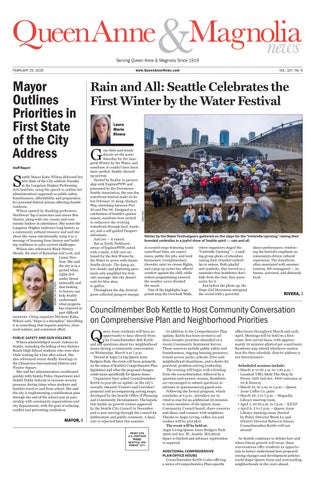
Winter by the Water Festivalgoers gathered on the steps for the “Umbrella Uprising,” raising their branded umbrellas in a joyful show of Seattle spirit — rain and all. at curated stops featuring iconic waterfront bites, art experiences, public fire pits, and local businesses. Complimentary chowder, mini ice cream flights, and a pop-up oyster bar offered comfort against the chill, while indoor programming ensured the weather never dictated the mood. One of the highlights happened atop the Overlook Walk,
where organizers staged the “Umbrella Uprising” — a smiling group photo of attendees raising their branded umbrellas in unison. Both playful and symbolic, they served as a reminder that Seattleites don’t hide from the rain; they accessorize for it. Just before the photo op, the Dope Girl Movement energized the crowd with a powerful
dance performance, reinforcing the festival’s emphasis on community-driven cultural expression. The waterfront, often associated with summer tourism, felt reimagined — intimate, activated, and distinctly local.
RIVERA, 3
Councilmember Bob Kettle to Host Community Conversation on Comprehensive Plan and Neighborhood Priorities
Q
ueen Anne residents will have an opportunity to hear directly from City Councilmember Bob Kettle and ask questions about key neighborhood issues during a community conversation on Wednesday, March 4 at 7 p.m. Hosted at Aegis Living Queen Anne Rodgers Park, the event will focus primarily on the status of Seattle’s Comprehensive Plan legislation and what the proposed changes could mean specifically for Queen Anne. Organizers have asked Councilmember Kettle to provide an update on the city’s recently released “Centers and Corridors” proposal and accompanying zoning maps, developed by the Seattle Office of Planning and Community Development. The legislation builds on growth centers approved by the Seattle City Council in December and is now moving through the council for deliberation and public comment. A final vote is expected later this summer. PRSRT STD U.S. POSTAGE
PAID
SEATTLE, WA PERMIT 1271
In addition to the Comprehensive Plan update, Kettle has been invited to address broader priorities identified in a recent Community Sentiment Survey. Those concerns include public safety and homelessness, ongoing housing pressures, transit access, parks, schools, litter and neighborhood cleanliness, and a desire for practical, problem-solving leadership. The evening will begin with a briefing from the councilmember, followed by a question-and-answer session. Residents are encouraged to submit questions in advance to queenannecc@gmail.com. Following the formal program, which concludes at 8 p.m., attendees are invited to stay for an additional 30 minutes to meet members of the Queen Anne Community Council board, share concerns and ideas, and connect with neighbors. Thanks to Aegis Living, coffee, tea and cookies will be provided. The event will be held at: Aegis Living Queen Anne Rodgers Park 2900 3rd Ave. W., Seattle, WA 98119 Space is limited and advance registration is required. ADDITIONAL COMPREHENSIVE PLAN OFFICE HOURS Councilmember Kettle is also offering a series of Comprehensive Plan-specific
office hours throughout March and early April. Meetings will be held on a firstcome, first-served basis, with approximately 10 minutes allotted per constituent. Residents may attend whichever session best fits their schedule; district address is not determinative. Scheduled sessions include: • March 4, 11:30 a.m. to 1:30 p.m. – Location TBD, likely The Shop by Porter, 1201 2nd Ave. #100 (entrance at 1st & Seneca) • March 18, 10 a.m. to 1 p.m. – Queen Anne Coffee Co. patio • March 26, 5 to 7 p.m. – Magnolia Library meeting room • April 1, 10:30 a.m. to 1 p.m. – KEXP • April 9, 3 to 5 p.m. – Queen Anne Library meeting room (hosted by Policy Director Brent Lo and District Director Rebecca Duran; Councilmember Kettle will not attend) As Seattle continues to debate how and where future growth will occur, these conversations offer residents an opportunity to better understand how proposed zoning changes and development policies could shape Queen Anne and surrounding neighborhoods in the years ahead.
2
FEBRUARY 25, 2026
Queen Anne & Magnolia
Worship Services
Sunday Worship at 10am
Live Streamed on our Facebook page and YouTube. Simply look for Magnolia Lutheran Church.
Neighborhood Marketplace HOME SERVICES
HOME SERVICES
CHIMNEY
ELECTRICAL SERVICES
Custom Masonry & Stoves, Inc.
Electric Company of Seattle
Fireplace and Chimney Repair
WHY WAIT?
Brick Home Restoration
Skilled Electricians Available Now!
Tuckpointing / Rebuilding
Pressure Washing
Christian Science Church Twelfth Church of Christ, Scientist 1700 28th Ave W, Seattle WA 98199
Panel changes and service upgrades our specialty! All types residential and commercial wiring. Stephen Brandeis, Master Electrician
LIC# *CUSTOMS077BE•BONDED•INSURED
(206) 524-4714 • Since 1962 Please see our reviews & photos on
206-633-3896
www.elcose.com Lic.#ELECTCI020BN • service@elcose.com
Service Calls Welcome
HOME SERVICES Discover the heart of what Christian Science is, and how it could be useful to you in your everyday life
Attend a Service
Visit the Reading Room
In-Person and Online
3210 W. McGraw, Seattle WA 98199
Sunday Services
Tuesday – Saturday 12pm – 3pm
11AM – 12PM Wednesday Testimony Meetings
7:30PM – 8:30PM
Details at ChristianScienceTwelfthSeattle.com
CALL: 206.283.6900
Additional Healing Resources ChristianScienceWA.org ChristianScienceTwelfthSeattle.com
All are welcome & warmly invited to join these healing services For additional assistance, please contact us at seattle12cs@gmail.com or 206.283.2300
For a Healthier You DENTISTS
CONSTRUCTION & ROOFING
Panel Upgrades • Repairs Senior Discount
206-782-1670
www.kemlyelectric.com Lic#KEMLYE1038DR
• All Types of Roofing • Aluminum Gutters • Leak Repairs • Roof & Gutter Cleaning • Moss Removal &Treatments • Dry Rot Repair • Fencing/Decks • Garage/Sheds • Custom Chimney Covers + Caps — 30+ Years Experience — Always FREE Estimates CALL 206-854-1706 206-783-3639 or 206-713-2140 www.bestway-construction.com BESTWC137LW
HOME SERVICES HANDYMAN SERVICES
SENIOR CITIZEN HOME REPAIRS A+ FREE ESTIMATES FAIR PRICES 40 YEARS EXPERIENCE
Queen Anne Dental Group
206-625-9900
AMERICAN GENERAL CONTRACTORS, INC. Licensed, Bonded and Insured WA lic #AMERIGC923B8
CLASSIFIED
WANTED
FOR SALE
Record LP’s/45’s, CD’s, Reel to Reel, 8 Track, Cassette Tapes.
4’x6’ black cargo trailer 2 wheel, locks included $3,000 christina1@hotmail.com
Dr. Frank J. Calvo & Family
Cosmetic, Implant, & General Dentistry
Call 206-499-5307
400 Boston St. 206-284-7812 www.QADG.net
YOUR AD HERE
DEADLINES
News Submissions | Friday, noon
Grow Your Business with Weekly Advertising
Christina Hill, 206-461-1300 ext. 303 or QAMagNews@pacificpublishingcompany.com
Retail Display Advertising | Wednesday, 1:30 p.m.
Christina Hill, 206-461-1300 ext. 305 or ppcadmanager@pacificpublishingcompany.com
Classified and Legal Advertising | Friday, noon
Jody Vinson, 206-461-1300 ext. 304 or legalads@pacificpublishingcompany.com
Subscriber Services |
Mikayla Morris, 206-461-1300 ext. 302 or ppccirc@pacificpublishingcompany.com
www.pacificpublishingcompany.com @pacificpubco
© 2026 Pacific Publishing Co. Inc. Address | 636 S. Alaska St., Seattle, WA 98108
• Low weekly rates • Flexible ad sizes • No ad? Don't worry! We can make it for you!
Call today to reserve your space! Contact: Christina Hill 206-461-1300 ext 305
Pacific Publishing Company – Queen Anne & Magnolia News • Madison Park Times • Eatonville Dispatch • Snohomish Tribune
Savvy Senior: Medicare Can Help Older Smokers Kick the Habit By Jim Miller Dear Savvy Senior, Does Medicare offer any coverage that helps beneficiaries quit smoking? —New Beneficiary
I
can save you money. A $8 packa-day smoker, for example, saves about $240 after one month without cigarettes, and nearly $2,880 after one year. HOW TO QUIT The first step you need to take is to set a “quit date,” but give yourself a few weeks to get ready. During that time, you may want to start by reducing the number or the strength of cigarettes you smoke to begin weaning yourself. Also check out over-the-counter nicotine replacement products – patches, gum and lozenges – to help curb your cravings (these are not covered by Medicare). And just prior to your quit day get rid of all cigarettes and ashtrays in your home, car, and place of work, and try to clean up and even spray air freshener. The smell of smoke can be a powerful trigger. GET HELP Studies have shown that you have a much better chance of quitting if you have help. So, tell your friends, family, and coworkers of your plan to quit. Others knowing can be a helpful reminder and motivator. Then get some counseling. Don’t go it alone. Start by contacting your doctor about smoking cessation counseling covered by
ZEPHYR STUDIOS
Dear New, f you’re ready to quit smoking, Medicare can indeed help! Medicare Part B covers up to eight face-to-face counseling sessions per year to help you kick the habit, and if you have a Medicare Part D prescription drug plan, certain smoking-cessation medications are covered as well. Here’s a guide to help you get started.
IT’S NEVER TOO LATE According to the Center of Disease Control and Prevention (CDC) 8.3 percent of Americans age 65 and older still smoke. Many older smokers indicate that they would like to quit, but because of the nicotine, which is extremely addictive, it’s very difficult to do. Tobacco use is the leading cause of preventable illness, responsible for an estimated one-fifth of deaths in the United States each year. But research shows that quitting, even after age 65, greatly reduces your risk of heart disease, stroke, cancer, osteoporosis and many other diseases. It also helps you breathe easier, smell, and taste better, and
SAVVY SENIOR, 8
Magnolia Branch to Close March 9–11 for Interior Upgrades
T
he Seattle Public Library’s Magnolia Branch will be closed Monday, March 9 through Wednesday, March 11 while interior improvements are completed. During the closure, the branch book return will also be unavailable, and all patron holds will be automatically extended. The library is scheduled to reopen on Thursday, March 12. Planned upgrades will focus on expanding and refreshing the children’s area. Improvements include new furniture,
RIVERA, FROM 1 Inside Pier 66, the BECU Vendor Marketplace offered warmth and bustle. Curated in partnership with Intentionalist, the marketplace spotlighted small businesses and provided a cozy counterpoint to the outdoor stroll. It was also home to one of the day’s biggest highlights: a preview of the 2026 Champions of Change celebrity pickleball event featuring Seahawks legends Michael Bennett, Doug Baldwin, and Cliff Avril. The trio — former teammates and philanthropic activists — brought charisma and camaraderie to the exhibition match. Baldwin served as emcee and team captain, effortlessly working the crowd while keeping the energy high. Bennett showcased both athletic skill and theatrical flair, drawing cheers with his showmanship and surprising finesse on the pickleball court. Avril proved the consummate professional, stepping back to invite public participation and stepping up at key moments to
updated flooring and the installation of an ADA-compliant self-check station to improve accessibility. A new mural will also be installed in the children’s section. The artwork, commissioned from a local Indigenous artist, celebrates interconnection with the natural world and is intended to create a welcoming, culturally reflective space for young readers and families. For additional information and updates, visit www.spl.org/Today.
close out plays with precision. The blend of accessibility and star power underscored the festival’s broader goal: connection across community lines. Throughout the day, Seafair President and CEO Emily Kang Cantrell could be seen bustling from activation to activation — greeting partners, checking logistics, and occasionally pausing
“Winter by the Water proved that Seattle’s waterfront doesn’t need the sun to shine.” to take in the scene. Her visible presence embodied the festival’s hands-on, collaborative spirit. Winter by the Water marks a strategic expansion for Seafair, the nonprofit long associated with major summer events, into yearround programming that keeps the waterfront alive beyond peak tourist months.
As afternoon gave way to evening, the energy shifted indoors for a Concert Celebration at Pier 66. Seattle’s new mayor, Katie Wilson, offered remarks highlighting the importance of activating downtown spaces in every season. Then came the music: local favorites Smokey Brights and The Talbott Brothers delivered performances that transformed the pier into a warm, communal gathering space. A live raffle drawing for travel and experience prizes — including Alaska Airlines vouchers — added to the celebratory tone. By nightfall, the damp chill still lingered outside, but inside, the atmosphere was unmistakably joyful. Winter by the Water proved that Seattle’s waterfront doesn’t need the sun to shine. With abundant indoor programming — restaurants, concerts, pickleball, vendor markets — and thoughtful outdoor moments designed to embrace rather than resist the rain, the festival demonstrated a simple truth: community isn’t seasonal. If anything, it’s strengthened by showing up when the skies are gray.
FEBRUARY 25, 2026
CROSSWORD
3
4
FEBRUARY 25, 2026
Legal Notices IN THE SUPERIOR COURT OF WASHINGTON IN AND FOR KING COUNTY In Re the Estate of DONALD MARTIN BROWN, Deceased. Case No. 26-4-013362KNT NON-PROBATE NOTICE TO CREDITORS RCW 11.42.030 The Notice Agent named below has elected to give notice to creditors of the above-named Decedent. As of the date of the filing of a copy of this Notice with the court, the Notice Agent has no knowledge of any other person acting as Notice Agent or of the appointment of a Personal Representative of the Decedent’s estate in the State of Washington. According to the records of the court as are available on the date of the filing of this Notice with the court, a cause number regarding the Decedent has not been issued to any other Notice Agent and a Personal Representative of the Decedent’s estate has not been appointed. Any person having a claim against the Decedent must, before the time the claim would be barred by any otherwise applicable statute of limitations, present the claim in the manner as provided in RCW 11.42.070 by serving on or mailing to the Notice Agent or the Notice Agent’s attorney at the address stated below a copy of the claim and filing the original of the claim with the court in which the Notice Agent’s Declaration and Oath were filed. The claim must be presented within the later of (1) Thirty days after the Notice Agent served or mailed the notice to the creditor as provided under RCW 11.42.020(2)(c); or (2) four months after the date of first publication of the notice. If the claim is not presented within this time frame, the claim is forever barred, except as otherwise provided in RCW 11.42.050 and 11.42.060. This bar is effective as to claims against both the Decedent’s probate and nonprobate assets. Date of First Publication: February 11, 2026 The Notice Agent declares under penalty of perjury under the laws of the State of Washington on02/06/2026 at Kent, Washington that the foregoing is true and correct. Signed: Jonnie Bell Brown Notice Agent Attorney for the Notice Agent: Brittany S. Stockton Address for Mailing or Service: Iddins Law Group 25052 104th Ave SE Suite B Kent WA 98030 Court of King County Published in the Queen Anne & Magnolia News February 11, 18 & 25, 2026 IN THE SUPERIOR COURT FOR KING COUNTY IN AND FOR THE STATE OF WASHINGTON ESTATE OF CHARLES Y. AYASHI, Deceased. No. 26-4-01176-9 SEA PROBATE NOTICE TO CREDITORS RCW 11.40.030 The person named below has been appointed as personal representative of this estate. Any person having a claim against the decedent that arose before the decedent’s death must, before the time the claim would be barred by any otherwise applicable statute of limitations, present the claim in the manner as provided in R.C.W. 11.40.070 by serving on or mailing to the personal representative or the personal representative’s attorney at the address stated below a copy of the claim and filing the original of the claim with the Court. The claim must be presented within the later of: (1) thirty days after the personal representative served or mailed the notice to the creditor as provided under R.C.W. 11,40.020(3); or (2) four months after the date of first publication of the notice. If the claim is not presented within this time frame, the claim is forever barred, except as otherwise provided in R.C.W. 11.40.051 and 11.40.060. This bar is effective as to claims against both the decedent’s probate and non-probate assets. DATE OF FIRST PUBLICATION: February 18, 2026. s/Judy Nakashima Shoji Attorney for Personal Representative WSBA# 22755 Personal Representative: Cynthia S. Shimabuku Address for Mailing or Service: JNS LAW PLLC 2400 NW 80th Street, #511 Seattle, WA 98117 Published in the Queen Anne & Magnolia News February 18, 25 & March 4, 2026 IN THE SUPERIOR COURT OF THE STATE OF WASHINGTON FOR KING COUNTY Estate of JULIEN JASSERME, Deceased. NO. 26-4-01019-3 SEA PROBATE NOTICE TO CREDITORS (RCW 11.40.030) The Administrator named below has been appointed as Administrator of this estate. Any person having a claim against the Decedent must, before the time the claim would be barred by any otherwise applicable statute of limitations, present the claim in the manner as provided in RCW 11.40.070 by serving on or mailing to the Administrator or the Administrator’s attorney at the address stated below a copy of the claim and filing the original of the claim with the court. The claim must be presented within the later of: (1) thirty days after the Administrator served or mailed the notice to the creditor as provided under RCW 11.40.020(1)(c); or (2) four months after the date of first publication of the notice. If the claim is not presented within this time frame, the claim is forever barred, except as otherwise provided in RCW 11.40.051 and 11.40.060. This bar is effective as to claims against both the decedent’s probate and nonprobate assets. DATE OF FIRST PUBLICATION: February 18, 2026 ADMINISTRATOR: Karla Cecilia Diaz-Parga ATTORNEY FOR ADMINISTRATOR: Ashley McAlhaney CMS Law Firm LLC ADDRESS FOR MAILING OR SERVICE: 811 Kirkland Avenue, Suite 201 Kirkland, WA 98033 206.659.1512 COURT OF PROBATE PROCEEDINGS: King County Superior Court CASE NUMBER: 26-4-01019-3 SEA Published in the Queen Anne & Magnolia News February 18, 25 & March 4, 2026
IN THE SUPERIOR COURT OF THE STATE OF WASHINGTON FOR KING COUNTY Estate of MICHAEL HARRIS, Deceased. NO. 26-4-01012-6 SEA PROBATE NOTICE TO CREDITORS (RCW 11.40.030) The Administrator named below has been appointed as Administrator of this estate. Any person having a claim against the Decedent must, before the time the claim would be barred by any otherwise applicable statute of limitations, present the claim in the manner as provided in RCW 11.40.070 by serving on or mailing to the Administrator or the Administrator’s attorney at the address stated below a copy of the claim and filing the original of the claim with the court. The claim must be presented within the later of: (1) thirty days after the Administrator served or mailed the notice to the creditor as provided under RCW 11.40.020(1)(c); or (2) four months after the date of first publication of the notice. If the claim is not presented within this time frame, the claim is forever barred, except as otherwise provided in RCW 11.40.051 and 11.40.060. This bar is effective as to claims against both the decedent’s probate and nonprobate assets. DATE OF FIRST PUBLICATION: February 18, 2026 ADMINISTRATOR: Ed William Lions ATTORNEY FOR ADMINISTRATOR: Elizabeth Brown CMS Law Firm LLC ADDRESS FOR MAILING OR SERVICE: 811 Kirkland Avenue, Suite 201 Kirkland, WA 98033 206.659.1512 COURT OF PROBATE PROCEEDINGS: King County Superior Court CASE NUMBER: 26-4-01012-6 SEA Published in the Queen Anne & Magnolia News February 18, 25 & March 4, 2026 IN THE SUPERIOR COURT OF THE STATE OF WASHINGTON FOR KING COUNTY Estate of PRESTON WADE DEGGINGER, Deceased. NO. 25-4-088887 SEA PROBATE NOTICE TO CREDITORS (RCW 11.40.030) The Personal Representative named below has been appointed as Personal Representative of this estate. Any person having a claim against the Decedent must, before the time the claim would be barred by any otherwise applicable statute of limitations, present the claim in the manner as provided in RCW 11.40.070 by serving on or mailing to the Personal Representative or the Personal Representative’s attorney at the address stated below a copy of the claim and filing the original of the claim with the court. The claim must be presented within the later of: (1) thirty days after the Personal Representative served or mailed the notice to the creditor as provided under RCW 11.40.020(1)(c); or (2) four months after the date of first publication of the notice. If the claim is not presented within this time frame, the claim is forever barred, except as otherwise provided in RCW 11.40.051 and 11.40.060. This bar is effective as to claims against both the decedent’s probate and nonprobate assets. DATE OF FIRST PUBLICATION: February 18, 2026 PERSONAL REPRESENTATIVE: Shawn Marie Danielson ATTORNEY FOR PR: Ashley McAlhaney CMS Law Firm LLC. ADDRESS FOR MAILING OR SERVICE: 811 Kirkland Ave Suite 201 Kirkland, WA 98033 Telephone: 206.659.1512 COURT OF PROBATE PROCEEDINGS: King County Superior Court CAUSE NUMBER: 25-4-08888-7 SEA Published in the Queen Anne & Magnolia News February 18, 25 & March 4, 2026 IN THE SUPERIOR COURT OF THE STATE OF WASHINGTON FOR KING COUNTY In the Matter of the Estate of MARJORIE E. BAKAMUS Deceased. IN PROh?h?i?h? No. 26-4-00537-8 KNT NOTICE TO CREDITORS The Personal Representative named below has been appointed and has qualified as personal representative of this estate. Persons having claims against the decedent must, prior to the time such claims would be barred by any otherwise applicable statute of limitations, serve their claims on the personal representative or the attorneys of record at the address stated below and file an executed copy of the claim with the Clerk of this Court within four months after the date of first publication of this notice or within four months after the date of filing of a copy of this Notice with the Clerk of the Court, whichever is later or, except under those provisions included in RCW 11.40.011 or 11.40.013, the claim will be forever barred. This bar is effective as to claims against both the probate assets and nonprobate assets of the decedent. DATE OF FIRST PUBLICATION: February 11, 2026 /s/ WILLIAM N. BAKAMUS /s/ GARY C. BERGAN Attorney for Estate WSBA NO. 7419 P.O. Box 1304 Issaquah, WA 98027 Published in the Queen Anne & Magnolia News February 11, 18 & 25, 2026 IN THE SUPERIOR COURT OF THE STATE OF WASHINGTON FOR THE COUNTY OF KING GSMPS MORTGAGE LOAN TRUST 2005-RP2, MORTGAGE PASS-THROUGH CERTIFICATES, SERIES 2005-RP2, U.S. BANK NATIONAL ASSOCIATION, AS TRUSTEE, SUCCESSOR-IN-INTEREST TO WACHOVIA BANK NATIONAL ASSOCIATION, AS TRUSTEE, Plaintiff, vs. BRIAN M HILFER, STEPHANIE L HILFER; , SECRETARY OF HOUSING AND URBAN DEVELOPMENT, OCCUPANTS OF THE PROPERTY, Defendants. Case No.: 25-2-18479-0 KNT SUMMONS BY PUBLICATION To: BRIAN M HILFER, STEPHANIE L HILFER; OCCUPANTS OF THE PROPERTY, THE STATE OF WASHINGTON TO THE SAID DEFENDANTS: You are hereby summoned
to appear within sixty days after the date of the first publication of this summons, to wit, within sixty days after the 25th day of February, 2026, and defend the above entitled action in the above entitled court, and answer the complaint of the Plaintiff, GSMPS MORTGAGE LOAN TRUST 2005-RP2, MORTGAGE PASS-THROUGH CERTIFICATES, SERIES 2005-RP2, U.S. BANK NATIONAL ASSOCIATION, AS TRUSTEE, SUCCESSOR-IN-INTEREST TO WACHOVIA BANK NATIONAL ASSOCIATION, AS TRUSTEE , and serve a copy of your answer upon the undersigned attorneys for Plaintiff, McCarthy & Holthus, LLP at the office below stated; and in case of your failure so to do, judgment will be rendered against you according to the demand of the complaint, which has been filed with the clerk of said court. The basis for the complaint is a foreclosure of the property commonly known as 12913 SE 172ND ST, RENTON, WA 98058, King County, Washington as a result of a default under the terms of the note and deed of trust. DATED: February 23, 2026 McCarthy & Holthus, LLP s/Grace Chu Grace Chu WSBA No. 51256 David Swartley WSBA No. 51732 108 1st Avenue South, Ste. 400 Seattle, WA 98104 Attorneys for Plaintiff Published in the Queen Anne & Magnolia News February 25, March 4, 11, 18, 25 & April 1, 2026 IN THE SUPERIOR COURT OF THE STATE OF WASHINGTON FOR THE COUNTY OF KING NATIONSTAR MORTGAGE LLC, Plaintiff, vs. UNKNOWN HEIRS, ASSIGNS AND DEVISEES OF JUSTIN MATTESON SHERRARD; OCCUPANTS OF THE PROPERTY, Defendants. Case No.: 25-2-35190-4 SEA SUMMONS BY PUBLICATION To: UNKNOWN HEIRS, ASSIGNS AND DEVISEES OF JUSTIN MATTESON SHERRARD, THE STATE OF WASHINGTON TO THE SAID DEFENDANTS: You are hereby summoned to appear within sixty days after the date of the first publication of this summons, to wit, within sixty days after the 11th day of February, 2026, and defend the above entitled action in the above entitled court, and answer the complaint of the Plaintiff, Nationstar Mortgage LLC, and serve a copy of your answer upon the undersigned attorneys for Plaintiff, McCarthy & Holthus, LLP at the office below stated; and in case of your failure so to do, judgment will be rendered against you according to the demand of the complaint, which has been filed with the clerk of said court. The basis for the complaint is a foreclosure of the property commonly known as 10757 17TH AVE SW, SEATTLE, WA 98146, King County, Washington as a result of a default under the terms of the note and deed of trust. DATED: February 6, 2026 McCarthy & Holthus, LLP s/Grace Chu Grace Chu WSBA No. 51256 David Swartley WSBA No. 51732 108 1st Avenue South, Ste. 400 Seattle, WA 98104 Attorneys for Plaintiff Published in the Queen Anne & Magnolia News February 11, 18, 25, March 4, 11 & 18, 2026 IN THE SUPERIOR COURT OF THE STATE OF WASHINGTON IN AND FOR THE COUNTY OF KING In re the Estate of MARY ALICE HUGGINS a/k/a MARY ALICE SCOTT, Deceased. No. 26-4-01394-0 SEA PROBATE NOTICE TO CREDITORS (11.40.030) The Personal Representative named below has been appointed as Personal Representative (PR) of this estate. Any person having a claim against the decedent must, before the time the claim would be barred by any otherwise applicable statute of limitations, present the claim in the manner as provided in RCW 11.40.070 by serving on or mailing to the PR or the PR’s attorney at the address stated below a copy of the claim and filing the original of the claim with the court. The claim must be presented within the later of: (1) thirty days after the Personal Representative served or mailed the notice to the creditor as provided under RCW 11.40.020(1)(c); or (2) four months after the date of first publication of the notice. If the claim is not presented within this time frame, the claim is forever barred, except as otherwise provided in RCW 11.40.051 and 11.40.060. This bar is effective as to claims against both the decedent’s probate and nonprobate assets. DATE OF FIRST PUBLICATION February 18, 2026 SAYRE LAW OFFICES, PLLC By: Eric C. Nelsen, WSBA #31443 Attorney for PR 1417 31st Ave South Seattle WA 98144-3909 (206) 625-0092 Jyvette Dobson Personal Representative c/o Sayre Law Offices, PLLC 1417 31st Ave South Seattle WA 98144-3909 (206) 625-0092 Published in the Queen Anne & Magnolia News February 18, 25 & March 4, 2026 IN THE SUPERIOR COURT OF THE STATE OF WASHINGTON IN AND FOR THE COUNTY OF KING In Re the Estate of: MARILYN J. HAMMER, Deceased. No. 26-4-00761-3 SEA PROBATE NOTICE TO CREDITORS (RCW 11.40.030) (NTCRD) The person named below has been appointed as Personal Representative of this Estate. Any person having a claim against the decedent must, before the time the claim would be barred by any otherwise applicable statute of limitations, present the claim in the manner as provided in RCW 11.40.070 by serving on or mailing to the Personal Representative or the Personal Representative’s attorney at the address stated below a copy of the claim and filing the original of the claim with the court in which the probate proceedings were commenced. The claim must be presented
within the later of: (1) Thirty days after the Personal Representative served or mailed the notice to the creditor as provided under RCW 11.40.020(1)(c); or (2) four months after the date of first publication of the notice. If the claim is not presented within this time frame, the claim is forever barred, except as otherwise provided in RCW 11.40.051 and 11.40.060. This bar is effective as to claims against both the decedent’s probate and nonprobate assets. Date of First Publication: 2/11/26 /s/ Marna Metcalf Marna Metcalf, Personal Representative /s/Bis Pierce Bis Pierce, WSBA #56755 Attorney for Personal Representative Address for Mailing or Service: Marna Metcalf, Personal Representative 8046 SE 72nd St. Mercer Island, WA 98040 Published in the Queen Anne & Magnolia News February 11, 18 & 25, 2026 IN THE SUPERIOR COURT OF THE STATE OF WASHINGTON IN AND FOR THE COUNTY OF PIERCE In re the Estate of: JOAN PATRICIA ISAAC, Deceased. NO. 26-4-00371-1 NOTICE TO CREDITORS The person named below has been appointed as Personal Representative of this estate. Any person having a claim against the Decedent must, before the time such claim would be barred by any otherwise applicable statute of limitations, present the claim as provided in RCW 11.40.070 by serving on or mailing to the Personal Representative or the Personal Representative’s attorney at the address stated below, a copy of the claim and filing of the original of the claim with the court in which the probate proceedings were commenced. The claim must be presented within the later of (1) Thirty days after the Personal Representative served or mailed this notice to the creditor as provided by RCW 11.40.010 (1)(c); or (2) four months after the date of first publication of this notice. If the claim is not presented within this time, then the claim is forever barred, except as provided in RCW 11.40.051 and 11.40.060. This bar is effective as to claims against both the Decedent’s probate assets and nonprobate assets. DATE OF FIRST PUBLICATION: February 25, 2026 PERSONALREPRESENTATIVE: /s/ Jean Anne Elliott MCCARTHY LAW OFFICE, PLLC By /s/ Conor E. McCarthy WSBA No 35497 1109 Tacoma Ave. South Tacoma, WA 98402 Phone:253-484-0142 Fax:253-572-8957 conor@conormccarthylaw.com Attorney for Personal Representative Address for Mailing or Service: 1109 Tacoma Ave. South Tacoma, WA 98402 Published in the Queen Anne & Magnolia News February 25, March 4 & 11, 2026 IN THE SUPERIOR COURT OF THE STATE OF WASHINGTON IN AND FOR THE COUNTY OF SNOHOMISH In the Matter of the Estate of Anthony M. Emmanuel, Deceased CAUSE NO. 25-402648-31 NOTICE TO CREDITORS (RCW 11.40.020) The person named below has been appointed Administrator of this estate. Any person having a claim against the Decedent must, before the time the claim would be barred by any otherwise applicable statute of limitations, present the claim in the manner provided in RCW 11.40.070 by serving on or mailing to the Administrator or the Administrator’s attorney at the address stated below a copy of the claim and filing the original of the claim with the court in which the probate proceedings were commenced. The claim must be presented within the later of: (1) Thirty days after the Administrator served or mailed the notice to the creditor as provided under RCW 11.40.020(1)(c); or (2) four months after the date of first publication of the notice. If the claim is not presented within this time frame, the claim is forever barred, except as otherwise provided in RCW 11.40.051 and 11.40.060. This bar is effective as to claims against both the Decedent’s probate and nonprobate assets. DATE OF FIRST PUBLICATION: February 11, 2026 ADMINISTRATOR Tracy Emmanuel 4015 281st Pl NE Redmond, WA 98053 ATTORNEY FOR ADMINISTRATOR Amber L. Hunt Woodinville Law 13901 NE 175th St, Ste G Woodinville, WA 98072 (425) 485-6600 Published in the Queen Anne & Magnolia News February 11, 18 & 25, 2026 IN THE SUPERIOR COURT OF THE STATE OF WASHINGTON IN AND FOR THE COUNTY OF SNOHOMISH In the Matter of the Estate of Jon E. Bylin, Deceased CAUSE NO. 26-4-00242-31 NOTICE TO CREDITORS (RCW 11.40.020) The person named below has been appointed Personal Representative of this estate. Any person having a claim against the Decedent must, before the time the claim would be barred by any otherwise applicable statute of limitations, present the claim in the manner provided in RCW 11.40.070 by serving on or mailing to the Personal Representative or the Personal Representative’s attorney at the address stated below a copy of the claim and filing the original of the claim with the court in which the probate proceedings were commenced. The claim must be presented within the later of: (1) Thirty days after the Personal Representative served or mailed the notice to the creditor as provided under RCW 11.40.020(1)(c); or (2) four months after the date of first publication of the notice. If the claim is not presented within this time frame, the claim is forever barred, except as otherwise provided in RCW 11.40.051 and 11.40.060. This bar is effective as to claims against both the Decedent’s probate and nonprobate assets. DATE OF FIRST PUBLICATION: Febru-
ary 25, 2026 PERSONAL REPRESENTATIVE Robert E. Bylin 1930 Lavender Way Gilroy, CA 95020 ATTORNEY FOR PERSONAL REPRESENTATIVE Amber L. Hunt Woodinville Law 13901 NE 175th St, Ste G Woodinville, WA 98072 (425) 485-6600 Published in the Queen Anne & Magnolia News February 25, March 4 & 11, 2026 IN THE SUPERIOR COURT OF THE STATE OF WASHINGTON IN AND FOR THE COUNTY OF SNOHOMISH In the Matter of the Estate of Richard Jarratt, Deceased CAUSE NO. 26-4-00089-31 NOTICE TO CREDITORS (RCW 11.40.020) The person named below has been appointed Personal Representative of this estate. Any person having a claim against the Decedent must, before the time the claim would be barred by any otherwise applicable statute of limitations, present the claim in the manner provided in RCW 11.40.070 by serving on or mailing to the Personal Representative or the Personal Representative’s attorney at the address stated below a copy of the claim and filing the original of the claim with the court in which the probate proceedings were commenced. The claim must be presented within the later of: (1) Thirty days after the Personal Representative served or mailed the notice to the creditor as provided under RCW 11.40.020(1)(c); or (2) four months after the date of first publication of the notice. If the claim is not presented within this time frame, the claim is forever barred, except as otherwise provided in RCW 11.40.051 and 11.40.060. This bar is effective as to claims against both the Decedent’s probate and nonprobate assets. DATE OF FIRST PUBLICATION: February 18, 2026 PERSONAL REPRESENTATIVE Carol A. Porter 17622 185th Ave NE Woodinville, WA 98072 ATTORNEY FOR PERSONAL REPRESENTATIVE Amber L. Hunt Woodinville Law 13901 NE 175th St, Ste G Woodinville, WA 98072 (425) 485-6600 Published in the Queen Anne & Magnolia News February 18, 25 & March 4, 2026 IN THE SUPERIOR COURT OF THE STATE OF WASHINGTON IN AND FOR THE COUNTY OF SNOHOMISH IN THE MATTER OF THE ESTATE OF: ANDREW JAMES MACK, Deceased. No. 26-4-0035431 PROBATE NOTICE TO CREDITORS (RCW 11.40.030) The personal representative named below has been appointed as personal representative of this estate. Any person having a claim against the decedent must, before the time the claim would be barred by any otherwise applicable statute of limitations, present the claim in the manner as provided in RCW 11.40.070 by serving on or mailing to the personal representative or the personal representative’s attorney at the address stated below a copy of the claim and must be presented within the later of: (1) Thirty days after the personal representative served or mailed the notice to the creditor as provided under RCW 11.40.020(3); or (2) four months after the date of first publication of the notice. If the claim is not presented within this time frame, the claim is forever barred, except as otherwise provided in RCW 11.40.051 and 11.40.060. This bar is effective as to claims against both the decedent’s probate and non-probate assets. Date of filing of Notice to Creditors: February 18, 2026 Date of first publication: February 25, 2026 /s/ THOMAS E. MACK Personal Representative of Estate of ANDREW JAMES MACK COURT OF PROBATE PROCEEDINGS: SNOHOMISH COUNTY SUPERIOR COURT CAUSE NUMBER: See Caption as stamped by clerk above ATTORNEY FOR ESTATE: PATRICK M. TRIVETT, WSBA #38906 LAW OFFICES OF P. TRIVETT, PLLC 1031 State Avenue, Suite 103 Marysville, Washington 98270 Phone: (360) 6532525 Fax: (360) 653-6860 Published in the Queen Anne & Magnolia News February 25, March 4 & 11, 2026 IN THE SUPERIOR COURT OF WASHINGTON FOR KING COUNTY In Re The Estate of: CHRISTOPHER MICHAEL WASHBURN, Deceased. No. 26-4-008130 SEA PROBATE NOTICE TO CREDITORS (RCW 11.40.030) (NTCRD) The person named below has been appointed as Administrator of this Estate. Any person having a claim against the decedent must, before the time the claim would be barred by any otherwise applicable statute of limitations, present the claim in the manner as provided in RCW 11.40.070 by serving on or mailing to the Administrator or the Administrator’s attorney at the address stated below a copy of the claim and filing the original of the claim with the court in which the probate proceedings were commenced. The claim must be presented within the later of: (1) Thirty days after the Administrator served or mailed the notice to the creditor as provided under RCW 11.40.020(1)(c); or (2) four months after the date of first publication of the notice. If the claim is not presented within this time frame, the claim is forever barred, except as otherwise provided in RCW 11.40.051 and 11.40.060. This bar is effective as to claims against both the decedent’s probate and nonprobate assets. Date of First Publication: February 11, 2026. Walter D. Washburn, Administrator Robin Swanson, Attorney for Administrator Bar #:39057 Address for Mailing or Service: Robin Swanson at Secure Legal Legacy, PLLC 12345 Lake City Way NE #2009, Seattle, WA, 98125 206-851-2413 Court of probate proceedings and cause number: King County Superior Court (SEA) 26-4-00813-0 SEA Published in the Queen
Pacific Publishing Company – Queen Anne & Magnolia News • Madison Park Times • Eatonville Dispatch • Snohomish Tribune
Anne & Magnolia News February 11, 18 & 25, 2026 IN THE SUPERIOR COURT OF WASHINGTON FOR KING COUNTY In Re The Estate of: DAVID JAMES BEATTY, Deceased. No. 25-4-07661-7 PROBATE NOTICE TO CREDITORS (RCW 11.40.030) (NTCRD) The person named below has been appointed as Personal Representative of this Estate. Any person having a claim against the decedent must, before the time the claim would be barred by any otherwise applicable statute of limitations, present the claim in the manner as provided in RCW 11.40.070 by serving on or mailing to the Personal Representative or the Personal Representative’s attorney at the address stated below a copy of the claim and filing the original of the claim with the court in which the probate proceedings were commenced. The claim must be presented within the later of: (1) Thirty days after the Personal Representative served or mailed the notice to the creditor as provided under RCW 11.40.020(1)(c); or (2) four months after the date of first publication of the notice. If the claim is not presented within this time frame, the claim is forever barred, except as otherwise provided in RCW 11.40.051 and 11.40.060. This bar is effective as to claims against both the decedent’s probate and nonprobate assets. Date of First Publication: February 18, 2026. /s/ BARBARA L. BRABETZ Personal Representative Print Name: Barbara L. Brabetz Address for Mailing or Service: BARBARA L. BRABETZ 171 LOST VALLEY RD AMSTERDAM, NY 12010 518-461-7718 Court of probate proceedings and cause number: -King County Superior Court 25-4-07661-7 Published in the Queen Anne & Magnolia News February 18, 25 & March 4, 2026 IN THE SUPERIOR COURT OF WASHINGTON FOR KING COUNTY In Re The Estate of: SEAN DAVID ORMSBY, Deceased. No. 26-4-01281-1 KNT PROBATE NOTICE TO CREDITORS (RCW 11.40.030) (NTCRD) The person named below has been appointed as Administrator of this Estate. Any person having a claim against the decedent must, before the time the claim would be barred by any otherwise applicable statute of limitations, present the claim in the manner as provided in RCW 11.40.070 by serving on or mailing to the Administrator or the Administrator’s attorney at the address stated below, a copy of the claim and filing the original of the claim with the court in which the probate proceedings were commenced. The claim must be presented within the later of: (1) Thirty days after the Administrator served or mailed the notice to the creditors as provided under RCW 11.40.020(1)(c); or (2) four months after the date of first publication of this notice. If the claim is not presented within this time frame, the claim is forever barred, except as otherwise provided in RCW 11.40.051 and RCW 11.40.60. This bar is effective as to claims against both the decedent’s probate and nonprobate assets. Date of First Publication: February 18, 2026 Administrator: Lynn Ormsby DATED this 9th day of February, 2026 at Federal Way, Washington. /s/ Chad Horner Chad Horner, WSBA #27122 GRAUNKE AYOUB LAW 33400 9th Avenue S, Suite 120 Federal Way, WA 98003 Telephone: 206-652-4310 Facsimile: 206-6860190 Email: chad@graunke-ayoub.com Counsel for Administrator Address for Mailing or Service: Graunke Ayoub Law33400 9th Avenue S, Suite 120 Federal Way, WA 98003 Published in the Queen Anne & Magnolia News February 18, 25 & March 4, 2026 IN THE SUPERIOR COURT OF WASHINGTON IN AND FOR KING COUNTY In Re the Estate of: DEANNA LORETTA FORD, Deceased. Probate No. 26-4-01290-1 KNT PROBATE NOTICE TO CREDITORS RCW 11.40.030 The Administrator named below has been appointed as Administrator of this estate. Any person having a claim against the Decedent must, before the time the claim would be barred by any otherwise applicable statute of limitations, present the claim in the manner as provided in RCW 11.40.070 by serving on or mailing to the Administrator or the Administrator’s attorney at the address stated below a copy of the claim and filing the original of the claim with the court in which the probate proceedings were commenced. The claim must be presented within the later of: (1) Thirty days after the Administrator served or mailed the notice to the creditor as provided under RCW 11.40.020(1)(c); or (2) four months after the date of first publication of the notice. If the claim is not presented within this time frame, the claim is forever barred, except as otherwise provided in RCW 11.40.051 and 11.40.060. This bar is effective as to claims against both the Decedent’s probate and nonprobate assets. Date of First Publication: Wednesday, February 25, 2026 Personal Representative: Randall Eugene Ford Attorney for the Personal Representative: Robert C. Iddins Address for Mailing or Service: Iddins Law Group 25052 104th Ave SE, Suite B Kent, WA 98030 Court of probate proceedings and cause number: King County Superior Court 26-4-01290-1 KNT Published in the Queen Anne & Magnolia News February 25, March 4 & 11, 2026 ORIGINAL TRUSTEE SALE RECORDED ON 10/24/2025 IN THE OFFICE OF THE KING COUNTY RECORDER. NOTICE OF TRUSTEE’S SALE File No.:23-128796 Title Order No.:794908 Grantor: Hyoung Lae Paik, an unmarried man Current beneficiary of the deed of trust: Wells Fargo Bank, N.A. Current trustee of the deed of trust: Aztec Foreclosure Corporation of Washington
Current mortgage servicer of the deed of trust: Wells Fargo Bank, N.A. Reference number of the deed of trust: 20001109001358 Parcel number(s): 0520900060-09 Abbreviated legal description: Lot 6 Bardahl Park No. 3, Vol 61, Page 89 records of King County Washington Commonly known as: 20018 2nd Avenue NW, Shoreline, WA 98177 I. NOTICE IS HEREBY GIVEN that the undersigned Trustee, AZTEC FORECLOSURE CORPORATION OF WASHINGTON will on March 6, 2026, at the hour of 9:00 AM at the 4th Avenue Entrance of the King County Administration Building, located one block east of the Courthouse, 500 4th Avenue, in the City of Seattle, WA, State of Washington, sell at public auction to the highest and best bidder, payable at time of sale, the following described real property, situated in the County of King, State of Washington, to-wit: Lot 6, Bardahl Park No. 3 according to the Plat thereof recorded in Volume 61 of Plats, Page 89, Records of King County, Washington, situate in the County of King, State of Washington. which is the subject of that certain Deed of Trust dated November 9, 2000, recorded November 9, 2000, under Auditor’s File No. 20001109001358, records of King County, Washington, from Hyoung Lae Paik, an unmarried man as Grantor, to First American Title Insurance Company, a California Corporation as Trustee, to secure an obligation in favor of World Savings Bank, FSB, a Federal Savings Bank, its successors and/or assignees as Beneficiary. II. No action commenced by the Beneficiary of the Deed of Trust is now pending to seek satisfaction of the obligation in any Court by reason of the Borrower’s or Grantor’s default on the obligation secured by the Deed of Trust. III. The Default(s) for which this foreclosure is made is/are as follows: Failure to pay when due the following amounts which are now in arrears: Delinquent monthly payments from the May 15, 2020 installment on in the sum of $111,920.10 together with all fees, costs and or disbursements incurred or paid by the beneficiary and or trustee, their employees, agents or assigns. The Trustee’s fees and costs are estimated at $3,337.06 as of October 20, 2025. The amount to cure the default payments as of the date of this notice is $117,177.29. Payments and late charges may continue to accrue and additional advances to your loan may be made. It is necessary to contact the beneficiary or Trustee prior to the time you tender the reinstatement amount so that you may be advised of the exact amount you would be required to pay. IV. The sum owing on the obligation secured by the Deed of Trust is: Principal Balance $130,471.78, together with interest in the Note or other instrument secured from April 15, 2020, plus a Deferred Balance of $370.11 and such other costs and fees as are due under the Note or other instrument secured, and as are provided by statute. The amount necessary to pay off the entire obligation secured by your Deed of Trust as the date of this notice is $243,450.34. Interest and late charges may continue to accrue and additional advances to your loan may be made. It is necessary to contact the beneficiary or Trustee prior to the time you tender the payoff amount so that you may be advised of the exact amount you would be required to pay. V. The above-described real property will be sold to satisfy the expense of sale and the obligation secured by the Deed of Trust as provided by statute. The sale will be made without warranty express or implied regarding title, possession, or encumbrances on March 6, 2026. The default(s) referred to in paragraph III, together with any subsequent payments, late charges, advances, costs and fees thereafter due, must be cured by February 23, 2026 (11 days before the sale date), to cause a discontinuance of the sale. The sale will be discontinued and terminated if at any time on or before February 23, 2026 (11 days before the sale date), the default(s) as set forth in paragraph III, together with any subsequent payments, late charges, advances, costs and fees thereafter due, is/are cured and the Trustee’s fees and costs are paid. The sale may be terminated any time after February 23, 2026 (11 days before the sale date), and before the sale by the Borrower, Grantor, any Guarantor or the holder of any recorded junior lien or encumbrance paying the entire principal and interest secured by the Deed of Trust, plus costs, fees and advances, if any, made pursuant to the terms of the obligation and/ or Deed of Trust, and curing all other defaults. VI. A written notice of default was transmitted by the Beneficiary or Trustee to the Borrower and Grantor at the following addresses: Estate of Hyoung Lae Paik 20018 2nd Avenue NW Shoreline, WA 98177 Unknown Heirs & Devisees of Hyoung Lae Paik 20018 2nd Avenue NW Shoreline, WA 98177 Julie Lee, Son of Hyoung Lae Paik, deceased 22343 Bahl Street Cupertino, CA 95014 Soo Kyoung Paik aka Soo K. Paik aka Soo Paik 20018 2nd Avenue NW Shoreline, WA 98177 Soo Kyoung Paik c/o Escrow Connection 19031 33rd Avenue W. Lynnwood, WA 98036 Occupant(s) 20018 2nd Avenue NW Shoreline, WA 98177 by both first class and certified mail on September 15, 2023 proof of which is in the possession of the Trustee; and the Borrower and Grantor were personally served on September 15, 2023 with said written notice of default or the written notice of default was posted in a conspicuous place on the real property described in paragraph I above, and the Trustee has possession of proof of such service or posting. The declaration by the beneficiary pursuant to RCW 61.24.030(7)(a) was transmitted by the Beneficiary or Trustee to the Borrower and Grantor at the above ad-
dresses on September 15, 2023, proof of which is in possession of the Trustee. VII. The Trustee whose name and address are set forth above, and whose telephone number is (360) 253-8017 / (877) 430-4787 will provide in writing to anyone requesting it, a statement of all costs and fees due at any time prior to the sale. VIII. The effect of the sale will be to deprive the Grantor and all those who hold by, through or under the Grantor of all their interest in the above-described property. IX. Anyone having an objection to the sale on any grounds whatsoever will be afforded an opportunity to be heard as to those objections if they bring a lawsuit to restrain the sale pursuant to RCW 61.24.130. Failure to bring such a lawsuit may result in a waiver of any proper grounds for invalidating the Trustee’s sale. X. NOTICE TO OCCUPANTS OR TENANTS The purchaser at the trustee’s sale is entitled to possession of the property on the 20th day following the sale, as against the grantor under the deed of trust (the owner) and anyone having an interest junior to the deed of trust, including occupants, who are not tenants. After the 20th day following the sale the purchaser has the right to evict occupants who are not tenants by summary proceedings under Chapter 59.12 RCW. For tenant-occupied property, the purchaser shall provide a tenant with written notice in accordance with RCW 61.24.60. XI. THIS NOTICE IS THE FINAL STEP BEFORE THE FORECLOSURE SALE OF YOUR HOME. You have only 90 calendar days BEORE the date of sale listed in the Notice of Trustee’s Sale. If an amended Notice of Sale is recorded providing a 45-day notice of the sale, mediation must be requested no later than 25 days BEFORE the date of sale listed in the amended Notice of Trustee’s Sale. DO NOT DELAY. CONTACT A HOUSING COUNSELOR OR AN ATTORNEY LICENSED IN WASHINGTON NOW to assess your situation and refer you to mediation if you are eligible and it may help you save your home. See below for safe sources of help. SEEKING ASSISTANCE Housing counselors and legal assistance may be available at little or no cost to you. If you would like assistance in determining your rights and opportunities to keep your house, you may contact the following: The statewide foreclosure hotline for assistance and referral to housing counselors recommended by the Housing Finance Commission: Telephone (Toll-free): 1-877-894HOME (1-877-894-4663) or Web site: http:// www.homeownership-wa.org/. The United States Department of Housing and Urban Development: Telephone (Toll-free): 1-800569-4287 or local counseling agencies: https://answers.hud.gov/ housingcounseling/s/?language=en_US The statewide civil legal aid hotline for assistance and referrals to other housing counselors and attorneys: Telephone (TollFree): 1-800-606-4819 or Web site: http:// nwjustice.org/home XII. FAIR DEBT COLLECTION PRACTICES ACT NOTICE: AZTEC FORECLOSURE CORPORATION OF WASHINGTON is attempting to collect a debt and any information obtained will be used for that purpose. If a discharge has been obtained by any party through bankruptcy proceedings, this shall not be construed to be an attempt to collect the outstanding indebtedness or to hold you personally liable for the debt. DATED this 23 day of October, 2025 AZTEC FORECLOSURE CORPORATION OF WASHINGTON By: Kathy Zagariya Vice President 1499 SE Tech Center Place, Suite 255 Vancouver, WA 98683 (360) 253-8017 / (877) 430-4787 ADDRESS FOR PERSONAL SERVICE Aztec Foreclosure Corporation of Washington 1499 SE Tech Center Place, Suite 255 Vancouver, WA 98683 STATE OF WASHINGTON ) ) SS. COUNTY OF CLARK ) This instrument was acknowledged before me this 23rd day of October, 2025, by Kathy Zagariya, Vice President. Kira Lynch Notary Public in and for the State of Washington My Commission Expires: 10/6/2028 KIRA LYNCH Notary Public State of Washington Commission # 188037 My Comm. Expires Oct 6, 2028 NPP0480503 To: QUEEN ANNE & MAGNOLIA NEWS 02/04/2026, 02/25/2026 STATE OF WASHINGTON CLARK COUNTY SUPERIOR COURT In the matter of the Estate of: KRISHNA VEERARAGHAVAN, Deceased. NO: 26-4-00165-06 NOTICE TO CREDITORS The Estate Administrator named below has been appointed as Estate Administrator of this estate. Any person having a claim against the decedent must, before the time the claim would be barred by any otherwise applicable statute of limitations, present the claim in the manner as provided in RCW 11.40.070 by serving on or mailing to the Estate Administrator or the Estate Administrator’s attorney at the address stated below a copy of the claim and filing the original of the claim with the court in which the probate proceedings were commenced. The claim must be presented within the later of: (1) Thirty days after the Estate Administrator served or mailed the notice to the creditor as provided under RCW 11.40.020(1)(c); or (2) four months after the date of first publication of the notice. If the claim is not presented within this time frame, the claim is forever barred, except as otherwise provided in RCW 11.40.051 and 11.40.060. This bar is effective as to claims against both the decedent’s probate and non-probate assets. Date of first publication: February 11, 2026 Estate Administrator: VILAKKUDI G. VEERARAGHAVAN Attorney for Estate Administrator: NICHOLAS ALEXANDER Address for mailing or service: c/o Vancouver Wills and Trusts 405 W 13th Street Vancouver, WA 98660 Court of probate proceedings and cause number:
CLARK COUNTY SUPERIOR COURT CAUSE NO. 26-4-00165-06 Published in the Queen Anne & Magnolia News February 11, 18 & 25, 2026 SUPERIOR COURT OF WASHINGTON FOR KING COUNTY Estate of, JACK LEE MCMAHON, Deceased. NO. 26-4-01020-7 KNT PROBATE NOTICE TO CREDITORS PLEASE TAKE NOTICE The above Court has appointed MICHAEL LEE MCMAHON Personal Representative of Decedent’s estate. Any person having a claim against the Decedent must present the claim: (a) Before the time when the claim would be barred by any applicable statute of limitations, and (b) In the manner provided in RCW 11.40.070: (i) By filing the original of the claim with the foregoing Court, and (ii) By serving on or mailing to my attorney at the address below a copy of the claim. The claim must be presented by the later of: (a) Thirty (30) days after this Notice has been mailed or served as provided in RCW 11.40.020(1)(c), or (b) Four (4) months after the date of first publication of this Notice. If the claim is not presented within this time period, the claim will be forever barred except as provided in RCW 11.40.051 and 11.40.060. This bar is effective for claims against both the Decedent’s probate and non-probate assets. Date of First Publication of this Notice: February 25, 2026 Prepared By: W. TRACY CODD WSBN 16745 Attorney for Personal Representative P.O. Box 1238 Seahurst, WA. 98062-1238 (206) 248-6152 Published in the Queen Anne & Magnolia News February 25, March 4 & 11, 2026 SUPERIOR COURT OF WASHINGTON FOR KING COUNTY Estate of, SHIRLEY LORRAINE WILLIAMS, Deceased. NO. 26-4-00949-7 KNT PROBATE NOTICE TO CREDITORS PLEASE TAKE NOTICE The above Court has appointed JANIE E. GARRIS Personal Representative of Decedent’s estate. Any person having a claim against the Decedent must present the claim: (a) Before the time when the claim would be barred by any applicable statute of limitations, and (b) In the manner provided in RCW 11.40.070: (i) By filing the original of the claim with the foregoing Court, and (ii) By serving on or mailing to my attorney at the address below a copy of the claim. The claim must be presented by the later of: (a) Thirty (30) days after this Notice has been mailed or served as provided in RCW 11.40.020(1)(c), or (b) Four (4) months after the date of first publication of this Notice. If the claim is not presented within this time period, the claim will be forever barred except as provided in RCW 11.40.051 and 11.40.060. This bar is effective for claims against both the Decedent’s probate and non-probate assets. Date of First Publication of this Notice: February 11, 2026 Prepared By: W. TRACY CODD WSBN 16745 Attorney for Personal Representative P.O. Box 1238 Seahurst, WA. 98062-1238 (206) 248-6152 Published in the Queen Anne & Magnolia News February 11, 18 & 25, 2026 SUPERIOR COURT OF WASHINGTON FOR KING COUNTY IN PROBATE Estate of MARY ELLEN ERICKSON, Deceased. No. 26-4-01298-6 SEA PROBATE NOTICE TO CREDITORS RCW 11.40.030 THE PERSONAL REPRESENTATIVE NAMED BELOW has been appointed and has qualified as Personal Representative of this estate. Any person having a claim against the decedent must, before the time the claim would be barred by any otherwise applicable statute of limitations, present the claim in the manner as provided in RCW 11.40.070 by serving on or mailing to the personal representative or the personal representative’s attorney at the address stated below a copy of the claim and filing the original of the claim with the court in which the probate proceedings were commenced. The claim must be presented within the later of: (1) thirty days after the personal representative served or mailed the notice to the creditor as provided under RCW 11.40.020(3); or (2) four months after the date of first publication of the notice. If the claim is not presented within this time frame, the claim is forever barred, except as otherwise provided in section 11 of this act and RCW 11.40.051 and 11.40.060. This bar is effective as to claims against both the decedent’s probate and non-probate assets. Date of First Publication: February 25, 2026 /s/ JULIE LYNN MEREDITH, Personal Representative Attorney for Personal Representative: Cory A. McBride WSBA# 49714 Address for Mailing or Service: P.O. Box 16354 4218 SW Andover St. Seattle, WA 98116 Published in the Queen Anne & Magnolia News February 25, March 4 & 11, 2026 SUPERIOR COURT OF WASHINGTON FOR SNOHOMISH COUNTY Estate of KENDALL A. WILSON Deceased. NO. 264-00137-31 PROBATE NOTICE TO CREDITORS (RCW 11.40.030) THE PERSONAL REPRESENTATIVE NAMED BELOW has been appointed as Personal Representative of this estate. Any person having a claim against the decedent must, before the time the claim would be barred by any otherwise applicable statute of limitations, present the claim in the manner as provided in RCW 11.40.070 by serving on or mailing to the Personal Representative or the Personal Representative’s attorney at the address stated below a copy of the claim and filing the original of the claim with the court. The claim must be presented within the latter of: (1) Thirty days after the Personal Representative served or mailed the notice to the creditor as provided under RCW 11.40.020(1)(c); or (2) four months after the date of first publication of the notice.
FEBRUARY 25, 2026
5
If the claim is not presented within this time frame, the claim is forever barred, except as otherwise provided in RCW 11.40.051 and RCW 11.40.060. This bar is effective as to claims against both the decedent’s probate and non-probate assets. Date of First Publication: February 18, 2026 Personal Representative Typed Name: Susan I. Binns Attorney for Personal Representative: Jody K. Reich, WSBA #29069 Address for Mailing or Service: Jody Reich Law, PLLC 209 4th Ave. South Suite 101-A Edmonds, WA 98020 Published in the Queen Anne & Magnolia News February 18, 25 & March 4, 2026 SUPERIOR COURT OF WASHINGTON FOR SNOHOMISH COUNTY In the Matter of the Estate of EVELYN A. CLARK, Deceased. No. 26-4-00228-31 PROBATE NOTICE TO CREDITORS RCW 11.40.030 The personal representative named below has been appointed as personal representative of this estate. Any person having a claim against the decedent must, before the time the claim would be barred by any otherwise applicable statute of limitations, present the claim in the manner as provided in RCW 11.40.070 by serving on or mailing to the personal representative or the personal representative’s attorney at the address stated below a copy of the claim and filing the original of the claim with the court in which the probate proceedings were commenced. The claim must be presented within the later of: (1) Thirty days after the personal representative served or mailed the notice to the creditor as provided under RCW 11.40.020(1)(c); or (2) four (4) months after the date of first publication of the notice. If the claim is not presented within this time frame, the claim is forever barred, except as otherwise provided in RCW 11.40.051 and 11.40.060. This bar is effective as to claims against both the decedent’s probate and nonprobate assets. DATE OF FIRST PUBLICATION: February 18, 2026 PERSONAL REPRESENTATIVE: CAROL L. JOHNSON ATTORNEY FOR PERSONAL REPRESENTATIVE: Sally A. Jeffers, WSBA #24155 Anderson Hunter Law Firm, P.S. 2707 Colby Avenue, Suite 1001 Everett, WA 98201 COURT OF PROBATE PROCEEDINGS: Snohomish County Superior Court AND CAUSE NUMBER: 264-00228-31 Published in the Queen Anne & Magnolia News February 18, 25 & March 4, 2026 Superior Court of Washington, County of King In re the marriage of: Petitioner/s (person/s who started this case): MAUHEOFA ANA FAGAFA And Respondent/s (other party/parties): PAULA TAU No. 25-3-068912 KNT Summons Served by Publication (SMPB) Summons Served by Publication To (other party’s name/s): Paula Tau I have started a court case by filing a petition. The name of the Petition is: Petition for Divorce You must respond in writing if you want the court to consider your side. Deadline! Your Response must be filed and served within 60 days of the date this summons is published. If you do not file and serve your Response or a Notice of Appearance by the deadline: • No one has to notify you about other hearings in this case, and • The court may approve the requests in the Petition without hearing your side (called a default judgment). Follow these steps: 1. Read the Petition and any other documents that were filed at court with this Summons. Those documents explain what the other party is asking for. 2. Fill out a Response on this form (check the Response that matches the Petition): FL Divorce 211, Response to Petition about a Marriage. You can get the Response form and other forms you need at: • The Washington State Courts’ website: www.courts.wa.gov/forms • Washington LawHelp: www.washingtonlawhelp.org, or The Superior Court Clerk’s office or county law library (for a fee). 3. Serve (give) a copy of your Response to the person who filed this Summons at the address below, and to any other parties. You may use certified mail with return receipt requested. For more information on how to serve, read Superior Court Civil Rule 5. 4. File your original Response with the court clerk at this address: Superior Court Clerk, King County 401 4th Ave N, Rm 2C, Kent, Washington 980324429 5. Lawyer not required: It is a good idea to talk to a lawyer, but you may file and serve your Response without one. Person filing this Summons or his lawyer fills out below: /s/ Mauheofa Ana Fagafa, Petitioner Date 12/15/2025 [X] the following address (this does not have to be your home address):31629 1st Pl S Federal Way, Washington 98003 email: mfagafa80@gmail. com (If this address changes before the case ends, you must notify all parties and the court in writing. You may use the Notice of Address Change form (FL All Family 120). You must also update your Confidential Information Form (FL All Family 001) if this case involves parentage or child support.) This Summons is issued according to Rule 4.1 of the Superior Court Civil Rules of the State of Washington. Published in the Queen Anne & Magnolia News January 21, 28, February 4, 11, 18 & 25, 2026 TS No WA08000107-25-1 TO No 250498083-WA-MSI NOTICE OF TRUSTEE’S SALE PURSUANT TO THE REVISED CODE OF WASHINGTON CHAPTER 61.24 ET. SEQ. Grantor: BRUCE L SPENCE JR, A SINGLE MAN WHO ACQUIRED TITLE AS BRUCE LINN SPENCE Current Beneficiary of the Deed of Trust: Wells Fargo Bank, N.A. as Trustee for Soundview Home Loan Trust 2007-OPT5, AssetBacked Certificates, Series 2007-OPT5 Original Trustee of the Deed of Trust: FIRST AMERICAN TITLE INSURANCE COMPA-
6
FEBRUARY 25, 2026
NY, A CALIFORNIA CORPORATION Current Trustee of the Deed of Trust: MTC Financial Inc. dba Trustee Corps Current Mortgage Servicer of the Deed of Trust: NewRez LLC FKA New Penn Financial, LLC DBA Shellpoint Mortgage Servicing Reference Number of the Deed of Trust: Instrument No. 20070710001854 Parcel Number: 537980343504 I. NOTICE IS HEREBY GIVEN that on March 6, 2026, 09:00 AM, Main Entrance, King County Administration Building, 500 4th Avenue, Seattle, WA 98104, MTC Financial Inc. dba Trustee Corps, the undersigned Trustee, will sell at public auction to the highest and best bidder, payable, in the form of cash, or cashier’s check or certified checks from federally or State chartered banks, at the time of sale the following described real property, situated in the County of King, State of Washington, to-wit: THAT PORTION OF THE NORTHEAST QUARTER OF SECTION 27, TOWNSHIP 23 NORTH, RANGE 4 EAST,W.M. IN KING COUNTY WASHINGTON DESCRIBED AS FOLLOWS:COMMENCING ON THE NORTHERLY LINE OF SAID SUBDIVISION AT A POINT NORTH 89 º 59 10” WEST 166.15 FEET FROM THE NORTHEAST CORNER THEREOF;THENCE SOUTH 0 ° 1550” EAST 2322.40 FEET TO THE TRUE POINT OF BEGINNING;THENCE SOUTH 0 ° 15 50” WEST 120.00 FEET:THENCE NORTH 89 º 59 10” WEST 65.00 FEET;THENCE NORTH 0 ° 15 50” WEST 120.00 FEET;THENCE SOUTH 89 59 10” EAST 65.00 FEET TO THE TRUE POINT OF BEGINNING;( BEING KNOWN AS THE SOUTHERLY 120.00 FEET OF THE WESTERLY 65.00 FEET OF THE EASTERLY 75.05 FEET OF LOT 27, BLOCK 15, MCMICKEN HEIGHTS, DIVISION NO. 2 ACCORDING TO THE UN-RECORDED PLAT THEREOF.)SITUATE IN THE COUNTY OF KING , STATE OF WASHINGTON APN: 537980343504 More commonly known as 4848 S 168TH ST, SEATAC, WA 98188-3240 which is subject to that certain Deed of Trust dated June 28, 2007, executed by BRUCE L SPENCE JR, A SINGLE MAN WHO ACQUIRED TITLE AS BRUCE LINN SPENCE as Trustor(s), to secure obligations in favor of MORTGAGE ELECTRONIC REGISTRATION SYSTEMS, INC. as original Beneficiary recorded July 10, 2007 as Instrument No. 20070710001854 and the beneficial interest was assigned to WELLS FARGO BANK, N.A.,AS TRUSTEE FOR SOUNDVIEW HOME LOAN TRUST 2007-OPT5, ASSET-BACKED CERTIFICATES, SERIES 2007-OPT5 and recorded February 2, 2011 as Instrument Number 20110202000138 of official records in the Office of the Recorder of King County, Washington. II. No action commenced by Wells Fargo Bank, N.A. as Trustee for Soundview Home Loan Trust 2007-OPT5, Asset-Backed Certificates, Series 2007OPT5, the current Beneficiary of the Deed of Trust is now pending to seek satisfaction of the obligation in any Court by reason of the Borrowers’ or Grantors’ default on the obligation secured by the Deed of Trust/ Mortgage. III. The default(s) for which this foreclosure is made is/are as follows: FAILURE TO PAY WHEN DUE THE FOLLOWING AMOUNTS WHICH ARE NOW IN ARREARS: DELINQUENT PAYMENT INFORMATION From March 1, 2025 To October 23, 2025 Number of Payments Monthly Payment 4 $1,782.98 4 $1,799.80 Total $14,331.12 LATE CHARGE INFORMATION March 1, 2025 October 23, 2025 $402.54 PROMISSORY NOTE INFORMATION Note Dated: June 28, 2007 Note Amount $257,400.00 Interest Paid To: February 1, 2025 Next Due Date: March 1, 2025 Current Beneficiary: Wells Fargo Bank, N.A. as Trustee for Soundview Home Loan Trust 2007-OPT5, Asset-Backed Certificates, Series 2007-OPT5 Contact Phone No: 800-365-7107 Address: 75 Beattie Place, Suite 300, Greenville, SC 29601 IV. The sum owing on the obligation secured by the Deed of Trust is: The principal sum of $179,326.91, together with interest as provided in the Note or other instrument secured, and such other costs and fees as are due under the Note or other instrument secured, and as are provided by statute. V. The above described real property will be sold to satisfy the expense of sale and the obligation secured by the Deed of Trust as provided by statute. Said sale will be made without warranty, expressed or implied, regarding title, possession or encumbrances on March 6, 2026. The defaults referred to in Paragraph III must be cured by February 23, 2026, (11 days before the sale date) to cause a discontinuance of the sale. The sale will be discontinued and terminated if at any time before February 23, 2026 (11 days before the sale) the default as set forth in Paragraph III is cured and the Trustees’ fees and costs are paid. Payment must be in cash or with cashiers’ or certified checks from a State or federally chartered bank. The sale may be terminated any time after the February 23, 2026 (11 days before the sale date) and before the sale, by the Borrower or Grantor or the holder of any recorded junior lien or encumbrance by paying the entire principal and interest secured by the Deed of Trust, plus costs, fees and advances, if any, made pursuant to the terms of the obligation and/or Deed of Trust, and curing all other defaults. VI. A written Notice of Default was transmitted by the current Beneficiary, Wells Fargo Bank, N.A. as Trustee for Soundview Home Loan Trust 2007-OPT5, Asset-Backed Certificates, Series 2007-OPT5 or Trustee to the Borrower and Grantor at the following address(es): ADDRESS LINN MALIK 4848 S 168TH ST, SEATAC, WA 98188-3240 BRUCE L SPENCE JR 4848 S 168TH ST, SEATAC,
WA 98188-3240 BRUCE LINN SPENCE 4848 S 168TH ST, SEATAC, WA 981883240 UNKNOWN SPOUSE OF BRUCE L SPENCE JR 4848 S 168TH ST, SEATAC, WA 98188-3240 LINN MALIK 4848 S 168TH ST, SEATAC, WA 98188-3240 BRUCE LINN SPENCE 4848 S 168TH ST, SEATAC, WA 98188-3240 by both first class and certified mail on September 23, 2025, proof of which is in the possession of the Trustee; and the Borrower and Grantor were personally served with said written Notice of Default or the written Notice of Default was posted in a conspicuous place September 22, 2025 on the real property described in Paragraph I above, and the Trustee has possession of proof of such service or posting. VII. The Trustee whose name and address are set forth below will provide in writing to anyone requesting it, a statement of all costs and fees due at any time prior to the sale. VIII. The effect of the sale will be to deprive the Grantor and all those who hold by, through or under the Grantor of all their interest in the above described property. IX. Anyone having any objections to this sale on any grounds whatsoever will be afforded an opportunity to be heard as to those objections if they bring a lawsuit to restrain the sale pursuant to RCW 61.24.130. Failure to bring such a lawsuit may result in a waiver of any proper grounds for invalidating the Trustees’ Sale. X. Notice to Occupants or Tenants. The purchaser at the Trustee’s sale is entitled to possession of the property on the 20th day following the sale, as against the Grantor under the deed of trust (the owner) and anyone having an interest junior to the deed of trust, including occupants who are not tenants. After the 20th day following the sale the purchaser has the right to evict occupants who are not tenants by summary proceedings under chapter 59.12 RCW. For tenant-occupied property, the purchaser shall provide a tenant with written notice in accordance with RCW 61.24.060. Notice to Borrower(s) who received a letter under RCW 61.24.031: THIS NOTICE IS THE FINAL STEP BEFORE THE FORECLOSURE SALE OF YOUR HOME. Mediation MUST be requested between the time you receive the Notice of Default and no later than 90 calendar days BEFORE the date of sale listed in the Notice of Trustee Sale. If an amended Notice of Trustee Sale is recorded providing a 45-day notice of the sale, mediation must be requested no later than 25 calendar days BEFORE the date of sale listed in the amended Notice of Trustee Sale. DO NOT DELAY. CONTACT A HOUSING COUNSELOR OR AN ATTORNEY LICENSED IN WASHINGTON NOW to assess your situation and refer you to mediation if you might eligible and it may help you save your home. See below for safe sources of help. SEEKING ASSISTANCE Housing counselors and legal assistance may be available at little or no cost to you. If you would like assistance in determining your rights and opportunities to keep your house, you may contact the following: The statewide foreclosure hotline for assistance and referral to housing counselors recommended by the Washington State Housing Finance Commission: Toll-free: 1-877-894-HOME (1877-894-4663) Website: https://www.homeownership-wa.org/ The United States Department of Housing and Urban Development: Toll-free: 1-800-569-4287 Website: https://answers.hud.gov/ housingcounseling/s/?language=en_US The statewide civil legal aid hotline for assistance and referrals to other housing counselors and attorneys: Toll-free: 1-800606-4819 Website: https://nwjustice.org/ home Dated: October 24, 2025 MTC Financial Inc. dba Trustee Corps, as Duly Appointed Successor Trustee By: Alan Burton, Vice President MTC Financial Inc. dba Trustee Corps 606 W. Gowe Street Kent, WA 98032 Toll Free Number: (844) 3678456 TDD: 711 949.252.8300 For Reinstatement/Pay Off Quotes, contact MTC Financial Inc. DBA Trustee Corps Order Number 118251, Pub Dates: 02/04/2026, 02/25/2026, QUEEN ANNE & MAGNOLIA NEWS TS No WA08000156-19-5 TO No 250504783-WA-MSI NOTICE OF TRUSTEE’S SALE PURSUANT TO THE REVISED CODE OF WASHINGTON CHAPTER 61.24 ET. SEQ. Grantor: ELIZABETH NIELSEN, MARRIED AS HER SEPARATE ESTATE Current Beneficiary of the Deed of Trust: Mechanics Bank FKA Homestreet Bank Original Trustee of the Deed of Trust: COMMONWEALTH LAND TITLE INSURANCE COMPANY, A PENNSYLVANIA CORP. Current Trustee of the Deed of Trust: MTC Financial Inc. dba Trustee Corps Current Mortgage Servicer of the Deed of Trust: Mechanics Bank Reference Number of the Deed of Trust: Instrument No. 20060630002091 Parcel Number: 226700-0360 | 226700-0360-08 I. NOTICE IS HEREBY GIVEN that on March 6, 2026, 10:00 AM, at 4th Ave entrance King County Administration Building, located one block east of the Courthouse, 500 4th Ave, Seattle, WA, MTC Financial Inc. dba Trustee Corps, the undersigned Trustee, will sell at public auction to the highest and best bidder, payable, in the form of cash, or cashier’s check or certified checks from federally or State chartered banks, at the time of sale the following described real property, situated in the County of King, State of Washington, to-wit: THE NORTH 40 FEET OF LOT 2 IN BLOCK 5 OF EDGEWEST GROVE, AS PER PLAT RECORDED IN VOLUME 29 OF PLATS, PAGE 38, RECORDS OF KING COUNTY AUDITOR; SITUATE IN THE CITY OF SEATTLE, COUNTY OF KING, STATE OF WASHINGTON. APN: 226700-0360 | 226700-0360-08
More commonly known as 8902 30TH AVE NW, SEATTLE, WA 98117 which is subject to that certain Deed of Trust dated June 23, 2006, executed by ELIZABETH NIELSEN, MARRIED AS HER SEPARATE ESTATE as Trustor(s), to secure obligations in favor of MORTGAGE ELECTRONIC REGISTRATION SYSTEMS, INC., as designated nominee for HOMESTREET BANK, A WASHINGTON STATE CHARTERED SAVINGS BANK, Beneficiary of the security instrument, its successors and assigns, recorded June 30, 2006 as Instrument No. 20060630002091 and that said Deed of Trust was modified by Modification Agreement and recorded March 22, 2011 as Instrument Number 20110322001092 and the beneficial interest was assigned to HOMESTREET BANK and recorded December 2, 2014 as Instrument Number 20141202001301 of official records in the Office of the Recorder of King County, Washington. II. No action commenced by Mechanics Bank FKA Homestreet Bank, the current Beneficiary of the Deed of Trust is now pending to seek satisfaction of the obligation in any Court by reason of the Borrowers’ or Grantors’ default on the obligation secured by the Deed of Trust/Mortgage. III. The default(s) for which this foreclosure is made is/are as follows: FAILURE TO PAY WHEN DUE THE FOLLOWING AMOUNTS WHICH ARE NOW IN ARREARS: DELINQUENT PAYMENT INFORMATION From March 1, 2025 To October 27, 2025 Number of Payments 8 Total $19,839.34 LATE CHARGE INFORMATION March 1, 2025 October 27, 2025 $678.70 PROMISSORY NOTE INFORMATION Note Dated: June 23, 2006 Note Amount $264,000.00 Interest Paid To: February 1, 2025 Next Due Date: March 1, 2025 Current Beneficiary: Mechanics Bank FKA Homestreet Bank Contact Phone No: 800.809.1377 Address: 601 Union Street, Ste. 2000, Seattle, WA 98101 IV. The sum owing on the obligation secured by the Deed of Trust is: The principal sum of $219,041.30, together with interest as provided in the Note or other instrument secured, and such other costs and fees as are due under the Note or other instrument secured, and as are provided by statute. V. The above described real property will be sold to satisfy the expense of sale and the obligation secured by the Deed of Trust as provided by statute. Said sale will be made without warranty, expressed or implied, regarding title, possession or encumbrances on March 6, 2026. The defaults referred to in Paragraph III must be cured by February 23, 2026, (11 days before the sale date) to cause a discontinuance of the sale. The sale will be discontinued and terminated if at any time before February 23, 2026 (11 days before the sale) the default as set forth in Paragraph III is cured and the Trustees’ fees and costs are paid. Payment must be in cash or with cashiers’ or certified checks from a State or federally chartered bank. The sale may be terminated any time after the February 23, 2026 (11 days before the sale date) and before the sale, by the Borrower or Grantor or the holder of any recorded junior lien or encumbrance by paying the entire principal and interest secured by the Deed of Trust, plus costs, fees and advances, if any, made pursuant to the terms of the obligation and/or Deed of Trust, and curing all other defaults. VI. A written Notice of Default was transmitted by the current Beneficiary, Mechanics Bank FKA Homestreet Bank or Trustee to the Borrower and Grantor at the following address(es): ADDRESS DARREN D MILLER 8902 30TH AVE NW, SEATTLE, WA 98117 UNKNOWN SPOUSE OF ELIZABETH NIELSEN 8902 30TH AVE NW, SEATTLE, WA 98117 ELIZABETH NIELSEN 8902 30TH AVE NW, SEATTLE, WA 98117 ELIZABETH NIELSEN 214 EAST GALER STREET, SUITE 100, SEATTLE, WA 98102 ELIZABETH NIELSEN C/O JOHN STEPHEN FORDERHASE, P.S., 214 EAST GALER STREET, SUITE 100, SEATTLE, WA 98102 by both first class and certified mail on September 9, 2025, proof of which is in the possession of the Trustee; and the Borrower and Grantor were personally served with said written Notice of Default or the written Notice of Default was posted in a conspicuous place September 10, 2025 on the real property described in Paragraph I above, and the Trustee has possession of proof of such service or posting. VII. The Trustee whose name and address are set forth below will provide in writing to anyone requesting it, a statement of all costs and fees due at any time prior to the sale. VIII. The effect of the sale will be to deprive the Grantor and all those who hold by, through or under the Grantor of all their interest in the above described property. IX. Anyone having any objections to this sale on any grounds whatsoever will be afforded an opportunity to be heard as to those objections if they bring a lawsuit to restrain the sale pursuant to RCW 61.24.130. Failure to bring such a lawsuit may result in a waiver of any proper grounds for invalidating the Trustees’ Sale. X. Notice to Occupants or Tenants. The purchaser at the Trustee’s sale is entitled to possession of the property on the 20th day following the sale, as against the Grantor under the deed of trust (the owner) and anyone having an interest junior to the deed of trust, including occupants who are not tenants. After the 20th day following the sale the purchaser has the right to evict occupants who are not tenants by summary proceedings under chapter 59.12 RCW. For tenant-occupied property, the purchaser shall provide a tenant with written notice in accordance with RCW 61.24.060. Notice to Borrower(s) who received a letter under RCW 61.24.031: THIS NOTICE IS THE FINAL STEP BEFORE THE FORECLOSURE SALE OF YOUR
HOME. Mediation MUST be requested between the time you receive the Notice of Default and no later than 90 calendar days BEFORE the date of sale listed in the Notice of Trustee Sale. If an amended Notice of Trustee Sale is recorded providing a 45day notice of the sale, mediation must be requested no later than 25 calendar days BEFORE the date of sale listed in the amended Notice of Trustee Sale. DO NOT DELAY. CONTACT A HOUSING COUNSELOR OR AN ATTORNEY LICENSED IN WASHINGTON NOW to assess your situation and refer you to mediation if you might eligible and it may help you save your home. See below for safe sources of help. SEEKING ASSISTANCE Housing counselors and legal assistance may be available at little or no cost to you. If you would like assistance in determining your rights and opportunities to keep your house, you may contact the following: The statewide foreclosure hotline for assistance and referral to housing counselors recommended by the Washington State Housing Finance Commission: Toll-free: 1-877-894-HOME (1877-894-4663) Website: https://www.homeownership-wa.org/ The United States Department of Housing and Urban Development: Toll-free: 1-800-569-4287 Website: https://answers.hud.gov/ housingcounseling/s/?language=en_US The statewide civil legal aid hotline for assistance and referrals to other housing counselors and attorneys: Toll-free: 1-800606-4819 Website: https://nwjustice.org/ home Dated: October 27 , 2025 MTC Financial Inc. dba Trustee Corps, as Duly Appointed Successor Trustee By: Alan Burton, Vice President MTC Financial Inc. dba Trustee Corps 606 W. Gowe Street Kent, WA 98032 Toll Free Number: (844) 3678456 TDD: 711 949.252.8300 For Reinstatement/Pay Off Quotes, contact MTC Financial Inc. DBA Trustee Corps Order Number 118337, Pub Dates: 02/04/2026, 02/25/2026, QUEEN ANNE & MAGNOLIA NEWS TS No WA09000007-23-4 TO No DEF678925 NOTICE OF TRUSTEE’S SALE PURSUANT TO THE REVISED CODE OF WASHINGTON CHAPTER 61.24 ET. SEQ. Grantor: RASSUL ILA AND PRISCILLA MIDDLETON, A MARRIED COUPLE BY PRISCILLA MIDDLETON, AGENT Current Beneficiary of the Deed of Trust: NewRez LLC DBA Shellpoint Mortgage Servicing Original Trustee of the Deed of Trust: ENDPOINT CLOSING INC. Current Trustee of the Deed of Trust: MTC Financial Inc. dba Trustee Corps Current Mortgage Servicer of the Deed of Trust: NewRez LLC FKA New Penn Financial, LLC DBA Shellpoint Mortgage Servicing Reference Number of the Deed of Trust: Instrument No. 20220630001739 Parcel Number: 3750601323 FKA 375060132301 | 3750601323-01 I. NOTICE IS HEREBY GIVEN that on March 6, 2026, 09:00 AM, Main Entrance, King County Administration Building, 500 4th Avenue, Seattle, WA 98104, MTC Financial Inc. dba Trustee Corps, the undersigned Trustee, will sell at public auction to the highest and best bidder, payable, in the form of cash, or cashier’s check or certified checks from federally or State chartered banks, at the time of sale the following described real property, situated in the County of King, State of Washington, to-wit: LOTS 22 AND 23 IN BLOCK 29 OF JOVITA, ACCORDING TO THE PLAT THEREOF RECORDED IN VOLUME 19 OF PLATS, PAGE 14, RECORDS OF KING COUNTY, WASHINGTON. APN: 3750601323 FKA 375060132301 | 3750601323-01 More commonly known as 36817 45TH AVE S, AUBURN, WA 98001 which is subject to that certain Deed of Trust dated June 29, 2022, executed by RASSUL ILA AND PRISCILLA MIDDLETON, A MARRIED COUPLE BY PRISCILLA MIDDLETON, AGENT as Trustor(s), to secure obligations in favor of MORTGAGE ELECTRONIC REGISTRATION SYSTEMS, INC. (“MERS”), as designated nominee for FAIRWAY INDEPENDENT MORTGAGE CORPORATION, Beneficiary of the security instrument, its successors and assigns, recorded June 30, 2022 as Instrument No. 20220630001739 and that said Deed of Trust was modified by Modification Agreement and recorded February 29, 2024 as Instrument Number 20240229000558 and the beneficial interest was assigned to NewRez LLC DBA Shellpoint Mortgage Servicing and recorded April 4, 2023 as Instrument Number 20230404000205 of official records in the Office of the Recorder of King County, Washington. II. No action commenced by NewRez LLC DBA Shellpoint Mortgage Servicing, the current Beneficiary of the Deed of Trust is now pending to seek satisfaction of the obligation in any Court by reason of the Borrowers’ or Grantors’ default on the obligation secured by the Deed of Trust/Mortgage. III. The default(s) for which this foreclosure is made is/are as follows: FAILURE TO PAY WHEN DUE THE FOLLOWING AMOUNTS WHICH ARE NOW IN ARREARS: DELINQUENT PAYMENT INFORMATION From April 1, 2025 To October 24, 2025 Number of Payments 7 $2,613.85 Total $18,296.95 LATE CHARGE INFORMATION April 1, 2025 October 24, 2025 $980.30 $980.30 PROMISSORY NOTE INFORMATION Note Dated: June 29, 2022 Note Amount $426,800.00 Interest Paid To: March 1, 2025 Next Due Date: April 1, 2025 Current Beneficiary: NewRez LLC DBA Shellpoint Mortgage Servicing Contact Phone No: 800-365-7107 Address: 75 Beattie Place, Suite 300, Greenville, SC 29601 IV. The sum owing on the obligation secured by the Deed of Trust is: The principal sum of $377,471.80, together with inter-
est as provided in the Note or other instrument secured, and such other costs and fees as are due under the Note or other instrument secured, and as are provided by statute. V. The above described real property will be sold to satisfy the expense of sale and the obligation secured by the Deed of Trust as provided by statute. Said sale will be made without warranty, expressed or implied, regarding title, possession or encumbrances on March 6, 2026. The defaults referred to in Paragraph III must be cured by February 23, 2026, (11 days before the sale date) to cause a discontinuance of the sale. The sale will be discontinued and terminated if at any time before February 23, 2026 (11 days before the sale) the default as set forth in Paragraph III is cured and the Trustees’ fees and costs are paid. Payment must be in cash or with cashiers’ or certified checks from a State or federally chartered bank. The sale may be terminated any time after the February 23, 2026 (11 days before the sale date) and before the sale, by the Borrower or Grantor or the holder of any recorded junior lien or encumbrance by paying the entire principal and interest secured by the Deed of Trust, plus costs, fees and advances, if any, made pursuant to the terms of the obligation and/ or Deed of Trust, and curing all other defaults. VI. A written Notice of Default was transmitted by the current Beneficiary, NewRez LLC DBA Shellpoint Mortgage Servicing or Trustee to the Borrower and Grantor at the following address(es): ADDRESS RASSUL ILA 36817 45TH AVE S, AUBURN, WA 98001 RASSUL ILA C/O PRISCILLA MIDDLETON, AGENT, 36817 45TH AVE S, AUBURN, WA 98001 PRISCILLA MIDDLETON 36817 45TH AVE S, AUBURN, WA 98001 OCCUPANT 36817 45TH AVE S, AUBURN, WA 98001 by both first class and certified mail on September 11, 2025, proof of which is in the possession of the Trustee; and the Borrower and Grantor were personally served with said written Notice of Default or the written Notice of Default was posted in a conspicuous place September 11, 2025 on the real property described in Paragraph I above, and the Trustee has possession of proof of such service or posting. VII. The Trustee whose name and address are set forth below will provide in writing to anyone requesting it, a statement of all costs and fees due at any time prior to the sale. VIII. The effect of the sale will be to deprive the Grantor and all those who hold by, through or under the Grantor of all their interest in the above described property. IX. Anyone having any objections to this sale on any grounds whatsoever will be afforded an opportunity to be heard as to those objections if they bring a lawsuit to restrain the sale pursuant to RCW 61.24.130. Failure to bring such a lawsuit may result in a waiver of any proper grounds for invalidating the Trustees’ Sale. X. Notice to Occupants or Tenants. The purchaser at the Trustee’s sale is entitled to possession of the property on the 20th day following the sale, as against the Grantor under the deed of trust (the owner) and anyone having an interest junior to the deed of trust, including occupants who are not tenants. After the 20th day following the sale the purchaser has the right to evict occupants who are not tenants by summary proceedings under chapter 59.12 RCW. For tenant-occupied property, the purchaser shall provide a tenant with written notice in accordance with RCW 61.24.060. Notice to Borrower(s) who received a letter under RCW 61.24.031: THIS NOTICE IS THE FINAL STEP BEFORE THE FORECLOSURE SALE OF YOUR HOME. Mediation MUST be requested between the time you receive the Notice of Default and no later than 90 calendar days BEFORE the date of sale listed in the Notice of Trustee Sale. If an amended Notice of Trustee Sale is recorded providing a 45day notice of the sale, mediation must be requested no later than 25 calendar days BEFORE the date of sale listed in the amended Notice of Trustee Sale. DO NOT DELAY. CONTACT A HOUSING COUNSELOR OR AN ATTORNEY LICENSED IN WASHINGTON NOW to assess your situation and refer you to mediation if you might eligible and it may help you save your home. See below for safe sources of help. SEEKING ASSISTANCE Housing counselors and legal assistance may be available at little or no cost to you. If you would like assistance in determining your rights and opportunities to keep your house, you may contact the following: The statewide foreclosure hotline for assistance and referral to housing counselors recommended by the Washington State Housing Finance Commission: Toll-free: 1-877-894-HOME (1877-894-4663) Website: https://www.homeownership-wa.org/ The United States Department of Housing and Urban Development: Toll-free: 1-800-569-4287 Website: https://answers.hud.gov/ housingcounseling/s/?language=en_US The statewide civil legal aid hotline for assistance and referrals to other housing counselors and attorneys: Toll-free: 1-800606-4819 Website: https://nwjustice.org/ home Dated: October 27 , 2025 MTC Financial Inc. dba Trustee Corps, as Duly Appointed Successor Trustee By: Alan Burton, Vice President MTC Financial Inc. dba Trustee Corps 606 W. Gowe Street Kent, WA 98032 Toll Free Number: (844) 3678456 TDD: 711 949.252.8300 For Reinstatement/Pay Off Quotes, contact MTC Financial Inc. DBA Trustee Corps Order Number 118336, Pub Dates: 02/04/2026, 02/25/2026, QUEEN ANNE & MAGNOLIA NEWS TS No WA09000031-25-1 TO No 92238712 NOTICE OF TRUSTEE’S SALE PURSUANT TO THE REVISED CODE OF WASH-
Pacific Publishing Company – Queen Anne & Magnolia News • Madison Park Times • Eatonville Dispatch • Snohomish Tribune
INGTON CHAPTER 61.24 ET. SEQ. Grantor: RITHY NHAN AND LINA VONG, A MARRIED COUPLE Current Beneficiary of the Deed of Trust: ServiceMac, LLC Original Trustee of the Deed of Trust: FIRST AMERICAN TITLE COMPANY OF WASHINGTON Current Trustee of the Deed of Trust: MTC Financial Inc. dba Trustee Corps Current Mortgage Servicer of the Deed of Trust: ServiceMac, LLC Reference Number of the Deed of Trust: Instrument No. 20230531001334 Parcel Number: 108566-0150 | 108566-0150-05 I. NOTICE IS HEREBY GIVEN that on March 6, 2026, 09:00 AM, Main Entrance, King County Administration Building, 500 4th Avenue, Seattle, WA 98104, MTC Financial Inc. dba Trustee Corps, the undersigned Trustee, will sell at public auction to the highest and best bidder, payable, in the form of cash, or cashier’s check or certified checks from federally or State chartered banks, at the time of sale the following described real property, situated in the County of King, State of Washington, to-wit: UNIT D-1, BUILDINGS D AND K, OF BRIDGEWATER II, A CONDOMINIUM, ACCORDING TO DECLARATION THEREOF RECORDED UNDER KING COUNTY RECORDING NO. 8806151048 AND ANY AMENDMENTS THERETO; SAID UNIT IS LOCATED ON SURVEY MAP AND PLANS FILED IN VOLUME 88 OF CONDOMINIUMS, PAGE(S) 45 THROUGH 50, IN KING COUNTY, WASHINGTON. APN: 108566-0150 | 108566-0150-05 More commonly known as 23960 58TH COURT S D-1, KENT, WA 98092 which is subject to that certain Deed of Trust dated May 30, 2023, executed by RITHY NHAN AND LINA VONG, A MARRIED COUPLE as Trustor(s), to secure obligations in favor of MORTGAGE ELECTRONIC REGISTRATION SYSTEMS, INC. (“MERS”), as designated nominee for MOVEMENT MORTGAGE, LLC, Beneficiary of the security instrument, its successors and assigns, recorded May 31, 2023 as Instrument No. 20230531001334 and the beneficial interest was assigned to ServiceMac, LLC and recorded August 12, 2025 as Instrument Number 20250812000006 of official records in the Office of the Recorder of King County, Washington. II. No action commenced by ServiceMac, LLC, the current Beneficiary of the Deed of Trust is now pending to seek satisfaction of the obligation in any Court by reason of the Borrowers’ or Grantors’ default on the obligation secured by the Deed of Trust/Mortgage. III. The default(s) for which this foreclosure is made is/are as follows: FAILURE TO PAY WHEN DUE THE FOLLOWING AMOUNTS WHICH ARE NOW IN ARREARS: DELINQUENT PAYMENT INFORMATION From July 1, 2024 To October 22, 2025 Number of Payments 16 $54,834.84 Monthly Payment Total $54,834.84 LATE CHARGE INFORMATION July 1, 2024 October 22, 2025 $1,451.78 PROMISSORY NOTE INFORMATION Note Dated: May 30, 2023 Note Amount $412,250.00 Interest Paid To: June 1, 2024 Next Due Date: July 1, 2024 Current Beneficiary: ServiceMac, LLC Contact Phone No: 877-297-5484 Address: 9726 Old Bailes Road, Suite 200, Fort Mill, SC 29707 IV. The sum owing on the obligation secured by the Deed of Trust is: The principal sum of $407,750.42, together with interest as provided in the Note or other instrument secured, and such other costs and fees as are due under the Note or other instrument secured, and as are provided by statute. V. The above described real property will be sold to satisfy the expense of sale and the obligation secured by the Deed of Trust as provided by statute. Said sale will be made without warranty, expressed or implied, regarding title, possession or encumbrances on March 6, 2026. The defaults referred to in Paragraph III must be cured by February 23, 2026, (11 days before the sale date) to cause a discontinuance of the sale. The sale will be discontinued and terminated if at any time before February 23, 2026 (11 days before the sale) the default as set forth in Paragraph III is cured and the Trustees’ fees and costs are paid. Payment must be in cash or with cashiers’ or certified checks from a State or federally chartered bank. The sale may be terminated any time after the February 23, 2026 (11 days before the sale date) and before the sale, by the Borrower or Grantor or the holder of any recorded junior lien or encumbrance by paying the entire principal and interest secured by the Deed of Trust, plus costs, fees and advances, if any, made pursuant to the terms of the obligation and/ or Deed of Trust, and curing all other defaults. VI. A written Notice of Default was transmitted by the current Beneficiary, ServiceMac, LLC or Trustee to the Borrower and Grantor at the following address(es): ADDRESS RITHY NHAN 23960 58TH COURT S D-1, KENT, WA 98092 RITHY NHAN 13522 37TH AVE S, TUKWILA, WA 98168 RITHY NHAN 23957 58TH COURT S. #D-1 , KENT, WA 98032 RITHY NHAN 23960 58TH CT S, KENT, WA 98032 RITHY NHAN 23960 58TH CT S, KENT, WA 98092 RITHY NHAN 23960 58TH CT S D1 , KENT, WA 98032 OCCUPANT 23960 58TH COURT S D-1, KENT, WA 98092 LINA VONG 23960 58TH COURT S D-1, KENT, WA 98092 LINA VONG 13522 37TH AVE S, TUKWILA, WA 98168 LINA VONG 23957 58TH COURT S. #D-1 , KENT, WA 98032 LINA VONG 23960 58TH CT S , KENT, WA 98032 LINA VONG 23960 58TH CT S, KENT, WA 98092 LINA VONG 23960 58TH CT S D1 , KENT, WA 98032 by both first class and certified mail on September 22, 2025, proof of which is in the possession of the Trustee; and the Borrower and Grantor were personally served with said written Notice of Default or the written Notice of De-
fault was posted in a conspicuous place September 22, 2025 on the real property described in Paragraph I above, and the Trustee has possession of proof of such service or posting. VII. The Trustee whose name and address are set forth below will provide in writing to anyone requesting it, a statement of all costs and fees due at any time prior to the sale. VIII. The effect of the sale will be to deprive the Grantor and all those who hold by, through or under the Grantor of all their interest in the above described property. IX. Anyone having any objections to this sale on any grounds whatsoever will be afforded an opportunity to be heard as to those objections if they bring a lawsuit to restrain the sale pursuant to RCW 61.24.130. Failure to bring such a lawsuit may result in a waiver of any proper grounds for invalidating the Trustees’ Sale. X. Notice to Occupants or Tenants. The purchaser at the Trustee’s sale is entitled to possession of the property on the 20th day following the sale, as against the Grantor under the deed of trust (the owner) and anyone having an interest junior to the deed of trust, including occupants who are not tenants. After the 20th day following the sale the purchaser has the right to evict occupants who are not tenants by summary proceedings under chapter 59.12 RCW. For tenant-occupied property, the purchaser shall provide a tenant with written notice in accordance with RCW 61.24.060. Notice to Borrower(s) who received a letter under RCW 61.24.031: THIS NOTICE IS THE FINAL STEP BEFORE THE FORECLOSURE SALE OF YOUR HOME. Mediation MUST be requested between the time you receive the Notice of Default and no later than 90 calendar days BEFORE the date of sale listed in the Notice of Trustee Sale. If an amended Notice of Trustee Sale is recorded providing a 45-day notice of the sale, mediation must be requested no later than 25 calendar days BEFORE the date of sale listed in the amended Notice of Trustee Sale. DO NOT DELAY. CONTACT A HOUSING COUNSELOR OR AN ATTORNEY LICENSED IN WASHINGTON NOW to assess your situation and refer you to mediation if you might eligible and it may help you save your home. See below for safe sources of help. SEEKING ASSISTANCE Housing counselors and legal assistance may be available at little or no cost to you. If you would like assistance in determining your rights and opportunities to keep your house, you may contact the following: The statewide foreclosure hotline for assistance and referral to housing counselors recommended by the Washington State Housing Finance Commission: Toll-free: 1-877-894-HOME (1877-894-4663) Website: https://www.homeownership-wa.org/ The United States Department of Housing and Urban Development: Toll-free: 1-800-569-4287 Website: https://answers.hud.gov/ housingcounseling/s/?language=en_US The statewide civil legal aid hotline for assistance and referrals to other housing counselors and attorneys: Toll-free: 1-800606-4819 Website: https://nwjustice.org/ home Dated: October 22, 2025 MTC Financial Inc. dba Trustee Corps, as Duly Appointed Successor Trustee By: Alan Burton, Vice President MTC Financial Inc. dba Trustee Corps 606 W. Gowe Street Kent, WA 98032 Toll Free Number: (844) 3678456 TDD: 711 949.252.8300 For Reinstatement/Pay Off Quotes, contact MTC Financial Inc. DBA Trustee Corps Order Number 118145, Pub Dates: 02/04/2026, 02/25/2026, QUEEN ANNE & MAGNOLIA NEWS TS No WA09000059-24-1 TO No 240332078-WA-MSI NOTICE OF TRUSTEE’S SALE PURSUANT TO THE REVISED CODE OF WASHINGTON CHAPTER 61.24 ET. SEQ. Grantor: MYONG HEE KIM, AN UNMARRIED PERSON Current Beneficiary of the Deed of Trust: TH MSR Holdings LLC FKA Matrix Financial Services Corporation Original Trustee of the Deed of Trust: TICOR TITLE COMPANY Current Trustee of the Deed of Trust: MTC Financial Inc. dba Trustee Corps Current Mortgage Servicer of the Deed of Trust: RoundPoint Mortgage Servicing LLC Reference Number of the Deed of Trust: Instrument No. 20220830000664 Parcel Number: 1112630120 I. NOTICE IS HEREBY GIVEN that on February 20, 2026, 09:00 AM, Main Entrance, King County Administration Building, 500 4th Avenue, Seattle, WA 98104, MTC Financial Inc. dba Trustee Corps, the undersigned Trustee, will sell at public auction to the highest and best bidder, payable, in the form of cash, or cashier’s check or certified checks from federally or State chartered banks, at the time of sale the following described real property, situated in the County of King, State of Washington, to-wit: LOT 12, BRIGHTON PARK OF FEDERAL WAY, ACCORDING TO THE PLAT THEREOF RECORDED IN VOLUME 248 OF PLATS, PAGES 56 THROUGH 61, RECORDS OF KING COUNTY, WASHINGTON; TOGETHER WITH AN UNDIVIDED 1/4 INTEREST IN TRACT C. SITUATE IN THE COUNTY OF KING, STATE OF WASHINGTON APN: 111263-0120 More commonly known as 36423 10TH COURT SOUTHWEST, FEDERAL WAY, WA 98023 which is subject to that certain Deed of Trust dated August 25, 2022, executed by MYONG HEE KIM, AN UNMARRIED PERSON as Trustor(s), to secure obligations in favor of MORTGAGE ELECTRONIC REGISTRATION SYSTEMS, INC. (“MERS”), as designated nominee for UPWELL MORTGAGE, INC., Beneficiary of the security instrument, its successors and assigns, recorded August 30, 2022 as Instrument No. 20220830000664 and the beneficial interest was assigned to MATRIX FINANCIAL
SERVICES CORPORATION and recorded February 6, 2024 as Instrument Number 20240206000072 of official records in the Office of the Recorder of King County, Washington. II. No action commenced by TH MSR Holdings LLC FKA Matrix Financial Services Corporation, the current Beneficiary of the Deed of Trust is now pending to seek satisfaction of the obligation in any Court by reason of the Borrowers’ or Grantors’ default on the obligation secured by the Deed of Trust/Mortgage. III. The default(s) for which this foreclosure is made is/are as follows: FAILURE TO PAY WHEN DUE THE FOLLOWING AMOUNTS WHICH ARE NOW IN ARREARS: DELINQUENT PAYMENT INFORMATION From December 1, 2023 To October 2, 2025 Number of Payments Monthly Payment 23 Total $77,151.74 LATE CHARGE INFORMATION November 1, 2023 October 2, 2025 $458.76 PROMISSORY NOTE INFORMATION Note Dated: August 25, 2022 Note Amount $404,000.00 Interest Paid To: October 1, 2023 Next Due Date: November 1, 2023 Current Beneficiary: TH MSR Holdings LLC FKA Matrix Financial Services Corporation Contact Phone No: 877-4268805 Address: 446 Wrenplace Road, Fort Mill, SC 29715 IV. The sum owing on the obligation secured by the Deed of Trust is: The principal sum of $397,621.29, together with interest as provided in the Note or other instrument secured, and such other costs and fees as are due under the Note or other instrument secured, and as are provided by statute. V. The above described real property will be sold to satisfy the expense of sale and the obligation secured by the Deed of Trust as provided by statute. Said sale will be made without warranty, expressed or implied, regarding title, possession or encumbrances on February 20, 2026. The defaults referred to in Paragraph III must be cured by February 9, 2026, (11 days before the sale date) to cause a discontinuance of the sale. The sale will be discontinued and terminated if at any time before February 9, 2026 (11 days before the sale) the default as set forth in Paragraph III is cured and the Trustees’ fees and costs are paid. Payment must be in cash or with cashiers’ or certified checks from a State or federally chartered bank. The sale may be terminated any time after the February 9, 2026 (11 days before the sale date) and before the sale, by the Borrower or Grantor or the holder of any recorded junior lien or encumbrance by paying the entire principal and interest secured by the Deed of Trust, plus costs, fees and advances, if any, made pursuant to the terms of the obligation and/or Deed of Trust, and curing all other defaults. VI. A written Notice of Default was transmitted by the current Beneficiary, TH MSR Holdings LLC FKA Matrix Financial Services Corporation or Trustee to the Borrower and Grantor at the following address(es): ADDRESS MYONG HEE KIM 36423 10TH COURT SOUTHWEST, FEDERAL WAY, WA 98023 MYONG HEE KIM 905 SW 365TH ST, FEDERAL WAY, WA 98023 OCCUPANT 36423 10TH COURT SOUTHWEST, FEDERAL WAY, WA 98023 UNKNOWN SPOUSE OF MYONG HEE KIM 36423 10TH COURT SOUTHWEST, FEDERAL WAY, WA 98023 by both first class and certified mail on April 8, 2025, proof of which is in the possession of the Trustee; and the Borrower and Grantor were personally served with said written Notice of Default or the written Notice of Default was posted in a conspicuous place April 8, 2025 on the real property described in Paragraph I above, and the Trustee has possession of proof of such service or posting. VII. The Trustee whose name and address are set forth below will provide in writing to anyone requesting it, a statement of all costs and fees due at any time prior to the sale. VIII. The effect of the sale will be to deprive the Grantor and all those who hold by, through or under the Grantor of all their interest in the above described property. IX. Anyone having any objections to this sale on any grounds whatsoever will be afforded an opportunity to be heard as to those objections if they bring a lawsuit to restrain the sale pursuant to RCW 61.24.130. Failure to bring such a lawsuit may result in a waiver of any proper grounds for invalidating the Trustees’ Sale. X. Notice to Occupants or Tenants. The purchaser at the Trustee’s sale is entitled to possession of the property on the 20th day following the sale, as against the Grantor under the deed of trust (the owner) and anyone having an interest junior to the deed of trust, including occupants who are not tenants. After the 20th day following the sale the purchaser has the right to evict occupants who are not tenants by summary proceedings under chapter 59.12 RCW. For tenant-occupied property, the purchaser shall provide a tenant with written notice in accordance with RCW 61.24.060. Notice to Borrower(s) who received a letter under RCW 61.24.031: THIS NOTICE IS THE FINAL STEP BEFORE THE FORECLOSURE SALE OF YOUR HOME. Mediation MUST be requested between the time you receive the Notice of Default and no later than 90 calendar days BEFORE the date of sale listed in the Notice of Trustee Sale. If an amended Notice of Trustee Sale is recorded providing a 45day notice of the sale, mediation must be requested no later than 25 calendar days BEFORE the date of sale listed in the amended Notice of Trustee Sale. DO NOT DELAY. CONTACT A HOUSING COUNSELOR OR AN ATTORNEY LICENSED IN WASHINGTON NOW to assess your situation and refer you to mediation if you might eligible and it may help you save your home. See below for safe sources of help. SEEKING ASSISTANCE Housing counselors and legal assistance may be available
at little or no cost to you. If you would like assistance in determining your rights and opportunities to keep your house, you may contact the following: The statewide foreclosure hotline for assistance and referral to housing counselors recommended by the Washington State Housing Finance Commission: Toll-free: 1-877-894-HOME (1877-894-4663) Website: https://www.homeownership-wa.org/ The United States Department of Housing and Urban Development: Toll-free: 1-800-569-4287 Website: https://answers.hud.gov/ housingcounseling/s/?language=en_US The statewide civil legal aid hotline for assistance and referrals to other housing counselors and attorneys: Toll-free: 1-800606-4819 Website: https://nwjustice.org/ home Dated: October 3, 2025 MTC Financial Inc. dba Trustee Corps, as Duly Appointed Successor Trustee By: Alan Burton, Vice President MTC Financial Inc. dba Trustee Corps 606 W. Gowe Street Kent, WA 98032 Toll Free Number: (844) 3678456 TDD: 711 949.252.8300 For Reinstatement/Pay Off Quotes, contact MTC Financial Inc. DBA Trustee Corps Order Number 120381, Pub Dates: 02/04/2026, 02/25/2026, QUEEN ANNE & MAGNOLIA NEWS TS No WA09000089-25-1 TO No DEF679768 NOTICE OF TRUSTEE’S SALE PURSUANT TO THE REVISED CODE OF WASHINGTON CHAPTER 61.24 ET. SEQ. Grantor: DONALD J. PACHECO, A SINGLE PERSON Current Beneficiary of the Deed of Trust: NewRez LLC DBA Shellpoint Mortgage Servicing Original Trustee of the Deed of Trust: CW TITLE Current Trustee of the Deed of Trust: MTC Financial Inc. dba Trustee Corps Current Mortgage Servicer of the Deed of Trust: NewRez LLC FKA New Penn Financial, LLC DBA Shellpoint Mortgage Servicing Reference Number of the Deed of Trust: Instrument No. 20220610000513 Parcel Number: 2617310010 | 261731-0010-02 I. NOTICE IS HEREBY GIVEN that on March 6, 2026, 09:00 AM, Main Entrance, King County Administration Building, 500 4th Avenue, Seattle, WA 98104, MTC Financial Inc. dba Trustee Corps, the undersigned Trustee, will sell at public auction to the highest and best bidder, payable, in the form of cash, or cashier’s check or certified checks from federally or State chartered banks, at the time of sale the following described real property, situated in the County of King, State of Washington, to-wit: UNIT 101, 416 FEDERAL AVENUE EAST CONDOMINIUM, A CONDOMINIUM, ACCORDING TO THE CONDOMINIUM DECLARATION RECORDED UNDER RECORDING NUMBER 20011101000474, AND AMENDMENTS THERETO, IF ANY, AND IN VOLUME 178 OF CONDOMINIUMS, PAGES 53 THROUGH 55, INCLUSIVE, IN KING COUNTY, WASHINGTON. IN THE COUNTY OF KING AND STATE OF WASHINGTON. APN: 261731-0010 | 261731-0010-02 More commonly known as 416 FEDERAL AVE E, APT 101, SEATTLE, WA 981027306 which is subject to that certain Deed of Trust dated March 21, 2022, executed by DONALD J. PACHECO, A SINGLE PERSON as Trustor(s), to secure obligations in favor of WELLS FARGO BANK, N.A. as original Beneficiary recorded June 10, 2022 as Instrument No. 20220610000513 and the beneficial interest was assigned to NEWREZ LLC DBA SHELLPOINT MORTGAGE SERVICING and recorded May 7, 2025 as Instrument Number 20250507000509 of official records in the Office of the Recorder of King County, Washington. II. No action commenced by NewRez LLC DBA Shellpoint Mortgage Servicing, the current Beneficiary of the Deed of Trust is now pending to seek satisfaction of the obligation in any Court by reason of the Borrowers’ or Grantors’ default on the obligation secured by the Deed of Trust/Mortgage. III. The default(s) for which this foreclosure is made is/are as follows: FAILURE TO PAY WHEN DUE THE FOLLOWING AMOUNTS WHICH ARE NOW IN ARREARS: DELINQUENT PAYMENT INFORMATION From January 1, 2025 To November 4, 2025 Number of Payments 7 $3,264.02 4 $3,253.93 Total $35,863.86 LATE CHARGE INFORMATION January 1, 2025 November 4, 2025 $563.64 PROMISSORY NOTE INFORMATION Note Dated: March 21, 2022 Note Amount $280,000.00 Interest Paid To: December 1, 2024 Next Due Date: January 1, 2025 Current Beneficiary: NewRez LLC DBA Shellpoint Mortgage Servicing Contact Phone No: 800365-7107 Address: 75 Beattie Place, Suite 300, Greenville, SC 29601 IV. The sum owing on the obligation secured by the Deed of Trust is: The principal sum of $215,581.89, together with interest as provided in the Note or other instrument secured, and such other costs and fees as are due under the Note or other instrument secured, and as are provided by statute. V. The above described real property will be sold to satisfy the expense of sale and the obligation secured by the Deed of Trust as provided by statute. Said sale will be made without warranty, expressed or implied, regarding title, possession or encumbrances on March 6, 2026. The defaults referred to in Paragraph III must be cured by February 23, 2026, (11 days before the sale date) to cause a discontinuance of the sale. The sale will be discontinued and terminated if at any time before February 23, 2026 (11 days before the sale) the default as set forth in Paragraph III is cured and the Trustees’ fees and costs are paid. Payment must be in cash or with cashiers’ or certified checks from a State or federally chartered bank. The sale may be terminated any time after the February 23, 2026 (11 days before the sale date)
FEBRUARY 25, 2026
7
and before the sale, by the Borrower or Grantor or the holder of any recorded junior lien or encumbrance by paying the entire principal and interest secured by the Deed of Trust, plus costs, fees and advances, if any, made pursuant to the terms of the obligation and/or Deed of Trust, and curing all other defaults. VI. A written Notice of Default was transmitted by the current Beneficiary, NewRez LLC DBA Shellpoint Mortgage Servicing or Trustee to the Borrower and Grantor at the following address(es): ADDRESS DONALD J PACHECO 416 FEDERAL AVE E, APT 101, SEATTLE, WA 98102-7306 DONALD J PACHECO 416 FEDERAL AVE E #101, SEATTLE , WA 98102 UNKNOWN SPOUSE OF DONALD J. PACHECO 416 FEDERAL AVE E, APT 101, SEATTLE, WA 98102-7306 DEBORAH PACHECO PO BOX 913,, FISHERS, IN 46038-0913 ESTATE OF DONALD J. PACHECO 416 FEDERAL AVE E, APT 101, SEATTLE, WA 98102-7306 ESTATE OF DONALD J. PACHECO 416 FEDERAL AVE E #101, SEATTLE, WA 98102 HEIRS & DEVISEES OF DONALD J. PACHECO 416 FEDERAL AVE E, APT 101, SEATTLE, WA 98102-7306 HEIRS & DEVISEES OF DONALD J. PACHECO 416 FEDERAL AVE E #101, SEATTLE, WA 98102 JEREMY PAUL LEMCKE 1253 GARLAND LN, BELLINGHAM,, WA 98226-0090 JESSICA M LEMCKE ( 947 VASSAR AVE,, WENATCHEE, WA 98801-1614 JOHN PACHECO 234 GOAT TRL, WHITEFISH,, MT 59937-8435 JORDAN MICHAEL LEMCKE 11000 CLAYWOOD DR, AUSTIN, TX 78753-3332 JUSTINA N LEMCKE ( 5362 COASTAL LOOP, BLAINE, WA 98230-9489 THOMAS P PACHECO PO BOX 172,, COLUMBIA FALLS, MT 59912-0172 by both first class and certified mail on October 1, 2025, proof of which is in the possession of the Trustee; and the Borrower and Grantor were personally served with said written Notice of Default or the written Notice of Default was posted in a conspicuous place October 1, 2025 on the real property described in Paragraph I above, and the Trustee has possession of proof of such service or posting. VII. The Trustee whose name and address are set forth below will provide in writing to anyone requesting it, a statement of all costs and fees due at any time prior to the sale. VIII. The effect of the sale will be to deprive the Grantor and all those who hold by, through or under the Grantor of all their interest in the above described property. IX. Anyone having any objections to this sale on any grounds whatsoever will be afforded an opportunity to be heard as to those objections if they bring a lawsuit to restrain the sale pursuant to RCW 61.24.130. Failure to bring such a lawsuit may result in a waiver of any proper grounds for invalidating the Trustees’ Sale. X. Notice to Occupants or Tenants. The purchaser at the Trustee’s sale is entitled to possession of the property on the 20th day following the sale, as against the Grantor under the deed of trust (the owner) and anyone having an interest junior to the deed of trust, including occupants who are not tenants. After the 20th day following the sale the purchaser has the right to evict occupants who are not tenants by summary proceedings under chapter 59.12 RCW. For tenant-occupied property, the purchaser shall provide a tenant with written notice in accordance with RCW 61.24.060. Notice to Borrower(s) who received a letter under RCW 61.24.031: THIS NOTICE IS THE FINAL STEP BEFORE THE FORECLOSURE SALE OF YOUR HOME. Mediation MUST be requested between the time you receive the Notice of Default and no later than 90 calendar days BEFORE the date of sale listed in the Notice of Trustee Sale. If an amended Notice of Trustee Sale is recorded providing a 45-day notice of the sale, mediation must be requested no later than 25 calendar days BEFORE the date of sale listed in the amended Notice of Trustee Sale. DO NOT DELAY. CONTACT A HOUSING COUNSELOR OR AN ATTORNEY LICENSED IN WASHINGTON NOW to assess your situation and refer you to mediation if you might eligible and it may help you save your home. See below for safe sources of help. SEEKING ASSISTANCE Housing counselors and legal assistance may be available at little or no cost to you. If you would like assistance in determining your rights and opportunities to keep your house, you may contact the following: The statewide foreclosure hotline for assistance and referral to housing counselors recommended by the Washington State Housing Finance Commission: Toll-free: 1-877-894-HOME (1877-894-4663) Website: https://www.homeownership-wa.org/ The United States Department of Housing and Urban Development: Toll-free: 1-800-569-4287 Website: https://answers.hud.gov/ housingcounseling/s/?language=en_US The statewide civil legal aid hotline for assistance and referrals to other housing counselors and attorneys: Toll-free: 1-800606-4819 Website: https://nwjustice.org/ home Dated: November 5 , 2025 MTC Financial Inc. dba Trustee Corps, as Duly Appointed Successor Trustee By: Alan Burton, Vice President MTC Financial Inc. dba Trustee Corps 606 W. Gowe Street Kent, WA 98032 Toll Free Number: (844) 3678456 TDD: 711 949.252.8300 For Reinstatement/Pay Off Quotes, contact MTC Financial Inc. DBA Trustee Corps Order Number 118568, Pub Dates: 02/04/2026, 02/25/2026, QUEEN ANNE & MAGNOLIA NEWS
8
FEBRUARY 25, 2026
WILSON, FROM 1 In the Chinatown International District, Wilson said SPD will restore a late-night presence that she described as effective before it was discontinued last year. She also said the city is examining legal options against building owners connected to chronic nuisance properties. Wilson said her office is developing a broader gun violence strategy, intended to be “robust” and “multi-pronged,” and built through collaboration among city departments, county partners, community experts, and families who have lost loved ones. She said the city will convene local and national experts to develop and launch a strategy tailored to Seattle’s needs. HOMELESSNESS AND SHELTER CAPACITY Wilson said her administration intends to continue and improve efforts to keep public spaces open and accessible, and that encampment removals will be prioritized based on safety issues and neighborhood impacts. She described visiting a Ballard encampment that was scheduled to be cleared and said she extended the timeline, believing better outcomes were possible for people living there and for the surrounding neighborhood. She said city staff were able to help some individuals transition into shelter or housing, including placement in a tiny house village. Wilson said she does not believe the city’s overall approach to homelessness has been successful and said Seattle needs more housing, shelter and services. She said her administration will work with the Unified Care Team to improve outreach by engaging earlier and allowing flexibility when housing placements are close. Wilson said shelter expansion is a central priority and referenced an executive order she issued to accelerate emergency shelter development. She said the city is identifying city-owned land for tiny houses and micro-modular shelter, exploring tools to speed development, and working to secure funding with the city budget office and philanthropic partners. She said her administration will introduce legislation to City Council to fund shelter expansion and make shelter faster and easier to build. Wilson set a goal of adding 1,000 new units in 2026, with services matched to people’s needs.
SAVVY SENIOR, FROM 3 Medicare and find out about the prescription antismoking drugs (bupropion and varenicline) that can help reduce your nicotine craving. You can also get free one-on-one telephone counseling and referrals to local smoking cessation
PREPARING FOR FEDERAL ACTIONS AND IMMIGRATION ENFORCEMENT Wilson said her office is preparing for potential threats from the federal government, including immigration enforcement activity. She said Seattle has not yet seen a surge comparable to activity in Minneapolis, but that the city is taking steps to prepare. Those steps include expanding outreach through the Office of Immigrant and Refugee Affairs, launching a centralized city webpage for policy and resources, clarifying SPD responsibilities to document unlawful federal actions, barring civil immigration enforcement from staging on city property, and encouraging private property owners to post notices stating federal agents may not enter without a warrant. Wilson said the city also sent a staff member to Minneapolis to learn from community response efforts there and said one lesson was the importance of strong local organizing. SURVEILLANCE AND CCTV CONCERNS Wilson addressed the pending expansion of Seattle’s CCTV surveillance system, describing it as a contentious issue. She said she continues to have concerns about data security and potential misuse against vulnerable communities, while also hearing from families and communities affected by gun violence who view cameras as a tool for solving crimes and reducing profiling. She said she does not want to rush a decision and intends to continue meeting with people holding different views to determine a path forward. AFFORDABILITY AGENDA Wilson said affordability is a defining challenge for Seattle residents across many income levels and that high costs affect workers, families, small businesses and the city’s economic stability. She announced an “Affordability Agenda” focused on four areas: housing, childcare, food, and small businesses. On housing, Wilson referenced a renter survey her office launched in 16 languages and said more than 6,000 people responded. She said respondents described frequent moves due to rising rents and frustration with fees and charges. She said her office plans to work with City Council on policies aimed at “deceptive and abusive practices” and will
programs through your state quit line at 800-QUIT-NOW or call the National Cancer Institute free smoking quit line at 877-44U-QUIT. It’s also important to identify and write down the times and situations you’re most likely to smoke and make a list of things you can do to replace it or distract yourself.
engage landlords, developers and affordable housing providers in that work. Wilson said Seattle needs to build more housing of many types and sizes and said she is committed to advancing additional legislation following last year’s comprehensive planning work. She also said building alone will not make homeownership affordable quickly for lower and middle-income families, and said she plans to expand programs supporting affordable homeownership, including backyard cottages, down payment assistance, partnerships with community land trusts, and support for legacy homeowners. SOCIAL HOUSING FUNDING Wilson highlighted social housing as a major recent development in her affordability agenda. She said City Council adopted an interlocal agreement that will allow approximately $115 million to begin flowing to the Social Housing Developer this spring, which she said is more than initially projected. She said social housing is intended to deliver mixed-income, permanently affordable, publicly owned housing, and described it as a tool to create stability amid rising housing costs and displacement pressure.
Wilson said the city should treat childcare and early education as “public goods” CHILDCARE AND EARLY EDUCATION Wilson said childcare is another major cost burden and described Seattle’s existing preschool and childcare assistance programs as important progress. She said it is “unnerving” that Seattle is seen as a national leader because it highlights how far the United States lags behind other countries on family support. She said her administration aims to bring down childcare costs, expand pre-K and enrichment opportunities, improve pay for childcare workers, and make it easier to site and operate childcare facilities. Wilson said the city should treat childcare and early education as “public goods,”
Some helpful suggestions when the smoking urge arises are to call a friend or one of the free quit lines, keep your mouth occupied with some sugar-free gum, sunflower seeds, carrots, fruit or hard candy, go for a walk, read a magazine, listen to music or take a hot bath. The intense urge to smoke lasts about three to five minutes, so do
similar to parks and schools, and said the city will pursue this vision as it implements the Families, Education, Preschool, and Promise levy approved by voters. FOOD ACCESS AND GROCERIES Wilson said rising food costs and recent grocery closures have highlighted food access challenges, including the emergence of food deserts. She highlighted the Fresh Bucks program, which supports low-income residents purchasing produce at participating retailers and said the city has increased benefits, cleared the waitlist, and now supports more than 17,000 households. She said city offices are exploring approaches with private partners and labor to protect jobs and expand food access, including alternative models such as a public grocery store. SMALL BUSINESS ENVIRONMENT Wilson said small businesses face affordability challenges, including high rents, complex permitting and the high cost of living affecting staffing. She highlighted city programs intended to cut red tape and help fill vacant storefronts, including the Small Business Expediting Program and Seattle Restored. She also referenced the Back to Business Fund as a resource to help businesses address property damage and security needs. Wilson told business leaders that their success matters to the city and said affordability is not solely a government responsibility, describing it as a shared economic imperative tied to the city’s competitiveness and quality of life. WHAT’S AHEAD IN 2026 Wilson closed by previewing major projects and events in 2026, including reopening the Hiawatha Community Center, opening the South Park Community Center, transit expansion, transportation improvements, and preparations for the FIFA World Cup. She also referenced new waterfront investments and said the city should expand access to public bathrooms. She acknowledged the city will face disagreement and public criticism but said she is hopeful Seattle can build a safer and more affordable city through partnerships and measurable progress.
what you can to wait it out. It’s also wise to avoid drinking alcohol and steer clear of other smokers while you’re trying to quit. Both can trigger powerful urges to smoke. For more tips on managing your cravings, withdrawal symptoms and what to do if you relapse, visit 60plus.SmokeFree.gov. There are also a variety of helpful quit
smoking apps you can download like EasyQuit, QuitNow and Quit Genius.
Send your questions or comments to questions@savvysenior. org, or to Savvy Senior, P.O. Box 5443, Norman, OK 73070.