Pacific Publishing is currently seeking a Jogger/Press Assistant, to work in our South Seattle SODO plant operating a newspaper “cold set” web press.
Position will help operate multiple web units, stack printed materials and move printing materials between locations within the plant. The position is part of a lean small team operating from Monday to Friday. (40 hrs a week). This is an entry level position. NO EXPERIENCE NECESSARY. We will provide the training.
A candidate who is mechanically inclined would be an exceptional fit. BENEFITS AVAILABLE INCLUDE: Medical, dental and vision Insurance. Life insurance, legal plans as well as accident insurance available as well. Please contact us at comprint@pacificpublishingcompany.com for more information.
Queen Anne &Magnolia
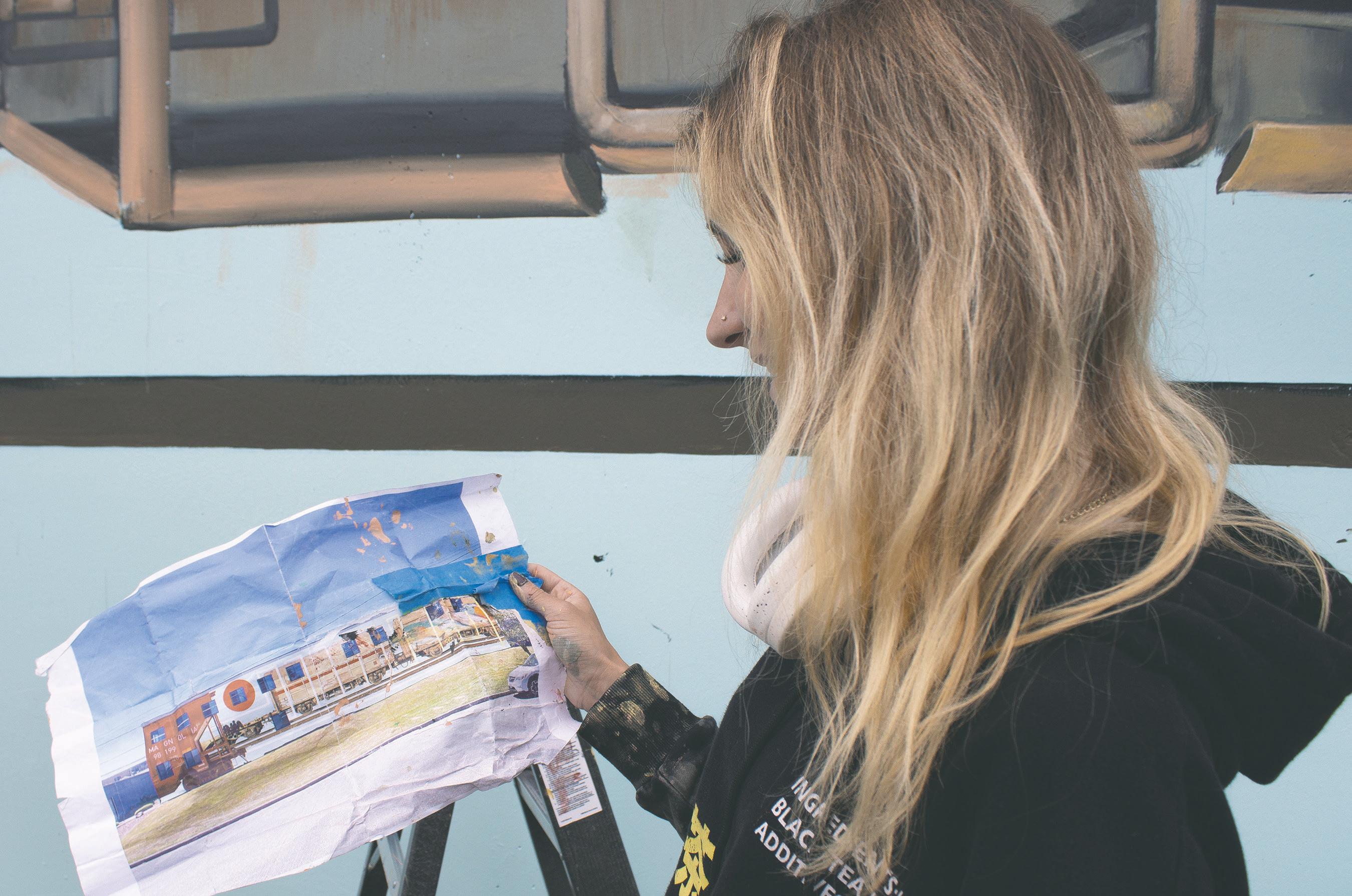
Ballard artist Ariel Parrow works on a section of the mural she is painting on the wall of the WBL Services building, 4433 27th Ave. W., in Magnolia. The Magnolia Chamber of Commerce commissioned Parrow to create the mural, featuring elements of industries found in Magnolia, including the railroad and salmon.
A perfect collaboration
Magnolia chamber commissions artist to paint mural celebrating neighborhood industries, history
By Jessica Keller QA&Mag News editor
When Ballard artist Ariel Parrow reached out to the Magnolia
Chamber of Commerce earlier this year to gauge the organization’s interest in having her paint a large-scale piece of art — her specialty — in the neighborhood,
she had no idea her proposal would receive such an enthusiastic reception.
Not only did the Magnolia chamber welcome Parrow’s pitch, it actually was perfectly timed because the organization had already been contemplating ideas to transform a certain area of Magnolia.
Chamber Executive Director Jason Thibeaux said members had
been discussing for some time how to transform the northeast quadrant of Magnolia off Commodore Way. That section of Magnolia is one of the few areas zoned for light industrial in Seattle, he said, and the businesses there fill a vital, albeit understated, niche in Magnolia and Seattle’s economy.
SEE MAGNOLIA, PAGE 8
QACC hosting candidate forums in October
Staff reports
The Queen Anne Community Council is hosting two virtual community conversations in October for the candidates running for City Council, mayor and city attorney in the Nov. 2 general election.
The forum for City Council positions 8 and 9 will take place from 3 p.m. to 4 p.m. Sunday via Zoom. Go to https://signup.com/ go/ntkQMyN to register.
City Council positions 8 and 9 are at-large seats and represent the entire city.
In the District 8 race, incumbent Teresa Mosqueda is running against challenger Kenneth Wilson.
For District 9, Fremont Brewing co-founder Sara Nelson and lawyer and activist Nikkita Oliver are vying to fill the open seat that will be left vacant by Council President Lorena Gonzalez, who is running for mayor.
The community conversation for the mayoral and city attorney candidates will begin at 3 p.m. Oct. 10. Go to https://signup. com/go/NGpALpJ to register.
In the mayoral race, Gonzalez
and opponent Bruce Harrell are running to replace incumbent Mayor Jenny Durkan, who decided she would retire at the end of her term.
In the city attorney race, Nicole Thomas-Kennedy and Ann Davison are squaring off to fill the seat currently held by Pete Holmes, who was ousted in the primary election.
The two forums will be moderated by journalist Erica C. Barnett. People may submit questions to be asked during the forums. Email queenannecc@gmail.com.
The Queen Anne Community
Council is non-partisan and does not endorse candidates.
In other QACC news, about 120 people voted in the recent Community Council board elections, Sept. 22. Current members reelected to the board were Ben Bennett, Denny Bird, Beth Bunnell, Sean Champagne, Laura Corvi, Sharon Levine and Jazmine Smith. New members are Caroline Davis, Debra Santos, Hannah Spring and Joe Woods.
The QACC next meets at 7:30 p.m. Oct. 6. Go to www.qacc. net for more information or to register to attend.
Have a New Listing You would like to get Front & Center Exposure? For only $150 each week! (Reg $200) You can be on the front page in this space!! Contact Tammy for availability & reservation 206-461-1322
Photo by Jessica Keller
Queen Anne & Magnolia Worship Services
Sunday Worship at 10am Live Streamed on our Facebook page and YouTube. Simply look for Magnolia Lutheran Church.
Twelfth Church of Christ, Scientist
In Person and Online Church Services
All are welcome & warmly invited to join these healing services
For best audio results, please join by clicking on the link from your computer or smartphone and choose “Call Over Internet”
All Zoom Services Meeting ID: 418 806 2637 https://us02web.zoom.us/j/4188062637
Sunday Services 11:00am – 12noon Pacific
Wednesday Testimonies 7:30pm – 8:30pm Pacific
Christian Science Quarterly Bible Lessons
Our weekly Bible Lesson Sermon may be found here: https://quarterly.christianscience.com/
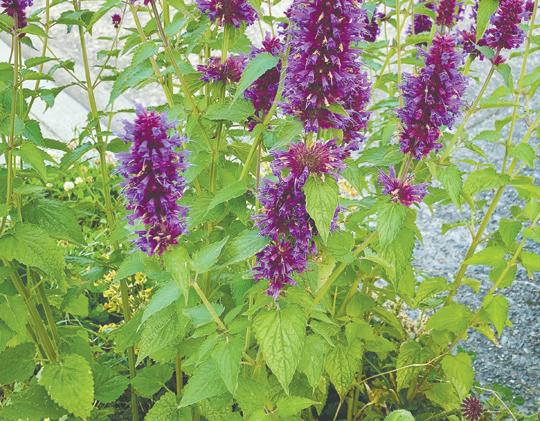
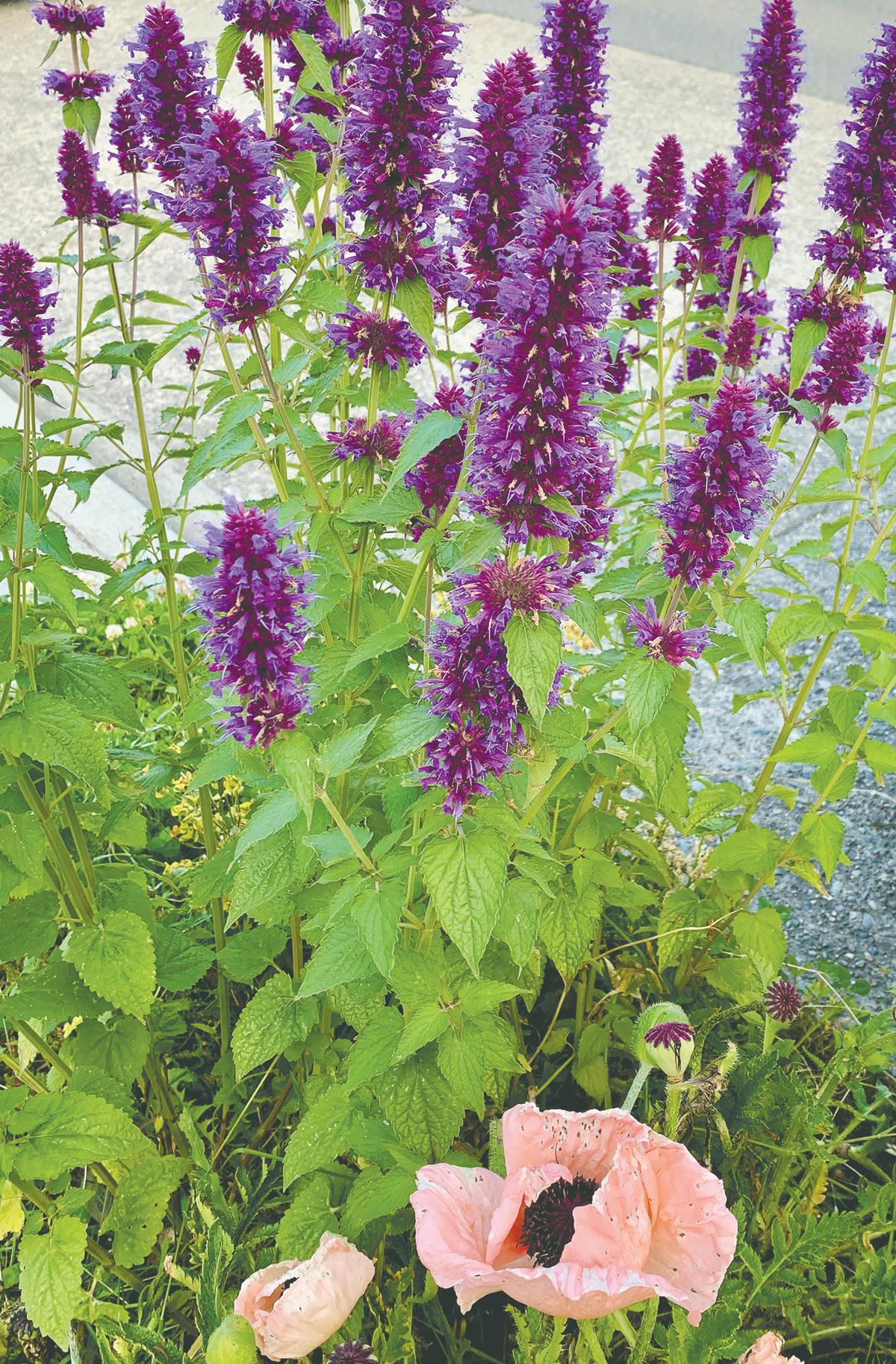
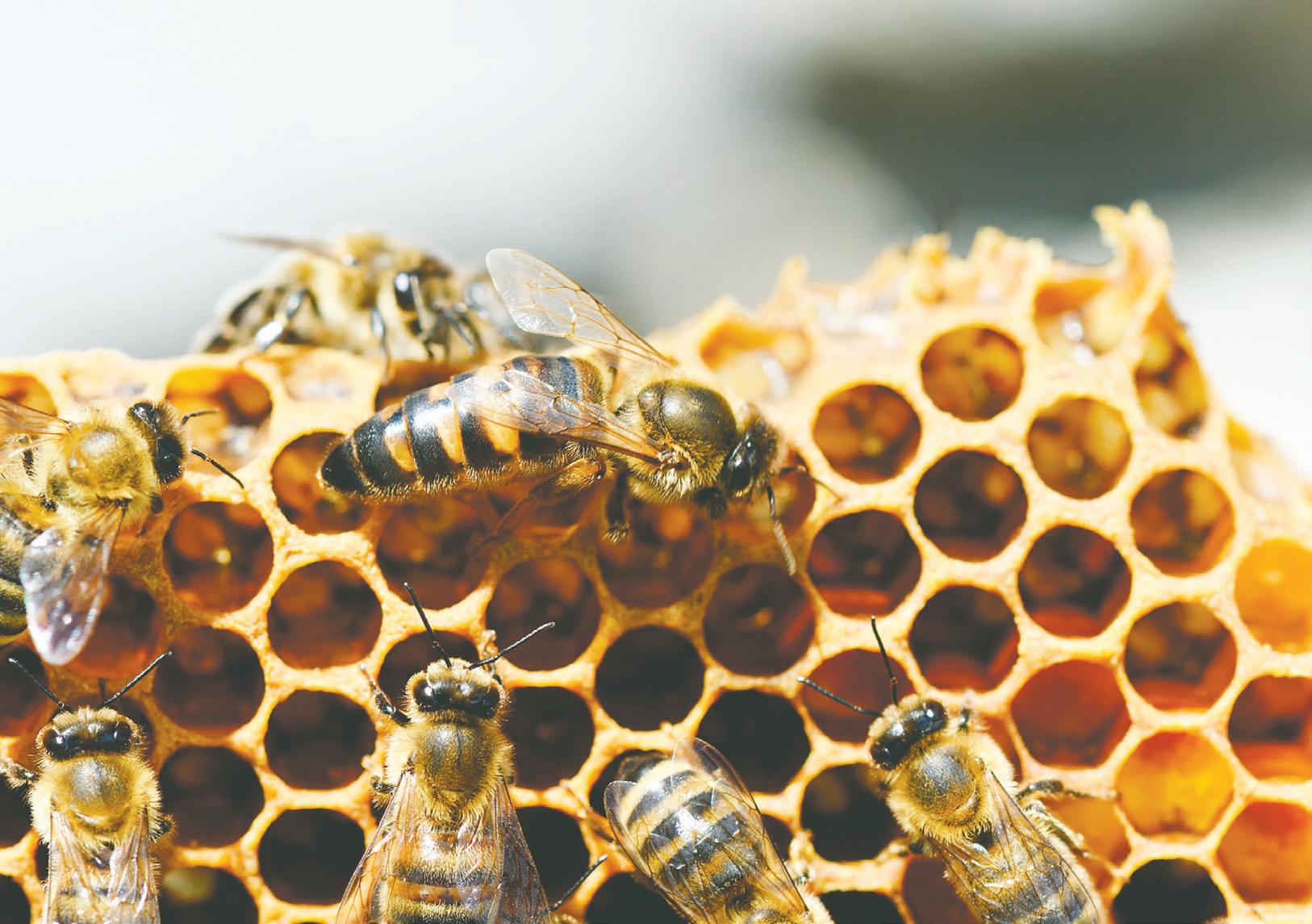
Cultivars of American natives Baptisia and Amsonia mix with drought-tolerant imports. Letting plants grow a little wild in their parking strip or potager can attract pollinators.
How wild is too wild?
Dennis
Moriarty, an 80-yearold veteran in Kansas City, was sick of mowing his 60-degree sloping front lawn. Traditional lawns require massive quantities of water, fertilizer, weed killers, which poison the groundwater, and gas for power mowers, which pollute the air.
Moriarty came up with a solution that would be easier on him and the environment while inviting and feeding a chorus of birds, butterflies, bees and other beneficial pollinators.
According to NPR station KCUR, at the start of the pandemic in April 2020, Moriarty covered his 1,500-square-foot terraced lawn with plastic to solarize and kill the grass — and planted wildflower seeds, including 10 species of native plants, https:// www.kcur.org/news/2021-09-11/ kansas-city-mans-plea-for-nativeflower-justice-unites-gardenersaround-the-world.
Moriarty received a warning that he was violating a city code banning the overgrowth of “rank weeds and noxious plants.” Moriarty was told, if he didn’t cut them down, he could face a court date or up to a $500 fine. The code, written in a way that
really makes no sense to anyone who has grown plants, cites that no “unattended” vegetation may grow higher than 10 inches. Trees seem to be exempt from “weed” status, which will shock anyone who’s met an Ailanthus growing through their concrete.
Basically anything “attended” is all right, but whose definition of tending are we using — Marie Antoinette’s, Mother Nature’s or somewhere in between?
“If everyone did this, you know how many bees, butterflies and hummingbirds are attracted to this?” Moriarty stated. “Their (city) code isn’t realistic in the first place.”
Thousands retweeted Moriarty’s Twitter post, spurring a supportive editorial in the Kansas City Star and a phone call from the mayor.
While the issue was not yet resolved, it seems like it was mainly an issue of tidiness — the Department of Neighborhoods has an unwritten policy of looking the other way on native plants if it doesn’t appear too overgrown, the Kansas City Beacon reports, https://thebeacon.media/ stories/2021/09/13/wildflowers-
or-weeds/.
Kansas City code excepted, a weed is generally defined as an unwanted plant — leaving it largely a matter of perspective. For instance, the leaves of dandelions — the sworn scourge of lawn growers — are nutritional powerhouses in a salad, and the flowers brew a sweet wine.
Home gardeners like Moriarty have the right idea of supporting pollinators and the environment through more sustainable planting, but the practice has yet to be fully mainstreamed, causing the occasional Mrs. Kravitz — remember “Bewitched?” — to drop a dime on their neighbor for a “weedy yard.”
In contrast to Kansas, the Iowa State Extension is promoting converting lands to restore some of the 30 million acres that were once prairie. It is encouraging farmers to include prairie strips and homeowners to plant their own prairies, https://naturalresources.extension.iastate.edu/ encyclopedia/prairie-restorationhabitat-headquarters.
According to the University of New Hampshire’s extension office, https://extension.unh.edu/ resource/wildflower-meadowsplant-selection-and-establishment, “adding even a small area of native wildflowers and meadow grasses to your property provides habitat for pollinators, birds and
Seattle, King County expand vaccination services to provide COVID-19 boosters for eligible people
Following the Centers for Disease Control and Prevention’s approval of booster doses of Pfizer-BioNtech vaccinations for select populations, King County and the City of Seattle are ramping-up vaccination services to ensure free booster doses are available to everyone eligible, as well as continuing to serve those who are not yet fully vaccinated. To help meet anticipated demand, King County, in conjunction with its vaccination partners, have already reopened or have expanded capacity at seventeen vaccination sites across King County. In addition, the City of Seattle will be opening three additional vaccination sites beginning in October to provide booster doses, as well as prime series vaccinations to those who are not yet fully vaccinated. The CDC now recommends booster doses of Pfizer vaccine for people who have completed two doses of Pfizer at least six months ago and are:
• 65 years or older
• Residents in long-term care facilities
• 50-64 years old who are at high-risk because of underlying medical conditions
The following people may also receive a booster shot of Pfizer vaccine at least 6 months after receiving two doses of Pfizer vaccine based on their individual benefits and risks:
• 18-49 years old who are at high-risk because of underlying medical conditions
• 18-64 years old in occupational or institutional settings that put them at high risk for COVID-19 (healthcare, schools, child care, homeless shelter, correctional facility) King County’s comprehensive network of reopened and expanded partnership vaccination locations include sites in Auburn, Kent, Federal Way, Renton, Capitol Hill, Montlake, Harborview, downtown Seattle, Northwest Hospital, Shoreline, Redmond, Bellevue, Eastgate and Snoqualmie. These are in addition to community health centers, primary care clinics and pharmacies across the county that are also providing vaccinations, including booster doses. All COVID-19 vaccinations are free of charge, and all King County vaccination partnership sites are Americans with Disabilities Act accessible and open to the public.
To make an appointment and to check days and hours of operation, go to Public Health’s vaccination webpage, https:// kingcounty.gov/depts/health/covid-19/vaccine/distribution.aspx.
The City of Seattle will be opening three additional vaccination sites beginning in October that will host weekly clinics to increase access to vaccinations. Sites are expected to serve West Seattle, South Seattle and Central Seattle with partners, locations and hours announced in early October. The City of Seattle will also relaunch mobile teams to focus on delivering boosters to older adults.
The city and county currently have sufficient vaccine doses and vaccination supplies to serve everyone who is eligible.
Public Health is also working to ensure those eligible for booster doses who cannot access traditional vaccination clinics are able to receive them. Many longterm care facilities are partnering with pharmacies to provide booster doses to eligible residents. Public Health will work closely with facilities that may not have a pharmacy partner to connect them with vaccination services. Mobile vaccination teams will
provide booster doses to people in-need who are homebound. At this time, only the Pfizer vaccine has been authorized by the Food and Drug Administration and recommended by CDC for booster shots, and the current recommendation only applies to
people who received the Pfizer vaccine as their primary vaccine series. Moderna and Johnson & Johnson vaccines are anticipated to be approved for booster doses, after the manufacturers submit data to FDA for review.
PUZZLE ANSWERS
Get Growing Erica B. Grivas
Photo by Erica Browne Grivas
Schedule an orientation to see how Kumon can benefit your kids and get FREE Registration!*
Kumon Math and Reading Center of Seattle - Queen Anne kumon.com/seattle-queen-anne 206.216.4426
What happens when a bee stings you?
A few different things happen when a bee stings you, and a few things happen to the bee, too.
When I got your question, I called up my friend Brandon Hopkins, who works as a honeybee researcher at Washington State University.
Just as bees have a defense system that helps them survive in the world, humans have a defense system of their own.
If you get a bee sting, it’s likely that your body’s immune system — which works to protect you — will kick into gear. The body will detect unusual invaders, or the molecules in the bee venom. As the immune system responds to these invaders, you might experience some redness, itchiness, swelling or, rarely, a severe allergic reaction.
When Hopkins was first working with honeybees and got stung, he would swell up and itch a lot. But now when he gets stung, it just looks like a little bug bite. The sting still hurts though. Over time his body’s immune system has recognized the venom in his body isn’t really going to do any harm.
Of course, everyone’s body is a little different. The reaction from a bee sting in one person might be quite different from a reaction in another person.
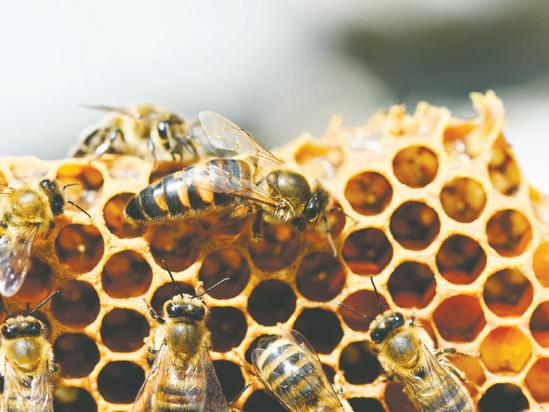
Now, for the bee’s perspective. Hopkins reminded me honeybees, wasps, bumblebees and yellow jackets sting in different ways. Wasps, bumblebees and yellow jackets can sting you multiple times. They don’t lose their stinger when they fly away. But honeybees can only sting once.
Part of the reason for this has to do with the body parts the honeybee uses to sting. First, there is the honeybee’s stinger. It isn’t exactly
like a needle, but rather a pair of saws that work side by side.
Then, there are the muscles. A honeybee uses its muscles to slide those saw-like parts back and forth. Meanwhile, the muscles help pump venom from the bee’s venom sack into the animal it wants to sting. All of these parts work together to help the honeybee defend itself.
After the honeybee flies away, it leaves behind this little packet of stinger, venom and muscles in your skin. This causes so much damage to the bee that it can no longer live. But the stinger packet can keep on stinging. As Hopkins put it, it’s a kind of “self-operating
stinging machine.”
Before they fly off and die, honeybees will also release some chemicals called pheromones into the air. The pheromones set off a kind of alarm to let other honeybees nearby know what’s up. If another honeybee picks up on the chemicals, it might also go into stinging mode. But for the most part, bees don’t really want to sting you, Hopkins said. Usually, they are busy taking care of their family or moving pollen around, which helps us produce everything from flowers to fruits to vegetables. For the honeybee, a sting is truly the last resort.
Sincerely, Dr. Universe
County districting committee seek public input at four town hall meetings
The King County Districting Committee announced four town hall meeting dates to gather public input on draft maps for redrawing King County Council districts. The committee is working on finalizing draft maps that will be posted on its website, www.kingcounty.gov/districting, in early October.
Before beginning work on the draft maps, the committee held more than 20 community listen-
POLLINATORS,
FROM PAGE 4
ing sessions to gather community input and learn about communities of interest.
The committee next will host four town hall meetings to discuss the plans and gather input at:
• 2 p.m. Oct. 17 via Zoom
• 2 p.m. Oct. 19 via Zoom
• 2 p.m. Oct. 20 via Zoom
• 7 p.m. Oct. 21 via Zoom
To find out how to participate, visit www.kingcounty.gov/districting. Community members can
tending.
other wildlife, serves as an infiltration area for stormwater, and prevents soil erosion, making them valuable components of sustainable landscapes. Once properly planted and maintained over a season or two, they require almost no inputs of water, fertilizer or energy.”
At home, I’ve kept meaning to make nice edges for my parking strip — and a few other beds, for that matter. For better or worse, however, putting in cool new plants has always taken priority over neatness. Most of my plants are over 10 inches high, and how much I “tend” them is up for debate. My goal is the less tending the better. In case you’re wondering, the Seattle code is mainly concerned with keeping the sidewalks, streets and driving views clear. Nuisances consist of either fire, health or safety hazards, https:// library.municode.com/wa/seattle/codes/ municipal_code?nodeId=TIT10HESA_ CH10.52WEVE_10.52.020NUDE.
You’re required to maintain 8 feet clearance over the sidewalks and 14 feet over streets, but there is no language about
also provide written testimony by emailing districting@kingcounty.gov. Interpretation will be available in Spanish, Mandarin, Cantonese, Vietnamese and American Sign Language. For additional requests, email districting@kingcounty.gov.
Following the town hall meetings and further study by the districting committee, a single final plan must be approved. A public hearing on the final draft plan is
Seattle is pretty pollinator-positive. It was at the forefront of “pollinator pathways” in 2008, when an artist created a now milelong stretch of parking strips planted with natives in the Central District. Since then, the city created the “Green Line” along 14 miles of lighting corridor in Upper Rainier Beach and “Flight Path” programs promoting wild bees at Sea-Tac Airport and Boeing Field.
In 2015, Seattle became a “Bee City” with the Xerces Society and others, promising to create or enhance pollinator habitat each year and incorporate pollinator-conscious policy.
King County has also penned a brochure about creating your own native plant pollinator paradise: https://your.kingcounty. gov/dnrp/library/water-and-land/yardand-garden/native-plant-guide-westernwashington.pdf.
Are you ready to go a little wild? Here are some suggestions that may help bring non-gardeners along with the idea:
Contain the chaos
Go ahead: Let your hyssop weave through your bee balm. Whether in a
slated for Nov. 30.
By law, council district boundaries must be redrawn after each U.S. Census to make each district as nearly equal in population as possible using the most recent Census data. The new district boundaries must be compact, contiguous and composed of economic and geographic units.
As much as possible, the districts must correspond with the boundaries of existing munici-
parking strip or a potager, people are more accepting of a little chaos within defined edges. The interior of your mini-meadow can be untamed and frizzy if you put an edge around it. This can be manmade, such as a border of stones, a brick or concrete mowing strip (if you still have some lawn) or edging fence panels.
Your edge can, British garden-style, use an edge of neat, if non-native, shrubs like boxwood (Buxus) or sweetbox (Sarcococca) or evergreen perennials that rein in the wild. Lower-growing perennials include sea thrift (Armeria), carnations (Dianthus), heuchera, thyme or ajuga.
Mulch with natural bark chips, soil conditioner or compost, which gives a finished, “gardened” appearance while feeding the soil. Keep in mind, the thicker you apply bark chips, the less likely seedlings — of either “weeds” or wildflowers — will multiply.
Announce your intentions
Understanding can be the first step in forging happy community relations. Installing a sign announcing “Bee Garden” or “Pollinators Welcome Here” will let people see the method to your madness. You can also have your yard certified as a Certified
palities, election precincts, census tracts, recognized natural boundaries and preserve communities of related and mutual interest.
Population data may not be used to favor any racial group or political party. The County Charter places sole responsibility for redistricting with the independent citizen districting committee.
The adopted final district plan will establish the new King County Council district boundaries.
Wildlife Habitat by the National Wildlife Federation or $25, and they will send you a sign to mount.
Do some research
Take care not to include invasive plants in your wildflower bed, for which neither your neighbors nor plants will thank you. Check wildflower mix labels for full botanical names, looking ideally for plants native to the Pacific Northwest. Be aware that grass species can often overtake the flowers quickly. Also, investigate how much seed is in the mix versus fillers like vermiculite. Cross-check names with the state’s noxious weed list, https://www.nwcb.wa.gov/ identify-a-noxious-weed. Some native perennials the Xerces Society recommends for the Pacific Northwest include Manzanita (Arctostaphylos), Japanese barberry (Berberis thunbergii — not vulgaris, which is a class C noxious weed), Clarkia, (strawberry) Fragaria, sneezeweed (Helenium), buckthorn (Rhamnus), and Checkerbloom (Sidalcea)
So, let’s keep those wildflowers and native plants under 8 feet tall and off the sidewalk, OK?
I’m so glad to live in Seattle.
Support for Hempfest
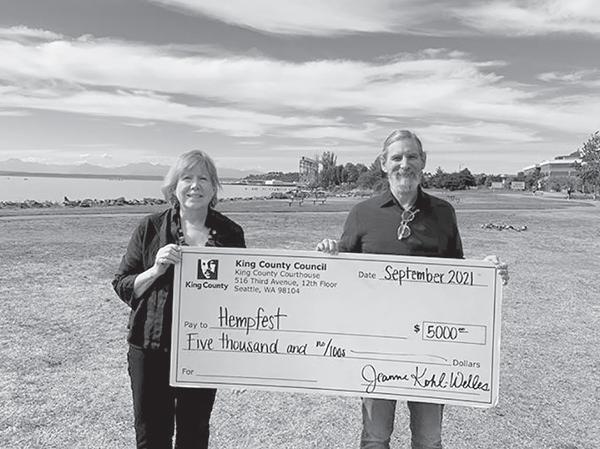
King County Councilmember Jeanne Kohl Welles, left, presents Vivian McPeak, founder and executive director of Hempfest, with a ceremonial check of $5,000 to support the festival, which has been postponed for the past two years because of COVID-19. Hempfest was established in 1991.
Photo courtesy Jeanne Kohl-Welles Office
District 30 legislators hosting informational presentation on new WA Cares Fund
District 30 state legislators Rep. Noel Frame and Rep. Liz Berry are hosting a webinar explaining Washington’s new long-term care benefit, the WA Cares Fund, at 5 p.m. Thursday. People should register at https://leg-wa-gov.zoom.us/webinar/register/ WN_bAZVghfLRTCa2-SCvLl3IQ to attend.
Washington is the first state in the nation to develop a way to make long-term care more affordable for all workers as they age through the WA Cares
Fund. Under the legislation, workers contribute up to $0.58 per $100 of earnings starting January 2022. Benefits will start January 2025, with up to $36,500 in long-term care services and supports.
The webinar will help explain to residents how the program works and answer questions. WA Cares Program Director Ben Veghte and AARP Washington Advocacy Director Cathy MacCaul will be guest panelists.
Seattle Public Library hosting virtual 5-part series exploring whether self care can lead to equity
Can meaningful self-care lead to equity, justice and liberation?
In a five-part series of virtual events hosted by The Seattle Public Library, guest curator Olaiya Land will explore this question in conversation with authors and activists of diverse backgrounds. The series, “Radical Self-Acceptance as Activism,” begins today and ends Dec. 9.
“The past year and a half have highlighted how much work is still required to create a just, equitable world,” Land said about the series in a press release. “But the extremely high level of burnout we’re experiencing prevents people from carrying out that activism. These conversations will look at why radical self-acceptance is so important, not only so you can show up for yourself, your family and your community, but also as an important form of activism in itself, especially for people who have traditionally been marginalized.”
The series will focus on reclaiming the concepts of self-care and self-acceptance from capitalism and mass marketing and highlight the experiences of marginalized groups as they push back against Western beauty standards, patriarchy and white supremacy and carve out spaces to feel accepted and whole.
EVENT SCHEDULE
• The Laziness Lie with Dr. Devon Price
From 6 p.m. to 7:15 p.m. today, Land will talk with Dr. Devon Price about their book “Laziness
Does Not Exist,” which explores the psychological and historical underpinnings of the “laziness lie.” Filled with practical and accessible advice for overcoming society’s pressure to do more, “Laziness Does Not Exist” also features interviews with researchers, consultants and experiences from real people.
• Body Resiliency with Dr. Lindsey Kite
From 6 p.m. to 7 p.m. Oct. 13, Land will talk with Dr. Lindsey Kite about our beautyobsessed world and how it perpetuates the idea that happiness, health and our ability to be loved are dependent on how we look. Authors and identical twin sisters Lindsay and Lexie Kite offer an alternative vision. In “More Than a Body,” Kite shares an action plan that arms you with the skills you need to reconnect with your whole self and free yourself from the constraints of self-objectification.
• BIPOC Access to Travel and the Outdoors with Amanda Machado
From 6 p.m. to 7 p.m. Oct. 28, writer and facilitator Amanda Machado will explore how race, gender, power and identity affect the way we travel and experience the outdoors.
Machado has written for magazines including The Atlantic, The Washington Post, Slate, Harper’s Bazaar, and Outside, and has worked as a social justice editor for Matador Network, the
world’s largest independent travel magazine. Go to www.spl.org/ calendar for a registration link.
• Go On an Anti-Diet with Caroline Dooner
From 6 p.m. to 7 p.m., Nov. 15, Caroline Dooner, the author of “The F*ck It Diet,” will explore the inherent flaws of dieting and diet culture, and ways to heal our physical, emotional and mental relationship with food. Go to www.spl.org/calendar for a registration link.
• The Sensual Self With Ev’Yan Whitney
From 6 p.m. to 7 p.m., Dec. 9, join author Ev’Yan to discuss “The Sensual Self.” For over a decade, Ev’Yan has dedicated themselves to sex education and sexual activism, helping folks reclaim their unique expressions and reconnect to their sensual bodies. This conversation will discuss Ev’Yan’s work on decolonizing, unshaming and liberating sexuality at the intersection of identity, pleasure and embodiment. Go to www.spl.org/ calendar for a registration link.
This series is supported by The Seattle Public Library Foundation and the Gary and Connie Kunis Foundation. Thanks to media sponsor The Seattle Times, this event will be recorded, captioned and then posted on SPL’s YouTube channel after the event.
Library events are free, and everyone is welcome. Registration is required. Find out more at www. spl.org/calendar.
Timothy Lyle Staley
1953 - 2021
Timothy Lyle Staley, age 67, of Mesa, Arizona, passed away at Banner University Hospital in Phoenix on March 29, 2021 due to heart/multi-organ failure. Tim was born to Lyle and Shelley Staley on November 9, 1953 in Williston, North Dakota. He grew up in Seattle and had 3 younger siblings - twin sisters, Kristin and Jean, and baby brother, Rob. He graduated from Queen Anne High School in 1972 and attended Seattle Pacific College. He met his future wife, Lisa, in 1979 - they married in August of 1981. They made their home on Queen Anne Hill and were blessed with 2 beautiful children - Erin Marie and Ian Timothy. He loved to travel but was also a homebody, enjoying home projects both inside and out - he definitely had a green thumb and was quite the handyman with a knack to fix almost anything. He worked at Ace Tank and Equipment and Northwest Handling Systems before retiring in Dec 2018 - then moving to Mesa in 2019 to be closer to the grandchildren. Although it was only for a short time, Tim was very happy and thoroughly enjoyed his life in Arizona.
Tim is survived by his wife, Lisa, children, Erin and Ian, son-in-law, Bryan, 3 beautiful grandchildren, Aiden, Kelsey and newborn Nolan Timothy. He is also survived by his mom, Shelley, sisters Kristin and Jean, nephews, Tom and Kevin and nieces, Kristi and Sarah. Preceded in death by his brother Rob and father Lyle. He was an amazing, kind and gentle man who will be dearly missed.
Remembrances can be made in his memory to the American Heart Association or the American Cancer Society.
City Council to host public hearings on proposed budget
Seattle Mayor Jenny Durkan released her final proposed budget for the 2022 fiscal year Monday. The City Council will spend the next several weeks making changes to the base document and craft what will ultimately be the city budget for the next year. During this time, the council will hold public hearings at:
• 5:30 p.m. Oct. 12
Toll
• 5:30 p.m. Nov. 10
• 9:30 a.m. Nov. 18
Meeting participation is limited to access by telephone conference line and online by the Seattle Channel.
Go to https://www.seattle. gov/council/committees/selectbudget-committee for more information on how to comment for the public hearing.
rates to increase for SR 99 tunnel, Tacoma Narrows Bridge
Toll rates will increase for the Tacoma Narrows Bridge and the state Route 99 tunnel beginning Friday. Drivers with Good To Go! passes will continue to pay the lowest toll rate on all roads. Tacoma Narrows Bridge All tolls will increase by 25-cents. That means trips with a Good To Go! pass will increase to $5.25. At the toll booth, drivers will pay $6.25, and Pay By Mail customers will be charged $7.25 for each trip.
This rate increase is part of a plan approved in 2018 by the state Legislature, to bring stability to toll rates on the Tacoma Narrows Bridge and help repay construction debt.
S Route 99 tunnel Tolls will increase by 15 per-
cent for all hours of the day. The current weekday peak Good To Go! rate of $2.25 will increase to $2.60, and the weekday Pay By Mail rate of $4.25 will rise to $4.60.
On SR 99, toll rate increases are needed due to revenue impacts related to the pandemic.
The increases were approved Aug. 24 by the Washington State Transportation Commission, which is required by law to set toll rates to ensure enough revenue is generated to cover debt payments, operations and maintenance.
During the Aug. 24 meeting, the WSTC also approved a 15 percent rate increase for the state Route 520 bridge, which goes into effect July 1, 2023.
“In some ways, it seems like it’s the forgotten part of Magnolia,” Thibeaux said of the area. “It brings so much in regards to jobs. There’s just some great businesses in Magnolia that just don’t have the visibility, and they deserve to be celebrated.”
That area of Magnolia also appealed to Parrow as an artist.
“There’s just so much space over here and all these buildings with walls open for artwork,” Parrow said last week.
Soon after Parrow’s initial call, Thibeaux lined up sponsors for the project, and the chamber commissioned Parrow to paint a mural on the side of the WBL Services building at 4433 27th Ave. W. Thibeaux said he approached Chamber President Daniela Eng, an owner of WBL Services, about the idea of a mural, and Eng agreed her building was a good place to launch the chamber’s revitalization efforts.
“Currently, it’s visible all the way to Ballard because there’s nothing in front of it right now, just a canal,” Thibeaux said of the building.
Parrow began painting the mural a couple of weeks ago, but only after she and the chamber had many back-and-forth conversations over what the painting should feature.
“One thing we wanted to do was give a nod to some of the industry in the area,” Thibeaux said.
Two of the elements Parrow is including in the mural are a train
car and salmon, as the railroad and maritime industries are prevalent in the area.
As of last week, Parrow said she was pleased with how the mural was coming, although she still had about two thirds of the approxi-
mately 115-foot wall left to paint.
She said her work has already garnered a lot of interest among passers-by, and she is excited for what the project will bring to the neighborhood when it is finished.
“This neighborhood already has
so much personality, and I think it will be really cool,” Parrow said.
“It’s just got all the potential in the world to be amazing.”
To celebrate the project and bring further attention to the businesses off Commodore Way,
the chamber is hosting a celebration and unveiling of the mural Oct. 8 through Oct. 10. During those days, people can see the mural while enjoying some music, food and brews at Dirty Couch Brewery next door.