In the 1970s, Japanese children’s book author Tarō Gomi created a bestselling picture book, “Everyone Poops,” delighting most children and causing consternation in some adults. Delighted or not, let’s face it: The title is true and an important fact to keep in mind when considering preparation for an emergency. In this last in a series of three simple earthquake preparation actions, the 3 W’s, we take up the topic of waste. (In September, we focused on warmth, and in October, water.)
OK, let’s review the basics again. According to the United States Geological Survey, there is a 5 percent chance of a Seattle fault and a 10-15 percent chance of a Cascadia Subduction Zone earthquake striking our region by 2055. This equates to an up to 20 percent chance of a major earth-
quake striking King County with potentially catastrophic damages in the next 35 years.
Proper control of human solid waste after an earthquake is essential because one of the top two causes of morbidity and mortality after natural disasters is life-threatening dehydration from diarrheal disease caused by fecal contamination of water, food, cooking implements and your own two hands. (The other is acute respiratory infections, which given the current pandemic, you know how to minimize your exposure to through social distancing, hand washing and wearing masks.)
Remember, should you need medical help in the aftermath of destructive earthquake, hospitals will be overwhelmed, understaffed and short on supplies. Ambulance services will likely not be available. Prevention of illness is your best strategy, and
managing solid human waste will play a significant role in that illness prevention.
Things to keep in mind
Water and sewer pipes are vulnerable to shaking amplification and rupture during an earthquake. In a 2018 study of earthquake response, the King County Wastewater Treatment Division concluded that recovery and reconstruction of our sewer system and treatment plants may take years to complete.
Water won’t be coming into your toilet, and you won’t want to waste any precious supply on flushing. Besides, any human waste that gets flushed and enters the sewer line will flood out of any break in the pipeline and pose a health risk. One alternative is to line your toilet bowl with a plastic bag to capture and manually dispose of poop, but it’s possible you may not have access
to your toilet.
Human urine is sterile, so we’re less concerned about illness with exposure to that.
Twin bucket toilets will serve you well, whether you are able to remain in your home post-quake or must live temporarily outside in a tent or shed.
Simple twin bucket toilets
Supplies needed: two 5-gallon buckets; pool noodles (or two toilet seats); several boxes of 13-gallon kitchen garbage bags; lots of toilet paper; several bags of kitty litter (alternately, store a shovel to collect and use dirt from your yard); and, of course, hand sanitizer.
Create two makeshift toilets from the two 5-gallon buckets by cutting a pool noodle to fit around the top lip of each bucket. These pool noodles are your comfy toilet seats. Mark one bucket for urine (pee bucket) and
the other for bowel movements (poop bucket). When you urinate, use the pee bucket but place any toilet paper you use in the poop bucket; take the pee bucket outside and spread the urine on the ground in an area larger than your shadow. Urine contains salts that can harm some plants, so spread it over a wider area.
Before you urinate and defecate, line the inside of the poop bucket with two plastic garbage bags and affix the pool noodle around the rim. After each use, sprinkle the entire surface of the pee and poop with kitty litter, wood ash, dirt, sawdust or sand to hold down the odor and absorb the liquid. You can use this poop bucket several times before emptying. Once the poop bag is half full, remove both bags and squeeze out the air and tie them off tight. Store this bag outside in
3 W’s , Page 7
The weather is cooling, but is the real estate market?
Buyers remained diligent as summer turned to autumn, with residential sales and pending listings up 30.9 percent and 42.4 percent respectively in Seattle. There were notable gains in the average price per square foot — up 10.4 percent to $499.60 — and median sales price — up 7.4 percent to $859,000 — due to record low interest rates and less homes on the market, as months of inventory dropped 43 percent from the same time last year. Residences also sold more quickly in 2020 third quarter than they did in 2019 third quarter, selling in just under three weeks. Uncertainty still rings true in market
times, however, with some homes going under contract quickly and others lingering.
In the area comprising our Madison Park, Washington Park and Capitol Hill neighborhoods, pending and closed sales were in line with Seattle at large, though these neighborhoods did not see as stark a drop in months of inventory (down 18.2 percent here, versus 43 percent in Seattle). The median sales price in the third quarter was $973,000, a 4 percent increase year-over-year and higher than the median in Seattle, which is typical of homes in our subset. Given the higher price point, it is not uncommon to see longer market times than in Seattle at large, though the former did see homes sell in an average of just one month in the third quarter. There are always homes that will fall to either side of the market time spectrum. Those well positioned for the market and priced appropriately still get snatched up in a heartbeat. Sellers that are too aggressive with
Revisiting the Park:
By Richard Carl Lehman
What we wouldn’t give to have the old restaurants back in Madison Park, even though there weren’t near as many as there are now. There was not much offered in the way of an evening out in the early ’40s as air raids and blackouts took precedence. In this year 2020, we have a similar situation with limited evenings out due to the coronavirus pandemic.
My grandparents converted a shed into a snack bar equipped with only two wheels — they were lucky to find any for the many shortages during World
War II. After applying a couple of coats of paint, they guided it to the south end of Madison Beach next to Johnson’s Marina and lifted the awning, which revealed a sign saying “Snack Bar” and listing all kinds of goodies. If memory serves, the grill was fueled by a natural gas line. My job as a 9-year-old was to peel potatoes and run errands.
price, or do not present a marketready home, will find little interest from savvy buyers, however.
If there is one thing we can say about the state of the Seattle real estate market in 2020, it’s that it has been unpredictable. Thus far, my 2020 real estate activity has proven busier than past years, as I have helped clients acclimate to conducting business in a primarily virtual world and achieve real estate goals to meet their changing needs. It is hard to say, of course, how the market will react to the final quarter of the year, but early October numbers indicate sustained activity, with 72 residential sales in our area in the first three weeks of the month alone. Buyers are also increasingly interested in some of the great neighborhoods that surround Madison Park, including Leschi, Madrona, Madison Valley and the Arboretum, which offer great amenities close by and a breadth of product types.
At the time of this writing, there are just six condominiums
listed for sale in Madison Park. Seven single-family residences are currently on the market, ranging in price from $1.499 million to $8.95 million.
If you are planning your real estate goals for the coming year, I would love to discuss market fundamentals with you. I am always open to a socially distanced in-person meeting, introductory
phone call or virtual cup of coffee. Here’s to a safe and healthy finish to 2020.
Leslie Dickinson is a founding member of RSIR Madison Park Office.
Leslie.Dickinson@rsir.com
206-200-2174
LeslieDickinsonHomes.com
That first spring day, the awning was raised and the aroma of hamburgers and hotdogs filled the air. Mothers with tykes in tow, service personnel (the wounded stationed at a marine hospital) and beach goers were
Pacific Northwest Ballet announced last week that it received a $1 million gift from the Friday Foundation.
With the gift, PNB created a new endowment, the Jane Lang Davis New Works Fund. According to a press release, annual income from the invested fund will be used in perpetuity to provide support for one new ballet each season, as well as to support PNB’s New Works initiative, including workshops for emerging artists.
PNB established the Pacific Northwest Ballet Foundation in 1998 to receive endowment gifts and bequests. PNB Foundation is a separate entity and is governed by its own board.
“The Pacific Northwest Foundation is honored to receive this transformational gift from the Friday Foundation establishing the Jane Lang Davis New Works
drawn in. It was well worth the price: 25 cents for a burger (30 cents with cheese), and that came with French fries. Do you know how many spuds you have to peel to make French fries? Way too many.
Madison Beach was the most popular of all Seattle beaches.
Fund,” said Peter A. Horvitz, chairman of the PNB Foundation Board of Trustees in the press release. “Richard E. Lang and Jane Lang Davis loved Seattle and their philanthropy enriched the cultural life of our city for decades. Jane Lang Davis loved ballet and through her passion and determination Pacific Northwest Ballet was born. Jane was an enthusiastic supporter of PNB throughout her life and had a particular love for new works. New choreography is the lifeblood of ballet, so it is of great importance that the Friday Foundation’s generous gift has endowed the Jane Lang Davis New Works Fund and that beginning this season, and for many years to come, the Jane Lang Davis New Works will be performed by PNB on the McCaw Hall stage, celebrating the legacy of Jane Lang Davis and her devotion to Seattle
The main eatery nearby was Riley’s Café (Villa Marina Apartments now). It was the hub for good breakfast for folks who rode the ferry to work at Todd’s Shipyards. After the war ended, it relied on the local patrons to keep afloat and soon was converted into apartments.
The Broadmoor Café opened about two blocks south, next to a tavern of the same name, which also featured a lunch menu. We students at J.J. McGilvra met there around 3:15 p.m. to order Green Rivers and listen to the big Wurlitzer juke box. Later, when we were 21, we would spend a
and her beloved Pacific Northwest Ballet.”
The first dance artist to benefit from this gift will be choreographer Penny Saunders, whose debut work for PNB will be financed in part by the new fund, with additional support provided by a gift from Seattle dance philanthropist Glenn Kawasaki. The as-yet-untitled ballet will have its world premiere Nov. 12 during PNB’s 2020-21 digital season.
According to the release, Lang Davis was instrumental in the formation of Pacific Northwest Ballet as a founding member of the organization and remained a life-long supporter, trustee and cheerleader for the company.
The Friday Foundation is dedicated to supporting arts organizations following the passion and philanthropy of Jane Lang Davis and Richard E. Lang during their
lifetimes.
quiet Saturday playing shuffleboard at the Broadmoor Tavern and order burgers and fries from next door.
The Broadmoor Drugstore, where Pharmaca is today, also served lunches and the best strawberry sodas! It was also the best place to hear gossip. That kept us busy for a while, but the main feeling of the day was boredom. Movies were few and far between because Hollywood was also recovering.
My mom met a nice guy, who at one time was a middle-weight boxer and had a son named Gary.
Hook , Page 7
The Friday Foundation also awarded a $1.5 million grant to the Seattle Symphony. The funds will establish the Richard E. Lang and Jane Lang Davis Living Music Program. According to a press release, the funds will directly support Seattle Symphony initiatives that “foster cultural exchange and awareness through ambitious and innovative programming.”
Each season, The Richard E. Lang and Jane Lang Davis Living Music Program “will be tied to a specific concert that features an emerging artist, a work by a living composer or an iconic modernist work that has reshaped symphonic repertoire in a fundamental way,” according to the press release.
he autumn issue of RESIDE® Magazine brings with it the dawn of a new era in residential real estate throughout the Pacific Northwest. In this exclusive issue, Sotheby’s International Realty® and Mansion Global editors provide Pacific Northwest readers with a roundup of some of the season’s most anticipated stories, including a Q and A with Seattleite and renowned sculptor Dale Chihuly, a look at up-and-coming interior designers around the world, tips for modernizing a historic home, and so much more. Please reach out to me for a complimentary print or digital copy!
RSIR ranks amongst the largest, most productive and fastestgrowing real estate companies in Washington with access to 23,000 brokers in 70 countries that generate global sales of $114 billion annually.
WHAT MY CLIENTS ARE SAYING
In all aspects of my professional life I run into folks who are exceptional in their given trade. Laura is a true genius and outlier in real estate sales, marketing and negotiations. Laura’s professionalism, poise, and approach are unmatched and we are indebted to her. We are loving our new home and would not be in this position without Laura’s help. The Seattle market is so crazy right now you really need a true professional to help you navigate and strategize how to successful buy and sell. If you don’t hire Laura you are selling yourself and your family short. She is the best in Seattle hands down. Thank you Laura!!!!!!
Sotheby’s Auction House Presents SASSOON: A Golden Legacy, Judaica and family memorabilia from the legendary “Rothschilds of the East.”
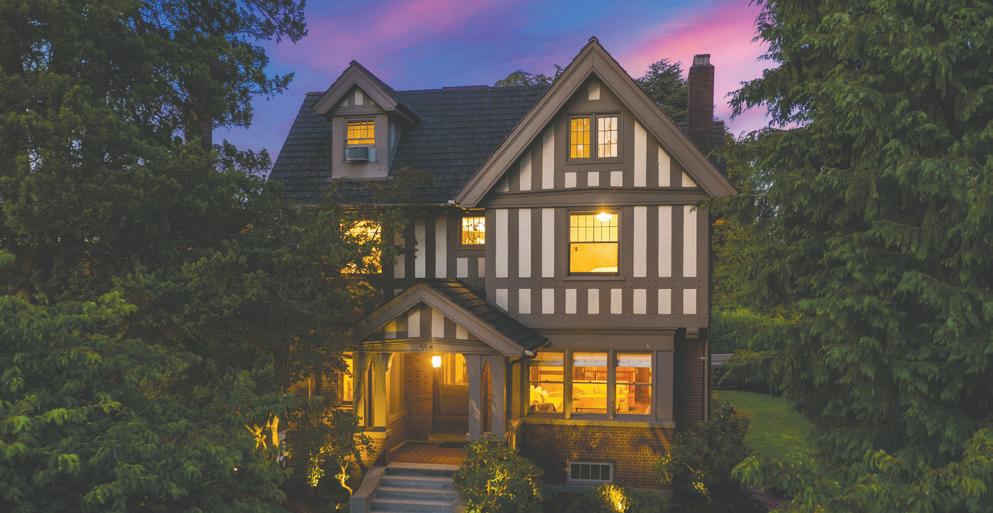
$2,188,000 rsir.com MLS #1670202
while also witnessing a spike of 7.7 million views of our
plan.
Sansevieria — where to begin? Tree Talk
By Steve Lorton
Any writer will tell you: Probably the hardest thing about crafting a story is to come up with a lede (lead to non-journalists). One always faces an agonizing search for the attention-grabbing sentence that, coupled with the headline, tickles the curiosity and engages the reader, making it almost impossible to escape the words and ideas that follow.
I’ll get to sansevieria in a minute, but first, some background.
Back in 1972, when, as a young writer, I walked into the Northwest Office of Sunset Magazine to start my career, I was expected to file travel and architecture copy, the occasional food story and fill the garden pages. In those days few people were writing about gardening. While I hardly knew the difference between a cedar and a fern, I had ample energy, plus, being the proud owner of a little cottage in Madison Park (where I still live), I was eager to learn by doing, creating my own garden.
Here the plot thickens. One of my jobs was to write the monthly Northwest Garden Guide. This was a four-page spread that had as many as 18 short, informative quick-read items on regional gardening. The formula was a snappy subhead, a strong lede, a cogent
nugget or two about the subject and a zinger last sentence to catapult the reader into action. It was taxing, but it was fun!
Then in 1990, Time/Warner put me on television to do twominute gardening segments for their network affiliates nationwide. I cranked them out with lightning speed to the amazement of my producers. “How does he do it?” Well, the old boy was merely looking into the lens and saying to the viewers what he’d been writing all those years in the garden guide. Of course, I never told anyone that … but it worked. Viewers loved it. Weekly, we’d hit as many as 120 markets, nationwide. Still, the secret was in the lede.
I look back on those days, and I think of how many times I pulled sansevieria out of the hat. This plant had so many virtues that it could be approached in any number of ways for a flashy, highly informative and motivating item or broadcast clip that would stop the reader or viewer and give them something that stuck.
So, herewith, a few of the ledes with which, over nearly a half century, I have (hopefully) excited readers, or viewers, with quick information about sansevieria. I’ve tried to fill their minds with ideas and aspirations while
filling my pages and air time with material.
*********
* Among the immeasurable riches of tropical western Africa, it’s quite likely that you’ve been looking at one for most of your life: sansevieria trifasciata. This soaring, statuesque plant, whose leaves can stretch 4 feet in height, has filled pots in hotel lobbies, office buildings and, quite likely, your ancestors’ living rooms for centuries. It’s commonly called snake plant, for its long, narrow, interestingly marked foliage. A less dignified moniker is motherin-law’s tongue, due to the tough, sharp leaves.
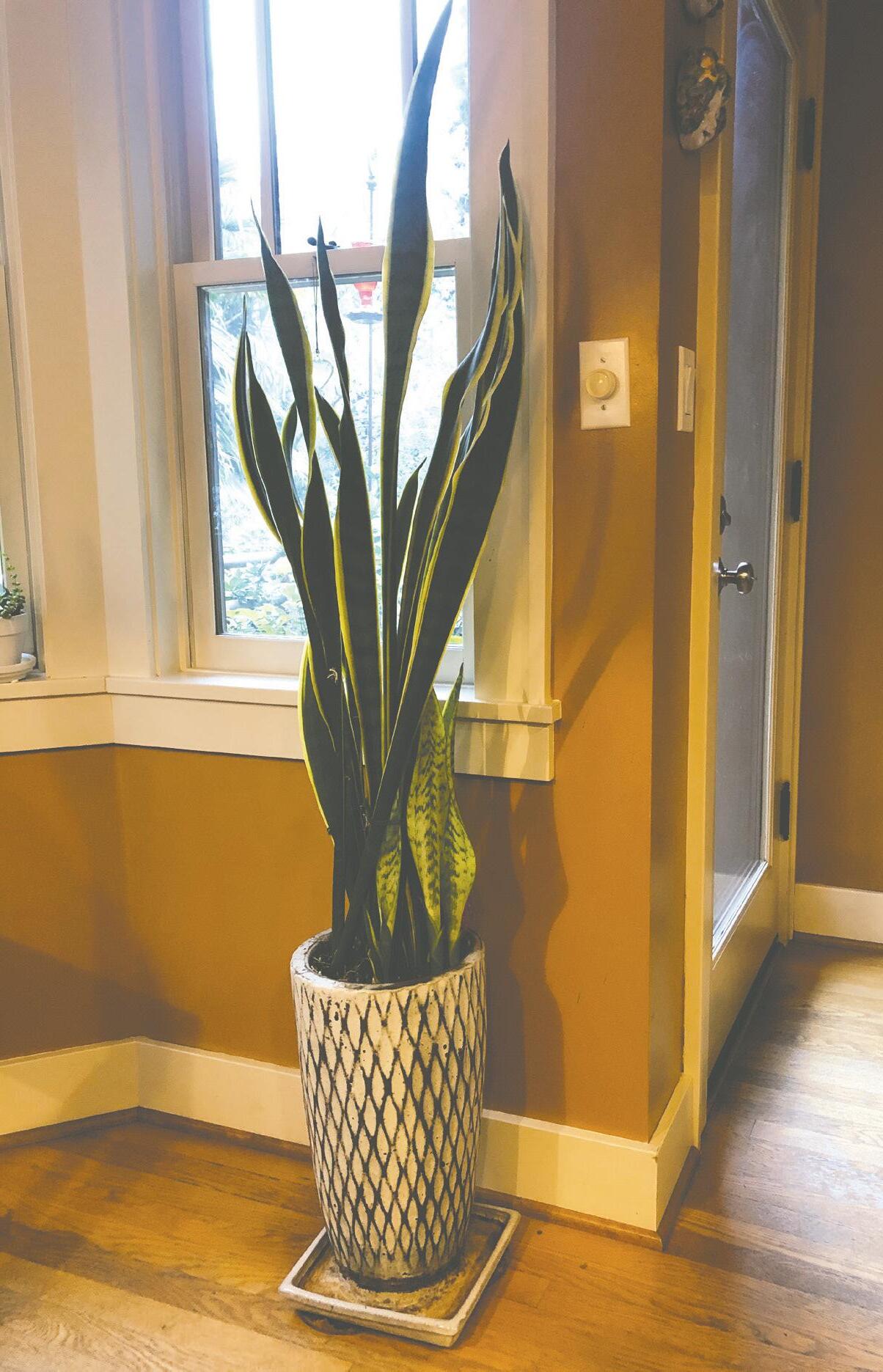
* Any gardener wanting to sign-up for Propagation 101 need not worry about passing this course if sansevieria is chosen as a class project. Growing on thick, resilient rhizomes, all one need do is pull a plant with three leaves or more out of a pot, knock off the soil, cut a third of the rhizomes away and repot. Put the cut-away plant material in a pot of fresh indoor planting mix, water well and within a few weeks you see new shoots poking out of the soil and on their way to towering beauty. The plant pictured here is a division of my motherin-law’s. She sent me home with it in November 1964, on my first
visit to her house as I was courting her daughter. Like the tongue of my wife’s mother, the leaves
Sansevieria, Page 7
are sharp, rigid, tough and indefatigable ... and also steadfast and loving like none others.
* Want to fill a dark spot in your living room with a pot full of live foliage? The Victorian era has passed down two no-fail choices to do the job: aspidistra (the cast iron plant) and sansevieria (snake plant). Both will flourish in a modicum of natural light, providing a burst of greenery to pull the eye to the gloomiest corner of the living room. Because sansevieria is so easy to propagate, maintain and find, it is somewhat taken for granted. Little that would matter to this undemanding old friend.
* Forgiveness has strong roots. Forget to water or feed most houseplants, and the Goddess Flora will punish you by letting them wither and die, provoking guilt that will stick with you through life. But sansevieria, that trusted old houseplant that is well known and beloved, will tolerate neglect like no other
Gary was my age but a few inches taller and many pounds heavier. When he visited, he picked on the skinny kid — me! Then, either he or I would say, “outside,” and the fight was on! I employed a barrage of flailing fists, and when I was near exhaustion, Gary would find my weak spot, and it was all over. Usually he’d knock me over to the tune of a split lip. Afterward, we’d go to the Broadmoor Drugstore, and Gary would buy us strawberry sodas (I sipped it through a straw to try to avoid open wounds). He taught me how to “get inside. You’ll get hit, but at least you’ll know his offense.”
That was one way to ward off boredom. The best way was the Saturday matinee with pop-
plant. Yet, give it a spot next to a bright window, regular watering and light feedings, and it will not only flourish, growing with vigor, it will probably reward you with blooms. Spikes filled with creamy tassel-like blossoms will emerge from the base of the plant with a powerful fragrance to perfume any room, delighting you and all visitors. If it happens to be summer when the flowers explode, set the potted plant out on the porch, in indirect light, but in a spot were hummingbirds can safely access it.
* Take a deep breath. Is anything more sustaining than the feeling of pulling clean fresh air into your lungs? We all know about the power of trees to purify the air, but recent studies have shown that even houseplants are good air cleaners and oxygen factories. Since the early 19th century (likely even earlier), the African native sansevieria has embellished parlors with sculptural greenery. Lately, horticultural scientists have discovered that it is second to none in its ability as an in-home air purifier.
corn and coke and two to three hours of movies. Another was to visit my mom downstairs at Ben Paris downtown, where she was the counter manager. There was a large fountain filled with trout that we fed. The sporting goods manager was Emil Sik who had a radio show called “Where They Biting?” At the time, Ray’s Boathouse rented outboard motorboats, and Emil would plug that — only the very early risers were able to rent.
My grandfather and I joined many in search of the illusive salmon. Emil sold all the latest gear, and if you caught anything of size, you had your picture taken where it showed up on the wall at Ben Paris. My mom caught a 50-pound halibut that broke the middle seat in a boat she rented. The photo made the wall, broken seat and all!
Any restaurant worth its salt had to have a hook — something to draw the public. Enter The Cottage Café on 15th and Madison. Ed and Fred were the owners, and they served great food from morning until closing. Della ran the morning service counter where steak, eggs, hash browns, toast and coffee could be had for $1.75. Patrons of the bar in the rear — a mixture of Madison Park-ites and Capitol Hill
3 W’s , from Page 1
a secure container, and the City of Seattle will pick it up eventually. Keeping it in your garbage can, recycle bin or compost bin will keep the rats and other vermin from feeding on the protein in your poop and spreading disease. And don’t forget to use hand sanitizer after using either of your buckets.
It removes formaldehyde, xylene, trichloroethylene, benzene and toluene from the air. This plant is one of the few that removes carbon dioxide and produces oxygen during the night. I’m dividing the plant I have and spotting it in other places around the house, and I plan to see that each of my grandchildren has a plant for their bedrooms. Grandpa will help them name their leafy pet and teach them how to tend it and keep it thriving, yet another way to imprint the minds of budding gardeners and future Earth stewards. *********
Hopefully this small sampling of some of the times sansevieria has come to my rescue to fill space with a compelling idea helps amplify its value. Now, go get a plant or, if you have one, propagate and share it. In the event you’re faced with a lull in conversation and you need a good lede, simply say, “I’ve fallen in love again! Know anything about sansevieria? I was recently reading the most interesting article...”
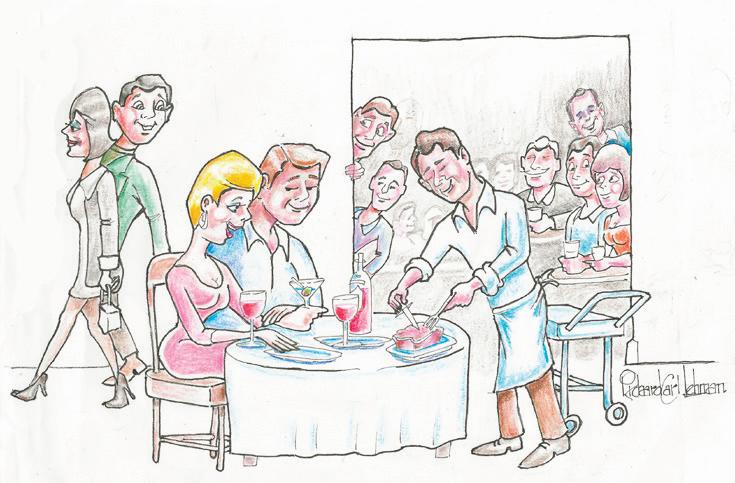
folks — would imbibe in cocktails while sharing stories, sports, news, etc. The hook: a flaming chateaubriand served in the other room by either Ed or Fred. The still-sizzling piece of cow was sliced at the table in front of a couple to the delight of the entire room for a mere $15!
My mom and grandmother ran the Quality Café after the city said, “No more snack bar!” It was mostly a lunch café featuring hot roast beef sandwich with gravy and homemade pies and cakes. It changed with the times, bringing in big wooden barrels as tables and smaller ones as chairs. Above the bar, there was a witch’s broom, which had a seat, a horn, buckle bars and rear-view mirrors. This was the dawning of “The Attic,” and it was a huge success. Peters in the Park (now Starbucks) had probably the biggest hook: hard booze. The villagers were skeptical that it could bring the wrong clientele as happened in Leschi at the Loading Dock (people got just a bit beyond the fun zone). Instead, it was an epic move, and so popular, they had two opening nights!
All of the restaurants currently open are a godsend to help once again socialize with our neighbors and friends at a safe distance in Madison Park. We are grateful!
As we’ve mentioned in earlier articles, it’s easy to put off completing these relatively simple tasks to get prepared for an emergency. With the fatigue of a pandemic wearing us down, turning our attention to something concrete like tending to the 3 W’s — warmth, water and waste — is a manageable approach that will help you survive a major earthquake.