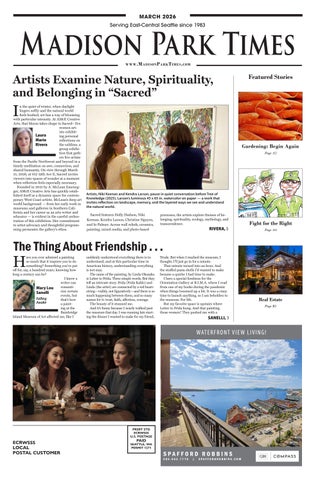
Madison Park Times March 2026

Page 1


Serving East-Central Seattle since 1983

Madison Park

Artists Examine Nature, Spirituality, and Belonging in “Sacred”

In the quiet of winter, when daylight lingers softly and the natural world feels hushed, art has a way of blooming with particular intensity. At AMcE Creative Arts, that bloom takes shape in Sacred– five women artists exhibiting personal reflections on the sublime, a group exhibition that gathers five artists from the Pacific Northwest and beyond in a timely meditation on awe, connection, and shared humanity. On view through March 15, 2026, at 612 19th Ave E, Sacred invites viewers into spaces of wonder at a moment when reflection feels especially necessary.

Founded in 2021 by A. McLean Emenegger, AMcE Creative Arts has quickly established itself as a dynamic space for contemporary West Coast artists. McLean’s deep art world background — from her early work in museums and galleries in Southern California and her career as an arts writer and educator — is evident in the careful orchestration of this exhibition. Her commitment to artist advocacy and thoughtful programming permeates the gallery’s ethos.

Sacred features Holly Hudson, Niki Keenan, Kendra Larson, Christine Nguyen, and Io Palmer. Across wall reliefs, ceramics, painting, mixed media, and photo-based

processes, the artists explore themes of belonging, spirituality, ecology, mythology, and transcendence.

The Thing About Friendship . . .

Have you ever admired a painting so much that it inspires you to do something? Something you’ve put off for, say, a hundred years; knowing how long a century can be?

Mary Lou Sanelli

Falling Awake

I know a writer can romanticize certain events, but that’s how a painting at the Bainbridge Island Museum of Art affected me, like I

suddenly understood everything there is to understand, and at this particular time in American history, understanding everything is not easy.

The name of the painting, by Linda Okazake, is Letter to Frida. Three simple words. But they tell an intricate story. Frida (Frida Kahlo) and Linda (the artist) are connected by a red heartstring―visibly, not figuratively―and there is so much happening between them, and so many names for it: trust, faith, affection, courage.

The beauty of it stunned me.

And it’s funny because I nearly walked past the museum that day. I was running late starting the dinner I wanted to make for my friend,

Trude. But when I reached the museum, I thought, I’ll just go in for a minute.

That minute turned into an hour. And the stuffed pasta shells I’d wanted to make became a quiche I had time to make.

I have a special fondness for the Orientation Gallery at B.I.M.A. where I read from one of my books during the pandemic when things loosened up a bit. It was a crazy time to launch anything, so I am beholden to the museum. For life.

But my favorite space is upstairs where Letter to Frida hung. And that painting, those women! They pushed me with a

Laura Marie Rivera
Artists, Niki Keenan and Kendra Larson, pause in quiet conversation before Tree of Knowledge (2025), Larson’s luminous 45 x 65 in. watercolor on paper — a work that invites reflection on landscape, memory, and the layered ways we see and understand the natural world. WATERFRONT

Opportunities to Prepare, to Cultivate Caring

For over a decade now a steady group of volunteers In Madison Park has been growing our neighborhood’s ability to plan and respond to an anticipated large-scale disaster resulting from a major earthquake, colloquially referred to as “the big one”. My grandson likes to tease me saying I’ve fallen prey to a Zombie Apocalypse conspiracy, but in fact, we’re paying attention to the Cascadia Subduction Zone, a fault line off the coast of the Pacific Northwest that stretches 700 miles from Northern California, through Oregon and Washington up to British Columbia. When it eventually ruptures scientists predict this will devastate the Pacific Northwest in an unprecedented way, generating an earthquake that could reach a magnitude 9.0 or greater and setting off a 100-foot tsunami that could alter the floodplain footprint for centuries. The historical timing of past earthquakes indicates that we are due for a major rupture any time now, and according to FEMA, a magnitude 9.0 earthquake on the Cascadia fault would kill an estimated 14,000 people in Oregon and Washington. Research suggests that it’s not a matter of IF we’ll get this “big one”, but WHEN. Yes, in today’s world it’s sometimes hard to distinguish fake from real news, but here are some reliable sources to check out:

• Pacific NW Seismic Network draws on research from the University of Washington;

• Kathryn Schultz’s July 13, 2015 New Yorker article: “The Really Big One”;

• 5 minute Nova/PBS video clip https:// www.friendsofmadisonpark.com/publicsafety

• You can find a number of reliable monitoring maps of earthquakes in our region

and sign up for active alerts with the MyShake app. So, yes, please take this seriously. Make use of easy-to-follow guidelines and toolkits to get your family, household, workplace, and neighborhood prepared and ready to respond. Our Mad Park neighborhood Emergency volunteer coordinators rotate over time with a variety of opportunities to lend your time, know-how and skills. We are ready for some new folks to learn the ropes and rotate in for a period of time. You can email us to learn more or get involved. madparkhub@ gmail.com .

ACTIVITIES

VOLUNTEER

Emergency Hubs volunteers in adjacent neighborhoods are starting to work together with our Mad Park Hub now part of

“this is foundational work for emergency preparation and response.”

the Central Area Sector. Our work includes education, skill building, and practice drills, preparing an Emergency gathering place with resources and guidelines to help with information and organizing mutual aid when all standard communication systems—think cell service and 911—goes down. Household and workplace emergency preparation and response is most effective when done as block by block organizing, what Seattle’s Office of Emergency Management (OEM) refers to as SNAP groups—Seattle Neighborhoods Actively Prepare. The City offers a valuable online toolkit to help

volunteers form SNAP groups with their neighbors. Prepare Your NeighborhoodEmergency Management | seattle.gov.

A foundation for emergency preparation and response is an ethic of caring, a desire to be neighborly and helpful. If we haven’t practiced this in our daily living, taken a moment out of our individual busy lives, what will happen when some crisis arrives?

A NEIGHBORHOOD THAT CULTIVATES CARING

We have some terrific examples of how Madison Park neighbors are caring people, people who respond to and with each other, when celebrations or projects or needs. Consider the formation of the Friends of Madison Park (FOMP) group, peo ple who recognized we no longer had a func tioning neighborhood community council, so put out a call to come together; people who demonstrated how to listen to what neighbors wanted, who created an organization with a big tent for different perspectives, concerns, longings. They began to shape short- and longer-term goals, built relationships with local merchants and City departments; started raising money, committees to organize neighborhood clean-ups and beautification; activities for children, families, pets; attention to public safety; parties, pop-up fairs; holiday celebrations, memorials, garden tours, and a viable summer farmers’ market. In my mind, this is foundational work for emergency preparation and response.

CARING BEYOND THE BIG EARTHQUAKE

The Global Pandemic of 2020 revealed remarkable examples of caring and creative mutual aid efforts, with stories probably most of us could offer as examples. Caring flowed in the summer of 2023 when Marisa Spooner Le-Duff, owner of the Domicile Gallery, one of our beloved Madison Park businesses, received some racially motivated threats. Merchants and neighbors came together with a “Love Happens Here/No Place for Hate” campaign to alert our community and rally protection and support for Marisa and the gallery. Perhaps in 2026 it’s time to reactive this expanded sense of what constitutes an emergency and how important mutual aid can be for those in our neighborhood to feel and be safe. Given the heightened divisiveness, fear and alarm across our country how can we further demonstrate that LOVE HAPPENS HERE? As I walk the neighborhood and hear many of our construction, landscaping crews, and child care workers, speaking languages other than English, and wonder if they might become a target of hate. I ask myself (and sometimes them), “Do you feel safe and welcome here?”

What will cultivate caring and grow our courage to make our neighborhood NO PLACE FOR HATE, for racial profiling and violence? How can we practice love and prepare an outpouring of caring in response to the emergency of an attack on those who live, work, and visit our neighborhood? When love is in the air it serves as anecdote to fretting fear, a safeguard to belonging and living up to our democratic ideals and principles.

Seattle Area Transit Launches Tap-to-Pay Ahead of World Cup

Riders in King County and across the Puget Sound region soon will have a simpler way to pay for buses and trains with the launch of a new contactless “tap-to-pay” option on public transit.

Beginning Monday, Feb. 23, most buses, light rail, commuter trains and other ORCAcompatible services will accept payment by tapping a contactless credit or debit card or a digital wallet such as Apple Pay, Google Pay or Samsung Pay on ORCA card readers.

Officials say the change will make transit easier for regular riders and particularly more welcoming for occasional riders and visitors, including the large number expected in the region this summer for events like the FIFA World Cup in Seattle.

“Adding Tap to Pay is a major milestone for transit in King County,” said King County Executive Girmay Zahilay in

a news release. “It brings our system into the modern era and makes everyday trips more convenient while opening the door for more people to choose transit.”

Under the new system, riders simply hold a contactless card or smart device near the fare reader when boarding. The standard full adult fare will be charged, and riders still receive ORCA’s two-hour transfer benefit - meaning a second boarding within two hours won’t cost extra.

Traditional ORCA cards remain available and are still needed for discounted fares, including ORCA LIFT, youth, senior and disabled programs. Riders who use these programs are encouraged to continue using their ORCA cards for those benefits.

Not all services will support tap-to-pay immediately.

Seattle Monorail, Washington State Ferries, Metro DART, Community Vans, Metro Flex

and some peer transit systems are excluded from the initial rollout, though additional services are expected to adopt the feature soon.

Transit agencies in the region have been testing similar open payment features since early 2026, and the broader implementation is a key part of

preparing for increased ridership and international travelers ahead of major events later this year.

But Weight, There’s More…

If you read last month’s column, you might be wondering if you ever really have any control over how your body looks. I’m all about building a world where that’s not the focus, but I also love the fact that the answer is yes.

My 4’11” body tends towards being muscular. So, in all fairness, no, I’m never going to look like, say, the ballerinas of New York City Ballet (or Pacific NW Ballet, either). But how I train gives me a lot of say over things like body composition (what percentage of my body is made up of fat and what percentage is muscle) and whether my muscles are bulky or long and lean. And yes, of course, fitness training gives me some control over my weight.

Back in the day, aerobics was what you did to burn calories and shed fat. But the science of the last few years has

stead to carry small sequences of RNA–the genetic material that carries out our DNA’s instructions. The specific strand of RNA that they found is called miR-1, and when it’s in muscle cells it prevents muscle building. So it makes sense that as you do strength training, the molecule that prevents muscle growth gets kicked out of the muscle cells. Here’s the clincher, though: as the researchers continued, they found that much of the miR-1 was taken up by fat cells, where it appeared to trigger the break-down of stored fat into fatty acids–energy that’s readily available for cells to burn. In other words, strength training encourages the body to burn fat.

This research was done on mice, but it explains a lot of things about human bodies and strength training that had not been explained before, like how changes in metabolism show up well before changes in body composition. So it’s reasonable to assume that the process for us humans is similar, if not exactly the same.

been shining a light on how strength training may be responsible for shrinking fat. In a 2021 New York Times article (https://www.nytimes.com/2021/07/21/ well/move/weight-training-fat.html), Gretchen Reynolds wrote about how “sophisticated experiments show that muscles … release a cascade of hormones and other proteins after exercise that enter the bloodstream, course along to various organs and trigger biochemical reactions there, in a process known as cellular crosstalk”. More specifically, what was thought to carry waste material from the muscles has been shown in-

SANELLI, FROM 1

certainty that has, in the past, drove me to do things spontaneously and without remorse. . . though there have been exceptions.

Once I realized I was staring at Frida and Linda, but I was looking for Lena and me, I sat right down and wrote my Letter to Lena. (Email, but still.)

Lena was my college roommate. I’ve written before about Lena; how, after graduation, she went one way, I went another, and like a lot of us, I began to work around the clock, and a decade passed and a decade passed and here we are. We did meet up for a weekend once. And when I saw her, I got nervous. Nervous about all the time that has passed. Nervous about the restaurant she’d chosen that was

It’s easy to take this information and try to translate it into a formula–how many reps will it take to lose 5 pounds, or 10, or 20? One problem with this response is that the body may not continue to function according to this research if we are over-training, or if we are aiming for a weight that is not healthy for us. Another is that this way of thinking follows from, and feeds into, the way media impacts our body image. Diving into the issue of media and body image is a whole other article, and perhaps more in the realm of psychology than fitness. Suffice to say that exercising to fix your body, or try to make it look like the ones on-screen can easily become a treadmill of misery.

I deeply believe that exercise should be a source of joy. And it’s also quite easy to take this information and say, “hey, how cool is that! I’m training to do (insert the activity that inspires you in this blank). I can also like how I look as a result.”

Michele McCauley is a personal trainer at Resilient Body Fitness. She would love to be your Best Friend in Fitness! E-mail your fitness questions to bff@ResilientBody.Fitness

clearly hipper than I am―extravagant, minimalist―seamless integration, I think they call it. Nervous that I would tell her everything, well, maybe not everything, yes everything, no, yes, just say it as a friend. Because I can do this when I’m nervous. Talk. And that’s what I did. I tried to say what I actually meant and thought and felt, and I still remember the rush I got from telling the honest-to-goddess truth about what was going on in my life. And when I asked about hers, she talked about her dog. And when I asked if she was still playing the piano, she talked about her dog. She talked a lot about her dog that night. The dog’s temperament. The dog’s need of an antidepressant. How much that dog liked to ride in the car and what that dog liked to eat. And

Madison Park Update: Music, Easter Eggs & Zoning Talks

LITTLE BEATS CONCERT CLOSES THE SEASON SATURDAY MARCH 7/11-12 AT PIONEER HALL

The Little Beats Concert Series has been a HUGE hit for families this Fall and Winter. Thanks so much to Meg Bartley, Pioneer Hall and Parkshore Residential Association for making this such a success. Our last concert features a crowd-favorite Harmonica Pocket on March 7th. Tickets are a bargain- $5!

THE EASTER BUNNY RETURNS TO MADISON PARK ON SATURDAY APRIL 4TH/ 10-2 IN THE PARK

Join Friends of Madison Park for a fun-filled Easter Egg Hunt on April 4th from 10:00 AM–12:00 PM at Madison Park Playground! Enjoy games, food, crafts, face painting, music, and a special visit from the Easter Bunny . Egg hunting begins at 10:20 AM sharp—don’t be late!

SAVE THE DATE FOR OUR FIRST MADISON PARK YARD SALE: SATURDAY MAY 9/ 10-4!

madison p k Easter Egg Hunt

Saturday, april 4, 10am-12pm @madison park playground

hosted by friends of madison p k

music & refreshments / crafts & games meet the Easter Bunny

egg hunt times: 10:15 ~ 0-2 year olds 10:25 ~ 3-5 year olds 10:35 ~ 6-8 year olds

Have goodies collecting dust and taking up space in your basement, your closet, your kitchen, your garage? Friends of Madison Park is here to help. Register for our community YARD SALE. Details are in the works and will be published in March: QR Codes will be posted for registering to be a seller and info to the public. We would LOVE to have volunteers for day of and prepping ahead of time. Interested? www.friendsofmadisonpark.com/volunteer.

CALLING ON VOLUNTEERS TO HELP KEEP OUR PARKS, OUR STREET ENDS AND OUR BUSINESS AREA LOOKING BEAUTIFUL.

FRIENDS OF THE PARK : Monthly Weekday Weeding Parties in our Parks- First Tuesday of each month/10:00 – 12:00 Meeting at Madison Park Bathhouse: March 4, April 1, May 6, June 3, July 1, August 5, September 2. First Spring Work Party Sunday April 19/9:30—12:30

SPRING CLEAN-UP: Saturday May 16th/ 9-12 in the Business Area. Check in at FoMP booth across from Bert’s. Sweep, weed, rake and clean. Tools provided or BYOT.

PROSPECT PRESERVE CLEAN-UPS: Saturdays: April 18, July 18 and October 17/9Noon. Tools provided, weeding, mulching and some planting. Find out more and sign up at www.friendsofmadisonpark.com/volunteer.

REMINDER OF CHANGE OF TIME FOR OUR NEXT NEIGHBORHOOD MEETING: TUESDAY APRIL 21 AT 7 P.M. AT THE BATHHOUSE

because she said all this without smiling, my mind started to run ahead itself and, to my life-long regret, I said how maybe she should return to her music and not spend all her time pampering a dog.

After that, it was a short conversation that felt very long.

As I saw it, the dog was pretty much beside the point; it was that she no longer played music that mattered to me, because I have faith in the restorative power of art, any kind of art, and that dog seemed a long way from art, which made it as good a topic as any to disagree about.

I don’t blame her for breaking up with me.

There are days I want to break up with me.

I couldn’t bring myself to admit this to Lena, because I couldn’t

PHASE 2 OF ONE SEATTLE PLAN GOES TO COUNCIL

Seattle’s Office of Planning and Community Development (OPCD) has now turned over to the Seattle City Council the next phase of the One Seattle Plan- phase 2 addresses raising zoning heights of each Neighborhood Center (Madison Park is designated a Neighborhood Center). Gio to https://one-seattle-plan-zoning-implementation-seattlecitygis.hub.arcgis. com/pages/zoning-map to see the proposed new zoning heights for Madison Park.

In 2024/2025, we requested reductions in zoning heights for several of the residential blocks and the historical sections of the business district. OPCD did not make any of the requested changes.

Now phase 2 is before City Council Select Committee on the Plan, headed by Council member Eddie Lin. The Council is awaiting any changes from the new Mayor’s Office as they review the zoning designations, but no major changes are expected for Madison Park.

The Office of City Council president (and our district rep) Joy Hollingsworth does not have a timetable for when these zoning heights will be voted on- possibly as late as July- but hearings will begin March 18 so we want to be sure Madison Park residents will be heard by the Council before this goes to a vote.

PLEASE take time to review our website One Seattle Plan tab (top of Home page)www.friendsofmadisonpark/oneseattle and please reach out to Council members and to the Mayor’s Office with your comments. (emails listed on our website).

bring myself to admit it to myself, yet, that I’d become someone who refuses to accept a dog as a next path in life, because it’s not the path I’d take.

But I had.

After reading my email, Lena agreed to meet again. Which is very Lena of her―she really is the nicest person on the planet.

This time, I began as cautious as if driving over Steven’s Pass in freezing rain. And slowly we began to talk. Be ourselves. Laugh. Like roomies again!

What a ridiculous word at our age. Roomies. But who cares.

When people ask (and they do ask because I wrote a book about friendship) who my first best friend was, I always say, “Lena.”

We anchor ourselves by our friendships, and I’m a little rootless,

so I need strong anchors. So in order to feel secure, secured, I needed to make Lena and me happen again; to reconnect our heartstring. Because the thing about friendship is that it’s never up to us if we will receive it, but it is up to us to extend it.

Just before I left the gallery a woman came up the stairs. She inspected her hair in the window glass. Also, her backside. Which made me smile. And when she gave her panties a little a tug from behind, I saw her, she saw me, and we saw each other see each other. So I waved.

Because for one whole second, I tried to pretend I wouldn’t do the same thing. Because I don’t think I could have stopped myself from waving even if I wanted to, and I didn’t. Because why not.

Gardening: A Gentle Invitation to Begin Again

There’s something quietly magical about stepping into a garden. Before anything grows, before a single seed is tucked into the soil, there’s a sense of possibility in the air — a feeling that this small patch of earth could become something beautiful. Life often feels the same way.

We’re handed moments, seasons, and opportunities that invite us to begin again, to stretch, to root, to bloom.

Imagine standing at the edge of your garden-to-be. The soil is cool and dark, waiting for your hands. Maybe you already know what you want to plant — tomatoes warm from the sun, herbs that release their scent with the slightest touch, flowers that open like little celebrations.

Or maybe you’re simply curious, ready to see what might happen if you give yourself permission to try.

That’s the quiet invitation gardening offers: start where you are, with what you have, and see what grows. As a WSU Extension Master Gardener, I'm personally inviting you to visit one of our demonstration gardens in 2026, most of our demonstration gardens welcome visitors from April through November, though each site follows its own seasonal rhythm. It’s always wise to confirm current hours and details online before you head out. If you’d like to explore what’s growing in your own community, these King County Master Gardener demonstration gardens offer inspiration, education, and a chance to see sustainable gardening practices in action:

KING COUNTY MASTER

GARDENER DEMONSTRATION

GARDENS

Animal Acres Demonstration

Garden - A peaceful neighborhood space showcasing sustainable practices and plants that thrive in our local climate.

Bellevue Demonstration

Garden - A vibrant teaching garden where visitors can explore vegetable beds, ornamentals, and hands on gardening techniques.

Carkeek Park Demonstration

Gardens - A collection of coastal inspired beds highlighting native plants and environmentally friendly gardening near Puget Sound.

Cesar Chavez Demonstration

Garden - A community centered garden celebrating food, culture, and accessible growing practices for all ages.

Magnuson Children’s Garden - A whimsical, interactive space designed to spark curiosity and help young gardeners discover the joy of plants.

Neely Soames Homestead

Demonstration Garden - A historic riverside garden blending heritage plantings with modern sustainable gardening methods.

Ronald McDonald House

Outreach Garden A healing, supportive space where families can enjoy fresh produce and the comfort of a living, growing landscape.

Shorewood High School

Culinary Arts Garden - A student driven garden where edible plants support culinary education and inspire future gardeners.

Soos Creek Demonstration Garden - A serene, expansive garden featuring themed beds, native plants, and examples of water wise gardening.

Thyme Patch Park

Demonstration Garden - A charming pocket garden filled with herbs, pollinator plants, and ideas for small space gardening.

Tribal Life Trail

Demonstration Garden - A culturally rich garden honoring Indigenous plant knowledge and the traditional uses of native species.

Vashon Demonstration

Garden at Mukai Farm and Garden - A beautifully restored island garden blending history, community, and practical gardening inspiration.

You can learn more about each site — including locations, seasonal hours, and volunteer opportunities — at the King County Master Gardener demonstration gardens page: https://extension.wsu.edu/king/ mg-home/educational-outreach/ many-demo-gardens

As you press seeds into the earth, you’re doing more than beginning a garden. You’re giving yourself a reason to step outside, breathe fresh air, and move your body in a way that feels grounding. You’re creating a space that asks nothing of you except presence — a few minutes of watering, a moment to check on new sprouts, a pause to appreciate how much can change in a week. And those early sprouts? They’re a reminder that growth doesn’t need to be rushed. Seedlings take their time. They lean toward the sun, strengthen slowly, and surprise you when you least expect it. There’s comfort in that rhythm. It’s a gentle nudge to be patient with yourself, too.

Of course, every garden has its challenges. Weeds appear,

sometimes overnight, and you find yourself kneeling in the dirt, pulling them up one by one. But even this can feel strangely satisfying. Clearing space around your plants gives them room to breathe and thrive. It’s a small act of care that makes a big difference — and it mirrors the way we sometimes need to clear space in our own lives, letting go of what no longer supports us.

Then come the seasons. Spring’s excitement, summer’s abundance, autumn’s quiet harvest, winter’s rest. A garden teaches you to move with these cycles instead of against them. Some days are for planting, others for pruning, and some are simply for sitting back and enjoying what you’ve created. There’s no rush, no pressure, no perfect way to do it. Just the steady rhythm of tending and noticing.

And that’s the heart of gardening — not perfection, but participation.

When you plan your garden, you’re really planning moments of joy for your future self. The scent of basil on your fingers. The first ripe strawberry. The sound of

bees drifting lazily from bloom to bloom. The satisfaction of a meal made with something you grew. These small pleasures add up, reminding you that life’s beauty often comes from the simplest places.

So consider this your invitation. Step outside. Feel the sun on your shoulders. Turn over a patch of soil and imagine what it could become.

Whether you plant a single pot on a balcony or transform your whole backyard, you’re creating more than a garden — you’re creating space for yourself to breathe, to move, to hope, and to enjoy the world a little more.

Gardening doesn’t demand expertise. It asks only for curiosity, a bit of patience, and a willingness to get your hands dirty. And in return, it offers fresh air, gentle exercise, a sense of accomplishment, and the quiet joy of watching something grow because you cared for it.

This season, let your garden — whatever shape it takes — be a reminder that life is full of beginnings. All you have to do is plant the first seed.

COULEUR
PIXABY

The Diminutive But Endearing English Primrose

Ishamelessly confess. I was once known to steal from someone’s trash can.

Here’s the story. It was late spring about eight years ago and I was out on my morning walk. Neighborhood trash was set out curbside, for pick-up that day. The top had flipped off a container and, for whatever reason, something (perhaps the Goddess Flora) called me to look inside. And there, three soil filled plastic 4-inch nursery containers had been indifferently tossed. From each, emerged rather wilted leaves…. the leaves of English Primroses. My blood boiled.

I recalled a sage piece of advice from a very talented Hungarian gardener: “There is a vast difference between gardening and decorating with plants.” Yes! Composting (not trashing) cut flowers is one thing. Buying a potted plant and throwing it out once the blooms fade is horticultural infanticide. To my mind, punishable by flogging!

I pulled the plants out, brought them home, soaked them over night in a sink filled with water, The leaves rehydrated and looked beautiful. Then, in a spot along a walk, where good morning and afternoon light is filtered by other plants, I settled them into the ground. They are blooming as I write.

English Primroses and their many hybrids and selections are for sale now

and have been for almost a month. Due, I think, to our climate and our botanical culture, the Pacific Northwest is one of the leading developers of these delightful and dependable plants. You’ll see them for sale, in bloom, all over town. The blossoms are single (about the size of a quarter), sometimes double, in deeply saturated colors, often red and yellow. In the photograph you’ll see flowers in white with yellow centers. All are cheerful harbingers of spring.

From a genus of about 400 species from various parts of the Northern Hemisphere, the English Primroses we grow are variations of Primula vulgaris (sometimes called Primula acaulis). Enjoy them indoors, where the blossoms last longer if you keep them in a cool room and set the plants in a sink and mist them with water, every couple of days. Or enjoy them in pots outside. Once flowers fade, knock the plants out of their containers and plant them in rich soil, where they get strong but filtered sunlight. Water them well (as you would rhododendrons), through our warm dry summers. Fertilize them as you do other perennials. Protect them from slugs, whatever your system. These plants and their flowers are slug salad and seeing the buds emerge, then be chewed off is beyond exasperating.

In poetry and prose, Shakespeare, Milton, Wordsworth, Burns, and Blake have all celebrated the diminutive but endearing

Holly Hudson’s practice reaches into mythology and religious iconography, drawing from Greek and Roman myths, Christian art, and global creation stories. “I’ve made art for as long as I can remember,” she says. “My parents are artists and art teachers and I always had access to supplies and books about art. Also, I think growing up surrounded by totems in southeast Alaska instilled in me at a young age that art is an essential part of storytelling, society, and what it means to be human.” Her paintings and ceramic works seek common threads across cultures, uncovering shared origin stories and archetypes. At a time when division often dominates head-

lines, Hudson’s work suggests a deeper continuity — a reminder that beauty and narrative are binding forces.

For Io Palmer, whose intricate installations are composed of thousands of hand-formed clay marks wired into layered, organic structures, art is inheritance. “Art is the family business,” she says. “Making was never presented as a choice. It was a way of thinking, of being.” In this exhibition, her sculptural environments feel like living ecosystems — dense and luminous. In a cultural moment that feels fractured, she describes building such environments as “a radical act of love and pushback,” a way of insisting on complexity and beauty.

Painter Niki Keenan channels a similarly reverent relationship to nature. Known for her boldly

colored scenes, she describes the work in Sacred as rooted in connection. “At its core, this work is heartfelt,” she says. “It comes from a deep desire to feel and foster connection — between self and other, land and sky, inner and outer worlds.” Having started creating as a child and “never stopped,” Keenan brings a vitality that underscores nature’s energy, intelligence, and power.

Kendra Larson’s paintings are shaped by the Pacific Northwest landscape, which has influenced her visual language since childhood. “One of my earliest memories is drawing pine trees with my mom when we lived in Seattle,” she recalls. For years, her work has explored the “motive qualities” of this region while engaging environmental themes. In Sacred, she incorporates imagery of trees,

crows, webs, and layered sightlines. “There’s a feminine power of the night and the natural world that seems really important right now,” she reflects, gesturing toward the broader political atmosphere. The symbolism remains open-ended, but its resonance is unmistakable.

Christine Nguyen’s photo-based works offer a cosmic dimension. Combining photography, painting, drawing, and the growth of salt crystals directly onto surfaces, her pieces balance precision with unpredictability. Inspired by the cosmos, the sciences, and the ocean, she describes her works as portals — spaces “where science, nature, and imagination meet.” Rather than explain, they invite pause and wonder. After years balancing studio practice with other obligations, Nguyen

now works full time as an artist, sustained by curiosity about how “everything connects.”

The cohesion of Sacred reflects McLean’s curatorial vision. As Palmer notes, “I’m grateful to McLean for bringing together artists whose work feels distinct but spiritually aligned. We all arrive at this conversation through different materials, histories, and lived experiences, but the exhibition feels cohesive — like a shared dialogue unfolding.” Nguyen echoes that sentiment, describing McLean as “thoughtful, professional, and deeply supportive,” creating a meaningful and generous space for the work.

In Sacred, the sublime emerges not as spectacle but as presence — in clay and salt, in myth and moss, in webs and constellations. Under McLean’s guidance, AMcE Creative Arts offers an exhibition that feels both grounded and expansive, a winter bloom that insists on beauty, connection, and the enduring power of imagination.

More information at amcecreativearts.com

primrose. Of course! Like violets, snowdrops, even dandelions, they escort us into spring, an overture to the glorious months
ahead. And do keep your eye out — they’re certainly worth rescuing from any trash can!
MARY HENRY
RIVERA, FROM 1
A full house at AMcE Creative Arts during last month’s opening reception for Sacred — an intimate evening of art, conversation, and shared reflection on the sublime.

Meet Your Neighbor: Daniel Padrnos

This is the fourth feature in a new “Meet Your Neighbor” series designed to help you get to know your neighbors. Although Madison Park is a small community, it can sometimes feel large. To foster a stronger sense of community, this column will introduce you to your neighbors. After reading each edition, you’ll be able to put a name to a face and greet people like Daniel when you see him walking by.

Daniel Padrnos is co-founder of the Supra Dinner Society. In this interview, you’ll learn about the non-profit he started and why he wanted to bring this unique dinner society to Madison Park and Seattle.

How long have you lived in the area and what brought you here?

I moved to Seattle about a year ago from South Carolina. My friend and I had the idea of starting an organization that would bring people together at a unique type of dinner party. He was in Oregon; I was in South Carolina. We looked at a map together and made a list of the cities that we thought would make good launching grounds for our idea: Chicago, Brooklyn, Austin, San Francisco… We knew Seattle would welcome the concept with open arms, and since we both have family here, the decision wasn’t too difficult in the end.

What inspired you to bring the Supra Dinner to Seattle?

The Supra is all about genuine connection and remembering the things that are actually important in life. Seattle of course has a reputation for being a little cold – and whether or not the freeze is real, I think most people would agree that Seattleites really value intentionality when it comes to community and connection. Since introducing the Supra to Seattle a year ago, the response has been overwhelmingly positive. I think that in general, people in this country are starving for real connection, and Seattle is no exception.

Tell us about the history of the Supra Dinner?

The Supra is a very ancient tradition, from the country of Georgia. I learned about it while working for a non-profit there

called First Things Foundation. In Georgia, they see the dinner table as the place of nourishment (Georgian food is great), but it’s also the place where you remember life’s meaning. It’s where stories are told, folk songs are passed on to children, and most importantly, toasts are made.

The Georgians call their way of feasting the “Supra,” and they do it for big formal occasions like weddings and funerals, but also very casually. If three friends in Tbilisi are at a table with some wine, they’ll be toasting with each other.

I’ve never met more hospitable people than Georgians. They have a phrase that goes, “When you meet a guest, he or she is a gift from God.” If you ever visit Georgia, you’ll hear this phrase a lot. Complete strangers will invite you into their homes and make you the guest of honor at their Supras.

And when we tell our Georgian friends that we do Supras in the States, they beam with excitement. They’re thrilled that

other people are interested in the traditions which give them (and anyone who experiences them) so much joy.

What keeps you motivated to do this work and what type of feedback have you received from participants so far?

I really love people, and I love watching what happens when a group settles in and the layers of resumes and small talk start to peel away. I wouldn’t necessarily call myself an extrovert, but I always feel energized when I leave a Supra. I think we’re in a society that encourages us to be versions of ourselves that aren’t exactly true. The Supra reminds us who we really are – as individuals, yes, but our purpose as individuals only makes sense in the context of our relationships to our families and communities. By the end of a Supra, there’s a profound sense of connectedness.

What is Georgian food like?

Georgia was a main point along

the Silk Road, so there’s a lot of influence from places faraway. The salads might remind you of what you would find around the Mediterranean, and then they have large dumplings (khinkali) that probably came from Mongolia. Some of the staple ingredients are pomegranates, walnuts and eggplant. But they’re probably most famous for their cheese bread (khachapuri).

At our community Supras, our Georgian caterers serve eight traditional dishes family-style, and the menu accommodates pretty much any allergy or preference.

What made you start this as a non-profit?

After graduating from Gonzaga with an engineering degree, I had a desire to serve others. I joined

a non-profit called First Things Foundation as a volunteer in a West African village, where I lived for two years. My mission was to integrate into the culture, learn the language and assist my local neighbors with their entrepreneurial ideas and projects. It was a life-changing experience. The First Things model worked because it placed my relationships with my neighbors before anything else. I worked for First Things for seven years, hiring new volunteers and helping them integrate into one of four different countries, Georgia being one of them. Me and the founder of First Things began to do Supras in the States to introduce people to our non-profit, and bring a genuine taste of old world hospitality to Americans.

Madison Park was a hot spot for the young, the want to be young and those acting like it in 1957. Those who were age 18 ½ to 26 had to sign up for the draft and were forced to put fun, youth and/or finding the all-important job on hold. The typical response was they’d like to hire you, but you were too close to being drafted. On top of that, good luck trying to find a rental.

A friend told us he had met a very desirable young lady who he tried to impress with his recent sales position. She asked with her knowing smile, “Aren’t you draft age?” He couldn’t escape that fact, so they laughed and in spite of his more probable future had a great evening over dinner.

I saw a few around the middle of basic training from our particular group of singles from the 410, El Gaucho or the many other downtown spots. All that effort put into refining a single lifestyle was about to be put into service time as a United States draftee in the chosen branch of service.

About five weeks into basic training, a major requested my presence. “You are an artist?” he asked. “Yes, Sir!” “At ease” he replied. He poured some coffee and showed me something he had bought in Korea--a hunk of wood with many different colors and grains. His request was for me to design a female torso valet. I designed depths, shapes, and arms out straight to hang clothes on.

After my various army stints in Ft. Lenard wood and a second time at Ft. Ord I was milling around the assignment center when a guy at the door yelled, “Lehman!” I had met him during basic training. He asked if I was interested in interviewing new recruits. Sounded good but a few hours later over coffee he asked if I wanted an even better position saying quietly, “There’s an opening in Commo (Communications)” to which I replied with a resounding, “Yah!”

“You’ll have to pass the communications test, so I’ll give you the manuals package”. After bed check, I read the needed information on the ANG-RE19-26 network. Assigned to the Commo group, I met Sgt Grant, Cecil Waits, Tom Smiths, Van Meter, Eugene Ward and asked them many questions. I was given the test by a first lieutenant. Nervous, you ask? Oh yes. But I passed. The main man even shook my hand after I saluted. Others passed but I got the one

Fight for the Right

84th Engineers position that I wanted.

A few days later, we were bussed to Hunter Liggett and the mountains above King City where we monitored and transcribed data for the Hearst Castle in Palisades (about a 17 mile away). There were other top information networks we were involved in. We were housed in a “Mash” like ten-man tent. I operated a priority signal and scanning position where I logged and implemented transmissions. There were others in my capacity in the room during an open microphone meeting. A major reprimanded me calling my presence a court martial offense. I showed him my papers and logbook which was all in order. He reluctantly apologized. The recent 2025 screwup in open mike should have been a court martial offense.

Communications personnel were exempt from KP and Guard except on rare occasions. I was not exempt one time where there was a memorable incident. It was the First Guard time frame. A Sgt of Arms drove me at 1 a.m. to a row of supply buildings. I walked at attention as ordered. In the area tall grasses prevailed where it was rumored snakes hung out. Sure enough, right in front of my path, a sidewinder appeared which was definitely reason for concern. I broke ranks and walked by on my toes. One of our friends was bit just past the top of his boot. Ain’t happening to me! Somehow walking on toes would keep the upper portion of my boot out of range. We were all on alert that unknown creatures inhabited the desert. Before sleep we shook our bedding to get rid of anything like snakes, scorpions or black widows.

I had another memorable incident while assigned a rare K.P. duty. Como personnel had to mon-

“Bad news, men! The ship is gonna sail without you, your mission is called off!”

itor transmissions we usually went to the front of the chow line with a lot of booing from the ranks. So, the one time I did K.P. I was called to work the 4:30a.m-5pm. shift and since everyone knew we were usually exempt, we were worked especially hard.

Sgt Carrol, head of Mess Hall, yelled, “Lehman! On the serving line now!” My job was to tend to

the spuds in the machine which whirled big sacks of spuds over and over removing the peelings. Next, I had to open the big door to allow 50lbs of spuds to thunder into huge pots. Everyone nearby got wet. Next, I opened big sacks of spuds and poured them into the top of the machine. “Lehman! Back get back to the serving line, you are behind!” yelled Sgt Carrol. “Lehman!” someone yelled. I had forgotten a machine as I got so busy elsewhere. I ran to open the big door and instead of thundering spuds, I got golf ball size things that created a “Plink! Plink” sound. Everyone fell over laughing, except for Sgt. Carrol.

So far, it looked like Hunter Ligget was our permanent duty station. The six of us in Commo had things in order. The Korean Was from 1950-1953 was in a holding pattern, and Viet Nam (19551975) was definitely a possibility. Our ten-man tents was home for now although at bedtime we laid cold wet towels up to our necks because it was so hot during the day but at 4:30 am it got down to 40 degrees which truly ached. In addition, our Commo gear was situated in the bed of a five-ton truck filled

with amps, recorders, teletypes and 3 personnel. Temperatures reached 125 degrees and was so hot all of the signals were lost in the ionosphere.

Enter the R.F.As Reserve Forces System to save the day. This new group of enlisters were in for six months and were added to our group making 24! These guys were all around age 18 and some were officers. We seniors had time in grade, so we put them to work cleaning equipment, taking shifts on the radio and battalion monitoring. Having expertly delegated this, we were free to find ways to bug out (go elsewhere with beer, sun and swimming). It was even suggested by those further ensconced in this man’s army.

The night before our first bugout, we inserted a pin in the Commo line which was hard wired between Headquarters and B and D Companies in order to put the “short” problem on hold. Only we six knew where in the mountains it was. The next morning, we loaded equipment into the truck for our mission to secure the severed signal source.

There was an area in Palisades where the river almost stopped. It was very warm water miles from camp. Beer and food from the mess hall for the day would be eaten at water’s edge. There were rocks some 30ft high that begged to be climbed. A flat area on top was perfect for a dive. I barely got started, turned and heard that sound, “ssssss” of a snake--it was big. I threw myself backwards into the water and started swimming rapidly. I could feel that snake near, but he probably never left his home. It was his home, after all.

We bugged out here for often. Soon it was time to pack up our temporary home at Hunter Ligget and return to Ft. Ord. Something was up; there were too many of us. We set Commo up in part in

standby mode. I heard the message and logged it, “84 Engineers, 82 Airborne, Action in Lebanon.” During basic I attended jump school but never jumped. Sgt. Grant encouraged me knowing I had been an iron worker. Commo packed our car in the motor pool and that night we slept in full combat gear. Good chance of getting any sleep.

We heard that a huge aircraft carrier was docked at Monterey. At 4:30 a.m. we all fell in for the morning report. The commander, Captain Browning, called us to attention and said, “Bad news, men! The ship is gonna sail without you, your mission is called off!” You could hear the cheers from Madison Park! Oh, how drunk we got that night.

I had coffee with Captain Browning at MARS radio station and kept calling him “Sir!” He was a tall black man with 18 years and was reverted to MSG (Master Seargeant) He was able months later to retire at the rank of Colonel with great benefits. He owned and operated a ham radio (known as N6IJ in Marina) in the facility. (MARS = Military Auxiliary Radio System).

He asked me about art, and I mentioned designing the valet for the major, also designing and drafting training sites, taking photos and developing them, drawing cartoons around the Commo area and coming up with a cartoon strip for the Ft. Ord Panorama. In the end, the Army gave me a thousand stories. I settled back into Madison Park with a quiet pride, grateful for the people I’d met, the close calls I’d dodged, and the strange, unforgettable moments that stitched themselves into memory. I’d fought for my right to come back to this place, to this life, and I loved it all the more for having left it.

Real estate Madison Park Times

Madison Park Real Estate: Momentum, Confidence, and a Personal Shift in 2026

If you’ve lived in Seattle long enough, you recognize that our real estate market moves in rhythms. Some are predictable. Others are emotional. And some are uniquely Pacific Northwest.

Traditionally, the housing market begins to warm up just after Super Bowl weekend. It’s an unofficial starting gun. The holidays are behind us. Buyers re-engage. Listings begin to surface. Momentum builds.

This year, however, was anything but typical.

Seattle was fully captivated. An epic Super Bowl weekend had the region focused entirely on the Seahawks. Conversations weren’t about inventory or interest rates - they were about touchdowns, community pride, and a shared moment that unified the city. For a brief stretch, real estate truly paused.

And then, almost exactly as anticipated, the market shifted.

Within weeks, activity accelerated. Showings increased. Open houses were energized. Buyers who had been waiting stepped back in with clarity and urgency.

In just the past week alone, we have seen multiple-offer situations on nearly every well-prepared property surrounding Madison Park. Homes that are thoughtfully positioned are moving quickly - and decisively.

Most notably, a local luxury residence near the park priced above $4 million went pending in a matter of days. That kind of movement at the upper tier of the market signals renewed confidence, not just activity.

Several factors are contributing to this resurgence.

Interest rates dipped below 6% for the 30-year fixed mortgage - an important psychological threshold for many buyers. Even modest rate improvements can significantly impact affordability. For those who had been watching and waiting, this adjustment provided the nudge they needed to move forward.

At the same time, inventory remains measured. We are not experiencing an oversupply. In fact, well-maintained homes in prime locations are commanding attention. Today’s buyers are informed and intentional - but when they find the right property in

Walkability to beloved cafés and dining. Immediate access to Lake Washington. Tree-lined streets.

Madison Park, they are prepared to act quickly.
And that brings us to the most important point: Madison Park continues to be one of Seattle’s most enduringly desirable neighborhoods.
There is a reason it performs consistently across market cycles.
Anne elegance
hilltop location

Is a sunroom right for you?

There is no denying the appeal of a sunroom.

Sunrooms bring more of the outdoors inside by bridging the gap between home and yard. Demand is shifting, with more than 61 percent of homeowners now preferring four-season insulated rooms for year-round use, according to Market Reports World. A sunroom has the potential to offer a roughly 50 percent return on investment and can cost anywhere from $22,000 to $72,000 on average. A sunroom addition is a significant investment and a decision not to take lightly, as it changes both the interior floor plan and backyard space. To decide if a sunroom really is a worthwhile endeavor, it’s important for homeowners to consider the footprint of their homes/yards, how they plan to use the space, and the amount of sun the home receives.

HOME FOOTPRINT

Professionals with the National Association of Realtors say that a sunroom should not consume more than 30 percent of the remaining backyard and urge homeowners to avoid overdeveloping a lot. If installing a sunroom will leave a homeowner with only a small patch of yard afterwards, the result can feel heavy and unbalanced. It also won’t match the neighborhood. Another consideration is the local zoning ordinances where a person lives. The City of Los Angeles, for example, warns that most towns

UTILITY

It is vital that homeowners determine how they will use the space and when. This will dictate the type of sunroom that should be built. A three-season room is typically uninsulated with only singlepane glass. This is ideal if someone is looking for a screened-in retreat without all of the bugs and a little weather protection. Four-season rooms are fully insulated and tie into a home’s HVAC system. This space will be functional all year long, but it is a more expensive undertaking as well.

LIGHT EVALUATION

Quarterly Market Snapshot

Q4 October 2025 - December 2025

Market Snapshot

require a setback between the sunroom structure and the property line. It’s also important to look at the home’s roof and whether

Q4 October 2025 - December 2025

Single-Family Homes

2025 - December 2025

or not the sunroom will fall right under the eaves or if it will require an expensive tie-in to the existing roof.

The purpose of a sunroom is to benefit from the sun. The value of the space will depend entirely on which way the room faces. North-facing sunrooms have soft light with minimal heat or glare that likely can be used all day. Morning people can appreciate an east-facing sunroom while drinking coffee or reading, and the space will cool down in the afternoon. South-facing rooms will be bright most of the day and may need high-end HVAC hookups or shades to stay comfortable, even in cooler months. West-facing sunrooms are great for watching sunsets, but the hot afternoon sun must be considered. UV-rated glass to prevent floor fading and even sunburn likely will be needed. It is important to work with a company that specializes in sunrooms. Such firms are experienced in helping homeowners design

and ultimately build these spaces to avoid common pitfalls, advises Champion, a window, sunroom and home exterior company. In general, a sunroom is not a DIY project since it typically involves a major structural change. It can be a viable addition to a home when built correctly to remain durable through every season.

Did you know?

The market research experts at Business Research Insights report that the three-season sunroom market size is projected to nearly double between 2025 and 2035. BRI reports that 65 percent of homeowners prefer cost-effective sunrooms when seeking to extend their living space. The popularity of sunrooms can be traced to a number of variables, including year-round access to a home’s surrounding landscape. That access might be hindered if the only spaces to experience nature is a patio, deck or another traditional type of outdoor living space. But sunrooms, particularly those equipped with heating and cooling, can bring homeowners in touch with nature during times of year when they might otherwise be compelled to steer clear of their outdoor living spaces due to less welcoming weather.

INTEREST RATES

Quarterly Market Snapshot

Q4 October 2025 - December 2025

number of properties that were sold in condominium market, the Seattle single-family significantly more sales. The months of supply months in Q4-2024 to 1.8 months in Q4increase in homes for sale creating a single-family homes for sale. Properties the Seattle market than in most others report, with homes spending an average market. Price growth remained flat, with year-over-year increase in the median sales price $995,000 in Q4-2024 to $1,000,000 in a 1.62% year-over-year increase in the square foot. Although more inventory was homes sold, with a 6.98% decrease from homes.

With over double the number of properties that were sold in the Seattle condominium market, the Seattle single-family market had significantly more sales. The months of supply increased from 1.2 months in Q4-2024 to 1.8 months in Q42025, with a 37.79% increase in homes for sale creating a market with 660 single-family homes for sale. Properties sold more quickly in the Seattle market than in most others analyzed in the report, with homes spending an average of 37 days on the market. Price growth remained flat, with a 0.5% year-over-year increase in the median sales price bringing it from $995,000 in Q4-2024 to $1,000,000 in Q4-2025. There was a 1.62% year-over-year increase in the average price per square foot. Although more inventory was available, fewer homes sold, with a 6.98% decrease from 1,189 to 1,106 homes.

Q4 October 2025 - December 2025

With over double the number of properties that were sold in the Seattle condominium market, the Seattle single-family market had significantly more sales. The months of supply increased from 1.2 months in Q4-2024 to 1.8 months in Q42025, with a 37.79% increase in homes for sale creating a market with 660 single-family homes for sale. Properties sold more quickly in the Seattle market than in most others analyzed in the report, with homes spending an average of 37 days on the market. Price growth remained flat, with a 0.5% year-over-year increase in the median sales price bringing it from $995,000 in Q4-2024 to $1,000,000 in Q4-2025. There was a 1.62% year-over-year increase in the average price per square foot. Although more inventory was available, fewer homes sold, with a 6.98% decrease from 1,189 to 1,106 homes.

With over double the number of properties that were sold in the Seattle condominium market, the Seattle single-family market had significantly more sales. The months of supply increased from 1.2 months in Q4-2024 to 1.8 months in Q42025, with a 37.79% increase in homes for sale creating a market with 660 single-family homes for sale. Properties sold more quickly in the Seattle market than in most others analyzed in the report, with homes spending an average of 37 days on the market. Price growth remained flat, with a 0.5% year-over-year increase in the median sales price bringing it from $995,000 in Q4-2024 to $1,000,000 in Q4-2025. There was a 1.62% year-over-year increase in the average price per square foot. Although more inventory was available, fewer homes sold, with a 6.98% decrease from 1,189 to 1,106 homes.

Seattle Q4 Market Snapshot

1,106 36 31 1,189

1,106 37 36 31 1,189

1,106 37 36 31

1,106 37 36 31 1,189

With over double the number of properties that were sold in the Seattle condominium market, the Seattle single-family market had significantly more sales. The months of supply increased from 1.2 months in Q4-2024 to 1.8 months in Q42025, with a 37.79% increase in homes for sale creating a market with 660 single-family homes for sale. Properties sold more quickly in the Seattle market than in most others analyzed in the report, with homes spending an average of 37 days on the market. Price growth remained flat, with a 0.5% year-over-year increase in the median sales price bringing it from $995,000 in Q4-2024 to $1,000,000 in Q4-2025. There was a 1.62% year-over-year increase in the average price per square foot. Although more inventory was available, fewer homes sold, with a 6.98% decrease from 1,189 to 1,106 homes. 1,106 37 36 31

One of the best ways to prepare yourself for your home-buying or selling journey is to stay informed of current market trends. Reach out to me today if you would like to receive a customized monthly market report with the neighborhoods of your choice via email. Let’s dig into this data together!

$1M

Renovations That Provide a Strong Return on Investment

Renovations that make homeowners and residents of a home happy are always worth the investment. Though it’s certainly true that projects that create more functional, usable space and add comfort and convenience are worth the price, such renovations are even more beneficial if they provide a good return on homeowners’ financial investment. Returns are often cashed in when homeowners put their homes up for sale, and each year Zonda JLC Group releases its “Cost vs. Value Report,” which considers a wealth of data across the United States to determine which renovations return the highest percentage of homeowners’ financial investment. According to the “2025 Cost vs. Value Report,” the following projects provide a strong return on investment (ROI).

1. Garage door replacement: The average job cost for this project is slightly more than $4,672 but the project is valued at $12,507, providing an especially high 267.7 percent ROI.

2. Steel door replacement: Zonda notes that a steel entry door replacement is worth 36 percent what it was worth in 2024. This project offers a 216.4 percent ROI on an average investment of $2,435.

3. Manufactured stone veneer: A manufactured stone veneer

is a man-made product that appears as if it’s natural stone. Many homeowners prefer manufactured stone veneer to natural stone because of the price, as the former is less expensive and easier to install, which means lower labor costs as well. The comparatively low cost of manufactured stone veneer is perhaps one reason why it averages a roughly 208 percent ROI on an average cost of just more than $11,700.

4. Minor kitchen remodel: According to the “2025 U.S. Houzz & Home Study” from Houzz Research, kitchens and bathrooms were the most popular rooms to renovate in 2024. There’s no denying the appeal of a newly renovated kitchen, and homeowners considering such a project may be happy to learn that a minor kitchen remodel that costs an average of around $27,000 provides a 96 percent ROI. Bankrate.com notes that minor kitchen remodels typically keep the current kitchen design, size and layout intact, but these projects may involve painting walls, refreshing backsplash, replacing lighting and plumbing fixtures, and changing cabinet hardware and facades.

5. Wooden or composite deck addition: A new deck can boost

Luxury Just Got a New Address in Madison Park

everyday livability while also enhancing curb appeal and resale value. The “2025 U.S. Houzz & Home Study” reports an estimated 94.9 percent ROI for a wood deck addition and 88.5 percent for a composite deck addition, making this project a strong performer among popular upgrades. For homeowners looking to prioritize outdoor space, the numbers indicate that decks remain a worthwhile investment.

6. Grand entrance upscale (fiberglass): Few things are as awe-inspiring as an impressive entryway, and upgrading to a grand fiberglass entrance door provides a 97 percent ROI. Components of these entryways can vary, but Remodeling magazine notes the project may entail removing an existing entry door and cutting and reframing the opening for a larger with dual sidelights. Home renovations that provide a significant ROI can make homeowners happy once a project is completed and even happier when the day comes to put a home up for sale.

To see the entire 2025 Cost vs. Value Report, see: www.zondahome.com/2025cost-vs-value-report/

The Hines Group — recognized as a 2024–2025 Top Team at The Agency Seattle — is honored to be a founding member of The Agency’s newly opened Madison Park office. As we begin this next chapter in the neighborhood, we’re proud to present The Glass Gallery House at the Arboretum.

The Glass Gallery House

A striking architectural residence where the home itself feels like a work of art. 2606 E Garfield St, Seattle | Offered at $4,350,000 | MLS# 2479100 4 Beds + Carriage House | 4 Baths | 4,370 SQ FT

Tour the home at GlassGalleryHouse.com

Sandra Hines | Managing Broker 206-778-6090 | Sandra@HinesGroupHomes.com

Blake Waggoner | Broker 425-200-4640 | Blake@BlakeYourBroker.com

The Hines Group

The Agency is a luxury boutique global brokerage specializing in exceptional homes and estates.

Sandra Hines and Blake Waggoner bring over 24 years of combined experience and more than $225M in sales over the past five years.

Voted one of The Seattle Times “Best of the Pacific Northwest” Luxury Real Estate Team (2023, 2024, 2025).

Buying or selling in Madison Park or greater Seattle? Contact The Hines Group for a confidential consultation.

Learn more at HinesGroupHomes.com

Home interior trends on the rise

Trends that seem ubiquitous one day can seemingly vanish before the sun rises again just 24 hours later. That’s especially true in the digital age, when overnight celebrities and viral videos can be on the tips of everyone’s tongue before being forgotten entirely when the next online sensation emerges in an increasingly rapid news cycle. Home trends typically benefit from a longer shelf life than viral videos and other fads that originate on the internet, and that’s something renovation-minded homeowners should consider when improving their homes. Homeowners preparing to do just that can consider these notable trends, which the online renovation experts at Houzz suggest will be particularly popular in the year ahead.

· Rounded furnishings: Houzz noted that gentle curves and rounded edges embody the organic modern styles that many current homeowners love. Rounded dining tables and similarly circular coffee tables may merit consideration among homeowners who want to embrace popular trends.

· Arches: Houzz cites arches among the more popular modern trends, and the experts at Better Homes & Gardens note this unique, eye-catching style has been gaining popularity for several years. Better

Homes & Gardens suggests that part of the appeal of arched doorways could be their deviation from a more traditional door shape. That uniqueness draws the attention of residents and visitors alike, and Houzz notes that arched windows, cabinets and even millwork details are part of the pivot toward arches.

· Stove alcoves: If it’s a touch of history homeowners want, kitchen range alcoves might be just the project for them. Range alcoves call an earlier time to mind when wood burning stoves were commonplace. The report from Houzz notes range alcoves immediately draw attention, which

REAL ESTATE, from page 1

Community schools. A village atmosphere that feels both intimate and elevated. You can paddleboard in the morning, walk to dinner in the evening, and still be minutes from downtown or the Eastside.

That balance is rare - and buyers recognize it.

But beyond rates and inventory, 2026 is shaping up to represent something deeper.

This is the year where real estate isn’t just business - it’s personal.

Buyers and sellers are no longer simply looking for transactions. They’re seeking guidance. They want strategy, yes - but they also want care. They want communication. They want an elevated, high-touch experience that reflects the significance of the decision they’re making.

Luxury today is not defined solely by price point. It is defined by experience.

It is thoughtful preparation. Strategic presentation. White-glove service. Discretion. Anticipation of needs before they are voiced. It is understanding that behind every property is a life transitionand treating it with the respect it deserves.

In Madison Park, where many homeowners have deep roots and long-standing connections to the neighborhood, that personal approach matters even more.

Sellers who have been waiting for the right moment may find that this early spring window offers real opportunity. Activity is strong. Buyer competition has increased. And renewed confidence is translating into decisive action.

On a personal note, the launch of our Madison Park office at 4000 East Madison Street, Suite 105, has allowed us to be fully immersed in this neighborhood’s daily rhythm. Being embraced by this community has been both humbling and energizing. We are grateful for the conversations, the trust, and the welcome we have received. Markets will always shift. Rates will move. Seasons will change. But what remains constant is the value of

undoubtedly adds to their appeal.

· Wood for warmth: Homeowners who hear “wood and warmth” might think fireplaces, but Houzz reports that wood elements are being incorporated into interior designs as a means to giving homes a more cozy vibe. Ceiling beams, trim, wall paneling, and cabinetry are utilizing wood to add warmth to a home.

Trends come and go, but home trends typically have more staying power than styles that emerge in other arenas. Homeowners who want to upgrade their home interiors can consider the latest trends and choose those that align with their own personal tastes.

community and the importance of trusted relationships.

As we move further into 2026, the momentum we are seeing suggests continued strength - particularly in neighborhoods like Madison Park that combine lifestyle, location, and limited inventory.

If you are curious about your home’s current value, considering a move, or simply want to better understand how these dynamics impact you, this is a wise time to begin the conversation.

Real estate this year is not just about numbers. It’s about experience. It’s about intention. It’s about making thoughtful decisions in a market that rewards preparation.

And we are here for it.

More importantly, we are here for you.

Turn static files into dynamic content formats.

Create a flipbook