Practice makes perfect
Residents prepare for natural disaster response at drill in Madison Park
By Jessica Keller Madison Park Times editor
It wasn’t an earthquake that prompted a small group of residents to gather at Madison Park near the tennis courts, Aug. 16, and open the unprepossessing brown metal container, but the drill was an important one in that they finally figured out what was in the box.
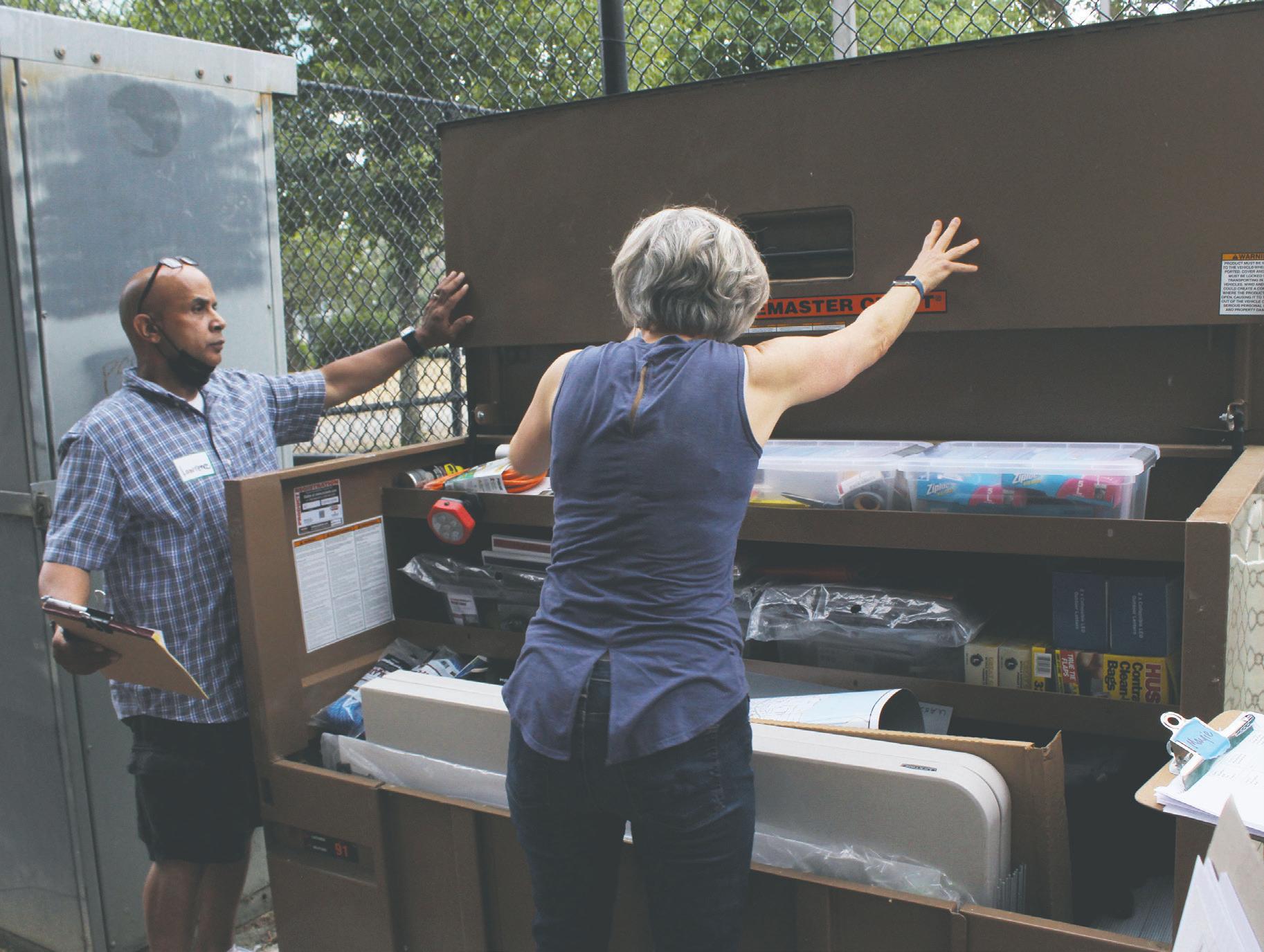
When Madison Park resident Sarah Armstrong, one of the organizers for the emergency planning event, unlocked the container, known as the hub box, the group found a variety of office supplies, a foldup table, laminated posters from the city advising residents what to do in case of an emergency and more.
By the end of the exercise, they had an even better idea of what communication materials they had at their disposal and what they wanted to have ready in the event of an emergency, mainly an earthquake that is anticipated to hit western Washington eventually.
“The bones are here. They just haven’t been put together yet,” organizer Margie Carter said of the box’s contents.
She said the purpose of the hub box is to act as a communication station where could go to share and receive information following a natural disaster.
Carter said, in the event of an earthquake, residents would ideally secure their own household and make sure everybody is safe and accounted for and there is not immediate dangers. They would then check with their neighbors and do the same. Then, one or more representatives from their block or emergency response group would go to Madison Park to the hub, where a station would be set up to share information between neighbors, such as immediate emergencies, resources available to share and other important tips people should know at the time.
Carter stressed that the hub box does not contain personal supplies for people, such as water, food or other necessities.
EMERGENCY, PAGE 6
communications

Photo by Jessica Keller
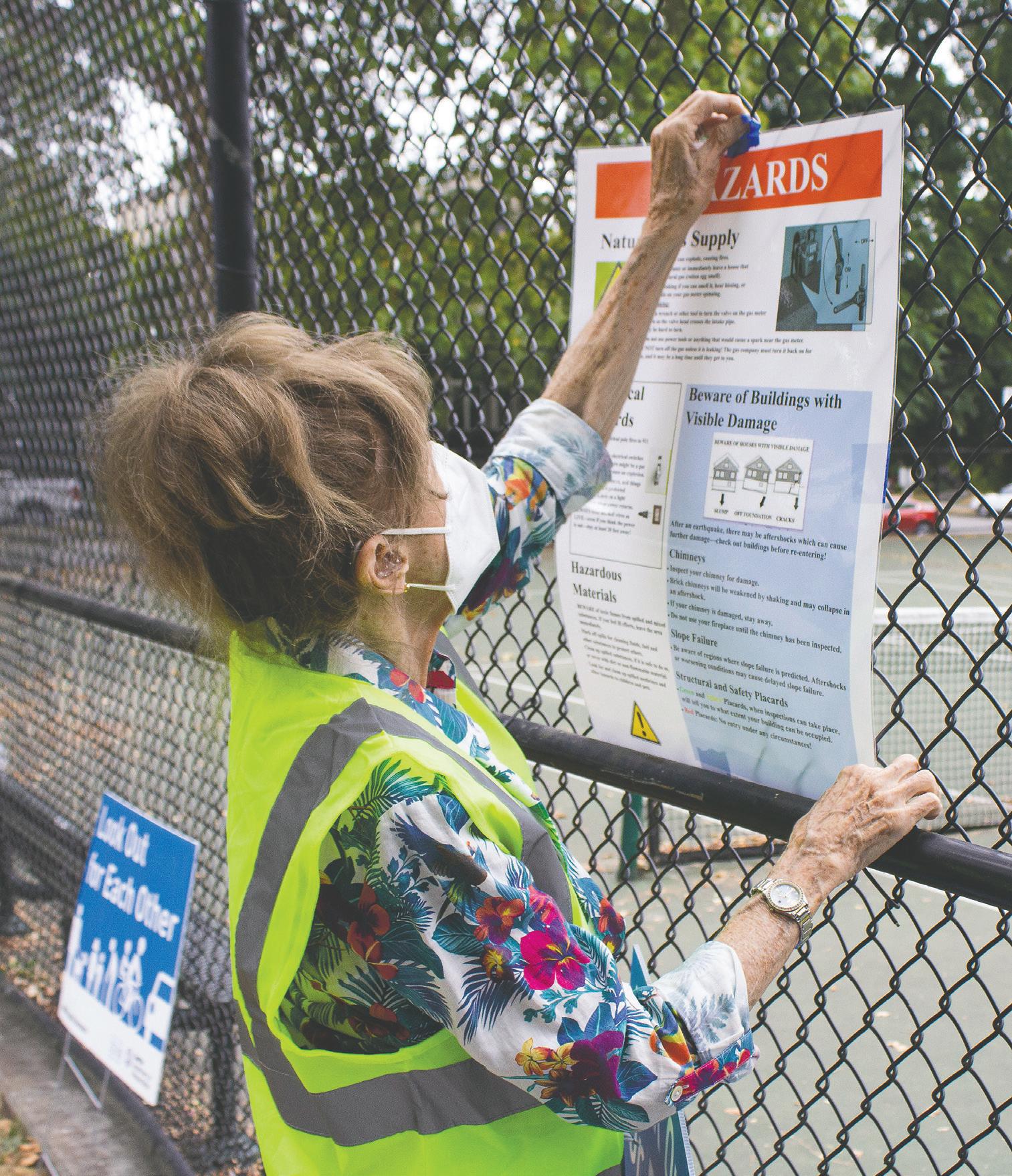
Madison Park resident Mary Pat Inman secures emergency preparedness posters from the city on the fence outside of the Madison Park tennis court during an emergency
planning drill in August.
Improving your balance from the center
Do you have poor balance? We all have varying degrees of balancing abilities, and while some folks may deal with neurological or inner ear (vestibular) disorders that would prevent them from having what we might consider to be “within normal limits” for the average person, others may suffer from subclinical unsteadiness on their feet, which impacts their ability to move effectively in their daily life as well as their favorite activities like golf, tennis and pickleball. A definition of balance is the ability to maintain a center of mass over its base of support, and so our ability to balance must begin with the ability you have to maintain control over your own center of mass.
Dr. Dan Michael Northwest Sports
Bipedal humans have a center of gravity (mass) that is located about the location of the naval, which brings us back to the topic of the core and what should be done to make it more fit for purpose.
To understand balance, we must
first understand how our bodies accomplish such a feat. A simple explanation may be that the brain gets information from the inner ear, eyes, skin, joints and muscles. With this information, the brain makes decisions to assist the executive part as it attempts to move the body at will. While the brain accomplishes much of the calculation needed to make movements precise at a subconscious level, there is great opportunity for supportive conscious control to boost our movement performance. In one of my previous articles, “How to Get More Out of Your Core,” I differentiated between core coordination and core strength. Core coordination is what happens when you link your trunk muscles to work with your thoracic diaphragm (breathing muscle) and your pelvic floor. Coordinating your core
structures like this allows for a stable base of support for your hips and shoulders to pull from, all of which is essential for good balance.
Coordinating your core is like learning how to ride a bike, whereby your abdominal wall and pelvic floor expands and contracts as the breath goes in and out. Think of it like two ballroom dancers with the lead hands pressed firmly but nicely together as they dance gracefully. This is how our core should feel as we breathe and move.
How good is your balance?
I’ve borrowed and modified a test from the Berg Balance Scale, which is a standardized balance assessment.
NOTE: If you have a high fall risk, do not attempt these assessments without supervision from a qualified professional. All others should take the necessary precautions to protect themselves from injury.
STANDING ON ONE LEG
INSTRUCTIONS: Stand on one leg as long as you can without holding on.
4 — able to lift leg independently and hold longer than 10
seconds
3 — able to lift leg independently and hold 5-10 seconds
2 — able to lift leg independently and hold ≥ 3 seconds
1 — tries to lift leg, unable to hold 3 seconds but remains standing independently.
0 — unable to try; needs assistance to prevent fall Score __/4
ADVANCED TEST: Repeat the above but with your eyes closed. This is very difficult, so do take more precaution than you think you need to prevent injury from falling or catching yourself. If you didn’t score a 4/4, these are some tips that can help improve your balance. Assuming everyone has either played Jenga or knows of the game, think of those precariously positioned and stacked blocks of wood; now imagine that your torso (center of gravity) is like those blocks of wood. If your muscles around the torso are loose and sliding around like blocks made of gelatin, soon your anatomical game of Jenga won’t be balanced for very long; and yes, much like Jenga, it does help to hold your breath if you really need to feel more stable.
Secondly and similarly, the
muscles around your hip, knee, foot and ankle need a similar level of dynamic stiffness to hold everything in exactly the right position while you stand on one leg. The muscles around these joints require what is called “co-contraction” to create stiffness instead of sloppiness.
To understand further what “co-contraction” is, think of a bodybuilder who is in the classic side chest pose and how the biceps and triceps fight against each other isometrically — that is co-contraction at the elbow and can be used from the torso all the way to the toes to create balance. Finally, it helps to think about grabbing the ground with your entire foot — especially the sole, versus simply clawing at the ground with your toes only. Try instead to grab the ground with the entire sole of the foot, almost as if you could pick up a tissue with the center of the foot. If your feet are feeling soft and inactive, swap out those house shoes and socks for barefoot walking to help “wake them up.”
— Dr. Dan Michael is a Certified Chiropractic Sports Physician® at NW Sports Rehab in Madison Park.
Pools, registered community center programs to begin phased reopenings
Seattle Parks and Recreation is increasing public services and programming at recreation facilities across Seattle beginning Sept. 7. This includes reopening most public pools for all drop-in swimming opportunities, including lap swim, water exercise and public and family swims; resuming community center and environmental learning center registered programs, such as lifelong recreation, specialized programs, etc., and restarting teen programs that support academic success and enrichment. These programs are in addition to the preschool and childcare programs already operating in community centers.
Because of the recent increase in COVID-19 cases, community center rentals, swim lessons and drop-in and general use will continue to be closed. This includes weight rooms, drop-in sports and similar amenities.
More information on specific programs times and locations can be found by visiting the Seattle Parks and Recreation website, checking out the community center Facebook page or through our online registration system.
All facilities will continue to follow any current COVID-19. The current guidance
DEADLINES
requires all staff and visitors to wear masks regardless of vaccination status. Conditions may change as restrictions and guidelines change.
Pool reopenings will increase over the course of the fall. The locations and hours of operations for these aquatic facilities are listed below.
The pools listed will open for all dropin swimming opportunities, including lap swim, water exercise and public and family swims. Swim lessons and some aquatic classes are still on hold as we monitor the Delta variant in our region.
Operating hours are based on projected staffing levels. Hours may be modified depending on staffing availability.
Check the Parkways blog, https://parkways.seattle.gov, for the latest information.
Southeast Seattle Medgar Evers Pool, Sept. 7: Open for lap swim, independent aquatic fitness, limited aquatic exercise classes and swim team rental
Rainier Beach Pool, Sept. 7: Open for lap swim, independent aquatic fitness, limited aquatic exercise classes and swim team rental
Press Releases | Wednesday, September 23,, Noon
Southwest Seattle Southwest Pool, Sept. 13: Open for lap swim, limited aquatic exercise classes, independent aquatic fitness and swim team rentals.
Colman Pool, closed for the season.
Northeast Seattle Madison Pool, Sept. 13: Open for lap swim, limited aquatic exercise classes, independent aquatic fitness and swim team rentals.
Meadowbrook Pool, Oct. 18: Open for lap swim, independent aquatic fitness, limited aquatics fitness classes and swim team rentals.
Northwest Seattle Queen Anne Pool, Sept. 7: Rentals only; Reopening January 2022
Ballard Pool, Oct. 18: Open for lap swim, limited aquatic fitness classes, independent aquatic fitness and swim team rentals.
Evans Pool: Reopening January 2022
Mounger Pool: Closed for the season
Teen life centers will be open during the hours below to support academic success and enrichment opportunities. These hours
Madison Park Times
Editor: Jessica Keller, 206-461-1310 or MPTimes@pacificpublishingcompany.com
Retail Display & Real Estate Advertising
Wednesday, September 23, 11:30 a.m.
Tammy Knaggs, 206-461-1322 or ppcadmanager@pacificpublishingcompany.com
Classified Advertising | Wednesday, September 23, 11 a.m.
Classifieds | General: 206-461-1332
are based on projected staffing levels. Staff hours may be modified, depending on availability. Check the Parkways blog for the latest information.
Teen life centers
Garfield Teen Life Center: 2:30 p.m.-8 p.m. Monday-Thursday; 3 p.m.-12 a.m. Friday; 7 p.m.-12 a.m. Saturday
Southwest Teen Life Center: 3 p.m.-8 p.m. Tuesday-Thursday; 3 p.m.-12 a.m. Friday; 7 p.m.-12 a.m. Saturday
Meadowbrook Teen Life Center: 3 p.m.8 p.m. Tuesday-Thursday; 3 p.m.-12 a.m. Friday; 7 p.m.-12 a.m. Saturday
Due to building renovations, the following recreation facilities will remain closed for programs, rentals and childcare through 2021:
Jefferson Community Center, closed until second quarter of 2022
Hiawatha Community Center, closed until second quarter of 2022
South Park Community Center, closed until fourth quarter of 2022
Discovery Park Environmental Learning Center, closed until second quarter of 2022
Laurelhurst will remain closed due to limited staffing.
SUBSCRIPTIONS
Ferry dock dives
By Richard Carl Lehman Revisiting the Park
Our newly formed Madison Park SCUBA group attended meetings to gather information on popular dive spots. Most of these spots involved having a boat, so, in lieu of that, we were able to take advantage of the ferry system.
From Seattle to anywhere we could dive around the many ferry landings. People on shore watched as we suited up, waded out and/ or jumped in to begin our watery quest to find life underneath. A favorite area was where lingcod fed on debris stirred up from the ferry. The log bumpers that line the ferry landing were much wider 30 to 50 feet down where they spread out and was another hangout for lingcod, mesmerizing all divers.
On one dive, I leapt in as others
suited up. I sank to the bottom and slowly surfaced, hand over hand along a piling. One area didn’t feel like hard wood, more like a covering of some kind. I looked toward the piling and an eye looked back! I froze — what the heck? It was a gray, overcast morning. Octopus are on the gray side, so this one blended in, but in the bright sun and sure of its surroundings they are orange. I simply gave Mr. Octopus a wide berth. He was big enough to wrap around the piling and seemed curious.
The others reached the bottom and spread out to look around the area, always in groups of two. We saw seals on the hunt, and wolf eels peered from their large boulder dens, mouths open showing their healthy bicuspids.
My dive companion shot a cabezon, similar to lingcod, with his arbalète, but it was all head and
a tiny body. As I reached for the spear, the top fin struck me just above the knee. Then my friend pulled the spear, which made the fish strike my hand. Lucky that fin didn’t break off. It would have been very difficult to find and

remove it. Believe me, the cost of cabezon went way up.
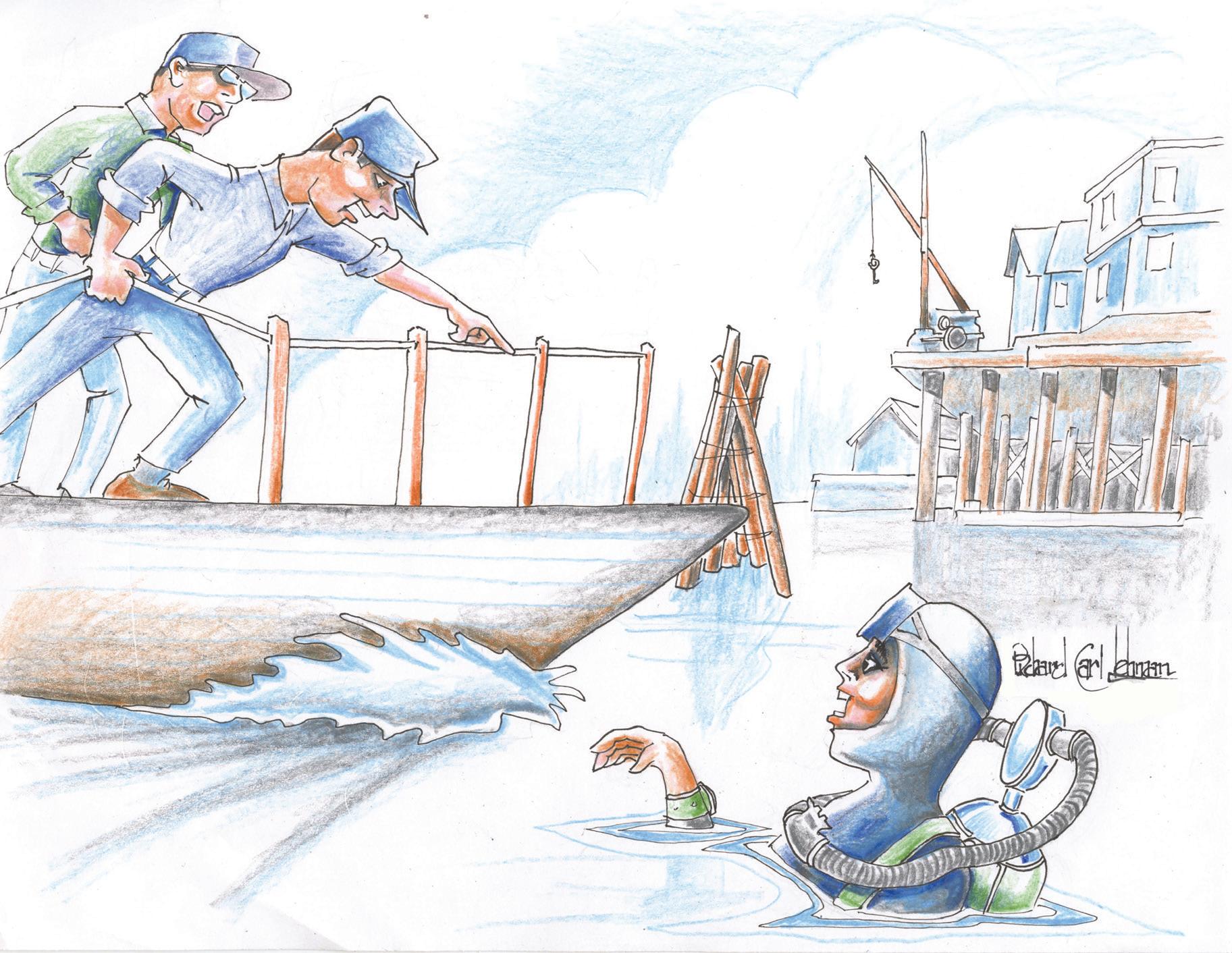
At one of the ferry landings, a deck hand saw a diver surface in the ferry’s path. All stop! The diver then surfaced not far away waving, OK. After that, there were signs posted, “No scuba divers near any landing in Washington State.”
Even dives near the beach had to have divers flags on site. Furthermore, no more catching fish by arbalète! In addition, we realized it was not wise to be down under when a water skier goes by above. Even then, some skiers thought it a game to touch the flag going by. New rules were making the sport of diving much safer.
A diver I knew was short of cash, but it didn’t deter his love of diving. He converted a tested “fire extinguisher,” which was far from the proper 2,150 pounds in regular dive tanks. Regular tanks had a five-minute reserve, which gave time for divers to surface from deep dives. We put him on notice and told him where he could rent a proper tank.
All of the restrictions to available dive areas made Edmonds beach a favorite, but it required a long swim out, and the same was true with Alki. Divers would snorkel with flags tied to inner tubes and then proceed to have a safe dive. Enter the famous World War II rebreather, which was used during underwater demolition in enemy territory because no bubbles would form. Good to 35 feet and then the air turned to carbon dioxide.
One diver brought one to an Edmonds dive. As divers swam to the wreck, he went missing from the group. He was found somewhat asleep on the bottom. He was OK but said he’d exerted himself. We put rebreathers on hold for future dives.
Feeling fairly confident diving with a tank at 2,150 pounds. to 130 feet, it would still create anxiety. One diver dove 700 feet in 12 minutes, but it took him 15 hours to come up to avoid getting the bends. It was a record in 1953.
In the early ’50s, a local gentle-
“From Seattle to anywhere, we could dive around the many ferry landings. People on shore watched as we suited up, waded out and/or jumped in to begin our watery quest to find life underneath. A favorite area was where lingcod fed on debris stirred up from the ferry.”
man realized he was in an unhappy marriage. He and his wife divided holdings, but he struggled to give up the family yacht.
When word of this great 40foot ship had met its demise in the south waters of Puget Sound, the air was full of sadness. It seems the ship sunk north of McNeil Island. It actually sank to a depth of 100 feet. The sheriff’s department deputies in unison must have said, “Hmmmmm…”
Local divers got word and offered to join the search. From a trusty ship above, they slid down the anchor line with limited visibility, and they saw the mighty ship with its many petcocks reaching up saying, “Here I am! Help me!”
Help the mighty yacht they did and found very little water damage and looking surprisingly well. How did those petcocks all decide to unscrew all at once?
The guilt surrounded the husband like a perfect-fitting life preserver. Rumor has it he, the ex-husband, resided in a cell at McNeil Island with an unobstructed view of where his ship went down.
Through the years, many innovations have made it possible to reach much greater depths. Always aware of decompression sickness, it is impressive, if not daring, to take to the water and embrace an otherworldly existence.
Our horticultural museum
By Steve Lorton Tree Talk
Madison Park is something of a living museum of trees. Any horticultural historian would have a heyday strolling our streets, poking a nose over a garden wall or hedge. As exotic plants began making their way into our far top left corner of America, they often landed here, first.
1889 was a big year for The Park. With the new Madison Park dock and steamer ferry slip and a cable car connecting the lakeshore with downtown, a summer playground began to take shape. Summer cottages sprang up.
A resort mentality took hold, and, along with it, front yards were planted with whimsical imports, which weren’t considered quite dignified for the gardens of the stately homes up the hill and to the west. Among them, Monkey Puzzle trees, Hollywood junipers, Windmill palms, a few still here, over 130 years later.
As the 20th century dawned, the burgeoning Japanese population in the city gave us Japanese gardeners whose plant choices and esthetics can be seen in the venerable and impeccably groomed and pruned Japanese maples filling lot corners and spilling over rock retaining walls.
Even towering conifers fell under their influence. These trees were often thinned of their limbs by 30 percent, opening up the beds below to more sunlight, producing a more sculptural silhouette, and allowing wind to pass through the trees, making them much less likely to come down in a strong, errant wind.
By the 1920s and with the advent of the automobile, summer cottages gave way to streets lined with year-around family homes. At this point, the nursery industry was in full swing, serious ornamental gardens emerged, and our byways were lined with shade trees.
Now, a century later, these plantings not only provide us with handsome and mature specimens of any number of plants, they are a living record of horticultural trends.
In the late 1970s the “Gardening Boom” thundered across America. It coincided with the physical fitness craze and the love of good cooking and fine dining. All three cultural explosions outlived trendiness to become established parts of our culture. Nowhere did any of the three fare better than in Seattle.
Nurseries, large and small,
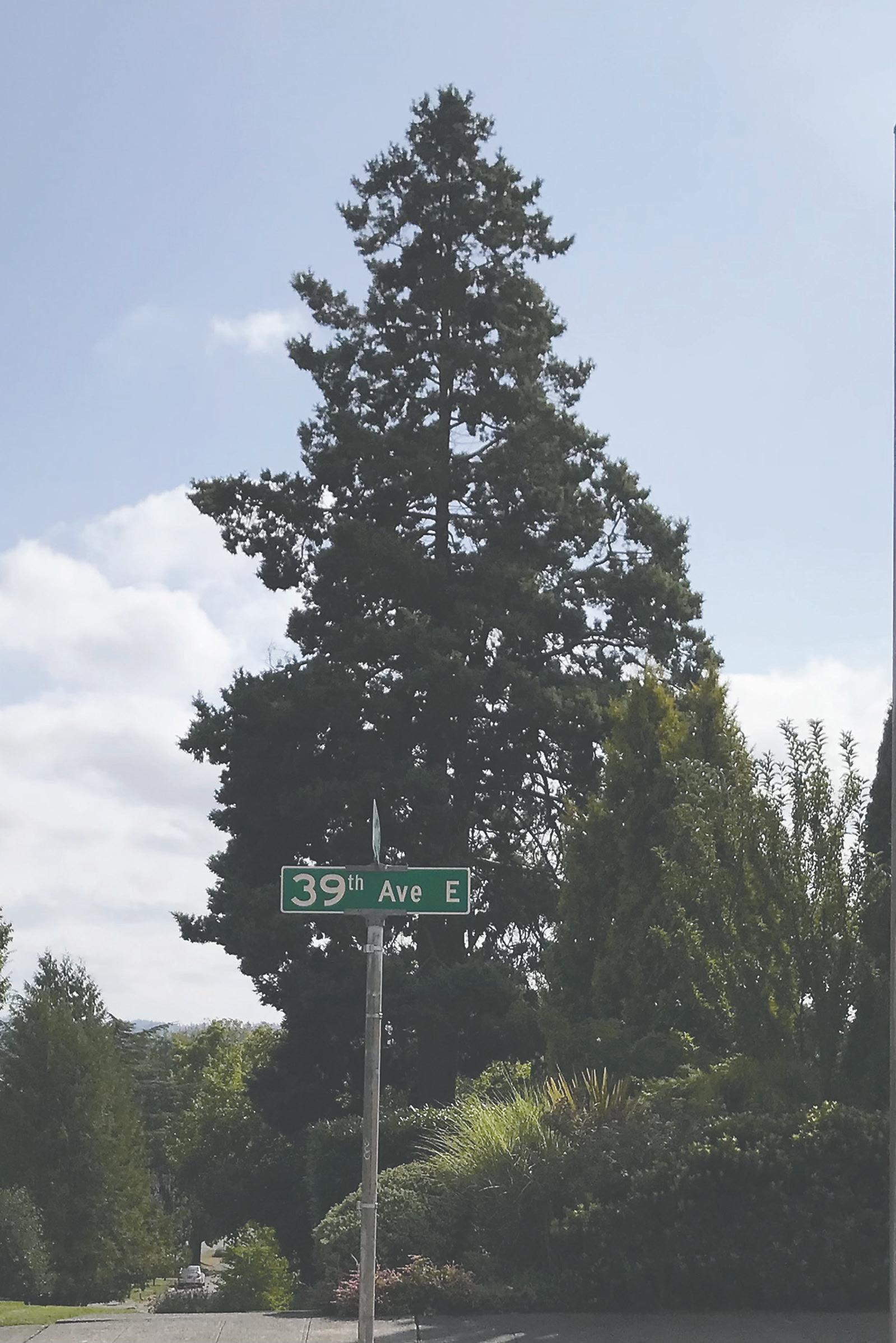
This giant at the corner of East Galer and 39th Avenue East is the Chamaecyparis pisifera ‘Boulevard.’ Native to Japan, these trees were introduced in the 1920s, prized for their steel blue foliage that is somewhat soft to the touch.
opened all over town. The Seattle Times, The Post Intelligencer, even The Seattle Weekly published regular gardening columns. Television shows did regular spots; garden clubs took off. The Madison Park Garden Club blazed the trail in neighborhood horticultural fundraising with their annual garden tours. Front yards were enclosed with garden walls and hedges to create outdoor rooms.
Everywhere, new plant introductions became the topic of discussion, equaling in enthusiasm (well, almost) the chatter about Huskies football and crew. Pandemonium? Well, certainly plantdemonium.
Use the gentle end of summer days to stroll our streets and look at the colors, shapes and beauty of our trees and gardens. Give thought to how this all came to pass. Pledge to be a part of it going forward.
A good place to start your exploration is at the northwest corner of East Galer and 39th
‘The Sea in Winter’ representing state at 2021 National Book Festival
The Washington Center for the Book, a partnership of The Seattle Public Library and the Washington State Library, has selected Washington author Christine Day’s “The Sea in Winter” to represent Washington state at the 2021 National Book Festival, sponsored by the Library of Congress.
Day’s middle grade novel, for ages 8 to 12, will be







Avenue East. Look south and east at the towering blue conifer (pictured above). It soars proudly, about a quarter of the way down the block.
This elegant giant is Chamaecyparis pisifera ‘Boulevard.’ Native to Japan, these trees were introduced in the 1920s, prized for their clouds of steel blue foliage that was somewhat soft to the touch. Gardeners loved them and planted them for their startling color, especially effective against our dark greens or paired with deciduous foliage that runs to the reds and burgundies. Put in place as shrubs and often sheared into balls and cones, few were ever allowed to achieve their rightful stature, topping out at 30 feet or more.
But should you make the pilgrimage to see this tree, you’ll be looking at a majestic plant that has graced Japanese temples for centuries … and is, today, yet one more exhibit in our wonderful Madison Park Museum of Horticulture.
part of the “Great Reads from Great Places” program, http://www.read.gov/greatreads/index.html, and the author will appear in conversation with children’s and teen book authors from other states. This year’s National Book Festival will be Sept. 17-26, with 10 days of virtual programs celebrating books and authors. The Great Places, Great Reads program features books and authors representing the literary heritage of the 50 states, the District of Columbia, Puerto Rico and the U.S. Virgin Islands.



Photo by Mary Henry
More Seattle library branches opening this month
The Seattle Public Library will significantly expand the open hours of its reopened locations this month and open others. The Montlake branch opened Sept. 1. The Madrona-Sally Goldmark Branch will open Sept. 15.
When the NewHolly Branch reopens later this fall, SPL will have successfully reopened all 27 of its locations. A precise date is not yet determined for the branch.
“We have worked very hard to reach this point, and we are so glad to now be offering a neighborhood library schedule that more closely resembles what we were offering pre-pandemic,”
interim Chief Librarian Tom

Welcome back students and community!!
We are open and following the Governor’s current mandates, so we can safely welcome you all back to the MLK FAME Community Center.
| mlkcommunitycenter@gmail.com
Fay said in a press release. “We know patrons of all ages are eager for more access to their home branches to browse collections, use computers, get help from library staff, and more.”
Starting this month, most reopened branches will be open every day.
According to a press release from Seattle Public Library, this expansion of hours marks a major step toward full restoration of pre-pandemic library open hours and is the result of funding provided by the Seattle Rescue Plan to restore staffing levels, which were reduced in 2020 and 2021 as part of citywide general fund budget cuts. The September hours expansion and building reopenings will increase total weekly open hours from 588 to 1,192.
All reopened libraries adopted their new schedules Sept. 1, except for the Central Library, which will expand hours starting Sept. 15 when it will add Sundays and Mondays to its current schedule. It will also be open later on Wednesdays, closing at 8 p.m. instead of 6 p.m. Currently, levels 1, 3 and 5 of the Central Library are available to the public. Library staff plan to open more floors to the public in coming weeks, but no dates have been set.
The Montlake branch, 2401 24th Ave. E., is open for the first time since March 2020. It is open from 1 p.m. to 8 p.m. Mondays and Tuesdays; from 11 a.m. to 6
p.m. Wednesdays, Thursdays and Saturdays; and from noon to 5 p.m. on Sundays.
Administrators will restore hours of operation to branches as staffing levels permit and seek to return to full, pre-pandemic, seven-day service, including evening hours, by the end of October. Expanded schedules and reopening dates may change in response to future developments related to the pandemic.
MASKS REQUIRED
To comply with Washington state public health regulations and to protect all patrons and staff, especially those who have not yet been vaccinated and/or are at greater risk from COVID-19, everyone must wear masks while in SPL buildings, regardless of vaccination status. All reopened locations are open at 100 percent capacity and currently do not require physical distancing of patrons.
ABBREVIATED LIST OF REOPENED LOCATIONS AND HOURS
Reopened libraries will operate according to the schedules listed below. Visit the library’s Hours and Locations page, www.spl. org/Hours, for a complete list of locations and services currently available.
Broadview Branch Operating hours as of Sept. 1
are from 10 a.m. to 6 p.m. Mondays, Tuesdays, Fridays and Saturdays; noon to 8 p.m. Wednesdays and Thursdays; and noon to 5 p.m. Sundays.
Capitol Hill Branch Operating hours as of Sept. 1: 10 a.m. to 6 p.m. Mondays, Tuesdays, Fridays and Saturdays; noon to 8 p.m. Wednesdays and Thursdays; and noon to 5 p.m. Sundays.
Central Library (Levels 1, 3 & 5)
Operating hours as of Sept. 15: 10 a.m. to 6 p.m. Mondays, Tuesdays, Thursdays, Fridays and Saturdays; 10 a.m. to 8 p.m. Wednesdays; and noon to 6 p.m. Sundays.
Madrona-Sally Goldmark Operating hours as of Sept. 15: 1 p.m. to 8 p.m. Mondays and Tuesdays, and 11 a.m. to 6 p.m. Wednesdays and Thursdays.
Montlake
Operating hours as of Sept. 1: 1 p.m. to 8 p.m. Mondays and Tuesdays; 11 a.m. to 6 p.m. Wednesdays, Thursdays and Saturdays; and noon to 5 p.m. Sundays.
University Branch Operating hours as of Sept. 1: 1 p.m. to 8 p.m. Mondays and Tuesdays; 11 a.m. to 6 p.m. Wednesdays, Thursdays and Saturdays; and noon to 5 p.m. Sundays.
A simple google search on cannabidiol (CBD) for workout recovery yields well over a million results. With CBD recently enjoying national legalization, athletes are using it more than ever to help recover after exercise. This article will examine what CBD is, the pros and cons of CBD for athletes, and the best methods of application.

CBD is a cannabinoid, or a chemical compound unique to the cannabis plant. When cannabis makes flowering buds, the buds produce compounds which include cannabinoids like CBD. Unlike THC, CBD is nonintoxicating (it doesn’t make you feel high), and it’s not used recreationally. For this reason, CBD is regarded as a wellness supplement rather than an intoxicating drug, and many people who use CBD regularly have no desire to get high.
When taken in significant amounts, CBD can induce noticeable effects which vary from person to person and may include relaxation, sleepiness, calmness, happiness, or nothing at all. Many people who experience chronic pain notice alleviation of the symptoms, similar to taking an OTC pain reliever (this is where CBD comes in handy for workout recovery). CBD is also known to help improve sleep quality, which is vital because most physical
recovery happens during sleep. Not only does CBD work directly to help the body recover after a workout, but it promotes auxiliary functions like deep sleep and relaxation that are doubly advantageous for recovery.
For a more in-depth look at how CBD works, we need to understand the endogenous cannabinoid system (ECS). Throughout our central nervous system are receptor sites for cannabinoids like CBD, which compose the ECS. These receptors are located in the entirety of the body, including in the brain, immune tissues, organs, and muscles. The ECS controls the uptake of cannabinoids produced naturally within the body, so when supplemented by cannabinoids like CBD, the functioning can be tonified or optimized. The ECS also controls a wide array of physiological functions, including the regulation and modulation of pain, the regulation of appetite, sleep, memory, and other processes. This is likely why many people who use CBD experience a sense of general wellness and uplifted mood, because the harmonic functioning of the body, known as “homeostasis,” can promote wellness at the cellular level. However, because CBD can cause relaxation and sometimes sleepiness, it’s best to use
CBD after, rather than before, a workout.
There are a variety of ways to use CBD, including smoking or vaporizing flower, drinking tincture or infused beverages, consuming capsules or CBD-infused edibles, or using topical products. The type of product you need is influenced by the results you’re looking for and the specific kind of recovery your body needs. Sore muscles can be alleviated with a topical or CBD consumed internally, although in my experience, a combination of both works best. Restful sleep is essential after a workout, and while topicals are unlikely to make you sleepy, a CBD gummy or capsule can have a longlasting effect throughout the night to help you stay asleep. Smoking or vaporizing CBD provides a more rapid onset, which is helpful if you have trouble falling asleep, rather than staying asleep. Some products are formulated to help with specific conditions and may include other ingredients like valerian root for sleeping or willow bark for pain relief. Ask your budtender for recommendations based on the specific results you need.
Cody Funderburk
Will the big brown box save you?
Perhaps you’ve noticed that brown metal box next to the tennis courts in Madison Park. Some people think it’s chock full of supplies that will help them after an earthquake, like food, water and medical supplies. They’re wrong. The box is the result of Madison Park neighbors coming together over the last decade to develop a communication center to activate after a significant disaster, like the magnitude-9 earthquake expected in Seattle some day in the future, https://www.geekwire.com/2020/ earthquake-researchers-lay-latestoutlook-really-big-one-thatll-hitseattle/.
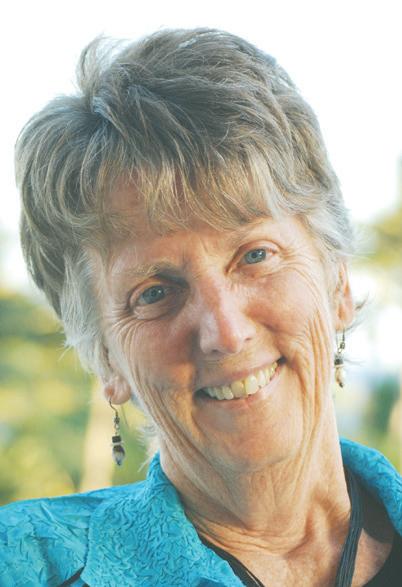
Margie Carter MP Emergency Preparedness
Recent research by seismologists and geophysicists propelled Madison Park residents John Madrid, Bob Edmiston, Sue Heffernan, Dave Reeder, other residents and the Madison Park Community Council members to gather donations to set up an emergency communications box in the park — called the hub box. While the box holds this history, it does not hold any supplies to help neighbors survive. Rather, supplies are limited to items that would help neighbors communicate what they need, offer skills that they have, learn what’s happening in other parts of Seattle after the quake and access information about how
EMERGENCY, FROM PAGE 1
Residents need to secure those supplies on their own.
The contents of the hub box were gathered by a previous group of residents concerned about “the big one” some years ago, Carter said, but most had moved away or were no longer involved, leaving it up to a new batch of people to carry on the efforts.
Carter and Armstrong have been actively trying to revive emergency management planning in Madison Park after the latest efforts had lost steam during the pandemic.
“So, our thought was, if we capture enough attention, people might catch the fire,” Carter said.
The Aug. 16 exercise was the first of several practices planned in Madison Park in the coming months. Carter said she thought the event was successful, albeit a bit chaotic, which accurately reflects what things would be like in the aftermath of a natural disaster.
“I think it was a really positive experience if only for the underlying goal of sparking interest in enough people to get something going to carry forward,” Carter said.
Leschi resident Tracy Bier attended the Madison Park event to get some idea of what her
to survive with what you have until help arrives.
Most of these early contributors to our Madison Park emergency preparation work have moved on. Currently, a small group of volunteers is trying to pick up their work and get ourselves educated and better prepared. This involves upgrading the hub box and holding practice drills so that we can efficiently set-up our local communication system after a quake.
Another aspect of our work together will be to mobilize neighbors into small block clusters to get know each other and plan for mutual aid. We certainly can build on some of the positive experiences we’ve had getting to know our neighbors better after 18 months of a global pandemic!
Will you join us in this effort?
We know it is both foolish and unsustainable to expect someone else to handle things that seem so daunting. If we each play even a small part, we can accomplish a great deal. You might want to join the ham radio team that will keep communications flowing between different neighborhoods and the city’s Office of Emergency Management after the earthquake. You might want to help mobilize neighborhoods or practice running the communication center during a drill. Or perhaps you
have some needed funds or supplies you could offer to upgrade the hub box. We have a knowledgeable team that will be guiding volunteers and co-creating our plans so your time or donations will be put to good use.
Consider joining us at one of our upcoming work sessions:
* A meeting to review the recommendations for upgrading the
hub box and breaking into teams to get the work done from 4 p.m. to 5:30 p.m. Oct. 3 at the HUB box by the Madison Park tennis courts.
* A chance to see the HUB communication center in action from 4 p.m. to 6 p.m. Oct. 21 at the HUB box by the tennis courts. Participants will be given “pretend scenarios” that they will follow
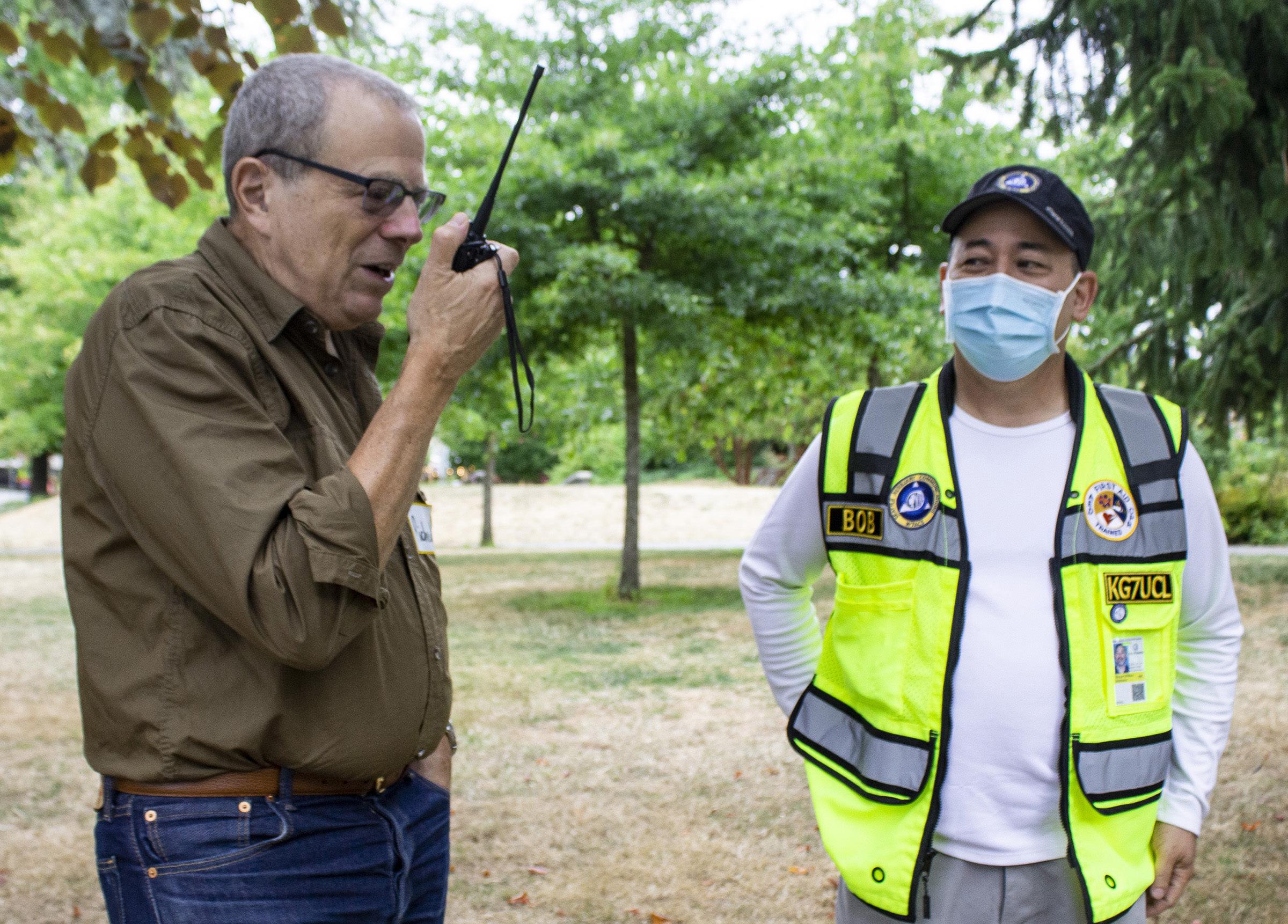
Richard Wolf, left, talks to another person via a two-way communication device at a communication hub emergency planning session as volunteer Bob Edmiston looks on at Madison Park, Aug. 16.
neighborhood should prepare for following an earthquake. She said, currently, there is no emergency management planning effort taking place in Leschi like there is in
Madison Park, and that concerns her.
“It’s going to be frightening when it happens, but even more frightening if we don’t get any-
thing done,” Bier said. At the end of the exercise, the group members agreed the most important commodity in their emergency response plan wasn’t
through the entire communication center from start to finish. If you have more questions, contact Sarah Armstrong, saraharmstrong215@gmail.com, and Mary Beth McAteer, msimiele1@ gmail.com.
Otherwise, we look forward to having you join us in the park Oct. 3 and Oct. 21.
going to be found in the hub box. Instead, given the uncertain nature of when a natural disaster will strike, the most important resource will be volunteers to assure efforts continue long into the future.
“There needs to be some collective memory lodged somewhere,” Carter said afterward.
She said, while previous organizers created a sort of “playbook” they included in the hub box as a reference for volunteers, things would likely be too chaotic immediately following a disaster or earthquake to make it practical.
“So that’s partly what we have to do: get a wide enough group to know parts of the playbook,” Carter said.
People who are interested in learning more emergency preparedness can go to the Office of Emergency Management website, seattle.gov/emergency-management or seattleemergencyhubs. org. The city is also hosting two simulated earthquake events people are invited to attend this month. The first is from 9 a.m. to 1 p.m. Sept. 18 at the Maple Leaf Playground off of Roosevelt Way. The second is from 9 a.m. to 1 p.m. Sept. 25 at Jefferson Park, 3801 Beacon Ave. S., west of the tennis courts. Email info@seattleemergencyhubs.org.
Photo by Jessica Keller
Madison Park emergency hub volunteers Lawrence Pitre and Sarah Armstrong survey the contents of the brown metal container next to the tennis courts at Madison Park during a drill in August.
Photo by Jessica Keller
Imogen Cunningham Retrospective debuts at SAM, Nov. 18
The Seattle Art Museum presents Imogen Cunningham: A Retrospective from Nov. 18 to Feb. 6, 2022. It will be the photographer’s first major retrospective in the United States in more than 35 years. Organized by the J. Paul Getty Museum, Los Angeles, the exhibition is a visual celebration of Cunningham’s immense contribution to the history of 20th-century photography.
It features nearly 200 works from her seventy-year career, including portraits of artists, musicians and Hollywood stars; elegant flower and plant studies; poignant street pictures; and groundbreaking nudes.
Beginnings in Seattle Imogen Cunningham (1883–1976) had deep connections to the Pacific Northwest; born in Portland, she grew up in Port Angeles and Seattle. The precocious child of a free-thinking father, Cunningham decided to become a photographer around 1901, while still in high school.
Her father famously asked,
“Why do you want to become a dirty photographer?” Yet he built her a darkroom in a woodshed, including the necessary and messy chemical supplies. Her first works were in the soft-focus, Pictorialist style.
Cunningham completed a chemistry degree at the University of Washington in 1907. During these years, she also participated in the artistic scene, becoming the youngest charter member — and only photographer — of the Seattle Fine Arts Society in 1908. She also apprenticed and then worked from 1907-09 at the Seattle studio of well-known photographer Edward S. Curtis. After a year-long fellowship in Dresden, Germany, Cunningham returned to Seattle in 1910 and opened what is considered the first studio for artistic photography in Seattle. Cunningham married a Seattle artist, Roi Partridge, in 1915, and eventually had three sons.
Artist and collaborator
SAM’s iteration of the exhibition highlights Cunningham’s collaborations with artists of many mediums, particularly dancer
Martha Graham and sculptor Ruth Asawa. In a section of artist portraits is one of Graham, taken during a 1931 session that resulted in dramatic close-ups of the dancer’s face and body; also in this section is a video of the dancer in her iconic solo Lamentation (1930).
Cunningham was introduced to Asawa in 1950, and the two, though 43 years apart in age, established a lasting friendship. Cunningham regularly photographed Asawa and her looped wire sculptures and wrote on her behalf for a Guggenheim Foundation grant. The exhibition features seven Asawa sculptures alongside Cunningham’s five portraits of the artist and her work.
Another section of the exhibition features examples from Group f/64, a Bay Area association of photographers begun in 1932 that championed a direct and objective approach. In addition to Cunningham, the group included Edward Weston, Ansel Adams, Sonya Noskowiak, and more. Also on view are photographs by Gertrude Kasebier, Dorothea Lange, Listette Model,
and more; they were all sources of inspiration for or collaborators with Cunningham.
The light within The exhibition also explores the last 42 years of Cunningham’s life, as the artist continued to face challenges and late-in-life triumphs in her career. It was only in the final 12 years of her life that she finally began to receive attention, with major solo shows in New York, Chicago, and San Francisco; a 1964 Aperture monograph spearheaded by her champion and fellow photographer, Minor White; and a 1970 Guggenheim Foundation grant that enabled her to print a cache of her early glass plate negatives.
During these years, she continued to innovate, gravitating toward street photography and creating cleverly composed examples of the genre. She also taught and mentored young artists, and she became involved in civic issues in San Francisco, as well as the civil rights and the anti-war movements.
At the age of 92, she embarked on a final series focusing on aging,
traveling with an assistant to document subjects. On view in this final gallery is Portrait of Imogen (1988), a short documentary film directed by Meg Partridge.
Ticketing
Museum Hours
• Closed Monday & Tuesday
• Wednesday–Sunday 10 a.m.–5 p.m.
• Holiday hours on the website
Special Exhibition Prices
• $29.99 Adult
• $17.99 Senior (65+), Military (with ID)
• $12.99 Student (with ID), Teen (15–18)
• Free for children (14 and under)
• Free for SAM Members
Special Prices
• First Thursdays: Free to all
• First Fridays: Free general admission for seniors (65+)
Details are subject to change. For the most up-to-date information on planning a visit, go to seattleartmuseum.org.