A Trifecta of Service
Seattle Massage Pro expands its offerings
By Brandon Macz Madison Park Times former editor
With room to grow in her new Madison Valley location, Seattle Massage Pro owner Amber Myers has added an infrared sauna and a float room for a trifecta of wellness services.
Myers has worked as a massage therapist for a decade, spending the last eight years practicing in Madison Valley.
“As soon as I started massage school, I thought, ‘I’m done. This is exactly what I want to do,’” she said.
Myers signed her first lease in Madison Valley in the former Lila Yoga studio space in 2011, opening with a few hundred dollars in the bank, a folding massage table and pink butterfly sheets she bought at Target. She spent the past two years subletting space above All The Best Pet Care across the street.
The Seattle Massage Pro owner said she was happy to find ground-level space in Madison Valley, and reached out to MoveMend owner Aaron Shaw when she learned he was expanding his business outside the neighborhood. She’d joked about taking over the space, she said, but was soon connected with the property manager.
The Attic Closes
Staff Reports
Park Times
Unexpectedly, Madison Park’s The Attic Alehouse and Eatery closed its doors February 2nd.
A Go Fund Me campaign has been created by Karen McConnell to pay for the living expenses of former employees Colleen, Ryan, Cindy and Jon.
The four former employees have spent a collective 50 years and more working at The Attic.
“Just like The Attic itself, they’ve become part of the neighborhood,” the campaign page states. “It’s unexpected closure has left these staff members equally and suddenly without a source of income.
According to the campaign page, a “local group is in current negotiations to take over the lease and reopen The Attic,” though getting a new liquor license will take a minimum of two months.
As of press deadline, the campaign has raised $16,156 of the $15,000 goal.
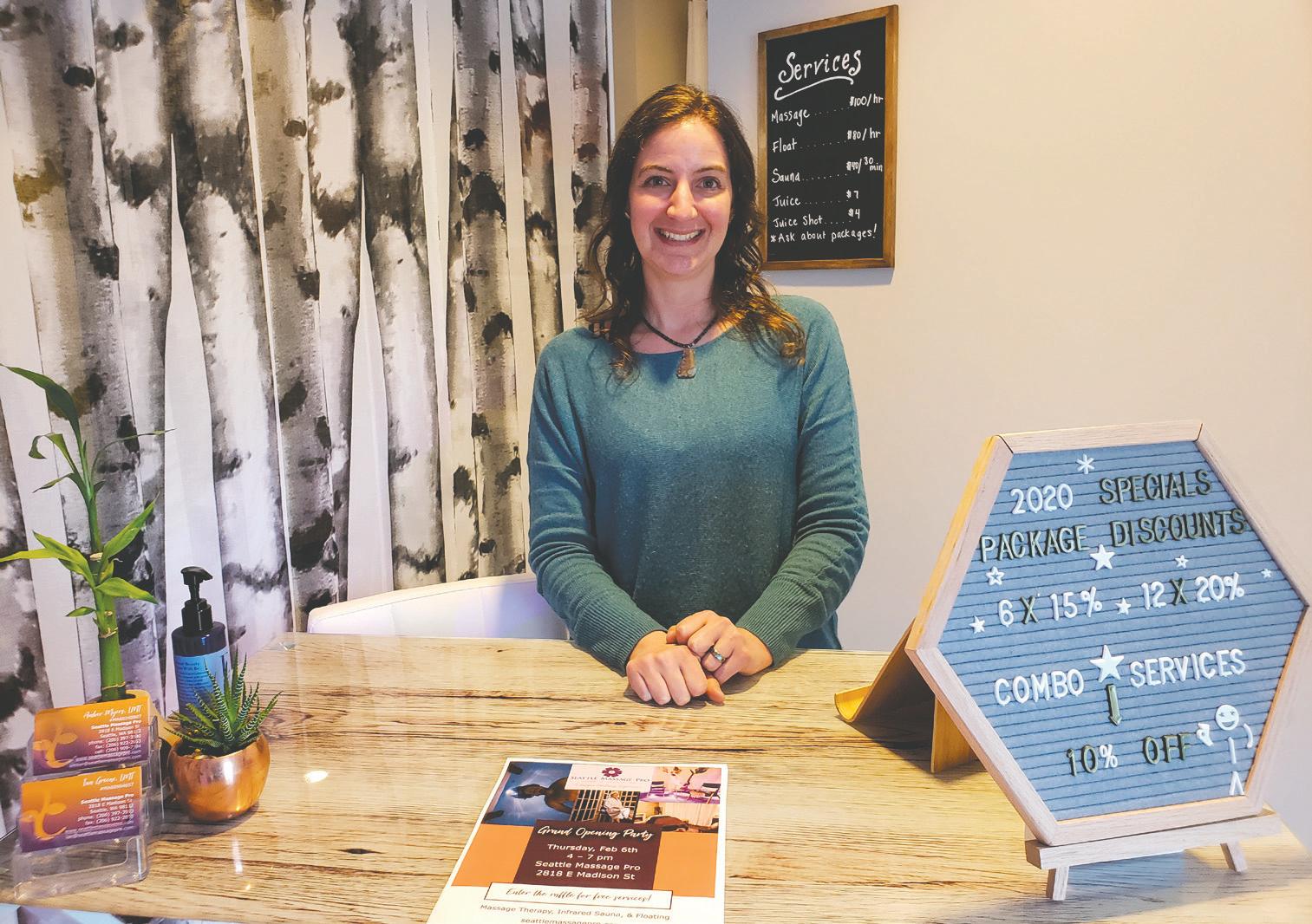
Myers spent six months building out the former MoveMend physical therapy office at 2818 E. Madison St.
A piece of the pink butterfly sheet is framed and hanging on the wall.
The space was larger than she needed for her two massage rooms, so she decided to add an infrared sauna, which seemed easy and approachable for clients. Her husband, Jesse, built the sauna room, which has wall panels that provide the infrared rays that
penetrate the skin and help repair muscle tissue, Myers said. He used the spare cedar wood to create sliding doors for the massage rooms.
Myers tried her first float therapy room a year ago during a visit to Portland.
“It was really monumental, I guess, because I was just thinking, ‘This has to happen, this has to happen; this is what my
MASSAGE, Page 6


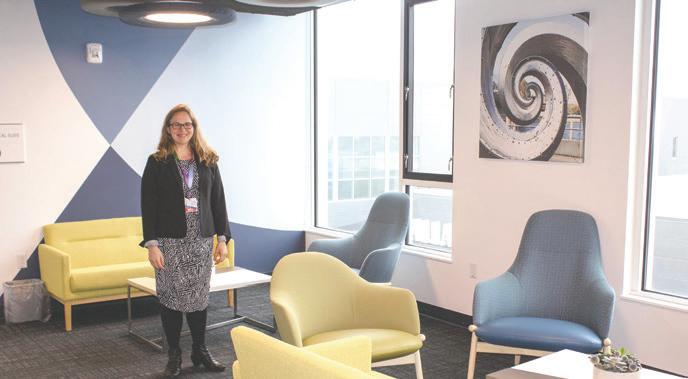




Photo by Brandon Macz Seattle Massage Pro owner Amber Myers has added an infrared sauna and a float room to her sevices at Seattle Massage Pro in Madison Valley.
Madison
Ballard Kaiser Permanente opens its doors
By Daniel Warn Madison Park Times editor
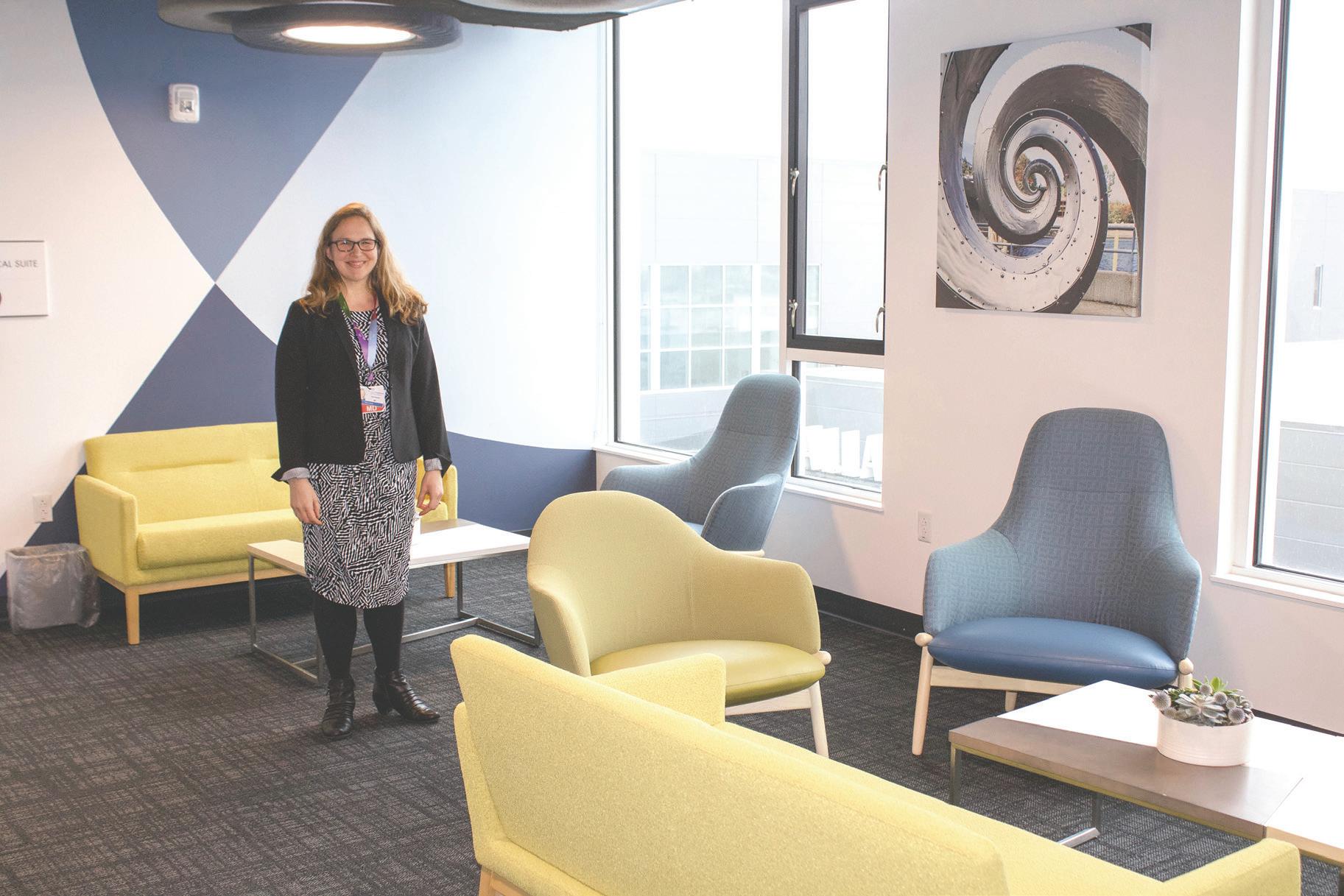
Kaiser Permanente recently opened a clinic in Ballard, designed from the bottom up for residents who call Ballard their home.
Trina Davis, medical director of innovation and business development for Kaiser Permanente Washington, and a family physician, said that Ballard people love Ballard and that Kaiser wanted to respect that as much as possible with the design of the clinic.
“Here at Ballard, when Kaiser decided that it would open a clinic in the Ballard neighborhood, we wanted to be really thoughtful and attentive to the location,” Davis said. “So we engaged in a process called ethnography, which is going above and beyond typical market research, doing intensive, in-depth interviews with over 100 people, and polling those members and bringing them into our design process.”
The ethnography process confirmed that Kaiser would be moving into a neighborhood passionate about local sights and culture.
“One of the main things we heard in all of that research was how important it was… that we
show up in a way that was authentic to Ballard,” she said. “We want to be attentive and sensitive and not come in like a big corporate brand, trying to just copy and paste an experience. Everything from the art on the wall, which is all local Ballard sights, to the color scheme were all informed by the place where we are.”
According to a press release announcing the clinic’s opening, Kaiser members will have personalized choices for the care patients will receive, with access to lab services, radiology, pharmacy, physical therapy, mental health, chiropractic care, obstetric, pediatric and primary care all on one campus.
The Ballard clinic is located on the fifth floor of the Ballard Blocks 2 retail complex at 1401 NW 46th Street in Seattle.
“This clinic was built to meet the needs of Ballard and nearby neighborhoods,” said Dr. Hannah Burdge, Chief of the Ballard Medical Center, in the press release. “As a resident of this neighborhood, I’m so proud to be part of the team bringing Kaiser Permanente medicine to this community, to serve current and welcome new members.”
Davis explained how the typical patient journey would progress starting even before a patient enters the clinic.
Before each appointment, pa-
tients can receive a digital bar code that they can conveniently scan upon arrival to check in.
There is also a patient access representative available to check-in the old fashioned way, but Davis said the point is to give members the option.
“You come in, you check in and you take a seat,” Davis said. “Within a couple minutes, your healthcare guide would come and
get you.”
Davis said that a health care guide is a new role at the Ballard Clinic.
“It is like an advanced medical assistant,” she said. “It’s someone who has all the skills to room you and take your blood pressure and all that, but they also have some training in health coaching and system navigation.”
This means that if a person’s
doctor says they need to eat less salt, the healthcare guide will sit down with a patient and explain what foods have a high amount of salt in them and make a plan for follow-up care.
The next stop on the patient journey is the rooms that the guide will take the patients to.
“In this exam room… our chair is also a scale, so you don’t have KAISER, Page 7
Your Pet's Broken Tooth
A broken tooth is a source of pain and potentially bacterial infection. If you or your veterinarian identifies trauma to a tooth, it is important to address the issue before it becomes a bigger problem.
only the outer structures of the tooth are classified as uncomplicated. Uncomplicated fractures of otherwise healthy teeth are the easiest to remedy. Typically a dental sealant is placed over the exposed dentin



Simplistically, teeth are composed of an outer layer of enamel that is very hard and impervious to penetration by bacteria and other noxious substances. Underneath the enamel is dentin, a very porous layer with thousands of tiny tubules. This dentil is in direct communication with the pulp chamber that houses the nerves and blood supply of the tooth.

There are essentially two types of crown fractures (broken teeth) – those that are termed “complicated” and those that are “uncomplicated”. If the fracture enters the living portion of the tooth called the pulp, then it is classified as a complicated fracture. More superficial fractures that involve
to create a shield to protect the tooth. This is appropriate treatment of minor chip fractures only, and assumes there is no evidence of disease or infection all the way down to the tip of the tooth root. The decision to “seal” the tooth is not necessarily always a blackand-white decision depending on what lurks below the gum line.
Complicated fractures are addressed by one of two approaches. The tooth can be extracted or can be salvaged with endodontic therapy (root canal therapy). A root canal treatment will essentially remove the contents of the pulp canal and replace them with inert substances – preserving the tooth but eliminating the pain associated with the fracture. Root canal therapy is typically reserved for the most “important” teeth in our veterinary patients like the largest chewing/ shearing teeth and the canine teeth. For those teeth that root canal therapy is not elected, extraction is the only appropriate option.
Dogs and cats are not likely to be expressive when it comes to oral pain. They often do not exhibit any noticeable symptoms. They will not stop eating, which is what most people assume means they are comfortable. It is up to us to not allow them to suffer in silence.
Photo by Daniel Warn
Trina Davis, medical director of innovation and business development for Kaiser Permanente Washington, and a family physician, shows off the lobby area.




Critters in the Hood

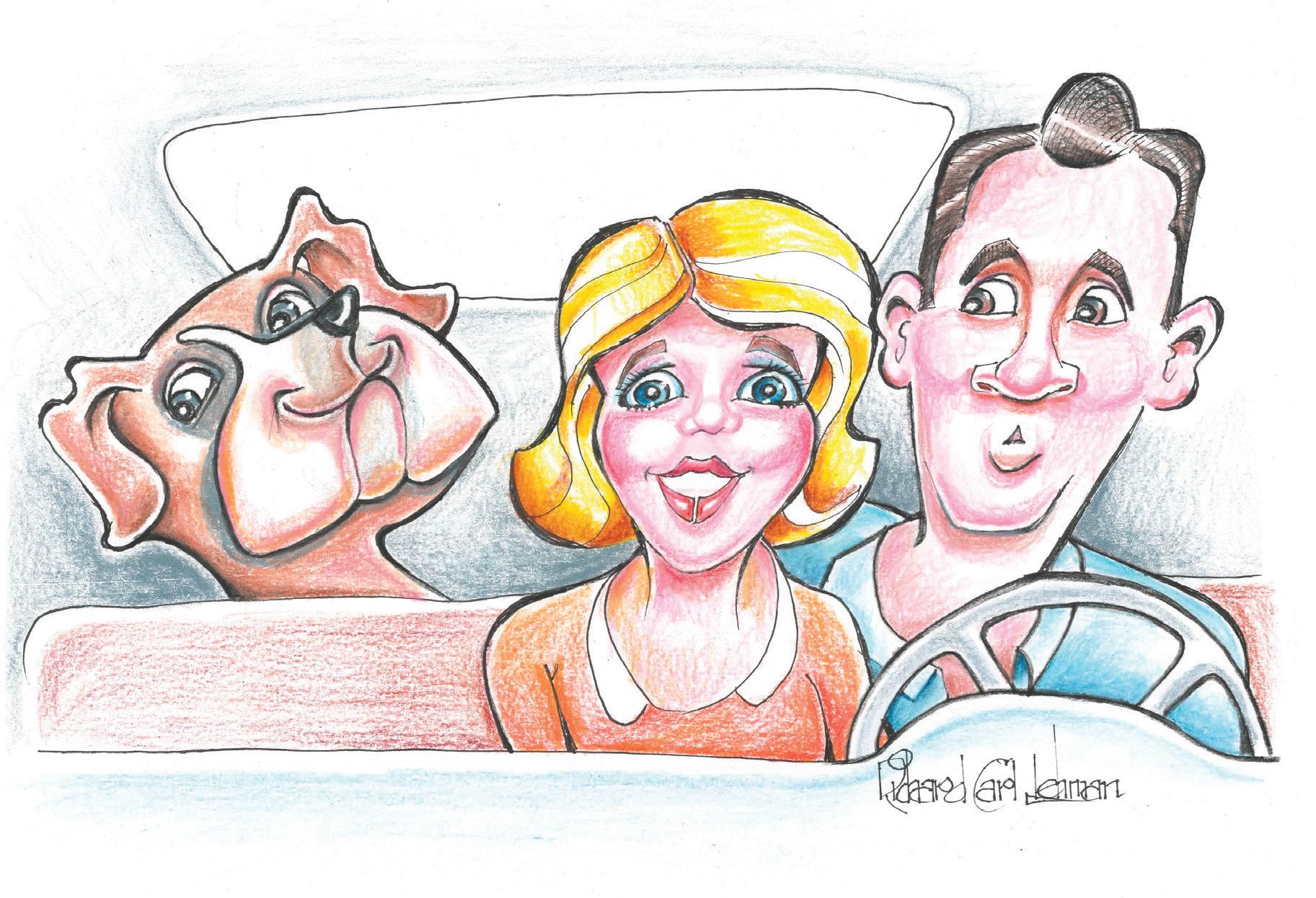
It was spring in the early fifties with one of those perfect warm blue-sky days--the kind of day commonly known as sick leave. I began the day detailing one of my favorite cars of the past, a 1950 Ford Convertible. Sally was a Madison Park neighbor who shared many Saturday matinees with me. We were to have our first drive-in movie date that night. I really wanted to impress her with a perfect experience.





My faithful friendly companion Bridget, the Boxer, was always nearby never far from the car hoping for a ride. Sally arrived and as I said hi, Bridget greeted her with more than average charm. Even her owner commented, “Wow, she is really awestruck by you”. Where was this going? Yes, it was to mean only one thing, “Let’s bring Bridget!” said Sally. Really? Like I had a word in this decision-making process. It wasn’t going to be just another cruise around the neighborhood either.
A short time later, top down, Sally at my side, Bridget perched happily on the passenger’s side
inhaling the fresh air. We sang “Sh-Boom” on KJR AM radio. Just past the Leschi Market we turned up hill to I-90 (a longgone shortcut) and cruised east at 55 mph. (Few ever went over that limit).
We arrived at the Sunset Drive-in near the Bavarian Tavern and a Mom and Pop store in Bellevue (Loehmann’s Plaza now). We parked in the rear near the concession stand and said hello to friends who happened to be there from Madison Park. Those cars with spotlights played “Chase the Red Dot on the Screen.”
As the evening cooled, I put the top up. Bridget was thoroughly enjoying the back seat all to herself. Sally got treats from the concession stand and even brought a hotdog for Bridget. The best treat, though, was a jumbo bag of hot fresh popcorn! Who knew this was going to be that dog’s favorite? We laughed throwing popcorn in the air and guess who never missed a catch? She just never seemed to get her fill.
Finally, the movie started and with a blanket for warmth and an Oly in hand we settled in.
Not long into the movie, we heard a sound much like a child squeezing air from a balloon. I looked at Sally and in unison said, “Not me!” We laughed so hard it caused Bridget to look quizzically, head tilted as if to say, “What?” Rolling the windows down at record speed we did as any adult would do, laugh hysterically. People walking by commented and the car next to us rolled their windows up. What lesson could be learned by this? None! We had no idea what to do next. Sally decried, “Take Bridget to that tall grass— relief station?!” The lesson--dogs who inhale more than an ample supply of air and popcorn are better off in large green pastures away from sensible movie watching people.
Back in ’68 there were two guys living on 41st who had an
import business. They were to bring their latest find to the Red Onion. We all met around the big round booth and here they came with a carrying bag and set it on the table. Slowly they unzipped it. A critter the size of a cocker spaniel with two big curious eyes emerged. It was a baby lion—a cub!! It drank some beer from a dish and when it meowed the sound was baritone. You could tell its genus by the size of its paws. Once it grew into those paws it could no longer be called with a, “Here kitty kitty.” Within a few months they donated it to a Portland animal rescue agency. That same year I worked with a friend who left her home in Brazil via a cramped jet fighter her brother flew. She owned two baby critters about the size of a squirrel called Kudamundi. They were very curious and affectionate. As we drank a very fine wine, the two of them ran around playfully. When guests arrived for dinner from her homeland, she told us of the dubious flight her brother navigated.
Ah yes, wine, laughter and Kudamundi’s—what could go wrong? They were curious about fingers and as they gripped to inspect, one of them bit my right index finger! I felt the pain to my shoulder. Our hostess said, “Oh, I forgot to mention, the female tends to bite—are you all right?” I answered, “Sure!” I think to myself, ‘Are you kidding me? It must’ve hit a nerve. Might look into a mouth guard!’
A lab named Duke was raised as a hunting dog by Jack Lomas, another neighbor. Duke walked the Ave near the beach, and liked to go after ducks, grasp one in its mouth—not injuring it physically, just mentally—and carry it away to parts unknown. The duck would quack all the while until Duke could display his catch. Jack usually laughed and commanded, “Duke, release the duck!” This was a talented dog not to be outdone by Timor the diving dog.
Stay tuned….
Council votes to end most evictions in winter months
By Daniel Warn Madison Park Times editor
Folks may not be evicted during winter months starting in December.
Seattle City Council passed legislation that will create a moratorium on winter evictions during the months of December, January and February.
This legislation is targeted for winter months because in December, January and February temperatures regularly fall into the 30s overnight.
Just before the ordinance passed 7-0, with councilmembers Lorena González and Debora Juarez excused from the meeting, councilmember and ordinance sponsor Kshama Sawant congratulated her colleagues on a job well done.
“At the end of the the day, what we will have achieved if this legislation is voted through is landmark legislation that has no precedent in the country and in fact very little precedence in the world, because as far as we know, only the country of France has something similar,” she said. “This is huge, and I think we should be proud of our movement for this.”
While introducing the legislation, Sawant detailed a study jointly issued by the the Seattle Women’s Commission and King County Bar Association about
evictions in Seattle.
“This study found that nearly 90 percent of people evicted become homeless and that people of color were disproportionately, in fact, overwhelmingly were the ones who were evicted,” Sawant said. “More specifically, black tenants experienced eviction at a rate 4.5 times what would be expected based on their demographics in Seattle.
She said that most Seattle tenants are evicted for not paying their rent, or for being short on rent.
“In most cases the study found that evicted tenants owed one month or less in rent,” Sawant said. “In one case, the tenant was evicted for owning $10.”
Sawant went on to say that an eviction can be a death sentence, with the study finding that out of 2017 evictions, six Seattle tenants died during or right after evictions.
Four of these individuals committed suicide, she said, one died of an accidental overdose the day after being evicted, and one tenant died during the eviction process while receiving hospice care.
According to Sawant, the study also found that at least nine people who died homeless on the street in 2017 had an eviction filed against them in the three years preceding their deaths.
“The data are a brutal inditement of a private housing market
that is dominated by corporate landlords who care more about profit than housing people,” Sawant said.
Several amendments to the ordinance passed prior to the vote.
One amendment, put forth by councilmember Andrew Lewis, was to create a framework for a mitigation fund that people facing an eviction could have access to in order to pay unpaid rent.
“Under this amendment, we would establish a mitigation fund,“ Lewis said. “It would only be accessible to folks who establish this defense. And I think it is important that when we talk about this moratorium, when are really talking about a defense in an eviction proceeding as where it’s applied.
“In a case where a tenant facing an eviction is able to establish this defense, this would then exist as a fund that could be accessed by the tenant in order to pay rent or access additional rental assistance.
Lewis said that up to half a million dollars would have to be put aside in the fall budget to make this mitigation fund fully effective.
This amendment passed 7-0.
Councilmember Alex Petersen put forth an amendment to the ordinance that would exempt small landlords — those who own four or fewer units — from the legislation.

“The amendment I think is important to exempt them because they do face economic hardships as well, in terms of being able to provide those units to the housing market. They do have a mortgage. They do have utility bills, property taxes…”
Sawant disagreed, saying that it would be an unfair burden to put on the detrimentally affected party to figure out whether they are eligible to take advantage of the legislation.
“This is unfortunately an example of a politician proposing a policy to benefit those who already have more than most at the expense of poor and working class people with really no data or evidence to support it,” Sawant said. “The point remains that the small landlord that this amendment is intended to help is entirely hypothetical.
“But the tenants whose lives are being destroyed and whom this amendment would not help — that’s very real,” she said.
The amendment passed with a 4-3 vote. Councilmembers Tammy Morales, Lisa Herbold and Sawant opposed.
Herbold then put forth an amendment that expanded language already in the bill.
“Currently a reason for termination that is exempt from the bill includes unlawful behavior, and this amendment would expand unlawful behavior to a particular type of lease violation and specifically impacts the health or safety of other tenants or the owner.”
Sawant and Morales opposed the amendment, but the rest of the council voted it in. Sawant
EVICTIONS, Page 6
Cannabis & the Creative Experience
How cannabis influences art and perception
Cannabis and art go hand in hand. The extensive history of some of the world’s most renowned artists, musicians, and entertainers frequently using cannabis may not be a coincidence. The artistic and cultural explosions that trademark the 20th century drew attention to the creative enhancement of cannabis and other drugs. Until very recently, the unique association between cannabis use and artistic creativity remained largely mysterious. Researchers have since explored the scientific connection between the use of cannabis on the frontal cortex, and how this enhances, or sometimes disrupts, creative output and potential.

There are several aspects of cannabis that may help with the creation and consumption of art. First is the notorious ability for cannabis to relax the mind and calm the nerves. For many artists, the ability to calm anxiety is conducive to artistic success; symptoms of anxiety can dramatically inhibit the ability to create good art and achieve a state of flow. Relaxing the body and mind, and becoming more in touch with the subconscious facilitates artistic expression and creative freedom.
Research on the effects of cannabis on the human brain indicates a stimulative effect on the frontal cortex, the part of the brain that deals with cognition and creativity. By consuming the right dose of THC, the artist can stimulate the parts of the brain that produce innovation and abstract thought.
So, what is it about cannabis that stimulates creativity? THC, the primary psychoactive ingredient in cannabis, influences cognition and
neurological function by modulating cannabinoid receptors. THC is a molecule that fits endogenous THC receptors, much like a key fits a lock. These receptors exist throughout the body, including in the cerebral cortex, which affects thinking and perceptual awareness, and in the amygdala, which affects emotions. The emotive influence of cannabis is important because it can help artists and their observers pull from a broader array of emotional and perceptual experiences when either creating or viewing art.
The psychoactive properties of cannabis can sometimes enhance creativity alone, particularly with high doses that may embody a psychedelic experience in which sight and sound are not only enhanced, but slightly altered. Visual artists, in particular, may find patterns, textures, and colors emboldened, which can spark inspiration in multiple ways. Higher doses of THC can also affect depthperception, lending to influences in both the creation and consumption of visual art. Although cannabis is a relatively safe drug, consuming quantities this high can also cause anxiety and paranoia, so it is not advised to over-consume cannabis.
In fact, the very stimulation that can enhance creativity on cannabis can also do the inverse; it can suppress creativity by overwhelming the mind and distracting creative thought. Similarly, overconsuming THC before observing art can cloud perspective by oversaturating perceptual stimulation. A 2014 study published in Psychopharmacology analyzed a phenomenon known as “divergent thinking” between people under the influence of cannabis
versus those not. Divergent thinking is a process we all do every day, it allows us to generate creative ideas by exploring different avenues of thought in a spontaneous, freeflowing, and non-linear manner.
The study measured results to a series of examinations that measured fluency, described as the number of responses provided, flexibility, described as the variation in answers, as well as originality and elaboration. The results showed that people under the influence of small doses of THC (5.5 milligrams, specifically) scored consistently higher in all four categories than those who weren’t high (the control group). Meanwhile, participants who were given a higher dose of 22 milligrams scored dramatically lower in every category. This research suggests that low doses of cannabis are beneficial to the creative process, while higher doses are detrimental.
While it remains virtually impossible to measure creativity objectively, the subjective human experience and minor scientific research indicate a correlation between cannabis use and creativity. The physiological mechanisms by which cannabis affects creativity, via stimulation of the prefrontal cortex and by encouraging blood flow to the cerebral cortex, is increasingly researched. The extensive association between cannabis use with creativity and the creation of art is hard to determine. Are creative people simply more likely to smoke pot, or does the pot lend to heightened creativity?
- Cody Funderburk
Seattle City Councilmember Kshama Sawant introduces legislation to end evictions in winter months.
NEIGHBORHOOD MARKETPLACE







CERTIFIED ARBORIST


Company
Skilled Electricians Available Now! Panel changes and service upgrades our specialty! All types residential and commercial wiring. Stephen Brandeis, Master Electrician 206-633-3896
Lic.#ELECTCI020BN • service@elcose.com www.elcose.com


Mailed |
Economic growth adds money to state coffers
By Cameron Sheppard WNPA News Service
Democratic caucuses in the house and senate rolled out separate spending plans that include hundreds of millions of dollars to address climate change, homelessness, and behavioral health.
Without imposing new taxes, the proposed expenditures unveiled on Monday, Feb. 24, would add $1.5 billion to the existing budget. Lawmakers credit increased revenues the state has enjoyed to strong economic growth, but $318 million of the money comes from one-time sources. The budget proposed by Senate Democrats is a 2.2% increase in spending, bringing the $52.4 billion biennium operating budget approved last year to $53.6 billion.
Sen. John Braun, R-Centralia, released a statement criticizing the budgets proposed by Democrats for increasing spending and
EVICTIONS
from Page 4
said that the language could give landlords the grounds to evict someone by saying that they attracted unsafe vermin to the building, or hung out with dangerous people.
Originally, the period of time for the moratorium was slated for five months of the year, but it was reduced to three months of the year after an amendment put forth by councilmember Dan Strauss passed 4-3, with Morales, Sawant and Herbold opposed.
Another amendment that passed, also put forth by Strauss,
MASSAGE
from Page 1
clients need,'” she said. Rather than purchase a float capsule, Myers created a whole room, which has a blue glow when the lights go out. With 900 pounds of epsom salt in the water, people can achieve complete
not providing tax relief despite being $1.5 billion ahead of revenue predictions.
“Republicans are listening to the people, and the people want some of their money back,” Braun argued. “All this taxing and spending makes you wonder who the Democrats are listening to.”
The Senate Democrats’ supplemental budget proposal outlines a $115 million allocation to help reduce homelessness, that includes $66 million to help increase homeless shelter capacity.
Sen. Christine Rolfes, DBainbridge Island, said additional funds to develop and support affordable housing would make further significant changes by next fall.
The House Democrats proposed a $253 million total allotment toward fighting homelessness, including $100 million for the Housing Trust Fund to be used for capital projects addressing housing affordability and
restricted the use of the legislation to only moderate income households, as defined by 100 percent of the area median income or less. This means an income of $76,000 for an individual, or $108,600 for a family of four.
Sawant classified this amendment as a way of means testing a vulnerable people group.
“What means testing really does is it forces poor and working class people to jump through additional hoops to access a protection that was meant for them,” she said.
Sawant and Morales were the only two against this amendment.
After all these amendments
buoyancy, Myers said, allowing them to lean back and let loose their neuromuscular holding patterns.
“I fall asleep now, almost immediately,” she said.
Seattle Massage Pro rates are $100 an hour for massages, $80 an hour for float therapy and $40 for 30 minutes in the sauna.
Clients choosing more than one
homelessness.
The $253 million also includes a $75 million for supportive housing, which Rep. Timm Ormsby, D-Spokane, said the funds would be used quickly to support the operations, maintenance and services for housing created for needy and at-risk tenants.
The Senate Democrats’ proposal also sets aside $100 million to mitigate the impact of climate change and strengthen the resilience of communities and the natural environment.
Rolfes said the climate resilience funds could go toward forest health and management as well as projects to protect endangered species and mitigate the impacts of invasive species.
Sen. David Frockt, D-Seattle, said he is confident the budget will be bipartisanly accepted.
“We tried to meet the needs of both urban and rural communities.” Frockt said.
and more were passed, Sawant said she was disappointed in the creation of loopholes, but that the legislation was historic.
She said that even more powerful movements were called for to continue the work that this legislation has started.
“We should also be sober about the limitations of the legislation,” Sawant said. “It will not end evictions. It will delay them, and we know that delaying will provide a real lifeline and could potentially completely prevent evictions, but on the whole, this won’t be enough. We also do need rent control, and we need major expansion of social housing. So we can’t stop fighting.”
service in the same day save 10 percent.
“You can do a trifecta in one day,” Myers said, which comes at a discounted price and bottle of Pressed Juicery juice.
Clients save 20 percent by purchasing a 12-massage package or 15 percent for a package of six.
Find more information at seattlemassagepro.com.











• Is your direct mail post card in the trash with the rest of the junk mail?
• Is your advertising message lost inside all the digital clutter?
• Are your pop-ups blocked?
• Is your email sitting in an inbox with all the other spam?
Reach potential customers on their commutes, during lunch breaks, on weekend mornings, or at home in the evenings during their down time.
Print Advertising does NOT have all the issues the above marketing avenues do that you have been using.
In fact, it might just be the best investment you have made for your business!
Call today and let us help you target your market the right way.

Moving effectively, moving resiliently, moving you
Watching the University of Washington Women’s Tennis play my alma mater (Purdue University) at the Nordstrom Tennis Center in February was entertaining (even though my Boilers lost) to watch how each player had their own way of executing their version of a forehand, backhand, serve, and volley. You see this kind of thing in every sport, and if you ever get me started, you’ll find it hard to get me to stop talking about the various biomechanics involved; things like ‘why this player has an injury here’, or ‘why that player gets more power there’.
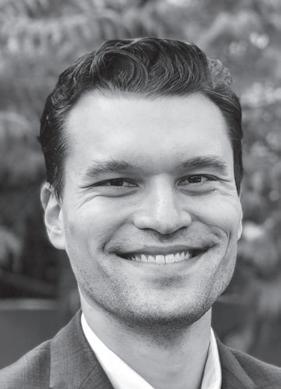
Dr. Dan Michael NW Sports
To me it was obvious that some of the players were fighting injuries, and equally as obvious that some of them were very healthy and playing exceptionally well. The question that we all must answer for ourselves is, ‘how do we maintain our activity level in a safe, effective and athletic way?’
This notion applies to both sport and non-sport humans, even if you’ve never played a sport in your life. Movement is movement, whether you’re emptying the laundry, or winning a Grand Slam, we all must decide how to move well. It’s not easy to prevent injuries, and in fact, many sports health like myself are discarding the phrase ‘injury prevention’ because it has proven to be too difficult. What we now hope to provide is athletic resilience to injury. Here are some tips that can help you along your own journey to resiliency in your life, your sport and your movement practice.
Use your core, better than before.
KAISER from Page 2
to go out in your gown and get weighed in front of a bunch of other people,” Davis said. “You just sit down, they push a button and we tell you how much you weigh.”
The rooms each have a large screen in them where the guides will sync their laptops to while writing in each patient’s chart. This way, each patient can see in real time what is being input into the system about their visit.
The screen can also be used to

You may have heard it before, but did you know that your core can bounce? It’s true, the abdominal cavity can be pressurized and act like a beach ball that can relieve pressure from your hips, back and knees. It can also be a source of stability when you make quick movements like when a tennis player sprints from one baseline to another.
Tip: think about creating tension in your core that’s strong enough you can’t poke your finger into it, but light enough you can breathe through it. Try for example, an exercise called the “Pallof Press”. Type this search into any internet browser and you’ll see a plethora of content to help you experiment.
Tighten the trunk, loosen the limbs.
Whether you play tennis, run on a treadmill, or go up and down stairs in your home, try to feel what muscles are working and see if you can move the working muscle tension towards your trunk and away from your
bring up educational materials or be used to help children feel more comfortable in the exam room.
“We curated five videos of local natural things to entertain kids while they are waiting,” Davis said. “So we’ve got footage from the Woodland Park Zoo of
hands and feet. In some cases, tension is a good thing to have in your hands and feet, but generally movement should come from the trunk and move outward, not the other way around.
Tip: think about a cracking whip. The movement starts where there is stability first at your hand and then moves outward. The core and trunk should always be your base of stability, at all times.
Fun fact: did you know that a whip makes a cracking noise because the end of the whip is moving faster than the speed of sound, this speed of movement makes a mini sonic boom.
See it, then be it.
Before you attempt any movement, you want to see it in your mind’s eye first, this is called visualization. Every athlete performs this mental exercise before every skilled activity. Therefore, some of the greatest athletes to ever play a sport study the craft of other great athletes who came before them. The brain contains a special type of cell called “mir-
the baby giraffe. We’ve got footage of the Seattle Aquarium with the otters playing. Just things that are interesting and entertaining, but not like over stimulating.”
Then, when the provider comes in, the guide will perform a warm hand-off and detail what
ror neurons” which are clusters of nerves in the brain that can see another human in an act, and then go and perform the same act in a similar way with relative ease after virtually no instruction. Tip: look at your movements first. You may not like to see yourself on camera, but if you can get over the fear factor and see the facts for what they are, you’ll likely see 2-3 things you can improve immediately. Virtually everyone now has a camera in their pocket, so now there’s one less excuse to get a little better at something you love.
Not sure how to apply this knowledge to your individual situation? Need to discuss more?
Give our clinic a call (206) 328-5466, or email info@nwsportsrehab.com, and ask for Dr. Dan. If I’m not able to step away or reply immediately, my staff will take your information, and I’ll respond to your request as my schedule permits.
the patient came in for and the concerns of the patient all while the patient is sitting and observing. Once the provider finishes up, there will be another warm hand-off back to the guide to facilitate the patients’s care plan. Call 206-397-5360 for more information.
Saturday, March 7, 2020 – 7:30 pm Nordstrom Recital Hall at Benaroya Hall 200 University St., Seattle

Sunday, March 8, 2020 – 2:00 pm Epiphany Parish of Seattle 1805 38th Ave., Seattle
This March, baroque violin virtuoso Tekla Cunningham and the colorful continuo team of Pacific MusicWorks led by GRAMMY-award winning conductor Stephen Stubbs take you on a journey into some of the wildest, most emotionally charged music ever written, including works by Biber, Schmelzer, Farina, Fontana, Uccellini, Pandolfi Mealli, and Albertini.
If