October 8, 2025
50¢
ISSUE 41
IT'S IN THE CLASSIFIEDS
Hunting for a job? In the market for a new home? Have something to sell? Turn to the Classifieds in The Dispatch and at dispatchnews.com
Franklin Pierce Routs Eatonville 78–14 in Homecoming Matchup By Skip Smith
T
HEATHER QUIRIE
he defending 2A South Puget Sound League champion Franklin Pierce Cardinals showed exactly why they hold that title Friday night, steamrolling the Eatonville Cruisers 78–14 in a one-sided Homecoming game at Yelm High School Stadium. From the opening kickoff, Franklin Pierce (3–2) wasted no time asserting dominance. The Cardinals scored touchdowns on their first nine possessions, racking up points in rapid succession and leaving the Cruisers reeling before halftime. Franklin Pierce’s first drive began at its own 47-yard line and ended just minutes later with a 17yard touchdown pass to open the scoring. After a quick Eatonville three-and-out, the Cardinals struck again on the next play — a 49-yard touchdown run — to go up 14–0 less than three minutes into the game. The onslaught continued. A 35yard rushing touchdown and a 42yard scoring run on back-to-back possessions gave Franklin Pierce
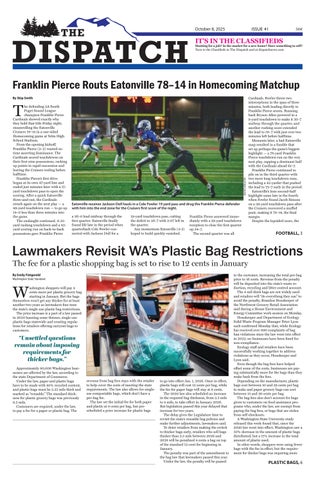
Eatonville receiver Jackson Doll hauls in a Cole Fowler 19 yard pass and drug the Franklin Pierce defender with him into the end zone for the Cruisers first score of the night. a 26–0 lead midway through the first quarter. Eatonville finally found life late in the period when quarterback Cole Fowler connected with Jackson Doll for a
19-yard touchdown pass, cutting the deficit to 26–7 with 2:07 left in the quarter. Any momentum Eatonville (3-2) hoped to build quickly vanished.
Franklin Pierce answered immediately with a 39-yard touchdown reception to close the first quarter up 34–7. The second quarter was all
Cardinals. Fowler threw two interceptions in the span of three minutes, both leading directly to Franklin Pierce scores. Running back Bryson Allen powered in a 9-yard touchdown to make it 50–7 midway through the quarter, and another rushing score extended the lead to 58–7 with just over two minutes left before halftime. Moments later, a bad Eatonville snap resulted in a fumble that set up perhaps the game’s biggest highlight — a 78-yard Franklin Pierce touchdown run on the very next play, capping a dominant half with the Cardinals ahead 65–7. Franklin Pierce continued to pile on in the third quarter with two more long touchdown runs, including a 42-yarder that pushed the lead to 72–7 early in the period. Eatonville’s lone second-half highlight came late in the fourth when Fowler found Jacob Simons on a 39-yard touchdown pass after the Cruisers recovered a muffed punt, making it 78–14, the final margin. Despite the lopsided score, the
FOOTBALL, 3
Lawmakers Revisit WA’s Plastic Bag Restrictions The fee for a plastic shopping bag is set to rise to 12 cents in January
By Emily Fiztgerald
Washington State Standard
W
ashington shoppers will pay 4 cents more per plastic grocery bag starting in January. But the bags themselves won’t get any thicker for at least another two years as lawmakers fine-tune the state’s single-use plastic bag restrictions. The price increase is a part of a law passed in 2020 banning some thinner, single-use plastic bags statewide and creating regulations for retailers offering carryout bags to customers.
“Unsettled questions remain about imposing requirements for thicker bags.” Approximately 80,000 Washington businesses are affected by the law, according to the state Department of Commerce. Under the law, paper and plastic bags have to be made with 40% recycled content, and plastic bags must be 2.25 mils thick and marked as “reusable.” The standard thickness for plastic grocery bags was previously 0.5 mils. Customers are required, under the law, to pay a fee for a paper or plastic bag. The
revenue from bag fees stays with the retailer to help cover the costs of meeting the state requirements. The law also allows for singleuse compostable bags, which don’t have a per-bag fee. The law set the initial fee for both paper and plastic at 8 cents per bag, but prescheduled a price increase for plastic bags
to go into effect Jan. 1, 2026. Once in effect, plastic bags will cost 12 cents per bag, while the fee for paper bags will stay at 8 cents. The 2020 law also scheduled an increase in the required bag thickness, from 2.5 mils to 4 mils, to take effect in January 2026. But legislation passed this year delayed that increase for two years. The delay gives the Legislature time to revisit the state’s reusable bag policies and make further adjustments, lawmakers said. To deter retailers from making the switch to thicker bags early, retailers who sell bags thicker than 2.5 mils between 2026 and 2028 will be penalized 4 cents a bag on top of the standard 12-cent fee beginning in January. The penalty was part of the amendment to the bag law that lawmakers passed this year. Under the law, the penalty will be passed
to the customer, increasing the total per-bag price to 16 cents. Revenue from the penalty will be deposited into the state’s waste reduction, recycling and litter control account. The 4 mil-thick bags are not widely used and retailers will “do everything they can” to avoid the penalty, Brandon Houskeeper of the Northwest Grocery Retail Association said during a House Environment and Energy Committee work session on Monday. Houskeeper and Department of Ecology Solid Waste Program Manager Peter Lyon each confirmed Monday that, while Ecology has received over 800 complaints of bag ban violations since the law went into effect in 2022, no businesses have been fined for non-compliance. Ecology staff and retailers have been successfully working together to address violations as they occur, Houskeeper and Lyon said. Even though the bag fees have helped offset some of the costs, businesses are paying substantially more for the bags than they make back from the fees. Depending on the manufacturer, plastic bags cost between 10 and 39 cents per bag to make and paper grocery bags can cost between 15 and 30 cents per bag. The bag fees also don’t account for bags given to customers on food assistance programs who, under the law, are exempt from paying the bag fees, or bags that are stolen from self-checkouts. A Washington State University study released this week found that, since the 2020 law went into effect, Washington saw a 50% decrease in the amount of plastic bags distributed, but a 17% increase in the total amount of plastic used. In other words, shoppers were using fewer bags with the fee in effect, but the requirement for thicker bags was requiring more
PLASTIC BAGS, 6