

Home & Real Estate
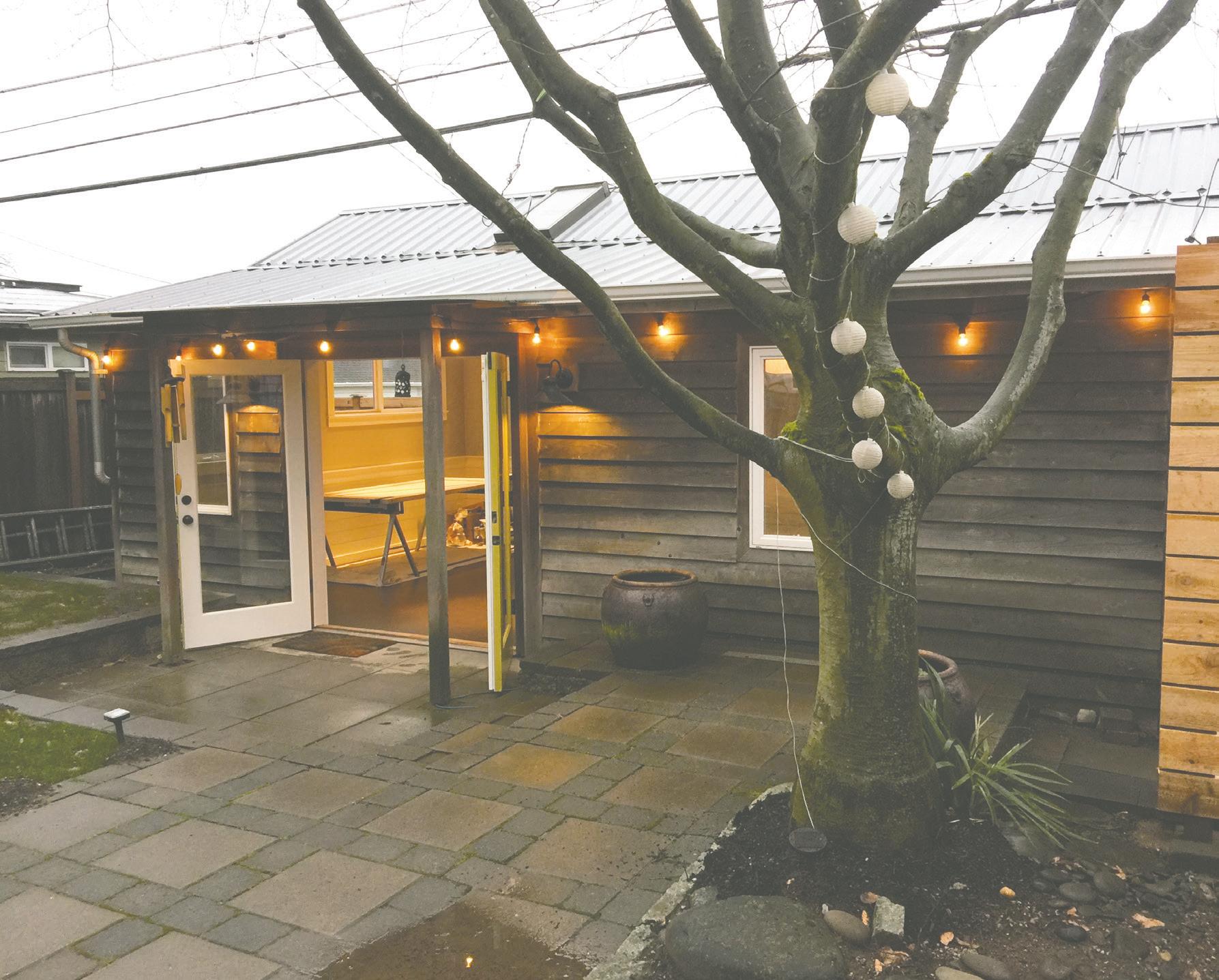
Yes in my backyard Backyard cottages can
add living space and extra income
BY DENNY CONNER, CRD DESIGN BUILD
Imagine having a private getaway or guest house tucked neatly into your own backyard. Since 2009, when the city started permitting this new type of development, hundreds of Seattle homeowners have chosen to invest in their very own backyard cottage retreat.
If you’ve ever wished you had a way to earn some rental income with your home or simply had more space, a backyard cottage might be a dream worth exploring. However, the regulations can be a bit confusing, and Seattle is in the process of changing them.
First off, what is a backyard cottage? Detached accessory dwelling units, or DADUs, as the city of Seattle calls them, are small, standalone houses built behind your main home. They allow you to maintain your privacy and all the square footage in your main house, while creating extra living space. Some homeowners opt to build them over a new or existing garage.
Backyard cottages provide many of the benefits of single-family homes, with no shared walls and a lower-density-neighborhood lifestyle. They can promote economic diversity in neighborhoods that might be out of range for average-income renters. Backyard cottages can provide passive rental income for the homeowner. Some are renting right now for between around $1,200 and $2,000 per month, or up to $24,000 per year. As a vacation rental, a cottage could earn you even more. This can help homeowners of modest means stay in their homes or simply put extra cash in your pocket to pay the mortgage or for home improvements.
An often-overlooked benefit is that backyard cottages can help reduce sprawl by slowly increas -

ing density while taking advantage of existing infrastructure. When compared to high-rise developments, backyard cottages help preserve the character of our beloved Seattle neighborhoods.
Seattle’s changing regulations
If you are thinking about building a backyard cottage, the first step is to make sure you know all the rules. There are some major changes in the works, but let’s look at the current regulations.
Lot size: Your lot must be 4,000 square feet in a single-family zone.
Cottage size: Only 800 square feet is allowed for cottages in single-family zones.
Codes: Like any construction project, your cottage must meet current land use and building standards. No surprise there.
Parking: You must create one off-street parking space for your new backyard cottage.
As of 2017, only 579 backyard cottages have been built in Seattle out of approximately 75,000 potentially eligible lots. To put that into perspective, Portland already had 720 in 2016. To encourage more to be built, the Seattle City Council is considering changing the regulations, such as increasing the maximum square footage of cottages and removing the off-street parking requirement. The Council is currently pursuing an environmental impact statement.
No bed, it’s a studio
If your plans for a backyard structure do not include a sleeping area, there are some permitting alternatives you may be able to consider. For standalone backyard structures under 750 square
Homeowners often ask if there is a best time to list their home. Homes are no different than anything else in that you will receive the most money when the demand is high, and the supply is low. Think about selling a boat in the winter or a sports car when it is snowing. The supply might be low, but there is not a high demand. In the north end of Seattle, we continue to experience a high demand for homes with a very limited supply of new listings.
November and December are typically our slowest months in real estate. When the new year begins we start seeing a few listings the first week and then they steadily climb until June or July. Listing and sales activity typically slow a bit through the end of the summer, pick up in the Fall and then slow again in winter. One way to gauge a very hot market is that it doesn’t slow down in August or December.
Many people believe that summer is the best time to sell because children are out of school. But, Seattle is a young city where the median age is 37 and many of our home buyers are not are not yet constrained by school schedules and can buy any time of the year.

preparation (a good Realtor will give you suggestions as to what to do), but it also takes a lot of physical and emotional energy to move. You want to list your home when you are ready to start your next adventure, whether it be retirement, a bigger or smaller home, or a new community.
You get the idea— we have been discovered! How do you take advantage of all the media attention that is helping to bring approximately 500 people per week to the area?
Other homeowners might think they want to wait until their garden is in full bloom, and that is a great idea, but everyone else’s garden is peaking at the same time. You may want to list while the bulbs are in bloom but perhaps not wait for the peonies.
I think we are all beginning to lose count of how many “Best of...” lists that Seattle is on. “Best place for young professionals” (Forbes 2017), “# 2 Coolest city” (Forbes 2017), “#6 Best places to live” (U.S. News and World Report 2017), and “Fodor’s 1 of 52 top destinations to go in the world”.
You get the idea—we have been discovered! How do you take advantage of all the media attention that is helping to bring approximately 500 people per week to the area? We might complain about the traffic that our new residents bring, but let’s not forget that we are also getting a young, highly educated, well-paid work force who prefer to live near the urban core.
Selling a home takes a lot of
Once you know you are ready, then I would suggest listing it as early in Spring as possible. The number of listings typically peak in June—yes, yards look good and school is out, but you also have more competition then. We are already starting the year with pent up demand from buyers and the stories of multiple offers and buyers doing pre-inspections and waiving conditions prior to bringing an offer are true. 2018 is starting where 2017 left off-- with high demand and low supply.
No one has a crystal ball telling us when the market is going to slow down. But I do know that this is the best seller’s market that I have seen in over 25 years of selling real estate in Seattle.
I suggest that if you have been thinking of selling your home for the past couple of years, then you should seriously consider selling it this year. And if you can put your home on the market this Spring, when there are plenty of buyers and not enough sellers, you may be in the desirable position of having to decide which offer to accept.
Kris Hendricks is a managing broker with Windermere Real Estate/ Wall Street Group, Queen Anne office. 206 755-5757 email: khendri@ windermere.com
Hendricks


Steve Lorton
TREE TALK
Snowfall is normally heavy and wet in the Pacific Northwest and rare as it is, when it occurs, it often covers everything in a thick blanket. In the last half century, these periodic snow dumps have come as early as Thanksgiving and as late as the 6th of April. Schools and many businesses close. Something of a festival ensues.
Beautiful and delightful as it



is to watch the giant flakes drift down and accumulate, plants can suffer. Most vulnerable are small scale deciduous trees with intricate branching patterns, broad-leafed evergreens and tall, thin conifers. Japanese maples, dogwoods, deciduous and evergreen magnolias often lose branches. An arborvitae or Italian cypress may be bent into an upside down U or pushed to the ground under the weight of the snow. Larger trees are usually indifferent to the snow.The bigleaf maple in the photograph and other large trees like it can handle the load easily, all the more gorgeous for being clothed in white.
So to prevent damage, the dedicated gardener needs to get outside, as the snow accumulates and shake
TREE Page R6
Seattle snapshot during one-night homeless count reveals ongoing issue
All Home expects 2018 Count Us In report to be ready in May
BY BRANDON MACZ
Volunteers packed into the Compass Center early Friday morning to receive their directions and forms before spreading out across Seattle and King County for the annual one-night homeless count.
All Home is required to conduct the count every two years as the lead agency for the Seattle/ King County Continuum of Care for the annual funding application to the U.S. Department of Housing and Urban Development (HUD).
Last year’s Count Us In documented 11,643 people experiencing homelessness in King County — 3,857 unsheltered in Seattle and another 4,665 living in some form of shelter.
“I don’t anticipate a lower count,” said All Home acting director Kira Zylstra, “and I don’t want to make assumptions any time.”
But data All Home has seen shows more people are falling into homelessness even as more resources have become available, Zylstra said.
Former All Home director Mark Putnam broke down the 2017 report for the King County Council and Seattle City Council last May. He said more than 7,500 homeless families were housed in 2016, a 52 percent gain from 2013. However, rents had risen 57 percent between 2010 and 2016.
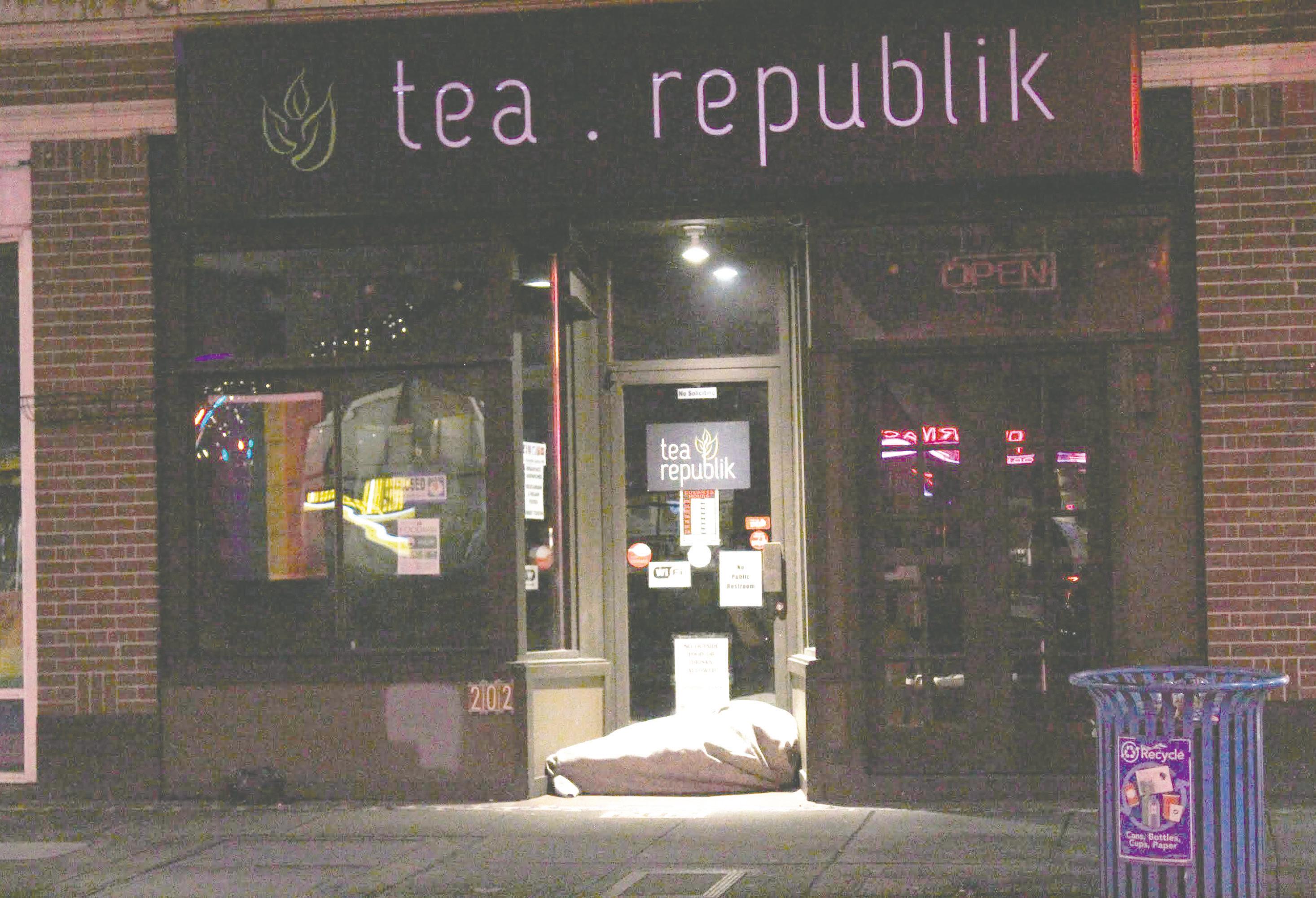
All Home put out a request for proposal in 2016, and in 2017 contracted with Applied Survey Research to improve on how data was collected for the one-night count, Zylstra said.
“Any count isn’t perfect,” she said.
On top of the street count, All Home also gathers data on people staying in shelters and transitional housing, and over the next several weeks the organization will conduct surveys that seek to get a better number of people experiencing homelessness, as wells as the circumstances that resulted in them being unsheltered and what needs they may have.
A report for the 2018 Count Us In isn’t expected to be completed until May.
“More people doesn’t neces -
Home & Real Estate
Serving North Seattle Neighborhoods: Ballard, Fremont, Greenlake, Green Lake, Northgate, Phinney/Greenwood, Ravenna/Roosevelt and Wallingford
Retail Display Advertising: Wednesday, March 7, Noon Tammy Knaggs Sales Director 206-461-1322 or PPCadmanager@nwlink.com
Neighborhood Marketplace Advertising: Wednesday, March 7, 5 p.m. Matt Wilemski 206-461-1332 or class@nwlink.com
Art Director: Mark Falconer
Production Designers: Emigdia Castro, Nick Brosas
Subscriber Services | Circulation: Chris Lemmen 206-461-1337 or ppccirc@nwlink.com
Vice President of Operations/ General Manager: Robert Munford
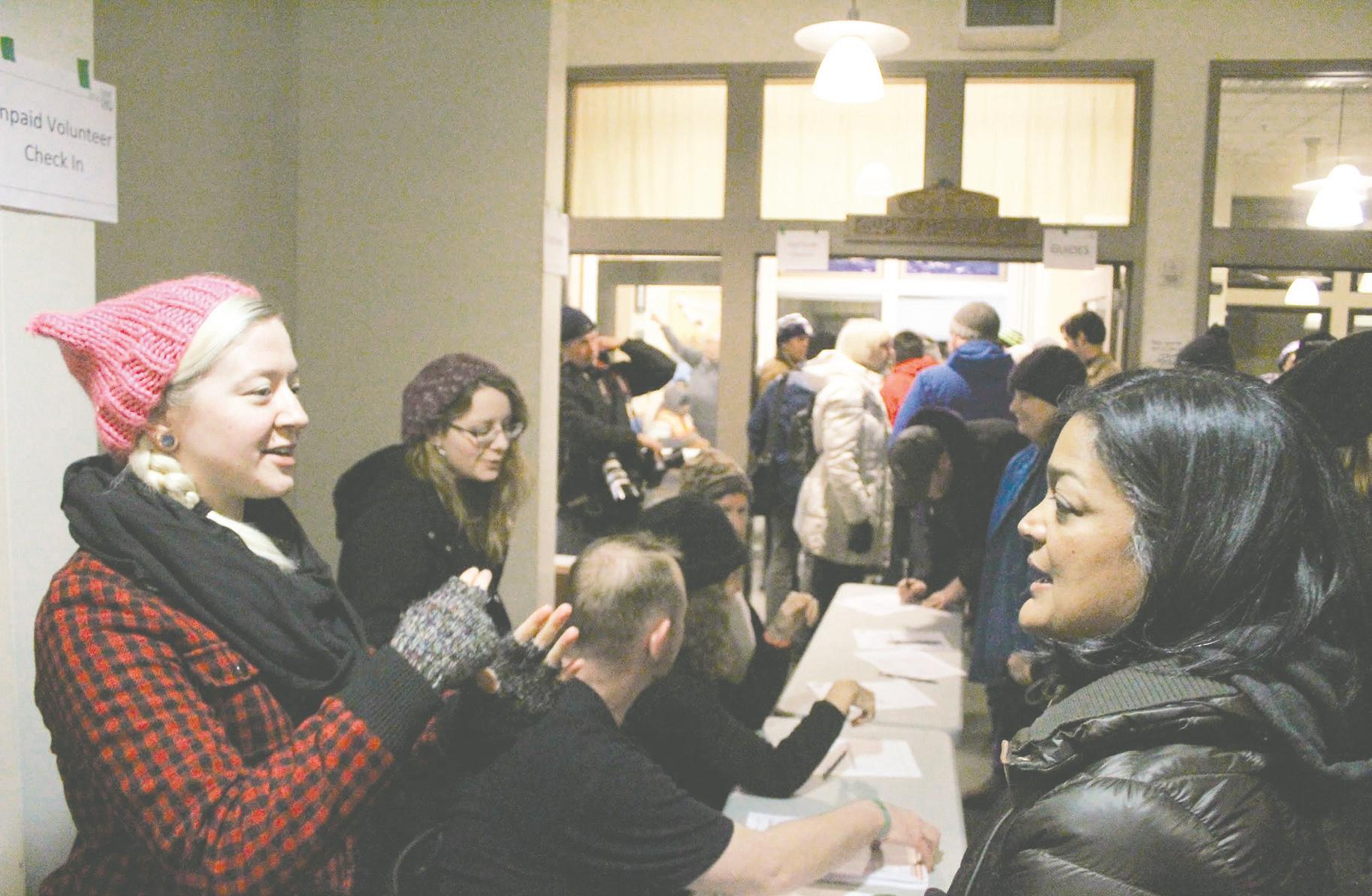
[Top] The 2018 Count Us In one-night homeless count took place from 2-6 a.m. Friday, Jan. 26, across King County.
[Above] Washington 7th District Congresswoman Pramila Jayapal speaks with a Count Us In volunteer before joining the effort.
sarily mean more money,” Zylstra said, but it does provide a clearer picture of the homelessness issues facing the county.
While there is concern about what the federal government’s future commitment to ending homelessness will look like under the Trump administration, Zylstra said, Continuum of Care program funding has been allocated through 2020. But agencies will still have to compete for them, she said, adding All Home was approved to receive all of its renewable funding earlier this month.
“This is my first in a long time,” she said. “I’ve done this, but it’s probably been over a decade.”
Under the leadership of Ben Carson, whose background is as a neurosurgeon and 2016 Republican presidential candidate, HUD has worked to cut back funding and roll back fair housing rules, Jayapal said.
“He doesn’t really believe in affordable housing — that’s the problem,” she said. Trump’s 2018 budget proposal would cut $6 billion from HUD.
duced in congress that seek to support people experiencing homelessness, including homeless youth, such as the Pathways Out of Poverty Act.
King County Executive Dow Constantine has covered Capitol Hill and the woods outside White Center during past onenight counts, he said, but Friday morning he was assigned to downtown Seattle.
“I think that anyone would be foolish not to be concerned about what’s going on in the federal government,” he said, citing what he considers a lack of empathy and concern for the nation’s homeless population. Mailing address:
Jayapal said there are a number bills that have been intro -
Washington 7th District Congresswoman Pramila Jayapal took a break from Washington, D.C., to participate in Friday morning’s one-night count.
Photos by Brandon Macz



Housing market predictions for 2018

Ray Akers ASK RAY ABOUT REAL ESTATE
Seattle real estate might be compared to a game of musical chairs. Anybody who has a seat is fearful of standing-up, because they won’t be able to find another home to buy. Low-inventory has been a persistent issue for several years, with Seattle making headlines with the lowest inventory of homes for sale in the nation in 2017. Adding more pressure to the local market, foreign investors have made Seattle the number one destination for investment in the United States Here are four predictions for 2018. The historically tight supply of single-family homes will tighten further in 2018. After hitting a record low of 3.4 months in November 2017, the inventory of homes available for sale is expected to continue trending lower for 2018, according to the Northwest Multiple Listing Service. This tight-supply trend has been ongoing for more than five years. What has been called a trend may be the new “normal”.
Seattle-area home price appreciation will continue, but at a slower pace. Home prices have been ris-

ing steadily since mid-2012, and there is no sign the boom is ending. In King County, home prices increased almost 16 percent in 2017. Rising interest rates and tax reform will somewhat reduce upward pressure on prices in 2018. Even with some downward pressure, Zillow forecasts home prices will rise 6-7 percent nationwide. If local trends are consistent, Seattle will see home prices rise higher than the national average.
Entry-level home prices will rise fastest due to demand by first-time buyers. Year-over-year appreciation for the bottom third of homes is expected to come in at 10.5 percent to 11 percent for 2018 (December 2018 over December 2017) based on data from CoreLogic Case Shiller. At current levels of wage growth, this boom in entry level home prices is ultimately unsustainable.
Foreign investment in Seattle and Eastside will mean tougher competition for local buyers. The “Emerging Trends in Real Estate” report names Seattle as the nation’s top real estate market in 2018. Our diverse economy, ample job opportunities, and an educated workforce will keep Seattle at the top. Seattle became the number one destination for Chinese investors in 2016 and foreign investment dollars continue to pour into Seattle, affecting both residential and commercial real estate. Forecasters predict a slowing of real estate price appreciation, resulting in a more sustainable pattern of growth. However, the appreciation of home prices continues
to outpace the growth in income for most workers.
With extreme demand pressures driving the local housing market, you can expect the building boom to continue, and upward pressure on home prices expanding outside of King County.
More first-time buyers will be forced to look beyond Seattle to the ‘burbs. They’ll find homes are more affordable, but commuting to jobs in Seattle will be nightmarish. You can expect more demand for homes adjacent to rail and transit stations.
Aging baby boomers will continue to stay put, remodeling their homes so they may age-in-place. This trend has baffled the housing industry and innumerable experts who forecast the boomer’s would sell and down-size in record numbers. Instead, aging Americans are staying and remodeling in record numbers.
According to Veros, a valuations provider, Washington State will dominate the nation’s real estate markets. The company’s latest VeroForecast for 2018 reports “Washington State is set to boom –occupying all Top-5 market spots.” “Never has one state held all top 5 spots in the forecast. The Seattle, Bellingham, Bremereton, Kennewick and Mount Vernon markets make up the ‘Top 5’ in Veros’ report.”
RAY AKERS is a licensed Realtor for Akers & Cargill Properties in Seattle. Send your questions to ray@akerscargill.com or call 206-722-4444
Re: New GOP tax plan means fewer deductions for homeowners

Dear Editor:
Mr. Akers’ article “New GOP tax plan means fewer deductions for homeowners” contains a factual inaccuracy regarding the new mortgage interest limits. It also seems to gloss over the fact that many middle and lower income taxpayers will actually have lower overall tax bills next year as a result of this new tax bill, even here in Seattle.
Mr. Akers states that “as many as two-thirds of current homeowners are likely to feel the impact.” However, it’s likely a much smaller group is affected when looking at the mortgage interest deduction taken in isolation. For one thing, Mr. Akers incorrectly states in his article that the mortgage acquisition debt limit dropped to $500,000 for all loans. That limit actually remains at $1,000,000 on existing home acquisition loans. It drops to $750,000 on new loans incurred after 12/15/17.
For another, a loan of $750,000 plus a 20 percent down payment would be enough to buy a home worth about $938,000 (ignoring closing costs). That is well in excess of Seattle’s December 2017 median home price of $635,000.
Knowing all this, I ask Mr. Akers what percentage of existing Seattle homeowners would be affected by the new mortgage limits? What percentage of new Seattle homeowners are buying after 12/15/17? Surely much less than 67 percent?
I would also point out that the $10,000 limit on property taxes would be less of an issue if our property tax bills went down. A delusional thought, I know.
It is true that some homeowners will be worse off
under the new tax law. However, it’s important to remember that mortgage interest and real estate taxes are just two elements of a taxpayer’s overall tax profile. Many other provisions of the new tax bill will help to ameliorate the new mortgage interest and property tax limitations. In fact, they may even result in an overall reduction in a middle or lower income taxpayers’ Federal income tax bill as compared to prior law. A few such provisions:
1. Increased child tax credit
2. Mostly lower tax rates
3. A 20 percent “Qualified Business Income Deduction”
4. A higher Alternative Minimum Tax exemption amount
5. A near doubling of the standard deduction
Finally, I wonder about the notion that the tax bill will deflate real estate prices. As a homeowner myself, I’m not thrilled about that idea. But it’s good to remember that not everyone in Seattle loses out if this were to happen. Affordable housing is a very hot topic in this region. I’m certain that for many Seattleites (renters and those wishing to buy a home), lower house prices would be most welcome.
Thank you.
Sincerely,
Michael B. Kleiner
6 Home Décor Trends to Make a Style Statement
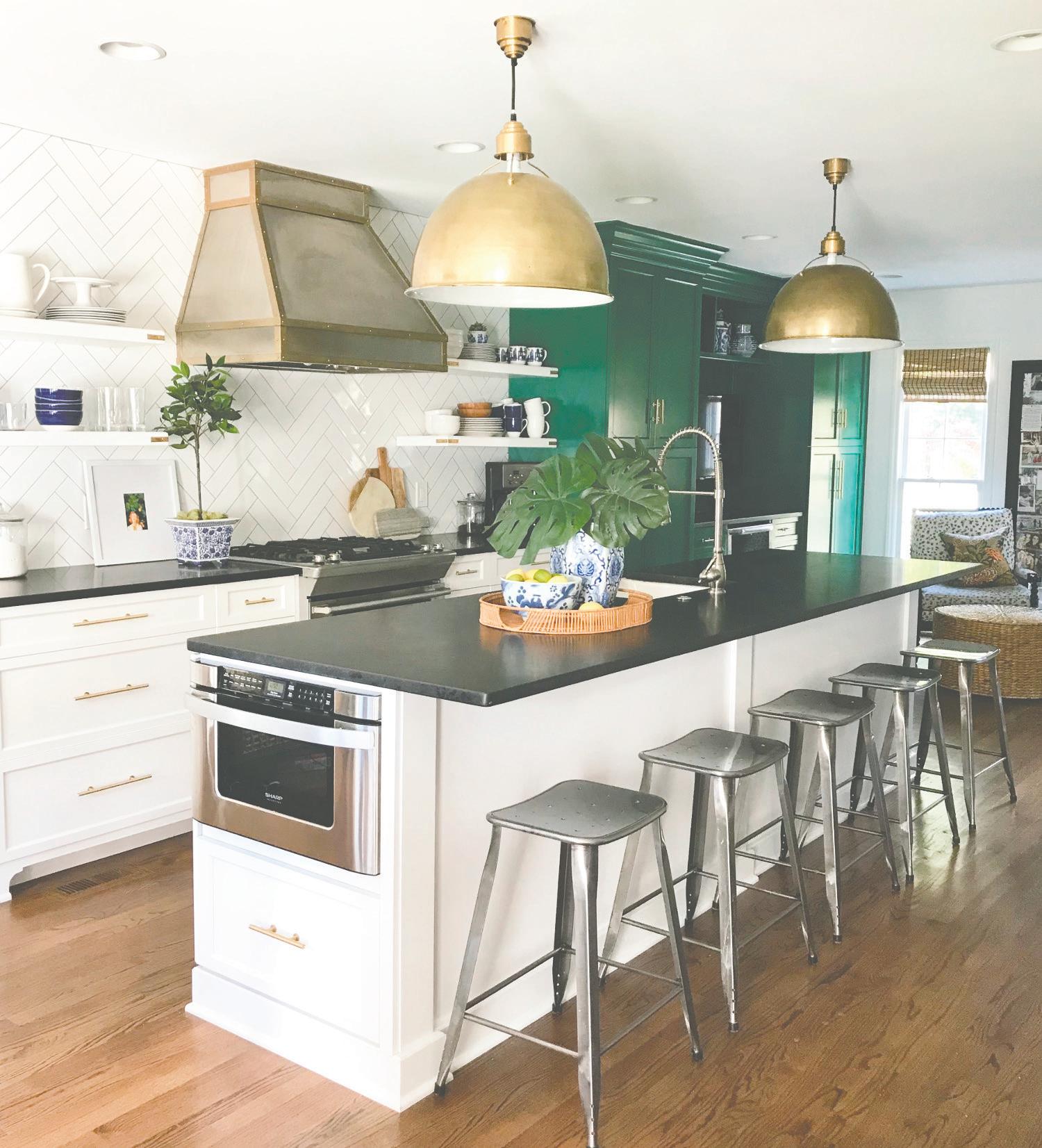
(StatePoint) Is your home décor starting to feel a bit stale? Spruce up your interiors with some of the hottest home design trends for 2018 -- from customized cozy to natural textures to retro touches.
Here are some stylish ways to incorporate new trends, from one of the nation’s most sought-after celebrity interior designers,Taniya Nayak.
1. CREATE AN OASIS:
Make your home a tropical escape all year long. Add floral or banana leaf accents to form a staycation-worthy “at-home paradise” no matter the temperature. Nayak suggests pairing pops of metallic gold with plush greens and crisp white to build a look that is sophisticated, yet fun and exotic.
2. KEEP IT SIMPLE:
In 2018, Nayak encourages DIYers to “go big or go home…in the simplest way imaginable.” An easy way to accomplish this is to paint your baseboards, trim or window mullions a dramatic contrasting color, like black against a white wall, for an effortless, yet powerful effect. And when it comes to achieving clean, sharp paint lines, one of Nayak’s vital, go-to tools is a premium painter’s tape, like FrogTape brand painter’s tape that delivers the sharpest paint lines possible. Treated with patented PaintBlock Technology, FrogTape is a fool-proof way to get professional-looking results and eliminate the need for touch-ups.
3. INCORPORATE NATURAL TOUCHES:
This trend is all about nature’s textures --
think wood grain, geodes or ocean waves. One way to incorporate this look is to combine earthy tones like browns, beiges and deep blues with vibrant neon colors to generate the effect of the northern lights around the home.
4. GET BACK TO THE FUTURE:
Give what’s old a modern, futuristic update to achieve this trend. Try painting a vintage chair with a pop of color, like the SherwinWilliams 2018 color of the year, Oceanside, a combination of rich blue with jewel-toned green. This creates an eye-catching masterpiece that seamlessly integrates into both retro and modern home décor. Introducing bright colors to antiques produces a beautiful new spin on a classic look.
5. DESIGN IT WITH LOVE:
What’s “in” in home design this year? Creating warm and cozy spaces that are customized just for you. This is the true essence of DIY. Painting an accent wall in a pastel color, like lavender, will set a relaxed and comforting tone in the room. From there, add personal pieces like a soft woven blanket, a macramé wall hanging or ivory plates on a wall to transform any room to “your” room.
6. EMBRACE NEW ENGLAND PREP:
This style embraces the timeless combination of crisp white linens and navy blues, but what really gives a room an authentic New England vibe is the addition of camel-colored leather décor accents. Nayak recommends adding monogrammed pillows to a leather accent chair, or whitewashing your brick
and inspiration. Get started on your home projects now so you can enjoy your
Pamela T. Bowe
MBA, Managing Broker
206-947-7914
pamelabowe@cbbain.com
1200 Westlake Ave. N. #406 Seattle, WA 98109






Visit FrogTape.com for more trend infor-









fireplace to create a look that never goes out of style.
mation
refreshed décor all year long.
feet, you might be able to qualify for a subject-to-field-inspection permit, which saves time and money. Examples of detached accessory structures might be art studios, workspaces, retreat spaces, or storage space. For even smaller structures, like garden or storage sheds, whose roof area footprint is less than 120 square feet, you probably won’t need a permit at all. It’s always wise to confirm with the Seattle Department of Construction & Inspections before you begin any construction project.
Getting started
If you are considering investing in a backyard cottage, the first step is to reach out to a qualified design-build firm or architect to discuss your eligibility, or you can refer directly to Seattle Municipal Code 23.44.041. For full-service custom construction, expect to pay between $250 and $350 per square foot. This is higher than the per-square-foot cost of a larger home because the most expensive rooms in a home— the kitchen and bathroom—are contained in a smaller space, with comparatively less square footage devoted to lower-cost living spaces, such as bedrooms and storage rooms. A complete guide to backyard cottage regulations and news is available at crddesignbuild.com/cottages.
Council diving into citywide mandatory housing affordability program
BY BRANDON MACZ
The Seattle City Council last week held the first of a number of meetings to discuss expectations from the citywide implementation of a Mandatory Housing Affordability program already in place in certain parts of the city.
The MHA program requires developers to either provide affordable housing in new construction or pay an assessed fee that goes into a fund that the City of Seattle then distributes to affordable housing developers for other projects. An incentive for this program is the upzoning of portions of the city, which has already taken place in Downtown, South Lake Union, Uptown, University District and three segments of 23rd Avenue in the Central District.
portunity, according to the FEIS, which is 3,000 fewer units than with Alternatives 2 and 3.
More housing capacity would be focused east of Broadway — from lowrise to midrise — and around the Capitol Hill light rail station, which has transit-oriented development on the way that includes four seven-story buildings, three of which will have 20 percent of their apartments at affordability levels. Capitol Hill Housing is developing a 110-unit B-North project at affordability rates of 30-60 percent AMI.
The goal is to expand all urban villages to at least a 10-minute walk shed of public transit.
In all, the MHA program is anticipated to create 6,000 affordable housing units by 2025.
•
A final environmental impact statement for the MHA program was released in November, and under the preferred alternative First HillCapitol Hill, Northgate and Rainier Beach would see the greatest increases in height limits, according to the FEIS — up to 140 feet in First Hill. Northgate should come up for a vote in the next few weeks, in order to capitalize on future transit-oriented development around incoming light rail service.
Along with monthly updates to the city council, the Office of Planning and Community Development will also be hosting open houses across Seattle’s affected districts, sharing maps showing where rezones are proposed and the expected impact.
An open house for Districts 3 and 7 is planned for 6-8 p.m. Thursday, March 29, at Washington Hall, 153 14th Ave. District 3 includes Capitol Hill, First Hill and the Central District, while District 7 includes Belltown, the west end of First Hill, Pioneer Square, Queen Anne and Magnolia. A public hearing with the Seattle City Council regarding Districts 3 and 7 is set for Monday, April 16, at Seattle Central College.
First Hill-Capitol Hill is identified as having a high displacement risk and high access to opportunity, and will be among the urban centers targeted for increased housing choices. The preferred alternative is additional midrise zoning, according to the FEIS, including in north Capitol Hill and the southwest side of First Hill. The MHA preferred alternative would create about 30 percent of the housing growth in such areas with high displacement and high access to op -
Tree, from Page R2
it off the plants. There are three good ways to do it. Here’s where children between the ages of eight and college come in handy. Bundled up, with a hoodie, you can send them out with the promise of hot chocolate and cookies once the job is complete. They’ll love it! Expect laughter to penetrate your frosted windows. The trick to getting the snow off is to give the trunk of the tree, or the side of the evergreen, several vigorous and firm (but not violent) shakes to dislodge the snow. If the shaker holds onto the trunk or pushes the side of the evergreen, they’ll get a good dousing. Keep the draw strings of the hoodie cinched around the face or, sans hoodie, wrap a muffler snugly around the neck. A push broom is an excellent tool for this job. With the broad horizontal brush placed against the trunk of
Councilmember Rob Johnson, who is chair for the council’s select committee on MHA, confirmed that about half of those units are expected to be created in areas that have already been rezoned.
Emily Alvarado, manager of policy and equitable development at the Office of Housing, said the MHA program defines affordability at or below 60 percent of the area median income, which translates to about $40,000 a year for an individual and $57,000 for a family of four. MHA also seeks to create affordable home ownership opportunities at 80 percent AMI, which, for a family of four with two income sources, would be $76,800.
One benefit of developers paying the assessed fee versus creating their own affordable housing units, Alvarado said, is that the city can invest funds in projects that will create family-sized units, which the Office of Housing understands are in high demand but low supply.
Councilmember Teresa Mosqueda requested an inventory of properties where there could be public-owned housing options. Alvarado said maximizing publicly owned housing is something her office is working on.
Councilmember Lisa Herbold said she’s concerned the city’s analysis of displacement risk with increased zoning has not been thorough enough, and she worries about losing naturally affordable housing options.
Johnson said the select committee will meet several times through June, with the next meeting to focus on his District 4 area on Monday, Feb. 12.
the tree, a few good pushes with the broom handle will make the snow come tumbling down. Or, to avoid the avalanche altogether, tie a sturdy rope around the trunk of the tree, long enough that the shaker can stand beyond the drip line of the plant and pull-release-pullrelease until the snow is shaken free.
In a long snowfall, you may have to shake each plant two or more times. But, should you fail and a limb breaks off, get out once the weather clears and prune off the fractured limb, making as smooth a cut as possible, as close to the larger limb or trunk to which it was connected. Don’t waste the damaged branch. It will likely be beautiful, groomed a bit, to grace a large vase indoors. With some red roses or tulips it will make a loving statement for Valentine’s Day, when these fade, add some blooms in pastels to herald the coming of spring. The buds of cut deciduous branches often swell up and open inside a warm house.
So, let it snow, let it snow, let it snow….. but shake, shake, shake your most delicate trees.
Ballard NW Senior Center
Spring Rummage Sale


Fri., Feb 9th
9AM to 4PM
Sat., Feb. 10th 9AM to 3PM
Lunch Cafe open 10AM to 2PM
5429 32nd Ave NW
Ballard, WA 98107
All proceeds benefit the Ballard NW Senior Center. For more information call 206-297-0403

Magnolia Adult Family Home
Excellence in Care
• Assisted Living
• Dementia Care
• Post-Hospitalization/ Rehab
• Respite
• Hospice
Mary Cruise BA, BSN, RN 206-285-8550 mcruisern@comcast.net
Visit us at: MagnoliaAdultFamilyHome.com

Our well maintained and cared for furniture items are traditional/classic/ rustic/: Ethan Allen upholstered sofa (patterned), oak dining room set (table & 6 chairs, sideboard), accent chair (dark brown velvet), oak armoire, solid cherry regular size bed frame (head and foot boards) with dresser, ornate Asian foyer table with matching mirror, living room coffee table (glass, mahogany), accent table (mahogany), oak 6-shelf bookcase, antique lamps and other small items (mirrors, art). Some dimensions and photos are available. Please text or call 425-260-5565. Location: Bellevue. Prices: Negotiable. Items are in public storage. Appointments only and some idea of the items you wish to see.


1-day a month delivery
Various drops throughout: Wallingford, Fremont, Phinney, Greenwood, Green Lake $63.75
* Must provide own delivery vehicle Interested Inquires: Contact Chris Lemmen, Circulation Supervisor (206) 461-1337








Small Estate Sale
Mayor announces short-term housing proposal with Bridge Housing strategy
BY BRANDON MACZ
Students at the Seattle Vocational Institute briefly put down their hammers and saws in January, so Mayor Jenny Durkan could announce her plans to create more tiny houses and shortterm measures to addressing affordability and homelessness using $11 million in proceeds from the sale of city-owned South Lake Union property expected to close this summer.
“We simply do not have the capacity now to move people out of the streets and the heartbreaking conditions they’re living in right now,” Durkan said.
The mayor’s “Building a Bridge to Housing for All” proposal is dependent on the sale of 1933 Minor Avenue going through this summer, and Durkan said her goal is to evaluate all sales of city property to see how they can advance goals around increasing housing affordability and addressing homelessness.
The proposal includes investing $5.5 million into a Bridge Housing Investment Strategy to increase the availability of shortterm housing and shelter space. An Innovative Housing Strategies subcabinet will be evaluating options, and Durkan said the next two months will be focused on finding additional locations for tiny houses, shelters and encampments.
Office of Housing director Steve Walker tells the Capitol Hill Times sites could include city and private properties, churches, nonprofits and banked land that the city will eventually use for affordable housing projects.
Upgrading current sanctioned encampments will also be completed, but not using this $11 million in funding, she added “Tiny Houses have housed over 300 residents in the tiny houses,” said Rev. Lawrence Willis. “Also, they have been used to transition into permanent housing.”
Willis serves on the board for the Low Income Housing Institute, which has been creating tiny houses around the city and, and also directs the Seattle Vocational Institute’s Pre-apprenticeship Construction Training Program.
The program began constructing tiny houses as projects two years ago, and attempts to complete two per quarter, Willis told CHT. Students were working on the 16th house during the Jan. 17 press conference.
Willis said the plan is to have more community construction events in the future, such as one held at SVI last August, where six houses were completed in a day, in order to increase production. LIHI has benefited from community partnerships, he said, and people are also now building tiny houses in their own backyards to donate.
The City of Seattle in the

spring will invest in tiny houses and an encampment serving chronically homeless women. Jason Johnson, deputy director of Human Services, said it’s more about creating a safe place for women than providing new or additional services. A number of women using current low-barrier shelters are medically fragile and have experienced a level of trauma, he said.
“With the sale of this one property we are advancing multiple goals,” the mayor said.
Durkan’s proposal also includes using $2 million to pilot a rental housing assistance program, which would attempt to keep people waitlisted by the
Seattle Housing Authority from becoming homeless while they wait for longer-term assistance.
The city reports nearly half of the 1,027 households issued an SHA Housing Choice Voucher in a 2015 lottery ended up experiencing homelessness during their wait.
Durkan said people need to be given more than just a housing voucher, and also be connected with case managers to help with finding long-term housing. She added there have been successes and failures with the voucher program.
The developer that is purchasing the 1933 Minor Avenue will provide $2 million of its required
Mandatory Housing Affordability fee up front, as negotiated by the city, Durkan said, and another $1.2 million at the end, all of which will be invested in creating more affordable housing. The city council expects to have a full MHA program developed and complementary rezones completed by the end of 2018.
The city’s IT Communication Shop is currently on the property, and part of the sale proceeds will go toward its relocation.
Another $1 million will go toward design and pre-planning costs to construct a new Seattle Fire facility to serve the South Lake Union and Denny Triangle area.
While tiny houses and microunits are not a long-term solution, Durkan said, they are a cost-effective measure to address urgent short-term housing needs.
She said she recently sat down with other mayors from around the Puget Sound region and King County Executive Dow Constantine to talk about a larger strategy.
“We will address this as a region, as well,” she said. “The question of affordability is not just in Seattle. The question of homelessness is not just in Seattle.”
Photo by Brandon Macz
Mayor Jenny Durkan tours a tiny house under construction by students in the Seattle Vocational Institute’s Pre-apprenticeship Construction Training Program on Wednesday, Jan. 17.