
Uniquely You! Indy April 2026 Digital Issue

Page 1


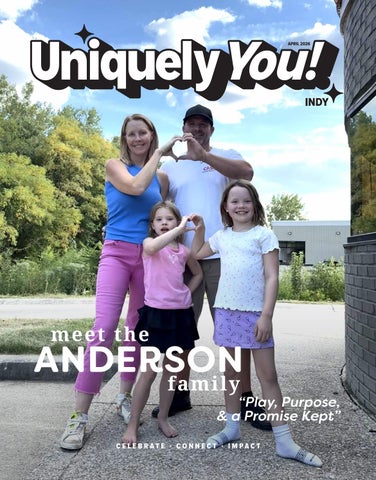
meet the family

“Play, Purpose, & a Promise Kept”

What Sets Us Apart

At JD Angels Transportation Services, we understand that consistent transportation is vital for preserving independence and enhancing the quality of life.

Our transportation services are designed to ensure that every client arrives at their destination safely, comfortably, and on time. Our compassionate and skilled drivers o er door-to-door service for any occasion, including medical appointments, grocery shopping, family visits, or community events.

Publication Staff

Jamie

PUBLISHER AND AREA DIRECTOR

CONTENT MANAGER, Dr.

“Lyn” Jones CONTENT COORDINATOR AND WRITER

Staff Writers and Contributors

Photographers

Team!

Zachary

COMMUNITY ENGAGEMENT

Lisa Jegen UNIQUELY YOU MAGAZINE IN NORTHWEST INDIANA

Katie Mende PHOTOGRAPHY
Christia Woodford
Darolyn
Olson
Curtis
Christina McGairk EDITOR-IN-CHIEF
Kelsey Green
Debra Bader Jessica Willits Andy Fitzenrider
Kelsey Amos
Francisco ‘Jay’ Javier Luna, Jr. Coleson Henry
Tanya Sood
Lindsey Watson
Charles Spray MS, LMHC
Susan Graham Dorie Zipperle
Paul Hathcoat

ComForCare Home Care goes beyond just home care. We understand the unique needs of families with medically complex children. We offer a network of support, ensuring their caregiving journey is a bit lighter.

Call or text with questions

317-575-3983

comforcare.com/indiana/north-metro-indianapolis

@comforcareindy

@comforcare_northmetroindy

Our Services

• Medicaid PA Home Health Aide Service

• Structured Family Caregiving Service

• Private Duty Home Care Services

• Medicaid Attendant Care Services

SCAN TO LEARN MORE

IMPORTANT PHONE NUMBERS

UNIQUELY YOU!

MAGAZINE AREA DIRECTOR

Jamie Olson 248-882-8448 jamie.olson@n2co.com

Scan to view the past issues of Special Needs Living Indy and Uniquely You!

Scan to view past digital copies, find resources, share a story or learn more about being involved.

317-977-2375

317-676-4222

800-609-8448

877-241-8144

800-545-7763

800-545-7763

800-622-4968

888-673-0002

800-403-0864

317-232-7800

317-925-7617

877-511-1144

317-466-1000

911

800-545-7763

317-232-0570

844-323-4636

317-233-4454

317-232-7770

812-855-6508

317-233-1325

844-446-7452

855-641-8382

800-332-4433

800-457-4584

317-232-7770 988

800-772-1213

800-772-1213

877-851-4106

317-871-4032

800-545-7763

Arc of Indiana www.arcind.org

Autism Community Connection www.autismcc-in.org

Autism Society of Indiana

Blind and Visually Impaired Services (BVIS) Bureau of Developmental Disabilities Services (BDDS)

Bureau of Rehabilitation Services (BRS)

Deaf and Hard of Hearing Services (DHHS) DHHSHelp@fssa/in.gov

Disability Determination Bureau

Division of Aging (IDA)

Division of Family Resources (DFR)

Division of Mental Health and Addiction

Down Syndrome Indiana

Early Childhood and Out of School Learning (OECOSL) Easterseals Crossroads www.easterseals.com/

Emergency

First Steps

Indiana Department of Education: Office of Special Education – www.doe.in.gov/specialed

Indiana Family to Family - www.inf2f.org

Indiana Family and Social Services Administration (FSSA) – www.in.gov/fssa/index.htm

Indiana Governor’s Council for People with Disabilities (GPCPD)

Indiana Resource Center for Autism

Indiana State Department of Health

Indiana Statewide Independent Living Council (INSILC) Indiana Works

INSOURCE – http://insource.org/

Medicaid Disability

Medicaid Waivers

National Alliance on Mental Illness

Social Security Administration (SSA)

Social Security Disability Insurance (SSDI)

Special Education Questions

United Cerebral Palsy Association of Greater Indiana Vocational Rehabilitation Services (VR)

n2co.com

Celebrate. Connect. Impact. © 2026 The N2 Company, Inc.

DISCLAIMER: The views expressed in the articles and advertisements in Uniquely You are those of the authors and advertisers and do not necessarily reflect those of The N2 Company or the publisher. Inclusion of paid advertisements does not imply endorsement, and neither N2 nor the publisher is responsible for the business practices of advertisers. We are proud to feature businesses that share our commitment to showcasing local connections. Please note that businesses profiled may have provided free products and / or services for the review. Uniquely You is for general informational and entertainment purposes only and is not intended to provide medical, therapeutic, educational, or legal advice. Always consult qualified professionals regarding the care and support of individuals with disabilities. NOTE: When community events take place, photographers may be present to take photos for the event, and they may be used in this publication.

The Boy We Didn’t Have & Instead THE WORLD WE FOUND

Life rarely unfolds the way we imagine. Kay and Jason expected their next chapter to be simple. With two young daughters, they hoped for one more child, a baby boy. They were preparing to grow their family when everything changed.

Kay was diagnosed with advanced breast cancer that had spread to her lymph nodes. The dream of a third child disappeared overnight, replaced by survival. Surgeries. Chemotherapy. Radiation.

Eventually, the words every family hopes for: no evidence of disease. While Kay fought for her life, Jason steadied daily life, parenting toddlers, coordinating care, and holding the household together through uncertainty. At the same time, another story inside their home was beginning.

Their daughters were just two and three. The youngest, Victoria, quickly became “that child” in daycare. The biter. The hitter. The pusher.

But at night she cried in pain over something no one could see. Her parents checked sheets for splinters and glass. Nothing was there. Slowly they learned light touch hurt, wind at certain angles hurt, clothes hurt, dangling legs hurt, and gentle guidance on her joints hurt.

She was too young to have words to say it hurt. So she communicated the only way she could: behavior.

Occupational therapy led to a diagnosis of autism. Suddenly the family’s life filled with specialists, sometimes 20 to 30 hours of appointments each week, while still navigating cancer treatment.

They began to understand Victoria’s world. She processes information

everything. She hums and sings to regulate. She seeks cold and deep pressure to calm her body.

One day she wrapped every finger in Band Aids. When someone asked why, Kay answered honestly, “I don’t know if it’s pressure or texture, but it helps her body feel safe and I’m sure it will inspire her to be a doctor or vet one day.”

Jason realized then parenting was not about correcting behavior but decoding communication.

What surprised them most was not therapy, it was people. The stigma. The ignorance. The judgement.

• “I’m sorry she’s autistic.”

• “Maybe you can pray it away.”

• “She’ll outgrow it someday.”

They learned many see autism as a single stereotype, but every autistic person

“I don’t know if it’s pressure or texture, but it helps her body feel safe and I’m sure it will inspire her to be a doctor or vet one day.”
Jason

experiences the world differently.

Victoria was not broken, she was overwhelmed. Her brain processed more sensory input than she could organize at once. Regulation was survival. They made a promise. Their home would always be a safe place to exist exactly as they are.

The Sibling Story We Rarely Tell

Victoria’s older sister Olivia, just 18 months older, instinctively learned how to calm her better than any adult could. Jason watched her step into helper mode long before childhood should require it.

But she also carried invisible weight, the pressure to help manage and protect. Through therapy the family discovered something else: Olivia has ADHD. Soon after, Kay realized she did too. What she thought was anxiety was internal hyperactivity.

Their family was not defined by one diagnosis but by neurodiversity.

After more than 20 years at Eli Lilly and Company, Kay and Jason saw the

same challenge everywhere. Restaurants overwhelmed one child. Play places overwhelmed another. Every outing meant someone struggled.

So they built the place they could never find. Prana Play was created so families would not have to choose who gets to be comfortable. Not special needs only. Not neurotypical only. A place intentionally designed for real families, where siblings, parents, and children with different sensory needs can exist together. A space with regulation in mind. A space where movement is welcomed, noise is understood, and sensory experiences are supportive rather than overwhelming. A place where no one is “too much.”

What began as a play space became something deeper, a reflection of everything they had learned about safety, nervous systems, and belonging.

That vision expanded into Waves of Change Foundation for Neurodiversity, focused on providing support, respite, and community so families can live balanced lives. The foundation exists to meet needs beyond play, offering

connection, education, and relief for caregivers who are often running on empty. It is about restoring hope, building understanding, and creating systems of care where families feel seen instead of isolated.

Kay and Jason never had the baby boy they planned. Instead they gained a deeper understanding of how we are all uniquely human.

They never wished their children were different. They wish the world was.

Sometimes the hardest journeys do not take us where we planned, they take us where we are needed.

At Uniquely You Magazine, we believe every family deserves spaces where no one has to apologize for how their brain works.

http://www.pranaplaycarmel.com/

CREATING A STRONGER, MORE INCLUSIVE COMMUNITY where individuals of all abilities are not only welcomed- but empowered.

Inclusive day habilitation and community-based programming for individuals with intellectual, developmental, and mental health disabilities

SKILL DEVELOPMENT

CREATIVE EXPLORATION

SOCIAL ENGAGEMENT

WELLNESS & MOVEMENT

SENSORY & EMOTIONAL REGULATION

Opening the World, Together HOW HOLLIS ADAMS BUILDS BELONGING AND RESILIENCE

“Hollis Adams builds resilience through friendship in facilitated spaces of dignity and belonging.”

That single sentence captures both a mission and a movement. In a world that often moves too quickly to notice who is being left behind, Hollis Adams stands as a reminder that friendship is not a luxury, it is essential to human well-being. For adults with disabilities, whose lives are too often shaped by barriers rather than opportunities, Hollis Adams creates something profoundly simple and profoundly rare: spaces where belonging is real.

HOLLIS ADAMS OVERVIEW:

“We work to end social isolation due to disability by opening the world, together.”

Social isolation is one of the least visible yet most devastating challenges

faced by adults with disabilities. While communities may invest in education, therapies, and medical care, the deeper need for connection, for friendship, shared experiences, laughter, and mutual recognition, can go unmet.

Hollis Adams exists to address this gap, not as an add-on, but as a core human necessity.

Adults with disabilities frequent Hollis Adams spaces to build and enjoy friendships and explore the world. Imagine what society looks like when we all experience dignity and belonging while exploring on our own terms. This is not simply an organizational goal. It is a reimagining of community itself.

A PERSONAL VISION ROOTED IN AWARENESS

The heart of Hollis Adams’ work is best understood through the perspective of those who believe deeply in its mission.

From the Executive Director:

“Central Indiana like most regions was designed for a very narrow type of person. That’s me. Neuro-typical. Able-bodied.

Until our spaces truly welcome adults with disabilities, we will continue imposing the devastating burden of social isolation on our neighbors.

I’m passionate about nonprofit missions that meet the moment and accomplish their mission. Special events and special spaces have a wonderful place easing social isolation. But we have the opportunity to end it together.”

Ben, Hollis Adams’ new Executive Director, reflects on a truth many people rarely stop to consider: our communities, systems, buildings, schedules, and social norms were largely created with a “default” person in mind. Those who fall outside that narrow definition,

whether due to physical, cognitive, sensory, or developmental differences, are frequently expected to adapt, compensate, or simply go without.

Hollis Adams challenges that assumption. Rather than asking adults with disabilities to squeeze into environments never designed for them, Hollis Adams intentionally cultivates spaces where dignity, autonomy, and authentic participation are foundational. The organization’s philosophy recognizes that isolation is not inevitable, it is often the byproduct of exclusion, misunderstanding, or inaccessible design. Ending isolation, then, is not about “fixing” individuals, it is about reshaping experiences, relationships, and community expectations.

BELONGING AS THE PATHWAY TO WELL-BEING

Belonging means well-being. Throughout life, the places and spaces of meaning we pass through embrace us in ways that recognize our struggles and joys. They recognize the unique expressions of individuality we bring. This recognition comes from the awareness, patience, and compassion of those who keep and inhabit each space. We each play a role in guiding the experiences of others who pass through our spaces, at home, at work, at the grocery, the park, the café.

The ease with which we move through these spaces determines the strength of our social network. Spaces of belonging that we can access throughout daily life bring a community of support that sees us and recognizes us for who we are. And we get to see and recognize them on our own terms. This is friendship, and it makes us healthy and resilient.

For adults with disabilities, everyday environments can present layers of difficulty. A crowded café may overwhelm sensory systems. A workplace may not accommodate communication differences. A social gathering may unintentionally exclude. Over time, these repeated challenges can shrink a person’s world.

Hollis Adams works in the opposite direction. By creating facilitated spaces designed around dignity and choice, the organization expands the environments where individuals can feel comfortable,

valued, and connected. These are not passive programs where participants are managed or entertained. They are dynamic communities where adults with disabilities shape their own experiences, develop relationships, and explore interests. At Hollis Adams, exploration on your own terms is the antidote to social isolation. We facilitate spaces where connections are built, and honest, authentic friendships are maintained in whatever style is right for you.

THE HOLLIS ADAMS EXPERIENCE

The Hollis Adams experience values dignity, curiosity, expression, engagement, and ingenuity. These values are not abstract ideals. They are lived realities that shape daily interactions, activities, and relationships within the Hollis Adams community. The impact of this approach is perhaps most clearly seen through the experiences of individuals and families.

Dignity

“He fits in and feels he belongs there. Scott knows what’s available to engage in on the days he attends. He gets to plan and control what he does. It’s been the best place in the world for him. He thrives and looks forward to it.”

Dignity begins with autonomy. For many adults with disabilities, life can be shaped by schedules created by others, caregivers, service providers, transportation systems, or program structures. Hollis Adams prioritizes personal agency. Participants are not simply told what they will do, they are empowered to make choices, express preferences, and direct their own days. Belonging is deeply connected to this sense of control. When individuals can anticipate what is available, select activities, and move through the day with confidence, anxiety decreases and engagement increases. Thriving becomes possible.

Curiosity

“Scott immediately liked the idea of exploring various destinations and the idea of meeting other people.”

Curiosity is a gateway to connection. Exploration at Hollis Adams may include community outings, new

activities, creative experiences, or shared adventures. These opportunities nurture a sense of discovery, not just about the world, but about oneself. New environments spark conversation. Shared experiences build common ground. Curiosity invites individuals out of routine and into possibility.

For adults who may have had limited access to varied social or recreational experiences, this emphasis on exploration can be transformative.

Expression

“He’s met a lot of people and takes control of his day more, between his morning routine and chores and his stories about what happened at Hollis.”

Expression is identity in motion. Friendships and meaningful engagement naturally generate stories. Participants don’t just attend Hollis Adams, they live experiences worth sharing. Conversations at home become richer. Confidence grows. Personal narratives expand. Expression may take many forms: conversation, art, humor, body language, assistive communication, or creative projects. Hollis Adams embraces the diverse ways individuals communicate and connect. Being seen and heard, in whatever style is natural, reinforces self-worth.

Engagement

“He thrives in that type of environment. He’s getting the opportunity to do a lot of things he wouldn’t have the opportunity to do without Hollis Adams. It’s an opportunity for him to become more well-rounded.”

Engagement is participation with purpose. Isolation often limits not only social interaction but also exposure to new skills, interests, and roles. Hollis Adams fosters environments where adults with disabilities actively participate rather than passively observe. Whether through structured activities, community involvement, creative expression, or collaborative projects, participants are invited into experiences that build competence, confidence, and joy. Being “wellrounded” is not about meeting external standards, it is about expanding opportunities to explore one’s own interests and capabilities.

Ingenuity

“He has opportunities to help out or volunteer, and he takes advantage of those. He gets to be a good friend and contribute.”

Ingenuity is contribution and creativity. Every individual has gifts. Too often, disability-centered narratives focus on needs, limitations, or deficits. Hollis Adams intentionally shifts this lens toward strengths, talents, and contributions. Participants are encouraged to help, volunteer, collaborate, and support one another. Contribution strengthens belonging. When individuals are recognized not only as recipients of support but also as valued contributors, friendships deepen and self-esteem grows. Community becomes reciprocal rather than one-sided.

A LEGACY OF BELONGING

For 57 years, Hollis has created pockets of dignity, curiosity, and engagement in a society that for many remains closed and unable to recognize their gifts or their individuality.

This legacy reflects decades of commitment to a simple yet radical idea: adults with disabilities deserve lives rich with friendship, exploration, and belonging. Over the years, Hollis Adams has evolved alongside changing understandings of disability, inclusion, and person-centered support, while remaining grounded in human connection. What began as dedicated spaces of welcome has grown into a broader vision.

Now, envision a world so open that spaces of belonging are not only tucked away in dedicated places like Hollis Adams but are available to be explored throughout daily life. A world where spaces of belonging become networks of curiosity and engagement, where those networks become a society of

imagination, wisdom, ingenuity, and love, the kind that we all miss out on when our spaces are kept for certain abilities, styles, and habits.

Hollis Adams does more than provide programs. It models what an inclusive community can look like. It demonstrates how dignity-centered design, facilitated relationships, and intentional belonging can reshape lives.

WHY THIS WORK MATTERS

The consequences of social isolation extend far beyond loneliness. Research consistently links isolation to increased risks of anxiety, depression, declining physical health, and reduced life satisfaction. For adults with disabilities, these risks can be compounded by limited transportation, inaccessible environments, communication barriers, and societal misconceptions.

Friendship, by contrast, is protective. Belonging supports mental health. Shared experiences nurture resilience. Authentic relationships create networks of emotional and practical support. Hollis Adams recognizes that fostering connection is not peripheral to wellbeing, it is central. Families often witness profound changes:

- Increased confidence

- Improved communication

- Greater independence

- Enhanced emotional regulation

- Renewed joy and anticipation

Caregivers, too, experience relief knowing their loved ones are not merely supervised, but genuinely connected.

BUILDING A MORE OPEN WORLD

Hollis Adams’ mission ultimately invites the broader community into reflection and action. What would it look like if more of our public spaces, workplaces, recreational environments, and social settings were designed with dignity and

accessibility at the forefront? What if belonging were not something adults with disabilities had to search for, but something embedded in daily life?

While Hollis Adams provides dedicated facilitated spaces, its deeper impact may be cultural. By centering friendship, autonomy, and dignity, the organization challenges communities to expand their understanding of inclusion. Inclusion is not simply physical presence. It is participation. Choice. Recognition. Relationship. It is belonging.

A COMMUNITY ROOTED IN FRIENDSHIP

At its core, Hollis Adams is about human connection. It is about adults with disabilities laughing together, supporting one another, exploring new places, sharing stories, and building friendships that extend beyond program hours. It is about dignity lived, not promised. It is about resilience built through relationships. It is about opening the world, together.

Street Address: PO Box 20512

Indianapolis, Indiana 46220

Phone: (463) 206-1032

Special Needs Trusts as a Safeguard for MEDICAID ELIGIBILITY

Takeaways

Special needs trusts (SNTs) enable individuals with disabilities to receive financial support without losing eligibility for needs-based government benefits like Medicaid and SSI.

SNTs protect assets by holding funds in a trust, managed by a trustee, ensuring distributions supplement rather than replace public benefits.

The Challenge of NeedsBased Benefits

More than one in three people with disabilities rely on Medicaid, according to the Kaiser Family Foundation. Jointly funded by states and the federal government, Medicaid is a public assistance program that provides health insurance to people with limited income and resources, including those with disabilities.

Because Medicaid is needs-based, qualifying for it requires meeting strict financial limits on income and assets. Exceeding those limits even by a small amount can mean losing essential medical coverage.

A special needs trust (SNT) can help people with disabilities meet these requirements and maintain their eligibility for Medicaid and other needsbased assistance such as Supplemental Security Income (SSI), while still receiving financial support.

Qualifying for Medicaid and SSI

To qualify, the Medicaid and SSI programs generally limit recipients to no more than $2,000 in countable resources for an individual. (Note that some states have different limits for Medicaid.) SSI recipients must also meet specific disability or age requirements.

In most states, qualifying for SSI automatically qualifies a person for Medicaid.

Some states also expanded Medicaid access under the Affordable Care Act, which allows people to qualify for Medicaid based on income alone. However, if the person needs long-term care services or home- or communitybased services (HCBS) waivers, they often must still meet strict resource limits, making an SNT necessary. Because Medicaid and SSI are sensitive to changes in assets, even a well-meaning gift or inheritance can unintentionally disqualify someone from receiving benefits. For example, if a family member leaves a direct inheritance to a disabled adult who receives SSI and Medicaid, that windfall could push them over the eligibility limit. Similarly, a personal injury settlement deposited into the disabled

person’s bank account could cause them to lose their benefits.

How Special Needs Trusts Help Protect Benefits

A special needs trust can help prevent this problem. When assets are placed in an SNT, they are generally not counted for purposes of Medicaid or SSI eligibility because the funds are held by the trust and not directly by the beneficiary, as well as meeting other requirements.

The trustee manages the funds and uses them to pay for goods and services that supplement, rather than replace, public benefits. Trustees must follow strict distribution rules and may need to provide regular reports to state Medicaid agencies. If the trustee gives cash to the beneficiary, it counts as income and may reduce or jeopardize essential benefits.

An SNT can pay for supplemental needs to improve quality of life. This may include private education, recreation, or medical and dental care not covered by Medicaid.

The trustee plays a critical role in ensuring that trust assets do not jeopardize benefits. Trustee responsibilities include exercising full discretion over distribution, ensuring that distributions comply with SSI and Medicaid rules, keeping accurate records, and providing required reports to state agencies.

Types of Special Needs Trusts

The three common types of special needs trusts are first-party, third-party, and pooled SNTs.

• First-party special needs trust: This type of trust is funded with the beneficiary’s own assets, such as an inheritance or lawsuit settlement. It must include a Medicaid payback provision.

• Third-party SNT: Third-party SNTs are funded with assets belonging to someone other than the beneficiary, such as a parent. It does not require a Medicaid payback and is often used as a key part of a loved one’s estate plan.

• Pooled trusts: These trusts are managed by a nonprofit organization that manages assets in a common fund for many beneficiaries.

With a first-party SNT, federal law requires that upon the death of the beneficiary, remaining funds must first be used to repay any state Medicaid program for benefits paid during the beneficiary’s lifetime. This Medicaid payback requirement is the single biggest difference between first- and third-party SNTs. If assets remain after payback, then they can be distributed to secondary beneficiaries.

Special needs trusts allow people with disabilities to receive supplemental financial support

while maintaining access to vital public programs. For those who rely on Medicaid and SSI, receiving an inheritance or settlement does not have to mean losing benefits. A properly drafted SNT can protect their eligibility while improving their quality of life.

8888 Keystone Crossing Suite 1600, Indianapolis, IN 46240

9900 Corporate Campus Dr. #3000, Louisville, KY 40223

T: (317) 567-2005

C: (317) 506-4734 “Calls only”

F: (317) 469-2500

ghomes@financialguide.com www.gordonfhomes.com

LET’S PULL OFF SOMETHING FOR KIDS IN NEED

When Saturday, April 25, 2026

9 a.m. - 12 p.m.

Where

Republic Airways Hangar

Indianapolis International Airport

3998 S. Hoffman Road

Indianapolis, IN 46241

April 25, 2026 |

14th Annual Republic Airways Plane Pull, presented by Lucas Oil, will be a day of fun, community and support for children with life-threatening or terminal illnesses.

We’ll have food and beverages to keep you fueled up for the big pull, and special guests to get the energy high. That’s not all. Our free Kids Zone will have activities, games and prizes for your

Come ready with your upper body strength, team spirit and maybe even a group costume — it could earn you a prize!

Kenny Moore II INDIANAPOLIS COLTS CORNERBACK
Anthony Calhoun WISH-TV SPORTS DIRECTOR
PLANE PULL EMCEE
SPECIAL GUEST GALA EMCEE

Medical Mutts Service Dogs

IT’S NO SECRET that dogs are considered man’s best friend, over half of American households own at least one pet dog. They’re known as some of the most loyal and loving friends you could have, with hundreds and hundreds of movies, shows, and even video games being about them and this aspect. There’s also scientific evidence that humans have kept them as pets dating back to as long as 14,000 years ago, showing that we as a species have long enjoyed the companionship provided by these lovable furballs. However, in the modern day, times are pretty difficult for a lot of dogs. Over 3 million enter shelters each year and about 300,000 (or 1/10) of these dogs are euthanized each year, just

in the United States alone. There are many organizations that aim to fix this, to give these dogs a loving home. The organization we’ll be talking about today not only helps in this regard, but gives these dogs the training necessary to become service animals, and gives them homes with people who can benefit from their services, essentially helping to solve two problems at once.

This organization was founded in 2013 by Jennifer Cattet, Ph.d., and Jack Topham, a husband and wife duo with an incredible list of credentials for this kind of work. Jennifer previously worked at a prison-based service dog organization as a Director of Training. During this time, she was among the pioneers of diabetic alert training, learning and proving that dogs could detect a drop in glucose levels in

diabetic patients by scent. This also led her to create a training program for service dogs to detect oncoming seizures, backed up by the research showing the release of certain scents during seizures.

Jack learned to train service dogs from his wife during his time volunteering at the same nonprofit. He also has multiple years of managing business enterprises under his belt, contributing to his business acumen. They combined their skills together to embrace a shared goal, positively impacting the lives of those with lifethreatening conditions and improving the lives of abandoned shelter dogs. So far, they have been very successful in achieving this goal, with Medical Mutts celebrating its 10 year anniversary in 2023 after many years

Henry
Marta has landed safely in Indy
Grads! Molly and Chloe

of adaptation and expansion, still going strong as of 2025.

As mentioned before, Jennifer helped pioneer research relating to both diabetic and seizure alert training for service dogs. So naturally, these are two of the conditions that their dogs are trained to help with. But it doesn’t stop there, these dogs are also trained to also help those with autism, people with psychiatric conditions, interrupt anxiety behaviors, and even assist with mobility.

These service dogs also give their owners emotional comfort, companionship, and increased independence. This is an extremely important factor since a lot of the clients of Medical Mutts face challenges like isolation, anxiety, and limited access to support systems. With a helpful and loving companion by their sides, along with the continuous support Medical Mutts offers, these clients gain more confidence, reduce their stress, and can navigate their lives with more ease and security than they could previously.

Another great thing about Medical Mutts is that they believe in training their service dogs via positive reinforcement, avoiding using any punishment-based training. They are dedicated to making sure their canine companions have a happy, trusting, and loving relationship with their owners while still teaching them everything they need to know effectively. By using methods like food rewards and clicker training, it helps to instill a happiness and eagerness to complete their tasks rather than them simply following a pain or fear response as a result of other more harsh training methods.

Medical Mutts is also dedicated to making their services affordable to individuals and families. They do this by setting up a scholarship fund that reduces the costs of their services for those in need. They get the money for the scholarship through fundraisers, like their recent Dogs and Designers Purse Bingo Night, making sure that these funds are used as effectively as possible. They also host team training weeks, teaching people to learn to work with their dogs, making sure that their clients are well informed and confident in their knowledge about their new companions.

Lastly, I’d like to highlight a testimonial from a woman named Molly Izer, to show just one of the many of the personal stories that show the difference Medical Mutts is making in people’s lives. Molly was an extremely active person, partaking in activities like alpine racing and dirt bike riding. She described herself as “an Outdorsey Oregon girl through and through”. However, a lot of this changed during 2021 when she contracted COVID-19 and developed debilitating Postural Orthostatic Tachycardia Syndrome (or POTS), a condition that makes it so her heart and brain fail to communicate. This causes her to experience a racing heart rate, extreme fatigue, fainting, painful palpitations, shortness of breath, and brain fog.

“Someone who could once run 10 miles without stopping now could barely walk up the stairs without sitting down,” said Izer. “I mourned what my body had become, but mostly I mourned the future it put in jeopardy.”

Molly had been accepted to Georgetown Law School, and was worried that she would fall behind in her coursework or possibly flunk out due to factors beyond her control. Pair this with the fact that her POTS was proven to be treatment resistant and resulted in her losing consciousness nearly every day, it painted a pretty grim picture about the future. That was the case, until she was recommended she get a service dog to help with her mobility and possibly detect her episodes before they happened. She did some research on the subject, came across Medical Mutts in an online forum, and knew that they were the perfect fit for her.

“Their training style, incredible staff, and immaculate record were astounding. Even then, I could have never expected how drastically my life would improve after acquiring one of their dogs, Chloe”

“Chloe is able to detect my POTS episodes up to 10 full minutes before I feel symptoms via scent detection training,” wrote Irez. “ She not only alerts me to episodes and ensures I am on the ground and safe, but lays on my lap to push blood back up to my head, guards me from strangers in the city,

and brings me the appropriate medical supplies. I went from passing out daily to having two episodes per week on average.”

Having Chloe around to alert Molly to her oncoming episodes has also heavily lowered their severity, making it so that she experiences far less pain and brain fog. This has the added benefit of her now being able to recover much more quickly than she previously did and get right back to her day. Not only has this improved the overall quality of her days, but it has also given her the confidence to attend law school and reach her highest potential. “She - and the CONSTANT support of the Medical Mutts team throughout the process and afterward - have changed my life irrevocably. Organizations like theirs, with the values and services they provide, are rare and deserve to be cherished.”

This is just one of many people that Medical Mutts has helped over their 12 years of business. Ethical training, giving abandoned dogs a home, helping those with debilitating conditions, dedication to making their dogs affordable, constant support for their clients, there’s a lot to admire about this organization. So if you or a loved one ever become in need of a service dog, now you know about a pretty great option. And if you ever just find yourself in a charitable mood, you also know of a place that makes every dollar count with their services.

To donate to and learn more about Medical Mutts Service Dogs, visit their website at https://www. medicalmutts.org/.

THE QUIET WORK of Single Moms Raising Exceptional Children

THIS IS NOT THE STORY I would have written for myself. Not because it is tragic or broken, but because it asks more than I ever expected to give. It requires focus, patience, and a kind of steadiness that can’t be rushed. Over time, I have grown into it, not all at once, but in pieces, shaped by experience rather than expectation.

Most days don’t look extraordinary. They’re built from routines that require precision, patience, and a lot of flexibility. Mornings that can’t be rushed. Appointments that stack up quickly. Meetings where I advocate, explain, push back, nod politely, and then go home to process what was actually said. Dinner usually happens at 6 p.m., but lately it happens when it can. Rest happens when it’s earned.

What people don’t see is the constant awareness. The mental load that never turns off. I’m always tracking energy levels, triggers, emotional shifts, and contingency plans. I’m holding today while preparing for tomorrow, all while carrying the weight of what’s already happened.

But, I’m not doing this completely alone.

My mom helps a lot. I have a couple of friends I can call and I know they will show up. Support does not always look perfect or predictable, but it is real, and it matters. It looks like a backup when plans change, understanding when energy runs low, and people who know this life well enough not to minimize it.

Single motherhood has a way of sharpening everything. You learn quickly how to move through the world with less margin for error. You become efficient, intentional, and selective. Relationships change, not always dramatically, just quietly. Life gets smaller in some ways and deeper in others. You stop explaining as much. You conserve energy. You figure out what actually matters.

There are moments of sadness, yes, but not the kind that consumes me. It’s more of an awareness. An understanding that this road isn’t the easier one. That some things require more effort, more planning, and more grace. And still, this is the life I’m living fully, even when it’s heavy.

And still, this road has shaped me.

My daughter has taught me how to slow down in a world obsessed with speed. How to notice progress others overlook. How to celebrate wins that don’t show up on timelines or charts. Success in our home looks different, and learning to honor that has changed me.

I’ve learned to trust myself. To speak up even when my voice shakes. To stop apologizing for advocating. To understand that exhaustion doesn’t mean I’m failing, it means I’m showing up.

This is work. Hard and invisible work. And it matters. There are moments that hold me steady, the unexpected laughter, the calm after a hard day, the way my daughter clings to me when the world feels overwhelming. Those moments don’t erase the difficult ones, but they remind me why I keep going.

If you’re a single Mama who has a child or adult who requires extra support, I don’t need to tell you how demanding this life can be, you already know. What I will say is this: tired doesn’t mean incapable, different doesn’t mean wrong, and showing up every day still counts, even when no one is keeping score.

We are doing heavy, meaningful work in systems that weren’t designed with our children, or our realities in mind. And even on the days we’re running on fumes, we are still standing. That counts. Every single bit of it counts.

If you know a single parent you wish to nominate go to https://form.jotform.com/240566014402142

Christina

Disability & The Church

”RELIGION THAT GOD our Father accepts as pure and faultless is this: to look after orphans and widows in their distress and to keep oneself from being polluted by the world.” James 1:27

“On the contrary, those parts of the body that seem to be weaker are indispensable.” 1 Corinthians 12:22

The heartbeat of the Church has always been community. Yet, too often, that community leaves out some of God’s most extraordinary image bearers those living with disabilities. Scripture doesn’t describe them as burdens or objects of charity but as essential members of Christ’s body. In God’s Kingdom, no one is disposable, and no contribution is small. The Church must do more than make room; it must recognize that without the gifts and perspectives of people with disabilities, the body of Christ is incomplete.

Becoming an Advocate for Inclusion

When James urges believers to care for “orphans and widows,” he highlights those society often overlooks the ones without privilege or power. In our world today, families affected by disability often carry similar burdens of isolation, exhaustion, and misunderstanding. Yet, when the Church embraces these families intentionally, it fulfills the very essence of “pure religion.” To love them is to love as Christ loved.

Paul’s teaching in 1 Corinthians 12:22 turns our assumptions upside down “the parts of the body that seem weaker are indispensable.” That word indispensable means necessary, vital, essential. God doesn’t merely tolerate people with disabilities; He has designed His Church to need them. Their faith, resilience, and joy reveal aspects of God’s character the rest of us might never see without them.

Consider Joni Eareckson Tada, who became a quadriplegic after a diving accident at age seventeen. Her suffering became a platform for global ministry through Joni and Friends, which now equips churches worldwide to love and serve families affected by disability. Or Nick Vujicic, born without arms or legs, whose message of hope in Christ has touched millions. These lives aren’t stories of pity; they’re testimonies of purpose proof that God’s strength is made perfect in weakness.

Churches that intentionally invest in inclusion often find that the blessing flows both ways. One congregation began a “Buddy Ministry,” pairing volunteers with children who have special needs. Soon, the entire church culture shifted, people greeted one another more intentionally, families who had once felt excluded found community, and volunteers testified that their “buddies” taught them more about worship and joy than any sermon ever had. Another church created a sensory friendly service for individuals on the autism spectrum. Attendance grew not only among those families but also among people who longed for a slower, more grace filled worship experience.

Every believer can help this vision come to life. You don’t have to be a pastor or program director to start building a culture of belonging. Here are a few places to begin:

• Listen and Learn: Get to know families and individuals living with disabilities in your community. Ask about their experiences, what has helped them feel welcomed, and what has made them feel left out? Listening opens the door to empathy and change.

• Start Small, Stay Consistent: Offer sensory friendly seating areas, create visual worship guides, or start a “buddy” program with just a few volunteers. The goal isn’t perfection, it’s progress.

• Invite Leadership: People with disabilities don’t just need a seat, they need a voice. Ask them to serve, lead, and share their stories. Inclusion becomes authentic when leadership reflects the full image of God’s people.

• Celebrate the Gift: Share testimonies and stories publicly. Normalize disability as part of God’s diverse design rather than a problem to solve. The more we celebrate, the more others will see the beauty of belonging.

When churches begin taking these steps, something miraculous happens: we discover that inclusion isn’t just for their benefit it’s for ours. The Church grows deeper in compassion, more aware of God’s grace, and more unified in purpose. As one pastor said after launching a disabilityfriendly ministry, “We thought we were making space for them, but God was making space in us.”

The call is clear: the people of God must move beyond awareness to action, beyond accommodation to celebration. This is not charity it is discipleship, obedience, and love in motion. When every part of the body is honored and engaged, the Church reflects Christ most beautifully.

So, ask yourself: Who is missing from your community? And what will you do, starting today, to help them belong?

Transcending Labels

Seeing Beyond What the World Assumes

Sometimes a book is born not from a single moment, but from years of quiet learning, moments that linger, conversations that stay with you, and people who change the way you see the world. Transcending Labels by Mitch Stevens is one of those books.

The seed for Transcending Labels was planted long before Mitch ever considered himself an author. As a high school student, Mitch worked closely with students with disabilities, an experience that shaped him in ways he did not yet have language for. Years later, after building a successful career in sales management, those early lessons never left him. Instead, they followed him, resurfacing again and again as reminders that true potential, dignity, and humanity are often hidden behind assumptions.

“I always knew I wanted to share these experiences,” Mitch reflects. “I just didn’t know when or how.”

That clarity came through volunteering. Through coaching with Special Olympics of Indiana, participating in community 5Ks, and showing up alongside families, athletes, and volunteers, Mitch found himself in conversations that revealed a deep hunger for understanding. Many people were connected to disability as parents,

siblings, or caregivers. Others were encountering the disability community for the very first time. What united them was curiosity and a desire to do better.

That was the moment Mitch knew the message could no longer stay internal. It needed to be shared.

At the heart of Transcending Labels is a simple but powerful idea: labels were never meant to be the lens through which we see one another. While diagnoses and classifications can provide access to services and support, they can also quietly limit expectations and connection. Mitch challenges readers to intentionally look beyond diagnoses, beyond assumptions, and beyond society’s often narrow definitions of success.

“Transcending labels,” he explains, “means refusing to let a label become the ceiling for someone’s humanity.”

One of the people who most shaped the heart of this book is Robert Hunt and his family. Through Robert, Mitch witnessed firsthand the depth of understanding, capability, and emotional intelligence that is so often underestimated. Robert’s family modeled advocacy, patience, and unconditional love, reinforcing the truth that labels rarely capture the fullness of a person’s lived experience.

Throughout the book, Mitch returns again and again to the theme of shared

humanity. Influenced by educators like special education teacher Cindy Gajus, Mitch emphasizes that disability is not separate from the human story. It is part of it. Disability does not diminish personhood. It deepens our collective understanding of empathy, resilience, and interdependence.

Mitch is honest about the reality of human nature. We all make initial judgments. But when those judgments go unchecked, they can prevent us from truly seeing the person in front of us, their personality, gifts, humor, and potential. Transcending Labels invites readers to replace assumptions with curiosity and distance with connection.

That connection, Mitch believes, is transformational for everyone involved.

For readers without lived disability experience, the book offers a gentle but clear invitation: show up. Volunteer. Get involved. Say yes to opportunities that feel unfamiliar or uncomfortable. Whether it is mentoring through programs like Best Buddies, volunteering at a Special Olympics event, tutoring, or simply building relationships in your own community, Mitch reminds readers that the disability community is known for its openness and warmth, and the need for volunteers has never been greater.

“The joy you receive is just as powerful as the support you give,” he

shares. “We were put on this Earth to live in community.”

The book is filled with real life examples that bring this message to life. One such story is Stephen Cornell, whose consistent joy and enthusiasm made a lasting impression on everyone around him. What stood out was not a single moment, but the way Stephen showed up, fully present and genuinely excited for connection every single day.

Listening, Mitch emphasizes, is foundational to transcending labels. Individuals like Robert Hunt often understand far more than people assume. Communication may take longer. Responses may come after pauses. But patience, presence, and the willingness to wait open the door to genuine understanding.

For families navigating disability, Mitch hopes this book offers reassurance that they are not alone. He wants them to know there is a growing community of people, many without a familial connection to disability, who care deeply, advocate fiercely, and want to support them.

Educators and schools will find practical takeaways woven throughout the book as well. Mitch acknowledges the very real challenges teachers face, limited resources, large caseloads, and systemic constraints, while still offering ideas that foster independence, dignity, and growth. From intentional routines to meaningful IEP implementation, the focus remains on empowering students rather than limiting them.

Beyond schools, Mitch believes workplaces and faith communities need a renewed commitment to empathy. True inclusion begins when we enter interactions aware that we do not know what someone else is carrying. One relationship at a time, cultures can shift.

When asked what one small action readers can take immediately after finishing the book, Mitch’s answer is simple: find one opportunity to volunteer.

Inclusion does not require grand gestures. It is inviting the student who sits alone to join your table. Introducing yourself to someone new. Checking in on a friend who might need reassurance that they matter. It is the daily practice of choosing presence over judgment.

“This should be required reading for every middle and high school student.”

Some of the most meaningful feedback Mitch has received so far speaks to the book’s reach:

“This should be required reading for every middle and high school student.”

While every chapter carries personal meaning, one stands out most to Mitch, Chapter 3, “My Buddy Steve.” The relationship he formed while tutoring Steve during his senior year remains one of the most impactful experiences of his life. “He’s the sweetest and purest human being I have ever met,” Mitch shares. “I will always be grateful for that time.”

Looking ahead, Mitch has bold hopes for Transcending Labels. His goal is to reach one million people through schools, classrooms, conversations, articles like this one, and speaking opportunities across the country. But at its core, the mission is not about numbers. It is about people.

As Mitch reflects on what he hopes Uniquely You Magazine readers remember most, his message is clear: Connecting with others on a deep, personal level is why we are here. There are people, many without direct ties to disability, who are in your corner, committed to making individuals with disabilities feel seen, loved, and appreciated. With collective effort, that community will continue to grow.

Transcending Labels is more than a book. It is an invitation to slow down, to see differently, and to choose connection over assumption. In a world that too often defines people by what it can easily name, that invitation feels both timely and necessary.

Learn more at www.mitchjstevens.com Contact Information: mitch.stevens05@gmail.com

The Sensory Shoppe

THE SENSORY SHOPPE is one of those places that feels welcoming the moment you step inside. Located in Carmel, Indiana, this thoughtfully designed space offers sensory products, classes, workshops, and experiences created with neurodivergent children and adults in mind, while still being inclusive to everyone.

It was founded by Emily Hawthorne, a mom inspired by her own daughters, one of whom is autistic, and her firsthand experience of how difficult it can be to find resources that are both supportive and affordable.

What started as a personal need grew into something much bigger. Today, The Sensory Shoppe is a place where families, caregivers, therapists, and educators can come together to find tools, connection, and genuine support.

Hawthorne, a West Lafayette native, moved to Zionsville after college, and now calls Carmel home. After earning her Communication degree from Purdue University, she spent several years working in the Governor’s Office before stepping into entrepreneurship. From 2014 to 2024, she ran a local

What started as a personal need grew into something much bigger. Today, The Sensory Shoppe is a place where families, caregivers, therapists, and educators can come together to find tools, connection, and genuine support.

volleyball club that became an important part of the community. Alongside her family, she also owns two Greek’s Pizzerias, further rooting her work in small business and local service.

What truly sets The Sensory Shoppe apart is the heart behind everything it offers. Each product, class, party, and workshop is carefully chosen with real families and real needs in mind. The goal is simple: to make sensory support, regulation tools, and joyful experiences accessible without being overwhelming or out of reach. It is a place where neurodivergent individuals do not have to explain themselves because they are already understood.

“Keep asking questions. Keep looking for what you need. Do not give up on finding your people. Whether it is a tool, a class, a resource, or a safe space, you deserve support.”

Her message to the community reflects that same spirit. “Keep asking questions. Keep looking for what you need. Do not give up on finding your people. Whether it is a tool, a class, a resource, or a safe space, you deserve support.” And that is exactly what The Sensory Shoppe is here to provide.

To learn more about The Sensory Shoppe, visit www. sensoryshoppecarmel.com or on their Facebook platform at https://www. facebook.com/SensoryShoppeCarme l

A Mother’s Journey in AUTISM ADVOCACY

How lived experience became research, clinical practice, and independence training for children on the autism spectrum

I was not always in healthcare. Before autism entered my life, I worked in IT. My world was logical, structured, predictable. Systems made sense. Problems had solutions. Then I became a mother. And slowly, I became the mother of a child who experienced the world differently.

What began as subtle concerns grew into a deeper awareness. Meltdowns that felt bigger than behavior. Resistance that did not respond to traditional parenting. Moments that left me searching not for control but for understanding. That was the beginning of my transformation.

Learning Before Leading

When my son struggled with independence, especially toileting, I immersed myself in learning. I read

extensively. I studied research. I filled notebooks with observations. I analyzed patterns. I practiced consistency.

What I discovered was this: Toileting is not just a task. It is a developmental, sensory, emotional, and motor process.

• Body awareness

• Sensory processing

• Motor planning

• Communication

• Emotional safety

• Environmental structure

It requires dignity. That realization shifted everything.

Changing Careers to Follow Purpose

I left my career in IT and trained in Applied Behavior Analysis, studying through the Florida Institute of Technology and becoming a Behavior Specialist. I delivered hundreds, eventually thousands, of therapy sessions.

Behavioral science gave me structure and measurable tools. But over time, I realized something was missing.

Not every behavior was defiance. Not every resistance was noncompliance. Often, it was nervous system overload.

So I went back to school again and became an occupational therapist.

Occupational therapy gave me the missing lens. It allowed me to integrate structure with sensory understanding. It gave me language for regulation, interoception, and activity analysis. It reframed independence as something built, not forced.

My son had been teaching me this all along.

Developing a Potty Training Program for All Abilities

Through lived experience and clinical practice, I developed a structured potty training program that works across abilities, typical and atypical, verbal and nonverbal.

I have now implemented and taught this approach to hundreds of children. My method is rooted in:

• Regulation before instruction

• Sensory-informed bathroom environments

• Step-by-step task analysis

• Interoceptive awareness training

• Communication supports

• Caregiver coaching

I do not use shame. I do not rush timelines. I do not treat accidents as failure. Instead, I treat them as information.

Toileting is often the first true milestone of independence. And when a child gains autonomy in this area, confidence expands into dressing, feeding, school participation, and social engagement.

Independence builds independence.

From Clinician to Doctoral Researcher

Today, I am pursuing my doctorate, researching caregiver coaching and regulation embedded independence training. My goal is to bridge research and real life practice.

Because independence does not happen in clinics alone. It happens at home. In bathrooms. In everyday routines. In consistent, supported moments. Caregivers need more than advice. They need evidence informed frameworks.

Nik’s Independence Academy

What began in my home has grown into Nik’s Independence Academy, named after my son.

The academy focuses on caregiver education, toileting independence, and regulation first teaching. It integrates behavioral structure, sensory science, and occupational therapy principles into a practical, compassionate approach.

My mission is simple.

Independence with dignity. Structure with compassion. Regulation before expectation.

5 Evidence-Informed Potty Training Tips for Children of All Abilities

1. Start with Regulation

A dysregulated nervous system cannot learn. Ensure the child feels safe and

supported before introducing expectations.

2. Teach Body Awareness

Support interoception through scheduled sits, visual supports, and consistent language about body signals.

3. Modify the Environment

Adjust lighting, sounds, foot support, and seating to reduce sensory discomfort.

4. Establish Communication First

Children must have a reliable way to signal the need to go, verbally or through AAC or gestures.

5. Remove Shame

Accidents are part of the learning process. Calm responses build confidence and long-term success.

From Awareness to Impact

Awareness was noticing my child was different. Acceptance was understanding he did not need to be changed. He needed to be supported.

Impact came when I realized families everywhere were asking the same questions I once asked. I changed careers not once, but twice. I returned to school multiple times. I transformed lived experience into professional purpose.

Today, I stand as a mother, Behavior Specialist, occupational therapist, doctoral researcher, and founder. But before all of that, I was simply a parent determined to help her child thrive. And that determination became a mission.

Because independence is not a luxury. It is a right for children of all abilities.

AUTHOR BIO

Tanya Malik, OTR/L, OTD Candidate is an occupational therapist, behavior specialist, and doctoral researcher specializing in regulation-embedded toileting and independence training. She is the founder of Nik’s Independence Academy, where she coaches caregivers and trains professionals in sensory-informed, dignity-centered approaches to daily living skills. Her work bridges lived experience, research, and clinical practice to support children of all abilities.

Designed to spark curiosity, build confidence, and prepare children for lifelong success.

Early Explorers Prep is Tangram’s newest autism services program, offering a school-like preparatory environment for early learners ready to take their next step. This program creates the foundation for growth across all developmental areas.

Through a play-based, experiential curriculum aligned with state Early Learning Standards, children are encouraged to discover, learn, and build skills that prepare them for school and beyond.

Early Explorers Prep integrates ABA therapy goals that strengthen communication, social interaction, language, and daily living skills, all within a developmentally appropriate and supportive environment.

With half-day and full-day options available, as well as speech therapy and transportation support, families can choose the approach that works best for their needs. Exploration today builds confidence for tomorrow.

Cubby Beds is the ultimate sleep solution for kiddos with special needs.

With its advanced sensory regulation features and remote monitoring technology, parents can check in on their kiddo sleeping peacefully from anywhere. #cubbybed

(888) 506-4182 | specialized4u.com 621 N Central Ave, Connersville, IN 47331 specializedhomecareservices@gmail.com.

Do you or someone you love suffer from ADHD, Anxiety or Autism? Let Us Help You Explore Your Options.

Neurofeedback is a non-drug, non-invasive solution to symptoms related to brainwave dysregulation. It's natural and offers a fix to the problem, not just a bandage that masks the symptoms.

"We followed the same path most of the other autism parents do with GFCF, DAN Dr., supplements, HBOT. What really made a difference in our son’s attention span, executive processing skills, and anger management was neurofeedback through INDY Neurofeedback and Leanne O’Neil."

Get a good night's sleep with our insurance approved Cubby Beds, now available in Indiana. Contact Specialized Home Care Services to learn more and order yours today! Indy Neurofeedback is Changing Lives!

Schedule a consultation today! 8801 N. Meridian, Suite 306, Indianapolis, IN 46260 (317) 888-8500 • www.indyneurofeedback.com

Spelling to Communicate is an innovative method of communication that starts with presuming in the cognitive competence of non, minimal and unreliably speaking individuals. It is believed that all individuals can and want to learn and communicate despite their perceived limitations. S2C empowers said individuals to overcome communication barriers through the motor movement of pointing to letters on a letter board and thus promoting synchrony between cognitive and motor systems. It is through the repeated practice (pointing to letters) that new neural pathways become formed and myelinated. The end result being a viable means of communication and the ability to show the world their cognitive prowess.

This section is here to give our readers easier access when searching for a trusted neighborhood partner to use. Get to know the businesses that make this magazine possible. Please support them in return and thank them if you get the chance!

ABA & Comprehensive Services

BehaviorWorks ABA (317) 731-7777 behaviorworksaba.com

Hopebridge Autism Therapy Centers (844) 786-0672 www.hopebridge.com

K1ds Count Therapy (317) 520-4748

ABA / Residential & Community Support

Sycamore Services (317) 745-4715 sycamoreservices.com

Tangram www.TheTangramWay.org

ABA/Comprehensive Services

The Hope Source (317) 578-0410

Advocacy & Disability Support AccessABILITY (317) 926-1660 www.accessabilityin.org

Attorney-Wills/Trusts/Estate Planning Law Office of Elizabeth A. Homes LLC (317) 660-5004

Behavioral Support/Pac New Beginnings BIS (317) 366-3432 www.newbeginningsbis.com

Community Inclusion & Adult Services Hollis Adams (463) 206-1032 www.hollisadams.org

Community Support AID of Indiana (765) 273-3999 aidofindiana.com/

Best Buddies Indiana (317) 436-8440 www.bestbuddies.org/indiana

Carters Play Place (317) 836-5510 cartersplayplace.com

Connie’s Clubhouse (435) 621-4153

www.conniesclubhouse.work

LEL Home Services (317) 387-1443 lelhomeservices.com

Noble (317) 375-2700

Phoenix Community Services LLC (765) 622-7808

www.Phoenixcommser.com

DJ/Entertainment Services

DJ Jesús Indy (317) 766-5742

www.instagram.com/dj_jesus_indy

Dyslexia Support Program

Retrain the Dyslexic Brain by Dr. Rebecca Troy (218) 393-2423

www.DrRebeccaTroy.com

Employment/Community Support Hopewell Center (765) 642-0201 www.hopewellcenter.org

Financial WestPoint Financial Group Gordon Homes (317) 567-2005

Home Care & Transportation

ABC Community Services LLC (317) 516-1178 www.abccommunityservices.com

Home Health Services

ComForCare Home Care (317) 575-3983

www.comforcare.com/indiana/ north-metro-indianapolis

Home Modifications / Specialty Equipment

Specialized Home Care Services (888) 506-4182

www.specialized4u.com/

Housing/Transportation/PAC/Respite

JD Angels Family Care (317) 654-2609

Ice Cream

Howdy Homemade Ice Cream (317) 397-0008 www.howdyindy.com

Insurance State Farm John Cole (317) 430-1958

Kid’s Sensory Gym

Rock the Spectrum (317) 764-6607 werockthespectrumcarmel.com/

Neurodiversity support tools Pop Sugar Cafe (260) 237-2377

www.popsugarcafe.com

Neurofeedback Therapy Indy Neurofeedback (317) 888-8500

Occupational Therapy Support NIKS Independence Academy (NIA) (463) 328-2637

Organizational Employee Development Team Sylvester (317) 691-9000 teamsylvester.com

Pediatric Home Care Guardian Care www.myguardian.care

Political

Friends of Blythe Potter (317) 285-8263

www.blythepotter.com

Turn static files into dynamic content formats.
Create a flipbook
Uniquely You! Indy April 2026 Digital Issue by Uniquely You - Issuu