Students debate free speech
By Maya Benmokhtar STAFF WRITER
Bridge SJSU hosted a debate Tuesday evening on Tower Lawn at San José State University. The debate allowed students to voice their opinions about Monday night's guest speaker Charlie Kirk, the founder and president of Turning Point USA. Bridge SJSU, is a nonprofit organization that fights political divisions on campus according to its official website.
Turning Point USA is a nonprofit conservative, anti-left group that supports defense of freedom, free markets, and limited government, according to its website.
Sabrina Nabizada, political science senior and president of Bridge SJSU, mediated the debate.

“We are not endorsing Charlie Kirk in any sort of way,” Nabizada said. “That is not what we do at our campus. We don’t endorse any specific features of any political parties.”
She said the organization invites students of all different political backgrounds to speak in the debate.
The debate began with students speaking on how they feel about Charlie Kirk being allowed a
platform at SJSU.
An economics senior who wished to remain anonymous took the mic and expressed that anyone should be given the chance to speak at SJSU. They said that during Kirk’s presentation, his views did not seem controversial.
“What I liked about the event was how much time was dedicated to addressing questions raised by those who did not agree with his political views,” the economics senior said.
They also said Kirk was very respectful of those with opposing political views.
History junior and member of Students for a Democratic Society (SDS), who also requested to remain anonymous said from their perspective, Kirk seems like someone who wants to have a debate and cause controversy.
“In reality he engages in what I would call, bad faith engagement,” the history junior said. “What I mean by this is typically he tries to go out of his way to portray his opposition on social media in the most negative light possible.”
The history junior also said there were instances where people from Students for a Democratic Society attempted to enter the event to ask
questions, but were denied. The history junior explained Kirk was not willing to address everyone, and was caught off guard by some of the questions asked by the attendees.
“It was interesting to me that there were barely any SJSU students attending the event, the majority of the people there were elderly and those were the people who wholeheartedly agreed with Kirk and even defended his every word,” Allen said.
Allen said regardless of her viewpoints, this event was a perfect example of upholding free speech.
The debate raised concern about safety following Kirk’s event, where a window was broken after a protest against Turning Point USA.
Heaven Watson, African American Studies freshman said these events can potentially put the campus at risk.
but overall we’re not required to alert the university on the event topic,” Nabizada said.
The group also discussed whether or not students should have a say in deciding which speakers are allowed on campus.
“I want to mention just how ludicrous and extremely self contradictory their argument on the grounds of free speech is to me, because they are a multi-million dollar organization being booed off one campus. They have dozens of other campuses they can go to,” the history junior said.
“He brushed it off instead of properly addressing it and engaging with it. Also he espoused Christian nationalist white supremacist views,” said the history junior. Public relations senior, who wished to be identified as FM Allen, said she attended the Charlie Kirk event on Monday and was surprised by the lack of SJSU attendees.
“It’s about how you present yourself and I think that people are still putting other people at risk,” Watson said. “You can put people at risk for a cause that you support but if your cause is that important you shouldn’t have to cause violence to show that.”
Nabizada said when organizations hold events on campus, organizations are not forced to explain what type of event they’re doing.
“Obviously there are guidelines that we all have to abide by, like no underage drinking, no hazing, etc.
The history junior also said as a student who pays to attend SJSU, he does not want that money to be used to support these kinds of events.
The junior said it’s fully within the rights of students to say they do not want certain people on campus.
Although this debate raised controversy for the students of SJSU, those who spoke out during the debate all said that there should be certain restrictions implemented in order to protect the campus and overall student safety.
Follow the Spartan Daily on X (formerly Twitter) @SpartanDaily
Librarians discuss banned books and censorship
By Melany Gutierrez STAFF WRITER
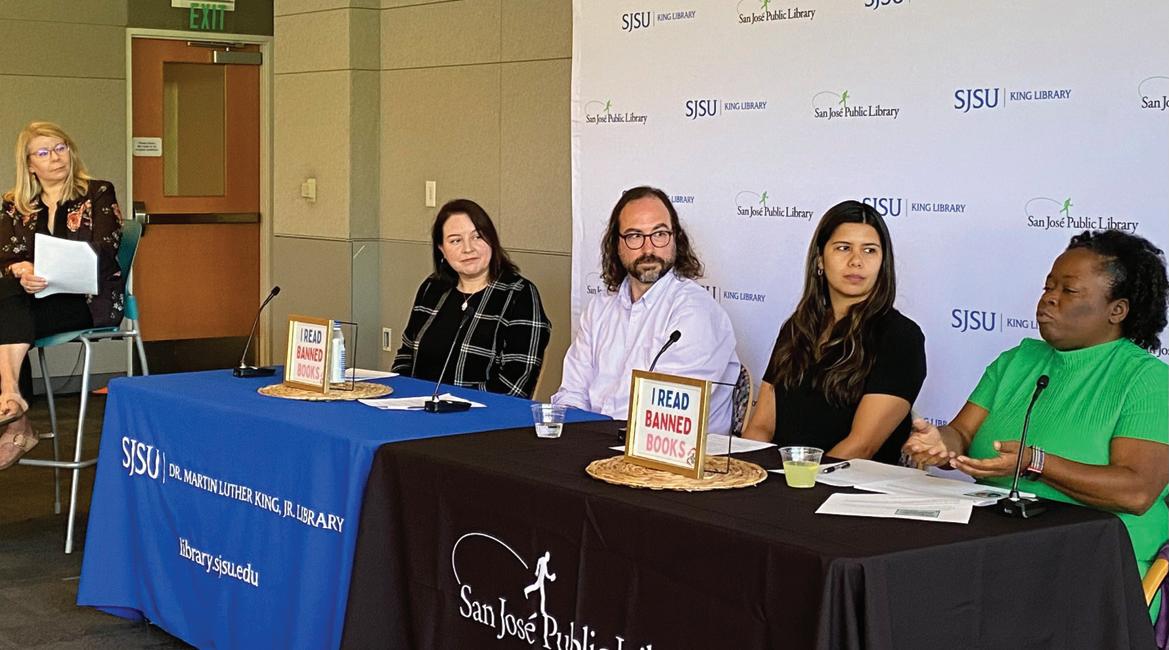
Dr. Martin Luther King Jr. Library faculty debated and discussed the topic of banned books at the Censorship Conversation Seminar on Tuesday.
Estella Inda, research services and social sciences librarian and organizer of Banned Books Week, said the Censorship Conversation seminar is a collaborative panel of Dr. Martin Luther King Jr. librarians and librarians from San José Public Libraries talking about censorship in K-12 schools through the banning of books.
The Censorship Conversation is one of the many events part of Banned Books Week at San José State.
Inda said banned books events are done annually at the library and she wanted to make sure something significant was done this year.
“I think celebrating banned books week this year alone is so important with book bannings becoming more prevalent and being out in the media a lot more,” Inda said.
Nick Szydlowski, digital
scholarship librarian at MLK Library, said librarians in other states are being vilified for trying to provide access to information through books.
He said it’s important that Banned Books Week occurs annually because resistance to content put in books ebbs and flows.
“There are a lot of attacks on curriculums in K-12 education, a lot of attacks on library books. So it’s important to keep the event going,” Szydlowski said.
Tiffany Bradford-Oldham, senior librarian for San José Public Library, said the Censorship Conversation Seminar and discussing how books are being banned is a small part of a bigger picture concerning censorship and access to materials.
She said accessibility to information is an ongoing conversation in the larger question of.
“We should even go as far as to think about what works are being oppressed,” Bradford-Oldham said.
Elizabeth Barragan, librarian for San José Public Library said all people should be represented in different books and banning
them is only taking that representation away.
“We live in a melting pot, especially here in San José we have such a diverse community,” Barragan said. “It’s so important for everybody’s voice to be heard and to be represented in the materials that we have within our shelves,” Barragan said.
Almost 1,500 books dealing with themes of sexuality, physical abuse, or health and well-being, were banned between 2022 and 2023, according to a website from Poets, Essayists and Novelists (PEN) America, a program dedicated to protecting free expression in the US.

Christa Bailey, academic librarian at MLK Library, said having the ability to individually select what you do and don’t want to read should be a personal liberty.
“For someone like me who didn't come from a really wealthy background, the library provided me the opportunity to access resources I wouldn't have had otherwise,” Bailey said.
Bradford-Oldham said when she was growing up, the book, “The Color Purple,” was a controversial
book that many authority figures in her life deemed inappropriate or questionable.
She said the book itself contained some difficult topics like brutality, rape and homosexuality, but it was important to her because it had cultural relevance.
Bradford-Oldham said she connected with the main character who was religious and wrote letters to God, just like she did.
“Growing up for me, there was always a clear understanding that there’s only one place in the world you can be free and that is
within your own mind,” BradfordOldham said.
Inda said that being understanding of all diverse viewpoints in books is what can help people consider why banning books is bad.
“I encourage people to read as they choose and explain and share and know that there’s going to be many different views,” Inda said.
SERVING SAN JOSÉ STATE UNIVERSITY SINCE 1934 WWW.SJSUNEWS.COM/SPARTAN_DAILY Volume 161 No. 19 Wednesday, October 4, 2023 NAMED BEST CAMPUS NEWSPAPER IN CALIFORNIA FOR 2022 BY THE CALIFORNIA COLLEGE MEDIA ASSOCIATION AND CALIFORNIA NEWS PUBLISHERS A SSOCIATION
MAYA BENMOKHTAR | SPARTAN DAILY
Attendees discuss the extent of free speech on San José State University's campus on Tuesday afternoon on Tower Lawn in response to a Turning Point USA event.
You can put people at risk for a cause that you support but if your cause is that important you shouldn't have to cause violence to show that.
Heaven Watson African American studies freshman
MELANY GUTIERREZ | SPARTAN DAILY
Follow the Spartan Daily
X (formerly Twitter) @SpartanDaily
A panel speaks to attendees about banned books on Tuesday.
on
Esports club creates community

 By Nikita Bankar STAFF WRITER
When the word “esports” is brought up, flashy headsets and large computer screens displaying video games might come to mind. However, for the San José State Esports Club, there is an aspect of community and effort that is often overlooked.
The San José State Esports Club is a premier competitive collegiate gaming team, according to its Instagram.

Blaire Chua, marketing senior and president of the Esports Club, said she was part of the League of Legends team at California State University, Monterey Bay before transferring to SJSU and joining the Esports Club.
“After joining Spartan Gaming and sharing my interest in esports, the former president of eSports reached out to me and asked if I wanted to join,” Chua said. “After a few weeks of meeting new people, going to more events and making myself more well known, I was given the role
of president eight weeks into the school year.”
Chua said the club has weekly meetings and check-ins for different groups within the club.
how to lead,” Chua said. “I was able to speak to people not only as a leader, but as a friend.”
The club was founded in 2018 by Alan Ignacio,
League of Legends and Overwatch.
Vincent Nguyen, marketing junior and vice president of the Esports Club, said he joined in
entertainment, according to a Nov. 14, 2017 article from The Telescope.
Although being president was a daunting task to begin with, Chua said she developed numerous skills that she would not have been exposed to had she not taken the position.
“I was learning not only about the club, but
who is now a Project Manager for the Gaming and Esports Group Zero Code, according to his LinkedIn profile. Ignacio has managed over 100 students and staff, along with serving as the general manager for the teams that played Valorant,
October of 2022 as an event coordinator.
Nguyen said he was tasked by the former club co-president Ameet Jogia and Chua, who at the time was the other co-president, to run and help plan events for the club.
“Long story short, Ameet and Blaire saw my passion and work ethic that I had for Esports, and asked me if I wanted to be the new vice president for the Spring 2023 semester,” Nguyen said.
Nguyen said working with team leads and staff members is something he enjoys, because of their shared goals.
“We all have this special mindset to help esports grow and succeed through all of our work,” Nguyen said.
Nguyen also said all team leads work together to create events, content, social media posts, videos and streams to showcase the talent and personality of the teams and players.

The common definition of a sport is labeled as an activity involving physical exertion and skill in which an individual or team competes against another or others for
Nguyen said while esports is not a sport in the traditional sense, like basketball, football and other sports that involve intense physical activity, it should still be labeled as a sport.
“I believe the level of mental exertion and practice can match current sports,” Nguyen said. “Teams in esports have hours and days worth of practice and competitions against other teams on a yearly basis.”
Brandon McCue, business senior and manager for the League of Legends team, said in today’s world, esports are starting to become more appealing to older age groups.
According to Finance Online, 32% of internet users who watch esports tournaments worldwide are between the ages of 16 and 24. Meanwhile, 30% are 25 to 34 years old, 19% are 35 to 44 years old, 10% are 45 to 54 years old, and 6% are from the 55 to 64 age bracket.
“The demographics have become much higher, which means people who are higher up have a much more positive outlook on it,” McCue said. The 2017 League of Legends World Championship drew more than 80 million viewers, making it one of the most popular esports competitions ever, according to an Aug. 27, 2018 CNN article.
In July, ESPN and Disney XD announced they secured a multiyear deal to broadcast the Overwatch League, a brand-new international league with 12 franchises centered around the incredibly popular multiplayer first-person shooter game, Overwatch, according to the same article.
McCue also said he enjoys the array of the games played in the club, and especially enjoys the group's diversity.
“A lot of our managers and team leads are women, and a lot of our members are different races too, so I like that we all get different perspectives and are from different backgrounds,” McCue said.
McCue said another one of his favorite parts about the Esports Club is the social aspect, and getting the chance to work with new individuals.
Being able to meet professionals in the field of esports at San José State was something else McCue said he liked about the club.
“I think at the end of the day what makes esports special is that not everything is about money,” McCue said. “It’s about community building.”
Nguyen said even through winning and losing, the players in the club can look back at their time in the club and say they had a positive experience.
“Through all of these differences, we are all motivated to succeed under the SJSU esports banner with a similar goal to work hard, compete hard, and play hard,” Nguyen said.
sjsunews.com/spartan_daily WEDNESDAY, OCTOBER 4, 2023 NEWS 2
PHOTO COURTESY OF BRANDON MCCUE
I think at the end of the day what makes Esports special is that not everything is about money. It’s about community building.
Follow the Spartan Daily on X (formerly Twitter) @SpartanDaily
Brandon McCue business senior and League of Legends team manager
GRAPHIC BY ALICIA ALVAREZ
San José State University's Esports club poses for a team photo in front of Tower Hall with all of its spring 2023 semester mem bers wearing matching jerseys.
How Tamra Judge saved ‘RHOC’
By Matthew Gonzalez EXECUTIVE EDITOR
“The Real Housewives of Orange County” went back to basics in Season 17, with Tamra Judge’s scheming and Vicki Gunvalson’s fiending . . . for camera time.
Tamra, who made her Housewives debut in Season 3 and was on the show for 11 consecutive seasons, came back after a two-season hiatus with her familiar object-throwing, pot-stirring energy that made “RHOC” so entertaining in its golden years.
It was largely because of Tamra’s willingness to go toe to toe with any housewife that Season 17 breathed a new excitement into the Orange County franchise, revitalizing “RHOC” as a whole.

Vicki, commonly known as “the OG of the O.C.,” because of her 12-year reign on the franchise, and instrumental role in the expansion of The Real Housewives as a whole, also made her return to filming in a “friend of” role.
A “friend of” is a cast member who appears sporadically throughout the season, usually in an attempt to attain the full-time housewife position for the following year.
Anyone who has watched Bravo for a long time has to give Vicki her flowers. She was the first housewife to make a name for herself.
From complaining about family vans to surprising her son at college and subsequently doing a keg stand in front of his friends, Vicki has earned her title as the original “RHOC” icon, but her digs at newbie housewife Jenn Pedranti tainted her comeback for me.
The longest-standing Orange County Housewife Shannon Storms Beador was also a key player this season, having early beef with Tamra and later feuding with Heather Dubrow.
Heather left the show after Season 12, but started filming again last season and assumed the vacant “head bitch in charge” throne that “RHOC” so desperately needed.
Alongside nowestablished Orange County Housewives Emily Simpson and Gina Kirschenheiter, Heather masterfully led a Shannon take-down in Season 16.
Unfortunately for Heather, Tamra has seemingly taken back that orange-crested crown and placed it on her blonde hair, using her strategy and ability to rally the troops against certain housewives to make the show interesting again.
Tamra vs. Shannon
The main storyline for the beginning of Season 17 was Shannon and Tamra's feud.
The long-time besties fell out after a cast shakeup in 2020, leaving Tamra and Vicki, two-thirds of the “Tres Amigas” trio with Shannon, in the dust as they both confirmed their departure from the show.
This feud played out for the first few episodes and it was incredibly amusing.
I personally feel “RHOC” is at its best when Tamra and Shannon are at odds.
Shannon’s unhinged neuroticism and Tamra’s innate ability to create drama and make great reality television has always set
their feuds apart from other housewife spats.
Even after Shannon called Tamra “unhinged” and Tamra accused her of being an alcoholic, the two quickly forged their path to forgiveness via a FaceTime call in episode three, and made their full amends in the cast trip to Montana.
The feud between these “RHOC” veterans was entertaining, but relatively short lived. I would have thought a feud three years in the making would merit a more epic quarrel, but it was clear Tamra had bigger and fancier fish to fry.
vs. Jenn
Tamra
Following her reconciliation with Shannon, Tamra quickly set her eyes on her friend and “RHOC” freshman Jenn Pedranti.
If Jenn’s rookie season told Bravo fans anything, it’s that she has all the makings of a quintessential housewife, and her deep-rooted history with Tamra made their feud all the more exciting.
In addition, her personal storyline is extremely Orange County coded.
Jenn, while married to biotech businessman William Pedranti, her husband of 18 years, had an alleged affair with her now boyfriend Ryan Boyajian, according to an article by Distractify, an online pop culture publication.
The catch? Jenn met both Tamra and Ryan at CUT Fitness, a now-closed gym ran by Tamra and her husband.
It was made apparent on the show that Ryan had a reputation around Orange County for being a player, something Tamra used against Jenn multiple times.
“You left for a player! You’re not the only person
camera to expose her friend’s new boyfriend? Yes. Was it entertaining? Also yes.
Jenn left her husband with whom she had five kids, and decided to join a reality television show her bonecollecting friend Tamra helped build. I hate to say she was asking to be eaten alive, but at some point Jenn needed to start playing chess rather than checkers.
Tamra steamrolled a softspoken, sensitive Jenn. Their season-long dispute was akin to watching a teenage boy
somehow managed to make her lack of awareness endearing.
This season, the “RHOC” ladies didn’t find Heather quite as lovable.
A lot of Fancy Pants’ issues stemmed from rumors that she was saying disparaging things about Shannon’s relationship with her now ex-boyfriend John Janssen, who broke up with her shortly after cameras stopped rolling in Orange County.
Again, who took the
Shannon, who already had issues with Heather, and Emily was already starting to get tired of Heather’s condescending attitude and lack of introspection.
With this, the marionettes were strung and a Fancy Pants take down was set. All Tamra had to do was nurture her friendships with other castmates and watch the dominos fall.
On the “RHOC” cast trip to Mexico, Tamra instigated multiple arguments with Heather and other castmasts
her resident hater Emily aside and broke down where their friendship took a left turn.
The friends turned foes somewhat reconciled, much to Tamra’s dismay.
As soon as Tamra saw Heather, Emily and Gina together, she went off on Heather. This was the first time we’ve seen Tamra be on the losing side of an argument this season, as her profane language and fingerwaving antics were no match for Heather’s calm demeanor and articulate verbal arsenal.
While the season was an overall success for Tamra, Heather, in my opinion, remained poised and handled what was clearly her season of reckoning well, and was the only housewife who was able to evade the Tamra attack that so many castmates have fallen victim to.
he f–ked at my gym,” Tamra said to Jenn in episode 15.
I will admit, her multiple diatribes against Jenn, one of which ended up with Jenn getting a Nobu napkin thrown in her face, were difficult to watch.
However, as a selfproclaimed Tamra apologist, I feel a big piece of information people fail to remember is that Jenn allegedly joined the “RHOC” cast behind Tamra’s back, according to a Reality Blurb article with screenshots of a July 6 Q&A she held on her Instagram story.
Tamra responded to a comment accusing her of bringing Jenn on the show writing, “I did not bring her (Jenn) on the show she tried out multiple years. We had very little contact two years prior to filming.”
Throughout the season, Tamra brought up different rumors she’d heard about Ryan, going so far as to bring in non-cast member Heather Amin who corroborated a story that she received a nude picture from Ryan.
Was it messy of Tamra to bring Heather Amin on
feed his famished snake a live mouse.
Luckily for Jenn, she did bring an interesting storyline but she lacked confidence and refused to stand up to her blonde-haired, more socially-adept foe. Better luck next season Jenn!
Tamra, Emily and Shannon vs. Heather
In Tamra’s most successful feat of Season 17, she managed to spearhead something pretty unprecedented in “RHOC’s” history, a Heather Dubrow takedown.
Coined as “Fancy Pants” because of her extraordinary wealth and affinity for champagne, Heather had a rough season and it was sort of sad to see it unfold.
Ever since Tamra introduced Heather to the Orange County cast in Season 7, I immediately took a liking to her.
Can I relate to her?
Absolutely not, she has private chefs and I have a microwave.
But even though Heather is inordinately rich, she
liberty to bring this up on the show? Tamra.
For years, Tamra and Heather were a powerful duo and more or less ran “RHOC” throughout Heather’s time on the show.
Unlike when Tamra and Shannon fight, I hate when Tamra and Heather are pitted against each other. I love their friendship and their treacherous reign in the O.C. was iconic.
2023 “RHOC” was a different vibe for the former duo, as Tamra, alongside castmate Emily Simpson, took any opportunity they could to take jabs at Heather.
Emily now has five seasons as a full-time housewife under her belt and while I didn’t love that she came after my girl Heather, it was nice to see a shift in alliances. In Season 16, Emily and Heather were close friends who both verbally decimated Shannon for her shady behavior throughout the season.
This gang up on Heather that took place in the second half of Season 17 was textbook Tamra. She mended fences with
including Shannon, Emily and even close friend Gina, telling the group that Heather called the four women “losers” at BravoCon in New York City.
BravoCon is an annual convention celebrating all shows and cast members on the network according to an E! article.
In Mexico, Heather reluctantly revealed to her already irritated castmates that she sold her Newport Beach home, lovingly referred to as “Chateau Dubrow” in favor of a Downtown Los Angeles penthouse.
Heather sold her home for $55 million, the thirdhighest sale in Orange County history, according to a People article.
Of course, this went over like a punch to a wasp's nest, and the cast immediately criticized her for not sharing the information sooner, as she kept the sale a secret from her castmates.
After the Hather takedown left Mexico, the season finale was primed to be a tough outing for Fancy Pants, but wisely she pulled
But, one thing Tamra might have underestimated was that she wasn’t dealing with fragile Shannon or reality television neophyte Jenn, this was Heather “I have fuck you money and don’t need this show” Dubrow.
Reunion
“RHOC” heavyweights Tamra and Heather have the two spots on either side of Andy Cohen on the reunion couch, usually signifying that these two had the most successful season and will likely be asked back to the franchise for Season 18.
Sneak peaks of the reunion have been released and it seems the conflict of the reunion follows the dynamics of the second half of the season, with Tamra, Emily and Shannon all berating Heather in the clips I’ve seen.
Bravo will air Part One of the Season 17 reunion on Oct. 4 at 8 p.m. PDT. Part Two will air Oct. 11 on Bravo, the time is yet to be announced.
sjsunews.com/spartan_daily WEDNESDAY, OCTOBER 4, 2023 ARTS & ENTERTAINMENT 3
JOANNA CHAVEZ | SPARTAN DAILY
Follow Matthew on X (formerly Twitter) @mattg2001
Jenn left her husband with whom she had five kids, and decided to join a reality television show her bonecollecting friend Tamra helped build. I hate to say she was asking to be eaten alive, but at some point Jenn needed to start playing chess rather than checkers.
“It was a good movie to laugh at, especially being someone who did get bullied my first couple years of high school, watching that was just like ‘this shit’s so dumb’ and I shouldn’t take it to heart. Bitches are going to be bitches you know what I mean? It’s a fun movie to watch, it doesn’t have to be that serious.”














Megan Allen business marketing sophomore






“I have a lot of memories with that. My cousins and I used to watch it all the time. I think it's super funny and like it's lowkey a comfort movie for me. I feel like it's a classic. It's one of the [movies] that you watch when you watch the old movies or you want that nostalgic type of thing.”








Carly Soto communicative science and disorders sophomore





“I think it's a really iconic movie of my generation. There's a lot of quotes that I see being thrown around here and there especially on the internet, you know, with memes and stuff. Oh my god, and especially when it's Halloween, all the hoodies come out with the pulled strings and the glasses. Yeah, I think Regina Georgia is so inspirational. Like I would love to be her one day.”

sjsunews.com/spartan_daily WEDNESDAY, OCTOBER 4, 2023 ARTS & ENTERTAINMENT 4 ‘It’s October 3rd,’ it’s ‘Mean
day EDITORIAL STAFF EXECUTIVE EDITOR MATTHEW GONZALEZ MANAGING EDITOR JILLIAN DARNELL PRODUCTION EDITOR ALICIA ALVAREZ NEWS EDITOR IRENE ADELINE MILANEZ ASSISTANT NEWS EDITOR ALINA TA A&E EDITOR ALEXIA FREDERICKSON SPORTS EDITOR MAT BEJARANO CONTACT US EDITORIAL –MAIN TELEPHONE: (408) 924-3821 EMAIL: spartandaily@gmail.com ADVERTISING –TELEPHONE: 408-924-3240 ADVERTISING STAFF ADVERTISING DIRECTOR MIA WICKS ABOUT The Spartan Daily prides itself on being the San Jose State community’s top news source. New issues are published every Tuesday, Wednesday and Thursday throughout the academic year and online content updated daily. The Spartan Daily is written and published by San Jose State students as an expression of their First Amendment rights. Reader feedback may be submitted as letters to the editor or online comments. SOCIAL MEDIA EDITOR BOJANA CVIJIC OUTREACH EDITOR CHRISTINE TRAN PHOTO EDITOR ALEXIA FREDERICKSON COPY EDITOR GILLIAN BROWN SENIOR STAFF WRITERS BRANDON NICOLAS NATHAN CANILAO STAFF WRITERS DYLAN NEWMAN NAVIN KRISHNAN NIKITA BANKAR MELANY GUTIERREZ JULIA CHIE ANGEL SANTIAGO VANESSA REAL AALIYAH ROMAN MAYA BENMOKHTAR LAMAR MOODY ILLUSTRATORS JOANNA CHAVEZ TRACY ESCOBEDO PRODUCTION CHIEF MIKE CORPOS NEWS ADVISER RICHARD CRAIG EMAIL: spartandailyadvertising@gmail.com CORRECTIONS POLICY The Spartan Daily corrects all significant errors that are brought to our attention. If you suspect we have made such an error, please send an email to spartandaily@gmail.com. EDITORIAL POLICY Columns are the opinion of individual writers and not that of the Spartan Daily. Editorials reflect the majority opinion of the Editorial Board, which is made up of student editors. CAMPUS VOICES
Girls’
Jessica Zabat psychology junior
GRAPHICS BY JILLIAN DARNELL
Surviving domestic violence isn’t shameful
I noticed these changes but started excusing the behavior, expecting I had done something wrong.
Alicia Alvarez PRODUCTION EDITOR


Trigger Warning: violence, suicide, sexual assualt.
I wish I could tell my 17-year-old self to delete that Instagram message.
I wish I could tell her to run, to ignore him, that he would quickly become a nightmare, a disease and scar I have yet to rid myself of.
I wish I could tell 18-yearold me it wasn’t her fault.
Domestic violence is never the victim’s fault.
The start of domestic violence awareness month has pushed me to reflect on my own horrific experience.
I met my abuser at 17 years old. He began as an unimportant annoyance to me. A man messaging me through social media every few weeks while I was enthralled in my first relationship. After that boyfriend and I broke up, I decided to give my future abuser a chance, unbeknown to me.
He quickly charmed me with flowers, gifts and sweet words. What I later learned was love bombing, had my 17-year-old heart soaring.
Love bombing is the action of subjecting a person to an excessive amount of affection and attention in hopes of gaining something according to the Oxford English Dictionary.
I had never experienced so much attention and love in such a short amount of time. I was never desired or pursued in high school, so garnering male attention was a fun new adventure for me.
After the first three blissfully-ignorant months of the relationship, my abuser let the loving and gentle facade fall.
The changes in his behavior started out small, like responding to my messages less often and no longer paying for my coffee.
These small changes soon became aggressive. I went from hiding the fact I would pay for all of our meals to hiding my tear-swollen eyes and bruises.
I heard that someone can only pretend for three months, then their facade of kindness and love disintegrates. I never believed it until the first time my best friend asked me why I always looked like I had just cried whenever I saw her.
This abuse, like many domestic abuse cases, only escalated.
effort and affection, to do the bare minimum. No one should ever have to beg their partner for the bare minimum in a relationship. I soon learned that this was another form of abuse. I was made to feel as though he held more power in the relationship instead of it being equal.
The violence came next.
I had the great misfortune of being with an abuser that was a skilled wrestler and an alcoholic. A terrible combination if you ask me. Without going into graphic detail, I became his unconsenting practice dummy.
Somehow, I became even
consequences of what is one of the most humiliating, dehumanizing, and damaging acts someone can inflict upon another.

It doesn’t matter if someone is drunk, if they’re partners, if the other denies the assault, it doesn’t invalidate or dismiss the truth.
No one should be gaslit and coerced into believing that their rape never happened, that they’re just being dramatic.
I plead to victims to speak up, to press charges, to seek justice, because I didn’t give myself the respect and internal trust to do so until it was too late.
ex had the delusional idea that I still belonged to him. January of 2021 marked the beginning of my two year endurance of stalking and threats.
After two or three months of pretending as though I wasn’t terrified of every loud car and every phone call, I broke down and called my father.
No daughter should ever have to cry to her father about how scared she was of her ex-boyfriend, who had been harassing me for months, showing up at my house, threatening me with revenge porn and calling me at all hours of the day.


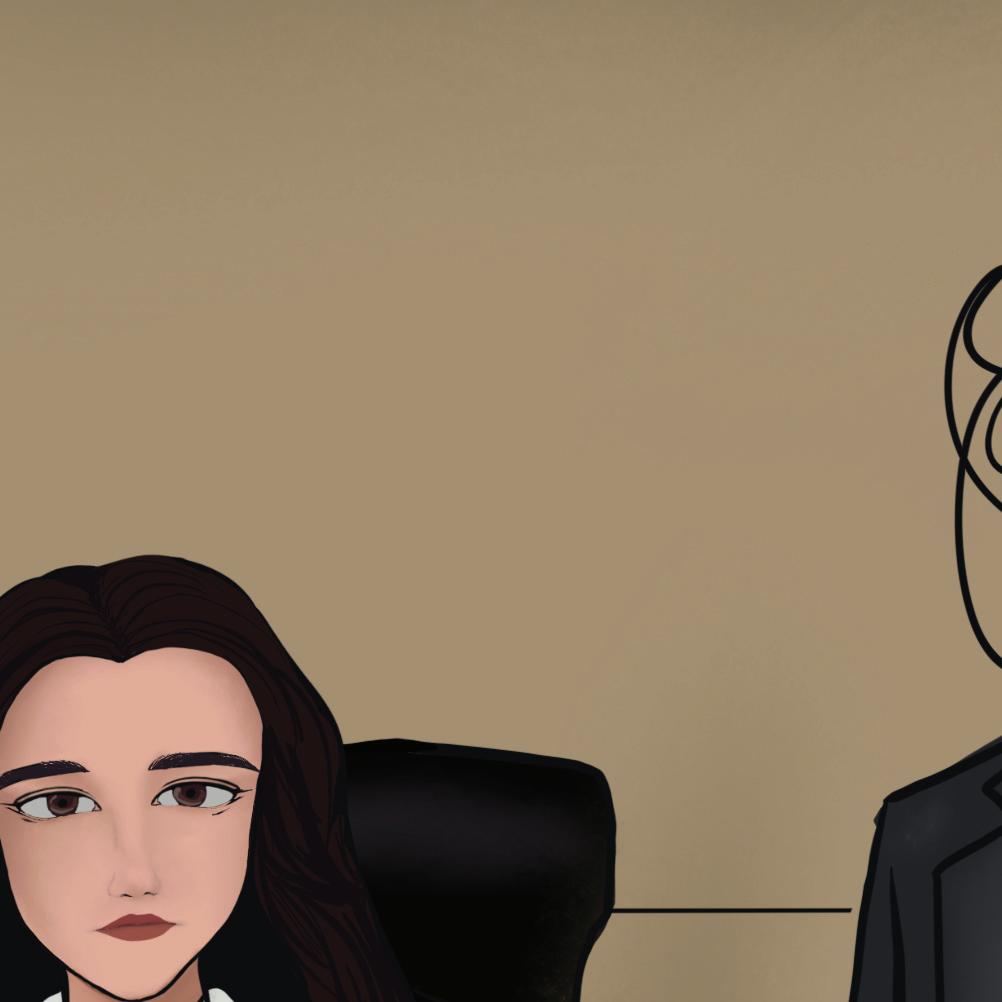
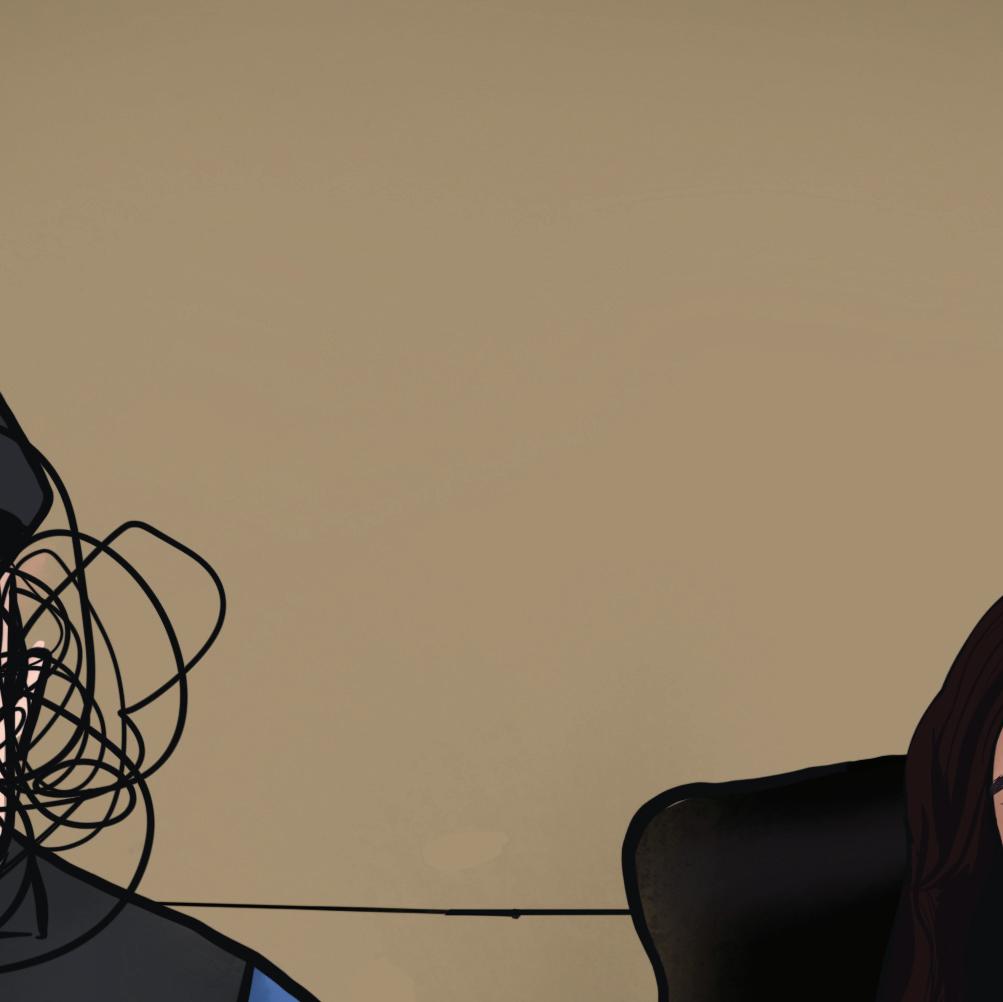
I was lucky enough to get
so-called luck, my ex still harasses me. I have gotten dozens of phone calls that I suspect are him within the past few weeks, two years after I left him. I had to make various police reports documenting his repetitive breaking of the restraining order. I’m so lucky, aren’t I?
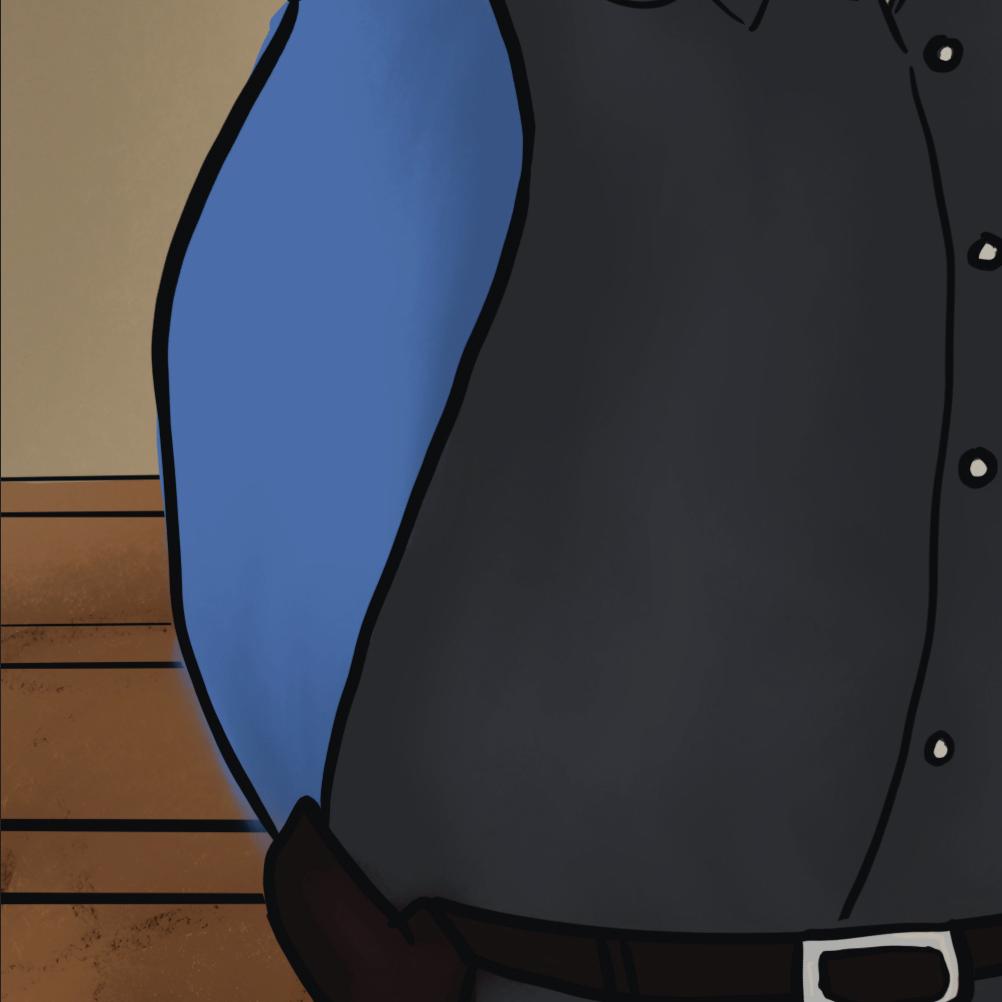
What I am lucky and grateful for is my recovery. I had an incredible support system once the truth came out. Family and friends rallied around me, offering me their home to hide in and their arms to find comfort in. I was lucky enough to experience a healthy and loving romance that helped me unlearn my survival tendencies and fears that were instilled in me.
Not everyone gets the chance to recover.
Not everyone gives themselves that chance either.
The verbal abuse came first. From invalidating my Mexican-American identity to threatening that he would kill himself if I left him, I heard all of the manipulation tactics an abuser could muster.
I was belittled for being bisexual. I was simultaneously called slurs and propositioned for threesomes by this monster masquerading as my boyfriend. My entirety of a being became ammunition for an assault of verbal carnage.

I was conditioned into believing that I didn’t deserve better, that the abuse he was forcing upon me was the best love I would ever receive. I became isolated from my friends and family while still remaining by their side. I was ashamed to admit that I was unhappy and allowed him to treat me this way. That’s why I stayed for just over a year.
One of the ways he kept me beneath him was the constant begging for love.
I had to beg him to pay attention to me, to give me
more ashamed of myself once he started leaving marks on me. I felt as though they were a reminder each time I looked in the mirror of how weak and worthless I was.
This experience is unfortunately a common one. Over 910,000 people experienced domestic violence in the U.S. in 2021, according to the U.S. Department of Justice's Office of Justice programs article.

Many victims of this type of violence do not even consider themselves victims, according to the same article.
I fell into this horrific line of logic for the majority of my stint with my abuser. I only clawed my way out of this line of thinking when the abuse worsened.
I was raped multiple times throughout my abusive relationship. He always used the excuse that he was drunk, he didn’t remember, that we were together so consent was implied.
Those are lies, excuses to wave away the severity and
Sexual and physical violence is never the victim’s fault. It does not matter if you were yelling, how much skin was showing, how angry the other person was. No one deserves to experience such cruelty.
I finally stood my ground after my countless attempts to break off the relationship when I witnessed my ex teaching his 12-year-old sister to use the “N-word.”
This little girl was the only reason I stuck through the abuse. My thought at the time was, “If he’s screaming at and beating me, at least he isn’t doing it to her.” I stayed in fear for my own life and for hers.
I finally realized that my own life was my only responsibility, that I couldn’t save this young girl even if I wanted to.
I’m torn between hoping she reads this so she knows the warning signs, and desperately praying that she doesn’t so her image of her brother isn’t so violently tainted.
Despite leaving him, my
a restraining order quickly and easily.
My lawyer, ironically the same man that represented my father when my mother left him, said something that terrified my little 18-year-old self.
He told me that he was surprised I was still alive.
He told me that he’s seen his clients kill and be killed, and that I could have easily been one of them.
That traumatized me even more.
He wasn’t too far off from the truth though, which made it even worse. My ex had attempted to take my life multiple times while he was drunk. Of course my ex didn’t believe me when I told him that.
I was one of the lucky ones, getting a restraining order so quickly. I find it disgusting that my experience was considered lucky. Our court system constantly fails victims of violence. I’m just grateful that I got justice before I was six feet under.

Even though I have this

The most important lesson I learned is that being a domestic violence survivor is not something shameful. Staying silent gives all abusers power. Keeping quiet about the pain and experience is a disservice to yourself and other survivors.
I share my story in the hopes of reaching another person who is scared, isolated, and in pain. My story isn’t a pleasant one, but a necessary one.
Talking about domestic violence shouldn’t be a shameful experience.
Expressing pain and recovery isn’t labeling yourself as weak. That was the hardest part of my recovery, realizing that it wasn’t my fault, and that I never deserved the violence that was inflicted upon me.
I am grateful I survived and have the strength to share my story. Passing that strength to another survivor will be my greatest triumph and insult to that coward of an ex that decided to lay his hands on me.
sjsunews.com/spartan_daily WEDNESDAY, OCTOBER 4, 2023 OPINION 5
TRACY ESCOBEDO | SPARTAN DAILY
Follow Alicia on X (formerly Twitter) @alicialvarez02
I plead to victims to speak up, to press charges, to seek justice, because I didn’t give myself the respect and internal trust to do so until it was too late.
Sports talk shows lack quality
 By Nathan Canilao SENIOR STAFF WRITER
As a kid, I loved watching ESPN. My day started with a morning edition of SportsCenter to catch up on any highlights of games I couldn’t watch the night before. After school, a rotation of shows like “Pardon the Interruption,” “Around the Horn” and “Highly Questionable” filled my afternoon before tuning into whatever game came on in the evening.
But as of today, I have cut down my viewing intake of ESPN and other sports networks such as FS1 and CBS Sports. Sports media on TV has evolved from hardhitting reporting to people screaming at each other about whether or not LeBron James is balding.
The shift away from traditional reporting and a focus more on social media views has made the sports discourse more about who has the wildest take rather than what actually happened in the game.
“The shift in the central focus of sports journalism seems to go more and more toward, I would say, TV, but it’s not even TV,” said sports media reporter Richard Deitsch in a Sept. 23 NPR article. “It’s video streaming because there's so many platforms now. But kind of the focus being on the takes, the opinions, the back-and-forth, the podcast and cable shows as opposed to the writing.”
The shift in sports media really started during the
mid-2000s. Former San Jose Mercury News beat reporter Skip Bayless left for ESPN in 2004 to start a new show called “Cold Pizza.”
The show was a first of its kind type of programming that featured Bayless arguing with various co-hosts on different topics surrounding the sports world. Bayless’s rowdy energy mixed with his shrewd reporting skills made the show entertaining for the normal sports fans.
As the show became more popular, Bayless said he knew he needed a more permanent co-host who could up the ante on the debate stage, according to a Sept. 7 episode of the “Skip Bayless Show.”
Bayless got his wish in 2012 when ESPN announced that sports columnist Stephen A. Smith would join a show called “First Take.” Smith and Bayless quickly rose to prominence, commanding one of the highest viewed shows in network television.
The two’s chemistry worked perfectly. Smith and Bayless were almost polar opposites when it came to their sports takes, creating the perfect forum for each of them to argue about almost any sports topic and make it entertaining.
But as the two grew bigger and bigger, the demand for networks to make shows with a similar format increased. Networks realized conflict created ratings and wanted to create shows where people constantly argued.
And that wasn’t just in the sports network space.
According to a 2017 Vox Report, networks like CNN saw the viewership spike shows like “First Take” were getting and wanted to mimic that format.
When Bayless left the show in 2016 to host his new show “Undisputed” on FS1, a shift happened across sports TV. Now, everyone wanted to have morning and afternoon programming be mostly debate shows featuring crazy personalities that were columnists, former athletes or entertaining TV personalities.
Fast forward to today and TV programming has taken another step into sports news becoming more about entertainment and less about storytelling.
This past summer, ESPN laid off dozens of TV personalities who were respected for their intellect and shrewd reporting abilities. Max Kellerman, Neil Everett and Suzy Kolber were just a few of the ESPN staples that were laid off.
Who did the network bring in to replace them?
How about a 40-somethingyear-old ex-punter whose show is based on being the “unfiltered” analyst in the room.
ESPN brought in former Indianapolis Colts punter Pat McAfee to bring more content to the network and paid $85 million dollars over a five year period to take over a lot of the network’s programming.
I’ll be the first to admit that McAfee’s show is entertaining as hell. Him and his crew of friends are funny and they often bring in great
guests that bounce off of McAfee’s personality. But the problem is not so much with him as it is with ESPN and the sports landscape they are creating.
Today, ESPN’s programming is a mix of shows like “First Take” and “The Pat McAfee Show.” There are mid-day programs like “NBA Today” and “NFL Live,” but those shows — which used to be very news and reporting heavy — now revolve around sports personalities clashing with each other on sports topics.
Now, personalities like Smith and Bayless have seemingly abandoned their titles as journalists and have become full-time opinionists.
What made First Take very successful early on was that Bayless and Smith still used their journalistic skills to create their opinions. The two used to report
games and write columns to formulate their opinions before coming onto the show to debate.
Now, they have seemingly retired from that type of work. What’s dangerous is that they have become so big that they are now playing characters instead of actually giving their opinions on things that matter in the sports world.
Pundits like Smith and Bayless have openly rooted for and against teams, something that has universally been taboo among those who work in sports media until now.
For example, Smith has become so anti-Dallas Cowboys that he has now made a career of making fun of the team when they lose. His patented catchphrase “what can go wrong, will go wrong,” is something that is said almost weekly on
“First Take” during the NFL season. There is no doubt that the way consumers view sports and the discourse around it is changing. No one really knows yet whether the new era of sensationalism among sports talk will actually last, but it’s dangerous.
When consumers get their news from pundits or opinionists, it usually doesn’t make viewers more informed regardless of what type of news they are watching. I fear that the reactionary nature of sports shows will make sports fans less informed while also giving them a warped reality of what sports actually are and its role in society.
sjsunews.com/spartan_daily WEDNESDAY, OCTOBER 4, 2023 SPORTS 6 ACROSS 1. Ripsnorters 6. Popular game fish 10. Native peace-maker 14. "Carmen" or "Aida" 15. One Adam Twelve, e.g. 16. Delicate deer 17. Some class reunion attendees 20. Type of condor 21. ___ the Man 22. Hotness under the collar 23. Lippy 25. Perfume bottle 27. Unleaded alt. 30. Tom, Dick and Harry 31. Use a sense 32. PAC member 34. Pacific islands' staple 36. Fireside implements 40. Bo-Peep problem 43. Quinine water 44. Robin Cook book 45. The very best 46. Create a permanent impression 48. Width units 50. Novel 51. Worldly 54. Pass a bill 56. Pindar product 57. Travel document 59. Possible 63. Went bonkers 66. Dame Kiri's forte 67. Saskatchewan indian tribe 68. Congeals 69. Posted, as a letter 70. Put a stop to 71. Hole for an anchor rope DOWN 1. Lady of song who gets whatever she wants 2. Well-briefed about 3. Ignore Polonius' advice 4. Prods 5. Arabic word meaning peace 6. Tend tables 7. Uptight 8. Look for evidence 9. Fighter plane action 10. Start to date? 11. Architectural order 12. San ___ Sula, Honduras 13. Home of Krupp 18. Beginnings 19. Hot fishing spots, usually 24. Seize before it passes 26. Maui greeting 27. Iron oxide 28. Radar return 29. "Glengarry ___ Ross" 31. Armed adversaries 33. Unfamiliar 35. Greek P 37. Some make light of it 38. Unit of inheritance 39. Etna's action 41. 6 x 9-inch book size 42. Open shelter 47. Boxing maneuver 49. Pressing problem? 51. Coke and Pepsi 52. Be smitten with 53. Plastics ingredient 54. Flip-chart support 55. Drums of India 58. Doris Day song word 60. Bungle 61. "Why don't we?" 62. To be, to Brutus 64. Knot and loop 65. Famous opera house 3 5 6 8 9 6 3 5 4 2 8 6 1 9 3 5 6 1 4 9 8 1 4 2 CLASSIFIEDS CROSSWORD PUZZLE SUDOKU PUZZLE Complete the grid so that every row, column and 3x3 box contains every digit from 1 to 9 inclusively. JOKIN’ AROUND What did the 0 say to the 8? Nice belt! PLACE YOUR AD HERE Contact our ad team via email for access to our media kit & any other advertising questions. SpartanDailyAdvertising @SJSU.edu SOLUTIONS 1 2 3 4 5 6 7 8 9 10 11 12 13 14 15 16 17 18 19 20 21 22 23 24 25 26 27 28 29 30 31 32 33 34 35 36 37 38 39 40 41 42 43 44 45 46 47 48 49 50 51 52 53 54 55 56 57 58 59 60 61 62 63 64 65 66 67 68 69 70 71 2 8 6 7 5 3 9 4 1 3 9 7 4 2 1 5 8 6 1 4 5 9 8 6 2 7 3 6 1 9 2 4 8 7 3 5 8 7 2 5 3 9 1 6 4 5 3 4 1 6 7 8 9 2 4 6 1 8 9 2 3 5 7 7 5 8 3 1 4 6 2 9 9 2 3 6 7 5 4 1 8 3 1 7 8 2 S T O W A B U T H A B I T L A V A N O S E I M A G O A X I L T Z A R A A R O N M I D D L E O F N O W H E R E O A R S P A D A N D I S H S T R A T A E R A S O L I O H E X E S C E N T E R O F G R A V I T Y A N N E X W I L E S O R E L A Y M A N S E T A M A T L E A O R E H E A R T O F D A R K N E S S E N N U I T A R T D A T E R O N I N E R I E O V E N S L A N G R E A D W E P T OCTOBER 3
GRAPHIC BY MAT BEJARANO
CANILAO'S COMMENTARY
Follow Nathan on X (formerly Twitter) @nathancanilao
