San Jose recalls Chicano protest
 By Brandon Nicolas SENIOR STAFF WRITER
Banners encouraging student and Chicano empowerment waved along the entrance of the San Jose Peace and Justice Center as speakers, teachers and students gathered to celebrate the 53rd anniversary of the Chicano Moratorium on Tuesday evening.
On Aug. 29, 1970 nearly 30,000 demonstrators formed the National Chicano Moratorium against the Vietnam War. Marching through East Los Angeles, the moratorium became one of the largest Mexican American antiwar demonstrations, including thousands of individuals who organized Chicano Moratoriums along the West Coast, according to a research guide by the Library of Congress.
The focus of the moratorium was to rally against the Vietnam War and remember the deaths of Mexican American troops during the war.
Other social issues in the United States that affected the Chicano community were also at the forefront of the march for the moratorium.
Inequality in public education, systematic exclusion from achieving higher education and high unemployment rates among Mexican Americans were core issues that supported the anti-war demonstration.
The Moratorium began as a peaceful march, but the Los Angeles County Sheriff’s Department and police department arrived at the scene, disrupting the crowd as police assaulted protesters, injuring several dozen and
killing three individuals, according to the same research guide.
Among the protesters, student activists and the Brown Berets marched together.
The Brown Berets is an organization concentrated on combating police brutality and racism against the Chicano community.
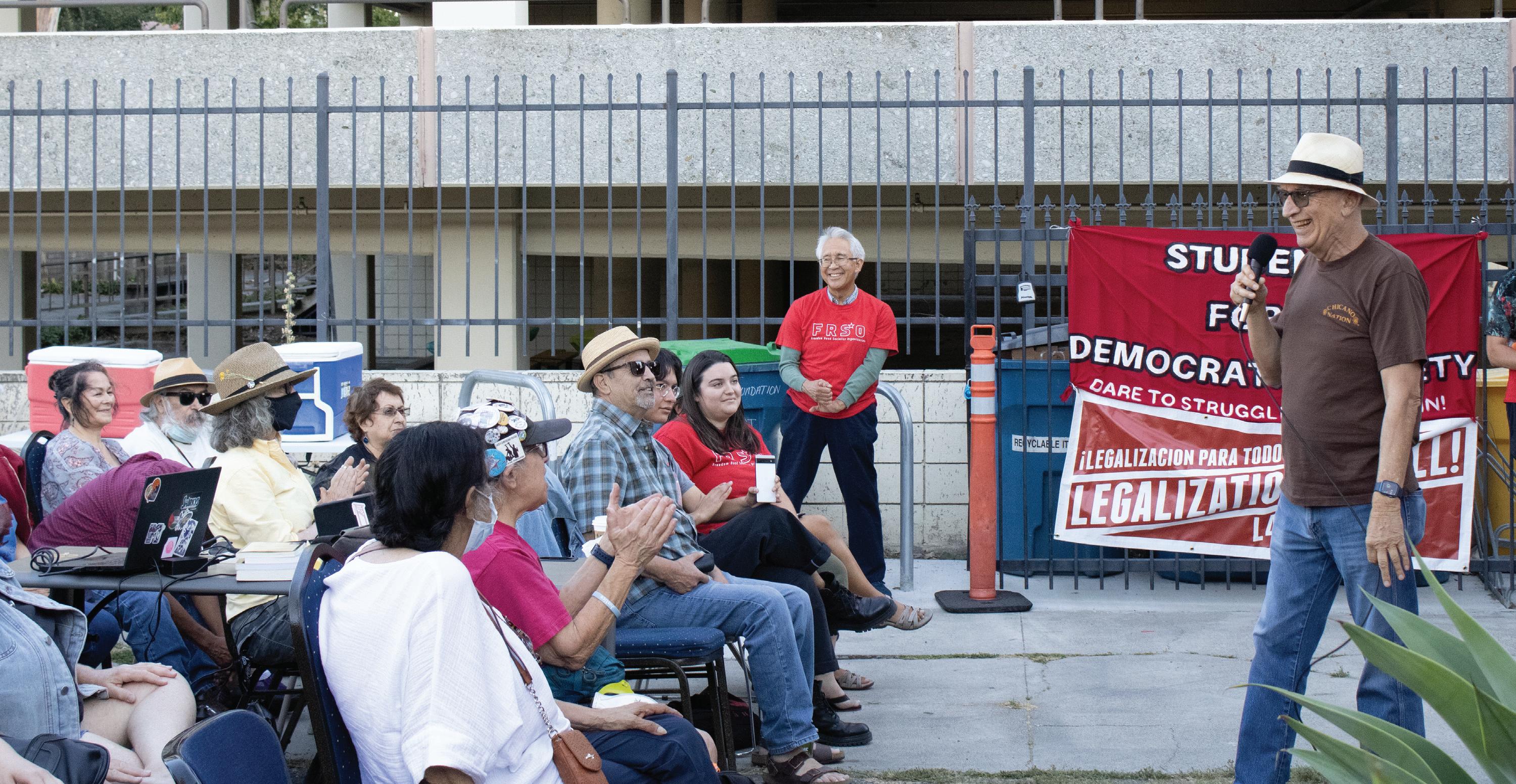
Guest speaker Carlos Montes is a veteran Chicano activist who co-founded the Brown Berets in the late 1960s and helped organize the moratorium.
“When the Brown Berets found out that there was a high casualty rate in Vietnam, we did the first Chicano Moratorium,” Montes said.
According to the Library of Congress, Chicanos were 5.5% of the deaths from the Vietnam War and 4.5% of the general U.S. population.
by the Los Angeles Police Department, sheriff department and the FBI.
Montes said he recalls police running into the crowd swinging clubs at protesters, threatening the submission of the demonstrators with shotguns and clouds of tear gas.
“There was tear gas all over the neighborhood and people were running,” Montes said. “People called it a riot, but I called it a rebellion.”
Los Angeles Times Journalist Ruben Salazar was one of the three individuals killed during the march.
“The FBI was spying on the Black-liberation movement and the Chicano movement, and they wanted to prevent the two from unifying,” Montes said.
like police abuse.
“One of the sheriffs shot a tear gas missile into the bar where Salazar was finding shelter and hit him,” Montes said.
The park’s name was later changed to Salazar Park to honor Salazar’s legacy in the Chicano movement.
“It was Chicano organized, and Chicano led . . . there is this legacy and narrative of resistance and activism and mobilizing against oppression,” Johnny Ramirez, assistant professor of Chicana and Chicano studies at SJSU said.

representation since the moratorium, low income and communities of color are still targeted.
“[Recruiters] only go to certain kinds of community colleges and Cal State schools because they know the student demographic is low income, first generation students of color,” Ramirez said. “How come those military recruiters don’t go to Stanford or the Ivy Leagues?”

He said his entry point into Chicana and Chicano studies was in community college.
MEChA is a student social justice organization that promotes higher education and Chicana and Chicano history and empowerment.
“The Chicana and Chicano studies came out of that movement,” Castillo said. “So this event is particularly special for me and my department because if it wasn’t for the movement in the ‘60s and ‘70s, we wouldn’t have this discipline.”
“It was a peaceful rally with music and a picnic atmosphere,” he said.
Montes said the march turned violent when individuals were attacked
He said the FBI was previously spying on the Brown Berets and Salazar, who at the time was reporting on the Chicano movement and struggles
He said in honoring the 53rd anniversary of the National Chicano Moratorium, it recognizes the Chicano community and disregards the stereotype that these communities are unable to stand and fight with their voices.
He said although there has been a great progression in Chicano
“As a young person in the ‘90s, it was that class that turned this light on and helped me understand that my cultural identity and heritage is connected to a movement,” Ramirez said.
Chicana and Chicano Studies senior Jorge Castillo is part of the Movimiento Estudiantil Chicanx de Aztlán (MEChA) Leadership Committee at SJSU.
He said it is the legacy of the moratorium and the representation that followed that gives him a sense of identity.
SERVING SAN JOSE STATE UNIVERSITY SINCE 1934 WWW.SJSUNEWS.COM/SPARTAN_DAILY Volume 161 No. 05
NAMED BEST CAMPUS NEWSPAPER IN CALIFORNIA FOR 2022 BY THE CALIFORNIA COLLEGE MEDIA ASSOCIATION AND CALIFORNIA NEWS PUBLISHERS A SSOCIATION
Wednesday, August 30, 2023
BRANDON NICOLAS | SPARTAN DAILY
Chicano activist Carlos Montes recounts his experience of the Chicano Moratorium to a crowd during an event at the Peace and Justice Center on Tuesday evening.
BRANDON NICOLAS | SPARTAN DAILY
Arturo Villareal, professor at Evergreen Community College, speaks at the Chicano Moratorium event.
Follow the Spartan Daily on X (formerly Twitter) @SpartanDaily
It was Chicano organized and Chicano led . . . there is this legacy and narrative of resistance and activism and mobilizing against oppression.
Johnny Ramirez SJSU assistant professor of Chicano studies
School shootings are disgustingly commonplace
On Monday at 1:02 p.m. EDT, shots were fired at the University of North Carolina campus.

A video of students jumping out of a window to escape the shooter went viral on multiple social media platforms.
Zijie Yan, a UNC physics professor, was shot and killed on Monday. Tailei Qi was arrested on suspicion of firstdegree murder on Tuesday. Another shooting. Another death.
to run or jump from windows in fear for their lives while at school.
We are in college to better our future, not have it robbed from us.
It’s horrifying that this is ourWereality. need a new system. Public places are not a shooting range and firearms cannot be irresponsibly regulated.
We’ve had enough of our government refusing to take a
Have you ever looked around your classroom and mapped out the best escape route?
Have you looked out a window and wondered if you’d survive the jump?
Have you ever looked down at your phone and wondered what your last words would be to the person you love most?
These are questions that our generation is forced to reflect on.
We’ve been taught how to respond to an active-shooter situation since elementary school. We were just children. Now we are desensitized to school shootings.
It’s sickening to watch college students like us have
stance at the expense of ourFellowsafety.students, please be safe. Talk to your teachers about an escape plan, learn survival tactics to save yourself and hopefully a classmate.
We are tired of hearing stories where teachers are forced to sacrifice their lives for students.
We send our condolences to the students, faculty and staff of UNC.
We see you. We hear you. We sympathize deeply.
sjsunews.com/spartan_daily WEDNESDAY, AUGUST 30, 2023 EDITORIAL 2
We are in college to better our future, not have it robbed from us.
Matthew Gonzalez EXECUTIVE EDITOR
Matthew
Jillian
Alicia Alvarez Alicia
Jillian Darnell MANAGING EDITOR
Gonzalez
Darnell Alicia Alvarez PRODUCTION EDITOR
Students pet goats and explore careers
By Matthew Gonzalez EXECUTIVE EDITOR
Chickens and goats found a temporary home on the Tommie Smith and John Carlos lawn on Tuesday.
The Career Center held a carnival-themed event aiming to make its services and connections with other companies known to San Jose State students.
According to its webpage, the Career Center is an organization that initiates campus efforts to prepare students for life after college and helps ensure lifelong career success.
The event had a petting zoo, carnival games and various snack stations.

On-campus organizations such as the Dr. Martin Luther King Jr. Library and SJSU Cares had booths at the carnival.
Cung Sin Mawi, engineering junior and transfer student, said she found out about the event through Instagram and also said the carnival helped her familiarize herself with what SJSU has to offer.
“I learned a little bit more about it, like what is [being offered] in the campus,” Mawi said. “I just went to SJSU Cares and they have a CalFresh food plan that’s basically helping SJSU students, so I think it’s really helpful.”
The CalFresh food plan provides monthly food benefits to lowincome families according to its website.
Additionally, rentalcar company Enterprise and bowling corporation Bowlero had booths at the event where students
were able to find out about a variety of jobs these companies offer.
Bobbi Makani, executive director of the Career Center said while companies like Enterprise might seem solely rental and sale focused, there are still opportunities for SJSU students in lesser-known roles.
“They’re not just a rental company, they hire a lot of different types of [people]. They also need computer science people, they also need people who work in IT,” Makani said.
Career promotions
success specialist Trisha Gilges said the carnival is a way to increase the Career Center’s approachability.
She also said this was the largest Career Center carnival event she’s been a part of, doubling the number of booths it had last year.
“In the past we’ve had anywhere from 900 to 1,100 students,” Gilges said. “This is one of the biggest events that we throw.”
Makani said incorporating other campus departments in the event is mutually beneficial for students and the different organizations.
She also said taking into account student feedback was an integral part of this year’s planning.
“So [students] give us some input and then we also learn from the surveys that we get from students,” Makani said. “We ask them how else we can improve and we literally go through those [responses]. It’s an exercise that we do because we want to make sure that we are launching all of our events to serve students’ needs, because otherwise why would we be here.”
She added that students
often push off their interaction with the Career Center until closer to graduation.
“Students don’t really think of the Career Center until they’re in their senior year,” Makani said. “ ‘We’re graduating, [and] I don’t have a job. Can you help me?’ Yes we can, but what we want to do is try to pace students so from the time you enroll at San Jose State we’re already with you.”
Education freshman
Kayla Meza said she enjoyed having the option to become acquainted with an array
of SJSU programs.
Meza also said she’s glad there is academic support offered on campus.
“There are a lot of resources, especially for tutoring,” Meza said. “I am very interested in that. I do struggle sometimes in math and English and there’s a lot of programs that are offering to help.”
sjsunews.com/spartan_daily WEDNESDAY, AUGUST 30, 2023 NEWS 3 ACROSS 1. Napoleon’s place of exile 5. Graduate’s keepsake 11. Word with gloss or stick 14. Beach scavenger 15. One way to be washed 16. “The Yearling” mother 17. 1988 thriller with Steven Seagal 19. One of the Bobbsey twins 20. Poured out 21. Cake topping 23. Stimpy’s cartoon buddy 24. Home, por favor 26. Motion detector 30. Sleep stage 31. Looks at curves? 35. Computer correspondence 36. Galileo’s birthplace 37. Baseball brothers’ surname 38. Politically moderate 41. “Would ___ to you?” 42. ___ Romeo (imported auto) 43. Gives temporarily 44. Belgrade resident 45. USSR successor 46. Excessively precious 47. Type of chamber 49. Scammed 50. Thin soup 53. Bullfighter 58. Comparison words 59. In custody 62. Campers, e.g. 63. Type of farmer 64. Ibuprofen target 65. Mentally bright 66. Mingo portrayer 67. Bygone big birds DOWN 1. Victorian exclamation 2. Service-station service 3. Coalition 4. Edison’s middle name 5. Reduce to rags 6. “White as a sheet!” 7. Molt 8. Costa del ___ 9. Historic period 10. Jerry of comedy 11. Anderson of “WKRP in Cincinnati” 12. Location of Qom 13. Sudden twinge 18. Register formally 22. Tony winner of 1967 and 1998 24. Jai alai basket 25. Nanking nurse 26. Finals prelude 27. Rousseau novel 28. Lowest point 29. Extra wager 30. Jazzmen’s specialties 32. End of a Garbo line 33. Natterjacks, e.g. 34. Like good dish water 36. Salk’s conquest 39. “Into ___ life ...” 40. Escape artist, e.g. 46. Jeweler’s measures 48. Laundry repository 49. Lena of “The Wiz” 50. Theda of movie fame 51. Letters on an invitation 52. Brewer’s oven 53. Ravens, for example 54. Name in a Saroyan title 55. Art follower 56. Job safety org. 57. Country rds. 60. Actor Beatty 61. Genetic letters 7 4 3 2 5 1 7 8 5 2 3 1 8 5 4 8 2 4 7 2 6 7 3 1 8 3 4 5 CLASSIFIEDS CROSSWORD PUZZLE SUDOKU PUZZLE Complete the grid so that every row, column and 3x3 box contains every digit from 1 to 9 inclusively. JOKIN’ AROUND The past, present, and future walk into a bar... It was tense. PLACE YOUR AD HERE Contact our ad team via email for access to our media kit & any other advertising questions. SpartanDailyAdvertising @SJSU.edu SOLUTIONS 1 2 3 4 5 6 7 8 9 10 11 12 13 14 15 16 17 18 19 20 21 22 23 24 25 26 27 28 29 30 31 32 33 34 35 36 37 38 39 40 41 42 43 44 45 46 47 48 49 50 51 52 53 54 55 56 57 58 59 60 61 62 65 64 65 66 67 9 1 2 4 3 5 7 6 8 8 4 6 1 2 7 3 5 9 3 5 7 6 9 8 1 2 4 1 7 9 2 4 6 8 3 5 5 8 3 7 1 9 6 4 2 6 2 4 5 8 3 9 1 7 4 6 5 8 7 1 2 9 3 7 3 1 9 5 2 4 8 6 2 9 8 3 6 4 5 7 1 1 2 4 9 6 8 6 6 1 2 9 3 2 S C A M M O J O I G A V E P U N Y O D O M N I M O Y O R N E T I N A S L A T E O V E R T H E S H O U L D E R L E S S E E A X L E M R E D I T S F U N D R O O P R E A D P I S A B E T W E E N T H E L I N E S L A T E J O E S H E D D A S P O N G E R O S A M A C K I S I T M E U N D E R T H E W E A T H E R M O R O N A V I S A I D A P L A N E K I T T L E A S S A T Y R I L S A Y U L E AUGUST 24
Follow Matthew Gonzalez on X (formerly Twitter) @mattg2001
ALICIA ALVAREZ SPARTAN DAILY
Students enjoy the Career Center petting zoo, showcasing farm animals on Tommie Smith and John Carlos lawn on Tuesday afternoon
Students skate at the Roller Disco

 By Melany Gutierrez STAFF WRITER
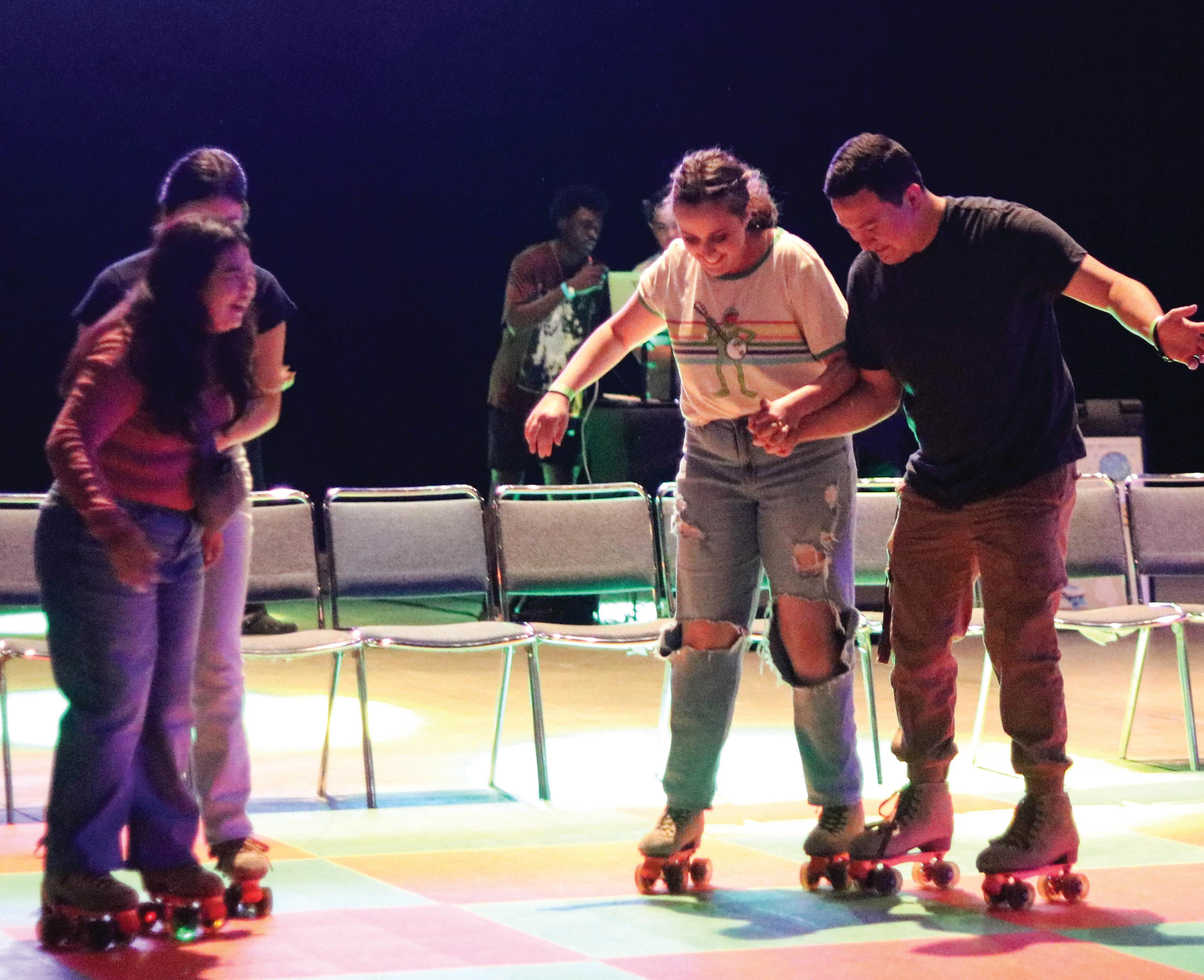
On Tuesday, students rolled into Roller Disco night, hosted by the SJSU Student Union, Associated Students and Student Involvement.

Students spent the night talking and laughing, even when falling down because of the roller skates.
Large groups of attendees lined up in front of the Provident Credit Union Event Center on 7th Street, creating a line stretching out to the Student Union at 6:30 p.m.
Digital media freshman Briana Rivera said the event would be a chance to hang out with her roommates and meet new people.
“I like roller skating too, I also heard there was going to be free pizza and good music so it just sounded fun,” Rivera said.
Weeks of Welcome is a series of events that take place at the beginning of each semester. The events aim to provide support to students returning back to school.
Industrial and systems engineering freshman Kayla Vasquez, said she came to the event because she likes rollerblading.
“I thought roller skating was probably not that different, but I was kind of wrong,” said Vasquez. “I think it reduces my stress. I actually forgot I was at school until you reminded me.”
Jess Prudent, Student Involvement campus programming coordinator said she was inspired to try to provide the best experience possible for
all students attending because she believes events like these are beneficial to students.
“When you get involved early on, especially in that first four to six weeks. We see that you have better network options, post-graduation. You’re more likely to graduate within your timeline and at the GPA that you’re wanting to get,” said Prudent.
“You just in general, have a better experience on campus.
You have lower rates of things like depression, anxiety, which any college student knows is common.”
Philosophy senior Nicole Lam said she was stuck to the lined up chairs on the side of the roller rink and though she was a bit scared, she was still happy to make it to the event.
“My friend told me it was gonna be fun,” said Lam. “I would definitely come again, last year we came to these
events a lot.”
Forensic science freshman Jeamarie McCarter said she attended the event excited and ambitious to interact with others and take advantage of the built in community at SJSU.
“I wanted to come to this event because I felt like it was going to be a great experience to hang out with friends and meet new people,” McCarter said.
“Now I have more friends than

I ever thought I would have, it is just an overall great experience to have.”
sjsunews.com/spartan_daily WEDNESDAY, AUGUST 30, 2023 ARTS & ENTERTAINMENT 4
MELANY GUTIERREZ | SPARTAN DAILY
Attendees of the Roller Disco Night were provided roller skates and skated at the Provident Credit Union Event Center on Tuesda y.
the best exp erience for better e xp erience on campu s. last year we came to these Now more
Students had the opportunity at the event to have their photos taken at the photobooth with other attendees at the side of the venue.
Follow the Spartan Daily on X (formerly Twitter) @SpartanDaily
MELANY GUTIERREZ | SPARTAN DAILY
Trump’s mugshot is criminally fabulous
While he might have to pay a few dimes, he still has the potential threat of jail time.
There are 13 different charges in the most recent indictment against him. This is his fourth indictment of the year according to an Aug. 25 article from BBC.
The scandalous charges range from falsifying accounting records to cover up an alleged affair with a porn star, to attempting to manipulate votes in the 2020 election.
I don’t like Trump at all, but I respect his flair for the dramatics and his versatility when it comes to committing crimes. He’s too ostentatious for something simple like petty theft.
Some charges brought against Trump will likely result in him paying some fines, according to the same article.
According to a Aug. 22 article from Forbes, Trump was indicted on 91 federal and state charges. These charges can amount to 717.5 years of prison time. This sentence is unlikely, knowing how our justice system works, but it is still a possibility no matter how slim.
satiates my appetite for ridiculous photos of politicians. It is a shame that we won’t see him clad in bright orange, the color suits him so well.
This is not the first presidential scandal, however. The American public has heard of affair after affair and coverups. Richard Nixon had the Watergate Scandal, and Ulysses S. Grant was arrested in 1872.
no charges or jail time which isn’t a surprise. He was the president, he could drive “Tokyo Drift” style down the streets with his horse if he wanted to.

Arresting the president for the 1870s equivalent of a street race is hilarious, but Trump still one-upped Grant with his almost 100 charges.
American politics have resembled a poorly written soap opera for
Chicago, there is nothing that bars someone with a criminal record from running for president. While Trump has no criminal record yet, his potential candidacy will not be disqualified if he incurs one.
Trump wouldn’t be breaking precedent either if he were to run with a criminal record. According to the aforementioned BBC
waking up to Trump’s cheeto-inspired spraytanned face plastered across every corner of my social media, I loved the dialogue it created.
Politics are polarizing, especially when it relates to our orangest former president. Somehow, this iconic mugshot didn’t create the aggressive discourse that I thought it would.
The online community was brought together in a way that Trump never managed to foster while he was in office. I have never seen so many edits of Trump with drag makeup and as a Bratz doll, but I hope to see more in the next few days.
This mugshot might be the best press photo Trump will ever release.
If he were slammed with prison time, Trump would be the first president to be behind bars. Trump has yet another opportunity to blaze a trail no one wants to follow.
While we might not see Trump in a prison-orange outfit, the mugshot still
Grant was allegedly speeding through Washington D.C. in his horse-drawn carriage and was arrested in the midst of a race with his friends according to a 2023 Smithsonian Magazine article.
Grant was released with
over a century. This soap opera continues as the election season approaches in the next year.
Trump’s mugshot doesn’t keep him from running for president. According to an Aug. 2 article from ABC7
article, Eugene Debs ran for president in 1920 with the socialist party and received over 1 million votes while incarcerated.
Trump’s little limelight was stolen there, but I’m sure he’ll find a way to claw back into it.
While I didn’t enjoy
Follow Alicia Alvarez on X (formerly Twitter) @alicialvarez02

sjsunews.com/spartan_daily WEDNESDAY, AUGUST 30, 2023 OPINION 5
ALINA TA | SPARTAN DAILY
An attendee at the Silicon Valley Pride Parade wears a t-shirt with a photo of Trump’s mugshot accompanied by a rainbow emoji o n Sunday.
When Trump’s mugshot first appeared in my daily doom scroll on Instagram, I nearly ruptured something from laughing so hard.
EDITORIAL STAFF EXECUTIVE EDITOR MATTHEW GONZALEZ MANAGING EDITOR JILLIAN DARNELL PRODUCTION EDITOR ALICIA ALVAREZ NEWS EDITOR IRENE ADELINE MILANEZ ASSISTANT NEWS EDITOR ALINA TA A&E EDITOR ALEXIA FREDERICKSON SPORTS EDITOR MAT BEJARANO CONTACT US EDITORIAL –MAIN TELEPHONE: (408) 924-3821 EMAIL: spartandaily@gmail.com ADVERTISING –TELEPHONE: 408-924-3240 ADVERTISING STAFF ADVERTISING DIRECTOR MIA WICKS ABOUT The Spartan Daily prides itself on being the San Jose State community’s top news source. New issues are published every Tuesday, Wednesday and Thursday throughout the academic year and online content updated daily. The Spartan Daily is written and published by San Jose State students as an expression of their First Amendment rights. Reader feedback may be submitted as letters to the editor or online comments. SOCIAL MEDIA EDITOR BOJANA CVIJIC OUTREACH EDITOR CHRISTINE TRAN PHOTO EDITOR ALEXIA FREDERICKSON COPY EDITOR GILLIAN BROWN SENIOR STAFF WRITERS BRANDON NICOLAS NATHAN CANILAO STAFF WRITERS DYLAN NEWMAN NAVIN KRISHNAN JOANNA CHAVEZ NIKITA BANKAR MELANY GUTIERREZ TRACY ESCOBEDO JULIA CHIE ANGEL SANTIAGO VANESSA REAL AALIYAH ROMAN FERNANDO CARMONA JACOB CHAVEZ MAYA BENMOKHTAR PRODUCTION CHIEF MIKE CORPOS NEWS ADVISER RICHARD CRAIG EMAIL: spartandailyadvertising@gmail.com CORRECTIONS POLICY The Spartan Daily corrects all significant errors that are brought to our attention. If you suspect we have made such an error, please send an email to spartandaily@gmail.com. EDITORIAL POLICY Columns are the opinion of individual writers and not that of the Spartan Daily. Editorials reflect the majority opinion of the Editorial Board, which is made up of student editors.
Alicia
Alvarez PRODUCTION EDITOR
Spartans need to start winning
more fans in the stands.
Spartans have a successful season to show that they are a marketable college program.
The good news about San Jose State’s 58-26 loss to No. 6 USC on Saturday in Los Angeles is that it’s over. The bad news is that it doesn’t get any easier from here.
The Spartans have a string of tough opponents in their next five games as they will face No. 18 Oregon State, Cal Poly, the University of Toledo, Air Force and Boise State. By the time SJSU hits the midway point of the season, it could be 1-5 on the verge of missing a bowl game.
SJSU’s success this season is important on the field, but with the ever changing landscape of college athletics, it is vitally important that the
The spotlight will be on the Spartans this Sunday for their home opener against No. 18 Oregon State in a nationallytelevised game. It’s the first time the Spartans will be on a national CBS time slot since 1982 when they
they did at USC, it could be a huge blow to the team’s morale being that the eyeballs of the entire country are on them. That would also mean they would have been routed in back-to-back games going into their toughest stretch of the season.
defeated Stanford 35-31.
If the Spartans get blown out on Sunday in the same fashion that
Head coach Brent Brennan said the team doesn’t think about the pressure of performing on national television, but hopes the extra attention will put
“I think it’s cool that it’s on national TV, and I really hope that everybody outside the state of California tunes in to watch the game, but I hope that everybody in the Bay Area actually comes to the game,” Brennan said in a Tuesday press conference. “That’s what I want. I want people in
they could get left behind in the college football realignment process.
Washington State President Kirk Schulz said Tuesday that he is holding out hope that the PAC-12 can somehow rebuild its brand, which means pulling teams from lesser conferences such as the Mountain West and American
else who is interested in joining a conference with the Spartans, that they are an intimidating opponent who has a passionate fan base that could be marketed to the rest of the country.
The Spartans are 17-point underdogs at home against the Beavers, but if they are able to make the game exciting and competitive, it should be considered a win for an SJSU team that has an uphill battle of a schedule ahead.
SJSU has laid out the groundwork for a successful athletics program with the recent success of the football, men’s basketball, women’s soccer and baseball teams last season.
the stands, I want people to see this cool facility and see the upgrades on South Campus in the last seven years and see all the really cool things that are happening in San Jose State.”
Brennan is right in that the game should garner more support in the Bay Area, but there is also a need for the Spartans to show that the investments into athletics will pay off.
With the constant movement of teams into different conferences, SJSU has a chance to prove that it could be a marketable team in the machine that is college football.
Since the Spartans don’t have a rich history of football success and are not the premier team in their own market, there is a real possibility that
Athletic Conference, according to a Tuesday Sports Illustrated article.
The worst possible scenario for the Spartans would be if the PAC-12 were to rebuild itself using teams from the MWC such as San Diego State, Cal State Fresno, Boise State and the University of Nevada, Las Vegas.
That leaves SJSU in a weaker conference that will not generate football revenue which is used to fund other sports in the athletic department.
Which brings us back to Sunday’s game against Oregon State and the nationally-televised opportunity the Spartans have to show that they are not the SJSU of old.
Sunday’s game is essentially a showcase game. SJSU needs to show Oregon State, and anyone

But it’s time for the Spartans to show that they can consistently compete as an athletic program who has historically been the laughing stock of college sports. The time to show that starts on Sunday against Oregon State.
“It’s our first time being on CBS national in 41 years,” said SJSU athletic director Jeff Konya on Tuesday. “So it’s obviously very important for our program for visibility and for our brand. We’re all super excited to be featured in a TV window where there’s no other football going on.”
sjsunews.com/spartan_daily WEDNESDAY, AUGUST 30, 2023 SPORTS 6 ANALYSIS
NATHAN CANILAO | SPARTAN DAILY
Follow Nathan Canilao on X (formerly Twitter) @nathancanilao
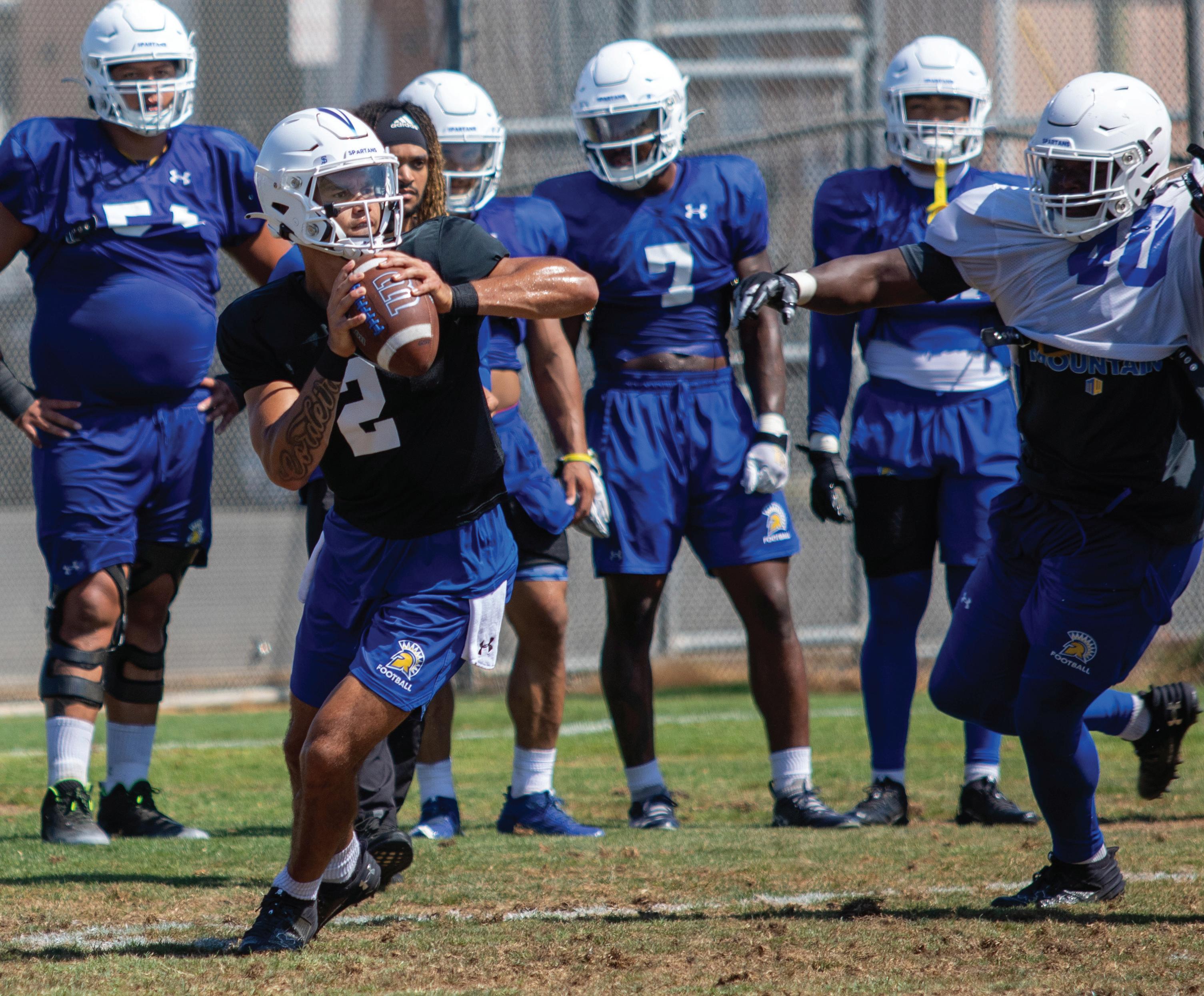
San Jose State quarterback Chevan Cordeiro drops back in the pocket while looking to throw the ball deep during a team practice last Wednesday.
Nathan Canilao SENIOR STAFF WRITER
Sunday’s game is essentially a showcase game. SJSU needs to show Oregon State, and anyone else who is interested in joining a conference with the Spartans, that they are an intimidating opponent who has a passionate fan base that could be marketed to the rest of the country.
PHOTO COURTESY OF SJSU ATHLETICS
Running back Kairee Robinson finished with 28 rushing yards in Saturday’s loss to USC.
