A&E
Opinion
Sports
Tips for mental health wellness during COVID-19
Operation Warp Speed: quick solution or going far too fast?
Student-athletes on postponement
Page 3
Page 4
Page 5
Tuesday, Aug. 25, 2020
Volume 155 No. 2 WWW.SJSUNEWS.COM/SPARTAN_DAILY
SERVING SAN JOSE STATE UNIVERSITY SINCE 1934
BLUE NGUYEN | SPARTAN DAILY
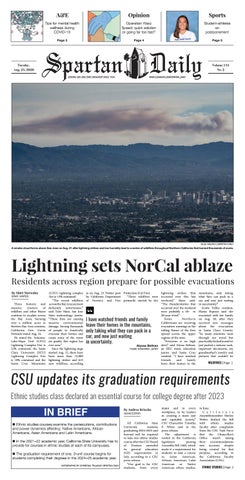
A smoke cloud forms above San Jose on Aug. 21 after lightning strikes and low humidity lead to a series of wildfires throughout Northern California that burned thousands of acres.
Lightning sets NorCal ablaze Residents across region prepare for possible evacuations By Shiri Marwaha
lightning strikes that (CZU) Lightning complex to an Aug. 23 Twitter post Protection (Cal Fire). by California Department “These wildfires were occurred over this last fire is 13% contained. “The recent wildfires of Forestry and Fire primarily started by dry weekend,” Maio said. “The thunderstorms that Three historic and across the Bay Area are most occurred over the weekend massive clusters of definitely unfortunate,” were probably a 10- to wildfires and other blazes said Tyler Maio, San Jose 20-year event.” continue to escalate across State meteorology junior. S ome Northern the Bay Area, burning “These fires are causing Californians are receiving over a million acres in massive environmental evacuation warnings as the thirteen Bay Area counties, damage, forcing thousands rolling flames of the fires California Gov. Gavin of people to frantically spread across the upper Newsom stated Aug. 24. evacuate their homes and regions of the state. He stated the Sonoma- create some of the worst “Everyone is on high Lake-Napa Unit (LNU) air quality this region has Lightning Complex Fire is ever seen.” Alyssa Beltran alert,” said Alyssa Beltran, music education, junior an SJSU music education Since the lightning siege 22% contained, the Santa junior and Santa Cruz Clara University (SCU) started Aug. 15, there have resident. “I have watched Lightning Complex Fire been more than 12,000 friends and family is 10% contained and the lightning strikes and 615 leave their homes in the Santa Cruz Mountains new wildfires, according STAFF WRITER
I have watched friends and family leave their homes in the mountains, only taking what they can pack in a car, and now just waiting in uncertainty.
mountains, only taking what they can pack in a car, and now just waiting in uncertainty.” Scotts Valley resident, Elaina Rapoza said she evacuated with her family on Aug. 20, after they received text messages about the evacuation in Santa Clara County. “So many emotions went through our mind but practicality kicked in and we just packed a suitcase each, important documents, my grandmother’s jewelry and pictures that couldn’t be WILDFIRES | Page 2
CSU updates its graduation requirements Ethnic studies class declared an essential course for college degree after 2023
IN BRIEF Ethnic studies courses examine the persecutions, contributions and power dynamics affecting Native Americans, African Americans, Asian Americans and Latin Americans. In the 2021–22 academic year, California State University has to provide for courses in ethnic studies at each of its campuses. The graduation requirement of one, 3-unit course begins for students completing their degrees in the 2024–25 academic year. INFOGRAPHIC BY CHRISTIAN TRUJANO I SPARTAN DAILY
By Andrea Briseño NEWS EDITOR
All California State University students graduating 2024-2025 and beyond will be required to take one ethnic studies course after the CSU Board of Trustees amended its general education (GE) requirements in July, according to a CSU press release. “Our goal is for CSU students, from every
major and in every workplace, to be leaders in creating a more just and equitable society,” CSU Chancellor Timothy P. White said in the press release. The adjustment is rooted in the California legislature passing Assembly Bill 1460, which made it a requirement for students to take a course in Asian American, African American, Latin American or Native American ethnic studies,
in June. C a l i f o r n i a Assemblymember Shirley Weber drafted the bill with ethnic studies faculty after complaints from the CSU Task Force that the Chancellor’s Office wasn’t taking their recommendations into account, despite being created for that purpose, according to the California Faculty Association (CFA). ETHNIC STUDIES | Page 2
2
sjsunews.com/spartan_daily
NEWS
TUESDAY, AUG. 25, 2020
WILDFIRES Continued from page 1 replaced,” Rapoza said. While Rapoza and her family are sheltered in a hotel, she said their biggest concern is whether they will see their house again and what it will look like. “Our house is safe from the fire for now, but the evacuated area is being looted,” she said. Beltran said while she’s happy to be safe, she doesn’t know how the world can continue to exist in this state of emergency and high alert. “Climate change is real and we need leadership to address it. I am tired of seeing people
ETHNIC STUDIES Continued from page 1 Marcos Pizarro, CSU Task Force member and SJSU Chicanx studies professor, said it seemed as if the Chancellor’s Office didn’t understand the underlying premise of their report calling for an ethnic studies course requirement. “What the task force has made clear is that we need to have students that graduate from a CSU with a certain base line of racial literacy,” Pizarro said. “Without that we’re doing a disservice to those students and to the communities that they will serve after they graduate.” More than 70 new tenuretrack faculty have been hired across the CSU ethnic studies departments since 2018, consistent with increased student enrollment in such courses by 9%, according to past minutes from the Committee of Educational Policy. The intent of the federal requirement is to get students to, “acquire the knowledge and skills that will help them comprehend the diversity and social justice history… of the society in which they live to enable them to contribute to that society as responsible and constructive citizens.” The chancellor believes this action will broaden student perspectives, which will only enhance the CSU degree. However he and the Academic Senate CSU (ASCSU) originally opposed AB 1460 because they felt campuses should have autonomy in picking what courses can satisfy the requirement, according to past minutes.
So many emotions went through our mind but practicality kicked in and we just packed a suitcase each, important documents, my grandmother’s jewelry and pictures that couldn’t be replaced.
Elaina Rapoza
Scotts Valley resident
suffer from things that could be prevented,” Beltran said. “I feel helpless and yet wanting to help everyone around me. This is a crazy time.” Eugene Cordero, SJSU meteorology and climate science professor, said the temperature
The Chancellor’s Office argued for humanities, arts and social science courses to fulfill the requirement as long it covered a social justice component. “The problem is when you expand beyond ethnic studies then you’re including other disciplines with a different focus,” Pizzaro said. Joanne Rondilla, Asian American studies professor, added that ethnic studies are different from such courses because it isn’t just trying to theorize how an ethnic group functions in society. CSU estimates new courses and administrative costs for implementing the requirement will cost $16.5 million versus only about $4 million if students were allowed to fulfill the requirement with existing courses. An estimated one-third of CSU campuses have “robust” ethnic studies programs, which is equal to the amount of campuses that have fewer ethnic studies courses, including CSU Maritime Academy that has zero, according to an Aug. 12 EdSource article. “I think what’s going to be more costly is not arming students with this knowledge,” Rondilla said in a phone interview with the Spartan Daily. Rondilla said universities should remember their true purpose of creating knowledgeable change makers who are interdisciplinary, which requires a financial investment to build and maintain. “If you have the money to pay executive-level people you know whatever it is that they get paid, then you have the money
What the task force has made clear is that we need to have students that graduate from a CSU with a certain base line of racial literacy. Without that we’re doing a disservice to those students and to the communities that they will serve after they graduate. Marcos Pizarro CSU Task Force member and SJSU Chicanx studies professor
Correction
of Earth’s atmosphere is getting warmer due to global warming, which was predicted by scientists about two decades ago. “The results we are noticing is magnified by the climate change and the longer droughts [that]
the state suffers are attributable directly to human impact,” Cordero said. He said California has a wet and dry climate. From November through April the climate is wet and after that it is dry for the rest of the year, which creates an ideal situation for forest fires. “We all keep windows shut and bear the heat to prevent breathing in smoke,” Beltran said. “I am staying inside except for essential errands, but my throat is still rough from the smoke, I feel fatigued mentally and physically.” Cordero said the only way to mitigate such disasters is to care for the environment and keep global warming in check. “We will continue to see rising temperatures but what we can do
to prevent this is reduce carbon emissions into the atmosphere,” he said.
Follow Shiri on Twitter @Marwaha5Shiri
ILLUSTRATION BY HANZ PACHECO | SPARTAN DAILY
to really educate your students,” Rondilla said. Ethnic studies was founded on people’s desire to want to make sense of their life and can provide a sense of belonging, she said. Students taking an ethnic studies course show improved academic performance and attendance, according to the Stanford Graduate School of Education. Furthermore, just one class comes with the increased benefit of graduating college at a higher rate than those that didn’t take any course in the discipline, according to an evaluation by College of Ethnic Studies at San Francisco State. “Unfortunately a lot of academics, especially ‘traditional’ academics, don’t understand the importance of needing to experience that heart-and-soul feeling in a classroom where like you read someone’s words and it reverberates in your soul,” Rondilla said. She said ethnic studies courses are key in order to avoid what Ron Takaki called the “master narrative” that leads to the erasure of what European colonization did to Native Americans for example. “This is why it’s important to take ethnic studies all throughout [your education] because you want to understand
the fullness of American history,” Rondilla said. “Not just the European perspective.” Like Rondilla, students usually don’t experience an ethnic studies course until they reach college she said. Rondilla, a University of California, Santa Barbara alumna, said she was “so shell shocked” after learning Asian American history because she was once told by her high school teacher that it didn’t exist. “I still ask myself why wasn’t this part of standard learning? You know from kindergarten on up,” she said. Assembly Bill 331, which currently awaits governor approval, would address the lack of ethnic studies in K-12 education by making it a requirement to take a course in it prior to graduating high school after 2024. “[The ethnic studies] discipline is something that we understand as necessary and integral to being just a fully rounded person in the world,” Pizzaro said. “That happens in our college classes, but it also happens in work that we’re doing.” Pizarro and other education members partnered with high schools within Santa Clara County to develop ethnic studies curriculum and guidance for juniors and seniors. “[Ethnic studies education]
should start when a kid starts school,” Pizarro said. In an ideal world he said ethnic studies education wouldn’t be needed because it would be intertwined into our history books in complex ways. “But that’s not the world that we live in,” Pizzaro said, adding that all educators should work from an ethnic studies approach to further challenge and engage students. He said educators should question the biases that are built into their field that allow limitations for ethnic people. Moreover, “[an] ethnic studies approach is usually one that is more deeply engaging to students and . . . provides a more thorough preparation for being out in the world whether they’re working for an accounting firm or working in their communities in some way,” Pizzaro said. He said he can also see people calling for social justice change through protests and social media. “[It’s] really exciting, and now it’s the responsibility of all of us that are involved in education to make that change,” Pizzaro said.
Follow Andrea on Twitter @_Andrea_Briseno
Crime Blotter
On Wednesday, Aug. 19, the Spartan Daily published a story titled, “SJSU Fall semester mainly online amid pandemic” in which Kristiara Garcia was misidentified.
Vandalism: Deface property Aug. 12, 10:03 p.m. at Engineering Building Information only
Grand theft Aug. 18, 11:10 a.m. at Delta Sigma Phi Information only
On Wednesday, Aug. 19, the Spartan Daily published a story titled, “Everything to know about fall sports” in which Natasha Andrea Oon was misidentified.
Trespass: occupying property without consent Aug. 13, 12:42 p.m. at Duncan Hall Information only
Rape: victim incapable of consent Aug. 21, 5:29 p.m. at Campus Village C Information only
The Spartan Daily regrets these errors. .
Auto burglary: commit felony while out on own recognizance Aug. 14, 1:01 a.m. at Lot 3 Adult arrest
sjsunews.com/spartan_daily
ARTS & ENTERTAINMENT
TUESDAY, AUG. 25, 2020
3
ILLUSTRATION BY NICK YBARRA
Mental health maintenance Compassionate tips if you or someone you know has tested positive for COVID-19 By Erica Lizarrago A&E EDITOR
It’s five months into the pandemic and suddenly you or someone you know has contracted the coronavirus. Figuring out how and where it was contracted, wondering if others you know are sick and the impending doom of at least two weeks in isolation are likely a few of the many thoughts you’ll have. According to Mental Health America, “As the number of cases of COVID-19 increases, so does the associated anxiety,” and with 1 in 5 Americans dealing with preexisting mental health conditions and 1 in 2 Americans at risk for developing them, the mental health effects of the virus are just as crucial to address as physical symptoms. I contracted the virus roughly one month ago and became a statistic along with more than 16,000 others in Santa Clara County and almost 6 million in the U.S alone. While I was fortunate enough to see the outside world through my bedroom window and not a hospital bed, being in isolation did not come without its fair share of sadness, loneliness and paranoia. And for friends I know who have tested positive for COVID-19, depression-like symptoms have been a recurring theme. Fortunately, there are things we can do during this time to boost our mental well-being, especially if you or someone you love tested positive.
TAKING CARE OF YOURSELF Once you test positive for the virus, it might be safe to say your brain is spinning with thoughts like “who gave it to me?” and “have I infected others?” It’s easy to get lost in paranoid thoughts. Regardless, it does not eliminate the fact that you’re already sick. You can’t change a positive test result, but you can change your outlook on it. Start by logging off social media and limiting your access to news outlets. Yes, I see the irony of a student newspaper telling you to stop looking at the news. But the reality is, any excess of social media and news will only contribute to the guilt you’re likely already feeling. According to HelpGuide, an online platform dedicated to selfhelp tools, spending too much time engaging with social media can make you feel more lonely and isolated and magnify symptoms of anxiety, depression and other mental illnesses. A study conducted in Germany for the European Archives of Psychiatry and Clinical Neuroscience found a correlation between stress levels and social media during the pandemic, “probably due to an elevated stress level induced by a flood of unfiltered information and a more emotional style of communication.” So instead, take this moment
IF YOU CONTRACT COVID-19
•
Limit social media access and phone usage
•
Indulge in creative pursuits
•
Maintain self-care routines
•
Light physical activity and healthy eating
•
Video and phone calls with friends and family
to step away from all of the opinions that might contribute to a negative mindset and instead use the extra time to indulge in things that make you happy. Whether it’s a blank canvas you have yet to paint, a book that has been sitting on your shelf for some time or even that Netflix show that’s been in your list for a year, disconnecting from your phone and putting that energy into pleasurable pursuits can help you rediscover some meaning. With the extra time on your hands in quarantine, it’s important to take care of your physical body, because the inside is fighting a battle. A good way to start is by maintaining physical hygiene and taking a hot shower or bath regularly. It’s a good way to let your thoughts run freely and you’ll come out refreshed. Just because no one is seeing you (or smelling you) doesn’t mean it won’t do you good. Investing in a good skin care routine is also a great way to boost your self-esteem. Take a chunk out of your morning and night to cleanse your skin well and apply your favorite serums and moisturizers. Make it a goal to come out of isolation with your skin glowing. Physical activity when your body is physically reeling from the virus sounds contradictory. But doing simple bodily tasks can help you feel better. Easy things like stretching or light yoga can aid in reconnecting your mind with your body. While it might be easy to stuff the junk food down your throat, remind yourself that food is fuel. The better you eat, the easier it will be for your body to fight off the virus and the more you will strengthen your mental health. However, if your symptoms were anything like mine, being able to taste might be out the window. According to Harvard T.H. Chan School of Public Health, supplements to consider while battling COVID-19 include zinc, vitamin C and vitamin D. But as always, it is important to see your
IF A LOVED ONE CONTRACTS COVID-19
•
Send care packages
•
Handwritten notes
•
Utilize contactless food delivery services
•
Share your favorite playlists
•
Watch movies via Netflix Party
•
Check in via phone or video calls
personal health care provider for a more personalized approach and better understanding of which nutrients your body lacks. Finally, make sure you stay connected with friends and family. This period of loneliness during quarantine is unprecedented. Call your loved ones anytime you’re feeling alone and in need of conversation. Our minds can be overwhelming, but remind yourself that you are not your thoughts and feelings; they are only a small fraction of who you are.
TAKING CARE OF OTHERS While it might be easy to blame them, the reality is the virus is invisible and spreads fast. Your loved one is likely already experiencing regret among many other negative emotions and it’s important not to contribute to this by gaslighting or guilttripping them further. Instead, express acts of kindness like sending care packages to their doorstep. Since they can’t go out and get what they might need, giving them a basket of these goodies will make all the difference. Include their favorite snacks, vitamins and supplements like melatonin to help them sleep better and fever or pain reducers like Tylenol and ibuprofen. Items like tea, Pedialyte and soup might
also be beneficial. You know them best, so include small items you know will make them happy with a handwritten “get well” note. You might also consider giving them a humidifier to help your loved one breathe easier. Grocery shopping is out of the picture for your loved one and they might run out of food while in a two-week isolation. Checkin with them and opt for treating them to a meal via no-contact delivery services like DoorDash or UberEats. Finally, just let them know you’re thinking of them during what is likely a tough time mentally and emotionally. Share your favorite uplifting playlists with them or watch movies together through the Netflix Party web extension. You can even try to connect them with others you know who have experienced COVID-19, because all stories of encouragement can help their mental well-being. Whether you or someone you know has been personally affected by the virus, this historic period does not come without its mental hardships. Compassion for ourselves and others is essential for getting through these incredibly taxing times.
Follow Erica on Instagram @erica.lizarrago
4
sjsunews.com/spartan_daily
OPINION
TUESDAY, AUG. 25, 2020
SJSU dorms need an evacuation plan By Katie Hoedt SPORTS EDITOR
It all started with a loud bang overhead and at that moment I knew what was in store for San Jose and its residents. In the mornings following the Aug. 16 dry lightning storm, the smell of smoke wafting through the air of San Jose State’s Campus Village B became a normal thing. Meanwhile on campus, residents walked around with cloth masks ignoring the ash falling around them. As a resident of the apartments on campus, it is worrying that there has been very little communication between the University Housing Services and residents on the fire closing in on San Jose and the poor air quality accompanying these fires. The fires surrounding San Jose seem to show no signs of slowing as the SCU Lightning Complex Fire is only 10% contained and the CZU Lightning Complex Fire is only 13% contained. Together these fires have burned 425,196 acres according to the Cal Fire website. Both of these fires are still increasing and closing in on San Jose as the wind has yet to change the course of the fire. With this information, residents are left questioning why SJSU housing officials have yet to inform their residents of a plan. It is worrisome that the only leadership from SJSU that students have seen is an email about the campus being closed due to bad air quality. If campus residents are
GIA PHAM | SPARTAN DAILY
San Jose State was closed on August 19 because of the unhealthy air quality from the SCU Lightning Complex and other surrounding wildfires.
forced to evacuate, there will be many questions to answer. For some residents, we are lucky
story. They may not have cars and they may live out of state or just far enough away to the point
Every morning the smell of smoke wafts through the building, making the air almost unbreatheable enough to be equipped with cars that we can use whenever we need to leave. For others, it is another
that they couldn’t drop everything and leave. So where will they go? This is a question that Housing needs to answer
now. It can’t stall a plan for its residents especially when the fire is on the edge of the city and ash is falling from the sky. Residents can’t wait to evacuate. Housing needs to evacuate students while it can, with the fires as close as they are. Housing needs to get its residents out before the fire hits the city in full force. Residents need to be informed now so they can plan for their departure to a safer area. However, if in some lucky turn of events, SJSU doesn’t have to evacuate campus residents in the hours, days or weeks to
don’t do that, they need to come up with a solution to keep the smoke from seeping into the building. In the meantime, Housing should provide an N95 mask to each resident, or give students air purifiers to rent out. Anything would be more helpful than the simple statement about how the campus is closed and it’s not healthy to breathe the air outside.
come, there still needs to be something done about the air we breathe in the building. Every morning the smell of smoke wafts through the building, making the air almost unbreathable. The air quality only worsens by the minute as the fires grow in size. According to AIRNow, San Jose’s air levels are at an unhealthy level and they are forecasting that it will continue to worsen in the days to come, leaving students’ health at risk. Housing needs to lend a hand to these students. They need to close campus now and if they
Follow Katie on Twitter @ hoedtkatie
Operation Warp Speed sacrifices safety for speed By Olivia Gerber STAFF WRITER
Nearly eight months into a global pandemic, the United States government is continuing to show that it cares more about capitalism than the safety of its citizens by spending billions of dollars to rush the development of a vaccine for the coronavirus. According to the Centers for Disease Control and Prevention, over 175,000 Americans have died as a result of contracting COVID-19. Meanwhile, in Wuhan, China where the earliest cases of the virus originated, residents are enjoying their slow return to normalcy. Despite the continued increase of COVID-19 cases and deaths in the U.S., the government seems to be focusing more of its time and resources on the development of a vaccine than preventing the spread of the virus. The U.S. Department of Health and Human Services and the Department of Defense have teamed up in an unprecedented effort to develop an effective vaccine in months versus the typical timeline for the development of a vaccine that could span over the course of multiple years. This collaborative effort called Operation Warp
Speed aims to produce and deliver 300 million doses of safe and effective vaccines with the initial doses available by January 2021, as part of a broader strategy to accelerate the development, manufacturing and distribution of COVID-19 vaccines, therapeutics and diagnostics. The drastic reduction in time that would normally be spent studying the side effects of a developing vaccine is reason enough for the average American to be wary of the vaccine upon its release in January. That is, if it is even actually released. Since its inception in May, Operation Warp Speed has clearly served as a money maker for private pharmaceutical companies and does not have the general population’s best interest in mind. A key component to Operation Warp Speed is the collaboration of the federal government and privately owned companies for the development of the candidate vaccines through transactions of millions and in some cases, billions of dollars. Even more alarming is that Dr. Moncef Slaoui, chief advisor for Operation Warp Speed, is a former pharmaceutical executive working under a contract that deems
ILLUSTRATION BY HANZ PACHECO
him exempt from federal disclosure rules that would require him to list his outside positions, stock holdings and other potential conflicts of interest. Meaning he could easily allocate funds to companies that he is invested in without any repercussions. In addition to the operation’s questionable leadership it has some obviously concerning protocols. Due to the rushed nature of the vaccine development, Operation Warp Speed is progressing through extreme multitasking, aligning its protocols for production efficiency
with protocols concerning safety demonstration. Essentially, several phases of development are happening simultaneously. As a result, the developing vaccine candidates are being mass produced before their side effects are fully observed and understood. So what happens if a candidate vaccine is proved harmful after it has been mass produced? This and other questions have been left unanswered by Operation Warp Speed leadership. One of the biggest unanswered questions about Operation Warp Speed is how the vaccine will be distributed
to Americans and what it will cost them. According to the fact sheet created by the Department of Health and Human Services, “The Administration is committed to providing free or low-cost COVID19 countermeasures to the American people as fast as possible. Any vaccine or therapeutic doses purchased with U.S. taxpayer dollars will be given to the American people at no cost.” This provides basically no real answer for Americans who are worried about the affordability of the vaccine upon its release. The American people
are continuing to suffer the consequences of a drastic underreaction from the U.S. federal government in response to the COVID-19 outbreak. Instead of taking the pandemic seriously from the beginning, the government has turned to spending billions of dollars that go directly to private corporations, offering no concrete results, that will put American lives in danger.
Follow Olivia on Twitter @LivGerber
SPORTS
sjsunews.com/spartan_daily
TUESDAY, AUG. 25, 2020
Campus voices
5
How do you feel about postponement? Sarah Smevog junior libero
“
“
Obviously the season not being normal in general is pretty heartbreaking with everything going on, but at the end of the day it’s much bigger than volleyball and everyone is being affected by this. I’m glad that we made the decision to keep everyone healthy, but of course not being able to play is heartbreaking.”
My first reaction was obviously one of disappointment. I’d say a large majority of the team was ready and eager to get back to playing football. However, I understand the reasons behind the decision to postpone, and I stand by the decisions of staff and administrators. While it will be a little while longer until we can play our actual season, this extra time allows for our team, as a whole, to build strength and improve our craft so we can be more prepared to play in the spring.”
Max Allen senior midfielder
“
“
Matt Mercurio sophomore kicker
The postponement of the season was something I believed was going to happen with the situation of the pandemic and how severe it has been the last couple of months. Obviously I was disappointed because I want to play no matter what but if [the NCAA and WAC] feel that it’s best to cancel for the health of everyone you just have to accept it.”
Karlee Pottorff I feel the season being postponed is an opportunity for our team, and for us individuals, to kind of grow and adapt to the circumstances being put in front of us. With the postponement, it definitely takes a part out of a lot of athletes’ lives that I think is so significant.”
senior defender
REPORTING BY KATIE HOEDT | PHOTOS COURTESY OF SJSU ATHLETICS
HAILEY FARGO JAMIE BENNETT SABRINA LIM
STAFF PHOTOGRAPHERS GIA PHAM AHMAD ALIABIDI YANN LAPNET SANJUANITA GARZA
ABOUT The Spartan Daily serves as San Jose State’s top news source and was named the best student newspaper in the state. New issues are published Tuesday through Thursday during the academic year with the website updated daily. The Spartan Daily is written and published by San Jose State students as an expression of their First Amendment rights. Reader feedback may be submitted as letters to the editor or online comments.
EDITORIAL STAFF
GRAPHICS EDITORS NICK YBARRA BRIANA CONTE HANZ PACHECO JASSIMRAN SRA RAQUEL GARCIA
SENIOR STAFF WRITERS CHELSEA NGUYEN FLEIGE JONATHAN AUSTIN
STAFF WRITERS LAURA FIELDS SAMANTHA HERRERA RUTH NOEMI AGUILAR KAH MUN CHIA ISALIA GALLO OLIVIA GERBER SHIRI MARWAHA JOVANNA OLIVARES FELIX OLIVEROS ALEXANDRA SHEZIFI
PRODUCTION CHIEF MIKE CORPOS
EXECUTIVE EDITOR CHRISTIAN TRUJANO
NEWS ADVISER RICHARD CRAIG
MANAGING EDITOR OLIVIA BOWMAN
ADVERTISING STAFF
EXECUTIVE PRODUCER JESUS TELLITUD
ADVERTISING DIRECTOR JESSICA CHAO
NEWS EDITOR ANDREA BRISEÑO
CREATIVE DIRECTOR JOHN BRICKER
ASST. NEWS EDITOR BRYANNA BARTLETT
ADVERTISING REPS MELINA CAMPOS JOEL CEJA MENDOZA ERIN COONEY KYLE JOHNSON SHAMSIA MIRWAIS HYEONJEONG PARK ARWINDER SINGH BHULLAR MIA WICKS
A&E EDITOR ERICA LIZARRAGO OPINION EDITOR CHRIS PADILLA SPORTS EDITOR KATHRYN HOEDT PHOTO EDITOR BLUE NGUYEN COPY EDITORS ALEXIS MEEHAN
ADVERTISING ADVISER TIM HENDRICK BUSINESS MANAGER CINDY LUU
CONTACT US EDITORIAL – MAIN TELEPHONE: (408) 924-3281 EMAIL: spartandaily@gmail.com
ADVERTISING – TELEPHONE: (408) 924-3270 EMAIL: spartandailyadvertising @gmail.com
CORRECTIONS POLICY The Spartan Daily corrects all significant errors that are brought to our attention. If you suspect we have made such an error, please send an email to spartandaily@gmail.com.
EDITORIAL POLICY Columns are the opinion of individual writers and not that of the Spartan Daily. Editorials reflect the majority opinion of the Editorial Board, which is made up of student editors.
– send a letter to the editor – Letters to the Editor may be placed in the letters to the editor box in the Spartan Daily office in Dwight Bentel Hall, Room 209 or emailed to spartandaily@gmail.com to the attention of the Spartan Daily Opinion Editor. Letters to the Editor must contain the author’s name, year and major. Letters become property of the Spartan Daily and may be edited for clarity, grammar, libel and length. Only letters of 300 words or less will be considered for publication. Published opinions and advertisements do not necessarily reflect the views of the Spartan Daily, the School of Journalism and Mass Communication or SJSU. The Spartan Daily is a public forum.