Spartans show graduate research
By Enrique Gutierrez-Sevilla STAFF WRITER
The College of Graduate Studies hosted the Grad Slam at the Hammer Theatre for graduate students to present their research projects on Tuesday.
Grad Slam is a research communication presentation where graduate students have three minutes and one slide to present their research to judges and a non-specialist audience, according to the San Jose State website.


The judges consisted of Kate Forrest, the 1st place winner at last year’s Grad Slam, Stefan Frazier, a professor of the department of linguistics at SJSU, David Korsmeyer, the Deputy Center Director for Research and technology at NASA’s Ames Research Center and principal scientific researcher at Genentech, Meenakshi Goel.
Holt Hanley, SJSU alumnus and meteorologist, was the emcee for the event.
“It’s a pretty awesome event where you take a massive amount of ideas and research and then condense them, make it more concise, and take an idea that you have shared with somebody else,” Hanley said.
The 1st place prize winner would be awarded a $1,200 check, meanwhile the 2nd place prize winner is awarded $800 and the audience choice winner would be awarded $500.
Jaedyn L. Rollins, biological sciences and systems physiology master’s student, won 1st place with her presentation, “Utilization of the RhD Locus as a Safe Harbor for Gene Editing Applications.”
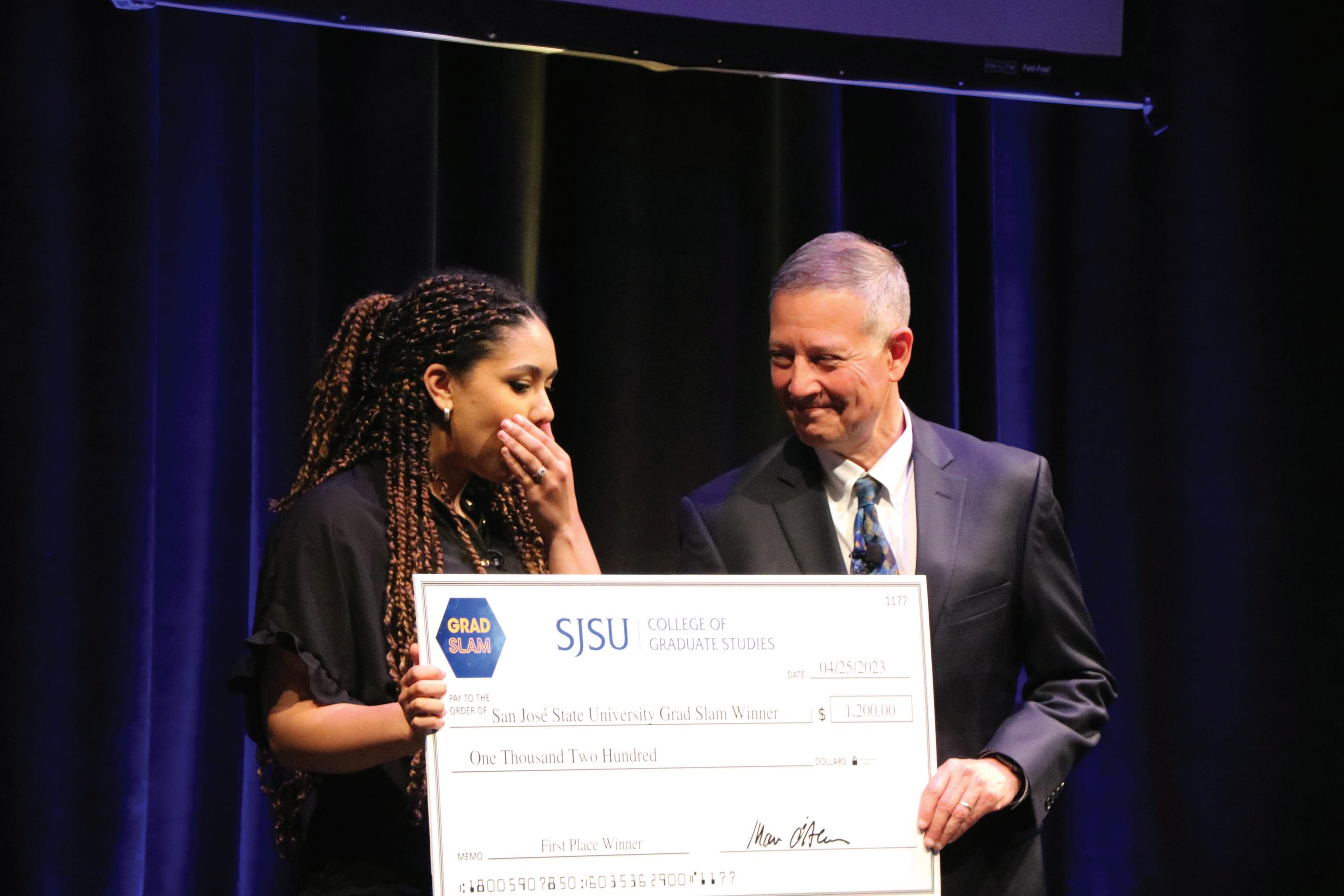
“There are over 10,000 different diseases in which a single functional gene is missing and due to this unreadable sequence, the body doesn’t function as it should,” Rollins said. “If we were to insert a healthy version of this gene into an individual’s DNA, they could be cured.”
She said in her research, she evaluates a specific DNA location that could be safe for gene insertion.
“This location determines if you have a positive or negative blood type, called the RhD locus,” Rollins said.
She gave the example of someone with blood Type A negative where the gene at the location is nonfunctional and individuals with a nonfunctional RhD gene are normal because the DNA location can be disrupted without causing any problems.
A negative blood type is a rare blood type determined by genes inherited from parents, according to the Give Blood website.
“We hypothesize that the RhD locus can be a safe place for gene editing,” Rollins said. “To insert a gene into DNA, we first need to make a cut in the DNA using CRISPR Cas9 technology.”
CRISPR Cas9 technology modifies genes by cutting DNA and letting it repair naturally, according to the CRISPR Therapeutics website.
She said CRISPR CAS9 includes three parts, a molecular scissor that cuts DNA of guide RNA that guides CAS9 to a specific location and a repair template that repairs the break in the DNA with the gene that’s
being inserted.
“We made our guide RNA match the DNA found at the RhD locus so that it can tell CAS9 where to cut there,” Rollins said. “Our repair template contains gene called GFP (Green Fluorescent Protein) that glows green so that we can visually prove when it is successfully inserted and then added these three CRISPR components to human blood cells and confirmed that the GFP gene was not only inserted at the correct location, but also functional, as observed by this green glow.”
Rollins said the next step is to repeat the process but instead insert the gene that is responsible for the bleeding disorder, Hemophilia A.
Hemophilia A is a hereditary bleeding disorder that alters blood coagulation, according
to the National Library of Medicine website.
“If successful, this innovative technique of using the RhD locus as a safe place for editing our genetic document can be applied to curing several diseases,” Rollins said.
Rollins said winning 1st place at the Grad Slam was surreal.
“I didn’t think it would happen, when they read my name, I was very shocked,” Rollins said.
She said winning to her meant to be more confident in the way she communicates her research.
“It’s sometimes hard to know whether what you’re saying the audience is understanding, so this kind of reaffirms that I am able to communicate my science,” Rollins said.
Rollins said she needed to include how CRISPR works and why it can impact the clinical
field overall in her presentation. The second place winner Hoang-Vi Vu, biological sciences master’s student, presented “Assessing the Effects of a Molecule on Chemotherapy Induced Peripheral Neuropathy”.
“Globally, close to 60% of new cancer cases require some type of treatment, and other 40% of them experienced the side effects of pain numbness and tingling, all of which are associated with balance skills, motor skills and fine coordination skills,” Vu said regarding the common side effects of chemotherapy induced peripheral neuropathy. She said there’s no current treatment or therapy that can cure CIPN and wants to know whether it could be prevented in the future.
Volume 160 No. 36 Wednesday, April 26, 2023 NAMED BEST CAMPUS NEWSPAPER IN CALIFORNIA FOR 2022 BY THE CALIFORNIA COLLEGE MEDIA ASSOCIATION
Marc d’Alarcao hands Jaedyn Rollins, biological sciences and systems physiology master’s student, the first place award at the Grad Slam event at the Hammer Theater on Tuesday.
Graduate students present their studies in three minutes using one slide
PHOTOS BY ENRIQUE GUTIERREZ-SEVILLA | SPARTAN DAILY
| Page 2
Speech language pathology master’s student Peace Lu presents her research on stuttering diagnosis criteria for bilingual children at the Grad Slam event at the Hammer Theater on Tuesday. GRAD
SLAM
Forum presents social change projects
By Matthew Gonzalez STAFF WRITER
San Jose State University’s Office of Research, in conjunction with the Human Rights Institute, held a Student Research, Scholarship, and Creative Activity Forum on human rights and social change on Tuesday at the Student Union.
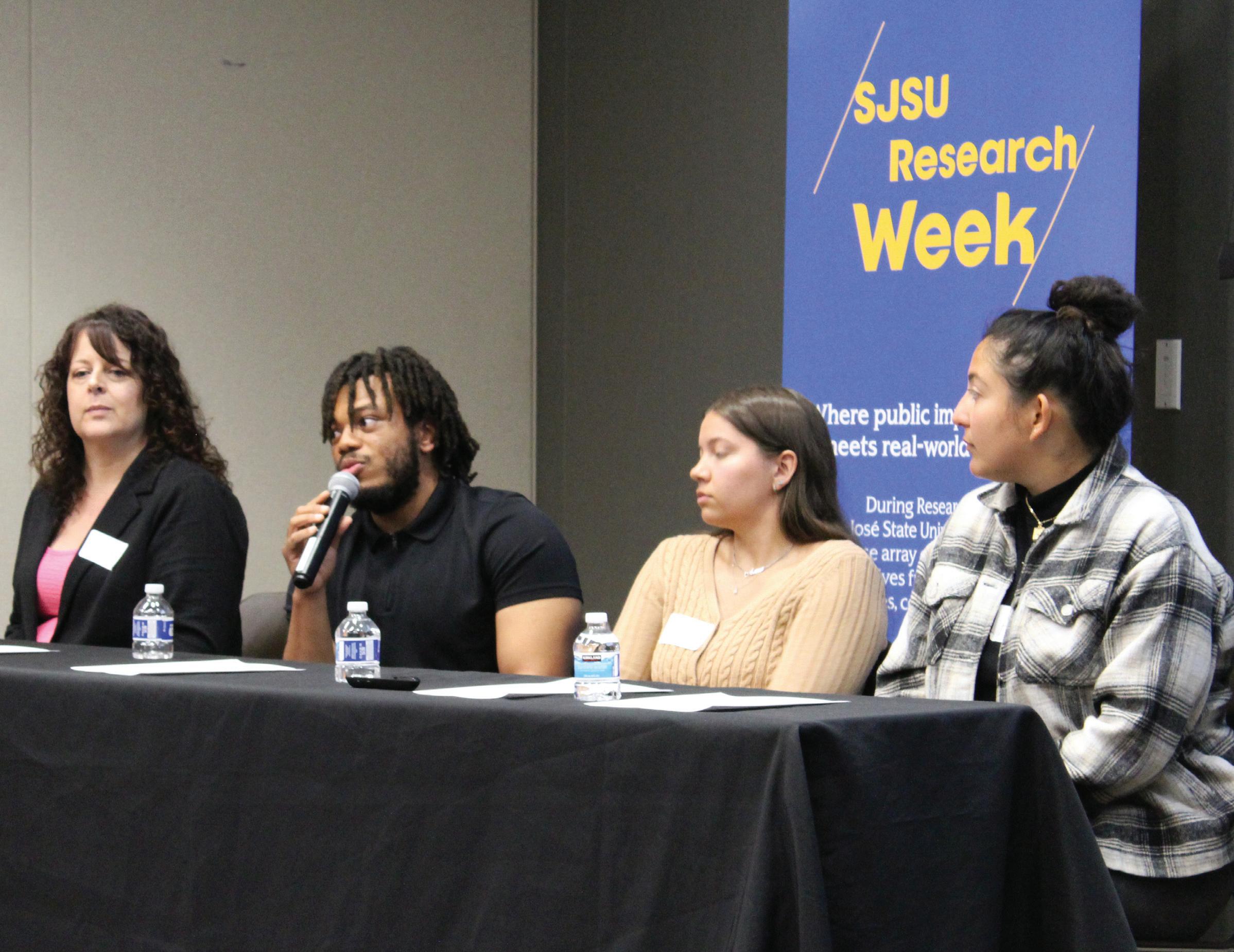
This is the second event of San Jose State University’s research week, after the SpartUp Innovation Showcase on Monday.
During the event, students were able to present research they conducted and answer the attendees’ questions. The research topics focused on taphonomy, the study of fossilization, HIV within the Black community and clearing cannabis-related criminal records.
Taphonomy & Houselessness
Applied anthropology graduate student Chloe Angst said her research was largely inspired by Jason de León, anthropologist and author of the book “The Land of Open Graves: Living and Dying on the Migrant Trail.”
The book tracks de León’s own investigation on the death of migrants crossing the United States-Mexico border.
Angst continued to talk about how she synthesized similar disciplines within her work in San Jose.
She said she wanted to examine an “accessible marginalized population” in her research, and ended up choosing people experiencing houselessness.
Angst said the harsh conditions they face such as exposure to extreme weather and cruel anti-homeless architecture make them an ideal independent variable, comparable to the migrants of de León’s study.
To simulate human reactions to environmental factors, Angst said she used pig carcasses as a proxy. A variety of factors were tested and studied during her experiment, including
GRAD SLAM
Continued from page 1
“Previous research has shown that in a warm molecule, if we remove a certain molecule, it can actually protect against the side effects of CIPN,” Vu said. “In the Wilkinson Neurophysiology Lab, we replicated this very same experiment by removing that very molecule but in a mouse instead.”
Vu said the lab studied the typical chemotherapy treatments real life patients undergo on a regular mouse and one with a molecule removed over the course of two weeks.
“We looked at the muscle spindle afferents because the muscle spindles found in our muscles, they act as these tiny little sensors that send messages to our brain and our brain is able to interpret this and let us know how our muscles are stretching or where they are in space,” Vu said.
She said the muscle spindle aspirins provide information on balance and coordination, both of which are affected by CIPN and indicate the side effects.
“We’ve already found
decomposition, skin discoloration and bugs that colonized the carcasses.
Angst said she hopes her findings will help develop proper post-mortem intervals, or amount of time passed after death for people experiencing houselessness.
“This model here can potentially guide investigators in the right direction for estimated post-mortem intervals when coming across [PEH] deaths in this region of study,” she said. “It is our duty as researchers to examine evidence, conduct experiments and ask questions behind the scenes to help those who have fallen victim to inequities of society.”
Cannabis-related criminal charges
Justice studies senior Alina Sandoval and political science senior Grace Barbieri gave a presentation on the expunging of marijuana-centric drug charges in California.
Sandoval said, because Judicial Branch courts are not
promising results that the inhibitor of this molecule can be taken in conjunction with treatment,” Vu said. “We hope in the future to continue to find solutions that not only target cancer cells, but also improve the quality of care of patients and their loved ones.”
She said the research project resonates with her personally because her mother was diagnosed with cancer and experienced some of the symptoms she spoke about.
After winning 2nd place, Vu said she was grateful for the experience.
“Public speaking is not my forte,” she said. “I’m very proud of myself for putting myself out there.”
The College of Graduate Studies had attendees vote on their phones using a QR code for their favorite presentation.
Peace Lu, speech-language pathology master’s student, won the audience choice winner award.
Her presentation was titled “Rethinking Stuttering Diagnosis Criteria for Bilingual Children” and spoke about the way bilingual stuttering is being assessed today. “Clinicians traditionally use
required to clean up cannabisrelated arrests without a petition, their research was approached as a way to address equity and human rights issues.
She said some ways that these stagnant charges can negatively affect people are through issues with child custody, trouble finding employment, driving privileges and college admission.
Sandoval said petitioning to overturn marijuana-related convictions has not been greatly effective, and it has led to no real change.
“It was declared that the state would do all the work and automatically clear or reduce people’s marijuana-related cases, and as we have found that has not happened,” she said.
Sandoval said having a specific person responsible for clearing all records would help mitigate stress faced by district attorneys who already deal with enormous amounts of work on a daily basis.
Barbieri said, although she had worked on other grassroots campaigns, dedicating time to meaningful research and
the 3% rule, if more than 3% of speech is considered bumpy, then a diagnosis of stuttering is usually given,” Lu said. She said this data was taken from monolingual children who only speak one language.
“I looked at existing data and found that bilingual children have different patterns of bumpy speech that do not conform to the 3% rule found in monolinguals,” Lu said. “If we were to use the 3% rule to assess for stuttering and bilingual children could end up giving incorrect diagnosis and sent to therapy for a disorder they don’t even have.”
presenting it in an academic atmosphere was surreal.
“I’ve only been in grassroots movements where you are getting [your] foot on the ground, you’re knocking on doors, this is like actual research,” she said.
HIV within Black churches
Humanities senior Justise Wattree put together a presentation detailing the response of Black churches toward HIV.
HIV is a cureless human immunodeficiency virus that attacks a human’s immune system, according to the CDC’s website.
Wattree said, as it pertains to HIV, Black churches have yet to address the disproportionate effect the illness has had on the Black community.
“It’s important to note that when it comes to HIV, this social activist response hasn’t been seen within the Black church,” he said.
He said a lot of his research material was gathered through interviews with church leaders
Lu said when assessing bilingual children, clinicians can take advantage of other resources including questionnaires for parents of young children who are bilingual.
“Remember, bilingualism is wonderful and your child may have more or less bumpy speech compared to their monolingual friends and that’s okay, for all of us,” Lu said. “It is absurd to assess bilingual children with criteria set for monolingual children.”
Lu said she is humbled to win the audience choice winner award and honored to be part of the experience.
with secondary data collected through internet searches.
Wattree said during this nearly year and a half long study, a participant in one of his interviews approached HIV in an unconventional way that opened a new way of thinking about his investigation.
“One of the participants said which I thought was really profound was that he believed that HIV was a chance given by God for the community to come together, and if you have a belief like this, that’s obviously going to curate some social activist response to HIV,” he said.
He also said he wanted to stress that HIV is not exclusively an issue dealt within the gay community, but an illness that has had an incredibly negative impact on Black people as well.
“I feel so honored to be part of this experience and get to learn and refine my research in that process,” she said. “It helps me as I’m going into my career in healthcare where I’m communicating a lot of information to people who don’t have a lot of background in whatever it is. And it helps me to learn how to dial something down from something that’s full of jargon to something that’s easily accessible.”
Follow Enrique on Twitter @mtvenrique
sjsunews.com/spartan_daily WEDNESDAY, APRIL 26, 2023 NEWS 2
Tuesday, the Spartan Daily published an article
“Spartans celebrate Earth Day” in which we misrepresented the titles for Sean O’Connell and Kalanna Eldridge.
Tuesday
Spartan Daily
an article
“SJSU
in solidarity with Florida” where we wrote a misleading headline.
Correction On Tuesday the Spartan Daily published an article titled, “Shake up: Carlson and Lemon ousted” in which we misrepresented the amount of money owed between Dominion Voting Systems and Fox News. On
titled,
On
April 18, the
published
titled,
academic senate passes resolution
errors.
The Spartan Daily regret these
Follow the Spartan Daily on Twitter @SpartanDaily
PHOTO BY ENRIQUE GUTIERREZ-SEVILLA | SPARTAN DAILY Jodie Warren, Justise Wattree, Grace Barbieri and Alina Sandoval answer questions about their research at the Student Union on Tuesday.
Students discuss human rights during innovation week
SOMOS Mayfair demands aff ordable housing in SJ
By Christine Tran STAFF WRITER
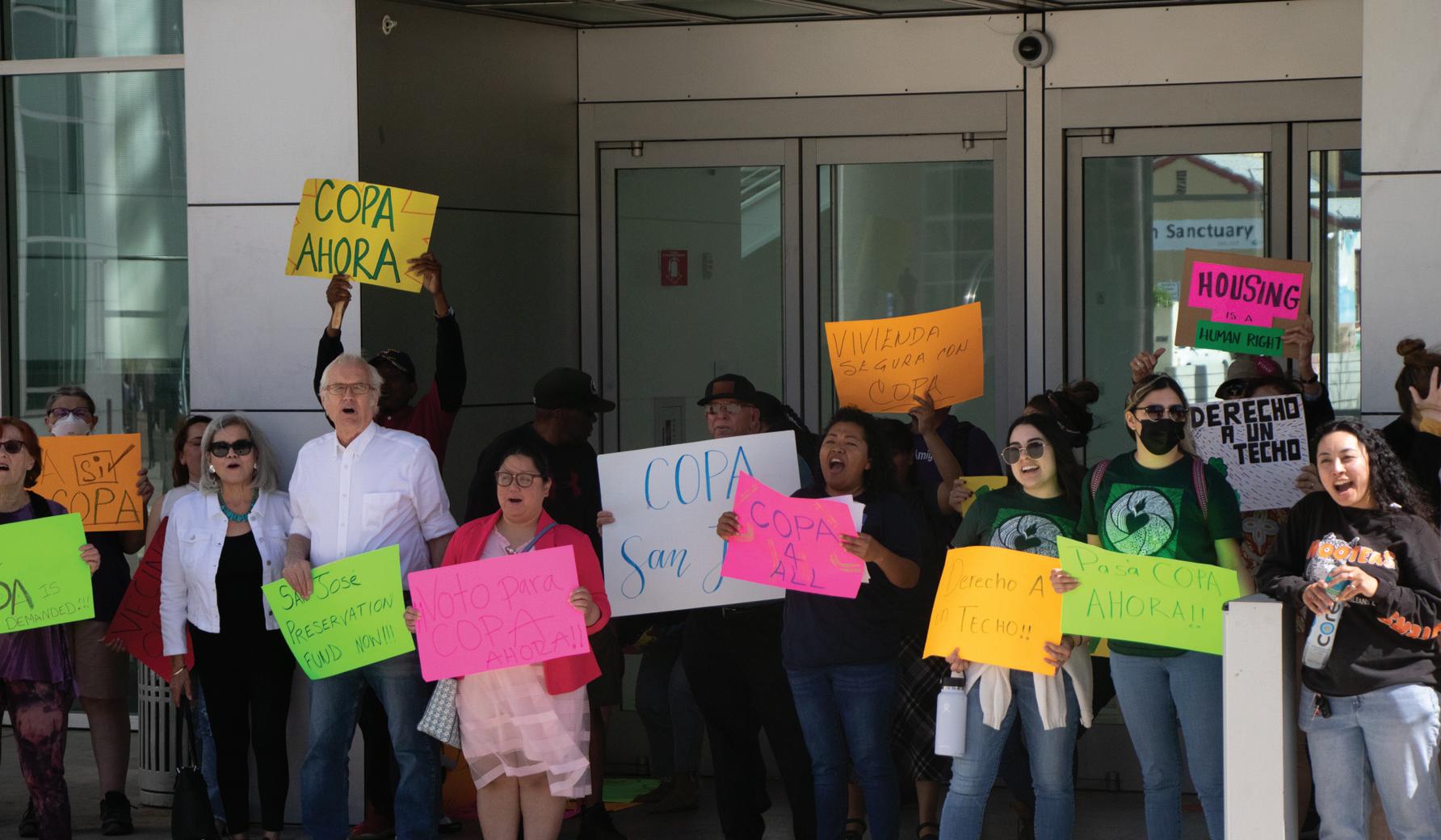
SOMOS Mayfair organized a rally on Tuesday at San Jose City Hall to convince City Council to vote yes to the Community Opportunity to Purchase Act.
SOMOS Mayfair is a movement in East San Jose that helps and uplifts families and residents through community power, according to its website.
The Community Opportunity to Purchase Act is a law that gives tenants or qualified nonprofits the chance to make the first offer to buy properties if homeowners sell it, according to the same website.
SOMOS Mayfair leaders, advocates and other community members gathered outside of City Hall before they headed inside for the San Jose City Council meeting.
Andrea Portillo, SOMOS Mayfair community organizing and policy director, is one of the leaders who organized the rally.
Portillo said the act is an integral part of the city’s commitment to building preservation ecosystems.
She also said the act is an anti-displacement strategy to protect tenants’ rights.
Portillo said San Jose is not building enough affordable housing to meet the city’s needs, so preservation is a way forward to ensure affordable housing for the community.
“It’s really key and an important piece of helping us address the displacement that we’re seeing across the city and across the Bay Area,” Portillo said.
She said the housing crisis in San Jose has affected her
personal life and loved ones.
“My family members have had to move out of the city and [in] my community, I think everybody knows friends, families and folks who had to leave because the cost of living is just too high and there’s not enough affordable housing so I think it’s impacting everybody,” Portillo said.
San Jose State social work master’s student Margarita Gaytan, said she wants the Community Opportunity to Purchase Act to pass to protect the San Jose community.
“I work with community members directly and I know that displacement caused by property-selling and the rent spiking up is very damaging to the entire household,” she said.
Gaytan said the act ensures that tenants aren’t blindsided by the news of their property being sold and the consequent rent increase.
“I think it would protect [tenants] just [by] giving [them] transparency in the process. Even if the non-profit isn’t able to buy it, at least families are notified beforehand and not caught off guard,” she said.
Social work master’s student Miriam Garcia said she has seen too many families struggling to find affordable housing during her work for a non-profit organization.
Garcia declined to name the non-profit organization she works for, but said it works closely with SOMOS Mayfair.
“These low-income apartments that are available are still pretty expensive and [low-income families] still struggle to make ends meet and you don’t just have one family living in one place,” Garcia said. “It’s multiple people
trying to make ends meet.”
The rally entered the council chambers, holding posters and other signs, where they listened to San Jose citizens and councilmembers discussing the Community Opportunity to Purchase Act.
Jose Lujano, treasurer for South Bay Community Land Trust, said he believes the act is the best policy to achieve the council’s goals.
The South Bay Community Land Trust vision is to fight displacement by providing permanent affordable housing, according to its website.
“Building housing is incredibly difficult,” Lujano said. “I can tell you this because I dedicate my life to building affordable housing every single day for my employer and preservation is not any much easier necessarily. COPA is a balanced policy framework that would help you achieve your goals of preserving housing.”
SOMOS Mayfair community organizer Matt Gustafson also gathered with those outside City Hall before addressing the council members.
Gustafson said he is a District 3 resident, homeowner and father.
“Many of you have said that preventing displacement of homelessness is a high priority,” he said.“I’m holding in my hand 2500 petition signatures that we’ve looked at around the city over the past two and a half years. We have the support of the community serving organizations and your own housing and community development community.”
Salem Ajluni, a San Jose homeowner and SJSU economics alumnus who has lived in different parts of the country, said he thinks housing is expensive in the Bay Area.
He said the Community Opportunity to Purchase Act doesn’t solve all of the problems
relating to housing crises and rent increases in San Jose, but it is one tool.
“It’s a small thing but if we don’t do small things, when we can kind of take advantage of policy, possibility and potential when we can do it, then we’re not being conscientious,” Ajluni said.
sjsunews.com/spartan_daily WEDNESDAY, APRIL 26, 2023 NEWS 3 ACROSS 1. Speech defects 6. Alumnus 10. Wan 14. Anagram of “Tiles” 15. Hindu princess 16. Jewish month 17. Fill with joy 18. Picnic insects 19. Steals 20. Tattletale 22. Tall woody plant 23. Angry 24. Bay window 26. Goes with salt 30. Blockish 32. Twiddled one’s thumbs 33. Out of the ordinary 37. Rip 38. Metal money 39. A rounded projection 40. Poison remedies 42. Doughnut-shaped roll 43. Associated with the moon 44. Scarcely 45. Incorrect 48. In place of 49. Swearwords 56. Circle fragments 57. Spindle 58. Utopian 59. Calf’s meat 60. Teller of untruths 61. Feeling 62. Glimpse 63. Kitchen or bathroom 64. Wed DOWN 1. Legal claim 2. Small island 3. Shredded cabbage 4. Animal companions 5. Arose (from) 7. Sounded a bell 8. Initial wager 9. Undresses 11. Love intensely 12. Record company 13. Celtic language 21. Paddle 25. 18-wheeler 26. Falafel bread 27. Biblical garden 28. Surveyor’s map 29. Dangerously 30. Colonial reporter 31. Coffee dispensers 34. Opera house box 35. Cain’s brother 36. Depend upon 38. Becomes gelatinous 41. Grayish brown 42. Christian rite 44. Fish eggs 45. Cables 46. Review 48. Wash 50. 22 in Roman numerals 51. Scheme 52. Notion 53. Opening 55. Sleigh 2 5 5 1 6 8 8 5 6 2 6 2 1 8 6 1 8 1 3 4 9 8 5 2 3 1 9 3 3 41 1 5 7 5 CLASSIFIEDS CROSSWORD PUZZLE SUDOKU PUZZLE Complete the grid so that every row, column and 3x3 box contains every digit from 1 to 9 inclusively. AROUND “Why was Cinderella so bad at soccer?” “She kept running away from the ball.” PLACE YOUR AD HERE Contact us at 408.924.3270 or email us at SpartanDailyAdvertising @sjsu.edu SOLUTIONS 4 26 23 9 5 8 1 9 8 5 8 6 4 6 2 7 8 4 1 3 4 3 7 6 3 5 2 2 1 4 2 1 5 4 9 3 7 8 6 3 2 6 7 7 3 7 9 3 9 6 4 9 1 2 5 2 8 3 4 8 8 2 7 2 1 5 6 3 9 2 5 9 4 4 8 4 5 6 7 7 67 1 2 reopened at DBH 213! 1234516789110111213 14115116 17118119 2021122 111123112425 262728293031111 3233343536 3738139 404142 11143144 145461147111 4849505152535455 56157158 59160161 62163164 RABASEASANTESAD EMASTSNITORTURE TENPINESTREAMER ERATRELEASEOMAN RINGESECCEECAPE SCARCLARKRTARES EASEKUSENSATYRH AIRNIGHTCLUBENO DSLAVEOAHARIDES ETIDYICRIBERENT PACEVSOILAUDATA AGEDSTRAINSHLET PENCHANTLIODINE ASSUAGEETPRINTS TOETHERSASEDGES
the
Daily on Twitter @SpartanDaily
Follow
Spartan
BRANDON NICOLAS | SPARTAN DAILY
San Jose residents gather in front of City Hall on Tuesday before protesting against housing costs inside.
John Fisher has ruined baseball for me
By Mat Bejarano STAFF WRITER
My love for the Oakland Athletics is almost as dead as their chances of staying in the city.

Last Wednesday, the team announced an agreement to purchase 49-acres of land in Nevada with the intention of opening a new dome baseball stadium, according to an April 20 New York Times article.
As a fan of the A’s for the last 12 seasons, my heart broke to hear that the third Oakland professional sports team is set to leave the city in the span of just five years.
The team’s reputation today is the laughing stock of baseball, but it’s hard for newer Bay Area sports fans to remember that the A’s were in the World Series six times in 19 seasons throughout the early ’70s and late ’80s.
What makes everything worse are people, such as that jabroni Rob Manfred, the MLB commissioner, who refuses to acknowledge the history of baseball in Oakland.
“I feel sorry for the fans in Oakland. I really do. But for the city of Oakland to point fingers at John Fisher, it’s not fair,” Manfred said in a Monday ESPN article.
To blame the city for not trying is completely irrelevant and not true, especially when the actual problem lies at the desk of A’s owner, John Fisher.
Initially, I grew up a Giants fan as it was hard to avoid the success they had when I was a kid, winning the World Series in 2010, 2012 and 2014.
But there was just something different about the 2012 Oakland Athletics team that included players, such as Coco Crisp and Cuban rookie Yoénis Cespedes, that really made me switch sides of the bay.
I even attended the last A’s game that year, a game where the club battled back from a 5-1 deficit to beat the Texas Rangers and win the division.
That was the first time I ever skipped
school to go to a baseball game, and even though it was just a division win, the chants of “Let’s Go Oakland” leaving the coliseum almost felt like a World Series championship.
But those glory days of being an A’s fan are clearly over as the team have done about everything they can to push fans away.
After a fire sale of the team’s best players, which included fan favorites such as Matt Olson, Matt Chapman and Chris Bassit following the 2021 season, fans showed their outrage by not showing up to games, causing the
team on the field, but then to rip them away from Oakland.
The A’s have killed the fans’ experience at the Coliseum by eliminating A’s access, a membership that I had that gave fans access to all 81 home games and other amenities, such as 50% off concessions and $10 parking.
But the team also went away with free parking on Tuesdays and giving out bobbleheads of current and former players.
Promotions like those were a big reason why fans kept coming back to the Coliseum but taking away those
to buy the land in Vegas.
I don’t feel like the city of Las Vegas is ready or even wants to pay $500 million for a team held hostage by a cheap billionaire owner who never likes to spend money to put good players on the field.
Manfred said that he would waive the relocation fee, which would be split amongst the 29 other team owners, for the A’s if they ultimately decided to leave to Las Vegas.
I find it incredibly difficult to see a future in which the other owners do not mind losing out on millions of dollars.
A’s to have the lowest average home attendance of 9,973 fans per game in 2022, according to an ESPN article.
Articles started popping up, criticizing the lack of attendance on fans’ behalf, such as the New York Time’s “The Loneliest Team in Baseball.”
There’s definitely some comedy in seeing a virtually empty baseball stadium, but it definitely rubs me the wrong way when people begin to blame the fans for the A’s ultimately deciding to leave.
Fisher has done nothing to ever keep fans loyal to the team.
The A’s have been in the bottom ten teams in player payroll for the last ten seasons, according to spotrac.com.
With an estimated net worth of $2.2 billion, according to Forbes.com, Fisher never wanted to open his wallet to upgrade the team to get them over the hump.
It’s a shame that MLB stands idly and allows Fisher to not only destroy the
little things made it hard to get excited about coming to games.
As a baseball fan, it’s going to be hard to see my team move away, but I don’t think I can completely give up watching the sport.
Despite the Giants being a contributor to the A’s not getting a new stadium by blocking their plans to relocate to San Jose during the previous decade, I think I would ultimately have to root for the local Bay Area team.
But before the team can make the transition to the hot, unwelcoming Las Vegas summer sun, there are still hurdles in their path.
The team is asking for $500 million in public money for the stadium from the city of Las Vegas, which has already been met with blowback from the Nevada community.
“Asking for and getting are two very different things,” Clark County Commissioner Michael Naft tweeted shortly following the A’s announcement
If the deal falls through with Las Vegas, then I will gladly accept the team back with open arms, even if Fisher is still the owner.
Despite the bad product on the field, I still love the A’s and what they represent to the Bay Area sports culture as a whole.
Oakland’s chances of keeping its last professional sports team is getting slimmer by the day, but if there’s anything notable about the Oakland A’s, it’s that they always come back when you least expect it.
sjsunews.com/spartan_daily WEDNESDAY, APRIL 26, 2023 SPORTS 4
PHOTO VIA ADOBE STOCK
Follow the Spartan Daily on Twitter @SpartanDaily OPINION EDITORIAL STAFF EXECUTIVE EDITOR NATHAN CANILAO MANAGING EDITOR ALESSIO CAVALCA ASSOCIATE EDITOR BOJANA CVIJIC NEWS EDITOR RAINIER DE FORT-MENARES A&E EDITOR VANESSA TRAN OPINION EDITOR JILLIAN DARNELL SOCIAL MEDIA EDITOR BRYANNA BARTLETT CONTACT US EDITORIAL –MAIN TELEPHONE: (408) 924-3821 EMAIL: spartandaily@gmail.com ADVERTISING –TELEPHONE: 408-924-3240 ADVERTISING STAFF ADVERTISING DIRECTOR MIA WICKS CREATIVE DIRECTOR BRIANNE BADIOLA ABOUT The Spartan Daily prides itself on being the San Jose State community’s top news source. New issues are published every Tuesday, Wednesday and Thursday throughout the academic year and online content updated daily. The Spartan Daily is written and published by San Jose State students as an expression of their First Amendment rights. Reader feedback may be submitted as letters to the editor or online comments. PHOTO EDITOR ALEXIA FREDERICKSON COPY EDITORS CHRISTOPHER NGUYEN GRAPHICS EDITORS HANNAH GREGORIC JANANI JAGANNATHAN MYENN RAHNOMA SENIOR STAFF WRITERS ADRIAN PEREDA JEREMY MARTIN OSCAR FRIAS-RIVERA STAFF WRITERS ALINA TA BRANDON NICOLAS CHRISTINE TRAN DYLAN NEWMAN DOMINIQUE HUBER ENRIQUE GUTIERREZ-SEVILLA JENNIFER YIN MAT BEJARANO MATTHEW GONZALEZ PRODUCTION CHIEF MIKE CORPOS NEWS ADVISER RICHARD CRAIG EMAIL: spartandailyadvertising@gmail.com CORRECTIONS POLICY The Spartan Daily corrects all significant errors that are brought to our attention. If you suspect we have made such an error, please send an email to spartandaily@gmail.com. EDITORIAL POLICY Columns are the opinion of individual writers and not that of the Spartan Daily. Editorials reflect the majority opinion of the Editorial Board, which is made up of student editors. I don’t
of
or even wants to pay $500 million for a
to spend
to
feel like the city
Las Vegas is ready
team held hostage by a cheap billionaire owner who never likes
money
put
good players on the fi eld.






































































sjsunews.com/spartan_daily WEDNESDAY, APRIL 26, 2023 ADVERTISEMENT 5 laspositascollege.edu/welcome | (925) 424-1602 Save money and finish faster by taking summer classes. Summer classes are shorter, flexible, and affordable. APPLY TODAY


































































sjsunews.com/spartan_daily WEDNESDAY, APRIL 26, 2023 ADVERTISEMENT 6 Save money and finish faster by taking summer classes. Summer classes are shorter, flexible, and affordable. APPLY TODAY chabotcollege.edu/welcome | (510) 274-1550
