Indigenous center to open Fall 2023
By Dominique Huber STAFF WRITER
Native American and Indigenous students at San Jose State have been designated a space on campus.
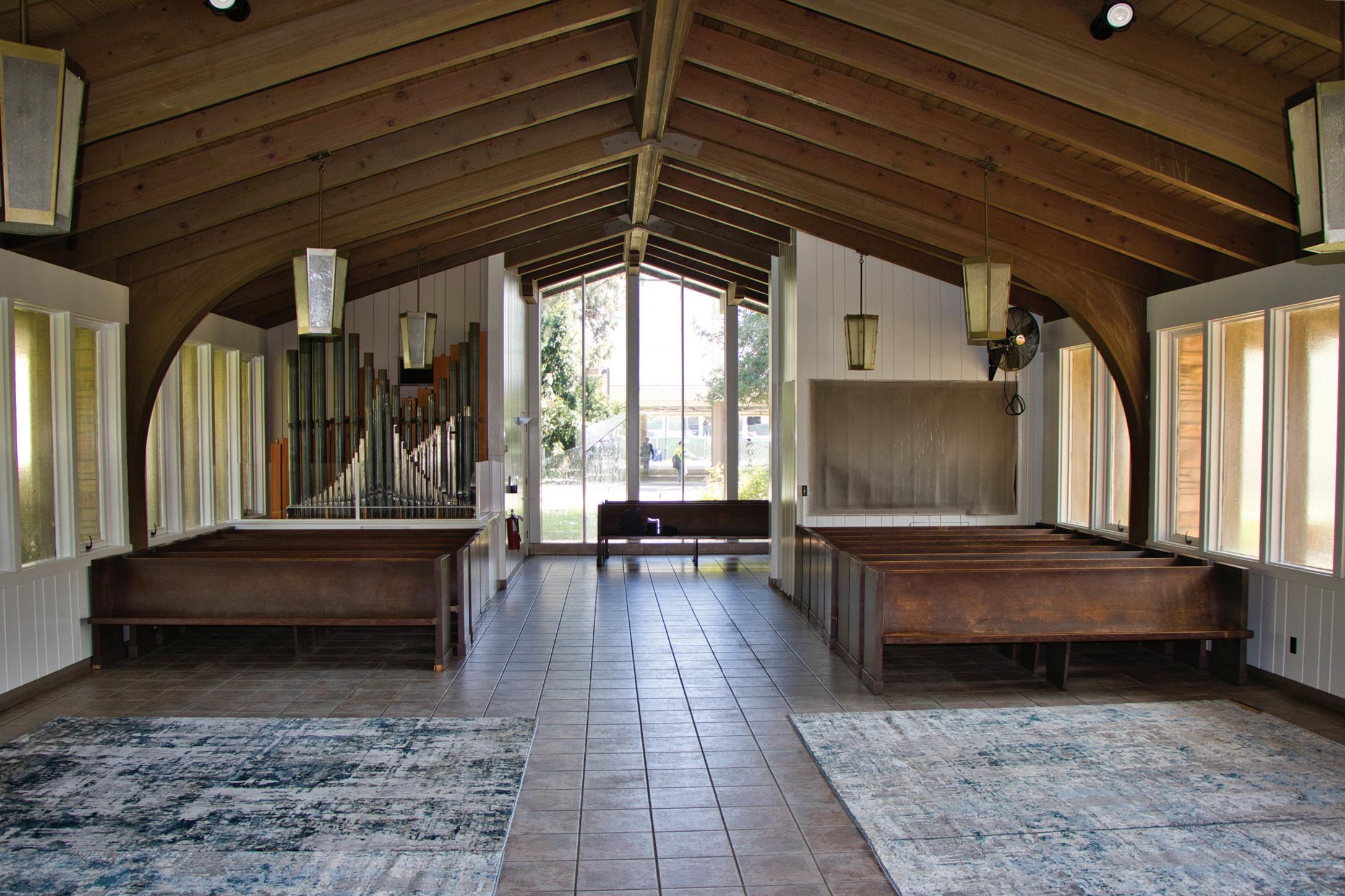
The new Native American and Indigenous Student Success Center will be located in the Spartan Memorial Chapel and is expected to have its grand opening in Fall 2023.
SJSU will be the ninth California State University to have a space designated to Native American and Indigenous students on its campus.
“We’re glad that the center is here,” said Luis Aquino, who is Zapotec, also known as Ben ‘Zaa, and a Native American Student Organization member.
“It’s gonna be a new home for our Native students here and it’s gonna welcome a new generation of Native and Indigenous students on our campus . . . it’s been a long time coming,” Aquino said.
Carmina Bosmenier, who is Yaqui and a member of the Native American Student Organization, said she wished they had more institutional support in opening a center.
“There’s already so much on our plates and then to be like, ‘Oh you guys have to fight for your own identity space if you want resources or to feel seen,’ ” Bosmenier said. “I think that’s a big responsibility that we all kind of took on because we’re like, ‘Okay well no one else is doing it.’ ”
SJSU’s Native American Student Organization is a
Experts discuss food insecurity during webinar
By Christine Tran STAFF WRITER
Non-profit volunteers discussed the role that hunger plays in prolonging poverty in the fourth part of a professional development webinar series.
Protest bubbles up over Joe West laundry rooms
By Rainier de Fort-Menares & Alessio Cavalca NEWS EDITOR & MANAGING EDITOR

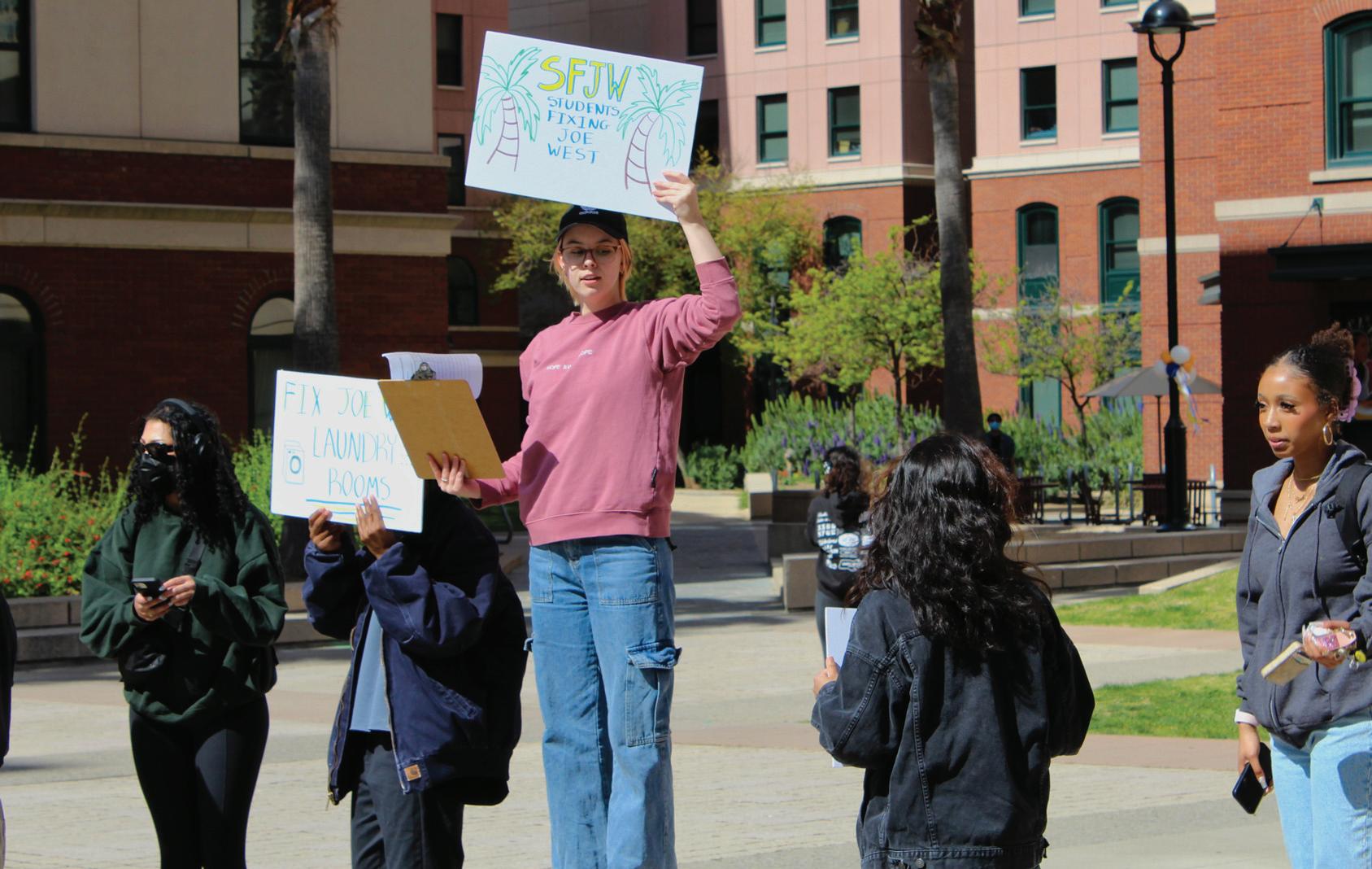
A group of students gathered in front of Joe West Hall on Wednesday afternoon in hopes of changing the conditions and lack of accessibility in the dorm’s laundry room.
Many of the students were from an activism, action and resistance class.
Communication junior Mariana Valadez said the students created a campaign focused on fixing the Joe West Hall laundry room to create an accessible and safer path for the people living in the building.
“Especially with the amount you’re paying for tuition, you should be getting the resources for what you’re paying,” she said. “And it’s just not safe and we’ve had people come and tell us their conditions that they’ve been in and how the elevators don’t even work and the doors don’t even open and have to prop it up with rocks.”
Valadez said the state of the laundry room has caused some students to go to SJSU Express Laundry and other laundromats off campus.
“For the amount you’re paying to be living here – I just don’t think it’s fair,” she said.
“Especially for people who can’t access the laundry room, like, what are you going to do?”
Communication senior Finn Mathews said Joe West Hall is not the only dorm facing problems. They said they faced issues when they were living in Washburn Hall during their freshman year.
“For example, in Washburn, some of my friends weren’t able to actually hear the fire alarms when it was going off in their rooms, which is really, like, it’s a really concerning safety issue,” Mathews said.
Mathews said they and Valadez tried to communicate with the multiple people on campus to fix the issues but never received any response.
“We’ve also been trying to contact the Residence Hall Association and we’ve reached out multiple times and just heard nothing back from them, which is frustrating because considering the workers, the students trying to make housing safer and safer and better for students,” Mathews said. “We were hoping that the right Residence Hall Association [would] contact us back but we haven’t heard anything so far.”
Communication studies lecturer Lucas
Building Equity in the Silicon Valley Food System is hosted by Veggielution, a community garden in San Jose, and Thrive, a San Mateo County-based network of 200+ nonprofit organizations.
prevent all of our neighbors from having enough resources needed to meet their basic needs,” she said. “We believe we can and must make a different choice and work together to solve the root causes of hunger.”
DiFiore said hunger in Maine is a significant issue though news outlets don’t usually cover it.
“Maine currently has the second highest food insecurity rate in New England and the highest rate of very low food insecurity – a more severe range of food insecurity that
The two speakers were Dawn DiFiore, director of community partnerships at Good Shepherd Food Bank in Maine, and Lauralyn Clawson, director of operations at Urban Growers Collective in Chicago.
They spoke to Zoom participants on their individual food systems project that aim to help their own respective communities.
DiFiore said she works with many teams across the food bank. DiFiore said improving access to nutritious food, building strong partnerships and mobilizing the public are important to finding long-term solutions in ending hunger.
“Our society has more than enough food for all but systemic inequities
Lauralyn Clawson Urban Growers Collective director of operations
involves reduced food intake and disrupted eating patterns,” she said.
DiFiore said single parent households have the highest rates of food insecurity, and nearly four times the overall rate in Maine. She said Black, Latino, Indigenous and other non-white households also experienced significantly higher rates of food insecurity.
In the Bay Area, there was a 63% increase in food insecurity in Hispanic households with children, and in households experiencing job disruptions during the COVID-19 pandemic, according to a SJSU ScholarWorks article.
Volume 160 No. 34 Thursday, April 20, 2023 SERVING SAN JOSE STATE UNIVERSITY SINCE 1934 WWW.SJSUNEWS.COM/SPARTAN_DAILY NAMED BEST CAMPUS NEWSPAPER IN CALIFORNIA FOR 2022 BY THE CALIFORNIA COLLEGE MEDIA ASSOCIATION
DOMINIQUE HUBER | SPARTAN DAILY
The Spartan Memorial Chapel, located between the Tower Lawn, the Spartan Complex and Yoshihiro Uchida Hall, is where the Native American and Indigenous Student Success Center is expected to open in Fall 2023.
RAINIER
Students protest the state of the Joe West Hall laundry rooms in the housing quad on Wednesday.
DE FORT-MENARES | SPARTAN DAILY
INDIGENOUS | Page 2 FOOD JUSTICE | Page 2 JOE WEST | Page 2
And our mission is that rooted in growing food, we cultivate nourishing environments which support health, economic development, healing and creativity through urban agriculture.
INDIGENOUS
Continued from page 1
group for Native American and Indigenous students to gather, support each other and build community, according to its website.
Aquino said this is one of the organizations they have been able to count on throughout their struggle to get a center opened on campus.
“We’re very grateful to have GAIN and NASO because they have been, like, our main motivators in the times that we have lost motivation ourselves,” Aquino said. “They have been the ones that always lift back our spirits.”
Aquino said Gathering of Academic Indigenous and Native Americans, and Students for Quality Education are other campus organizations that have contributed to the effort of opening a center.
Elisa Aquino, who is Ben ‘Zaa and the program director for the Native American and Indigenous Student Success Center, said she hopes the new center will create muchneeded visibility at SJSU for Native American and Indigenous students.
Less than a quarter of 18-24 year old Native American and Indigenous students are enrolled in college in comparison to 41% of the overall U.S. population, according to a report from the Postsecondary National Policy Institute.

With the Native American population making up only 1% of the students in the University of California and California State University systems, Native American and Indigenous people are disproportionately missing from higher education, according to an Aug. 5, 2021 CalMatters article.


Kihabet Alcorta-Hernandez, who is Mixteca and an advocate for the Native and Indigenous Student Success Center, said SJSU lacks engagement with Native American and Indigenous people.
“[People] still talk about us in the past tense. It’s like, ‘I’m here. I’m alive . . . my family is very much alive, not a thing of the past,” Alcorta-Hernandez said.








Bosmenier said she hopes the center will encourage younger Native American and Indigenous people to pursue higher education.
“Maybe this will be like a reassurance, like, ‘Oh, I do wanna be here because my people are here,’ ” she said. “To [say] to students,
JOE WEST




Continued from page 1
Hatton was protesting with his students in front of the building.
“I want to support what they’re doing, what they’re about to give assistance to make sure that that the action is successful,” Hatton said.
He said he believes engaging college students in similar activities is an important way to further their education.
“Creating something is the highest


‘Hey you have a space here where you’re gonna be heard and we’re gonna do our best to find resources for you.’ ”








Elisa Aquino said in addition to creating visibility, some of the goals for the center are to build a stronger relationship with the Muwekma Ohlone Tribe, help Native American and Indigenous students access resources and connect students to other Indigenous faculty and staff.
SJSU is located on “Thámien Ohlone-speaking tribal ethnohistoric territory, which . . . includes the unceded ancestral lands of the Muwekma Ohlone Tribe of the San Francisco Bay Area,” according to the university’s land acknowledgement webpage.
Quetzalli Sanchez, who is Purepecha and a member of Native American and Indigenous Student Organization, said SJSU has done the bare minimum to build its relationship with the Muwekma Ohlone Tribe.
“How are you gonna include a population of people who, rightfully so, had this land and just use their name without any kind of interaction with them?” Sanchez said.
Sanchez said the opening of the center is a good start, but there is still more work to be done.
“The center is really only a small step in the right direction,” Luis Aquino said. “There are a lot of systemic issues that need to be dealt with as well in order for our students to see themselves represented at our institution. To see themselves and be able to say ‘This person is doing this, I can do this too.’ ”
Luis Aquino said Native American and Indigenous students need a number of things from the university, including increased hiring of Indigenous faculty and administration, longevity for the center, initiatives from the university to educate people on indigeneity, waived tuition for native students and “intentional and continuous engagement” with Native American and Indigenous communities.

“It’s like we’re the minority within the minority. Our numbers already show that there’s not a lot of success within higher ed and it’s like why? Because these things lack,” Sanchez said. “If we bring this forth to the table, can you imagine how much good it would do?”
Follow the Spartan Daily on Twitter @SpartanDaily
demonstration of knowledge about it,” Hatton said. “So if you can go out and create a campaign, then you have to take everything you’ve read in a textbook and put it into action.”
Follow the Spartan Daily on Twitter @SpartanDaily
Nathan Canilao contributed to this article.
FOOD JUSTICE
Continued from page 1
Good Shepherd Food Bank is committed to end hunger in Maine by the year 2025, according to its webpage. To do this, it wants to raise $250 million in a statewide campaign for accessible and nutritious food.


DiFiore said this goal will be achieved with at least $150 million and large scale food donations raised from food retailers, manufacturers, producers and farmers.
She said the other $100 million will come from private donations from individuals, businesses and philanthropic foundations.
“We acknowledge the food bank cannot achieve its mission alone and we rely on the experience and expertise, expertise of the many community partners to do our work,” she said. “We must listen to understand the diverse experiences and needs of Mainers at risk of hunger and we must invest in and work alongside our partners and neighbors.”
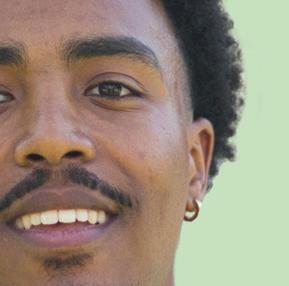
Clawson spoke on behalf of Urban Growers Collective, a Black and women-led nonprofit farm in Chicago that aims to create an equitable food system.

Urban Growers Collective grows food, provides jobs and “cultivates eight urban on 11 acres of land, predominantly on Chicago’s south side,” according to its webpage.




Clawson said some of the organization’s short-term goals is to increase knowledge and access to healthy foods as well as increasing
send a letter to the editor
the number of healing spaces.
“We very much enjoy partnering with the Chicago Park District because we recognize that park districts are land that is held in perpetuity for the benefit and enjoyment of Chicagoans,” she said.
Clawson said as Urban Growers Collective supports their partners, they try to ensure any land used for urban agriculture is ready for future developments.
The organization also offers community farmers a plot in community gardens for a year to grow food for their families.

Clawson said communities in South and West Chicago have been historically targeted by systematic racism that affects their food security.
During the pandemic, racial and ethnic minorities experienced increased rates of food insecurity compared to whites, according to a SJSU ScholarWorks article.






“Our vision is, we aim to address the inequities and structural racism that exists in the food system using urban agriculture as our tool and method for this work,” she said. “And our mission is that rooted in growing food, we cultivate nourishing environments which support health, economic development, healing and creativity through urban agriculture.”
Follow the Spartan Daily on Twitter @SpartanDaily
Letters to the Editor may be placed in the letters to the editor box in the Spartan Daily office in Dwight Bentel Hall, Room 209 or emailed to spartandaily@gmail.com to the attention of the Spartan Daily Opinion Editor.
Letters to the Editor must contain the author’s name, year and major. Letters become property of the Spartan Daily and may be edited for clarity, grammar, libel and length. Only letters of 300 words or less will be considered for publication.
Published opinions and advertisements do not necessarily reflect the views of the Spartan Daily, the School of Journalism and Mass Communication or SJSU. The Spartan Daily is a public forum.
What does 4/20 mean to you?

“The first that comes to mind is my that my dad’s birthday is on 4/20 and I never understood growing up why people would make such a big deal about it . . . like, ‘Oh my gosh! It’s my dad’s birthday, so I guess it’s a day to celebrate!’ ”


sjsunews.com/spartan_daily THURSDAY, APRIL 20, 2023 NEWS 2
REPORTING BY BRANDON NICOLAS
CAMPUS VOICES
“I like it. It’s a good day and everyone can be relax for once.”
Ashwin Mahendran management information systems junior
Brianna Gilbert occupational therapy master’s student
“So 4/20, as the bible says, it’s actually a sin to smoke weed. It says to be sober minded because the devil prowls.”
Matusala Ykeallo
pre-nursing
sophmore
“I think it’s pretty sick, you know. It’s a good time to be alive – they say, ‘4/20 blaze it’ for a reason right? Release the anxiety and just chill out and mellow out.”
Joseph Luna criminology senior
GRAPHIC BY VANESSA TRAN
WOMEN’S GOLF
SJSU competes in conference fi nal
By Oscar Frias-Rivera SENIOR STAFF WRITER
The San Jose State women’s golf team is defending its Mountain West Conference championship this week at Mission Hills Country Club in Rancho Mirage, Calif.

The Mountain West Championship tournament began on Tuesday and the Spartans are looking to win their second straight conference championship. The course is 18 holes.
In the first round of play, the Spartans finished in second place behind New Mexico as SJSU went 2-under-par and recorded a total score of 286.
SJSU graduate student
Antonia Malate finished the first round tied for first place individually with a score of 68, which was 4-under-par.
On Wednesday, the Spartans finished the day at the top of the leaderboards with a score of 569, which was 7 under par. SJSU held a 4-shot lead after day two of the tournament.
Senior Kajsa Arwefjäll, ended the day with a score of 71 and a total of 141 which was good for fourth place after.
“I started off good,” Arwefjäll said in a post game Twitter video. “I had a lot of birdie opportunities but I didn’t really make them so that’s sad. I still made some birdies and a lot of pars, which is good.”
Arwefjäll said team comradery has been key to the Spartans’ success over the past two days.
“The team is great. All of us, we put everything in and try to make as much birdies as possible. We all cheer for each other to make each other play the best we can,” she said.
Malate led the team with a third place finish on day two with a score of 72. She has recorded a total of 140 after both days, which is -4 under par.
With two Spartans leading in the top four, they will have
a 4 shot lead going into the final round.
SJSU head coach Dana Dormann said the team did the little things on Wednesday to take the lead.
“I saw some really solid approach shots and some good putts and some birdies,” she said. “We had a couple hiccups around and some double bogeys that we would like to avoid but overall pleased with today’s score.”
Dormann also said if the team sticks to the game plan, they will be successful in the final round.
“We would like to stick to our process, focus on being committed and making sure that we keep on bringing the energy tomorrow,” she said.
The Spartans won the 2022 MW Tournament with a record setting 30 shots over par against New Mexico last year.
The conference tournament win in 2022 was the Spartans’ first conference championship win since joining the conference in 2013.
San Jose has a total of seven top-five finishes this season that led to two wins in USF Intercollegiate and Carlbom
at the Landfill Tradition in its 20th anniversary.
The Spartans are scheduled to tee off at 7 a.m. today at Mission Hills Country Club.
sjsunews.com/spartan_daily THURSDAY, APRIL 20, 2023 SPORTS 3 ACROSS 1. Hemlock spruce genus 6. Foreshadow 10. Experienced 14. Respect 15. Black, in poetry 16. Melange 17. Of a pelvic bone 18. Heredity unit 19. Double-reed woodwind 20. Seer 22. Units of 2000 pounds 23. Anagram of “One” 24. Scenes 26. Steps 30. Pottery fragment 32. Veers 33. Sharpness 37. Engrave 38. Munchkin 39. Behold, in old Rome 40. Instrumentalists 42. Exclamation of contempt 43. Army brass instrument 44. Busts 45. Nigerian money 47. Poetic contraction 48. Match 49. Belladonna 56. River in Spain 57. Lacquered metalware 58. Roof overhangs 59. Winglike 60. Detail 61. Slumber 62. Depend upon 63. Walking stick 64. Repentant DOWN 1. Not that 2. Alone 3. Freshwater mussel 4. Caprine animal 5. They use bows and arrows 6. Started 7. Follow orders 8. Accomplished 9. Weaken 10. Foot side predominance 11. Arm joint 12. Kings of the jungle 13. Foot digits 21. Mayday 25. Anger 26. Flower stalk 27. Ballet attire 28. Circle fragments 29. Repressive 30. British biscuit 31. Sings with closed lips 33. Nitpicky to a fault 35. Cheat 36. Stitches 38. Immense 41. Mongrel 42. Own 44. Morsel 45. Majestic 46. Ear-related 47. Motif 48. Grizzly 51. Secluded valley 52. Angelic headgear 54. Elk or caribou 55. Glimpse 8 2 9 9 8 1 3 9 6 8 7 3 9 8 3 9 7 6 6 6 2 5 4 2 5 7 6 8 3 1 5 CLASSIFIEDS CROSSWORD PUZZLE SUDOKU PUZZLE Complete the grid so that every row, column and 3x3 box contains every digit from 1 to 9 inclusively. AROUND “Why did the bike fall over?” “It was two tired.” PLACE YOUR AD HERE Contact us at 408 924 3270 or email us at SpartanDailyAdvertising @sjsu.edu SOLUTIONS 4 19 23 7 2 1 4 5 4 3 7 6 6 9 6 6 1 8 8 4 2 7 2 4 8 7 9 9 1 7 1 2 2 3 9 8 9 57 8 9 5 9 61 8 2 7 5 4 6 4 3 4 3 1 5 8 3 1 6 5 7 5 72 3 4 4 6 3 8 1 6 5 9 5 9 2 38 2 3 1 reopened at DBH 213! 1234516789110111213 14115116 17118119 2021122 111123112425 262728293031111 3233343536 3738139 4041142 11143144 1454611471111 4849505152535455 56157158 59160161 62163164 DCENTSHASTOATSK AALOHAATCABBAGE TRADERRCOLESHOW HITEMISERLYUERE IBIDDOMANYAINNS ROVEALASSFANTEE DUELLALEATWISTR LUNEBULLIENTGOG AMATEDOERAGISLE PAPEDATSAREALES DIPSOPESTONLOST ODEEBULLETSOSSE MENTALLYUAUTHOR ENDORSEASPREENE DASTEERKESENDSR
PHOTO COURTESY OF SJSU ATHLETICS INSTAGRAM
UPCOMING MATCH Mountain West Championship Mission Hils Country Club Today 7 a.m.
Follow Oscar Frias-Rivera on Twitter @oscar_frias408
Frank Ocean’s Coachella set was disappointing
who couldn’t afford the hefty $550 price tag that comes with attending the 3-day festival.

on stage at 10:05 p.m. but did not grace the stage until shortly after 11 p.m.
I felt an endless amount of disappointment after watching Frank Ocean’s concert Sunday.
After a six-year hiatus from performing live, Frank Ocean’s Coachella set was not worth the wait.
As a long time fan of Ocean’s music, I was looking forward to streaming his headlining show but was extremely let down after it was announced on YouTube’s Twitter that there would be no official stream.
Many fans, including myself, were left to only imagine what the stellar come-back performance could have been.
Currently, we don’t know the official reason why the stream was pulled, but allegedly Frank decided to pull the plug on it last minute, according to a Monday Twitter post by @TheFestiveOwl.
If this is true, then this is a slap in the face to all the fans
While I understand that not all artists live stream their performance at Coachella, fans had been waiting to see a performance by Ocean for so long that not broadcasting it to his large audience was a major disservice.
This ultimately led me, and many other fans, to resort to watching the show on other concert attendees’ Instagram and TikTok live streams.
Initially, Ocean was set to have an extravagant stage that included an ice rink accompanied by Loyola Marymount University hockey players, according to a Monday Rolling Stone article.
But Ocean allegedly didn’t want to use the rink at the last minute because of an ankle injury that occurred a week prior to the concert, according to the same Rolling Stone article.
“It was chaotic,” Ocean said in a statement to Billboard on Wednesday.
“There is some beauty in chaos. It isn’t what I intended to show but I did enjoy being out there and I’ll see you soon.”
On the official Coachella website, Ocean was set to get


Ocean would open with his first official single “Novacane,” and even watching it on a poor quality Instagram livestream, it still felt surreal to see and hear him live again.
Ocean spent most of the concert sitting down and
his songs without actually singing to them, it felt more like a listening party than a Coachella headlining event.
“Guys I’m being told it’s curfew so that’s the end of the show. Thank you so much,” Ocean said after the last song of the night.
Fans vocalized their displeasure as an audible gasp was heard as the lights signal
a fan who had streamed the concert on her Instragm to an audience over 130,000 viewers according to a Tuesday Pitchfork article.
After the DJ Crystallmess interlude, Ocean performed seven more songs but only sang four of them live.
Two of Ocean’s biggest songs, “Nikes” and “Nights” – a song that has over half a
Ocean doesn’t owe you anything” is flawed when you’re spending money on what you expect to be a Frank Ocean concert – not Frank Ocean lip syncing his own songs.

I understand that fans can often be disappointed by setting up unreal expectations for these musicians, but you expect the performer to at least sing his own songs at his concert.
Ocean has now dropped out of the second week of Coachella and it’s clear that he isn’t ready to fully immerse himself back into the spotlight.
would often walk out of frame after songs. His vocal performance was stellar and his backing band sounded fantastic, especially the drums.
I appreciated the different mixes he did for songs such as “White Ferrari” and “Solo.”
It’s cool to hear songs that I’ve listened to so frequently performed in a different way.
Although his singing at the concert sounded great, when he would give the stage to another act or play
them to go home.
Ocean would have DJ Crystallmess remix some of his most popular songs in the middle of his set, taking 12 minutes away from his performance.
If Ocean was aware of this curfew and still made the decision to give the DJ an ample amount of time instead of giving a full performance, it comes off as disrespectful to the fans who waited hours at the stage to see you.
This includes Morgan Lee,
billion streams on Spotify –were played over the festival speakers while Ocean just awkwardly danced on stage on a supposedly “hurt ankle.”
I could only imagine the confusion and disappointment to fans who had spent time and money to see one of their favorite singers, just to have them stand there while some of their biggest hits play in the background with no live vocals.
The mentality that “Frank
“On doctor’s advice, Frank is not able to perform weekend 2 due to two fractures and a sprain in his left leg,” a Frank Ocean rep said in a statement provided to Billboard on Wednesday. No matter what, I’m going to listen to Ocean’s next album, and if he does tour again, I will try my hardest to make it to a show, but man what an overall let down his performance was.
Follow the Spartan Daily on Twitter @SpartanDaily
Stop blaming politicians for mass shootings
policy making, and others sometimes tell them they are making huge mistakes on how to improve the city’s most pressing political issues.
Sometimes I see the council members look at one another or at the ground.
Alina Ta STAFF WRITER

Politicians are people, they’re not gods. They are probably just as clueless as the average citizen when it comes to finding solutions on how to stop mass shootings in the United States.
That does not mean they should not be aware of how their comments on the issue may further stigmatize the trans community and those suffering from mental health disorders and illnesses.
I report on and go to San Jose’s City Council meetings almost every other week.
At every meeting, I watch politicians struggle to try to come up with solutions to problems that appear to be too complex to solve with one new policy.
One by one, I watch citizens or community speakers come to the podium at the front of the chamber or come on to Zoom
Some of the community speakers praise the mayor and city council members for making good decisions on
At the last meeting I went to, I saw the mayor stand up in his chair with a flushed complexion before storming off into a private room on the side of the chamber.
I can’t blame him.
Like every other week, the same man called the mayor and the council members liars and criminals, again.
I’m not angry at the government for not coming up with solutions.
I’m angry at the way we as a society talk about mass shootings.
Over and over again, I watch city officials and politicians make comments on who the shooter was and why the shooting may have happened.
In combination with their heartfelt comments and facts about how the shooting happened, I listen to vague commentary on how the shooter’s struggles with their mental health may have played a role in why the shooting happened.
At time of writing this, the U.S. has already reached
a total number of 165 mass shootings this year, according to data from the Gun Violence Archive.
Seventy-seven children and 453 teens have been killed by gun violence this year, according to the same source.
There’s enough sadness and emotions going around, let’s not channel these emotions into stigmatizing other communities.
On March 27, in Nashville, 28-year-old Audrey Hale, shot and killed three children and three adults at the Covenant School, a private Christian elementary school, according to a March 27 New York Times article.
A day later during a March 28 press conference, John Drake, Chief of Police for the Metropolitan Nashville Police Department, gave the public more details about the shooter, “[He] was under doctor’s care for an emotional disorder.”
There is nothing incorrect about saying the shooter was struggling with a mental health crisis.
However, we should be able to talk about mental health without stigmatizing other communities, such as the trans community and the mental health community.
On top of this, Drake
mentioned Hale was transgender during a March 27 press conference.
It’s not incorrect to state the shooter’s preferred gender, but there is a risk in how certain media organizations choose to cover the story.
Equating mass shooters with those experiencing mental health issues and the trans community creates a stereotype that can further stigmatize these groups.
After the shooting in Uvalde, Texas at Robb Elementary school, at a press conference Texas’ Attorney General, Greg Abbott, acknowledged mental health is a real issue.
Although Abbott acknowledged that mental disorders and mental illnesses are a huge issue, he also lumped shooters and those struggling with mental disorders and mental illnesses together.
Many mass shooters were reported to be experiencing a mental health crisis beforehand. But not everyone who is mentally ill is inclined to shoot someone.
Politicians and city officials are not doing a good job at communicating that these topics or the people connected to these issues are not always in the same
community.
It’s because of this confusion that those struggling with mental health issues are accused of being violent and monstrous.
Comparing those experiencing mental health issues to some who Abbott described as a “demented person” makes it more emotionally difficult for those who plan to seek mental health services to do so.

Similarly, stating the shooter in the Nashville shooting was “under a doctor’s care” and was struggling with an unidentified “emotional disorder” creates a similar issue, stigmatizing those who are experiencing mental health struggles.
For example, U.S.
Representative Marjorie Taylor Greene’s Twitter account was recently banned after she tweeted, “Trans Day of Vengeance” the same
week the Nashville shooting happened, according to a March 29 article from Forbes.
Nearly all mass shooters were in a state of mental crisis days or weeks before each shooting, and 30% of the shooters were suicidal, according to a Feb. 3, 2022 article from the National Institute of Justice.
Some people want to ban guns and sacrifice America’s long history with gun culture. Others want to bring more guns into the classroom so the school can defend themselves, but not acknowledge the problems that come with it. I don’t have a solution to end mass shootings, but in the meantime let’s not create more problems by stigmatizing marginalized communities in the process.


sjsunews.com/spartan_daily THURSDAY, APRIL 20, 2023 OPINION 4
GRAPHIC BY JILLIAN DARNELL
Mat Bejarano STAFF WRITER
GRAPHIC BY VANESSA TRAN
I understand that fans can often be disappointed by setting up unreal expectations for these musicians, but you expect the performer to at least sing his own songs at his concert.
Follow the Spartan Daily on Twitter @SpartanDaily
Metal geezers still bring the thrash

 By Mike Corpos PRODUCTION CHIEF
This is Metallica at 60 – or very nearly anyway.
More than 40 years into a hall of fame career, the Bay Area-based titans of heavy metal dropped their 11th studio album, “72 Seasons,” with listening parties in movie theaters across the country last Thursday.
“72 Seasons” provides a little for Metallica fans of all eras. The sound is largely contiguous with their last two releases, “Death Magnetic” (2008) and “Hardwired . . . to Self-Destruct” (2016).
This album finds James Hetfield, 59, Kirk Hammett, 60, Lars Ulrich, 59, and Robert Trujillo, 58, still experimenting at times, but content with where they are in their career.
“72 Seasons” features flashes of brilliance along with the take-no-prisoners mentality that made Metallica the biggest of the Big 4 of thrash metal, giving some credence to the adage that age is really just a number.
They’re not the only ones, either.
Even as members approach eligibility for Social Security, Metallica, Megadeth and Anthrax are still going strong, while members of Slayer officially retired in 2019 for health reasons.


The opening track, “72 Seasons,” sports a very thrashy opening riff and then settles into a (slightly) slower, heavier ’90s Metallica vibe before the chorus steps up the tempo again.
It’s a good introduction as the rest of the album shifts from heavy and ever-so slightly slower to full-speed thrash metal.
The fourth track, “Sleepwalk My Life Away,” highlights a rasp in Hetfield’s voice that serves as a reminder of his 40-plus years at the mic and the mileage he’s put on his larynx.
“Take a deep, waking breath/
Hope the blood arrives/ Burn my eyes with the sun/ And pretend I’m alive,” he sings as Ulrich (drums) and Trujillo (bass) lay down a chest-thumping rhythm.
The lyrics sound like waking with a hangover, likely nodding to Hetfield’s career-long battle with alcohol dependency.
“You Must Burn!” has a very “Sad But True” feel, taking listeners back to 1991’s Black Album, officially titled “Metallica.”
The new track even borrows key words like “anger” and “misery” from the classic
album review
“72 Seasons”




Rating:

MULTIMEDIA

Artist: Metallica Release Date: April 14, 2023
Genre: Metal
song, almost as if it were a spiritual sequel.
Halfway through, long-time listeners’ ears are in for a treat with “Lux Æterna.”

The first single released is the fastest and most classic Metallica song on the album. Clocking in at just 3 minutes, 22 seconds, it could easily have featured on 1983’s “Kill ’Em All.”
Even the lyrics, “All generations/ Approaching thunder awaiting the light/ Full speed or nothing/ Full speed or nothing,” combined with Hammett’s frenetic guitar solo are eerily reminiscent of “Hit the Lights,” the opening track on “Kill ’Em All.”
Hell, the line “full speed or nothing” comes straight from “Motorbreath,” the third track on the band’s debut album.
Some might call it lazy songwriting, but it feels like an intentional nod to the band’s history.
“72 Seasons” features heavier riffs than the last two albums, which signaled a return to the band’s 1980s thrash metal roots.
“Seasons” is definitely more of an homage to their mid ’90s material that was in itself a departure from their early speed metal years.
Live sets in recent years have included more material from the Black Album, signaling a desire to get back to that style.
The new record definitely does that, but it also shows that these aging metalheads still have the thrash DNA.
Listeners get their money’s worth as “72 Seasons” has a run time of 1 hour, 17 minutes, features an average song length of 5:56 and wraps up with the 11-minute “Inamorata” – the longest song in Metallica’s catalog.
Longtime fans may be disappointed the album isn’t faster or heavier in spots,
but there’s enough to placate even the most discriminating Metallica fans.
And let’s be honest, you can’t make “Master of Puppets” every time out. Widely considered Metallica’s masterpiece and one of the greatest metal albums of all time, 1986’s “Puppets” inevitably draws that unfair comparison with every new release.
Production values are high throughout the album and the Dolby Atmos mix means it’ll take advantage of spatial audio, as well as your home theater like few other albums.
Translation: none of the five (or seven) speakers in a home theater setup will go unused, ensuring that you piss off your neighbors even more effectively.
Follow the Spartan Daily on Twitter @Spartandaily
sjsunews.com/spartan_daily THURSDAY, APRIL 20, 2023 ARTS & ENTERTAINMENT 5
ALBUM REVIEW
ILLUSTRATION BY HANNAH GREGORIC
VIDEO BY ALEXIA FREDERICKSON
Browser games defined my childhood
By Jeremy Martin SENIOR STAFF WRITER
In today’s modern gaming landscape, arguably only a handful of people can look back on the days of browser-based video games.


While most players today are more worried about the latest and greatest video games on console and PC, there was once a simpler time where players didn’t need an advanced device to play great video games.
Browser-based video games like Cartoon Network Universe: FusionFall, Wizard101, Club Penguin and Toontown practically flooded the market in the early 2000s.

While I’ve only played a fraction of these video games, I definitely remember a time when you couldn’t watch TV for a second without seeing some type of ad for them.
Here are five browser-based video games I reminisce about playing and saw advertised a hell of a lot when I was growing up.
Club Penguin was one video game that I actually had an account for and played for a bit.
I played off and on for a couple years before I eventually forgot my username and password.
Club Penguin is an Adobe Flash-based multiplayer online video game that was released in 2005, where players take control of a customizable penguin and interact with other players in an arctic city landscape, according to a Nov. 15, 2018 YouTube video by Billiam.
The world in this video game is known as the United States of Antarctica.
I vaguely remember becoming a member of Club Penguin, which required a monthly fee. In fact, I bought a subscription card and enjoyed interacting
with other players at the touch of a button.
However, my experience with this video game was short lived.
Neopets was another webbased flash video game that came out in 1999.
Instead of a massively multiplayer online game, Neopets would take on the form of a social network geared toward children, allowing them to care of up to four different animals, according to a Nov. 19, 2019 Vox article.
In a way, Neopets was the evolved successor of the popular virtual pet Tamagotchi.
Several Neopets are based on a variety of creatures that are both real and mythical, according to the same article.
The site also mixed a series of video games and even added online forums to the overall experience, according to the article.
While I never played Neopets online, I clearly recall seeing merchandise for it everywhere.
I acquired the trading cards at some point and saw several TV ads telling me to, “ask for parents permission before going online,” like any other ad for browser video games at the time.
Toontown was another web-based multiplayer online video game created by Disney in an effort to bring a more family friendly atmosphere to massively multiplayer online games in 2003, according to a May 16, 2019 YouTube video by Billiam.
According to the video, Toontown is a video game where you create your own custom character and join the resistance of Toons against an evil group known as the Cogs.
Toontown is another video game I never played, but remember seeing a plethora of commercials on TV for.
In fact, Toontown is best known for its TV commercials, according to Billiam, as this is most of what anyone seems to remember about the video game. One commercial showed a couple kids riding skateboards and throwing pies at Cogs. In another commercial, a baseball pitcher is seen throwing a series of pies at a Cog member who is batting. Network
Universe: FusionFall was conceptually the browser video game I was most interested in when it came out.
Being a Cartoon Network superfan, I always wanted to play the video game but never had the permission from my parents to actually go online.
Cartoon Network Universe: FusionFall was another webbrowser based massively multiplayer online game released in 2009, according to a Jan. 30, 2009 IGN article.
In the video game, the planet has been taken over by the Fuse, an alien monster in the Cartoon Network universe, according to MMORPG, a news site that specializes in massively multiplayer online games.
It’s the players’ responsibility to help save the planet, alongside several Cartoon Network characters, redesigned with new anime-like graphics, according to an Aug. 16, 2018 YouTube video by Billiam.
Back in 2009, I was watching Cartoon Network constantly and would see rapid fire commercials for this online video game.
The idea of a massively multiplayer online game featuring all of my favorite classic Cartoon Network characters seemed like a nice change of pace.
I’d much rather see them release a video game like this than continue watching the abomination of live-action programming that flooded the network at the time with CN Real.
Out of all the browser video games I remember seeing and playing, Wizard101 is the one that I not only played, but played the most.
Wizard101 was a free-to-play massively multiplayer online game where players take the role of a student wizard, perfecting
different spells at a wizard school known as Ravenwood, according to an April 12, 2022 article by MMOByte.
The countless amounts of TV ads that aired for this video game had me hooked as a young teen.
While a portion of the video game is free-to-play, players are required to pay a fee for premium access to certain areas using premium currency.
Most of the time players would purchase prepaid cards to unlock these features.
Some cards would even give you a free pet that could travel with you in the video game, with more options to purchase other pets using premium currency while logged in.
I explicitly remember getting a free pet from one of these cards and buying another within the video game.
Wandering around Wizard City and challenging other people to battles with action packed turn-based combat was so fun.
Soon enough, I moved onto other things and lost track of my login information.




While these video games entertained players back in the day, a couple of them still exist and others lived a somewhat short life, shutting down before anyone really knew it.
However, many of these video games caused fans to take action with a few attempts at fan-made revivals, but many of these attempts were short-lived as well.
With revival efforts dwindling, many of these video games remain forever lost within our own memories of a simpler time.
CORRECTIONS POLICY The Spartan Daily corrects all significant errors that are brought to our attention. If you suspect we have made such an error, please send an email to spartandaily@gmail.com.
EDITORIAL POLICY Columns are the opinion of individual writers and not that of the Spartan Daily. Editorials reflect the majority opinion of the Editorial Board, which is made up of student editors.
sjsunews.com/spartan_daily THURSDAY, APRIL 20, 2023 ARTS & ENTERTAINMENT 6 EDITORIAL STAFF EXECUTIVE EDITOR NATHAN CANILAO MANAGING EDITOR ALESSIO CAVALCA ASSOCIATE EDITOR BOJANA CVIJIC PRODUCTION EDITOR CAROLYN BROWN NEWS EDITOR RAINIER DE FORT-MENARES A&E EDITOR VANESSA TRAN OPINION EDITOR JILLIAN DARNELL CONTACT US EDITORIAL –MAIN TELEPHONE: (408) 924-3821 EMAIL: spartandaily@gmail.com ADVERTISING –TELEPHONE: 408-924-3240 ADVERTISING STAFF ADVERTISING DIRECTOR MIA WICKS CREATIVE DIRECTOR BRIANNE BADIOLA ABOUT The Spartan Daily prides itself on being the San Jose State community’s top news source. New issues are published every Tuesday, Wednesday and Thursday throughout the academic year and online content updated daily. The Spartan Daily is written and published by San Jose State students as an expression of their First Amendment rights. Reader feedback may be submitted as letters to the editor or online comments. SOCIAL MEDIA EDITOR BRYANNA BARTLETT PHOTO EDITOR ALEXIA FREDERICKSON COPY EDITORS CHRISTOPHER NGUYEN HAILEY FARGO GRAPHICS EDITORS HANNAH GREGORIC JANANI JAGANNATHAN MYENN RAHNOMA SENIOR STAFF WRITERS ADRIAN PEREDA JEREMY MARTIN OSCAR FRIAS-RIVERA STAFF WRITERS ALINA TA BRANDON NICOLAS CHRISTINE TRAN DYLAN NEWMAN DOMINIQUE HUBER ENRIQUE GUTIERREZ-SEVILLA MAT BEJARANO MATTHEW GONZALEZ PRODUCTION CHIEF MIKE CORPOS NEWS ADVISER RICHARD CRAIG EMAIL: spartandailyadvertising@gmail.com
Follow the Spartan Daily on Twitter @Spartandaily
JEREMY’S CAMPAIGN
d deo games me Even thoug h I didn’t play t his one, Cartoon
GRAPHIC BY VANESSA TRAN AND SAM DIETZ
GRAPHIC BY VANESSA TRAN
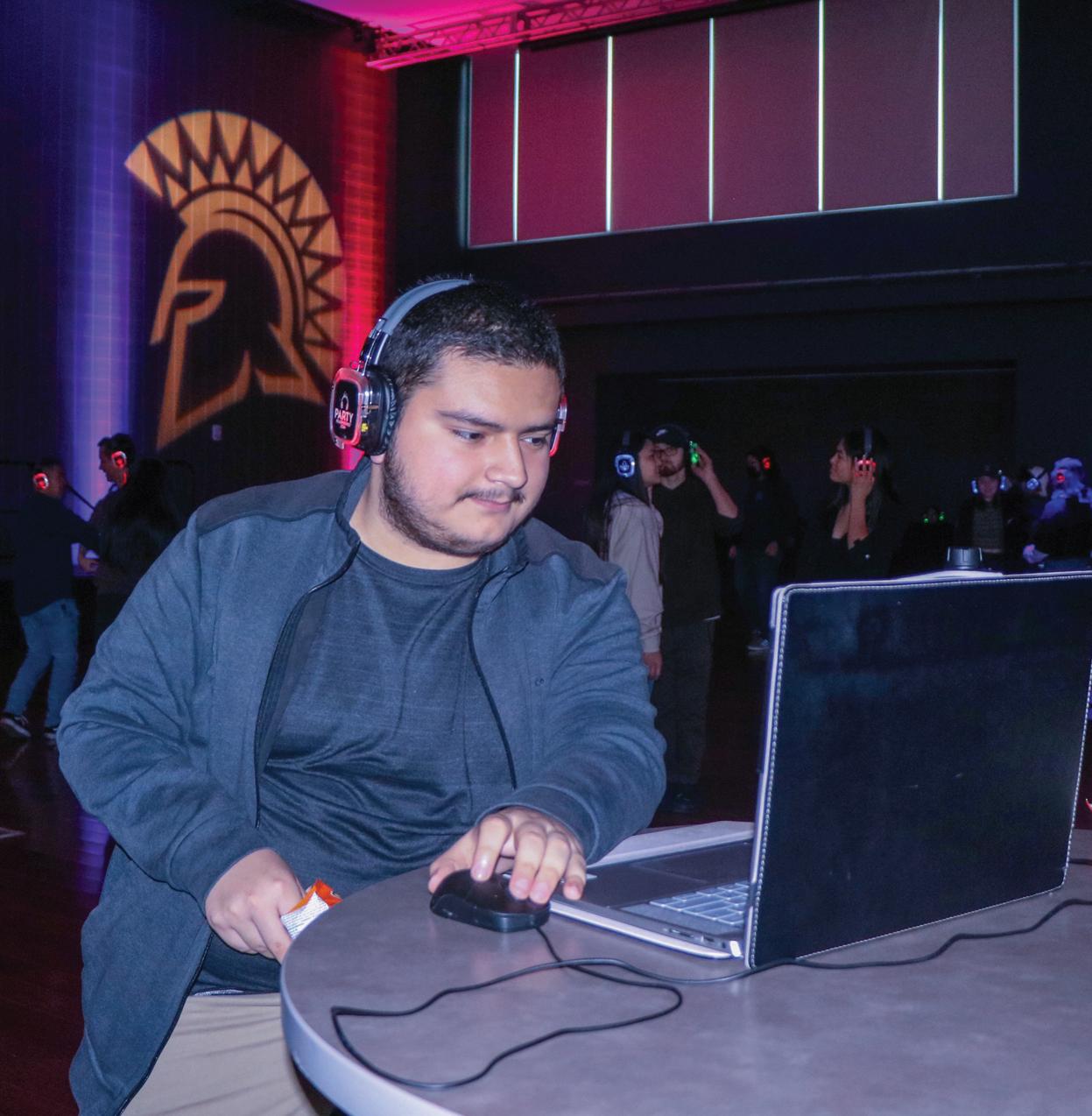
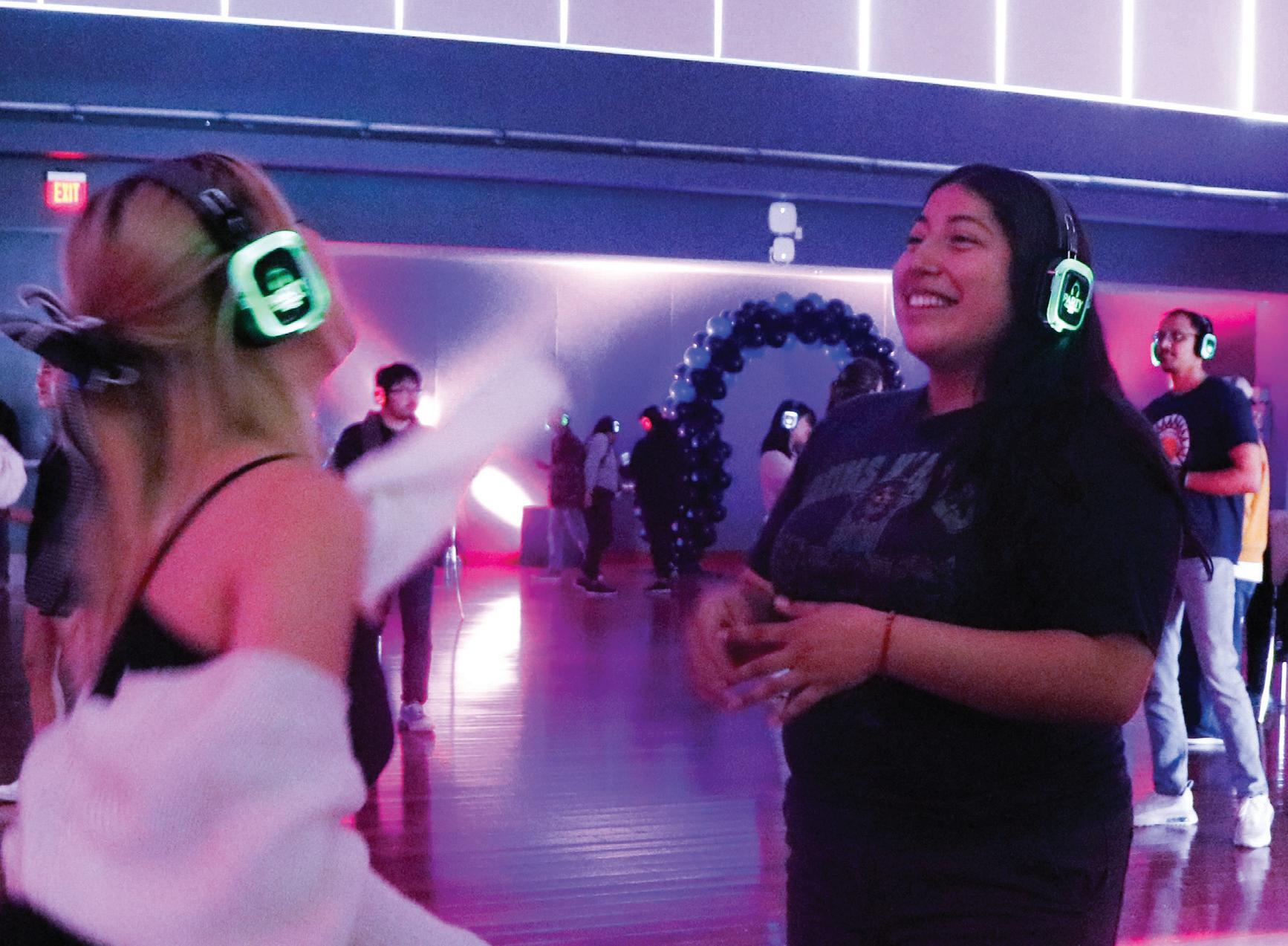
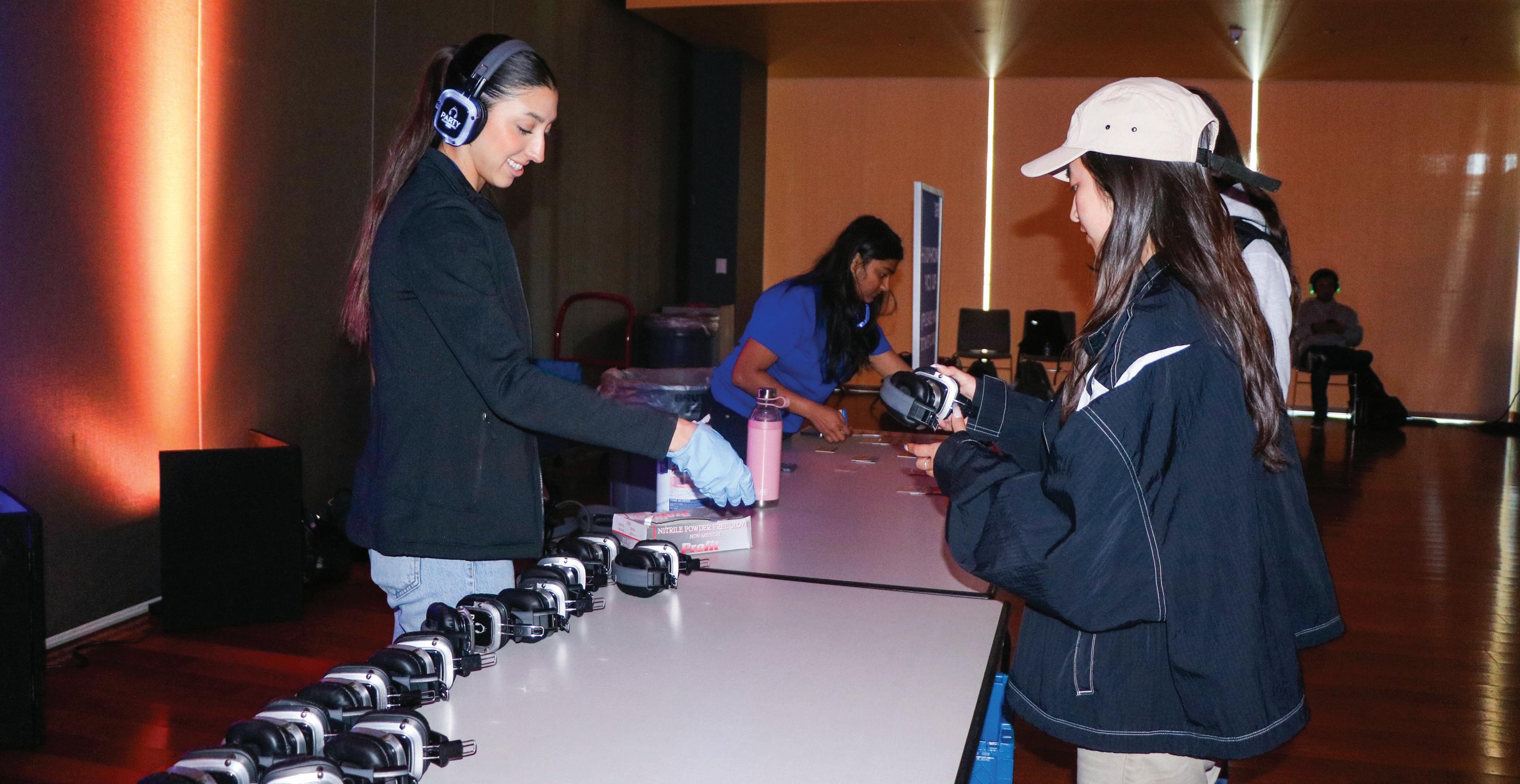
Spartans groove at Silent Disco












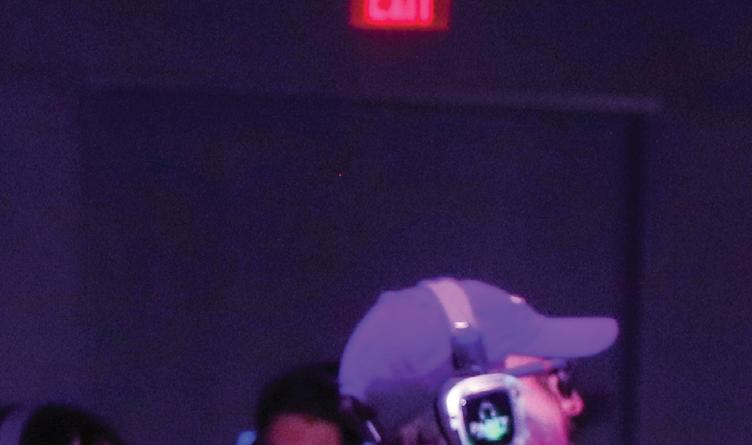

sjsunews.com/spartan_daily THURSDAY, APRIL 20, 2023 ARTS & ENTERTAINMENT 7
A group of students dances during Wednesday’s Silent Disco hosted by Student Union Inc. in the Student Union Ballroom.
Freshman Jesus Alvarez enjoys free snacks while listening to “EARFQUAKE” by Tyler the Creator.
Junior Kat Huang and sophomore Natalia Ramirez dance together to “One Kiss Is All It Takes” by Calvin Harris and Dua Lipa.
#1:
#2:
#3:
Event
students headphones for the Silent Disco.
#4:
coordinator Catilyn Montoya gives
DAILY 4 2 3 1 send a letter to the editor Letters to the Editor may be placed in the letters to the editor box in the Spartan Daily office in Dwight Bentel Hall, Room 209 or emailed to spartandaily@gmail.com to the attention of the Spartan Daily Opinion Editor. Letters to the Editor must contain the author’s name, year and major. Letters become property of the Spartan Daily and may be edited for clarity, grammar, libel and length. Only letters of 300 words or less will be considered for publication. Published opinions and advertisements do not necessarily reflect the views of the Spartan Daily, the School of Journalism and Mass Communication or SJSU. The Spartan Daily is a public forum.
PHOTOS
BY ALINA TA | SPARTAN

sjsunews.com/spartan_daily THURSDAY, APRIL 20, 2023 ADVERTISEMENT 8

sjsunews.com/spartan_daily THURSDAY, APRIL 20, 2023 ADVERTISEMENT 9
