Thursday, April 8, 2021
Volume 156 No. 28 SERVING SAN JOSE STATE UNIVERSITY SINCE 1934
WWW.SJSUNEWS.COM/SPARTAN_DAILY
City plans could threaten vendors Proposed redevelopments surrounding the San Jose Flea Market cause community concern and frustration By Jovanna Olivares SENIOR STAFF WRITER
Uncertainty and fear have left thousands of local vendors on edge over the possibility of displacement because of new city development plans, said Flor, a long-time vendor at the San Jose Flea Market. “[City leaders] call it progress, but really it’s just showing to our face that we are disposable to them and don’t matter,” said Flor in a phone call. She asked to be referred to by only her first name. The San Jose City Planning Commission voted during their March 24 Zoom meeting to delay sending plans to city councilmembers about replacing the flea market on Berryessa Road with residential and commercial units. The vote arose after flea market supporters voiced concerns over the effects redevelopment could have on the community without plans to relocate vendors. Many community members said the flea market is a focal point for entrepreneurship despite some vendors experiencing language, literacy and documentation barriers. “The Market is the heart of our
It is very important that the vendors are included in this [planning] process. If they are not at the table then they will be on the menu. Jesus Flores Latino Business Foundation Silicon Valley president
Latino Culture,” flea market vendor Lupe Verduzco said in Spanish during public comment. “The fact that some of you want to use our situation as a platform for a campaign scares me. We are not a political platform, we are people who fight to keep food on the tables of our family.” However, Pierluigi Oliverio, former District 6 councilmember and a current member of the San Jose Planning Commission, urged fellow leaders to FLEA MARKET | Page 2
JOVANNA OLIVARES | SPARTAN DAILY
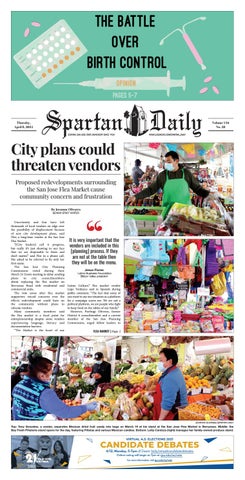
Top: Tony Gonzalez, a vendor, separates Mexican dried fruit candy into bags on March 19 at his stand at the San Jose Flea Market in Berryessa. Middle: the Bay Fresh Piñateria stand opens for the day, featuring Piñatas and various Mexican candies. Bottom: Letty Cardoza (right) manages her family-owned produce stand.
VIRTUAL A.S. ELECTIONS 2021
CANDIDATE DEBATES 4/12, Monday, 5-7pm // Zoom: bit.ly/virtualcandidatedebates Online voting will begin at 7pm at sjsu.edu/as/vote For more information, visit sjsu.edu/as/vote
2
sjsunews.com/spartan_daily
NEWS
THURSDAY, APRIL 8, 2021
INFOGRAPHIC BY PAULA PIVA; SOURCE: SAN JOSE PLANNING COMMISSION
FLEA MARKET Continued from page 1 support the development plan and not feel obligated to listen to public opinion. Oliverio was in office from 2007-16. “I can’t find any reason of merit to vote against the staff recommendation,” Oliverio said during the meeting. “There’s no legal obligation from a property owner to tenants. It’s unfair to make a property owner do something that is not legal [obligation].” San Jose Planning Commissioner Jorge Antonio Garcia proposed a motion to deny the redevelopment plan altogether and not present it to city council. Oliverio seconded the motion and said, “I’m going to second it for the purpose of the discussion because I’d really like to understand why you [the planning commission] legally think that we should deny this applicant.” The public hearing on the rezoning of the flea market was pushed to May 12 after a 6-1 motion tabled the discussion. After the May 12 meeting, the item will move to San Jose City Council if approved by the planning commission.
Flea
market history redevelopment plans
and
The flea market, also known as La Pulga, was established by George Bumb Sr. in 1960, according to a 1999 Metroactive article, a Silicon Valley nightlife, music, clubs, arts and culture website.
There’s no legal obligation from a property owner to tenants. It’s unfair to make a property owner do something that is not legal [obligation]. Pierluigi Oliverio San Jose Planning Commission member
Bumb first created the flea market as a family-owned business with about 20 vendors, and it rapidly grew in popularity and eventually became the nation’s largest open air market in 1996, according to the same article. The flea market temporarily closed last spring to adhere to the county’s social distancing guidelines and stay-at-home orders. In May 2020 the market reopened and now operates Wednesday, Friday, Saturday and Sunday from 8 a.m. to 5 p.m. The plan to redevelop the flea market is part of the city’s Berryessa BART Urban Village Plan, which will turn the property into an urban village. Urban villages are “walkable, bicycle-friendly, transit-oriented mixed use settings that provide both housing and jobs,” according to the San Jose Urban Villages webpage. The urban village plan stems from the city’s Envision San Jose 2040 General Plan, which was adopted in November 2011 and aims to redevelop Downtown San Jose and existing residential neighborhoods. This plan would implement several urban villages in the city by 2040 and was amended by city council on March 16, 2020. The urban village plan should create more than 14,000 new jobs and councilmembers believe more development around the Berryessa BART station will generate economic growth, according to the 2040 General Plan presentation during the March 24 planning commission meeting. The plan includes building more high-density housing units that target the city’s affordable housing crisis. High-density housing units are single-family houses on small lots, townhouses and apartments in densely-populated areas. Erik Schoennauer, a Bumb family representative, said more than 130,000 square feet of commercial space on the flea market’s north side was reduced to make room for the BART and apartments built in 2019, cutting its original size in half. “In fact, half the project is already built,” Schoennauer said during the
meeting. “North of Berryessa Road, we’ve constructed 1,000 residential units and we’re just completing the shopping center, anchored by Safeway, CVS and Chase Bank here.” Planning commission members suggested the Bumb family and city staff meet with the Berryessa Flea Market Vendors Association (BFVA), a union and advocacy group for the flea market, to discuss a location alternative and come to a consensus. Commission chair Mariel Caballero suggested a Community Benefits Agreement (CBA), a contract signed by community groups and real estate developers, to be signed between the BFVA and planning commission. CBAs require developers to provide specific amenities and/or mitigations to the local community or neighborhoods that are being redeveloped, according to the For Working Families Community Benefits webpage. The Partnership For Working Families is a network of regional advocacy organizations that support solutions to U.S. economic and environmental problems, according to its website.
Vendors
demand recognition and inclusion
Most community members and vendors were unaware of the March 24 meeting and other redevelopment plans, which left many feeling unvalued, Flor said. Some Spanish-speaking community members said they urged councilmembers to reject or postpone plans until vendors are included in the conversation and offered a relocation plan. “It is very important that the vendors are included in this [planning] process,” said Jesus Flores, president of the Latino Business Foundation Silicon Valley, during the meeting. “If they are not at the table then they will be on the menu.” Latino Business Foundation Silicon Valley is a San Jose nonprofit that supports small businesses and organizations in the Bay Area. Many community members said their concerns were inaccurately translated by city staff, making the vendors feel unheard.
The fact that some of you want to use our situation as a platform for a campaign scares me. We are not a political platform, we are people who fight to keep food on the tables of our family. Lupe Verduzco flea market vendor
“I raised my hand again because my comment was not translated. I want to bring awareness about that,” said Luis, a community member who originally spoke in Spanish during the meeting and didn’t provide a last name. Flor said she was speaking at the meeting for her father, who’s 66 and only speaks Spanish. “He, like most vendors here, only speaks one language and it’s not English,” Flor said in a phone call after the meeting. Although the meeting lasted about six hours, community members voiced additional frustration at some councilmembers who didn’t have their cameras on for a majority of the Zoom meeting. “In class, for my Zoom meeting, I can see everybody at all times and even when someone is sharing the screen, I can still see everybody,” said San Jose resident Lupe, whose last name was not given, during the March 24 meeting. “Right now I don’t see the commissioners faces and I think that is a huge problem because we can’t tell if somebody else is on their phone.” Lupe said the way vendors and community members are being treated is “truly disrespectful.”
Follow Jovanna on Twitter @joo_zunigaa
Crime Blotter Assisted robbery March 18, 11:49 p.m. at Science Building Adult Arrest Weapon possesion on campus March 20, 1:51 a.m. at Spartan Stadium Adult Arrest
Hit and run with property damage March 25, 9:33 a.m. at Kappa Delta Adult Arrest Sexual Battery March 26, 5:16 p.m. at East San Carlos and South 9th streets Juvenile Arrest
Burglary March 26, 11:44 p.m. at Student Union Adult Arrest
Burglary April 1, 7:30 a.m. at Spartan Stadium Information Only
Burglary March 30, 8:30 p.m. at Sigma Chi fraternity Active Investigation
Assault with intent to rape April 1, 12:17 p.m. at West Garage Adult Arrest
sjsunews.com/spartan_daily
ARTS & ENTERTAINMENT
THURSDAY, APRIL 8, 2021
3
ANALYSIS
Viewers trade reality for fantasy By Christina Casillas STAFF WRITER
While some people are still limiting contact with the outside world, they’ve found a way to escape the monotony of stale pandemic life by immersing themselves into the experiences of television and film characters. Communication studies junior Kim Ngo, found herself watching a number of time period TV shows and movies during the pandemic and allowed the allure of a wealthy lifestyle and historical scapes to influence her viewing habits. While watching the opulence of royal families, such as Netflix’s “The Crown,” Ngo said she felt contempt and anger toward the privilege and wealth of the characters but was simultaneously intrigued. “Another part of me can’t help but feel really fascinated by watching how the elite few live,” Ngo said in a phone interview. “It’s almost addicting to see what their life is like, so it’s definitely escapism.” According to MerriamWebster, escapism is the “habitual diversion of the mind to purely imaginative activity or entertainment as an escape from reality or routine.”
ILLUSTRATION BY BIANCA RADER
Ngo said she’s drawn to shows she finds aesthetically pleasing, such as “The Borgias” and “Medici,” but she’s not a fan of the excessive lechery laced throughout them. “I think I gravitate towards series and films that are more historically accurate, [the films and TV shows that] talk about political tensions,” Ngo said. SJSU film and theater lecturer Drew Todd said during generally heavy times people have historically sought on-screen entertainment that reflects day-to-day life. “I think many assume movies/series that are ‘escapist’ do best in such moments, where escapism refers to upbeat films, whether musicals, fantasies, comedies,
Todd also said there are historical and cultural elements that contribute to the All these cartoons that entrancing nature of certain films and shows. A show’s I’ve been watching, intrigue ultimately depends it puts me in a really on personal taste. nostalgic place and “I would answer more kind of returns me to assertively that it’s a mixture of elements – style and a simpler time and storytelling, characters, stars, it’s nice, especially etc. – but that mixture times like this where I genres, changes depending upon the can’t really go out that context of production and much. reception,” Todd said. Design studies senior Julian Kern Design studies senior Julian Kern watched the Matrix trilogy during the etc.,” Todd said in an email. pandemic and said the movies “If we look back at the 1930s, are reflections of the era they came from. following in the wake of the “I don’t know if it’s much of Great Depression, there are a thing now but, like, at least many movies that reflect the during that period people hard times in their plots.” were expected to be working
CLASSIFIEDS CROSSWORD PUZZLE
SUDOKU PUZZLE Complete the grid so that every row, column and 3x3 box contains every digit from 1 to 9 inclusively.
in cubicle desks their whole career,” Kern said over the phone. “It feels a little outdated because nowadays jobs are trying to become less of that.” Kern also said the TV shows and movies he watches are comforting to him, including Marvel movies and cartoons from his childhood. “All these cartoons that I’ve been watching, it puts me in a really nostalgic place and kind of returns me to a simpler time,” Kern said. “And it’s nice, especially times like this where I can’t really go out that much.” While a return to normal life is slow and tedious, the threat of new variants and possibility of spreading and contracting the coronavirus remains. Media provides an escape from reality into nostalgic times and exotic lands without requiring consumers to leave the safety of their homes. Film and TV are meant to divert the attention of viewers and during difficult times, the importance of distraction is invaluable.
Follow Christina on Twitter @christina_casi
JOKIN’ AROUND What is a vampire’s favorite fruit?
A blood orange.
SOLUTIONS SOLUTIONS
ACROSS 1. Type of beer 6. Indian music 10. Tins 14. Drink garnish 15. Twin sister of Ares 16. Biblical garden 17. Aromatic seeds 18. Canvas 19. Exploded star 20. Unappeasable 22. Journey 23. 53 in Roman numerals 24. Chipper 26. Not highs 30. Ribonucleic acid 31. 2,000 pounds 32. Death notice 33. 1/100th of a dollar 35. Follow as a result 39. Fashionable 41. Least difficult 43. Leaky 44. Found on most beaches 46. District 47. Historic period 49. What we sleep on 50. “___ we forget”
51. The first event in a series 54. Ends a prayer 56. Street 57. Permissiveness 63. As well 64. Press 65. Metaphor or hyperbole 66. Place 67. Dispatched 68. Ballet skirts 69. Mats of grass 70. Foot digits 71. It makes dough rise DOWN 1. Hubs 2. Astringent 3. Hobbling gait 4. Wicked 5. Kidney-related 6. Advanced fees 7. High-spirited horse 8. Lass 9. View 10. 100th anniversary 11. Love intensely 12. Not a single time 13. Serpentine
21. Approximately 25. Garden tools 26. Cuts off 27. Double-reed woodwind 28. Sponge 29. Prodigious 34. Run-down apartment houses 36. Arid 37. Applications 38. French for “State” 40. Stringed instrument 42. Viper 45. Type of shellfish 48. A creative person 51. Not written exams 52. Infantile paralysis 53. Alleviated 55. Dapper 58. Chocolate cookie 59. Not false 60. Greek letter 61. Creative work 62. Where a bird lives
4/7/2021
PLACE YOUR AD HERE Place your Classified Ads Online at Spartandaily. CampusAve.com
Contact us at 408.924.3270 or email us at
SpartanDailyAdvertising @gmail.com
Our office at DBH 213 is closed because of the pandemic.
4
sjsunews.com/spartan_daily
SPORTS
THURSDAY, APRIL 8, 2021
PHOTO COURTESY OF HANNAH HALL
Former San Jose State women’s soccer player Hannah Hall, who left the team after a 2019 injury, said her time and experience playing a collegiate sport set her up for future success.
Athletes call for more financial freedom By Madilynne Medina STAFF WRITER
Over the course of several weeks, the trending Twitter hashtag #NotNCAAProperty has called for change in the National Collegiate Athletic Association’s treatment of student-athletes. Several athletes competing in the NCAA men’s basketball March Madness tournament began protesting the organization’s restrictions on athletes using their own names, images and likeness for monetary use, according to a March 18 Washington Post article. While the NCAA does offer many scholarships to student-athletes as a means of compensation, kinesiology senior and women’s soccer defender Lauola Amanoni explained this isn’t enough. “I’ve heard ‘just because you’re on a scholarship you should be fine,’ but it’s not enough,” Amanoni said. “I have to plan financially just to be OK.” She said during her junior year of college, she had to be a full-time athlete, student and work a part-time job to be economically stable. Kinesiology freshman and swimming and diving athlete Alice Ciobanu said although she’s on scholarship, many of her athletic peers outside of San Jose State don’t have the same luxury. She said she’s seen a majority of her peers outside of SJSU who aren’t on scholarships unable to work because of time-consuming practices which cause them to take out an excessive amount of loans. “The world is changing, society is changing and prices are going up,” Ciobanu said. “I feel like especially if we are only confined to our sports and academics, we should get some compensation. Especially for those who are not on scholarships and have to pay for themselves.” According to the NCAA website, the organization’s member-led mission is “dedicated to the well-being and lifelong success of college athletes.” However, Ciobanu said being unable to accept brand
If the NCAA could do anything, they should at least allow us to accept brand deals which would allow us to branch out and invest in our future.
Alice Ciobanu swimming and diving athlete
deals and ambassador opportunities, especially when related to student-athletes’ majors, keeps them restricted only to their sports. “If the NCAA could do anything, they should at least allow us to accept brand deals which would allow us to branch out and invest in our future,” Ciobanu said. According to NCAA regulations, athletes aren’t eligible for college sports if they accept pay for promoting a product or service or if they allow their names or pictures to be used for a company’s promotion. College basketball players Jordan Bohannon from the University of Iowa, Geo Baker of Rutgers University and Isaiah Livers from the University of Michigan have led the student-athlete protest. They called a meeting with state and federal lawmakers to enact change by July 1, according to a March 18 New York Times article. The report mentioned in the article stated athletes’ main focus at the moment would be a follow-up on a vote that was delayed in the last days of former president Donald Trump’s administration. It would potentially loosen restrictions on athlete’s ability to monetize their fame. The inability to monetize personal work is a nationwide struggle among student-athletes. Ciobanu drew a connection to famous TikTok influencer Sedona Prince, a University of Oregon women’s basketball player who is unable to accept any of her earned money on the platform because of NCAA regulations. She said Prince’s creator fund would be worth a considerable amount of money given her account has 1.7 million followers. Although many fans find the struggle among student-athletes disheartening, many players still pursue their athletic endeavors because of several benefits and passion for their sports. Amanoni said despite the SJSU women’s soccer program not gaining as much revenue and publicity as sports with larger programs such as football, the community has tried its best to assist each other. “As much as I would want to have the same benefits as football, we just don’t generate as much money,” Amanoni said. “However, the football program is very generous and they give us a lot of food and extras for our team, which I really appreciate.” Communication studies junior and former SJSU women’s soccer player Hannah Hall said she’s appreciative of the experience she received. Hall is a medically retired athlete but still remains on scholarship. Her goal is to work in the sports industry, so networking and building connections have always been a meaningful experience to her despite being a nonpaid athlete. “I am a firm believer that hard work pays off,” Hall said. “In most jobs, you have to start from the bottom and rise your way up. Similar to an athlete who is on the bench
ABOUT
EDITORIAL STAFF
The Spartan Daily prides itself on being the San Jose State community’s top news source. New issues are published every Tuesday, Wednesday and Thursday throughout the academic year and online content updated daily.
EXECUTIVE EDITOR ERICA LIZARRAGO
The Spartan Daily is written and published by San Jose State students as an expression of their First Amendment rights.
ASSISTANT NEWS EDITOR STEPHANIE LAM
Reader feedback may be submitted as letters to the editor or online comments.
MANAGING EDITOR OLIVIA GERBER EXECUTIVE PRODUCER SAMANTHA HERRERA NEWS EDITOR BRYANNA BARTLETT
A&E EDITOR FELIX OLIVEROS OPINION EDITOR LAURA FIELDS SPORTS EDITOR ALEXANDRA SHEZIFI SOCIAL MEDIA EDITOR KATHRYN HOEDT
PHOTO EDITOR SANDRA SANTOS-CRUZ STAFF PHOTOGRAPHERS BLUE NGUYEN YANN LAPNET YAMI SUN COPY EDITORS HAILEY FARGO ISALIA GALLO REBECCA LEE SAVANNAH NATIVIDAD ALAN BAEZ KAH MUN CHIA GRAPHICS EDITORS NICK YBARRA HANZ PACHECO LINDSAY VILLAMOR PAULA PIVA AUDREY TSENG YUE XIN BIANCA RADER RYAN JOHNSON DAISHA SHERMAN
SENIOR STAFF WRITERS RUTH NOEMI AGUILAR CHRISTOPHER PADILLA SHRUTHI LAKSHMANAN JOVANNA OLIVARES CHRISTIAN TRUJANO JESUS TELLITUD STAFF WRITERS JAMIE BENNETT CHRISTINA CASILLAS SARAH DWYER MADISON FAGUNDES ROYVI HERNANDEZ GIORGINA LAUREL MADILYNNE MEDINA JACQUELINE VELA PRODUCTION CHIEF MIKE CORPOS NEWS ADVISER RICHARD CRAIG
I’ve heard ‘just because you’re on a scholarship you should be fine,’ but it’s not enough. I have to plan Lauola Amanoni financially just to women’s soccer defender be OK. wanting to get minutes on the field, you must work your way up.” As the Michigan basketball players and other student-athletes across the NCAA continue to advocate for change, new developments regarding their rights could surface depending on the results of the current movement.
Follow Madilynne on Twitter @madilynneee
PHOTO COURTESY OF LAUOLA AMANONI
SJSU women’s soccer defender Lauola Amanoni balanced her sport and job to maintain financial stability during her junior year.
ADVERTISING STAFF ADVERTISING DIRECTOR MIA WICKS CREATIVE DIRECTOR JOHN BRICKER ADVERTISING REPS ABAS ALTUWARISH ASHLEY BARCELON BRANDON VU DONOVAN FRANCIS ENSIYAH SYED ISABELLA VICTORIA HAGGERTY JOHAN ROMANI-CACERES JOSHUA TORRES JUAN TAPIA ZAVALA KENNETH TRIEU LINH LAM LINH THIEU MOISES CARATACHEA SAM LEE SEAN MARTIN
SEVERIANO MENDEZ YULIAN FRANKIV ADVERTISING ADVISER TIM HENDRICK BUSINESS MANAGER CINDY LUU
CONTACT US EDITORIAL – MAIN TELEPHONE: (408) 924-3821 EMAIL: spartandaily@gmail.com
ADVERTISING – TELEPHONE: 408-924-3240
EMAIL: spartandailyadvertising @gmail.com CORRECTIONS POLICY The Spartan Daily corrects all significant errors that are brought to our attention. If you suspect we have made such an error, please send an email to spartandaily@gmail.com.
EDITORIAL POLICY Columns are the opinion of individual writers and not that of the Spartan Daily. Editorials reflect the majority opinion of the Editorial Board, which is made up of student editors.
5
sjsunews.com/spartan_daily
sjsunews.com/spartan_daily
OPINION
THURSDAY, APRIL 8, 2021
THURSDAY, APRIL 8, 2021
6
Finding freedom from a painful cycle
Doctor’s neglect almost ruined my life
minute. Some side effects include headaches, nausea, sore breasts, change of period flow and spotting, also according to Planned Parenthood. Being young and immature, I would consistently forget to take the pill, which caused it to be less effective. Not to mention I experienced one huge side effect: weight gain. I immediately wanted to stop using the pill because in my 15-year-old head, gaining a little weight was a bigger crisis than being in agonizing pain every month. So I switched up my birth control and tried the NuvaRing, which I loved. The NuvaRing is a small, plastic circular ring inserted into the vagina after the user’s period every month and is removed before menstruation starts. It prevents pregnancy by releasing hormones into the body, according to Planned Parenthood. I was a bit intimidated by the NuvaRing at first and was honestly grossed out to shove it up my vagina, but I soon realized it’s a great birth control method.
When doctors don’t respect our wishes, they imply we’re incapable of assessing our own bodies and that we aren’t in control of what happens to them either.
Samantha Herrera EXECUTIVE PRODUCER
I remember being curled up on my cold bathroom floor holding my stomach, crying while gasping for air and begging God to rip my uterus out so the pain would finally stop. It might seem dramatic, but that was the reality of my menstrual cycle for five days every month. My only escape would be if I was drugged up on pain pills, living out those five days in a haze of artificial relief.
Having hormones pumped into my body not only helped control my awful period pain, but also cleared my acne, maintained my weight and allowed me to practice safe sex when I was first exploring my sexuality. The pain was so overbearing when I turned 15 that I couldn’t take it anymore. My doctor suggested I try birth control and it was one of the best things I’ve ever done. My birth control journey began with taking the pill. The pill is 91-99% effective against pregnancy if you maintain the medication’s strict schedule, according to Planned Parenthood. The pill is taken once a day at the same time down to the
RESULTS ARE FROM 344 PEOPLE SURVEYED ON INSTAGRAM.
Having hormones pumped into my body not only helped control my awful period pain, but also cleared my acne, maintained my weight and allowed me to practice safe sex when I was first exploring my sexuality. I experienced freedom within my own body for the first time and it was extremely liberating. However, all good things come to an end and so did my time on NuvaRing. I was about to take a leap into young adulthood and attend San Jose State six hours away from home and I knew I needed to switch to a more permanent birth control method. NuvaRing came one ring at a time and required me to go to the pharmacy once a month to pick up my prescription. As I moved away from home for the first
time in a completely new environment, I felt unprepared for a new prescription without my mom’s help. So after talking to my doctor, I decided to try Nexplanon. Nexplanon, known as “the implant,” is a thin, short rod that is inserted into the arm and prevents pregnancy up to five years, according to Planned Parenthood. I won’t lie, when Nexplanon was implanted into my arm it hurt tremendously and left me with extreme bruising for days. I could almost feel the overwhelming wave of hormones taking over those first few days and it changed the way I viewed my body at a crucial time when I was trying to understand myself. The implant came into my life at a period when I was
struggling with bouts of depression. I’m unsure whether it was the new wave of hormones running rampant through my body or that I was leaving for college, but I started to feel happy and
Madison Fagundes STAFF WRITER
Despite millions of women and people around the world using birth control, the violent side effects are rarely brought to light. Birth control isn’t inherently bad, but the struggles faced because of it often aren’t taken seriously and that needs to change.
After the pill was approved by the U.S. Food and Drug Administration in 1960, many women experienced similar and even worse side effects still felt today, according to a PBS American Experience article. The symptoms they suffered ranged
love myself again. Birth control gave me empowerment across all aspects of my life because I’m in control of my body and my mental health.
Follow Samantha on Twitter @sammiherreraa_
PAGE GRAPHICS BY LINDSAY VILLAMOR
from depression and mood swings to loss of vision, blood clots and death. According to the same article, 11 cisgender women were reported to have died from pill-related blood clots by 1962. When these women visited their doctors, their complaints weren’t taken seriously or were written off as an exaggeration. Some were even told it was the price they must pay for effective contraception. This disgusting negligence toward their pain seems barbaric, but it’s still a reality for many people today. I was about to graduate from high school when I was offered the Nexplanon arm implant through a free school program. I was told receiving the implant would be a smart decision because I could go to college without worrying about taking oral pills. It took me about three months to realize something was wrong with how the implant was interacting with my body. I was sick, continuously menstruating and losing weight rapidly. After great consideration, I decided it was time to remove it and turned to San Jose State’s Student Wellness Center for help. When I arrived at my appointment however, the doctor told me I wasn’t “sick enough” for her to remove it. I explained my ordeal and said I was desperate to have it removed. Despite my begging, she outright refused its removal. I went home and cried in defeat. After eight months on the implant, I finally had it removed at Planned Parenthood. I was so ill by then that my family wanted me to move back home from college. They described me as skeletal and sickly and said I didn’t look like the person I used to be. I’d lost more than 30 pounds, was sick to my stomach every day and my mental health was in the gutter. This could’ve been avoided if that first doctor had just taken me seriously. Sadly, stories like mine aren’t uncommon. In a March 1, 2019 HuffPost article, Karine Tessier and several others shared their stories of doctors not taking them seriously when they had complications with birth control. Tessier suffered with complications from intrauterine
RESULTS ARE FROM 322 PEOPLE SURVEYED ON INSTAGRAM.
devi devices (IUDs) for seven years before she found a doctor who listened to her and respected her wishes. She endu endured severe pain, cramps, hair loss and depression thro throughout her ordeal. D Doctors tried to diagnose and operate on Tessier for endo endometriosis, a painful disorder that affects the female repr reproductive organs, despite her asking them to remove the IUD I first. She had to switch her gynecologist twice
So many people’s lives are disrupted by birth control complications every day, yet we’re dismissed and made to feel like we’re crazy. befo before she convinced the third to remove it. Sh She said she felt instant relief after the IUD was rem removed and all of her symptoms subsided within 24 hours. h So many people’s lives are disrupted by birth control com complications every day, yet we’re dismissed and made to fe feel like we’re crazy. When doctors don’t respect our wish wishes, they imply we’re incapable of assessing our own bod bodies and that we aren’t in control of what happens to them either. There needs to be more research on treating or elim eliminating these side effects and doctors must listen to us. W We are the masters of our own bodies and we deserve to b be in full control.
Follow Madison on Twitter @maddxsonn
Abortion rates will drop with accessible contraception Preventing people from receiving free and affordable birth control is counterproductive in abortion prevention. If politicians wish to stop abortions, they must first help prevent unplanned pregnancies.
Jamie Bennett STAFF WRITER
Safe abortions are becoming more difficult for women to access and states that oppose the procedure should focus on preventing pregnancies by implementing policies to provide accessible birth control and resources to people who need them. We are currently at a cultural crossroads in the U.S. According to a 2016 study from the New England Journal of Medicine, 45% of pregnancies in the U.S. are unplanned and disproportionately affect low-income women. Abortions may be the only way some can prevent pregnancies, especially with many women lacking access to free or low-cost birth control. However, the right to an abortion has been fiercely debated in the U.S. Supreme Court over the past decade, particularly during the recent years of former president Donald Trump’s administration. The Supreme Court found restrictive abortion bans to be unconstitutional in 1973, ruling 7-2 in the landmark case Roe v. Wade. Politicians have tried bypassing Roe v. Wade by implementing Targeted Restrictions on Abortion Providers (TRAP) laws. These laws are so specific clinics don’t receive enough state funding to make changes and are forced to close down, according to a May 15, 2019, Business Insider article. TRAP laws include strict measurements on the size of procedure rooms, width of clinic corridors and regulations that would admit women to hospitals if complications arose. This is despite less than 0.5% of abortions resulting in complications that require a hospital visit. Laws similar to these prevent people from getting safe abortions and also from receiving other resources available at women’s clinics. “Politicians are taking a hatchet to the rights and freedoms of the very people they’re supposed to represent,” said Alexis McGill Johnson, president and chief executive of Planned Parenthood Federation of America, in a 2019 New York Times interview. Legislation restricting abortions is part of an effort to prevent women from accessing basic health care. Politicians are passing laws influenced by their morals and not with the ideals of their citizens in mind. Anti-abortion activists don’t stop at just limiting abortion. Some advocate for more restrictions on access to all birth control.
This culminated in a July 8, 2020, Supreme Court decision allowing employers to opt-out of women’s health provisions in the Affordable Care Act (ACA) for religious and moral reasons. The ACA provisions previously required employers to provide employees with contraceptives. Decisions such as these are ridiculous. Why should companies decide if employees have birth control access? That’s a private decision. The ACA currently provides people with birth control options including pills, implants, IUDs, the vaginal ring, a patch, a shot, internal condoms, diaphragms, cervical caps, tubal ligation (female sterilization) and emergency contraception, according to Planned Parenthood. Preventing people from receiving free and affordable birth control is counterproductive in abortion prevention. If politicians wish to stop abortions, they must first help prevent unplanned pregnancies. Colorado was one of the first states to test this idea and create a program allowing people to receive free and low-cost IUDs at health clinics, according to an Oct. 21, 2019, Colorado Sun article. Abortion rates dropped 10% in Colorado from 2014-17, according to Guttmacher Institute research. Some government officials rejoiced in the effectiveness of the programs in 2017. Teen birth rates fell 54% with a 64% drop in abortion rates among teens 15-19, according to a Nov. 30, 2017 Denver Post article. The state also avoided a hefty expense of $70 million by preventing labor and delivery costs, pediatric care, food stamps and child care, according to a 2017 Colorado Department of Public Health & Environment report. If programs like these were implemented around the United States, lawmakers would limit abortions while still allowing women to keep their body autonomy.
SOURCE: PLANNED PARENTHOOD. EFFECTIVENESS CAN CHANGE PLUS OR MINUS 5%.
Follow Jamie on Intsagram @j4mjam
sjsunews.com/spartan_daily
COUNTERPOINTS
THURSDAY, APRIL 8, 2021
7
ILLUSTRATION BY YUE XIN
Should men have a birth control pill option? Yes, men should have a role in family planning Christian Trujano SENIOR STAFF WRITER
After decades of relying on women to take birth control while men whine about wearing a simple condom, it’s time for us to take some responsibility. We need to be more open to the idea of male birth control. Women have endured different treatments to prevent pregnancies dating back to 1850 B.C., including inserting a honey and crocodile dung mixture into their vaginas, according to an Aug. 13, 2020 WebMD article. However throughout history, the responsibility of contraception and birth control has almost always fallen on cisgender women. Currently, the three most common birth control forms for females are: sterilization, the pill (which contains hormones that prevent pregnancies) and LARCs (long-acting reversible contraceptives). About 40% of pregnancies in the United States are unplanned, according to a April 20, 2019 UT Southwestern Medical Center article. This is partly because society unfairly dictates that cis women are primarily responsible for pregnancy prevention and family planning. In other words, it’s always the woman’s job to ensure she doesn’t get pregnant rather than put an equal role on the man when pregnancy happens. But as many of us know, men are dogs that have the critical thinking skills of a peanut. The lack of sexual responsibility from cisgender men is outright unfair to women. While men do have limited methods of contraception, a birth control option will make it easier for us to take control of our fertility, especially because the options we have now aren’t the most appealing. Vasectomies, or male sterilization, are potentially permanent and a little scary to many men. Condoms or pulling out during sex aren’t always effective and there is abstinence, but let’s face it, the average guy probably doesn’t even know what that word means. But more male birth control options could
Researchers are actively working to limit as many side effects as possible so males can be more responsible in their sex lives.
change that. Fertile males constantly make new sperm cells triggered by high testosterone levels, according to a March 26, 2019 BBC News article. The main issue with creating male birth control is that it would temporarily block the creation of new sperm cells without lowering hormone levels, creating severe side effects. However, researchers from The Los Angeles Biomedical Research Institute and the University of Washington are testing a new male birth control model, according to an April 2, 2018 Healthline article. The pill, called dimethandrolone undecanoate (DMAU), reduces male
The lack of sexual responsibility from cisgender men is outright unfair to women. hormones to amounts that are low enough to suppress sperm production. Researchers are actively working to limit as many side effects as possible so males can be more responsible in their sex lives. Dr. Stephanie Page, professor of medicine at the University of Washington School of Medicine and the study’s senior investigator, told Healthline in the article that “sexual functioning, libido, performance – our analysis of the reports we received showed no difference in sexual health between the men taking the pill and those on a placebo.” Many men are opening up to the idea of taking the pill if it’s developed with low side effects. Research shows many men would welcome a hormone-based male birth control pill with up to 83% saying they’d use it, according to a WebMD article reviewed on Aug. 13, 2020. But developing a safe, reliable and effective male birth control pill has been slow. Not only that, it raises the issue of whether women would trust men to take the pill. A 2011 survey from Anglia Ruskin University in the UK found 70 out of 134 women worry their male partner would forget to consume the pill. While commercial release of DMAU could take a decade or longer, it’s nice to see research pursuing new treatment options that promote shared accountability for contraception. And when the time comes when we do get the pill for men, it’s up to us to finally grow a pair and take some responsibility. If sex is on our minds, it’s only fair we work harder to ensure women don’t suffer from our lack of wanting to use a condom.
Follow Christian on Twitter @ChristianTruja2
No, women should control decisions about their bodies Laura Fields OPINION EDITOR
Since the birth control pill became available in the U.S. in 1960, cisgender women have had the luxury of deciding for themselves if or when they choose to become pregnant, a monumental shift in history. Pregnancy changes a woman from the inside out, transforming our bodies into life-giving vessels that surge with hormones to nurture and protect the life within us. It’s also women who traditionally raise children and receive blame when things go wrong. Creating male birth control pills would give the autonomy women achieved back to men. A contraceptive pill must be taken at the same time every day in order to be 99% effective, according to Planned Parenthood. How can women trust men to be responsible for taking a birth control pill daily when it’s already hard for them to factor it into their own lives? Also, what’s to say a man won’t lie and say he is taking the pill just to get into someone’s pants? Who will have to bear the consequences? Certainly not males. It’s not just behavioral tendencies that make male birth control more difficult to create. Females produce one egg a month while males produce millions of sperm. So it’s easier to stop females from producing one egg than it is to lower male’s sperm count enough to render them sterile, according to a Nov. 3, 2016 NPR article. “With women, you can take advantage of their normal monthly cycle with the birth control pill. There’s nothing equivalent to that in men,” the article continues. Male participants in a birth control study published in The Journal of Clinical Endocrinology and Metabolism
How can women trust men to be responsible for taking a birth control pill daily when it’s already hard for them to factor it into their own lives?
reported having severe acne and mood swings. Some reactions were so severe, multiple male participants opted out of the study. Why would otherwise healthy men put up with severe side effects just to protect their female partners from unwanted pregnancy? A March 23, 2018 Daily Wire article reports, “this male birth control pill will have the same side-effect on men as female contraceptives have on women: decreased libido,” meaning deceased levels of testosterone. So, heterosexual couples who try out the new pill might have trouble getting in the mood because of it.
Creating male birth control pills would give the autonomy women achieved back to men. Contraceptive use in college students is already spotty. A November 2009 study of students at a large northwestern U.S. university in the journal Sex Roles found that students’ heavy drinking influenced risky sexual behaviors, some resulting in unwanted pregnancy. When the risk of unprotected sex is so high during drunken encounters, women can’t rely on men to take a pill when condom use in these encounters alone is considered “non-normative.” My colleague mentions the current two forms of birth control for men: condoms and vasectomies and that there ought to be more safe, reversible options. The reason why there are limited birth control options for men is simply because males can’t become pregnant themselves. There are enough options for men on the market to prevent pregnancy. The variety of birth control options for people with a uterus, the individuals who inevitably bear the brunt of pregnancy, serve their purpose. A June 6, 2017 Study Breaks article says it all, “at the end of the day, birth control will never be the ‘shared responsibility’ of the feminist ideal.” It should only be up to women to take the reins regarding birth control. They alone can make effective decisions that could drastically alter their bodies and lives.
Follow Laura on Twitter @swimgirllaura
8
sjsunews.com/spartan_daily
ADVERTISEMENT
THURSDAY, APRIL 8, 2021
D I D YO U K N O W
Your first 2 years at Chabot College = $2,208. Then transfer to CSU/UC. Save $30,000 on your bachelor’s degree (approx.).
Invest in Register Today www.chabotcollege.edu