United Farm Workers spark talk of conditions
By Nikita Bankar SENIOR STAFF WRITER
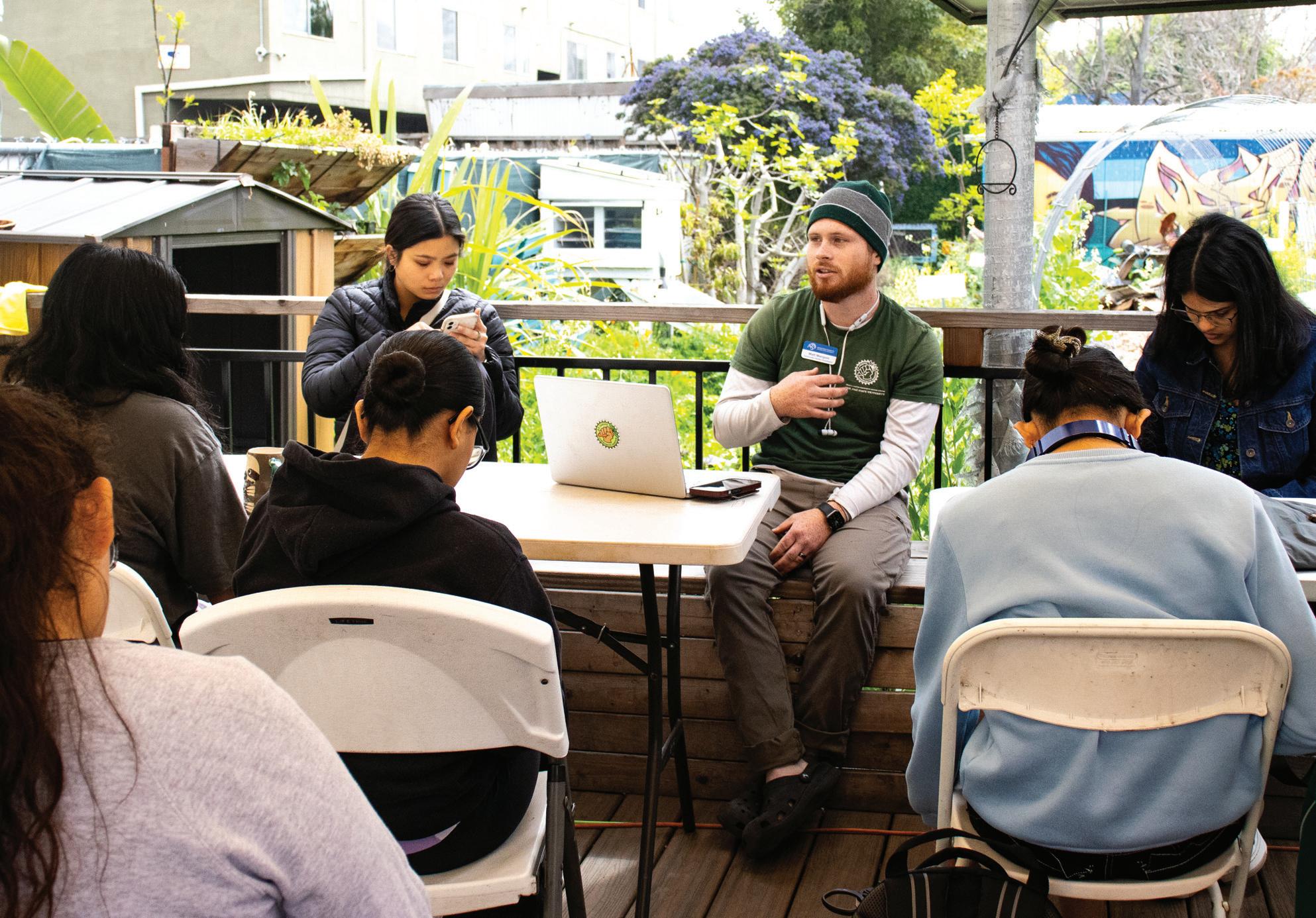
In hopes of sparking conversations and action surrounding the treatment and conditions of farmworkers, the San José State Campus Community Garden hosted a group discussion to talk about the importance of United Farm Workers on Tuesday afternoon.
United Farm Workers (UFW) was founded in 1962 by César Chávez, Dolores Huerta, Gilbert Padilla and other early organizers, and is the nation’s first enduring and largest farmworkers union, according to its website. The UFW continues organizing in major agricultural sectors, mainly in California, according to the same site.
During the discussion, students sat at benches, ate slices of vegan pizza from Sammy G’s Pizzeria and shared personal stories and opinions about farmworkers being taken advantage of, despite their tedious efforts.
Matthew Mangoni, Associated Students Community Garden coordinator, started the conversation by asking the group to consider where the food on their plates came from, leading to conversations about how to take action.
He said there are already great organizations that exist supporting farmworkers, but there is still very little public support or awareness for the workers that feed us all.
“The biggest thing I think that we can do is have more conversations and raise public awareness of the struggles farmworkers face, and make farm work more front of mind, instead of completely forgetting about,” he said. “Additionally, we can support the
organizations that already have close connections with farmworker communities.” Mangoni said farmworkers endure various obstacles while working including unstable citizenship status, language barriers, educational attainment and more.
“It is important specifically for us as college students to have these discussions, because we will all soon have influence in our circles as we start our careers, and we have a responsibility to change the current system for the better,” he said.
Farmworkers are paid less than even some of the lowest-paid workers in the U.S. labor force, according to the Economic Policy Institute. The majority of farm laborers in the United States are Latiné, while more than 40% are undocumented, according to the same site.
In 36 of the 50 states in this country, farmworkers are either excluded entirely or partially from workers’ compensation coverage for occupational injuries, illnesses and deaths, according to Farmworker Justice.
Environmental studies junior Jillian Clavette sat at a bench with multiple students in the corner of the garden, with a wooden fence and a collection of plants and vegetables growing behind her.
Clavette said it is important to start discussions about farmworker conditions with a simple question, to get individuals to start considering how they feel.
“I might just start with, ‘Have you ever thought about where your food comes from?’ ” Clavette said. “The Bay Area was the Valley of Heart’s Delight, and was huge for agricultural practices because of the soil.”
The southern region of the San Francisco Bay, now commonly known as Silicon Valley, was known as the Valley of Heart's Delight, a name inspired by the region's orchards and acres filled with ripening fruit, according to Business Insider.
Clavette also said a lot of people think about farmworkers and the way they are being treated.
“If I start off a conversation with a simple fun fact, I can then get the discussion moving and then eventually ask the person what they think,” she said. “It is important to talk about farmworker conditions not only here at San José State, but universally as well.”
Liberal studies alumna Megan Yee said farmworkers are the reason we are able to eat, and they are unseen in our day-to-day lives.
Yee said the garden has
done a great job providing a space for discussion.
The Campus Community Garden, created in 2014, provides the SJSU students, staff, faculty and the community with an opportunity to participate in food justice, gain accessibility to fresh and healthy food and engage in cultural exchange and cooperation, according to the SJSU website.
“Having these workshops and holding conversations with peers and family members is really helpful in spreading awareness and starting programs to help with workers’ healthcare and heat protection,” Yee said. “It is something that we as a society need to work on.”
She said finding common ground and sharing a similarity with someone can make it easier to discuss such a topic.
“If you and a friend are
both eating, you could say, ‘where do these tomatoes come from?’ ” she said. “You could also ask the person if they know anything about the conditions of farmworkers, and if they have any personal relatives who work in farms.”
The UFW has created dozens of contracts to protect thousands of farmworkers, including agreements with California based tomato, dairy, mushroom and winery companies, according to its website.
Many recent UFWsponsored laws and regulations protect all farm workers in California, including protection from death and fatigue from intense heat, according to the same site.
Nutritional science freshman Esha Dhillon said from the discussion in the garden, she was able to learn more about ways in which
farmworkers are taken advantage of.
“It is so important to speak with others in open spaces like these, so we can not only understand one another but also raise awareness about something that is not really highlighted,” Dhillon said. “These people are how we get our food, which is why they need to be recognized.”
Mangoni said farmworker struggles are a large issue, which will not easily be disrupted or altered.
“However, there are a lot of people that want to make a change,” he said. “You can be part of that.”

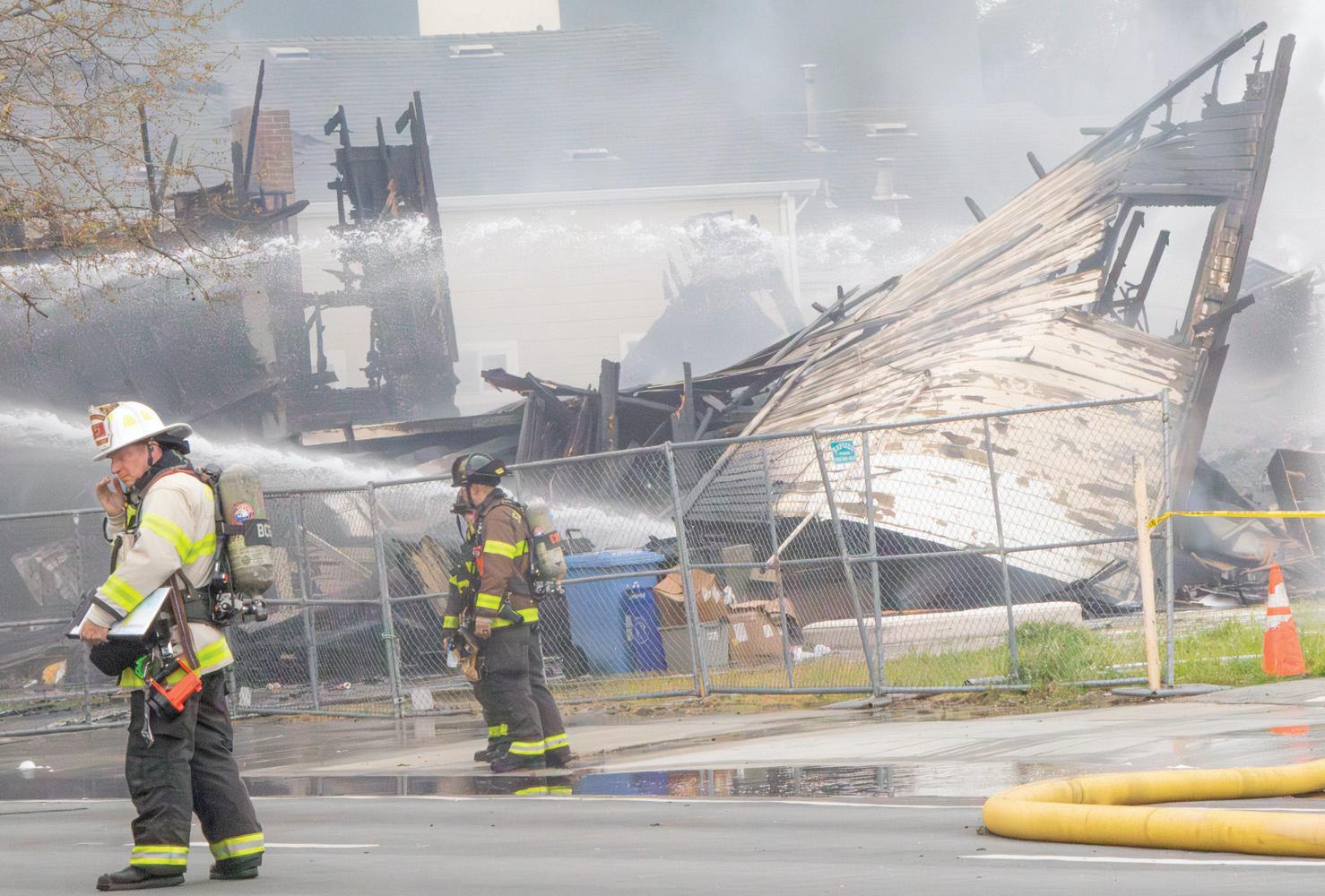
SERVING SAN JOSÉ STATE UNIVERSITY SINCE 1934 WWW.SJSUNEWS.COM/SPARTAN_DAILY Volume 162 No. 27 Wednesday, March 27, 2024 WINNER OF 2023 ASSOCIATED COLLEGIATE PRESS PACEMAKER AWARD, NEWSPAPER/NEWSMAGAZINE NAMED BEST CAMPUS NEWSPAPER IN CALIFORNIA FOR 2022 BY THE CALIFORNIA COLLEGE MEDIA ASSOCIATION AND CALIFORNIA NEWS PUBLISHERS ASSOCIATION KAYA HENKES-POWER | SPARTAN DAILY Firefighters spray water on a Victorian house fire on Monday afternoon in San José. NIKITA BANKAR | SPARTAN DAILY Matthew Mangoni, Associated Students Community Garden coordinator, starts a discussion on sustainability.
San José Fire Department (SJFD) arrived on the scene of a fire that started in a Victorian house at the intersection of Fourth Street and E St. James St in Downtown San José on Monday afternoon.
battalion chief Robert Culbertson
the cause of the fire is unknown.
SJFD
said
Johnson, San José citizen and witness of the scene, said she drove past the scene around noon.
lived in San José for 13 years and thinks the house
about 70 years old.
Johnson said she has
is
Nikita on Instagram
Follow Aaliyah on Instagram @aaliyahcr_
Follow
@nikitabankar
BridgeUSA debates political topics
By Jonathan Canas STAFF WRITER
BridgeUSA’s San Jośe State chapter hosted another Jubilee Spectrum-style event this Tuesday night in the Student Union and this week's topic was a “Red vs. Blue event” that focused on four different subjects.
A Jubilee Spectrum event is based off of the show, “Jubilee”, that aims to provoke understanding, according to its website.
BridgeUSA is a nonprofit organization that fights political division on campus, according to its website.
Climate change, the criminal justice system, U.S. healthcare and the Second Amendment were the topics of the night, according to the presentation.
Political science senior Sabrina Nabizada is the president and founder of BridgeSJSU and she said it is the spot for students to talk about political emotions in a healthy way.
“There aren't a lot of concrete ways for students to get involved politically, and I feel like a lot of that gets suppressed.” Nabizada said. “This offers a healthy outlet to discuss these sorts of issues in a productive
manner.”
With over 20 attendees, Nabizada opened up the event with an ice breaker before getting into the main subjects to be discussed.
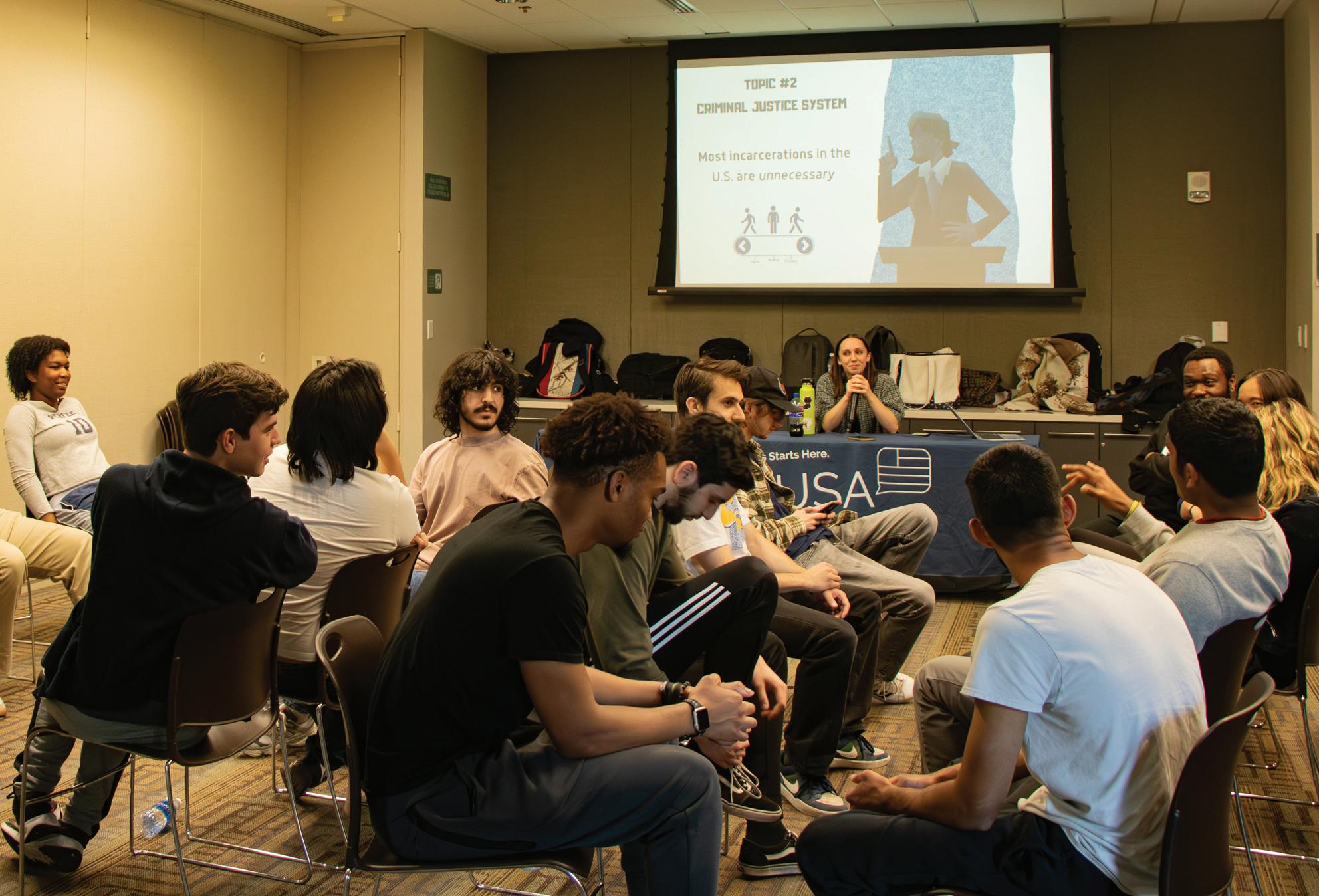
Chairs were divided into three sections with up to 10 seats each. The left side was for those who agree, the right side was for those who disagree and the middle section was for those who were neutral on the subject.
Director of outreach and applied math sophomore Margot Catrini led the conversation on the first topic, climate change.
Catrini ignited the conversation by showing a
slide to the crowd and said, “Do corporations have a social responsibility to keep the environment clean?”
Then everyone went to their respective side of the room.
Current Bridge member and communications sophomore Samantha Sternstein said the climate change topics were her favorite of the night.
“I really loved talking about climate change because it's a really important topic to me,” Sternstein said.
Nabazida said Sternstein will be the next director of outreach and Catrini will be
filling in as president upon her graduation this spring.
Strenstein said the importance of these events is so students have the platform to speak on political subjects.
“I think what intimidates
I think it’s valuable to assess your own point of view outside of any echo chambers where people already agree with you.
Joey Hyder Senior
sociology
member of the outreach committee
people about politics is the argument and that there’s somebody on the other side waiting to attack,” Strenstein said. “With this, it's more of an open forum and people can say what they feel and it's all respected.”
When Catrini asked the group about whether or not California should abolish the death penalty people shot out of their seats and moved to either the left, middle or right to discuss with their new groups.
The three topics Catrini shared were about the death penalty, healthcare and accountability for parents who raised children that committed mass shootings.
A majority of the students
in the room took the chance to share their opinion and thoughts on each of the discussion points.
“You do get a little bit of heated moments where people get passionate about what they're talking about but it's always respectful and at the end of the day we can all be friends afterwards,” said Joey Hyder, a senior majoring in sociology and a member of the outreach committee.
Hyder said BridgeSJSU has been learning from these events and finding new things they could try out. He said he wants to work on doing more research and gaining more background information on these types of topics.
“I feel like it's hard if you don't know the exact data. but it's fun to entertain the theoretical,” Hyder said.
Hyder said he stumbled upon one of these meetings a year and a half ago and has been coming consistently ever since.
“I think it's valuable to assess your own point of view outside of any echo chambers where people already agree with you,” Hyder said. “Hearing some opposing points of view is always valuable to bring new ideas to your attention and help you understand the world better.

sjsunews.com/spartan_daily WEDNESDAY, MARCH 27, 2024 NEWS 2
JONATHAN CANAS | SPARTAN DAILY
BridgeUSA club members turn their attention to a student speaking on the right side of the room on Tuesday.
Follow the Spartan Daily on Instagram @SpartanDaily
in
majoring
and
Childhood horror stories are revealed
By Kaya Henkes-Power STAFF WRITER
A piece of my childhood died last Monday with the release of the docu-series “Quiet on Set: The Dark Side of Kids TV”.
The chilling reality about one of my childhood favorite television networks, Nickelodeon, unraveled in four different episodes each a little over 40 minutes.
The docu-series weaves a tale of horrors with the stories of former employees, child stars, parents and the support of two journalists.
Directors Mary Roberston and Emma Schwartz set up these interviews in a way that makes it easy for the audience to follow.
The first episode of the documentary establishes the professional dynamic of actors and writers on the iconic ‘90s and 2000s show, “The Amanda Show”.
Journalists Kate Taylor and Scaachi Koul guide the audience through the intricacies of this particular story.
The audience learns the beginnings of Dan Schneider, Nickelodeon’s most memorable producer and screenwriter.
Shows that came from the mind of Schneider are “Drake and Josh”, “The Amanda Show”, “iCarly”, and “Victorious”.
The documentary provides the story behind who Schneider was and initially establishes him as a well-liked man.
Like many documentaries
though, this beloved and funny man would evolve into someone who was less than desirable to be around.
This helped to show the audience that there were warning signs of maltreatment and how culture enabled this behavior by normalizing patterns of harassing behavior early on.
Similarly, this revealed that the environment created by Schneider didn’t allow for anyone to express their discomfort.
Two screenwriters, Jenny Kilgen and Christy Stratton, who were the only two female writers for “The Amanda Show”, described their experience of the work environment.
“He could literally be nice and then mean and then nice and then mean, like, throughout the day,” Kilgen said.
I felt my stomach tighten and squeeze as Kilgen and Stratton recounted the harassment they endured from Schneider.
Kilgen recounted an experience about how Schneider would send messages to employees to say out loud.
“Scream ‘hammers’ and you’d scream it,” Kilgen said. “Then it would be more degrading, like, scream ‘I’m an idiot’ or ‘slut’.”
Kyle Sullivan, a former cast member for the Nickelodeon TV show “All That” described how directors got away with more.
“The show was full of these uncomfortable
sketches,” Sullivan said. “I think that Dan got a kick out of walking a line with that.”
As I got older, I saw online speculation about these sexual innuendos and the truth about Dan Schneider.
I feel like this docu-series helped to confirm these speculations from first-hand experiences of people who worked with him.
Seeing the scenes I watched as a child flash on screen with fresh eyes left me horrified and genuinely queasy.
The scenes and characters from the beloved TV shows I used to watch were tainted with hidden sexual jokes and stories that made me want a chemical bath.
A scene in particular that stuck with me was a young Ariana Grande sucking on her toes or squeezing a potato while squealing, “Come on, give up the juice”.
Looking at this as grown adult I truly felt my stomach drop and made me question the types of shows I was consuming.
There is a lot to unpack in this series with so many stories interwoven into the larger issue of protections being needed for child stars.
The docu-series calls into question so many aspects of my childhood. Who else was affected? How can we help these individuals and what can we do to prevent this in the future?
Another major vocal point of this docu-series were the stories about



two former Nickelodeon employees; Brian Peck and Jason Handy who were convicted of child sexual abuse within the same year.
Drake Bell’s story was probably one of the most shocking ones featured in this series, especially considering the archetype he played on air.
Drake Bell, a former Nickleodeon star, shared his story about the sexual abuse he endured at the hands of a production assistant.
Peck was an actor and dialogue coach loved among cast members, their parents and other crew members.
So much so that despite revealing to them he was pen pals with a pedophile and murderer, John Wayne Gacy, no one batted an eye.
Bell described what it was like going through these abusive experiences while also rising to fame and struggling to maintain his status as a role model.
“I didn’t know how
to process it and I think that led to a lot of selfdestruction and a lot of selfloathing,” Bell said.
I give kudos to the directors of this docu-series for being able to foster an environment where people felt comfortable enough to come forward to talk about such horrific memories.
At the same time, I wished they had touched on Bell’s charges of child endangerment related to accusations of him allegedly grooming a 12 year old in 2017, according to a 2024 Entertainment Weekly article.
I think it also speaks to a bigger issue about how sexual abuse victims can become perpetrators themselves.
A 2018 research article published by Cambridge University Press showed that there was a positive correlation between a perpetrator being a victim.
I fear that Bell’s story,

BY KAYA
which he bravely shared, will overshadow the crimes he committed against a young girl.
I wish certain things were further questioned, such as Dark Bell’s child endangerment charges, because it’s not just something that can be glossed over.
I think this series is a reminder that some of our favorite memories are connected to people who caused the most horrific pain for others.
“Quiet on Set: The Dark Side of Kids TV” further proves that we need further protections for child actors and hold individuals accountable for their crimes.
sjsunews.com/spartan_daily WEDNESDAY, MARCH 27, 2024 ARTS & ENTERTAINMENT 3 ACROSS 1. Gestation station? 5. "Common Sense" author 10. Word with square or bone 14. Early exile 15. John Wayne, by birth 16. Scat queen 17. Amos or Spelling 18. Superman feature 20. Surveying instruments 22. Like some private communities 23. ___-Day vitamins 24. Prior to, to Prior 26. Half a figure eight 27. Kama ___ 30. "SNL," e.g. 33. Heavy knock 34. View "Mamma Mia!" e.g. 38. Mrs. Chaplin 39. Federal IOU 41. "___ Camera" 42. Bring to an end gradually 44. Located around a central hub 45. Don't leave the house 47. ___ Haute 48. N.Y.C. hrs. 51. Some modern TVs 52. North Carolina college town 54. Front for wed 56. Daydream 60. Oil magnate 63. Pelvic bones 64. Of the ear 65. Light on one's feet 66. Sundae topping, perhaps 67. Pinstriped player, informally 68. More miffed 69. Emanate DOWN 1. Lightbulb unit 2. Pepe Le Pew's defense 3. Harelike rodent 4. Bach work, informally 5. Sprite 6. Of a trunk in a trunk 7. "As ___ saying ..." 8. A vote against 9. Part of SASE 10. Costa ___, Calif. 11. 12-pitch type 12. Emollient-producing plants 13. Wins, as a contract 19. "Can ___ Witness" (Marvin Gaye) 21. Variety of pea 24. First name in daredeviltry 25. Fishing device 27. Red, to a motorist 28. "I'm in trouble now!" 29. Game fish 31. Last Supper question 32. Eclipse feature, perhaps 35. It may be spiked 36. Poet Khayyam 37. Cloth ridge 39. Tailless amphibian 40. Pays the price for 43. Antiknock compound 44. Liquid add-on 46. Irritate 48. Relish 49. Nasal membranes 50. "Tom Sawyer" author 53. Cake section 55. "The Joy ___ Club" (Tan) 56. Prepare paint 57. Reunion member 58. Pasta choice 59. Daybreak direction 61. Explorer's need 62. Me Generation problem 5 7 1 9 2 8 9 3 5 7 6 4 7 1 2 5 5 1 7 9 4 8 6 8 2 7 CLASSIFIEDS CROSSWORD PUZZLE SUDOKU PUZZLE Complete the grid so that every row, column and 3x3 box contains every digit from 1 to 9 inclusively. JOKIN’ AROUND Why do seagulls live by the sea? Cause if they lived by the bay, they'd be bagels. PLACE YOUR AD HERE Contact our ad team via email for access to our media kit & any other advertising questions. SpartanDailyAdvertising @SJSU.edu SOLUTIONS 1 2 3 4 5 6 7 8 9 10 11 12 13 14 15 16 17 18 19 20 21 22 23 24 25 26 27 28 29 30 31 32 33 34 35 36 37 42 43 44 45 46 47 48 49 50 51 52 53 54 55 56 57 58 59 60 61 62 63 64 65 66 67 68 69 38 39 40 41 3 6 9 2 5 8 1 6 9 2 4 3 1 9 7 6 9 7 1 5 4 7 1 5 9 2 6 8 4 9 1 3 5 2 2 7 8 4 3 5 4 8 6 1 9 5 4 6 7 3 1 8 1 8 4 7 3 2 8 8 4 3 6 1 6 5 9 3 9 7 2 2 5 8 6 7 4 7 3 5 2 B A G S L A P S S A G A A T L A S I S E E O N U S W O O D P E C K E R R A R A D N A H U H P I L E S U P Y E T E R E H O I S T I R O N M O U N T A I N D U L L E S E L S E S D I U R A L S T E K I L L M D S R I P E S A Y A Y A P U T T E R A R O U N D D I N A R S S E C B S R A N K W E D G E I S S U E O N C E A L O E C U T I N P E E R R Y E S B E N T P S A N D Q S A I M A R C March 26
Follow Kaya on Instagram @kayuh.h
DOCU-SERIES REVIEW
GRAPHIC
HENKES-POWER
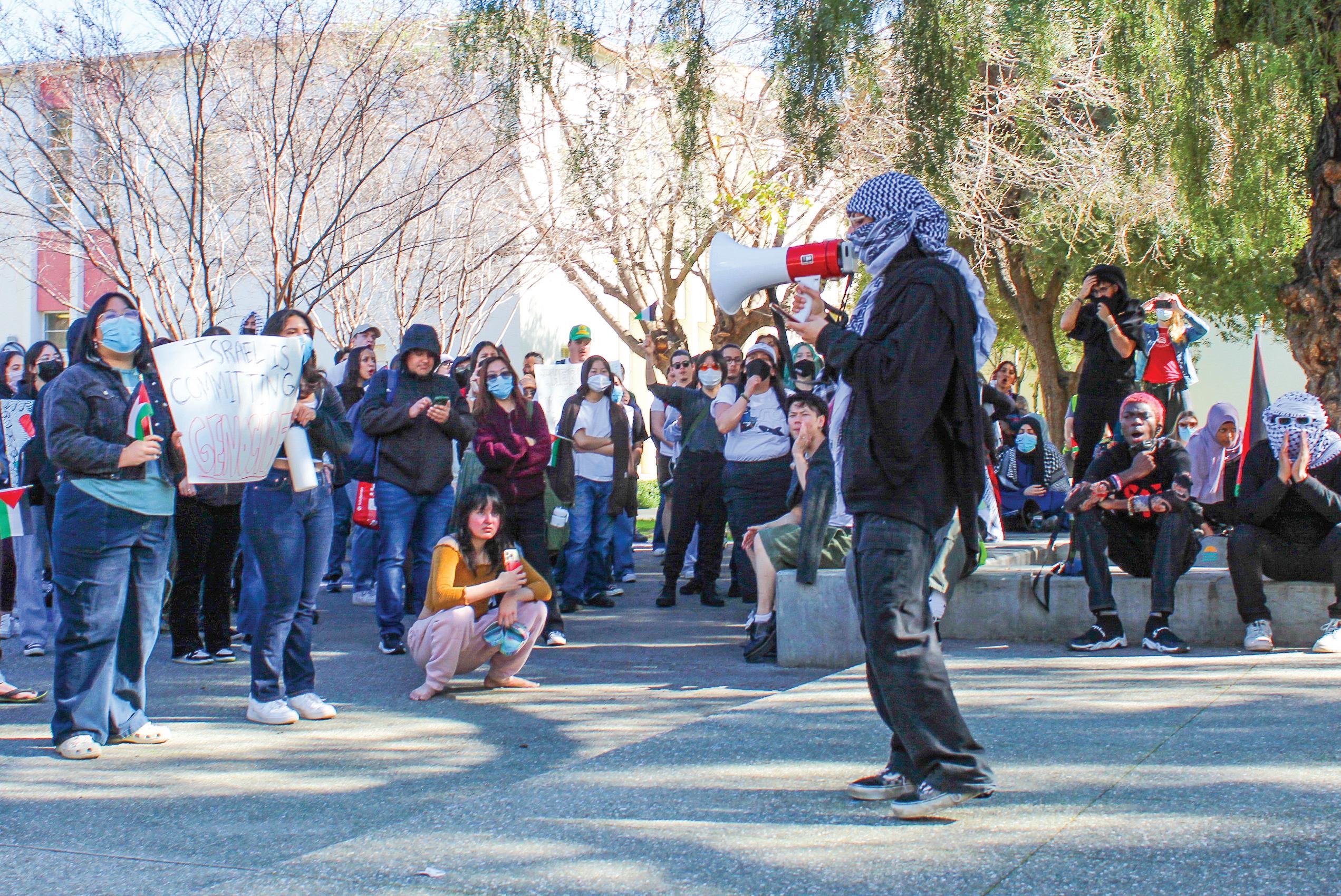
As I watched the Students for a Democratic Society protest for Palestine unfold, I had a thought, “What is this going to lead to?”.
We’re here, shouting out our lungs about everything we think is unfair and unjust about the world, but what are we really doing?
I watched a group of students protest on Feb. 29th and watched as they marched through campus.
The protest’s primary focus was centered around the tuition hike, but protestors also mentioned two separate issues.
One surrounding an incident last semester where the police were called to the Black Scholars Floor in Joe West in response to a call that involved a Taser allegedly owned by a student, and another more recent incident on Feb. 19th where Jonathan Roth, a history and Jewish studies professor, allegedly grabbed a Muslim student during another protest on campus.
I watched some of the protestors antagonize and provoke the university police. At one point, one of the organizers with the megaphone directly insulted the chief by describing him as a “little Black man.”
While I’m not at all saying that the anger and high tensions aren’t justified, the method and the way we channel these emotions falls quite short of productive.
I notice that every now and then there’s semi-consistent protests that occur on campus, but not much else seems to be taking place that’s conducive to actual, permanent change.
Let’s give a callback to the political and social activism of legendary figures like Malcolm X, Dr. Martin Luther King, Jr., Mohandas Gandhi, Angela Davis and other activists.
There were two key things —among countless other remarkable qualities— that these extraordinary people had in common: a willingness to die for their cause and the desire to push for unity as a platform to combat oppression.
These leaders had those traits and so did those who followed them in mass.
When King led protests and marches through the streets, he did so with a calm heart despite the injustices that happened to him when he was still alive.
In 1965, he interrupted and attacked during a protest when police used tear gas, whipped him and used other actions to disrupt the movement, according to an article by the History of Racial Injustice website.
What resulted from his organized nonviolent protest was King’s famous “I Have a Dream Speech” which heavily influenced the passing of the Civil Rights Act, according to an article by Britannica.
LETTER TO THE EDITOR

He reacted by continuing to systematically disrupt the institutions that perpetuated the oppression of his people.
According to an article from John L. Puckett at University of Pennsylvania, when Malcom X used Islam as a medium to uplift the Black community and combat oppression through organized and academic rallies, he was blacklisted by the FBI.
That didn’t stop him from organizing or strategically gaining power to combat oppression and racism across America.
He reacted continui ng titutions the pression n L. Puckett at Universit y as a to ift mbat anized and academic rallies, was blacklisted the FBI. ganizing ning pression merica.

Gandhi pushed for satyagraha, or nonviolent protest and fought against racial discrimination, according to a timeline published by the Indian National Congress,


Satyagraha means “clinging to truth”, it is most commonly used as a form of nonviolent protest, according to an article published by the Indian National Congress.




After spending years in prison, his support for non-violent protests allowed him to expand his message with nationwide campaigns, despite everincreasing death threats.










Angela Davis, a celebrated member of the Black Panthers, was forced to flee the state and was actively pursued by the government, according to an article by History.com.



ainst racial discrimination, ording the Indian National ngress, d as a otest, icle tional son, n-violent owed pand h n at io nw id e mpaigns, pite evercreasi ng e at h eats. vis, ebrated mber ac k nthers, s fo rc ed t e an d wa s ively the vernment, tor y.com. Ye t sh e ne ve r pped un di ngsever al









Yet she never stopped advocating for the people, founding several

advocacy groups and alliances, such as the National Alliance Against Racists and the Political Repression organizations, according to an article by There’s no chance you’d ever find any of these legendary activists hurling insults at police


advoca cy g ro up s such National Ag the Pol Repression organizat according to an articl New York History. Th er e’s no c h an act insults p officers. d would like ly resul b knew the forw was u Bein g vio insul w t con that they all knew. m accom be successfu antagonizing other side w a We’re pu
Partially because doing such a thing back then would likely result in broken bones or worse.












They all knew the only way forward was unity. Being violent and throwing insults at different people would only work against them, and this was a key concept If all we do is make physical noise every now and then, we can’t really accomplish anything besides successfully antagonizing the



between people even further. The same concept that the corruption in this country thrives on.
As time goes on, there just seems to be more and more polarization and less and less actual unity. We keep villainizing each other and genuinely believe that doing so will fix real problems or change something.
That’s not how it works.
If we want genuine change, we have to be willing to compromise and meet with the opposition on the other side.
Now if we’re not willing to take those risks and put in that work to pave the way to actual change, that’s honestly okay too. We don’t really owe anyone that.
But we should at least have the decency to admit that and not villainize other people who are comfortable with whatever effort or lack thereof they put forth.
So I go back to the original question. What are we really doing here?
Are we establishing actual change, or are we just shouting at the things that make us angry and expecting someone else to do something about it?

Right now, we’re pushing people away.

g thlh t e









We’re pushing away the very people who have the means and the power to establish actual change. What I saw at that protest a month ago was the perpetuation of polarization. Driving the gap
sjsunews.com/spartan_daily WEDNESDAY, MARCH 27, 2024 OPINION 4
Protests are not productive
A protestor chants with a crowd of students gathered together outside of the Student Union to protest in support of a cease-fire resolution for Israel and Palestine, and to protest against tuition hikes from the CSU’s administration.
EDITORIAL STAFF EXECUTIVE EDITOR ALINA TA MANAGING EDITOR MELANY GUTIERREZ PRODUCTION EDITOR JULIA CHIE NEWS EDITOR ALEXIA FREDERICKSON A&E EDITOR AALIYAH ROMAN OPINION EDITOR MAYA BENMOKHTAR SPORTS EDITOR NAVIN KRISHNAN CONTACT US –MAIN TELEPHONE: (408) 924-3821 HOURS: 6:00 PM - 12:00 AM MONDAY - WEDNESDAY EMAIL: spartandaily@gmail.com ADVERTISING TELEPHONE: (408) 924-3240 EMAIL: spartandailyadvertising@ gmail.com ADVERTISING STAFF ADVERTISING DIRECTOR GIULIA CRUZ ABOUT The Spartan Daily prides itself on being the San José State community’s top news source. New issues are published every Tuesday, Wednesday and Thursday throughout the academic year and online content updated daily. The Spartan Daily is written and published by San José State students as an expression of their First Amendment rights. Reader feedback may be submitted as letters to the editor or online comments. SOCIAL MEDIA EDITOR MAT BEJARANO OUTREACH EDITOR CHRISTINE TRAN COPY EDITORS JOAQUIN DE LA TORRE ADRIAN PEREDA PHOTO EDITOR DANIEL POTTER ILLUSTRATORS CIA CASTRO CAMMY TAN SENIOR STAFF WRITER NIKITA BANKAR STAFF WRITERS KAYA HENKES-POWER ETHAN LI JONATHAN CAÑAS MELISSA ALEJANDRES PRODUCTION CHIEF MIKE CORPOS NEWS ADVISER RICHARD CRAIG CORRECTIONS POLICY The Spartan Daily corrects all significant errors that are brought to our attention. If you suspect we have made such an error, please send an email to spartandaily@gmail.com. EDITORIAL POLICY Columns are the opinion of individual writers and not that of the Spartan Daily. Editorials reflect the majority opinion of the Editorial Board, which is made up of student editors.
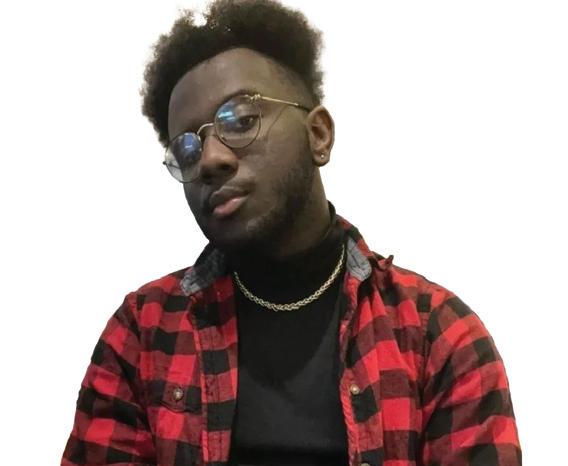
COURTESY PHOTO BY GABRIEL EVANS
p
shin
D
Follow the Spartan Daily on X (formerly Twitter) @SpartanDaily have wer to as the ation. the ver y who he means and the po stablish actual a month ago w polariz rivin g the g ap py
Gabriel Evans CONTRIBUTOR