A photonic source with half-a-GHz single-photon flux P. Zahalka,1 S. Huijser,1 A. Pancaldi,1 S. Kruger,2 X. Zhao,1 Z. Liu,1 I. Suleiman,1 R. Jensen,1 L. Stefan,1 A. Ludwig,2 V. Remesh,1 J. C. Loredo,1 and P. Lodahl1 1
Sparrow Quantum Aps, Nordre Fasanvej 215, 2000 Frederiksberg, Copenhagen, Denmark 2 Ruhr-Universitat Bochum, Universitatsstrasse 150, 44801 Bochum, Germany
Advanced optical quantum technologies demands high quality quantum light generation at very high rates. Here, we report on a deterministic single-photon source that simultaneously combines high excitation rates with high system efficiency to reach over 500 MHz of in-fibre single-photon flux. The source delivers optical power of over 100 pW, as is measured with an off-the-shelf powermeter, enabling a simple and direct way of determining the single-photon source fiber efficiency.
arXiv:2609.05387v1 [quant-ph] 4 Sep 2026
I.
INTRODUCTION
Deterministic single-photon sources are essential components for high-efficiency photonic quantum information processing, quantum key distribution, optical quantum computing, and quantum enhanced machine learning [1, 2]. The throughput of nearly every quantum photonic protocol scales linearly with the source clock-rate and decreases exponentially with the photon source efficiency. Similarly, for secure communication based on quantum key distribution, information sent through optical fibers is subject to losses and decoherence, which can be mitigated by boosting the repetition rate, avoiding the need for prohibitively long integration times. These applications fundamentally depend on a supply of pure and indistinguishable photons delivered at rates that are directly useful to the end-user—hence the demand for photonic sources with the highest single-photon flux. Single-photon sources based on solid-state quantum dot emitters can reach the highest photon fluxes by driving efficient sources at high repetition rates [3–7]. In this work, we drive a quantum dot single-photon source at excitation rates up to 1 GHz to produce a fibred singlephoton stream with over 500 MHz photon flux, the highest value reported to date. The quantum light stream contains an optical power over 100 pW, as measured directly with a standard optical powermeter.
II.
a
b
c
CARVED LASER PULSES
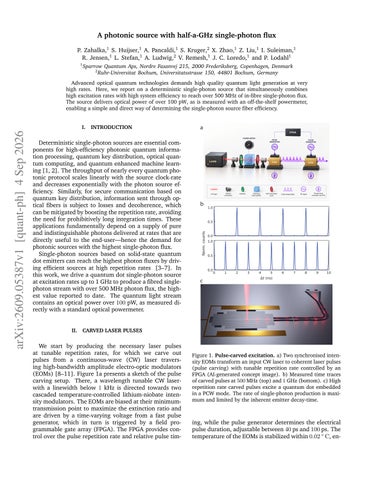
We start by producing the necessary laser pulses at tunable repetition rates, for which we carve out pulses from a continuous-wave (CW) laser traversing high-bandwidth amplitude electro-optic modulators (EOMs) [8–11]. Figure 1a presents a sketch of the pulse carving setup. There, a wavelength tunable CW laserwith a linewidth below 1 kHz is directed towards two cascaded temperature-controlled lithium-niobate intensity modulators. The EOMs are biased at their minimumtransmission point to maximize the extinction ratio and are driven by a time-varying voltage from a fast pulse generator, which in turn is triggered by a field programmable gate array (FPGA). The FPGA provides control over the pulse repetition rate and relative pulse tim-
Figure 1. Pulse-carved excitation. a) Two synchronised intensity EOMs transform an input CW laser to coherent laser pulses (pulse carving) with tunable repetition rate controlled by an FPGA (AI-generated concept image). b) Measured time traces of carved pulses at 500 MHz (top) and 1 GHz (bottom). c) High repetition rate carved pulses excite a quantum dot embedded in a PCW mode. The rate of single-photon production is maximum and limited by the inherent emitter decay-time.
ing, while the pulse generator determines the electrical pulse duration, adjustable between 40 ps and 100 ps. The temperature of the EOMs is stabilized within 0.02 ◦ C, en-