

Women in Business adds vending machine to commons
Paula Luszczewski News Writer
Anew vending machine run by the Women in Business club is now operating in the commons. Unlike other vending machines in the school, this one is mostly managed by students involved in the club.
The vending machine offers a mix of necessities and popular items, setting it apart from traditional vending machines found in schools. The project has become a visible presence in a shared student space.
“We wanted to do something business-related since the club helps students learn about and develop business skills,” Ms. Amy Kladis, the Women in Business sponsor, said.
This project gives students handson experience running a real business at school. The vending machine also has a purpose beyond convenience.
“The main goal is to raise money for our Women in Business scholarship,” Ms. Kladis said.
The scholarship is awarded to a senior who has been involved in the club and is interested in business.
Funds raised through the vending machine contribute directly to the club’s scholarship efforts. This project serves as both a fundraising initiative and a student-led activity
within the school.
Unlike the other vending machines at South, the Women in Business vending machine sells anything non-food or drink related.
Students played a role in choosing which items would be sold through a survey.
“Over 200 students responded, and we based our initial purchases on that survey,” Ms. Kladis said.
This process helped ensure the machine reflected student interest.
Since the vending machine was introduced, certain items have been more popular than others.
“The Nee-Dohs are the most popular and sell out the fastest,” Ms. Kladis said.
The popularity of these items has drawn attention to the vending machine. Their quick sellouts highlight which types of products students are most likely to purchase in the future.
The vending machine also gives club members hands-on experience with business concepts, increasing business acumen.
“It has been a great way to learn about inventory, customer preferences, ordering protocol and budgeting,” Ms. Kladis said.
While there aren’t any current plans to add additional vending machines, the Women in Business club
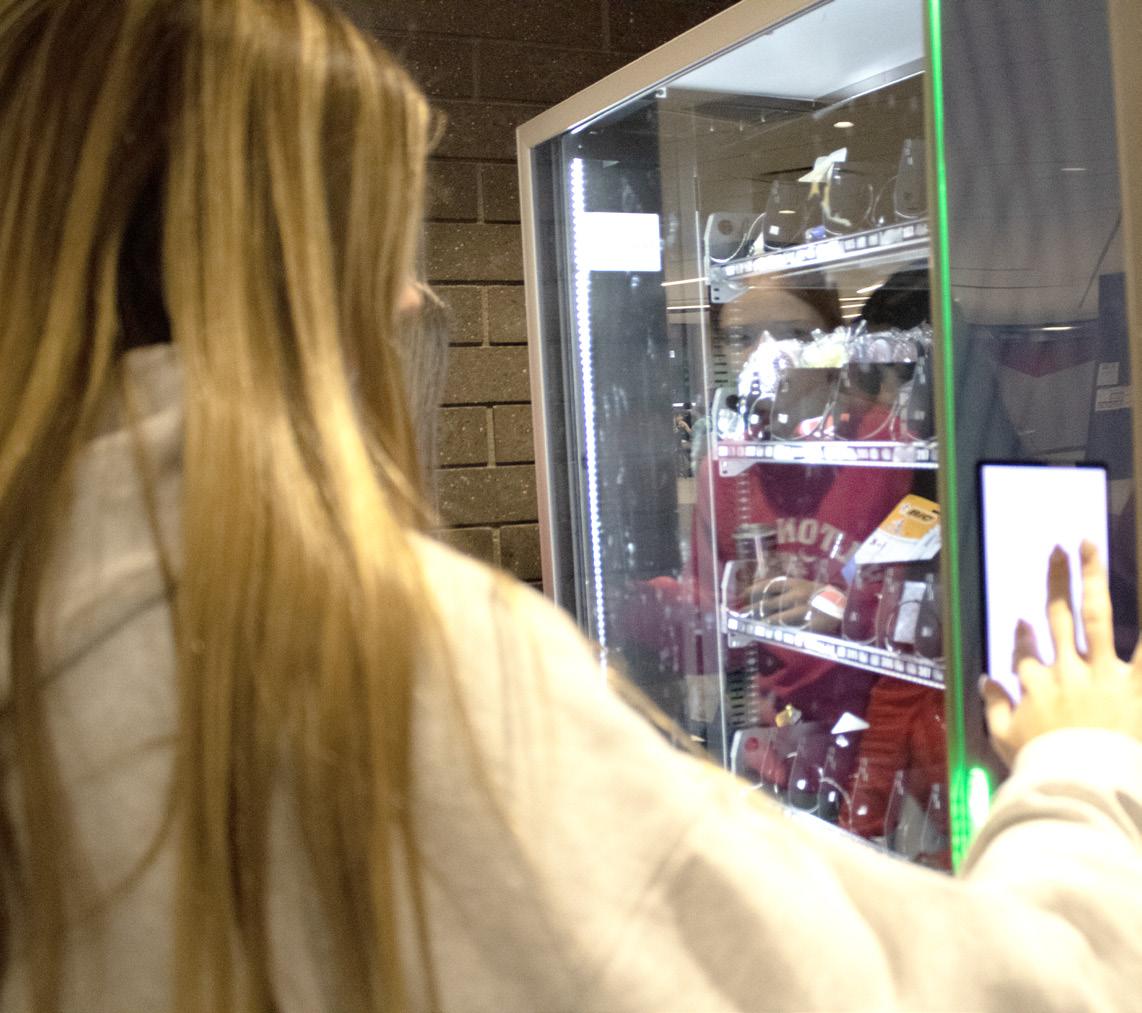
plans to continue maintaining and improving the project. There is a QR code on the side of the machine where students can give feedback and input for the machine’s contents.
Although the vending machine is still new, it has already become a part of student life in the commons.
Students continue to interact with
the machine during the school day.
“I bought tide wipes from the vending machine not that long ago. They were a super good price and they come in super handy,” freshman Jenna Najowski said.
“We are always open to ideas of what to stock the vending machine with,” Ms. Kladis said.
Maine South hosts first school-wide fundraiser in two years
Julia Pertsak News Writer
This semester, the school-wide fundraiser is returning, providing an opportunity for students, staff, and the community to participate and unite together towards a common cause in our community.
“We chose to fundraise for Bear Necessities, an organization meant to aid families dealing with pediatric cancer,” senior Sarah Frantz, the organizer of the fundraiser, said. “It was chosen through multiple rounds of surveys sent out to the Maine South community asking for fundraising causes, and finding reliable organizations based on those causes.”
Selecting the organization came with planning and looking at different local organizations and charities. Input was considered from the entire Maine South community.
“We want them to be a local or-
ganization because we want to give back to the community, to the extent possible,” Associate Principal of Student Experiences, Mr. Michael Edwards, said. “With student voice, with staff voice, it was a combination of a lot of different input and then of course finding an organization that we knew the money goes to the right place. They stand behind the values of Maine South, and Maine South stands behind their values.”
Planning has been underway since before winter break started, with there being various interactive activities being carefully planned in order to support the purpose and aim of this school-wide fundraiser.
“We had to redirect because, for a while, we have been planning to do things like bracelets and blanket drives,” Frantz said. “I have reached out to some people who work at Bear Necessities to ask if they would like those materials, and they preferred
monetary donations.”
Coordinating the fundraiser to meet the individual needs of the organization came with new methods of making this fundraiser become a reality here at Maine South.
“We are planning on putting out buckets around the school where people can donate as well if they don’t have the time or abilities to do interactive fundraising,” Frantz said.
Frantz believes there is importance to fundraisers that extends beyond the money they raise.
“Part of the reason I enjoy fundraising is because I think it’s something that unites people.” Frantz said. “As Mr. Edwards said, it’s no matter what you personally believe or support, you can get behind helping children go through something tough. It’s great because it’s uniting people.”
School-planned fundraisers, such as this collaboration with Bear
Necessities, allow students and staff to participate in their community and contribute to a common effort.
“We all want to solve the problems of the world, and most of the time, it starts in your backyard,” Mr. Edwards said. “This is a good learning opportunity for students to see that you can make an impact, whether it’s giving a couple of coins, organizing, communicating, or just raising awareness.”
The fundraiser calls for participation from clubs and sports all over Maine South to help support their cause.
“This is our invitation to all the clubs, the teams, and all other organizations at Maine South who want to get behind this work to help us get it done, whether it is contributing when we have major events or considering adding a little donation to existing fundraisers,” Mr. Edwards. said
CHECKING OUT Maine South students can be found supporting the Women in Business club by buying from their vending machine. The vending machine is filled with various everyday necessities.
PHOTO BY KATIE JOHNSTON
ILMEA recognizes All-State Hawks
Cassie Jewel News Writer
Freshman Ramona Schroer and junior Reed Maurer, have earned the honor of being selected as All-State musicians, placing them among the top high school band performers in the state. All-State recognition is awarded to students who demonstrate skill, dedication, and musical excellence through a highly competitive audition process.
“The state is divided into [nine districts], and within each district, there are hundreds and hundreds of musicians per instrument,” Maine South band director Mr. David Hutter said. “They have a blind audition, which means the judge only listens to their music instead of watching, so they don’t know who they are, how old they are, or what school they
are from. It’s just all about how they played the music.”
Preparation for All-State requires months of dedication outside of regular practices. Junior Reed Maurer described the experience as challenging but rewarding.
“We get the etudes [near the end of the previous school year], so I start looking at them then,” Maurer said. “In the month leading up to the audition turn-in date, I start practicing the etudes more. A week before it’s due, I start actually recording and I’ll give myself a couple days to do some takes here and there.”
Beyond musical growth, All-State band participation helps students develop discipline, instill confidence, and build time-management skills.
Hutter noted the impact of the
experience on the whole band.
“It develops lots of camaraderie;” Mr. Hutter said. “We celebrate our students that make it each year because it’s usually just one or two people, and instead of people being bummed that they didn’t get a chance, it’s like, ‘wow, it’s so hard. I can’t believe that my friend got to do it.’”
All-State musicians serve as role models within the band program and the school community. Their achievements highlight the value of music education and demonstrate the results of hard work and dedication at the highest level.
“Everyone [there has] one goal, they just want to sound the best they can. So it’s pretty nice being with so many [likeminded] people,” Maurer said.
Band program travels to Disneyland for the first time
Lucia Fuentes News Writer
Every other year, the Maine South Band has the chance to travel and showcase their talent on a new stage. This year, they had the memorable opportunity to travel to Los Angeles with 111 of the 151 students in the band. The band left for the extended weekend on Jan. 16 and returned on Jan. 20.
“Within the past decade we have traveled to Orlando twice, Washington DC, and Indianapolis,” Band Director Mr. Hutter said. “This was the first time in school history that the band traveled to Los Angeles, California.”
The band’s goal is to find opportunities that they would not normally have in the Chicagoland area. There were a variety of unique experiences the band enjoyed, particularly their own parade marching down Main Street USA where they performed a medley of songs from the well known movie “Frozen.”
Other special experiences included a backstage tour of the Warner Brothers film studio and a concert by the LA Philharmonic.
“We had a tour of Hollywood Boulevard, and we went to the LA Farmers market on the first day. It was my first time in LA, so it was nice to see so much in so little time,” sophomore Jagoda Samborska said.
Apart from the band’s actual performance, months of planning, communication and troubleshooting went into coordinating the trip. Although

the trip was announced in the spring of 2025, significant work and preparation was underway approximately a year beforehand.
“Logistically, the effort to bring an entire marching band across the country is daunting,” Mr. Hutter said. “We brought all of our instruments, uniforms, and luggage on three different flights.”
For this year’s trip, 10 adults accompanied the band. In addition, families traveled to support their children and the band as they paraded through the streets of Disneyland for this once-in-a-lifetime experience.
Beyond getting to show off their hard work, these trips help foster a sense community amongst band members.
“It’s great for band students to bond and celebrate their hard work over the years,” Mr. Hutter said. “Band trips like this are often students’ fa-
vorite memories of their career in the high school band.”
The students in the band had a memorable experience.
“I loved being able to go on a trip with the band, being with friends for a few days, riding rides together, and being in the parade,” Samborska said. “It is something I will remember for a long time.”
For some students, this was be their second time traveling with the band. For others, this is their first time experiencing a band trip.
Many band members felt proud that their hard work paid off, and they were pleased to demonstrate their talents with some of their closest friends and visit the West Coast.
“I loved being able to go on a trip with band,” sophomore Madelyn Grapenthien said. “It was a lot of fun seeing parts of LA and going to Disney with friends,”
Food drive comes to South
Eddie Schauerte News Writer
Marking its fifth year, the Maine South Food Drive, running from late October to Nov. 24, provided an opportunity to support community families in need.
“I got the idea from Marshawn Lynch, who played running back for the Seattle Seahawks,” Mr. Scott Tumilty, a Maine South Health and Wellness teacher who founded and leads the food drive, said. “Marshawn would annually distribute turkeys to his community.”
The Food Drive partners locally, bringing support for the people in the area.
“Typically, [Mr. Tumilty] seeks out local food pantries, like the Maine Township and Good Food Pantry,” Assistant Principal Mr. Michael Edwards, who provides logistical support, said.
These pantries are grateful for Maine South’s efforts and the food.
“Each year, we average three to five large bins of food that [are] dropped off to Disciples of Our Lord Food Pantry,” Mr. Tumilty said.
“There is a line of people waiting outside of this church on Thanksgiving getting food to their families.”
Students at Maine South also believe in the importance of the food drive.
“I believe the most significant impact of the food drive is helping those in our community in need,” junior Shannon Ottow who promoted this year’s food drive, said. “When SNAP benefits were cut, it infuriated me knowing that millions of Americans relied on SNAP to have a meal to feed their families. It was unfair, and I knew I wanted to make a change.”
Ottow appreciated participating in something that makes a positive impact for those in need in their local community.
“[When I found out that] the Health and Wellness department was running a food drive already, I was incredibly grateful I could hop on board and add to Maine South’s contributions,” she said.
Giving back to their community is something about the food drive that stands out to its participants.
“It brings me a lot of joy volunteering to help others,” Mr. Tumilty said.
PHOTO COURTESY MICHELLE BAYNES
PARADE-ISE The Maine South Band performed a medley of “Frozen” songs in a parade through Disneyland. Preparations for the trip began a year in advance.
Maine South splits up all freshman PE swim classes
Alexandra Lobo News Writer
Starting this year, the freshmen class of 2029 will not have co-ed swimming. This differs from previous years, where boys and girls in the same class were required to swim together. This policy is not being applied to sophomores, junior, or seniors.
“In my first 20 or so years, freshmen used to be a semester co-ed and a semester single gender,” PE teacher Ms. Sona Torosian said. “The semester that was single gender was the one that had swimming, along with other units. Shortly after COVID, we went straight co-ed for all freshmen, both semesters.”
This change in the freshman PE classes is because the administration eliminated the co-ed swimming. The arrangement is being tested this year, so it is unclear whether or not the change is permanent.
“We have seen a rise in students not swimming since we have been in the co-ed environment, which also fell around the COVID pandemic,” Ms. Torosian said. “We are not sure of the exact reason, but we are trying to see if the switch to single gender will help encourage students to
have a stronger desire to participate in the swimming unit. At the end of the day, our goal as a department is to teach our students foundational skills and exercises to live a healthy lifestyle.”
Students who are gender nonconforming are still able to participate in the swim unit even with the new policy.
“Students can choose to swim with whatever gender they identify as,” Health and Wellness department chair Mr. Donald Lee said.
For freshman PE this year, there are at least two freshman teachers for each period, with one male teacher and one female teacher.
The freshman classes are currently single-gender and the girls are participating in team games for three weeks while the boys are in the pool.
They will then switch and go into the pool for three weeks, and the boys will participate in team games. After the completion of this unit, all freshman classes will return to the co-ed environment for PE.
“I think this is best for everyone, and I think some students may benefit from non-co-ed swimming,” freshman Mateo Pumo said. “So far,
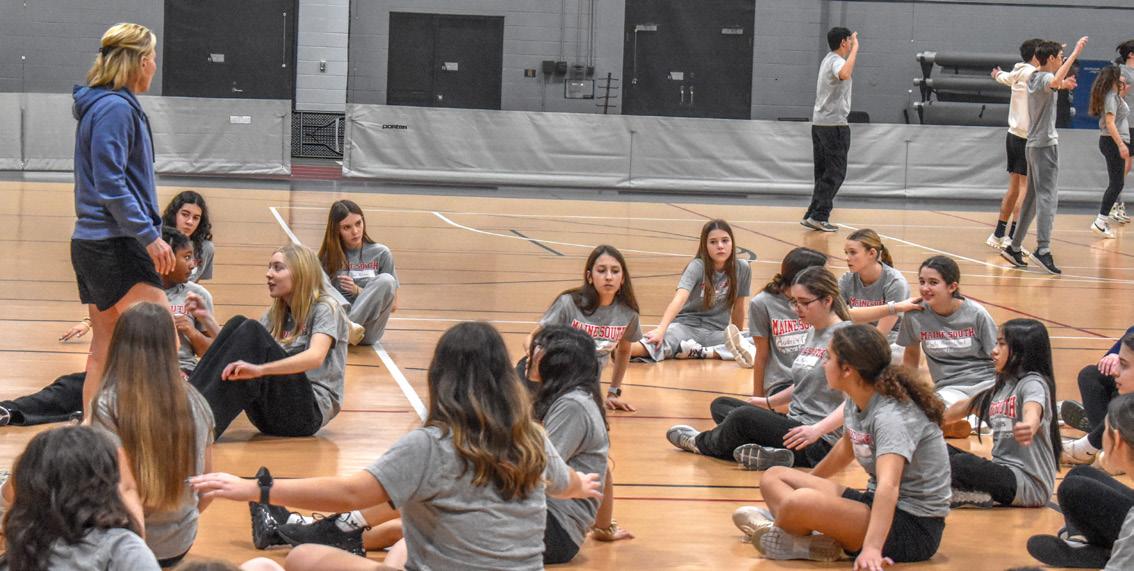
my swim experience has been good. I think I prefer the division of PE classes.”
Some students believe that the separation of genders already existed naturally in co-ed swim classes.
“When it was co-ed, it was kind of awkward being with the other gender in the pool,” sophomore Don Natividad explains. “But because everyone felt that way, everyone kind of split up already. I would have 100% preferred non-co-ed.”
Some students believe that the co-ed environment made a negligible difference in their swimming experience.
“I don’t think that fact that it was co-ed made much of a difference,” sophomore Ava Lowery said. “I’d rate it about an 8 out of 10.”
What remains constant from previous years is that exemptions are still allowed.
If there is a medical reason behind why a student is incapable of being in the pool, they are able to get a doctor’s note exempting them from swimming. A student could also be exempted for religious reasons. Exempt students must still participate in some form of physical activity in the meantime, typically walking the whole period.
WWII plane the Maine Flyer lands back in Maine Township
Rose Hassman News Editor
Leonard Johnson, a Maine South 1977 graduate, was honored in a recent board meeting after donating pieces of a recovered World War II plane, named the Maine Flyer, to Maine East on Dec. 1, 2025.
During a board meeting on Jan. 5, Maine East principal Dr. Melissa Pikul gave a brief history of the plane and District 207 students’ involvement in its existence.
“In 1944, at the height of World War II, Maine Township High School, the only high school in the district at the time, raised half a million dollars in war bonds — the equivalent of 10 million dollars in today’s money — to finance a C-54 Skymaster transport plane,” Dr. Pikul said.
“The nose art and slogan placed on the airplane that the students proudly chose was, ‘faster and higher, that’s Maine’s Flyer.’”
After many years of being unaccounted for, the flyer was located and tracked down by Mr. Johnson and finally brought to Illinois in 2019.

“After a military and civilian career, the airplane ended up in a boneyard in Chandler, Arizona,” Dr. Pikul said. “Len [Leonard] Johnson, a former Park Ridge firefighterparamedic, spent over a decade researching and trying to receive permission to retrieve the Maine Flyer. In August of 2019, Mr. Johnson went to Arizona to bring the Maine Flyer
home. The Niles Historical Society proudly displayed the parts he recovered from the Maine Flyer, including a section of the cockpit.”
Attempts to retrieve the flyer began as a retirement project after Johnson’s career in bricklaying and later, his job as a firefighter-paramedic.
“I went into bricklaying right out
of high school and did that for 14 years,” Johnson said. “I went on to take the firefighter test and got on at 31 as a firefighter-paramedic and did that for 21 years and retired as a Lieutenant. Once I retired, I had a lot of new chapters in my life, and one of them was finding the Maine Flyer.”
Johnson’s efforts teach an important lesson about perseverance, after he worked on the Maine Flyer project for over a decade.
“For everybody out there, you students, never give up,” Johnson said. “Keep trying, and whatever you want to do, it can be accomplished. That’s what I found out in life, and you guys can do the same.”
Plans at Maine East regarding what should be done with the recovered flyer are underway, though plans are not yet finalized.
“Maine East is excited to receive this incredible piece of the school’s history,” Dr. Pikul said. “The Maine Flyer parts will be displayed as part of the historical artifacts room and will be incorporated into some school events. We are still planning these events as of now.”
CLASS IS IN SESSION Freshman PE teacher Ms. Laura Markus gets her class of freshman girls ready for the period. With the new freshman swim policy, Ms. Markus’s boys went to the swim teacher, and that teacher’s girls came to her class.
PHOTO BY SAMUEL HIGGINS
FLYING IN STYLE Pictured above is the actual plane Maine Township students raised money to purchase in 1945. The plane was originally used in WWII as a cargo plane.
SOUTHWORDS FILE PHOTO
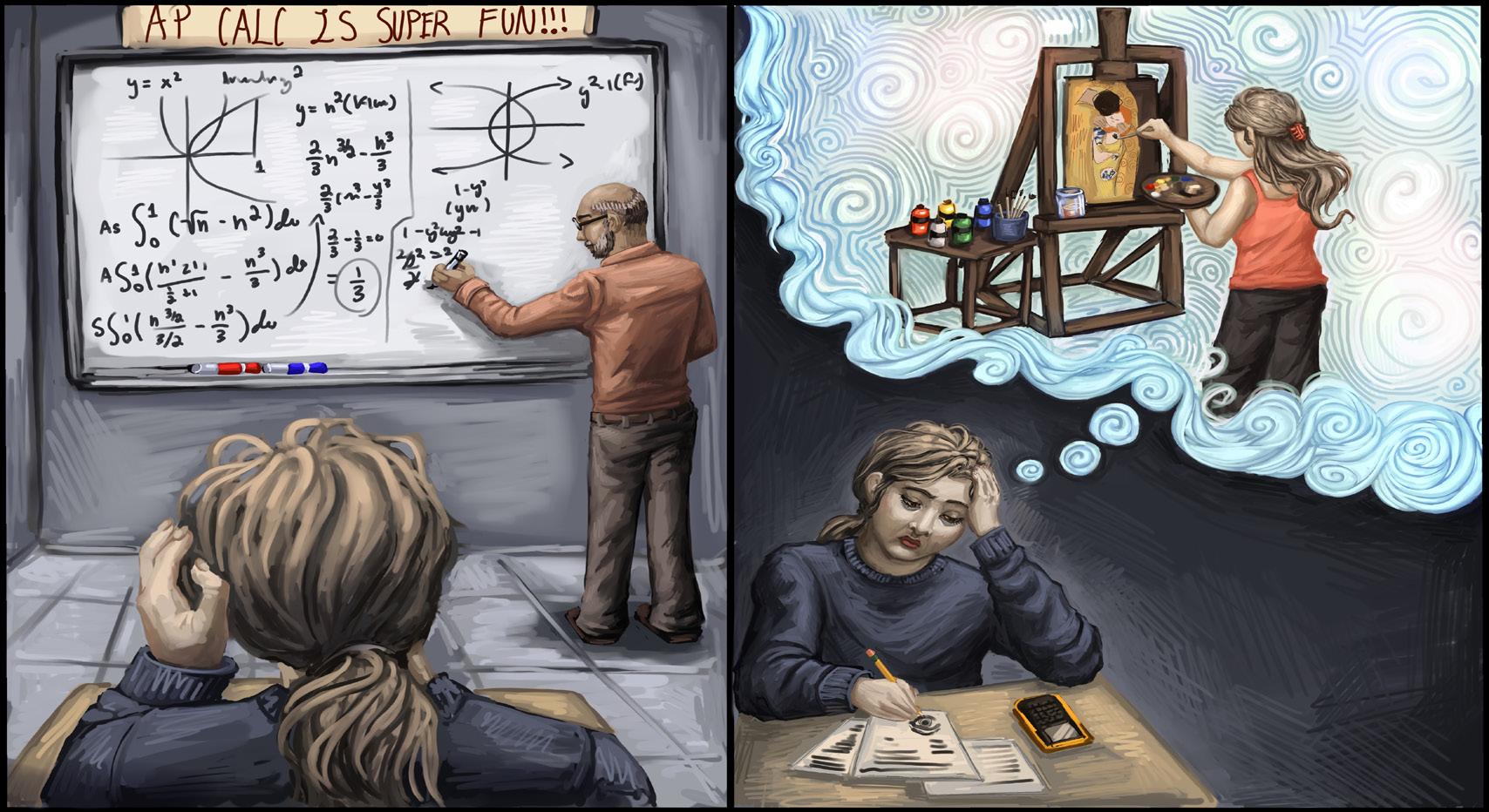
STAFF EDITORIAL
Incentives for electives lost in the midst of academic pressure
The phrase “if you love your job, you won’t work a day in your life” conveys the desire for enjoyment and passion in a working adult’s life. Unfortunately, from the high school perspective, this seems almost unachievable when there is so much pressure on high school students to challenge ourselves with a demanding classload in preparation for college rathe than developing our interests.
Social media has instilled in many high school students that the only way it’s possible for them to be accepted into a prestigious college is to enroll in as many AP classes as possible and pack their schedule with extracurricular activities.
Current Ivy League students share their success stories on social media of how they were part of the lucky few who got admitted. These stories are often paired with their unattainable achievements: these students had perfect test scores and GPAs, were published researchers, and took a plethora of classes related to their future major.
These anecdotes give students the impression that the only way to emerge victorious from the grueling college admissions process is to exceed all expectations academically.
Students feel discouraged at these seemingly impossible college prerequisites, ultimately believing that their achievements will never meet the high standards set by social media.
This strategy of taking on a rigorous schedule in high school may seem reasonable in the sense that it will better prepare students for difficult college courses. However, it comes
with the drawback of preventing students from taking classes that bring them joy.
With Maine South’s eight-period schedule, each period is a precious block of time, leaving students with a tough choice: should they fill that one period in their schedule with an extra AP class to impress college admissions officers, take that fashion or art class they’ve been interested in, or give themselves time to breathe with a free period?
For students who have been victims of online fear-mongering, it seems glaringly obvious to avoid any class that doesn’t bring “academic value” to your resume. Unfortunately, the notion that it’s only acceptable to enroll in AP or career-focused classes discourages students from exploring other interests.
It seems unfair that there is a fear of not being good enough for college when students consider exploring electives related to their interests. Having a passion or interest beyond core academics is valuable, and there shouldn’t be a “punishment” for taking a class that isn’t AP or accelerated. Another issue that stems from social media is the belief that the only way to be competitive when applying to college is to take all classes related to their future major.
At the age of 14 or 15 — when most students map out their schedule for their four years at Maine South — it's unrealistic to ask them to box themselves into a certain major. High school should be a time to find your interests; finding your niche takes time, so it's important to explore dif-
ferent options.
If students pigeonhole themselves into a singular area of study early on, they may miss out on experiencing electives that may better suit their skills.
Required classes are another area that can take away opportunities for exploration. Classes like financial literacy or health consume an entire class period, making it challenging to take electives.
A remedy to this issue is to allow students to take required classes like financial literacy over the summer or to allow business electives — like Intro to Business — to fulfill the required credit. The summer option works wonderfully for required classes like health or Civics and Government, and it allows students to fill their schedule with classes they find more personally fulfilling.
We were forced to explore many subjects through electives in elementary and middle school, but in high school, our schedules can lock us out of this exploration. With the option to take more required classes over the summer, this issue can be solved. When students are in classes they are interested in, there is a higher likelihood of their engagement and attendance in every class.
Having a passion is valuable. Schools should place emphasis on the exploration of interests through electives; the excitement students have about taking an elective class just for fun should be celebrated and encouraged when we choose our classes. Joy is necessary in life; our school schedules can reflect that.

Maine South High School 1111 South Dee Road Park Ridge, IL 60068 http://www.southwords.org

Southwords is a student-run publication designed as a public forum for student opinion and balanced reporting on topics relevant to the Maine South community.
Unsigned staff editorials represent the consensus opinion of the Southwords Editorial Board. Personal commentaries represent the opinion of the author alone and do not represent the opinions of the publication nor District 207.
Student participation in the newspaper, whether through readership, submitting articles, or voicing comments or concerns, is encouraged.
Signed letters to the editor can be given to a member of the editorial staff or e-mailed to southwords@maine207.org. Southwords reserves the right to edit material for clarity and brevity and to reject obscene/libelous submissions.
Editors-in-Chief
Production
Adviser
EDITORIAL CARTOON BY SONIA LOIZOS
School bus funding prioritizes athletics over academics
Lola Cosma & Emery Yates Commentary Editor & Editor-in-Chief
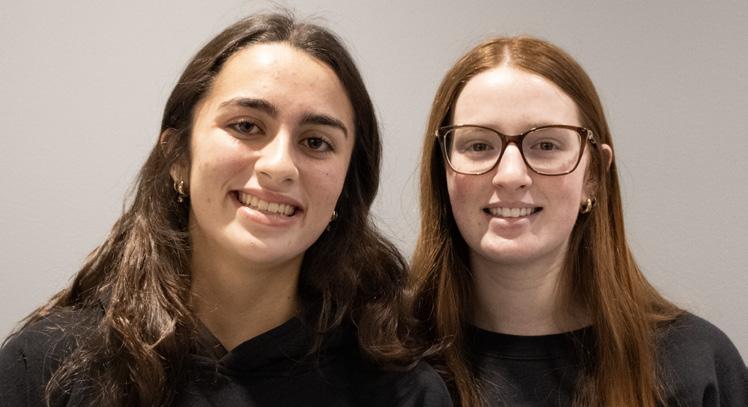
MaineSouth is home to over 150 clubs and around 28 sports with about 3 teams each, so students travel to a variety of different events across the academic and athletic spheres.
Whether it’s a girls’ basketball game or a DECA competition, Maine South is represented far beyond our school walls.
With the ever-growing number of organizations across the school, more and more transportation is needed. Unfortunately, the funding for this transportation is not always spent equitably.
Athletics fund all buses from their own account; however, for academics, students are forced to split the entire cost of transportation for many events.
This is because it is Maine South policy that only transportation for competitions, academic or athletic, is covered by the school.
However, for some academic clubs like Mock Trial, students still paid for transportation, even though their trip was a competition.
Clubs will often do their own fundraising to try to cut down the cost of their activities.
For example, Mock Trial recently sold Crumbl Cookies to try to defray the costs of their competitions, and while it helped, it does not completely cover the costs.
Furthermore, when it comes to field trips, transportation is never covered by the school.


This is inequitable because costs may deter a student from getting the educational value that comes with the immersive experience of a field trip.
For example, every year, the Law and American Society class goes on a field trip to a courthouse.
While this is an incredible opportunity that holds a lot of educational value, transportation is not covered, leaving some students unable to go, as the extra fee makes it too expensive.
Field trips have as much value as competitions, and they should be funded as such. They provide important opportunities for discovering new interests or fostering the development of current ones, and if a teacher deems a trip necessary, the school should fund it. In fact, until approximately 15 years ago, Maine South used to pay for buses for all field trips.
Without proper funding, these trips could

cease to exist.
While athletics have their own system when it comes to funding and transportation, automatic coverage of transportation should be a schoolwide policy.
Academic opportunities are equally important and deserve to have the same level of treatment.
There has recently been a lot of effort from the administration to try and make all aspects of the school equitable and make everyone feel included and seen. This idea applies outside the classroom.
If Maine South wants to create a community where students feel truly included, then they need to universally fund transportation for both athletic and academic events.
Otherwise, we are perpetuating the myth that athletic achievement is more valuable than academic achievement.
Get through rejection and learn to be okay with disappointment

I, along with millions of fans around the world, waited with bated breath for the final season of “Stranger Things,” only to be met with disappointment.
The end of the decade-long TV show has been built up over the last year as the ultimate ending to a legendary franchise. But fans around the world have been expressing their anger at the unsatisfying ending.
This whole debacle reminded me of the message that I have heard throughout my entire college admissions process: learn to be okay with disappointment.
Much like the finale of “Stranger Things,” the month of January can be filled with disappointment as the last bit of early application decisions are released throughout the month.
During times like this, it’s hard to not become dismayed at rejections or deferrals.
However, it is also important to remember that a couple of rejections do not define your life.
Life is more than what college you go to or what score you got on your ACT.
And while it is okay to be disappointed, it’s not okay to stay disappointed.
One bad outcome isn’t the end of the line. Learn to allow that let down fuel another attempt.
“And while it is okay to be disappointed, it’s not okay to stay disappointed”
There are always more jobs, more tests to take, and more chances to succeed.

While it may not feel like it right now, it is ultimately not the end of the world.
It is important to remember that life is full of disappointments, and no one gets everything they want.
You’re not always going to get the job, the grade, or the outcome that you want.
College isn’t the be all end all, either; you don’t need to go to the best, most prestigious school out there to flourish.
Getting rejected from your top school doesn’t mean the end of your academic career. There is always another opportunity.
What matters most is the effort you put into your degree and into yourself.
When one door closes, another opens; if you don’t go through the
door that opened and instead dwell on the one that closed, then you shut out all future possibilities.
There is no reward in dwelling on rejection — but here is one for getting through it.
We can learn from the ending of “Stranger Things.” While it left some viewers feeling dismayed, it also has a been a source of joy for many for a decade.
It launched the careers of very talented actors and brought people enjoyment while looking forward to new episodes.
Being left disappointed doesn’t erase all the work it took to get there, much like how one rejection doesn’t erase all the hard work it took to get through high school and the tedious application process.
It is important to learn to appreciate the work that you did and find ways to get better, instead of focusing on what you did wrong.
ILLUSTRATION
‘Hustle culture’ produces burnout, not success
Lucas Runtz Commentary Editor
You’ve likely come across people on social media preaching what is known as “hustle culture” — a mindset glorifying constant productivity at the cost of well-being. Whether it’s the millionaire wanna-be’s starting countless side-hustles or the self-help gurus crediting their success to their grind and sleepless nights, they all perpetuate this harmful societal norm.
A non-stop, workaholic culture can lead to emotional exhaustion and burnout. This can result in poor sleep, a depressed mood, and a general decline in well-being. Hustle culture treats this exhaustion as strength and rest as weakness.
What we need is not to stop working hard; it’s to change our approach to the work. Hard efforts don’t need to cause unnecessary stress, but for many, a fear-based mindset causes this undue anxiety. Instead of using panic as fuel, use calmness and clarity. We need to

stop working out of fear, pressure, and the mindset of “never enough,” and instead focused on long-term success and happiness.
Grinding to achieve a goal isn’t inherently wrong, but it causes problems when this grind results in burnout. Loving the process of achieving a goal, not just the goal in itself, is crucial to well-being and sustainable work.
Besides, there are other ways to improve your character than just selfdiscipline. You can exhibit generosity by helping a friend in need or volunteering in your community. You can grow your self-confidence by choosing to follow your own beliefs and goals,
defying the criticisms of others. You can be open-minded and listen sincerely to the thoughts of others.
Hustle culture rejects these virtues in favor of self-centered actions. It breeds competition with the goal of “getting ahead” of others rather than working on positive relationships to improve our lives.
The 20-year-olds grinding alone to become millionaires fail to realize how impacting others in a meaningful way inadvertently creates personal success. By helping others, you don’t just benefit them; you benefit yourself through networking and mutual support. There is dignity in working hard. There’s also dignity in taking time to rest, reflect, and have fun with other activities. Our most creative, inspirational, and joyous thoughts often come during these times.
Ultimately, it’s up to you to decide what kind of life you want. As an adult, you may actually enjoy making five side hustles on Depop shop and chugging Red Bulls until 4 a.m. or you might just want to live a tranquil life away in the Himalayas. The truth is, no matter how much “hustle” you have, what truly matters is loving what you do.
New DECA policy shapes a stronger club
Final exams: more pros than cons
Rabeh Salamah Commentary Writer
Asfinals schedules have made a return to Maine South, students have been feeling the end-of-semester pressure. While many look at finals as added anxiety, they prepare students for life after high school by promoting good study habits and the retention of information crucial to one’s success in their future endeavors.
Because assessments given at the end of the semester are not as heavily weighted as final exams taken in college, the intense pressure of an exam being worth a large percentage of one’s grade is removed. Additionally, this gives students one last chance to bump their grades up if they manage their time well and study accordingly.
With the pressure of final assessments, students are led to reevaluate their preparation for exams, allowing for an improvement in academic performance during the next semester.

Emily Eng Commentary Writer
DECA
is often seen as a gateway into the world of business — a place where students learn to present ideas, compete, and apply concepts to real-world scenarios. For many, it is not just a club, but an introduction to their future careers.
This year, however, a new membership requirement has reshaped who gets to have access to that experience. While some worry that this will keep interested students from participating, it will ultimately build a better organization.
Under the updated policy, students are required to have completed at least one year of business classes and be currently enrolled in a business class to join DECA.
At first glance, the requirement seems restrictive, particularly for underclassmen eager to explore business early on.
Yet the policy reflects a harsh reality: DECA is an extremely competitive club, demanding prior knowledge and commitment more than interest alone — areas that are difficult to navigate without a foundational understanding.
The intention behind the policy is not to close doors, but to ensure that the students who walk through them are prepared to succeed.
Without prior exposure to business concepts, participants may find themselves at a disadvantage from the start, turning a valuable learning experience into an overwhelming one.
That said, the new rule mainly applies to freshmen. While most sophomores and juniors typically enter after gaining classroom exposure, the policy does allow for flexibility. Exceptions can be made for students who were unable to fit business classes into their freshman schedules.
Still, the impact of the rule is worth examining. This rule delays the early exploration of business for some students. Interest in business does not always begin in a classroom. For many, DECA is where that spark
is lit. Requiring prior coursework may discourage students who are still testing the waters, even with exceptions available, and might deter those who find four years of consistency in a club a priority for themselves.
By setting clearer expectations, the policy may reshape DECA into an organization less defined by size and more by dedication.
Students who join will do so with intention — having already invested time in learning the material and choosing to participate rather than simply for fun or resume-building. In doing so, DECA will be less about casual participation and more about purposeful involvement.
Clubs are not sustained by numbers alone. They thrive through the dedication of their members in both willingness and effort.
While the new rule may narrow the path into DECA, it also strengthens the very foundation of those who walk it.
In the long run, it is not about casting people out or punishing underclassmen; it is about creating a clearer path for those who are committed to the program.
Managing study plans for multiple tests can help students in college and beyond, by helping them practice skills in time management.
Finals can cause what is known as “eustress,” a healthy form of psychological stress. Studies have found that eustress has a positive correlation with exam performance, meaning that as the amount of eustress that an individual experiences increases, so does exam performance.
Continuous review when studying builds stronger connections within the brain. By reviewing material given throughout the semester, students are able to strengthen their neural connections, ultimately leading to a better understanding of the information given within that specific subject.
Finals are not your everyday kind of tests. Instead, they are end-ofsemester opportunities given to students for a chance to grow within a diverse range of subjects. They lead to improved study habits, influence healthy forms of stress, and lead to better retention of information essential to one’s success.
Whether or not you like them, they undeniably make you a more resilient student and set you up for success later in life.
Canine Companions:
Meet Luke and Sadie, South’s fur-fect staff members
Eliza Chasak Features Writer
Whetherit be in the hallways, the SST office or even while gazing out the glass hallway and into the courtyard, students may see the furry figure of Sadie or Luke roaming around with their fluffy, golden coats. Although they aren’t human, Sadie and Luke, Maine South’s emotional support dogs, are essential members of the SST staff.
For almost a decade now, Maine South has been in the presence of our two friendly pups, Sadie and Luke.
Counselor Ms. Diane Spillman brought Sadie in at just one year old, after being trained with the intention of being a counseling dog.
“The dog from Maine West, Teddy, and Sadie both came from a trainer in Michigan, so she came to me already trained,” Ms. Spillman said.
Although she is a companion for students, Sadie is not a certified therapy dog. She is classified as a counseling dog, meaning she still has her quirks.
“Sadie is good enough to be in school to socialize with kids, but she steals sandwiches from people’s hands and she goes in trash cans,” Ms. Spillman said.
Unlike Sadie, Luke is an actual certified therapy dog.
“I felt like Luke had the perfect temperament and was always just a very sweet dog,” Counselor Ms. Cris Villalobos said.
Although they may have different personalities and behavior, both dogs have had a profound impact on the Maine South community.
“Every time I see them, it lights up my day,” AP biology teacher Mr. Dave Fermanich said.
A normal day for the dogs often consists of regular visits with students, walks around the school, and loads of treats.
“[Sadie] has visitors every morning,” Ms. Spillman said. “The same two or three kids come in every morning to visit her, and that’s how they start their day.”
Afterward, the time comes for Sadie’s favorite part of the day. She roams the halls in search of as many treats as she can get ahold of.
“Sadie has at least seven teachers in this building who have treats for her, and she knows where every single one of those people is,” Ms. Spillman said. “If you took her to the A-wing stairwell and you opened the door, she would go right to the second floor and know right where [English teacher] Ms. [Colleen] Hatch’s room is.”
Anyone who knows Sadie knows that her biggest passion is eating. Her day revolves around obtaining food whenever she can.
“What makes Sadie the crazy dog is, again, her desire for food,” Ms. Spillman said. “There’s an administrative assistant in the front office, and Sadie knows how to open her bottom drawer, which

SIT
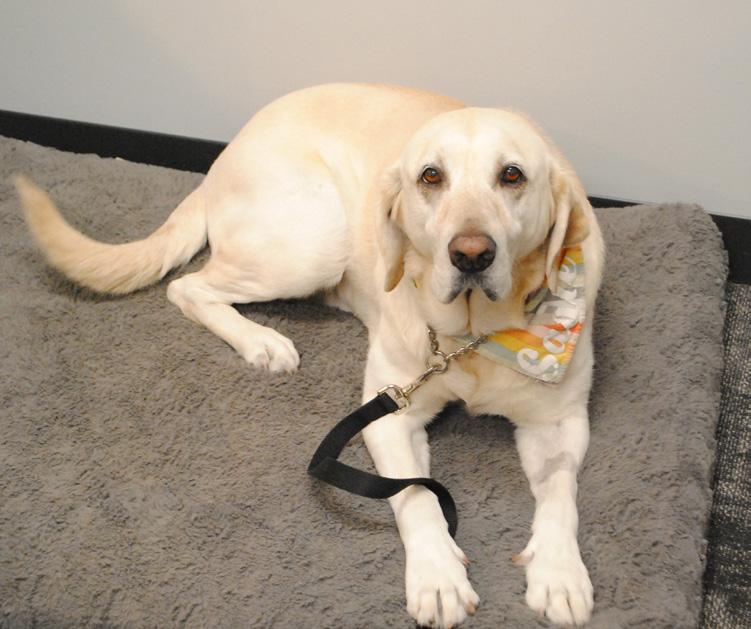
STILL LOOK PRETTY Luke rocks his personalized bandana, branded with his name. This certified therapy dog spends his days interacting with students in the SST with the goal of making their days better.
is where her treats are.”
Sadie’s food obsession becomes more evident with her snack-stealing talents.
“That has been our biggest issue… her literally stealing kids’ food,” Ms. Spillman said.
Sadie’s intense love for food has caused a bit of chaos outside the lunchroom before as well: a couple of years ago, Sadie almost caused an ACT irregularity while hunting for a snack.
“The door wasn’t locked, and all of a sudden, Sadie opened the door, let herself in, and went after the trash can while a kid was taking their test,” Ms. Spillman said. “However, most kids take it pretty well. One of them was literally in tears when it happened, but they’re friends now.”
For Sadie, lunchtime is all the time, but for Luke, lunchtime is a chance to reunite with his brother at home.
“At lunch, I will take Luke out,” Ms. Villalobos said. “I have a second dog at home, and I live eight minutes away. So I’ll usually go home, let my other dog out, walk the two of them, and then come back to school.”
Although walks with his brother are pleasant, Luke is an extreme workaholic. He’s always ready and full of excitement when returning to Maine South.
“As soon as we get to the door, he looks at me, I’ll drop his leash, he picks it up in his mouth, and he walks down the hallway,” Ms. Villalobos said. Ms. Villalobos and Luke also donate their time to volunteer around their local community.
“We do a volunteer program, so twice a month we go to Misericordia,” Ms. Villalobos said “We do sometimes like to read with a dog program at local libraries.”
Although these regular adventures are all thrilling, for the majority of the school day, the dogs spend their time interacting with students in the SST.
“That’s really it,” Ms. Villalobos said. “It’s her being in the office with the kids.”
Sadie and Luke are able to recognize students under distress and provide immediate comfort.
“I remember one time Ms. Villalobos brought them into our class, and they were going to specific people because they were really anxious,” said junior Aristea Kostarelou. “They generally provide a calming feeling and brighten people’s days. Seeing them makes me feel safe.”
Many students enjoy casually seeing the dogs.
“Seeing Luke at pickleball club is always fun,” junior Andy Burkum said. “Just small interactions with him make my day better and I think the dogs really do help students who are struggling and need to be comforted.
The dogs are especially helpful to students in need of a boost.
“They are both obviously trained therapy dogs so they are able to sense a difference in emotion, and I’m just glad they are there,” junior Morgan Murakami said. “They make me a lot happier and help me calm down. I see Luke every single day. He recognizes me and runs up to me. I feel like I have a strong bond with him.”
Sometimes, students aren’t comfortable around dogs.
“We respect the fact that not everybody likes dogs or is comfortable with dogs,” Ms. Spillman said. “For some kids, being around a dog, especially of her size, can feel a little overwhelming.”
For many students and staff, however, these pups have created a more enjoyable school environment.
“There is a lot of research that supports having a comfort dog present,” Mr. Fermanich said. “It’s the calming nature of an animal in a community, where no judgment is involved.”
The two have had a tremendous impact on the school. Their presence has always seemed to add a tad more joy to our school as a whole.
“I think what you notice when walking down the hall is the smiles on the kids’ faces,” Ms. Spillman said. “The kids love to interact with her, pet her, and get to know what kind of dog she is.”
PUPPY DOG EYES Sadie the counseling dog lounges on her dog bed in the SST office. Sadie is a renowned food thief, bringing joy and smiles to students here at South.
PHOTO BY LUQUES HEREDIA
PHOTO BY LUQUES HEREDIA
Auto club builds high-mileage car
Erin Pedersen Features Writer
Whena student approached him in the late 2000s about starting a club about cars, CTE teacher Mr. TJ Krause wondered what activities the club would do.
“We weren’t going to work on other people’s cars, so we were looking into other automotive activities like electric go–karts,” Mr. Krause said.
While the club was looking at different activities, the Maine West Auto Club got involved in a highmileage vehicle competition.
The competition focuses on building gasoline-powered cars that are evaluated for efficiency.
“You drive a certain number of laps and you come back in and they weigh the fuel,” Mr. Krause said, “You see how much fuel is burned for a known distance on the track and then calculate for efficiency.”
The club designs a car that they bring to an annual car competition in Joliet. However that competition recently lost access to their racetrack
due to funding issues.
“They rent out racetracks, have paramedics and people working on course,” Mr. Krause said. “It’s expensive.”
The loss of the track has forced the club to change events.
“We might be looking at an event called Black Hawk Farms Raceway, which is out towards Rockford,” Mr. Krause said. “The car and competition might not continue after this year, because of logistics.”
The club elects new student presidents each year. Senior Christian Hamielec is a co-president of the club and is responsible for organization.
“We’re in the process of building the frame,” Hamielec said. “I’m sort of leading the charge on it, organizing materials that need to be bought, directing the club in the order we create it in.”
Members of the club have to find creative uses for different hardware.
“It involves looking for resources available to you, like at local hardware and bike shops,” Mr. Krause said.
“There’s a lot of problem solving, because I don’t have all of the answers.”
Working on the car is a major time commitment that many members are willing to make.
“A lot of work is done outside of school, because of the time it takes to redesign, weld, or grind specific things,” Mr. Krause said. “It can take
an hour or two.”
Through the work, the club has become a tight-knit group.
“I love the community,” Hamielec said. “It’s not a huge club, but it is a group of dedicated individuals who do come in the mornings and work on stuff together, even when it’s seven and you don’t want to be at school.”
Maine South Promise: helping the community
Alisa Durkee Features Writer
MaineSouth Promise is a program that was established to support the community by providing items that directly aid those in need while keeping a low profile.
The program was created about seven years ago by Ms. Beth Vainowski, a retired physical education and health teacher.
Ms. Jennifer Roddick-Small, also a physical education teacher, aided her and later took over the program.
Ms. Vainowski started the Maine South Promise by reaching out to those who she felt might have needed additional aid, but were maybe embarrassed or uncomfortable communicating that.
“Here at Maine South, it’s sometimes a difficult place to ask for help… There’s a lot more need than we actually know,” Ms. Roddick said. “So, [Ms. Vainowski] noticed some students who perhaps could have used a little extra assistance, and she went ahead and approached them and their parents individually to see if that was truly how they felt or what it was that they needed the most.”
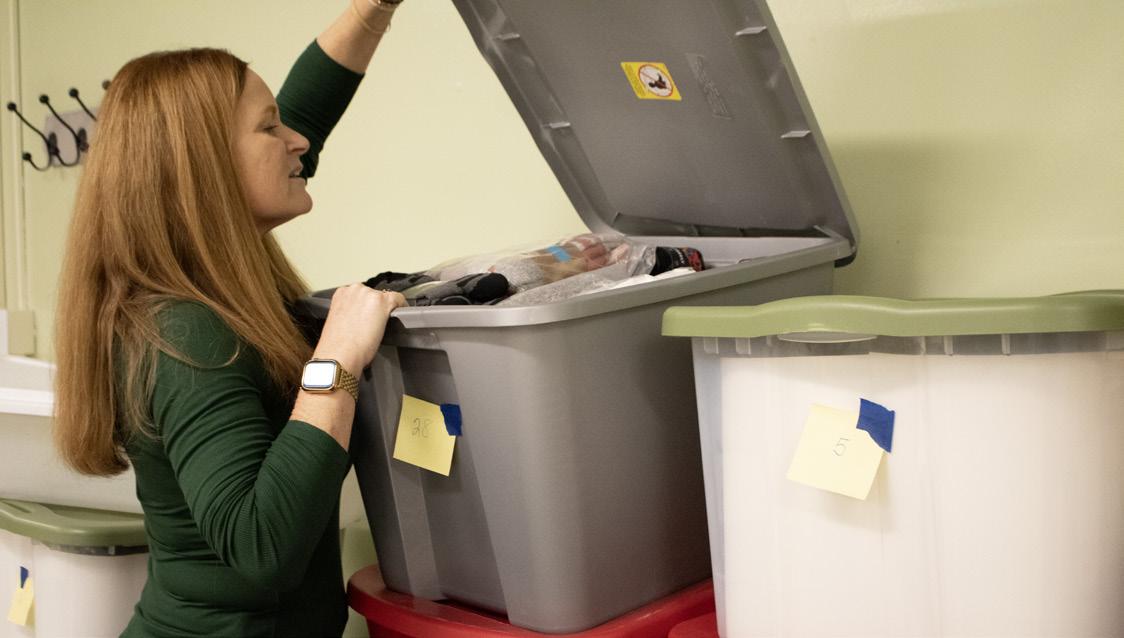
When Ms. Vainowski was just starting the program, Ms. Roddick reached out to her.
“I was just committed to helping her with that,” Ms. Roddick said.
Ms. Roddick aided Ms. Vainowski in running Maine South Promise for three years before she retired, and Ms. Roddick then took over as program coordinator.
In sudden situations like losing a job, housing instability, or an unexpected family emergency, the Maine South Promise Program is
able to assist.
“We can jump in and get a couple of boxes together and give them what we have,” Ms. Roddick said.
Unlike most clubs at Maine South, the Maine South Promise does not have much student involvement.
“In order to protect students, families, or community members, it’s been tricky to involve many people,” Ms. Roddick said.
The privacy of Maine South community members are at risk when students take part.
For example, if a student is asked to gather something like a winter coat, and sees someone wearing the same winter coat, it puts that community member in a vulnerable position.
“In order to really try to honor and respect everybody’s confidentiality, I just have struggled to have students be super helpful.” Ms. Roddick said. “I have called on a few kids to help me organize supplies… but that’s really as far as it goes.”
However, this does not mean Ms. Roddick doesn’t get any assistance from student organizations.
This past fall, the Donation Club gathered supplies from the community for Maine South Promise.
“Our missions are very similar, but yet we’re still separate,” Ms. Roddick said. “I could not do it without so much support.”
To contact the Maine South Promise Program, there is a Google Form on the Maine South website under Resources and Programs.
“Through the donations of community members, families, and students, we’re able to help,” Ms. Roddick said.
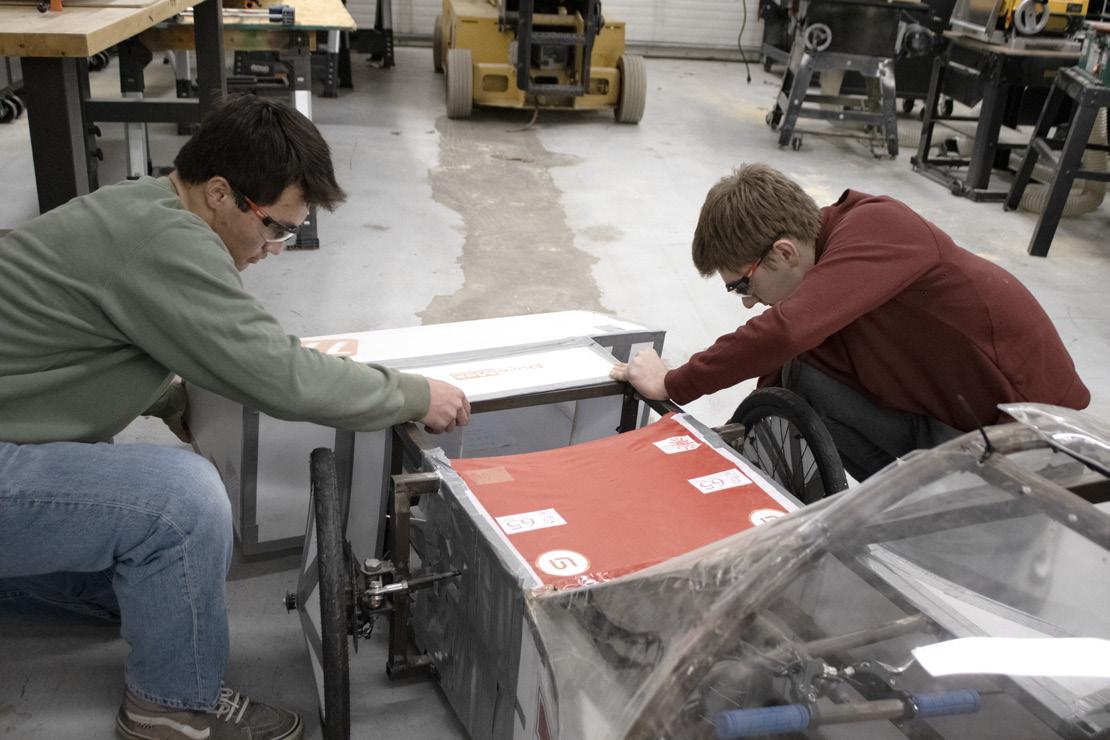
AUTOMOTIVE DESIGN Seniors Christian Hamielec and Marco Zdravkovic work on modifying the Auto Club’s car. The car is raced in an annual efficiency competition.
PHOTO BY KATIE JOHNSTON
FEEDING FUTURES Health and Wellness teacher Ms. Jennifer RoddickSmall organizes the Maine South Promise supplies. The supplies are distributed based on different families’ needs.
PHOTO BY KATIE JOHNSTON
Sarah Frantz Features Editor

recommends you try to accomplish in the new year.
Maine South’s 2026 Bucket List
Get involved in the fine arts
Maine South’s award-winning fine arts productions offer many opportunities to get involved. With two musicals this school year, there are even more opportunities for students to get involved in a production. There are multiple types of involvement; whether it’s on-stage acting or behind-the-scenes helping crew, there is something for everyone. Senior Ola Nawrocki, who played Catherine of Aragon in “Six,” recommends joining to anyone. “Being a part of performing art is such a freeing experience, and is something I think everyone should try at least once,” Nawrocki said. “Even just auditioning, whether you get in the show or not, is so worth it because you can prove to yourself you can do anything you set your mind to.” Senior Lily Arnswald has been a props head for two shows. “Joining props is a great way to join a community and meet new people,” Arnswald said. “It’s also a great way to try new things and create something new.”
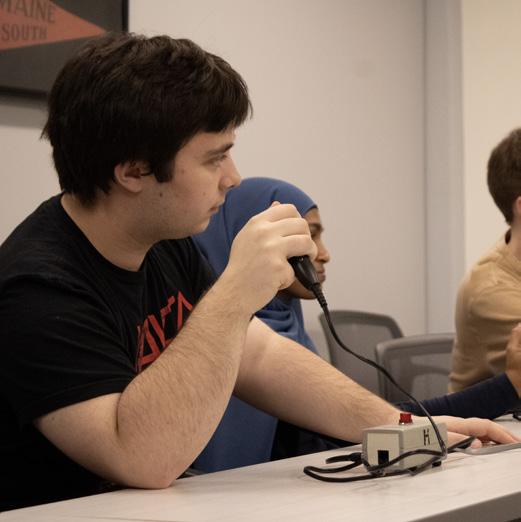
Participate in academic competitions

Besides sports, Maine South has many other competitions that students can take part in. One such competition is the History Fair, where students create an in depth presentation on a historical topic. Each year has a different theme, and students can compete at regional, state and national levels. Mr. Michael Biondo’s U.S history class participates in the competition every year. “I think the History Fair is a very unique academic competition, because it’s not often that you get to do an assignment for a class…and have your work displayed publicly and celebrated.” Mr. Biondo said. “You get to interact with museum professionals, archivists and librarians, and you get to get the more hands-on history experience.” Another popular competition club is the Constitution Team, run by Ms. Leah Politi. “It’s a way to sort of see if you like different professions,” Ms. Politi said. “Something we hear from C-team students a lot is that they become friends with people who are in totally different corners of the school. It’s a nice use of academics to bring people together that maybe you wouldn’t have known otherwise.”
Join more clubs
Maine South hosts many possibilities to learn outside of the classroom. With the abundance of clubs available, stu dents can explore a multitude of interests. “I am a big advocate for students getting involved outside the classroom,” Team Black counselor Mr. Mark Zambrano said. “Whether it’s tied to a career interest or something they enjoy, clubs help students explore their passions, connect with peers who share similar interests, and feel more connected to the school community.” Postsecondary counselor Ms. Robyn Moreth also believes that clubs are important to see what activities best suit your skills and interests. “High school is about exploration,” Ms. Moreth said. “The key is to start exploring, even if you’re not sure where to. Sometimes you try something and you realize ‘Oh, I don’t really like that,’ and that’s valuable too.”
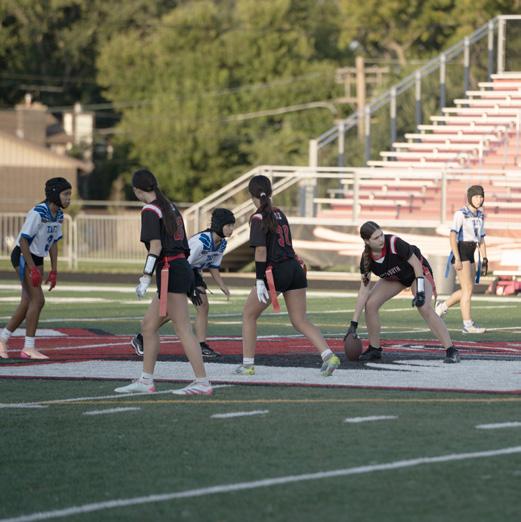
Support girls’ sports
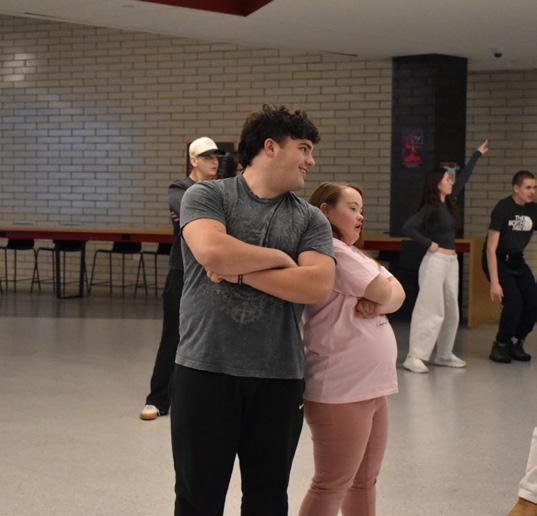
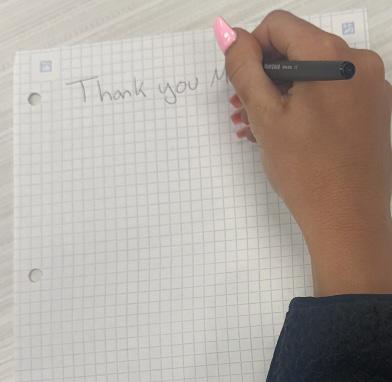
With everything teachers do for us, showing our appreciation with a simple “thank you” doesn’t seem like nearly enough. However, it goes a long way for biology teacher and Hawk PRIDE facilitator Ms. Alexis Liakakos. “Personally, a note of thanks or appreciation from a student means an incredible amount to me,” Ms. Liakakos said. “When a student takes the time to write a note to say thank you for a positive experience they’ve had, it makes me feel that my work is seen and it reminds me how lucky I am to get to do this job.” But, it can be just as meaningful to write it to a friend or loved one. Not only are writing these notes meaningful for the person receiving them, but also for the person writing them. “Telling someone that you appreciate them or that they’re a good friend makes both people feel good,” Ms.Liakakos said. “Expressing gratitude through the gratitude notes…doesn’t just positively impact the person who receives the note but also the person who wrote the note in the first place.” PHOTOBYLIZPALMER
Maine South’s girls’ sports have been excelling this past year. Despite their recent wins, girls’ sports still don’t receive the recognition they deserve. However, even if you’re not on a team, there are some simple ways to support girls’ sports, like going to spectate at games. “As a school we want each other to win for the good of Maine South, and having a spirited crowd really helps the players achieve a new level of confidence and competitiveness,” senior Grace Cioromski said. Spectating isn’t the only way to support Maine South girls’ sports. Flag football coach Ms. Jarizza Martinez has another idea for students who can’t make it to the games, but still want to show support. “We have a Maine South flag football Instagram page… and being able to repost and show their support through that means a lot,” Ms. Martinez said. Girls’ basketball coach Mr. Jeffrey Hamann agrees that support can be important off of the playing field. “You can just say ‘Hey, good luck in your performance tonight,’ or ‘Hey, congratulations on the win last night,’” Mr. Hamann said.
‘Stranger Things 5’ reaches unsatisfying conclusion
Mia
Kalinowski & Shauna Ronan
Entertainment
Writers

“Stranger Things 5” - Netflix
“Stranger Things” has consistently broken Netflix viewing and streaming records for years, and has steadily become known as one of Netflix’s most successful shows, with some claiming it “made” Netflix as popular as it is now. Season five is currently the ninth most viewed season of a TV series on Netflix, with over 105 million views in the first 91 days of its release.
This season, however, is receiving some harsh criticism and backlash from fans following the finale of the show, with many saying it lacked the suspense and drama they had anticipated. Compared to other season finales, which got IMDB scores of around 9.3/10, this one only got 7.6/10, reflecting fans’ disappointment.
The “Stranger Things” plot can be challenging to follow at times, with multiple storylines, characters, and scientific concepts. Season five is representative of the complexity, overlapping storylines, as well as abundance of characters in the show. Although the cast was already

large, the show continued to introduce more main characters, creating a more difficult storyline to keep up with. With overlapping dimensions, storylines from other seasons, and shifts between group dynamics, the season became overwhelming and difficult to follow. These complexities actually led to a multitude of plot holes in the show.
As the story played out and became increasingly complex, questionable and illogical scenarios seemed to come up.
On social media, fans started to make speculations that there was a secret extra episode coming out or that there was unreleased footage be-
cause some of these plot holes and inconsistencies were so big. With neither of those happening, people have questioned the true meaning and logic behind things happening in the show and why the Duffer Brothers, the creators of the show, made these choices, especially compared to previous seasons.
Episodes with long runtimes felt like overstuffed movies, with some exceeding 90 minutes. The longest episode, the finale, titled “The Rightside Up,” spanned 128 minutes. The length of the episodes made the ending of the show very tedious and almost punishing with epilogues and a jump 18 months into the future.
While the finale gave many storylines closure, they didn’t all feel true to the characters and left many parts of the ending up to the viewers’ interpretation. This left many fans disappointed since they had known these characters since 2016 when the show first came out.
With an hour left in the final episode, it had seemed like the plot should be over. This left many thinking: what could even happen next?
To nobody’s surprise, essentially nothing plot-based happened after that, and the final hour was a time jump 18 months into the future focusing on what the characters were up to, a seemingly lazy and anti-cli-
mactic ending to such a well-regarded series.
With this ending, it became evident there wasn’t enough action in the finale, or in season five altogether. Shifting abruptly from a highstakes and action-driven plotline to a slow-moving epilogue, the finale suffered from emotional whiplash.
Season five wasn’t a bad season, but it doesn’t come close to the greatness of the other seasons. There were many aspects of the plot that were enjoyable, including Holly and Max’s connection, Mike and Eleven’s relationship, Lucas and Max’s relationship, and also the bond and relationship between Hopper and Eleven. Expectations were high as the very last season of “Stranger Things” came out.
The Duffer Brothers promoted season five as one of the most emotional seasons yet, leaving fans with high expectations.
Season four of “Stranger Things” was released in July of 2022, leaving three years for us to imagine the possibilities of what could come of season five.
The directors just didn’t seem to fully meet the expectations placed upon them. There was so much anticipation and such high hopes from fans beforehand that the season couldn’t possibly measure up in the end.
CAVA is a healthier option, but comes at a cost
Karin Flensborg, Andrew
George & Gabi Shaw
Entertainment Editors

CAVA, the viral Mediterranean restaurant, has made its way to Des Plaines, opening in mid-December. They have become known for their fast-casual dining, chic atmosphere, and as a “healthy Chipotle.” With a multitude of options, it’s clear why the chain is a fan-favorite for those seeking a healthy fast food alternative.
The setting of the restaurant is modern, clean, and a place you’d want to sit down and eat at. As a result of CAVA’s marketing to a younger audience, many teenagers and young adults have discovered the restaurant.
The “fan-fave” Harissa Avocado

bowl, priced at $17.05, is one of their signature pre-se lected bowls. The flavors of each component in the bowl complement each other ex cellently. Howev er, this bowl also ex emplifies the importance of the “build your own” element of the restaurant. The price could easily move down if some parts of the bowl are taken out, and different ingredients could better match one’s taste. This is where CAVA seems to excel, as most people tend to build their own bowls.
Other than the bowls, CAVA also offers a pita meal as a main entree. Pitas are most comparable to burritos, but instead of being wrapped in a tortilla, it’s wrapped in pita bread.
CAVA’s pita chips are their main side, and they are delicious.
Crispy with the perfect amount of salt, the pita chips complement the entrees well.
With many bottled and canned drinks, along with other fountain sodas and juices, CAVA offers many beverage options. The “maine root” beverages, CAVA’s sodas, taste like mimics of common sodas. They also have special fruit-flavored sodas. While these sodas taste good, their “made-in-house” juices aren’t quite as good. Both the Blueberry Lavender and Tangerine Aleppo are lacking sweetness, leading to the beverage tasting more like flavored water
rather than juice.
The restaurant has a Californian vibe with a very modern, Bohemian style and an emphasis on healthy food.
However, the health value comes at a price: the bowls range from $12.25 to $17.85. In contrast, the kids’ meals are $7.65 with a reasonable amount of food, side and drink included. While the portion sizes of the full entrees are big, they aren’t worth the price.
Despite their emphasis on healthy foods, they have a few dessert options, like brownies, blondies, and cookies. With the brownie and blondie being priced at $2.95, you’d expect it to be big, but you can eat it in one bite.
While the quality and taste of CAVA is great, prices don’t match the fast-casual model and only makes it worth the occasional splurge.
Harissa Avocado Bowl - $17.05
PHOTO BY KARIN FELNSBORG
Attention spans weakened from short form content

Isabella Fayhee Entertainment Writer
According to Eyesafe, the average person is projected to spend roughly 21 years on their phone, equivalent to over 181,000 hours lost to your phone. This comes as no surprise, especially since continuous scrolling became a mainstream hobby during the pandemic as a way to cope with the isolation.
Since then, it has evolved into a global health crisis — one slowly reshaping our brains’ chemistry. A meticulously curated algorithm provides shocking, emotional, and overstimulating videos, pumping your brain with dopamine and urging you to keep scrolling. This phenomenon, aptly named “doomscrolling,” has profoundly damaged day-to-day life.
Studies demonstrate that these 60-second clips lead to a reduced attention span and a decreased ability to perform long tasks. The brain searches for constant novelty and craves to fill every dull moment. Whether it is walking, eating, or a lull in conversation, our phones are in our hands. We gluttonously consume the media and disregard any time for independent thought or reflection.
This shift in attention has permanently altered the way we consume books, shows, and movies. People would rather get their info on Twitter than tune into the morning news. Movies are used for background noise rather than for enjoyment.

Your phone is the last thing you see at night and the first thing you see in the morning.
Ultimately, doomscrolling has transformed entertainment from a fun and captivating leisure activity, to a daily habit. With the continued intake of short form media, it is possible long form media will disappear completely.
Along with the decline of attention spans comes the rise of multitasking; 74% of people have reported using their phones to multitask, and 70% use their phones alongside other devices. The brain searches for constant engagement. It has become a rare occurrence to see someone sitting alone with their thoughts instead of their screens. Similarly, if a movie is not constantly captivating, such as when a frame sits for too long or a scene is drawn out for emphasis, the film loses the attention of its viewers.
This is most commonly seen in kids shows or movies. Previously, colors were soft, backgrounds were minimal, therefore placing emphasis on the characters, and plots were concise. Now scenes
change rapidly — scenes are on average below four seconds. Effects are loud and frequent and multiple plotlines occur at once. Comparing a show from the early 2000’s like “The Berenstain Bears” to the recent shows like “Paw Patrol” demonstrates this shift.
Beyond its effect on attention span, a lot of these short online videos lack quality or purpose. While some provide actual useful information or life skills, most have no real meaning. Other forms of entertainment, such as novels, advocate for critical thinking and force your brain to process and digest the information it consumes.
A striking piece in the news may sit with us for days while a video three scrolls ago is already long forgotten. Developers merely concern themselves with what will keep you on their platform the longest rather than providing meaningful or thoughtprovoking content.
Short-form content is taking over our society, and while meaningful long form storytelling may not entirely disappear, it will become a rarity.
A uniquely fresh take on success: ‘Marty Supreme’
Joseph Calderón Editor-in-Chief

“Marty Supreme,” released on Dec. 25, 2025, directed by Josh Safdie and starring Timothée Chalamet, is a refreshing and electrifying film that tells the story of the charismatic yet shameless hustler Marty Mausser as he competes in the world of professional table tennis and faces numerous personal challenges.
Set in the postwar era of the 1950s, the movie follows the narcissistic Marty as he ventures to London to compete in the British Open, where he is defeated in the Championship Match by Japanese player Koto Endo. Marty, driven by a compulsive need to win, spends the remainder of the film finding himself in increasingly high-stakes
and risky situations in order to make enough money to compete in the World Championship in Tokyo, where he seeks to face off against Endo once again.
A sports-comedydrama film, “Marty Supreme” consists of a strong cast with numerous A-list actors in addition to Chalamet, such as Gwyneth Paltrow, Odessa A’zion, and Abel Ferrara, as well as roles starring pop culture icons Tyler the Creator and Kevin O’Leary. The film was scored by Daniel Lopatin, delivering powerful electric synth music to accompany high-tension moments, giving the film a retro vibe. The film received lots of hype and was the product of a unique marketing campaign using personality-driven stunts headed by Chalamet.

“Marty Supreme” is somewhat lengthy at a 149 minute runtime, yet it keeps the audience in suspense the whole time, with many high-stress scenes. What makes the movie work so well is its commitment to the protagonist. Despite Marty’s established narcissism and many faults, the character keeps you engaged, eager to see what he does next. Chalamet delivers an amazing performance, simultaneously making Marty unlikable yet charming. The film is propelled forward with an intentionally unforgiving pace.
The quality of the film is also quite notable. The engaging and enthusiastic acting pairs excellently with Josh Safdie’s direction. His precise use of claustrophobic framing and frantic pacing mirrors the
mental state of Marty throughout the film. The camera is kept at an intimate length, making the audience feel like they are in the film. The sound design and editing heighten the sense of stress and urgency the viewers feel.
“Marty Supreme” is more than the story of an arrogant hustler struggling towards victory. In a sense, it is a modern American epic, focusing on the ideals of ambition, reinvention, and a goal to live in excess, all of which are embodied in Marty. He refuses to accept defeat, essentially believing his own success into existence. The film touches on the theme of success without meaning, and it critiques a culture of false confidence, particularly criticizing the idealized American dream.
With a uniquely refreshing story, high-quality acting, and a tense yet humorous vibe, “Marty Supreme” cements itself as an instant classic.
“Marty Supreme” - A24
STUDIO CREDIT A24
Winter play brings D&D to the stage
Lily O’Malley
Entertainment Writer
This year’s Winter Play “She Kills Monsters,” is directed by first-time Maine South director Ms. Samantha Kaufman. Ms. Kaufman is a newer face in the PA wing, previously working professionally primarily as an intimacy and fight scene director. Before “She Kills Monsters” she had contributed to Maine South productions like “The Laramie Project” and “Pippin.”
“She Kills Monsters” is a play that takes you through the adventure of Agnes, played by senior Sadie Meeks, after she finds her recently deceased sister’s notebook, which contains a Dungeons and Dragons game that follows events that happened in her life.
“[This show] blends humor and heart and spectacle, pulling the audience into a world where fantasy and real life collide,” Ms. Kaufman said. “It’s fast-paced and fun, but it’s also asking big questions about identity and grief, friendship, and growing up.”
The rigorous rehearsal process began after the Maine South variety show came to a close at the end of November.
At the end of each school day, the cast and crew prepare for three to four long hours of rehearsals, which occur five days a week and sometimes even on Saturdays.
The cast has had many fun and memorable moments during rehearsals.
“Getting to see my real sword and shield was really, really, really cool,” Meeks said. During the play, she gets to carry around a real metal sword lent to the cast by another school as well as axes and many other unique props.
“She Kills Monsters” is one of the most demanding shows for the crew. In the Maine South theater department, multiple crews are overseen by the stage manager, senior Jayden Bublitz, and the technical director, Mr. Jon Luke Lassa.
“The stage crew here at Maine South consists of eight separate smaller crews… construction, props, painting, sound, lights, costumes, hair, and makeup,” Mr. Lassa said. “My job as the technical director is to be in charge of all of those except costumes.”
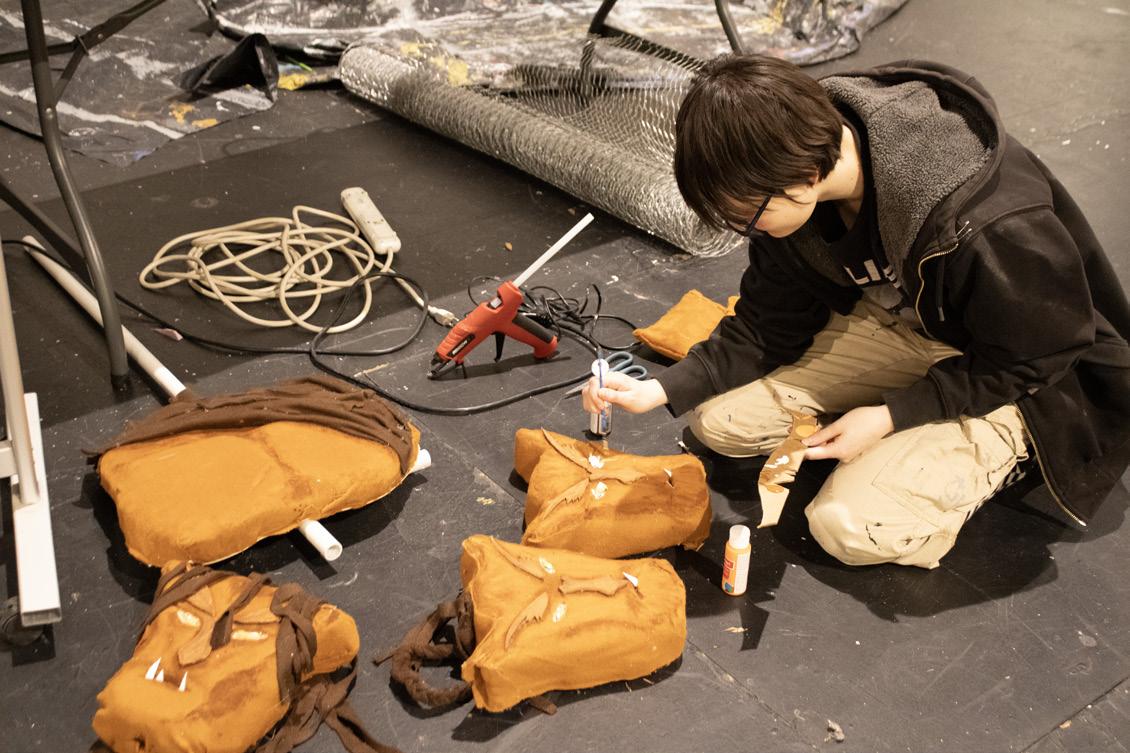
Crew for this show is specifically very important due to the cast needing almost 30 handmade puppets, many even life-sized.
“Some of the puppets play characters in the show, though the rest are all monsters that the characters are kind of fighting in their journey,” Mr. Lassa said. “There’s a big gelatinous cube and a five-headed dragon and lots of other stuff.”
For this show, an entirely new branch of crew was formed to create these puppets who worked hard to make them just right.
“We’ve been working with the cast a lot, building a prototype, letting them come and test it and play around with it in rehearsal, figuring out what works and what doesn’t work, and then going back to the drawing board,” Mr Lassa said. “It’s been a lot of that back and forth.”
Many students who signed up for
crew this year were expecting to be working on only their crew, though this year they all banded together. Even with help from the cast, they kept pushing through the hard work of creating these puppets that would make or break the show.
“I would never have been able to do it without students coming back every day and pitching a different idea after we’ve come across a problem or coming in and asking me even to come in on weekends and work on stuff,” Mr. Lassa said.
The winter play, though visually impactful, also has compelling and thought-provoking themes.
“[The show emphasizes] really making an effort to get to know people, not just people you love, but new people,” Meeks said. “Just making sure that you are always saying, ‘please’, always saying ‘thank you’, always remembering what people do
for you and doing things for people in return is something that this show touches on beautifully.”
The characters demonstrate this character development throughout the show.
“Through the life of the sister she lost, [Agnes] really found the importance of who she is,” Meeks said.
Respect plays a very big role in this show — not only respect for other people, but respect for what you have and the things that you should be grateful for, especially due to the storyline following a girl whose sister had recently passed.
“The show reminds us that fantasy isn’t an escape from reality, but a way to understand it and to survive it,” Ms. Kaufman said. “At its heart, the story is about connection, just learning to see the people who we love for who they truly are, even when we think we’ve lost that chance. It encourages empathy, acceptance, and the courage to embrace both strength and vulnerability.”
The cast and crew are patiently waiting and preparing for the show and are very passionate about why Maine South students, families and friends should come see the show.
“I think what people will enjoy about this show is the creative and unique uses of actors, props, and crew,” Bublitz said. “It’s filled with action, comedy, and ‘90s music.”
The show is unlike those Maine South has done in the past.
“[‘She Kills Monsters’] offers something that they can’t get anywhere else,” Ms. Kaufman said. “It’s a powerful story that’s told in a fresh, imaginative way that’s both entertaining and meaningful.”
Not only is the plot unique, but the central idea is something that many can connect to.
“Ultimately, I want audiences to leave feeling that imagination can be healing and that being yourself is powerful and that everyone deserves to be seen and understood.”
“She Kills Monsters” will be performed at the Watson Auditorium at 7:30 p.m. on Friday, Feb. 6, and Saturday, Feb. 7, along with a matinee at 2 p.m. on Sunday, Feb. 8.
Tickets can be purchased for $10 for students and $12 for adults at the door of the auditorium before the show. Only cash or checks will be accepted.
PAINTING PUPPETS Sophomore Rowan Halstead works on creating puppets for “She Kills Monsters.” This show is unique in that there are over 30 puppets that need to be created, many even being life-sized.
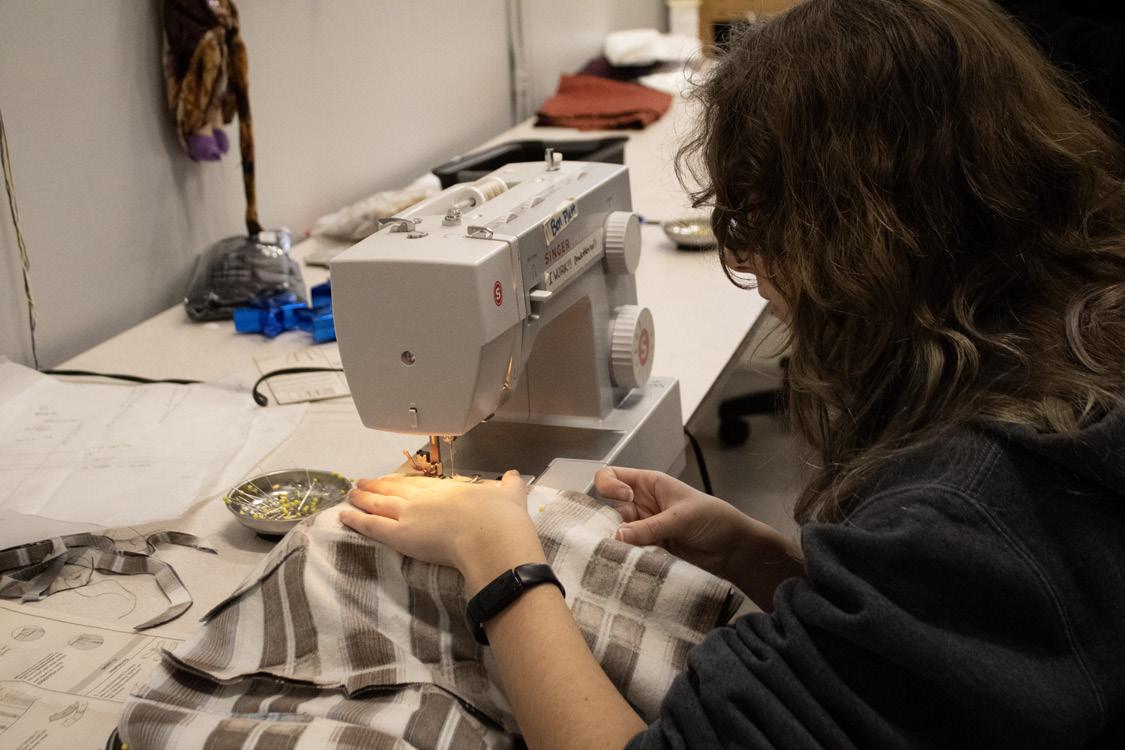
SEW ‘90s Junior costume crew head Audrey Demott works on sewing costumes for “She Kills Monsters.” The show is set in the ‘90s, so the costume crew has to make sure every piece of clothing that they create fits the time period.
PHOTO BY KATIE JOHNSTON
PHOTO BY KATIE JOHNSTON
Gavin Brich earns a spot in the All-State game
James Biagi Sports Editor
After four years on the Maine Hockey Team, senior forward Gavin Brich earned a spot on the Boys High School 2026 All-State Team.
While making All-State wasn’t a primary goal at the beginning of the season, it started to become a possibility gradually throughout the season.
“At the start of the year, I wanted to win championships,” Brich said. “Then I got off to a pretty good start, and I made All-Conference, but I didn’t really think All-State was an option...I woke up [on Jan. 5] to an email saying I made All-State.”
Making All-State is the highest individual honor in high school hockey. The Amateur Hockey Association of Illinois (AHAI) selects the top high school hockey players in the state to play each other in the All-State game, which will be held on Jan. 26 at West Meadows Ice Arena in Rolling Meadows.
The AHAI nominates a total of 42 high school hockey players and splits them into two teams of equal skill level to play in this match.
The Blue and the White teams
both have three goalkeepers, six defensive players, and 12 forwards.
“I was named to the Blue team,” Brich said. “I’m playing with kids from…any Illinois high school team, no matter what league they play in, it’s just the top players in Illinois.”
Brich was selected to play for the All-State Blue team as a forward.
“There are 24 forwards that got selected over the two teams, and I was lucky enough to be one of them,” Brich said.
To be selected for the All-State teams, candidates must stand out by being well-rounded players and not just excel in one area.
“I can score goals and put the puck in the net, but I value playing defense, killing penalties, and being a leader on the team,” Brich said.
While Brich is able to score and help the team, his energy doesn’t go unnoticed by his teammates.
“Gavin always has positive energy in the locker room, joking around while still being a leader,” senior forward Shawn Chansed said.
Not only did Brich have to put in hard work, but he had to deal with injuries and pain during the season.

“[Maine Hockey] had four weeks in a row, [where we had] three games in a weekend, so my back was messed up, and I had something with my shoulder,” Brich said. “It’s just something that you get used to, especially as a senior.”
Although Brich earned the AllState honor, he continues to focus on
the rest of the regular season and the upcoming playoff games.
“[The All-State game] will be fun, but I care a lot more about playoff hockey,” Brich said. “Last year [Maine Hockey] won Illinois West, and we are trying to do that again. But we feel that State didn’t end how we wanted to last year, so we want to do better this year.”
Cheer achieves highest score in Maine South History
Riley Story Sports Editor
After a long, successful sideline season this past fall, girls’ cheerleading transitions into its competition season. To start the season, the team earned the highest raw score in Maine South Cheer history and were crowned conference champions for the first time in two years. Five different athletes performed a “full,” or rotating backflip, in the routine, a near record number of girls with this skill.
The girls are working hard to bring a positive mindset and strong work ethic to the competition season.
“This year we are coming into competition with a more positive mindset and continuing with the same determination from last year,” junior Claire Newton said. “We use sideline to help ease the transition by learning our new skills, so that we can then focus on perfecting our routine for competitions.”
Practices have become more rigorous as the team is entering the competition season and implementing new stunts and skills. Each rou-
tine the team performs is two minutes long. While two minutes may seem quick to some, going all out in this time is a mentally and physically draining task.
“We practice every day and consistently repeat each section of our routine until it becomes second nature,” head coach Stacy Pater said.
As they continue to surpass their achievements from last year as a team, they are also focusing on individual goals and skills on top of this.
“We spend a lot of time focusing on individual goals based on positions, such as specific techniques in stunts and sticking landings on skills,” senior Molly Panizo said.
They also spend time planning specific days of the week, working on not just skills but also reviewing their routine. Incorporating both is crucial.
“We organize practices to take the time to review film from both practices and competitions as well as analyze judges’ score sheets,” Coach Pater said.
The competition brings new challenges to the team that aren’t present during the sideline season. The
intensity of practices is increased, as well as the pressure to succeed at competitions.
“Along with these adjustments, practices also are an hour longer and every day during the week,” Panizo said. “Preparing for these practices is much more mentally tough, but with our goal to have zero deductions at competitions, I feel super motivated.”
Throughout January, the team has competitions every weekend leading up to Sectionals, which take place on Jan. 31. To advance to State, the team must place at Section als.
“Our coaches en sure that we are pre paring efficiently throughout these weeks and making adjustments moving forward,” Newton said.
The team has been ex tremely successful over the past few seasons, hav ing qualified for the state competition consecutive ly for three years; they
even qualified for the state finals in the 2024 season. The team hopes to keep up this momentum and excel at the State level once again.
“One of our main goals is to return to the State Championship,” Coach Pater said. “If we qualify, this senior class would become the first group since the class of 2016 to advance to State all four years of high

The team is eager to make it back down to State after placing 16th in the large Varsity Division last year. The Hawks are aiming to make a fourth consecutive trip
“As a team, we have a strong feeling we can make an even better run in state this year,”
ICE COLD Senior Gavin Brich stands on the ice before the third period in a game against the Warriors Hockey Club (Waubonsie, Metea, Wheaton North, and WheatonWarrenville South) on Nov. 21. Brich will play in the All-State game on Jan. 26.
Freshman Josie Steinfels performs with her team on Jan. 15. The team won at Maine East claiming the conference title.
Girls’ wrestling continues growth
Maggie Bublitz Sports Writer
The rising interest in girls’ wrestling has allowed the Maine South team to coninue to thrive. With new faces, including 11 freshmen, the girls are competing with a bigger team than in previous years.
“Last year, we had eight girls, and this year we have 17,” sophomore Crystalia Psyhogios said. “The growth of our team definitely reflects the growth of the sport.”
This season, the team features a more experienced group, with girls who have wrestled before high school.
“Most of our new girls this year have also wrestled prior, which will really help us compete at a higher level,” junior Jasmine Dutt said.
The girls’ team has shown significant improve ment since the program began in 2022. Coach Angela Lee was a member of that initial roster and is now a first-year coach for the team.
Lee has helped her wrestlers develop both physically and mentally. With a former Maine South student and athlete as a coach, the girls have someone who they can relate to.
“I understand the challenges that girl wrestlers may face that come with the sport, which creates a better connection,” Lee said.
As the wrestling season progresses, the team continues to develop its skills. The key to the girls’ success this season is confidence.
“One of the most important skills we are still learning to develop is confidence,” Coach Lee said. “Wrestling can be unforgiving, but as we progress into learning new skills, we always reinforce repetition, and with repetition comes confidence.”
The girls overcome these challenges by being consistent in both practice and competition.
In and out of the wrestling room, the athletes’ main focus is prioritizing discipline. The team navigates these difficulties by pushing one another.
“Watching each girl grow over time, both physically and mentally, is such an amazing feeling,” Dutt said.
Although most of the team has individual
Girls’ gymnastics supports young team
Sydney Hollingsworth Sports Editor
Despite multiple athletes missing time early in the season, the girls’ gymnastics team has posted competitive scores and had consistent performances. To help maintain their mental health throughout the rigorous season, the team has been meeting with sports psychologist, Demi Agaiby.
“Given that gymnastics is a very mental sport, [Agaiby] has helped us all so much with improving our confidence, learning to stay calm, and strengthening our connections with teammates,”
Boys’ swim & dive has young talent
Sydney Hollingsworth Sports Editor
The boys’ swim and dive team is off to a strong start after winning the Rolling Meadows Invite. This year, the team’s roster only has one senior diver, so with young talent, practices look a little different.
“This is a season meant for connecting as a group and getting better rather than dwelling on our scores,” sophomore Michael Saviski said. “We have no seniors on our roster, so we don’t really have those older guys to help us boost scores. We are all just trying to get better with every practice so that next year we can consistently win.”
Swim practices consist of rigorous workouts and intense swims. Over winter break, the team had practice every day except Christmas Eve, Christmas, and New Year’s Day.
“Our practices are really intense,” junior David Mazurek said. “We usually start with a warm-up and a pre-set to get our heart rates up, but then we do broken swims and kick sets. During broken swims, we break up a race into four parts, swim as fast as we can, and then add up the times to get a mock race time.”
Not only was the team swimming every day over break, but they also practiced twice a day. This very intense schedule will help the team continue to improve.
“What makes the swim team unique is that we



Hawkettes look to defend national title
Scarlett Schembeda Sports Writer
Defending their title, the Hawkettes won the CSL conference competition yet again. However, the Hawkettes are working towards one main goal this season: win Nationals.
Last year, the team attended the National Dance Alliance (NDA) competition and became the 2025 pom national champions. This year, the girls look to become national champions at a different competition — the Universal Dance Association (UDA) nationals.
Since the girls will be attending UDA rather than NDA, they will have to work even harder to defend their national championship.
The UDA rewards teams for doing more technical and acrobatic routines whereas the NDA rewards teams for cleaner execution.
The team practices Monday through Friday from 3:30 to 6. In addition to these rigorous practices, the team also participates in ballet classes, workouts with their trainers, and clinics led by Maine South’s sports psychologist. With their high reputation and skill comes
pressure to do their best.
“I plan to stay fully committed in every practice, motivate my teammates to give their best, and lead by example both on and off the floor,” senior captain Annabelle Nelson said. “Practices can get intense, so it is important for me to be there for my teammates when they need me.”
This year, the Hawkettes are adjusting to their new team. Many team members are sophomores and juniors, and do not have the same experience that the senior veterans have at competitions. With this obstacle, it has become crucial to ensure they practice as a team and strive to be the best they can be.
“Our biggest and most important competition is UDA Nationals, and only seven of us on the team have experienced it,” senior captain Alyssa Ira said.
Through these obstacles, the girls are expected to still do their best and maintain their reputation. To reach their goals, they all need to put in hard work, stay positive, and work as a team.
“I hold high expectations in challenging the dancers to work hard, stay disciplined, and be encouraged for con-
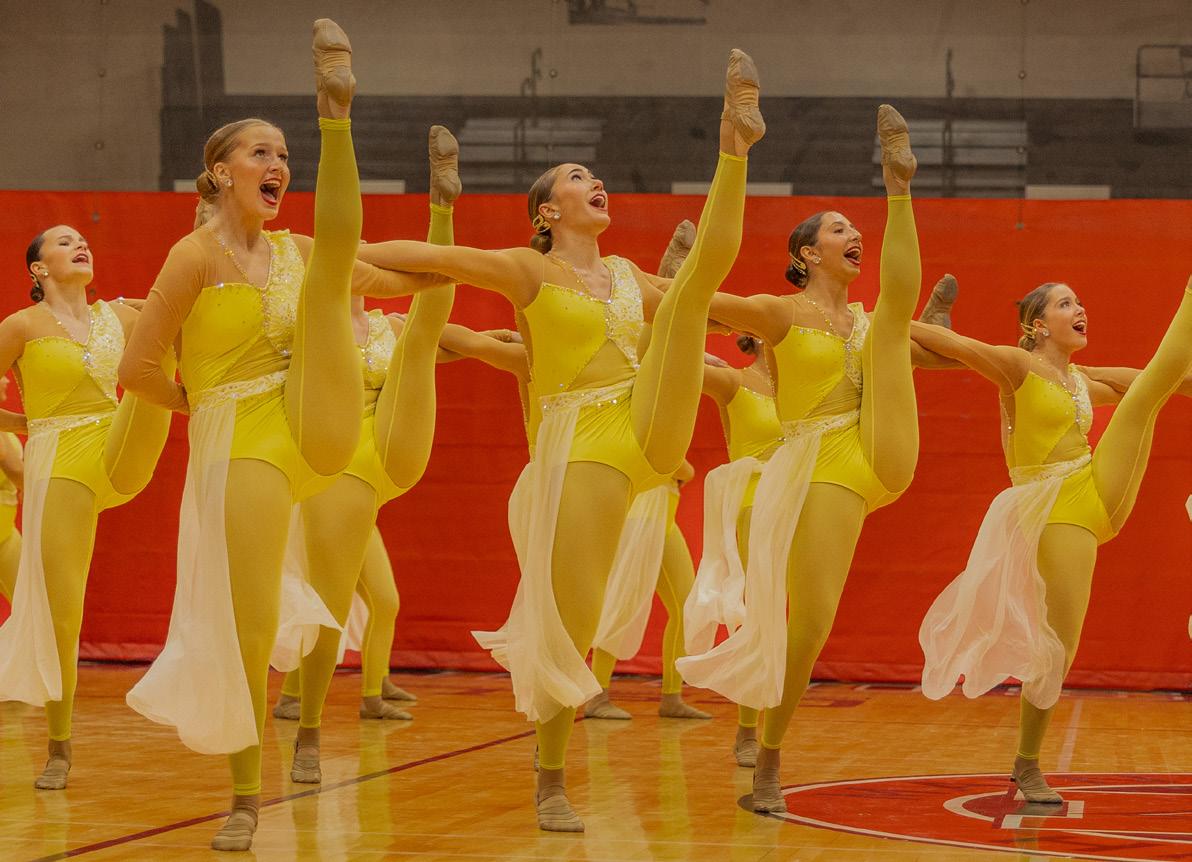
tinuous growth the year,” Coach Lauren Haman said.
As the sideline season for the Hawkettes has come to an end, the team has been dedicating every minute in practice for Nationals. With a rigorous practice schedule, the girls are excited for what is to come.
“We want to put on a performance that truly shows all of our hard work, growth, and dedication as a team, and ultimately to lead us to a win at UDA Nationals,” Nelson said. “I am so proud of these girls and what we have done, and I can’t wait to see what we can accomplish.”
Panayiotis Sotos reaches 1,000 varsity points
Katie Johnston Production Editor
After working tirelessly for the past four years, senior Panayiotis Sotos has achieved a rare feat: 1,000 points scored throughout his high school basketball career.
Sotos is the first player on the boys’ basketball team in a decade to score 1,000 points.
“It’s a milestone that shows all the hard work and determination I’ve put in,” Sotos said.
This hard work is shown throughout the season, as Sotos averages 18.5 points a game. This stat is accompanied by his averages of five rebounds and three assists per game. Sotos, along with Coach Colin Wehman, believes that the team is at the center of all achievements.
“We have talked about how individual achievement is a product of a team,” Coach Wehman said.
Coach Wehman emphasizes that the team is what every individual achievement is rooted in because nobody could score points or make important plays without all five players on the court.
“In the end, there is no way I would have achieved this goal without my teammates throughout the last four years,” Sotos said.
One thousand points is no easy feat. Over the past four years, Sotos has worked to tailor his skills to perfect his shot.
Sotos has been going through basketball training for many years, and his hard work is reflected by this achievement.
“Being in the gym day in and day out, it takes a lot of sacrifices that I am willing to make now, and even from a young age,” Sotos said.
Although scoring 1,000 points is an achievement that brings lots of personal attention, Sotos knew that despite this highlight, he still had a game to play.
“In the moment, I had a lot of emotions going through me, but it just so happened that it occurred during a close game, so I was more focused on getting the win rather than celebrating,” Sotos said. “It definitely was a sigh of relief once I got it though.”
Coach Wehman, who has been Sotos’s coach all four years at Maine South, has been able to see the true growth of his game.
“I’m super happy for him,” Coach Wehman said. “We have had a great relationship, and it has been a joy to see him grow, mature, and improve.”
This milestone game, as incredible as it is, is not the endgame for Sotos. He and his team have big plans for
the end of the season.
“I want this team to finish out this year strong, rack up some wins, and make a push in the playoffs,” Sotos said.
Since Sotos is a captain on the team, it’s important that his goals are always team oriented.
“Everyone is a part of our goals and what we strive to achieve,” Sotos said.
Sotos always wants what is best for the program as a whole and is working constantly towards improving it.
“His mentality is ‘TEAM’ and what the team can do as a whole, which is a lot,” Coach Wehman said.
1 OF 1,000 Senior Panayiotis Sotos shoots a free throw in a game against Down ers Grove North. The Hawks won 55-53.

KICKING HIGH The Hawkettes debuted their new kick and pom routine at their holiday show on Dec. 7. They will perform at Division I UDA Nationals starting Feb. 6.
PHOTO BY SAM HIGGINS
PHOTO BY AMIR ALKHAFAJI