SERVICE M
A T T
E
R
S
±±±
vol. 2 spring 2015 ˛
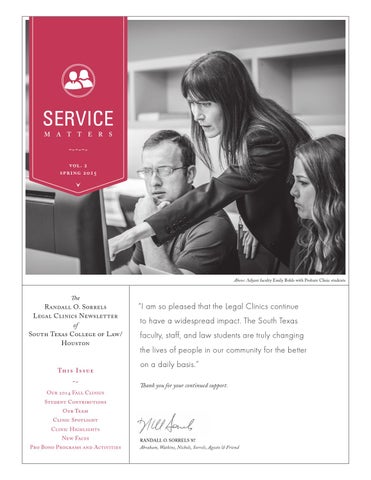
Above: Adjunt faculty Emily Bohls with Probate Clinic students
The
Randall O. Sorrels Legal Clinics Newsletter of South Texas College of Law/ Houston Th i s I s s u e ±
Our 2014 Fall Clinics
“I am so pleased that the Legal Clinics continue to have a widespread impact. The South Texas faculty, staff, and law students are truly changing the lives of people in our community for the better on a daily basis.” Thank you for your continued support.
Student Contributions Our Team
Clinic Spotlight
Clinic Highlights New Faces
Pro Bono Programs and Activities
RANDALL O. SORRELS ’87
Abraham, Watkins, Nichols, Sorrels, Agosto & Friend
S E R V I C E M AT T E R S
S P R I N G 2 0 15 , V O L . 2
Our 2014 Fall Clinics Our Fall 2014 Student Contributions ±
Number of students enrolled in all on-site Clinics: 66
Civil Practice Clinics
Seven clinics were offered in the Civil Practice Clinic Unit during the Fall 2014 semester, together with two transactional clinics and three special-focus clinics.
The law school’s Civil Practice Clinics provide free legal assistance for low-income and disadvantaged populations throughout the Houston metropolitan area. Clinic legal services include direct client representation, legal advice and counsel, outreach and community education, and pro se assistance. The cases are handled by faculty, staff attorneys, paralegals, and law students enrolled in the clinical program. Students gain firsthand experience in developing their practical lawyering skills, learn about challenges facing poor Texans in obtaining access to justice, and experience giving back to our community. Child Welfare Clinic: Representation of youth aging out of foster care; special
±
education advocacy.
With a conservatively estimated average contribution of 100 hours per clinic student and a billing rate of $50 per hour, the fall student contribution to the Houston community from our on-site clinics exceeds $330,000
Estate Planning Clinic: Preparation of end-of-life documents, including powers
of attorney, advance directives, and final wills.
Family Law Basic Clinic: Representation in divorces involving no substantial
property and no children.
Family Law Advanced Clinic: Representation in divorces with children; modification
of custody/conservatorship/support; original suits affecting parent-child relationship; amicus appointments.
Government Benefits Clinic: Assistance in preparing and filing applications for Social Security and veterans benefits. Guardianship Clinic: Seeking guardianship for incapacitated adults and special
needs minors.
±
Probate Clinic: Representation in post-death transfer of property, including small Number of students enrolled in Mediation Clinics: 6
Transactional Clinics
Trademark Clinic: Assistance for individuals, nonprofits and small businesses in
filing trademark applications as part of the United States Patent and Trademark Office’s Certification Program.
±
Number of students enrolled in Academic Externships: 21
estate affidavits, independent administrations, and dependent administrations; as well as advice and counsel in tax court for real property forfeiture proceedings.
Patent Clinic: Assistance for inventors filing for patents as part of the United
States Patent and Trademark Office’s Certification Program.
Special Focus Clinics
Asylum and Human Trafficking Clinic: Represention of vulnerable populations
in state and federal jurisdictions, with an emphasis on litigation, investigation, and community awareness.
Actual Innocence Clinic: Investigation and assistance in preparing post-conviction
challenges based on claims of innocence and wrongful conviction, and studying and recommending criminal justice reform. Mediation Clinic: Service as third-party neutrals to help disputants resolve conflict
in a variety of settings, ranging from small claims court suits to employment discrimination claims. Randall O. Sorrels Legal Clinics Newsletter of South Texas College of Law /Houston
page 2
S E R V I C E M AT T E R S
S P R I N G 2 0 15 , V O L . 2
Our Team Through clinical courses and pro bono programs, students are able to appreciate the lasting impact their public service can have on individual lives in our community.
Teaching Faculty
Full-time clinical faculty members whose sole teaching assignments are in the clinical program. There is one full-time clinical professor in each major area – civil practice clinics (Family Law Advanced Clinic and Estate Planning Clinic), special focus clinics (Actual Innocence Clinic and Domestic Violence Clinic), and academic externships:
Catherine Greene Burnett „ Elizabeth Dennis „ Betty Luke „
Tenured full-time doctrinal faculty members also teaching in the clinics:
Service matters.
Ted Field Phillip Page
„
Crystal Le „ Alec Lawton „ Andrew Milne „
A faculty-guided learning experience in which students work in the field under the direct supervision of a judge or attorney and study the delivery of justice. Placement opportunities in these externship clinics are at a local, statewide, national, and international level.
Clinical Adjunct Attorneys and Supervisors:
Gianpaolo Macerola, Actual Innocence Clinic
„
Public Interest Attorneys
Vinh Ho, Managing Attorney, Civil Practice Clinics „ Elliott Tucker, Civil Practice Clinics „ Eric Marfin, Civil Practice Clinics „
Equal Justice Works/Texas Access to Justice Fellow
Stephanie Truong, Civil Practice Clinics
Clinical Teaching Fellows in the Civil Practice Clinics:
Academic Externships
„
„
„
(continued from Our 2014 Fall Clinics, pg. 2)
Tim Shen, Trademark Clinic Hon. Bruce Wettman, Mediation Clinic
„
Support
Paralegals, Civil Practice Clinics Christa Bynam Liz Scallan
„ „
Clinical Adjunct faculty:
Naomi Bang, Asylum and Human Trafficking Clinic „ Emily Bohls, Probate Clinic „ Kevin Jones, Patent Clinic „
Office Coordinator Lyther Walker
„
Program Administrator „ Gladys Radetti, Academic Externships and Pro Bono Honors Program
Public Interest: Traditional non-
profit placements, whether for the direct provision of services or study and advocacy efforts. Government: State and federal
agency placements.
Judicial: State and federal chambers, at both trial and appellate levels. Criminal: Prosecution and defender
placements.
Hospital: General counsel’s office
placements.
International: Judicial, public inter-
est, criminal, and non-governmental organization placements.
Left to right: Civil Practice Clinics Managing Attorney Vinh Ho and Public Interest Attorney Elliot Tucker Randall O. Sorrels Legal Clinics Newsletter of South Texas College of Law /Houston
page 3
S E R V I C E M AT T E R S
S P R I N G 2 0 15 , V O L . 2
Clinic Spotlight
Student Perspective
Domestic Violence
One Client's View Even after leaving her abusive husband in 1989, Grace could not find peace. The immediate threat from her abuser had dissipated — he no longer hit her, choked her, or threatened her with weapons — but she was still married to him and still had his last name. Grace faced many other challenges and unknown, as well. She had moved to Texas shortly after the separation. Would she have to travel back to the state of the marriage to get a divorce? And how could she afford an attorney? She spent everything she had to support herself and her children from a subsequent relationship. She had no money for “extras” like access to legal services and the courts. To add to her challenges, Grace was diagnosed with cancer. Happily, she survived with treatment, but she was left completely disabled. At that point, the possibility of earning enough discretionary income to pay for an attorney and a divorce seemed even more remote. For nearly 25 years, Grace faced her battles as they came, but she never was able to break her legal ties to her abuser. In 2014, she came to the Randall O. Sorrels Legal Clinics at South Texas College of Law for free legal help. Clinic students worked on Grace’s case under faculty supervision. They advised her of her legal rights and filed a petition for divorce on her behalf. They located her abuser — he had been imprisoned for rape since the mid 90s — and had him served. When her abuser demanded money to settle the divorce, Grace’s legal team gave Grace the information she needed to reject his ridiculous offer. Grace was granted her divorce and had her maiden name restored, along with her peace of mind.
Benefits of Experience South Texas law students participating in the Randall O. Sorrels Legal Clinics, both for course credit and as volunteers, gain valuable experience, putting their classroom education to practical use. Our students are exposed to a lawyer’s day-to-day work and learn first-hand the kinds of obstacles low-income clients face in accessing the justice system. Societal Impact of Poverty:
By participating in community outreach and case selection decisions, as well as various special court assistance projects, students gain insight into the impact of indigency beyond its application to legal issues presented by a specific case. Access to Justice: Understandably,
some students are unaware of the specific realities of federal and state income guidelines that limit client eligibility for traditional legal aid services across the nation. Students learn that some low-income clients are not “poor enough” to qualify for aid despite not having adequate resources to hire an attorney.
Low-Income Lawyering Options:
Through simulated budget exercises and actual case selection discussions, students grapple to identify alternative delivery systems to close the service gap mentioned above. Future Pro Bono Attorneys:
Clinic students surveyed at the end of their participation identified themselves as 1) better equipped to accept a pro bono case, AND 2) more likely to incorporate pro bono work into their future practice. Frequently, these students identified the subject matter of cases handled by the clinic in which they participated as areas of interest for their future pro bono work.
Randall O. Sorrels Legal Clinics Newsletter of South Texas College of Law /Houston
page 4
S E R V I C E M AT T E R S
S P R I N G 2 0 15 , V O L . 2
Clinic Highlights Actual Innocence Clinic: During the fall term, students worked on two complex, active
cases. In the first, they assisted local counsel in researching and drafting a federal postconviction challenge to imposition of the death penalty. In the second, they developed a case theory and arguments for a clinic client challenging his murder conviction on the basis of newly discovered evidence, prosecutorial misconduct, and ineffective assistance of counsel standards for an array of forensic science practices ranging from dog-scent lineups to coroners and medical examiners.
Asylum and Human Trafficking Clinic: In addition to direct representation on cases
pending in federal immigration courts, clinic students helped present a four-hour training program to the local bar, “The Nuts and Bolts of Defending the Rights of Unaccompanied Children at the Border: Be Part of the Solution.” As part of their client representation, students interviewed clients and witnesses, investigated factual claims of persecution, researched country conditions, drafted witness statements and pleadings, and appeared in court. Child Welfare Clinic: Students screened and reviewed cases from a Houston-based
juvenile district court. Their goal was to identify cases requiring the courts to pursue a more in-depth inquiry into specific issues including the use of psychotropic medication, special education, and disability issues. The target population for both that project and individual case representation was youth on the brink of aging out of the foster care system. Students and fellows worked to craft “best practices” guidelines for child representation of this vulnerable population of 13- to 17-year-olds who have been in the system for more than a year. Estate Planning Clinic: Eleven students functioned as the primary representatives
for individual clients; they undertook each critical step of the lawyering process in this practice area. Their activities during the semester took them from interviewing through drafting and execution of end-of-life documents for their individual clients ranging from wills to powers of attorney to directives to physicians.
Family Law Advanced Clinic: Each student in this advanced class handled three
complex family law matters, including court-appointed assignments as amicus counsel. Under close faculty supervision, students addressed a variety of legal issues from complex jurisdictional issues to contested custody claims. They participated in court-ordered mediation as well as Family Law Court practice.
Family Law Basic: During the Fall semester, clinic students completed representation
in a dozen cases and began representation in a dozen more. Their clients, at or below the federal poverty level, were seeking a divorce in circumstances where limited assets and no children were involved. Students were active at each phase of these typically uncontested divorces, from interviewing clients to investigation to drafting of petitions and final decrees to court appearances and final “prove ups.”
Government Benefits Clinic: Clinic fellows and students expanded representation
to include veteran benefits claims and worked collaboratively with the Military and Veterans Unit of the local legal aid office to increase the pool of available advocates and streamline applications. Veteran case work included applications for change in discharge status as well as applications for benefits. The clinic also accepted its first appeal to the federal Court of Appeals for Veterans Claims.
“As a student, I represented a real client and made oral arguments before a real federal judge, which was incredibly beneficial to me. The clinic experience gave me knowledge, training, and confidence.”
–Benny Agosto, Jr. ’95–
Thanks to Our Supporters and Funders Texas Access to Justice Foundation Rockwell Fund, Inc. Equal Justice Works United Way of Greater Houston Contact Us: Randall O. Sorrels Legal Clinics South Texas College of Law/Houston 1303 San Jacinto Houston, Texas 77002 713-646-2990/www.stcl.edu To make a gift, please contact: Melinda Guthrie Director of Development mguthrie@stcl.edu
Patent Clinic: During this inaugural semester, students screened potential client
requests for assistance in filing patent applications before the United States Patent and Trademark Office. Randall O. Sorrels Legal Clinics Newsletter of South Texas College of Law /Houston
page 5
S E R V I C E M AT T E R S
S P R I N G 2 0 15 , V O L . 2
Clinic Highlights
New Faces
(continued from Clinics Highlights, pg. 5)
Probate Clinic: Students worked on six probate post-death transfer of property cases
and seven guardianships over the course of the Fall semester. They also participated in assisting pro se litigants scheduled on the property tax foreclosure docket by gathering information from the litigants to help screen cases and identify issues to coach the litigants about possible rights that may be asserted.
Mediation Clinic: Fall clinic students mediated more than 130 Justice of the Peace
and EEOC (Equal Employment Opportunity Commission) disputes. They helped parties reach resolution in more than 121 of those cases. Throughout the semester, students also honed their skills in simulations by serving as mediators for Alternative Dispute Resolution competition teams. Trademark Clinic: Clinic students researched availability, prepared, and electronically
filed more than 15 applications with the United States Patent and Trademark Office. Their clients came from across the United States and were often small entrepreneurs and start-up businesses. This was the fifth semester of operation for the clinic, and students reached the 50th application milestone. For clinic clients whose applications had been filed in prior semesters, students responded to “office action” requests from hearing examiners.
Connecting To The Practicing Bar and Legal Community
Clinic faculty and staff are committed to student experiential learning and best practices in client representation. That dedication is supported through involvement in legal service organizations, bar associations, and attorneys in practice. Involvement in the legal community helps the Clinic team stay current with practice trends, identify legal needs in the community, and expand student opportunities. During the Fall 2014 semester, that professional involvement took many forms, including:
Kevin Jones ’09 is a registered U.S. patent practitioner and a principal in Kevin M. Jones & Associates, LLC, a full-service general practice law firm with an IP practice. He has worked with all levels of inventors, from single patent holders to full corporate design teams. Kevin is experienced in domestic and foreign patent prosecutions and has 20+ years of experience in Information Systems, Computer Engineering, and Mechanical Design.
Legal Services to the Poor in Criminal Matters
State Bar of Texas Standing Committee Chair, Catherine Greene Burnett Tahirih Justice Center
Board Member, Elizabeth Dennis Fe y Justicia Worker Center Board Member, Elliott Tucker Houston Immigration Legal Services Collaboration
Executive Committee Members, Catherine Greene Burnett and Vinh Ho K.I.N.D.
Houston Advisory Board Member, Catherine Greene Burnett Legal Services to the Poor in Civil Matters State Bar of Texas Standing Committee Member, Vinh Ho
Ben Santillan joined to the Legal Clinics this spring after working in the law school’s CLE department since 1998. Ben came from Amigos Volunteering in Education Services, and he enjoys working at a place that serves low-income families. As the Clinical Programs Administrator, Ben works with Academic Internship and Pro Bono Honors Program students, connecting them with opportunities at law firms, government agencies, and other nonprofits.
Randall O. Sorrels Legal Clinics Newsletter of South Texas College of Law /Houston
page 6
S E R V I C E M AT T E R S
S P R I N G 2 0 15 , V O L . 2
Pro Bono Programs and Activities Community Work The Randall O. Sorrels Legal Clinics received Lone Star Legal Aid’s 2014 “Community Pro Bono Partner” Award. The law school also served as a venue for community outreach and collaboration, hosting the Fall Pro Bono Immigration Fair which partnered corporate counsel and immigration advocates. Student Contributions In addition to volunteering with local public interest and pro bono organizations, STCL students also participated in three major law school-sponsored pro bono initiatives: Tax Court Advice and Counsel Project - Coaching pro se litigants on property tax foreclosures in the Harris County Tax Court - STCL Adjunct Faculty, clinic Teaching Fellows and students help these litigants navigate the laws and court system
„
Pro Bono Honors Program - Celebrating students with contributions of 50 or more hours volunteer of service
„
Educating Beyond the Law School “The Nuts and Bolts of Defending the Rights of Unaccompanied Children at the Border: Be Part of the Solution” (August 2014) „ CLE for Unaccompanied Minors Representation (September 2014)
Our goal: To provide students with hands-on opportunities to build and enhance their lawyering skills while developing a sense of professional identity and community responsibility.
„
Trending for Spring - Summer 2015 New hires: a clinic Teaching Fellow and Public Interest Attorney „ Access to Justice Clinic: a community action initiative focusing on animal law „ Formation of new clinics to begin in August 2015: - Immigration Clinic - Marshall-Brennan Constitutional Literacy Project - Child Welfare Project Report „
Our Annual Fund Clinic Donors John T. Alford, ’15 Indira L. Azizi, ’15 Thomas P. Barnes, ’15 Catherine G. Burnett Lynn M. Clements, ’05 Anthony T. Davis Alexandrea L. Diskin, ’15 Joni M. Fields, ’15 Christopher M. Flores, ’15 Maya C. Fredrickson Samantha M. Gonzales, ’15 Marianne M. Ibrahim, ’03 Veronica F. Jacobs, ’94 Gloria J. Moritz Sashikala Nisankarao, ’15 Wilson A. Pickett Gordon J. Quan, ’77 Disha Roy, ’12 Stacy E. Saxon, ’15 Estate of Frances M. Williams Mark Wright, ’07 Zachary A. Zapata Jennifer L. Zenero, ’15
Asylum and Human Trafficking Clinic students at a detention center to meet with clients. Randall O. Sorrels Legal Clinics Newsletter of South Texas College of Law /Houston
page 7
South Texas College of Law /Houston
1303 San Jacinto Street Houston, Texas 77002-7006 www.stcl.edu
OUR MISSION
ON SERVICE
±
South Texas College of Law/Houston provides a diverse body of students with the opportunity to obtain an exceptional legal education, preparing graduates to serve their community and the profession with distinction.
±
SERVICE
“Everybody can be great, because anybody can serve.”
±±±
– Martin Luther King, Jr.–
M
A T T
E
R
S
Randall O. Sorrels Legal Clinics Newsletter