prague Czech Republic
South Texas College of Law/Houston William Mitchell College of Law California Western School of Law New England Law|Boston
offer an exciting opportunity to study international and comparative law at historic Charles University
May 27-July 8, 2016 Application Deadline • March 23, 2016
cd
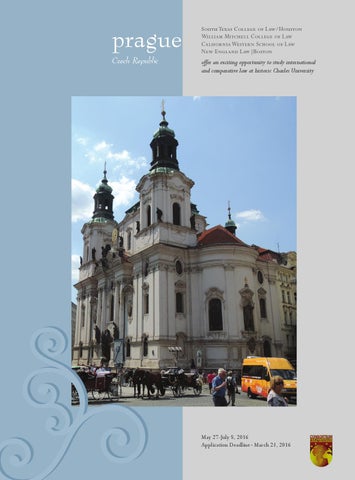
Lying proudly along the banks of the River Vltava, Prague offers a wealth of artistic and cultural treasures, and possesses an individual charm with its many buildings of spectacular architectural form and proportional harmony. cd
OVERVIEW
Approved by the American Bar Association, the Prague program is open to students in good standing at ABA-accredited United States law schools. The program begins with an orientation session on Friday, May 27, 2016. Each class in Session
One meets for 14 class periods on the following dates: May 30 – June 3; June 7 – 9; June 14 – 17; June 20 – 22. A reading
day on June 23 is followed by final exams for Session One on June 24, 2016. Session Two classes will meet on the following dates: June 28 – July 1; July 4 – July 6, with a reading day on July 7 and final exams on July 8, 2016.
“The Magical City,” “The City of a Hundred Towers,” and “The Paris of the East” are some of the common descriptions of Prague. Lying proudly along the banks of the River Vltava, Prague offers a wealth of artistic and cultural treasures, and pos-
sesses an individual charm with its many buildings of spectacular architectural form and proportional harmony. During his reign from 1346-1378, Charles IV made Prague the capital of the empire and founded Charles University in 1348. Prague
grew into one of the largest cities in Europe and acquired many of its Gothic landmarks, including the Charles Bridge and St. Vitus Cathedral, during this period. Along with its fascinating history, Prague remains a bustling city of sights, sounds, and culture not to be missed. A member of NATO, the Czech Republic has moved toward integration in world markets, a development that poses both opportunities and risks. The Czech Republic is a member of the European Union (EU). COURSES
Orientation and classes will be held at the historic Charles University Law Faculty Building located in the Josefov
section of Prague, near Old Town (Stare Mesto). All courses are taught in English and assessment of student performance uses the same criteria employed in upper-division elective courses, which includes written final examinations, graded projects and presentations. The professors responsible for each of the courses offered both write and grade the examination for his/her course. Courses in the first
session of the 2016 Prague summer program are: Intellectual Property by Design,
International Environmental Law, Legal Profession in a Comparative Context, and
Global Issues in Wrongful Conviction. Students choose two of the courses offered in Session One for a total of four (4) credits in the first session. Students may earn
two (2) additional credits by enrolling in Session Two from June 28 – July 8, 2016 and choosing either Comparative Refugee & Asylum Law or Intellectual Property &
Human Rights.
In order to complement the summer curriculum, one or two class days during
Session One will be spent visiting legal institutions, including the Higher Court in
Prague. A trip to the Terezin Concentration Camp is organized as part of program costs. While coursework is intensive during the week and attendance at orientation, all class sessions, enrichment lectures, and visits to governmental agencies and
courts is mandatory, two long weekends allow for travel to nearby destinations. Students should bring a business suit for the court visit. SESSION ONE: MAY 27- JUNE 24, 2016
Orientation May 27; Classes: May 30 – June 22, 2016; Reading Day June 23, 2016; Final exams June 24, 2016 x
Choose one course per timeslot in Session One for four (4) credits:
Daily 9:00 a.m. to 10:50 a.m. I ntellectual P roperty x Professor
by
Design
x Two
semester hours credit
Phillip Page, South Texas College of Law/Houston
High fashion clothing, smart phones, automobiles, sports gear, kitchen appliances,
and the many other objects that fill our lives and fuel our markets, often place a high
value on design. This course will use protection for the innovative designer as a way of comparing different forms of intellectual property whether copyright, patent, trade
dress, or other. It will also compare the very different approaches taken by the United States and other regimes for protecting design in an increasingly global market. OR
Daily 9:00 a.m. to 10:50 a.m. International E nvironmental Law x Two semester hours credit x Professor
Richard Finkmoore, California Western School of Law
International Environmental Law (IEL) is a dynamic, fascinating, and critically important field of law. This course begins with an overview of the current state
of the global environment and the human activities which affect the biosphere,
followed by a brief history of IEL. Because students are not expected to have any prior background in international law, the course also introduces the process of making international law and the institutions involved in implementing IEL,
such as the United Nations Environment Programme, treaty secretariats, and nongovernmental organizations (NGOs). We then examine the most significant current
global environmental issue, climate change, and take a close look at the principal international agreements, such as the United Nations Framework Convention on climate change. Students will also gain familiarity with the central concepts in
this field, such as sustainable development, the precautionary principle, and the common heritage of humankind.
The course will incorporate a variety of class formats, including breakout sessions and brief student reports on recent developments in IEL. AND
Daily 11:00 a.m. to 12:50 p.m. Legal Profession
in a
C omparative C ontext x Two semester hours credit x Professor Katerina Lewinbuk,
South Texas College of Law/Houston
This course is intended to expose students to various types of regulation of lawyers in different parts of the world. It will
comparatively examine the structure and ethical framework of the legal profession in the United States, European Union
and in a few selected countries, such as Russia, including the recourse that may be taken against attorneys for misconduct and professional malpractice. Other topics to be covered will include a range of accompanying ethical and legal issues,
such as the role of lawyers and judges, beginning and ending of the attorney-client relationship, globalization of the legal profession and the image and expectations of lawyers in different parts of the world. The course will also address various
aspects of law practice in selected countries and analyze the reasons behind established traditions and practices in various legal systems. The assigned course book will be “Global Issues in Legal Ethics� by James Moliterno & Paul Paton (Thomson West 2014) and a number of supplemental handouts will be distributed. OR
Daily 11:00 a.m. to 12:50 p.m. Global I ssues
in
Wrongful C onviction x Two semester hours credit x Professor Justin Brooks, California Western School of Law
Thousands of people have been wrongfully convicted around the world, including more than 2,000 documented cases in
cd
Prague grew into one of the largest cities in Europe and acquired many of its Gothic landmarks, including the Charles Bridge and St. Vitus
Cathedral, during the reign of Charles IV from 1346-1378. Prague
remains a bustling city of sights, sounds, and culture not to be missed. cd
the United States. These cases are tragic and very difficult to identify and resolve. This course is designed to give students
an overview of the global legal issues associated with wrongful convictions by studying some of the most famous cases in-
cluding Rubin “Hurricane” Carter, “The Central Park Five,” and “The Dingo Ate My Baby” case, as well as exploring topics such as false identifications, false confessions, post-conviction litigation, DNA evidence, innocence and parole processes, and compensation for the wrongfully convicted. The course will be highly interactive and graded by exam. SESSION TWO
Classes June 28 - July 6; Reading day July 7 x Final exam July 8, 2016
Choose one course in Session Two: Daily 9:00 a.m. to 12:30 p.m.
C omparative Refugee & Asylum Law x Two semester hours credit x Assistant
Dean Elizabeth A. Dennis, South Texas College of Law/Houston
There are over 60 million displaced persons in the world today, more than at any other time since World War II. This massive migration impacts economic, cultural, political and national security interests, and shows no sign of abating. This course
will give students an understanding of the international laws, treaties, and conventions governing refugee and asylum matters,
and will examine whether these instruments are sufficient to address the issues we face in 2016. Relevant U.S. and E.U. legislation will be compared, and students will learn how to draft and argue an effective asylum petition. OR
Daily 9:00 a.m. to 12:30 p.m. I ntellectual P roperty & Human Rights x Two semester hours credit x Professor
Peter Karol, New England Law | Boston
This course will examine the intersection of international intellectual property and human rights law, a burgeoning and exciting
field. We will generally approach the issues from two perspectives: whether and how enforcement of various intellectual property laws might conflict with international human rights laws and other norms; and conversely whether the right to attain and assert various forms of intellectual property is or should be a human right. Specific topics are likely to include: patents versus the right to health; creator’s rights as human rights; indigenous people’s rights and IP; conflicts between rights to free expression and IP;
copyright versus the right to education; and the right to food versus control of plant genetic resources. The course is designed to accommodate students with little exposure to intellectual property or human rights law, as well as those with prior experience
in either subject. The course will begin with basic introductions to international human rights and intellectual property systems, with a specific eye to evaluating the adequacy of purported safeguards for human rights built into such regimes.
FACULTY
Justin P. Brooks, Professor of Law at California Western School of Law, is the
Director of California Innocence Project, the Institute for Criminal Defense Ad-
vocacy, and California Western’s LL.M. in Trial Advocacy Specializing in Federal Criminal Law. Prior to moving to California, he practiced as a criminal defense
attorney in Washington D.C., Michigan, and Illinois. He founded the California Innocence Project and has assisted in the founding of several innocence projects
in Latin America where he also does extensive attorney training. Over the course of his career he has served as counsel on several high profile criminal cases and
has been successful in exonerating many wrongfully convicted clients (including
former NFL player Brian Banks). He has been recognized several times by the Los Angeles Daily Journal as one of the Top 100 Lawyers in California. In 2010 and 2012, California Lawyer Magazine awarded him the prestigious “Lawyer of the
Year” award. Professor Brooks has published extensively in the areas of criminal law, clinical education, and habeas litigation. He is the author of the only legal
casebook devoted to the topic of wrongful convictions. Professor Brooks will teach Global Issues of Wrongful Conviction in Session One.
Elizabeth A. Dennis , is Assistant Dean, Director of Academic Internships and
Associate Professor of Clinical Studies at South Texas College of Law/Houston.
Dean Dennis earned her J.D. from South Texas, where she also serves as a faculty
advisor to South Texas Law Review, CURRENTS: International Trade Law Journal
and Construction Law Journal. Her teaching interests and experience in international law focus on international criminal
law and refugee and asylum law. She has supervised law students working with defense counsel at the ICTY in The Hague
and with the United Nations High Commissioner on Refugees representative in Malta. In the U.S., Prof. Dennis’ pro bono work focuses on assisting non-citizen victims of domestic violence to seek U Visa protection under the Violence Against
Women Act. Dean Dennis will teach Comparative Refugee and Asylum Law and serve as program director in Session Two. Richard Finkmoore , Professor of Law at California Western School of Law, specializes in environmental and natural
resources law. He is a graduate of Stanford University and Stanford Law School. Professor Finkmoore was a clerk for
Justice Robert F. Utter of the Washington Supreme Court, served as an assistant attorney general for the State of Wash-
ington, and was a partner in a law firm for seven years. He is the author of a casebook, Environmental Law and the Values of Nature, and editor of The Natural Resources Law Manual published by the American Bar Association. He authored Critical Connections: The Amazon and Global Climate Disruption, a chapter in Environment and Law in Amazonia. Professor Fink-
moore served for many years as a visiting professor in the Environmental Studies Program at the University of California, San Diego, and has taught international environmental law in four law school foreign study programs and at the National
Judicial College. His passion is educating others about the multiple and serious challenges humanity now faces. Professor Finkmoore will teach International Environmental Law in Session One.
Peter J. Karol , Associate Professor of Law at New England Law | Boston, teaches a wide range of intellectual property
courses, as well as Property, and coordinates the school’s new Intellectual Property Concentration. Professor Karol focuses his scholarship on intellectual property matters generally, and copyright and trademark law in particular. He has recently published articles challenging the requirements for federal service mark protection and the use of theft rhetoric in civil
copyright trials, and proposing constitutional limitations on federal trademark law. Prior to joining the faculty, Professor
Karol was partner in the IP litigation, trademark, and copyright practice groups of Sunstein Kann Murphy & Timbers LLP, Boston, where he represented companies in complex litigation and appellate matters, including intellectual property
litigation and appeals, and managed global trademark portfolios. Professor Karol will teach Intellectual Property and Human Rights in Session Two.
Katerina Lewinbuk, Professor of Law at South Texas College of Law/Houston, previously taught at DePaul University Law
School in Chicago and practiced at the Chicago office of Baker & McKenzie. Her major interest and research involves
global and comparative legal ethics and attorney malpractice, as well as human rights law. Prof. Lewinbuk served a 2 year
term as a Fellow from the Texas Project for Human Rights, and served as a Program Director/Course Advisor at the Inter-
national Law Institute in Washington, D.C. She taught abroad as a Fulbright Senior Specialist in both Monterrey, Mexico and in Prague, Czech Republic, and offered skills courses in Moscow, and Istanbul and lectured on law-related topics in
multiple international locations. Professor Lewinbuk will teach Legal Profession in a Comparative Context in Session One. Phillip Page, Professor of Law at South Texas College of Law/Houston, teaches a range of intellectual property courses
including Copyright, Trademarks and Unfair Competition, Intellectual Property Survey, and a Media Law seminar. He has
served as a member of the Copyright Society of the U.S.A. and for many years sat on the board for Texas Accountants and Lawyers for the Arts. Professor Page has also been involved as an expert in domestic and international copyright litigation. He earned his J.D. from the University of Memphis and holds an LL.M. degree from New York University, where he
specialized in intellectual property law. Professor Page will teach Intellectual Property by Design and will serve as program director in Session One. Housing
Students make their own housing arrangements for Prague. An internet search for “apartments in Prague” provides multi-
ple links to companies that provide short term rentals. The law school is located in Prague 1 near Old Town (Stare Mesto) in Josefov, right on the river at the Cechuv “Most” (Most means bridge). The physical address of the Law Faculty building is Namesti Curieovych 7, Prague 1. Students are provided with transport passes that are valid on trams, buses and public transportation in Prague, so it is not necessary to live in the immediate vicinity of the law school. The college does not
endorse any particular housing agents, but past students have made positive comments about their experiences with housing agencies in Prague such as: www.vrbo.com (select Europe, Czech Republic, then Prague), www.prestigeapartments.cz, and www.lovingprague.com. T r a n s p o r tat i o n
Arranging air and ground transportation to and from Prague is the student’s responsibility. Several airlines serve Prague
through European hub cities such as Amsterdam, Frankfurt, Paris and London. Locally, transportation to most areas of the city by tram, trains (Metro) and bus is inexpensive, reliable and easy to navigate. A transport pass valid for the duration of the program is included in program costs and provided at orientation. Accessibility
Facilities in Europe are not as accessible to individuals with disabilities as American facilities are. Individuals with special needs should contact the program at 713-646-1825 by March 24, 2016. Academic
credits
Students should consult their home schools about transfer of credits and about their schools’ grading requirements for
transfer of course credits. It is unlikely that participation in foreign summer programs may be used to accelerate graduation.
Students interested in acceleration of graduation should consult their home school about this possibility. For students not enrolled at South Texas College of Law/Houston, transfer of summer program credits to another law school will be the responsibility of the students and requires receipt of a written Request for Transcript form.
Enrollment
Thirty eight (38) students representing six (6) U.S. law
schools attended the 2015 program in Prague. Expected enrollment for 2016 is 40 students. A p p l i c at i o n
i n f o r m at i o n a n d d e a d l i n e s
withdraw as a result of such a warning or if the program is terminated, students will be refunded fees paid to the program prior to the date of termination or withdrawal
within twenty (20) days of withdrawal. The Prague pro-
gram has never been canceled. In the event of cancellation,
Admission is open to any law student at an ABA accredited
all monies, including the $200 application fee, would be
completed the first year of full-time study or its equivalent
dividual courses in any program may be canceled if they are
tion for admission along with $200 application fee; and 2)
unless one is not accepted into the program or the program
that credits earned in the Prague program will transfer
Responsibility
Should an application not be accepted, South Texas will
injury or for loss or damage to personal property. Students
fee will be applied to the tuition and program expenses such
for accidents or illness that may occur during their partici-
visits to courts and governmental agencies.
The sponsoring schools reserve the right to change any as-
law school who is in good academic standing and who has
returned within 20 days after the program is canceled. In-
in part-time study. Applicants should submit: 1) an applica-
under-enrolled. The $200 application fee is non-refundable
a letter of good standing from his or her law school stating
is canceled.
toward his or her J.D.
and
M o d i f i c at i o n s
The sponsoring schools will not be responsible for personal
return this application fee within 20 days. The application
are expected to maintain or obtain medical insurance coverage
as orientation, opening reception, and closing dinner and
pation in this program, including repatriation expenses.
Tuition for Session One is $2,480 for up to four (4) credits,
pect of the program which circumstances make necessary or
tion includes the orientation program, transport pass, trip
or cancellation of the program. Student and faculty conduct
use of facilities at the law library of the Charles University
dance, plagiarism, and sexual harassment of South Texas
sors. It does not include airfare, medical insurance, traveling
about any aspect of this policy should contact the program
or tuition for both sessions is $3,720 for six (6) credits. Tui-
desirable. Participants will be notified of material changes
to Terezin Concentration Camp, court or government visits,
in the Prague program is governed by the rules on atten-
Law Faculty, and course materials supplied by the profes-
College of Law/Houston. Any student who has questions
expenses, costs associated with optional tours or field trips
director or Assistant Dean Wanda Morrow at South Texas
to areas outside the home campus, housing, meals, or books.
College of Law/Houston at wmorrow@stcl.edu.
The application and $200 application fee are due by March
Questions
17, 2016. Enrollment is limited; therefore, early application
should be directed to:
23, 2016. The remaining balance of the tuition is due May is encouraged. Financial aid loans are generally available to students participating in this study abroad program.
Students interested in obtaining loans for the study abroad program should contact the Financial Aid Office at their home school for applicable deadlines. C a n c e l l at i o n
The sponsoring schools may cancel the summer program in the event of compelling circumstances, including unrest or instability in the host country or insufficient enrollment.
If, during the course of a program, a U.S. State Department Travel Warning or Alert is issued for the Czech Republic,
students will be notified promptly of the warning and given an opportunity to withdraw from the program. If students
All inquiries, forms and correspondence about the program 2016 Summer Law Study Abroad Program South Texas College of Law/Houston Attention: Assistant Dean Wanda Morrow 1303 San Jacinto Street Houston, Texas 77002-7006
Phone: 713-646-1825 Fax: 713-646-2929 E-mail: wmorrow@stcl.edu
 Internet: www.stcl.edu/study-abroad/prague.htm/ Photography by Catherine Greene Burnett and Wanda Morrow
cd 2016 PRAGUE SUMMER LAW STUDY ABROAD PROGRAM The Consortium for Innovative Legal Education South Texas College of Law/Houston
x
New England Law|Boston
x
California Western School of Law
x
William Mitchell College of Law
APPLICATION FOR ADMISSION (must be received by March 23, 2016) G Number or Social Security Number
Date of Birth
E-mail Address Passport Number Full Name Last Name First Name Middle Name Mailing Address Street City State Zip Code Home Phone Cell Phone Emergency Contact Full Name/Relationship Phone E-mail Education Law School Location Grad. date Year of law school completed by June 1, 2016:
o
First
o
Second
o
Third
Instructions An applicant from a law school other than South Texas College of Law/Houston must submit a written statement from the dean or other appropriate off icial of his or her law school certifying that the applicant is in good academic standing and is not on probation for disciplinary or other reasons. The statement should also indicate that the applicant’s law school will accept the credit earned from the 2016 Prague Summer Law Study Abroad Program. The application will not be complete until this statement is received. Call 713.646.1825, fax 713.646.2929, or e-mail wmorrow@stcl.edu. If accepted, I plan to enroll in the following sessions and courses: Session One: May 27-June 24, 2016 (choose two courses, one per time slot) 9:00 a.m.-10:50 a.m. o Intellectual Property by Design (Prof. Phillip Page) OR o International Environmental Law (Prof. Richard Finkmoore) AND 11:00 a.m.-12:50 p.m. o Legal Profession in a Comparative Context (Prof. Katerina Lewinbuk) OR o Global Issues in Wrongful Conviction (Prof. Justin Brooks) o
o
Session Two: June 28-July 8, 2016 (must also enroll in Session One, choose one course) 9:00 a.m.-12:30 p.m. o Comparative Refugee & Asylum Law (Assistant Dean Elizabeth A. Dennis) OR 9:00 a.m.-12:30 p.m. o Intellectual Property and Human Rights (Prof. Peter Karol)
Return this form and a check or money order for $200 made payable to South Texas College of Law/Houston to: South Texas College of Law/Houston, Attention: Wanda Morrow-Assistant Dean, 1303 San Jacinto, Houston, Texas 77002-7006
The $200 deposit is refundable only if you are not accepted into the program, or if the program is canceled. The sponsoring schools reserve the right to cancel this program in the event of compelling circumstances. In such event, all monies, including the $200 would be refunded within 20 days. The Prague program is open to students of any race, color, national or ethnic origin and does not discriminate on the basis of sex, sexual orientation, age, race, color, religion, national and ethnic origin, or disability in administration of its educational policies, admission policies, scholarship and loan programs or other school-administered rights, privileges, programs or activities generally accorded or made available to students at the school. P lease read the
following , then sign and date :
I affirm that the information I have provided on this application form and on any other materials submitted by me is complete, accurate, and true to the best of my knowledge. I authorize each college or school I have attended to release academic and personal information related to this application upon request by South Texas College of Law/Houston. I agree to submit other material, if requested, for this application. I understand that furnishing false or incomplete information may result in cancellation of admission. Signature Date For office use only
Good standing
cd
Financial aid