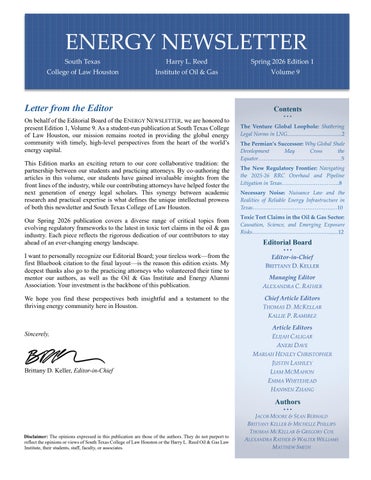
ENERGY NEWSLETTER South Texas
Harry L. Reed
Spring 2026 Edition 1
College of Law Houston
Institute of Oil & Gas
Volume 9
Letter from the Editor On behalf of the Editorial Board of the ENERGY NEWSLETTER, we are honored to present Edition 1, Volume 9. As a student-run publication at South Texas College of Law Houston, our mission remains rooted in providing the global energy community with timely, high-level perspectives from the heart of the world’s energy capital. This Edition marks an exciting return to our core collaborative tradition: the partnership between our students and practicing attorneys. By co-authoring the articles in this volume, our students have gained invaluable insights from the front lines of the industry, while our contributing attorneys have helped foster the next generation of energy legal scholars. This synergy between academic research and practical expertise is what defines the unique intellectual prowess of both this newsletter and South Texas College of Law Houston.
Contents •••
The Venture Global Loophole: Shattering Legal Norms in LNG........................................2 The Permian’s Successor: Why Global Shale Development May Cross the Equator………………………….……………5 The New Regulatory Frontier: Navigating the 2025-26 RRC Overhaul and Pipeline Litigation in Texas….……………………….8 Necessary Noise: Nuisance Law and the Realities of Reliable Energy Infrastructure in Texas……………………………………..…10
Our Spring 2026 publication covers a diverse range of critical topics from evolving regulatory frameworks to the latest in toxic tort claims in the oil & gas industry. Each piece reflects the rigorous dedication of our contributors to stay ahead of an ever-changing energy landscape.
Toxic Tort Claims in the Oil & Gas Sector: Causation, Science, and Emerging Exposure Risks…………………………………….......12
I want to personally recognize our Editorial Board; your tireless work—from the first Bluebook citation to the final layout—is the reason this edition exists. My deepest thanks also go to the practicing attorneys who volunteered their time to mentor our authors, as well as the Oil & Gas Institute and Energy Alumni Association. Your investment is the backbone of this publication.
Editor-in-Chief BRITTANY D. KELLER
We hope you find these perspectives both insightful and a testament to the thriving energy community here in Houston.
Sincerely,
Brittany D. Keller, Editor-in-Chief
Editorial Board •••
Managing Editor ALEXANDRA C. RATHER Chief Article Editors THOMAS D. MCKELLAR KALLIE P. RAMIREZ Article Editors ELIJAH CALIGAR ANERI DAVE MARIAH HENLEY CHRISTOPHER JUSTIN LASHLEY LIAM MCMAHON EMMA WHITEHEAD HANWEN ZHANG
Authors •••
Disclaimer: The opinions expressed in this publication are those of the authors. They do not purport to reflect the opinions or views of South Texas College of Law Houston or the Harry L. Reed Oil & Gas Law Institute, their students, staff, faculty, or associates.
JACOB MOORE & SEAN BERWALD BRITTANY KELLER & MICHELLE PHILLIPS THOMAS MCKELLAR & GREGORY COX ALEXANDRA RATHER & WALTER WILLIAMS MATTHEW SMITH
The Venture Global Loophole: Shattering Legal Norms in LNG
Background and Structure of Long-Term LNG SPAs
By: Jacob P. Moore & Sean Berwald*
Venture Global began as a mere startup in 2020 before growing into the nation’s second-largest LNG producer.5 Its state-of-the-art Calcasieu Pass plant achieved commercial operating status on April 15, 2025, after completing a prolonged three-year commissioning process.6 While commissioning usually takes only a few months, Venture Global claims multiple catastrophic circumstances delayed completion of the Calcasieu Pass terminal.7 Energy majors, however, contend that the lengthy commissioning process was intentionally designed to avoid compliance with its SPAs in favor of more lucrative spot market deals.8 Indeed, Venture Global earned over $19 billion from spot market sales over the same three-year span, while other customers waited years to access the same cargoes.9 Venture Global even warned investors that “revenue from Calcasieu Pass will fall” when it began commercial operations on April 15, 2025, thereby satisfying its obligations to its long-term customers.10 Regardless of which view is correct, the contrast arises from how long-term SPAs are typically structured. There is generally no boilerplate fit-for-all-purposes SPA.11 In drafting a SPA, a multitude of relevant factors must be considered, including the “unique transactional and credit issues/requirements of a particular LNG trade,” the number and diversity of participants involved in effectuating the agreement, the variety of gas markets supplied with LNG, unique terms regarding price, and “regulatory changes affecting local gas markets.”12 LNG SPAs have developed and evolved over time alongside the industry, reflecting advances in technology, evolving regulatory schemes, and market fluctuations.13 For example, SPAs were historically twenty to twenty-five years in length, “reflecting the substantial investments required” to open a liquefaction facility.14 Now, “shortterm deals of three to five years and mid-term deals of
“It means that every LNG contract in the world was probably rewritten since this case began, to make sure this situation will be avoided in the future.”1
Introduction Venture Global, “a long-term, low-cost provider of American-produced liquefied natural gas,”2 finds itself at the center of a dispute between a disruptive, modulartechnology-focused American exporter and a consortium of established European and Asian energy majors. The conflict centers on long-term Sales and Purchase Agreements (SPAs) and the interpretation of the “Reasonable and Prudent Operator” (RPO) standard during prolonged project commissioning. The dispute arises over a three-year stretch during which Venture Global exported over 400 cargoes into a record-breaking spot market while simultaneously claiming that technical deficiencies prevented the project from achieving formal commercial operations for its longterm contract holders.3 The resulting legal saga, culminating in a series of arbitration tribunals under the International Chamber of Commerce (ICC), has produced fragmented results. While Venture Global secured victories against Shell and Repsol, it suffered defeat against British Petroleum (BP).4 Understanding the disparity in these outcomes requires distinguishing between literalist and intent-based interpretations of LNG contracts and recognizing the inherent subjectivity behind the RPO standard.
*Jacob Moore is a graduate of Texas A&M University at Galveston and a second-year law student at South Texas College of Law Houston. Sean Berwald is an oil and gas attorney at Ray, Feighny & Hartle PLLC, where he advises clients on acquisitions and due diligence. The authors extend their appreciation to the Editorial Team of the Harry L. Reed Oil & Gas Institute Energy Newsletter, and in particular Editor in Chief Brittany Keller, for their support throughout the topic selection, editing, and publication process. 1 Ruth Liao, Venture Global Triumphs over Shell in LNG Arbitration Fight, ENERGY CONNECTS (Aug. 13, 2025), https://www.energyconnects.com/news/gas-lng/2025/august/ventureglobal-triumphs-over-shell-in-lng-arbitration-fight/ [https://perma.cc/2B7J-39SW] (quoting Ira Joseph, Senior Research Associate, Center on Global Energy Policy, Columbia University). 2 About Us, VENTURE GLOBAL LNG, https://ventureglobal.com/about-us/ [https://perma.cc/QH9T-VXJP] (last visited Apr. 19, 2026). 3 Stephanie Kelly et al., How BP Won Its $1 Billion-Plus Case Against Venture Global, ENERGYNOW (Nov. 5, 2025), https://energynow.com/2025/11/how-bp-won-its-1-billion-plus-caseagainst-venture-global/ [https://perma.cc/95YB-4XG3]. 4 Id.; Jacob Dick, Venture Global Cleared in Repsol Case Amid Ongoing LNG Contract Battles, NAT. GAS INTELLIGENCE (Sept. 5, 2025), https://naturalgasintel.com/news/venture-global-cleared-in-repsol-caseamid-ongoing-lng-contract-battles/ [https://perma.cc/J2ZD-VLS4].
5 See Curtis Williams, Venture Global LNG Starts Commercial Operations at Calcasieu Pass Plant, REUTERS (Apr. 15, 2025), https://www.reuters.com/business/energy/venture-global-lng-startscommercial-operations-calcasieu-pass-plant-2025-04-15/ (on file with the Harry L. Reed Oil & Gas Institute Energy Newsletter). 6 Id. (“Commissioning” refers to the process of ensuring a facility’s systems are functioning as designed.). 7 Id. (Specifically, the 2020 pandemic, two hurricanes, and a force majeure event.). 8 Id. 9 Curtis Williams, New LNG Plant to Boost Venture Global Profits as Calcasieu Serves Long-Term Customers, REUTERS (Apr. 10, 2025), https://www.reuters.com/business/energy/new-lng-plant-boost-ventureglobal-profits-calcasieu-serves-long-term-customers-2025-04-10/ (on file with the Harry L. Reed Oil & Gas Institute Energy Newsletter). 10 Id. 11 See Harry W. Sullivan, Jr., LNG Sale and Purchase Agreements, in LIQUEFIED NATURAL GAS: THE LAW AND BUSINESS OF LNG 185, 185 (3d ed., 2017). 12 Id. at 193. 13 See id. at 193, 207–08. 14 Id. at 193.
eleven to fifteen years” have become more common.15 While a multitude of factors can be attributed to this shift,16 none was more responsible than the United States shale gas revolution of the early 2010s, which resulted in a booming supply of domestic natural gas from new, unconventional production methods.17 Just a few years beforehand, the U.S. was expected to become the world’s largest importer of LNG;18 in 2010, Cheniere Energy filed an application with the Department of Energy to export LNG.19 Shortterm SPAs are not necessarily advantageous or disadvantageous for the seller: on one hand, more markets are available, but on the other, investors face increased risk, and it is difficult for newer buyers to enter the market due to lack of credit.20 Venture Global found a way to get the best of both worlds. The so-called Venture Global loophole in its SPAs allowed the company to sell cargoes on the recordshattering spot market without fulfilling its obligations to its long-term customers.21 After the terminal began production in 2022, Venture Global maintained that commissioning remained incomplete and began selling its commissioning cargoes on the spot market.22 Federal Energy Regulatory Commission filings show how Venture Global broadly defines Commercial Operating Date (COD), stating it cannot occur “unless and until” three conditions are met: (i) all of the facilities comprising the relevant project, or phase thereof, have been completed and commissioned, including any ramp up period;
obligations under such post-COD SPAs; and (iii) the applicable project company has notified the customer under the post-COD SPAs.23 SEC filings show the company’s explanation for the lengthy commissioning. Due to the company’s “unique modular development approach . . . it is necessary to commission and test [their] LNG facilities sequentially over a longer period of time than traditional LNG facilities.”24
Competing Interpretations of the RPO Standard in the Venture Global Arbitrations Venture Global’s long-term customers invoked arbitration with the ICC, alleging that the company breached the SPAs by intentionally delaying commissioning to take advantage of a record-shattering spot market that arose after Russia invaded Ukraine.25 Some proceedings resulted in Venture Global’s defeat (BP)26 while others resulted in victories (Shell, Repsol).27 Yet all three involve similar facts, similar SPAs, and the same seller. The key difference lies in the strategies employed in each tribunal. BP prevailed under “an argument of unfair behavior,” which Shell “did not push.”28 The “unfair behavior” was Venture Global’s failure to satisfy the RPO standard during its delayed commissioning process.29 Stated differently, a reasonable operator in Venture Global’s position would have declared that commercial operations had begun; failing to do so was a breach.30 The tribunal ruled that Venture Global’s “delay in declaring COD amounted to a
(ii) the project or phase thereof is capable of delivering LNG in sufficient quantities and necessary quality to perform all of its 15
Id. These include the Japanese tsunami in 2011, the oil collapse of 2014, over-exuberant Chinese LNG purchases, and the simultaneous opening of new terminals causing oversupply. See, e.g., INT'L ENERGY AGENCY, LNG Market Trends and Their Implications 4 (June 2019), https://www.oecd.org/content/dam/oecd/en/publications/reports/2019/06/ lng-market-trends-and-their-implications_69688d80/90c2a82d-en.pdf [https://perma.cc/SY9L-GDXS] (describing the 2011 Fukushima demand shock and the subsequent 2014 price collapse); Teddy Kott & Akos Losz, They Might Be Giants: Emerging LNG Importers Are Reshaping the Waterborne Gas Market, COLUMBIA CTR. ON GLOBAL ENERGY POL’Y 4 (Nov. 2017), https://www.energypolicy.columbia.edu/sites/default/files/pictures/CGE PTheMightBeGiantsLNG1017_1.pdf [https://perma.cc/R9XR-MTU6 ] (analyzing the impact of surging Chinese consumption and the unprecedented wave of new liquefaction terminal capacity). 17 See KING & SPALDING LLP, The Emerging Price Offerings from Second Wave U.S. LNG Projects: Perspectives from Sellers and Buyers 4–6 (2019), https://www.kslaw.com/attachments/000/007/214/original/The_Emergin g_Price_Offerings_From_Second_Wave_U.S._LNG_Projects_Perspecti ves_From_Sellers_and_Buyers.pdf [https://perma.cc/S3Z8-5QMG]. 18 Id. at 3. 19 Id. 20 Sullivan, supra note 11, at 193. 21 MarketMinute, Venture Global Scores Major Legal Win in Landmark LNG Dispute with Repsol, THE CHRONICLE JOURNAL (Jan. 23, 2026),
https://markets.chroniclejournal.com/chroniclejournal/article/marketmin ute-2026-1-23-venture-global-scores-major-legal-win-in-landmark-lngdispute-with-repsol [https://perma.cc/7SZE-4L63]. 22 Id. 23 Venture Global Calcasieu Pass, LLC’s Answer at 18, BP Gas Marketing Ltd. v. Venture Global Calcasieu Pass, LLC, FERC (filed Jan. 2, 2024) (on file with the Harry Reed Institute for Oil & Gas Energy Newsletter) (emphasis added). 24 Venture Global refers to liquefaction trains; since it uses “midscale liquefaction trains” rather than traditional, large-scale ones, they contend that a longer commissioning process is necessary. Venture Global, Inc., Annual Report (Form 10-K), at 137 (Dec. 31, 2024) https://www.sec.gov/Archives/edgar/data/2007855/00020078552500001 0/vginc10-kxye2024.htm [https://perma.cc/3JDC-U8LV]. 25 The customers sought over $5 billion in damages. Kelly et al., supra note 3. 26 Id. 27 Id.; Ruth Liao, Venture Global Wins LNG Arbitration Case Against Repsol, ENERGYNOW (Jan. 23, 2026), https://energynow.com/2026/01/venture-global-wins-lngarbitration-case-against-repsol/ [https://perma.cc/HMX3-9WNQ]. 28 Kelly et al., supra note 3. 29 Curtis Williams et al., BP Wins Arbitration Case Against Venture Global Over LNG Cargoes, ENERGYNOW (Oct. 9, 2025), https://energynow.com/2025/10/bp-wins-arbitration-case-againstventure-global-over-lng-cargoes/ [https://perma.cc/ZU9A-XR32]. 30 Id.
16
3
constructive evasion of contractual obligations.”31 Commentators described the decision as an affirmation that “arbitrators will look beyond formality and test whether a seller’s conduct aligns with the commercial fairness expected under the agreement.”32 Shell, on the other hand, focused on the SPA’s language before losing in arbitration.33 It then attempted to overturn the award in the New York Supreme Court (New York County), claiming that Venture Global made misrepresentations during the tribunal proceedings and accusing the exporter of “misleadingly withholding critical evidence.”34 Shell highlighted that Venture Global’s 8-K disclosure for the BP tribunal suggested that the company acted willingly in breaching the SPA.35 During the arbitration, Venture Global heavily relied on monthly progress reports prepared by an independent third-party engineer.36 On cross-examination, a representative of this third-party discussed written communications that allegedly had not been produced.37 The court dismissed Shell’s argument as “pure speculation” because the evidentiary record complained of was “squarely in front of” the tribunal.38 Further, the court noted the tribunal's finding that the third-party engineer was “honest and credible” before unanimously concluding that Venture Global did not breach the SPA.39 Repsol met a similar fate to Shell. There, the tribunal found that Venture Global acted as an RPO by declaring COD on April 15, 2025.40 Venture Global stated that the Repsol tribunal determined it had acted in accordance with the SPA and maintained that it “has fully honored the clear and mutually agreed-upon terms” of its SPAs without any exceptions.41 These divergent outcomes demonstrate the RPO standard’s subjectivity. One view is that an RPO would ensure its facility is fully compliant before declaring COD. This argument allowed Venture Global to defeat Shell and Repsol.42 The other view is that an RPO would not intentionally delay commissioning to exploit a more lucrative market at the expense of its long-term customers. BP succeeded in arbitration by focusing on the intent of Venture Global rather than the SPA’s literal language.43
Conclusion: Market Consequences of the Venture Global Loophole
31 LNG: How Arbitration Battles Are Redefining the Global Gas Trade, BUS. INSIDER AFR. (Oct. 31, 2025), https://africa.businessinsider.com/local/markets/lng-how-arbitrationbattles-are-redefining-the-global-gas-trade/qht79hm [https://perma.cc/E7WZ-67AD]. 32 Id. 33 Id. (noting that the tribunal took “a literal approach to the contractual text” in ruling that Shell “accepted the commissioning provisions at signing.”). 34 Shell’s Verified Petition to Vacate at 2, Shell NA LNG LLC v. Venture Global Calcasieu Pass, LLC, N.Y. Sup. Ct., NYSCEF No. 1. 35 Id. at 7. 36 Id. at 2. 37 Id. 38 Order Denying Motion to Vacate at 2, 17, Shell NA LNG LLC v. Venture Global Calcasieu Pass, LLC, N.Y. Sup. Ct., NYSCEF No. 266. 39 Id. at 4, 9. 40 Venture Global, Inc., Annual Report (Form 8-K) (Jan. 21, 2026), https://jusmundi.com/en/document/other/en-repsol-s-a-v-venture-global-
lng-inc-us-sec-disclosure-of-venture-global-inc-on-outcome-of-thearbitration-wednesday-21st-january-2026#other_document_48971 (on file with the Harry Reed Institute for Oil & Gas Energy Newsletter). 41 Jacob Dick, Venture Global Cleared in Repsol Case Amid Ongoing LNG Contract Battles, NAT. GAS INTELLIGENCE (Jan. 22, 2026), https://naturalgasintel.com/news/venture-global-cleared-in-repsol-caseamid-ongoing-lng-contract-battles/ (on file with the Harry Reed Institute for Oil & Gas Energy Newsletter). 42 Id.; see also LNG: How Arbitration Battles Are Redefining the Global Gas Trade, supra note 31. 43 LNG: How Arbitration Battles Are Redefining the Global Gas Trade, supra note 31. 44 Id. 45 Tsvetana Paraskova, Shell Takes Venture Global LNG Arbitration Loss to NY Supreme Court, OIL & GAS 360 (Nov. 11, 2025), https://www.oilandgas360.com/shell-takes-venture-global-lngarbitration-loss-to-ny-supreme-court/ [perma.cc/E7WZ-67AD]. 46 Kelly et al., supra note 3. 47 Id.
The “Venture Global loophole” has created uncertainty in the global energy market. European LNG traders have begun inserting “commissioning cap” clauses in new SPAs to close this loophole, placing limits on “how many cargoes can be sold outside contractual commitments before COD is declared.”44 The biggest potential issue for Venture Global moving forward is the breakdown of trust. TotalEnergies has publicly declared that it will no longer do business with Venture Global, citing the company’s “profiteering” behavior during a particularly unstable period for the European energy market.45 Today, the Calcasieu Pass saga is entering its final stages, with several key arbitrations (Edison, Galp, Orlen) still pending.46 Whether these claimants succeed depends on whether they argue unfair behavior under the RPO standard, as BP did, or a literal breach of production capacity, as Shell and Repsol did. A commercial resolution may be preferable to scorched-earth legal battles, and these claimants may settle, as Unipec did.47 For decades, the focus on operational efficiencies has driven legal activity, but the shattering of industry norms by the Venture Global loophole will continue to send reverberations throughout the deal-making world for years to come.
4
The Permian’s Successor: Why Global Shale Development May Cross the Equator By: Brittany D. Keller & Michelle Phillips*
Introduction Argentina’s Vaca Muerta shale formation has remained a sleeping giant for over a decade.1 Conventional wisdom sees a basin that could be a resource of global scale, constrained by political volatility, regulatory intervention, and most notably insufficient infrastructure. Developments between late 2025 and early 2026 indicate that Argentina is undergoing a transformation that is repositioning it as a potential driver of global unconventional energy growth.2 The convergence of geological maturity, long-term legal reform, and exportoriented infrastructure investment is repositioning Vaca Muerta from a domestically constrained resource into an integrated supply hub capable of serving international markets.3 Meanwhile, the global shale landscape is changing. After dominating global growth for over a decade, U.S. unconventional production is maturing.4 This new phase prioritizes capital discipline, resulting in lower rig counts and slower output expansion.5 International capital is increasingly seeking new basins capable of delivering scalable, cost-competitive supply.6 Globally, Argentina’s Vaca Muerta is emerging as the only shale play positioned to fill that role at scale.7
Context & Background: A Tale of Two Basins Vaca Muerta is an approximately 8.6 million-acre shale formation8 located in Argentina’s Neuquén Basin. While its geological quality has long been recognized, large-scale development was historically constrained by *Brittany Keller is a former student of Texas A&M University and second year at South Texas. Michelle Phillips is the Vice President of Land at Lime Rock Resources and an adjunct-professor at South Texas. Brittany first wants to thank Professor Phillips for her guidance throughout this article. She would also like to thank both Sean Berwald and Randall Sadler for their continued support. 1 Andrew McConn, Vaca Muerta: The Global Shale GameChanger, ENVERUS: BLOG (Sept. 15, 2025), https://www.enverus.com/blog/vaca-muerta-the-global-shale-gamechanger/ [https://perma.cc/HG6D-GLMG]. 2 Luana Torruella, Argentina Hits 15-Year Oil and Gas Output Record, Driven by Vaca Muerta, ENERGY CIRCLE (July 10, 2025), https://www.energycircle.org/news/argentinas-oil-and-gas-productionhits-15-year-high---a-structural-shift-driven-by-vaca-muerta [https://perma.cc/UZC9-D88G]. 3 Argentina’s Southern Energy Signs Record 8-Year LNG Agreement with Germany’s SEFE, BUENOS AIRES HERALD (Dec. 2, 2025), https://buenosairesherald.com/politics/argentinas-southernenergy-signs-record-8-year-lng-agreement-with-germanys-sefe [https://perma.cc/V95P-84Z5]; Vaca Muerta: An Opportunity to Respond to the Global Energy Crisis, MCKINSEY & CO. (2022), https://www.mckinsey.com/industries/oil-and-gas/ourinsights/vaca-muerta-an-opportunity-to-respond-to-the-global-energycrisis [https://perma.cc/V95P-84Z5]. 4 ENVERUS, Energy in Focus: 2025 Outlook Report (2025), https://www.enverus.com/ebooks/energy-in-focus-2025outlook-report/[https://perma.cc/8Y6Z-RQG5].
above-ground instability, including currency controls, domestic price caps, and frequent regulatory reversals.9 These legal and economic conditions discouraged longcycle investment and prevented Argentina from fully monetizing its resources. Infrastructure constraints intensified these challenges. For years, limited pipeline capacity forced producers to rely on trucking and domestic consumption overall, suppressing export margins.10 By contrast, the Permian Basin benefited from regulatory stability, deep capital markets, and extensive midstream networks, allowing it to dominate unconventional growth for more than a decade. However, U.S. shale production is expected to plateau as Tier One acreage becomes increasingly scarce and operators focus on maintaining output rather than expanding it.11 This market transition has created an opening for new shale basins capable of sustaining longterm growth.
Analysis & Discussion A. Geological and Operational Advantages Although Argentina’s total current oil production remains significantly lower than that of the Permian Basin, Vaca Muerta has demonstrated superior performance on a per-well basis. Wells in the Neuquén Basin average more than 100 barrels of oil per lateral foot, compared to approximately 70 barrels in the Delaware Basin (the most productive segment of the Permian).12 These results are partly attributable to Vaca Muerta’s thick shale formations, which can range from 11 meters to 1,250 meters in thickness. 13 The thickness allows operators to drill multiple horizontal landings from a single pad, improving capital efficiency while reducing surface impact.14 Drilling times have also declined significantly, with some operators achieving spud-to-sales cycles of under thirty days, narrowing the historical cost gap with 5
Id. MCKINSEY & CO., Vaca Muerta, supra note 3. 7 Id. 8 Argentina's Vaca Muerta Shale Is Smashing Oil Production Records, BRAZIL ENERGY INSIGHT (Nov. 12, 2025), https://brazilenergyinsight.com/2025/11/12/argentinas-vacamuerta-shale-is-smashing-oil-production-records-in-2025/ [https://perma.cc/5EMP-EWYN]. 9 Energy Laws and Regulations 2026: Argentina, GLOBAL LEGAL INSIGHTS (Dec. 22, 2025), https://www.globallegalinsights.com/practiceareas/energy-laws-and-regulations/argentina/ [https://perma.cc/WZB8KP93]. 10 Argentina Pipeline Investments to Connect Vaca Muerta Flows with Consumers, RYSTAD ENERGY (Jan. 8, 2026), https://www.rystadenergy.com/insights/argentina-pipelineinvestments-to-connect-vaca-muerta-flows-with-consumers [https://perma.cc/CNV8-29UK].; Argentina's Vaca Muerta Sur Oil Pipeline Notches Up Progress, Indus. Info Res. (Oct. 3, 2025), https://www.industrialinfo.com/news/article/argentinas-vacamuerta-sur-oil-pipeline-notches-up-progress—346773 [https://perma.cc/J4HW-5NUN]. 11 ENVERUS, supra note 4. 12 McConn, supra note 1. 13 C. Guzmán, M.L. Loss & E.O. Cristallini, Analysis of the Horizontal Stress Field Acting on Vaca Muerta Formation in the Neuquén Basin, Argentina, 81 REV. ASOC. GEOLÓGICA ARG. 600 (2024). 14 McConn, Vaca Muerta, supra note 1. 6
U.S. shale operations.15 Applying lessons learned by shale operators in Lower 48, developers can optimize productivity while decreasing cost and time to market.
approximately 550,000 barrels per day in 2027,23 enabling Argentina to load very large crude carriers (VLCCs) for direct export to global markets. This pipeline effectively ends Argentina’s reliance on large-scale trucking, removing the high transportation costs that historically limited production growth. By providing direct access to international pricing, the project transforms Vaca Muerta from a domestically constrained basin into a globally competitive export platform. Similar progress is underway in the natural gas sector. 24 In 2025 and 2026, Argentina signed its first major long-term liquefied natural gas export agreements, including an eight-year deal with Germany’s state-owned energy company, SEFE.25 These projects rely on floating liquefaction vessels, allowing Argentina to rapidly monetize gas surpluses that were previously shut in or flared. 26
A. Legal Stability and the RIGI A primary catalyst for recent investment is the implementation of the Incentive Regime for Large Investments (RIGI).16 The RIGI provides thirty years of fiscal and legal stability for qualifying projects and directly addresses the regulatory uncertainty that historically deterred prior institutional investment.17 Within its first year of operation, RIGI attracted more than $30 billion dollars in committed energy and mining investments, with major pipeline and liquefied natural gas projects among the approved initiatives.18 By reducing the risk of sudden policy reversals, RIGI acts as a prerequisite for unconventional resource commercialization. The credibility of this framework is reinforced by the growing presence of international industry leaders.19 In early 2026, Continental Resources, led by U.S. shale pioneer Harold Hamm, significantly expanded its footprint in Vaca Muerta while decreasing core U.S. operations, signaling confidence in both the resource and Argentina’s evolving legal environment.20 B. Infrastructure and Market Access Recent infrastructure development represents the most tangible evidence that Argentina’s shale sector has entered a new era.21 The Vaca Muerta Oil Sur pipeline, a 437-kilometer privately-funded project, is scheduled to enter service in late 2026 and will initially transport up to 180,000 barrels per day of crude oil to the Atlantic coast.22 The system is designed to ramp up capacity to
C. Environmental and Social Constraints Despite strong economic momentum, rapid unconventional development has generated environmental and social challenges. Hydraulic fracturing activity in the Neuquén Basin has been linked to a potential increase in induced seismicity.27 Academic studies have identified correlations between injection operations and seismic events in previously stable regions.28 Water usage presents another constraint. With annual fracturing demand approaching 30 million cubic meters,29 the resulting competition for water among agricultural, municipal, and energy stakeholders presents a material operational risk in this semi-arid region.30 Social conflict also remains a material risk.31 Mapuche communities have brought international legal
15 Analysis: Vaca Muerta and a 2025 Review, SHALE24 (2025), https://www.shale24.com/en/oil-gas/analysisvaca-muerta-and-2025-review-n177 [https://perma.cc/4TN5-XRHZ]. 16 RIGI Map: Approved Projects and Those Still Pending for 2026, SHALE24 (2026), https://www.shale24.com/en/oil-gas/rigi-mapapproved-projects-and-those-still-pending-for-2026-n285 [https://perma.cc/F3BS-7KT3]. 17 Id. 18 Vaca Muerta, the Promise of Dollar Generation, FUNDS SOCIETY (Oct. 29, 2025), https://www.fundssociety.com/en/news/business/vaca-muertathe-promise-of-dollar-generation/ [https://perma.cc/VL4T-RLU5]. 19 Harold Hamm's Continental Resources Doubles Down on Vaca Muerta, FINANCIAL CONTENT (Jan. 8, 2026), https://markets.financialcontent.com/prnews/article/marketminute -2026-1-8-harold-hamms-continental-resources-doubles-down-on-vacamuerta-as-argentine-gas-hits-7-bcfd-milestone [https://perma.cc/XAF2JU5H]. 20 Id. 21 MOS Completes Surface Installation as Techint-SACDE Seek Specialized Workers, SHALE24 (Dec. 22, 2025), https://www.shale24.com/en/oil-gas/vmos-completes-surfaceinstallation-as-techint-sacde-seek-specialized-workers-forcomplementary-pipelines-n229 [https://perma.cc/HT7Y-SVSM]. 22 Argentina's VMOS Signs $2 Bln Loan to Fund Vaca Muerta South Project, REUTERS (July 8, 2025), https://www.reuters.com/business/energy/argentinas-vmos-signs-2-blnloan-fund-vaca-muerta-south-project-2025-07-08/ (on file with the Harry L. Reed Institute for Oil & Gas Energy Newsletter). 23 Id.
24 Argentina's Southern Energy Signs Record 8-Year LNG Agreement with Germany's SEFE, BUENOS AIRES HERALD (Dec. 2, 2025), https://buenosairesherald.com/politics/argentinas-southernenergy-signs-record-8-year-lng-agreement-with-germanys-sefe [https://perma.cc/M4SD-NFSF]. 25 Id. 26 Id. 27 Chasing the Ghost of Fracking: Induced Seismicity in the Neuquén Basin, SEISMICA (2025), https://seismica.library.mcgill.ca/article/view/1 435/1729 [https://perma.cc/R4WA-N3QS]. 28 Id. 29 Tribunal Delegation to Investigate the Case of Fracking – Argentina, INT’L RTS. OF NATURE TRIB. (Apr. 5, 2023), https://www.rightsofnaturetribunal.org/vaca-muerta/ [https://perma.cc/8GVS-DRST] (reporting that by 2023, annual water demand for Vaca Muerta fracturing operations would double and reach almost 30 million cubic meters). 30 Laura Forni et al., Watershed Implications of Shale Oil and Gas Production in Vaca Muerta, Argentina 7 (STOCKHOLM ENV’T INST., Working Paper, 2021), https://www.sei.org/wpcontent/uploads/2021/05/watershed-implications-of-shale-oil-and-gasproduction-in-vaca-muerta.pdf [https://perma.cc/CJ9V-EL5Q](analyzing the risk of climate-induced water scarcity and the resulting competition between unconventional hydrocarbon extraction and the region’s 150,000 hectares of irrigated agriculture). 31 Mohamed Alzaabi, Decarbonizing the Barrel: Global Trends in Oil's Carbon Intensity, JPT (May 12, 2025), https://jpt.spe.org/twa/decarbonizing-the-barrel-global-trends-inoils-carbon-intensity [https://perma.cc/A2H4-QCEC].
6
actions alleging insufficient consultation and violations of indigenous land rights in areas affected by shale development.32 These disputes present potential permitting, reputational, and political challenges for operators and policymakers alike.33
Conclusion & Outlook With expanded infrastructure and stable investment now in place to capitalize on its resource potential, Argentina’s ascent in the unconventional energy sector reflects a structural pivot toward global export capacity rather than a temporary market anomaly. Argentina is projected to approach 1 million barrels of oil per day by 2027, positioning the country to transition from regional sufficiency to a significant net energy exporter in the global market.34 The convergence of geological quality, long-term legal stability, and export infrastructure has fundamentally altered Argentina’s role in global energy markets. While environmental and social risks remain, the scale and durability of recent reforms suggest that Argentina’s relevance will persist beyond the current commodity cycle. As U.S. shale enters a mature phase, the global center of unconventional growth is shifting toward regions capable of delivering long-term volume, cost competitiveness, and regulatory certainty. The structural realignment of the Neuquén Basin positions Argentina as a central fixture in the global unconventional supply chain through 2027.
32
34
Sofía Barquero, The International Search for Justice of the Mapuche Communities in Mendoza, Argentina, AIDA (Feb. 25, 2025), https://aida-americas.org/en/blog/the-international-search-forjustice-of-the-mapuche-communities-in-mendoza-argentina [https://perma.cc/3359-L5PT]. 33 INT’L RTS. OF NATURE TRIBUNAL, supra note 29 (describing the “criminalization” of Mapuche communities and alleging that shale operations involve “ecocide” and “violations” of collective rights).
Victoria Adlauz et al., Argentina oil and gas sector: Vaca Muerta shale can drive near-term growth and fuel medium-term opportunities, DELOITTE INSIGHTS (Feb. 20, 2025) https://www.deloitte.com/us/en/insights/topics/economy/americas/vacamuerta-argentina-energy-sector-boom.html [https://perma.cc/6SCXX86C].
7
The New Regulatory Frontier: Navigating the 2025-26 RRC Overhaul and Pipeline Litigation in Texas By: Thomas D. McKellar & Gregory C. Cox*
Introduction The Texas energy sector is currently experiencing a regulation renaissance. In less than eighteen months, the Railroad Commission of Texas (the Commission) and the Supreme Court of Texas (SCOTX) have effectively rewritten the rules governing midstream infrastructure and produced water economics. For advocates counseling upstream producers, midstream operators, and infrastructure developers, these changes will likely require significant strategic adjustment to maintain compliance and protect project timelines.
The Chapter 3 and 4 Overhaul: A New Compliance Era On December 17, 2024, the Commission formalized a comprehensive overhaul of its Chapters 3 and 4 waste management rules—the first revision in over forty years.1 These amended rules restructure the regulatory framework for oil and gas waste disposal, produced water recycling, carbon sequestration, and geothermal operations.2 The Commission’s objective was to replace a “abyrinthine tangle” of informal interpretations with a predictable, consolidated regulatory scheme. However, this clarity comes at the cost of increased procedural complexity.3 Among the more significant changes is the new registration requirement for produced water recycling pits.4 Prior to the revisions, operators recycling produced water on lease enjoyed considerable flexibility, often operating under general permits or exemptions. The revised Chapter 4 rules now require formal registration of all recycling pits, including detailed engineering specifications, liner integrity standards, and closure bonding.5 For operators in the Permian Basin (where produced water volumes have increased exponentially with fracking), these requirements * Thomas (Tom) McKellar is a second-year law student at South Texas College of Law Houston and a graduate of the Virginia Military Institute. He previously served as an officer in the United States Army. Gregory C. Cox is a 2007 graduate of South Texas College of Law Houston and currently serves as Senior Counsel at EOG Resources, Inc. The authors extend their appreciation to the Editorial Team of the Harry L. Reed Oil & Gas Institute Energy Newsletter for their support throughout the topic selection, editing, and publication process. 1 RRC Proposes Significant Overhaul of Oil & Gas Waste Management Rules, TEX. R.R. COMM’N, Aug. 16, 2024, https://www.rrc.texas.gov/news/081624-rrc-proposes-significantoverhaul-of-oil-gas-waste-management-rules/ [https://perma.cc/UD6ZWY24]. 2 See, e.g., 16 TEX. ADMIN. CODE § 3.8 (subsurface disposal); id. § 3.9 (produced water recycling); id. §§ 3.46, 4.101–.133 (geothermal and carbon sequestration); see also id. chs. 3, 4 (effective July 1, 2025) (comprehensively restructuring the regulatory framework for oil and gas waste and emerging energy operations).
impose material compliance costs. The registration process itself requires sixty to ninety days, and crucially— incomplete applications trigger full rejection, with no cure period. Additionally, the new rules mandate annual inspections and reporting, creating ongoing administrative burdens that smaller operators now must keep in account.6 Perhaps the most significant procedural change is the extension of the public protest period from fifteen to thirty days.7 The Commission couched this change as “promoting transparency and public participation.” This extension provides opponents—particularly those concerned with disposal wells near residential areas—more time to coordinate technical challenges and media outreach, potentially delaying project start dates.
Defining Ownership: The Cactus Water Decision In June 2025, SCOTX issued its long-awaited decision in Cactus Water Services, LLC v. COG Operating, LLC,8 resolving a question that had been in limbo in the midstream water industry for years: who owns produced water once it reaches the surface? The Court’s answer was clear-cut. Produced water is not groundwater subject to the rule of capture and the surface estate’s rights.9 Rather, it is an “oil-and-gas waste” that presumptively belongs to the mineral lessee unless the lease expressly provides otherwise.10 The Court reasoned that produced water, unlike groundwater, is a byproduct of mineral extraction that only exists at the surface because of the lessee’s operations.11 This distinction carries widespread implications for fracking operations in the Permian. Because produced water is characterized as waste belonging to the mineral estate, surface owners cannot assert ownership claims to water that operators might otherwise recycle, sell, or dispose of through injection wells. The decision directly undermines the arguments of possession that surface owners and water marketers had advanced in several pending cases. The Cactus Water decision restructures the economics of midstream water services throughout the Permian Basin. Prior to the ruling, the uncertainty of ownership and the risk of litigation over produced water hampered the development of contractual relationships between producers and midstream water services.12 Some 3
TEX. R.R. COMM’N, supra note 1. 16 TEX. ADMIN. CODE § 4.201–.250 (2025). 5 Id. 6 Id. 7 16 TEX. ADMIN. CODE § 3.46(b) (2025). 8 718 S.W.3d 214 (Tex. 2025). 9 Id. at 230. 10 Id. at 230 (holding that “if the surface owner actually wants to retain ownership of constituent water incidentally and necessarily produced with hydrocarbons, the reservation or exception from the mineral conveyance must be express and cannot be implied”). 11 Id. 12 Jim Strawn, Produced Brine Ownership: Worth the Salt, But Who Owns It? (Jan. 10, 2024), R REESE & ASSOC., https://rreeselaw.com/produced-brine-ownership-worth-the-saltbut-who-owns-it/ (“Ownership claims to brine and its minerals can arise 4
contracts attempted to address ownership through indemnification clauses; others simply avoided the issue, thus creating disputes waiting for exploitation. By vesting ownership in the mineral lessee, the Court has enabled producers to convey produced water to midstream counterparties with confidence. Water midstream companies, in turn, can expand collection and retention operations more comprehensively, invest in recycling infrastructure, and market treated water without the onus of adverse ownership claims from surface estates.
decommission lines that cannot economically support the required assessments. The regulatory and judicial developments of 2025–2026 represent a generational shift in the legal framework governing Texas midstream operations. The Commission’s Chapter 3 and 4 overhaul, the Cactus decision, and the evolving landscape of common carrier scrutinization, in aggregate, require reassessment of longstanding regulatory assumptions. In this new era, proactive engagement and strategic litigation management will distinguish operators who thrive from those who struggle.
Eminent Domain and Infrastructure Integrity A recurring source of confusion for practitioners is the Commission’s relationship to eminent domain authority. Despite its broad regulatory jurisdiction over oil and gas pipelines, the Commission does not adjudicate eminent domain disputes; that authority resides exclusively in Texas district courts.13 This jurisdictional division creates strategic implications for pipeline developers. While the Commission may grant common carrier or gas utility status, the public use question is determined by the judiciary.14 Texas district courts have grown increasingly skeptical of common carriers designations. Recent decisions reflect a willingness to look beyond formal Commission designations and examine whether the pipeline serves a public function or merely serves a single producer.15 This heightened scrutiny has practical consequences for pipeline development. Landowners are increasingly contesting condemnation proceedings, and Texas judges have shown a newfound receptivity to arguments that common carrier status is often a legal mask for what is essentially private infrastructure. For smaller midstream operators, this shift transforms rights-of-way acquisition into a high-stakes litigation risk. Beyond the courtroom, the Commission’s updated regulations now impose a ten-year inspection mandate for rural crude gathering lines—assets that previously operated with minimal regulatory oversight.16 The new mandate requires systematic integrity assessments, including inclination inspections where technically feasible.17
Strategic Outlook for 2026-27 For midstream operators of legacy gathering systems, these inspection requirements impose substantial compliance costs. Some operators will face difficult decisions about whether to invest in aging infrastructure or
from various parties, including oil and gas owners, surface owners, and mineral rights holders.”). 13 Tex. Rice Land Partners, Ltd. v. Denbury Green Pipeline-Texas, LLC, 363 S.W.3d 192, 198 (Tex. 2012). 14 See TEX. NAT. RES. CODE ANN. § 111.019 (granting common carriers the right of eminent domain); TEX. PROP. CODE ANN. § 21.012 (governing condemnation procedure); see also Denbury Green PipelineTex., LLC v. Tex. Rice Land Partners, Ltd., 510 S.W.3d 909, 917–18 (Tex.
2017) (holding that common carrier status requires a reasonable probability of future public use). 15 See Miles v. Tex. Cent. R.R. & Infrastructure, Inc., 647 S.W.3d 613 (Tex. 2022); accord Hlavinka v. HSC Pipeline P’ship, LLC, 650 S.W.3d 483 (Tex. 2022). 16 16 TEX. ADMIN. CODE § 3.72(h) (2025). 17 16 TEX. ADMIN. CODE § 3.11(b) (2025).
9
At the state level, Texas Penal Code section 42.01 provides only limited criminal regulation and does not displace common law nuisance claims.7 Because nuisance claims may seek injunctive relief in addition to damages, operators face the prospect that ongoing or planned construction activity may be halted or delayed while disputes are litigated. Even where operators comply with applicable law, construction-related noise may still be evaluated under common law nuisance principles that rely on fact-specific, jury-driven assessments of reasonableness, creating uncertainty for infrastructure operators engaged in lawful development, particularly as projects expand into historically rural areas.8 Texas law is grounded in the important principle that landowners are entitled to reasonable use and enjoyment of their property, even in the face of nearby lawful activity. At the same time, energy infrastructure is developed to meet state and nationwide needs that extend well beyond any single tract, and courts have long recognized that socially necessary projects may impose temporary inconveniences that do not warrant injunctive relief.9 Framing construction-related noise disputes without accounting for that broader public function empowers localized objections to impede infrastructure essential to modern energy reliability.
Necessary Noise: Nuisance Law and the Realities of Reliable Energy Infrastructure in Texas By: Alexandra C. Rather & Walter T. Williams*
Introduction As Texas expands energy infrastructure into rural and unincorporated areas, construction-related noise has emerged as a source of private nuisance litigation, particularly where industrial operations conflict with existing expectations of quiet land use. `Pipeline construction and related projects often require continuous or extended operations driven by safety, engineering constraints, and system reliability. In much of Texas, construction-related noise disputes are addressed through common law nuisance litigation governed by retrospective, reasonableness-based standards rather than objective regulatory thresholds.1 This framework creates uncertainty for operators engaged in lawful, permitted activity, who lack clear ex ante guidance regarding acceptable noise levels or construction schedules. Texas nuisance law does not turn on technical compliance alone.2 Energy infrastructure nevertheless occupies a role analogous to other essential public utilities operating in the public interest. As a practical matter, projects are frequently planned to reduce conflicts with existing land uses and population density.3 This article examines how the lack of clear county-level noise regulation shifts noise disputes involving energy infrastructure into unpredictable litigation, increasing risk for operators engaged in socially necessary activity.
Analysis A. Regulatory Silence Replaces Compliance with Litigation Risk In jurisdictions with comprehensive noise ordinances, operators can assess compliance ex ante by reference to objective standards.10 In much of Texas, however, no such benchmarks apply in unincorporated areas, leaving energy infrastructure operators without clear guidance regarding permissible noise levels or construction schedules and subjecting them instead to case-by-case nuisance determinations.11 As a result, lawful construction activity is evaluated not through advance regulatory compliance, but through retrospective nuisance litigation governed by fact-specific reasonableness determinations.12 This framework shifts decision-making authority from regulators to juries applying fact-intensive, community-based reasonableness standards after the fact, creating litigation risk that is difficult for operators to anticipate or manage in advance.13 For pipeline projects
Background Unlike states that authorize counties to adopt and enforce local noise control regulations,4 Texas law authorizes incorporated municipalities to define and prohibit nuisances—including noise—leaving unincorporated areas without comparable objective standards governing construction noise.5 As a result, energy infrastructure projects outside city limits often operate in a regulatory gray area where noise disputes are resolved through litigation rather than advance compliance.6
4 See WASH. REV. CODE §§ 70A.20.030(3), 70A.20.060 (defining “local government” to include county government and authorizing local governments to adopt and enforce noise control regulations). 5 TEX. LOC. GOV’T. CODE § 217.042 (a)–(b) 6 See Crosstex N. Tex. Pipeline, L.P., 505 S.W.3d at 592–94. 7 TEX. PENAL CODE § 42.01(a)(5), (c)(2). 8 See Crosstex N. Tex. Pipeline, L.P., 505 S.W.3d at 593–95. 9 See Schneider Nat’l Carriers, Inc.,147 S.W.3d at 286–87. 10 See, e.g., Hous., Tex., Code of Ordinances ch. 30, § 30-5 (2022) (establishing specific decibel limits and permit procedures). 11 Crosstex N. Tex. Pipeline, L.P., 505 S.W.3d at 607. 12 See Schneider Nat’l Carriers, Inc., 147 S.W.3d at 269–70. 13 See Crosstex N. Tex. Pipeline, L.P., 505 S.W.3d at 593.
*Alexandra Rather is a graduate of Texas A&M University and a second-year law student at South Texas College of Law Houston. Walter Williams is a partner at Zabel Freeman Attorneys at Law. Alexandra gratefully acknowledges Walter for his guidance in the preparation of this article, as well as the attorneys and staff at Zabel Freeman for their insight and assistance in identifying research topics. She also thanks the Editorial Team of the Harry L. Reed Oil & Gas Institute Energy Newsletter for their support and hard work. 1 See Schneider Nat’l Carriers, Inc. v. Bates, 147 S.W.3d 264, 269– 71 (Tex. 2004). 2 Id. at 270–71. 3 See PIPELINE 101, Routing, https://pipeline101.org/topic/routing/ [https://perma.cc/64C4-APNH] (last visited Apr. 2, 2026) (Explaining the process of pipeline operators determining the locations for pipeline construction.).
10
requiring long-term coordination, capital investment, and safety-driven scheduling decisions, reliance on retrospective judgment undermines predictability even where operators act pursuant to statutory authority and established industry practices.14
reflecting the nuisance-law principle that the reasonableness of interference depends on the social utility of the activity and the interests of the surrounding community.22 Evaluating construction-related noise, without adequate consideration of operational necessity and social utility risks, distorts nuisance analysis by isolating inconvenience from the broader public interests served.23
B. Energy Infrastructure and the Tolerance of Necessary Inconvenience Energy infrastructure occupies a distinct role within Texas’s legal and economic landscape. Pipelines and related facilities operate as part of an integrated energy infrastructure serving broad public needs, a factor Texas courts recognize as relevant in nuisance analysis.15 Operators constructing and maintaining this infrastructure act in furtherance of public-serving objectives that extend beyond any single landowner or community.16 As with other essential utilities, the benefits of energy infrastructure have long been accompanied by an understanding that some degree of temporary inconvenience is unavoidable.17 Nuisance law evaluates whether an alleged interference is substantial and unreasonable under the circumstances.18 The determination turns on a fact-specific inquiry that considers factors such as the character of the locality, the duration and frequency of the activity, and the social utility of the conduct, making advance determinations inherently difficult.19 Much of the energy consumed in Texas’s major metropolitan areas is produced and transported through infrastructure located in smaller communities and unincorporated regions, underscoring the difficulty of regulating statewide systems through purely localized expectations. C. Nighttime Construction and Operational Reality Nighttime or continuous construction schedules are often operationally necessary for pipeline projects due to safety considerations, environmental constraints, traffic management, and the efficiency of linear construction.20 In many cases, shorter, more intensive construction periods reduce overall disruption by minimizing total project duration.21 The logic underlying these practices is not unique to pipeline construction. Communities routinely accept overnight utility work and sustained noise during emergency repairs or post-storm restoration efforts,
Conclusion Noise disputes involving energy infrastructure in Texas highlight the tension between localized expectations and the operational realities of systems designed to serve the broader public. In the absence of countywide noise ordinances, construction-related noise disputes lack objective regulatory benchmarks. As a result, such disputes are resolved through common law nuisance litigation that relies on retrospective, jury-driven assessments rather than objective standards.24 For operators engaged in lawful, statutorily authorized construction, this framework replaces regulatory predictability with uncertainty, even where temporary inconvenience is inherent in maintaining essential infrastructure.25 Particularly in regions such as Houston and the Texas Gulf Coast, where energy reliability is closely tied to storm resilience, construction-related noise must be understood as a necessary incident of sustaining modern life.26 Because construction-related noise disputes are unlikely to diminish as infrastructure development continues, greater clarity through statewide legislation— either by establishing uniform standards or empowering counties to regulate locally—would reduce conflict and better support infrastructure essential to Texas’s economy and public safety.27
14
TEX. LOC. GOV’T CODE ANN. § 217.042. See Crosstex N. Tex. Pipeline, L.P., 505 S.W.3d at 593–95. 16 Id. at 594. 17 See Storey v. Cent. Hide & Rendering Co., 226 S.W.2d 615, 618–19 (Tex. 1950). 18 Crosstex N. Tex. Pipeline, L.P., 505 S.W.3d at 595; Holubec v. Brandenberger, 111 S.W.3d 32, 37. 19 See Crosstex N. Tex. Pipeline, L.P., 505 S.W.3d at 600. 20 See generally TEX. DEP’T. OF TRANSP., Special Specification 7048, Natural Gas Pipeline (2024) (mandating that construction avoid interference with access points, often necessitating off-peak construction schedules). 21 TEX. DEP’T OF TRANSP., Guidelines for Analysis and Abatement of Highway Traffic Noise (2011). 22 Jeff Civins, Michael Mazzone, Nuisance is a Legal Injury, Not a Cause of Action - A Waltz Across Texas Nuisance Law, HAYNES BOONE
(July 22, 2026), https://www.haynesboone.com/news/alerts/nuisance-isa-legal-injury-not-a-cause-of-action [https://perma.cc/W2CS-Y94P]. 23 See Crosstex N. Tex. Pipeline, L.P., 505 S.W.3d at 600–03. 24 See Schneider Nat’l Carriers, Inc., 147 S.W.3d at 269–71. 25 See Holubec v. Brandenberger, 111 S.W.3d at 37–38. 26 See generally James Bradbury, Melissa Allen & Rebecca Dell, Climate Change and Energy Infrastructure Exposure to Storm Surge and Sea-Level Rise, U.S. DEP’T OF ENERGY (2015) https://www.energy.gov/sites/prod/files/2015/07/f24/QER%20Analysis %20%20Climate%20Change%20and%20Energy%20Infrastructure%20Exp osure%20to%20Storm%20Surge%20and%20Sea-Level%20Rise_0.pdf [https://perma.cc/9EHS-9CBD] (discussing the prioritization of facility hardening and repair of power facilities to promote reliable service). 27 See Storey, 226 S.W.2d at 618–19.
15
11
In oil and gas, exposure claims may be styled as negligence, nuisance, products liability, or failure to warn. Still, they share a common feature ordinary accident cases lack: the alleged injury comes from chemical exposure rather than a single traumatic event.4 In oil and gas operations, exposure claims often trace back to the substances and waste streams generated during exploration and production. The Environmental Protection Agency (EPA) identifies produced water as the largest wastewater stream by volume in the industry.5 Federal regulations define it as water or brine drawn up
from hydrocarbon-bearing strata, which can include formation water, injection water, and chemicals added downhole or during the oil and water separation process.6 EPA further explains that produced water can carry constituents like bromide, calcium, chloride, magnesium, sulfate, and radioactive materials, and may also include hydraulic-fracturing, stimulation, and well-maintenance chemicals.7 The breadth of possible exposure pathways is part of what makes these cases hard. EPA has identified 692 unique ingredients across more than 39,000 FracFocus8 disclosures, , illustrating the chemical variability that may complicate later claims involving drilling, workover, or production-related exposures.9 Some hazards are particularly tied to oil and gas. Hydrogen sulfide (H₂S) is a familiar one. Hydrogen sulfide is a colorless gas with a “rotten egg” odor that is both extremely flammable and highly toxic.10 Hydrogen sulfide occurs naturally in wells and is also generated in refining,11 and because it is heavier than air, it tends to pool in lowlying or enclosed spaces, making acute exposure events especially dangerous.12 At sufficient concentrations, exposure escalates fast: from headache and respiratory irritation to collapse, unconsciousness, and death.13 More recently, PFAS—the man-made compounds EPA often calls “forever chemicals” for their environmental persistence—have emerged as a significant industrial-contamination claim, signaling toxic tort litigation’s reach beyond traditional exposure theories.14 PFAS have been used for decades in industrial and consumer products, with EPA linking long-term exposure to cancer and other serious illnesses.15 The agency’s recent drinking water rule and PFAS roadmap reflect that this contamination is now treated as a major environmental and public-health issue, especially where it reaches drinking water systems.16 PFAS litigation isn’t unique to oil and gas, but its growth illustrates the recurring problem: identifying a hazardous substance is not enough. Liability still turns on
* Matthew Smith is a student at South Texas College of Law Houston. He would like to thank the Harry L. Reed Oil & Gas Law Institute Energy Newsletter editorial team for their time, guidance, and careful review. Special thanks are extended to Aaron Koenck for his helpful feedback, support, and encouragement during the preparation of this article. 1 Kevin M. Lara & Matthew D. Jacobson, Toxic Tort Litigation Forecast: The Current and Future State of Toxic Tort Litigation, Reed Smith (Sep. 1, 2025), https://www.reedsmith.com/articles/for-thedefense-september-2025/ [https://perma.cc/5SX5-TD5C]. 2 U.S. ENV’T PROT. AGENCY, SUMMARY OF INPUT ON OIL AND GAS EXTRACTION WASTEWATER MANAGEMENT PRACTICES UNDER THE CLEAN WATER ACT, 7–8 (2020), https://www.epa.gov/sites/default/files/2020-05/documents/oil-gas-finalreport-2020.pdf [https://perma.cc/6WY2-YUXF]. 3 Merrell Dow Pharms., Inc. v. Havner, 953 S.W.2d 706, 714–15 (Tex. 1997). 4 Id. 5 Supra note 2 at 7. 6 40 C.F.R. § 435.11 (2026). 7 Supra note 2 at 7–8. 8 FracFocus is the national hydraulic fracturing chemical registry, a publicly accessible database where oil and gas operators disclose the chemical ingredients used in hydraulic fracturing fluids. It is managed by
the Ground Water Protection Council (“GWPC”) and the Interstate Oil and Gas Compact Commission (“IOGCC”). See FRACFOCUS, https://fracfocus.org/welcome [https://perma.cc/UH7B8ZUA] (last visited Apr. 25, 2026). 9 Supra note 2 at 7–8. 10 OSHA, Hydrogen Sulfide: Overview, https://www.osha.gov/hydrogen-sulfide [https://perma.cc/7NLA-55EQ] (last visited Apr. 25, 2026). 11 Id. 12 Id. 13 OSHA, Hydrogen Sulfide: Hazards, https://www.osha.gov/hydrogen-sulfide/hazards [https://perma.cc/ZX5J4PY8] (last visited Apr. 25, 2026). 14 U.S. ENVTL. PROT. AGENCY, PFAS National Primary Drinking Water Regulation April 2024 1, https://www.epa.gov/system/files/documents/2024-04/pfas-npdwr_factsheet_general_4.9.24v1.pdf [https://perma.cc/7VPF-WKSK] (last visited Apr. 25, 2026). 15 Id. 16 U.S. ENVTL. PROT. AGENCY, Final PFAS National Primary Drinking Water Regulation 3–4, https://www.epa.gov/system/files/documents/2024-04/drinking-waterutilities-and-professionals-technical-overview-of-pfas-npdwr.pdf [https://perma.cc/8P7D-PWVV] (last visited Apr. 25, 2026).
Toxic Tort Claims in the Oil & Gas Sector: Causation, Science, and Emerging Exposure Risks By: Matthew J. Smith*
Introduction Toxic tort litigation is a growing feature of modern industrial practice, and few industries face it on as many fronts as oil and gas.1 Exploration and production routinely generate wastes and byproducts including produced water, spent drilling fluids, muds, and drill cuttings that may contain naturally occurring constituents or chemicals introduced during drilling, stimulation, or maintenance.2 In environments this technically complex, disputes over exposure quickly become disputes over science. That is what sets toxic tort claims apart from a conventional negligence suit. In a typical accident case, the fight is over whether the defendant acted unreasonably or caused an immediate injury. In a toxic tort case, the plaintiff must establish that the substance is hazardous, that it was capable of causing the alleged injury, and that the plaintiff’s own exposure was enough to actually have caused it.3 Hazard, in short, is not enough.
The Nature of Toxic Tort in Energy Operations
whether the plaintiff can prove a legally sufficient causal connection between exposure and injury.17
which no toxic effect occurs and exposure beneath that threshold cannot establish causation.27 That point is especially important in oil and gas, where alleged exposures often involve trace concentrations, multiple possible sources, or substances that occur both naturally and industrially. Recent oil and gas litigation reinforces the point. The Fifth Circuit’s Deepwater Horizon cleanup-worker cases are a useful illustration. In Ruffin v. BP Exploration & Production, the court treated toxic tort causation as a two-step process requiring admissible evidence of both general and specific causation.28 The court declined to require precise quantitative dose figures in every case, but nevertheless affirmed exclusion: the plaintiff’s expert had “fatal analytical flaws” and could not reliably support causation.29 Braggs followed the same line, affirming summary judgment where a Deepwater Horizon cleanup worker could not produce admissible expert testimony tying alleged exposure to crude oil and dispersants to his medical condition.30 The throughline across these cases is the same: hazard plus exposure does not equal causation, and the plaintiff’s science has to bridge that gap.31
The Causation Hurdle Causation is usually the decisive issue. Texas law requires more than proof that a substance is hazardous or that the plaintiff was around it; the plaintiff must connect substance, dose, exposure, and injury through scientifically reliable proof.18 Texas courts split that inquiry into two parts. General causation asks whether a substance is capable of causing the injury in the general population; specific causation asks whether it caused the injury in this plaintiff.19 The distinction matters because a substance can be capable of causing disease in some circumstances yet still fail to support liability when the plaintiff cannot show exposure at a level sufficient to cause the injury alleged. Three Texas Supreme Court (SCOTX) decisions set the floor. In Havner, SCOTX held that plaintiffs may rely on epidemiology to establish causation, but only under demanding conditions.20 The studies relied on must fit the plaintiff’s actual exposure, not merely show some abstract association.21 Crucially, this illustrates how fit matters because scientific literature may show that a chemical is associated with disease in one context while doing little to establish causation in another. Dose came next. In Borg-Warner Corp. v. Flores, SCOTX rejected the notion that “some exposure” was enough,22 identifying dose, the amount of chemical actually entering the body, as “the single most important factor” in deciding whether a chemical caused a specific effect.23 Proof that a plaintiff was exposed, even repeatedly, is not enough unless the evidence supplies a meaningful basis for measuring the exposure attributable to the defendant.24 SCOTX reaffirmed the point in Bostic v. Georgia-Pacific Corp., rejecting the “any exposure” theory even in asbestos cases and held the plaintiff must show that the defendant’s contribution was substantial.25 The court emphasized that toxic-disease cases remain dose-related and that relaxing the dose requirement would effectively erase causation as a meaningful legal limitation on liability.26 The science backs this up. The Federal Judicial Center’s Reference Manual on Scientific Evidence recognizes that many chemicals carry a threshold below
Expert Testimony & Scientific Gatekeeping Since these claims rest so heavily on scientific proof, they are usually won or lost on expert testimony. The decisive question is rarely whether the plaintiff can identify a harmful substance; it is whether the plaintiff can put forward an expert whose reasoning and methodology survive judicial scrutiny.32 In Daubert, the Supreme Court of the United States (SCOTUS) told trial courts to act as gatekeepers, ensuring expert testimony is both relevant and reliable before it reaches the jury.33 The Court identified several nonexclusive considerations relevant to reliability: whether the theory or technique can be tested; whether it has been subjected to peer review and publication; whether it has a known or potential error rate; and whether it is generally accepted in the relevant scientific community.34 This reliability framework matters most in toxic tort cases, where experts routinely extrapolate from epidemiological studies, toxicology, animal data, occupational literature, or exposure models to reach a
17 See e.g., Merrell Dow Pharms., Inc. v. Havner, 953 S.W.2d 706, 714–20 (Tex. 1997); Borg-Warner Corp. v. Flores, 232 S.W.3d 765, 769– 73 (Tex. 2007); Bostic v. Georgia-Pacific Corp., 439 S.W.3d 332, 338– 40, 353 (Tex. 2014). 18 Havner, 953 S.W.2d at 714–15. 19 Havner, 953 S.W.2d at 714; Bostic, 439 S.W.3d at 347. 20 Havner, 953 S.W.2d at 715–20. 21 Id. at 720. 22 Borg-Warner, 232 S.W.3d at 770–73. 23 Id. at 769–70. 24 Id. at 770–73. 25 Bostic, 439 S.W.3d at 338–40, 353. 26 Id. at 338–40.
27 FEDERAL JUDICIAL CTR., REFERENCE MANUAL ON SCIENTIFIC EVIDENCE 1080 (3d ed. 2011), https://www.fjc.gov/sites/default/files/2015/SciMan3D01.pdf [https://perma.cc/5WFU-PXBK]. 28 Ruffin v. BP Expl. & Prod., 137 F.4th 276, 280 (5th Cir. 2025). 29 Id. at 278–80. 30 See Braggs v. BP Expl. & Prod., Inc, No. 23-30297, 2024 U.S. App. LEXIS 4841 (5th Cir. 2024). 31 Havner, 953 S.W.2d at 714–20; Borg-Warner, 232 S.W.3d at 769–73; Bostic, 439 S.W.3d at 338–40, 353. 32 Daubert v. Merrell Dow Pharms, Inc., 509 U.S. 579, 589–95 (1993). 33 Id. at 589–92. 34 Id. at 593–94.
13
causation opinion. In General Electric Co. v. Joiner,35 the Supreme Court explained that an expert’s conclusions don’t have to be admitted just because the expert references scientific literature; trial courts may exclude testimony where there is “too great an analytical gap” between the data and the conclusion.36 This ruling has a substantial effect on toxic tort cases, where the temptation to bridge evidentiary gaps through inference is often hard to resist. Daubert’s gatekeeping obligation extends well beyond the hard sciences. As the Court confirmed in Kumho Tire Co. v. Carmichael, the reliability requirement applies to technical and experience-based testimony alike.37 Because trial judges have “considerable leeway” in tailoring how they conduct that inquiry,38 they are well positioned to handle the multidisciplinary nature of toxic tort litigation. The Fifth Circuit’s Deepwater Horizon rulings show what gatekeeping looks like on the ground. Braggs turned on the plaintiff’s inability to produce reliable expert testimony under Daubert and Rule 702;39 in Ruffin, the court drilled into whether the expert had a scientifically reliable basis for tying the plaintiff’s alleged chemical exposure to his cancer.40 The lesson for energy-sector defendants is straightforward: the outcome often turns less on whether a hazardous substance was present than on whether the plaintiff’s science can survive a Daubert challenge.
Conclusion Toxic tort litigation in oil and gas sits at the intersection of industrial operations, environmental exposure, and evidentiary rigor. The substances at issue can cause real harm, but Texas and federal law require more than that. Plaintiffs must prove both general and specific causation through reliable science, and courts must ensure expert testimony rests on sound methodology rather than speculation.41 The importance of these standards is heightened in the energy sector, where alleged exposures often involve multiple sources, variable concentrations, and evolving science. Still, toxic tort claims will continue to turn on whether allegations can be proved.
35
39
522 U.S. 136, 146 (1997). Id. at 146. 37 Kumho Tire Co. v. Carmichael, 526 U.S. 137, 147–49 (1999). 38 Id. at 150–52.
Braggs, 2024 U.S. App. LEXIS 4841, at *7–9. Ruffin, 137 F.4th at 278–80. 41 See Havner, 953 S.W.2d at 714–20; Borg-Warner, 232 S.W.3d at 769–73; FED. R. EVID. 702.
36
40
14