

The South Side Weekly is an independent nonprofit newsprint magazine written for and about neighborhoods on the South Side of Chicago. We publish in-depth coverage of the arts and issues of public interest alongside oral histories, poetry, fiction, interviews, and artwork from local photographers and illustrators. The South Side Weekly is dedicated to supporting cultural and civic engagement on the South Side and to providing educational opportunities for developing journalists, writers, and artists.
Editor-in-Chief Jake Bittle
Managing Editors Maha Ahmed, Christian Belanger
Director of
Staff Management Ellie Mejia
Director of
Writer Development Mari Cohen
Deputy Editor Olivia Stovicek
Senior Editor Emeline Posner
Education Editor Hafsa Razi
Lit Editor Sarah Claypoole
Music Editor Austin Brown
Stage & Screen Editor Julia Aizuss
Visual Arts Editor Corinne Butta
Contributing Editors Joe Andrews, Eleonora Edreva, Andrew Koski, Lewis Page, Sammie Spector, Carrie Smith
Editors-at-Large Mari Cohen, Ellie Mejia
Video Editor Lucia Ahrensdorf
Radio Producer Maira Khwaja
Social Media Editors Sierra Cheatham, Emily Lipstein, Sam Stecklow
Visuals Editor Ellen Hao
Layout Editors Baci Weiler Sofia Wyetzner
Staff Writers: Olivia Adams, Maddie Anderson, Sara Cohen, Christopher Good, Anne Li, Emiliano Burr di Mauro, Zoe Makoul, Sonia Schlesinger, Darren Wan
Staff Photographers: Juliet Eldred, Finn Jubak, Alexander Pizzirani, Julie Wu
Staff Illustrators: Javier Suarez, Addie Barron, Jean Cochrane, Lexi Drexelius, Wei Yi Ow, Amber Sollenberger, Teddy Watler, Julie Wu, Zelda Galewsky, Seonhyung Kim
Editorial Interns Gozie Nwachukwu, Kezie Nwachukwu, Bilal Othman
Webmasters Alex Mueller, Sofia Wyetzner
Publisher Harry Backlund
The paper is produced by an all-volunteer editorial staff and seeks contributions from across the city. We distribute each Wednesday in the fall, winter, and spring, with breaks during April and December. Over the summer we publish monthly.
Send submissions, story ideas, comments, or questions to editor@southsideweekly.com or mail to:
South Side Weekly
6100 S. Blackstone Ave. Chicago, IL 60637
For advertising inquiries, contact: (773) 234-5388 or advertising@southsideweekly.com
Cover photo by Luke White
A week’s worth of developing stories, odd events, and signs of the times, culled from the desks, inboxes, and wandering eyes of the editors
After a months-long decision process, no details of which have been made available to the public, the Obamas and the Obama Foundation have decided on Jackson Park as the site for the Barack Obama Presidential Library (whatever that is). The library, which will be designed by the architecture firm behind the University of Chicago’s nearby Logan Center, will occupy a portion of the park that stretches from 60th to 63rd Streets along Stony Island, part of the former site of the 1891 World’s Fair and currently home to a baseball field and a running track. The selection of Jackson Park over Washington Park came as a surprise to some commentators who had pointed to Washington Park as the favorite for the site, given the UofC’s redevelopment efforts in the neighborhood and the enthusiasm for the library among community leaders. However, Obama Foundation chairman Marty Nesbitt said the “iconic location” of Jackson Park made the difference in the end, though he also claimed that the $220 million annual economic boost the library is expected to bring to the South Side will benefit more than just the Woodlawn neighborhood.
After an exhausting, despairing summer that of course included what was the hottest July on record—yes, ever, in the world—August arrived with a breath of fresh air: a story of simple delight, of excitement, of emotional highs, of the secondhand adrenaline that comes with watching a story well-told, of witnessing actions that drive you to ask, How is it possible for a mere human to pull this off? No, we are not talking about the Olympics. We are talking about the saga of Clarke’s Diner, 1447 E. 53rd Street. After years of unparalleled mediocrity—the sort that is not just a decent diner’s due, but that gives you a milkshake two hours after ordering, or tries to pass off strawberry jam for lingonberry—2016 emerged as a reverse-banner year for the twenty-four-hour restaurant brought to Hyde Park in 2011 by the UofC, neighborhood developer <i>extraordinaire</i>. The incremental differences between the various stages of temporary and permanent closure that the diner passed through in May are too subtle for this brief note to do them justice. What’s crucial to know is that all seemed well after the June reopening—until last week, when the UofC announced the diner’s eviction. Their justification? Clarke’s had paid rent just once since November. It took the UofC ten months to serve the eviction notice—nearly as long as it usually took to be served a milkshake at Clarke’s. A UofC spokesman told DNAinfo that the UofC would soon announce a new tenant for the space, but Clarke’s owner Tom Tsatas has other plans for this story’s narrative arc: “I can promise you the community is in store for quite a surprise. Stay tuned.”
Over one thousand Chicago Public Schools employees, including five hundred teachers, received layoff notices this month—but don’t worry. That’s at least how many employees were let go last year, and the year before, and the year before that. As in previous years, CPS officials now say most of the laid off teachers will be hired into the one thousand teaching openings across the district. So even though Forrest Claypool promised principals during budget meetings in July that after a difficult year, there would be no large-scale layoffs this summer—he probably just meant, no more layoffs than usual, anyway. After all, CPS can’t get soft—no more relying on millions of dollars from the state that don’t come when schools need them. “That was last year,” Claypool said in July. And now it’s this year. Funny how it feels the same.
THE WEIgHT Of THE WOrD She did not believe in waste. quraysh ali lansana........................4
LIKE IT WaS YESTErDaY “Ain’t no one safe in this happy city.” efrain dorado.................................6
SO mUcH nOISE TO bE HEarD It’s a vision for healing in rhythm, in dance.
christopher good..........................8
UnDEr THE raDar
The growing Asian-American presence on the Southwest Side offers the city a glimmer of hope.
daniel kay hertz..............................9
fOr WOUnDS LOng UnSEEn anD nEgLEcTED “This is a game changer.” sara cohen.......................................10
aaU baSKETbaLL: mOrE THan a cOnvEnIEnT vILLaIn “Horrible, terrible AAU basketball. It’s stupid.” evan moore......................................12
SpEED bUmpS On THE rOaD TO prOgrESS Is stopping crime really as simple as installing speed bumps and traffic circles? naomi ezquivel...............................13
BY QURAYSH ALI LANSANA
Imoved to Chicago in 1989, leaving behind an ugly experience in broadcast journalism and the contempt for the state of Oklahoma only natives can truly appreciate. I arrived with two suitcases, a folder full of poems, and big dreams of reinventing myself as a poet in the city that fed some of my guiding lights: Malcolm X, Haki Madhubuti, and Gwendolyn Brooks.
In 1993, while working with the programming committee of Guild Literary Complex, one of the Midwest’s most significant literary centers, I was asked to help develop an idea Ms. Brooks was cooking up with Complex founder, poet Michael Warr. She wanted to hold an annual open mic poetry contest and award the winner of said contest $500 of her own monies. Not Illinois Poet Laureate cache, but a personal check from her pocketbook. This is how I met Ms. Brooks, swaddled in the democracy and generosity of her spirit.
Two years later, while driving her home after the third Gwendolyn Brooks Open Mic Award contest, I mentioned I was considering a return to academia to complete my B.A., abandoned in 1985 at the University of Oklahoma. She enthusiastically reminded me that Prof. Haki Madhubuti, her publisher and founder of Third World Press, was at Chicago State University and that I should look at no other place. I was reserved about her suggestion initially, remembering my bankrupt attempt of a manuscript Third World Press rejected only a year earlier. Noting my hesitation, Ms. Brooks offered to speak with him about school, not my manuscript.
Neither Ms. Brooks nor I knew at the time that within a year we would workshop weekly in the conference room of the center created in her honor.
Madhubuti founded the Gwendolyn Brooks Center for Black Literature and Creative Writing at Chicago State University in 1990. He also initiated the Brooks Conference for Writers of African Descent
in the same year. I had met Prof. Madhubuti previously, on the floor of his flagship bookstore and African-centered school. He was what many of my Black male friends wanted to be when we grew up: a builder of positive reality.
In spring 1997, Ms. Brooks sat with eleven young poets of varying levels every Tuesday evening for two and a half hours. It was joy. It was torture. It was Prof. Madhubuti who convinced Ms. Brooks to lead this one last semester-long poetry workshop. Unfortunately, it was to be her final collegiate class.
Ms. Brooks in workshop was a marvel and a wonder. She was an igniter of mind riots. She dropped morsels of ideas: clippings from newspapers, poems by authors she admired, assignments in traditional forms, then sat back and watched us scramble, scrap, and heave. All the while a mischievous, wide grin on her dimpled face, rubbing her hands in delight. She loved instigating, agitating. My work benefited from her firm nudging. It also benefited from her fierce red pen.
Ms. Brooks made it very clear that revision is a part of the creative process, and clearly her work is proof of that mantra. She did not believe in waste. Hers was a hand of precision, and she often spoke of laboring for months over a single word.
The piece (facing page, left) that begins with the short poem by Langston Hughes (eventually titled “baggage”) was inspired by the work of my close friend and The Walmart Republic co-author Christopher Stewart. What is printed here is a later draft, very close to the way the poem appears in my first book, Southside Rain. In one of the many earlier drafts, Ms. Brooks commented on the fifth stanza by writing:
“not ‘slipping’ into? Doesn’t an ‘orifice’ have a wall?
Wouldn’t that prevent through—slipping?”
How hardheaded was I? The edits she
suggests here fail to manifest in the final version.
On the same draft she wrote the following regarding the sixth stanza:
“rich, fatty soul food is also soft, so teeth could hardly be cut upon it.”
These lines remain unchanged in the draft printed here. However, I finally caught on for the published version: or would you collect them, while struggling to remember the stuff that makes us whole.
Additionally, Ms. Brooks and I tinkered with the second stanza of the draft printed here, and ultimately agreed to jettison “the mattresses of mom and dad” for “your parents’ mattresses.”
Addressing current events in verse was important to Ms. Brooks, as any student of her work is acutely aware. “smolder” (facing page, right) was born not only of an assignment, but of the evening news hitting literally very close to home.
1995 and 1996 saw a rash of Black church bombings, in mostly Southern states, but a few in the North and Midwest as well. The First Baptist Church of Enid, Oklahoma, located three blocks south of the church in which I was raised, was leveled by a slightly disturbed gentleman who claimed he was simply “copy-catting.” Regardless of his motives, he displaced and disrupted the lives of many relatives and old family friends. My people were on edge for weeks. I penned the first drafts (the first stanza and most of the final stanza in the version printed here) in Chicago.
Perhaps a month after the First Baptist bombing I went home for a visit. While sitting in the cluttered, historic landmark that was the living room of my eccentric aunt, the late Marie Adams (we called her Aunt Ree), I realized the depth of her struggle to forgive (one of the cornerstones of Chris-
tianity) this crazy dude who blew up any church, let alone a church in our hometown: he got a white face but he got blood just like mine
Ms. Brooks immediately gravitated toward the quote. It made the poem human, personal. Something that was second nature for her.
Her comments on the bottom of the page refer to edits I implemented for the third stanza. In an earlier draft, the poem closes:
while a cross burns the saints meeting place she prays for better days in the ashes of 1996
The draft printed here seems unwieldy, particularly the second line. She compared the drafts, and, after much discussion, we met in the middle for the finished product: aunt ree has lived through the mississippi of sheeted heads soiling family hands she say he got a white face but he got blood just like mine
she prays for better days in the ashes of 1996
while a cross burns the saints’ meeting place
At the conclusion of the semester, the class, now the Gwendolyn Brooks Writers Collective and only nine in number, initiated a tradition by taking Ms. Brooks out to dinner. She reciprocated, inviting us to a meal that next Christmas. It was at our spring/ summer outing in 1999 that her ill health was becoming apparent. She was very frail, and, uncharacteristically for Ms. Brooks, did not have much of an appetite. We worried that she didn’t like the restaurant. She didn’t, but there was more to it than this. Prof. Madhubuti, who was always very protective of Ms. Brooks, was more tight-lipped than usual.
That August, my wife Emily, my two
sons (now four), and I went to visit Ms. Brooks at her condo the day before we moved to New York City. I had been accepted to the MFA Creative Writing Program at NYU, a graduate school journey Ms. Brooks helped initiate and further. She crafted recommendation letters on my behalf and mailed them to Sharon Olds at NYU and the late Michael Harper at Brown. She was weak and clearly in pain, though gracious and playful as always. She loved my sons, and demanded to be either the first or second person phoned upon their births. She was second for both. The photo I shot of her with Emily, Nile, and Onam sitting on her piano bench is bittersweet joy. It is one of the last photos of Ms. Brooks. She joined
the ancestors three and a half months later.
Helping to carry her casket through Rockefeller Chapel was among the most difficult tasks I’ve experienced. I sobbed with the weight of her, of the inverted metaphor. She held me up, both prior to and after our loveship began, through marriage, births, my first teaching gig, and my first book. The blizzard raging outside the chapel was also metaphor, also very Gwendolynian.
Ms. Brooks chose me, and Baba Haki groomed me to become director of the Brooks Center. This was my dream job since attending my first Black Writers Conference in the early nineties. This was the work I was built for since eighth grade, when her poetry and this new art called hip-hop changed my
way of seeing. I was honored to help guide that remarkably special space for nine years, and loathe the way it ended. That is another essay.
I led workshops, taught class, or held meetings in her conference room, the conference room of the Gwendolyn Brooks Center, almost every day for nine academic years. It was both an honor and a chore. But, most of all, I loved to open the door to the Center when no one was in but the two of us. ¬
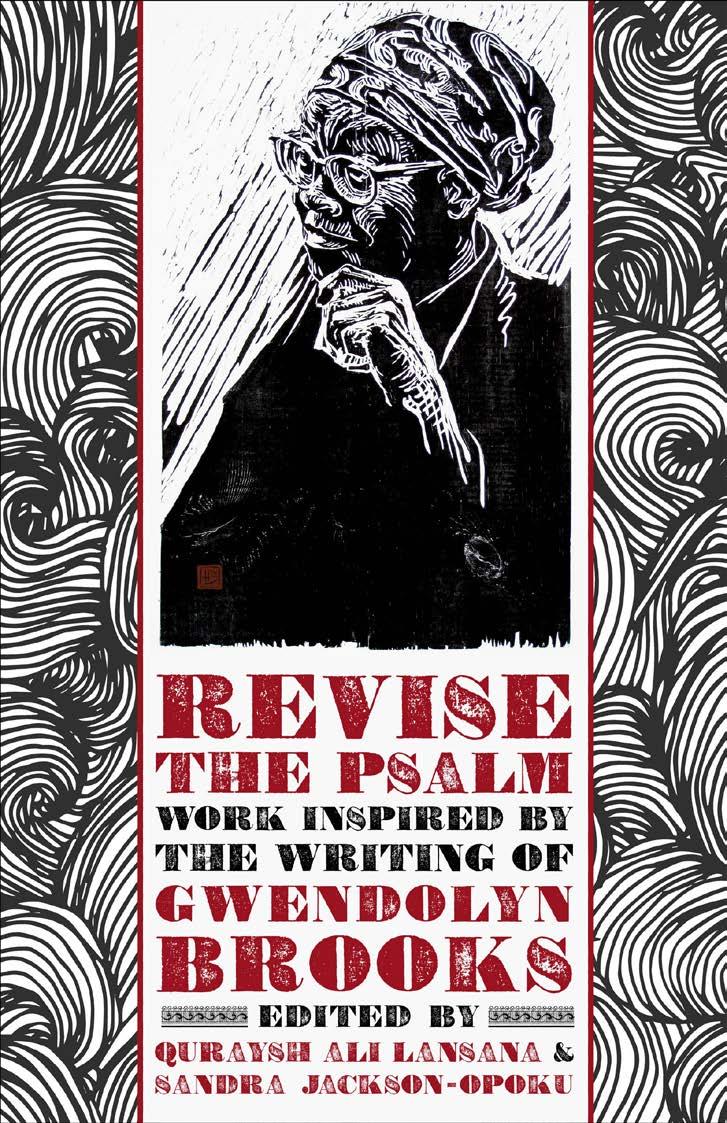
Revise the Psalm: Work Inspired by the Writings of Gwendolyn Brooks, edited by Quraysh Ali Lansana and Sandra Jackson-Opoku, will be published by Curbside Splendor in January 2017.
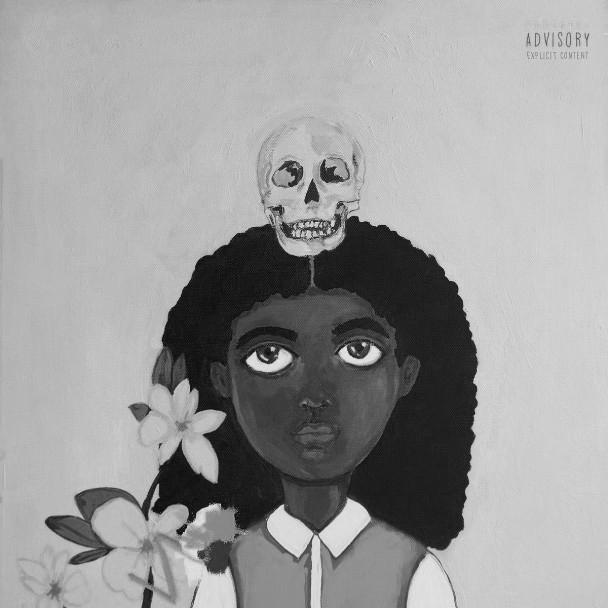
A review of Noname’s “Telefone”
BY EFRAIN DORADO
Fatimah Warner, better known as Noname, constructs her own unique world of feeling with her debut mixtape Telefone—a long-awaited statement from one of Chicago’s finest emerging talents that finds itself yearning to playfully capture the abstract between life and death.
Noname began her career cutting her teeth at Chicago art hubs YOUmedia and Louder than a Bomb, but became a breakout hip-hop artist in her own right following her standout verse on Chance the Rapper’s “Lost.” On this mixtape she asserts her poetic mastery with soft-spoken rhymes and songs that vividly illustrate her world: lyrics portray her surroundings as full of despair and desolation, even as instrumentals maintain a buoyant atmosphere of glitz and glitter. By creating a musical world that balances between life and death, Noname calls attention to the correlated beauty of both. “All my n——s is casket pretty/ Ain’t no one safe in this happy city,” she says on “Casket Pretty,” mediating a blatantly dark subject matter with subtle reminders of the city’s bliss. While Noname does address citywide and sometimes worldwide issues, the way she compresses them into personal anecdotes broadens the emotional range of the tape, presenting loss as more than mere tragedy. On tracks like “Casket Pretty” and “Shadow Man,” the raw lyrical exposition of her chosen topics, when cushioned by flamboyant instrumentals, allows the heaviness to scan as relatable.
On many tracks, Telefone feels hopeless, but Noname’s lyrics and music also carry the listener to moments where it feels
like her hopes couldn’t be higher. “Casket Pretty” and the tape’s opener “Yesterday” reveal a fascination with the beginnings of adulthood, when one’s mistakes suddenly have the potential to become lasting. “Diddy Bop,” on the contrary, travels/ to days of childish bewilderment and the music of P. Diddy. On a feature verse, Raury says, “Happily making my accident/ Mama gon’ whoop on my ass again.” and Noname shares similar experiences—her youthful missteps were also met with a belt, but not without the reassurance of love: “For stealing that twenty dollars like ‘baby, just ask me’/ Mama say she love, love, loved us.”
On “Yesterday,” Noname expresses feelings of debased nostalgia in light of the loss of Brother Mike, an influential Chicago poet whose impact on the city’s hip-hop scene is everlasting. “Me missing brother Mike, like something heavy/ Me heart just wasn’t ready/ I wish I was a kid again,” she says, But even as she grieves, Noname refuses to let her grief obscure what Brother Mike taught her: rather, the visions and memories of him soften the loss and ignite reassurance in times of doubt. “When the sun is going down/ When the dark is out to stay/ I picture your smile, like it was yesterday.” Here she adds yet more nuance to the mixtape’s treatment of loss, expanding its emotional horizons beyond mere tragedy.
The interplay between the tape’s ideas constitutes an existential push-pull, with acceptance and contentment emerging as themes as Noname searches for self-worth. “Forever” is an uplifting ode to belief as Noname attempts to accept herself despite high aspirations, “I’m trying to re-imagine
abracadabra for poverty/ Like poof I made it disappear/ Proof I’m made of happiness.”
On “Forever” and at other points throughout the tape, she adopts the mantra of “everything is everything” from Lauryn Hill, who herself claimed simply that, “change, it comes eventually.” Despite her feelings of powerlessness in a bleak world, her missed opportunities on “Reality Check” and feelings of unrequited love on “Freedom Interlude,” Noname still manages to find light within and around herself.
Noname’s peak as a wordsmith comes with “Bye Bye Baby,” a personified narrative of an abortion. In the Bible, Exodus 3:8 finds God promising the Israelites liberation from slavery in Egypt and deliverance to a spacious land flowing with milk and honey: Noname spins this into a parable for child care, intoning, “My baby need some milk and honey,” itself an allegory for a home birth control remedy. She presents this first from a mother’s perspective, then allows herself to speak as the unborn child in the second verse. To come to terms with her decision, she speaks through this baby to fulfill the absence of love: as Noname later said herself on Twitter, “I wanted to make a song that brought love into the narrative of abortion.” It’s a heartbroken sentiment that still manages to depict optimism within despondence.
To Noname, death is not final, nor is it fearful—rather, by portraying the beauty that lies within and around it, she transforms loss into something blissful and worth exploring, despite the pain that comes with it. ¬
BY CHRISTOPHER GOOD
One of the most striking motifs found in The Disco’s of Imhotep, the newest album by Chicago musician Jamal Moss (stage name Hieroglyphic Being), isn’t musical at all: it’s a single word. “Kmt,” a simple anglicization of Egyptian hieroglyphs, is scattered throughout Moss’s discography. Here, it lends its name to “The Sound of KMT,” but earlier this year it served as the title for a collaborative album with his cousin Noleian Reusse in a project called Africans with Mainframes.
Kmt (sometimes spelled “kemet”) has nearly as many meanings as Moss does aliases. It serves as the name of Ancient Egypt as a whole, for one thing, but the basic hieroglyph at its core, km, also connotes darkness, blackness (in the form of “Crocodile Skin”—also the title of a track on Disco’s). But if the aforementioned definitions weren’t enough, there’s often one more: termination, an ending symbolized by burnt charcoal.
This doesn’t necessarily apply to the tracks of Disco’s: they don’t have beginnings or endings so much as start and end times. Songs fade in and out, but you can imagine the jams they were excerpted from spiraling out for hours in either direction. But in this respect, “kmt” is an apt metaphor for Moss’s career: he’s been focused on his sound for years, and in all likelihood, he’ll be focused long after the tastemakers have moved to shine the light on someone new. But it’s this dedication that makes Disco’s one of the most rewarding techno listens in recent memory.
The recent acclaim Disco’s has received has been a long time coming, of course. Since the turn of the decade, hardly a year has passed without several of Moss’s fulllengths hitting record shops—and even when not shuffling pseudonyms, he can be found speaking at panels, touring, or maintaining his Mathematics imprint. It’s enough to prompt Discogs commenters to wonder where he finds the time to sleep.
So it’s with good reason that at this point Moss has earned a reputation as an innovator in Chicago electronic music; it’s hard to
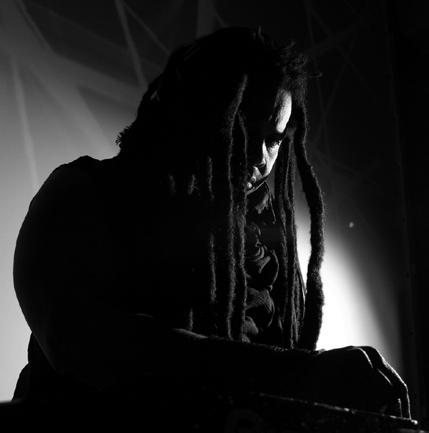
point to another artist producing anything of the same quality with the same frequency of release. The side-chained chimes of cuts like “The Shrine of the Serpent Goddess” might evoke artists like Actress (now a labelmate of Moss’s at Ninja Tune), for instance—but from its intricate percussion to the squealing synths, Disco’s is unmistakably a Hieroglyphic Being LP.
And yet, for all the ink that’s been spilled on Moss’s status as an outsider or iconoclast, Disco’s puts his knowledge of the scene’s past and respect for its champions on full display. The influence of mentors like Steve Pointdexter bleed throughout almost as clearly as the tape hiss: consider the breakbeat snares of “Sepulchral Offerings,” which pin a slasher-flick arpeggio to a bassline like a butterfly to a corkboard, or the dog-whistle frequencies of “Spiritual Alliances.”
Much has been made of Disco’s gritty soundscape, from the tape hiss to the clipping kicks. But it’s hard to overstate how good a decision this is: what the album loses in accessibility, it gains in sheer dynamism. Some of Moss’s peers—that is, lo-fi revivalists who conflate understatement with poignancy— record music that is frustratingly distant, as if the listener were sitting on the curb outside the club. But listening to “Nubian Energy,” in contrast, is like listening to a subwoofer with a stethoscope. It’s anti-background music; it commands attention.
It’s for this reason that Moss’s description of Disco’s as “Sound Healing,” a claim made in the album’s press release, is initially a surprise. Doesn’t “healing” belong with burnt-out hippies or helicopter parents convinced that Mozart makes babies smarter?
Yet the case Disco’s makes is not for the therapeutic, but for the cathartic. It’s a vision for healing in rhythm, in dance. And at a time when music is both weaponized (the “enhanced interrogations” of Guantanamo Bay) and commodified (the furniture music of your local H&M), it’s a more powerful statement than ever. ¬
BY DANIEL KAY HERTZ
Chicago is a city obsessed with neighborhoods, neighborhood boundaries, and neighborhood character, and therefore with neighborhood change. Demographic trends, from the rapidly declining black populations on the South and West Sides to the gentrification of the Northwest Side, get a lot of play in the media and in conversation. Which is why it’s weird that we’re in the middle of a demographic transition that is already of historic importance for the city and almost no one is talking about it.
Which is: the Southwest Side, first a bastion of European immigrants and their descendants, and then of Mexican immigrants and their descendants, is now gradually filling with Chinese immigrants and their descendants.
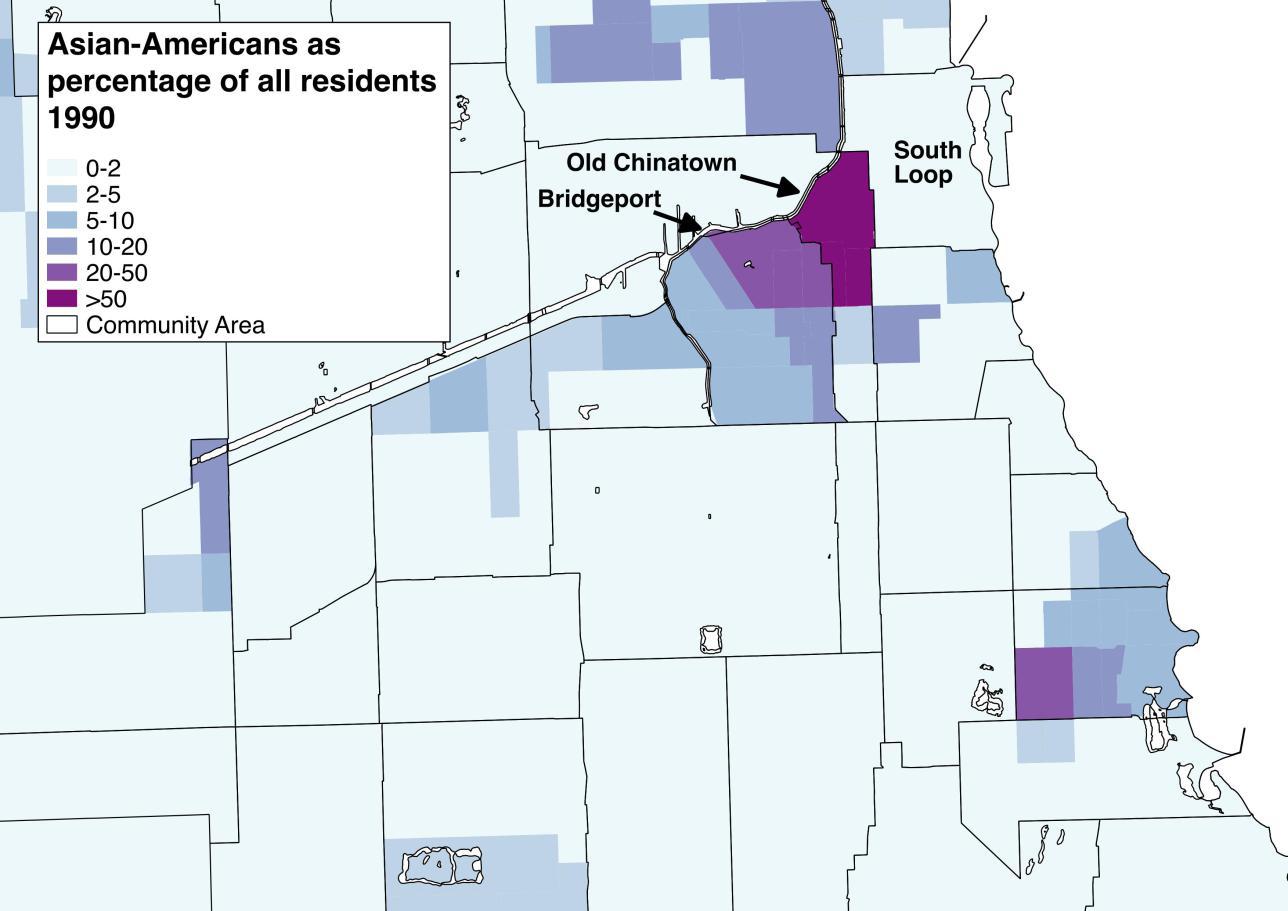
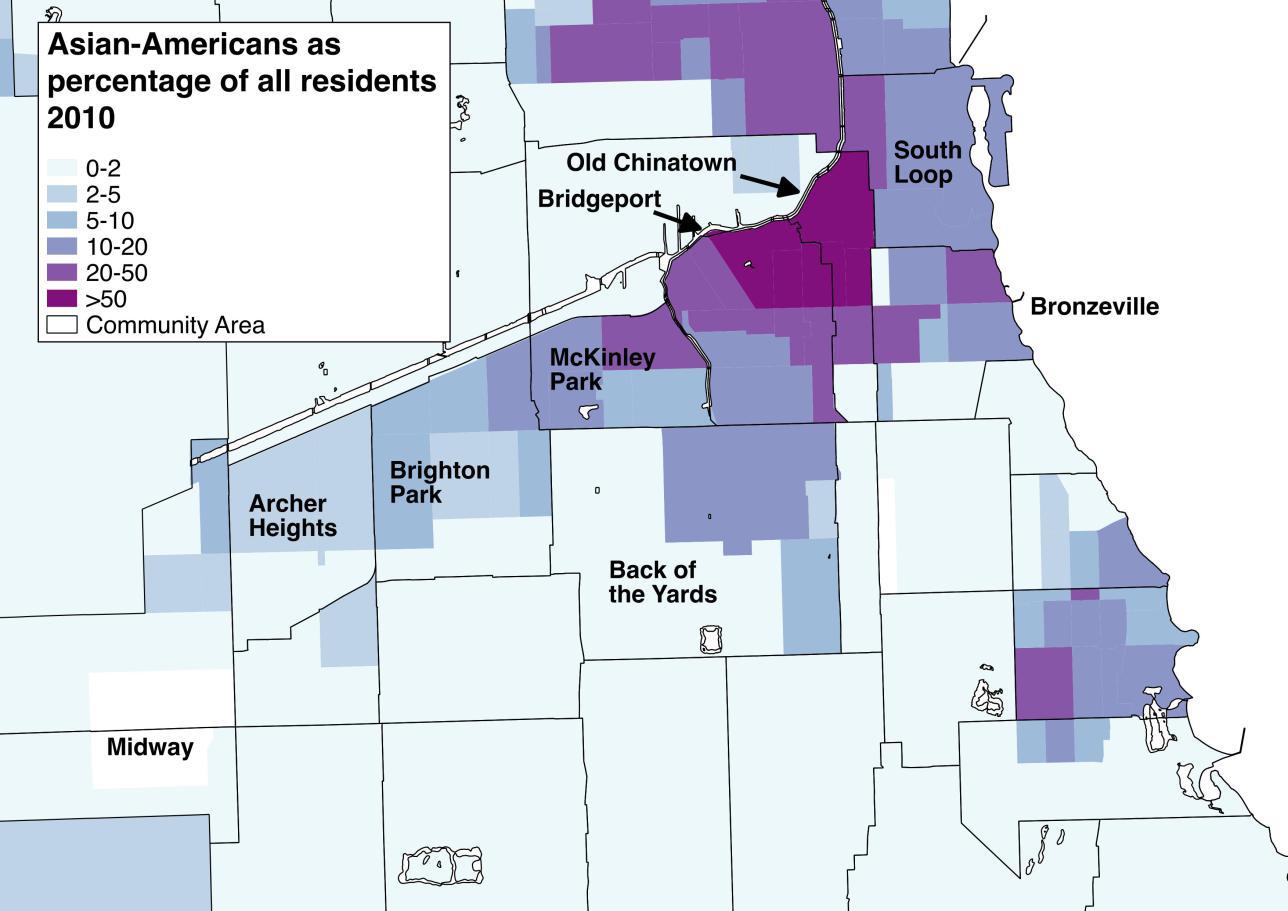
In 1990, there was virtually no presence of Asian-Americans east of the Dan Ryan into the South Loop or Bronzeville, or south of Pershing (39th Street), except for Hyde Park. (I’m going to say “Asian-American” here, because those are the census numbers I have, though it appears that nearly all of the Asian-Americans in this part of the city are of Chinese descent.) There was no significant (over 10% of residents) presence east of Racine (1200 West) or so, or south of 31st Street. By 2010, there was a continuous band of Asian-American population down Archer Avenue, the backbone of the Southwest Side, nearly all the way to Midway Airport, as far south as 51st Street and as far west as Cicero (4800 West). There were continuous pockets of neighborhoods over 10% Asian-American stretching from the lake to California Avenue, more than four miles away—and a nearly continuous stretch from the lake to Damen, more than three miles away, that were over 20%.
If it seems that I’m making a big deal out of a few percentage points in some areas, it’s important to note that historically, Chicago-area segregation has led to situa-
tions in which many neighborhoods would have virtually no representation from one or more ethnic groups; that was certainly the case with Asian-Americans on most of the Southwest Side. Breaking that barrier from “none” to “a few” is a notable step.
To be fair, this alone isn’t especially dramatic in the context of Chicago neighborhood change. Certainly in the white flight era, a neighborhood’s racial makeup could transition much more quickly, and the gentrifying parts of Logan Square, say, may appear more unrecognizable to a decades-long resident than sections of Brighton Park that have gone from zero to eight percent Chinese-American in twenty years.
But there are several reasons, I think, that this movement is really notable. First, for many years Chicago has been seen by many as culturally and politically divided into three major ethnic groups: Black, Latino, and white. In fact, the city was notable for how evenly divided the population was between those three groups, and for the extent to which their segregation allowed racially-specific geographic political representation. But though Asian-Americans have been in Chicago for a long time— in 2012, Chinatown celebrated its 100th year—they are only now beginning to reach a point where the population is large enough, and geographically concentrated enough, to demand that kind of local political representation.
Already in the 2010 district remapping, neighborhood organizations were able to lobby—unsuccessfully—for a ward around Chinatown that would have been over 40% Asian-American. And in the March primary elections, one of the people asking for that remap, Theresa Mah, beat out a Latino candidate for the Democratic nomination for a state legislative seat. By the 2020 remap, it seems very hard to imagine that there will not be an Asian-American majority, or strong plurality, seat on City Council, bringing a kind