The South Side Weekly is a nonprofit newsprint magazine written for and about neighborhoods on the South Side of Chicago. We publish in-depth coverage of the arts and issues of public interest alongside oral histories, poetry, fiction, interviews, and artwork from local photographers and illustrators. Started as a student paper at the University of Chicago, the South Side Weekly is now an independent nonprofit organization dedicated to supporting cultural and civic engagement on the South Side, and to providing educational opportunities for developing journalists, writers, and artists.
Editor-in-Chief Osita Nwanevu
Executive Editor Bess Cohen
Managing Editors Jake Bittle, Olivia Stovicek
Politics Editors Christian Belanger, Rachel Schastok
Education Editor Mari Cohen
Music Editor Maha Ahmed
Stage & Screen Lucia Ahrensdorf
Editor
Visual
Arts Editors Lauren Gurley, Robert Sorrell
Editors-at-Large John Gamino, Bea Malsky, Meaghan Murphy, Hannah Nyhart
Contributing Editors Julia Aizuss, Austin Brown, Sarah Claypoole, Emeline Posner, Hafsa Razi
Social Media Editor Emily Lipstein
Web Editor Andrew Koski
Visuals Editor Ellie Mejia
Layout Editors Adam Thorp, Baci Weiler
Senior Writers: Patrick Leow, Jack Nuelle, Stephen Urchick
Staff Writers: Olivia Adams, Max Bloom, Amelia Dmowska, Mark Hassenfratz, Maira Khwaja, Jeanne Lieberman, Zoe Makoul, Olivia Myszkowski, Jamison Pfeifer, Kari Wei
Staff Photographers: Camden Bauchner, Juliet Eldred, Kiran Misra, Siddhesh Mukerji, Luke White
Staff Illustrators: Jean Cochrane, Lexi Drexelius, Wei Yi Ow, Amber Sollenberger, Teddy Watler, Julie Wu
Editorial Intern Clyde Schwab
Webmaster Shuwen Qian
Business Manager Harry Backlund
The paper is produced by an all-volunteer editorial staff and seeks contributions from across the city. We distribute each Wednesday in the fall, winter, and spring, with breaks during April and December. Over the summer we publish monthly.
Send submissions, story ideas, comments, or questions to editor@southsideweekly.com or mail to:
South Side Weekly
1212 E. 59th Street
Ida Noyes Hall #030 Chicago, IL 60637
For advertising inquiries, contact: (773)234-5388 or advertising@southsideweekly
Read our stories online at southsideweekly.com
Vacant and Abandoned
The housing crisis lives on in the homes it has emptied—and banks aren't taking responsibility
BY JOHN GAMINO
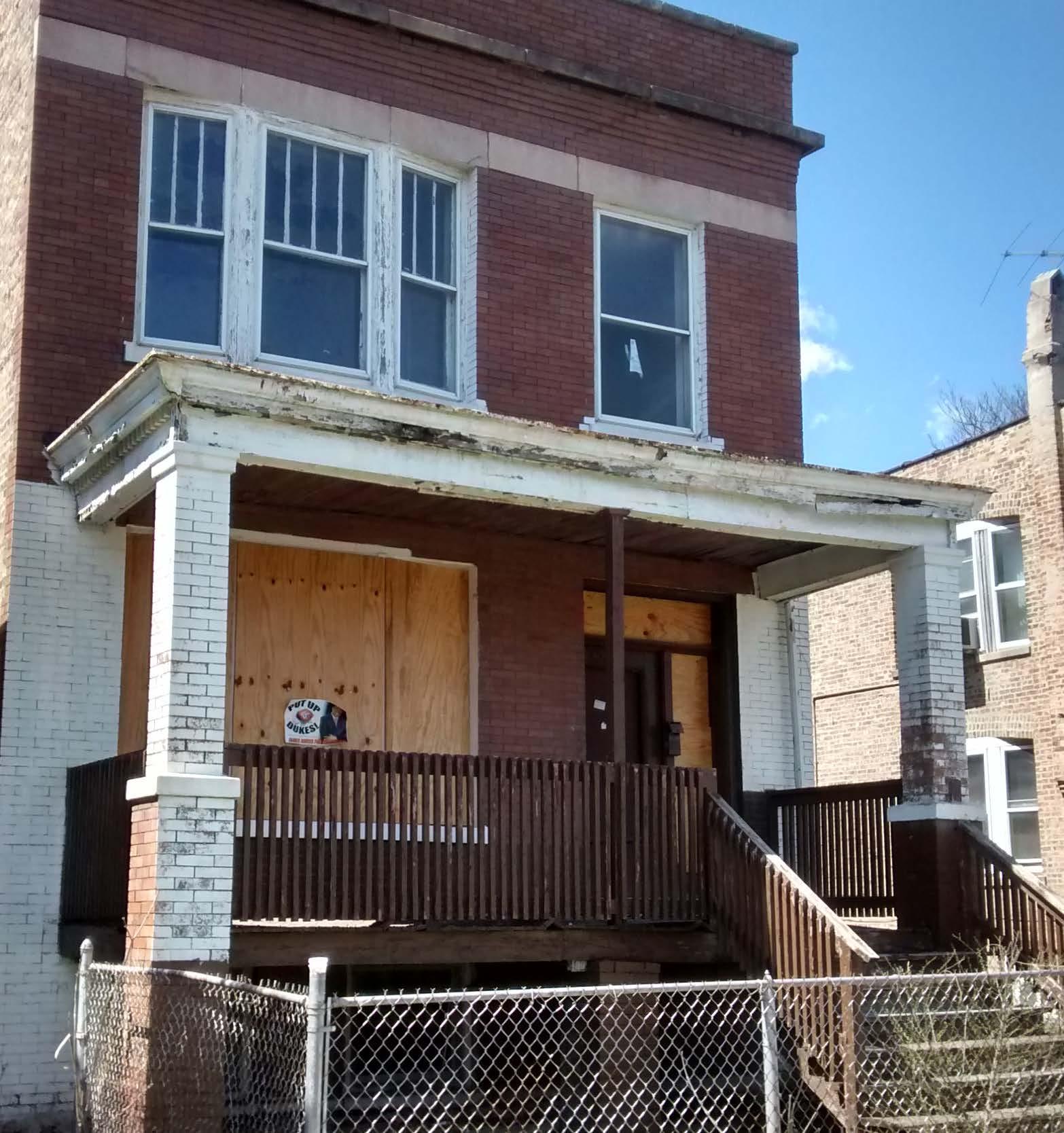
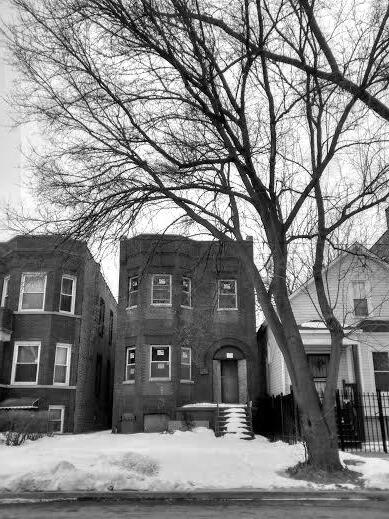
322 South Laflin is a brick, two-story apartment building with broken windows and an unlocked front door. It wouldn’t look inhabited save for a few bottles of shampoo visible in one of the windows of the upper floor. It completed foreclosure in June of last year, when, like most foreclosures, it was sold back to the mortgage lender, Selene Finance LP.
A woman who lives nearby says that people still live there (“squatters’ rights”). After the housing crisis, says the woman (she declined to give her name), “people had no place to go so they moved in wherever they could get.” She points to a bullet hole in the basement window just left of the front door.
“Poor people had nothing and they took all their shit.”
“They”—in this case, Selene Finance LP—still haven’t claimed official ownership of the property. That’s because after the auction that completes the foreclosure process, it is incumbent on the new owner of the property to file the deed with the Cook County Recorder of Deeds. At the vast majority of foreclosure auctions in Cook County there are no buyers, and the properties go back into the hands of the mortgage lender. But it is not in the lender’s interest to claim ownership of the property until it wants to make a sale. As long as the deed goes unrecorded, the lender that owns the building can avoid property taxes, vacant building regulations and fees, utilities bills, and essentially all accountability for the property.
A months-long review of city records by the South Side Weekly uncovered numerous properties that are deteriorating and impairing the housing recovery in neighborhoods because lenders fail to update deeds and take responsibility for all the properties they now own.
“People left their homes and were forced out, and the city came in and boarded them up, but the banks don’t take ownership of the property,” says Mattie Butler, the director of Woodlawn East Community and Neighbors (WECAN) and an activist with decades of experience fighting for affordable housing.
“You can’t even negotiate to get that property because they haven’t completed their filings for it,” Butler continues. “The only way you can go and trace the property is through the courts. You can’t go to the Cook County Deeds because the property is still registered [in the previous owner’s] name.”
“It’s one of the greatest crimes that’s been committed,” says J.R. Fleming of the Chicago Anti-Eviction Campaign.
Fleming says foreclosed, bank-owned homes with unrecorded property deeds are another way buildings become “zombie
properties,” typically a term for properties that banks walk away from without ever completing the foreclosure process. The same banks that pushed people out of their homes can step in to claim these homes as soon as it becomes convenient (or profitable)—leaving them vacant and abandoned for as long as that day takes to arrive. “There are years between eviction and the bank putting things up for sale,” Fleming says.
Around the corner from 7322 South Laflin, at 1474 West 73rd, is another bankowned property in Englewood with an unrecorded deed. 1474 was sold back to CitiMortgage almost a year ago, in April, but is still in the name of its previous owners before foreclosure. Although from the outside it looks secure, its interior is filled with debris, and would likely need extensive rehab before it could be sold to a new homeowner.
Nearby, 1474 West 74th is also vacant and through foreclosure with an unrecorded deed. Although both 1474s are boarded up and appear maintained, 5915 South Ada, 658 West 62nd, 6422 South Green, and 7355 South Lowe, to name just a few other vacant properties with unrecorded deeds in Englewood, do not. 5937 South Racine, 5734 South May, 5749 South Aberdeen, and 5931 South Marshfield were also vacant and unmaintained until city inspections within the last few months. The banks haven’t been by since the city “temporarily” secured the properties. 6155 South Loomis was secured by a city inspector in February; the notice is pasted over a red and white “For Sale—Financing” sign.
While there were fewer foreclosures in Chicago in the first half of 2014 than the first half of 2013, that does not signal a citywide recovery. The homes made vacant by the housing crisis, like 1474 West 73rd, are now themselves the cause of what experts call “negative spillover effects,” and the people who live in the most affected neighborhoods continue to suffer from them. A single foreclosed, tax delinquent, and vacant home can lower the value of neighboring homes by as much as ten percent, according to a working paper from the Federal Reserve Bank of Cleveland. Many blocks in neighborhoods on the South Side have more than one such home.
In Englewood, 11.1% of residences had been vacant for more than two years as of the first quarter of 2014—up from 8.1% in 2010—according to data from the Institute of Housing Studies (IHS) at DePaul. This was the second highest among community areas in the city, after Riverdale. 8.3% had been vacant for more than two years in West
Englewood (up from 5.4% in 2010), and 7.6% had been vacant for the same period in nearby Woodlawn (up from 4.6% in 2010). Homes that have been vacant for more than two years are often unmaintained and have the worst effects on surrounding property values, although other vacancies, which the IHS does not collect data for, are harmful as well.
“Most of the vacancies [in Woodlawn] are because of the predatory lending stuff and people losing their homes through foreclosure,” says Butler.
The housing crisis first hit homeowners directly through subprime loans. Around the country, subprime loans with high interest rates were disproportionately sold to people in poor, minority communities. At the peak of the housing crisis, almost half of all loans sold to African-Americans were subprime, the Center for Responsible Lending, a research nonprofit, found. Court affidavits reveal that Wells Fargo loan officers called their black customers “mud people,” and the subprime loans they sold them “ghetto loans.” In 2007, Wells Fargo sold black homeowners in the Chicago area the highest-priced loans of any of the nation’s top ten lenders, according to the Chicago Reporter. (Many of the vacancies the Weekly found with unrecorded deeds also belonged to Wells Fargo.)
But even those residents who managed to stay afloat on their loans continue to struggle with a problem they didn’t create— the vacant properties around them. And as banks take over homes in foreclosure, but don’t file the deeds and don’t maintain the properties, they continue to exacerbate this problem.
In July 2011, the city passed updated regulations for vacant buildings, instituting the requirement that all vacant residential buildings be registered with the Department of Buildings and tasking mortgage holders with maintenance of properties within thirty days of their owners having vacated them. The ordinance extended the definition of property ownership in Chicago to include mortgage lenders, and required them to take responsibility for the buildings abandoned by those whose mortgages they’d serviced. This was in part an effort to cut down on the number of zombie properties, cracking down on those who would let vacant properties sit in limbo.
The ordinance passed unanimously in City Council and earned praise from Mayor Rahm Emanuel. But questions surrounded the legality of making the mortgage holders the owners of the homes.
“You can’t just make a secured lender an owner because there’s a word changed in the law,” Linda Koch, president and CEO of the Illinois Bankers Association, a lobbying group, told the Huffington Post after the bill’s passage. “The only way that we are and should be responsible is if we are the actual owner and have the title to the property.”
So the law was amended that December—after negotiations with Bank of America, Wells Fargo, JPMorgan Chase, and PNC Bank—to make mortgage holders responsible for maintenance without legally considering them the owners until the foreclosure was completed.
But despite the law, the city has been overwhelmed in its enforcement efforts. City officials openly admit that there are vastly more vacancies than can be kept track of, which has made it very easy to hide abandonment. The ordinance is almost impossible to enforce, and while that would still be the case even if the July version hadn’t been changed, the amended version has allowed the banks to avoid the responsibilities of ownership yet again.
“The challenge with the enforcement [of the ordinance] is that there are only a limited number of inspectors who can look at properties,” says David McDowell, a senior organizer with the Southwest Organizing Project, one of the groups that pushed for the ordinance in 2011.
“We stopped paying attention to the enforcement process. We thought that this would be a way to address what was happening in the neighborhood,” he says. “We found that wasn’t effective.”
In the second quarter of 2014, there were 33,073 homes in Chicago that had been vacant for over two years, according to an analysis of USPS/HUD vacancy data by the Institute for Housing Studies at DePaul. Only 18,718 vacant homes were registered with the city as of March.
“Until the neighbors start complaining they don’t get attention,” Butler says of the vacancies in Woodlawn. “It’s not automatic.”
Even among those properties that are registered as vacant with the city, many, if not most, have unpaid fines. 5915 South Ada, 658 West 62nd, and 6422 South Green are among them. Then there are even stranger cases, like that of 5734 South May. Though the house has been registered with the Buildings Department since last June under Wells Fargo (Wells Fargo still isn’t on the deed) and has no unpaid fines, its windows are no longer boarded and secure—although they were when photos were taken for the city’s registry—and it was slapped with a “First Time Vacant” notice on March
2.
“Most of the vacant buildings aren’t registered [in accordance with the ordinance] and paying, and they’re not properly secured,” says Cathy Gerlach, who directs the city’s Micro-Market Recovery Program (MMRP), a program working to revitalize thirteen small, distressed areas of the city. The MMRP partners with community organizations in neighborhoods like Woodlawn and Englewood to reoccupy vacant buildings and keep people in their homes..
“Not only do we have a situation where no one can buy it, but the new owner, which is the bank, isn’t doing what they’re supposed to,” Gerlach says.
“It’s not registered, it’s not secured, they’re not picking up the trash, they’re not mowing the grass, they’re not shoveling snow. You the city are doing your best, because you’re out there writing tickets and sending people to administrative hearings, but you’re sending the wrong person because you’re sending the old owner,” she says.
Working on the MMRP in Woodlawn, Gerlach has seen cases where banks take back properties that complete the foreclosure process but record the deeds “sometimes never, sometimes not for months or years.”
Housing experts call vacant properties that never complete the foreclosure process “zombie properties” because, with neither homeowner nor bank to account for them, they sit in complete abandonment and disarray. These are the homes with broken windows and rotting boards, the ones in the most severe disrepair. They are the strongest deterrents to neighborhood recovery. Those homes that complete foreclosure but don’t have their deeds recorded by the bank can sit in a similar limbo situation, which some have called “zombie title.”
“It was recognized [by the city] as a significant problem last year, because it started to reach epic proportions,” Gerlach says.
Spencer Cowan, head of research at the Woodstock Institute, a nonprofit housing research organization, says he started to notice the problem when preparing a recent report on zombie properties.
“[The banks] had the title for a considerable amount of time before they took the deed to record,” Cowan says. “It was obvious from that that there were instances where the bank got title but didn’t report it promptly.” Cowan found that some banks were waiting to record the deeds until right before they could sell the properties off.
The Woodstock report on zombie properties, which focused only on those that never finished foreclosure or were still in
foreclosure, was released in January 2014. Cowan doesn’t consider properties that go through foreclosure with unrecorded deeds “zombies.”
“You’ve got a property that’s effectively unmarketable,” he says, “but [the bank] knows at some point the value of that property is going to matter to it, so it has an interest in keeping the property up.”
Yet the line between zombies and other vacant homes can run thin. The average foreclosure in the Chicago metro area, which, as of 2014, took an average of 903 days from the initial filing to auction, is a little less than two hundred days short of a zombie by Woodstock’s definition. What’s more, many homes that finish foreclosure finish it in bad shape, with little value beyond their lot and their potential for often prohibitively expensive rehab.
“A lot of the vacant properties that are for sale are not inhabitable,” Gerlach says. “They don’t have any plumbing, they don’t have any electricity. You’re going to need to have a contractor do a lot of work before anyone can move in.” Given this fact, there’s often not much reason for the banks to be interested in keeping the properties maintained.
5th Ward Alderman Leslie Hairston says zombie titles are “a very large problem.”
“The fact is that the bank has not taken care of the property,” she says. “They don’t want to spend the money, they figure they’ve already lost money.”
Hairston, who is licensed to practice law in Illinois, is on a committee of the Illinois State Bar Association that was established to look into what can be done about bankowned properties with unrecorded deeds.
“The banks don’t want to take responsibility for weeds, or keeping the city from fining them, or if there are any costs for demolition [around $15,000 to $20,000], so they keep the homeowner in title,” says Erica Minchella, founder and president of the Association of Foreclosure Defense Attorneys, and one of the other lawyers on the committee.
“It ruins communities,” Minchella says.
Hairston said there were “a very significant number” of such properties, but when asked about Chicago and areas on the South Side specifically, she said the committee was looking into the issue statewide and that she could not give a sense of its impact locally.
“Banks that have not properly filed the recording of deeds on foreclosed properties occasionally present obstacles to the City’s Law Department for code enforcement matters as well as for rehabbers,” said John Holden, speaking on behalf of the City and the Law Department.
As long as the deed goes unrecorded, the lender that owns the building can avoid property taxes, vacant building regulations and fees, utilities bills, and essentially all accountability for the property.
“These issues are governed by state law and resolving them can add up to several months of processing time to achieve legal title on properties. These situations occur in a very small number of cases.”
Calls to Wells Fargo and servicers maintaining Wells Fargo-owned homes were not returned.
The only way to get a count of how many properties in the city have gone through foreclosure and have outstanding deeds would be to tabulate every case in which a bank has confirmed the sale but the previous homeowner has the latest deed, which would mean manually searching the pin numbers of each bank-owned property in the Cook Recorder of Deeds.
J.R. Fleming, of the Anti-Eviction Campaign, says he first heard of zombie titles when a former property owner kept getting her water bill. These fines and bills can be dismissed if proof of the sale is brought to court, but that’s assuming they’ve reached a responsive, previous owner in the first place. The bigger problem lies with the vacant homes themselves, and their effects on the people who live around them.
5941 South May was sold back to its mortgage holder, Fifth Third Bank, in September 2013, but the deed is still in the name of the previous owner, Michael Cornell Ridley. The lots on either side of 5941 are both vacant, although if you look up photos of it on real estate websites, you can still see 5943 South May standing next to it. There are blue and white curtains in the upstairs windows of 5941, and three names taped onto one of the two black mail slots (not Ridley’s).
Jimmy Blake lives just across the street at 5940 South May, in a one-story brick house. He says the previous owner passed away sometime ago, and that he doesn’t know the people who live there now, although there are some people who do. (Residents are not always evicted right away after foreclosure, although the bank doesn’t have to record the deed for eviction to occur—6421 South
May, just down the street, was sold back to Wells Fargo in September 2013 and hasn’t had a deed recorded since 2011. An eviction notice from September 2014 is still posted on the door.)
“When I first moved here this was a vacant lot,” Blake says, referring to his own house, which he built. “That was in sixty-eight.”
“There were only two vacant lots on this block then,” he says, “here and here,” pointing to his own porch, where he’s sitting, and then to the northeast corner of 60th and May.
Now, he notes, there are a number of vacant homes and lots on his block, including a large swath of land above 60th and between May and Racine to the west, where a large tree is lying uprooted on the ground. “There are a lot of vacant homes,” he says, “but I don’t know who owns them.”
Unsurprisingly, most residents aren’t very concerned with who actually owns and should be responsible for vacant properties. There are far too many of them to worry about specific instances of abandonment and unaccountability.
When I go to check out 7322 South Peoria, which was sold back to Chase in July 2013 but is still in the name of its previous owner, a group of young men sitting nearby say they were just talking about the banks’ eventual plans for vacant homes, although they don’t know anything about 7322 South Peoria in particular.
“They want to kick all of us out,” says one of the men, who, like the others, did not want to be identified.
“This is happening all across urban America,” he says. “Look at New Orleans.” He then mentions the area south of Garfield and around Normal, where land has been purchased to expand the Norfolk Southern Railway. He says there will be other local developments that displace African-American people before transitioning to talk about how there’s now a New Balance store on 55th Street in Hyde Park.
The open fields along Normal are just
Though heavily associated with multiple crews, Angel Davanport is a force to be reckoned with all on her own. One only has to see her live or watch the videos of her performances to understand why. Not only is she a true talent, she expresses said talent with admirable versatility. She first caught the attention of Strange Music’s Tech N9ne during an impromptu green room singing performance at Chicago’s House of Blues—when she followed up her undeniable vocal talent by rapping a few bars, the prolific, radical underground rapper was hooked. She has since collaborated with Tech and the Game on his album Something Else, released a monster of an EP titled FREEPU$$Y, and dropped a host of collaborations with various members of her respective collectives, Skigh Mob and the Rapper Chicks. We paid Angel and her fellow Rapper Chicks a visit at the Chicago Cultural Center as they were preparing for SXSW, at which they have since performed to much-deserved fanfare.
What’s your music story? I feel like everyone who does music has a progression.
I started performing in grammar school. I acted in plays until high school, which is when I started getting involved with slams. That’s how I found out about YCA [Young Chicago Authors]. I was getting into a lot of trouble—my friends were getting in trouble and I was getting in trouble trying to stick up for them. I met with one of my poetry teachers, Ms. Qadir, and she told me, I can’t have you out in the streets fucking your life up; you should be in my honors English class and my poetry class. I started working with YCA through Ms. Qadir, and then I just got sucked into the slam world. After that, I wasn’t really sure where my life was taking me. I was starting college at the University of Illinois, I was working toward becoming a teaching artist with YCA. Unlike a lot of people who were super involved with music when they were younger, I wasn’t really involved with hip-hop—I didn’t even listen to it much until I was about sixteen, seventeen. I didn’t know what to do with my life, but I knew I was a hard worker, so I went and got a catering job. I did office work at school, I was teaching with YCA and writing...and then I got this form on my desk that said, go work for Disney! I took that as a sign. They accepted me into the program, so I moved to Florida. After working for Disney I came home and felt really lost. I got into rap listening to those of my friends who were rappers—poets too, but mainly hip-hop artists—wanting to freestyle, wanting to write.
I feel like having a writing background helps coming into it. People who write first end up having some of the best bars.
It’s definitely a gift and a curse. I can write stories really well. That’s the part that I like. Because I’m not really the best at writing
cracks and punch lines yet, but I recognize that’s my weak point, my challenge area. I’m getting to be the best emcee I can be.
Why start rapping instead of just sticking to singing? Because clearly you can sing and you’ve always known that.
Why not? You know? I like to sing, I like the challenge of rap. It’s exciting. I’m a woman, so people don’t anticipate that when I get on stage I’m gonna open my mouth and be rapping. I think they look at me and think dirty things right away. But I don’t mind that because nothing really changes. They’re just surprised—a lot of people are. That’s the kicker I get out of it. I feel like I’m versatile as an artist, and I just want to be able to talk to everybody.
Why do you think there are so few women featured in hip hop, especially when there are so many talented and hard-working female emcees?
There are going to be a million guys who are average, but there can only be one woman who is amazing. Some guys aren’t even average. They’re just bad rappers, but they have a lot of steez, a lot of swag. And that’s cool, but I think there is a stereotype, a glass ceiling in hip-hop. You can’t go that far if you’re a girl. Well, you can go far, but you can’t…
Because there’s only room for one girl in the crew.
Exactly. And every other girl is a ho or a bitch or not good enough. But that’s not necessarily the case! If you put all the raw girls together then you’d realize how raw they are. You don’t have to have a man validating you, telling you what to do, dictating who you are and what kind of music you make and what your style is and what you look like.