The South Side Weekly is an independent nonprofit newsprint magazine written for and about neighborhoods on the South Side of Chicago. We publish in-depth coverage of the arts and issues of public interest alongside oral histories, poetry, fiction, interviews, and artwork from local photographers and illustrators. The South Side Weekly is dedicated to supporting cultural and civic engagement on the South Side and to providing educational opportunities for developing journalists, writers, and artists.
Editor-in-Chief Osita Nwanevu
Executive Editor Bess Cohen
Managing Editors Jake Bittle, Olivia Stovicek
Politics Editor Christian Belanger
Education Editor Mari Cohen
Music Editor Maha Ahmed
Stage & Screen Julia Aizuss
Editor
Visual Arts Editor Corinne Butta
Editor-at-Large Emeline Posner
Contributing Editors Lucia Ahrensdorf, Will Cabaniss, Sarah Claypoole, Eleonora Edreva, Lewis Page, Hafsa Razi, Sammie Spector
Social Media Editors Austin Brown, Emily Lipstein, Sam Stecklow
Web Editor Andrew Koski
Visuals Editor Ellie Mejia
Deputy Visuals Editors Ellen Hao, Thumy Phan
Layout Editor Baci Weiler
Senior Writer: Stephen Urchick
Staff Writers: Olivia Adams, Sara Cohen, Christopher Good, Emiliano Burr di Mauro, Michal Kranz, Kristin Lin, Zoe Makoul, Sonia Schlesinger, Darren Wan
Staff Photographers: Juliet Eldred, Finn Jubak, Alexander Pizzirani, Julie Wu
Staff Illustrators: Javier Suarez, Addie Barron, Jean Cochrane, Lexi Drexelius, Wei Yi Ow, Amber Sollenberger, Teddy Watler, Julie Wu, Zelda Galewsky, Seonhyung Kim
The paper is produced by an all-volunteer editorial staff and seeks contributions from across the city. We distribute each Wednesday in the fall, winter, and spring, with breaks during April and December. Over the summer we publish monthly.
Send submissions, story ideas, comments, or questions to editor@southsideweekly.com or mail to: South Side Weekly 6100 S. Blackstone Ave. Chicago, IL 60637
For advertising inquiries, contact: (773) 234-5388 or advertising@southsideweekly
Read our stories online at southsideweekly.com
Check out South Side Weekly Radio's new series, South Side Modern Love, at soundcloud.com/south-side-weekly-radio
A week’s worth of developing stories, odd events, and signs of the times, culled from the desks, inboxes, and wandering eyes of the editors
All Aboard the Pension Expre$$
A report by the Sun-Times’s “The Watchdogs” series explores the massive pensions of CTA board members. From 2005 to 2014, the report claims, the CTA put over $3 million into board pension funds; in 2014, nineteen board members got nearly $330,000 in combined pension payments. Among the recipients of these yearly five-figure payments are Valerie Jarrett, who served on the board for almost eight years before becoming senior adviser to President Obama, and Howard Medley, who has received more than $200,000 from the CTA over twenty-five years despite having been convicted in 1989 for accepting bribes related to a CTA fuel contract. The report goes on to detail a few other board pensioners who have received soaring sums at the expense of city taxpayers.
R(amen)
Furious Spoon, a self-described “housemade noodle, hip-hop ramen” shop planning to open a location in Pilsen, is named in order “to educate guests on the culturally proper way to eat ramen—‘furiously.’ ” This week in Pilsen, parishioners in three of the neighborhood’s six Catholic churches might be almost as furious as the culturally proper way to eat ramen, or even the restaurant’s titular spoon. Citing needed structural repairs, declining mass attendance, and changing demographics, the Archdiocese of Chicago has
IN THIS ISSUE IN CHICAGO
THE nUmbErS gamE
“People looking at the numbers don’t know what is actually going on at IPRA.”
jasmin liang...4
bUDgET cUTS bY THE nUmbErS CPS is currently operating at a $1.1 billion deficit.
julianna st. onge...7
a raDIcaL ImagInaTIOn Counter-narratives around a place of incarceration
darren wan...8
made the decision to close St. Adalbert and convert St. Ann and Providence of God to “worship sites” for St. Paul and St. Procopius. The Archdiocese said that they “see great value and opportunities for all parishioners in combining the strengths, talents and traditions of our Pilsen parishes”; at the moment, it looks like the talents and traditions of a hip-hop themed Japanese noodle shop are in higher demand.
Red Line Rides Reveal Widely Known Fact
Have you ever ridden the Red Line from 95th all the way to Howard? Eighteen-year-old Chatham native Austyn Wyche has made this northsouth schlep multiple times, taking photos of Red Line riders of the people in his car to prove a point about segregation in Chicago. Wyche observed the people that would get on and off of the train along the Red Line route and noticed subtle changes between stops that would result in obvious shifts in ridership demographics that corresponded with the racial makeup of each neighborhood the train runs through. Wyche self-published his photos in a book and online under the name Connected Division, showing graphically how the makeup of Red Line cars changes as the train chugs along from Roseland to Rogers Park and back. “People may have known that the city was segregated, but many have never actually seen it,” Wyche explains in his book.
2nD fLOOr rEar: WE arE HErE FORT is poised right at the edge of chaos. michelle gan, christopher good, stephen urchick...10
bLacK HISTOrY mOnTH “Art often makes us feel better. It really does.”
as told to bess cohen...12
DEcEIvIng appEarancES
Beauty is all the more intense when it arrives unexpectedly.
kevin gislason...13
gaTHErIng fOrcE
“It’s an intimate act, kind of, touching their faces.”
kristin lin...14
THE rIgHTS Lab ExpErImEnT
A tale of tech, art, and activism michal kranz...16
Cover art by Ellie Mejia
The Numbers Game
What’s the truth behind IPRA’s statistics?
BY JASMIN LIANG
The Independent Police Review Authority (IPRA) has been called ineffectual by critics since its beginnings in 2007, when it replaced the Office of Professional Standards as the body responsible for investigating serious misconduct and police shootings by officers of the Chicago Police Department (CPD). In response, IPRA has launched several programs over the past six years that it claims have resulted in significant improvements in its performance. According to Larry Merritt, IPRA’s Director of Community Outreach and Engagement, the percentage of cases with “positive findings”—cases with enough evidence to come to a conclusion—rose from about thirty percent to about fifty-three percent from 2009 to 2015, and the percentage of cases with “sustained findings”—cases with enough evidence to justify disciplining officers—rose from about four percent to about twenty percent. Additionally, Merritt argues that despite the criticisms leveled against IPRA, its percentages of “sustained findings” are “not that low” compared to other parts of the country.
But according to some who have previously worked at IPRA, these figures obscure the agency’s shortcomings and suspect practices.
“It is all just a numbers game,” says Lorenzo Davis, a former IPRA supervisor. “People looking at the numbers don’t know what is actually going on at IPRA.” Davis, a former police officer, was allegedly fired by former IPRA head Scott Ando for purported anti-police bias. He argues many of the programs launched by IPRA over the years were part of a conscious effort to improve its statistics.
“The numbers might look good,” Davis says, “but [those programs] sacrifice the quality of investigation.”
IPRA’s annual reports explain that when complainants file allegations, they first go through a review process with an “Intake” group. Then, first-hand information is gathered from those complainants who submit a signed affidavit swearing their claims are truthful. If no affidavit is received, the case is closed. IPRA says this program improves the initial reviewing process and directs limited resources to cases with sufficient evidence to make a conclusion. However, Davis says, this practice is often exploited to reduce IPRA’s caseload. According to Davis, the investigators no longer actively seek the complainant’s signature for their affidavit and try to close the cases as quickly as possible. In fact, in IPRA’s 2014 Budget Statement to the City Council, it attributed its improvements in case resolution partially to the introduction of new practices, including the streamlining of investigations through the 2011 creation of a Rapid Response team of investigators. According to the statement, the Rapid Response team is charged with working with the “Intake” group to “close out cases more efficiently and much quicker.”
Nathaniel Freeman, another supervisor who left IPRA in 2011, agrees with Davis. “In the past, if need be, investigators would go out and knock on the complainant’s door to ask for an affidavit,” says Freeman. “But now the complainant has to first make an appointment with the investigator, take time from their work, and come all the way down themselves. Sometimes the investigators would not even be available or ready to take statements after a person traveled to the office.”
If a complainant does submit an affadavit, IPRA assigns one or a team of investigators to canvass the field and gather any related evidence. This evidence is then put into a file and reviewed by another investigator or a supervisor. In this transition, Davis claims, much of the evidence is often not properly commu-
“The numbers might look good,” Davis said, “but [those programs] sacrifice the quality of investigation.”
nicated, which gives rise to seeming contradictions and gaps in complainant statements. “They will then close the case as ‘unfounded,’” says Davis, “when, at a lot of times, they do not review all the evidence, nor interview the officers before they make the conclusion.”
The experiences of one IPRA employee, who spoke to the Weekly on the condition of anonymity, seem to corroborate Davis’s claims. In the summer of 2013, the source allegedly received a series of instructions from an investigation coordinator and a supervisor regarding changes in IPRA’s investigative procedure. According to the employee, the two allegedly ordered all members of the staff responsible for the intake of complaints about officers to “not ask” complainants any detailed information about the officers they accused or injuries resulting from the incidents in question. “If the complainant volunteered the information,” the source recalls being told, “just write down basic information. Leave out eye color, facial hair, hair style, color, wavy or straight, et cetera. Leave out detailed injuries in the incident.”
The source was told that case investigators, instead of the intake group staff, would gather this detailed information later on in the investigative process.
The source refused to follow this order and claims that because the details were missing in initial reports, cases were wrongly assigned to the Internal Affairs Division, a department of the CPD that disciplines officers’s minor infractions, and had to be reclaimed by IPRA later. The source says these details are
crucial information, without which investigators are either unable to identify officers or unable come to proper conclusions on cases. As a result, complaint cases can be unjustifiably closed due to “insufficient evidence.”
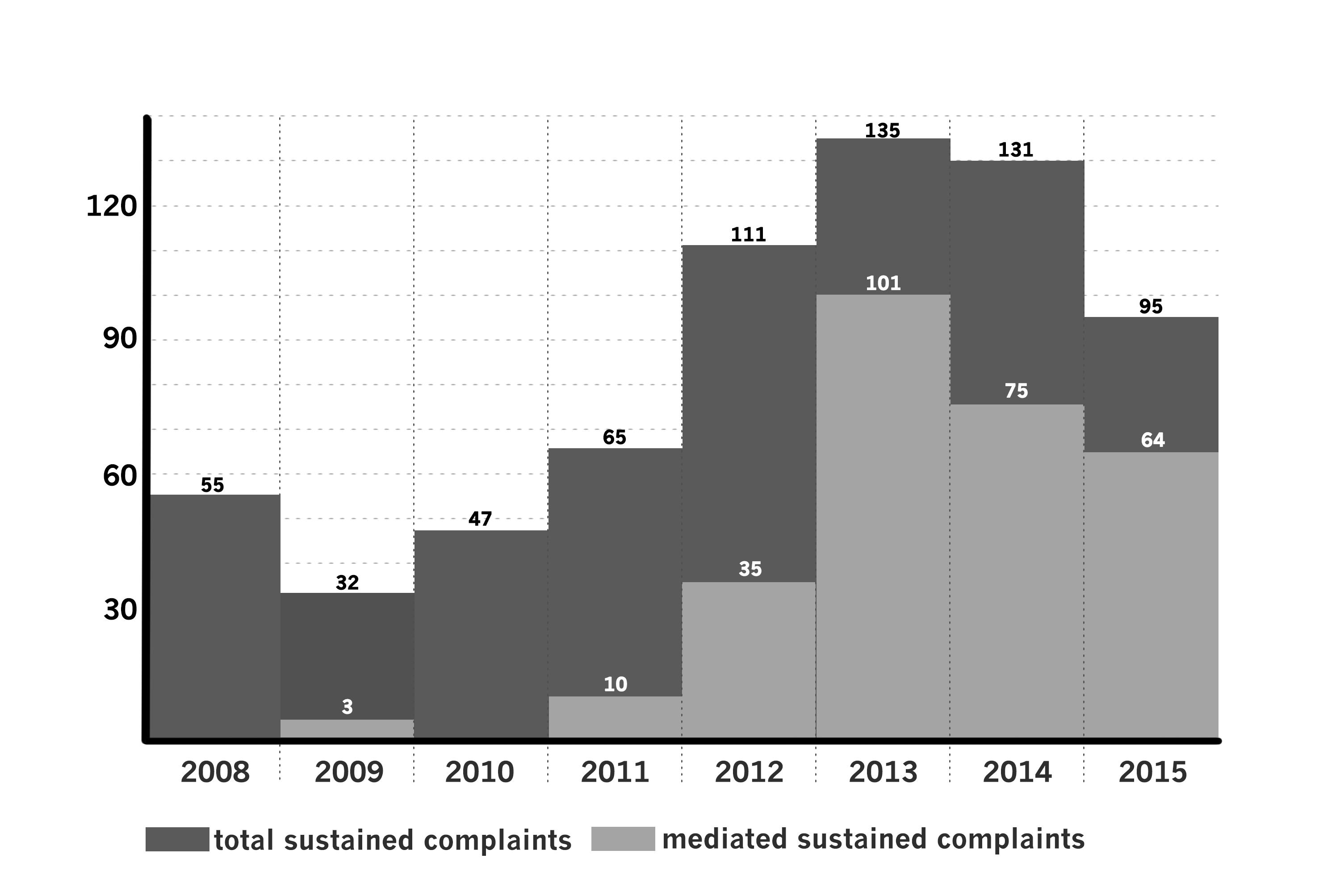
Mediation, a process which, according to an IPRA annual report, “allows an officer to take responsibility for his or her mistakes and reach an agreement with IPRA on an appropriate level of discipline,” is another one of IPRA’s key practices. In 2015, over half of the cases IPRA sustained were settled by mediation. According to Larry Merritt, mediation helps IPRA close cases more efficiently when officers are willing to accept responsibility for their actions. However, this practice may also bolster IPRA’s rate of sustaining cases while protecting officer interests. If there are multiple allegations against an officer from one incident, all of those allegations are assigned a log number that represents the case. Davis says that through mediation, IPRA is able to sustain part of the allegations, often the minor infractions with light penalties, while dismissing other more severe charges within the case as “not sustained.”
“In the process of mediation, the officer, an FOP attorney and an IPRA attorney are brought into the meeting, where they negotiate which of the allegations would be sustained until the punishment is light enough for the officer,” says Davis. “The complainant is completely excluded from the process, not even notified.”
DATA FROM IPRA WEBSITE ANALYZED BY DAVIS TSUI, GRAPH BY ELLIE MEJIA
Since late 2012 when mediation was first introduced in IPRA , it has been frequently used to increase the statistics of sustained cases. Over the past 4 years, a majority of the yearly sustained cases were resolved through mediation.
Merritt responds that IPRA’s mediation is an administrative process, not a trial. Therefore, the presence of complainants is unnecessary. He also justifies the frequency of light penalties in mediation. “The purpose of penalty is to educate, not to punish,” he says. “If the officer admits the mistakes and accepts the punishment, he is willing to change.”
Paula Tillman, another former investigator at IPRA, disagrees. “What IPRA does should not be termed ‘mediation,’ but a plea bargaining, a process they use to negotiate punishment in court,” she says.
According to both Tillman and Freeman, mediations in other cities across the country are vastly different from those in Chicago. “The
practice[s] of mediation in both New York and San Diego let the officer and complainant sit down and have a face-to-face conversation,” says Freeman, recalling his visits to other public agencies for police accountability. “Only in that sense [is] the conflict is truly resolved.”
Davis and Freeman also allege that deliberate acts further corrupt IPRA’s procedures.
“Findings have been changed, files have disappeared or been stolen away,” says Freeman. “If you refused to change your finding, an administrator of higher position could step in and change the finding.”
The Weekly’s source also alleges that administrators not only censor and control findings, but also silence investigators who question the system and try to speak out. The anonymous source says that after these investigators refused to follow their orders and tried to report the sabotaging of work or documents being deleted or changed by coworkers, IPRA threatened them with termination. The source typed up their complaints and submitted paperwork to the city’s Department of Human Resources, but no one responded.
This is the system that Sharon Fairley entered. Fairley was appointed by the mayor as IPRA’s new chief administrator after the resignation of Scott Ando on December 6 of last year. Ando left his post in the wake of the Laquan McDonald video release on November 24. Tasked with rebuilding IPRA, Fairley has promised to bring independence and transparency to the agency. In early January, she proposed a set of reforms that included introducing new administrative and legal leadership, strengthening IPRA’s legal oversight by assigning legal attorneys to work with individual investigators, hiring a new community outreach coordinator, and publishing the details of investigations on a caseby-case basis.
But it is still unclear whether these reforms could bring substantial change to the agency given that its issues, critics say, are systemic, evincing both a lack of discipline and a pro-police culture throughout the agency.
For Nathaniel Freeman, IPRA’s problems lie not only with its leadership but with personnel on every level. “A significant number of the people who work at IPRA have ties with
All being said, it comes down to one answer for Futterman: instead of redeeming its old structure, IPRA needs to “start fresh.”
the police department,” he says. The Weekly’s source agrees: “Many of them have no prior experience in criminal investigations and are not provided with formal training after being hired,” they said. “A lot of people don’t even know how to write a report. Most of them only follow what they are told by the supervisors. This is what makes those illegal obstructions possible.”
Davis also believes Fairley’s reforms have not yet struck the root of the problem. Ill-founded investigation design and practices, Davis argues, can only be effectively addressed after a reorganization of personnel. “Ms. Fairley has not had a chance to make reforms,” he says. “To be successful, her reforms must include removing Scott Ando’s old regime.”
Craig Futterman, a professor at the University of Chicago Law School who specializes in litigations related to police accountability, agrees with Davis.
“Simply changing the top leadership will not guarantee independence and change,” he says. “The problem is deeper than one person.” He commends Fairley’s intentions but believes her potential influence is limited. “I admire the intentions of Ms. Fairley and I believe she will do everything in her power to improve investigations,” he said, “but she is inheriting an agency steeped in institutional bias.”
Nor did Fairley’s promise immediately evoke confidence among the public. Ted Pearson, the co-chair of the Chicago Alliance Against Racist and Political Repression (CAARPR), has little faith in IPRA’s transformation. CAARPR is an activist campaign calling on the city to eliminate IPRA and replace it with an elected Civilian Police Accountability Council. Pearson believes Fairley’s reform can only bring temporary improvement.
“As long as IPRA remains under the Mayor’s office, it cannot be truly independent,” Pearson says. He also questions the fundamental structure of IPRA and its limited authority in the system. “If IPRA can only make recommendations of penalties to the police superintendents, if it has no power to directly fire or discipline the police officer, [then] it has no actual power in bringing changes to the Police Department,” he says.
Futterman, on the other hand, sees the ex-
isting hierarchy as necessary. He believes that by limiting IPRA’s authority and placing the ultimate jurisdiction in the CPD, the current structure holds the superintendent accountable for officer supervision and discipline.
“The superintendent should bear final responsibility for discipline [to the officer], not IPRA,” says Futterman. Regarding the possibility that this system would allow the superintendent to overlook IPRA’s recommendation and contain the officer’s misconduct, Futterman stresses the importance of transparency. “To ensure the superintendent’s accountability to the public, the Department must also promptly publish the Superintendent’s response to IPRA’s disciplinary recommendations and his or her reasons for any departures from those recommendations,” he says. “Transparency breeds accountability.”
But that’s only one of several reforms IPRA needs in order to become qualified for its role as the overseer of the CPD. “What IPRA needs is, first, a leader who is as much divorced from the politics as possible,” Futterman says. “The process of selecting and replacing leadership should be independent and transparent, and the process should include voices from the community. Second, its budget and resources must be politically insulated. A good leader is not enough. He or she must have the power and resources to hire qualified personnel and train them accordingly.”
Futterman is currently working on potential legislation to enhance the agency’s independence by ensuring its financial independence. For him, it comes down to one answer: instead of redeeming its old structure, the agency needs to “start fresh.”
Merritt says that many of IPRA’s practices, including mediation, are currently under examination, and also says that reforms of investigator training are underway. Additionally, IPRA is currently creating a new position that focuses on analyzing its performance and improving public access to its data.
But after eight years of dubious statistics, the Weekly’s anonymous source remains skeptical. “Talk is cheap,” they say. “Action speaks louder than words, louder than numbers.”
Additional
research by Davis Tsui
JASMIN
Budget Cuts by the Numbers
BY JULIANNA ST. ONGE
Last week, Chicago Public Schools (CPS) unveiled the details of its latest round of budget cuts. After CPS failed to receive state funding, CEO Forrest Claypool initiated the cuts in an attempt to close a $480 million budget gap. CPS is currently operating at a $1.1 billion deficit, and administrators are facing criticism from the Chicago Teachers Union that the cuts are an attempt to force teachers into contract negotiations. As part of the cuts, CPS has announced it will no longer contribute to teacher pensions as it has done in the past, a decision that is expected to save the district $65 million this year and $130 million per year afterwards.
Individual school budgets are determined by the number of stu-
dents enrolled on the twentieth day of the school year. This system, called Student Based Budgeting (SBB), also dictates the way cuts are made, as changes in student enrollment dictate the percentage of funding taken out of a given school’s budget. According to DNAinfo, schools with the highest enrollment received the steepest cuts in last week’s budget announcement.
Schools typically spend between ninety-three and ninety-nine percent of their SBB funds on teacher salaries. The remainder is spent on services and materials. Though each school’s deficit is determined by the school district, principals must decide on their own what they want to cut.
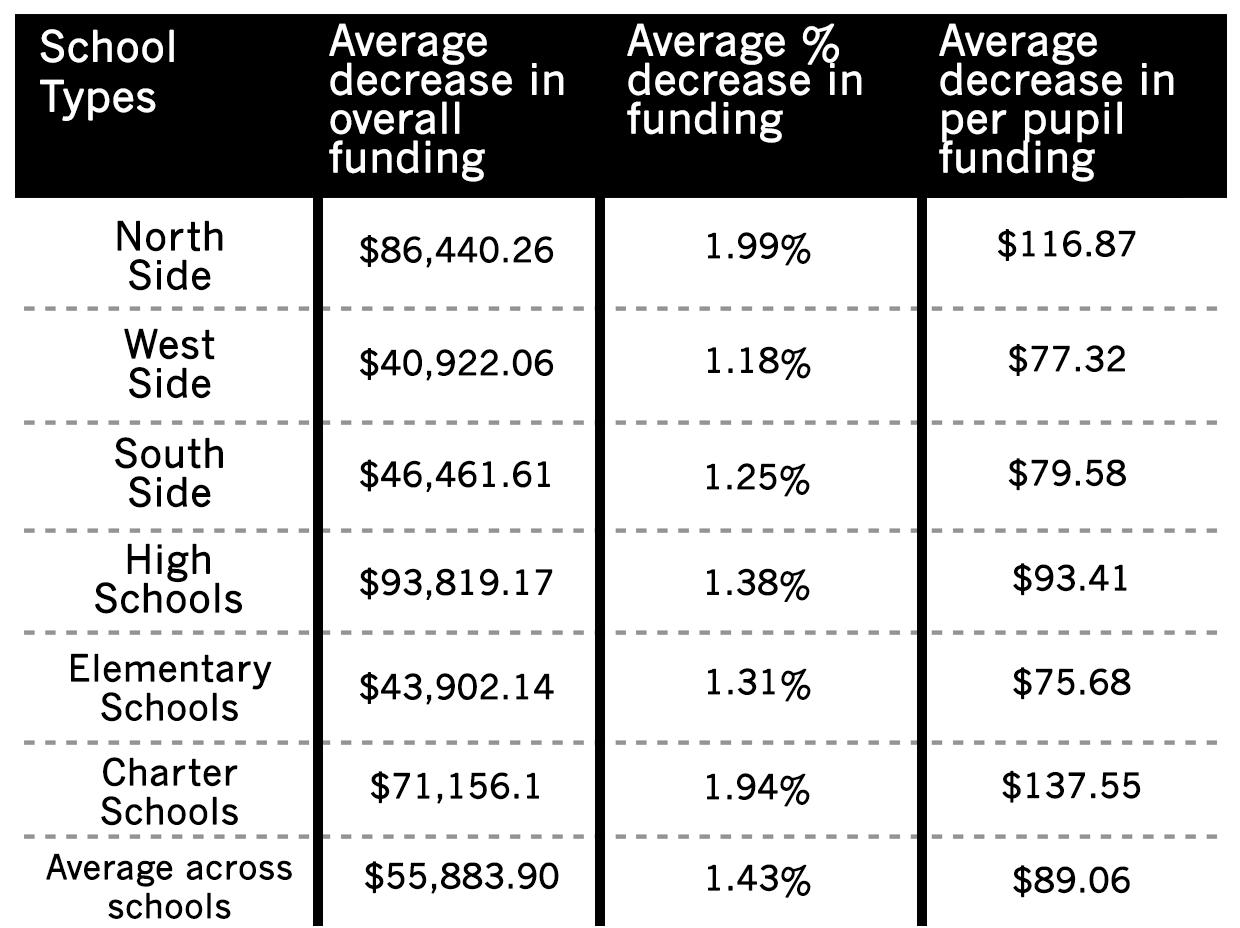
1 Schools on the North Side face the largest cuts, both in the amount of money cut and the percent change in their overall funding. North Side schools had an average of $86,440 in cuts, while schools on the South and West Sides took losses of about half that amount on average. Schools on the North Side had their budgets cut by 1.99 percent on average, while schools on the West and South Side had average cuts closer to 1.18 percent and 1.25 percent.
2 High schools faced the largest overall cuts, with an average cut of $93,000 compared to an average of $44,000 for elementary schools and $71,000 for charter schools. The percentage reductions differ less across school type and location, however.
3 Title I funds are federal funds provided to schools with high concentrations of low-income children enrolled. Only charter schools saw decreases in their Title I funds, with an average of $18,576 per school. Non-charter schools, on average, received increases in their Title I supplementary and discretionary funds to offset the reduction in SBB funds.
TABLE BY ELLIE MEJIA
A Radical Imagination
The 96 Acres Project
BY DARREN WAN
Anyone new to Little Village would be confronted by a glaring visual contrast when walking south on Sacramento Avenue. On the right is an ordinary residential area, with families going about their daily business; on the left stand the austere concrete walls of the imposing Cook County Jail, above which floodlights are installed at regular intervals, pointing inward. Slightly further south, the harsh concrete is abruptly replaced by two layers of chain-link fencing, topped with multiple coils of barbed wire. As the jail continues to sprawl southward, the houses segue into a soccer field, a community space with floodlights of its own.
The sheer immensity of Cook County Jail and its stark juxtaposition against the calm residential community are some of the ideas that the 96 Acres Project—so named for the vast land area occupied by the jail—grapples with. Maria Gaspar, the project’s founder, was born and raised in Little Village, and remembers growing up under the shadow of one of the largest jails in the country. “The jail is such a prominent part of the neighborhood. However, it was sort of invisible, you know?” she says.
During her childhood, she visited Cook County Jail as part of a school field trip. “It was definitely using the approach of the ‘Scared Straight’ program. And so my class of mostly Mexican immigrant kids were taken to the jail, through Division I, one of the maximum-security parts of the jail,” Gaspar says. She distinctly remembers walking through the division’s occupied cells. What was most perplexing for her was that there was no context ever provided for her experience, as her teachers never talked about it with the class. “I think it’s slightly different now, but when I look back, I think about the ways that that place has been silenced or made invisible, and that the only time that we see it is through the lens of racialized criminalization. Not just of race, but also of poverty.”
Working closely with Jaime DeLeon at Enlace Chicago, an organization dedicated to bettering the lives of the residents of Little Village, Gaspar fostered neighborhood involvement from the outset by initiating conversations with locals on her interest in arts pro-
gramming and support for the incarcerated at Cook County Jail. Gaspar and Enlace Chicago garnered support for their project from such figures as Cook County Commissioner Jesus “Chuy” Garcia. After working closely with the Chicago Public Art Group to apply for funding, the 96 Acres Project launched in 2012.
Gaspar is an assistant professor at the School of the Art Institute of Chicago, and the philosophy behind her artwork underpins the project’s focus on community-engaged art. “My own artistic practice as an artist and as a teacher involves a lot of performance and a lot of action-based work. As an artist and as a community member, I was interested in working with others to think about ways that we could create counter-narratives around a place of incarceration,” Gaspar says. “There’s a dominant narrative that we all are familiar with, especially coming from communities of color. What are the ways that we can create art that is insightful, that is challenging, and that also humanizes the jail?”
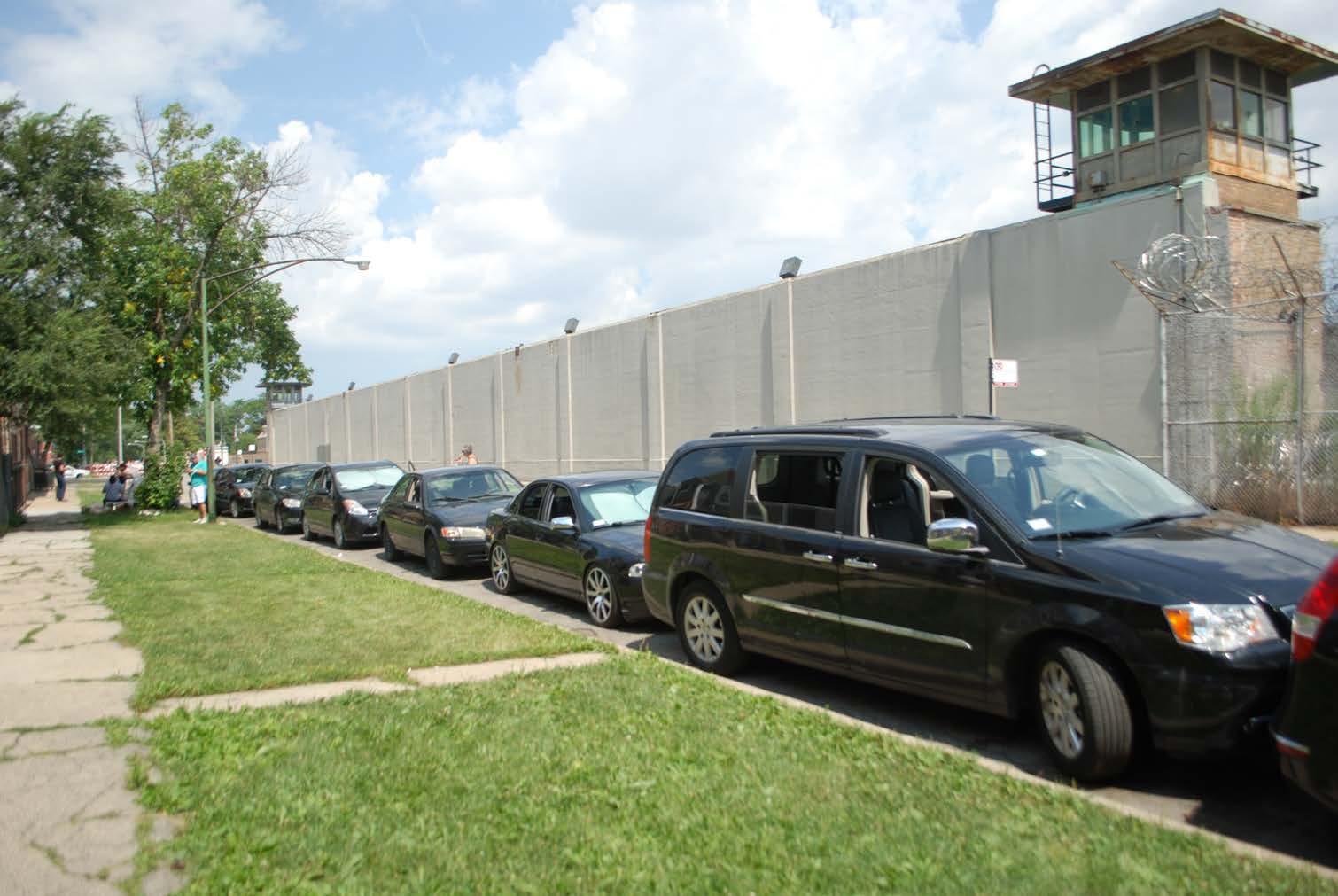
These ideas have shaped the eight cross-medium artistic endeavors that the 96 Acres Project has undertaken over the last three years. Many of the projects are site-responsive and take place around Cook County Jail, including Landon Brown’s “PARK.” Members of the public were invited to park their black, brown, and white cars along Sacramento Avenue, according to the racial demographics of individuals detained at Cook County Jail. The car owners, crowdsourced through various social media platforms, rolled down their windows and played recordings of B.B. King’s 1970 performance at Cook County Jail. To Gaspar, it was this combination of visual data representation, auditory engagement, and community involvement that gave Brown’s work its power. “We have sound coming out of these cars, and sound starts to transcend these walls that are borders, that are dividers, that are separating people. It starts to move through space, and I think during that event many people experienced this transcendence of space, you know? It’s a very literal implication of the body which I think is very, incredibly powerful.”
Several projects also involve or are aimed
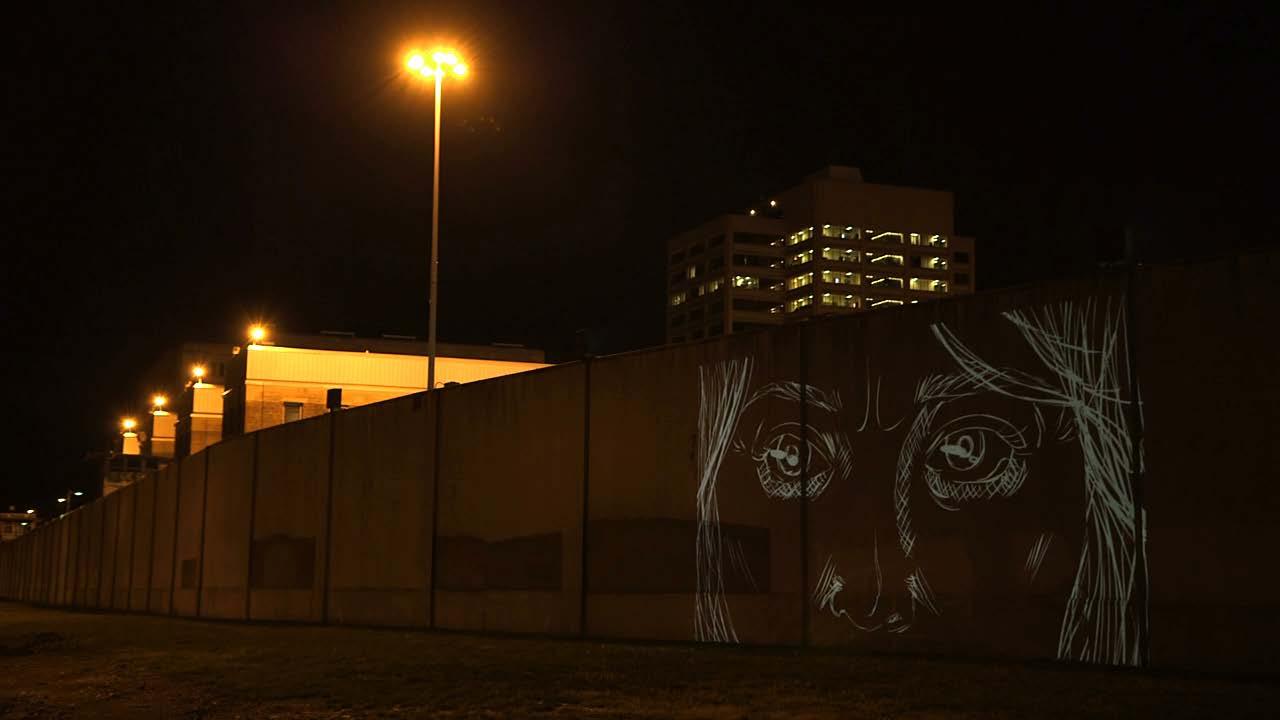
at families of the incarcerated. Bianca Diaz’s The Princess Who Went Quiet, for instance, is a children’s comic book written to broach the subject of incarceration, especially for families with at least one incarcerated parent. One of the most recent projects of 96 Acres was Stories from the Inside/Outside, in which two films were projected on a concrete wall of Cook County Jail. The first film, produced by the Prison + Neighborhood Arts Project, dealt with how the
OF MARIA GASPAR
incarcerated at Stateville Correctional Center, a maximum security state prison, experienced freedom and time. The second film portrayed the experience of a family torn apart by incarceration and subsequent deportation, complementing the first film by narrating a story from the other side of the walls of a detention facility.
Apart from these artistic works, the 96 Acres Project also supports the education of youth, teachers, and others. While education
was not a core element from the outset, it developed organically and has become an inseparable component of the project. Silvia Gonzalez from Village Leadership Academy and Paulina Camacho from Benito Juarez Community Academy are among the art teachers who work with 96 Acres and who are actively involved in creating their own curricula for the students in their respective schools. “So many of the kids that we work with know someone in the jail, or have come across it in some kind of way, so the teachers were really excited about producing curriculum that is based on the work of the artists and the art projects that we’re doing, and bringing it into the classroom,” said Gaspar.
“As an artist and an educator, I want to think about ways that creative people of all kinds can reimagine alternatives for prisons and jails,” Gaspar said. Her project is paving the way in reshaping the skewed narratives surrounding the prison-industrial complex, and, without a doubt, she is making waves beyond Little Village, across creative communities on the South Side.
“My hope is that all of us can individually and collectively understand that jails and prisons are built on deep systemic oppression, that not only affects the people who are incarcerated, but everyone. And I hope that we can really focus more on creating a system that is not based on racism and sexism, but on justice. I think that it deeply requires a radical imagination.”
COURTESY
2nd Floor Rear 2016: We Are Here
For five years, the beloved DIY arts festival 2nd Floor Rear has teamed up with Chicago artists to bring ephemeral and experimental exhibits to apartments, backyards, and alternative art venues across the city. In years past, the festival took place largely in North Side neighborhoods, but this year 2nd Floor Rear split its over thirty events between two days and the neighborhoods around two CTA train lines: the Blue and the Pink. Three Weekly writers set out for Avondale and Pilsen last weekend to take part in the festivities. They returned with accounts of forts and kazoos, vibrantly colored dresses, and a temporary greenhouse. (Emeline Posner)
FORT (at the edge of chaos)
BY CHRISTOPHER GOOD
There’s a bright red message scrawled on the sign hanging from the door:
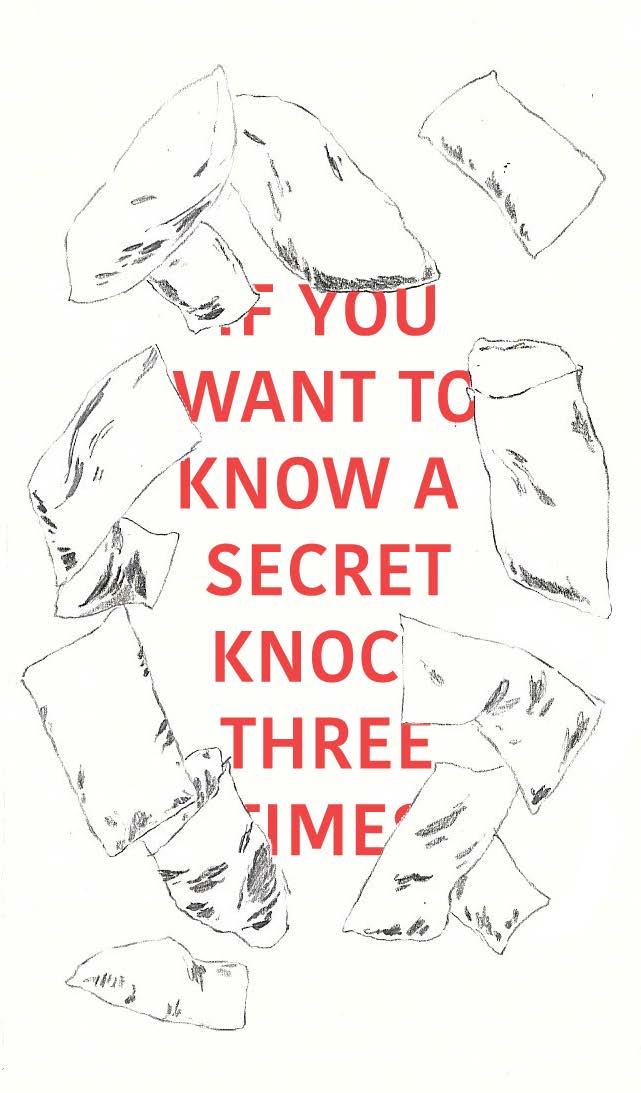
“IF YOU WANT TO KNOW A SECRET KNOCK 3 TIMES.” I’m in Pilsen, a few blocks south of 18th Street, and against my better judgment, I’ve knocked three times.
At once, the door cracks open and a wary pair of eyes looks me over. A voice grills me about the secret I want to know. After I stammer out an apologetic question about the pillow fort I’d heard about online, the door swings open and I’m escorted inside.
It takes a moment for me to untie my shoes and adjust to the dim lighting, but as I squint at the draped linens and the crosslegged crowd, I realize I am standing (or stooping) within “FORT,” a performance art installation staged as part of 2nd Floor Rear. It doesn’t take long for me to realize that, as promised, “FORT” is poised right at “the edge of chaos.”
John Harness and Grace Needlman, the organizers of the piece, described the event online as a “comforting, playful environment for confronting uncomfortable ideas.” Sequestered within the screwball trappings of a pillow fort, I’m told, there is a capital-E Experience.
Blankets are draped across the ceiling; crustless cream cheese and cucumber sandwiches are spread across a kitchen countertop.
Someone is strumming campfire songs on an acoustic guitar, and everyone’s playing along with bright plastic kazoos. (As I fold a bright sheet of construction paper into a crown, I’m told that the kazoos are to be used “in the event of a cave-in.”)
Several sandwiches later, the fort is ready. I start crawling through a tight passageway on my hands and knees, and only seconds later I am startled by a loud noise. Previously hidden beneath a mound of stainless steel pots and pans, a woman in a grey blazer and equally grey face paint blocks my path. She introduces herself as “the Wall” and asks me who I deny.
Later confrontations are only more absurd: first, I’m scolded by a woman in librarian cat-eye glasses for making an unsatisfactory paper snowflake, then I’m yelled at by a “snowflake assessment committee.” At times, I’m not sure whether to laugh, take offense, or sit in silence. My paper snowflake is stolen by a raccoon hand puppet; I play a game of chess with Scrabble tiles and dice. At the end, a scepter-wielding princess asks me how everything went, and for the life of me, I can’t think of a straight answer.
I can’t say if everyone would have enjoyed “FORT” as much as I did, but never let it be said that John Harness, Grace Needlman, and their cast of actors settled at just a pillow fort.
ELLEN HAO
Hot House
BY STEPHEN URCHICK
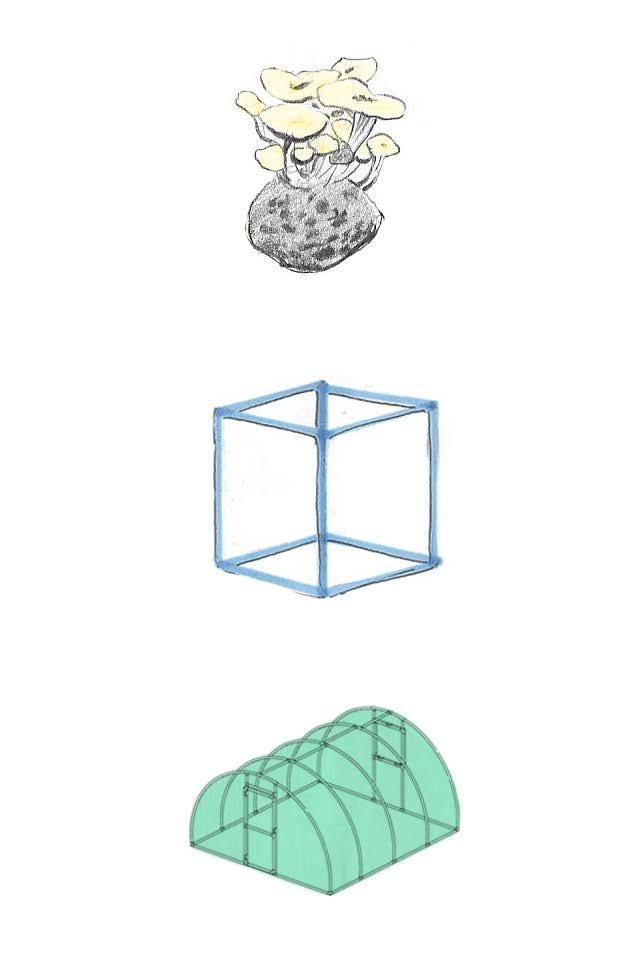
The pop-up exhibit “Hot House” felt less like a greenhouse than a drive-in—a chance to stop by, look over a few bite-sized pieces of contemporary art, chat up the artists, and head back out. Julia Klein, Curt Miller, and John Szczepaniak presented four works inside a semi-cylindrical tent, built out of PVC and plastic sheeting on a back lawn at 21st Place.
One of many stops in this year’s 2nd Floor Rear crawl, “Hot House” was a tidy and efficient display: poetry to a gallery’s lengthy prose. The temporary greenhouse was erected as part of a collaboration with the “Uptool” programming series, based out of UIC’s Greenhouse and Plant Research Laboratory. “Uptool” screens films, holds science demos, and gives lectures inside a more permanent greenhouse near Little Italy. The smaller-scale plastic frame in Pilsen served as a conceptual frame, gesturing at ideas of shelter or inhabitation. In passing into the half-opaque bubble, the visitor walked into the context helpful for understanding the objects on display.
This bubble was noticeably warmer than the outside air: Curt Miller had placed four terracotta space heaters in the corners of “Hot House.” Each heater was powered from underneath by a lit buddy burner, a stove made from smoldering cardboard coated with fuel and crammed in the butt of an aluminum beer can. The pots were hot to the touch, and gradually warmed the hand before singeing it.
A humble-looking, grade-school science project on a table at the tent’s center, “PF-TEK city no. 1” was a rock inside a sealed-up fish tank, humidified through a plastic tube that
was connected to an adjacent, water-filled evaporator. On top of the rock a colony of yellowish-white mushrooms sprouted under the tank’s favorable conditions. The title of Szczepaniak’s piece references both a technique for indoor fungus cultivation (“PF-TEK”), and the tendency of modern artists to title their abstract works with non-descriptive numbers (“city no. 1”). By isolating the mushrooms and placing them on a pedestal, Szczepaniak highlights a case where nature appears to imitate art. But at a second, deeper level, “PF-TEK city no. 1” is a hot house inside of “Hot House.” Remove the fungus from its muggy home, and it will dry up in a matter of hours.
An untitled piece by Julia Klein helped to draw together the artificially biological feeling of “Hot House.” Klein suspended a floor-to-ceiling wire net from one of the greenhouse’s PVC support struts. She tied tufts of Spanish moss and bits of other multicolored detritus to the looped weave. The whole apparatus swayed gently with the passage of air through the plastic tent. The thick-leaved clippings felt parasitic, or sporelike, clinging to the net in a colorfully counterproductive way. Their occasional tremors heightened the sense that the greenhouse was alive, even though nothing had been planted inside.
“Hot House” turned the botanical conservatory into conceptual art in a deft and modest way. In a way, it symbolized the kind of “flash formalism” encouraged by 2nd Floor Rear at large. “Hot House” captured the wandering spirit of this backdoor expo, offering the visitor an installation that was equal parts swift, small, and smart.
Don't Tell Me I'm Pretty
BY MICHELLE GAN
This year’s 2nd Floor Rear installments centered on the concept of “being somewhere.” It seems fitting then, that the textile-centered exhibit in Avondale would be housed in the second-floor gallery space of the Hairpin Arts Center, a building impossible to miss on account of its massive, glowing sign. Curated by poet Elizabeth Lalley and Lauren Leving, a UIC grad student, “Don’t Tell Me I’m Pretty” showcases the work of photographer and textile artist Na Chainkua Reindorf and fiber artist Grace Kubilius, alongside fellow textile artist Grace Cross and mixed media painter Sherwin Ovid. Their creations––mannequins dressed in loud outfits including a floor-length hot pink dress, bouncy exercise balls encased in colorful patterns of woven fiber, and a seemingly blood-soaked hammock––vivify the white walls and floors of the gallery space.
The range of visitors and gallery organizers present amplified the sense of animation. A girl in black lipstick who had manipulated a clear garbage bag into a jacket, complete with hood and shorts, conversed with a woman wrapped in a bright green Ghanaian dress that almost looked like it was lifted off of one of Na Chainkua Reindorf’s mannequins. A four-year-old child and his sister bounced on the textile exercise balls as their mother chatted away to a friend, competing to see who can bounce higher. By the entrance, there were tables occupied by 2nd Floor Rear organizers; one invited passersby to play a tarot card game. “People just want to promote creative practices, we’re all about that,” said Jesus Gonzalez Flores, one of this year’s associate curators, “We just present a platform for them.” Flores noted that many involved with “Don’t Tell Me I’m Pretty” are
currently pursuing an MFA, and that the host gallery is not corporate, meaning that all proceeds go entirely to the artist.
In her response to the overall theme of “We Are Here,” Na Chainkua Reindorf took a global point of view. She showcased six textile dresses—on mannequins and in photographs— that represent six of the eight Millennium Development Goals, international development goals for developing countries set by the United Nations.
One photograph depicts a woman in an African print dress with hues of red, orange, and yellow, looking skyward in a barren field. The stark contrast between the crops on the pattern of the dress and the dead fields in which the model stands seems to refer to the UN’s goal of eradicating extreme poverty and hunger.
Reindorf honed in on Ghana, a developing
country where clothing is an important indicator of status and occasion. Explaining her rationale for exploring the Millennium Development Goals as they pertain to Ghana, Reindorf said, “Ghana’s progress, in terms of reaching some of these national developmental goals, has not been fully realized.”
“Don’t Tell Me I’m Pretty” challenges viewers to look past first impressions of elegant women in beautiful dresses, or of cute, bouncy playthings, and instead encourages us to look past reactions to aesthetic and to explore what each component may mean.
Na Chainkua Reindorf’s MDGS: A Fabrication Study can be seen at ncreindorf.com/mdgs-a-fabric-study
ELLEN HAO
In honor of Black History Month, Maséqua Myers, Executive Director of the South Side Community Art Center (SSCAC), has curated a small series of images from the Art Center’s collection to celebrate African-American history, African-American art, and the South Side Community Art Center’s role in preserving that legacy. On February 8, the SSCAC announced that it won a $300,000 grant from the Alphawood Foundation.
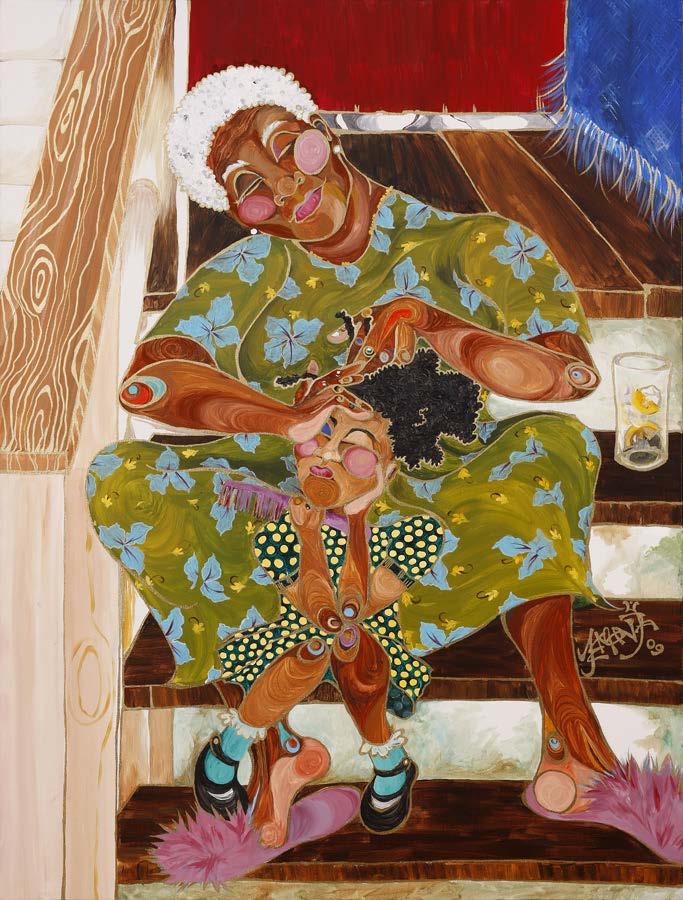
Yemonja Smalls is a clinical psychologist who uses art as therapy, so she’s actually an art therapist, and I smile whenever I visualize that picture. Art often makes us feel better. It really does. And that’s why it’s so important to involve ourselves in art. It can take us away from negativity, from depressing moments in our lives. Art can be motivational, too; it can make us angry, it can fuel other emotions—but so often it’s a feel-good thing.
Dr. Smalls works in acrylics, and she works in circles, if you can see that—it’s like circles. And she creates her images, her faces, her ankles, her feet in circles. It’s just amazing artwork. And she works in bright colors. I love the feel-good feeling that you get from Dr. Smalls’s work. She’s a self-taught artist! Sometimes the best creativity comes from a self-taught, informal situation. It’s good to expose yourself to as much knowledge as possible because you don’t know what else will come out of your creative well. But she’s a self-taught artist, and I’m glad she taught herself. She’s so unique.
This is braiding. This is a really—well maybe it’s in other cultures too, I just know it’s in mine—but it’s a wonderful bonding in African-American culture to braid hair. So this is a bonding moment between a grandmother
and a grandchild while she’s braiding and combing her hair. I know it’s a warm, warm thing. So she teaches an African-American tradition and shares it with the world through that painting.
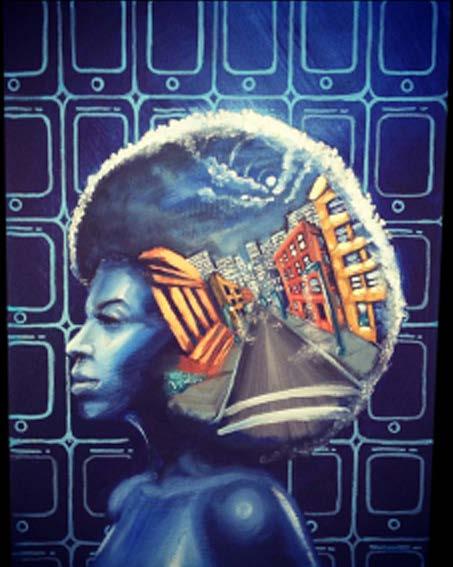
Rahmaan Statik calls his art “liberation art.” Rahmaan Statik started as a graffiti artist, a street artist. And he was introduced to the South Side Community Art Center—this is why we have to stay alive—as a twelve-year-old. He’s now in his early thirties. But he is one of the most sought-after muralists here in Chicago. He has murals throughout the city.
He’s also very kind to the African American female; he understands the importance of the female teaching, and so what he does is a lot of portraits of women from neck up, or bust
up. He always incorporates the multi-level or the economy that African Americans often find themselves in which is, “How do I hold on to my African heritage and also love all what I can about my American heritage and experience and blend those two?” and “How then do I ensure that I see myself in the future?”
He’s a very conceptual artist. And as you can see, he’s used the afro—which is kinda coming back, I’ve seen a lot of it. I say “Wait a minute, am I back in the sixties and seventies or what?” And that’s okay, because what doesn’t go out of style is who you are. And so, if you want to be as the creator made you, as God made you, then you should have that right. And so he draws women often in their natural state of hair. And within that hair he puts memories, and he puts projections, and he puts aspirations. (Maséqua Myers)
Yemonja Smalls - Braidin' (Acrylic) 2008
Rahmaan Statik - Data Mining (Oil on Canvas) 2013
Deceiving Appearances
Peter Wächtler's first solo U.S. show embraces indecision
BY KEVIN GISLASON
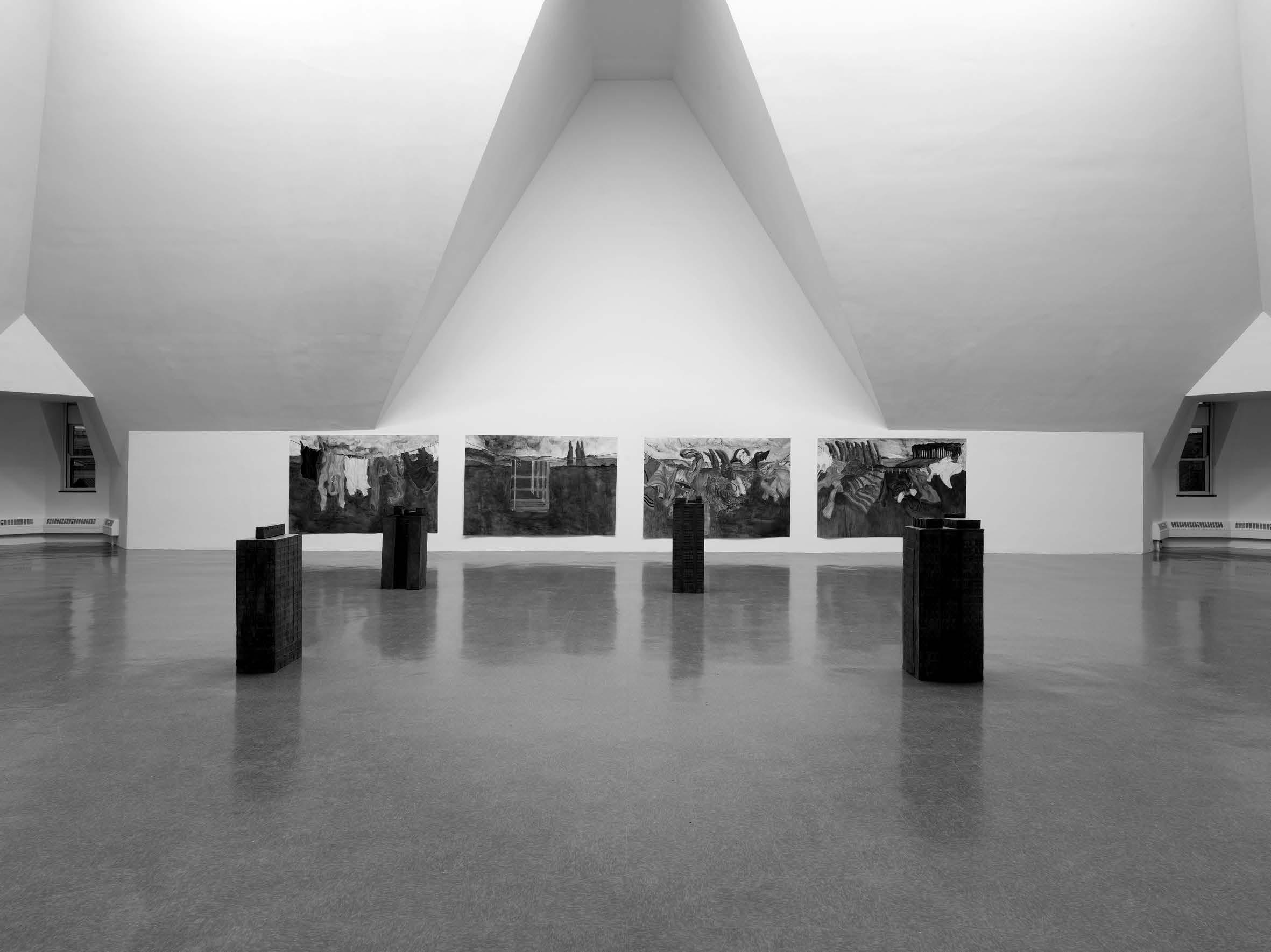
Peter Wächtler’s Secrets of A Trumpet is on display at the Renaissance Society, mostly. The exhibition’s lone outlier—a bronze statue of an otter in a baseball uniform—stands a few hundred feet outside on the University of Chicago quadrangle. The oddly charming piece is a nice bit of publicity for the rest of the Brussels-based German artist’s work, commissioned specifically for the Renaissance Society. But after
viewing the rest of the exhibition, one can’t help but wonder if its displacement carries some higher significance. One leaves Wächtler’s exhibition in a state of giddy confusion; it is the kind of art that makes you think deeply about art.
Before entering the stark white, high-ceilinged exhibition space, one encounters a prose poem of sorts, the text of an unfocused, colloquial monologue mounted
on two wall panels. Its speaker, an unnamed middle-aged man, examines “what makes a good farmer,” the importance of planning, love, and his many frustrations, without reaching much of a conclusion. One enters the main body of the exhibition with a confusion that is never fully resolved.
The exhibition’s individual components are wildly divergent, lacking any obvious commonalities in either style or subject. The
tone is set with Wächtler’s “Teddy Boy” series, the first cluster, which consists of four rectangular wooden boxes against a wall, each depicting the life of a big-haired, gaudily attired man from the titular British subculture on three sides. The scenes are drawn in a deliberately amateurish style; colors are sloppy, and pencil shows through under the paint.
Many of the scenes are abjectly ridic -
COURTESY OF THE RENAISSANCE SOCIETY
“Spying on them is a perfect response to them spying on you. That’s how we win.”
—Jerry Boyle
BULLETIN
Trump
as Fascist?
Seminary Co-op , 5751 S. Woodlawn Ave. Wednesday, February 17, 6pm–8pm. (773) 7524381. semcoop.com
Spy magazine famously described Donald Trump as a “short-fingered vulgarian” just as the real estate developer was breaking onto the national scene; since then, many descriptors have been tried out for the now-front runner for the Republican nomination. But is Trump a fascist? Journalist and historian Rick Perlstein will consider the question. (Adam Thorp)
Brazil 2016: The Politics of an Olympian Crisis
Saieh Hall for Economics, 5757 S. University Ave, Room 203. Friday, February 19, 3pm–5pm. clas.uchicago.edu
Building a Movement to Fight Racism
37 S. Ashland Ave. Saturday, February 20, 2pm. Free. (312) 620-2305. on.fb.me/1oltFEN
Get ready for action and join a discussion of the police state that black and brown people live under. Listen to speakers from various backgrounds who will share the experience of fighting for justice and learn how to strengthen existing social movements. (Yunhan Wen)
Phenomenal Black Women and Girls Symposium
UofC School of Social Service Administration, 969 E. 60th St. Saturday, February 20, 8am–3pm. $10 for general registration, $60 for three CEUs. Fees include breakfast and lunch. ssa.uchicago.edu
Boyle, and activist Todd St. Hill from black youth activist organization BYP100, Boyle recounted how BYP100 held a march that distracted the police from an action happening at the Chicago Patrol League’s credit union. Protesters were thus able to shut down the credit union with cops caught off guard.
“Bringing the War on Drugs and the War on Terror home helps [the police] to control people,” St. Hill said at the panel discussion. “It helps them to contain people’s dissent.” But because of the increasingly important role of technology in activism, he says that it is becoming clearer than ever before that “there is a role for everyone in these movements.”
According to Kunichoff, Rights Lab is designed to motivate people of all walks of life to stand up to systems of mass surveillance: “I think it gives people information about different groups and activities that are going on. The fact that we did the first episode around an app, which is something that anyone can download and use, means that there is a real practical application here.” As far as the series’ intended audience, Kunichoff says, “We’re going for a broad audience that we can introduce these concepts to and also interest them in a way that reading
about [these issues] wouldn’t.”
Despite the lofty goals of this collaborative effort, even Kunichoff admits that Rights Lab’s viewership thus far has come from a rather specific segment of the population. “The audience itself has turned out to be heavily activist-driven, and that’s partially because of who Truthout’s readership is, but I think the people who came to the event were actually a pretty good smattering of people.”
The next installment of Rights Lab is due to come out February 28 and will focus on drone use. As the next few monthly episodes are released, it remains to be seen whether Rights Lab will reach as broad a constituency as it hopes. So far, the first episode only has about 1,350 views on YouTube, although these numbers are likely to grow as the series gains publicity. The project is a unique amalgamation of art, investigative journalism, and documentary filmmaking, and it will likely continue to turn heads in the activist community in Chicago. If they want to create waves outside of this specific niche, the Rights Lab team must overcome these formidable challenges of visibility and ensure that, in the spirit of activism in the digital age, the whole world will be watching.
It’s a familiar story for Chicagoans: a tremendous opportunity is proffered, a chance to bring home international prestige—but sacrifices must be made. In Brazil, public opinion has turned against the trade-offs demanded by the upcoming Olympic Games in Rio. This roundtable will consider the shift. (Adam Thorp)
Architecture Lecture: Melvis & Van Deursen
S. R. Crown Hall, Illinois Institute of Technology, 3360 S. State St. Wednesday, February 17, 6pm–7:30pm. (312) 567-3230. arch.iit.edu.
Learn about the principles and inspiration of architecture from Armand Mevis and Linda van Deursen at the Mies Society Lecture during this spring’s Cloud Talks series. The founders of the Dutch design firm Mevis & van Deursen Design have been working together for thirty years, and are pivotal figures in contemporary Dutch design. (Anne Li)
Social
Justice Fair
1456 E. 70th St. Saturday, February 20, 2pm–6pm. (773) 440-1578. on.fb.me/246Epah
Explore and network with social justice organizations at this walk-through event hosted by K. Carlton, Inc. Learn how you can get involved in changing the world, and who can help you do it. (Anne Li)
This weekend the African American Alumni Committee of the School of Social Service Administration’s symposium will consider issues affecting black women and girls. A prestigious panel of researchers and professionals, covering topics including the criminal justice system and behavioral health, will talk about how to help black women and girls thrive. (Yunhan Wen)
Foucault and Neoliberalism
Seminary Co-op, 5751 S. Woodlawn Ave. Monday, February 22, 6pm. (773) 752-4381. semcoop.com
To many, Michel Foucault’s role in shifting cultural paradigms was as obvious as his bald head or signature turtlenecks, but in his new book, Daniel Zamora questions the philosopher’s relationship with “the question of liberalism.” Zamora will be joined in discussion by Walter Benn Michaels, a writer and professor at the University of Illinois at Chicago. (Christopher Good)
Chicago Education Expo
Crowne Plaza Hotel, 733 W. Madison St. Saturday, February 27, 9am–12:30pm. Free. (312) 504-0094. chicagoeducationexpo.com
Looking for some options for your Pre-K through eighth grader? Check out presentations from over fifty schools, education organizations, and childcare centers. The expo will also feature a panel discussion with representatives from non-traditional schools as well as guest talks about nutrition and early childhood education. (Hafsa Razi)
VISUAL ARTS
Exhibition Walkthrough: Secrets of a Trumpet
The Renaissance Society, 5811 S. Ellis Ave., Cobb 418. February 7–April 3. Tuesday–Friday, 10am–5pm; Saturday–Sunday, noon–5pm. Tour Wednesday, February 17, 6pm. Free. (773) 7028670. renaissancesociety.org
With everything from oil paintings of clotheslines to bronze sculptures of otters wielding baseball bats, “Secrets of a Trumpet,” German artist Peter Wächtler’s first stateside installation, “oscillates between the prosaic and the outlandish.” Join Chief Curator Solveig Øvstebø for a guided tour of Wächtler’s “homespun, heartfelt” work. (Christopher Good)
Photo Group Exhibition at Zhou B
Zhou B Art Center, 1029 W. 35th St. Opening reception Friday, February 19, 6pm–9pm. Through March 12. Monday–Saturday, 10am–5pm. Free. (773) 523-0200. zhoubartcenter.com
At this February’s “3rd Friday” at the Zhou B Art Center, a group photo exhibition will feature the works of eighteen Chicago-based, prominent-on-Instagram photographers. Curated by Chicago artist Zespo, the exhibition will be the first time the works will be showing in a physical space. Reception to follow. (Isabelle Lim)
Midwest Clay Stories: Through the Eye of the Vessel
Bridgeport Art Center, 1200 W. 35th St., fifth floor. Opening reception Friday, February 19, 7pm–10pm. Through April 2. Free. (773) 2473000. bridgeportart.com
This exhibition presents the people and themes that strongly influence ceramics around the world. It also provides journals throughout the exhibit where visitors, especially fellow ceramic artists, can share their thoughts and experiences for what will become a digital archive. (Mira Jaworski)
The Road Ahead at Project Onward
Bridgeport Art Center, 1200 W. 35th St. Opening reception Friday, February 19, 6pm–9pm. Through March. Tuesday–Saturday, 11am–5pm. Free. (773) 940–2992. projectonward.org
This traveling show presented by Project Onward (an organization dedicated to showcasing artists with developmental disabilities)
will make the second of its four tour stops at the Bridgeport Art Center. Sixteen of Project Onward's artists will display their recent work, which the event description says will encompass "one million emotions." (Jake Bittle)
A Super Sunday at HPAC
Hyde Park Art Center, 5020 S. Cornell Ave. Sunday, February 21, 1pm–5pm. Special toast at 3:15pm. (773) 324–5520. hydeparkart.org
The Hyde Park Art Center will pull out all the stops this weekend for an event-packed, four-hour showcase. This bonanza will feature not only the Center's multiple current exhibits, which include "The Weight of Rage" and "Who Cares for the Sky," but also an open house and meet-and-greet with its various artists-in-residence. (Jake Bittle)
Galán and Lezama in the Pellizzi Family Collections
Mana Contemporary Chicago, 5th Floor, 2233 S. Throop St. Opening reception Saturday, February 21, noon–4pm. Through August 15. Monday–Friday, 11am–5pm; Saturday, noon–4pm. Free. (312) 850-0555. manacontemporarychicago.com
The Mana Contemporary will be blowing the dust off art critic Francesco Pellizzi’s personal collection and exhibiting some hidden gems: namely, the work of Julio Galán and Daniel Lezama, two twentieth-century Mexican surrealists with unique styles and unorthodox approaches to their shared heritage and national identity. (Christopher Good)
MUSIC
BJ The Chicago Kid
Reggies, 2105 S. State Street. Thursday, February 18, 8pm. 21+. Enter to win tickets online. (312) 949-0120. reggieslive.com
Some of us might be living The Life of Pablo right now—but on Thursday night, there will only be one Chicago Kid. The Kanye collaborator and Acid Rap mainstay will be celebrating his much-hyped new LP, In My Mind, which features Chance, Kendrick, and stunning artistic growth from BJ. (Christopher Good)
R.A. the Rugged Man
The Promontory, 5311 S. Lake Park Ave. Friday, February 19. Doors and show 9pm. $12
advance, $18 at door. (312) 801-2100. promontorychicago.com
Writer, rapper, and hip-hop historian R.A. the Rugged Man takes the stage February 19 at the Promontory. An underground rap superstar, R.A. aims to remind audiences why the Notorious B.I.G. thought he was “the illest.” With young freestyle prodigy A-FR-O by his side, the past and future of hiphop combine in a compelling performance. (Kezie Nwachukwu)
Shirley King’s Tribute to BB King
The Promontory, 5311 S. Lake Park Ave. Sunday, February 21. Doors 7pm, show 8pm. $15$35. (312) 801-2100. promontorychicago.com
“Daughter of the Blues” Shirley King performs a special show for Black History Month at the Promontory. The artist will honor her father BB King and captivate audiences with expressive jazz. (Gozie Nwachukwu)
Pussy Riot: Punk Politics and Prisons
Thalia Hall, 1807 S. Allport St. Sunday, February 21, doors 7:30pm. $15. All ages. (312) 526-3851. thaliahallchicago.com
Illinois Humanities and the University of Illinois at Chicago’s School of Art & Art History will host a conversation about the Kremlin’s least favorite art-rock provocateurs, Pussy Riot, featuring former band member/ political prisoner Maria Alyokhina and prison reform activist Ksenia Zhivago. Neon balaclavas are welcome, but not required. (Christopher Good)
Lynn Hilton
The Quarry, 2423 E. 75th St. Friday, February 26, 7pm–11:30pm. (773) 741-6254. mobetterjazzchicago.us
Internationally renowned vocalist Lynn Hilton will drop by Mo Better Jazz later this month. Having performed around the world, she returns to her native city of Chicago to share her multifaceted abilities. (Bilal Othman)
Wayne Wonder and Mýa
The Shrine, 2109 S. Wabash Ave. Saturday, February 27, doors 10pm, show 12:30am. $30 early bird, $40 general admission. 21+. (312) 753-5700. theshrinechicago.com
If the slush and sunshine of what feels like the warmest winter ever has you in a tropical mood, celebrate by seeing Jamaican dub and dancehall all-star Wayne Wonder. Wayne will be joined by R&B starlet (and one-time Dancing with the Stars contestant) Mýa, best known for her collaboration on the Moulin Rouge! version of “Lady Marmalade.” (Christopher Good)
Busta Rhymes
The Shrine, 2109 S. Wabash Ave. Saturday, March 26, doors 10pm. $37.50. 21+. (312) 7535700. theshrinechicago.com
Fresh off his Christmas return-to-form mixtape The Return of the Dragon (featuring Chance the Rapper and BJ the Chicago Kid), Busta comes to The Shrine for a mysterious show. “Finally… The Shrine & The Conglomerate present Busta Rhymes,” the event page reads, offering little more information but leaving us with the feeling that we’ve been waiting for this without knowing it. Expect a show. (Sam Stecklow)
STAGE & SCREEN
Mishima: A Life in Four Chapters with Philip Glass
Logan Center Performance Hall, 915 E. 60th St. Wednesday, February 17, 7pm. Free. (773) 7022787. filmstudiescenter.uchicago.edu
To celebrate composer Philip Glass’s residency at the UofC, the Logan Center will screen a film with one of his finest scores: Mishima, Paul Schrader’s innovative portrait of the writer, nationalist, reactionary, and bodybuilder. Glass will be present for discussion afterward, so show up early—the audience is more likely to be half-full than half-empty. (Christopher Good)
Reading the Black Library with Kiara Lanier
Stony Island Arts Bank, 6760 S. Stony Island Ave. Thursday, February 18, 5pm-6pm. (312) 857-5561. rebuild-foundation.org
Former American Idol contestant and Chicago-raised soprano singer Kiara Lanier will perform readings from the current exhibition about DuSable High School, which showcases documents and books from the historic school’s library. A discussion to reflect on these readings will follow Lanier’s performance. (Ada Alozie)
Battledream Chronicle and Twagga
Studio Movie Grill Chatham 14, 210 W. 87th St. Thursday, February 18, 7pm. $6. blackworldcinema.net
Drop by SMG’s Chatham location this week to view two action-filled movies, Battledream Chronicle and Twagga. Whether you witness the thrill of a young Martinican slave fighting her way to freedom (Battledream) or watch a superhero story that takes place during the time of Marxist leader Thomas Sankara (Twagga), you can expect to have a night as wild as these stories. (Bilal Othman)
Viva La Causa
Kartemquin Films, 1901 W. Wellington. Friday, February 19 – Thursday, February 25. Free. (773) 472-4366. Watch online at watch.kartemquin.com
Celebrate the fiftieth anniversary of Kartemquin Films by watching Viva La Causa, their short film which records the creation of a mural in Pilsen during the 1970s and addresses the important place this art form holds in Latino culture's artistic heritage. The screening will feature additional content not in original film. (Sam Royall)
Jahaji Music: India in the Caribbean
Black Cinema House, 7200 S. Kimbark Ave. Sunday, February 21, 4pm–6:30pm. Free. (312) 857-5561. rebuild-foundation.org
In the gleefully multilingual Jahaji Music, musician and cross-cultural dilettante Remo Fernandes explores Indo-Caribbean music through calypso, dancehall, soca, and sega. A screening of the film will be followed by a conversation with multimedia curator and Encyclopedia of Indian Cinema co-editor Ashish Rajadhyaksha. (Christopher Good)
Skirts at Mana Contemporary
Mana Contemporary Chicago, 2233 S. Throop St. Sunday, February 21, 12pm–4pm. Free. highconceptlaboratories.org
Explore the boundaries of femininity and time while pondering the politics of beauty and humor through a collaborative work combining live performance with a dancefilm exhibition, a playground for the audiovisual senses. The endeavor’s been in the works since last fall, so expect a developed showcase of artistic experimentation and contentious ideas. (Ada Alozie)
Blues for Mister Charlie
Logan Center for the Arts, 915 E. 60th St. Monday, February 22, 6:30pm. Free. (773) 753-4472. courttheatre.org
The Logan Center and Court Theatre join forces for a joint reading of James Baldwin’s Blues for Mister Charlie, the first installment of Court’s new Spotlight Reading Series. Read by Northwestern lecturer, director, and actor Aaron Todd Douglas, the work focuses on the harrowing effects of racism in the 1950s—effects that have not completely disappeared in the present day. (Kezie Nwachukwu)
Lines in the Dust
eta Creative Arts Foundation, 7558 S. Chicago Ave. February 5 – March 27. Friday and Saturday, 8pm; Sunday, 3pm. $30, discounts available for seniors, students, and groups. (773) 752-3955. etacreativearts.org
“Who gets the best education in America?” This is the question asked by Lines in the Dust, playwright Nikkole Salter’s gripping look into education inequity, poverty, and its human cost. Join director Phyllis E. Griffin for the play’s Chicago premiere. (Christopher Good)
South Side Weekly
your work for consideration at
Chicago Civic Journalism Project is presented by the South Side Weekly, City Bureau, University of Chicago Careers in Journalism, Arts, and