The South Side Weekly is a nonprofit newsprint magazine written for and about neighborhoods on the South Side of Chicago. We publish in-depth coverage of the arts and issues of public interest alongside oral histories, poetry, fiction, interviews, and artwork from local photographers and illustrators. Started as a student paper at the University of Chicago, the South Side Weekly is now an independent nonprofit organization dedicated to supporting cultural and civic engagement on the South Side, and to providing educational opportunities for developing journalists, writers, and artists.
Contributing Editors Will Cabaniss, Eleonora Edreva, Lewis Page, Hafsa Razi
Social Media Editor Sam Stecklow
Web Editor Andrew Koski
Visuals Editor Ellie Mejia
Layout Editors Adam Thorp, Baci Weiler, Sofia Wyetzner
Senior Writer: Stephen Urchick
Staff Writers: Olivia Adams, Amelia Dmowska, Maira Khwaja, Emiliano Burr di Mauro, Michal Kranz, Zoe Makoul, Sammie Spector, Zach Taylor
Staff Photographers: Juliet Eldred, Finn Jubak, Alexander Pizzirani, Julie Wu
Staff Illustrators: Javier Suarez, Addie Barron, Jean Cochrane, Lexi Drexelius, Wei Yi Ow, Amber Sollenberger, Teddy Watler, Julie Wu, Zelda Galewsky, Seonhyung Kim
Editorial Intern Clyde Schwab
Webmaster Sofia Wyetzner
Publisher Harry Backlund
The paper is produced by an all-volunteer editorial staff and seeks contributions from across the city. We distribute each Wednesday in the fall, winter, and spring, with breaks during April and December. Over the summer we publish monthly.
Send submissions, story ideas, comments, or questions to editor@southsideweekly.com or mail to: South Side Weekly 6100 S. Blackstone Ave. Chicago, IL 60637
For advertising inquiries, contact: (773)234-5388 or advertising@southsideweekly
Read our stories online at southsideweekly.com
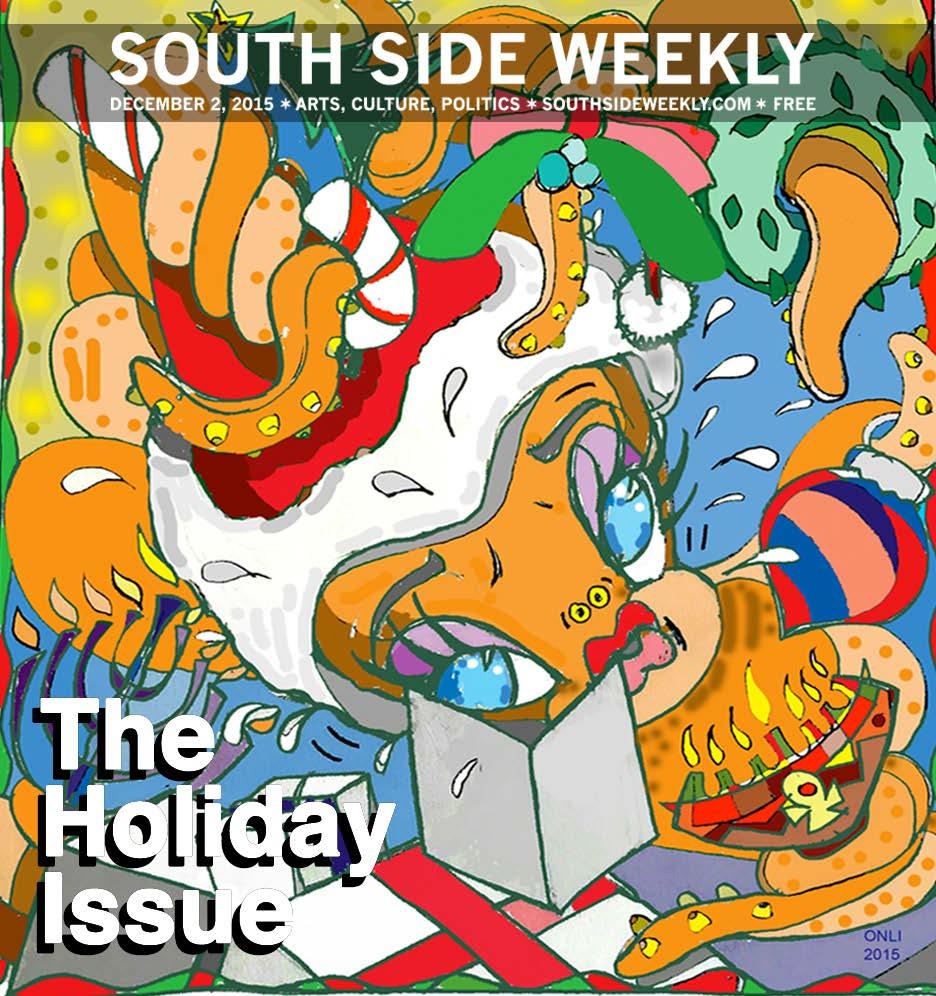
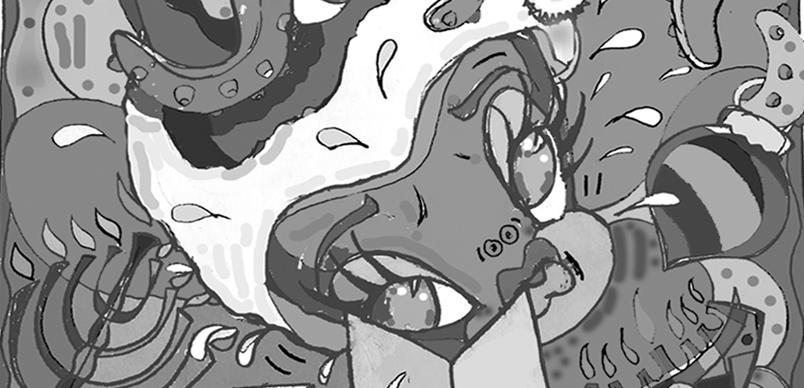
Cover illustration by Turtel Onli
IN CHICAGO
A week’s worth of developing stories, odd events, and signs of the times, culled from the desks, inboxes, and wandering eyes of the editors
Correction: In a note on Laquan McDonald last week, the Weekly stated that, based on previous reporting on the case, the video of McDonald’s death initially released by the city would show McDonald attacking a police car. This was based on a description of the incident given to the City Council by the City of Chicago’s Corporation Counsel Stephen Patton in March, as reported by the Chicago Tribune. The initially released video does not clearly show an attack. The Weekly regrets the error.
UofC Threat
Hyde Park was on edge Monday as a threat posted on the website WorldStarHipHop led the University of Chicago to cancel all classes and close down its campus and some affiliated buildings after being tipped off by the FBI. The poster, Jabari R. Dean, who was arrested on Monday afternoon, allegedly threatened to kill sixteen white male students or staff, as well as police officers, in response to the death of Laquan McDonald. The story was quickly picked up by the national media and deployed by political commentators angling to place the threat in the context of recent mass shootings and protests over McDonald’s death. Although the fallout from the threat is still taking shape, Hyde Park residents are breathing a sigh of relief. It was an odd, sad day. As recent events in this country and on the other side of the world have reminded us, it could have been worse.
Rauner Backtracks
After his call to halt the allowance of Syrian refugees into Illinois on the tail of this month’s Paris attacks went over less than well with some constituents, Governor Bruce Rauner backtracked, reframing his call for a ban as a simple “request” that the Obama administration “take a deep breath.” The irony of his plea for the practice of mindfulness and meditation aside, let’s hope Rauner has realized what many have already discussed endlessly—that he and the myriad other governors on his side have little administrative power in this situation. In other words, the only action he can take that could remotely approach something resembling a ban is to lower the already-paltry percentage state agencies use (currently at sixty percent) of the total federal funds Illinois is given specifically for the purpose of housing international refugees.
Wildcats Win
This past Friday, Wendell Phillips Academy captured the 4A Illinois football championship, becoming the first Chicago public high school ever to win a state title. The Bronzeville-based Wildcats, who lost in the same game last year, demolished the hapless, beautifully named Belleville Althoff Crusaders 51-7, as quarterback and Connecticut commit Quayvon Skanes—one of ESPN’s three three-star recruits on the team—rushed and passed for a combined four touchdowns. Meanwhile, Chicago’s Catholic football league continued its statewide dominance: Loyola Academy won the 8A (don’t ask us what these numbers mean) title game 41-0 against fellow Catholic school Marist.
IN THIS ISSUE
a pLan TO rEWrITE aUTHOrITY
In pOLIcE mIScOnDUcT
“With this proposal, we’re on the bleeding edge.” isaac stein...4
a cOLLabOraTIvE crEaTIOn
“Ten Chicago Women/Fifteen Years” at the Bridgeport Art Center sara cohen...6
an UnEvEn pLaYIng fIELD
“There are so many walls in between. I feel like I have no way to climb that wall.”
jasmin liang...7
LIbEraTIOn In rapTUrE, rHYTHm, anD rHYmE
“You put a dip in your hip, you let your backbone slip...” ariella carmell...10
a DIffErEnT KInD Of EDUcaTIOn
This is a place for people to have conversations who are generally way too busy and overworked. olivia adams...9
HOLIDaY InSErT
“The tradition is family, community orientation, and looking around and seeing what we can do for others.” 11
narraTIvE acTIOn
“Media, in all its incarnations, should serve a higher purpose than just mindless diversion.”
anne li...20
an OpEn bOOK(STOrE)
“We’re not going to make a killing on this.”
michal kranz...21
A Plan for Reform Activists press for citizen-led police oversight
BY ISAAC STEIN
For over three years, Larry Redmond, a lawyer who runs a solo practice from his home in Morgan Park, has volunteered pro bono legal counsel for the Chicago Alliance Against Political and Racist Repression (CAARPR). In the shadow of recent and numerous fatal police shootings of Chicago residents, including the high-profile deaths of Laquan McDonald, Rekia Boyd, and Flint Farmer, Redmond and CAARPR are currently lobbying for a complete overhaul of how Chicago investigates police misconduct.
Their objective is to compel City Council to pass an ordinance that would remove the authority to investigate alleged police misconduct from the current system of mayoral-appointed boards, instead transferring it to an elected board of twenty-two Chicago citizens, one from each of the City’s police districts. Redmond believes that this proposal for a Civilian Police Accountability Council (CPAC) is one solution to a system of police accountability characterized by inefficacy and conflicts of interest.
At present, all complaints of misconduct filed against the Chicago Police Department (CPD) are received by the Independent Police Review Authority (IPRA), an investigatory board funded by, and accountable to, the City of Chicago. On average, IPRA receives about 6000 new complaints per year.
The mayor of Chicago is responsible for appointing IPRA’s Chief Administrator; last year, Mayor Rahm Emanuel named Scott Ando to that post. Ando has a thirty-three-year history in law enforcement, including twenty-eight years with the U.S. Drug Enforcement Administration (DEA), as well as as five years as an employee of the Prosecutor’s Office in Bergen County, N.J.
Because IPRA’s head is appointed by the mayor and is responsible for determining what constitute misconduct, “it therefore is the job of the head of IPRA to find as little misconduct as possible,” Redmond says.
Additionally, Redmond says IPRA investigators are often ex-law enforcement agents, like Ando, whom he believes are unlikely to investigate alleged police crimes impartially.
Larry Merritt, IPRA spokesman, denied that ex-law enforcement agents make up a large share of IPRA staff.
“The claim that IPRA is staffed with ex-law enforcement officials is just not supported by fact. Of our sixty investigators, I know of four who have law enforcement experience; I don’t know about the other staff. Of those four, two worked for the CPD, and two were from out-of-state,” Merritt said.
As of press time, the Weekly’s Freedom of Information Act (FOIA) request for the names and last job held by each of IPRA’s employees had not yet been fulfilled.
Emanuel also appoints the nine mem-
bers of the Chicago Police Board, the city body that receives complaints that are “sustained” by IPRA (which means that IPRA investigations of complaints have found the CPD to be at fault). To Redmond, this setup presents a conflict of interest, as the City’s current contract with the Fraternal Order of Police Chicago Lodge No. 7, the union for CPD officers, releases individual officers from liability for all monetary indemnity, such as a civil award in a misconduct suit, provided that they “cooperate with [the City of Chicago].”
Redmond cited Ando’s recent firing of former IPRA officer Lorenzo Davis as an example of IPRA’s failure to investigate impartially. Davis, who was employed by the CPD for over twenty years before joining IPRA, has publicly claimed that he was
fired for sustaining allegations of police misconduct; an IPRA performance evaluation obtained by WBEZ that dates from before his termination claimed that Davis held “a clear bias against police.”
“Ando is ex-DEA. And he’s just as bad, or worse, than CPD,” Redmond claimed. “[Davis] was fired from IPRA because he was told by Ando, and told by IPRA, that he should change his findings.
“I’ve heard [Ando] speak on at least one occasion,” he continues. “His tone was such that I got the sense that he would do anything to suggest that a police officer’s actions, no matter what they were...that they were founded.”
Redmond believes that the fact that IPRA may only recommend sanctions against officers, and not actually fire or indict them, is evidence that the agency is ineffective. His additional suggestion that complaints against CPD officers rarely develop into sanctions against them is also supported by data.
The Citizens Police Data Project, an online database compiled by the Invisible Institute, concluded that of 56,362 complaints filed between 2002 and 2008, and 2011 to 2015, 2,277 were sustained by IPRA—meaning that the IPRA investigators concluded that the CPD acted improperly just over four percent of the time. In Redmond’s hometown of Morgan Park, 18 out of 307, or approximately six percent of complaints were sustained.
However, the “sustained” cases include recently closed complaints that were received prior to the years in question. In September, IPRA closed the case of Dante Servin, the CPD officer who shot Rekia Boyd, and recommended his firing about three years after the incident took place (IPRA is authorized to indict or fire police officers; those powers are respectively reserved for Alvarez and the Police Board, which will hear the Servin case in at a to be determined date. Police Board representatives could not be reached
ellie mejia
for comment for this story.)
Redmond said that he was hopeful when former mayor Richard M. Daley established IPRA in 2007, replacing the Office of Professional Standards (OPS), an internal CPD body that was charged with investigating the misconduct of its own officers. But in 2012, he joined the CPAC campaign with the belief that an elected organization with the power to indict is necessary to curtail policing practices, such as stop and frisk, that he argues are inherently racist.
“I remember when IPRA was formed,” he said. “Yes, I was hopeful for it. But it never had any clout at all.”
In response to what it sees as an internally conflicted and ineffectual system for prosecuting alleged CPD misconduct, CAARPR published “Draft Legislation for an elected Civilian Police Accountability Council” on its website. Redmond said the group has not yet presented the plan to aldermen, but says that it aims to do so by “early 2016, maybe by spring.”
According to the proposal, CPAC would be authorized to “appoint the Superintendent of Police,” “investigate police misconduct,” “indict police officers for crimes they commit,” “establish its own budget,” organize a board to review police pensions, and suspend any active-duty police officer suspected of shooting a civilian. In addition, CPAC members must not have ever been employed at any law enforcement agency, including the CPD. Redmond, who said that individual CPAC candidates would not need to have any qualifications except residence in the police district for which they intend to run, also does not think that the proposal would lead to bias against police in misconduct investigations, and rather “merely eliminates a conflict of interest.”
Nothing like CPAC has been proposed in any other American city.
“With this proposal, we’re on the bleeding edge,” Redmond said. “Do I think that the [CPD] is particularly brutal or rac-
“I’ve heard [Ando] speak on at least one occasion; his tone was such that I got the sense that he would do anything to suggest that a police officer’s actions, no matter what they were...that they were founded.”
ist, and therefore this kind of board is only necessary for Chicago? No; there are other departments that are as brutal as Chicago. I think that more generally, all police departments are racist.”
In response to the question of how CPAC would thoroughly conduct criminal investigations without members who are affiliated with law enforcement, he also said that CPAC members would not conduct the investigative work themselves, but may choose to hire investigators from both the private sector or law enforcement agencies. He named Appolon Beaudouin Jr., his personal friend and an investigator with the Hammond, Indiana branch of the Northern District of Indiana Federal Community Defender’s Office, as the type of investigator that CPAC would want to retain.
At his current job, Beaudouin Jr. said that he collects evidence for cases in which defendants have been indicted for federal crimes. From 1991 to 2003, he also worked at the Office of the State Appellate Defender, which is the public defender service for the State of Illinois.
While working at his former post, he said that his view of Chicago’s investigations
into alleged police misconduct was most affected by the Illinois State Attorney’s 2002 investigation into the alleged torture of police suspects by former CPD Commander Jon Burge. In their final report, specially appointed investigators found that Burge was guilty of “prisoner abuse,” but did not seek an indictment, claiming that the statute of limitations had expired on the incidents, which occurred in the 1980s. In 2007, the plaintiffs reached a $19.8 million settlement with the City of Chicago. Burge was later indicted and found guilty of perjury and obstruction of justice, for which he was sentenced to four years in federal prison.
At the time, People’s Law Office, a Chicago-based group of civil rights lawyers, compiled a report that argued that the investigators could have easily sought an indictment for Burge, and found that Edward Egan, one of the State Attorney’s investigators, was the uncle of a detective who had worked for Burge. In addition, the report claimed, a total of eight of Egan’s living relatives were CPD officers. The report stated that this was a conflict of interest. Beaudouin, Jr., who interviewed some of the same victims as the State Attorney’s Office, re-
ferred to the State Attorney’s investigation as “the biggest bullshit that you’ve ever seen in your life.”
He added that he does not assume that any police documents are truthful in the course of conducting investigations.
“In investigating any police officer, what I have done is my standard operating procedure--find out if this officer was ever sued by anyone,” he said. “I find those documents [in federal court], and then I find the people that filed the suit, and then I go and interview them.”
However, Beaudouin, Jr. does not agree with Redmond’s suggestion that the best way to investigate alleged police misconduct is to exclude ex-law enforcement from the proposed CPAC. He believes that the Board should include both ex-law enforcement and civilians, but have a majority of civilians.
“For me, the smartest thing to do is at least have a conversation with law enforcement. A conversation between law enforcement and civilians,” he said, adding that from the police perspective, officers have mixed opinions on alleged misconduct.
In order to become law, CPAC must pass City Council as an ordinance, as IPRA was, and would not have to pass as a bill in Springfield. Redmond said that CAARPR wants to canvass in order to gain popular recognition and support, particularly in South Side neighborhoods, before it presents its proposal to “targeted aldermen.” But Redmond said an objective is to finish collecting signatures of citizens that support the draft legislation by this upcoming February. The group has already circulated a petition based on the proposal.
“Once the Alliance has enough support for CPAC, it will be in a position to threaten aldermen who do not support the proposal with democratic removal from office,” Redmond said. “They must put it on their agenda.”
A Collaborative Creation
“Ten
Chicago Women/Fifteen Years” at Bridgeport Art Center
BY SARA COHEN
Ten women, ten collections of individual life experiences, ten unique approaches to visual art––these all qualify as accurate descriptions of “Ten Chicago Women/Fifteen Years,” the current exhibition at the Bridgeport Art Center, which presents the fruits of fifteen years of work of ten female Chicago artists. And yet, despite their distinctions, words like unity, friendship, and collaboration are what most authentically represent these artists and their relationship to one another.
“We meet every six to eight weeks. We look at each other’s work, we critique it, we drink copious amounts of alcohol, and we eat dinner, and, you know, we talk about art,” said Suzanne Cohan-Lange, one of the artists. Another collaborator, Sharron Pierce, laughed and nodded in agreement, adding, “We go home and do our art, and when we’re stuck we’ll come back and bring a piece and say, ‘What do you think? I don’t know what to do, do you have any ideas?’”
These informal and lighthearted conversations have formed the structure of their collaborative artistic discourse for over fifteen years. The women initially came together as friends looking to support each other in a field they viewed as dominated by men.
“When Linda [Sorkin Eisenberg] and Elyn [Koentopp-Vanek] invited us, they invited women,” said Cohan-Lange. “We said we needed to support each other. That’s all. It was not an overtly political act.”
After Eisenberg and Koentopp-Vanek began collaborating, they each invited other independent artists, including many who had become friends while pursuing graduate art studies at Columbia College. Gradually the group blossomed to the ten women whose work can be viewed today at the Bridgeport exhibition.
In contrast with the collective nature of the group’s artistic discourse, each artist has remained highly specialized and idiosyncratic in her own craft. “I think that our work has remained true to who we are,” said
Cohan-Lange. “What we do is we push each other to be better.”
Due to a variety of factors, each of the featured women’s art has evolved over the years. Lois Long, explaining the method behind her photography, said, “I continued with the mirrors and the glass because they became these things I could play with with the light because there’s still a reflective surface on it, so it creates a layering. As we get older, our lives become much more layered, and so I liked this idea that the layers were there. And it also reflects what it sees. And I think about the reflection not only in terms of physical reflection but also mental reflection.”
With this passage of time also came a necessary adaptation to new artistic methods. Though Long claimed she was “dragged kicking and screaming into digital,” she learned to effectively utilize the new medium. Her photographs reflect her evolving spirituality, introspection, and versatility; on display were strikingly vibrant shots that
were both realistic and surreal, and which at times more closely resembled abstract painting than traditional photography.
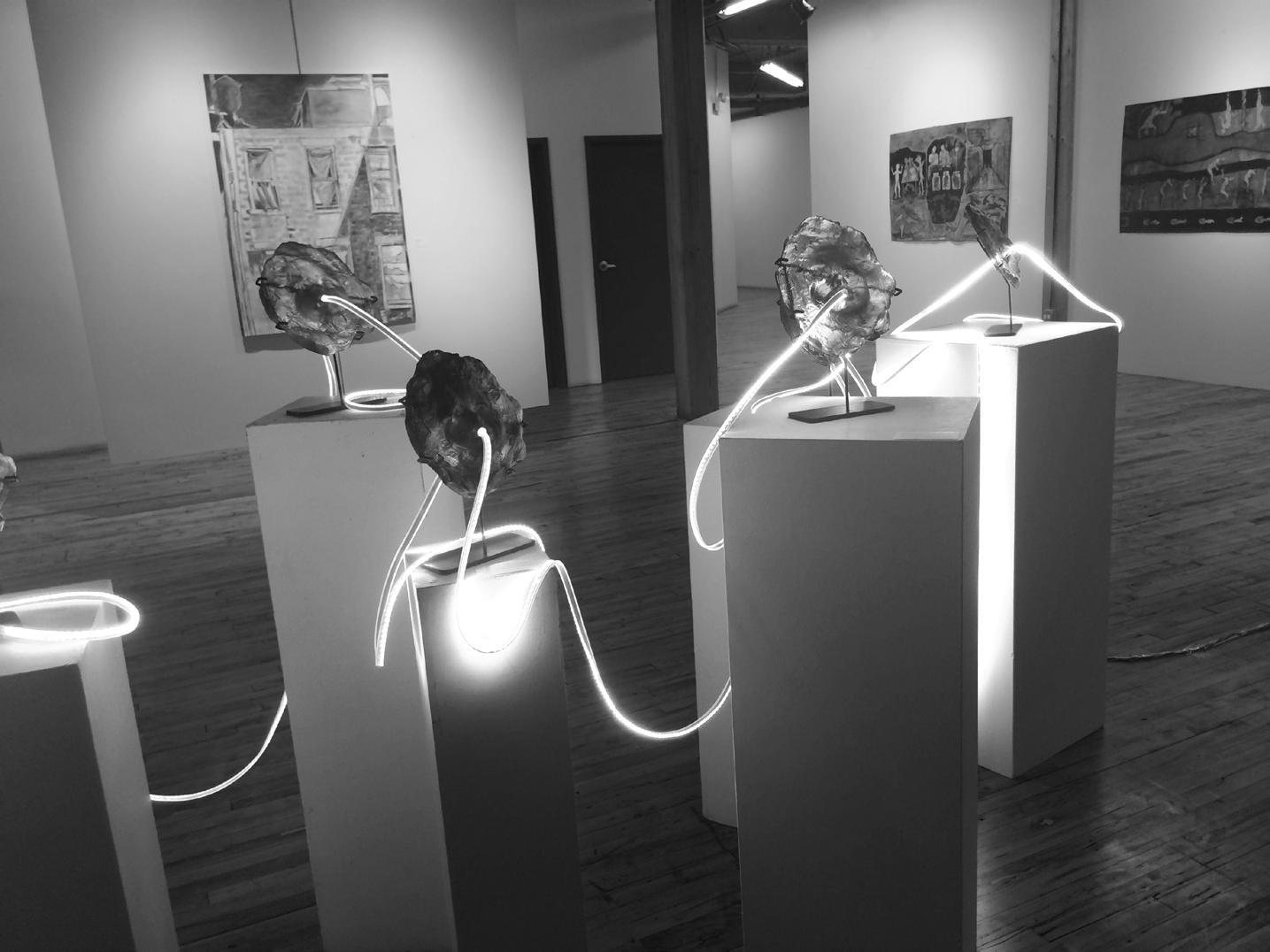
Suzanne Cohan-Lange also attested to ability-related adaptations to her work she’s had to make over the years. “I always worked life-size,” she said. “I can’t do that anymore––it’s too hard. [Sharron Pierce] used to work on pieces that weighed 500-1000 pounds. You can’t do that once you get to be a certain age. And so you learn. I’m working in glass now, these head-sized pieces, since I can.” Cohan-Lange’s striking twopart display, “The Conversation: Talking to Ourselves,” incorporates cast glass, steel, and LED elements, with an array of subtle and detached faces interlinked through the mouth by a long illuminated ribbon.
“When I first started,” Cohan-Lange said, “I was welding life-sized figures. She [Pierce] was doing pieces of clay that weighed the same as a Buick. So you know, you adapt to what you can do.”
Despite these aforementioned changes,
as well as the various life events, achievements, and challenges that each woman has experienced over the years, their friendship has only gotten stronger. They look forward to their meetings, itching for the critique to which they attribute their continued artistic growth. “Critique is not a bad word,” clarified Pierce. “It’s bad and scary for students usually, but it exists for positive reasons. It’s always positive. We ask for it. We wouldn’t bring our work if we didn’t want to be critiqued. And we grow from it.”
“Just little subtleties,” added Linda Sorkin Eisenberg, whose exhibited sculptures offer a complex and colorful rendition of the garments and personas behind select Greek goddesses and mythical figures. “It’s not like, ‘This is awful, you’ve got to change the color.’ It’s more suggestion.”
Since the group’s inception, the ten have had joint, cumulative shows of this nature almost every year. With such marked success, it’s no wonder that the women envision continuing on with the group as long as they can. As for diversifying the gender composition of the group, the women say they would be open to anyone who requested to join, though they cannot imagine a man electing to endure their chatter-filled, high energy meetings.
“When we have meetings in each other’s houses our husbands flee—they run upstairs,” Cohan-Lange explained.
“Or they leave the house,” said Pierce.
“We’re loud.” The two look at one another and laugh jovially.
“I mean this is serious work,” Cohan-Lange continued. “But that doesn’t mean that we don’t giggle and scream. And you can do that if you’re a room full of people that are supportive and not critical––there’s the difference. So it’s not about criticism, it’s really about construction, helping, collaboration.”
Bridgeport Art Center, 1200 W. 35th St., fourth floor. Open through December 31. Monday–Saturday, 8am–6pm; Sunday, 8am–noon. Free. (773) 247-3000. bridgeportart.com
sara cohen
Kartemquin’s latest documentary illustrates the harsh realities that thwart CPS students’ college dreams
BY JASMIN LIANG
The Uneven Playing Field
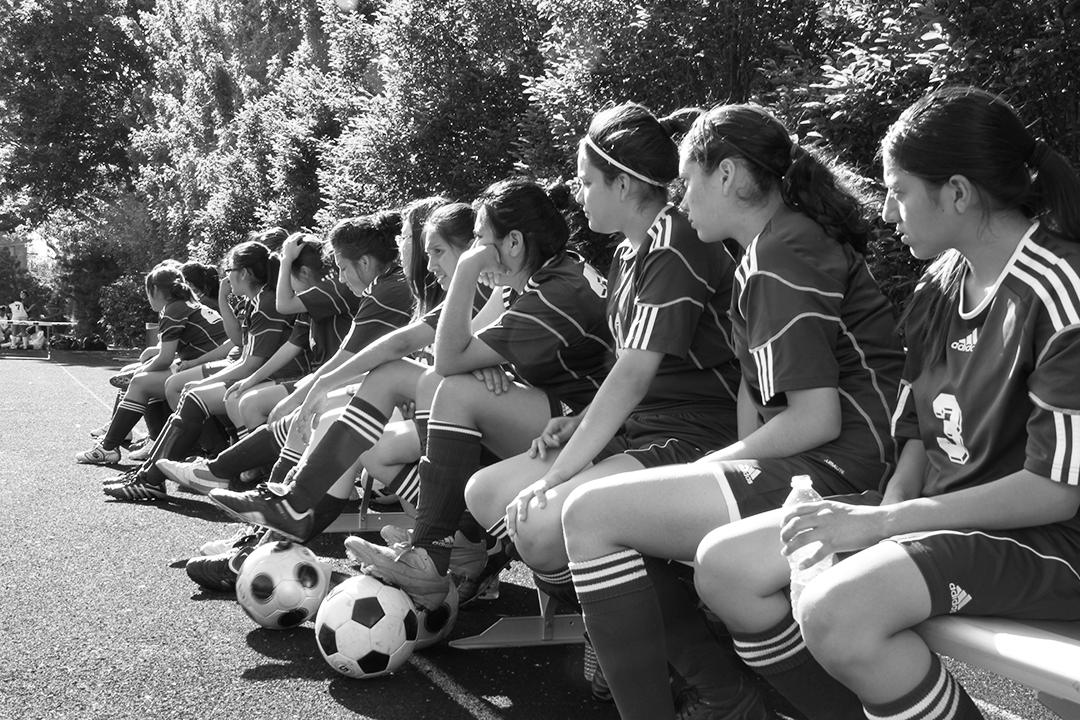
“Iwant to be known for who I am, not who I want to be,” says Elizabeth, organizing the storage of her parents’ small clothing shop in Brighton Park. Elizabeth is one of many second-generation Hispanic youths who aspire to improve their current situation by getting a college degree. Undeterred by financial obstacles, Elizabeth believes in what her soccer coach has told her: “You are the leader.”
This is the beginning of In the Game, a Kartemquin Films production directed by the Peabody Award-winning documentary filmmaker Maria Finitzo. Over the span of five years, the film follows three
students at Kelly High School in their journey from high school soccer matches to the real world. However, the playing fields are uneven in both games. The fact that Kelly does not have its own soccer field poignantly mirrors the girls’ future: college is a playing field exclusive to those who can pay for it. For the girls, it is no longer a matter of winning the game, but instead simply staying in it, whether that means having three jobs at the same time, or taking a gap year in order to pay for a year of tuition at a community college through work.
Finitzo highlights this tension between illusory hope and stern reality through the
parallel storytelling of different characters. Maria, the captain, wins her first architecture design competition and decides to pursue architecture in college, but former captain Elizabeth has already compromised to reality, dropping out of college after a sudden fire destroys her family’s house. Elizabeth’s circumstances foretell those of Maria, who is eventually forced to suspend her studies and get married. “There are so many walls in between. I feel like I have no way to climb that wall,” Maria says, after a lawyer tells her that it is almost impossible for her to rise above her financial difficulties.
Even if the possibility exists, its fulfill-
courtesy of kartemquin
ment demands total devotion and immeasurable sacrifice. The girls, like many other children from immigrant families, bear a family obligation to help out the household in a variety of ways, but achieving their college dream might entail severing family ties, as In the Game suggests with Alicia’s story. While Elizabeth has her parents’ steady support, and Maria settles down with a new family of her own, Alicia is left alone, paying for her tuition on her own.
Alejandro Espinoza, who attended a public screening of In the Game a couple weeks ago at Archer Heights Library, teaches at Curie Metropolitan High School in Archer Heights, right next to Brighton Park. He finds it disturbing that high school often gives these underprivileged students false hope.
“They only told the kids, you are in control of your life and you can deal with your own cards,” Espinoza said after the screening. “One of the responsibilities for us, as educators and as members of the community, is not to preach these hopey hopes—what those students really need is critical hope. We need to teach them to recognize the give-and-take in achieving this college dream.”
As the audience, we see the young players grow on the soccer field and in the classroom. And initially, the film caters to our assumption that the girls will be given the opportunities they deserve; against our expectations, though, it turns out to be a story of those beaten by the system. In doing so, the documentary candidly shatters the popular notion of the American Dream and offers a trenchant criticism of the inequality deeply rooted in our social system. Effort does not determine your outcome in the game of life—race, gender, and socioeconomic background do. This truth is not unfamiliar to the girls. “Sometimes in life, you are still going to fail even when you make the effort,” says Stan, their soccer coach, after the girls are defeated by Whitney Young Magnet High School, a well-funded school renowned for its soccer program.
The soccer game between Kelly and Whitney Young is a microscope the film uses to expose greater issues of racism and funding inequity. At the end, the film hits hard with a news report that, already un-
der-resourced, Kelly High School nevertheless suffered the most funding cuts in the 2015 CPS budget crisis. As a result, the school is unable to provide toilet paper, chalk, markers, and other basic school supplies for its students and faculty, tough luck for a student body drawn primarily from undocumented Latino families who cannot vote. Here, the film implicitly criticizes the interest-driven politics of the city. “Our community has been hit harder than other communities,” a Brighton Park Neighborhood Council member says in the film. “I don’t understand how you couldn’t look at it through a racial justice lens.”
Kelly High School is by no means the only neighborhood school in this kind of economic plight. Curie High School, just ten minutes away from Kelly, shares a similar student body and similar challenges. “All the public high schools are fighting against a shrinking pot of money,” Espinoza said, speaking to his own experience at Curie. “It is bizarre to see that we have external funders coming in to help us fix this, fix that. It makes you wonder how public the schools are when they receive so little public funding from the city.”
Nevertheless, what lies at the heart of the film is an earnest celebration of the resilience of three girls in the face of adversity, and the value of being part of a team.
Despite the seeming cliché, the film successfully demonstrates its power through an unsentimental narrative that depicts how in a team, one becomes stronger in overcoming setbacks. Individual effort is necessary, yet attention and support from the community are indispensable. Given the social awareness it creates, In the Game earned its place as a selection this year for One Book, One Chicago, a Chicago Public Library program aiming to foster understanding and engagement in the community. Just like what Stan always told the girls at soccer games, the film brings forth a powerful message: we need a team—the concerted effort of every member of the community to ensure the game is played fairly.
Liberation in Rapture, Rhythm, and Rhyme
BY ARIELLA CARMELL
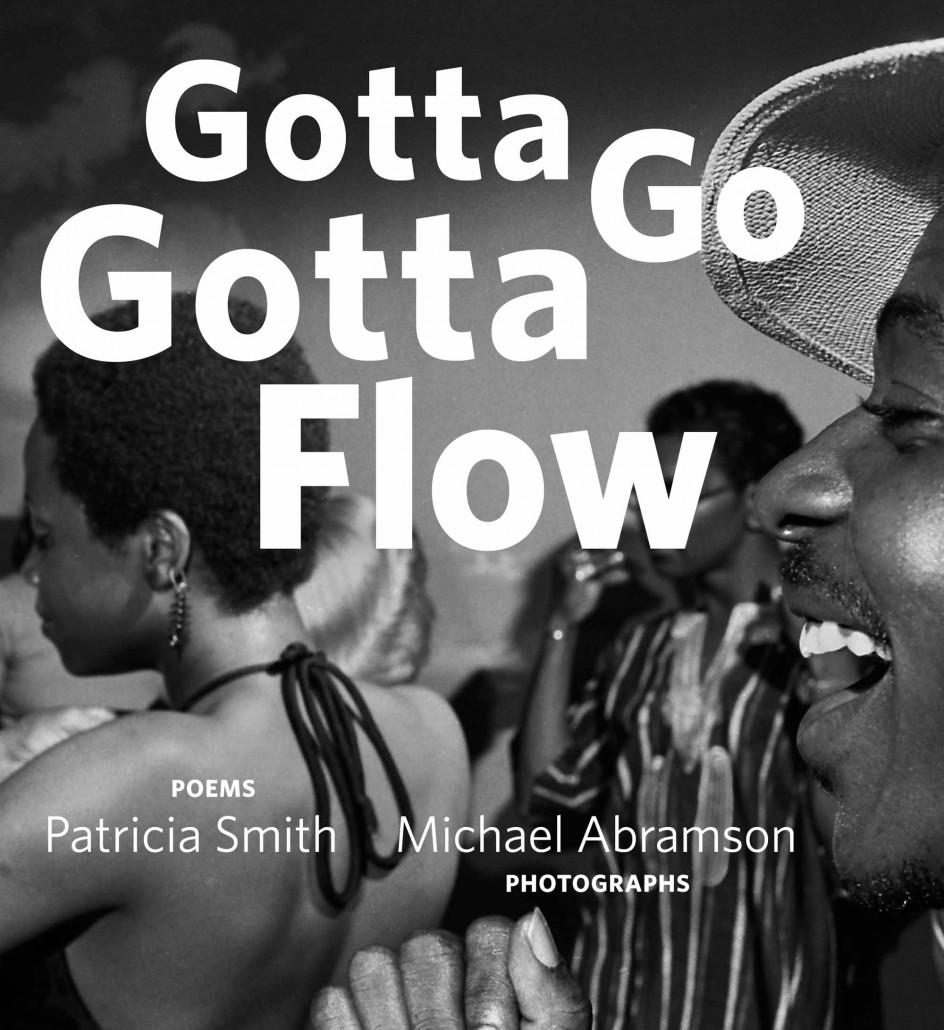
“Your body was crafted for this,” writes poet Patricia Smith, her verse stark and sparse against a white page, neighbored by a glossy blackand-white photograph of a man in rapture to music. Such affirmations fill the pages of Gotta Go Gotta Flow: Life, Love, and Lust on Chicago’s South Side, at once an exploration of the South Side’s nightlife in the 1970s and a celebration of the body in movement. It is also, in the wake of the artist’s passing in 2011, a rebirth of the images of Michael Abramson— referred to in the foreword as “that white boy lugging that camera again”—initially known for his documentation of Chicago’s urban life. While one cannot quite call Smith’s poetry in this book descriptive, the individual poems personify the pictures, bringing us into the souls of the subjects.
One image, for instance, depicts two
women poised in their seats, arms waving to the music. Smith takes on their voices, writing, “We dance demurely in our seats/while waiting for partners.” By writing from their point of view, Smith gives us a glimpse into the inner lives of bodies in motion, the thoughts caught behind their furrowed expressions, the beads of sweat. They are no longer strangers to us; while the intimacy of Abramson’s camera brings us close to his subjects, Smith’s poetry provides us with the cadences of their voices and the pulsating rhythms of the jazz clubs depicted.
Smith’s accolades include two Pushcart Prizes, the Carl Sandburg Literary Award, and the Academy of American Poets’ Lenore Marshall Award. She is a four-time Nation-
al Poetry Slam champion; her background in spoken-word clearly informs the tone and tempo of these poems, often foregoing floridity for the power of simple declarations. Take the interior monologue of a fur-coated woman whose back is turned to us, her cocked cigarette ghostly white: “I am not about/compromise/I am not about/negotiation/I am not about/discussion.” The musicality lies in her terseness, her repetitions, her proclamations.
Smith does not only rely on performance-inspired verse, however, often delving into different varieties of metric composition. Some poems even function like songs, using lines that invoke assonance and rhyme schemes such as, “You put a dip in your hip, you let your backbone slip/You keep your eyes on the prize and let his nature rise.” One could say the book is an exploration of different types of music, from thumping bass to slow jazz.
Above all, this collection of photographs and poetry illuminate the culture of a Chicago forty-plus years past. The pages brim with the modish fashions of the day—flared sleeves and plaid suits, miniskirts and tight pants— and conjure up the aura of not only a time but a place. The clubs of Chicago have a certain texture like no other locale, and through Abramson’s lens every grain is tangible, even the grime glistening. Every expression is caught at its most potent moment, from a singer in rapture mid-song to the dead-eyed gaze of a woman rejecting advances. Though these people are clearly and proudly of a different era, we can’t help but know them through the modernity of Smith’s words, often evoked through the power of the women’s voices, the sense of liberation from the male gaze. The photographs are relics of a different time, and the poetry recasts them in a contemporary and emancipating light. While Abramson may have taken his pictures with a sense of detachment as an outsider to this culture, Smith reclaims the narrative with her words, giving these figures’ thoughts an edge of authenticity.
“this is chicago/this is america. oh wait/ this is/1 in the morning,” Smith says, in the voice of a wide-eyed girl staring off into the distance. These are the faces of a country, an era, and, perhaps most importantly, a city.
An Open Book(store)
Theaster
Gates seeks to bring rare art books to the masses
BY MICHAL KRANZ
As he rummages through a slew of cardboard boxes in the cramped basement of Bing, a new bookstore in Washington Park, curator Hamza Walker’s excitement is tangible. “Check this out,” he says, turning to manager Chris Salmon, “it’s Bauhaus, the band!” He and his colleague proceed to flip through the seminal post-punk group’s pamphlet, surrounded by boxes of similarly rare and highly valuable knick-knacks.
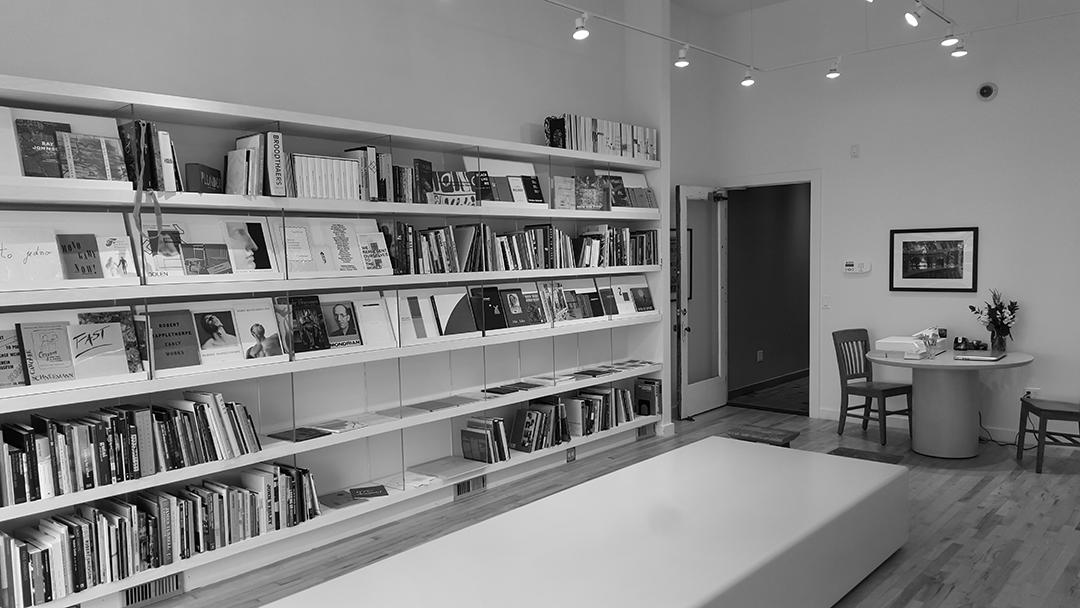
Flanked by empty retail spaces and whitewashed storefronts, Bing sits quietly across from the Garfield Green Line station, easily overshadowed by the trains that rumble overhead. Part bookstore, part reading room, artist and University of Chicago professor Theaster Gates’ newest venture resembles a saloon from the outside. Its catchy name is spelled out in a vaguely Western font, lit up with a bright white neon that flickers invitingly. But despite its humble appearance, Bing has the honor of being the only bookstore on the South Side to exclusively sell art books, and its mission is more community-based than it is commercial.
While most of the pieces Walker and Salmon sift through will end up in Gates’ own galleries rather than at the new bookstore, the pair’s fascination with rare art books demonstrates that the Bing project is about a lot more than just making money.
“Conceptually, [the store] was supposed to be a reading library—an active library that people participate in,” says Salmon, who worked for twelve years at Powell’s Books in Hyde Park.
The store’s warm interior manages to be cozy despite its modernist aesthetic. Its well-lit display room is punctuated by a place for visitors to read and examine the objects around them, a low table that doubles as a seating area and fits the library function Salmon describes. The left-hand side of the room is adorned with books and pamphlets of all shapes and sizes. Artists from Roy Lichtenstein to Yoko Ono are
“The idea is that this is a communal space. People can access these books if they can’t afford to buy them. The stuff is for sale, but we’re happy to have people come in and simply experience them as well.”
represented on these shelves, and every item is more intriguing than the last.
The opposite side of the display room has a slightly different character, and although the items are of a similar nature, they are tucked away in various drawers designed to be pulled out and examined. And there is plenty to examine—every drawer contains something eye-catching, like a pamphlet depicting abstract art built around war medals from fascist Italy or photographs of Muhammad Ali in Zurich from 1971.
A door at the back of the display room opens into the store’s as-of-yet unopened
wine bar, and an adjacent staircase leads to a sparsely furnished corridor that ends in a red-brick screening room. Bing has been hosting week-long film screening series there every month (something Salmon calls “passive programming”), showing films borrowed from another Gates endeavor, the Black Cinema House. During other events, passersby can walk in at any time and experience the downstairs space at their leisure.
The layout of the space, as unconventional as it may be, is meant to allow guests to access Bing’s collection of art books, one that is without parallel on the South Side.
The vast majority of the books at Bing come from either Walker’s collections or from Powell’s Books, and while every item is technically for sale, many of them are not priced for the average consumer. The rare Parkett periodical, for example, is listed at $3,500. Salmon, however, says that selling books at Bing is more of a financial necessity than a focus.
“We’re not going to make a killing on this,” he says. “That’s not the idea. But we’d like to cover what it costs to run it, if nothing else.”
The high cost of some of the books at Bing has led some to express concern about the potential for such stores to drive gentrification in the area. The bookstore is located along a stretch of East Garfield Boulevard that already includes the UofC’s Arts Incubator and Currency Exchange Café, both projects of Gates, who has said that he dreams of converting this section of Garfield into an arts and culture district.
But Salmon says that rather than focus on the prices of the books, local residents should see Bing as a resource for people of all backgrounds to visit and enjoy.
“If you can sum up the goal here in one sentence, it’s just to get people in the door and exposed to—and interested in—things they would not normally be exposed to,” he says. “The idea is that this is a communal space. People can access these books if they can’t afford to buy them. The stuff is for sale, but we’re happy to have people come in and simply experience them as well.”
The bookstore’s wine bar is still waiting on a liquor license and its organizers still have many ideas in the works. Regardless of its profitability, however, the people behind Bing seem deeply connected to its idiosyncratic collection of art books, pamphlets, and other ephemera. For them, providing the public with access to such a collection has become a passion in its own right. Bing, 307 East Garfield Blvd. Tuesday–Saturday, 12pm–7pm. bingartbooks.com
chris salmon
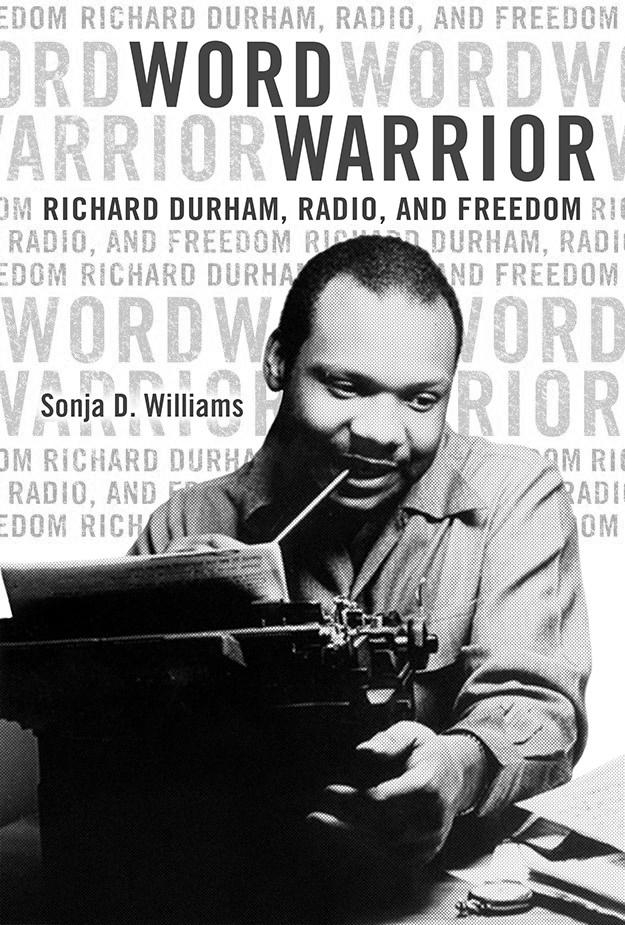
Word Warrior by Sonja D. Williams paints a colorful portrait of journalist and activist Richard Durham
BY ANNE LI
Narrative Action
Richard Durham’s chosen name embodies the force with which he advanced his life’s goal: greater freedom for all people through the narration of stories. Born Isadore Durham, the writer chose the name Richard in light of his admiration for Richard the Lionheart, the crusading medieval king. Details like this one fill Word Warrior, Sonja D. Williams’s lively biography of Durham, a pioneering black journalist and radio dramatist.
Williams, a professor at Howard University and a recipient of three Peabody
is presented as being central to his activist drive and unwillingness to step aside when challenged.
Williams makes Durham’s passion for universal equality and freedom clear. His work tackled issues ranging from women’s rights to health care, and he pursued these goals even while working for labor unions and the Nation of Islam, often giving advice and support to female colleagues. Durham’s friend Abena Joan Brown declared that in his lesser known television program Bird of the Iron Feather, “he wrote not only for
“His accomplishments,” she writes, “reinforced my own belief that media, in all its incarnations, should serve a higher purpose than just mindless diversion.”
awards for her work as a radio producer, began this biography after hearing episodes of Durham’s radio series Destination Freedom “His accomplishments,” she writes, “reinforced my own belief that media, in all its incarnations, should serve a higher purpose than just mindless diversion.”
The story begins a few generations back, taking the reader through the history of race relations leading up to Durham’s childhood in a Chicago facing an influx of migrants from the South. The beginnings of trouble from white realtors back then foreshadow the discriminatory practices that Durham would combat in his work.
Descriptions of Durham as a child are used to heavily presage his future character. The colorful anecdotes provided by Durham’s sister Clotilde, for instance, are framed as an adventurous boy learning to observe and dissect his surroundings. Durham’s brief boxing career in high school
himself but he wrote for us so that we could better understand what this journey is all about.”
The name of Durham’s signature radio program Destination Freedom, in which Durham dramatized the lives of historic African Americans, might seem suggestive of the idea that activism is a journey. But true to his chosen name, Durham was more of a crusader than a traveler. Williams portrays Durham as an activist who used words as weapons in an ongoing fight. Hindsight sometimes makes Durham’s career path feel more like destiny than ambition, but this is made up for by William’s ability to convey Durham’s forceful personality.
In Williams’s portrait, Durham’s only downfall is that he would always “whip out his boxing gloves to hammer home his point—sometimes going overboard to do so.” On multiple occasions, Durham’s career is jeopardized by his refusal to compromise
on points of artistic or racial justice. When he refused to cut “anything [he] felt was healthy for inspiring Negroes to a more militant struggle,” Durham faced rumors of being a “Red” communist, but held firm. Similarly, while writing the Nation of Islam’s journal Muhammad Speaks, Durham insisted on maintaining the publication’s journalistic integrity despite intense pressure from the religious hierarchy. These challenges didn’t stop him from creating seminal works of radio and journalism, including his lesser known authorship of The
Greatest, Muhammad Ali’s 1975 autobiography.
Durham’s career is itself an accomplishment of racial and ideological progress. Although his groundbreaking projects faced many obstacles, his perseverance opened opportunities for other black artists of the time and created a path for others to follow. Sonja D. Williams. Word Warrior: Richard Durham, Radio, and Freedom. University of Illinois Press. 181 pages. $26.
Holiday The Issue
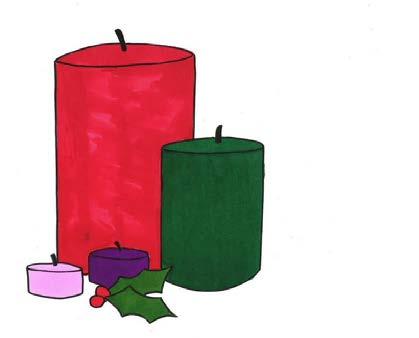
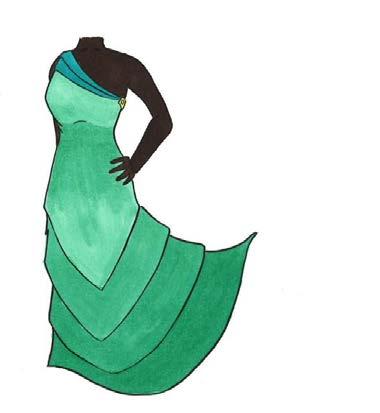
This issue is our gift to you, and it’s a gift that keeps on giving. In these pages you’ll find a Holiday Gift Guide filled with South Side establishments where you’ll find presents and local personalities guaranteed to spread holiday cheer. We’ve also curated creative writing and interviews with South Siders on the traditions and memories that have made the holidays special for them. Happy Holidays!
Holiday Gift Guide
ILLUSTRATIONS BY SHANNON SEU
Red Cups
DIANE O’NEILL
It’s November but at Dunkin’ Donuts Elvis sings about blue Christmas Frank warns that Santa is coming to town I drink decaf from a styrofoam cup shouting “Joy” celebratory red surrounded by evergreen boughs and “Warning: Extremely Hot” while a few blocks away baristas pour five-dollar lattes in plain red cups entering the war on Christmas while governors vote to exclude refugees slash benefits for people who are poor split families deporting moms and dads but let’s make sure our coffee cups talk about love and peace on earth while we rejoice in our right to bear arms
crafts & classes
FOR ANYONE YEARNING FOR YARN Yarnify!
Yarnify! is a haven for knitting and crocheting enthusiasts, offering needles, hooks, patterns, and yarns. This shop is not only a retailer of fibrous necessities, but also a welcoming community of artists, ready to provide professional guidance on personal projects or instruction in larger class settings. Beginner classes generally take place over the span of five Saturday sessions and cover the basics of knitting or crocheting. More advanced classes offer instruction on specific techniques and patterns, such as felted clogs or thrummed mittens.
Yarnify!, 47 W. Polk St. Monday–Friday, 11am–7pm; Saturday, 10am–6pm; Sunday, 12pm–5pm. (312) 583-9276. yarnify.com (Alexandra Epstein)
FOR THE ADVENTUROUS HOME CHEF
Ranjana’s Indian Cooking Lessons
No more excusing curry-fear, roti-phobia, or any other trepidation about subcontinental cooking—Ranjana’s Indian Cooking Lessons promise to demystify this wonderful cuisine. Hands-on instruction takes place in the warmth of Ranjana’s home, where she teaches the handling of Indian spices, along with vegetarian curries, paneers, daal, and masala. Ranjana has been offering up her knowledge for three decades, garnering rave reviews from Chicago chefs and recognition in the Tribune. Class ends as all cooking classes should—with a nine-course feast consisting of the student’s own work.
Ranjana’s Indian Cooking Lessons, 6730 S. Euclid Ave. Monday and Thursday, 6:15pm–9:15pm; Saturday 9:15am-12:15pm. Registration required. (773) 355-9559. indiancookingclass.com (Morley Musick)
FOR YOUR AIR GUITARIST
Muzicnet School of Music
Do you know someone who is just dying to take their air guitar skills to the next level? A set of guitar lessons from Muzicnet School of Music is the perfect gift to bring out their inner rock star. Three-year-olds and one-hundred-year-olds alike can learn to play anything from piano to woodwind instruments, and even voice. With relatively low prices––an hour-long lesson will cost you between twenty and twenty-five dollars––this is a gift that will harmonize well with any music lover.
Muzicnet School of Music, 8725 S. State St. Monday–Wednesday, Friday, 2pm–7pm; Saturday, 9am–3pm. (773) 487-7529. muzicnet.net (Margaret Mary Glazier)
FOR PEOPLE OF THE CLOTH
The Quilter’s Trunk
Here, you can find over two thousand bolts of fabric, three thousand spools of thread, and another couple thousand different types of buttons. For novices, there’s a “start sewing” gift pack, which includes basic materials and an introductory book. Seasoned quilters may enjoy a traveler’s gift pack, complete with mini iron and mini cutting mat for any on-thego quilting needs, or a gift card, so that they can choose from the store’s dizzying array of colorful materials.
The Quilter’s Trunk, 10352 S. Western Ave. Tuesday–Saturday, 9am–5pm; Sunday, 12pm–4pm. (773) 980-1100. thequilterstrunk.com (Hafsa Razi)
home goods
FOR THE WINDOWSILL BOTANIST
Verdant Matter
The temperature might be dropping, but at Verdant Matter, the most Pinterest-worthy locale this side of the Garfield Park Conservatory, it’s springtime all year. Since its opening down the street from Thalia Hall in September, Pilsen’s newly founded combination gift shop and succulent greenhouse has become a hub for local horticulturists. From the rustic wood surfaces and glazed ceramics to the Christmas lights and hanging planters, there’s something for everyone. Expect Cactaceae, Echeveria, and more aloe than you can shake a stick at. Verdant Matter, 1152 W. 18th St. Tuesday–Sunday, 11am–7pm. facebook.com/verdantmatter (Christopher Good)
FOR HOMES IN NEED OF SPRUCING UP Treasures Depot
This independent thrift store is considered a well-kept secret by its devoted fans, a group that consists of both locals and lucky visitors to the neighborhood, who make the trip on the regular to score some of the city’s best deals on used furniture and other housewares. Household items are the main attraction here, but even those with perfectly furnished homes will find something to love among the shop’s collection of clothing and antiques.
Jo Ann Williams has been serving the Washington Heights community for over sixteen years on the corner of South May and 95th, specializing in balloons, flowers, and gift baskets. Williams will decorate for any kind of party you’re planning to throw: she says, “You name it, we do it.” There are holiday gift baskets available as well—one of the more popular selections is called, enticingly, the “Victoria’s Secret.” And for the lazier or busier holiday decorators, Williams even sells dressed Christmas trees with ornaments and all the trimmings.
JoJo The Balloon Lady, 1116 W. 95th St. (773) 298-8625. jojotheballoonlady.net (Jonathan Poilpre)
The Bus
BY JACK MURPHY
Picked us up at the same spot every time, near the teacher’s parking lot behind the school, where the girls would file in, sometimes loudly, sometimes quietly, past the same driver, Ed, who would smile wide while starting his speakers.
And though the girls in back surely would have preferred WGCI or maybe a phone to stream soundcloud, Ed controlled the music and in his quiet, kindly, unrelenting way refused anything but Christmas carols. And so it was.
And so they sang. Before Tuesday road games in November, far off in the dark suburbs, when the girls were exhausted from their Bio study guides and ACT prep packets, or trying in panic to finish Macbeth, they sang Joy to the World in back. And
After the Latin School destroyed us in December, went up 17-4 halfway through the first, and the girls had to sulk out humiliated through the hallways of the shining, magnificent school, in the bus they sang Dominic the Donkey in back. Or
Before the game we almost forgot Aisha when she ran back in for her knee brace, the one against Pritzker when Izzy made five three-pointers in the 2nd half, when the girls on the bench kept trying to do the wave, they sang—what’s it called? Or
When Dee Dee made that game-winner in January, grabbed a rebound and dribbled down the entire court, end to end, six seconds flat, put in a layup that nearly gave me a heart attack, they joyously sang ‘Dee Dee’ Bell Rock in back. And
I never sang along, though now I wish I had. When I hear them now, I don’t think of Santa or midnight kneeling in a church—just the back of the bus, the girls singing out of tune, in communion together, forever and ever, amen.
Thanksgiving, Turkey, and Mogen David Wine
Excerpt from chapter three of Old School Adventures from Englewood: South Side of Chicago
ELAINE HEGWOOD BOWEN
For Thanksgiving, I vividly remember having celery sticks stuffed with dressing, cream cheese, and crushed walnuts, and Mogen David wine, in the middle of a feast fit for a queen. Now just how our family ended up with a wine that has a Jewish association is beyond me. As I researched the wine, I saw blogs and message boards where many people recalled it as being the “festive” wine served during their holidays, also.
But Thanksgiving, no matter where it is celebrated, has nothing on Christmas! During Christmas time, my father would go down to Fulton Market and buy fruits, nuts, candies, and other goodies for our home.
Fulton Market was much like many markets in other big towns, where small store owners would go to buy produce, fruit or fish. And the little guy trying to raise a brood of kids was also welcome to shop. During this season, the area would be filled with people from all over the city caught up in the holiday spirit—sort of like a scene from A Christmas Carol or from If Scrooge Was A Brother (a play performed by one of Chicago’s black theater companies). But my father would also have enough to share with neighbors. Christmas circa 1966 also involved neighbors on our block going house to house singing Christmas carols. The two evergreen or fir trees, one in the front yard and one in the back, would be decorated with festive lights that you could see from at least a block away. And the big snowman that lit up our entire front porch would be on display for all to see. Before we started using real Christmas trees, we would place the fake Christmas tree in the living room, decorate it and wait for the big, white Santa Claus (because this is all we knew) to come down the chimney.
We would leave milk and cookies out, and I guess my mother would come and take those away and place the presents under the tree. During these times, my siblings and I enjoyed games like Operation, Candyland, Twister, Etch a Sketch and Hands Down. These were all just simple things that kept our attention for hours, long before the electronics invasion.
FOR THE FRAGRANCE FANATIC Aromatic Synsation
This Woodlawn gem is the perfect one-stop spot for cosmetics, vintage clothing items, and, as the name suggests, aromatherapy products. Stop by the boutique to select from over 100 options of body oils or home fragrances. Then pick out an aromatherapy lamp from an assortment of shapes, sizes, and colors. Finish off by choosing a unique vintage clothing item or accessory to complete the ultimate holiday gift bundle.
Aromatic Synsation, 6540 S. Cottage Grove Ave. Tuesday, Wednesday, Friday, and Saturday, 12pm–7pm; Thursday, 12pm–5pm. (773) 324-6335. (Sara Cohen)
clothing, hair, mind, & body
FOR CHICAGOANS WHO HAVE CONSIDERED HORSES WHEN CTA ISN’T ENUF 1st
Choice Fashions Inc.
The West has come to the Midwest. With a collection of cowboy boots and hats that rival any rodeo kiosk in Texas, 1st Choice Fashions offers an array of texana clothing while staying true to the humble roots of the Midwest with their selections of affordable button-downs. The diverse matching belts and buckles combinations, the collection of sturdy wallets, and other accessories compliment any cowboy-in-training. If the Wild West is too wild, blouses, blue jeans, and other more casual pieces of clothing are also available. 1st Choice Fashions Inc. Western Wear, 10518 S. Ewing Ave. Monday–Wednesday, 11am–6pm; Thursday–Saturday, 11am–8pm; Sunday, 11am–3pm. (773) 731-6000. (Ada Alozie)
FOR FASHIONISTAS
Urban Renew Boutique
Searching for gifts for your fashion-forward friend? Chic cousin? Stylish sister? Look no further than this trendy Little Italy consignment store. Featuring unused or lightly-used seasonal clothing and accessories ranging in from modern to vintage, this shop could supply the perfect holiday garment for anyone. Prices run reasonably, with jeans costing less than $20, and designer bags going for at most $250. Can’t make it to University Village? Visit these tech-savvy youngsters on their Etsy shop in cyberspace.
Urban Renew Boutique, 925 S. Loomis St. Tuesday–Thursday, 12pm–5pm; Friday-Saturday 12pm–6pm; Sunday, 12pm–4pm. (312) 952-1086. urbanrenewchicago.com (Sara Cohen)
FOR THE PAMPERED POOCH
Divas-n-Dogs
A spot where you can find both human and canine couture? This boutique is the cat’s dog’s pajamas! Shoes and purses are the highlights for human fashionistas, while doggie shoppers can pick up special treats and toys such as Manolo Barkniks or Jimmy Chews. Fashion hounds are sure to be satisfied with the wide range of doggie outfits, whether