

A workshop with Pulitzer Prize-winning reporter Rick Tulsky
Sunday, November 22, 2015, 1pm–3pm
South Side Weekly Office at the Experimental Station, 6100 S. Blackstone Avenue
Part four of the Chicago Civic Journalism Project Data Journalism Series, presented by Chicago Studies, City Bureau, South Side Weekly, and University of Chicago Careers in Journalism, Arts, and Media.
The South Side Weekly is a nonprofit newsprint magazine written for and about neighborhoods on the South Side of Chicago. We publish in-depth coverage of the arts and issues of public interest alongside oral histories, poetry, fiction, interviews, and artwork from local photographers and illustrators. Started as a student paper at the University of Chicago, the South Side Weekly is now an independent nonprofit organization dedicated to supporting cultural and civic engagement on the South Side, and to providing educational opportunities for developing journalists, writers, and artists.
Editor-in-Chief Osita Nwanevu
Executive Editor Bess Cohen
Managing Editor Olivia Stovicek
Politics Editor Christian Belanger
Education Editor Mari Cohen
Music Editor Maha Ahmed
Stage & Screen Julia Aizuss
Editor
Visual Arts Editor Emeline Posner
Editors-at-Large Lucia Ahrensdorf, Jake Bittle, Austin Brown, Sarah Claypoole, Emily Lipstein
Contributing Editors Will Cabaniss, Eleonora Edreva, Lewis Page, Hafsa Razi
Social Media Editor Sam Stecklow
Web Editor Andrew Koski
Visuals Editor Ellie Mejia
Layout Editors Adam Thorp, Baci Weiler, Sofia Wyetzner
Senior Writer: Stephen Urchick
Staff Writers: Olivia Adams, Amelia Dmowska, Maira Khwaja, Emiliano Burr di Mauro, Michal Kranz, Zoe Makoul, Sammie Spector, Zach Taylor
Staff Photographers: Juliet Eldred, Finn Jubak, Alexander Pizzirani, Julie Wu
Staff Illustrators: Javier Suarez, Addie Barron, Jean Cochrane, Lexi Drexelius, Wei Yi Ow, Amber Sollenberger, Teddy Watler, Julie Wu, Zelda Galewsky, Seonhyung Kim
Editorial Intern Clyde Schwab
Webmaster Sofia Wyetzner
Publisher Harry Backlund
The paper is produced by an all-volunteer editorial staff and seeks contributions from across the city. We distribute each Wednesday in the fall, winter, and spring, with breaks during April and December. Over the summer we publish monthly.
Send submissions, story ideas, comments, or questions to editor@southsideweekly.com or mail to: South Side Weekly 6100 S. Blackstone Ave. Chicago, IL 60637
For advertising inquiries, contact: (773)234-5388 or advertising@southsideweekly
Read our stories online at southsideweekly.com
Cover illustration by Ellie Mejia & Silvia
Wei
A week’s worth of developing stories, odd events, and signs of the times, culled from the desks, inboxes, and wandering eyes of the editors
Rauner Tries to Refuse Refugees
How far would you go to prevent the very, very unlikely? On Monday, Illinois Governor Bruce Rauner became the latest state executive to voice opposition to the relocation of Syrians on his home turf. (Twenty-five others across the country—all Republicans—have done the same.) Ostensibly a response to last week’s terrorist attacks in Paris, Rauner framed the move as an attempt to protect Illinoisans from similar dangers. But though his announcement read like a decree, there’s actually a good deal of precedent to suggest he lacks the power to decide where the displaced can or can’t go. When it comes to important national security issues like immigration, the federal government is the ultimate authority. So Rauner couldn’t physically deny entry to newly minted Syrian-Americans, but he and his twenty-five allies could still refuse to cooperate with the feds, complicating the task of relocating a projected 10,000 of them across the country. The bottom line? Illinois might not see the resettlement of more Syrians, who, according to the State Department, have been flooding into the state at the untenable rate of approximately nine a week.
Pfleger Takes on Comcast
St. Sabina’s, the church that held nine-year-old Tyshawn Lee’s funeral last week, was out of Internet after Comcast canceled six scheduled service appointments within the Auburn Gresham and neighboring Englewood areas last week. Jack Segal, Comcast regional vice president of communications, said that “heightened potential for violence” in the area following Lee’s death posed a risk to employees, and that they would reschedule the appointments within several days. Soon after Father Pfleger took to Facebook to express his indignation, Comcast sent
technicians over to solve the church’s Internet woes, but a day’s worth of computer and GED classes were interrupted. Several St. Sabina’s employees felt that this was a case of profiling and suggested that they might take their Internet business elsewhere unless Comcast offers an apology, which they haven’t yet.
As Rahm Likes It
“O Rahm-eo, Rahm-eo, wherefore art thou Rahm-eo? That which we call a Derrick Rose by any other name would smell as sweet.” We hope you’re on board for this Chicago/Shakespeare mash-up, because beginning in 2016, all Chicago’s a stage for the “Shakespeare 400 Festival” put on by the city with Chicago Shakespeare Theater at its head. In honor of the 400th anniversary of the Bard’s death, the festival will include collaborations with Chicago’s major cultural institutions, as well as with schools, parks, and libraries, which hope to bring Shakespeare to everyone in the city. Because, well, you know what they say: Some are born with knowledge of Shakespeare, some achieve knowledge of Shakespeare, and some have Shakespeare thrust upon them. According to DNAinfo, the event will feature artists from around the world—in disciplines from theater to culinary arts—who take their inspiration from Stratford-upon-Avon’s most famous resident. In Rahm Emanuel’s announcement, disappointingly not in iambic pentameter, he said, “The power of our world-class cultural institutions uniting behind one theme serves to amplify Chicago’s role as a global destination for cultural tourism.” If reducing cultural festivities to a bland advertisement for the city of which you are mayor be the food of love, speak on, Rahm, speak on.
lots of love
$1 lots from Englewood to Pullman andrew koski...4
bus tour commemorates obama
““People in Chicago talk about World’s Fairs, while we have a sitting president and all the places he lived and worked right here.”
sonia schlesinger...5
underserved and under the spotlight
South Side, West Side, anywhere. mari cohen...6
finding (wall) space in little village Graffiti has changed into a symbol of improvement rather than an impediment to it.
emiliano burr di mauro...10
the poetrY of everYdaY language “Poetry was like a group of outsiders.” darren wan...12
rethinking agamemnon There are no togas to be seen here. emeline posner...14
joe hill lives todaY
“Warning: Entering this space could be interpreted as a political act” c.j. fraley...15
art wing in flight
“It’s basically their space.” sarah liu...16
the path to happiness
“I do not want to be an accomplice to impotency.”
zoe makoul...17
BY ANDREW KOSKI
Applications recently closed for the fourth iteration of the city’s Large Lots program, in which residents of Pullman and Roseland were eligible to purchase over 300 city-owned abandoned lots, each for less than the cost of a cup of coffee: just a dollar. As the program expands, it raises the question of whether previous phases have been successful. What has become of the 430 lots already sold?
The original Large Lot pilot project took place in the Greater Englewood Area with applications closing in April 2014, and most owners received their deed earlier this year. In order to get a better sense of the results of the program in the Greater Englewood Area, the Weekly visited thirty of the total 276 lots sold in the first portion of the program. Their current state was compared with photos of the lots before sale on largelots.org, a website created by Local Initiatives Support Corporation
and cuts maintenance costs. The city owns thousands of vacant lots across the city—some 13,500 according to the Tribune—that sit unused, accumulating weeds, litter, and abandoned cars, while the government foots the bill for upkeep.
The Large Lots program sells available vacant lots to eligible nonprofit groups and residents who already own property on the same block. In order to qualify, applicants must be current on all city taxes and debts. They must also agree to meet the criteria of the city’s Municipal Code, which requires enclosing the area with a noncombustible screen fence, cutting weeds, and doing general maintenance. The program aims to increase local investment in the area, create wealth within the community by allowing owners to sell their properties after five years, and rejuvenate vacant lots that had previously been eyesores.
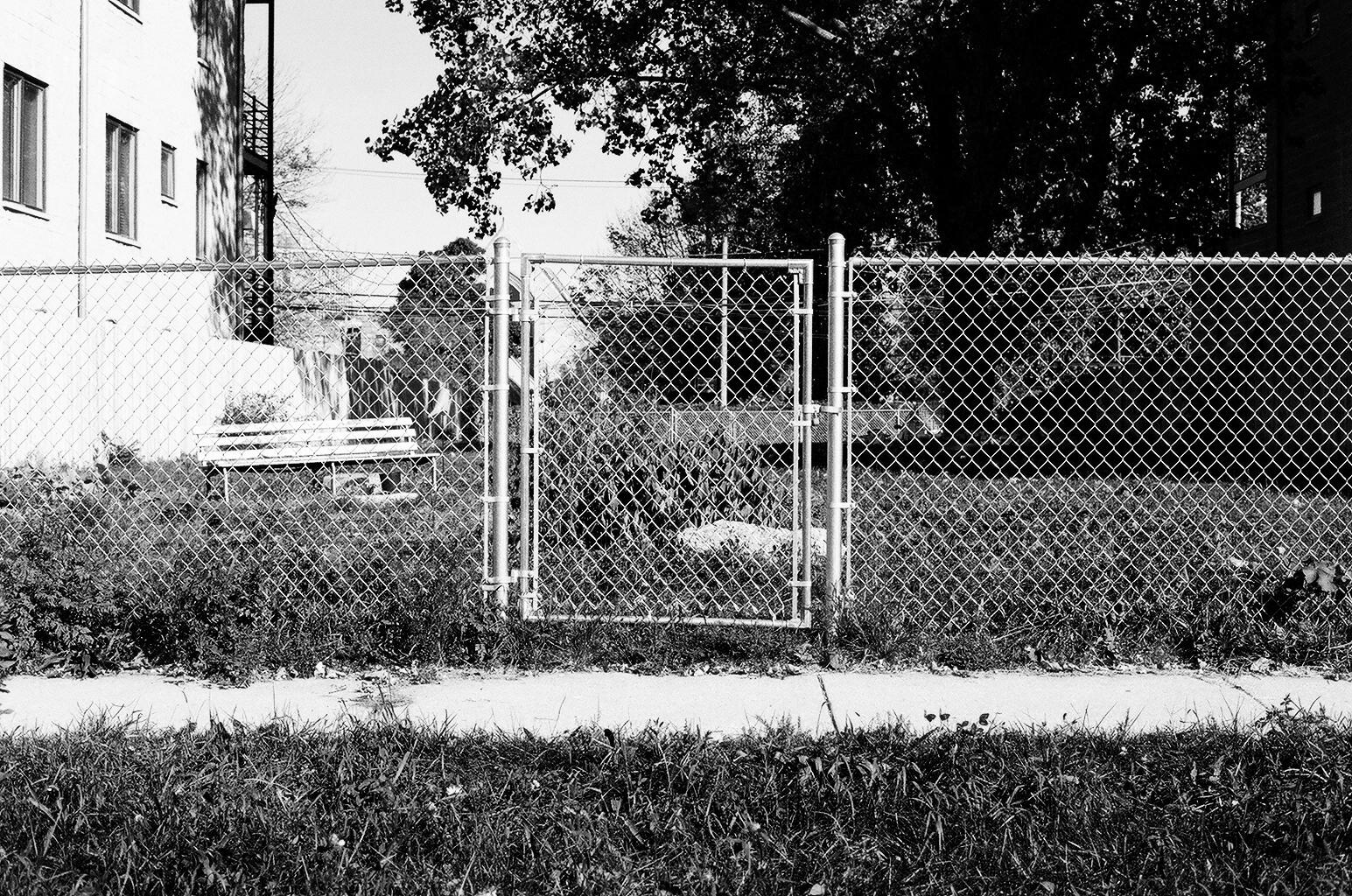
Although it’s too soon to tell what longterm economic effect the program will have on the community, the immediate benefits are beginning to be felt. Signs of ownership can already be seen in the Woodlawn and Englewood lots; out of thirty, only four seem to have no signs of improvement. Some lots have yet to be fenced in, but the majority showed multiple signs of upkeep: mowed grass, litter removed, weeds cut back.
“The biggest thing [for lot owners] for the first six to nine months is funding and realizing their initial goals,” Mekazin Alexander, a Large Lot owner and member of R.A.G.E., explained. “Then phase two will be actually completing big projects. It takes patience; meeting basic city requirements and criteria is the first step.”
While lot owners figure out their longterm goals for their lots and clear away detritus, they have also been working with R.A.G.E. to obtain resources to complete larger projects. In order to secure funding, R.A.G.E. has already applied for a Chicago Neighborhood Development Award as well as other grants. Butler said that R.A.G.E. has also been working with local businesses to acquire materials and they have led volunteer projects with local high-school students to clean up some of the lots. Since the goal of the Large Lots Program is rooted in community building, R.A.G.E. has incorporated the local community in its Large Lot revitalization efforts.
(LISC) Chicago and DataMade, and adopted by the City of Chicago as the official Large Lots website. Of the lots sampled, almost all seemed to show signs of improvement. Lots that once sat unused have been transformed into decorative green spaces for tenants or reborn as community gardens, and although some changes were more dramatic than others, almost all the lots felt like someone owned them.
The $1 Large Lots Program is part of the Chicago Department of Planning and Development’s Green Healthy Neighborhoods planning project, which the city’s website describes as “a 10- to 20-year planning strategy to maximize the use of vacant land and other neighborhood resources.” Ideally the program should be a win-win for community members and the city government, because it returns ownership to the local community, and in doing so increases revenue from property taxes
This program is still in its earliest stages. Most owners in the Greater Englewood Area only received their deeds a few months ago after applying last year, and as the first participants of the program, they have no example to follow when it comes to lot ownership. As a result, it is unrealistic to expect the lots to undergo an overnight turnaround, and the current progress, though largely undramatic, is encouraging. Moreover, by working together through community organizations, some lot owners have created solidarity among owners and worked together towards common goals.
The Resident Association of Greater Englewood (R.A.G.E.) is one group that has been working with owners to transform their lots. Its president, Asiaha Butler, said that R.A.G.E. was the only group to submit its own recommendation to the city for the Green Healthy Neighborhood Plan, which implemented the Large Lots program. Many members of R.A.G.E. are also Large Lot owners. “R.A.G.E. has really become a ‘Large Lots Owners Club,’ ” she joked. The Weekly spoke with her, as well as other members of R.A.G.E., after a focus group they held with $1 Large Lot owners to discuss people’s experiences with the program and to work together to realize everyone’s personal goals for their lots.
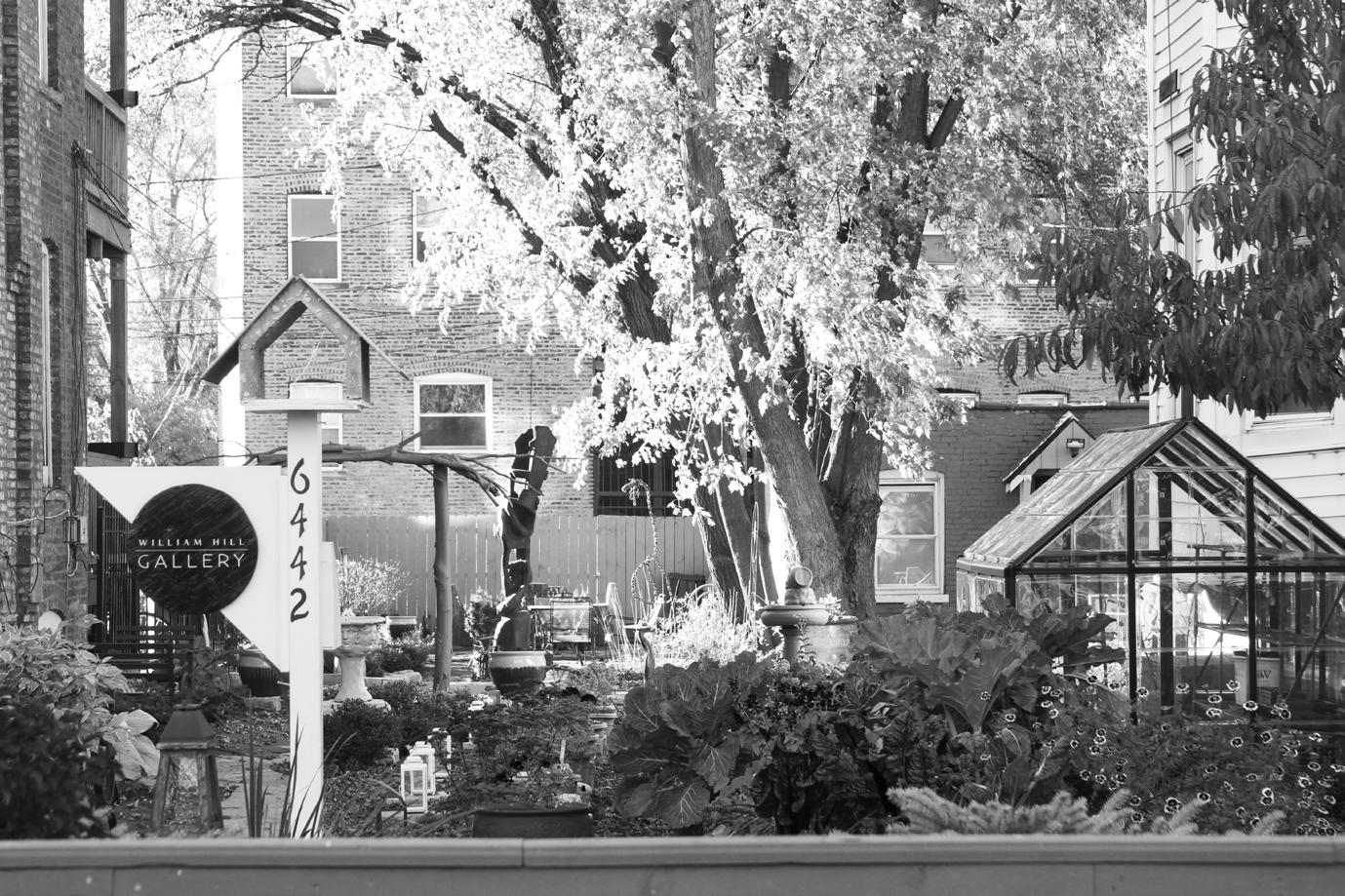
Some owners have already completed ambitious projects with their lots. If you were to drive past the William Hill Gallery today in Woodlawn, it might be hard to believe that such a stunning, well-curated sculpture garden was a weed-filled lot just ten months ago. While such a project, certainly no small task, is not feasible for every lot owner, it stands as a clear example of the kind of positive reversal that the one-dollar lot program can make possible.
“Most of the work was done by a small group of neighborhood volunteers and myself,” Hill said. “One major challenge was the removal of limestone, broken glass, and metal from the vacant lot.” Urban sustainability was one of the main goals of the project, so with the help of volunteers Hill recycled much of the brick and limestone back into the sculpture garden. He also repurposed cement from when the city replaced the sidewalk, using it to create a winding pathway through the garden. Hill said the project as a whole had evolved over a three-year period. The gallery and sculpture garden were originally founded on the adjacent property in the spring of 2012, and the Large Lot was added this year. The William Hill Fine Art Sculpture Garden is now a 5,000-square-foot garden space dedicated to educating community members in visual arts and gardening. The garden isn’t Hill’s first endeavor in transforming previously abandoned lots, though. He also leads the nearby Dorchester Botanical Garden Project, where he provides educational programming for area youth on the topics of urban farming, sustainability, and using edible plants for
healthy living.
The Large Lots program has not only been useful for individual owners; for I Grow Chicago, a nonprofit community organization in Englewood, the program was a real estate boon. It provided them with the land to create an extensive community garden on a vacant lot at 6403 South Honore Street, right across the street from their Peace House, an abandoned residence that they renovated with the help of local youth. The Peace House serves as their headquarters, where they offer educational programming and support services to community members of all ages. According to their website, “through sustainable farming and educational programs in nutrition, movement yoga and the arts, [I Grow Chicago] foster[s] creativity, wellness and empowerment for individuals in the community as a whole.”
In the coming months, residents of Pullman and Roseland will be notified of their Large Lot application status, and for those accepted, there will certainly be much to be hopeful about, and also much to consider. When asked what advice she would give to Large Lot buyers in Roseland and Pullman, R.A.G.E. member and lot owner Tina Hammond exclaimed, “Talk to someone in Englewood!” Butler said, “It’s a process; it takes time and patience.”
Property tax hikes are another concern for potential owners, especially considering Mayor Emanuel’s budget that City Council approved October 28, which includes a record aggregate of $589 million in property tax increases. Butler said that current Large Lot owners will not be taxed until next year, but added that she does not expect the increase will drastically affect lot owners, since the properties are small.
BY SONIA SCHLESINGER
“TThe R.A.G.E. members also said that a major concern was the lengthy process to receive the deed to the lot; for most of the owners, it took about a year. Hammond said that one R.A.G.E. member has still not received a deed. Butler said that the backlog has been due to staffing capacity issues at the Department of Planning and Development (DPD), but she was hopeful the issue would improve going forward. The DPD did not respond to comment for this story.
Another concern has been providing new Large Lot owners with the necessary information to improve their lots. Alexander said that the city does not clearly explain to new owners the criteria for lot maintenance and the deadline to meet it, which is troublesome because the city can impose stiff fines for noncompliance. Alexander said that one R.A.G.E. member has already been threatened with a ticket for not trimming a tree.
To streamline the process and ease concerns, Butler said, “LISC is working to secure a Large Lot coordinator who could follow up with owners and help them with any issues.” LISC Chicago is a part of a nationwide nonprofit corporation, LISC, which operates throughout the country to help local community organizations improve their neighborhoods. LISC Chicago also partnered with DataMade to create the largelots.org website.
Issues with the rollout of the program aside, the Large Lots program has already had an impact on participating communities, even though the first three phases were only pilot projects. For residents in Roseland and Pullman, as well as other potential neighborhoods, it will be exciting to see what these lots can become and witness what local ownership can do for a community.
he young Obama has this utopian vision,” Reverend Joel Washington proclaimed to the crowd gathered at Roseland’s Reformation Evangelical Lutheran Church on Sunday, November 8. “We want to keep that utopian vision that hasn’t been dampened down by reality politics.” In addition to the Sunday regulars, the church was filled with fifty-two history buffs, Chicago natives, and Obama enthusiasts who sat in on the service before heading down to the church’s basement, a site of Obama’s early work as a community organizer.
The church was only the second stop on Forgotten Chicago’s Rise of Barack Obama bus tour, scheduled precisely one year from next Election Day and the end of the president’s political career. Other locations included Altgeld Gardens, a public housing project at the city’s southernmost edge, Michelle Obama’s childhood home in South Shore, potential presidential library sites, and the president’s favorite Hyde Park barbershop and restaurant.
Forgotten Chicago aims to showcase little-known areas of the city through their tours and website. Two years ago, on the fifth anniversary of the 2008 election, Forgotten Chicago led a tour that explored the less famous sites of the president’s Chicago life.
“I’d never heard of any organization doing this before, so we said, ‘heck, we’re doing this,’ ” recalled Patrick Steffes, an independent historical researcher and Forgotten Chicago guide.
“People in Chicago talk about World’s Fairs, while we have a sitting president and all the places he lived and worked right here,” added Jacob Kaplan, tour guide and Executive Director of the Cook County Democratic Party.
This year the tour was offered for the second time and sold out several weeks in advance. Many stages of Obama’s Chicago life were represented in the mix of the tour’s participants: one of his students at the UofC Law School, a Rosemoor neighborhood community group, and life-long Chicagoans who watched him deliver his historic 2008 acceptance speech in Grant Park.
Jamie Franklin was a student of Obama’s in 1995 and attended the tour in hopes of learning how Obama’s work outside Hyde
Park shaped his path to the presidency. “I’m interested in the early career of a man who might be remembered as a great president and hero,” she explained. “It’s a true American success story.”
Laura Kozak also hoped to see, in her words, “Obama’s old stomping grounds”. As a college student in Chicago in 2008, Kozak attended both Obama’s election party and his first inauguration. She takes particular interest in Michelle Obama’s role in his life: “I’m gonna keep asking ‘was Michelle here?’ ” she joked before the tour. “Because...she’s an incredibly important part of it too.”
The group included fourteen members of the Rosemoor neighborhood community organization, which meets weekly to discuss neighborhood issues ranging from crime to education. “We do the same thing [Obama] did,” member Janet Poole said of the group. Poole was familiar with much of Obama’s work on South Side before she went on the tour but was nonetheless glad to take part in an Obama-related event. “I’m African-American and he’s African-American and we’re just real proud of him,” she said. “And he should be proud of me.” Poole’s fellow community group member, Ruthie Marshall, agrees: “He’s a grassroots organizer and has always been about justice,” she said, “and that’s what so many others have forgotten.”
As the tour bus made its way back to the Loop, passing Grant Park and the street corner where Barack and Michelle first met, the group reminisced about the 2008 election night. “It didn’t really hit me until I saw a vendor selling a T-shirt that said ‘Commander in Chief’. I still get emotional thinking about it today,” recounted Steffes.
“I experienced this with my sons and my grandchildren,” Marshall said of Obama’s election. “I didn’t think it was possible and I’m wondering how long we have to wait again.”
Tom Shepherd, head tour guide, South Side native, and self-described “old political hack,” had declared before the tour that “people are going to tell their grandkids about this day.” As the tour came to a close, Marshall vowed to do just that. “If this tour is offered again I’m gonna tell all my relatives to come,” she said. “I’m gonna go home and get on the telephone.”
Uber brings the South Side into the battle between taxis and ridesharing services in Chicago
BY MARI COHEN
In the first few seconds of a video that ridesharing company Uber posted to YouTube on October 19, a man walks to the curb outside an apartment building, puts down his suitcase, and looks around at the empty street, without a car in sight to welcome him. The scene shifts to another Chicago street, where an African-American woman waves and waves at a taxi that sweeps right by her.
A solemn voiceover accompanies the video: “You never know. Will a taxi show up in your neighborhood? Will an empty cab pass you by? That’s the reality with taxis. But now you have a choice. With just a touch of a button, Uber will show up anywhere you are. South Side, West Side, anywhere.” The ad goes on to implore viewers to call their aldermen and support Uber’s bid for the right to pick up passengers at Chicago’s airports (Uber ultimately got its will, as the city
started allowing ridesharing companies to pick up passengers from the airport in late October).
This thirty-second advertisement exemplifies one of Uber’s current strategies to gain support in Chicago: demonstrate its commitment to the often underserved South and West Sides. As competition between ridesharing services like Uber and Lyft and traditional taxis plays out here and in cities across America, Uber Chicago has used this rhetoric to claim superiority over taxi companies. Taxi drivers, for their part, accuse Uber (especially UberX, the service which allows drivers to use their own cars) of providing the same services without adhering to the same regulations and inspection requirements.
As part of its effort to win over Chicago consumers, Uber has broadcasted statistics about its friendliness to the South Side. Fif-
ty-four percent of Uber’s Chicago rides begin or end in “areas deemed by the city as underserved by taxi and public transportation,” according to Uber Chicago spokesperson Brooke Anderson, who added that it takes an average of five minutes to request an Uber on the South and West sides.
Uber has also heavily recruited new drivers in these areas. In June, the company announced an initiative to recruit 10,000 new drivers from the South and West Sides—by October 23, they were halfway to their goal. In September, they joined Pastor
Michael Pfleger of St. Sabina Church in Auburn Gresham to announce Xchange, a car leasing program that helps potential Uber drivers lease cars at affordable rates. Uber has also held job fairs throughout the South Side and continues to plan more.
“We connect drivers with the closest ride, and that ride takes them to their next
area,” Anderson said in an email. “Ridership on Chicago’s South and West Sides is growing, and our effort to recruit more drivers there will help ensure that people who live in the community are benefitting from that growth.”
Uber’s focus on the South Side is significant in this oft-neglected region, and the company’s interest in providing jobs and rides south of Roosevelt is attracting enthusiastic riders and drivers. Still, controversy remains—taxi drivers maintain there are other ways to increase service to the South Side, and not everyone agrees that Uber is an ideal employment opportunity for South Siders. Furthermore, discontent simmers among Uber drivers who claim the company’s model makes it hard to earn what they had expected.
Understanding the South Side’s role in the battle waged between Uber and taxis requires the context of South Side transportation history. The South Side has long been underserved by both public and private transportation: any map of the CTA makes it evident that North Siders have a larger selection of ‘L’ stops.
Todd Schuble, a geographic information systems specialist and social sciences lecturer at the University of Chicago, attributes Chicago’s current transit infrastructure to the city’s historical development. Originally, Schuble says, most of Chicago’s rail yards were on the South Side, an obstacle to the construction of public transit. The abundance of industry on the South Side meant that workers often lived nearby and walked to work.
“There’s a huge disparity with regards to population density,” he said, in that people live much closer together on the North Side than they do on the South Side.
Schuble called the city transportation strategy “reactive,” meaning it responds to population demand, rather than “proactive,” which would mean creating transportation
“There’s no question that a lot of people are getting service that weren’t getting it before,” Mayer said of Uber’s ridesharing services, but at the same time, “most folks driving Uberx are not bopping over to Englewood or Pullman or Roseland to get a cup of coffee.”
options (such as more light rail transit) that would increase the population and improve opportunity.
“That’s the transportation infrastructure across the United States, sadly,” he said. “Some urban areas are investing in the future and some can afford to, some can’t. Chicago’s one of those that really can’t, unfortunately.”
Uber presents itself as one solution to these problems. In the second part of Anderson’s statement, she writes, “Transportation equity is something we are very passionate about…Improving access to transportation in areas that need it is good for riders who now have the power to push a button and get a ride, and drivers who benefit from the increased economic opportunity of providing that ride.”
Of course, it’s hard to consider Uber a stand-in for public transit due to the disparity in cost. Schuble pointed out that regularly taking Ubers may be beyond the disposable income of many South Siders.
A more apt comparison would be to
consider ridesharing services like Uber alongside taxis, which have long been accused of discrimination in U.S. cities. In July, Sun-Times columnist Laura Washington published a piece called “Uber upends problem of ‘hailing while black.’” After describing her own history of being “dissed, ignored, waylaid, and mistreated” when attempting to get a taxi, she quoted a study conducted by pollster Cornell Belcher, which showed that sixty-six percent of African Americans thought taxi cabs deliberately avoided picking them up. Complicating matters is the fact that the study was commissioned by Uber—another indication of the company’s eagerness to capitalize on an already-present distrust of taxis.
While the study may be another part of Uber’s marketing plan, it clearly has resonated with those like Washington who have been frustrated with taxi service. On September 9, the day before he hosted an Uber hiring event, Pfleger wrote a Facebook post criticizing a lack of taxi service at St. Sabi-
na. “NONE of the Cab companies respond when we call for a cab to come to St. Sabina,” he wrote. “Uber does!!! And the Cab companies have never asked to have a Hiring event on 78thPl. and Racine.”
In June 2014, Emily Badger of the Washington Post examined complaints about taxis made to Chicago’s Business Affairs and Consumer Protection agency and found a host of complaints of racial discrimination, discrimination against those with disabilities, and refusals to go to the South Side.
But while the two taxi drivers the Weekly spoke to admitted that neglect of the South Side is a problem and that racism and fear of the South Side exist among taxi drivers, both attributed the lack of service to the South Side mainly to economic concerns.
Peter Ali Enger, a cab driver and the secretary of the United Taxidrivers Community Council, which supports certain “grassroots taxi driver-led struggles,” agreed that some taxi drivers are afraid, because “when crimes happen, the general sense is that there’s some neighborhood where more crimes happen.” However, he added, “that’s not the main component, the main component is economics.” While he doesn’t agree with this practice personally, he said that since there are often fewer fares on the South Side, many drivers are reluctant to spend gas money taking passengers far into the South Side should they not find passengers on the way back.
“That’s not a good reason, that’s not an appropriate reason,” said Enger. “We should take people wherever they want to go and eat that risk.”
Cheryl Miller, a cab driver from the Kenwood/Oakland area whom the Weekly found through the union Cab Drivers United, said that she spends part of her day on the South and West Sides, but that there aren’t as many taxi drivers there. However, she also said the state of the economy in recent years had made earning money in the areas
more difficult.
“Whenever there’s an economic downturn, it’s going to hit the South and West Sides harder and longer,” she said. With this in mind, she has started spending more time working downtown.
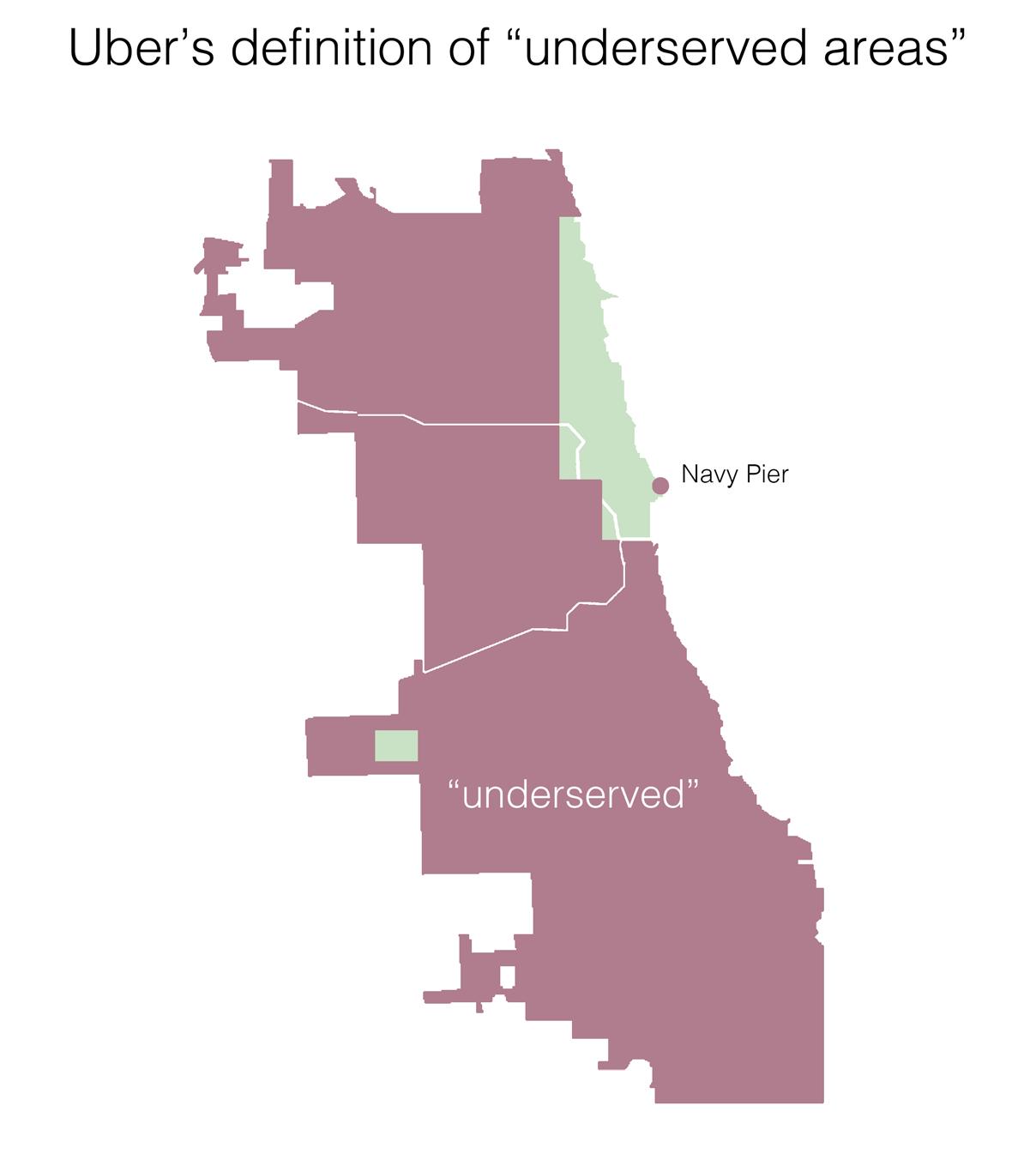
But not all of this behavior is unique to taxis. Uber’s impressive statistic—that the fifty-four percent of rides start and end in underserved areas—is somewhat misleading: the definition Uber uses for “underserved areas” is not restricted to the South and West Sides. Anderson cited a city document last updated in 2012 as the source of Uber’s definition, under which the boundaries for underserved areas include north of Devon Avenue, west of Ashland between Devon and Grand, west of Halsted between Grand and Roosevelt, and south of Roosevelt, with the exclusion of the airports (and, for some reason, the inclusion of McCormick Place on Sundays). The enclosed area includes places like Wicker Park and Logan Square, the very neighborhoods that Chicagoans probably associate with bar-hopping millennials and Ubers swarming around to collect them. (It is unclear whether the city still uses this definition.)
This casts a new light on Uber’s assertions, but perhaps it shouldn’t be surprising; Uber drivers also have to make ends meet. As Enger pointed out, the same economic disincentives that may keep taxis out of the South Side could have the same effect on Uber. He was skeptical that adding more South and West Side drivers would necessarily lead to more rides in those areas, since the drivers might leave for the North Side to get more fares.
“When I start on the South Side of the city, more times than not I wind up on the North Side of Chicago,” said one Uber driver who requested anonymity to keep his job with Uber safe. The driver also works for Lyft.
But he also said that the expansion of South Side drivers could improve the avail-
ability of South Side rides: “Maybe you will have local people do local trips now and they’ll go ahead and do the fares within their own neighborhood, instead of someone having to come further and get them.”
Gersh Mayer, who has been driving for Uber for five months but has driven for various services, including a cab company, since 1961, said that from his experience, Uber drivers are sometimes guilty of discrimination as well. Mayer, who’s from Hyde Park, sometimes posts on a forum called UberPeople.net, where Uber drivers congregate to discuss their work, and spoke of threads where drivers discuss which neighborhoods in Chicago to avoid. The Weekly found drivers posting about this topic on the forum as well.
“There’s no question that a lot of people are getting service that weren’t getting it before,” Mayer said of Uber’s ridesharing services, but at the same time, “most folks driving UberX are not bopping over to Englewood or Pullman or Roseland to get a cup of coffee.”
Schuble said the breakdown of stigma over the South Side is essential for improving transportation in the area.
“It’s like, people live there, okay?” he said. “It’s not like it’s some zone where it’s completely uninhabitable and it’s just sort of reckless, it’s not like that at all.”
While Uber may posit itself as part of that improvement, taxi drivers and supporters maintain that there are other ways to increase service to the South Side. Having already purchased or leased the expensive taxi medallions that are required to drive a cab, taxi drivers are concerned about making up those expenses and are fearful that ridesharing services will eventually siphon off all of their business.
In early October, Mayor Rahm Emanuel announced a tax credit program for both taxis and ridesharing services that would incentivize picking up passengers in underserved areas. Enger, however, is skeptical that
this will have any impact, given the difficulty for the driver of keeping track of all the records.
Enger’s solution is an idea he pitched to the city for a universal taxi dispatch app, which would allow passengers to electronically summon a taxi, just as they would an Uber. The city put out a request for proposals for the app in May, and Enger said it will be released in the upcoming months. (At press time, the city had not responded to requests for confirmation.) He thinks the convenience of electronic payment, as well as the fact that users will be able to access all the taxis in the city rather than just from one taxi company, will be popular among consumers.
“The more reliable we become, the more likely it is that people call us,” said Enger. “People on the South Side have fallen out of the business of calling taxis because they can’t get one.”
Enger also said a guaranteed electronic payment through the dispatching app could help assuage cab drivers’ fears of not getting paid or of having wads of cash stolen, which could make them less nervous about entering areas they consider dangerous.
In response to the prospect of a taxi dispatch app, Anderson of Uber wrote, “We welcome competition.”
When questioned on whether the taxi app would really be able to compete with Uber’s lower fares (excluding its times of surge pricing), Enger said that some people would pay a few extra dollars for the safety he believes comes with the increased regulation of cabs or just for ethical reasons.
Another alternative, cab driver Cheryl Miller suggested, is a revival of the city’s underserved medallion program, in which the city gave some drivers a medallion for free if they did a certain amount of service in underserved areas.
“By reducing the cost to drivers, it made it feasible for drivers who wanted to work in the neighborhoods to actually be able to do so,” she said. However, “when medallion prices started to climb, it was more profitable
for the city to sell them at an auction.”
Both Miller and Enger see preserving taxi careers against the encroachment of ridesharing companies as a way of maintaining full-time jobs that have historically opened a path into the middle class. They contrast this with Uber’s employment model, in which many drivers work parttime.
Uber, however, actively promotes the fact that drivers can work part-time and have flexible hours. Anderson wrote that more than fifty percent of drivers use the Uber platform less than ten hours a week. Andrew Wells, director of the Workforce Development Center at the Chicago Urban League, said that the Urban League partners with Uber so it can refer those who come in looking for more flexible work.
“If they don’t want to be bogged down from nine to five, then Uber was the best choice for them,” said Wells. “And many of them love the money they’re able to make. They’re able to pay their bills.”
However, while Wells said the drivers he had referred to Uber were satisfied and Pfleger wrote in an email that the drivers he had spoken to liked it, others are not so optimistic about Uber’s opportunities. Discontent plays out publicly on the UberPeople. net forum, and Mayer and the anonymous Uber and Lyft driver articulated some concerns to the Weekly. Just as taxi drivers worry about making ends meet, some Uber drivers struggle with the same challenge under the company’s employment structure, both here and beyond Chicago. In October, some Detroit Uber drivers went on a weekend strike to protest the company’s lower fares.
One factor in their discontent is the commission that Uber takes for each ride, which has been rising, according to drivers. The anonymous Uber and Lyft driver said that Uber’s commission was ten percent when he first started, but it rose to fifteen and then twenty percent. He said Lyft also takes a twenty percent commission. Howev-
er, newer Uber drivers are paying even more; Mayer said Uber is taking twenty-five percent of his commission, and many new drivers writing on UberPeople.net corroborated that claim. This commission raise for new drivers has been playing out in other cities across the nation as well, as Ellen Huet of Forbes reported in September. In Chicago, this means that many of the drivers signed up under Uber’s South and West Sides initiative will pay the twenty-five percent commission. Uber also does not allow passengers to tip in the app, while Lyft does.
Uber keeps its fares low partly because the company doesn’t pay for car maintenance and complete insurance. But Uber drivers still eat that cost, since the wear on their car from Uber driving eventually catches up with them. One user on Uberpeople.net, S_hicago, wrote in response to a request for
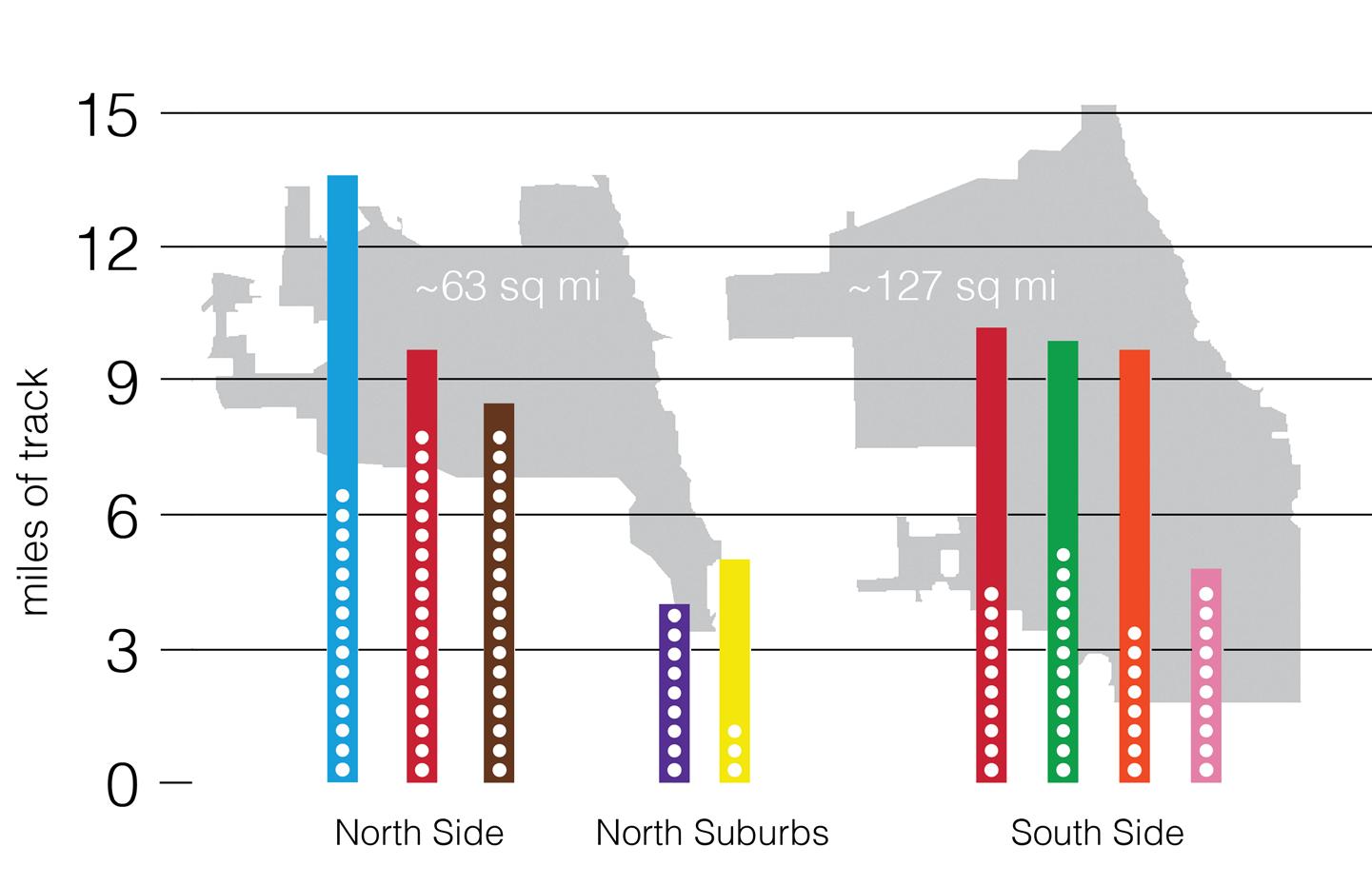
Above: The ratio of track length to number of stops (represented by white dots) is lower on the South Side than on the North Side.
Left: Uber uses a definition of “underserved areas” that comes from a city Department of Business Affairs and Consumer Protection (BACP) document entitled “Public Chauffeurs Rules and Regulations,” last updated in 2012.
sources, “That’s the biggest problem for any driver. The hidden cost of depreciation that you won’t notice for a while if you don’t realize it’s there. You could dig yourself a hole for two years without ever realizing it.” According to Mayer, who is highly critical of the company despite driving for it, when Uber advertises high earnings to its drivers, they often use figures that imply gross revenues, rather than revenue after expenses.
Uber is also often criticized (usually by taxi drivers) for having questionable insurance policies. The company provides liability insurance for UberX vehicles while the Uber app is on, but Mayer said that many of the insurance policies Uber drivers have themselves don’t support vehicles that are ever used for ridesharing services. Some insurance companies have canceled policies after finding out that their clients are rideshare drivers after
an accident, according to a PolicyGenius article from last year. Recently, some insurance companies have created policies that cater to rideshare drivers; Uber has partnered with the insurance startup Metromile to offer one. Mayer was able to get a fairly inexpensive one of these policies, but he estimates that many other drivers still don’t have this insurance, since Uber doesn’t require it.
Despite saying it had been more difficult to maintain earnings recently, reporting struggles with a new update to the Uber app, and claiming that “Uber isn’t what it used to be,” the Uber/Lyft driver who spoke to the Weekly still had good things to say about Uber.
“I like being my own boss and having the freedom,” he said. “There are certain things you have to give up for freedom.”
S_hicago from Uberpeople.net said
these financial concerns end up affecting where Uber drivers go. In S_hicago’s view, while service to the South Side needs to be addressed, it’s not just about particular drivers not being willing to work in the area.
Uber has certainly expanded service to the South Side, and there’s no denying that racism and discrimination can have an ugly influence on both taxi and Uber service. Yet in the debate about how to sustainably and fairly solve the problem of equitable service to the South Side, it is important to consider the fact that many taxi and Uber drivers, including those from the South Side, are working to pay off expenses and make a living in a difficult climate.
“I would have zero problem driving the South Side,” wrote S_hicago. “There’s just no money to be had. Read or write whatever socioeconomic story you want into that.”
BY EMILIANO BURR DI MAURO
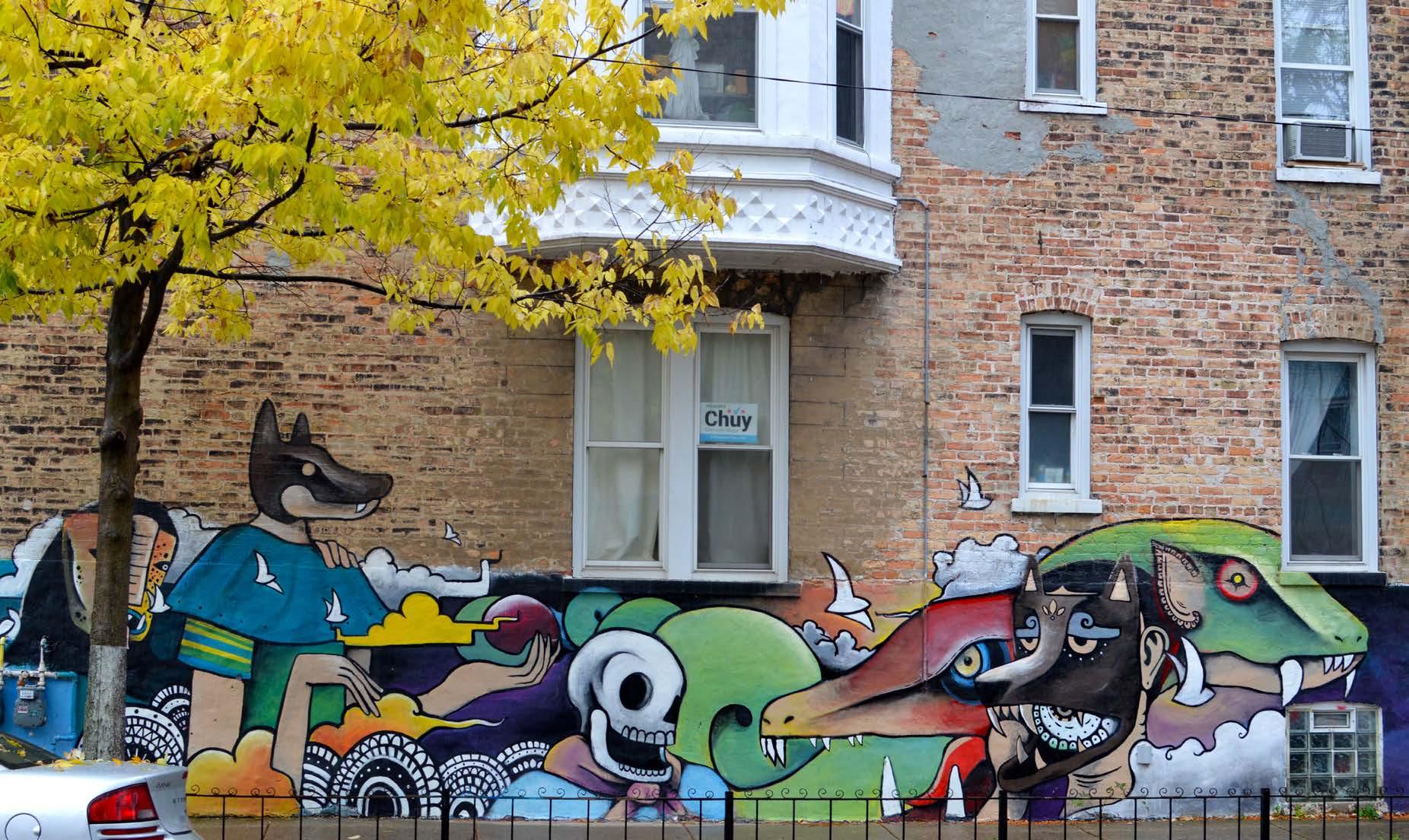
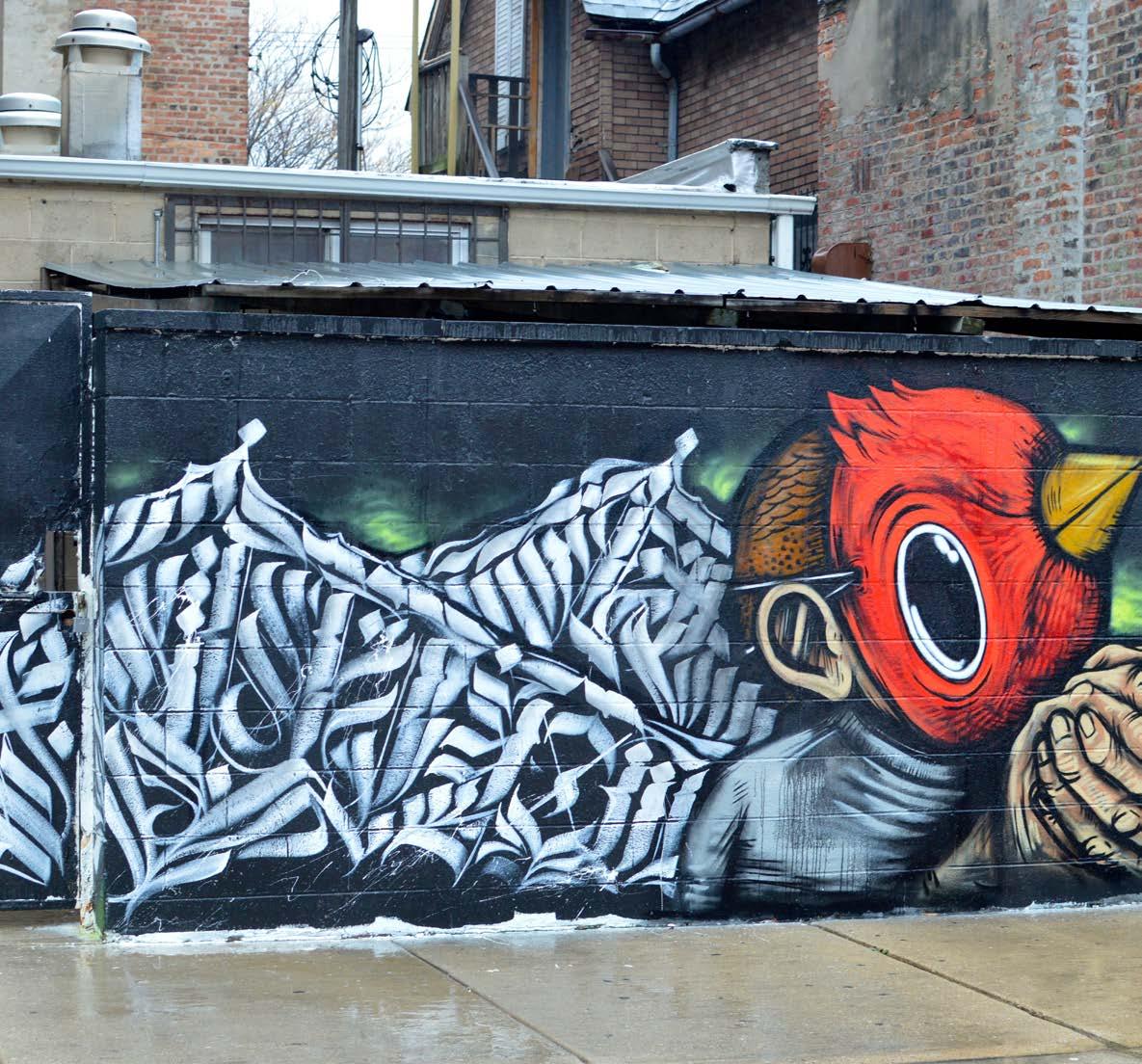
On a particularly gray Saturday, the murals along West 26th Street seem to be temporarily storing all the spirit of Little Village, ready to return to its rightful place in the inhabitants and businesses only when the rain finally lets up. Other pedestrians who pass these murals are understandably unfazed by their vibrancy, as I’m sure they’ve passed them numerous times before.
Initially, the pieces seem to blend into their surroundings, the colors and depictions as common as the bricks they are painted on. Yet it does not take long for their sheer volume to become apparent: on every other street corner, on the exterior walls of businesses, and plastered all over alleyways, they often take up whole sides of buildings. The imagery is eventually so ingrained in my mind that dilapidated buildings and shuttered storefronts begin to look less like abandoned places and more like canvas space up for grabs.
I’m meeting Hector Lopez, a graffiti artist who grew up and went to school in Little Village, at the laundromat on Avers Avenue, close to where he lives (he has to do a load of laundry before we start speaking). We walk in a different direction than the one I had come; this time the walls around us exhibit some of his own work—in which lettering is more central, in contrast to the emphasis on characters or images in the murals I saw during my own exploration. Our conversation paused every few minutes as he rattled off the names of several artists, pointing to their work as we walked.
Lopez has been interested in art for most of his life, but turned his focus to pub-
lic art and mural painting when the problem of gang-related graffiti in the neighborhood became too large to ignore. Multiple came to the same conclusion about five years ago, and murals started appearing to er tags designating disputed territory between gangs—tags that Lopez says used to cover large majority of the residential and commer cial wall space in the neighborhood.
“I would say about fifty-five percent why I started was because I wanted to paint,” Lopez says. “But forty-five percent was cause I wanted to cover up that gang graffiti saw everywhere. I thought this neighborhood deserved more.”
Lopez and other artists I spoke to started doing graffiti in high school in the only they could: illegally, on any wall space could find. But, says Lopez, it’s hard for kind of artist to get people to take them their work seriously.
Nowadays, he is a part of one of the graffiti crews in the neighborhood: somewhat elusive groups that have the rights to certain walls (permission granted by business owners or landlords); these crews gladly rotate rights amongst themselves, allowing others paint over their work.
While he declined to tell me the of his crew, perhaps in an attempt to preserve some of the counterculture tradition that ularized graffiti art in large urban centers New York, Los Angeles, and Chicago 1970s and 1980s, Lopez admits that he doesn’t have to worry about getting permission wall space anymore.

problem neighborhood artists or six to covbetween cover a commerpercent of paint,” was begraffiti I neighborhood started only way space they for that them and many somewhat certain owners those others to name preserve that popcenters like in the doesn’t permission for
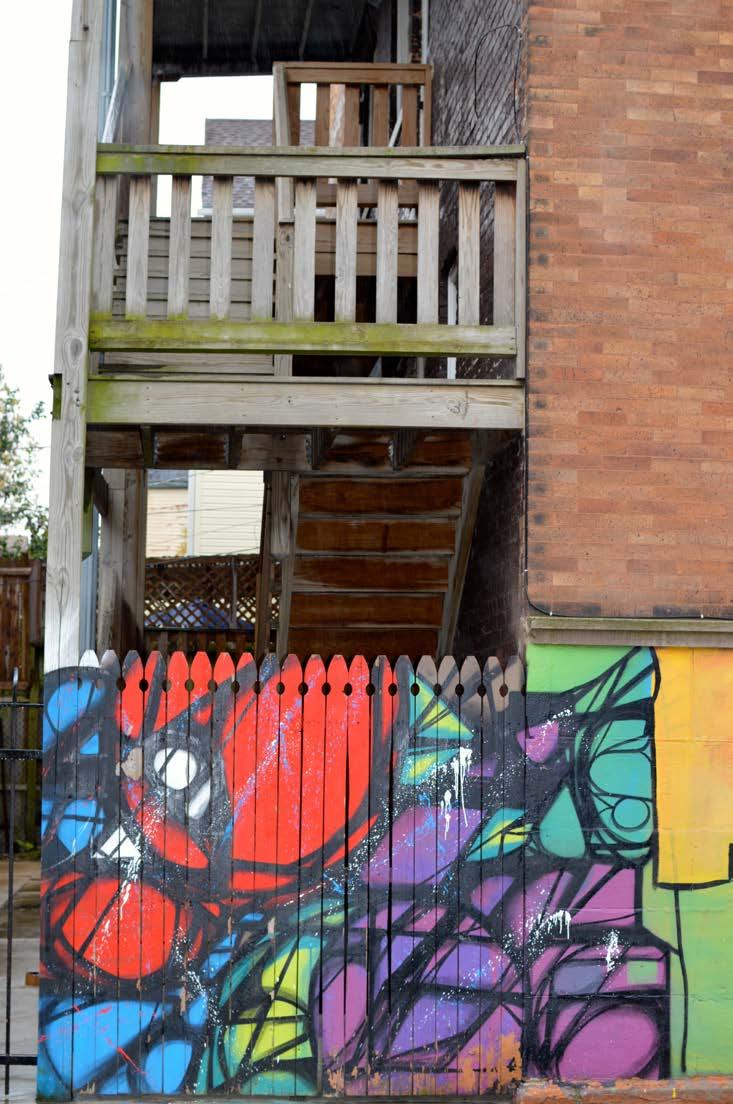
Only a few minutes later, we make it to the intersection of 26th Street and Karlov Avenue, where there is a small alcove of concrete space in between two storefronts, completely covered in artist work; both wall and ground space are entirely painted over (pictured). Coincidentally, this is one of the spaces that Josue Aldana, a friend and collaborator of Lopez’s, told me to visit when I spoke with him on the phone earlier that week.
The space features the work of multiple artists, and is one of nine spaces that Aldana has “activated” in recent years: it features a wide range of artists and their various styles.
“Because of my love for the community and the need to really find this niche as an artist here, I felt like small paintings didn’t get the point across,” Aldana says. “Street art and vibrant murals are the best way to reimagine or reactivate these spaces completely in terms of culture, history, and Mexican lore.”
These artists’ investigation of their collective identity has also unintentionally changed the way residents of the neighborhood think of the medium. Graffiti has traditionally been shrouded in secrecy and viewed negatively in the eyes of the public, particularly in light of the ubiquitous presence of gang tags on Little Village’s surfaces, says Aldana. But in the process of “neighborhood improvement,” graffiti has changed into a symbol of that improvement rather than an impediment to it, for residents and business owners alike.
Lopez’s ease in attaining wall space permission hints at this trend. Now, what would have been done under the cover of night just five or ten years ago can be and is done in
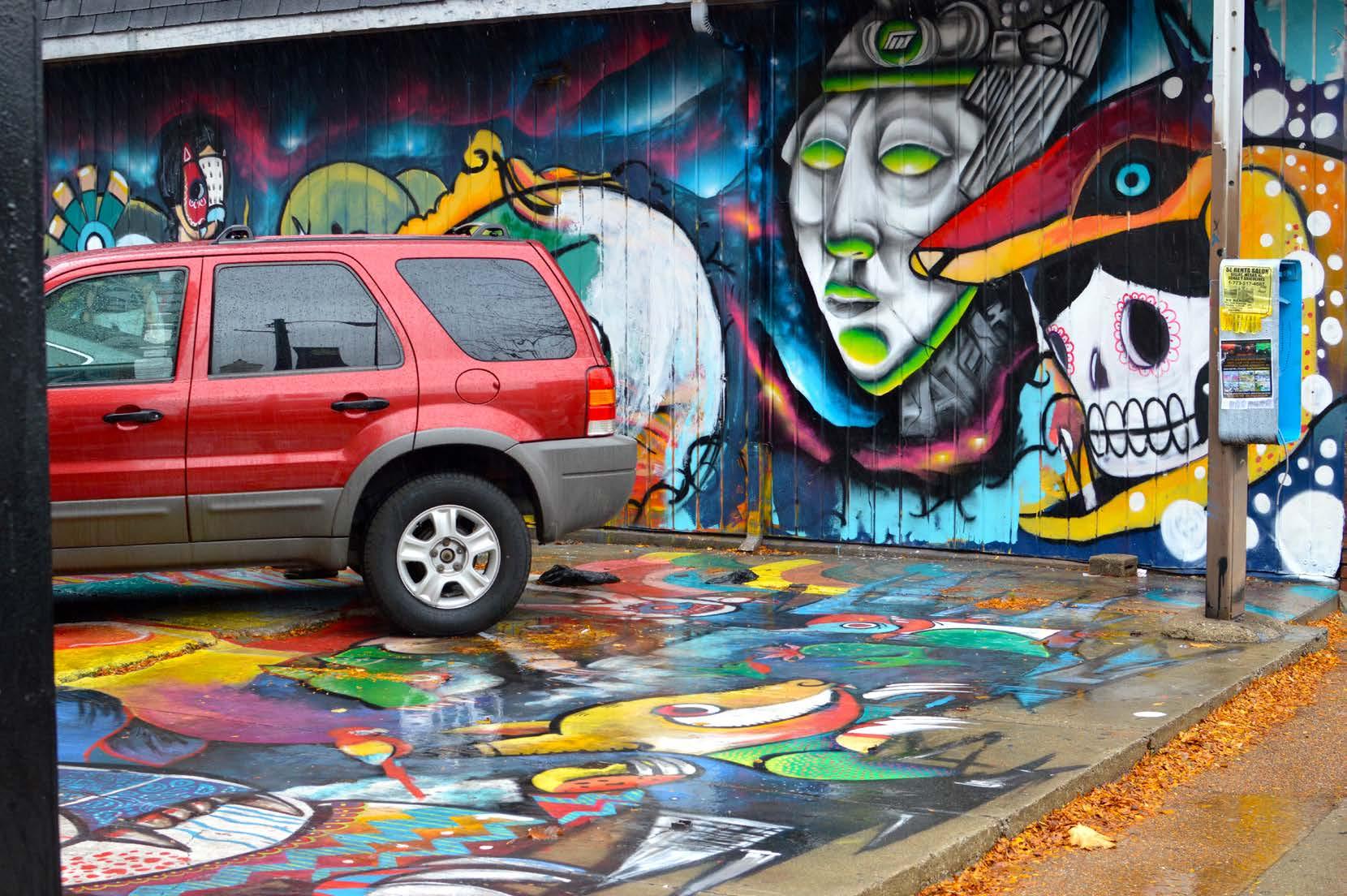
broad daylight, with many artists painting from morning till night.
“It’s a lot more acceptable now than it was five years ago,” graffiti artist Epifanio Monarrez says. “There are a lot of walls I asked for five years ago, from people who said it would never happen, and now I see them give those same walls to artists as they are becoming more accustomed to seeing massive pieces everywhere.”
The intentions of this transformation, however, were not singular: concurrently, the act of community beautification also began to address what Lopez felt to be a lingering stigma around traditionally marginalized Latino communities. As the work spread, with artists independently joining crews and, at the same time, the unspoken movement against gang graffiti, the murals began to tackle questions of identity within Little Village, which only became inhabited by a wave of Mexican immigrants in the 1970s, after a long history of Eastern European, Irish, and Polish settlement and immigration. A reflection of this attempt at understanding, many artists’ work—including that of Aldana and Monarrez—heavily employs the use of Mexican imagery and iconography.
In recent years community organizers have joined in on this transformation and begun to build upon what artists started in their mission to cover up gang graffiti. In particular, though, these organizers brought the new goal of incorporating the neighborhood’s youth in this process, according to Monarrez.
Enlace Chicago, an organization based in Little Village, is one such group; it does
not have an arts focus, but for the last three summers it’s been coordinating the Graffiti to Mural initiative, which has graffiti artists from the community like Aldana teach a class to high school students. The curriculum often includes the planning and painting of a largescale mural.
“That’s one of the most powerful things about arts in the neighborhood: that many artists started out as kids, themselves,” Docia Buffington, the development director at Enlace, said. “It’s really the connection to youth that artists have—I can’t think about any collaboration with youth that’s not geared towards improving the neighborhood.”
In addition to Enlace, other arts programs for Little Village high school students are offered through the Yollocalli Arts Reach initiative at the National Museum of Mexican Art. The programs at Yollocalli also exist with the hope that collaboration between youth and artists like Monarrez and Lopez fosters dialogues about Mexican and Mexican-American culture and identity beyond the basic goal of offering an opportunity to learn a set of technical skills.
One of the Yollocalli teaching artists at Richards High School, who goes by the name Gloe, hopes that she can help her students learn graffiti whilst also assisting them in asking some of the questions that she was thinking about during her own childhood in Little Village. “I think it’s very important to help youth question things. With social media and TV, there’s too much information to take in, and a lot of time young people don’t take the time to process that information,” Gloe says. “I
think through slowing down and creating art, you let your mind unwind and allow yourself to learn about who you are.”
Artists responding to and shaping their environments, familiar or otherwise, is nothing new to Chicago—and neither is graffiti and mural art, for that matter. However, there is something particularly effective about the way artists who grew up in Little Village are expanding their work past something of personal expression and experience, and collaborating with community organizers for the common goal of visually and culturally invigorating Little Village.
As the two parties realize the power of previously illegal art in empowering the community and its youth, they are actively taking charge of both the public opinion surrounding their neighborhood and strengthening how residents view themselves. “Our culture is only as deep as our roots go, but we can always go deeper,” Aldana says. “There should be a heavy sense of pride and we need to cultivate that amongst ourselves.”
Murals may not immediately do more than beautify spaces and allow for expression, but, as the graffiti crews and artists of Little Village demonstrate, public art in specific context can reflect the passion of a neighborhood’s residents and its roots.
“Little by little with the new generation, new minds push this place differently, but there’s still a reference back here. I mean, let’s see what it’s like in fifteen years,” Lopez said as we walked back down West 26th Street towards the laundromat.
The tale of the House of Atreus continues at Court Theatre with Agamemnon
BY EMELINE POSNER
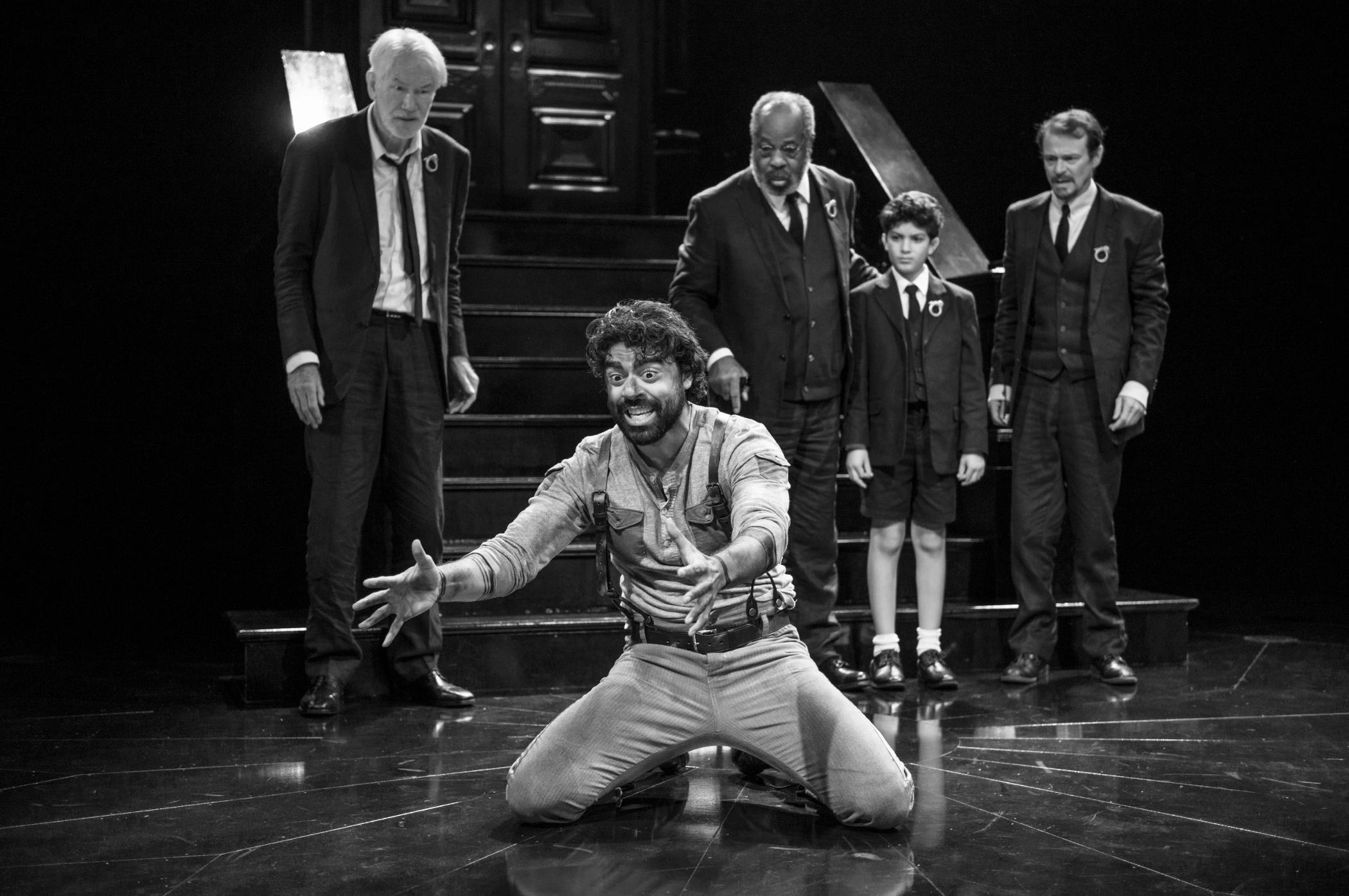
“Sing sorrow, sorrow, but let the good prevail.” So goes the chanted refrain of a three-man chorus of city elders as they speak of the great Agamemnon to the young boy in their company, too young to have met the Mycenaean king before his departure for the Trojan War, too naive to truly understand the origins of his family’s perpetual bloodshed.
Agamemnon, the second in Court Theatre’s three-tragedy cycle, builds upon the story begun in last fall’s production of Iphigenia in Aulis: the tale of the House of Atreus, a powerful Greek family with a legacy of familial slaughter. In Iphigenia, the eponymous first-born daughter of Agamemnon dies at his hands, sacrificed to the gods so that the Greek fleet might find favorable weather conditions as they sail to war from Boeotia to Troy.
Ten years elapse as the lights dim for Agamemnon, and the Greek fleet is making its victorious, long-awaited return home from battle. But the return, which one would expect to herald joy, does no such thing. Although the two tragedies were written by different hands—Iphigenia by Euripides, Agamemnon by Aeschylus as the first third of the tragic trilogy the Oresteia—the latter does not forget the lasting despair of Clytemnestra, the deceived mother of Iphigenia.
The early incantations of the chorus set the trepid tone that endures throughout the play, a tone that is augmented by the audience’s knowledge of the imminent murders of Agamemnon and Cassandra, the prophetess of Apollo he brings home from Troy as a concubine. But a superb quartet of cast, directing, set, and costumes holds the audience captive in their seats to a play that, for its innumerable translations and productions over the years, remains as enthralling and relevant as ever.
The audience first sees Clytemnestra (Sandra Marquez) when an imposing pair of black doors at center stage swing
open forcefully, as if by the will of a deity. Clytemnestra stands in the small foyer, laughing maniacally as she scrawls on walls that were once a pure white: Iphigenia. IPHIGENIA. IPHIGENIA.
Marquez brings to Clytemnestra’s character a womanhood that is fierce and sensual, but all the while calculating. She acknowledges unapologetically her capability as ruler of the House of Atreus and, by virtue, the city of Argos in the absence of her husband: “I am a queen, and there is no shame to speak of it.” Even the chorus, loyal to her by virtue of her marriage to Agamemnon, but wary of her cunning, concedes that she possesses the “wisdom of a sensible man.” Yet the extent of her power needs no verbal affirmation; as she dances her fingers over her body and through the air around her, imitating the movement of the beacons that alerted her to the Greeks’ victory over the Trojans, she reduces the men of the chorus to quivers and moans on the floor.
Not even upon the return of war-weary, icy-eyed Agamemnon, played this year as last
by Mark L. Montgomery, does Clytemnestra allow her rage at her husband’s deceit to eclipse her cunning, though the bitterness in her voice betrays her in a way that the content of her lengthy speeches does not. They partake in a mistrustful dance across the stage and weave around the chorus as Clytemnestra caresses her husband’s ego in an (ultimately successful) maneuver to reaffirm his trust in her before bringing his first day back in Argos to an unexpected end.
But it is the continuous onstage presence and dialogue of the fantastic chorus (played by Gary Wingert, Thomas J. Cox, and Alfred H. Wilson) that sustains the play between the lengthy monologues of the more explosive central characters. While sole occupants of the stage, the chorus members present their own multifaceted take on ongoing events, as well as their hopes for their city, with the added emphasis of the stamping of canes and gestures towards the heavens, and with teary eyes as they clutch at the white kerchief of Iphigenia.
And when Agamemnon cavalierly
presents Cassandra, his new addition to the house, Cassandra sits stunned, responding to neither Agamemnon nor his seething wife. Only when the conciliatory chorus cautiously and kindheartedly approaches her does she begin her haunting song, part prophecy of the murder that is shortly to occur, part lament of the curse of Apollo—because she rejected Apollo’s advances, not a word Cassandra speaks reaches believing ears.
Agamemnon’s translator Nicholas Rudall, University of Chicago Professor Emeritus in Classics and Court Theatre’s Founding Artistic Director, is known for the “playability” of his translations of ancient literature, and Agamemnon is no exception. Rudall forgoes the formality characteristic of many translations meant to be read alone in favor of a script that resonates with a modern audience.
Rather than having his chorus speak at length in unison, or chant and dance as they would have in an ancient Greek production, Rudall has them partake in dialogue with each other, with the exception of short refrains (“Sing sorrow, sorrow, but let the good prevail”) and invocations of the gods, which they chant together. The fusion of dramatic elements characteristic of Greek tragedy and a more casual dialogue format make for a more dynamic play and more relatable characters, as well as for a variation in opinion expressed by the chorus—about, for example, the nature of Clytemnestra’s rule and the validity of justifications employed after the killing of a family member.
One of the results of this “playable” translation is that even at the play’s most tense moments, an offhand remark by a character elicits laughter from the audience, a reaction one doesn’t necessarily expect during a tragedy. After a monologue in which Clytemnestra persuades her husband to walk into the household on the finest of purple fabrics, as is only fit for a king, she urges, Agamemnon turns around to say, “You