The South Side Weekly is a nonprofit newsprint magazine written for and about neighborhoods on the South Side of Chicago. We publish in-depth coverage of the arts and issues of public interest alongside oral histories, poetry, fiction, interviews, and artwork from local photographers and illustrators. Started as a student paper at the University of Chicago, the South Side Weekly is now an independent nonprofit organization dedicated to supporting cultural and civic engagement on the South Side, and to providing educational opportunities for developing journalists, writers, and artists.
Contributing Editors Will Cabaniss, Eleonora Edreva, Lewis Page, Hafsa Razi
Social Media Editor Sam Stecklow
Web Editor Andrew Koski
Visuals Editor Ellie Mejia
Layout Editors Adam Thorp, Baci Weiler, Sofia Wyetzner
Senior Writers: Patrick Leow, Jack Nuelle, Stephen Urchick
Staff Writers: Olivia Adams, Amelia Dmowska, Maira Khwaja, Emiliano Burr di Mauro, Michal Kranz, Zoe Makoul, Sammie Spector, Zach Taylor
Staff Photographers: Juliet Eldred, Finn Jubak, Alexander Pizzirani, Julie Wu
Staff Illustrators: Javier Suarez, Addie Barron, Jean Cochrane, Lexi Drexelius, Wei Yi Ow, Amber Sollenberger, Teddy Watler, Julie Wu, Zelda Galewsky, Seonhyung Kim
Editorial Intern Clyde Schwab
Webmaster Sofia Wyetzner
Publisher Harry Backlund
The paper is produced by an all-volunteer editorial staff and seeks contributions from across the city. We distribute each Wednesday in the fall, winter, and spring, with breaks during April and December. Over the summer we publish monthly.
Send submissions, story ideas, comments, or questions to editor@southsideweekly.com or mail to: South Side Weekly 6100 S. Blackstone Ave. Chicago, IL 60637
For advertising inquiries, contact: (773)234-5388 or advertising@southsideweekly Read our stories online at southsideweekly.com
Cover illustration by Ellie Mejia
IN CHICAGO
A week’s worth of developing stories, odd events, and signs of the times, culled from the desks, inboxes, and wandering eyes of the editors
Police, Protests, and Presidents
Sixty-six protesters were arrested outside McCormick Place on Saturday after they chained themselves together and blocked traffic. The protest was a challenge to participants in the ongoing International Association of Chiefs of Police (IACP) Conference taking place inside the convention center. They were from a crowd of hundreds of other protesters representing various groups, including We Charge Genocide and the Black Youth Project 100. The groups gathered to call for an elected police accountability board and to oppose Rahm Emanuel’s plan to increase police funding and hire 300 additional officers, among other demands. At press time, President Obama had not yet made his planned Tuesday speech to the conference, though last week he did defend protesters’ use of “Black Lives Matter” instead of “All Lives Matter” at a criminal justice forum.
Spike Speaks
On Thursday, Chicago Magazine had the honor of presenting Spike Lee’s first in-depth interview about his film Chi-Raq, to be released in December on Amazon. Lee opened up to reporter Bryan Smith about his clashes with the mayor over the movie’s theme (Chicago gun violence), his tight relationship with Father Michael Pfleger of St. Sabina, and some details about the film. Lee called Rahm Emanuel a “bully” for accusing Chi-Raq of bringing Chicago bad press and impairing tourism, when, Lee claims, tourism and economic development are doing just fine downtown, while the South Side is neglected. Lee also confirmed
that the film will be based on Aristophanes’ ancient Greek comedy Lysistrata, in which women withhold sex from men in order to convince them to end the Peloponnesian War. (The remaining two percent of people who weren’t already eagerly awaiting Chi-Raq’s release must now be anxiously anticipating how Lee will pull off this unlikely marriage of themes.) Overall, Lee says, his primary mission with the film is to “save lives” by highlighting the impact of violence. The movie will include Purpose Over Pain, a group of mothers who have lost their sons to gun violence. “Calm down,” says Lee to those concerned about the film’s plan to intertwine humor and death. He promises he will address the violence with its due gravity; otherwise, he says, “Father Pfleger would have… damned me to hell a long time ago.”
Curse of the Byrd
Today, Chicago Public Schools CEO Forrest Claypool is set to go in front of the Board of Education to propose opening two new charter schools in the city. During the same meeting, the CPS proposal will call for ten charter schools to be put on a warning list, which could result in a shutdown in the next few years. The numbers just aren’t in CPS’s favor this week—Emanuel’s proposed budget calls for $480 million in state funding for the city’s schools. There’s only one problem—the state budget isn’t likely to pass anytime soon. To cap it off, CPS enrollment decreased by 4,400 students this year, dropping below 400,000 for the first time in twenty years, most of it in district-run schools. Though charter school enrollment went up.
IN THIS ISSUE
In the shadow of the announcement, one contingent has been almost completely silent on the subject. isaac stein...4
THE pOTEnTIaL Of SpacES It wouldn’t make sense for us not to participate in the Biennial. cecilia resende-santos...6
“THIS IS a cOnvErSaTIOn” This was the kind of boldness he was hoping for. ariella carmel...7
SEEIng THE InvISIbLE
Only fourty-four cases out of all complaints resulted in a “repeat” officer being issued a major penalty. lewis page...8
OnWarDS anD UpWarDS "These guys are pros and they know what they are doing."
stephen urchick...12
pOLITIcaL cLaY
I know I am in the right place when I see Donald Trump's face on a plate. ellen hao...14
HOpE In a HOT SHOp
“I wanted something with crazy, wild colors.”
kristin lin...15
gOD DrOpS THE gOSpEL Waka Flocka Flame has worn one of his shirts. christophor good...16
a SpacE Of HEr OWn
Honest pastries that do not convey any hint of pretension darren wan...17
HOLY crOSS TraUma cEnTEr
After Years of Protest, Red Tape Ahead for Holy Cross Trauma Center
ELLIE MEJIA
Proposal must pass regional hospital vote, lengthy public hearing
BY ISAAC STEIN
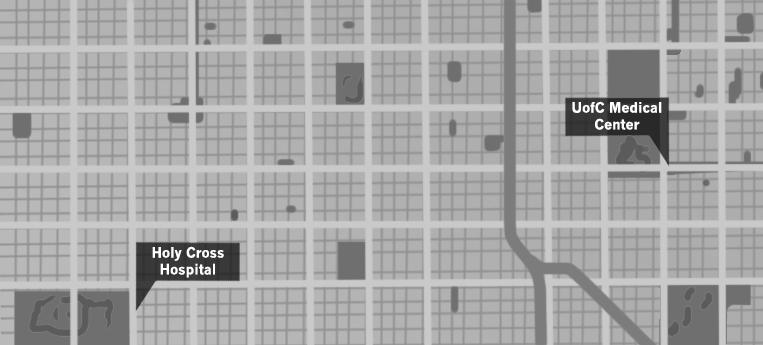
The construction of an Adult Level I Trauma Center on the South Side, long a rallying point for local health equity activism, will likely be realized in the next few years at Holy Cross Hospital in Chicago Lawn. In September, the University of Chicago Medical Center (UCMC) and Sinai Health System, the private, nonprofit hospital group of which Holy Cross is a member, announced a proposal to build a trauma center at the hospital, which administrators of both organizations estimate will take at least two years.
Significantly less certain is how the trauma center will be financed once it is constructed, and the timeline for the bureaucrat-
ic checkpoints that are required to bring the facility to fruition. And for the South Side activists who vocally applied public pressure to the UofC, the outcome—a trauma center some distance from Hyde Park—has left some with mixed feelings.
Dr. Gary Merlotti, Chair of Sinai Health System’s Department of Surgery, said that all regional trauma center directors will vote on the proposal at a Region XI EMS meeting on December 17. Region XI EMS is a professional association of all emergency care-providing hospitals in Chicago, and it includes not only nonprofit private institutions like Sinai and UCMC, but also the John H. Stroger, Jr. Hospital of Cook Coun-
ty, which is public. Pending an affirmative vote, the proposal will travel to the Illinois Department of Public Health (IDPH) for state approval.
Last month, the UCMC announced in a statement that it would contribute capital to the project in order to “fund the facility improvements at Holy Cross Hospital, which are estimated to be in the range of $40 million,” and would also staff the trauma center with trauma-related subspecialists in its employ, including “general trauma, neurological, orthopedic and plastic surgeons, urologists, and other areas.” Merlotti said that the UCMC’s contribution of personnel will be critical for the facility to function and noted
previous instances of the two organizations sharing human resources.
“We would expect that the majority of people at Holy Cross would be Sinai Health System people, but the UofC is going to be helping us with some of the higher-end people, if you will. In terms of the partnership, it is certainly not written in stone, but it is not a plan that they’re going to dump $40 million to build this building, and just walk away from this. We have had a long-term collaboration with the University of Chicago in many areas. Their residents rotate to our hospital at [Mount] Sinai for Trauma Education, believe it or not,” Merlotti said, in reference to the scale of UCMC’s human
resources and budget.
“They are also obviously going to be involved in caring for patients at Holy Cross,” Merlotti added. “The $40 million number is not contractually agreed upon, and the cost of building the trauma center could be higher.”
But he declined to comment on what, exactly, the UofC’s money will be spent on, how the UCMC and Sinai will share the costs of running the trauma center once it is constructed, or what would happen if the facility loses money.
The UCMC is familiar with the last scenario; it occurred when it built an Adult Level I Trauma Center at its main location in Hyde Park in 1986. According to WBEZ, the facility lost $2 million per year until the UofC closed it in 1988. Currently, the UCMC operates a pediatric trauma center that admits patients as old as fifteen years of age. For Merlotti, a critical difference in the financial viability of a trauma center at the present time is that patients who were previously uninsured are covered by the Affordable Care Act.
“The financial milieu for trauma at the present time is somewhat improved because of the Affordable Care Act, and the fact that the majority of people who in the past came to trauma centers in the state uninsured, now they almost always qualify for Medicaid managed care, and we can recoup some of the cost of providing care for them,” Merlotti said. “But this is not going to be a moneymaker, and this is not why we’re going into trying to make this into a trauma center. We’re trying to provide a service to a community around us that needs that service desperately.”
That need, he said, is for high-quality adult trauma care at a hospital that people who live near Chicago Lawn tend to go to because of the inaccessibility of closer facilities, even if they have serious injuries that could warrant transport to an existing trauma center.
However, Merlotti contests the suggestion that physical proximity to a trauma center is critical to preventing South Side trauma deaths.
In 2013, Dr. Marie Crandall, an associate professor of Surgery and Preventative Medicine at Northwestern, and collaborators published “Trauma Deserts: Distance From a Trauma Center, Transport Times, and Mortality From Gunshot Wounds in Chicago” in the American Journal of Public Health, which argued that the absence of a trauma center within five miles of most South Side residents contributed to longer ambulatory transport times for trauma patients, and
therefore a higher likelihood of trauma death after transport, than for their North Side counterparts.
“In all honesty, we’re still waiting to collect some data to provide a clear of analysis of this,” Merlotti said. He pointed out that “in the language of Crandall’s research, when this facility is constructed, the most at-risk patients that she identified in her study will be within five miles’ radius at Holy Cross.” He noted, however, that “Dr. Crandall’s ‘Trauma Deserts’ is also not a universally accepted document in the trauma care community; the study has never been replicated. In this type of care, mileage [in transport] is not the critical factor. If you had a supersonic train to get there, you’d be doing well. Time is the issue. Time on the scene, time on the ambulance, time that the hospital takes to intervene.”
vocate Christ Medical Center in Oak Lawn, although he believes that this is unlikely. If the proposal passes, it will then go to the Illinois Department of Public Health (IDPH) for official approval, after which construction may begin. Sinai and UCMC are not required by law to submit their proposal to the IDPH by any particular date.
Courtney Avery, the administrator for the Illinois Health Facilities and Services Review Board, the nine-member arm of the IDPH that holds public hearings for new applications for in-state medical buildings and passes its recommendations to the main IDPH office in Springfield, said that a lengthy public hearing for the proposal is “very likely, as the project is affiliated with the University of Chicago.”
Avery declined to clarify her statement, but sent the Weekly a fifty-page transcript
But he declined to comment on what, exactly, the University’s money will be spent on, how the UCMC and Sinai will share the costs of running the Trauma Center once it is constructed, or what would happen if the facility loses money.
Merlotti’s emphasis on time to treatment is consistent with the “Golden Hour” theory, which asserts that a trauma victim’s survival odds decrease substantially after one hour has passed from the time of the incident. However, this viewpoint, like Crandall’s, is not academic consensus. One 2010 study of 3,656 trauma patients, titled “Emergency Medical Services Intervals and Survival in Trauma: Assessment of the ‘Golden Hour’ in a North American Prospective Cohort,” with first author Dr. Craig Newgard of Oregon Health & Science University, found “no significant association” between total time to treatment and mortality.
According to Merlotti, Region XI EMS will consider various studies on the effect of transport times on trauma patient death rates when it meets on December 17 in closed session to discuss and vote on the joint UCMC/ Sinai proposal for the trauma center at Holy Cross. He added that the group will also assess the possibility that the plan could draw patients away from the trauma center at Ad-
Together Organizing for Power (STOP), under the banner of the Trauma Care Coalition (TCC), routinely brushed with the Chicago Police Department in efforts to make their demands heard; at a protest in June, nine participants were arrested. In a statement dated September 10, the same day that UCMC and Sinai announced the plan to build a trauma center at Holy Cross, the TCC released a statement that argued that the location of Holy Cross still leaves “large swaths of the South Side that will not be adequately served by the new trauma center,” as the boundaries of some South Side neighborhoods, such as South Shore, are more than five miles away from the hospital.
While representatives for FLY and STOP declined to comment for this story, Anna Nathanson, a UofC student and member of SHE, said that the activists’ relative quiet is not a reflection of apathy, but rather is about taking time to assess a proposal that is really a public relations gambit. She added that the University’s plan to co-operate an Adult Level I Trauma Center at a facility other than the UCMC is consistent with its goal of “keeping young black people away from their campus.”
“Some of this gets into theories of why social dislocation works. It’s embarrassing for [UofC] alumni to hear about their alma mater’s moral failures, so the proposal at Holy Cross is to make the appearance that the university is doing the right thing,” Nathanson said. She added that she disagrees that most potential trauma patients would be insured, including under Medicaid managed care.
of the proceedings of the last time that the IDPH received a UCMC proposal, in August 2014. The plan, which was approved, was to build a $66.9 million medical office building in Orland Park, which is due to be completed in 2018. In the minutes for the public hearing, Sharon O’Keefe, the CEO of UCMC, discussed UCMC’s role in South Side trauma care at length when prompted by Board Vice Chairman John Hayes. She emphasized the UCMC’s focus on pediatric trauma care, even though the subject was not directly relevant to the proposal.
However, UCMC representatives declined to comment altogether about the planned facility at Holy Cross.
But in the shadow of the trauma center announcement, one contingent has been almost completely silent on the subject: the activist groups that petitioned and protested the UCMC for years to build an Adult Level I Trauma Center at its Hyde Park facility. Students for Health Equity (SHE), Fearless Leading by the Youth (FLY), and Southside
“This stays in line with the UCMC’s policy of keeping the hospital as profitable as possible,” she said.
Nathanson said that SHE is currently soliciting “input” from residents who live near Holy Cross Hospital. She declined to comment on what questions SHE is asking Chicago Lawn residents in order to compile this input.
While Merlotti said that he has not spoken with SHE, STOP, or FLY since the UCMC announced the Holy Cross proposal, he credited activist groups with convincing the University to follow through with the project.
“I cannot say what they’re thinking now, outside of what I’ve read in the papers,” he said. “They just maintained a public awareness of the issue, and they made the University of Chicago believe that they did want to collaborate with us. I think community activism played a role in the University saying yes.”
The Potential of Spaces
The Arts Incubator helps to bring the Chicago Architectural Biennial to the South Side
BY CECILIA RESENDE-SANTOS
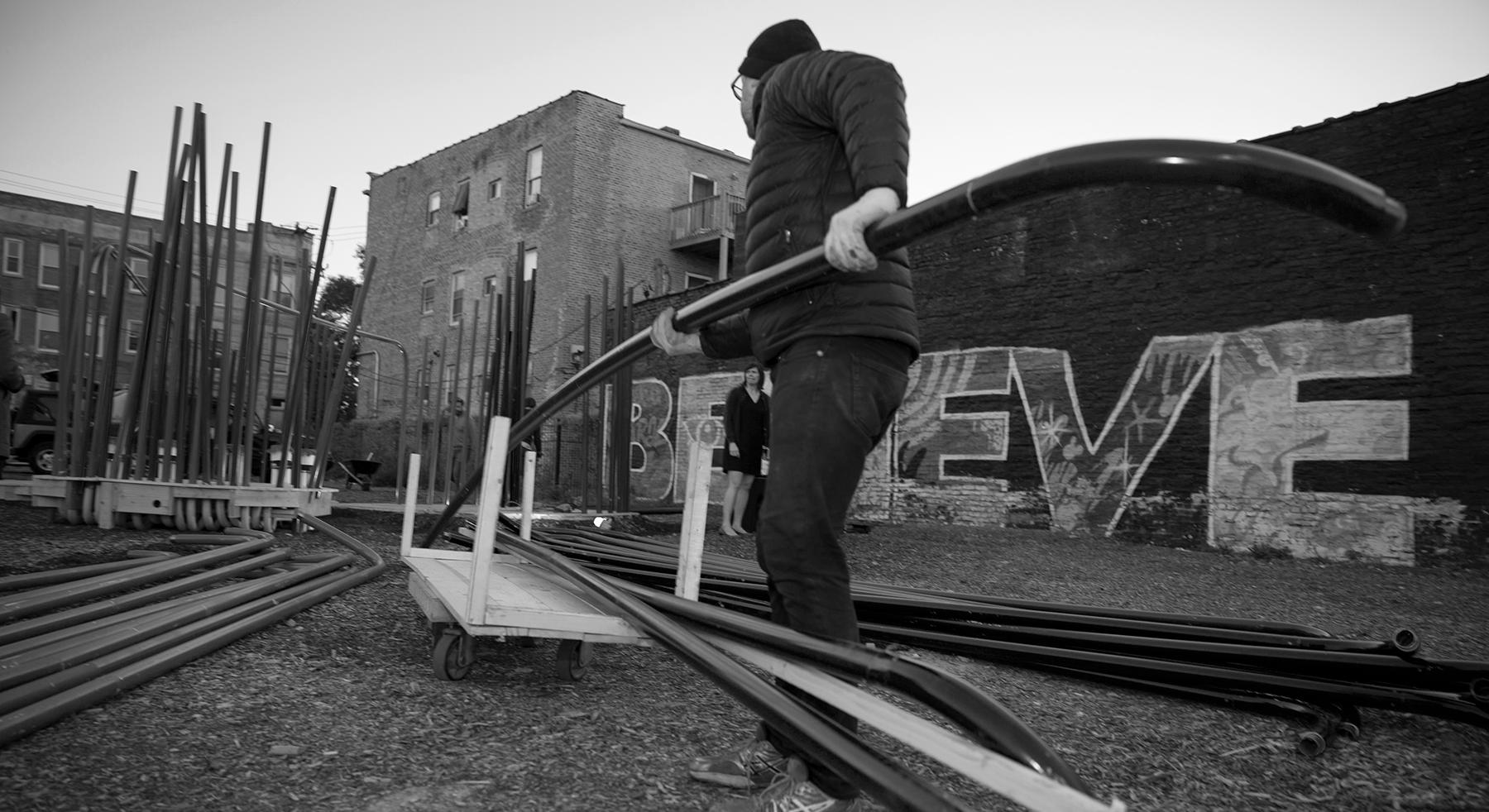
At the opening event for “Forms of Imagination: Reveal and Action” at the Arts Incubator, patrons didn’t stay inside for very long. Instead, they filled the sidewalk in front of the Incubator, gathering around a reshaped and decorated street cart filled with goods. In a vacant lot across Prairie Avenue, under the eye-catching “BELIEVE” mural, a structure of blue PVC pipes, reminiscent of a playground, took form before the eyes of the amused crowd.
The revamped street cart, called “Nomadic Habitat,” is a rickshaw redesigned by artist Carlos Rolón/Dzine and put to use by local street seller Garland Gantt. The blue pipes constituted the “Resonance Room,” a
percussion installation created by PORT Urbanism in partnership with musician Mikel Patrick Avery. Its “activation” was the night’s big event: as soon as the structure was ready, the audience was invited to enter it and watch South Side-based percussion group Bucket Boys give life to the pipe drums.
This was the first event in a three-part series entitled “Forms of Imagination,” the Arts Incubator’s contribution to the Chicago Architecture Biennial. Co-curated by art historian and artist Tempestt Hazel, the Incubator’s arts program manager, and architect and urban designer Paola Aguirre, the Incubator’s research analyst, “Forms of Imagination” is a full exploration of the
Incubator’s potentialities, responding to multiple aspects of the questions central to both the Biennial and the Arts Incubator.
About a week after its opening, on October 22, the “Resonance Room” was still standing strong, but the rickshaw had been rolled inside and the Incubator’s doors were closed. Visitors were directed to the intersection of King Drive and Garfield Boulevard. There, an old auto shop had been turned into a temporary outdoor cinema, with a projector on the sidewalk directed at the shop’s wall, a semicircle of foldable chairs, and a table with hot chocolate, marshmallows, and graham crackers for the chilly night. The night’s event, “South Side Home Movies,” was a screening and
discussion of recordings from the archives of University of Chicago professor Jacqueline Stewart, who researches homemade films from the time of 8mm, Super 8mm, and 16mm cameras.
As part of the Biennial, “Forms of Imagination” seeks to stimulate dialogue about design, architecture, and the built environment. For the co-curators, participation in the Biennial was a natural choice for the Arts Incubator, as those themes are an important component of their mission. “It wouldn’t make sense for us not to participate in the Biennial,” says Hazel. The Incubator tries, in Aguirre’s words, to “understand how design can contribute to many different things—if it’s to make
SARA POOLEY
something more fun, or more functional— and bring curiosity to the Washington Park community, just by putting out objects thought by designers.”
Judging by the first two events, they have succeeded at sparking curiosity in students, architects, curious neighbors, and passers-by alike. (The final event in “Forms of Expression” will be excerpts from Barak adé Soleil’s performance “Triptych: Cycle” on November 12). Visitors’ engagement with the space before, during and after the presentation was remarkable during both:
urban design firm PORT with Hyde Park musician Mikel Patrick Avery. “It was an interesting flow of ideas,” Aguirre said of the collaboration. “Just having [PORT] actually come here, work, and spend their time here, eating in local restaurants and trying to understand how people use the space, is really positive.”
The rickshaw was a partnership too, between Pilsen-based artist Carlos Rolón and Garland Gantt, better known as “Hustleman,” a street vendor who sells everything from snacks to bed sheets next to
“The South Side in particular is ready to have this conversation about the built environment.”
they gathered in groups to discuss the event and approached the artists, and children ran and played nearby, creating an instantaneous feeling of community.
Aguirre and Hazel explain that they explored themes related to time and space with the three events that comprise “Forms of Imagination.” The series experiments with different timescales, from the permanence of the “Resonance Room” installation to the mobility of the rickshaw in “Nomadic Habitat,” which might eventually travel to other places, to the ephemeral “South Side Home Movies,” which left no physical trace after its realization. Similarly, each works with a different range of sizes, from the movie screening on the dimensions of a building, to the “Resonance Room” on the scale of the vacant lot, to the small rickshaw, a mobile object.
Aguirre and Hazel emphasize the importance of the diversity of backgrounds, perspectives, subjects, and media responsible for putting the exhibition together. This began with the different backgrounds they each brought to the work: Aguirre is trained in architecture and Hazel in art history and visual arts. They also tried to bring local artists together with those who work further afield. The “Resonance Room,” for example, came from the pairing of downtown-based
“This is a Conversation”
Junot Díaz discusses power and representation at UofC talk
the Green Line station across the street from the Incubator. In placing Gantt’s work into the domain of the arts, the Arts Incubator harkens to its very foundation of thinking about neighborhoods, their economic development, and their relationship to arts and culture. Rolón, who introduces Gantt as his artistic partner, sees in the project a way of changing the way people view the street seller, and hopes the cart will travel to other communities.
The Arts Incubator is one of the few participating venues in the Biennial that asks visitors to look beyond downtown. “The South Side in particular is ready to have this conversation about the built environment, thinking about vacant lots and the potential of those spaces,” Hazel said. “There’s so much possibility”—and architecture and design are “a launching pad” to think of how neighborhoods can use those spaces creatively or to address different needs. Hazel summarizes: “I think what we tried to do through the exhibition is to empower people to start thinking about how they can impact their environment.”
Arts Incubator Gallery, 301 E. Garfield Blvd. Through January 8. Tuesday–Friday, 12pm–6pm, Thursday 12pm–7pm. Free. (773) 7029724. arts.uchicago.edu
BY ARIELLA CARMELL
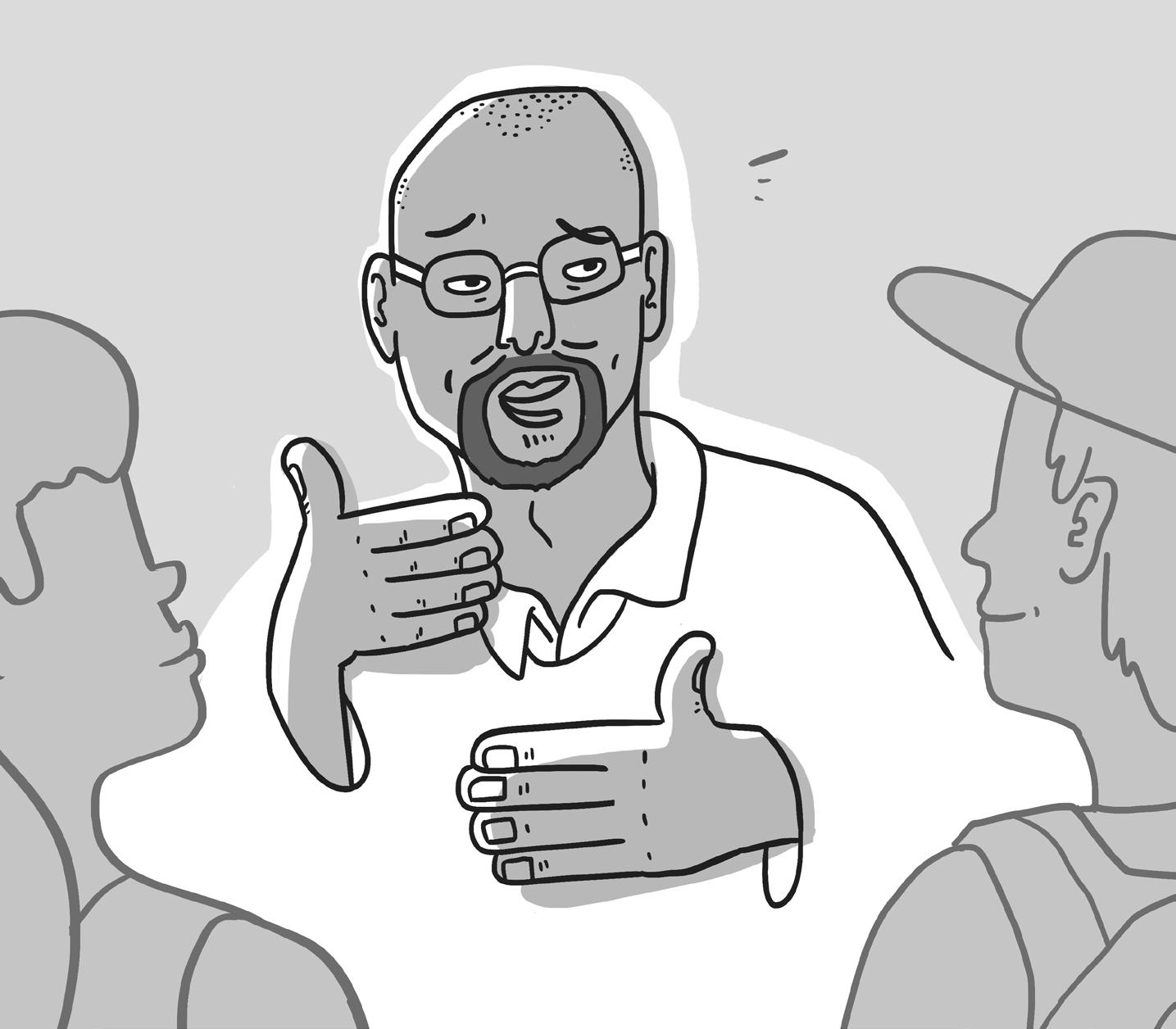
“How did the women in your life react to <i>This is How You Lose Her</i>?” a student from Cristo Rey Jesuit High School asked Pulitzer Prize and MacArthur “Genius Grant”-winning author Junot Díaz. Díaz lurched his head back a little and grinned; this was the kind of boldness he was hoping for from the audience, but from its youngest members especially—the willingness, as he explained earlier, to engage with those perceived as more powerful.
Power was a prominent theme on October 19, as Díaz spoke with the lively crowd during his sold-out talk held at the University of Chicago. Díaz was freeform in the topics he approached, answering audience-driven questions about his writing process and about the effects that living in a dominantly white culture have had on his writing. The experience of immigrating from the Dominican Republic to the United States at age six, he said, left an imprint on his psyche that resonates throughout all his
work. One of his main goals as a writer is to disentangle literature from the hegemony of the Western canon by promoting writers of color, commending authors such as Sandra Cisneros for their vivid depictions of the minutiae of life as a person of color. “No matter what we [people of color] do,” he said, “we’re automatically challenging structures.”
“This is a conversation…let’s talk!” Diaz announced early on. His demeanor during the talk was loose and improvisational, perhaps meant to counteract the trope of the “aloof literary type.” He cussed casually and addressed the audience as “man,” strolling across the stage in worn jeans. Before he began reading excerpts from <i>This is How You Lose Her<i/>, his collection of short stories often criticized for the representation of its female characters, he asked a female audience member to hand him a copy. He thanked the woman for not throwing the book at him.
Seeing the Invisible
The story of how Jamie Kalven got the city to release all of its allegations of police misconduct from the last five years, and then turned that data into an online model for public access and empowerment.
BY LEWIS PAGE
In the early nineties, Jamie Kalven had a crisis of conscience.
“I didn’t want to be the sort of writer that just wrote eloquent essays urging action on other people in response to great social issues,” he recalls.
For Kalven, the solution was to begin spending time in Stateway Gardens, the Chicago Housing Authority high-rise public housing facility that was demolished in 2007. High-rise public housing was a contentious topic in the media at the time, and Kalven hoped to gain a personal perspective on the community so close to his lifelong home in Hyde Park.
“It was several years before I really became aware of consistent patterns of police abuse and police misconduct that weren’t the occasional aberration, but were really daily circumstances,” Kalven recounts.
What Kalven saw led to a question.
“What set of institutional conditions would have to exist for what I’m seeing every day to be the case? I knew it was the case because I was seeing it every day, I was testing it on my nerve endings, I knew it was real. But I didn’t understand what kind of a world it was happening in.”
This question will eventually lead to the release of the Citizen Police Data Project on November 10, 2015. The database, an online tool for public use, presents an unprecedented amount of information about police misconduct, showing the minutest details of 54,581 complaints filed against 8,337 offi-
cers from 2001-2008 and from 2011-2015.
This is the story of how Kalven, through almost a decade of legal battles, turned a question about police accountability into an interactive database for free public use, and why that matters.
On April 13, 2003, Diane Bond, a resident of Stateway Gardens, was berated, physically threatened, verbally abused, and forced to expose herself by
about the setting and the situation that I believed Ms. Bond,” recalls Kalven. “But because I am not of that community, but move through other spheres, I also had access to lawyers and was able to convince them to take her case.”
Craig Futterman, the lawyer that represented Bond, had been introduced to Kalven through a mutual friend. Futterman is a clinical professor of law at the University
“But because I am not of that community, but move through other spheres, I also had access to lawyers and was able to convince them to take her case.”
—Jamie Kalven
that started the series of legal battles that would eventually lead to the release of the information presented in the Citizen Police Data Project.
In this case, Kalven and Futterman crafted requests for background information on the five implicated police officers. Kalven saw this as an opportunity to learn even more about abuses from the city, and also requested a list of all officers who had received ten or more complaints in the last five years.
“These requests were really designed to extract information from the city that could be analyzed to see—how does this system work and not work to allow guys that are so outrageously abusive to act with impunity,” Kalven said
The city granted the request for the documents under a protective order—an agreement that the documents would not be released to the public. Kalven, represented pro bono by Jon Loevy of Loevy & Loevy, requested that the protective order be lifted and that the documents be made available to the public at large.
“I don’t think we had high expectations for it succeeding,” Kalven recalls.
a group of police officers. This was the first in a series of incidents Kalven recounts in articles eventually collected under the title “Kicking the Pigeon”.
“I was so embedded in the community, so much a part of the community, that I had sources, knew Ms. Bond, knew enough
of Chicago Law School, where he heads the Civil Rights and Police Accountability Project at the Mandel Legal Aid Clinic. Futterman and his students had worked on a series of civil rights cases in Stateway by the time Bond’s case came around.
It was this case, Bond v. Utreras, et al.,
But the request did succeed. Judge Joan Lefkow ruled that the documents had “a distinct public character, as it relates to the defendant officers’ performance of their official duties.”
“Without such information,” Lefkow wrote, “the public would be unable to supervise the individuals and institutions it has
entrusted with the extraordinary authority to arrest and detain persons against their will. With so much at stake, defendants simply cannot be permitted to operate in secrecy.”
The city immediately issued a stay of her order pending appeal. Two years passed. Ultimately, Judge Lefkow’s decision was overruled. The defeat was disappointing for Kalven and his team, but one footnote in the ruling left some hope. The passage in question reads: “The protective order does not interfere with Kalven’s ability to try to obtain the documents he seeks directly from the City under the Illinois Freedom of Information Act (FOIA).”
“We took them up on the invitation and drove a truck through that footnote,” Kalven later said in an interview with the Columbia Journalism Review.
Kalven, along with Futterman, Loevy, and Flint Taylor of the People’s Law Office, pushed forward litigation in hopes of making documents detailing registered complaints (CRs) and a list of officers with repeated complaints (RLs) available to the public.
In March of 2014, Kalven v. City of Chicago was decided in favor of the Kalven camp. The decision reads: “In sum, neither the CRs or RLs are exempt from disclosure under FOIA.”
Under the Illinois Freedom of Information Act, anyone can submit a request for documents from federal agencies that are not currently publicly available. If the description of the requested files is specific enough and the files are not exempt, the agency is obligated to release the documents.
As soon as this decision made the documents publicly available under FOIA, the Tribune and the Sun-Times put in requests for all of the disciplinary records of every CPD officer dating back to 1967. Kalven and his cohort made a parallel request for all these records in order to be involved in the litigation.
Surprisingly, the city agreed to release all of the files without litigation, allowing public access to documents whose contents might result in a good deal of criticism, outrage, and scrutiny.
Immediately after the files were deemed public, however, Chicago’s police union, the Fraternal Order of Police (FOP), filed a lawsuit seeking to bar the city from releasing the information. The union argued that their contract required disciplinary records to be
destroyed after five years.
“That’s the provision that’s been in the union’s contract for fifteen, twenty-some years,” says FOP attorney Pat Fioretto. “That’s what formed the basis of the underlying grievance.”
“You need to weigh the transparency issues with the privacy issues that a public employee has—you don’t surrender your privacy rights just because you wear a badge,” Fioretto says. “And a lot of the time, these complaints made by someone were issues that were ‘unfounded’ or ‘not sustained’. Well, if they’re unfounded or not sustained, why do they need to remain in the employee personnel file for the rest of their career?”
The FOP case is still ongoing, and an oral argument is expected sometime this fall. But although the release of older documents depends on the outcome of the FOP’s lawsuit, the last four years of complaints of misconduct—from March 2011 to March of 2015—are completely open to the public.
By the late nineties, Kalven was deeply embedded in the Stateway Gardens community. Technically squatting, he established an informal office in an empty residency on the first floor of one of the buildings. He served as an advisor to the resident council. He ran the Neighborhood Conservation Corps, an employment program of his own creation. In 2001, he started publishing articles online under the title The View from the Ground. The articles were published online, in the early days of web publishing, from his makeshift office on the first floor. As a joke about these low-budget circumstances, Kalven included a note that reads “published under the auspices of the Invisible Institute” in one of the early articles. The name stuck. Today, the Invisible Institute is a nonprofit with its own office and five employees.
The Institute is a convenient way for Kalven to facilitate the kind of collaborations that he has always been a part of. Craig Futterman was one of Kalven’s first collaborators in the realm of police misconduct and is still one of his closest. Chaclyn Hunt, a current member of the Invisible Institute, was intro-
KIRAN MISRA
duced to Kalven by Futterman when she was a law student.
After a few years of working on legal projects with Kalven and Futterman, Hunt started a program called the Youth/Police Project, an initiative that started out with the goal of teaching teenagers about their rights.
“Our way of going back to the ground, after we made all these big systemic arguments, was the idea that we should focus on the simplest atomic particle of these larger phenomena,” Kalven said. “Which I take to be an encounter between a police officer and a black teenager.”
Hunt quickly found out that teaching a know-your-rights workshop to a class of teenagers who interact with the police on a sometimes daily basis was, in her words, “totally absurd.”
“When you start with [the questions ‘what are your interactions with the police?’ and ‘how do they make you feel?’] and you get into that conversation with kids, and they’re having this grave personal conversation with you, and you say, ‘Well, let me teach you how to deal with that in the future,’ they tell you, ‘That’s bullshit! You’re lying, you’re crazy.’”
In its current iteration, the Youth/Police Project (made up of Hunt and a group of interested lawyers, students, and academics) meets with a broadcast media class at Hyde Park Academy once a week. Hunt and the volunteers talk to the kids about their encounters with the police, and the kids use their broadcast media skills to record and edit their own interviews and roleplays.
Rajiv Sinclair, a Canada native with a background in web development and media production, was visiting a friend in Chicago during the summer of 2014. He met Kalven, saw the work that the Invisible Institute and Youth/Police Project were doing, and never left. Sinclair started out helping the Youth/ Police Project with video production, but would soon take on a new role as the technology wizard and web development liaison primarily responsible for facilitating the creation of the Citizen Police Data Project.
“What we’re trying to do going forward
is build a lean, agile, small, but adequate creative team that then works in a range of collaborative relationships with others,” says Kalven. The official Invisible Institute roster also includes two journalists, Darryl Holliday and Alison Flowers, and author Audrey Petty, best known for editing the book HighRise Stories: Voices from Chicago Public Housing, in which former residents recount their time spent in public housing.
Although officially released to the public after the Kalven decision, the complaints of misconduct were a cumbersome collection of scanned government documents. In this form, Kalven’s team assumed that only the most intrepid investigative reporter or academic researcher would engage with the information. The Invisible Institute wanted the data to be readily accessible to anyone and everyone.
“One way to think about this is that the knowledge exists, within the boundaries of a certain set of problems, to fix those problems. But that knowledge is sort of divided from itself and scattered and sort of atomized,” says Kalven. “Part of our challenge is to create the feedback loops, and the sense of possibility that the information you have could actually matter and be acted on. To begin to connect and weave together those different kinds of knowledge.”
“There is a giant disconnect,” adds Hunt, “between people who live every day with police misconduct and the people who have the resources to do something about it.
“Civil rights attorneys, academics, politicians are not living in conditions where there is police misconduct. And it’s difficult for them to access that information. Think about attorneys who are client hunting, who have an idea of what kind of reform they want to see happen and then they have to go hunt for a client.”
“That process alone says that something is broken, that people aren’t matching up.”
The Citizen Police Data Project, which Sinclair has been working to develop, is an attempt to accomplish these goals and to deploy all the information in a way that is
engaging and useful. The Project displays all the records of complaints on a map of Chicago. Users of the Project’s site can explore the records geographically—by neighborhood, police beat, even school ground. The site also allows users to filter and explore complaints by type, and a graph on the right side of the page displays the proportion of complaints that resulted in punishments for officers. Below the map, names of specific officers appear. If users click on one of these officers, all of their complaints will be displayed, along with all of the officers that have been accused of complaints alongside them.
In digging into the complaints, Sinclair
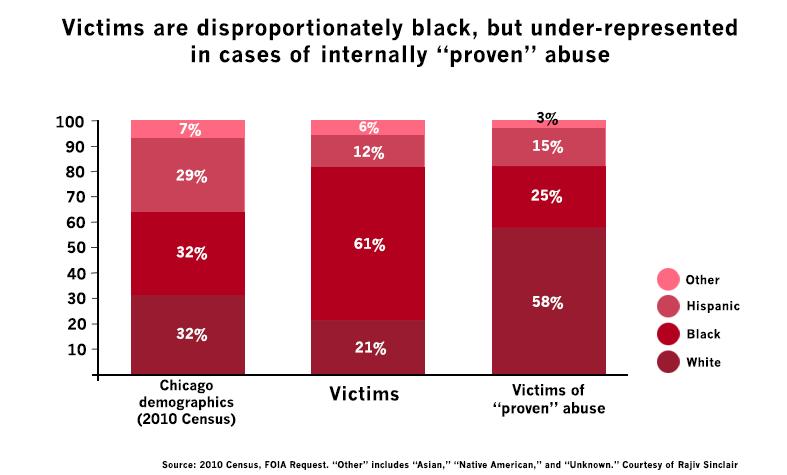
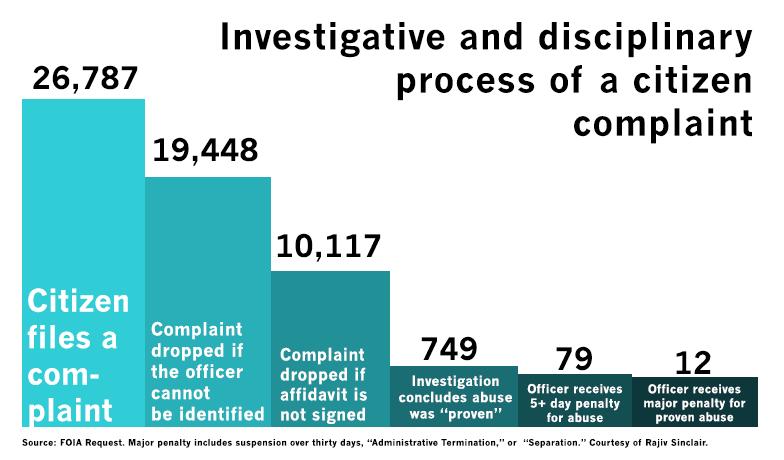
Even when misconduct is proven, about eighty-five percent of disciplinary actions are suspensions of zero to five days. Only forty-four cases out of all the complaints documented in the Project resulted in a “repeat” officer being issued a major penalty—a suspension greater than thirty days or termination of their employment.
When Diane Bond was abused in 2003, serious allegations of police misconduct were investigated by the Office of Professional Standards, an in-house office at the Chicago Police Department. In 2007, after charges of bias, the city replaced the department with the Independent Police Review Authority,
“There is a giant disconnect between people who live every day with police misconduct and the people who have the resources to do something about it.”
—Chaclyn Hunt
tained” allegations is not the only metric of IPRA’s effectiveness. Merritt argues that cases where the officer is exonerated (defined as a complaint where alleged actions were found to have occurred but did not violate CPD policy) or when allegations are deemed unfounded are also what he calls “positive findings,” given that IPRA had enough information to make a definitive decision about those incidents incident. Merritt cites that the percentage of these “positive findings” has gone up from about thirty percent in 2009 to 52.83 percent in 2015.
“Even if you compare twenty percent to police stations around the country,” Merritt says of the rate of sustained allegations, “you know, that’s not that low.”
“But again,” he continues, “it’s not just the sustained rate that determines whether or not we are doing the investigation thoroughly, but instead about positive findings.” Kalven and the Institute do not believe that the information in the Project alone will bring about reform. But Kalven hopes that public engagement with newly transparent information will change the conversation about police misconduct.
“To say ‘information is power’ is a bumper sticker,” Kalven says. “But what we’re trying to figure out is: what does it actually mean to redistribute power, to make adjustments in asymmetries of power by redistributing information?”
and Kalven have uncovered some alarming trends. Only nine percent of the overall complaints were “sustained,” meaning that some kind of punishment was doled out as a result. A surprisingly large number of the complaints concerned a small proportion of the total officers. Additionally, “repeat” officers— officers with ten or more complaints—comprised only ten percent of the officers in the CPD over the periods covered by the Project but account for thirty percent of all the complaints. These officers have 16.8 complaints on average, while the average CPD officer has only 4.5. Out of 27,154 complaints against “repeat” officers in the Project, only 1,059—about four percent—were sustained.
an organization which, as the name suggests, is supposed to operate independently of the police. In reality, a number of its investigators have been former police officers, some from the CPD.
IPRA, for its part, cites major improvements in handing down punishments in recent years. Their rate of “sustained” findings has risen from 4.32 percent in 2009 to 20.13 percent in 2015. A finding of “sustained” is defined as a complaint where “the allegation was supported by sufficient evidence to justify disciplinary action.”
Larry Merritt, IPRA’s Director of Community Outreach and Engagement, also emphasizes how the percentage of “sus-
Visit http://invisible.institute
Editor’s note: Darryl Holliday, a member of the board of South Side Weekly, and Harry Backlund, this paper’s Publisher, both work as paid consultants on the Invisible Institute’s Citizen’s Police Project. Neither was involved in the reporting or editing of this story.
Onward and Upward
Project Onward showcases its creative community of artists with disabilities
BY STEPHEN URCHICK
Although Project Onward had already opened their studio doors for a public celebration and viewing, many of the artists present were still hard at work. The evening reception was the second part of a four-day, multi-artist exhibit, “When I Paint My Masterpiece,” which highlighted the creations and techniques of artists with disabilities from across Chicago. One artist, Adam Hines, put down his
pencil, and held out a passing fist bump to Project Onward’s photographer for the evening, Mike Pocius. “It’s time to rock and roll for the second time,” Hines said with relish, swiveling back around in his chair before absorbing himself in a new sketch.
Pocius volunteered to show me around the building and introduce me to a few of its more than fifty artists. A nonprofit, community-engaged space on the fourth
floor of the Bridgeport Art Center, Project Onward unites workstations and private ateliers under the same roof with an adjacent white-cube gallery for displays and art sales; its physical layout makes possible a joint showcase of artists’ creative processes and their finished products.
Project Onward has only been in the building for the past three years. I had a chance to talk to one of its newer artists,
Sheila Smith, about her paintings. Smith came to Project Onward in 2014 and had high praise for the relationships that sprung up between the artists.
“It’s a very friendly and safe atmosphere. A person just comes over and is like: ‘Sheila, I like your painting!’ ”
Two of Smith’s canvasses—“Black and White Gears” and “Out of the Box”—were hung across from each other, almost as com-
stephen urchick
parative pendant pieces. Smith said that the monochrome “Gears” was an experiment she’d undertaken at a previous suggestion; she normally prefers the bright, vibrant colors on display in “Box.” Both of the works are meticulously slick and smooth. Smith leverages the plasticky properties of the acrylic paint, obliterating facture and other traces of brushwork—creating uniform, geometric bodies or seamlessly melted confluences of color.
In the case of “Gears,” the handling is so smooth that the paint reveals the weave and nap of the canvas. Her black and white painting confuses figure and background in a way that her colored works do not. Their vibrant hues clearly indicate what she’s added to the canvas as a painter and that legibility is swallowed up when she takes the colors away, working outside her preferred mode.
The sheer dedication of the artists strikes you when you first walk in. The different desks and easels stretch deep into the open floor plan. Flat file storage for works on paper line the back partitions. More work happens behind the closed doors. Finished canvasses hang salon-style wherever there’s space on the walls. Hines, for example, joked that he’d completed over 10,000 drawings since joining the group; the immense portfolio he had out that night suggested that he wasn’t altogether kidding.
When I asked Pocius how often the artists came in, he turned to one artist packing up for the night: Four days a week, if doctors’ appointments didn’t throw him off. The next artist, Motesem Mansur, admitted to working 11am to 5pm every Friday. He was currently finishing up an exacting study of the iconic Chicago Theatre sign, at least fifteen or twenty in number, at varying angles and sizes.
Mansur was recruited after a stretch of time at the downtown Chicago Cultural Center, designing greeting cards and architectural sketches popular with tourists. He credited a lot of help and inspiration to another Project Onward artist, Andrew Hall. When Mansur came in, most of his figural experience was from working on copy paper, in ballpoint pen. “Andrew encouraged me to use professional materials, encouraged me to look at perspective and look at colors the right way.”
Mansur was especially appreciative of the creative community he had grown over time. His praise extended to Project Onward’s many volunteers. He’d come to work in the morning and find a volunteer had already laid out a soda for him from the kitchenette—a simple but helpful and heartfelt gesture.
Talking with different artists, collectivity turned out to be a big theme, an essential influence on their creative strategies. Each person I met could instantly hook their thumb in the direction of a friend’s chair or single out a specific head in the crowd. Project Onward’s executive director, Rob Lentz, chalked up the formation of this professional society as one of the organization’s big successes. “Our space is a communal studio,” Lentz underscored. “Socially, it’s a huge benefit. Most of these guys are self-taught, which means they’ve done this alone.”
In bringing these artists together, the space remedies a key challenge for adults with disabilities—isolation. Lentz explained that the robust support systems offered by elementary and high schools don’t always extend later into life. The trope of the lone bohemian painter is, in this case, worsened by shortcomings in larger social structures.
Project Onward thus provides the framework and—as much as funding permits—the materials for great art to happen. Advocates more than educators, Lenz argued that Project Onward only really attends to the logistical side of creativity.
“These guys are pros and they know what they are doing,” said Lenz. “The best thing we can do is get out of their way.”
It’s tempting to read the exhibition’s title, “When I Paint My Masterpiece,” as an open-ended statement. Project Onward’s ethos defers the definitive magnum opus that would cap an artist’s career. The willingness of its artists to actively experiment and abundantly create flows from the community-building that the nonprofit enables. The togetherness they cultivate drives a kind of aesthetic fearlessness—a spirit confirmed in the fantastic number and variety of objects the studio’s artists make. Project Onward lets artists cultivate a vital, evolving practice, enhancing the daily lives of artists with disabilities while encouraging them to create ever greater work.
The City Revealed: Analyzing + Interpreting Public Data
Sunday, November 1, 2015, 1pm–3pm South Side Weekly Office at the Experimental Station, 6100 S. Blackstone Avenue
Chicago Tribune Investigative Reporter Angela Caputo will demonstrate techniques for extracting meaning from raw data, and discuss the steps that go into her own public interest reporting.
Part two of the Chicago Civic Journalism Project Data Journalism Series, presented by Chicago Studies, City Bureau, South Side Weekly, and University of Chicago Careers in Journalism, Arts, and Media.