The South Side Weekly is a nonprofit newsprint magazine written for and about neighborhoods on the South Side of Chicago. We publish in-depth coverage of the arts and issues of public interest alongside oral histories, poetry, fiction, interviews, and artwork from local photographers and illustrators. Started as a student paper at the University of Chicago, the South Side Weekly is now an independent nonprofit organization dedicated to supporting cultural and civic engagement on the South Side, and to providing educational opportunities for developing journalists, writers, and artists.
Contributing Editors Will Cabaniss, Eleonora Edreva, Lewis Page, Hafsa Razi
Social Media Editor Sam Stecklow
Web Editor Andrew Koski
Visuals Editor Ellie Mejia
Layout Editors Adam Thorp, Baci Weiler, Sofia Wyetzner
Senior Writers: Patrick Leow, Jack Nuelle, Stephen Urchick
Staff Writers: Olivia Adams, Amelia Dmowska, Maira Khwaja, Emiliano Burr di Mauro, Michal Kranz, Zoe Makoul, Sammie Spector, Zach Taylor
Staff Photographers: Juliet Eldred, Finn Jubak, Alexander Pizzirani, Julie Wu
Staff Illustrators: Javier Suarez, Addie Barron, Jean Cochrane, Lexi Drexelius, Wei Yi Ow, Amber Sollenberger, Teddy Watler, Julie Wu, Zelda Galewsky, Seonhyung Kim
Editorial Intern Clyde Schwab
Webmaster Sofia Wyetzner
Publisher Harry Backlund
The paper is produced by an all-volunteer editorial staff and seeks contributions from across the city. We distribute each Wednesday in the fall, winter, and spring, with breaks during April and December. Over the summer we publish monthly.
Send submissions, story ideas, comments, or questions to editor@southsideweekly.com or mail to: South Side Weekly 1212 E. 59th Street Ida Noyes Hall #030 Chicago, IL 60637
For advertising inquiries, contact: (773)234-5388 or advertising@southsideweekly
Read our stories online at southsideweekly.com
IN CHICAGO
A week’s worth of developing stories, odd events, and signs of the times, culled from the desks, inboxes, and wandering eyes of the editors
Rahm (Sort of) Defends Cops
In a conversation with Attorney General Loretta Lynch last week, Rahm Emanuel described Chicago police officers as “fetal.” He later clarified this puzzling characterization, explaining that officers—in the wake of Baltimore, Ferguson, and similar incidents—fear losing their jobs, or worse, causing them to hesitate over previously easy decisions. Presumably, Rahm’s statement was partially in reference to the recent emergence of a number of video recordings, like the one released this past June that showed Chicago police officer Marco Proano firing multiple times into a car full of six black, unarmed teens. (Proano’s case is still under investigation.) Fortunately, some police officers appear to be taking matters into their own hands: after seventeen-year-old Laquan Mcdonald was shot sixteen times by a CPD patrolman, a group of officers allegedly deleted the footage of the shooting from a nearby security camera.
Marrython
Trade champagne for paper cups of Gatorade and a teary audience for hordes of sweaty, selfie-taking runners and you’ll be picturing Sunday’s most unconventional wedding. Lakeview residents and runners Stephanie Reinhart and Mark Jockel tied the knot at an under-fourminute ceremony at mile eight of the thirty-eighth annual Bank of America Chicago Marathon, surrounded by friends and family, before they got back on the course to complete the next eighteen miles. It’s a truly inspirational (and, let’s be real, maddening) tale for all the single and sedentary. While the Chicago Marathon brought matrimony to one couple and glory to the winners, Dickson Chumba and Florence Kiplagat of Kenya, it brought frustration to the non-marathoners attempting to navigate the city.
Jailbyrd?
In keeping with the long tradition of corrupt Chicago politicians, former CPS CEO Barbara Byrd-Bennett was indicted last week for—among other things—taking hundreds of thousands of dollars worth of gifts in exchange for giving a $20 million no-bid contract to her former employer, Supes Academy. Investigations into ByrdBennett’s scheme began after South Side resident and CatalystChicago reporter Sarah Karp called attention to the fishy no-bid contract. Byrd-Bennett, who resigned in May when district records were first subpoenaed, will plead guilty. Supes executives Gary Solomon and Thomas Vranas—who opened trust funds in the names of two of Byrd-Bennett’s relatives and promised jobs to the CEO’s friends and family—have also been charged with fraud, bribery, and conspiracy. Each of her twenty counts of fraud are punishable by up to twenty years in jail. The best part of the coverage of Byrd-Bennett’s unbelievable greed are the absurdly transparent emails including such incriminating gems as Byrd-Bennett writing that she had “tuition to pay and casinos to visit.”
“Hello? Hello?”
“The number you have dialed has been disconnected or is no longer in service.” That’s the message you get when you call someone who hasn’t been paying their phone bill, and the last message you would ever expect to hear upon dialing 9-1-1. However unlikely the latter scenario, it grows more likely with every day that Governor Rauner continues to squabble with the Democrats over the Illinois budget impasse, which is leaving 9-1-1 call centers short $32,000 per month, no small portion of their budgets. Sorry, Illinoisans, but it seems that Rauner values his game of political chess over the safety and well-being of his constituents.
IN THIS ISSUE
THE OrIgInS Of Ipra
Obrycka, Bond, and others were the victims of a CPD-wide code of silence.
will cabaniss...4
WHEn pOLIcE arE InvESTIgaTED, WHY DO THEY HOLD On TO THE rEcOrDS?
The data IPRA has is kept by the very agency it’s investigating—the Chicago Police Department.
christian belanger...5
Lewis has been undergoing treatment for a brain tumor diagnosed last October. She stated that she is now healthy, and that she is “not done” fighting.
sonia schlesinger...6
paInT THE TOWn
Colors seen on her painted houses include Harold’s Chicken Shack Red, Newport Blue, and Pink Oil Moisturizer Pink.
eleonora edreva...7
EDUcaTIOn aS LIbEraTIOn
The most important layer is that of dignity.
lewis page...10
cHIcagO rap UnITES fOr “jUSTIcE Or ELSE”
The whopping eight-minute track anticipated and was inspired by Saturday’s anniversary of the Farrakhan-organized Million Man March.
jon poilpre...12
Cover photo by Eleonora Edreva.
bacK In THE gamE
The Origins of IPRA
How Chicago was pressured to establish an independent police review authority
BY WILL CABANISS
The series of events that would eventually lead to an overhaul of the bodies that oversee the CPD started on February 21, 2007, when Officer Anthony Abbate, then a 12-year veteran of the force, physically assaulted a bartender named Karolina Obrycka.
Only after Obrycka’s attorneys released security footage of the incident – nearly one month later – was Abbate arrested. Police officials said they had been “unable to locate” him in the intervening weeks, even though they had apprehended Abbate in the confines of his own home. That claim took five years to disprove, when a federal jury found the police guilty of brushing Abbate’s case under the rug.
The Abbate case was not the only one on Chicago’s mind at the time. The city settled another high-profile dispute in December 2006, when it awarded $150,000 to a woman named Diane Bond. Bond had accused five CPD officers abusing both her physically and psychologically in and around her Stateway Gardens apartment.
November of 2007 saw the release of a study led by Craig Futterman, a professor of law at the University of Chicago, which alleged that Obrycka, Bond, and others were the victims of a CPD-wide code of silence.
February 21, 2007
Officer Anthony Abbate, a 12-year veteran of the force, physically assaults a bartender named Karolina Obrycka.
“The odds are two in a thousand,” the study found, “that a Chicago police officer will receive any meaningful discipline as a result of being charged with abusing a civilian.”
Futterman and his team provided hard evidence that the department’s internal investigations were nearly meaningless. The evidence of cover-ups and inefficiencies within the Office for Professional Standards, the branch of the Chicago Police Department formerly responsible for investigating police misconduct, struck a particularly painful chord. But other broad swaths of the CPD were implicated in the report as well, from administrators down to officers.
The Abbate scandal led to the ouster of Superintendent Philip J. Cline, the CPD’s top administrator, who resigned in April 2007. Headlines concerning police misconduct dominated Chicago media outlets for months following both events, forcing city leaders to act or face the political consequences.
This environment set the foundations of the Independent Police Review Authority (IPRA). That summer, the city council voted to dissolve OPS and establish an independent agency to oversee police investigations, a proposal championed by Mayor
March 2007
Obrycka’s attorneys release security footage of the incident; Abbate is subsequently arrested at his home.
April 2, 2007
Richard M. Daley. The founding of IPRA was set to begin a new era of accountability and discipline with the CPD. Some praised the mayor, while others called the move a transparently political calculation.
To lead the new organization, the mayor tapped Ilana Rosenzweig, an attorney who had kept an eye on the Los Angeles County Sheriff’s Office at the city’s Office of Independent Review. The mayor also brought in a new police chief from outside the department, a former FBI agent named Jody Weis.
Futterman said that at the time, he and his team were encouraged by the decision to establish an independent oversight committee and to bring someone from outside the CPD to lead it, but had reservations about the mayor’s motivations.
“There was a real risk of federal intervention in Chicago,” Futterman said, referring to the period after Cline stepped down, “and one of the ways in which they very adeptly attempted to head that off was to bring in someone from federal law enforcement themselves.”
The key to IPRA was built into its name – it would investigate cases independent of the police and city government officials, and that caseload would not be small.
CPD Superintendent Philip J. Cline resigns.
The agency, as it is currently structured, intakes all claims of misconduct, investigating those that involve “excessive force, domestic violence, coercion through violence, or verbal bias-based abuse.” All other complaints are forwarded to the CPD’s Bureau of Internal Affairs (BIA).
Disciplinary recommendations for officers found guilty of misconduct, if issued at all, range from simple reprimands to suspensions. “Separation,” IPRA’s harshest possible recommendation and one of the many institutional euphemisms the agency employs, is police-speak for being fired.
IPRA then investigates complaints that involve “excessive force, domestic violence, coercion through violence, or verbal bias-based abuse,” its website says, and forwards all other cases to the Bureau of Internal Affairs (BIA).
How much attention and money these reform efforts received, however, was ultimately dictated by public outrage. While the scandal initially dominated Chicago headlines, the shock soon waned. As a result, Futterman said, IPRA wasn’t given the funding or the resources it needed to conduct thorough investigations or even find more people capable of carrying them out.
Just months after Rosenzweig’s ap-
July 19, 2007
City Council unanimously votes to overhaul OPS, renaming it the Independent Police Review Authority. Daley appoints Los Angeles attorney Ilana Rosenzweig to lead the fledgling agency.
November 2007
A study led by University of Chicago law professor Craig Futterman finds evidence that “the odds are two in a thousand that a Chicago police officer will receive any meaningful discipline as a result of being charged with abusing a civilian.”
This fall, journalists with the Invisible Institute will publish an interactive online database of all allegations of police misconduct in Chicago between March 2011 and March 2015, as well as partial data from earlier years. These records, obtained by the Invisible Institute through years of Freedom of Information Act litigation, offer an unprecedented view into the City’s system of police accountability. This series, produced in partnership with City Bureau, is meant to provide context for the forthcoming database.
pointment, IPRA was already facing difficulties. The Tribune reported in December 2007 that the agency, “budgeted for 85 positions … is short 24 people.” Each investigator was taking on thirty cases at a time –triple the number Rosenzweig thought was appropriate.
More important was the perception of critics that nothing had changed. Beyond the acronym swap, some initially saw few differences between OPS and IPRA.
“(Rosenzweig) inherited the exact same staff (from OPS) that was inadequate and had a culture of protecting the police,” Futterman said.
IPRA now has almost a decade of experience under its belt. It has a new leader, a former Drug Enforcement Administration officer named Scott Ando. (Rosenzweig abruptly left the agency in 2013 when her husband accepted a job in Singapore.)
But whether it has succeeded in gaining Chicagoans’ trust is unclear. Questions about its efficiency and supposed impartiality remain unanswered, too.
Eight years later, IPRA’s record shows few recommendations for punishments as severe as “separation.” At press time, the latest high-profile case of a police-involved shooting to pass through IPRA’s doors is that of Officer Dante Servin, who fatally
February 1, 2008
Former FBI agent Jody Weis is sworn in as CPD Superintendent.
shot 22 year-old Rekia Boyd nearly three and a half years ago. Servin shot into a crowd while off duty in Lawndale, claiming that he saw a man in the group produce a gun. Boyd was caught in his line of fire. No weapon was ever recovered.
On September 16, 2015, IPRA recommended to police chief Garry McCarthy that Servin be fired. It was only the second such verdict the agency had ever issued related to a police-involved shooting. (IPRA has also never found an on-duty shooting to be justified.) Before Servin’s case was that of Officer Francisco Perez, who fired 16 bullets at a car while off-duty. Perez was fired this past summer not for his actions, according to Supt. McCarthy, but for lying about them during the investigation.
Yet the reality is that, even after this most recent decision, Servin’s career with the CPD is by no means over. In fact, should McCarthy reject IPRA’s recommendation, he would save Servin from the ignominy of facing the Police Board, a panel of nine private citizens who make the final call on allegations of misconduct. IPRA’s recommendations are still no more than that –recommendations. The case against Servin, should McCarthy want it to, would come to a standstill.
April 13, 2013
Rosenzweig resigns, former DEA agent Scott Ando takes over IPRA.
When Police are Investigated, Why Do They Hold on to the Records?
BY CHRISTIAN BELANGER
When the Independent Police Review Authority was created in September 2007, a key term was “independent.” The organization was created following concerns that its predecessor had too many ties to the police department it was meant to oversee.
IPRA was to be completely independent: staffed and overseen by civilians, not police officers. But what the organization didn’t openly reveal, and what it took an interested civilian advocate months to figure out, is that its data—the files on investigations and complaints—isn’t independently held.
That’s because the data IPRA has is kept by the very agency it’s investigating— the Chicago Police Department.
Tracy Siska, executive director of the Chicago Justice Project, discovered this potential conflict when he filed a Freedom of Information Act request (a petition for ac-
cess to public records) with IPRA asking for the agency’s police complaints from January 2013.
“Over a series of phone calls, it got to a point where [Larry Merritt, IPRA’s Public Affairs Director] seemed to say that they couldn’t get the data out because it was in CLEAR,” recounts Tracy Siska, executive director of the CJP.
The CLEAR (Citizen Law Enforcement and Reporting) database is maintained by the Chicago Police Department. Its primary purpose is to log and track crime incidents in Chicago, but it also stores the data for all Internal Affairs investigations. As Siska discovered, IPRA’s data is also contained within the system.
“Finally, there was a phone call between me, Larry [Merritt], and a data guy at IPRA. I gave an ultimatum at the end of the conversation—can you get the data or not?—and the IT guy said they don’t have
administrative rights to the database.”
According to Siska, the result was that data fields had to be pulled individually out of CLEAR, in what he called a “very complicated, very ridiculous process.” The data was finally released to the CJP, over half a year after the original FOIA request (for reference, a federal report found that most FOIA requests take about twenty business days to complete), but Siska still isn’t sure that he has all of the data.
Merritt told the Weekly that while IPRA investigations are stored in the CPD database, there’s a clear separation between the two organizations. “They [the CPD] don’t have access to our files, we don’t have access to their files. If we need to find anything, our computer guy, he runs a report that accesses the CLEAR database, and we get all the information we need.”
Crista Noel, a leader in the movement for a civilian police review board, said that she suspects the shared infrastructure is a holdover from IPRA’s predecessor, the Office of Professional Standards, which was a CPD agency: “The majority of people who worked at OPS went over to IPRA. They rewrote the ordinance a little bit, but they didn’t change much else. And I think the database probably went with them.”
And while there is some dispute between Siska’s and Merritt’s claims about the level of access IPRA has to the data, experts say that the shared database is a problem either way.
“It makes you wonder what other kind of compromises are made. It’s not quite clear what the limit between the two agencies is.” said Sam Walker, a professor of criminology at the University of Nebraska at Omaha, and the author of several books on police accountability. Apart from the potential for serious conflicts of interest, though, Walker, simply said that keeping the databases separate amounts to common sense: “They’re an independent agency, they should have their own independent database. It’s not really a matter of law, just a matter of good policy.”
Back in the Game
CTU President Karen Lewis, known for outspoken criticism of the mayor’s education policy, seeks a third term
BY SONIA SCHLESINGER
Karen Lewis, president of the Chicago Teacher’s Union (CTU), recently announced that she will seek a third term in May 2016. Lewis has been undergoing treatment for a brain tumor diagnosed last October, but she stated in her announcement that she is now healthy, and that she is “not done” fighting for Chicago’s students and teachers.
An outspoken critic of Mayor Rahm Emanuel, Lewis considered opposing Emanuel in February’s city election, but, as a result of her diagnosis last year, decided not to run. Instead, she threw her support behind Cook Country Commissioner Chuy Garcia, whose candidacy forced a run-off election in April, despite what was supposed to have been an easy win for Emanuel.
A South Side native, Lewis fought particularly hard against Emanuel’s decision to close fifty of Chicago’s lower-performing and lower-income public schools in 2013, many of which are on the South Side. Lewis herself attended Kenwood Academy High School in Hyde Park-Kenwood, and taught at King College Prep High School, a selective enrollment school in Kenwood.
Lewis spoke at Mahaila Jackson Elementary School in Auburn Gresham after Emanuel announced the closings, deeming him the “murder mayor.” Her speech also linked the decision to race, stating that “88 percent of students affected by such CPS school actions are African-American. And that is by design.” In May 2014, a year after the Board of Education approved the school
closings, Lewis accused the mayor of “failed policy” in a statement, explaining that when school communities asked for resources and support, Emanuel made the “easy, draconian choice” to close them instead. She has also continually voiced support for Dyett High School in Washington Park, where fifteen activists went on a hunger strike in an attempt to convince the school district to consider reopening the school.
The school closings were far from the first time Lewis has clashed with Emanuel. In 2012 she led CTU on an eight-day teachers’ strike. Their demands included improved benefits and working conditions, a teacher evaluation system not based on student test scores, and protection for teachers who had been laid off due to school closings. They were successful in fighting for both new evaluations and teacher protections, and Lewis deemed the strike “a real victory.”
More recently Lewis has been working with the school board to negotiate a new teachers’ contract to replace the most recent
one, which expired in June. The board and the CTU had almost settled on a one-year contract, in which CPS teachers would not receive pay raises, but CPS withdrew that offer in August.
One particular point of tension was pension pick-up. Currently teachers pay only two percent into their pension, while the district covers seven percent of their nine percent contribution. The board aims to have teachers pay the full cost in hopes of rectifying CPS’ $1.1 billon deficit, and has already begun to eliminate pension contribution for central office and non-union employees. Lewis argues that the budget problems are structural, and that the removal of pension pick-up can’t fix them, as she told Chicago Tonight in August. She has said that removal of the seven percent pickup is, in effect, a pay-cut, and even called the elimination of pension pick-up “strike worthy” at an August news conference.
As Lewis approaches a potential third term in office, pushing for policies that will benefit the many CPS schools on the South Side remains one of her top priorities. Following her announcement that she plans to run again, she stated that she and Emanuel are on good terms. Still, Emanuel will surely continue to face significant pressure from Lewis on a number of issues ranging from an elected school board (advocated for by Lewis and the CTU, opposed by Emanuel) to pensions, school closures and more.
Paint the Town
BY ELEONORA EDREVA
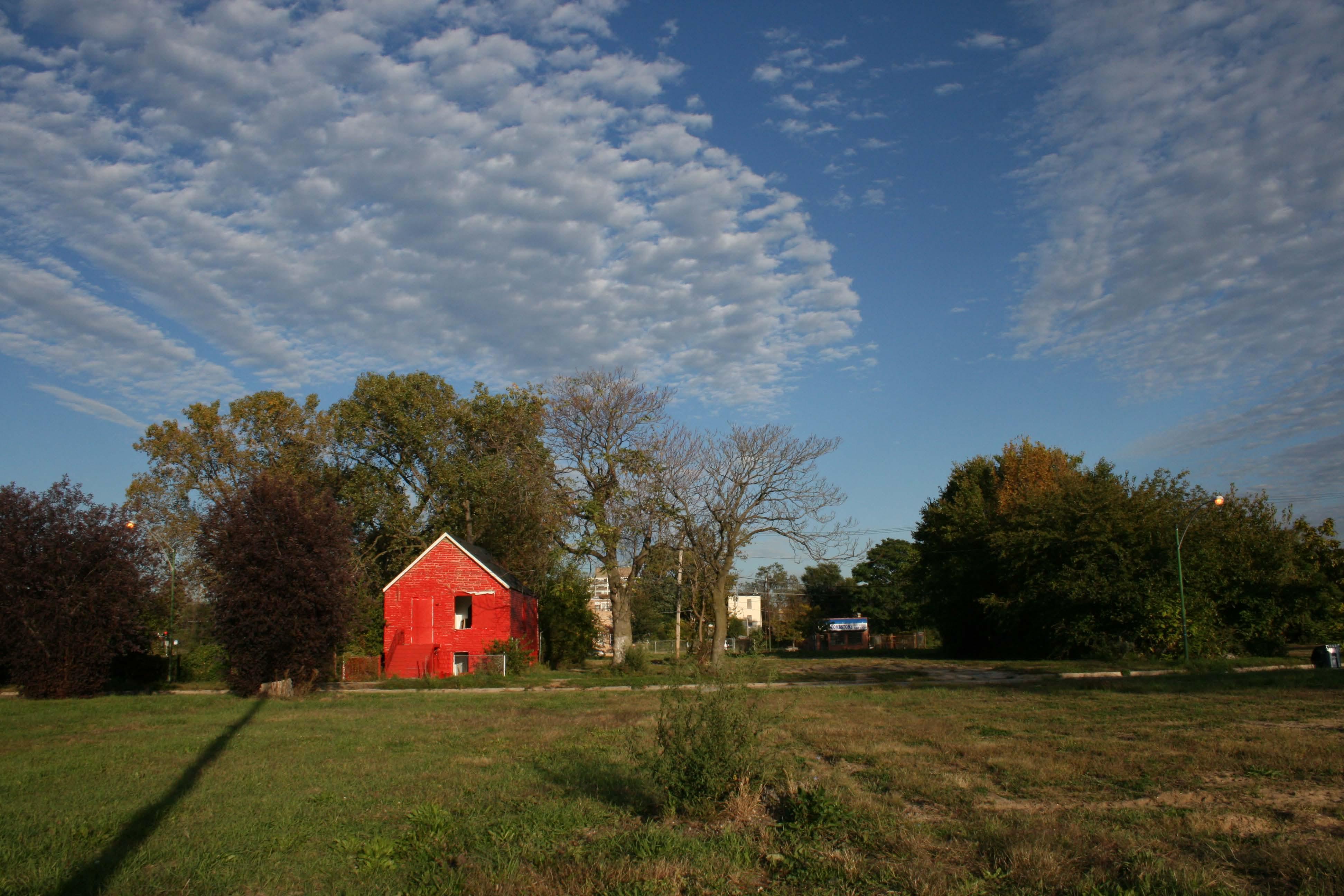
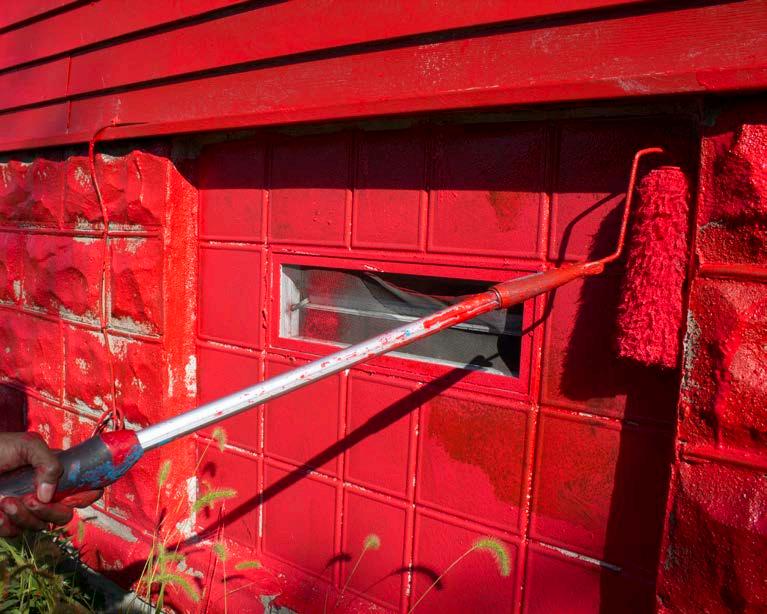
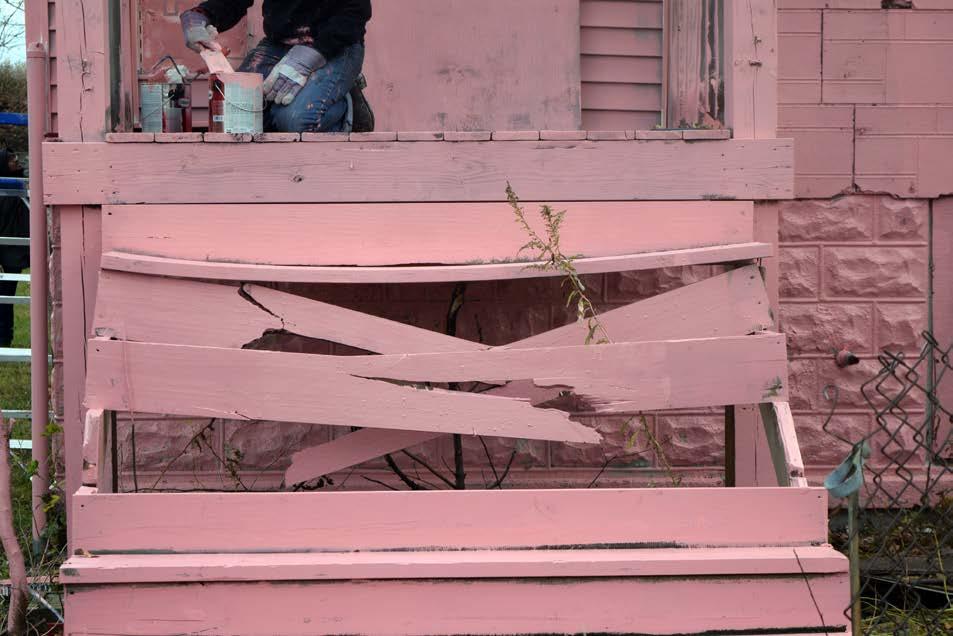
On a cold Saturday morning, fifty bundled-up people painted an abandoned house the color of Flamin’ Hot Cheetos. Most of these people didn’t know each other before today: they’re risking cold fingers and paint-splattered clothing to help out Amanda Williams, a South Side-born, Cornell-trained architect who has been painting vacant and abandoned houses around the South Side as part of her most recent project, titled Color(ed) Theory. This Saturday marked her seventh and final house, and people from every
chapter of her life helped see her project to completion. Williams’s architecture students directed volunteers; her sister-in-law braved the perilously unstable porch and painted the front door; her high school classmates reconnected after finding themselves painting side-by-side.
The event took place as part of the opening weekend of the inaugural Chicago Architectural Biennial, the largest international survey of contemporary architecture in North America. Almost no cultural institution in Chicago can escape the grip of architecture fever this fall, but Williams will be in the minority of Biennial participants
Amanda
Williams
explores the colors of the South Side
who are focusing on local issues. Color(ed) Theory was born out of Williams’s interest in thinking about the intersections of color, race, and space. A few years ago, she decided to stop actively practicing architecture and dedicate herself to painting, the art form she has always loved. She didn’t know what her place in the unpre-
dictable contemporary art world would be, unsure of any “conceptual underpinnings” in her work beyond her love for color. The struggle continued until a friend suggested a seemingly simple solution—“Why don’t you just paint on the scale of architecture?” This idea planted the seed for Color(ed) Theory, a project painting seven abandoned houses on the South Side in “culturally significant” colors of Chicago’s black community. Williams hopes that infusing bursts of color amongst the onslaught of abandonment and foreclosure will draw attention to the ubiquity of disregarded and undervalued black spaces within the city.
courtesy of amanda williams
The houses Williams painted were all slated for demolition—she did not intend the works to be permanent—but in a landscape where boarded-up homes are not rare, Williams had to think hard about which ones she felt were most important to showcase. “I thought about which ones stood really apart and isolated from the landscape, and I wanted to tell those stories,” Williams says. “I started to see them as people or characters, and think about what it would be like to be on a block where you’re isolated or abandoned or the only one left.”
Choosing colors was a painstaking process as well, as color is one of Williams’s favorite things about the work she does. “Obsessed with color” since childhood, she’s upset to see how disregarded it currently is in the architectural world. “In a field dominated by minimalism, architecture that’s colorful is often dismissed and seen as col-
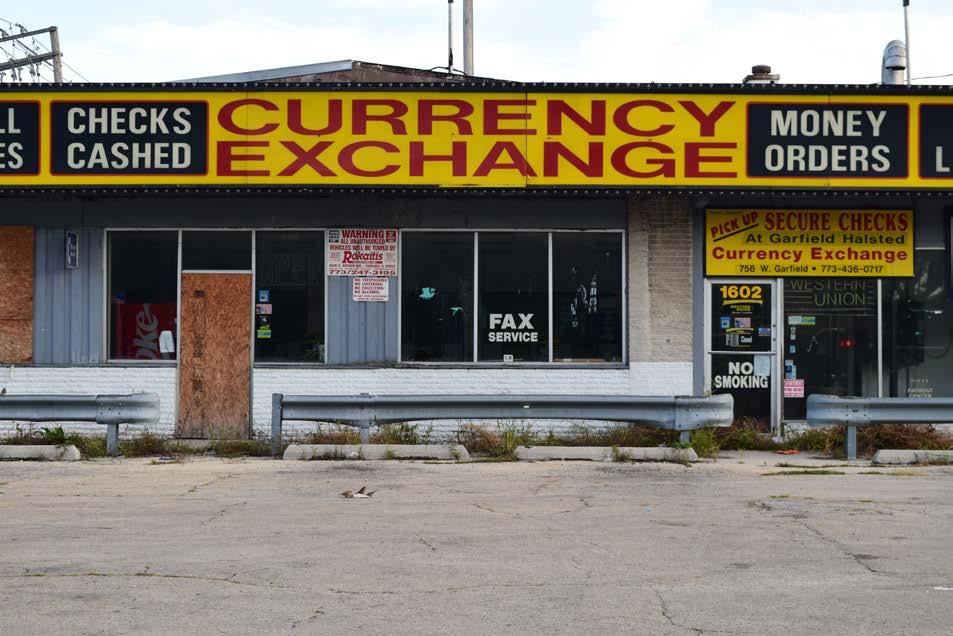
loquial,” says Williams. “It’s commonly used in most non-Western architecture, though, and I’ve been trying to understand the politics of that.” She started thinking about memories from her South Side childhood that were tied to a specific color. The first color she chose for the project was the shade of yellow used in Currency Exchange buildings. “It was the kind of building that you would reference through the color and not so much the type or style of building,” she says. From there, she canvassed friends at barbecues and parties for their ideas, deliberating for a long time about the list before she was finally pushed by friends to start working. Colors seen on her painted houses include Harold’s Chicken Shack Red, Newport Blue, and Pink Oil Moisturizer Pink. She paints the entire surface area of each house, turning them into splotches of color within a muted urban landscape that
are impossible to ignore. The eye-catching quality of the houses forces a reaction from viewers, turning the project into a love-orhate phenomenon. Neighbor reactions have ranged from appreciation to intense disapproval. She’s received praise for the beauty of the houses and complaints that they’ve become neighborhood eyesores. Williams isn’t upset about the negative feedback— she’s getting people talking, and that’s what’s important to her.
The project was also controversial in the architectural world; Williams admits that there was talk about why a project only tangentially related to architecture was included in the Biennial. Her retort is simple: who gets to decide what is and isn’t included? According to Williams, “A lot of the stuff that goes into the Biennial has no relevance to the everyday person.” She sees her role as an architect to be showcasing the field as a
“part of the fabric of people’s everyday lives.”
The Biennial organizers themselves were very supportive of the project, showing interest both in her work and in promoting the conversation that her work was engaging in. They were, however, less interested in spreading that conversation beyond her piece. Their official publications state their aim as being to “facilitate radical new thought about what the built environment should be in the 21st century,” but very little of this “radical new thought,” if the Biennial’s event schedule is to be believed, is being produced farther south than Roosevelt Road.
On the South Side, much of the Biennial activity is centered around University of Chicago-related spaces and figures, with the biggest South Side player in the Biennial being the Stony Island Arts Bank—the brand new project of well-known local art-
Amanda Williams’ work (top left, bottom middle) is inspired by Chicago’s naturally-occuring colors. She often spots locations that catch her eye on her “Sunday drives” around the South Side (top middle, right; bottom left, right).
courtesy of amanda williams
In a field dominated by minimalism, architecture that’s colorful is often dismissed and seen as colloquial.
ist and UofC professor Theaster Gates. This space is the newest of his repurposed old buildings and has opened simultaneously with the Biennial.
Williams acknowledges the limited South Side inclusion in the Biennial, but also hopes that by making her piece one of community participation, she can prod South Side residents to seek out cultural representation. “A lot of people say ‘Well, this isn’t for me, anyway,’ and think of cultural events like these as being something that stays downtown, she says, “but this Biennial is for all of Chicago, and there is a way you can engage.”
Her feelings about this are strong, which is to be expected, given the deep relationship she has to her home. Born in Auburn Gresham, she recently moved back to the South Side after practicing architecture in the Bay Area for years. “After ten years of living there, I still didn’t feel like it was home,” Williams says. “I bought a condo there, and I was like, ‘It’s still not home.’” In order to prove to herself that she really wanted to come back to Chicago, she decided she needed to return in the winter, moving back in January. She now lives in Bronzeville, but owns her childhood home in Auburn Gresham, where her husband also grew up. She calls these two places her “bookends” and frequently travels between them to visit her family and friends scattered throughout the South Side.
Every Sunday, her family drives to Auburn Gresham to visit her mother-in-law, continuing Williams’ years-long tradition of “Sunday drives,” where she drives around the South Side, looking at and studying the architecture found in its neighborhoods. A common critique of Color(ed) Theory is that it romanticizes poverty, but Williams says this landscape—and the questions it raises about beauty, urban space, and place making—is a large part of what inspired her to go to architecture school in the first place. “I didn’t grow up knowing a lot about the art world, but I knew that I found a lot of beauty in the spaces I grew up in,” she says. This project has recently received a lot of attention, and Williams says she’s starting to hear herself referred to as a “cultural force” on the South Side—a reputation that comes as a surprise to her. “I haven’t really done anything; I’ve painted and brought attention to things that everybody knows, but this is not about me,” she says. The completion of the Flamin’ Red Hots house marked the end of Color(ed) Theory, and she’s already looking forward to what’s next. When asked if this project has changed her relationship to the South Side, Williams answers that it’s changed her more than it’s changed her relationship to her home. “I’m obsessing a little bit more about vacant properties—I keep driving by vacant lots and being like, ‘Oh, that’s a good one!’ before I forget that this chapter is done.”
The City Revealed: Finding + Exploring Public Data
October 25, 2015, 3pm–5pm South Side Weekly Office at the Experimental Station, 6100 S. Blackstone Avenue
Columbia Journalism Professor Jeff Kelly Lowenstein discusses his work in data journalism, and gives a lesson on finding datasets through public data portals and Freedom of Information Act requests.
Part one of the Chicago Civic Journalism Project Data Journalism Series, presented by Chicago Studies, City Bureau, South Side Weekly, and University of Chicago Careers in Journalism, Arts, and Media.
Education as Liberation
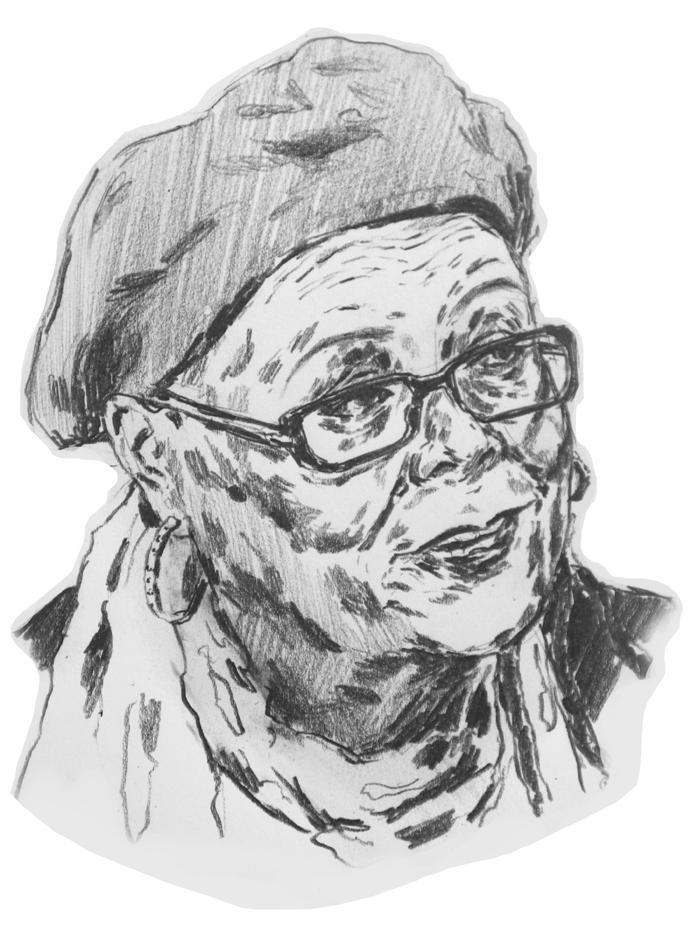
An interview with Juan Salgado, community leader and newly minted MacArthur Fellow
On Monday, September 28, Juan Salgado, president and CEO of Instituto del Progreso Latino, received a phone call. He was informed that he had been named a MacArthur Fellow and would receive $625,000. The MacArthur Fellows Program, often referred to as the “Genius Grant,” awards no-strings-attached fellowships in an attempt to celebrate and inspire the creative potential of exceptional individuals. Salgado received this honor in light of his visionary work: under his leadership, Instituto del Progreso Latino has developed a wide range of pre-professional education programs, providing the language and technical skills necessary for members of low-income, immigrant Latino communities on the Southwest Side to have access to higher paying jobs. The Weekly spoke to Salgado about the present, past, and future of his work.
BY LEWIS PAGE
What is the mission of Instituto, and how is it working to accomplish its goals?
Our mission is to contribute to the fullest development of Latino immigrants and their families. Through education and workforce development, training, [and] employment, we aim to foster full participation in our society while preserving cultural dignity and identity. We operate on the core belief that there is immense power in education. There’s a power to provide for your family and ensure a better quality of life. So everything we do is kind of geared towards bringing the power of education to people who haven’t had a real opportunity to experience it.
The mission statement of the Instituto Justice and Leadership Academy states, “The Instituto Justice and Leadership Academy (IJLA) is dedicated to the principle that education is liberation.” How
did your own education inform your views about education as a form of liberation?
Well, the “education as liberation” theme is one that has permeated our organization for the last thirty-eight years, and I was drawn to this organization because of it. From my personal vantage point, there are different layers of education. The first one is [what] you get from your parents, which are values that you live by. For me, preparing me for life, without that education in the home, I wouldn’t be prepared to make good life choices on my own. But the other vantage point is that the more you know, the more you are able to create the kind of world that you wish for yourself, for your family, for other families, for the community. And the more you are actually able to make an impact on it. So for me, “education as liberation” speaks to not only getting an education to advance yourself, but getting an education to advance a society. It’s not
teddy watler
liberation for any individual; it’s about getting the kind of society that everyone feels free in and is able to contribute and able to grow in and be embraced by.
You mentioned, when you were first talking about Instituto, that you work to preserve cultural values. How is that involved in the work you do?
Well, there are different layers to culture. The most important layer is that of dignity. And you can’t get to dignity if you don’t have a good sense of who you are, no matter who you are.
We try to operate as an organization in such a way that anyone who works with us will give us the respect we deserve because we have done the things we need to as an organization. So for us, dignity comes in every interaction that a teacher has with a student, every way that I interact with an institution in my community or outside of my community. And it comes in embracing who we are, as leaders. So, we call our organization Instituto de Progreso Latino. We use the Spanish name to identify ourselves. And we hope to set ourselves apart from a kind of colorful symbolism of who we are as a community and our indigenous roots...because we want those to be valued just as much as our present day society, which has evolved its values. We don’t necessarily want to go back to the past, because we’re future-oriented. We’ve got our eyes on getting people to a better place economically, but we are very much an organization that honors the past, because that is very much a part of cultural dignity and identity. Honoring our parents and our grandparents and their parents and their grandparents and on and on and on.
Instituto has been praised for its national influence. Do you hope to do more on that national scale, or do you like engaging in more local projects?
The way we refer to ourselves is that we are a laboratory of innovation. We take what’s not working in our city—we take these systems that are at place in our city, that are very much similar across the country. And if we can show a new way forward that actually works in our local geography, we can not only make our city and region a hell of a lot better, but we can be that proof point to spur on changes in other places.
So I’m not sure if you’re going to see Insti-
tuto actually servicing other people in the country as much as we are going to be the folks that identify the failures in our current ways of working that are holding people in our communities back, and we are going to show what can be done. We are going to address those failures and push on those systems—not just in our city, but in our state, and in other states and other cities. We are going to push on those systems to effectively meet the needs of our local community. And we are going to find partners in other cities that can pick up on what we’re doing and make that kind of reality happen for people in their local communities.
I’m sure you’ve got this question a lot lately, but where were you when you found out you received the MacArthur Genius grant, and what was your initial reaction?
I was on the street; I was actually walking in the neighborhood about a couple blocks away from one of our really strong churches in the community, which was a great thing, by the way. I prefer to be on the street with my community when I get that kind of phone call, rather than sitting in my office. I do very little sitting in my office. I was kind of speechless, basically, and a little bewildered, because I didn’t realize this was even happening. So, it was like, wait a minute, how did this happen?
So, the MacArthur “Genius Grant.” No strings attached. You simply receive that $625,000. Some people use this money to take greater risks than they otherwise might or sustain themselves as they take on those greater risks. Has your vision for Instituto and perhaps other projects and the future of your own work changed at all?
You know, that’s a great question. I think the answer is, absolutely yes. And I’m not sure exactly yet what the actual manifestations of that will be. But it’s got my head spinning about a lot of things that have to do with how we better our communities. And I don’t just mean Latino communities. I mean, I’m a kid from the South Side of Chicago. I grew up in a very diverse community that was not a majority Latino community. So my personal interest is that the kind of work that we’re doing can have impacts across the kind of diverse community that Chicago represents and that our country represents.
We are going to address those failures and push on those systems—not just in our city, but in our state, and in other states and other cities. We are going to push on those systems to effectively meet the needs of our local community.
Chicago Rap Unites in Justice Or Else
The newly released mega-track addresses police brutality and community violence
BY JON POILPRE
“Came all the way from the slave ships / 2015 it’s the same shit.”
In a recording studio on the corner of 22nd and Wabash Avenue, the Honorable Minister Louis Farrakhan sits quietly with his eyes closed, listening to these lyrics rapped by Roseland artist Pyro. Headphones on, hands clasped in front of his face, Farrakhan nods his head to the track “Justice or Else,” a collaboration between various South Side artists that speaks out against police brutality and institutionalized racism.
This is what Pyro claims he saw when Farrakhan previewed the track a few days before its September 24 release on SoundCloud. “Justice or Else” features Farrakhan’s own booming voice in addition to a slew of other Chicago artists: Lil Herb, King Louie, Saba, Goalden Chyld, GLC, Teefa, Pyro, Katie Got Bandz, Chella H, Que Billah, Mic Terror, to name a few. Producer SickOne also collaborated with Xcel and Da Internz in the production of the song, which is filled with heavy orchestral strings and guitar. Local artist Antwone Muhummad organized the collaboration, helped produce the track, and brought Farrakhan on board. The track’s producers sampled some of Farrakhan’s past speeches, most notably a speech he made in
June at the Metropolitan African Methodist Episcopal Church in Washington D.C.
I had the chance to speak to Pyro and Goalden Chyld, brothers who traded bars in a verse on “Justice or Else.” Pyro was on the “L” when Antwone Muhammad, a friend and mentor of Pyro’s since the sixth grade, contacted him about an open spot on the track.
“He sent me the beat, and I was on the train writing up the rap right there,” Pyro said. He described the importance of the track coming from Chicago artists, stating that the media often portrays Chicago as “the worst of the worst.”
“The youth in particular, who are coming out of this violence, who grew up in it, are saying that this system is not right and we are not going to take it anymore,” he says.
Both artists touched on the responsibility that musicians have to speak positively and to educate others. “Artists are leaders of the world,” Pyro said.
The seven-minute track was inspired by and named after Saturday’s commemoration of the anniversary of Farrakhan’s original Million Man March. Twenty years ago, the Million Man March brought together hundreds of thousands of African-Ameri-
can men with the hope of spreading a positive, nonviolent image of the black male that challenged stereotypes. The march doubled as a call for placing black Americans’ concerns back on the national political agenda. This year’s event again demanded justice for America’s black population, but also expanded its scope to include Native Americans, Mexicans and other Latinos, women, veterans, the poor, and the incarcerated, according to the event’s website.
“Justice or Else” takes the concerns of the marchers seriously. Goalden Chyld questions the negative image of black Americans in one of his verses: “Where we get the guns and the drugs from? / ‘Cause come on, I know you know we’re not sitting around trying to make ‘em.” He and Pyro go on to express positivity and unity: “That’s word to
the Almighty! / But these devils they ain’t ready for God’s army!”
A single, steady note on the piano punctuates the last few seconds of the track with no other instruments in the background. Even though the message is spoken by many, “Justice or Else” has a powerful resounding singularity that culminates in what Goalden Chyld called a “huge step towards mental, physical, and spiritual freedom.” Pyro’s single, “Arrogant” and an EP, Who Am I, are coming out soon. He also recently released “10,” a track inspired by the “Justice or Else” movement. Goalden Chyld just released an album called Stand For (Justice or Else). Both “10” and Stand For (Justice or Else) are available on SoundCloud.
Autumn Leaves
ACROSS
1. Has 5. "Scat!"
9. Subject
14. Smell
15. "___ Flux" (Charlize Theron movie)
16. Quickly
17. Like some DVD extras
20. Part of a TV season
21. White Castle offerings
22. Prefix with byte or flop
24. @@@
25. Slightly ill
30. ___ Donut on Cottage Grove
33. Where Noah landed his ark
34. Pep rally cry
35. Genie's offering
36. More levelheaded
37. It's sometimes glossed?
38. ___ blank (totally forgot)
39. City in Nevada
40. Jesse Jackson, for one: Abbr.
41. Only president of both the Screen Actor's Guild and the United States
42. Snake sound
43. Ruin a picture, maybe
45. Nov. follower
47. Shoulder muscle, informally
48. It makes the heart grow fonder
52. Trough
57. Starting over
59. Town ___ (early news announcer)
60. Election day: Abbr.
61. ___ fool (go nuts)
62. Impertinent
63. One and only
64. Word that can precede the starting words of 17-, 25-, 43-, and 57-Across DOWN
1. "Eat ___ eaten"
2. Cry
BY JOE LOTHAN
BULLETIN
Acts of Kindness Day
47th St. and King Dr. Wednesday, October 14, 5pm–6:30pm. Free. (773) 924-9270, ext. 25. trcwabash.org
Spread some warmth in the face of the looming cold weather! The Renaissance Collaborative is calling all kind people to volunteer and engage with the Bronzeville community by passing out kindness cards, information on job opportunities, and smiles. (Jena Wang)
Access to Capital from A to Z Preparation
Chicago Urban League, 4510 S. Michigan Ave. Wednesday, October 14, 5pm–7pm; Thursday, October, 15, 10am-12pm. Free. (773) 285-5800. meetup.com
Word Warrior by Sonja Williams
Carruthers Center for Inner City Studies, 700 E. Oakwood Blvd. Thursday, October 15, 3pm–5pm. (312) 428-8033. bronzevillehistoricalsociety.wordpress.com
Richard Durham’s Destination Freedom radio series helped sculpt a heroic narrative of the civil rights movement as it was in its infancy; he’d go on to be the editor for the Nation of Islam’s official newspaper, the co-author of Muhammad Ali’s autobiography, and a speechwriter for Harold Washington. Come to this book signing to learn about this pioneering journalist. (Adam Thorp)
Vermont Governor Peter Shumlin
3. Classic pop brand
4. Cross-country ___
5. Most melancholy
6. Not homo-
7. "___-la-la"
8. Singles
9. Unspoken
10. Newspaper opinions pieces
11. Window part
12. Froster
13. Word before pool or pit
18. Relatively near 19. /
23. Came
25. Desert havens
26. European/Asia border range
27. Armored vehicles
28. Cookie often dunked in milk
29. Faucet
30. Muralist Rivera
31. ___ expected (predictably)
32. Macbeth's title
35. Rolled sandwich
37. "My Name is Asher ___"
38. Showtime show with a serial killer cop
40. Boxer Marciano's given name
41. Catch and ___
44. Gas up again
45. Hockey feints
46. Way in
48. Kindergarten basics
49. Theda of early films
50. Chem. and bio.
51. Ballpark figs.
53. Like many sign language users
54. ___ Raton, Fla.
55. Worldwide: Abbr.
56. Actress Patricia
58. Status ___
answers,
Prep for the Speed Lending portion of “Access to Capital from A to Z” at the Chicago Urban League this Wednesday. Small business owners are welcome to get guidance on the ins and outs of the financing application process. (Rachel He)
Hate Crimes in the Heartland
Center for the Study of Race, Politics, and Culture, 5733 S. University Ave. Thursday, October 15, 4pm-6:30pm. Free, RSVP required. (773) 702-8063. csrpc.uchicago.edu
What happens when a string of racially motivated shootings stirs up old tensions in a quiet Midwest city? Filmmaker Rachel Lyon will screen and discuss her film about two Tulsa, Oklahoma hate crimes separated by ninety years. (Will Cabaniss)
Becoming an Antiracist Social Worker: Consultation Group
First Unitarian Church of Chicago, 5650 S. Woodlawn Ave. Thursday, October 15, 6pm–7:30pm. $20. eventbrite.com
Masters-level social workers and counselors can RSVP to join the consultation group held by SydneyMalcome LLC. Respond to the urgent call for action to undo racism in the current practices at the clinical and organizational levels. Case studies will be the major form of discussion. (Yunhan Wen)
Ida Noyes Hall, 3rd Floor Theater, 1212 E. 59th St. Thursday, October 15, 10am-11am. Free, RSVP required. (773) 834-4671. politics.uchicago.edu
Few politicians persevere on a single issue with as much drive and tenacity as Peter Shumlin has shown in taking on heroin abuse. Hear the governor speak at the UofC about his efforts to stop the drug’s advance through the verdant mountains of his home state and his ideas about treating drug abuse as a public health issue. (Will Cabaniss)
March for Black Girls
North Lawndale College Prep High School, 1615 S. Christiana Ave. Saturday, October 17, 10am-12:30pm. (877) 571-1751. alongwalkhome.org
March with the group A Long Walk Home to take a stand against violence faced by African-American girls and women both in and out of the home. This march will conclude at the site where twenty-twoyear-old Rekia Boyd was fatally shot by a police officer. (Yunhan Wen)
I Shocked the Sheriff
CPD Headquarters, 3510 S. Michigan Ave. Saturday, October 24, 1pm. ishockedthesheriff. org