
south side weekly
The South Side Weekly is a nonprofit newsprint magazine written for and about neighborhoods on the South Side of Chicago. We publish in-depth coverage of the arts and issues of public interest alongside oral histories, poetry, fiction, interviews, and artwork from local photographers and illustrators. Started as a student paper at the University of Chicago, the South Side Weekly is now an independent nonprofit organization dedicated to supporting cultural and civic engagement on the South Side, and to providing educational opportunities for developing journalists, writers, and artists.
Editor-in-Chief Bea Malsky
Managing Editor Hannah Nyhart
Deputy Editors John Gamino, Meaghan Murphy
Politics Editors Osita Nwanevu, Rachel Schastok
Music Editor Jake Bittle
Stage & Screen Olivia Stovicek
Editor Visual Arts Editor Lauren Gurley, Robert Sorrell
Editor-at-Large Bess Cohen
Contributing Editors Maha Ahmed, Lucia Ahrensdorf, Christian Belanger, Mari Cohen, Emma Collins
Social Media Editor Emily Lipstein
Web Editor Sarah Claypoole
Photo Editor Luke White
Illustration Editor Ellie Mejia
Layout Editors Adam Thorp, Baci Weiler
Senior Writers Jack Nuelle, Stephen Urchick
Staff Writers Olivia Adams, Julia Aizuss, Max Bloom, Austin Brown, Amelia Dmowska, Mark Hassenfratz, Maira Khwaja, Jeanne Lieberman, Zoe Ma -koul, Olivia Myszkowski, Jamison Pfeifer, Hafsa Razi, Kari Wei
Staff Photographers Camden Bauchner, Juliet Eldred, Kiran Misra, Siddhesh Mukerji
Staff Illustrators Jean Cochrane, Lexi Drexelius, Wei Yi Ow, Amber Sollenberger, Teddy Watler, Julie Wu
Editorial Intern Clyde Schwab
Webmaster Shuwen Qian
Business Manager Harry Backlund
The paper is produced by an all-volunteer editorial staff and seeks contributions from across the city. We distribute each Wednesday in the fall, winter, and spring, with breaks during April and December. Over the summer we publish monthly.
Send submissions, story ideas, comments, or questions to editor@southsideweekly.com or mail to: South Side Weekly 1212 E. 59th Street Ida Noyes Hall #030 Chicago, IL 60637
For advertising inquiries, contact: (773)234-5388 or advertising@southsideweekly
Read our stories online at southsideweekly.com
Cover images courtesy of Skandar Skandal, design by Ellie Mejia.
IN CHICAGO
A week’s worth of developing stories, odd events, and signs of the times, culled from the desks, inboxes and wandering eyes of the editors
Obrahma
With the election around the corner and Rahm’s ratings at an all-time low, it only makes sense that Chicago’s incumbent mayor would enlist some celebrity endorsements—such as, for example, the President of the United States, soon-to-be-brought-home-? (see page 9) Chicagoan Barack Obama. You can go online or flip on the radio to hear Obama tout Rahm’s record—longer school day, higher minimum wage, the phrase “every neighborhood”—over the Spotify in-house ad music. The kicker is when Big O praises Rahm for “doing what’s right, instead of what’s popular,” as if it isn’t possible to do neither. For the record, eighty-seven percent of Chicagoans voted in November to raise the minimum wage.
Remembering Mr. Banks
It’s a sad week for Chicago sports. Ernie Banks, the Chicago Cubs Hall of Famer and eleven-time All-Star, died of a heart attack on January 23 at age eighty-three. The shortstop and first baseman, who spent all nineteen of his Major League seasons with the Cubs, was so beloved by the team’s fans that the famously caustic manager Leo “The Lip” Durocher once said, “I had to play the man or there would have been a revolution in the street.” He was often asked to recite his signature catchphrase—“Let’s play two!”—by random Chicagoans; Banks always obliged. His bronze statue, which currently sits outside Wrigley Field, will be moved to Daley Plaza from Wednesday to Saturday so fans can pay their respects. Here’s to you, Mr. Cub.
Trouble Brewing
For the second time in one week, the owners of Bow Truss, a Pilsen boutique coffee shop opened last August, were greeted on Monday morning by anti-gentrification signs. The handmade signs, left on the shop’s front windows, read: “GENTRIFICATION IS NOT Welcome here! Racism and Classism smelllls like your coffee...” and “Te Gusta leche con tu cafe? Sugar with your GENTRIFICATION?” In response, Bow Truss owner Phil Tadros has reached out to 25th Ward Alderman Danny Solis for advice on how to handle the situation, and has declined to report the incident to the police. Speaking with DNAinfo, Tadros has extended an open hand to whoever put up the signs, expressing a wish to meet with the community at his shop. “To do anything positive, or move forward, we have to have a conversation with the people doing this. We aren’t here to harm anyone,” he said. Meanwhile, on Facebook and EveryBlock, a conversation has been triggered. Commenters are weighing in on both sides, with some denouncing the signs as foolish and reductive and others expressing real concern over gentrification’s racial displacement and Bow Truss’s expansion from their original North Side locales of River North and Lakeview. Whether you choose to look at these signs as sharp commentary on change in the neighborhood or as pointless rabblerousing, it’s clear that there’s a conversation to be had regarding gentrification, artisanal coffee, and business ownership in Pilsen.
IN THIS ISSUE
the audacious archive of the aacm robert sorrell...4
The group of musicians, and—importantly—the music itself, was “free” to begin with.
“There was a vibrancy that this particular magic art center brought to the neighborhood.”
ssac at seventy-five rachel schastok...7
Parson’s staging, like all good Godot stagings, asks us to… ponder our pondering.
worth the wait osita nwanevu...5
taking kids of the block michelle gan...6
“You can only help the youth by focusing on what they need, not what you think they need.”
The impression this campaign creates is one of a grassroots effort spontaneously emerging out of the surrounding neighborhoods.
bringing obama home christian belanger...9
finding charley organaire jack nuelle...12
“Daddy Charles, all these years I’ve been dancing to your music and didn’t know?”
Both “Happy Days” and a song by Tupac find their place.
humor but no laughs chloe hadavas...16
The play, each performance a largely improvised affair, is at once a poem, a song, and a prayer to the now deceased King. playing king will craft...16
the most everything maha ahmed...16
You can’t help but feel part of something visceral, emotional, elevated—brutal.
The Audacious Archive of the AACM
“Free at First” at the DuSable Museum
BY ROBERT SORRELL
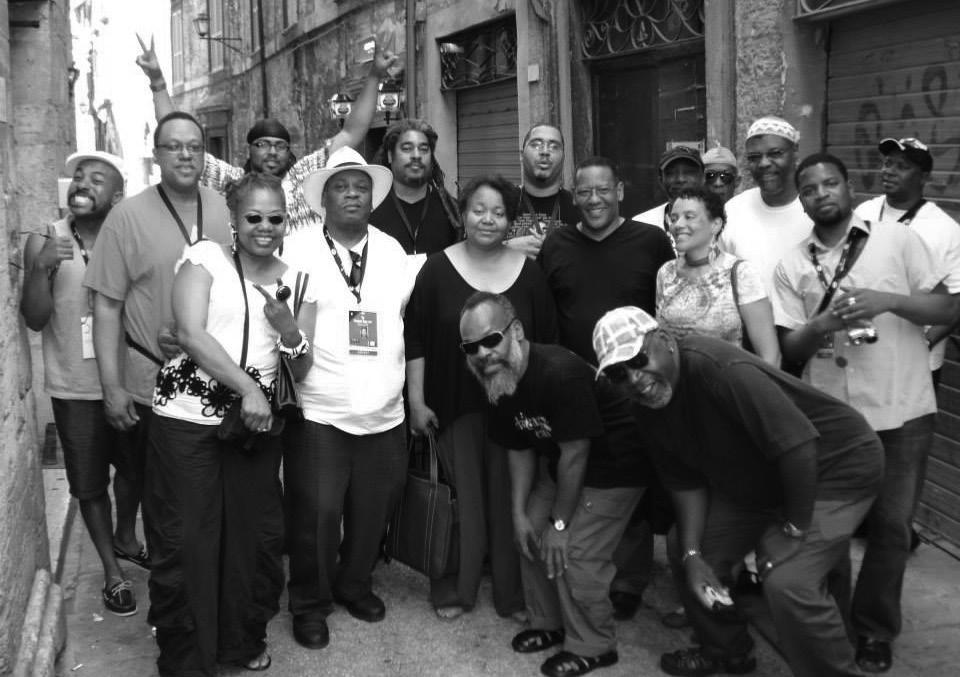
The DuSable Museum was a flurry of activity on MLK Day. Grammy Award-winning artist J. Ivy performed in the auditorium, family-friendly films on the civil rights movement played on repeat, docents led tours, and in one of the main galleries upstairs, a small exhibition focusing on a group of musicians from the South Side opened its doors.
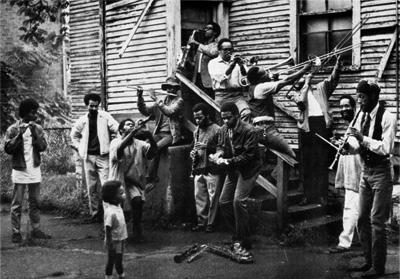
“Free at First: The Audacious Journey of the Association for the Advancement of Creative Musicians” takes up a different kind of struggle than the one most of the crowd focused on last week. The AACM constantly sought creative expression through music—jazz, to be specific. A sound that comes up through the heels of feet and bent knees, arches through the back, and explodes out of brass, wood, and steel. Fast, improvisational, momentary.
The initial premise of “Free at First” is spelled out in the title. Namely, that the group of musicians, and—importantly—the music itself, was “free” to begin with: free from creative stifling, free from institutions, and free from the traditional money-run world of entertainment.
“The only jobs that we’re going to have where we can really perform original music are concerts we promote,” proclaimed Jodie Christian, one of AACM’s founders. His words are written neatly on one wall over a photograph of him at the piano. Next to him are photos of the other founders: Kelan Phil Cochran, Steve McCall, and Muhal Richard Abrams. Above Abrams’s head appears the dictum, “We need to be remembered as representing ourselves.”
Formed in 1965, two years after King’s “I Have a Dream” speech, three years before his assassination, and in the same year as the Selma-Montgomery march, the AACM has evident ties to both King and the civil rights movement. Yet, instead of having to fight for
their rights, the AACM asserted them from the very beginning. They weren’t asking to be allowed in, but rather pushing to open the door, showing what was possible—and, after them, expected—in experimental jazz. Free at first.
The DuSable’s exhibit uses anything it can find to create a portrait of this amorphous, dynamic group, the whole thing a feeling of collage. Though there is perhaps no other way to capture a group that, in their fiftieth year, calls themselves the “oldest and most venerable organization of its kind.” A rather modest title, given the DuSable’s assertion that the AACM is the only remaining musician’s collective, a fact nearly impossible to prove.
Nonetheless, inside the DuSable exhibit’s MLK Day opening, these concerns were put aside as a mix of parents, children, retirees, and the occasional young adult wandered through the collection of photos, posters, clothing, objects, and TVs.
In addition to the paraphernalia lining the walls and filling a few museum cases, in one corner stood a recreation of the famous “Hubkaphone” created by Henry Threadgill, an early member of the AACM. The DuSable’s version of the Hubkaphone, placed in the largest room of the exhibit, consists of a metal frame with three horizontal bars running through it. On these bars hang—you guessed it—hubcaps, in addition to large metal plates, cowbells, a wooden slit drum with a mallet, and other sundry metal objects that may or may not have come from an actual car.
Children and adults alike flocked to the massive instrument, testing out the sound of an old Mercedes hubcap versus a newer Chevrolet, brake disc versus cowbell. The ruckus mixed with videos of live performances, creating a soundtrack oddly fitting for the experimental musicians the exhibition at-
tempts to capture.
Wandering through the rooms of “Free at First” is a bit like going on a treasure hunt. Photos cluster together on walls painted pumpkin yellow and bright red. Looking closely, wonderful details pop out: a man playing a saxophone that must be at least six feet tall, a concert poster from Japan near an album recorded live in 1972 at Mandel Hall, just a few blocks east of the museum.
On one of the TV screens, an excerpt from a documentary on saxophonist Kalaparusha Maurice McIntyre, Closeness, plays. In one segment, McIntyre tells a story about playing with Miles Davis, who told him to stuff cotton in his ears to keep the band from blowing his eardrums. On stage McIntyre found a groove, and kept riffing on it, eyes closed until he cracked a lid to find he was the only one left on the stage. Davis and his band had left, frustrated by the sax player from
McIntyre passed away in 2013, and most of the other early members of the AACM (not to mention the Prince of Darkness himself, Miles Davis) have passed away as well. With the AACM heading into its fiftieth year, heaps of great music and scores of nearly mythic musicians in its wake, “Free at First” could easily have been all nostalgia. The AACM was “free” from the beginning. And despite the slow decline of popular interest in jazz, and the equally slow but just as acidic disappearance of music venues across the South Side, maybe it still can be. After the DuSable’s entrance fee, of course.
DuSable Museum of African American History, 740 E. 56th Pl. Through September 6. $10; free Sundays. (877)387-2251. dusablemuseum.org
Chicago who wouldn’t shut up. McIntyre tells the tale with a grin.
Worth the Wait
Waiting for Godot at the Court Theatre
BY OSITA NWANEVU
Aselection of adaptations that inspired director and Court Theatre resident artist Ron OJ Parson’s staging of Samuel Beckett’s absurdist play Waiting for Godot are singled-out on a large poster hanging in the Court Theatre’s lobby. Two of these stagings—a 1957 Broadway revival starring Geoff Searle, Mantan Moreland, and Geoffery Holder and a 2006 show by the Classical Theatre of Harlem placing the characters in a flooded, post-Katrina New Orleans— featured, as Parson’s staging does, an allblack cast, a move Parson says sits well within the tradition of draping changes over the play’s bare-bones structure to imbue it with particular meanings for particular communities.
“I am not here to change the play, maybe just deepen some of the issues found in the play by having the cast represented with the bodies and actors I cast,” he says in an interview featured in the show’s program. “I wanted to do something the Black community could get involved in— but not in the most stereotypical way.”
Later in the interview, he makes reference to the deaths of Eric Garner and Michael Brown as indicative of a deliverance that the African-American community in particular has long awaited even as it seeks answers to the questions that trouble all humanity, or so the play argues. The play’s lead characters—Vladimir and Estragon, two hobos who implicitly stand in for all humanity—wait for the duration of the play for the arrival of a man named Godot, whom, from its very first staging, has been understood as a catchall symbol. He is an absent embodiment of the answers to our deepest questions, our queries about existential meaning. The value of
interpersonal relationships. The existence and nature of God.
The selection of an all-black cast both broadens and grounds those questions. Audiences, Parson suggests, can imagine a black Vladimir and Estragon waiting for justice, equality, and dignity in the firm here and now even as they look to the heavens and down the road for all the rest.
But although race relations are likely on the minds of this staging’s viewers
oppression more than a white Pozzo with a black Lucky might have. The tendency of men to exploit others and the kinds of pontifications used to justify or obscure that tendency—which Smith delivers in a stout and sonorous voice that betrays his experience as a voiceover artist—are both universal, despite the particular alignments of oppressors and oppressed played out in our history. As is the temptation to succumb to both, as Vladimir and Es-
Audiences, Parson suggests, can imagine a black Vladimir and Estragon waiting for justice, equality, and dignity in the firm here and now even as they look to the heavens and down the road for all the rest.
even before the first crack of the whip of Pozzo—a proud buffoon who drives a man named Lucky in front of him like a mule—Parson’s staging retains the opacity and thematic ambiguity of the play as written. He’s avoided certain unsubtle moves. A black Pozzo, played with bombast and bravura by A.C. Smith, who was recently seen in both The Misanthrope and Tartuffe at Court, invites viewers to examine the nature of pure power and de-racialized
tragon’s playful flirtations with exercising authority demonstrate.
The risk of succumbing is embodied by Lucky, who, as Vladimir exclaims in a brief attack of insight and indignation, is a human being stripped of his humanity by Pozzo and circumstance. Though Lucky is mute through most of the play, the rigid expressions of actor Anthony Lee Irons and his trembling anger at being ordered around speak volumes. At one of the play’s
most memorable moments—after Lucky is ordered to “Think”—Irons is a revelation, convulsing frenetically and bandying across the stage and into the audience while delivering Beckett’s absurd stream of consciousness monologue. His performance is at once frightening and funny; audience members should prepare to join in an ovation as soon as Lucky finally comes to rest.
The play’s other two leads are decent in their roles. Alfred H. Wilson and Allen Gilmore nail the physically comedic and evocative parts of Estragon and Vladimir as a Laurel and Hardy-type pair. Gilmore, who plays Vladimir, has a sadness to his face that lends certain scenes extra poignancy. His despair at the second visit of Godot’s boy near the play’s end ensures that audiences leave as moody and contemplative as Beckett intended. Gilmore and Wilson play their roles with a naturalistic chumminess that makes the open questions they pose fit with their more ribald and banal banter. This may well have been what Beckett intended: an illustration in their characters of our inclination to squeeze thoughts about the great beyond and ourselves into minds already crowded with frivolities. Of our willingness to place our musings on God and man on a shelf between our fart jokes and favorite songs. Parson’s staging, like all good Godot stagings, asks us to examine that shelf more closely. It asks us to ponder our pondering—our willingness to wait for Godot, who or whatever it might be.
Court Theatre, 5535 S. Ellis Ave. January 28–February 15. $55, $49.50 seniors, $41.25 students. (773)753-4472. courttheatre.org