The South Side Weekly is an independent nonprofit newsprint magazine written for and about neighborhoods on the South Side of Chicago. We publish indepth coverage of the arts and issues of public interest alongside oral histories, poetry, fiction, interviews, and artwork from local photographers and illustrators. The South Side Weekly is dedicated to supporting cultural and civic engagement on the South Side and to providing educational opportunities for developing journalists, writers, and artists.
Editor-in-Chief Osita Nwanevu
Executive Editor Bess Cohen
Managing Editors Jake Bittle, Olivia Stovicek
Politics Editor Christian Belanger
Education Editor Mari Cohen
Music Editor Maha Ahmed
Stage & Screen Julia Aizuss
Editor
Visual Arts Editor Emeline Posner
Contributing Editors Lucia Ahrensdorf, Will Cabaniss, Sarah Claypoole, Eleonora Edreva, Lewis Page, Hafsa Razi, Sammie Spector
Social Media Editors Austin Brown, Emily Lipstein, Sam Stecklow
Web Editor Andrew Koski
Visuals Editor Ellie Mejia
Deputy Visuals Editors Ellen Hao, Thumy Phan
Layout Editor Baci Weiler
Senior Writer: Stephen Urchick
Staff Writers: Olivia Adams, Sara Cohen, Christopher Good, Emiliano Burr di Mauro, Michal Kranz, Zoe Makoul, Sonia Schlesinger, Darren Wan
Staff Photographers: Juliet Eldred, Finn Jubak, Alexander Pizzirani, Julie Wu
Staff Illustrators: Javier Suarez, Addie Barron, Jean Cochrane, Lexi Drexelius, Wei Yi Ow, Amber Sollenberger, Teddy Watler, Julie Wu, Zelda Galewsky, Seonhyung Kim
The paper is produced by an all-volunteer editorial staff and seeks contributions from across the city. We distribute each Wednesday in the fall, winter, and spring, with breaks during April and December. Over the summer we publish monthly. Send submissions, story ideas, comments, or questions to editor@southsideweekly.com or mail to: South Side Weekly 6100 S. Blackstone Ave. Chicago, IL 60637
For advertising inquiries, contact: (773) 234-5388 or advertising@southsideweekly
Read our stories online at southsideweekly.com
photo by Nate Earnest.
IN CHICAGO
A week’s worth of developing stories, odd events, and signs of the times, culled from the desks, inboxes, and wandering eyes of the editors
Correction
A review of Juice's Bar'd Up mixtape in the January 6 issue of the Weekly contained a number of errors. Juice currently lives and works in Chicago, not California. The mixtape contains eight songs, not the seven available for streaming on Bandcamp. Juice defeated Eminem in a rap battle but did not defeat Supernatural. The song "13," while it does concern a murderous teenager, also concerns the negative effects of bullying. Finally, the review neglected to mention that Bar'd Up is part of a fundraiser meant to help Juice and his wife Bella pay legal fees they incurred when they were pulled over by police in Nebraska and had their savings confiscated through the controversial "civil forfeiture" program. The original review did not accurately reflect the context and content of Bar'd Up.We regret the errors and have updated the review online.
Prayers for Anita Alvarez Cook County State’s Attorney Anita Alvarez said on Monday that there is no need for a special prosecutor to handle police shooting cases. Alvarez’s comments were a response to a question posed at a Martin Luther King Jr. Day forum on community justice at the Community Renewal Society's Faith in Action Assembly. All three candidates for State’s Attorney were at the forum and responded to the special prosecutor question—Donna More proposed the creation of a section within the State’s Attorney’s office exclusively devoted to police prosecutions, while Kim Foxx said she would want a special prosecutor to handle those cases. Alvarez argued that the State’s Attorney is legally
only allowed to hand off a case to a special prosecutor in the case of a “legal conflict,” one which Alvarez does not see in police shooting cases. Foxx on the other hand contended that there is a conflict of interest, arguing that the State’s Attorney’s office depends on the police department for cases, which creates an “inherent intimacy.” In reaction to Alvarez’s answer, the gathering of congregants from Chicago-area churches stood and prayed together that God help Alvarez “see the light.”
Shootings Up in 2016
Ten days, 110 shootings: from January 1 to January 10, 110 people have been have been shot in Chicago. According to DNAinfo, that’s up two and a half times since last year, when forty-four people had been shot by this time. And after a year like 2015, when gun violence became a national issue and President Obama made gun safety a central policy goal, a statistic of that scale is sure to intensify debate on both sides. John Escalante, Interim Police Superintendent following Garry McCarthy’s firing in early December, explained the spike in crime as originating in gang feuds, although through a new medium: Twitter and Facebook posts “taunting and challenging” rival gangs. “It’s the modern way of gang graffiti,” he said. Escalante is now tasked with the unenviable job of simultaneously countering a rapidly expanding inter-gang violence problem and working to restore confidence in the department, after damage done to its reputation by the Laquan McDonald video and subsequent protests.
IN THIS ISSUE
HOW TO bE HEarD
"You deserve their ears, they deserve you."
kristin lin...4
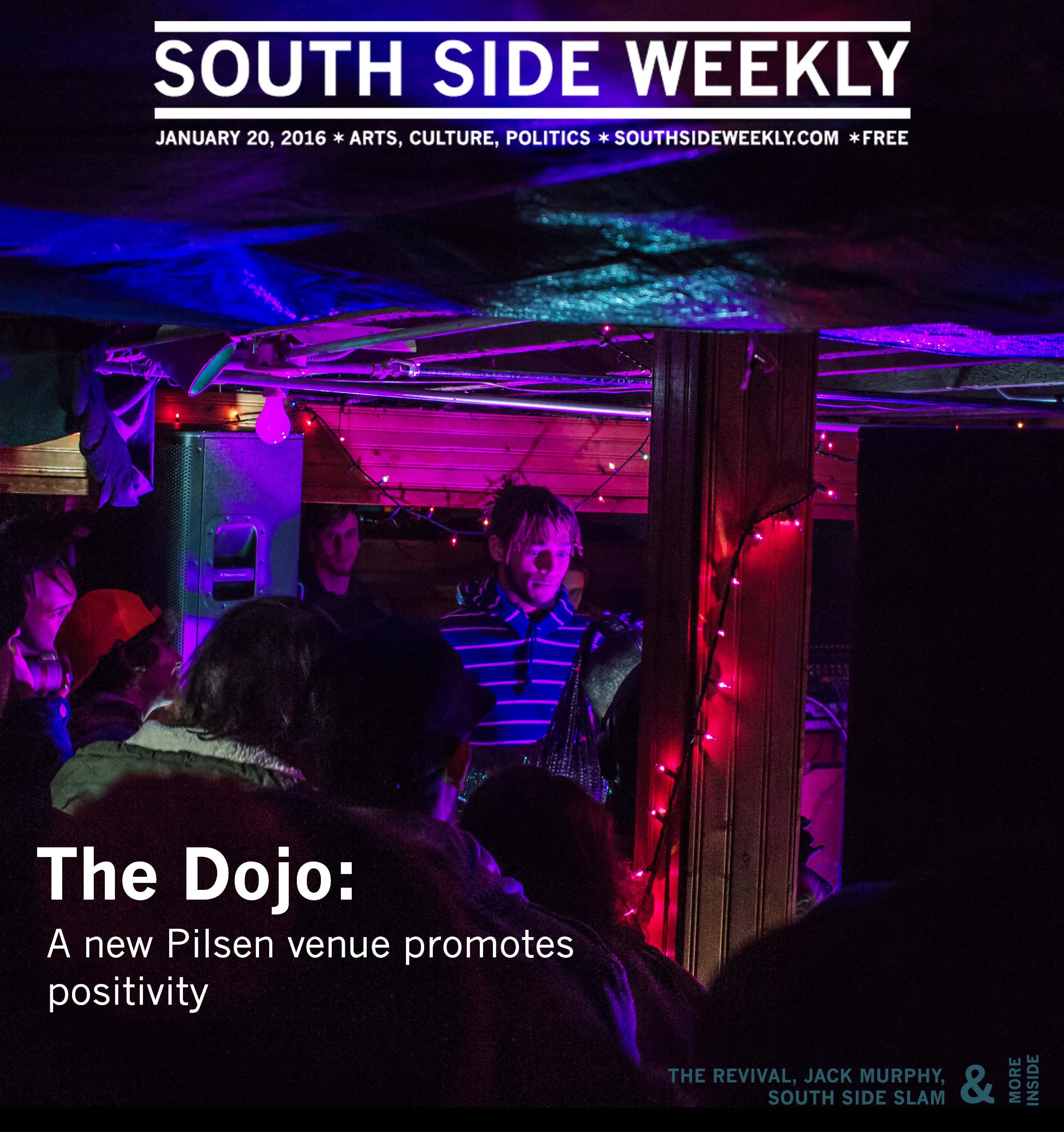
nO DEfEaT aT THE DOjO
“We try to keep everything in house." jon poilpre...5
papErbacK WrITEr
"I think I’d rather write a great poem." sarah claypoole...8
paraDIgm SHIfT
At first, he didn’t take the job seriously—he assumed that people would see him as “just a gangbanger.” ari feldman...10
frOm THE prESSES, fOr THE pEOpLE
“This was a story that needed to be told.” sara cohen...12
rEvIvaL On 55TH STrEET
“We are sitting right on the corner where the art form [of improv comedy] was invented.”
ariella carmell...13
Cover
How to Be Heard
High school spoken word community gathers at the South Side Slam
BY KRISTIN LIN
On a Tuesday afternoon, Julian Johnson sat in a classroom in TEAM Englewood Community Academy with the rest of his slam poetry team. Although he’s a junior at TEAM Englewood, Johnson is new to the team. He had seen upperclassmen perform spoken word and written some poetry here and there, but joining the team was a big step. Melissa Hughes, the coach of TEAM Englewood’s team, noted this as she confirmed his plans to attend South Side Slam, an annual competition for high school poets on the South Side.
“I know you are dying to perform,” Hughes said to Johnson. “I cannot wait to see you perform.”
The following Saturday, Johnson joined students from twelve high schools across the South Side at TEAM Englewood Academy for the South Side Slam. The sixth annual Slam was an opportunity for teen poets to share their work with a live audience in anticipation of Louder Than A Bomb (LTAB), the annual Chicago-wide poetry competition for high school students.
Hughes, an English teacher at TEAM Englewood, and Molly Myers, who teaches at Lindblom Math and Science Academy, co-organized the event. Young Chicago Authors, the spoken word nonprofit that hosts LTAB, provided staff and connected new coaches to Hughes and Myers.
Hughes intended the South Side Slam to be a place where students could share their stories, and where the audience could listen and learn. The poems covered a variety of
topics—from gentrification to cultural appropriation to experiences with abuse. Marquis “Picasso” Eason, a junior at Percy L. Julian High School, had to pause for a moment while performing a piece on his experiences with bullying. In response, the audience snapped and clapped in encouragement.
“I was choking up,” Eason said later. “I took a pause, took a breath, and continued on.”
Eason is the captain of Julian’s poetry team. He was first drawn to poetry when he saw a performance on TV at three years old. Eason was shy when he joined the team as a freshman, but with his coach’s encouragement he eventually opened up. He said he chose the stage name Picasso because his coach, noting Eason’s talent for painting, told him he was an imagery poet.
“Every time I come to South Side Slam, I hear the poetry, and I am just like, wow,” said Eason, who represented his team in the final round. “It’s like that first time and I’m back at that TV screen, the first time hearing it, the first time I’m listening to it.”
Patricia Frazier, the captain of the poetry team from Gwendolyn Brooks College Preparatory Academy, performed a group piece about cultural appropriation, as well as an individual piece about how gentrification has impacted her life. Frazier grew up in the Ida B. Wells Homes in Bronzeville before they were demolished and still returns to the neighborhood to visit her grandmother.
“Every time I go over there, there’s a big plain where all the buildings used to be,” she said. “And there’s police cameras…There are
KRISTIN
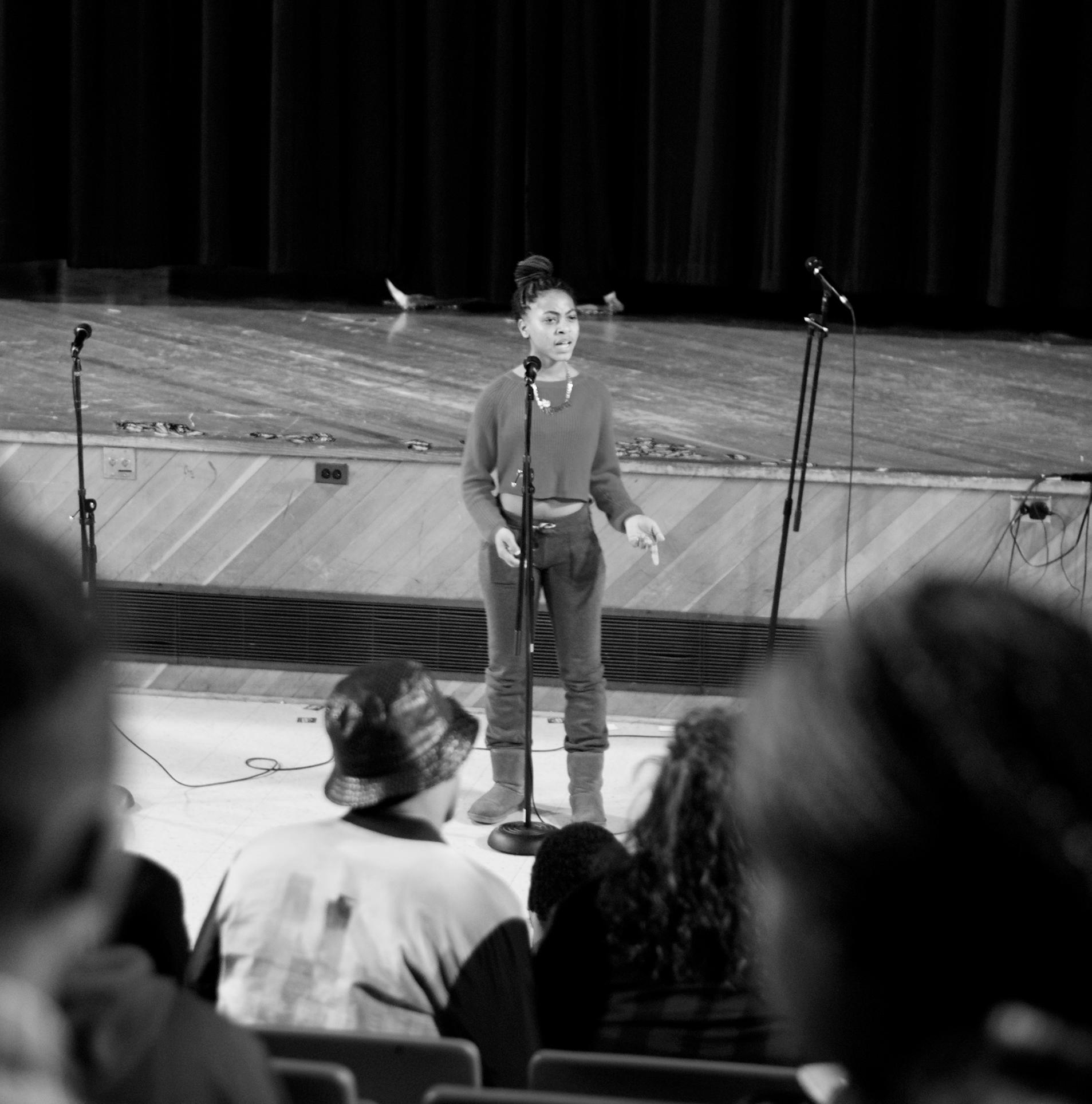
Mariah "Prophecy" Monroe, 16, performs her poem, "The Creation of Poetry" in the final round of the South Side Slam. She is part of Enough Said, the winning team from Kenwood Academy High School.
people here who don’t know the history, who don’t know what ground they’re walking on.”
“I cry in a lot of my pieces,” said Frazier. “I try not to, but I think the importance is that you’re honest in all of your stories and you give yourself to the audience, because that’s what the audience deserves. You deserve their ears, they deserve you.”
As the South Side Slam came to a close, all twelve teams gathered in the TEAM Englewood auditorium to watch the final round. The three teams still in competition gathered at the auditorium floor for the final score tally. Third place went to Julian High School, second place to Merrillville High School (from Merrillville, Indiana), and first place to Kenwood Academy.
“This is a fair representation of what I think Chicago youth are really all about,” said Timothy Miller, the coach of Kenwood
Academy’s team. “[So often] we’re in the negative press, but when you sit and you look at what can happen when you are allowed to express yourself and you are given a medium on which to do that, the things that can come out of it are so phenomenal.”
Miller says his team will be celebrating a little, but not for long.
“Back to work, really,” said Miller. “We got to prep for LTAB.”
As for Johnson, he said his debut with TEAM Englewood’s team was more than encouraging.
“I was nervous,” he said. “I actually got up there and when I got up there it was like, ‘Okay, you’re just going to do this; just get it out of the way.’ And as I began the poem, I felt I was being listened to. I’m going to do this again; I need to do this again…I can’t wait to go home so I can start writing.”
LIN
No Defeat at the Dojo
Inside Pilsen's new underground gallery and music venue
BY JON POILPRE
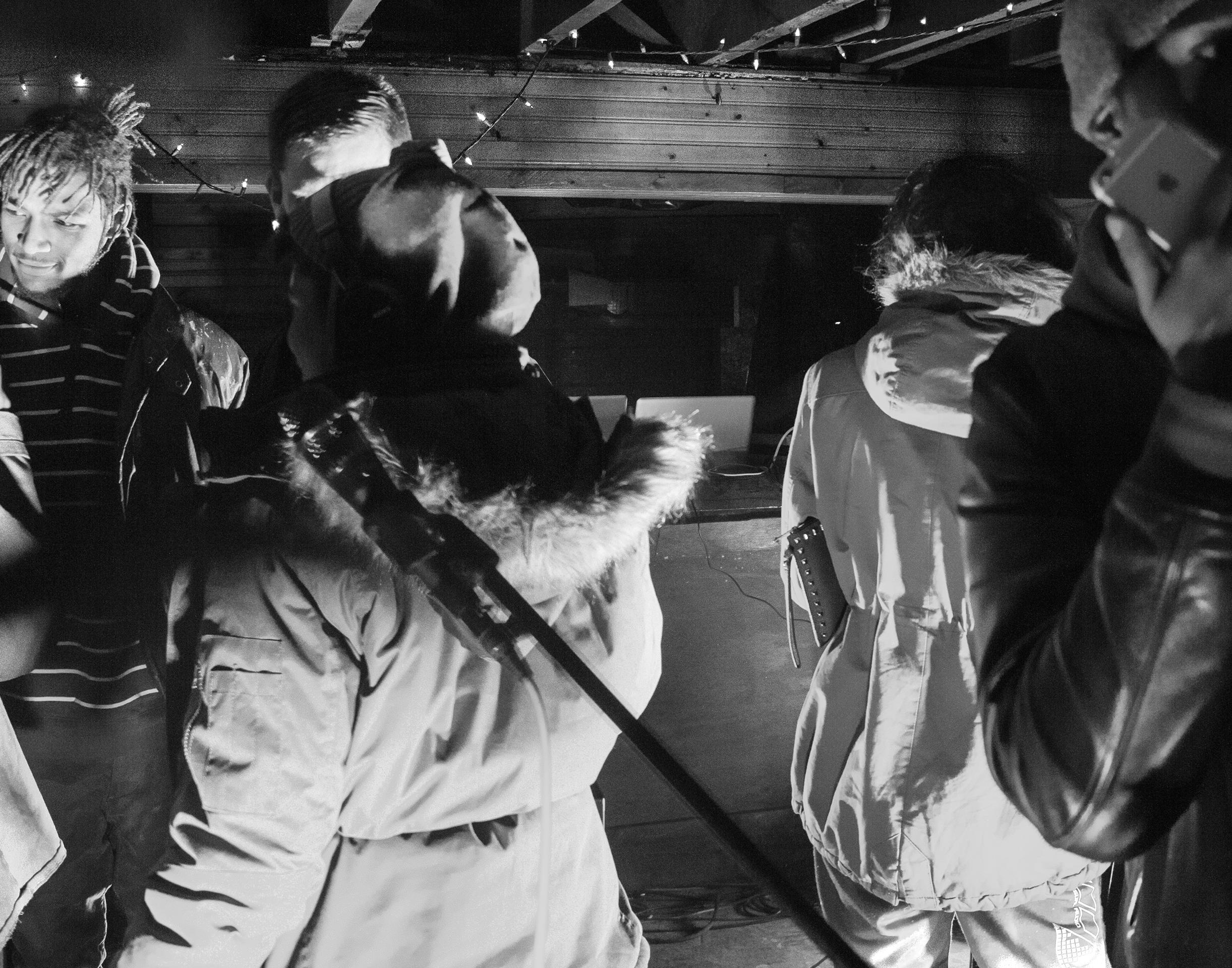
In a corner of the Dojo’s basement, a guitar leans propped up next to a snow shovel and broom, as if it’s a household tool. In another room, a medium-sized VHS collection sits in a wood shelf underneath a series of colorful paintings that line the wall. The wood-paneled basement bar looks like a ruin from a '70s man cave, but supports a mixing board and mic equipment. These artifacts lie at the intersection of art and home and capture the lifestyle of Pilsen-based artists Mykele Deville, Daniel Kyri Madison, and Alex Palma. The three are residents of the Dojo, an underground performance venue and gallery in southwest Pilsen.
The group moved into their building complex in the summer of 2015. Having known each other through their involvement in Chicago’s DIY (“Do It Yourself”) music scene over the past five years, the artists wanted to create their own venue and began looking for a location. The Dojo, located in Pilsen, now hosts a few events a month, some of which can feature as many as thirty artists and musicians in one night.
The physical spaces in the Dojo hint at the dual nature of the venue: the compartmentalized space contains a living-roomslash-gallery, a bedroom-slash-installation-space, a backyard-slash-theatre, and a basement-slash-concert stage.
At the helm of this space sit the members of the Dojo board, who Kyri says “keep things running.” The board is currently made up of Deville, Kyri, and locals Selena Boyer, Samantha Hollis, Palma, and Emily Woods. They accept applications from local artists and community members interested in curating shows, and also serve as liaisons between the curators of the Dojo and the artists they host.
The board members all serve unique roles for different shows, though Kyri notes they’ve all been known to pull eight-hour shifts to help plan and set up events. Deville,
for example, serves as the social facilitator of the Dojo, while Palma is responsible for tech. The Dojo also has a staff of “Dependable Homies” and a plethora of other volunteers.
Deville claims that the reason the Dojo has been successful so far is that the space expects accountability from its artists.
“It’s not any less professional than those pop-ups on 18th [Street],” he says. The shows take weeks of preparation and
are meticulously organized, both thematically and spatially.
“We try to keep everything in house. People can’t just come in and bring their band and six other bands on the tickets.”
The shows themselves are incredibly diverse; past events have featured visual arts, zines, live painting, installations, theater, comedy, poetry, and music.
“We want to avoid some weird hierarchy,” says Deville, a nod to how many DIY spaces in the city prioritize music over other visual or performance arts.
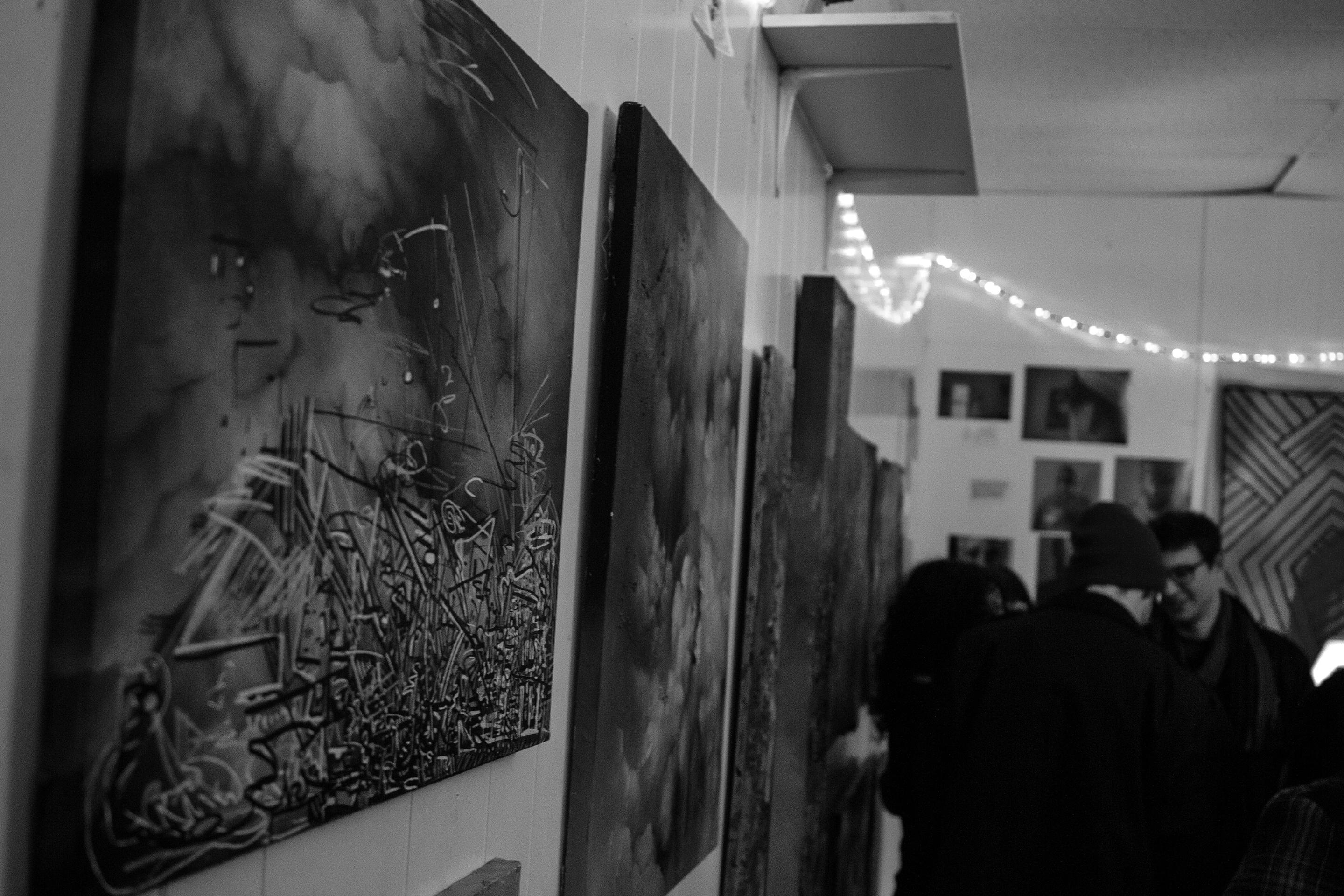
At first impression, The Dojo exudes far more of a party atmosphere than the feel of a gallery; the rooms can get full of so many people that some of the artwork is obscured. At the last major Dojo event, an all-female-produced art event called “FEMI-NICE” on January 16, the curators had to squeeze a few large paintings into a small, poorly-lit room at the back of the house.
But local artists seem to appreciate this style of display. Muhammad Naqee, a painter and jewelry artist who was displaying a
NATE EARNEST
“We’re about positivity, we’re about safe space, while [in] other places it’s more about coming in and having a good time, and then leaving.”
handful of his own works, believes the Dojo’s unique curation style creates an atmosphere superior to that of a traditional gallery. At the latter, “you have the older, rich white crowd,” Naqee says, “and they wanna come out for the scene and to be seen, as opposed to appreciating it, actually interacting with people, and just enjoying what's happening.”
The more casual and social atmosphere of the Dojo events encourages participation by artists and art appreciators as opposed to art collectors. The art sits on the walls, behind a sea of people, but all the spectators are people who want to, and will, seek out engagement with the pieces and their makers. In the back room of “FEMI-NICE,” I stood and looked at a painting of an apple and a knife against a black background. A man made eye contact with me from across the room, and in a second appeared next to me. He shared some commentary on the painting, quickly assessed and compared the
clothes of everyone in the room, and walked away.
Deville believes the Dojo’s style of “hyper attention” provides unique opportunities for artist promotion, but the Dojo’s high level of organization and preparedness can cause disagreements with artists accustomed to other venues or spaces.
“Sometimes the spirit of doing things in a specific way breeds this hyper attention and organization that a lot of DIY venues don’t want to do or believe is necessary,” says Deville, “because that’s not ‘the spirit of DIY.’”
He cited Presley Joy Paget, a painter and maker of wearable art, as a golden example of a Dojo success story. Paget arrived days early to work with the curators. She mounted her work in a way that complemented crowd flow, painted live during the events, and stuck around during the show, connecting with other artists and interested
buyers.
“Mykele claimed a jacket straight away,” she said. “I then gave a pair of painted pants to Monet [a Dojo-affiliated artist], and then another to one of the bands and suddenly my art was floating through the space. This night started my engine for wearable art.”
Though Dojo curators do not charge or profit off the artists’ displays, they expect them to be prepared and professional.
“[Paget] set a precedent for artists,” said Deville. “We won’t take anything less.”
In addition to the respect and positivity that defines the Dojo’s curatorial relationships, Deville says the Dojo also aims to create a positive and healthy space in Chicago’s artistic community as well. “There is no defeat in this dojo” is a moniker plastered around the walls of the building and on its Facebook page, capturing the zero-tolerance policy the Dojo has for all dis-
NATE EARNEST
Paperback Writer
Beware of Napkins, Poems and Illustrations Inspired by the Beatles
BY SARAH CLAYPOOLE
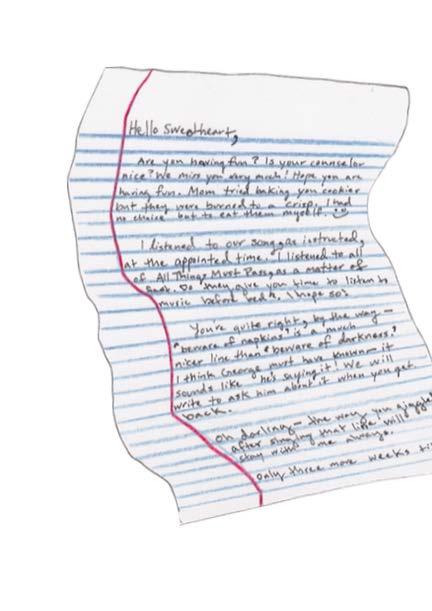
Jack Murphy is a Bridgeport-based writer and teacher, currently teaching at Truman Middle College in Uptown. He and illustrator Melanie Jeanne Plank recently released Beware of Napkins, a book of Beatles-inspired illustrations and poems. It is dedicated to Sister Mary, the administrator at the now-closed St. Gregory High School in West Edgewater, where he taught a class on the Beatles. A previous book of his, My Apartment in Chicago, shared these poems’ creativity of form and love of pop culture. In addition to poems and illustrations, Beware of Napkins, features a series of fictional letters between a Beatles-loving father and daughter that serve as a narrative thread grounding poems that explore legacy, family, and the connective powers of music. Murphy’s work has appeared in both of the Weekly’s Lit Issues.
How does Beware of Napkins speak to readers who aren’t Beatles super-fans?
I didn’t want to come off as a fanboy—every page like, wow, isn’t this song so good? Remember that lyric? It’s more human than that. Writing a collection about one band acknowledges that the one band is super great and really exceptional, but I tried to drain that out a little bit. One poem is about Mal [Evans], their roadie. You see these videos, and the Beatles are just chilling, and in the background, you see Mal, carrying in amplifiers and all that. There are people behind them that are making this work too. The music is at the heart of it, but the focus is really on everyone around the music, that the music has brought together: the people who are listening to it, the people in the background. That’s what I was most interested in.
What drives you to write about pop culture?
I try to write about the most important thing to me at any given time, and the Beatles were this really important thing to me, not just because I love their music but because I taught a class about the Beatles in
my old school, and my old school got shut down. Then I no longer had this place to connect with students over music, so I felt this gap there. Whenever I had a Beatles thought that I maybe would have talked about in class, I wrote poems about it. In some ways, the poems treat the Beatles as a piece of pop culture, and in other ways, the Beatles are such a personal part of so many people’s lives and a huge part of my life: things I talk about in class I feel an extra-special connection to.
Does being a writer affect how you teach?
Definitely. I teach American literature, I teach writing, and that’s probably what I’m best at. I talk to them like a writer—not as a teacher teaching writer—I feel like I’m a writer who is teaching. Teaching writing informs what I write because I’m constantly thinking about it, responding to students asking questions, to what students are doing. You might have a feeling as a writer, but as a teacher, you have to be able to articulate it.
What was the relationship between the poems and the letters in Beware of Napkins?
The letters were a really great way [to add content]—I wanted more pieces, and those are easy to do, I could write fifty of those. It’s an easy way to write my fandom into my character’s mouth. The dad is saying, “I can’t believe how fast their hair grows,” and that’s something I used to think. You can’t write a poem about that detail but it fits into that narrative, that story—the dad would have noticed that. The letters were really useful to give the book this narrative all the way through. I didn’t want it to be just about the four Beatles, that I thought they were these gods, because in that sense they’re not that important. It’s really about this dad and this daughter, and they’re using the Beatles as a way to connect.
You’ve written flash fiction in the past. Why poetry for this project?
If I have an idea, I don’t care ultimately if it turns out to be a short story or poetry. I don’t privilege one over the other, but I think that writing a poem—you know what, maybe I don’t think that. I think I’d rather write a great poem. There’s something extra-special about a poem, there’s something more mysterious about it. There’s something lurking underneath it, much more so than in other pieces. When you’re writing in longer form, you have more of a tendency to just say it. With a poem, you have less space, less time, so you have to hide more. It’s more shadowed.
On Liverpool Losing the Liverpool, 1978
It’s a sort of death when what belongs to you alone becomes something owned by Now I see that the Last Supper’s burning will never belong to Vatican City, that you can be young and great once, that there are things only 17 know. I love you still, though I neither clip your articles nor record your shows. I no longer defend you to my father he’s finally come around.
When I play Abbey Road, I lower the volume to nothing. I look beyond and through the remember you as you were, imagine you’re walking home.
Jack Murphy and Melanie Jeanne Plank, Beware of Napkins. Self-published. Available at jackmurphychicago.com. 52 pages. $15
POEMS BY JACK MURPHY ILLUSTRATIONS BY
MELANIE JEANNE
From the Presses, For the People
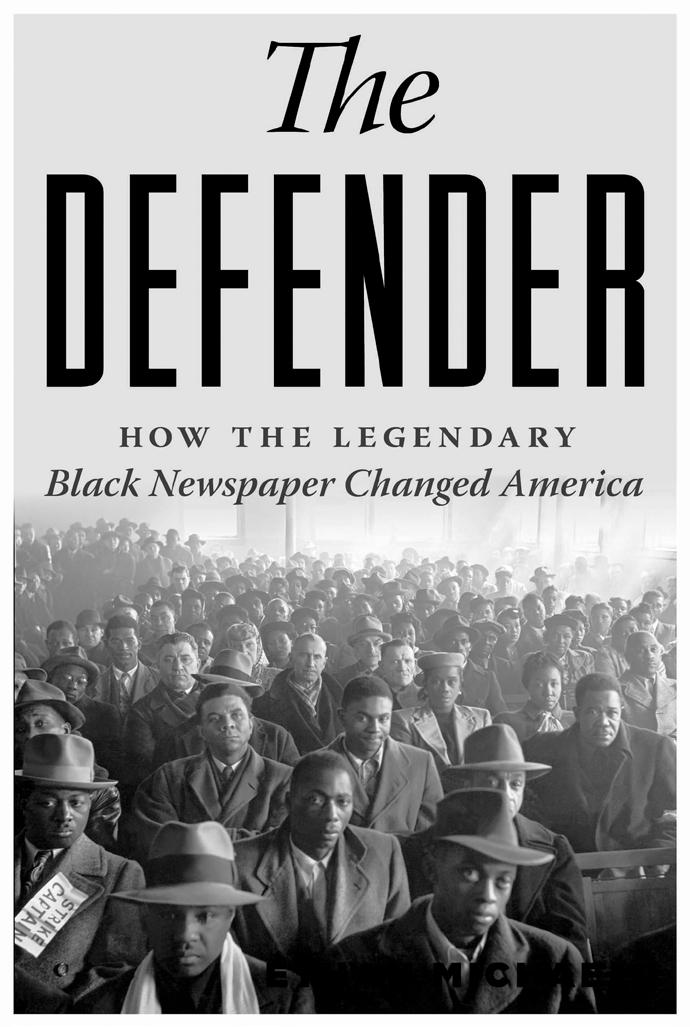
Ethan Michaeli's The Defender commemorates the newspaper that captivated, compelled, and transformed black America
BY SARA COHEN
When Ethan Michaeli first walked through the doors of The Chicago Defender at 24th Street and Michigan Avenue in 1991, he knew very little of the publication and its influence. His interview for a copy editor position that day was Michaeli’s first step into the world of the newspaper and its vast history. As he soon learned, Michaeli, a Jewish graduate from the University of Chicago, had just attached himself to a news source that had, in its nearly century-long lifespan, provoked social change, endorsed countless transformative politicians and political movements, exposed barbaric demonstrations of racism, and, in more ways than one, unified a nation.
The first part of Michaeli’s new book, The Defender, chronicles the efforts of Robert Sengstacke Abbott, the newspaper’s charismatic founder and publisher. A darkskinned man born to former slaves in Georgia, Abbott grew up in the presence of his stepfather, Reverend John Sengstacke, who contributed significantly to Abbott’s eventual success. Michaeli writes, “Thanks in large part to the influence of his stepfather, he refused to let others’ reactions to his complexion hamper his own expectations...his stepfather’s colorblindness built a reserve of self-confidence in Robert on which he could draw in the coming years.”
Using the snug dining room of Henrietta Lee, the landlady of his 27th Street apartment, as a newsroom, Abbott, who “resolved to be his own reporter, editor, and circulation crew, as well as publisher,” distributed the first copy of The Chicago Defender on May 5, 1905. Though the years that followed dealt Abbott and his neophyte paper no shortage of economic hardship, The Defender’s following and staff gradually increased. Abbott went to extreme measures for fundraising and promotion, employing Pullman Car Porters to spread The Defender’s audience.
“The porters,” Michaeli writes, “in regular contact with the black communities dispersed across and beyond, were perfect emissaries for The Defender; they knew every newsstand, barbershop, and other potential distribution point, from the largest cities to the tiniest rural settlements.”
Abbott’s remarkable dedication and ingenuity didn’t go unnoticed; during the first two decades of publication, The Defender’s influence exploded. Enlisting the help of Frederick Douglass and Ida B. Wells, among others, the paper denounced the horrors of the Jim Crow South, beckoning readers North in what became known as the Great Migration.
By the time Michaeli arrived at The Defender in 1991, it had endorsed refor-
mative politicians such as “Big Bill” Thompson, John F. Kennedy, Harold Washington, and Barack Obama; covered the triumphs of prominent black figures such as Jack Johnson and Bessie Coleman; and featured the writings of Martin Luther King, Jr., Langston Hughes, and Gwendolyn Brooks, to name a few.
Michaeli continued to work at The Defender, then under the management of Abbott’s nephew, John Sengstacke, until 1996. In addition to copyediting, Michaeli reported on the beats of the Chicago Police Department and Chicago Housing Authority, notably covering the Cabrini-Green protests. He later reported on the Nation of Islam, the Kupona Network and its fight for AIDS activism, and the Public Allies, an organization headed by soon-to-be First Lady Michelle Obama.
“It took me six years to write this book, but it was a dream that I had ever since I worked there,” said Michaeli at an author talk at the Harold Washington Library on January 14. “This was a story that needed to be told.”
Compiling the archives, interviews, and research for The Defender may have been arduous—the twenty-five-page bibliography attests to this fact—but the fruit of those labors, combined with masterful storytelling and an easy-to-follow chronological struc-
ture, makes Michaeli’s finished product a literary treasure. Michaeli draws upon rich sensory detail in his descriptions of historical scenes like Abbott’s annual Bud Billiken Parade, or the 1893 World’s Columbian Exposition. In these passages, Michaeli paints portraits that transcend the passage of time, aspiring to leave an impression that truly lasts, not unlike the newspaper itself.
“Writing this book was a way to take what I had learned about what the country really is and to take it to a broader audience,” Michaeli said. “Taking a reader through the history of The Defender, I sincerely hope, will give the reader the same experience that I had by actually being at The Defender in recognizing and learning that truth.”
If anything, the book’s sole shortcoming is its lack of information on the current state of The Defender. Though its coverage of Obama’s various campaigns drew attention, the newspaper shrunk in prominence in recent years, as it stopped its daily publication in order to navigate a more digital world. When asked at his author talk what The Defender can teach about the political and race-related plights facing Chicago today, Michaeli responded, “What we’re seeing in Chicago today often feels to me like an epilogue of this book. It often feels like we haven’t made much progress.”
Revival on 55th Street
Bringing comedy back to Hyde Park
BY ARIELLA CARMELL
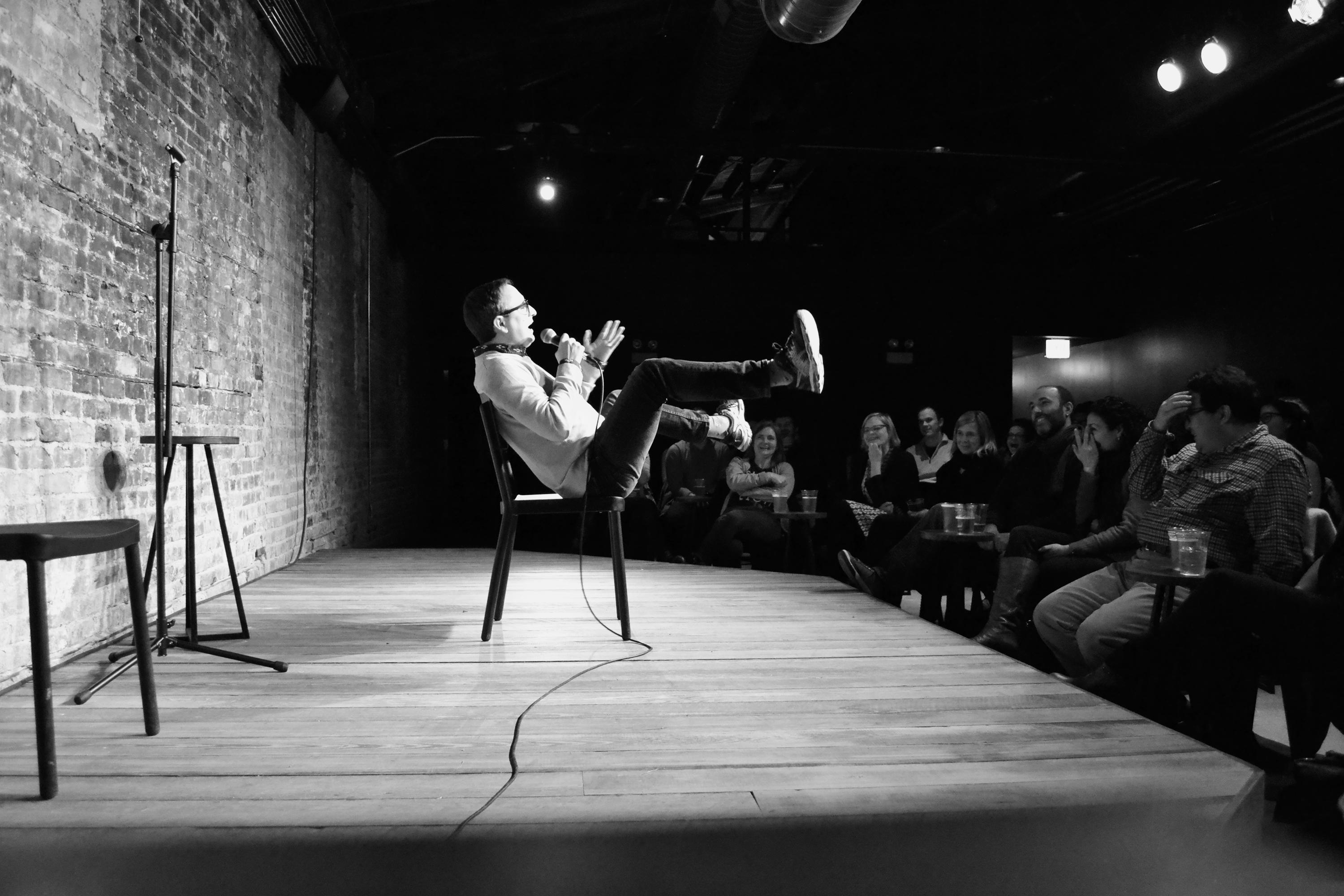
Chairs sit against a plain brick wall, waiting to become elements of a new universe. Two men begin pantomiming a first date, eating meals made of air. This is the essence of improvisational comedy: culling new existences from nearly nothing.
It is also the ethos adopted by The Revival, a new comedy club established in Hyde Park, intent on rejuvenating the relatively dormant comedy scene on the South Side. Its name and location evoke its historical significance—the club is located on the same corner as the theater of the Compass Players, an improv troupe that was the progenitor of Second City. Comedic luminaries such as Mike Nichols and Elaine May got their start in the
cabaret on 55th Street. The Revival’s homage to them and their contemporaries can be felt; the walls of the club hearken back to their roots with black-and-white photographs of the original Compass Players. Despite having only opened this past November, The Revival is building its image, in part, on sixty years’ worth of history.
“We are sitting right on the corner where the art form [of improv comedy] was invented,” The Revival’s founder John Stoops says, clasping his hands against the slick bar counter. It is evening, before show time, and he greets the people trickling in with a sense of warmth that contrasts with the club’s muted ambience.
One might expect the venue, with its dim lighting and dusky color scheme, to
be a place for Beat poetry and subdued snapping, not laughter. There is little to distract the audience from the workings of the actors, no elaborate props or set design to ease the suspending of disbelief. The decor has a minimalist, coffee shop feel— the chairs are black, the walls sparse. For a place built atop mounds of antiquity, the space seems to have a paradoxical desire to be new.
Stoops described the presence of The Revival as following a type of revitalization in Hyde Park that includes the expansion of retail, restaurants, and entertainment. “There seems to be something in the air,” he said, “and we thought it would be a great time to do something of this sort.” The majority of theater in Chi -
cago—comedy or otherwise—is located on the North Side, and Stoops hopes that placing The Revival on the South Side will encourage talent to diffuse geographically throughout the city, as well as promote emergence of distinctly South Side voices. Notably, The Revival is the only venue on the South Side that offers a mix of improv, stand-up, and sketch comedy.
In this endeavor, “everything is genuinely created from scratch,” Stoops says. He’s referring not only to the on-the-spot nature of improvisation, but also to the building of a new community for comedy. The Revival’s projects include partnering with the University of Chicago improv troupe Off-Off Campus and offering training sessions for community members of Hyde Park or surrounding neighbors.
“I feel like so many of the great cultural movements that have emanated from Chicago were actually rooted on the South Side,” he said. “It seemed like almost a miss...to not give the voices of the South Side a stage in their own backyard, to express themselves.”
Nevertheless, to call The Revival— located in one of the whitest neighborhoods in the otherwise ethnically diverse South Side—emblematic of what the South Side has to offer is a tenuous claim at best. In fact, the hour of comedy I witnessed that night was comprised solely of white actors making the trek down from the North Side. This raises the question: does the Revival represent the South Side as a whole, or is it simply a product of Hyde Park’s aspiration to revitalize itself?
Stoops recognizes that it’s dubious to speak for an area of such size and variety. “I think it’s tough to generalize too much. Certainly as a resident of Hyde Park, I’m aware of the unique personality of Hyde Park...I am interested in bringing together both that world and the surrounding South Side,” he says. He doesn’t say how he will go about this, only that this combination has yet to be accomplished.
The ambitions of The Revival are bold, but listening to the tepid laughter of a scant audience, I don’t feel the rejuvenation the comedy club’s name promised me. Like the rickety chair I sat in, the Revival is standing on coltish legs.