
south side weeKly
The South Side Weekly is a nonprofit newsprint magazine written for and about neighborhoods on the South Side of Chicago. We publish in-depth coverage of the arts and issues of public interest alongside oral histories, poetry, fiction, interviews, and artwork from local photographers and illustrators. Started as a student paper at the University of Chicago, the South Side Weekly is now an independent nonprofit organization dedicated to supporting cultural and civic engagement on the South Side, and to providing educational opportunities for developing journalists, writers, and artists.
Editor-in-Chief Bea Malsky
Managing Editor Hannah Nyhart
Deputy Editors John Gamino, Meaghan Murphy
Politics Editors Osita Nwanevu, Rachel Schastok
Music Editor Jake Bittle
Stage & Screen Olivia Stovicek
Editor
Visual Arts Editor Lauren Gurley, Robert Sorrell
Editor-at-Large Bess Cohen
Contributing Editors Maha Ahmed, Lucia Ahrensdorf, Christian Belanger, Mari Cohen, Emma Collins
Social Media Editor Emily Lipstein
Web Editor Sarah Claypoole
Photo Editor Luke White
Illustration Editor Ellie Mejia
Layout Editors Adam Thorp, Baci Weiler
Senior Writers Jack Nuelle, Stephen Urchick
Staff Writers Olivia Adams, Christian Belanger, Austin Brown, Amelia Dmowska, Mark Hassenfratz, Maira Khwaja, Emily Lipstein, Jamison Pfeifer, Kari Wei, Arman Sayani
Staff Photographers Camden Bauchner, Juliet Eldred, Kiran Misra, Staff Illustrators Lexi Drexelius, Wei Yi Ow, Hanna Petroski, Amber Sollenberger
Editorial Intern Clyde Schwab
Webmaster Shuwen Qian
Business Manager Harry Backlund
The paper is produced by an all-volunteer editorial staff and seeks contributions from across the city. We distribute each Wednesday in the fall, winter, and spring, with breaks during April and December. Over the summer we publish monthly.
Send submissions, story ideas, comments, or questions to editor@southsideweekly.com or mail to:
South Side Weekly
1212 E. 59th Street Ida Noyes Hall #030 Chicago, IL 60637
For advertising inquiries, contact: (773)234-5388 or advertising@southsideweekly
Read our stories online at southsideweekly.com
IN CHICAGO
A week’s worth of developing stories, odd events, and signs of the times, culled from the desks, inboxes and wandering eyes of the editors
Saturday in the Park
After more than a year spent painstakingly writing ambiguous ad copy and gobbling up private lots in Washington Park and Woodlawn, the UofC has finally revealed its blockbuster plan(s) for an Obama Presidential Library that will “create a global destination for learning and engagement” not only on the University’s huge stash of private land, but also on public park land that—uh, how to put this?—does not actually belong to the UofC. Seemingly more important to the UofC than this “collaborative” learning center, however, are the “improvements to the area’s infrastructure” that the library would bring. The promotional art for the bid features high rises, chain stores, bike lanes, restaurants, a baby riding its father’s shoulders, a copy of Chicago magazine, and the “Potential of Garfield Boulevard,” but not, apparently, a library. Let’s hope President Obama thinks long and hard about this one. Change, sure, but hope? Not so much.
Bright Spot
Most Chicagoans with a television know that Rahm Emanuel has a lot to be proud of right now. Under his tenure, activists have won a ten-year fight to close coal-fired plants in Pilsen and Little Village, City Colleges have boosted their graduation rates by giving “personal enrichment” students degrees, and just about everyone
has come to agree on a $13 (or more) minimum wage. On Monday, Rahm dropped another half-minute spot touting his latest credential. Donning a crisp suit, on a stroll in a sunny Millennium Park, he looks up at the camera and says that he is “very excited to continue his dialogue directly with Chicagoans.” That is why he is pleased to announce that he has just agreed to five debates with his mayoral challengers. He says the time has come for politicians who are accessible to voters. He smiles, continues walking, and reminds voters that his campaign theme is “Chicago Together.”
Cleaning House
Last Friday, City Council took the landlords of twenty properties to emergency heat court following a barrage of heat-related complaints from chilly renters. As a result of the hearing, Rahm Emanuel is implementing a plan to identify landlords who have repeatedly failed to provide important services to their tenants, like heat. These landlords will be publicly shamed on the Internet via a “bad landlords list,” slated to emerge in the next few weeks. New York has established a similar website called the Landlord Watchlist. The new website will also help Chicagoans exact revenge for having to wear three pairs of socks to bed. The site will allow the city to deny offending landlords privileges like obtaining city land, business licenses, and building permits.
IN THIS ISSUE
a biography in reverse julia aizuss...4
James did not step into these people’s lives and their work; they stepped into his.
“People in the community know that this is a space where the arts are highlighted, where non-mainstream cultural activity can have a home.” united in cultura mari cohen...6
The latter paintings have busier foregrounds—more yonic, more aquatic than galactic, and entirely unafraid of pink. there is no shadow here stephen urchick...7
citizens for a less polluted la villita rachel schastok...8
In anticipation of Emanuel’s appearance, a group calling themselves the “The Oh Heeeeellz Naaaaaaaaaa Coalition” organized an event.
thirty years of music
I realized that I’d interrupted a family jam session.
chloe hadavas...10
The reclamation of power often begins as heavy community involvement.
profiles in progress lois chen...11
truffles with a tang jeanne lieberman...12
The Turmeric Ginger truffle is like hanging out with your peppy aunt who never sits still.
Cover art by Ellie Mejia.
A Biography in Reverse
“People
at Work” at URI-EICHEN
BY JULIA AIZUSS
Michael Gaylord James leans against the window, legs crossed and one black boot perched on the other, the two “Jesus Garcia for Mayor” buttons on his chest standing out against his sensible winter fleeces. His black-andwhite reflection in the window seems like it belongs among the photographs lining the wall next to him: an artist at work, seventy or so years old, surveying his output.
“I walked a fine line between which side of the camera I was on,” he had told me earlier.
Now, no camera sits in his hands, so there are no sides to worry about. James is at URI-EICHEN Gallery to talk at the opening reception of “People at Work,” a show of thirty-two photos he and his son selected from his upcoming collection, “Pictures From the Long Haul.” The haul is indeed long: James has been documenting his travels in black and white since he road-tripped to Mexico City as a college student in 1962.
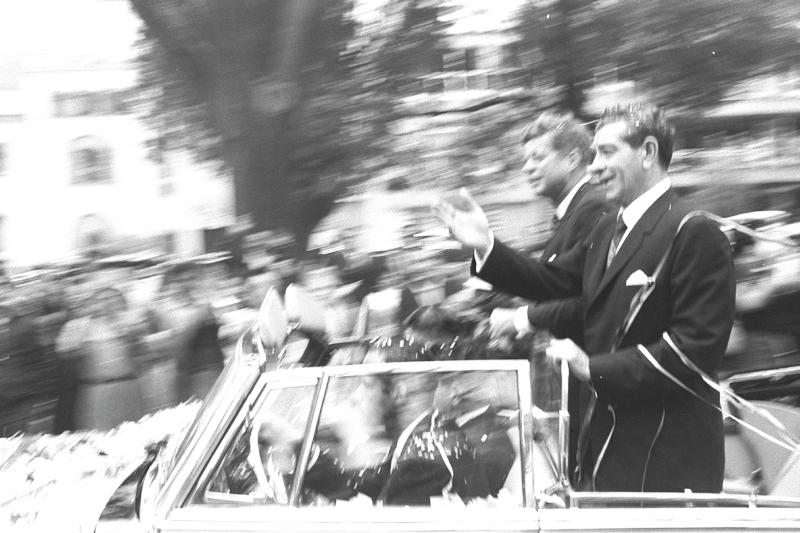
The shot he snapped there of John F. Kennedy and then-president of Mexico Adolfo López Mateos zipping by in a Mercedes hangs above the newest photo in the show, which shows unionizers at the 2012 Illinois State Fair demonstrating against then-governor Pat Quinn. Other than the photos of Mexico, which predominate, between the bookends of James’s career lies a miscellany of moments: nightclub dancers in Russia, a still-black-haired Obama campaigning for Senate, a barber in El Paso.
James traces fragments of his own story, from bourgeois Westport, Connecticut, through his time at Lake Forest College and later in several social justice organizations. Though his work as a community organizer taught him the importance of documentation, that’s not quite the reason for his ceaseless snapping; nor, it seems, was his upbringing among artistic types in Westport.
“I don’t quite know what moves me to take the pictures,” James says, a bemused sentiment he likes to repeat. “I just did.” For James, the work of photography is intuitive.
It’s thanks to his son, David Libman, that James even bothered to develop many of his thousands of negatives. When Libman was working at a photo lab in the late nineties, James gave him the JFK negative. “I think you have a show here,” Libman told James when he saw the resulting print. Although James’s artistic ambitions have grown since that moment of valida-
michael gaylord james
tion—he expressed confidence in an imminent public breakthrough, as well as a desire to make movies—his artistic pretensions haven’t. He remains proud of his photographic ignorance: “I know you got light and all that stuff. Four hundred film and you shoot it such-and-such.”
If he knows some of the photos on view are overexposed, he doesn’t show it. Libman, who studied photography in college, has no complaints. In fact, he says he’s learned from James’s honesty-as-art method.
“To me it’s a different experience,” Libman said, hands in his coat pockets, having arrived too late to snag a folding chair. “It’s not a photographer who has these high ideals about composition and making a statement. This is a reflection of his travels and the people he meets. He pops a shot. A lot of his shots are sideways.”
So aesthetic concern is secondary. Fair enough; “People at Work” suggests a focus on political content anyway, and James chose this theme because URI-EICHEN’s owner is a labor organizer. Decorations on a corkboard near the entryway include an Occupy Wall Street poster and an anti-gun illustration. URI-EICHEN often exhibits shows with a left-wing activist bent, dealing with subjects like migrant labor and drones, and has served as a meeting space for union activists.
Somewhat disappointingly, there is little depth to the portrayal of labor in the photos. Libman called James’s enormous collection of prints and negatives “an archive of his life experiences,” which is exactly correct. James’s photos of people at work are often not photos of the people so much as they are photos of his experience shooting them.
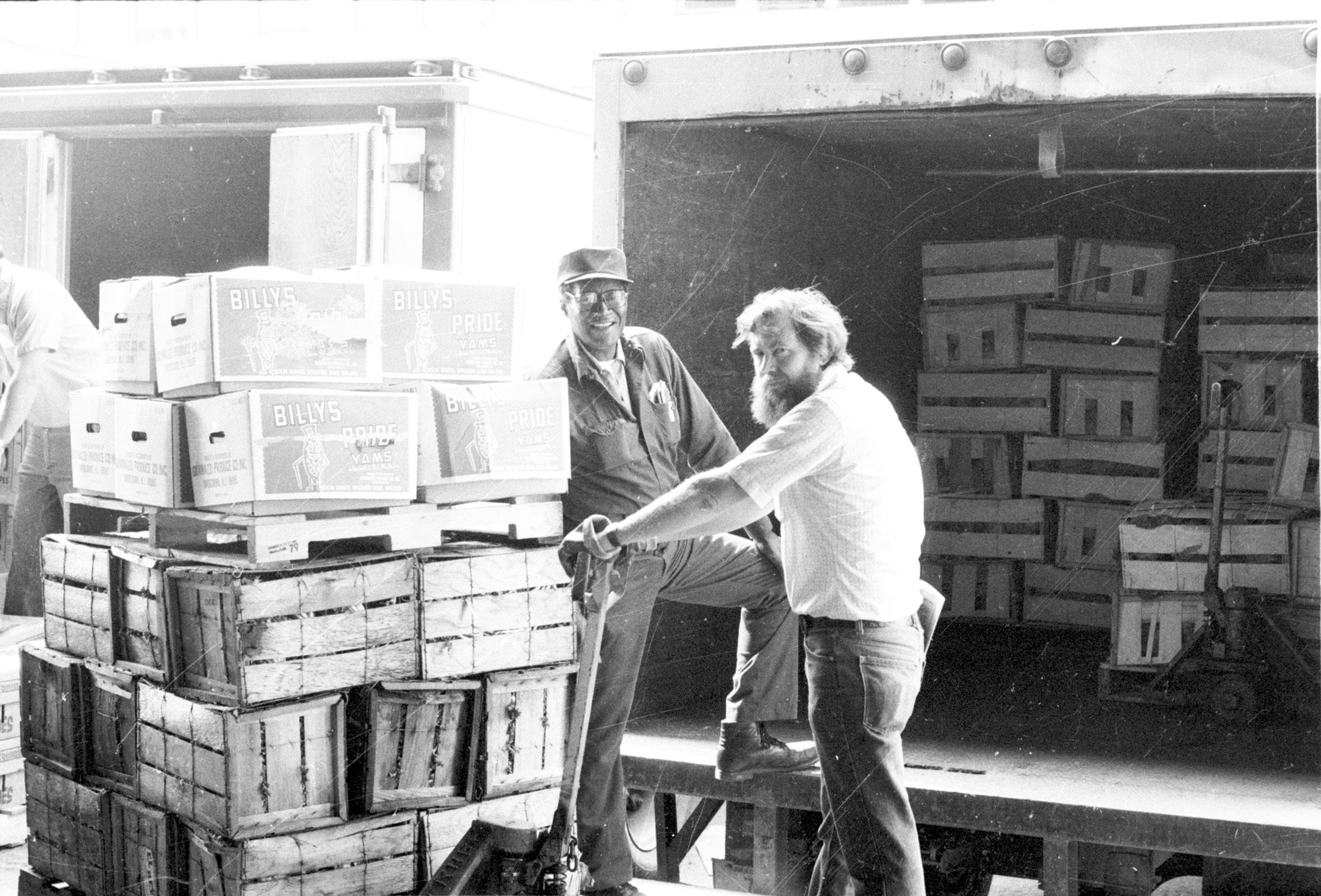
In one photo, a Nicaraguan daycare worker’s smile hovers between irritation and charm, an effect of James’s gregariousness, as does the expression of a worker at a Chicago street market in another. The captions below the photos are characteristically loquacious tangents that center more on James’s experiences than on what’s in the frames. James did not step into these people’s lives and their work; they stepped into his. What results is a biography in reverse, of the person at work on the other side of the lens; a fine line indeed.
Perhaps it’s misguided to expect a more rigorous exploration from photos that were shot without sophisticated intention. Although most merely happen to depict people working, sometimes the focus is
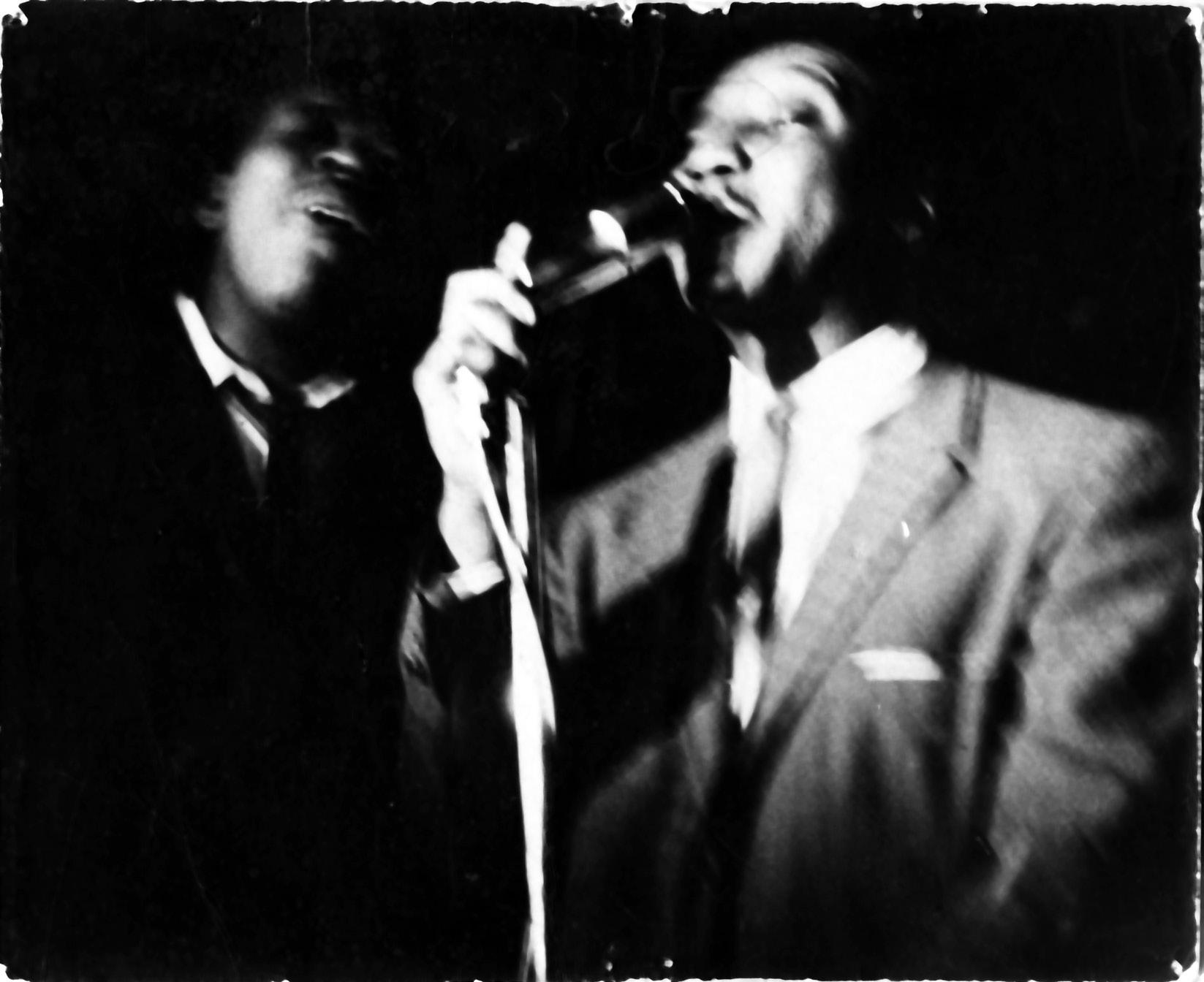
more than nominal. While Libman explained that each photo was an experience from James’s life, he stood in front of a 1962 shot of blues musicians, Muddy Waters and James Cotton, performing in Chicago. This photo is the show’s best, a joyful blur of cheeks and crooning mouths that emerge from complete darkness while their suits melt into it. Unlike the other photos, it’s an experience from the subjects’ lives, one that James captured fully while omitting his own presence. It says, simply: this is our work, this is what we do, and we love it.
James probably understood such joy. In the boundless rambling stories he and his friends told at the opening, negativity was notably absent. James’s work—the art, the activism, the occasional acting, the radio show, the café, the books-in-progress— seems anything but a burden to him, despite its volume. Still, James was reminiscing about the civil rights movement when he suddenly added, “I never did as much as I thought I should’ve.”
Later, with the audience, his outlook brightened. He described his idea for a new story, of “an old guy” who ventures into the
prairie in 2016 with a camera and an old car he’s tuned up. “I think there are a lot of ideas in his head,” James said, as his friends in the front chuckled approval. The work continues.
URI-EICHEN Gallery, 2101 S. Halsted St. Closing reception Friday, February 6, 6pm9pm. Hours by appointment. (312)852-7717. uri-eichen.com
michael gaylord james
United in Cultura
Contratiempo and Gozamos join forces in Pilsen
BY MARI COHEN
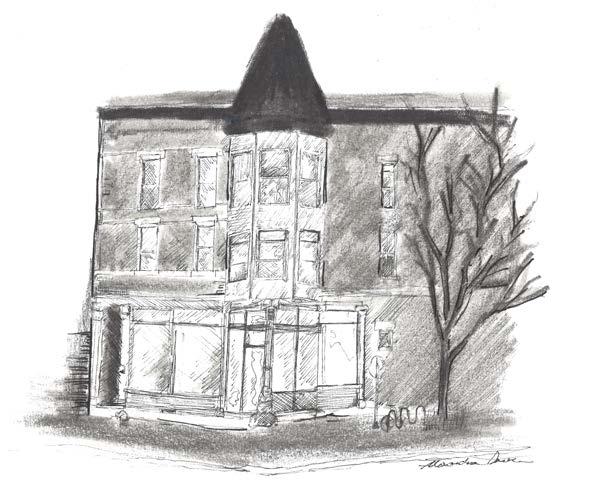
When I entered Cultura, an arts and community space on the corner of 19th and Carpenter in Pilsen, it was a quiet Friday afternoon. Just a block from Pilsen’s busy 18th Street, the snowy intersection was mostly devoid of cars and pedestrians. Inside, Cultura’s main room was also calm. The black stage against the front window was empty, and the white walls of the room were dotted with only a few works of art.
But after my talk with Cultura co-managers Luz Chavez and Moira Pujols, it wasn’t hard to imagine the space packed with people at one of their many public events, which have included concerts by Latino artists, a holiday-themed art bazaar, and writing workshops by noteworthy Latino writers. Chavez and Pujols have a clear vision for their project: a hybrid of art and activism that aims to engage the Pilsen community, offer a space for various organizations and events, feature both local Chicago artists and artists from Latin America, and create a dialogue about what it means to be part of Chicago’s Latino community.
Cultura was formed as a partnership between two organizations: Contratiempo, a Chicago-based organization that aims to present the cultural offerings of the Spanish speaking population of the U.S. and publishes a magazine with cultural commentary and literary submissions, and Gozamos, an online magazine directed towards young Chicago Latinos that publish-
es articles on arts and culture in English. In 2013, Contratiempo and Gozamos, having already collaborated on previous projects and both looking for a new space that would allow for more community engagement, decided to come together and create Cultura. The property had already been used as a space for art and activism, most recently under Calles y Sueños, another organization focused on arts and community.
“People in the community know that this is a space where the arts are highlighted, where non-mainstream cultural activity can have a home, where people can be listened to and can express themselves, both as activists and as artists,” said Pujols, who in addition to managing Cultura, is executive director of Contratiempo. Pilsen may be known for its art scene, but Pujols said this scene includes mostly galleries and studios. Cultura plans to host curated art exhibits too, but fills a void by also offering a space for performance and collaboration. In 2015, Cultura plans to add an open mic space to Pilsen’s monthly second Fridays Gallery Event.
Behind Cultura’s event space there is also an office area, shared by founding organizations Contratiempo and Gozamos, which continue to operate independently, in addition to working together on events at Cultura. Several organizations-in-residence with diverse missions are also housed in this space. The Chicago Latino Writers Initiative, a joint project of Gozamos and Proyecto Latina, highlights talented
Latino writers from all over Chicago and also hosts workshops. There’s also Chicago Community and Workers Rights, which holds educational workshops for immigrants on their legal rights, and FMEL, a Latino electronic music company. A newly formed initiative called Latino Techies plans to host low-cost workshops on coding and web design in the coming months.
According to Pujols and Chavez, part of the reason that Contratiempo and Gozamos work well as partners is that their audiences are generally different, and that together they can reach a broad cross-section of the Latino community.
Part of Contratiempo’s mission is to provide a cultural space for immigrants. Their audience is comprised mostly of immigrants (as is their staff), and their programming is conducted either only in Spanish or in Spanish and English.
“I think very often immigrants are condescendingly addressed, in a very basic manner as if they were not capable of any sort of complex and sophisticated process of absorbing art, and we just feel really, really proud to offer that,” said Pujols, who is from the Dominican Republic but has spent most of her life in Chicago.
Though Gozamos also has a pro-immigrant, pro-immigration message, its focus is slightly different. Gozamos is an English-language publication and has a staff and audience that’s mostly second- and third-generation Latino-American.
“We know Spanish, but we communi-
cate in English,” said Chavez. “As adults, that tends to be the dominant language, even if Spanish, like in my case, was my first language.”
The two organizations demonstrate the complexity of Latino identity and challenge the notion that it could be addressed as a homogenous identity. Chavez and Pujols hope the Cultura project can present an opportunity for dialogue about these types of issues without dividing the community.
“There’s just that constant conversation that needs to happen,” said Pujols. “We have it literally, we want to have it as part of the space in what we represent and present.”
Cultura aims to open dialogue about other issues as well, including LGBT rights (“particularly the T, which tends to get dropped off when you talk about LGBT rights,” noted Chavez). Several LGBT related events have been held in the space. In June, Contratiempo published an edition of the magazine centered around Latino trans issues. Gozamos helped sponsor and livestream a panel on the same theme, put on by the organization RAICES. The panel took place at Cultura and featured trans activist Bamby Salcedo, as well as some of the authors who had been published in the Contratiempo issue.
“It was packed, it was moving, it was illuminating, it was educational,” said Chavez emphatically. “When you have that kind of event, you feel like this is exactly the reason that we want to have this space.”
lexi drexelius
is No Shadow Here
“Air Affair” at BLUE1647
BY STEPHEN URCHICK
In 1951, Robert Rauschenberg exhibited a series of canvasses painted white all over, in part to test how we might think about the simple play of gallery lights and shadow on a surface. Roberto Adrian Rodriguez, in his recent solo show “Air Affair” at BLUE1647 in Pilsen, took that same historical interest in the insubstantial qualities of a painting, smashed it together with extensive 3-D graffiti practice, piped it through an airbrush, and mixed it with some actual grit.
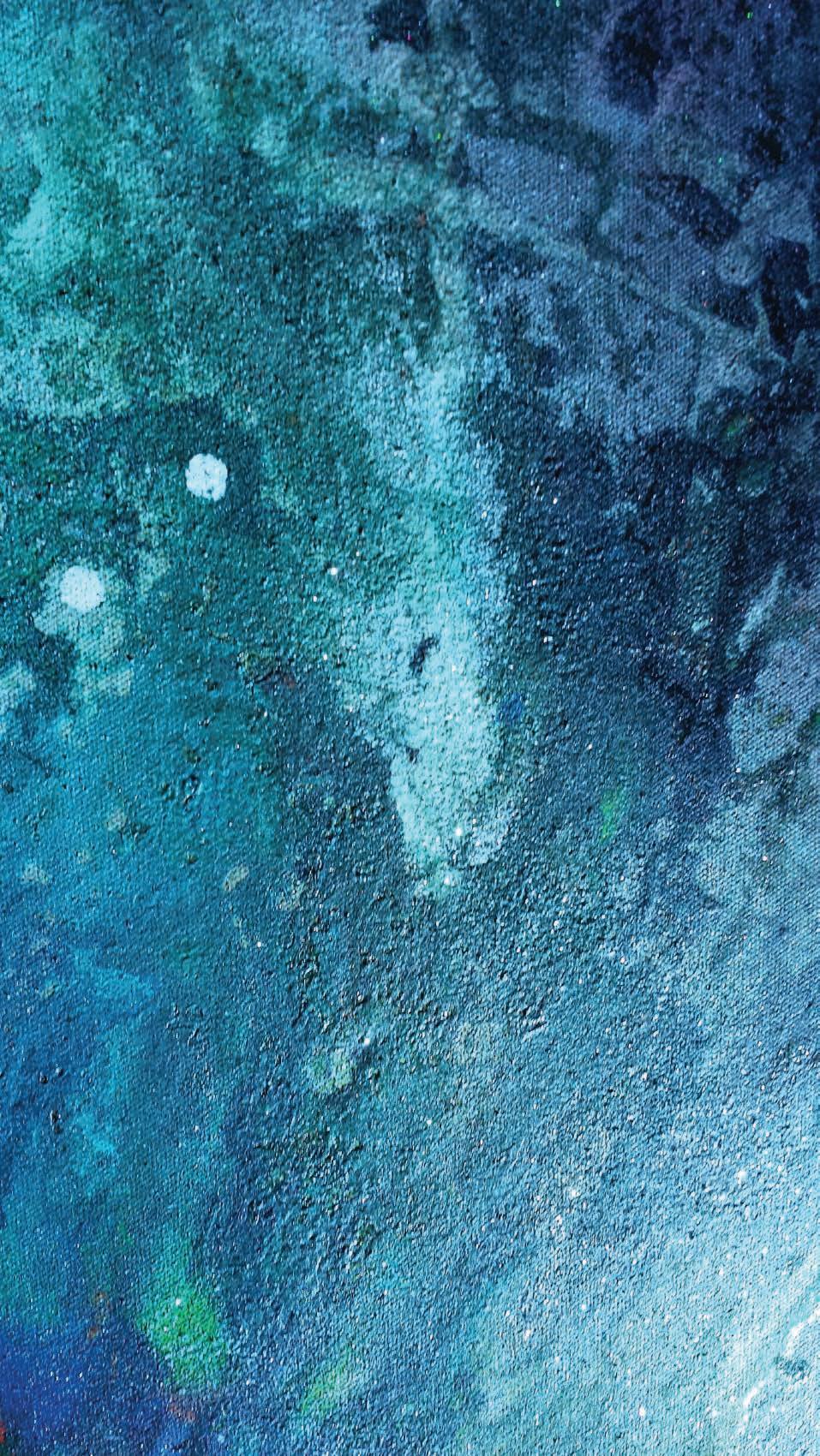
Over long sessions with each of his canvasses, between repeated applications of thin washes of paint, he blended in sparkling powders and mineral dusts, adjusting both the paint and its basic material qualities as it dried. “Air Affair” produces images that resemble the ethereal fogs seen through a Hubble Space Telescope by tinkering with optics itself.
Separating a painting like “Ephemerality of Euphoria” from any of number of Rodriguez’s other paintings is something of a technical problem from a writerly standpoint: one painting’s description sounds a lot like the next. “Euphoria” is set on a black field flecked with lighter paint—resembling stars—with a central explosion of matter in its foreground. Some of that paint fans out, nebulae-like. Other paint has been layered with opaque metal powders, creating Rorschach-style blots. There are no legible strokes; the painter’s typical “fingerprint” has been suppressed by his preference for the airbrush. The mineral powder has even fused each individual layer of paint into one surface. The painting looks something like a print, while still being rough and varied and deliciously tactile up close.
This is true for “Ephemerality,” but also for the horizontal canvas stretched to its left, the round canvas to the right. The series of six coupled canvasses hung in succession along the room’s far wall. Granted, the latter paintings, for example, have busier foregrounds—more yonic, more aquatic than galactic, and entirely unafraid of pink. Some of his paintings leverage thick, heavy acrylic impasto. Some smaller canvasses have spray-can motifs that would be perfectly comfortable chilling out on a streetside mural. But, for the most part, the same compositional principles apply across his show.
confession, is a rigorously coded meditation on a former relationship. Rather, it’s worth taking his appeal to abstraction, his seriality, or his seeming decision to forgo token informative labels on opening night as a bid to refocus attention onto his technique and not his psychology. It was more fun to watch Rodriguez walk through a sheaf of his formative, experimental test-runs, than attempt to diagnose each painting’s explicit content through some kind of pseudoscience.
Much of Rodriguez’s technique hinges on the careful management of chance. He has to minimalize it, in some cases: taking extensive pains to track the thicknesses of his paints, lest they clog and disable his tools as he’s working. His paint, as it exits the airbrush as a vapor, is subject to physical, gaseous probabilities. Each stroke is mediated by a level of air, as it descends to the surface, which will literally diffuse his ideas. Whenever he applies granular materials like mica, each shake or toss he makes will disperse the substance in a predictable but imprecise pattern. He can tolerably calculate the result he’ll achieve, but never find himself certain as to how the sheer stuff will behave.
Rodriguez lit his works with raking, offblue lamps and posed the question of air’s intervening quality not just to himself, as the creator, but also to the viewer. In something of a paradox, the blue light activates Rodriguez’s earthly minerals, mobilizing the painting and causing it to shimmer fluidly and airily. The reflective properties of the elements he blended into and laid over the paint allow the painting to take on a hundred different aspects, since glints of light will appear at many new and different points while traversing the 180 degrees of vision the canvas accommodates.
urchick
This isn’t to say that Rodriguez is interested in getting rid of his presence as an author, by abandoning the intimate identifying mark made between the painter’s hand and his brush. “Euphoria,” by his own
Take away all the light, and the painting becomes a technology for moving beyond ordinary vision in a gallery; among Rodriguez’s mineral media are phosphorescent compounds that glow in the dark. The phosphorescent elements in his painting assert a kind of independence beyond the beholder: they will faintly glow, and actively make themselves visible to us, where the human eye is otherwise powerless to perceive fine shapes, color, and forms. The likeness of Rodriguez’s paintings to the births of stars or deaths of galaxies is not a coincidence. Science exploits physical tricks and quirks to bring those vistas back through the black to Earth, just as “Air Affair’s” unique methodologies threaten to defy lightlessness itself.
stephen