773-241-6044 • 6100 Blackstone Ave. • @61market • 61market.org
Join our team! South Side Weekly and the Hyde Park Herald are hiring a full-time Executive Director. We are looking for a passionate, systemsoriented leader to head South Side Media Works, our parent nonprofit.
Learn more and apply southsideweekly.com/were-hiring
2 SOUTH SIDE WEEKLY ¬ AUGUST 27, 2026
A program of Experimental Station, with the support of: WOODLAWN DISTRIBUTION TRUST
SOUTH SIDE WEEKLY The South Side Weekly is an independent non-profit newspaper by and for the South Side of Chicago. We provide high-quality, critical arts and public interest coverage, and equip and develop journalists, artists, photographers, and mediamakers of all backgrounds. Volume 13, Issue 17 Editor-in-Chief
Jill Petty
Deputy Editor
Adam Przybyl
Art Director and Layout Editor
Mel Dempsey
THE LESSONS OF BLACK AUGUST IN THIS ISSUE When Juneteenth became a national holiday in 2021, it marked the culmination of decades of organized efforts—by activists, educators, creatives, and other community leaders—to raise awareness of the history of legalized slavery in the US, and to celebrate its formal abolition. Until the ascendance of the Civil Rights and Black Power movements in the 1960s, which sparked the recuperation and sharing of suppressed knowledge, most people in the U.S. were not aware of the importance of June 19, nor of Black history more generally. Similarly, today many people are unfamiliar with the origins of Black August, an annual commemoration and prison-based holiday that centers the plight of Black political prisoners, awful prison conditions, and Black freedom struggles in the U.S. and beyond. Black August came out of California jails and prisons, imagined by incarcerated people who came together (at San Quentin State Prison) in 1979 to commemorate the deaths of prison activists W.L. Nolen, Jonathan Jackson, George Jackson, and Khatari Gaulden in the 1970s.
Assistant Managing Editor
Ellie Gilbert-Bair
Engagement Editor
Alycia Kamil Moaton
Senior Editors
Martha Bayne Christopher Good Olivia Stovicek Jocelyn MartinezRosales
Fact Checker
Jo Harris
Office Manager
Mary Leonard
Advertising Manager
Susan Malone
August 1: Emancipation Day in several Caribbean nations and Canada.
Interim Publisher
Jianan Shi
August 5: Nelson Mandela’s arrest and imprisonment in 1962.
Editor Emeritus
Jacqueline Serrato
August 7: Death of Jonathan P. Jackson at San Quentin State Prison in 1970.
The Weekly publishes online weekly and in print every other Thursday. We seek contributions from all over the city. Send submissions, story ideas, comments, or questions to editor@southsideweekly.com or mail to: South Side Weekly 6100 S. Blackstone Ave. Chicago, IL 60637 For advertising inquiries, please contact: Susan Malone (773) 358-3129 or email: malone@southsideweekly.com For general inquiries, please call: (773) 643-8533
Doc Holiday, an activist and friend of George Jackson who is still imprisoned at the Federal Correctional Institution in Marion, Illinois, writes, “Black August is...a reflection and commemoration of history of those heroic partisans and leaders that realistically made it possible for us to survive and advance...such as Nat Turner, Harriet Tubman, Gabriel Prosser, Frederick Douglas, W.E.B. DuBois, Marcus Garvey, Paul Robeson, Rosa Parks, M.L. King, Malcolm X, and numerous others...[and] the antithesis to ‘celebration’ and empty ‘homage.’ Black August attempts to place struggle and sacrifice on center stage.” Noted historian and author Gerald Horne has observed that “there’s a striking confluence that occurs in August” with regards to Black resistance history. Among the notable dates:
August 9: Killing of Mike Brown by a police officer in Ferguson, Missouri, leading to the Ferguson Uprisings in 2014. August 10: The Attica Prison Rebellion is remembered as part of Black August, with some arguing that the revolt began on August 10, 1970, in Manhattan’s House of Detention, and continued through the official rebellion dates of September 9-13, 1971. August 11: Watts riots, also known as the Watts Uprising, which occurred from August 11-16, 1965. August 14: Bois Caiman Vodou ceremony, which sparked the Haitian Revolution. August 17: Birth of Pan-Africanist leader Marcus Garvey in 1887. August 21: Beginning of Nat Turner’s Rebellion (August 21-23, 1831) and death of George Jackson at San Quentin State Prison in 1971. August 22: Start of the Haitian Revolution in 1791. August 30: Birth of Fred Hampton, deputy chairman of the Black Panther Party, assassinated in Chicago. Today, some groups across the U.S. use the month as time for engagement. For example, the Brooklyn-based Free Black Women’s Library created lesson plans using the tenets of the original Black August commemoration (“study, fast, train, and fight”) to connect with readers.
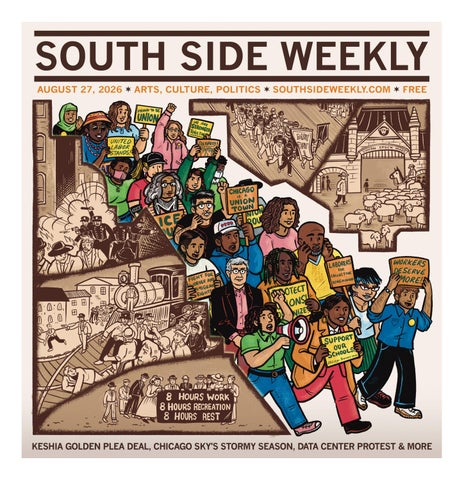
ask an expert: what makes chicago a union town? Professor Emeritus James Barrett, Professor of History Lilia Fernández, and Chicago Teachers Union President Stacy Davis Gates discuss the past, present, and future of Chicago’s labor movement.
ellie gilbert-bair...................................4 domestic abuse survivor keshia golden accepts plea deal Following a multi-year case that generated concerns about the rights of the abused to self-defense, Golden pled guilty to involuntary manslaughter for fatally stabbing her partner.
dave byrnes..............................................7 south side residents press johnson to halt quantum campus Johnson voiced support for a citywide moratorium on data centers, but stopped short of opposing the quantum campus.
max blaisdell, hyde park herald...................................8 the chicago sky push through a stormy season Eliminated from 2026 playoff contention, the Sky still brought energy home last week with their annual Latina Empowerment Night.
malachi hayes....................................... 10 illinois prisons expand free phone calls The Voices of Connection program gives incarcerated people 775 minutes of free phone calls per month.
tatiana walk-morris, chicago reader...................................... 13
‘seems like a betrayal’: they fled violence, followed u.s. asylum rules —and still faced deportation
President Trump’s administration is using a little-known legal motion to remove asylum-seekers without a hearing to unfamiliar, third countries like Ecuador and Uganda.
r. taylor robinson, borderless magazine............................ 15 the exchange: an ode to The Weekly’s poetry corner is a collaborative space celebrating the literary arts.
alycia kamil, jalen kobayashi..................................... 19
And in Chicago, this year organizations like the South Side Community Art Center and the Black Metropolis Research Consortium convened Black August-oriented events to spur deep thinking, commitment, and community building.
Cover illustration by Teddie Bernard
As we close the month with this issue of the Weekly, we’re sharing perspectives on the history of the labor movement (and Labor Day); reporting on environmental justice, via Quantum Center protests; updates from trusted colleagues at Borderless Magazine, about cruel and inhumane treatment of asylum seekers; and up-to-date coverage of the Keshia Golden case. We’re also reflecting on the lessons of Black August. Gerald Horne says, “By protesting injustice, you’re also protesting the spread of injustice. In other words, ultimately, it’s an act of self-preservation because if you allow injustice to fester, it can obviously spread right to your front door.”
AUGUST 27, 2026 ¬ SOUTH SIDE WEEKLY 3
COMMUNITY ORGANIZING
INTERVIEWS BY ELLIE GILBERT-BAIR
James R. Barrett is professor emeritus of history and African American studies at the University of Illinois at Urbana-Champaign. He was born and raised in Chicago and is the author of The Irish Way: Becoming American in the Multi-Ethnic City (Penguin Books, 2012), History From the Bottom, Up and the Inside Out: Race, Ethnicity, and Identity in Working-Class History (Duke, 2017). He is working on Chicago: A Peoples’ History.
Ellie Gilbert-Bair: Why do we celebrate Labor Day? James Barrett: Nationally, [we celebrate it] as a recognition of the significance of labor in society. The International Workers Day is on the first of May, [commemorating a mass strike for the eight-hour work day, organized by the Federation of Organized Trades and Labor Unions in 1886]. It seems that part of the U.S. government’s motivation in establishing Labor Day, which falls on the first Monday of September every year, was to provide an alternative to May Day, which is generally recognized as a radical holiday. The other motivation is a little bit
Lilia Fernández is professor of history at the University of Illinois Chicago. She is the author of Brown in the Windy City: Mexicans and Puerto Ricans in Postwar Chicago (University of Chicago Press, 2012), which examines migration, settlement, activism, and community formation. Her current research explores the historic ethnic and class diversity of Latino Chicagoans with an emphasis on industrial workers, student activists, and coalitional politics and solidarities among the working class.
unclear, but might have had to do with the Pullman Strike and boycott. The Pullman Strike was a national railroad strike, but its origins were actually in Chicago. At the time, there was a separate company town on the far South Side run by George Pullman and his corporation, [the Pullman Palace Car Company], and a conflict broke out there between Pullman and the American Railway Union. If there is a connection between that and Labor Day falling in September every year, it might have to do with the fact that the federal government, which eventually declared the Labor Day holiday during that same summer of 1894, intervened. They intervened legally, using the Sherman Antitrust Act [a
4 SOUTH SIDE WEEKLY ¬ AUGUST 27, 2026
Stacy Davis Gates is president of the Chicago Teachers Union, president of the Illinois Federation of Teachers, vice president of the American Federation of Teachers, and chair of United Working Families. Her background as a high school history teacher drives her commitment to fully funded schools for all of our children. In the fall of 2019, she led a 15-day strike, negotiating a historic contract for smaller class sizes, social workers in every Chicago public school, sanctuary protections for immigrant families, and support for unhoused families.
federal law passed in 1890 that prohibits monopolization], and they intervened with massive military intervention. A lot of people were killed during the boycott and strike. How has Chicago’s labor movement evolved over time? Chicago is generally recognized as a labor town, meaning labor has a stronger profile in Chicago than it does in many other places. In 1866, there were 20 unions already in the city. There was a labor federation to coordinate activities, labor had its own newspaper—The Workingman's Advocate—strikes were beginning to take place, and so forth.
That level of organization was a little bit unusual. In the late 19th century, Chicago was sort of the seat of the radical labor movement in the United States—socialist organizations and anarchist organizations were strong, as well as craft unions and unions in several industries in the city. A general strike for the eight-hour work day was called on May 1, 1886, and it was in that context that the Haymarket Affair—[wherein around 1,500 workers gathered at Haymarket Square on May 4 to protest police violence that left one dead and many injured at a McCormick Harvesting Machine Company strike the day prior]—took place and put Chicago on the map.
COMMUNITY ORGANIZING
The common misunderstanding is that Haymarket wiped out the labor movement. There was clearly an effort to do that; a lot of people were jailed in the wake of Haymarket, the Haymarket trial [a two-month trial of eight men charged with murder, in connection with a bombing at the rally] took place, and some of the people responsible for organizing the strike were executed legally [August Spies, a German immigrant and one of the organizers of the rally was sentenced to death]. What happened instead was another big upsurge in union activity. Unions reemerged, certainly by the 1890s. A lot of the early unions were essentially craft unions [which organized workers by trade rather than company or industry], so they organized only skilled workers. But in Chicago, there was a lot of activity among the unskilled as well. Then, [there was] another period of decline. Black workers and recent immigrant workers were fairly well organized during the period of World War I, when there were labor shortages and the employers were in a tougher situation. The stockyards and the steel industry both had large numbers of Black workers and Mexican workers, but those unions with a lot of unskilled workers were often defeated. The next big period of organization was in the wake of the Great Depression and during World War II, and those are the mass unions ... in steel, electrical manufacturing, meatpacking and slaughtering, and the garment industries. Those unions, unlike a lot of the earlier ones, took everybody. Women were organized in the mass production industry—they were important in electrical manufacturing and some of the other industries. And these new CIO [Congress of Industrial Organizations] unions were pretty good on issues of civil rights. The stockyards had a very large number of Black workers, so that was really a breakthrough. The decline of those unions is directly connected to the decline of industries in Chicago. The meatpacking
industry left Chicago, really by the 60s. By the 70s, steel was largely gone. The most recent installment, which one could argue once again makes Chicago a labor town, largely has to do with … service workers, white-collar workers, and teachers. The earliest union for janitors in the United States was founded in Chicago, Local 1 of the Service Employees International Union. The first local of the American Federation of Teachers was in Chicago.
Sleeping Car Porters. They were not organized by white unionists. So both the employers, and in a certain way, the unions themselves, were an obstacle to many workers. But once the organization took place—both the stockyards and the steel industry are good examples—Black workers were swept into unions and they rose to leadership positions. These were big steps forward.
Historically, what Chicago’s workers organizing?
You've studied the history of Mexicans and Puerto Ricans in Chicago. What were some struggles faced and strides made by these groups when organizing in the city?
challenges did endure when
With rare exceptions, [the label of Chicago being a labor town] was fought tooth and nail right down the line. Lockouts were used in many industries. It’s almost like the employers [would go] on strike; they shut down the industry and wouldn’t let people come back to work until the union was destroyed. The railroad industry, among other industries, used a blacklist to identify the people that were most active in the union, and keep those people out of that industry. There are blacklists in Chicago archives of corporations and of unions. In the craft unions, [there was] a lot of discrimination against African American workers and against women. The conventional wisdom in some of the more conservative unions was that women, African Americans, even recent immigrants, could not be organized. They were “unorganizable.” And history does not bear that out. [For example], the teachers union, which is very important in Chicago now, was organized by women. The big union that fought the Pullman strike and boycott in 1894 was led by socialist Eugene Debs—they did not take Black workers. Virtually all the porters on the Pullman line were Black, and those workers did not get a union formed in Chicago until the 1920s, when they essentially formed their own union: the Brotherhood of
Lilia Fernández: First, I think we need to acknowledge that these populations were present at all, because the way that we narrate Chicago’s labor history is very black and white, and tends to focus on European immigrants and the incoming African American migrants from the South, who started joining the meatpacking plants and such. But Mexican workers started arriving in Chicago in the late 1800s, and really in significant numbers by the 1910s and 20s. There were quite a number of them in local steel mills, in the packinghouses, [and] on the railroads. It’s important to recognize, for example, that Mexican workers participated in the Republic Steel event that led to what’s known as the Memorial Day Massacre in 1937. Their numbers declined during the Great Depression because of massive deportation campaigns, much like what we’re seeing today. That was basically an effort to remove certain populations from the labor market, and to remove people off of welfare rolls—people who were asking for assistance from private charities, because at the time, we didn’t have a national social welfare safety net. In the 1940s, many more Mexicans began arriving in Chicago, along with significant numbers of Puerto Ricans.
This was explicitly, very clearly, a labor migration. People were coming to the city to work. Oftentimes, they were single men who came on their own to try to find a job, get set up, and then they would send for family members. When they arrived, Latino workers were pretty enthusiastic about joining labor unions in some areas. For example, Mexican and Puerto Rican workers who tended to work in some of the hardest departments—like the blast furnaces at the steel mills— were very eager to join the CIO unions in the 1930s. The United Steelworkers of America, for example. In other industries, that was true as well. One thing I will point out, however, is that there were moments when some of these unions were not operating in the interest of their members. They might be corrupt, they might be connected to the mob, they might have inside deals with the bosses, or they might have been recruited, or set up, by employers as a way to keep out other unions that might demand better wages [and] better working conditions. There were times when Latino workers might have fallen prey to those kinds of organizations or associations. But when we talk about groups like the steelworkers, some railroad unions, and some unions in the factories—the Teamsters was a big one—many Latinos participated, and even took on leadership roles in some workplaces as shop stewards and that sort of thing. They were like any other worker: trying to get along, make a living, and survive. An area where a lot of women, Latina women, were members of labor unions, was in the garment industry. The Near West Side of Chicago—which today are renovated condos and upscale apartments, and the area around UIC, where I work—was full of garment factories. There were many many women, and I’m talking here in the thousands, who worked in the garment shops often operated by men. Many of them labored for decades, getting paid pretty AUGUST 27, 2026 ¬ SOUTH SIDE WEEKLY 5
COMMUNITY ORGANIZING
poor wages, and whether or not their unions were effective in representing them, I think, is up for debate. There were a couple of different unions: the Amalgamated Textile Workers and the International Ladies Garment Workers Union. So there’s a broad diversity of experiences that people have had. Historically, what were some ways in which workers came together across differences? The late 19th century was a really critical period in local labor history. In the era of industrialization—think of the railroads, the factories, the steel mills first emerging on Chicago’s landscape—there was a massive movement among workers to demand better wages, better working conditions, [and] to organize themselves in solidarity with one another. That was very difficult to do because there were so many different immigrant groups at that time, primarily from Europe, and we have to remember that they all spoke different languages. Communicating across German, Italian, Polish, Slavic languages, and more was not easy. It shouldn’t surprise folks to learn that workers could often be divided, and employers often benefited from that. We tend to think only along racial lines— that Black workers were segregated from white workers, or that they were pitted against each other. But in many workplaces, like the packinghouses as one example, workers were segregated by ethnic group, or by national origin. The older immigrant groups, or the ones who were born in the Chicago area or in the U.S., tended to be higher up in the labor hierarchy. They often got better jobs. They got better treatment from managers, foremen, [and] bosses. They often were the foremen, and could sometimes treat other workers pretty poorly, with prejudice and discrimination. We can imagine how that would keep workers divided, keep them
from organizing and coming together across linguistic barriers, across ethnic or national origin lines, or across racial lines. The most progressive or radical unions understood that they had to promote and foster interethnic, interracial solidarity and unity. Some labor unions might still have had meetings where they organize workers by language. So, if you spoke Spanish, you might be in one meeting, if you spoke Polish, you might be in another, so on and so forth. Despite that, which was basically out of linguistic necessity, they still would try to foster a sense of camaraderie, a sense of inclusion and belonging in the larger union. Especially later on—by the 1930s, 40s, 50s—as more immigrant groups had assimilated, learned English, and particularly as their children, the second or third generations, were English-speaking, those barriers could fall away a bit. That didn’t mean that there were not still prejudices amongst different workers based on ethnicity, nationality, or race. But the most powerful and effective workers and labor union members saw beyond those differences and advocated for what brought them all together, or what they had in common.
How does the Chicago Teachers Union organize? Stacy Davis Gates: A union is one of the most powerful institutions in American society because it is multiracial, it is multigenerational. We call each other sister, brother, sibling. We live everywhere, we work everywhere. It is the single most important institution in how we maintain democracy and fight for the protection, the support, and the benefit of working families. We organize both for the worker, and our students and their families. Very early on, educators are taught that young people come from [different]
6 SOUTH SIDE WEEKLY ¬ AUGUST 27, 2026
people and they come from [different] places. If you are going to advocate for your workplace, you have to advocate for what every stakeholder in that workspace requires. [Adopting that philosophy] instantly made our voice bigger and more dimensional, because we take our students and their families’ issues to the table, like we do ours as workers and as members of our own families. The Chicago Teachers Union ... has tested and won the [debate about] investing in young people who need public education, the public good. We have an elected school board for the first time ever in the history of this city. We are well on our way to winning increased revenue for Chicago schools and every school in this state. We are well on our way to making sure that those who have more take more pride and responsibility in the common good as well. Those are things that this union is doing without apology, with joy, and with effectiveness. What are you organizing around in Chicago right now? The issues are easy to organize [around] because of the lack of affordability we experience as workers, as educators, as neighbors, and as family members. We are able to create more connection in our community, and throughout this country, and it is both our privilege, our honor, and our duty to create spaces that organize and negotiate for better wages, [especially for] a population of workers that are over 80% female. We are also able to transform public education by setting class size minimums in [the contracts we negotiate], and offer refuge for immigrant children and families through sanctuary policies that we've negotiated. We are able to see LGBTQIA+ young people and workers because we negotiate safe spaces for them, and we are able to repair relationships with Black students and their families through the creation and the expansion of the
Sustainable Community School model. Back-to-school season is approaching. What are you prioritizing and fighting for this fall? We’re going to be prioritizing teacher voice. We think, in this season of the first-ever elected school board, that our members—who are teachers, paraprofessionals, clinicians, neighbors, heads of households—have the ability to tell voters why it is important to participate in this election, [and how] not to be duped by billionaires who have unprecedented power and control in this moment. We believe that the people have to demonstrate the capacity to lead, that they have to demonstrate the capacity to engage and advocate. And look no further than our union—we do it in coalition. We do it with our students. We do it with the families we serve. We do it with our neighbors because we live in this city. We do it with other labor. We do it with community groups. We create the capacity for the largest project of solidarity that the city has ever seen, and that is inherently democratic because there’s no way you get people in solidarity without taking votes, without asking questions, without having debates, without centering shared values and outcomes. ¬ Ellie Gilbert-Bair is the Weekly’s assistant managing editor.
Do you have a topic you would like to ask an expert about? Email us at elliegilbertbair@ southsideweekly.com
JUSTICE
Domestic Abuse Survivor Keshia Golden Accepts Plea Deal
Following a multi-year case that generated concerns about the rights of the abused to self-defense, Golden pled guilty to involuntary manslaughter for fatally stabbing her partner. BY DAVE BYRNES
O
n Monday afternoon, Chicago mother Keshia Golden stepped out of the Leighton Criminal Courthouse, at 26th and California, surrounded by supporters and her attorneys from the Cook County Public Defender’s Office. She had entered the court with first degree murder charges, after years of proceedings. Almost four years ago, on October 22, 2022, Golden fatally stabbed her partner Calvin Sidney. Golden maintained that she killed Sidney to defend herself and her then-unborn child. Court records show Sidney had been arrested in July 2022 for domestic battery against Golden; Golden also had a July 2022 order of protection against Sidney that was dismissed in August 2022. Public defenders also claimed Golden called the police on Sidney at least 50 times before the night she fatally stabbed him. Facing trial on Monday morning, Golden instead took a last-minute deal offered by the Cook County States Attorney’s office, allowing her to plead guilty to an involuntary manslaughter charge in exchange for two years of probation, community service and drug testing, but no prison time. Though this allowed Golden to avoid a murder trial and potentially years in prison, the public defender’s office still criticized the state’s attorney’s office for letting the case get this far at all. “The offer from the State’s Attorney’s office clearly shows that prosecutors never
Keisha Golden holds a sign stating “Keisha Golden did nothing wrong” while surrounded by community supporters and attorneys from the Cook County Public Defender’s Office, who raise their fists in solidarity. Photo by Dave Byrnes
believed they could convince a judge or jury that our client, Keshia Golden, was guilty of first-degree murder. It is a disgrace that it took almost four years for the prosecution to admit this,” the public defender’s office said in a prepared statement. “Continuing to prosecute Keshia for first-degree murder has caused her and her family unbelievable stress as she was threatened with decades in prison.” While a far less severe charge than first-degree murder, involuntary manslaughter is a felony.
For all the difficulties the conviction may add to her life, Golden took the plea deal because she said it would let her stay with her young daughter Ky’liyah, who was born shortly after Golden’s initial 2022 release on bond. "I took this plea because I want to be able to raise my daughter...all she has is me," Golden said in court. Golden also apologized in court for any harm she caused to Sidney’s family, which county judge Steven Watkins noted. But outside the courtroom, Golden’s supporters and public defenders were
less conciliatory, arguing the State’s Attorney’s Office had effectively pressured an abused Black woman into accepting a further injustice. “Congratulations Eileen Burke, you win,” Julie Koehler with the Cook County Public Defender’s Office said Monday, referencing current Cook County State’s Attorney Eileen O’Neill Burke. “You have bullied an innocent mother into taking a plea deal that will haunt her for the rest of her life.” The case against Golden began while Eileen Burke’s more progressive predecessor, Kim Foxx, was Cook County State’s Attorney. Under Foxx and the more conservative Burke, Golden’s prosecution has raised concerns over how the States Attorney’s office treats domestic violence cases, and how the state may compound the mistreatment of women who fight back against their abusers. Golden and Sidney had reportedly hosted a baby shower on October 22, hours before the fatal encounter. But after the party, Sidney reportedly attacked Golden—then pregnant. At some point, Golden grabbed a knife and stabbed Sidney in the leg. Her attorneys said this was an attempt to get him to stop his attack. She fatally struck him in his femoral artery. Prosecutors planned to argue at trial that she stabbed Sidney after the fight had ended, while he was laying on a bed in a separate room, based on witness testimony from a relative of Sidney’s. AUGUST 27, 2026 ¬ SOUTH SIDE WEEKLY 7
JUSTICE
Golden was arrested in late October 2022, with her bail initially set at $2 million. The court reduced that amount to $50,000 soon after; community members via the Chicago Community Bond Fund, helped her post bail in early November. Yet she was still formally indicted on first degree murder charges later that month. When Burke took over as state’s attorney in December 2024, she did not drop the case. Before the trial, community groups like Dare to Struggle and Moms United Against Violence and Incarceration rallied for Golden, maintaining that she did what oppressed or abused people should be able to: fight back. “[Golden] is alive today because she refused to do what this system, what State’s Attorney Eileen Burke, what the courts, what the police expected her to do,” a Dare to Struggle organizer named Ezi said during a rally in support of Golden in downtown Chicago last week. “Which was to submit to her abuse, die at the hands of her abuser. She fought back. She resisted.” The groups that rallied in support of Golden also briefly occupied the lobby of the George Dunne Cook County Administration Building in the Loop last Tuesday, August 18, demanding to speak with State’s Attorney Burke. Though Burke did not speak with them, Moms United Against Violence and Incarceration organizer Holly Krig argued their advocacy placed pressure on the state’s attorney’s office. “When we rallied and organized and chanted inside that office, she was forced to listen to us,” Krig said. Like Ezi, Koehler and other supporters of Golden, Krig also argued that the state was effectively trying to criminalize a pregnant woman defending herself against an abuser. She denied that Golden’s guilty plea on a manslaughter charge changed that. “It has nothing to do with innocence,” Krig said. “It has everything to do with the millions that the state has to crush you with.” The State’s Attorney’s Office itself, however, said it recognized “the complexities of domestic violence and the importance of thoughtfully reviewing
the full circumstances surrounding each case.” They also noted that prosecutors offered Golden a plea deal last March, which would’ve had her plead guilty to a second degree murder in exchange for no additional time served. Golden rejected that offer. “Today's resolution reflects our commitment to making fair evidencebased decisions that consider the full circumstances of each case and serve the interests of justice,” Burke’s office said in a statement. The state’s attorney’s office also said that despite the “complexities” of domestic violence, it “is charged with and committed to seeking justice for victims and their families.” Judge Watkins also noted the gravity of Sidney’s death in his own remarks during court on Monday, even as he agreed to abide by the plea deal in imposing Golden’s sentence. “We have no winners here,” the judge said. “We have a life lost and a child without a father.” Golden herself lamented Sidney’s death Monday, as well as the fact that she and Sidney’s daughter will grow up without her father. Before she left, Golden’s mother Tarsha Ellis, whom Golden’s attorneys said she also helps care for, praised her daughter for breaking the cycle of abuse she says she was previously caught in. “Keshia broke the cycle… I’m very proud of her,” Ellis said. The mood among Golden’s supporters as they exited the courthouse Monday was also celebratory; public defender Kyan Keenan said they plan to seek a pardon for Golden from Democratic Illinois Governor J.B. Pritzker. In front of the doors to the Leighton criminal courthouse, they stood with raised fists around Golden, who displayed a sign reading “Keshia Golden did nothing wrong.” “We will stand with Keshia, we will stand with any survivor," Ezi said. ¬ Dave Byrnes is a Chicago-born independent journalist who has covered the Trump administration's anti-immigration campaign for the Weekly.
8 SOUTH SIDE WEEKLY ¬ AUGUST 27, 2026
South Side Residents Press Johnson to Halt Quantum Campus Johnson voiced support for a citywide moratorium on data centers, but stopped short of opposing the quantum campus. BY MAX BLAISDELL, HYDE PARK HERALD This story was first published by the Hyde Park Herald.
H
undreds of South Side residents packed the gymnasium at Arnold Mireles Academy on Saturday, August 15, shouting down Mayor Brandon Johnson and booing when he declined to call for a full stop to construction of the Illinois Quantum and Microelectronics Park (IQMP), the $9 billion development rising on the former U.S. Steel South Works site in South Chicago. The town hall, called “Community Over Quantum” and organized by the community group Southside Together, opened with a water ceremony by Kalpulli Xinachtli Xochikalli, a Pilsen group that practices Nahua traditions. Participants danced in a circle around a conch, an ear of corn and a ceramic vessel to drums and rattles. Below the stage sat a poster of an eagle with “pull the permits” written across its wings, beneath banners reading “clean air and water is our right” and “our homes, our community, our choice.” Organizers called for Johnson to put
a halt to the quantum campus and related developments. Justin Cosby, an emergency medical technician and organizer with Southside Together, led the crowd in enthusiastic chants of “Mayor Johnson, shut it down. Revoke the permits. Do it now.” Appearing onstage after listening to organizers’ demands, Johnson was asked by Renee Redmond, a South Chicago resident and Southside Together organizer, whether the quantum campus development squared with his environmental commitments. “My values have not changed,” Johnson told the crowd. “Innovation cannot take place at the expense of environmental justice. Development cannot happen at the expense of utilities and working people, and that's why investment cannot happen at the expense of our overall public health.” Johnson said environmental remediation is taking place at the site, per state requirements, and that he received a letter from IQMP stating the 128-acre campus would not house a data center. He did not address whether this affected Related Digital’s planned data center to the north of the site.
DEVELOPMENT
Audience members Justin Blake and Jay Waxse chant during Southside Together’s Community Over Quantum rally at Arnold Mireles Academy, 9000 S. Exchange Ave., Aug. 15, 2026. Photo by Marc C. Monaghan
Southside Together activist Faerah McGrueder speaks during the organization’s Community Over Quantum rally at Arnold Mireles Academy, 9000 S. Exchange Ave., Aug. 15, 2026.
“If they were to do that, they would be strictly bound to the executive order that I have put forth to provide stronger regulations,” Johnson said. The IQMP’s developer, Related Midwest, said the company “is very focused on delivering the first phase of the development and a data center is not part of that development.” “Related Midwest is committed to transforming the 440-acre vacant former South Works site into a vibrant hub for innovation and research that will provide residents with the opportunity to build a career in their own backyard,” said spokesperson Tricia Van Horn. Related Digital did not respond to a request for comment as of press time. Johnson did voice support at the meeting for a City Council-led moratorium on data centers citywide, an idea he floated when he signed an executive order August 11 creating enhanced environmental and noise review for the facilities and a temporary pause on new tax incentives. But he stopped short of announcing his support for halting development of the quantum campus itself, drawing loud boos. Organizers argued the distinction between a data center and a quantum computing campus is beside the point. “Data center, quantum center, whatever you want to call it, it’s all the same,” Redmond said in an interview afterward. The IQMP’s leaders disagree. “The IQMP is not a data center, and it will not house one on its campus,” Harley Johnson, IQMP’s CEO, wrote in an August 14
with Governor J.B. Pritzker at the project’s groundbreaking, months after Related Digital had already announced the data center. “This investment will bring new jobs and educational pathways while also paving the way for expanded health care and community amenities,” Johnson said then. Rather than a quantum campus, organizers said they want investment in a grocery store, as well as upgrades for hospitals and schools in the area. Cosby pointed to the recent closure of a nearby grocery store as evidence of elected officials’ misplaced priorities. “It’s weird that the city and the state have money to subsidize a quantum computer, but not a grocery store,” he said. Cosby tied the fight to a national wave of opposition to data centers. A March poll by Gallup found that roughly seven in 10 Americans oppose local construction of data centers. The research firm Data Center Watch found that at least 75 projects worth roughly $130 billion were blocked or delayed nationwide in the first quarter of 2026 alone. In June, Pritzker seemed to join that wave by suspending tax breaks for new data centers and calling for new legislative reforms in the fall. Southside Together organizers said they plan to continue their campaign, with a rally planned at the IQMP site on September 12. They also urged residents to attend the September 23 City Council meeting to voice their disapproval. “We need thousands of people locked in together to do what we need to do to get this facility shut down,” said Southside
letter to Mayor Johnson. “That distinction matters for the environment as much as it does for technology.” Quantum computers rely on “a closedloop helium cooling system,” Harley Johnson wrote, rather than the water-intensive cooling that large-scale data centers require. He claimed that “the water use we anticipate will be comparable to that of an average hospital, not a server warehouse.” “And because quantum systems solve problems in far fewer computational steps, their power needs will be significantly lower than a data center’s,” Harley Johnson wrote. Although the technology’s potential to reduce data centers’ energy demands has not yet been proven, some industry leaders think quantum processors will eventually become components inside data centers, lowering their overall energy demand rather than adding to it, according to CNBC. But some quantum computers may require data centers of their own to house classical computing equipment paired with quantum hardware and cryogenic systems that keep components near absolute zero, according to University of Chicago quantum instructor Danyel Cavazos and Itamar Sivan of IQMP tenant Quantum Machines, as reported by the Chicago Reader. ComEd has estimated the quantum campus will draw up to 350 megawatts, while the data center Related Digital has proposed for the site’s north end would need at least 1 gigawatt, enough to power roughly 800,000 homes. Johnson’s statements Saturday marked a shift from last September, when he stood
Photo by Marc C. Monaghan
Together organizer Lia Terrell. Not everyone in the area opposes the project, however. In March, a group of residents and businesses formed a coalition backing the entire Quantum Shore development, including the proposed data center, saying they represent the “authentic voice of Southeast Chicago residents.” Jorge Perez, owner of Chico’s Donuts and one of the coalition’s organizers, claimed that most of the attendees at Saturday’s meeting were outside activists who don’t speak for South Chicago residents. “The fact that most of these folks are scared proves the point that they’re not South Chicagoans because most South Chicagoans are pretty tough and resilient, and have much more grip than a lot of these folks,” he said. “The boogeyman kind of tactic is kind of played out.” Perez separately runs Lake Effect Community Development, an economic development nonprofit that may partner with the IQMP’s developer to build housing on 40 lots close to the quantum computing campus. Perez told the Herald he would not financially benefit from the nonprofit’s proposed development. “We’re doing that as a mission of God,” he said. “We’ve sold donuts to them and coffee,” Perez continued, referring to the quantum campus developers. “But that’s at Chico’s.” ¬ Max Blaisdell is the staff writer for the Hyde Park Herald.
AUGUST 27, 2026 ¬ SOUTH SIDE WEEKLY 9
SPORTS
The Chicago Sky Push Through a Stormy Season
Though they’ve been eliminated from 2026 playoff contention, the Sky brought energy home last week with their annual Latina Empowerment Night. BY MALACHI HAYES
B
ased on the festive atmosphere at the Wintrust Arena on August 18, you wouldn’t have guessed that the Chicago Sky were heading into their game against the New York Liberty with a 13-22 record, and near the cellar in the league’s Eastern Conference, behind the Atlanta Dream, Indiana Fever, Liberty, and Washington Mystics. The Sky will miss the playoffs for the third year in a row, and this year, they’ve failed to send a player to the All-Star Game for the first time in their history, despite hosting the matchup and events in July. Still, the size of the near threequarters capacity crowd was a sight difficult to imagine just a few years ago, especially for a Tuesday evening, and happy chatter emerged from packed lines into the arena as tipoff approached. The Sky’s 93-86 victory over the Liberty, firmly in the hunt for a follow-up to their 2024 WNBA title, was cathartic for the crowd witnessing a tough season. The Sky held the lead for most of the game, powered by the performance of veteran guard Natasha Cloud, who electrified the crowd with a career-best 35 points. The game’s energy was no doubt elevated by its platforming of the team’s annual Latina Empowerment Night. Popup shops and info booths lined the 100-level concourse, many brimming with consistent activity throughout the evening. Employees of Pásele Señito, a Mexican artisania store located at 1648 West 18th Street in Pilsen, complemented the arena’s usual selection of basketball-themed knickknacks with a lively spread of Mexican pop-culture art and jewelry. Across the arena, children’s author Nina D. Sanchez raised money and
Illustration by Marcus Coleman
awareness for her children’s book, Somos / We Are, and the ¡Viva! Los Libros bilingual children’s literacy project. Running a booth for Azul, a familyowned crafts workshop based in the Bridgeport Arts Center on 35th and Racine, Amber Rosales spoke with pride of “bringing Latino culture through jewelry and accessories into spaces” where they aren’t typically found. And lately, the Sky have saved their best for the home fans. After losing six of their first seven games at Wintrust this season, the win against the Liberty made for eight in their subsequent 11 tries. A few days later, a dramatic last-minute comeback against the Golden State Valkyries made it nine wins out of 12. Of late, their play has been slightly better than their overall record indicates, as they’re now 11-10 over their last two months of play after an abysmal 4-12 start.
10 SOUTH SIDE WEEKLY ¬ AUGUST 27, 2026
For many fans, it’s certainly too little and too late. The Sky’s loss to the Indiana Fever on Sunday, August 23, quashed their home winning streak and guaranteed a fourth straight losing season. This is the franchise’s longest stretch of subpar play since their inaugural 2006 campaign; it took them seven years to earn a .500 record. As it was often the case this season, oncourt play was overshadowed by off-court events. This time, Cloud—known for her outspokenness and her advocacy of trans athletes—got into a shouting match with former NBA player Enes Kanter Freedom, an anti-trans activist. Team security eventually removed Kanter Freedom and escorted him from the arena. The loss was not surprising, and some fans attempted to take it—and accompanying distractions—in stride. But as good as vibes have been at recent
home games, lifelong South Sider Bethany Pickens, 66, isn’t fooled. When asked how she was feeling about the team at the moment, Pickens was blunt. “That’s a Tyler question.” A longtime Sky fan, Pickens was simply deadpanning, offering up a tonguein-cheek acknowledgment of the public tensions between Sky head coach Tyler Marsh and star guard Skylar Diggins. Earlier this season, Diggins directed a reporter to “ask Tyler” about the team’s offensive struggles, creating a mild stir. Similarly, Pickens seemed to lay many of the team’s struggles at the feet of the second-year head coach. “He’s a little bit too passive for me, and he doesn’t really make quality decisions,” she said, also questioning his development of third-year center Kamilla Cardoso, who frequently flashes star potential but continues to struggle with consistency and foul issues on defense. A college star and national champion at South Carolina, Cardoso is averaging a career-best 14.8 points and 8.8 rebounds per game. Max Kimble, 33 and a Sky fan of nearly a decade, called Cardoso a “double-double machine,” citing her play as a highlight in an otherwise disappointing year. Still, her status as team leader may say more about the state of the Sky’s roster than anything else. Entering the home stretch, the Sky are one of three WNBA teams without a player averaging at least 15 points per game. After being acquired in an offseason trade with the Los Angeles Sparks, Rickea Jackson had an average of 18 PPG in four early contests, but she was quickly sidelined by a knee injury that ended her season prematurely, depriving the Sky of a key offensive engine.
SPORTS Injuries also prevented veteran guard Courtney Vandersloot and former Most Improved Player DiJonai Carrington from making their season debuts until June 26 and July 30, respectively. 35-year-old Diggins, a South Bend native and the team’s flagship free agent signing, has been limited due to a knee injury of her own. She has the accomplishments to end up in the Naismith Basketball Hall of Fame at the conclusion of her career. But since she signed in April, she’s been a poor fit for Chicago’s system, posting her worst offensive numbers. The nadir of the Sky’s season may have occurred on July 6, when Diggins publicly slammed Marsh on social media for a reported benching less than a month after bluntly criticizing the team’s “loser mentality” to reporters. It’s easy to write off such battles as inevitable one-off conflicts, especially during a disappointing season. However, longtime observers note that these chemistry issues extend a larger pattern of “team-versus-star” dysfunction that has seemed to plague the organization for years. “[Diggins] was echoing every Elena Delle Donne-Kahleah Copper-Marina Mabrey-James Wade-Angel Reese voice from the past who at some point have said the quiet part about the Sky out loud,” veteran basketball commentator Robert “Scoop” Jackson wrote for the Chicago SunTimes last month.“Skylar just happened to be the one who has said it last and sooner than all of the others who also regrettably have been associated with Michael Alter’s franchise.” Diggins has joined a growing list of big names who have struggled with Sky management. A real estate developer who has been the principal owner of the Sky since their 2006 launch, Alter has been criticized for his resistance to invest in professional-quality facilities for the team. After years of sharing practice space with the general public at the Sachs Recreation Center in northwest suburban Deerfield, they broke ground in 2024 on a state-of-the-art private practice facility in Bedford Park. Though a completed practice facility in 2026 was reportedly a part of the free agent pitch used to sign Diggins and Azurá Stevens—the latter generated wide interest around the league after placing second in Most Improved Player voting last year—the team announced in July that they would not utilize the new facility until after this season. Professional observers like Jackson
aren’t the only ones picking up the Sky’s penchant for conflict with players. Lupe Puga, 36, has been a fan for over a decade and became a season ticket holder in 2024. “I do believe that we need to change to keep players happy and sign longer [contracts],” she told the Weekly when asked about this season’s struggles. “First things first, [make] sure they have a practice facility. I think the org has to be open to more feedback from the players. It all seems so hostile,” Puga continued. Pickens echoes Puga’s worries about the organization’s hostility and hasn’t forgiven the bizarre handling of longtime WNBA star Teresa Weatherspoon, who was unexpectedly dismissed after just one year as head coach in 2024.
leaving the Sky high and dry, jumping ship just a month after the retirement of franchise icon Allie Quigley and transfers of championship centerpieces Candace Parker and Courtney Vandersloot to more playoff-ready rosters. Current GM Jeff Pagliocca was left with few options with which to rebuild the roster. Pagliocca’s attempts to maneuver out of the tough hand he was dealt have been largely unsuccessful. In an early attempt to recoup some of the assets dealt by Wade, former Sky star Kahleah Copper was traded to the Phoenix Mercury, where she remains one of the league’s deadliest scorers. Risky trades made to build a playoff contender around 2024 first round pick Angel Reese backfired catastrophically.
“First things first, [make] sure they have a practice facility. I think the org has to be open to more feedback from the players. It all seems so hostile.” – Lupe Puga “That crushed the whole chemistry that was already there with her and the franchise player, who was Angel Reese. And that blew the whole thing up,” Pickens said. Pickens also expressed disappointment in the limited coaching opportunities afforded to Black women in the WNBA. Despite Black women making up the majority of the league’s players, currently none of the league’s 15 head coaches are Black women. In 2025, the WNBA had one Black woman head coach, Seattle’s Noelle Quinn. She was dismissed after that season despite a career record of 97-89 and four playoff appearances in five seasons with the Storm. The road to the Sky’s current moment of perdition might be dated to July 2023, when then-head coach and general manager James Wade, who had led the Sky to the 2021 WNBA Championship and a league-high of 26 wins in 2022, shockingly departed the team mid-season to take an assistant role with the NBA’s Toronto Raptors. Wade drew heavy criticism for
“As much as the story of the season has been injuries and losing close games, it’s also knowing the pick that Olivia Miles was taken with originally belonged to the Sky and wondering what could have been,” Kimble said. “That takes up at least half the conversations in my group chats about the team.” Miles, a guard for the Minnesota Lynx, is an MVP candidate and runaway favorite for Rookie of the Year. She was selected by Minnesota with the second overall pick in this spring’s first-year draft—a selection that would have belonged to the Sky, had they not granted the Lynx rights to the pick two years ago in a deal that originally netted them Reese. The Sky traded Reese to the Atlanta Dream last April in exchange for draft picks in 2027 and 2028. Playing the what-if game with Miles alone is painful enough. Unfortunately, Sky fans must also consider Sonia Citron, who leads the playoff-bound Washington Mystics with 16.9 points per game. Citron has been named an All-Star in both her seasons after being chosen with the third
overall pick in the 2025 draft—a pick that also initially belonged to the Sky but was dealt to the Mystics in exchange for guard Ariel Atkins. Atkins played just one underwhelming year in Chicago, averaging 13.1 points per game last season, before being traded to Los Angeles. Though it’s been a tough journey for Sky fans since their 2021 championship win, there are promising glimpses of the future. Undrafted rookie Sydney Taylor has been a revelation, emerging as one of the WNBA’s best underdog stories of the year while making the most of opportunities created by the Sky’s depleted roster. Taylor, now 25, went undrafted in 2024 following her final college season at the University of Louisville. But she earned a training camp deal with Chicago this spring after successful professional stints in Poland and Lithuania. It only took a few games before she began to see regular rotation minutes; when injuries opened the door for her to shine, she seized the moment. In a breakout performance, Taylor exploded for 30 points in the Sky’s June 11 loss to the Indiana Fever, and she’s been a mainstay in the starting lineup ever since, now averaging a team-high 18.1 points per game. “The different ways she’s able to score is remarkable,” said Kimble. A deadly shooter who’s chucking up nearly seven three-pointers per contest this season—and making over 40% of them— the Sky have exclusive rights to negotiate a long-term deal with Taylor at the conclusion of this season’s one-year contract. With a multi-week break in the WNBA schedule for the FIBA Basketball World Cup starting on August 30, the Chicago Sky’s season is effectively coming to a close. The four games they have scheduled on the other side of the tournament will not restore their dashed playoff hopes. Moreover, they’re guaranteed to send their first round draft pick to the Mystics, as a part of last year’s trade for Atkins. Nevertheless, those last four games could present new opportunities for strategies to work their way into plans that are formulating for 2027. However they pan out, they will likely hint at how the Sky plan to escape the competitive wilderness they’ve found themselves lost in, three summers in a row. ¬ Malachi Hayes is a Bridgeport-based writer and South Side native.
AUGUST 27, 2026 ¬ SOUTH SIDE WEEKLY 11
CLASSIFIED SERVICE DIRECTORY Section To place your ad, call: 1-773-358-3129 or email: malone@southsideweekly.com Ad copy deadline: 1:00 p.m. Friday before Thursday publication date
Apartments for Rent-Chicago Help Wanted 51 & Greenwood Sunny & Spacious 4BD, 2BA. Laundry in building. On-site mgmt.
Help Wanted Construction 001 JO & RUTH REMODELING
Cleaning Service
We Specialize in Vintage Homes and Restorations! Painting, Power Washing, Deck Sealing, Brick Repair, Tuckpointing, Carpentry, Porch/Deck, Kitchen & Bath Remodeling.
Best Maids 708-599-7000 House Cleaning Services
10% OFF For 1st-Time Homebuyers
773-251-1200
Family owned since 1999 www.bestmaids.com
10% Discount For All Seniors Thru Oct 15, 2026
*Since 1982* 773-575-7220
Advertise in the South Side Weekly Today!
Masonry
001
Accurate Exterior and Masonry Masonry, tuckpointing, brickwork, chimneys, lintels, parapet walls, city violations, caulking, roofing. We are licensed, bonded and insured. Rated A on Angie’s List Free Estimates 773-592-4535
Plumbing The Plumbing Department Available for all of your residential plumbing needs. Lic. & insured. Serving Chicago & Suburbs. Senior Discounts. Call Jeff at 773-617-3686
Let Us Help Build Your Business! Advertise in the South Side Weekly Business & Service Directory Today!!
BUSINESS & SERVICE SHOWCASE:
MASONRY, TUCKPOINTING, BRICKWORK, CHIMNEY, LINTELS, PARAPET WALLS, CITY VIOLATIONS, CAULKING, ROOFING.
Licensed, Bonded, Insured. Rated A on Angie’s List. FREE Estimates
JO & RUTH REMODELING General Contractors
- Family Owned Since 1982 -
Complete Remodeling Services Specialists in:
Accurate Exterior & Masonry 773-592-4535 773-575-7220 • Vintage Homes Restorations • Kitchens & Baths • Basements • Electric & Plumbing • Wall & Floor Tile • Painting & Carpentry
10% Discount For All Seniors Thru Oct 15, 2026
10% OFF For 1st-Time Homebuyers
We Work With You To Meet Your Needs
Advertise in the South Side Weekly’s Business & Service Directory today!! email: malone@southsideweekly.com
CLEANING -
CONSTRUCTION -
JO & RUTH 708-599-7000 REMODELING
MASONRY -
PLUMBING -
MASONRY, TUCKPOINTING, BRICKWORK, CHIMNEY, LINTELS, PARAPET WALLS, CITY VIOLATIONS, CAULKING, ROOFING.
Licensed, Bonded, Insured. Rated A on Angie’s List. FREE Estimates
General Contractors Accurate
Residential Plumbing Service Exterior & Masonry Family owned since 1999 Complete Remodeling Services www.bestmaids.com 773-592-4535 Specialists in:
House Cleaning Services
Build Your Business! Place your ad in the Business & Service Directory!
12 SOUTH SIDE WEEKLY ¬ AUGUST 27, 2026
- Family Owned Since 1982 -
• Vintage Homes Restorations • Kitchens & Baths • Basements • Electric & Plumbing • Wall & Floor Tile • Painting & Carpentry
10% Discount 10% OFF For For All Seniors 1st-Time Thru Oct 15, 2026 Homebuyers
We Work With You To Meet Your Needs
773-575-7220
SERVICES INCLUDE:
Plumbing • Drain Cleaning • Sewer Camera/Locate Water Heater Installation/Repair Service • Tankless Water Heater Installation/Repair Service Toilet Repair • Faucet/Fixture Repair Vintage Faucet/Fixture Repair • Ejector/Sump Pump • Garbage Disposals • Battery Back-up Systems
Build Your Business! Place your ad in the Business & Service Directory!
Licensed & Insured • Serving Chicago & Suburbs
10% OFF Senior Citizen Discount License #: Call 773-617-3686 058-197062
Build Your Business!
Place your ad in the Business & Service Directory!
JUSTICE
Illinois Prisons Expand Free Phone Calls The Voices of Connection program gives incarcerated people 775 minutes of free phone calls per month. BY TATIANA WALK-MORRIS, CHICAGO READER This story was originally published by the Chicago Reader.
T
he Illinois Department of Corrections (IDOC) is extending a pilot program that provides incarcerated people with 775 minutes of free phone calls per month. Naomi Puzzello, public information officer for the IDOC, confirmed in an email to the Chicago Reader that the department decided to extend the program after seeing “a significant increase in minute usage as individuals gained greater access to phones.” The IDOC launched the Voices of Connection program in November. During the pilot, incarcerated people could make 20-minute phone calls from their tablets or the wall phones in their facilities. The department will continue the program and offer the same number of free minutes per month, Puzzello wrote. “Since the Voices of Connection program launched in November 2025, the free minutes have made the increased phone access calls more affordable and sustainable for individuals and their families,” Puzzello wrote. “Based on these results, the Department determined that extending the program would continue to support meaningful connection between individuals in custody and their loved ones.” While offering free minutes to incarcerated people eases the financial burden of keeping in touch with their loved ones, advocates urge the agency to not only keep the program but improve
Illustration by Mike Centeno for Chicago Reader
the quality of the free phone calls. Other states, including Rhode Island, New Jersey, Pennsylvania, Washington, Hawai‘i, Oregon, and Maryland, have considered adopting similar policies, said Bianca Tylek, founder and executive director of Worth Rises, a New York– based advocacy nonprofit that aims to dismantle the prison industry. While Illinois prisons have among the lowest phone call rates in the country, free phone call programs have reduced infractions and violence that plagued the once-scarce resource, Tylek said, citing the findings from Worth Rises’s national analysis of free prison phone calls. “What
we’ve heard time and time again, not just from people who are incarcerated and their families, but also from correctional administrators and staff, is that having access to free communications, particularly over tablets, has remarkably reduced tensions within facilities,” Tylek said. “That...just makes the environment safer for everybody.” Though the transition to free phone calls via tablets and wall phones may pay dividends for incarcerated people and prison staff, prisoner advocacy groups told the Reader that the poor quality of phone calls often negates the savings offered by the program.
With the rapidly rising cost of living, some people—especially older adults on a fixed income—are forced make difficult choices about whether to pay their bills in full or fund communications with their incarcerated loved ones, said Regina Russell, member and leader of the Mothers of the Kidnapped Group, a Chicago-based group for loved ones caring for police torture survivors, a part of Mamas Activating Movements for Abolition and Solidarity (MAMAS). While free phone calls can ease that financial burden, ICSolutions, which provides the phone call services to Illinois prisoners, needs to get the phone call quality under control and increase the number of free minutes per person, Russell said. These days, the phone calls she receives from her son, Tamon Russell, sound as if he’s in a bubble or underwater, Russell said. One of them will often hang up on the other because it’s so hard to hear. Then, they have to wait ten minutes before calling back again, she said. According to a September 2025 memo from IDOC director Latoya Hughes, both tablet and wall phone calls have a ten-minute lockout period between calls, but Puzzello didn’t respond to the Reader’s questions about whether that lockout was a company or IDOC policy. “We’re grateful because that takes a little bit of money off our pockets, but it doesn’t help when you can’t hear them,” Russell said. “The misconception that they give the public is that they’re
AUGUST 27, 2026 ¬ SOUTH SIDE WEEKLY 13
JUSTICE
spending taxpayers’ money on people that are incarcerated and they’re getting all of these glorious perks—and those perks are not glorious the way they are saying it.” Neither Puzzello nor ICSolutions responded to the Reader’s follow-up questions regarding how the free phone call program has affected revenue for the company. Though the free prison phone call program has trimmed the cost of phone calls, other expenses, such as messaging and additional phone calls beyond the free 775 minutes, remain, Russell noted. Furthermore, the poor phone call quality can complicate matters for incarcerated people who, for example, are trying to talk with or schedule appointments with their lawyers, said
Erica Bentley, codirector of MAMAS. Bentley attributes the poor phone call quality, in part, to the WiFi being inconsistent in people’s cells. Prisons generally are concrete structures that make transmitting WiFi a challenge, though prison phone calls are never on par with the quality we would accept outside of prison, Tylek said. “It’s not an insurmountable challenge, but it’s a challenge,” Tylek said. “I think that the companies that are responsible for all of this are not necessarily looking to invest a ton of money.” In a statement to the Reader, Puzzello said the department “is not aware of any continued systemic call quality complaints stemming from ICSolutions’ services. ICSolutions
Senior Services Need Help with Medicare? We’ve got you Covered! Medicare Open Enrollment is October 15th - December 7th.
Turning 65 and need to learn more about enrolling in Medicare? Want help choosing the right prescription drug coverage? Monthly Medicare or prescription drug costs increasing?
We are here to help! Call Senior Services’ Information & Assistance Helpline 312-744-4016 or email aging@cityofchicago.org Ask for a Senior Health Insurance Program (SHIP) Counselor Appointment. Free language interpretation services available.
Learn More About Low-Income Supports Extra Help (Social Security Low Income Subsidy - LIS) helps pay for prescription drug costs. Medicare Savings Program (MSP) helps pay for Medicare premiums, deductibles and coinsurance.
Take Care of Your Health Medicare offers all beneficiaries free or low cost Prevention and Wellness Benefits •Wellness Visit Physical •Yearly Wellness Visit •Screenings, Vaccinations & much more Scan Here for Senior Benefits Help
14 SOUTH SIDE WEEKLY ¬ AUGUST 27, 2026
8/26
Illustration by Mike Centeno for Chicago Reader
continues to monitor the system and make ongoing improvements to call quality. The Department remains in regular communication with ICSolutions to ensure these issues are resolved.” While the call system remains imperfect, being able to talk to incarcerated loved ones benefits both the imprisoned and their families, particularly children of incarcerated parents. Timika Williams Gregory has seen that impact firsthand. In her twenties, Williams Gregory took in her niece and nephew, Lashawn and Mariah, after their mother went to prison. Shortly after they lost their mother, they experienced bullying in school and depression, recalled Williams Gregory, now 42. Today, the two talk to their mom on the phone to update her on milestones in their lives or ask her for advice, Williams Gregory said. “Even though they still have their moments...I can still see the change,” Williams Gregory said. “They might see the prison phone number come across their screen [and say], ‘Let me talk to my mom. Let me see how she doing.’” Conversations between children and their incarcerated parents can impact their mental health by helping them to feel less isolated and maintain their bonds with their children, Williams Gregory said. Sustained communication can also help incarcerated people remain connected with their community and find housing and employment once they’re released, she added.
Williams Gregory and her incarcerated fiancé, Bobby Wright Jr., have started a nonprofit called Children of Incarcerated Parents, which aims to provide mentorship and educational resources to children with incarcerated parents. Williams Gregory is searching for a building to house the charity in the Austin or Garfield Park neighborhoods, because she and Wright Jr. grew up on the west side of Chicago and they want to provide a safe haven for children in the community. Lately, Williams Gregory hasn’t added additional money for phone calls, but she used to spend more than $100 per month on phone calls alone before the pilot. Still, in a given month, messages run her about $75 to $100, she said. Like Russell, Williams Gregory raised concerns about the poor phone call quality issues, including dropped calls and echoing. Whether the IDOC or ICSolutions is to blame, ultimately, these problems affect incarcerated people and their loved ones on the outside, she said. Still, she thinks it’s important for incarcerated people to continue receiving free phone calls to ease the financial burden and help incarcerated people maintain bonds with their children. She even hears from Wright Jr. that having calls with loved ones regularly can relieve stress and give incarcerated people a much-needed reprieve from isolation. In response to the Reader’s question regarding whether the IDOC plans to reduce the cost of messaging or other services, Puzzello said, “The rates for ICSolutions’ messaging services and other communications-related fees are established through a NASPO (National Association of State Procurement Officials) cooperative purchasing contract. Because these rates are set through that cooperative contract, the department does not independently set or adjust these rates.” Reflecting on the importance of the program, Russell said,“They need to keep it going, because a lot of people in there don’t have family members, and that’s a good way for them to stay in contact. But the quality is piss-poor, and I have to pay for it.” ¬
IMMIGRATION
‘Seems Like a Betrayal’: They Fled Violence, Followed U.S. Asylum Rules — and Still Faced Deportation
President Donald Trump’s administration is using a little-known legal motion to remove asylum-seekers without a hearing to unfamiliar, third countries like Ecuador and Uganda. BY R. TAYLOR ROBINSON, BORDERLESS MAGAZINE This story was first published by Borderless Magazine.
O
n an overcast afternoon in April, Juan Pabon and his wife Joseline De Caires de Pabon sat at a sticky table in a McDonald’s in Chicago’s Uptown neighborhood. Outside, the stars and stripes flag flapped above the golden arches. Inside, Taylor Swift’s “Shake It Off ” played on the restaurant’s speakers. This is a world apart from reality that Pabon and his family endured in order to find themselves in the relative safety of this disheveled McDonald’s. Pabon, a Venezuelan farmer, traversed the treacherous Darién Gap four years ago with his wife and two young daughters to seek asylum in the U.S. Now, the Department of Homeland Security (DHS) has ordered them removed to Ecuador—a country they’ve never been to—without hearing their case. This, despite the fact that they sought entry to the U.S. using the government’s CBP One app, in keeping with federal policy. “President Biden had ordered migrants to follow these regulations, and we entered in obedience to those rules,”
Pabon, a Venezuelan farmer, crossed the treacherous Darién Gap four years ago with his wife and two young daughters to seek asylum in the U.S. Photo by R. Taylor Robinson for Medill/Borderless Magazine
Pabon said in Spanish. So the fact that they don’t get to make their case for asylum, he continued, “seems like a betrayal.” Pabon and his family are among thousands of immigrants who entered legally during the Biden administration and now find themselves in the crossfire as President Donald Trump dismantles regulations his predecessor put in place in an immigration system that was already difficult to navigate.
The Migration Policy Institute estimates that the Trump administration has taken more than 500 actions on immigration in the first year alone. The resulting changes include the one Pabon and his family experienced: the termination of asylum cases before they have the chance to be heard, with asylum seekers sent to a third country, like Ecuador. The little-known legal principle that
allows this maneuver is called a motion to pretermit. According to DHS, these motions to pretermit are justified by the existence of Asylum Cooperative Agreements that certain countries, like Ecuador, have signed with the Trump administration, agreeing to accept asylum applicants from the U.S. Such motions were once rarely used. But between November and March, when DHS recommended that their attorneys pause the tactic, they became a powerful tool for the Trump administration to meet its deportation goals. In May 2025, the immigration court system reviewed approximately 360,000 cases nationwide, and DHS filed 361 motions to pretermit. In January 2026, out of about 345,000 cases, DHS filed 19,325 motions to pretermit.
Pabon’s journey
Pabon is from the small town of Cordero, Táchira, in western Venezuela, where he worked and lived on a farm. He grew flowers, like lilies, as well as potatoes, beans, and peas. But most of all he loved the animals they raised: cows, pigs, chickens, and the stray dogs that roamed his neighborhood.
AUGUST 27, 2026 ¬ SOUTH SIDE WEEKLY 15
IMMIGRATION Then, on December 3, 2003, his idyllic world was shattered. Pabon’s mother and brother, along with a third person, were kidnapped by armed men in a van. He reported their disappearance to the authorities, but his mother and brother were never seen again. Pabon and his family started receiving threatening phone calls demanding money in return for his family. He paid them money and asked for proof of life, but they never provided one. He never found his mother and brother. Pabon believes they were taken by members of the Anti-Extortion and Kidnapping unit of Venezuela’s Bolivarian National Guard. He filed a case with the Venezuelan court system, as he was determined to get justice for his mother and brother, but they didn’t see any results. He spoke to the media about his belief that the government was involved and his daughters were visited at school, which the family took as a threat. When he began to fear for the safety of his wife and two elementaryage daughters, Pabon decided to flee the country with them and make the dangerous journey to the U.S. Pabon said their decision was motivated partly by his desire to bring his mother’s and brother’s cases to the Inter-American Commission on Human Rights in Washington, D.C. In June 2022, Pabon and his family started their yearlong voyage. “It wasn’t easy to leave the place where we were born, where we grew up, where we studied, where our friends were,” De Caires de Pabon, Pabon’s wife, told Borderless in Spanish. They took a bus to Colombia, but quickly ran into trouble. Colombian soldiers took all the money they and dozens of other families had brought with them, forcing them to face the long and difficult trek ahead with nothing. To reach Mexico, they first had to cross the Darién Gap, a roughly 66-mile stretch of treacherous wilderness between Panama and Colombia. This roadless natural barrier between North and South America is filled with dangerous fauna and flora as well as violent human and drug traffickers. Despite this, for hundreds of thousands of immigrants
who cross it every year, it is the only viable overland route to the United States. One night in the middle of their trudge through the jungle, Pabon said one of their daughters, Ana de Dios, fell down a deep hollow, injuring her hip and nearly breaking her spine. She was unable to walk and had to be carried. They had to spend the night at the foot of a gigantic tree. They regrouped the next day in the rain and trudged on with his daughter still injured. He said they walked for 11 days from 6 a.m. until dusk. They crossed deep rivers seeing people drown.
according to Pabon. But still, he remained patient. “They opened up a few gates along the border wall, and everybody started crossing,” Pabon said. “They would tell me, ‘Hey, old man, you’re crazy, take your girls now and cross with us.’ I told him, ‘No, I am going to wait for my application. I am going to apply through my CBP One.’” De Caires de Pabon got permission to enter in March 2023 through Arizona. Pabon and their two daughters were directed to enter through El Paso in June of the same year.
could also face danger in the nearby South American country. Venezuelan immigrants say they experience discrimination—and danger— across many Latin American countries, just as they do in the U.S., due to tensions around increased immigration and xenophobic associations with gangs like Tren de Aragua. Hence, many Venezuelans expect they would be targeted for violence or abuse in Ecuador, even though it is not far away from their own nation. “What guarantees do they [the U.S. government] give us that nothing will happen to us” when the family gets to Ecuador, Pabon asked. “If this is a country in which there is democracy, there is freedom, and there is justice, then those responsible have to be held accountable.”
A motion to pretermit
Luciano Pedota, who leads the Illinois Venezuelan Alliance, helped Pabon navigate his case. Photo by R. Taylor Robinson for Medill/Borderless Magazine
On the other side of the jungle, they made their way up through Central America. They worked menial jobs like cleaning houses and washing dishes in each country to earn enough to eat and pay a driver to get them one step closer to the United States. Despite the hard journey, when they got to the U.S.-Mexico border in Juárez, Pabon was determined that the family would follow the rules established by the United States. They downloaded the CBP One app and filled out the necessary forms to enter the U.S. and apply for asylum. They waited for their appointment with the U.S. government, living on the street or occasionally, in the homes of generous Mexicans in Juárez. At one point, the situation at the border devolved into complete chaos,
16 SOUTH SIDE WEEKLY ¬ AUGUST 27, 2026
Upon entering the U.S., Pabon and his family moved to Chicago to complete their immigration procedures. When Pabon and his family finally sat in front of the judge at Chicago’s immigration court on February 20, 2026, he was ready. He had newspaper clippings about the kidnappings, documents from his legal proceedings in Venezuela, and his asylum application on hand. Then DHS motioned to pretermit the case and send the family to Ecuador. They had 20 days to file a response in English explaining why they should not be sent to Ecuador. They have since successfully filed the response, but only with the help of a lawyer the family can barely afford. While Pabon had prepared extensively to explain why the family would not be safe if they returned to Venezuela, he fears they
The concept of pretermission is not new. Regulations allowing pretermission have existed for years, but until Trump’s current term, it wasn’t utilized often, attorneys told Borderless. In February, among the cases that Borderless observed, 32% were pretermitted. Just weeks before Pabon and his family received their pretermission orders, Borderless observed another Venezuelan asylum seeker, who will remain anonymous to protect his identity, as he stood on his one remaining leg in Judge Gina Reynolds’ Chicago courtroom, prepared to present his case for asylum. He had come to the U.S. because of fear of persecution in Venezuela, and had lost his leg in a trucking accident while in the U.S. The case was pretermitted, and DHS recommended the man be removed to Ecuador. The asylum seeker and his attorneys were given less than 10 days to respond. The attorney argued that, in Ecuador—a country he had never been to—a Venezuelan man with an amputated leg would face not only discrimination as a Venezuelan, but systemic barriers as a person with a permanent and debilitating disability. Despite protest from the man’s attorney, the DHS attorney argued that all the points made were speculation,
IMMIGRATION because the man had never been to Ecuador and, therefore, couldn’t know for sure that he would be in danger there. Generalizations and speculative fears are not accepted as evidence in immigration court, according to Bethel Erastus, a professor of international law at the University of Aurora and a member of the asylum seeker’s legal team. He said a successful defense against motions to pretermit and send immigrants to a third country all but requires the respondent to have lived in the third country and experienced persecution there. “It is very difficult to win it from the respondent’s perspective,” Erastus said. “It’s very difficult to say ‘I will be harmed if you send me to Ecuador.’ How do you know? You’ve never been there?” In February, Borderless observed a Colombian asylum seeker, who will remain anonymous to protect their identity, and her family as they sat for an immigration hearing over the video platform Webex. What should have been a quick procedural checkup took a grave turn. The DHS attorney motioned to pretermit the case and recommended that the family be removed to Ecuador. The woman shook her head slowly side to side. “Qué vergüenza, qué vergüenza,” she said—“shame, shame.” Vanessa Dojaquez-Torres, practice and policy counsel for the American Immigration Lawyers Association, said she thinks that pretermission paired with third-country removal is being used as “a fear tactic” to scare people into selfdeporting. A few months after the Trump administration discontinued the CBP One app that Pabon and many others had used to legally enter the U.S., the app was reintroduced with a new name: CBP Home. It now facilitates self-deportation. People may decide to leave “voluntarily” because deportation based on an asylum case being pretermitted “comes with a lot of consequences on potentially ever being able to legally immigrate to the U.S. again,” DojaquezTorres explained. She added that while immigrating back to the U.S. after being removed is not impossible, it is “very unlikely, depending on your circumstances.”
“Either way, the government gets what it wants, which is a reduction in migrants who want to stay here,” Erastus said. After invoking pretermission and third-country removal frequently over the course of a few months, DHS shifted its strategy again, abruptly halting pretermissions that Borderless observed in Chicago courtrooms. A March 12 memo obtained by the Seattle Times from the Department of Homeland Security called on government attorneys to stop pretermitting asylum applications on the basis of sending people to third safe countries. But it remains unclear if this is a temporary or permanent move, and applicants with pretermitted cases will still have to defend themselves against removal to third countries. According to Dojaquez-Torres, despite the pause, lawyers are seeing asylum cases still being pretermitted and third-country removals still happening. The only difference is now DHS attorneys need a reason besides the existence of Asylum Cooperative Agreements to pretermit a case. Such reasons could range from an incomplete application to a single checkbox overlooked, she said.
see people arrive “with the same aspirations that I had 30 years ago—and somehow those aspirations were being crushed.” Pabon and his family are now working with a lawyer, to whom they had to pay $11,500 to respond to the motion to pretermit on their behalf, Pabon said. On June 24, Pabon, along with his family and attorney, returned to Judge Curran’s courtroom to contest the motion to pretermit. On July 10, Curran granted the motion to pretermit and ordered them removed to Ecuador. Pabon’s family has 30 days from that date to appeal the decision to the Board of Immigration Appeals. His lawyer is working on the appeal, but it will cost him another $1,030. Without an appeal, the judge would issue an order of removal on the 31st day. The odds will likely be
against them there. Like the immigration courts themselves, the board is part of the Department of Justice, under the executive branch’s jurisdiction, and the Trump administration has reduced the board’s size and replaced its judges. Immigrants can appeal unfavorable BIA decisions to federal circuit courts. Pabon still has faith in such checks and balances in this country. “Here, we are not living in a dictatorship. There is a separation of state institutions,” Pabon said. “The day that is lost, then there is no democracy here.” ¬ R. Taylor Robinson is a graduate student in journalism with Northwestern University’s Medill School of Journalism. This story was produced as part of a collaboration between Borderless Magazine and the Medill Investigative Lab-Chicago.
The American Dream
In January, Luciano Pedota had never heard about pretermission until he came across the case of a Venezuelan man in Chicago with his wife and two girls. “He wanted to pay for a lawyer. He didn’t want one of those pro bonos,” said Pedota, who leads the Illinois Venezuelan Alliance based in Chicago. “He actually had work. He says, ‘I work, and I can pay.’” That man was Pabon. Pabon went to the Illinois Venezuelan Alliance following his court date, looking for help. When Pedota learned about pretermission, he was awestruck. He himself immigrated to the U.S. 32 years ago on a student visa, and stayed thanks to a series of three work visas before he finally acquired citizenship. “I think I caught the last of the American dream as it relates to a pathway to being a citizen of the United States of America,” Pedota said. He was dismayed to AUGUST 27, 2026 ¬ SOUTH SIDE WEEKLY 17
Age Well Together ARTS & WELLNESS PROGRAMS FOR ADULTS 55+ FREE PROGRAMS
EXPLORE YOUR
POSSIBILITIES
GOLDEN STAR CLUB
Lindblom Park | 6054 S. Damen Avenue September 16 | 10:00 a.m.–12:00 p.m.
MATHER AT DUSABLE
The DuSable Black History Museum and Education Center 740 E. 56th Place September 23 | 1:00–3:00 p.m.
FEED YOUR MIND, BODY & SOUL
AKARAMA Foundation | 6220 S. Ingleside Avenue September 24 | 9:30–11:30 a.m. Register today! Anyone 55+ is welcome to join for our free programs.
VISIT MATHER.COM/IN-PERSON OR CALL/TEXT (888) 600.2560 TO REGISTER
082726 CB SSW
You could buy a home with no down payment! Zero down payment options and down payment assistance loans could help you reach your dream of homeownership sooner than you thought!
Reach out to start your home buying journey! Giovanni Lopez
Mortgage Loan Originator
[M] 937.716.3663
glopez@usa-mortgage.com glopez.usa-mortgage.com
8075 Washington Village Dr. Dayton, OH 45458 NMLS: 2085998 | Co. NMLS: 227262 Not an offer to lend. Subject to credit approval and additional terms apply. DAS Acquisition Company, LLC dba USA Mortgage NMLS #227262. OH #RM.850291.000. Headquarters: 12140 Woodcrest Executive Drive, Suite 150, St. Louis, Missouri 63141, Toll Free: (888) 250-6522. For licensing information, go to: www.nmlsconsumeraccess.org. Licensed by the Department of Financial Protection and Innovation under the California Residential Mortgage Lending Act Interest rates and products are subject to change without notice and may or may not be available at the time of commitment or lock-in. DAS Acquisition Company, LLC is not affiliated with or endorsed by any government entity or agency, including USDA, HUD or VA.
18 SOUTH SIDE WEEKLY ¬ AUGUST 27, 2026
LIT
A collaborative space celebrating the literary arts
T
he Exchange is the Weekly’s poetry corner that celebrates the power of the literary arts and the bridge it creates between those of all walks of life. In each entry of The Exchange, you’ll be introduced to various pieces of writing and encouraged to create something of your own. Writers are encouraged to respond to the prompt with original work and be considered to be featured in the next issue of the Weekly. Join us every third Thursday of the month for Third Thursdays: a writing workshop and open mic in partnership with Build Coffee and Books. What smells come to mind when thinking of a loved one? Or a location you’re immediately sent to when hearing this person’s name? We write to give honor and recognition to those who set blaze to paths many were scared to embark on. For this issue and the center of our September Third Thursday, we’re writing ode poems. Start thinking about the person, place, or thing that holds weight in your life and let the adornments flow. Here’s a piece from our feature to get us started.
Heaven
by jalen kobayashi I see God on the red pleather couch Smoking a Paul Mall short And fondling a bag of pork rinds. She calls Black angels from candle backs And names prophets she met at Cermak in the coconut aisle She got a watermelon face and an unreluctant bosom Bounce like a bassline through the house shake her monkey til she funky Heaven is the smell of her mop bucket Must be holy how still she stands (when) bleach and fabuloso dance in the water
God the concoction, short and mad as hell She can only pray when her check hit Cuz other days the pain won’t go away I trust God more because I seen her Look out the window and move winds with a grin that worn weathered face could keep igloos warm in the storm I miss God because I can’t see her But isn’t that faith? She says I’ll come back through your eyes And write my own scripture.
Alycia Kamil Moaton is the engagement editor for the Weekly. THIS WEEK'S PROMPT: WRITE AN ODE TO SOMEONE IN YOUR LIFE WHO'S ESSENTIAL TO UNDERSTANDING WHY YOU ARE THE PERSON YOU ARE TODAY.
Feel free to write this as a poem or free-form writing. Submissions can be new or something previously written. Join us for Third Thursday on September 17, from 6:00-8:30pm, at Build Coffee and Books, where we’ll write around this prompt more in depth. Submissions can be sent to bit.ly/ssw-exchange or via email to alycia@southsideweekly.com.
Illustration by David Alvarado
AUGUST 27, 2026 ¬ SOUTH SIDE WEEKLY 19
20 SOUTH SIDE WEEKLY ¬ AUGUST 27, 2026