The DuSable Black History Museum and Education Center
The DuSable Black History Museum and Education Center
740 E. 56th Place
740 E. 56th Place
March 25 | 1:00–3:00 p.m.
March 25 | 1:00–3:00 p.m.
Register today! Anyone 55+ is welcome to join for our free programs.
Register today! Anyone 55+ is welcome to join for our free programs.
SOUTH SIDE WEEKLY FROM THE EDITORS
The South Side Weekly is an independent non-profit newspaper by and for the South Side of Chicago. We provide high-quality, critical arts and public interest coverage, and equip and develop journalists, artists, photographers, and mediamakers of all backgrounds.
Volume 13, Issue 5
Interim
Editor-in-Chief Adam Przybyl
Investigations Editor Jim Daley
Immigration Project
Editor Alma Campos
Senior Editors Martha Bayne
Christopher Good Olivia Stovicek
Jocelyn Martinez-Rosales
Engagement Editor Chima Ikoro
Editor Emeritus Jacqueline Serrato
Public Meetings Editor Scott Pemberton
Art Director Shane Tolentino
Research Editor: Ellie Gilbert-Bair
Fact Checkers: Zara Norman
Lauren Sheperd
Arieon Whittsey Susie Xu
Layout Editor Mel Dempsey
Publisher Malik Jackson
Office Manager Mary Leonard
Advertising Manager Susan Malone
The Weekly publishes online weekly and in print every other Thursday. We seek contributions from all over the city.
Send submissions, story ideas, comments, or questions to editor@southsideweekly.com or mail to:
South Side Weekly
6100 S. Blackstone Ave. Chicago, IL 60637
For advertising inquiries, please contact: Susan Malone (773) 358-3129 or email: malone@southsideweekly.com
For general inquiries, please call: (773) 643-8533
Cover illustration by Bella Spagnuolo
The United States’ and Israel’s war on Iran has already taken the lives of more than 1,300 Iranians, including over 150 children, while the seventh U.S. casualty was reported last week. President Donald Trump and defense officials have claimed the war is necessary to stop Iran’s nuclear program, one that experts have said is years away from developing nuclear power. The Trump administration has continued bombing Iran without congressional approval, throwing into question the legality of the war.
While many celebrate the killing of Ali Khamenei, who was the head of Iran’s decades-long repressive regime, others point to the United States’ long imperial history, arguing the attack reflects self interest and geopolitical greed rather than a genuine effort to liberate the Iranian people.
The attacks have all the hallmarks of potential war crimes, including attacks on oil deposits in Tehran that triggered toxic rainfall affecting nearly 10 million civilians. Meanwhile, reports that Trump’s sons could profit from a drone investment are only the latest allegations of elites enriching themselves from an unconstitutional war. Since the U.S. attack on Iranian nuclear facilities last June, Polymarket, a global betting market, has allowed wagers on when the U.S. would strike again. More than $529 million has been traded, including suspicious anonymous bets placed the night before the February 28 attack, raising concerns about possible insider trading.
The cost of war extends far beyond the bloodshed. Early estimates suggest the U.S. has already spent at least $5 billion, while Pentagon officials continue to dodge questions about the true price tag. At the same time, millions of Americans are grappling with the rising cost of living. Oil prices have climbed twenty-seven percent since the start of the war, an impact that extends from gas to groceries. The Illinois Policy Institute, a right-wing think tank, reported that seventeen percent of Chicagoans were living below the poverty line in 2024, a reality that could worsen as war spending grows and the gap between the wealthy and everyone else continues to widen.
Chicagoans took to the streets immediately after the bombing began, with hundreds meeting at Federal Plaza and marching through the Loop on March 1. On March 7 and 8, people marched against the war again with signs that gave nod to International Women’s Day, “Women Rise Up, Resist & Strike.” According to a recent CNN poll, more than half of Americans are opposed to the war. Back in Capitol Hill, Democratic efforts seem futile as they are threatening a repeat vote on Iran, after two failed attempts to pass a war powers resolution, if administration officials don’t publicly testify on the ongoing war. In the meantime, innocent lives continue to be lost, and Americans continue to foot the bill—reminding us all who really bears the cost of war.
IN THIS ISSUE
2nd congressional district race
The seat left behind by Rep. Robin Kelly has ten Democratic contenders.
hannah faris, hyde park herald 4 frontrunners kelly, krishnamoorthi, and stratton vie for senate seat
Here’s where the leading candidates to replace Sen. Dick Durbin are on the issues.
With the primary approaching, here’s what voters need to know about what the Cook County Board’s president and 17 commissioners do, and the stakes of their power. zoe pharo .................................................... 6
the future of the 78 is soccer
The Chicago Fire broke ground on their incoming stadium last Tuesday, signalling a new era for the long vacant area. malachi hayes 9
chinatown celebrates the year of the fire horse
Thousands gathered to celebrate the annual Lunar New Year Parade on the first day of March.
james hoeck 12
tres candidatos compiten por el escaño que deja dick durbin en el senado Estas son las posturas de Kelly, Krishnamoorthi y Stratton sobre los temas clave.
leigh giangreco,
traducido por alma campos ................ 14
lo que hay que saber sobre la junta del condado de cook
Con las elecciones primarias acercándose, ¿qué hace la Junta del Condado de Cook y sus 17 comisionados, y cuáles son los riesgos de su poder?
zoe pharo, traducido por gisela orozco 16
public meetings report
A recap of select open meetings at the local, county, and state level.
scott pemberton and documenters ...... 19
sports roundup
The latest results and news from the Chicago sports world. malachi hayes 21 the exchange
The Weekly’s poetry corner offers our thoughts in exchange for yours.
The seat left behind by Rep. Robin Kelly has ten Democratic contenders.
BY HANNAH FARIS, HYDE PARK HERALD
Illinois' 2nd Congressional District stretches from Chicago’s 43rd Street south along the Lake Michigan shoreline and Indiana border to Danville in Vermilion County, encompassing roughly 732,000 residents.
The district’s seat became competitive after Rep. Robin Kelly announced she would not seek reelection in 2026 and would instead run for Senate. The 10 Democratic candidates vying for her seat include longtime state legislators, political outsiders and a candidate who once held the same role.
Former U.S. Rep. Jesse Jackson Jr., who represented the 2nd District from 1995 to 2012, is seeking a return to Congress more than a decade after resigning amid a campaign finance scandal. Jackson, son of the late civil rights icon Rev. Jesse Jackson Sr., pleaded guilty in 2013 to misusing $750,000 in campaign funds and later served 30 months in prison. He has argued voters should weigh that history against his nearly 17 years of congressional experience. On the trail, he has emphasized expanding the Affordable Care Act, easing the path to pardons for exoffenders, supporting caregivers and teachers, and continuing to push for a long-discussed south suburban airport near Peotone.
Cook County Commissioner Donna Miller (D-6th) is running on a platform centered on health care, environmental justice and economic development, while pitching herself as a pragmatic, results-focused candidate with deep roots in the district. But her campaign has also drawn scrutiny because of its fundraising: Miller raised about $1.3 million through the end of 2025, and a Chicago Tribune analysis found that more than 65% of that total—more than $856,000—came from donors who had previously contributed to the pro-Israel lobbying group AIPAC or affiliated groups, with most of those donations coming from outside Illinois.
State Sen. Robert Peters (D-13th),
who represents Hyde Park and nearby South Side neighborhoods in Springfield, entered the race as one of its best-known local candidates and has positioned himself as its leading progressive. A former community organizer, Peters has won backing from prominent progressive figures and groups, including Sens. Bernie Sanders and Elizabeth Warren and the Working Families Party. He has campaigned on expanding health care access, protecting Social Security, supporting workers’ rights and forcefully opposing President Donald Trump’s agenda.
State Sen. Willie Preston (D-16th), chair of the Illinois Senate Black Caucus, has cast himself as a blunt, working-class alternative to better-funded rivals. Preston, who grew up in Englewood and has emphasized his background as a tradesman and small business owner, says the district needs a fighter focused on vocational training, expanded health care access and stronger constituent services.
Metropolitan Water Reclamation District Commissioner Yumeka Brown has highlighted her lifelong ties to the district and background in community advocacy. Brown, who grew up on Chicago’s Far South Side and now serves as village clerk in Matteson, has focused her campaign on public safety, affordable health care and job creation. She has also spoken about personal experiences with gun violence and the health care system that shaped her decision to run for Congress.
The Democratic primary field also includes Eric France, a management consultant; policy expert Adal Regis; Patrick J. “PJK” Keating; Toni C. Brown; and Sidney Moore, all of whom have positioned themselves as alternatives to the race’s better-known elected officials. ¬
Hannah Faris is the editor-in-chief of the Hyde Park Herald
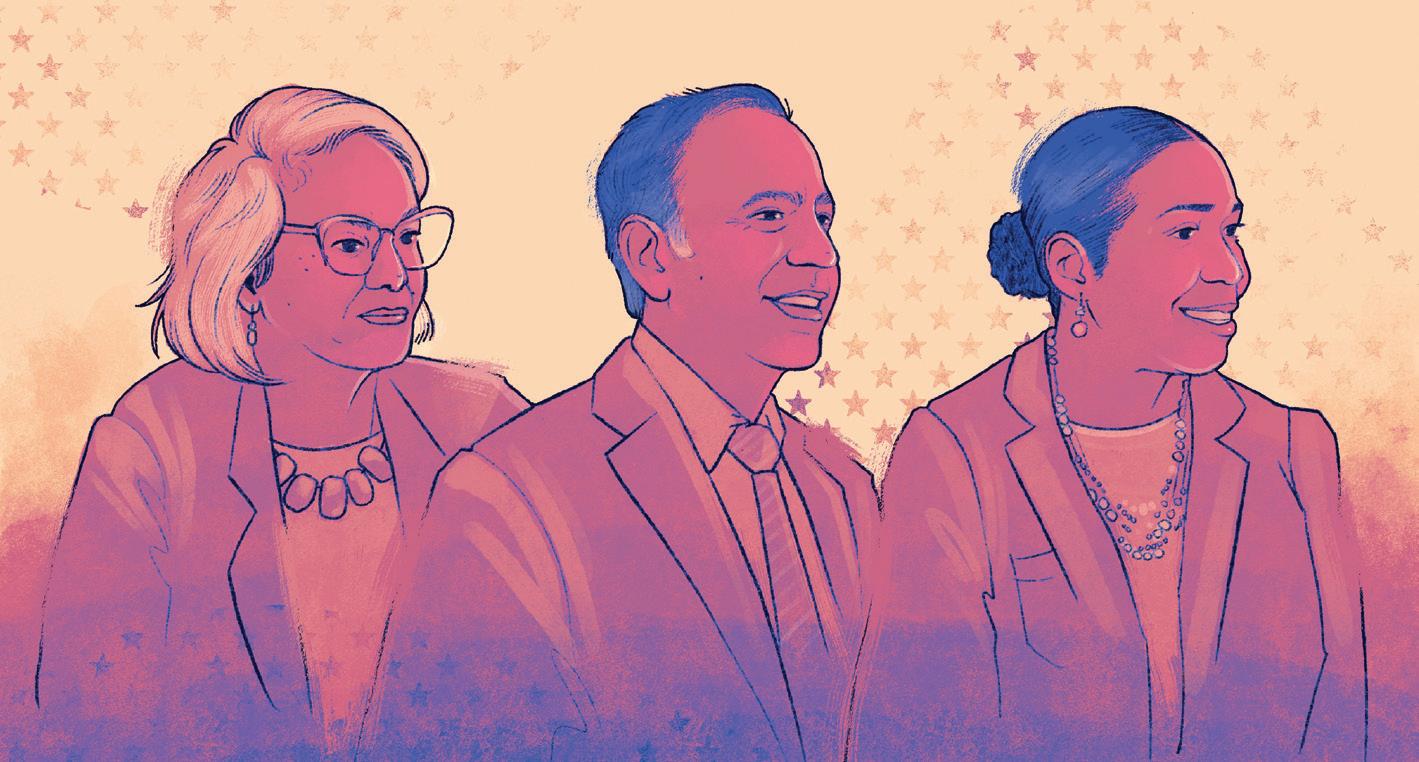
Frontrunners Kelly, Krishnamoorthi and Stratton Vie for Senate Seat
Here’s where the leading candidates to replace Sen. Dick Durbin are on the issues.
BY LEIGH GIANGRECO
When Illinois Senator Dick Durbin announced he would not seek re-election last spring, it opened up a coveted seat that had not been open in three decades.
The Democratic primary this month, which will likely decide the overall winner of that senate seat in deep blue Illinois, has come down to three frontrunners: Congresswoman Robin Kelly (IL-02), Congressman Raja Krishnamoorthi (IL-08), and Lieutenant Governor Juliana Stratton.
Krishnamoorthi led in polls conducted in January by WGN and the independent group Victory Research with an average of 31.5 percent of respondents saying they supported his candidacy. Stratton averaged about 15.5 percent while Kelly was polling around 9.5 percent.
Since President Donald Trump’s administration began targeting Chicago in his barrage of immigration raids over the last year, voters have pushed the senate candidates to declare their stance on immigration enforcement. The phrase “abolish ICE” has become the new “defund the police” this campaign cycle, a shorthand for measuring candidates’ progressive bona fides and willingness to get rid of the troubled Immigration and Customs Enforcement agency. Stratton has emerged as the only candidate to commit to abolishing ICE, while Krishnamoorthi and Kelly have pushed to reform the agency.
As the affordability crisis worsens, the three candidates have taken varied approaches to the fight for an increased minimum wage. Illinois’ minimum wage
Candidates Steve Botsford, Sean Brown, Awisi Bustos, Jonathan Dean, Brian Maxwell, and Kevin Ryan are all polling under 2 percent.
Illustration by Shane Tolentino
is $15 an hour, while Chicago’s minimum wage is $16.60. But the government has not raised the federal minimum wage, which stands at $7.25 an hour, since 2009.
Vermont Senator Bernie Sanders proposed a bill last year that would raise the federal minimum wage to $17 by 2030, which both Kelly and Krishnamoorthi support. Lt. Gov. Stratton, meanwhile, has called for a statewide $25-an-hour minimum wage.
Congressman Raja Krishnamoorthi
• First elected to Congress in 2016
• Born in New Delhi, India and raised in Peoria, Illinois
• Policy adviser for Barack Obama’s senate campaign
Healthcare and affordability: Krishnamoorthi is one of 169 Democrats who have cosponsored Sanders’ companion bill in the House to raise the minimum wage.
“I think that we have to balance two things,” Krishnamoorthi said in a February 19 debate on WGN. “On the one hand, we have to make sure that the minimum wage is raised. On the other hand, we have to make sure that small businesses are able to continue to hire to grow.”
Krishnamoorthi is not advocating a Medicare for All plan. Instead, he has pushed to expand Medicaid coverage and a public option available on the health insurance marketplace. He previously cosponsored Congresswoman Pramila Jayapal’s bill that proposed lowering Medicare eligibility from sixty-five to sixty. He has also proposed expanding the number of drugs subject to negotiation under Medicare, building on a provision included in the 2022 Inflation Reduction Act.
Krishnamoorthi said he would vote to reverse Republicans’ cuts to Medicaid.
Would vote to extend ACA subsidies? Yes.
ICE and immigration: On March 4, the day before Trump fired Secretary of Homeland Security Kristi Noem, Krishnamoorthi moved to subpoena Noem to testify before the House Committee on Oversight and Government Reform about abuses by DHS, ICE, and Customs and Border Protection (CBP) under the Trump administration. House Republicans blocked the motion.
While Stratton has declared that she wants to “abolish ICE,” Krishnamoorthi
has taken a more moderate stance, saying he wants to “abolish Trump’s ICE.” In a Jan. 29 debate on ABC7, he added that he wants to “revamp” CBP and DHS. He criticized Stratton’s suggestion to transfer ICE’s duties to CBP, noting that the federal agency employed Greg Bovino, as well as the two agents charged in the fatal shooting of Minneapolis protester Alex Pretti.
“I think that would be a grave mistake,” Krishnamoorthi said.
Krishnamoorthi has called for various reforms to ICE, including unmasking officers, requiring them to wear body cameras, ending warrantless arrests, installing an inspector general within the agency and requiring a third-party investigation into use-of-force incidents.
Foreign Policy: When asked whether he would vote in favor of Congresswoman Rashida Tlaib’s resolution declaring Israel’s actions against the Palestinian people as genocide, Krishnamoorthi demurred.
“I want to see the language,” Krishnamoorthi said during a February 19 debate on WGN. “But I need to be comforted right now that this type of resolution doesn’t get in the way of progress right now for Gazans.”
In the same debate, Krishnamoorthi did not swear off contributions from the pro-Israel lobbying group AIPAC.
Indian Prime Minister and Hindu nationalist Narendra Modi has enjoyed wide popularity among Hindus in the U.S. The congressman draws a large part of his donors from the Indian diaspora and has appeared alongside Modi several times, including the “Howdy, Modi” event with President Donald Trump in 2019. When Jayapal, the first South Asian American woman elected to the House of Representatives, circulated a letter in Congress urging Joe Biden to discuss human rights during his June 2023 meeting with Modi, Krishnamoorthi did not sign on.
Lieutenant Governor Juliana Stratton:
• Grew up in Calumet Heights
• Has represented the 5th District in the Illinois House since 2016
• Elected lieutenant governor alongside Governor JB Pritzker in 2018
Healthcare and affordability: Stratton has called to raise the federal minimum wage to $25 an hour. She’s hoping to take a page from the state of
Illinois, which approved a six-year phase-in which was completed in 2025.
Her opponents have criticized her approach as unrealistic and have pointed to progressive senators like Sanders, who have proposed an incremental approach toward $17 an hour.
Stratton supports Medicare for All.“I think right now, Americans should be heading to look at big, bold ideas and do whatever we can to get people the health care coverage that they need,” Stratton told IPM News. “I would support the Medicare for All bill. But what I could say is, there's lots of different paths to getting there.”
Would vote to extend ACA subsidies? Yes.
ICE and immigration: “I want to abolish ICE because this agency cannot be reformed,” Stratton said during a January 26 debate hosted by WBEZ, the Chicago Sun-Times and The University of Chicago Institute of Politics. “We are looking at what's happening and it doesn't matter whose ICE it is.”
Stratton added that she wants to investigate and prosecute ICE agents.
Foreign policy: On Israel, Stratton believes that Israeli Prime Minister Benjamin Netanyahu should be removed from power and that the country should hold elections. However, when asked whether she would vote in favor of Tlaib’s resolution a genocide in Gaza, Stratton dodged the question. Stratton, like Krishnamoorthi, has not sworn off AIPAC contributions.
Congresswoman Robin Kelly:
• Born in New York and studied at Bradley University in Peoria
• Former chair of the Illinois Democratic Party before Pritzker threw support behind Illinois State Rep. Lisa Hernandez
• Elected to Il-02 in 2013 to replace former Congressman Jesse Jackson Jr.
Healthcare and affordability: Like Krishnamoorthi, Kelly supports phasing in a $17 per hour minimum wage by 2030.
“That's what studies show is viable,” Kelly said during the ABC7 debate. “We have to be realistic about how much we want to raise it because of course we have to get 218 votes in the House and 60 votes in the Senate and even speaking with Bernie Sanders, he
talks about $17 an hour because that is a realistic amount that wages can be raised.”
Last September, Kelly introduced an economic platform that touted a minimum tax on individuals who net more than $10 million a year. She would also push the Child Care for Working Families Act that would increase government support for childcare. However, the legislation has languished in Congress for nearly a decade.
Would vote to extend ACA subsidies? Yes.
ICE and Immigration: Kelly’s district includes the apartment building at 7500 S. South Shore that over 300 federal agents stormed during a massive immigration raid last October. In an interview with the Chicago Tribune later that month, Kelly compared the federal agents’ actions to “gestapo tactics.”
In January, Kelly introduced articles of impeachment against Noem after an ICE agent shot and killed Renee Good in Minneapolis. Krishnamoorthi was among the 187 Democratic cosponsors of the House resolution.
“But the whole Department of Homeland Security needs an overhaul. Yes, dismantle ICE, but also the Border Patrol, also the agency that looks over citizenships and asylum. All of it needs to be dismantled and rebuilt so people are not terrorized by their own governmental agency,” Kelly said during the ABC7 debate. “So I think we do need enforcement. There's no question about that. But not the enforcement that we have now.”
Foreign policy: Kelly is one of sixty-two Democratic cosponsors to Illinois Rep. Delia Ramirez’ Block the Bombs Act, which would stop the president from selling, transferring or exporting arms to Israel. She has also called Israel’s actions against Palestinians a genocide.
“It may not have started out that way, but I believe that’s what it has turned into,” Kelly said of the situation in Gaza.
Though Kelly has come out strongly against Israel on the campaign trail and promised not to accept AIPAC contributions, she has previously accepted money from the pro-Israel lobbying group. ¬
Leigh Giangreco is a freelance reporter based in Chicago. You can follow her work on Twitter/X @LeighGiangreco and at leighgiangreco.com
Demystifying the Cook County Board
With the primary approaching, here’s what voters need to know about what the Cook County Board president and the Board’s 17 commissioners do, and the stakes of their power.
BY ZOE PHARO
Cook County residents will cast their ballots in the 2026 primary election through March 17 for a range of federal, state, and county elected officials, including judges, deciding which party nominees will appear on the November general election ballot. This year, residents will choose their next Cook County Board president and, in some districts, their commissioner—both for four-year terms with no term limits. But what does the Cook County Board do?
The county can be an esoteric branch of government to understand. With the primary approaching, the Weekly looked into the positions of Cook County Board president and the Board’s 17 commissioners to understand what powers these electeds hold.
What powers does the Cook County Board hold?
The Cook County Board of Commissioners is the governing board and legislative body of the county. It is composed of 17 commissioners elected by the residents of their respective districts, each containing roughly 300,000 people. That’s a lot of commissioners compared to counties of similar populations nationwide; Cook County is the only one of the five most populous U.S. counties with more than five members on its governing board.
In addition to passing legislation to enact policy and run the county government, Cook County commissioners serve on various committees and subcommittees and represent the interests of the constituents in their respective districts. But we
shouldn’t think of them as alderpeople for the county, according to University of Illinois Chicago professor emeritus and former Chicago alderman Dick Simpson.
“Commissioners don’t intervene in how court cases are handled, and they don’t intervene in who gets care at Cook County Hospital in the same way an alderman might intervene over getting a pothole fixed,” Simpson told the Weekly Instead, he said, commissioners might reach out directly to department heads or to the Board president, to accomplish an aim more informally.
This year, seven commissioner seats have contested races for the Democratic nomination, while in the Republican primary, only one commissioner seat drew more than one candidate. Five districts will have a contested race in the general election.
The Cook County Board president, elected by voters from the entire county, is the county’s chief executive officer.
The Board president presides over the typically monthly meetings of the Board, approves or vetoes Board ordinances and resolutions, presents an annual budget for approval by the commissioners, and can themself directly introduce legislation.
The Board president also supervises the offices and departments that provide services to residents and run county operations, such as the Bureau of Finance and the Department of Human Rights and Ethics; appoints people to serve on boards and commissions and to administer county affairs; and negotiates on behalf of the county with governmental units and the private sector.
Besides the Board president and commissioners, Cook County government
is run by 10 other elected positions—these include the assessor, county clerk, sheriff, treasurer, and more—many of which are up for election this year. Additionally, there are appointed and independent agencies within the county system, such as the Office of the Independent Inspector General and the Cook County Public Defender. Although the other electeds control their own areas of the county government independently for the most part, the Cook County Board sets or approves the budget for all of them.
What does the Cook County Board oversee?
Cook County is the only Illinois county that has adopted home rule, which means that it may exercise any power or perform any function relating to its government and affairs, such as regulation, licensing, borrowing money, and levying taxes, as long as it’s not specifically limited by the state.
One of the most salient examples of this power was the county’s 2016 increase of its sales tax by one percent, which, at the time, gave Chicago the highest combined sales tax rate in the country— and which helped the county close a projected budget gap this last budgeting cycle.
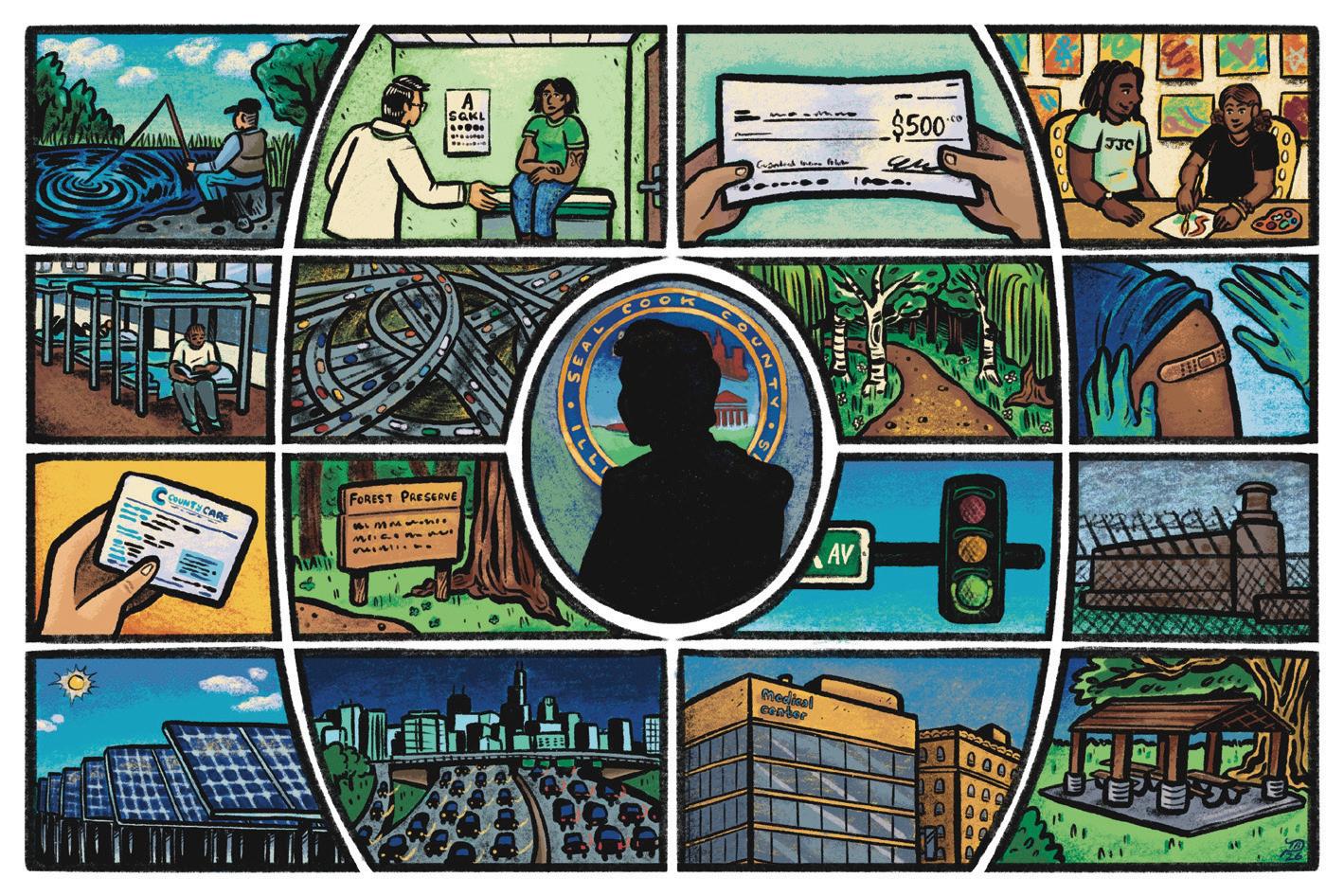
The Cook County Board president’s policy roadmap provides a good overview of what types of things the Board president and commissioners oversee. The county’s goals mainly fall into one of six buckets: health and wellness, economic development, safety and justice, climate resiliency, infrastructure and technology, and good government practices. Broadly
Illustration by Teddie Bernard
speaking, the Board president oversees the county’s public health and hospital systems, criminal justice system, forest preserves—about 70,000 acres of natural areas and open space—transportation infrastructure, more than 20,000 employees, and a roughly $10 billion annual budget. Cook County is the nation’s second-most populous county, after only Los Angeles County.
In October, current Cook County Board President Toni Preckwinkle, who has held the office since 2010—the longest tenure for a Board president—proposed a balanced $10.12 billion budget for fiscal year 2026, later approved by the Board. The county budget is funded primarily by revenues generated through Cook County Health (for example, from Medicaid managed care revenue and patient fees), property taxes, home rule taxes (including sales tax), fees, and federal grants, such as American Rescue Plan Act funds. Healthcare and public safety together made up 74% of the total budget, with the Health Fund alone comprising more than half of the total budget.
Nearly 400,000 Cook County residents are members of CountyCare, a Medicaid managed care plan launched in 2012 that provides no-cost health coverage, and more than 300,000 people visit the county’s two hospitals, John J. Stroger Jr. Hospital and Provident Hospital, and its health centers and clinics annually. The Cook County health system has received particular attention this election cycle, as the county is bracing for as much as $400 million in losses in the coming years as people are losing their health insurance—due to the federal government instituting new work requirements, more frequent checks on qualifications, and reduced or eliminated subsidies on Obamacare plans—or are not able to pay after visiting the hospitals or clinics.
The county has also invested significant funds into grants for violence prevention and reduction and youth criminal justice reform. One such program is the Juvenile Justice Collaborative, a joint program between Cook County government and service providers that provides access to traumainformed care and community-based
services for youth who have experienced or are at high risk for exposure to violence or trauma. Preckwinkle also advocated for the passage of the state-level Pretrial Fairness Act, which passed in 2021 and went into effect in 2023, making Illinois the first state to eliminate cash bail.
and New York, the county and city have been consolidated, making the county essentially obsolete, and the city government administers both functions. Other places, such as LA County, have kept the separate structure of the county, similar to Cook County.
The county’s goals mainly fall into one of six buckets: health and wellness, economic development, safety and justice, climate resiliency, infrastructure and technology, and good government practices.
Other Cook County government initiatives in recent years have included the Cook County Small Business Source, which connects small business owners with guidance and recovery grants; the Cook County Promise Guaranteed Income Pilot, which provided $500 in monthly cash payments to 3,250 low-tomoderate income families for a period of two years (and money was allocated in the 2026 budget to make the program permanent); the county’s first power purchase agreement for renewable energy in partnership with Constellation and Switch Current Energy; investments of $44 million in behavioral health services via the Stronger Together Initiative; and opening a new Center for Hard to Recycle Materials.
What are counties, anyway?
Counties, as a governmental entity, date back to the 1600s.
“If you take counties as a general entity in the United States, they have not changed as quickly as other forms of local government,” Christopher Goodman, associate professor of public administration at Northern Illinois University, told the Weekly. “Cities, for instance, do significantly more things than they did 100 years ago.”
In some cities, like Philadelphia
their board president from among the board’s own members, whereas in Cook County, residents are the ones making this decision.
In Illinois, there are three different forms of government for counties: the township form, commission form, and county executive form. Cook County is the county executive form, one of three in the state.
What this means is that the Cook County Board president runs the executive branch of the county and also presides over legislative matters in the commission. This is not the case in the township form—the most common form in Illinois, used by 85 counties—where the Board president helms the legislative branch, and the executive side is run by a separate administrator, typically an appointed official. This also differs from mayoral power in Chicago, where the mayor is the head of the executive branch. The mayor runs City Council meetings, but they are not formally a member of the Council and cannot introduce legislation. (They can, however, get around this by having someone on City Council introduce legislation on their behalf, Goodman noted.)
“There is that tension of, you are on one side adopting policies, or involved in adopting policies, and then on the other side you’re also in charge of implementing those policies,” Goodman told the Weekly “We usually split those functions apart for accountability reasons.” He added that many counties nationwide elect
The Cook County Board president is typically a full-time position, whereas commissioners can be, though often are not. Some, for example, are also practicing lawyers. According to the Cook County Office of the President, a Cook County official, elected or appointed, may pursue another job in addition to the role, but they are required to disclose any other employment or change in employment to the Cook County Ethics Director and the Board of Ethics within 30 days. Preckwinkle has none currently listed. The current salary for commissioners is $102,170 a year, while the Board president has a salary of $204,340. Some commissioners’ meeting attendance has been called out in the course of the campaign cycle, with some challengers promising they would hold only the job of commissioner if elected.
Over time, the number of Republicans on the Cook County Board has waned, with only one currently on the Board: 17th District Commissioner Sean Morrison of Palos Park, who is not running for reelection.
Simpson said that today there is also “much tighter control” of finances by the Board president and the chairman of the Board’s finance committee (currently John P. Daley), with few amendments to the budget once it is presented. “That’s not to say that commissioners aren’t important in advocating for [the] needs of their section of the county, and that they don’t come up with ideas that eventually get adopted by the county,” Simpson told the Weekly.
Cook County Board primary candidates
Prior to Preckwinkle’s election as Cook County Board president in 2010, she served as 4th Ward alderperson for 20 years, and before that, as a high school history teacher, an economic development coordinator for the City of Chicago, and the executive director of the Chicago Jobs Council. Since 2018, she has also chaired the Cook County Democratic Party.
Preckwinkle, 78, announced that she would be running for reelection last March, citing potential impacts of federal decisions as a reason she wants to remain in the role. “With a new administration at the helm in the federal government causing chaos and uncertainty, now is not the time to step aside from this important work,” she wrote in a campaign email. In October, she signed an executive order banning the use of Cook County–owned property and resources by Immigration and Customs Enforcement (ICE).
In her reelection campaign, Preckwinkle has pointed to her strong track record of fiscal responsibility. During her tenure, she has closed deficits of hundreds of millions of dollars, erased more than $820 million in medical debt for residents, never raised the county’s portion of property taxes, and funded the county’s pension fund around 66%, which is more than double that of the city’s four major pension funds. Under her leadership, the country has received four bond rating upgrades since 2021, while the city is in
significant and mounting debt.
In her last run for reelection for Board president in 2022, Preckwinkle won by almost 69% of the vote against Republican candidate and former 2nd Ward alderperson Bob Fioretti.
Challenging her in the Democratic primary this election is longtime 42nd Ward alderman Brendan Reilly, 54. Reilly got his start in politics as an aide to former Illinois House Speaker Michael Madigan—who was convicted of bribery and corruption charges in 2025—and worked as an AT&T executive before his election to the 42nd Ward seat in 2007. Reilly is one of the more conservative Democrats on City Council; for example, in 2020 he endorsed Republican Patrick O’Brien over Preckwinkle’s former chief of staff Kim Foxx in the race for Cook County state’s attorney.
Also running for Cook County Board president this year are Libertarian candidates Michael Murphy and write-in Justin Tucker and Republican write-in candidates Max Rice and Eric Wallace.
Reilly has criticized Preckwinkle over property tax system delays— property bills have gone out late, forcing school districts to take out loans—and has said he will end the county’s contract with Tyler Technologies, which has been working to upgrade the technology behind the property tax system. Preckwinkle responded that she’s one of several people working to oversee the tax system.
Reilly has said the county should have prepared for Medicaid cuts more aggressively. County leaders said they did by instituting staff cuts and freezes and setting aside reserves. He also wants to ensure the county isn’t absorbing costs from nonresidents.
As for the Cook County commissioner races, commissioners whose districts overlap with the South Side include the 2nd District’s Michael Scott, the 3rd District’s Bill Lowry, the 4th District’s Stanley Moore, the 5th District’s Dr. Kisha McCaskill, the 7th District’s Alma Anaya, and the 11th
District’s John P. Daley. Of these South Side races, only the 2nd and 5th Districts are seeing challenges to the incumbent.
In the 2nd District, Scott is being challenged by activist and perennial candidate Democrat Andre Smith. In the 5th District, McCaskill is being challenged by Democrat Kiana Belcher, a trustee for the Village of Dolton, and the winner of the Democratic primary will face Republican candidate Richard Nolan, who has previously run for Thornton Township Supervisor. ¬
Zoe Pharo is a writer and fact-checker based in Chicago. She grew up in Durham, North Carolina, and studied political science and international relations at Carleton College. She is a former staff writer for the Hyde Park Herald and editorial intern for In These Times , and she currently freelances for Chicago Documenters and South Side Weekly. She last wrote for the Weekly about residents’ experiences at a newly combined, city-run temporary shelter in Hyde Park.
The Future of The 78 is Soccer
The Chicago Fire broke ground on their incoming stadium last Tuesday, signalling a new era for the long vacant area.
BY MALACHI HAYES
The future home of the Chicago Fire is not easy to get to. At least, it took me a few tries. From the Roosevelt Road overpass in the South Loop, I scanned for a way into the tract of land known as The 78, where the groundbreaking for the 22,000-seat stadium was taking place in 20 minutes. With no through access for blocks, I had to venture further northwest to Harrison and Wells before heading south. For now, this stretch of Wells is the only way in or out of The 78: bordered by Metra tracks to the east and the south branch of the Chicago River to the west, there’s no arriving from those directions, either. A rare kink in our beloved grid system.
Not that it’s mattered much until recently. Looking out from the Roosevelt overpass last Tuesday, I might have mistaken Chicago for a Rust Belt rail junction, were it not for the gleaming skyline behind me.
That’s how this piece of land has looked for about as long as most of us can remember: dusty and vacant, nestled between a twisted web of tracks and railyards with the steel of the defunct St. Charles Air Line Bridge rising in the distance.
On this day, though, a huge white canopy tent plopped in the middle of The 78 cut through the rainy gloom. As I arrived, a steady stream of cars filed into an adjacent makeshift parking lot. I had kindly been invited to the groundbreaking ceremony along with Fire season ticket holders, other media members, and a smattering of elected officials.
Given the usual pace of major infrastructure projects in the city, it’s remarkable that we were about to witness shovels in the ground less than a year after the concept was first announced to the public. Chicagoans learned about
get ready to break ground on the Chicago Fire’s new stadium in The 78 on March 3, 2026.
the stadium last June through an open letter from the Fire’s billionaire owner, Joe Mansueto. After clearing zoning committee votes, the plan was voted in by the full City Council in September.
The new stadium will be privately owned and funded by Mansueto, sidestepping the need to request taxpayer dollars that ultimately tanked recent stadium proposals from the White Sox and Bears. Real estate company Related Midwest, which acquired the plot in 2016, is slated to develop a surrounding planned community. Renderings from the Fire and Related Midwest show numerous green and social gathering spaces, commercial corridors, and high-rise residences conceived around a proposed extension of Chicago's riverwalk. Information on potential developers and commercial tenants has not been released.
It’s a grand accomplishment for the
Major League Soccer (MLS) franchise, which has struggled with turf quality and scheduling conflicts at Soldier Field in recent years. The Fire played there from 1998 until 2006 before moving to Bridgeview’s SeatGeek Stadium, built specifically for the soccer team. Dissatisfied with the results, they returned to Soldier Field in 2020.
Under the tent at The 78, speeches began at 2pm with Fire’s president of business operations, Dave Baldwin, who appealed to the growing popularity of soccer in the United States as grounds for the stadium project’s viability.
“Soccer is having its moment in America,” Baldwin said, referring to the Fire as a “sleeping giant” that could be awakened by new facilities. MLS Commissioner Don Garber stressed that projects like this were critical to fostering a local soccer culture. Even 3rd Ward Ald. Pat Dowell, whose ward includes
The 78, was in the know. “Soccer is booming in the United States, I’m told,” she deadpanned near the end of her time at the podium.
The imminence of a soccer explosion in the United States is not a new talking point from those within the sport. Commissioner Garber wrote a guest column for the New York Times in 2002: “Finally, we are witnessing…the coming of age of the American professional soccer player, with literally millions more developing their games on soccer fields and alleyways throughout our country.” At that time, the impending construction of multiple soccer-only stadiums around the country led the commissioner to conclude that “By any measure soccer has arrived.” On Tuesday, Garber pointed to stadium developments in Chicago, New York, and Miami as similar evidence.
A lot can change in twenty-four years. MLS did grow substantially in the decade-and-a-half after Garber’s column, growing from twelve to twenty-two franchises and seeing average attendance jump by nearly 50 percent in that time. Since then, though, average attendance has stagnated, even as the number of franchises has ballooned to thirty.
The league’s broadcast reach appears to be struggling, too. MLS games, shown exclusively on Apple TV since 2023, averaged 120,000 unique viewers last season, down two-thirds from 2022 when matches were available on ESPN.
Perhaps attendance and viewership aren’t critical factors in stadium planning. After all, the Women’s National Basketball Association (WNBA) and the National Women’s Soccer League (NWSL) only have a handful of dedicated stadiums, despite both leagues booming in recent years. The WNBA has seen its per game attendance nearly double since 2022, and averaged just under a million viewers per
Officials
Photo by Malachi Hayes
game across networks. The NWSL has experienced the same growth over the last decade, and reported an average of 214,000 viewers across all networks.
Speakers from the Fire and MLS heralded the groundbreaking as a milestone for American soccer. Elected officials did the same for Chicago’s economic prospects. Those present believe that the stadium represents a landmark economic milestone for the city and their constituents. “This day today signals that Chicago is open for business,” Ald. Dowell declared.
The 78 site has long been prized as one of downtown Chicago’s last undeveloped swaths of land. The railyard that sits just across the river on the site's western border once encompassed the entire area, before being cleared in the 1970s as heavy industry and passenger rail declined. But as other Loopadjacent neighborhoods have boomed, The 78 remained barren. A TIF district encompassing the land was created under Mayor Richard M. Daley in 1997, and for a time, it was owned by infamous real estate developer Tony Rezko. Rezko failed to develop the site amid the corruption scandals that ultimately led to his imprisonment, and it remained in limbo until Related Midwest’s purchase from a Luxembourg-based company in 2016. Now, after ten years of failed proposals that included a casino and stadiums for the White Sox and Bears, it’s finally happening.
With that history in mind, it’s understandable why the elected officials at the groundbreaking ceremony sounded so excited. Noting the site’s famously long vacancy during his speech, Mayor Brandon Johnson promised: “With today’s groundbreaking, we begin to meet our city’s fullest potential,” calling the project a “major step towards the development of the whole city.”
It’s the first public comment on the project from Johnson since it was announced. It also echoed the rhetoric used by the mayor in his support of the Chicago Bears’ failed 2024 stadium proposal, emphasizing the benefits of focusing private investment around a stadium as an anchor for a larger business community. That proposal promised
nearly 2,300 permanent local jobs in the region, while Related Midwest projects a total of 5,000 for the Fire stadium project and community. But while the Bears’ proposal offered a projected annual economic impact of $248 million for the city, Related Midwest’s plan for the Fire claims their development will result in over $2 billion in yearly economic impact.
It’s hard to know what to make of these promises. Stadium public policy expert Geoffrey Propheter at the University of Colorado Denver told the Weekly that job creation numbers promised by stadium developers are often impossible to corroborate or follow up on, because who’s to say what they’re counting as a job? What kinds of jobs are we talking about, and more importantly, what do they pay and who gets them?
“Half the problem,” Propheter said, “is that there is no standard lexicon for describing these [things].”
In his remarks, Johnson stressed the need to ensure that Chicagoans and local residents would be the beneficiaries of the jobs and development promised by the parties involved. In an August statement to the Weekly, a spokesperson for Related Midwest stated that their projection of 5,000 permanent jobs included “jobs and investment generated in the broader supply chain”—that is, second- and third-order jobs down the supply chain, which may or may not be anywhere near Chicago or its residents. The spokesperson also declined to directly answer whether they and their partners would commit to ensuring the jobs created by the project would provide employees with a fair and living wage.
Propheter also said that projections for economic impacts and tax revenue may be overstated because impact studies often overzealously (and erroneously) identify all economic activity associated with a development as being caused by said development. More importantly, he said, they don’t account for the opportunity cost of what might otherwise be occupying the development space in question.
“Even if the numbers themselves are credible, an economic impact report is still completely useless from a policy standpoint because of those tradeoffs. It tells you nothing about what you could
have done differently [with that space] and what those costs and benefits would be if you allocated the target resources in some other way,” Propheter said.
“Generally speaking, the highestvalue and best use of land is never, ever for sports.”
It’s easy to see what’s in this for the Fire. The turf at Soldier Field is notoriously poor, and the Fire are routinely obligated to relocate games and plot their schedule around Bears games and concerts at Soldier Field. They won’t have to sign a lease. The team will have facilities that they can finally be proud of.
“You don’t wash a rental car,” Mansueto quipped about the Fire’s current tenancy at Soldier Field.
But the speed of the project’s development and approval has left residents with questions about the development’s scope and concerns about its impact on surrounding neighborhoods.
Speaking on behalf of Community Benefits Agreement (CBA) for 78, a “cross-ward coalition representing the interests of working families” in wards impacted by The 78, organizer Sarah Tang described the development agreement’s affordable housing allocations as “not satisfactory,” and called for “good housing solutions, not just what’s required.”
According to Tang, CBA for 78 is primarily concerned with housing
security, and pushing back on the forces of land speculation that typically accompany stadium developments— and could price longtime residents out of their homes. She called the potential for stadium-based displacement “a real, existential threat” to communities like Pilsen, Chinatown, and Bronzeville. With the development set to include high-rise apartments and yet-to-beannounced soccer-themed commercial endeavors, concerns that price pressure could expand into adjacent wards aren’t without merit.
At the ceremony, Dowell said her role in the project was informed by extensive community input, explaining that at least twelve community meetings had been held. “These types of projects do not take place in a vacuum,” Dowell said. “It requires a lot of input and listening.” Related Midwest cited a poll conducted by a South Loop community group showing “73 percent of respondents were ‘supportive’” of the proposal.
Not all community members are echoing that level of support. At a press conference held the day before the groundbreaking ceremony, representatives of the different community groups in CBA for 78 shared concerns that the developers’ promises to the community would go unfulfilled without a CBA in place. Consuela Hendricks, co-president of community
A Chicago Fire flag flutters in the breeze at the groundbreaking ceremony for the team’s new stadium on March 3, 2026.
Photo by Malachi Hayes
organization People Matter, told media members that “new development should prioritize families that are already living in the communities instead of pushing them out.” Other speakers echoed Tang’s earlier contention that the basic affordable housing fulfillments proposed by the developers are still likely to be out of reach for residents in surrounding communities.
Tang told the Weekly that residents’ capacity to bring forth concerns was limited. She said most meetings were private, and that all public 3rd Ward meetings were conducted via Zoom, with vetted questioning and no open floor, while the only 11th Ward meeting was invite-only. “All the other meetings that were face-to-face were privately held by homeowners associations in the area,” she said.
In an emailed statement to the Weekly, Dowell wrote that her office conducted two community meetings over Zoom “to ensure accessibility” and that questions were “slightly edited when
necessary to combine similar inquiries.” Dowell added that her office met with a number of local organizations across South Loop and Chinatown, published an FAQ about the project, and answered emails from constituents.
At the ceremony, Dowell acknowledged Curt Bailey, the president of Related Midwest, who was thanked repeatedly through the afternoon’s remarks. Disclosure records show that Bailey donated $1,500 to Dowell’s campaign committee in March 2025, just over two months before plans for the stadium were announced. Dowell received an additional $3,000 from Don Biernacki, a Related Midwest executive vice president, in 2025, including $1,500 on the same day as Bailey’s donation. Biernacki has also contributed $4,000 since 2023 to 11th Ward Ald. Nicole Lee, who was in attendance at the groundbreaking.
Multiple speakers cited the endlessly publicized fact that the stadium would be privately financed by Mansueto. But
plenty of public money is still tied up in the project. In 2019 the city created a TIF district in the area and entered an agreement with Related Midwest in which the developer would cover up front costs of infrastructure improvements and then recoup the investment from tax revenue captured by the TIF. The planned infrastructure, which included a new Red Line station and repositioned Metra tracks, was projected to cost $700 million.
Those improvements seem to have been left out of the final plans presented by the Fire and Related Midwest, leading CBA for 78 and others to believe the idea has been scrapped despite residents’ requests for increased transit access regardless of what goes on at The 78.
The TIF district created for these transit projects remains in place, and it’s unclear if Related Midwest still plans to recoup development costs through the TIF. 25th Ward Alderperson Byron Sigcho-Lopez has called for transparency regarding the developer’s use of these
You could buy a home with no down payment!
TIF funds, saying at last Monday’s press conference that any unused funds could be “used for affordable housing and other needs.”
As remaining questions continue to shape the development, what’s clear is that The 78 is entering a new era. The name of the site, after all, was coined with the notion that it might be Chicago's 78th community area. After decades of political grandstanding and failed proposals, it seems that's actually happening, at least in part.
At the groundbreaking, a Chicago Fire flag fluttered below the American stars and stripes on a construction crane, hailing the team’s victory over the White Sox, Bears, and all other wouldbe occupants of this long-coveted land. Finally, work had begun.¬
Malachi Hayes is a Bridgeport-based writer and South Side native.
Chinatown Celebrates the Year of the Fire Horse
Thousands gathered to celebrate the annual Lunar New Year Parade on the first day of March.
BY JAMES HOECK
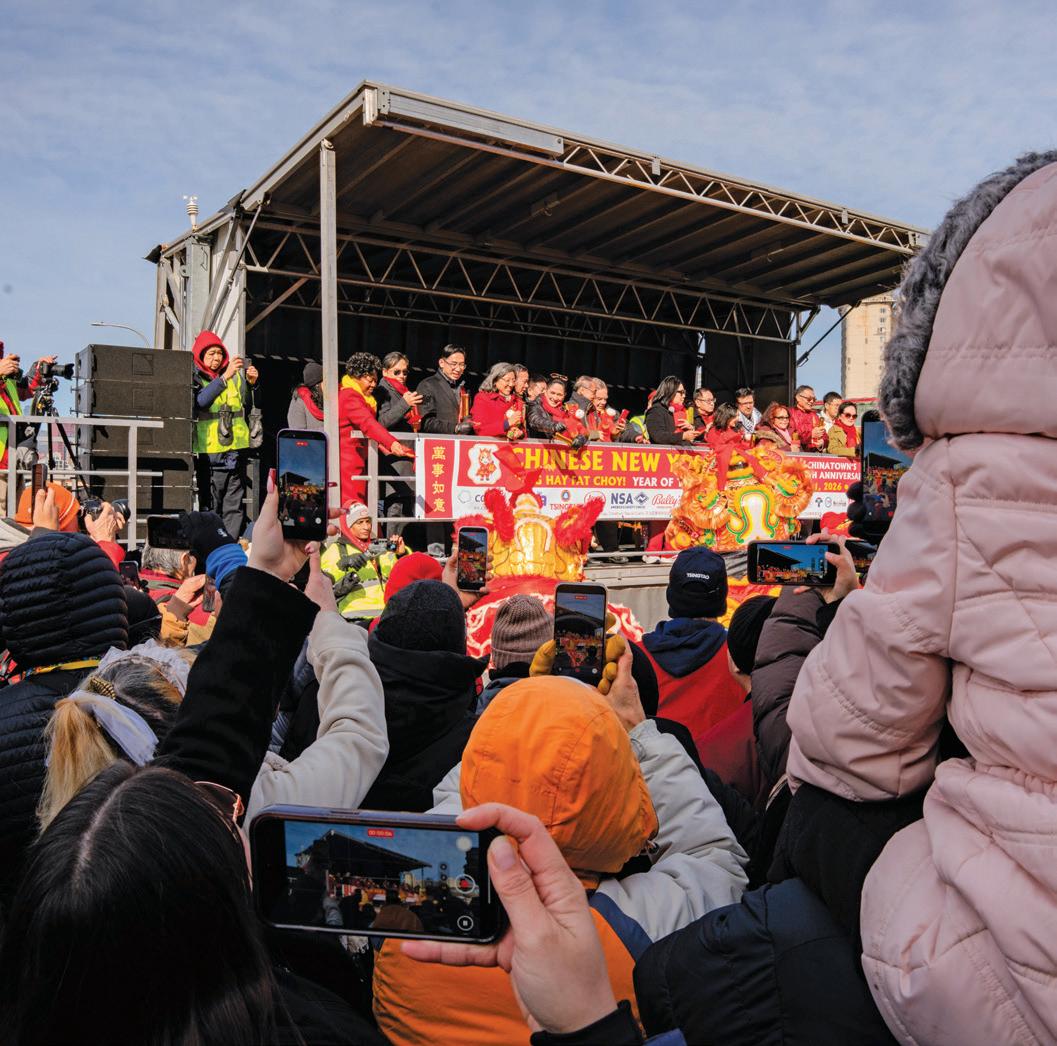
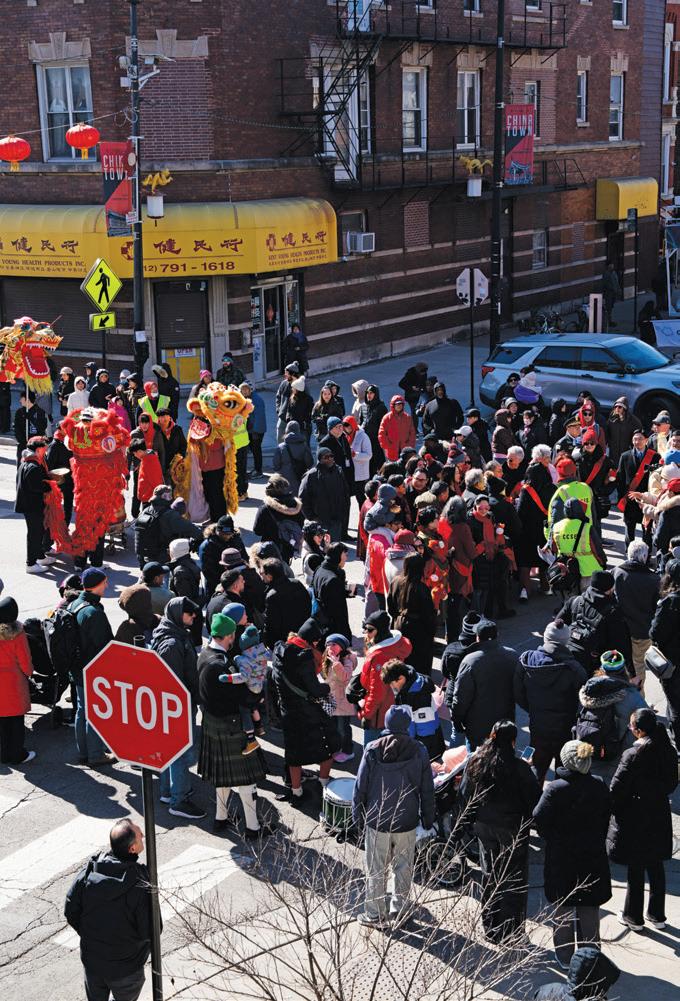
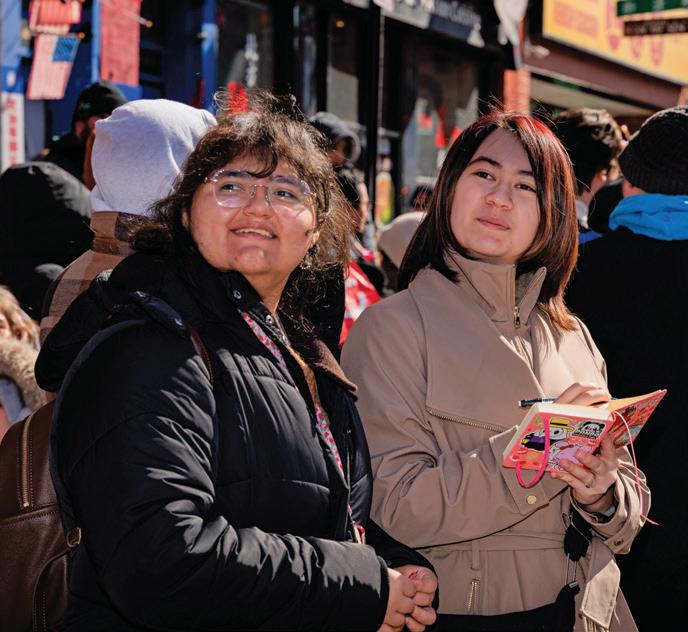
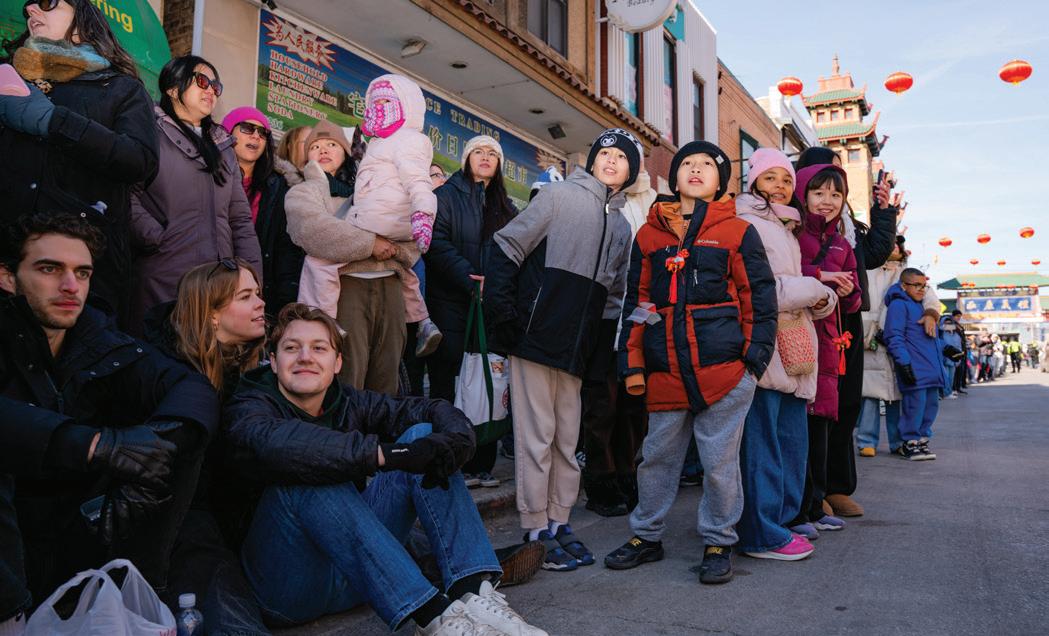
On March 1, the Chicago Chinatown Community Foundation hosted its annual Lunar New Year Parade, celebrating the Year of the Horse and the 114th anniversary of Chicago’s Chinatown on a sunny and windy Sunday afternoon. Traditional lion and dragon dancing flowed through South Wentworth Avenue and West Cermak Road alongside marching bands, floats, dancers, and members of local schools and organizations. Thousands of visitors filled both sides of the street, excited for the performances of the parade, as confetti glided through the air during the day.
After the parade, lion dancers spread throughout the Chinatown area to bless local businesses with good fortune throughout the new year with many patrons from the day’s event visiting local establishments within the area.
February 14 marked the official start of the Lunar New Year and Year of the Fire Horse, occurring for the first time in sixty years. According to the Chinese calendar, we’ve entered the year 4,724. The Lunar calendar rotates between five elements and 12 animal zodiac signs. ¬
James Hoeck is an independent photographer, journalist and artist. Hoeck is a freelance photojournalist with South Side Weekly
Confetti flies in the air as the Lunar New Year parade continues down South Wentworth Avenue on Sunday, March 1, 2026.
Parade members dressed in hanfu smile and wave at community members as they pass during the Lunar New Year parade Sunday, March 1, 2026, at South Wentworth Avenue.
A lion dancer performs at the Lunar New Year parade in Chinatown on South Wentworth Avenue on Sunday, March 1, 2026.
A cymbal player from the Hoysun High School Alumni Association stands amongst fellow alumni at South Wentworth Avenue and West 24th Street as members of the parade and attendees filter in prior to the start of the event on March 1, 2026.
The Lunar New Year parade begins as organizations march down South Wentworth Avenue at 12:43 p.m. Sunday, March 1, 2026.
Parade performers lift the lion head to swap dancers as they head closer to the Chinatown Gateway on South Wentworth Avenue during the Lunar New Year parade on Sunday, March 1, 2026.
By the Chinatown Gate on South Wentworth Avenue on Sunday, March 1, 2026.
Thousands attend Chinatown's Lunar New Year parade Sunday afternoon at South Wentworth Avenue on March 1, 2026.
Attendees watch for upcoming performers on Sunday during the Lunar New Year parade on South Wentworth Avenue on March 1, 2026.
A fire horse puppet flies through the air by a member of the Lunar New Year Parade in Chinatown on Sunday, March 1, 2026. Feb. 17 marked the year of the fire horse in Chinese zodiac.
Sunday, March 1, 2026 outside the Chinatown Gateway on South Wentworth Avenue.
Tres candidatos compiten por el escaño que deja Dick Durbin en el Senado
Estas son las posturas de Kelly, Krishnamoorthi y Stratton sobre los temas clave.
POR LEIGH GIANGRECO TRADUCIDO POR ALMA CAMPOS
Cuando el senador de Illinois Dick Durbin anunció la primavera pasada que no buscaría la reelección, se abrió un codiciado cargo que no había estado disponible en tres décadas.
La primaria demócrata de este mes, que probablemente decidirá al ganador final de ese escaño en el Senado en un estado fuertemente demócrata como Illinois, se ha reducido a tres principales contendientes: la congresista Robin Kelly (IL-02), el congresista Raja Krishnamoorthi (IL-08) y la vicegobernadora Juliana Stratton. Krishnamoorthi lideraba en las encuestas realizadas en enero por WGN y el grupo independiente Victory Research, con un promedio de 31.5 % de los encuestados diciendo que apoyaban su candidatura. Stratton promediaba alrededor de 15.5 %, mientras que Kelly registraba cerca de 9.5 %.
Los candidatos Steve Botsford, Sean Brown, Awisi Bustos, Jonathan Dean, Brian Maxwell y Kevin Ryan aparecen en las encuestas con menos del 2 %.
Desde que la administración del presidente Donald Trump comenzó a enfocar a Chicago en su ola de redadas migratorias durante el último año, los votantes han presionado a los candidatos al Senado para que declaren su postura sobre la aplicación de las leyes de inmigración.
La frase “abolir ICE” se ha convertido en el nuevo “abolir la policía” en este ciclo electoral, una forma abreviada de
medir las credenciales progresistas de los candidatos y su disposición a eliminar la problemática agencia de Inmigración y Control de Aduanas (ICE). Stratton ha surgido como la única candidata que se ha comprometido a abolir ICE, mientras que Krishnamoorthi y Kelly han abogado por reformar la agencia.
A medida que la crisis de asequibilidad empeora, los tres candidatos han adoptado distintos enfoques en la lucha por aumentar el salario mínimo. El salario mínimo en Illinois es de 15 dólares por hora, mientras que el salario mínimo en Chicago es de 16.60 dólares. Sin embargo, el gobierno federal no ha aumentado el salario mínimo nacional, que se mantiene en 7.25 dólares por hora, desde 2009. El senador de Vermont Bernie Sanders propuso el año pasado un proyecto de ley que elevaría el salario mínimo federal a 17 dólares para 2030, propuesta que tanto Kelly como Krishnamoorthi apoyan.
Congresista Raja Krishnamoorthi
• Elegido por primera vez al Congreso en 2016
• Nació en Nueva Delhi, India, y creció en Peoria, Illinois
• Fue asesor de políticas públicas en la campaña al Senado de Barack Obama
Salud y costo de vida: Krishnamoorthi es uno de 169 miembros del Congreso, todos demócratas, que han patrocinado el proyecto de ley impulsado por Bernie
Sanders en la Cámara de Representantes para aumentar el salario mínimo.
“Creo que tenemos que equilibrar las dos cosas”, dijo durante un debate el 19 de febrero en WGN. “Por un lado, debemos asegurarnos de que se aumente el salario mínimo. Por otro lado, debemos asegurarnos de que las pequeñas empresas puedan seguir contratando y creciendo”.
Krishnamoorthi no apoya un plan de Medicare para Todos. En su lugar, ha impulsado ampliar la cobertura de Medicaid y crear una opción pública disponible en el mercado de seguros de salud. Anteriormente copatrocinó un proyecto de ley presentado por la congresista demócrata de Washington Pramila Jayapal que proponía reducir la edad de elegibilidad para Medicare de 65 a 60 años.
También ha propuesto ampliar la cantidad de medicamentos cuyos precios pueden negociarse bajo Medicare, basándose en una disposición incluida en la Ley de Reducción de la Inflación de 2022.
Krishnamoorthi dijo que votaría para revertir los recortes a Medicaid impulsados por los republicanos.
¿Votaría para extender los subsidios de la Ley de Cuidado de Salud Asequible (ACA) que expiraron? Sí.
ICE e inmigración: El 4 de marzo, un día antes de que el presidente Donald Trump despidiera a Kristi Noem,
Krishnamoorthi presentó una moción para citar a Noem a declarar ante el Comité de Supervisión y Reforma del Gobierno de la Cámara de Representantes sobre presuntos abusos cometidos por el Departamento de Seguridad Nacional (DHS), el Servicio de Inmigración y Control de Aduanas (ICE) y la Oficina de Aduanas y Protección Fronteriza (CBP) durante la administración Trump. Los republicanos en la Cámara bloquearon la moción.
Mientras Stratton ha declarado que quiere “abolir ICE”, Krishnamoorthi ha adoptado una postura más moderada, afirmando que quiere “abolir el ICE de Trump”. En un debate el 29 de enero en ABC7 añadió que también quiere “reformar” la CBP y el DHS.
Criticó la propuesta de Stratton de transferir las funciones de ICE a la CBP, señalando que esa agencia federal empleó a Greg Bovino, así como a los dos agentes acusados en el tiroteo fatal del manifestante de Minneapolis Alex Pretti.
“Creo que sería un grave error”, dijo Krishnamoorthi.
Krishnamoorthi ha pedido diversas reformas a ICE, entre ellas exigir que los agentes se identifiquen sin máscaras, que usen cámaras corporales, poner fin a los arrestos sin orden judicial, establecer un inspector general dentro de la agencia y requerir investigaciones independientes sobre incidentes de uso de la fuerza.
Política exterior: Cuando se le preguntó si votaría a favor de la resolución
presentada por la congresista demócrata de Michigan Rashida Tlaib, que declara que las acciones de Israel contra el pueblo palestino constituyen un genocidio, Krishnamoorthi evitó dar una respuesta directa.
“Quiero ver el lenguaje de la resolución”, dijo Krishnamoorthi durante un debate el 19 de febrero en WGN. “Pero necesito tener la seguridad de que este tipo de resolución no obstaculice el progreso que se necesita ahora mismo para los gazatíes”.
En el mismo debate, Krishnamoorthi tampoco descartó aceptar contribuciones del grupo de cabildeo proisraelí AIPAC.
El primer ministro de la India y líder nacionalista hindú Narendra Modi goza de gran popularidad entre muchos hindúes en Estados Unidos. El congresista recibe una gran parte de sus donaciones de la diáspora india y ha aparecido en varias ocasiones junto a Modi, incluido el evento “Howdy, Modi” en 2019 con el presidente Donald Trump.
Cuando la congresista demócrata Pramila Jayapal, la primera mujer sudasiática elegida a la Cámara de Representantes, circuló una carta en el Congreso instando al entonces presidente Joe Biden a abordar el tema de los derechos humanos durante su reunión de junio de 2023 con Modi, Krishnamoorthi no firmó la carta.
Vicegobernadora Juliana Stratton:
• Creció en Calumet Heights, en Chicago
• Ha representado el Distrito 5 en la Cámara de Representantes de Illinois desde 2016
• Fue elegida vicegobernadora junto al gobernador JB Pritzker en 2018
Salud y costo de vida: Stratton ha pedido aumentar el salario mínimo federal a 25 dólares por hora. Su propuesta se inspira en el modelo de Illinois, donde se aprobó un aumento gradual durante seis años que entró en plena vigencia en 2025. Sus oponentes han criticado su enfoque por considerarlo poco realista y han señalado que senadores progresistas como Bernie Sanders han propuesto un aumento gradual hasta 17 dólares por hora. Stratton apoya Medicare para Todos.
“Creo que en este momento los estadounidenses deberían estar considerando ideas grandes y audaces y hacer todo lo posible para que las personas tengan la cobertura de salud que necesitan”, dijo Stratton a IPM News. “Yo apoyaría el proyecto de ley de Medicare para Todos. Pero también diría que hay muchos caminos distintos para llegar ahí”.
¿Votaría para extender los subsidios de la Ley de Cuidado de Salud Asequible (ACA) que expiraron? Sí.
ICE e inmigración: “Quiero abolir ICE porque esta agencia no se puede reformar”, dijo Stratton durante un debate el 26 de enero organizado por WBEZ, el Chicago Sun-Times y el Institute of Politics de la Universidad de Chicago. “Estamos viendo lo que está pasando y no importa de quién sea ese ICE”.
Stratton añadió que quiere investigar y procesar a agentes de ICE.
Política exterior: Sobre Israel, Stratton cree que el primer ministro israelí Benjamin Netanyahu debería ser removido del poder y que el país debería celebrar nuevas elecciones. Sin embargo, cuando se le preguntó si votaría a favor de la resolución de Rashida Tlaib que declara que lo que ocurre en Gaza es un genocidio, Stratton evitó responder directamente.
Al igual que Krishnamoorthi, Stratton tampoco ha descartado aceptar contribuciones de AIPAC, el influyente grupo de cabildeo proisraelí.
¿Votaría para extender los subsidios de la Ley de Cuidado de Salud Asequible (ACA) que expiraron? Sí.
ICE e inmigración: El distrito de Kelly incluye el edificio de apartamentos ubicado en 7500 S. South Shore, donde más de 300 agentes federales realizaron una gran redada migratoria en octubre pasado.
En una entrevista con el Chicago Tribune ese mismo mes, Kelly comparó las acciones de los agentes federales con “tácticas de la Gestapo”.
Congresista Robin Kelly:
• Nació en Nueva York y estudió en Bradley University, en Peoria
• Fue presidenta del Partido Demócrata de Illinois antes de que el gobernador JB Pritzker respaldara a la representante estatal Lisa Hernandez
• Fue elegida para representar el Distrito 2 de Illinois en el Congreso en 2013, tras reemplazar al excongresista Jesse Jackson Jr.
Salud y costo de vida: Al igual que Krishnamoorthi, Kelly apoya aumentar gradualmente el salario mínimo federal a 17 dólares por hora para 2030.
“Eso es lo que muestran los estudios: que es viable”, dijo Kelly durante el debate de ABC7. “Tenemos que ser realistas sobre cuánto queremos aumentarlo porque, por supuesto, necesitamos 218 votos en la Cámara de Representantes y 60 votos en el Senado. Incluso cuando hablo con Bernie Sanders, él menciona 17 dólares por hora porque es una cifra realista para aumentar los salarios”.
En septiembre pasado, Kelly presentó una plataforma económica que propone un impuesto mínimo para personas que ganan más de 10 millones de dólares al año. También impulsaría la Child Care for Working Families Act, que aumentaría el apoyo gubernamental para el cuidado infantil. Sin embargo, esta legislación lleva casi una década estancada en el Congreso.
En enero, Kelly presentó artículos de juicio político contra Kristi Noem después de que un agente de ICE disparara y matara a Renee Good en Minneapolis. Krishnamoorthi fue uno de los 187 demócratas que copatrocinaron la resolución en la Cámara.
“Todo el Departamento de Seguridad Nacional necesita una reforma profunda”, dijo Kelly durante el debate de ABC7. “Sí, desmantelar ICE, pero también la Patrulla Fronteriza y también la agencia que supervisa ciudadanía y asilo. Todo debe desmantelarse y reconstruirse para que la gente no sea aterrorizada por su propia agencia gubernamental”.
“Creo que necesitamos aplicar la ley. No hay duda de eso. Pero no la forma de aplicación que tenemos ahora”.
Política exterior: Kelly es una de 62 demócratas que copatrocinan el Block the Bombs Act, presentado por la representante de Illinois, Delia Ramirez, que impediría que el presidente venda, transfiera o exporte armas a Israel.
También ha calificado las acciones de Israel contra los palestinos como genocidio.
“Puede que no haya comenzado así, pero creo que eso es en lo que se ha convertido”, dijo Kelly sobre la situación en Gaza.
Aunque Kelly ha criticado fuertemente a Israel durante la campaña y ha prometido no aceptar contribuciones de AIPAC, anteriormente sí recibió dinero del grupo de cabildeo proisraelí. ¬
Leigh Giangreco es una reportera independiente radicada en Chicago. Puedes seguir su trabajo en Twitter/X en @ LeighGiangreco y en leighgiangreco.com.
Ilustración de Shane Tolentino
Lo que hay que saber sobre la Junta del Condado de Cook
Con las elecciones primarias acercándose, ¿qué hace la Junta del Condado de Cook y sus 17 comisionados, y cuáles son los riesgos de su poder?
POR ZOE PHARO TRADUCIDO POR GISELA OROZCO
Los residentes del condado de Cook emitirán su voto en la elección primaria de 2026 hasta el 17 de marzo para elegir a una serie de funcionarios federales, estatales y del condado, incluidos jueces, y así decidir qué candidatos de cada partido aparecerán en la boleta de la elección general de noviembre. Este año, los residentes elegirán a la próxima persona que presidirá la Junta del Condado de Cook y, en algunos distritos, a su comisionado o comisionada—ambos cargos con mandatos de cuatro años y sin límites de reelección. Pero, ¿qué hace la Junta del Condado de Cook?
El gobierno del condado puede ser una rama del gobierno difícil de entender. Con la primaria acercándose, el Weekly examinó los cargos de la presidencia de la Junta del Condado de Cook y de sus diecisiete comisionados para comprender qué poderes tienen estos funcionarios electos.
¿Qué poderes tiene la Junta del Condado de Cook?
La Junta de Comisionados del Condado de Cook es el órgano de gobierno y el cuerpo legislativo del condado. Está compuesta por 17 comisionados elegidos por los residentes de sus respectivos distritos, cada uno con aproximadamente 300,000 personas.
Es un número elevado de comisionados en comparación con condados de poblaciones similares en todo el país; de los cinco condados más poblados de Estados Unidos fuera de Chicago, todos tienen cinco comisionados.
Además de aprobar leyes para promulgar políticas y dirigir el gobierno del condado, los comisionados del Condado de Cook participan en diversos comités y subcomités y representan los intereses de los electores en sus respectivos distritos. Sin embargo, Dick Simpson, profesor emérito de la Universidad de Illinois en Chicago y ex concejal de Chicago, afirmó que no son exactamente como los concejales.
“Los comisionados no intervienen en la tramitación de los casos judiciales ni en la decisión sobre quién recibe atención en el Hospital del Condado de Cook, como un concejal podría intervenir para arreglar un bache”, declaró Simpson al Weekly En lugar de ello, dijo, los comisionados podrían comunicarse directamente con los jefes de departamento o con el presidente de la junta, para lograr un
objetivo de manera más informal.
El presidente de la Junta del Condado de Cook, elegido por los votantes de todo el condado, es el director ejecutivo del condado. Preside las reuniones, que suelen ser mensuales, aprueba o veta las ordenanzas y resoluciones, presenta el presupuesto anual para su aprobación por los comisionados y puede presentar directamente proyectos de ley. También supervisa las oficinas y departamentos que prestan servicios a los residentes y gestionan las operaciones del condado, como la Oficina de Finanzas y el Departamento de Derechos Humanos y Ética; nombra a personas para formar parte de las juntas y comisiones y para administrar los asuntos del condado; y negocia en nombre del condado con las unidades gubernamentales y el sector privado.
Además del presidente de la Junta y los comisionados, el gobierno del Condado de Cook está dirigido por otros 11 cargos electos principales —entre ellos, el asesor, el secretario del condado, el alguacil, el tesorero, entre otros—, muchos de los cuales se presentan a elecciones este año. Asimismo, existen agencias designadas e independientes dentro del sistema del condado, como la Oficina del Inspector General Independiente y el Defensor Público del Condado de Cook. Sin embargo, aunque los demás electos en su mayoría controlan sus propias áreas del gobierno del condado de forma independiente, la Junta del Condado de Cook establece o aprueba el presupuesto para todos ellos.
¿Qué supervisa la Junta del Condado de Cook?
Una gran diferencia entre el Condado de Cook y otros condados de Illinois es que Cook es el único que ha adoptado la autonomía. Esta autonomía significa que los condados pueden ejercer cualquier facultad o realizar cualquier función relacionada con su gobierno y asuntos, como la regulación, la concesión de licencias, la obtención de préstamos y la imposición de impuestos, siempre que no esté específicamente limitada por el estado.
Uno de los ejemplos más destacados de esta facultad fue el aumento del impuesto sobre las ventas del condado en un 1% en 2016, que, en aquel momento, otorgó a Chicago la tasa combinada de impuesto sobre las ventas más alta del país y que ayudó al condado a cerrar un déficit presupuestario previsto en este
Ilustración de Teddie Bernard
último ciclo presupuestario.
La hoja de ruta de políticas de la presidencia de la Junta del Condado de Cook ofrece una buena visión general de los asuntos que supervisan la presidencia y los comisionados. Los objetivos del condado se agrupan principalmente en seis áreas: salud y bienestar, desarrollo económico, seguridad y justicia, resiliencia climática, infraestructura y tecnología, y buenas prácticas de gobierno.
En términos generales, la presidencia de la Junta supervisa el sistema de salud pública y hospitales del condado, el sistema de justicia penal, las reservas forestales—unas 70,000 acres de áreas naturales y espacios abiertos—la infraestructura de transporte, a más de 20,000 empleados y un presupuesto anual de aproximadamente 10 mil millones de dólares. El Condado de Cook es el segundo condado más poblado del país, solo detrás del Condado de Los Ángeles.
En octubre, la actual presidenta de la Junta del Condado de Cook, Toni Preckwinkle, quien ocupa el cargo desde 2010 —el periodo más largo para una presidencia de la Junta— propuso un presupuesto equilibrado de $10.12 mil millones para el año fiscal 2026, que posteriormente fue aprobado por la Junta.
El presupuesto del condado se financia principalmente con ingresos generados a través de Cook County Health (por ejemplo, ingresos de Medicaid managed care y tarifas de pacientes), impuestos a la propiedad, impuestos de “home rule” (incluido el impuesto sobre las ventas), tarifas y subvenciones federales, como los fondos de la Ley del Plan de Rescate Estadounidense (American Rescue Plan Act). La atención médica y la seguridad pública representaron conjuntamente el 74 % del presupuesto total, y el Fondo de Salud por sí solo constituyó más de la mitad del presupuesto total.
Casi 400,000 residentes del Condado de Cook son miembros de CountyCare, un plan de atención médica administrada de Medicaid lanzado en 2012 que ofrece cobertura médica gratuita. Más de 300,000 personas visitan anualmente los dos hospitales del condado, el John J. Stroger Jr. Hospital y el Provident Hospital, así como sus centros de salud y clínicas. El sistema de salud del Condado
de Cook ha recibido especial atención en este ciclo electoral, ya que el condado se prepara para pérdidas de hasta $400 millones en los próximos años a medida que las personas pierden su seguro de salud —esto debido a que el gobierno federal instituyó nuevos requisitos laborales, controles más frecuentes sobre las calificaciones y subsidios reducidos o eliminados para los planes de Obamacare— o no pueden pagar después de visitar los hospitales o clínicas.
fondos en el presupuesto de 2026 para que el programa fuera permanente); el primer acuerdo de compra de energía del condado para energía renovable en colaboración con Constellation y Switch Current Energy; inversiones de más de $40 millones en servicios de salud conductual a través de la Iniciativa Stronger Together; y la apertura de un nuevo Center for Hard to Recycle Materials.
Los objetivos del condado se dividen principalmente en seis áreas: salud y bienestar, desarrollo económico, seguridad y justicia, resiliencia climática, infraestructura y tecnología, y buenas prácticas gubernamentales.
El condado también ha invertido fondos significativos en subvenciones para la prevención y reducción de la violencia y la reforma de la justicia penal juvenil. Uno de estos programas es el Youth Juvenile Justice Collaborative, programa conjunto entre el gobierno del Condado de Cook y proveedores de servicios que brinda acceso a atención adaptada al trauma y servicios comunitarios para jóvenes que han experimentado o corren un alto riesgo de exposición a la violencia o el trauma. Preckwinkle también abogó por la aprobación de la Ley de Equidad Previa al Juicio a nivel estatal, que se aprobó en 2021 y entró en vigor en 2023, convirtiendo a Illinois en el primer estado en eliminar la fianza en efectivo.
Otras iniciativas del gobierno del Condado de Cook en los últimos años incluyen la Cook County Small Business Source, que conecta a los propietarios de pequeñas empresas con subvenciones de orientación y recuperación; el Cook County Promise Guaranteed Income Pilot, que proporcionó $500 en pagos mensuales en efectivo a 3250 familias de ingresos bajos a moderados durante un período de dos años (y se asignaron
Esto significa que el presidente de la Junta del Condado de Cook dirige el poder ejecutivo del condado y también preside los asuntos legislativos en la comisión. Esto no ocurre en el municipio —el más común en Illinois, utilizado por 85 condados—, donde el presidente de la Junta dirige el poder legislativo y el ejecutivo está a cargo de un administrador independiente, generalmente un funcionario designado. Esto también difiere del poder de la alcaldía en la Municipalidad de Chicago, donde el alcalde preside el poder ejecutivo. El alcalde dirige las reuniones del Concejo Municipal, pero no es miembro formal y no puede presentar leyes (sin embargo, puede evitar esto designando a alguien del Concejo Municipal para que presente leyes en su nombre, señaló Goodman).
¿A todo esto, qué son los condados?
Los condados, como entidad gubernamental, se remontan a 1600.
“Si consideramos los condados como una entidad general en Estados Unidos, no han cambiado tan rápidamente como otras formas de gobierno local”, declaró Christopher Goodman, profesor asociado de administración pública en la Universidad del Norte de Illinois, al Weekly. “Las ciudades, por ejemplo, hacen muchas más cosas que hace 100 años”.
En algunas ciudades, como Filadelfia y Nueva York, el condado y la municipalidad se han consolidado, lo que ha vuelto al condado prácticamente obsoleto, y el gobierno municipal administra ambas funciones. Otros lugares, como el Condado de Los Ángeles, han mantenido la estructura separada del condado, similar al Condado de Cook.
En Illinois, existen tres formas diferentes de gobierno para los condados: el municipio, la comisión y el ejecutivo del condado. El Condado de Cook es el ejecutivo del condado, uno de los tres que existen en el estado.
“Existe esa tensión: por un lado, se adoptan políticas o se participa en su adopción, y por otro lado, también se está a cargo de implementarlas”, declaró Goodman al Weekly. “Normalmente dividimos esas funciones por razones de rendición de cuentas”. Agregó que muchos condados en todo el país eligen a su presidente de junta entre los propios miembros de la misma, mientras que en el Condado de Cook, son los residentes los que toman esta decisión.
El presidente de la Junta suele ser un puesto de tiempo completo, mientras que los comisionados pueden serlo, aunque con frecuencia no lo son. Algunos, por ejemplo, también ejercen la abogacía. Según el Código de Ética del Condado de Cook, un funcionario electo o designado del Condado de Cook puede desempeñar otro trabajo además de su cargo, pero este no debe exceder las 20 horas semanales ni entrar en conflicto con el horario laboral del condado, y debe ser divulgado. Actualmente Preckwinkle no tiene ninguno en la lista. El salario actual de los comisionados es de $102,170 al año, mientras que el de Preckwinkle es de $204,340. La asistencia a las reuniones de algunos comisionados ha sido cuestionada durante el ciclo de campaña, y algunos aspirantes han prometido que, de ser elegidos, sólo ocuparán el cargo de comisionado.
POLÍTICA
Con el tiempo, el número de republicanos en la Junta del Condado de Cook ha disminuido, y actualmente solo hay un miembro en la Junta: el comisionado del Distrito 17, Sean Morrison, de Palos Park, quien no se postula para la reelección.
Simpson afirmó que hoy en día existe un control financiero “mucho más estricto” por parte de la presidenta de la Junta y del presidente del comité de finanzas de la Junta (actualmente John P. Daley), con pocas modificaciones al presupuesto una vez presentado. “Eso no significa que los comisionados no sean importantes a la hora de defender las necesidades de su sector del condado, y que no propongan ideas que finalmente sean adoptadas por el condado”, declaró Simpson al Weekly
Candidatos a las primarias de la Junta del Condado de Cook
Antes de su elección como presidenta de la Junta del Condado de Cook en 2010, Preckwinkle se desempeñó como concejala del 4º Distrito durante 20 años y, antes de eso, como profesora de historia de secundaria, coordinadora de desarrollo económico de la Municipalidad de Chicago y directora ejecutiva del Consejo de Empleo de Chicago. Desde 2018, también preside el Partido Demócrata del Condado de Cook.
Preckwinkle, de 78 años, anunció que se postularía a la reelección en marzo, citando el posible impacto de las decisiones federales como una razón para permanecer en el cargo. “No voy a predecir qué sucederá en Washington, pero la incertidumbre y la brutalidad
CHICAGO DEPARTMENT OF TRANSPORTATION 95TH STREET AT THE UNION PACIFIC RAILROAD PUBLIC INFORMATION MEETING
The Chicago Department of Transportation (CDOT) will hold a public information meeting for the proposed improvements at the 95th Street and Union Pacific Railroad highway-rail grade crossing. The grade crossing is located along 95th Street, approximately ½-mile west of I-90/94.
All persons interested in the project or wanting to receive more information about the project are invited to attend. The details of the meeting are as follows:
Date: Thursday, March 26, 2026 Time: 6:00 p.m. to 7:30 p.m.
Location: Woodson Regional Library, 9525 S. Halsted St., Chicago, IL 60628
The purpose of the meeting is to:
• Provide information on the project
• Obtain public feedback
• Present the alternatives considered, the preferred alternative, and proposed interim improvements
The proposed project may affect the Chicago Park District’s Fernwood Parkway Park. These impacts would not affect the park’s activities, features, or attributes that make the property eligible for Section 4(f) protection. A Section 4(f) de minimis impact finding will be sought from the Federal Highway Administration. The proposed project may result in future property relocations. Right-of-way acquisition and relocation assistance information will be available at this meeting. Exhibits will be on display from 6:00 p.m. to 7:30 p.m. Project team members will be present to discuss the project and answer questions. The formal presentation will be from 6:30 p.m. to 7:00 p.m. This meeting will be accessible to people with disabilities. Anyone needing special assistance, including the need for a sign language interpreter or other similar accommodations, should contact Soliman Khudeira at least five days prior to the meeting, at (312) 744-9605.
All correspondence regarding this project should be sent to:
Chicago Department of Transportation
2 N. LaSalle St., Suite 820, Chicago, IL 60602
Attn: CDOT-Division of Engineering
Soliman Khudeira, PhD, PE, SE
Section Chief – Major Projects or submitted via email to: Soliman.Khudeira@cityofchicago.org
Comments received by April 10, 2026, will become part of the meeting record. Comments can be sent via email to Anthony.Pakeltis@parsons.com and can also be provided at the project website: https://95thuprr.com/contact/
de las cosas de las que hablan es muy preocupante”, declaró a Politico. En octubre, firmó una orden ejecutiva que prohíbe el uso de propiedades y recursos del Condado de Cook por parte del Servicio de Inmigración y Control de Aduanas (ICE).
En su campaña de reelección, Preckwinkle ha destacado su sólida trayectoria de responsabilidad fiscal. Durante su mandato, ha cerrado déficits de cientos de millones de dólares, condonado más de $600 millones en deuda médica, nunca ha aumentado la parte del condado en impuestos prediales y ha financiado el fondo de pensiones del condado en aproximadamente un 66%, más del doble que los cuatro principales fondos de pensiones de la ciudad. Bajo su liderazgo, el país ha recibido cuatro mejoras en la calificación de sus bonos desde 2021, mientras que la ciudad mantiene una deuda significativa y creciente.
En su última candidatura a la reelección como presidenta de la Junta en 2022, Preckwinkle ganó con casi el 69% de los votos contra el candidato republicano y ex concejal del Distrito 2, Bob Fioretti.
En las primarias demócratas de estas elecciones, se enfrenta a ella Brendan Reilly, de 54 años y veterano concejal del Distrito 42. Reilly se inició en la política como asesor del expresidente de la Cámara de Representantes de Illinois, Michael Madigan, quien fue condenado por soborno y corrupción en 2025, y trabajó como ejecutivo de AT&T antes de ser elegido para el escaño del Distrito 42 en 2007. Reilly es uno de los demócratas más conservadores del Concejo Municipal; por ejemplo, en 2020 en la contienda por la fiscalía estatal del Condado de Cook, apoyó al republicano Patrick O’Brien en lugar de a Kim Foxx, exjefa de gabinete de Preckwinkle.
Este año, también se postulan a la presidencia de la Junta del Condado de Cook los candidatos libertarios Michael Murphy y Justin Tucker, ambos por escrito, y los candidatos republicanos por escrito Max Rice y Eric Wallace.
Reilly ha criticado a Preckwinkle por los retrasos en el sistema de impuestos prediales —las facturas de propiedad se han emitido con retraso, lo que ha obligado a los distritos escolares a
solicitar préstamos— y ha anunciado que rescindirá el contrato del condado con Tyler Technologies, empresa que ha estado trabajando para actualizar la tecnología del sistema de impuestos prediales. Preckwinkle respondió que es una de las varias personas que trabajan para supervisar el sistema tributario.
Reilly también ha afirmado que el condado debería haberse preparado para los recortes de Medicaid de forma más agresiva —los líderes del condado afirmaron que así fue, con recortes y congelaciones de personal y la reserva de fondos— y que quiere asegurarse de que el condado no absorba costos depersonas que no viven en el condado.
En cuanto a las contiendas para comisionados del Condado de Cook, entre los comisionados cuyos distritos se superponen con el Distrito Sur se encuentran Michael Scott (2º Distrito), Bill Lowry (3º Distrito), Stanley Moore (4º Distrito), la Dra. Kisha McCaskill (5º Distrito), Alma Anaya (7º Distrito) y John P. Daley (11º Distrito). De estas contiendas en el Distrito Sur, sólo los distritos 2 y 5 enfrentan desafíos para el titular.
En el 2º Distrito, Scott se enfrenta al activista y candidato demócrata Andre Smith. En el 5º Distrito, McCaskill se enfrenta a la demócrata Kiana Belcher, fideicomisaria de la villa de Dolton, y al candidato republicano Richard Nolan, quien anteriormente se postuló para supervisor del municipio de Thornton.¬
Zoe Pharo es escritora y verificadora de datos, radicada en Chicago. Creció en Durham, Carolina del Norte, y estudió ciencias políticas y relaciones internacionales en Carleton College. Fue escritora del Hyde Park Herald y becaria editorial de In These Times. Actualmente trabaja como freelance para Chicago Documenters y South Side Weekly. Su artículo más reciente para el Weekly fue sobre las experiencias de los residentes en un albergue temporal, recientemente integrado y administrado por la Municipalidad, en Hyde Park.
Public Meetings Report
A recap of select open meetings at the local, county, and state level.
BY SCOTT PEMBERTON AND DOCUMENTERS
February 9
At its meeting, the Chicago Council on Mental Health Equity learned that the Crisis Assistance Response & Engagement Program (CARE) is scheduled to be attached to the Chicago Fire Department’s fire dispatch in the first half of 2026. CARE has been operating out of the Chicago Department of Public Health, and the move is part of a city-wide expansion of mental health crisis response services. The Council also learned that the Chicago Police Department (CPD) Crisis Intervention Team (CIT) refresher training has been updated to include content on substance use and co-occurring disorders, psychotropic medications, and child and adolescent issues. Officers are required to take the forty-hour basic training. CPD is set to give the council an update in May. The lone public commenter was Judy King, MD. She reminded Council of the achievements of the now-defunct Community Mental Health Board of Chicago (CMHBC) and expressed disappointment that the CMHBC no longer has a role in city mental health services. Dr. King also asked where the public could view the training document and questioned whether the committee was violating the Open Meetings Act by speaking to each other individually outside of subcommittee meetings.
February 10
During its meeting, the Chicago Residential Investment Fund (RIF) Board of Directors considered ethics updates, investment committee concerns, future projects, and committee reports. The investment committee assists the not-for-profit RIF in the use of its $135 million revolving fund. Public commenters expressed strong concern that the investment committee is not subject to the Open Meetings Act, that its members won’t be vetted, and that because the investment committee is advisory, its members are not required to meet the same ethical standards as the full board. The speakers represented several organizations, including the Institute for the Public Good, the Illinois Green New Deal Coalition, People for Community Recovery, and Palenque LSNA. The sustainability advisory committee presented a report. Its job is to recommend sustainability standards that support “high-quality, environmentally friendly housing as well as the fiscal health of the RIF's investments.” RIF is a new City of Chicago entity designed to “invest in, develop, and manage high-quality, permanently mixed-income housing,” according to its website. The RIF’s first meeting took place last fall.
February 11
Nine public commenters had their say at a Chicago Park District Board of Commissioners meeting. The seven-member board is appointed by the mayor and meets monthly. The Board voted on several agenda items at this meeting, including vendor contracts, and approved all consent agenda items. Public commenters raised concerns about funding for competitive swimming programs for underserved athletes
and their families, health insurance and public pension funding, tiny-home villages as a solution for homelessness encampments, violence at Douglass Park, and resources for unhoused park residents. Officials gave presentations on Park District initiatives, including Black History Month and Heart Health Month celebrations. Perri Irmer, president and CEO of the DuSable Black History Museum, welcomed the board after the singing of the Black National Anthem, “Lift Every Voice and Sing.” This year is the 65th anniversary of the museum, which was founded in 1961 and is the oldest Black history museum in the country. It’s located in Washington Park, about a mile west of the Obama Presidential Center under construction in Jackson Park. The Obama Center is scheduled to open in June.
February 19
The Regional Transportation Authority (RTA) Board of Directors met to discuss transit crime statistics, funding, bridge repairs, and the RTA's upcoming reorganization into the Northern Illinois Transit Authority (NITA). NITA was established in December of last year as part of an effort to “avert a fiscal cliff,” according to its website. NITA replaces the RTA and assumes additional responsibilities in fare policy, service, and capital planning. The first item discussed at the RTA Board meeting was bridge repairs, which appear to be urgent. A Metra presentation indicated that 210 bridges “absolutely have to be worked on”, and Metra is seeking $230 million to rehabilitate nineteen bridges immediately. “There can’t be a higher priority, I think, than bridge safety,” said Chair Kirk Dillard, who encouraged Metra leadership to talk to the state about funding, especially Governor J.B. Pritzker. Public comments focused on disability services. The first speaker, a member of Metra’s Americans with Disabilities Act (ADA) advisory committee, emphasized the importance of the city’s Rideshare Access Program (RAP), explaining that the program enables disabled people to work and to move around the city without the advance planning Pace requires. The second speaker also lauded RAP but said that disabled riders still face challenges, especially overcrowding. He advocated for more options, and he thanked the RTA Board for defending RAP against funding cuts. The next two speakers commented on the number of monthly rides available to disabled riders. One is grateful for the recent increase to forty but asked that unused rides be allowed to roll over into the next month. The other speaker said that the forty RAP rides he receives per month aren’t enough, forcing him to use the Pace service, which requires reservations at least one day in advance. He would like the Pace service to extend farther south and southwest into the Chicago area. He asked for sixty RAP rides per month in 2027.
During a two-hour meeting, the Metropolitan Water Reclamation District (MWRD) of Greater Chicago Board first observed a minute of silence for Rev. Jesse Jackson Sr., the notable civil rights leader and founder of Chicago’s Rainbow PUSH Coalition. He died at the age of eighty-four on February 17. The Board then unanimously approved, adopted, or published and filed twenty-five of twenty-seven agenda items. One item was deleted and one deferred by Board President Kari Steele. Deferred was a co-lease request from the mayor of Crestwood in connection with 4Crestwood, LLC, to allow operation of a video gaming casino. During the public comment period, the mayor explained that without the proposed lease, the current situation imposes a financial burden on the village. He said he had emailed the district about this matter but had not received a reply. Another public commenter and property owner asked to expedite a master intergovernmental agreement with the MWRD for Rolling Meadows to build a fence on his property. He told the board that he is readily available to meet about or discuss the matter. The Board approved an MWRD request to advertise for underground storage tank improvements at various locations with an estimated cost of between $1.2 and $1.5 million. As required by the state’s fire marshal, the tanks must be maintained and have a lifespan of ten to twenty years. The district asked to settle a lawsuit between the district and an electronic plating vendor for an injunction to keep a sewer plugged, and to impose additional civil penalties for violations of a previous Board order. Discussion was postponed.
This information was collected and curated by the Weekly in large part using reporting from City Bureau’s Documenters at documenters.org.
Illustration by Holley Appold/South Side Weekly
CLASSIFIED Section
Vinyl Records Wanted
for Sale
anymore. Good condition. Good for a beginner. You will have to arrange to get it moved. It’s on the first floor, so it only has to go down the porch stairs. Please email with serious inquiries only at hollyflorida@hotmail.com
Exhibits
VATICAN INTERNATIONAL EXHIBIT OF MIRACLES OF THE EUCHARIST AT ST. MOTHER TERESA OF CALCUTTA PARISH!
March 14th, 1-5 pm & March 15th, 10:30 am-1:30 pm Plus, 2 talks on March 14th at 10:30 am at 2832 S. Quinn St, Chicago, IL 60608
Estate/Moving Sale
Hyde Park Estate/Moving Sale
Sat, 3-14, 10-2
Sun, 3-15, 10-2
Mon, 3-16, 10-2
Tues, 3-17, 10-2
Entire contents of a 3-story Victorian home and basement. Items include an antique dining room table that seats 20 fully fully estended, a nice collection of china & crystal including Royal Worcester, Orrefors, Royal Copenhagen, Herend, Jame Campbell, Johnsons Bros, Sevres & more, carpets, room size & smaller, assortment of original art & prints, books books, books and more books. Inlaid sofa table, Cloisonne, needlepoint chairs, Mission oak coat stand, pottery, wine, souvenir decorative items, yarn, white stacking storage shelves with bins, textiles, table linens, Boy Scout memorabilia fro 40’s & 50’s, workshop contents, 4 aluminum ladders assorted sizes, patio furniture, flower pots, large selection of basement/ garage storage shelves, ladies clothing. flatscreen TV’s with wall brackets, crystal mantel lights, beveled & etched framed mirror, comfy chairs, table & floor lamps, Queen bed & frame, so much more.
For photos, go to candacesantiques.com
Apartments for Rent-Chicago
Sunny & Spacious 51 & Greenwood
4 Bedrm & 2 Bath Apt & a 1 Bedrm English Garden Apt. Laundry in the building. On-site management 773-251-1200
Cleaning Service
Best Maids
708-599-7000 House Cleaning Services
Family owned since 1999 www.bestmaids.com
Construction
JO & RUTH REMODELING
We Specialize in Vintage Homes and Restorations! Painting, Power Washing, Deck Sealing, Brick Repair, Tuckpointing, Carpentry, Porch/ Deck, Kitchen & Bath Remodeling.
*Since 1982*
773-575-7220
BY MALACHI HAYES
Welcome to the South Side Sports Roundup! Check back every month for the latest news and updates on everything South Side sports fans need to know.
Bulls endure winless February, look towards future
It’s been a season of firsts for the Bulls. The team started off hot, opening the season 5–1 for the first time since Michael Jordan’s heyday. As they cooled off, the Bulls made not just their first in-season trades in over three years, but engineered the most drastic reshaping of the roster perhaps since Jordan’s departure, making a league-high seven deadline trades last month.
They weren’t done. Now, the Bulls have achieved one of the worst firsts imaginable, going the entire month of February without a win. It’s the first time in sixty seasons that they’ve gone winless over a full calendar month. They halted their losing streak at thirteen games last Monday, coming up three short of an ignominious franchise record, but they find themselves in 11th place in the Eastern Conference, on pace for their worst record in more than five years. They’re all but guaranteed to miss the playoffs for the eighth time in nine seasons.
It’s not a coincidence that the Bulls are just now letting the bottom fall out, as this summer’s NBA draft is shaping up to be one of the deepest in recent memory. There are not one, not two, but three college players who are considered potential franchise-changers: BYU’s AJ
Dybantsa, Kansas’s Darryn Peterson, and Duke’s Cameron Boozer, eldest son of former Bulls forward Carlos Boozer. It’s unlikely the Bulls finish with a bad enough record to put them in position to nab one of those three. But with few long-term contracts on the books and as much salary cap space as any team in the league, it’s sure to be an offseason of change at the United Center.
Chicago Public League (CPL) basketball season concludes
Another year of Chicago high school basketball is just about in the books, and as is often the case, a fair share of South Side schools took home hardware this year. After four consecutive championship game losses, the Kenwood Broncos took home their first CPL Girls Basketball title in a dominant win over fellow South Siders Butler College Prep. Meanwhile, the CPL Boys Basketball trophy is headed to the Southwest Side after the Curie Condors secured a nine-point win over Lincoln Park High School. It’s the second title in three years for Curie, who defeated Kenwood to win the 2024 CPL title. Their semifinal win over Kenwood this year kept the Broncos from their fourth consecutive city championship appearance, though they did manage to secure bronze with a third-place game victory over Hyde Park Academy High School.
As is usually the case, the road to Chicago’s high school basketball crown runs through the South Side. A South Side high school has taken the Public League title in all but three years since 2010, with a 2015 upset from Bogan and 2013 and 2021 runs from Whitney Young being the only exceptions. While Young has maintained a chokehold on the Girls Basketball title for much of the
past two decades, Simeon and Kenwood have risen to their challenge in recent years.
White Sox kick off Spring Training, send players to World Baseball Classic
The early days of Spring Training are underway at the White Sox facilities in Glendale, Arizona. While a few names have raised eyebrows— notably, Edgar Quero and Miguel Vargas are tearing the cover off the ball—news is sparse. More exciting action is coming from the World Baseball Classic, which kicked off last week with games in Miami, Houston, San Juan, and Tokyo, and includes five current Sox players, as well as one alum. Star offseason signee Munetaka Murakami is representing his native Japan, and catcher Kyle Teel is suiting up for the Italian squad, as is Antonacci. New closer Seranthony Domínguez will be pitching for the Dominican Republic, while backup infielder Curtis Mead represents Australia. Most excitingly, former Sox stalwart Alexei Ramírez, who ranks fourth in team history with nearly 1,000 games played at shortstop, will be suiting up for Cuba at age forty-four, a full decade after his last appearance in the major leagues. The World Baseball Classic semifinals and finals are set to be played on March 15 through 17.
DePaul men on the upswing?
The Chicago Sky have dominated the headlines at South Loop’s Wintrust Arena in recent years, and it’s easy to
forget that it’s also home to the basketball teams of the DePaul University—a program that once competed among the best in the country but has since long fallen by the wayside.
Joining the Big East conference in 2005 triggered a steep decline for the once-proud program. They’ve only had a winning season twice out of twenty-one years in the conference, and not a single time have they finished with a winning record against Big East opponents, at one point compiling a 2-52 stretch between 2008 and 2011. They reached a nadir with an 0-for-20 showing in Big East play in 2023-24.
The times, though? They are a’changing. Now in his second season with the Blue Demons, coach Chris Holtmann was the most high-profile hire the school has made in recent memory. Holtmann is familiar with the Big East, having taken the Butler Bulldogs to three consecutive NCAA Tournaments, which he followed up with a 137-86 run at Ohio State that resulted in four tournament berths in six years. After posting a 14-20 record in his first year at the helm, Holtmann has DePaul sitting at 16-14, on the verge of just their third winning season in over two decades. Perhaps more impressively, he’s already led them to eight wins in conference play, the most they’ve ever won since joining the Big East and more than their past three seasons combined. Though senior leaders CJ Gunn and NJ Benson are set to graduate, DePaul is set to return three starters next year, and with another full year of recruiting under his belt, college ball at Wintrust Arena could be worth watching sooner rather than later.
Illustrations by Kristel Becares
Our thoughts in exchange for yours.
The Exchange is the Weekly’s poetry corner, where a poem or piece of writing is presented with a prompt. Readers are welcome to respond to the prompt with original poems, and pieces may be featured in the next issue of the Weekly.
South Side Weekly and Build Coffee & Books will host our Third Thursdays open mic, featuring a writing workshop facilitated by theMIND, on March 19 at 6:30pm!
ATLAS COMPLEX by
themind
I been broke
I stay breaking shit
Like your concentration
Condensation rolls down my mason
This the last clean glass in this empty house
Every month I wonder how the hell we make it
I told you everything, gave you everything
You always wanted me naked
Now I’m selling everything, I’m telling everything
I hope honesty saves us
Look what these melodies gave us
Plane tickets to places I can’t pronounce
Women friends and kinfolk who never loved me
Called me ugly
I had my doubts
My house ain’t have mirrors and neither did yours
How’d you see yourself?
How you see yourself?
I guess it took something breaking just to be something more
Who goin pick these pieces off of this floor?
Not you
Don't move the old couch in your new house
Burn that shit
If these wall could talk I would move out
I don't need that lip
I been trying build a new one
Too caught up in confusion
Of moving out and moving on and needing you for both I think we broke too close
I know my soul is still intact
I still question if shoes fit
Prayed for this shit, granny said hopes for the foolish
Never seen myself making it past 22
Know it can't buy happiness, but look what this money do
In foster homes ain’t never seen this many smiles where I'm from
Scared of failing my family, I know that we still young
Tell me how many make it close to this point
Knowing I played the fool
What if I stayed in school?
I shed tears here with this ballpoint
Enough to fill a drake-sized swimming pool
I need to feel love for some insurance
You could slice the pressure in the air with a Ginsu
Spilled my whole soul in this venue
Trying to get this shit off my mental
I still have nightmares in that house that me and my sisters done lived thru
I can’t even wipe this kinda shit from psyche
Reliving all this shit and rinse my eyes with some Visine
Don't move the old couch in your new house
Burn that shit
If these wall could talk I would move out
I don't need that lip
I been trying build a new one
Too caught up in confusion
Of moving out and moving on and need you for both
I think we broke
Chima Ikoro is the Weekly’s Engagement Editor.
THIS WEEK'S PROMPT: “WRITE FROM THE PERSPECTIVE OF AN OBJECT THAT HOLDS MEMORIES YOU MAY OR MAY NOT WANT TO KEEP.”
This could be a poem, journal entry, or a stream-of-consciousness piece. Submissions could be new or formerly written pieces. Submissions can be sent to bit.ly/ssw-exchange or via email to chima.ikoro@southsideweekly.com