The South Side Weekly is a nonprofit newsprint magazine written for and about neighborhoods on the South Side of Chicago. We publish in-depth coverage of the arts and issues of public interest alongside oral histories, poetry, fiction, interviews, and artwork from local photographers and illustrators. Started as a student paper at the University of Chicago, the South Side Weekly is now an independent nonprofit organization dedicated to supporting cultural and civic engagement on the South Side, and to providing educational opportunities for developing journalists, writers, and artists.
Editor-in-Chief Osita Nwanevu
Executive Editor Bess Cohen
Managing Editors Jake Bittle, Olivia Stovicek
Politics Editors Christian Belanger, Rachel Schastok
Education Editor Mari Cohen
Music Editor Maha Ahmed
Stage & Screen Lucia Ahrensdorf
Editor
Visual Arts Editors Lauren Gurley, Robert Sorrell
Editors-at-Large John Gamino, Bea Malsky, Meaghan Murphy, Hannah Nyhart
Contributing Editors Julia Aizuss, Austin Brown, Sarah Claypoole, Emeline Posner, Hafsa Razi
Social Media Editor Emily Lipstein
Web Editor Andrew Koski
Visuals Editor Ellie Mejia
Layout Editors Adam Thorp, Baci Weiler
Senior Writers: Patrick Leow, Jack Nuelle, Stephen Urchick
Staff Writers: Olivia Adams, Max Bloom, Amelia Dmowska, Mark Hassenfratz, Maira Khwaja, Jeanne Lieberman, Zoe Makoul, Olivia Myszkowski, Jamison Pfeifer, Kari Wei
Staff Photographers: Camden Bauchner, Juliet Eldred, Kiran Misra, Siddhesh Mukerji, Luke White
Staff Illustrators: Jean Cochrane, Lexi Drexelius, Wei Yi Ow, Amber Sollenberger, Teddy Watler, Julie Wu
Editorial Intern Clyde Schwab
Webmaster Shuwen Qian
Business Manager Harry Backlund
The paper is produced by an all-volunteer editorial staff and seeks contributions from across the city. We distribute each Wednesday in the fall, winter, and spring, with breaks during April and December. Over the summer we publish monthly.
Send submissions, story ideas, comments, or questions to editor@southsideweekly.com or mail to:
South Side Weekly
1212 E. 59th Street
Ida Noyes Hall #030 Chicago, IL 60637
For advertising inquiries, contact: (773)234-5388 or advertising@southsideweekly
Read our stories online at southsideweekly.com
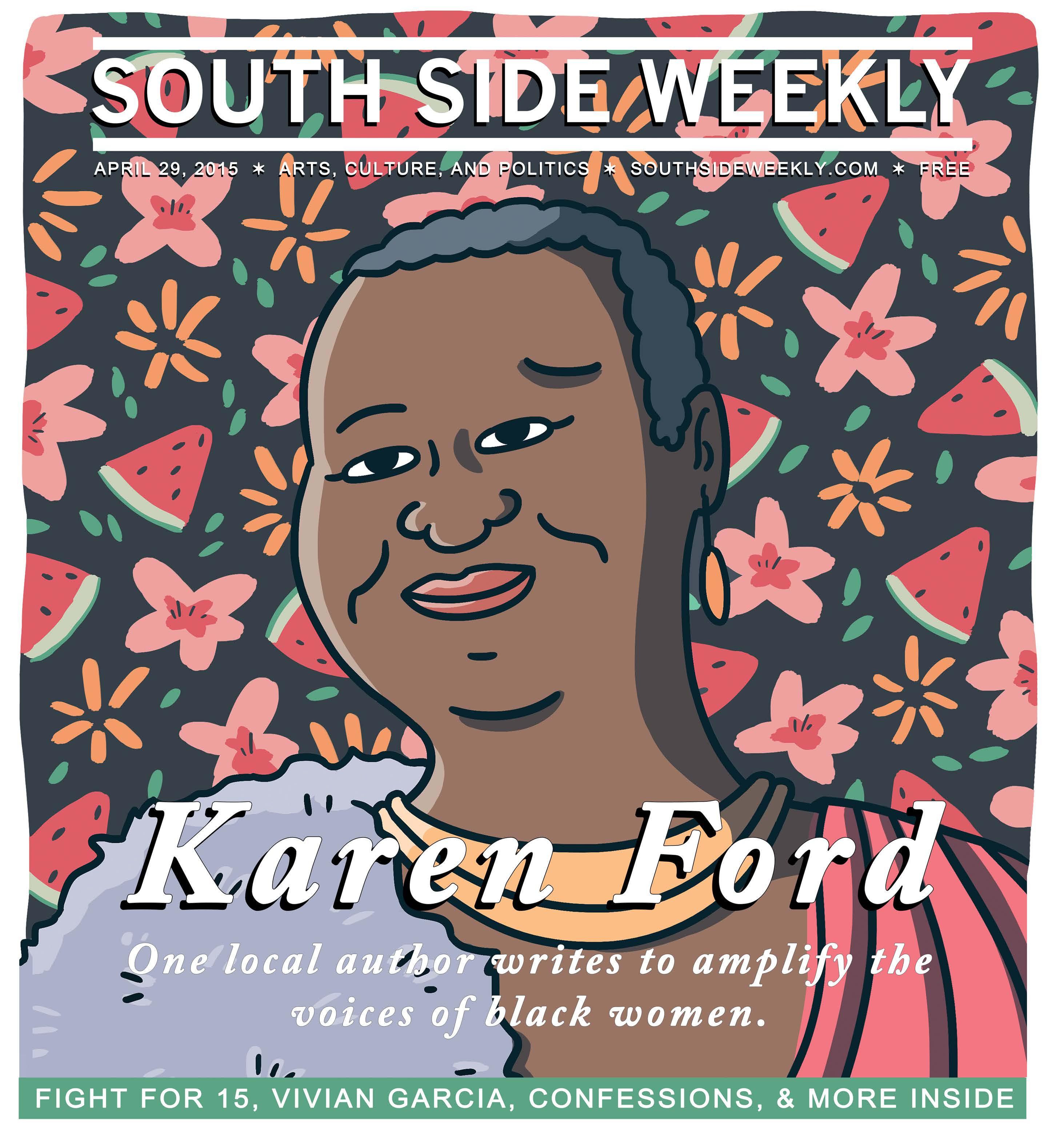
Cover art by Javier Suarez.
IN CHICAGO
A week’s worth of developing stories, odd events, and signs of the times, culled from the desks, inboxes and wandering eyes of the editors
Ahhhhh, Rats!
Deep in the recesses of the city’s official website, a drily written page on Chicago rats serves to educate/terrify curious citizens. The facts stated, which start off like lines from Trivial Pursuit cards (“the name [Norway rat] is rather misleading as this species originated in Asia”), eventually become something more akin to horror movie taglines (“[Chicago’s rats] can...land unharmed after a five-story fall”). Another page on the same website describes methods for dealing with infestations, but the reassuring sentiment near the end (“if rats can’t feed, they can’t breed!”) loses a bit of its bite when one realizes that with rats’ extremely varied diet (“rats may even eat the weakest and young [of their own]”) they can pretty much always, in fact, feed.
Crosstown Classic
In early April, North Siders and South Siders united to revive two discontinued bus routes on 31st Street and Lincoln Avenue. Together, they form the Crosstown Bus Coalition, and they’re lobbying the CTA to bring their buses back. According to leading member 47th Ward Alderman Ameya Pawar, it’s “kind of like the Crosstown Classic, only we’re not at odds with each other” (which, admittedly, is the whole point of the Classic). The formation of the coalition has brought new attention to the two routes, which could provide better access to schools, businesses, and healthcare. Unfortunately CTA officials appear unmoved by this beautiful new friendship, insisting that the joint bid treated as two separate proposals—ones they
don’t seem to be considering very highly, citing a lack of demand according to their own surveys. Coalition members hope to make a new impression on a new CTA president, to be appointed after the current president Forrest Claypool moves to City Hall to be Rahm Emanuel’s chief of staff in his second term. However, the results of a different election might mean a long wait for the two buses—Gov. Bruce Rauner’s proposed budget would cut the CTA’s funding by $133 million.
New Charter School Proposals
The school year isn’t quite over, but CPS is already thinking ahead to fall 2016. After closing nearly fifty schools in 2013, CPS is proposing over thirty new charter schools (raising the total number of charter schools in the district to over 160), some of which will open in the fall of next year. These schools are not being assigned by location (although they’re being proposed in neighborhoods including Back of the Yards, Hyde Park, and Lawndale), nor by need; rather, all proposals are vetted on their “quality,” as was told to the Tribune by CPS’s chief officer of “innovation and incubation” Jack Elsey. If CPS decides to reject a proposal, the school (and its funding) is forfeited to the Illinois Charter School Commission. Vice president of the CTU Jesse Sharkey has reacted to the new school proposal more or less as expected. Officially, CPS encourages all its critics, whether they are Karen Lewis or not, to advise them on these decisions through Neighborhood Advisory Councils.
IN THIS ISSUE
frOm cHaTHam TO WOnDErLanD
“In all of the adaptions of Alice I’ve seen, she doesn’t look like me.” zoe makoul…4
WHEn a WOman bIKES In THE cITY
“It’s just an all-in-one empowerment device.”
adia robinson…5
THEY DOn’T KnOW InvISIbILITY
Why does Rev. Jesse Jackson’s opinion matter any more than that of a freelance writer from Auburn Gresham? mari cohen…6
THE THIngS WE cOULDn’T SaY
Bucking the chance to signal what’s important.
celia bever…7
a prODUcT Of ExpOSUrE
“Being bicultural and bilingual opened a lot of [musical] opportunities for me.” itzel blancas…9
“I’m YOUng, I’m bLacK, anD I WanT $15”
Signs screamed out in large font that almost half of Chicago’s African-American workers earn a minimum wage. will cabaniss…10
grOUnDbrEaKIng ObSErvaTIOnS The audience weaved in and out of Giles’s colossal sculptures. alex harrell…11
THrEE HEaDS arE bETTEr THan OnE
The trio is with [the selected] artist through every step of the process from the first gallery visit to installation. emiliano burr di mauro…12
rEWOrKIng THE famILIar Exploring is what Parra does best. lauren poulson…14
mYSTErIES frOm cHILDHOOD
“Our exhibition is perhaps somewhat mysterious, but mostly kind of playful.” darren wan…15
bEaT pOET
In some poems hip-hop is the central object of meditation, while in others its beat pulses unobtrusively in the background.
kevin gislason…16
a IS fOr aSHLanD, b IS fOr brIDgEpOrT S is for South Side is rich in details the reader can enjoy and the toddler can point out.
maira khwaja…17
From Chatham to Wonderland
Fifteen year-old Ariana Burks is Chicago’s youngest rising star
BY ZOE MAKOUL
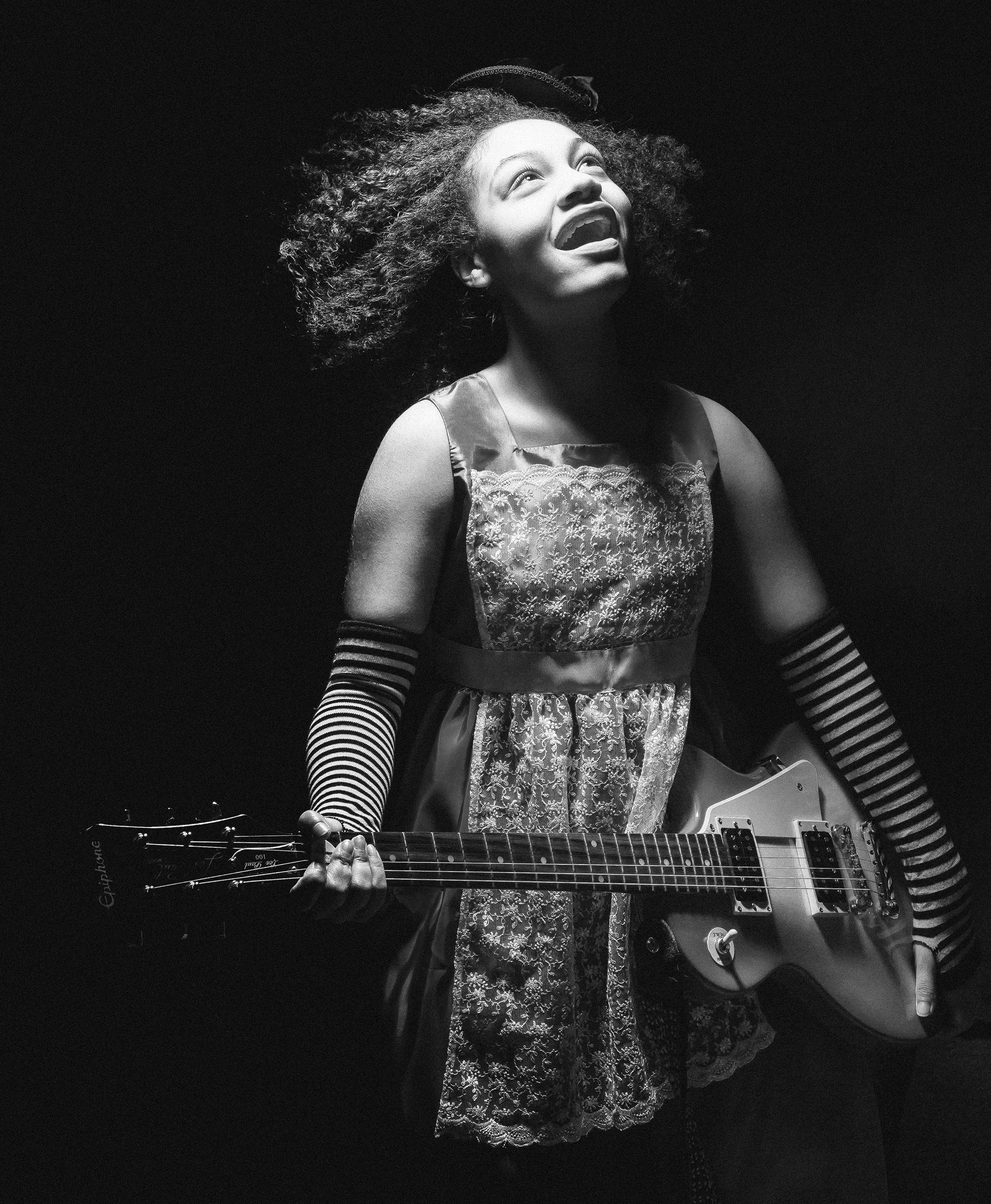
The cast of Wonderland, Alice’s Rock & Roll Adventures energetically circles the stage, chanting, “Curiouser and curiouser.” Suddenly they freeze, and a small girl plops herself down center stage, chess pieces in hand and trademark blue dress secured tightly with a white apron. Of course, this is Alice, played by dynamic fifteen-year-old South-Sider Ariana Burks. Delivering her first lines with the appropriate childish melodrama, Burks proclaims loudly, “I now crown you Queen Alice, Queen of Everything!” The audience, mostly children, laughs. Alice then declares that dessert shall be eaten before dinner, and that she shall always be picked first for every team.
Burks made her debut in Chicago Children’s Theatre’s performance of Wonderland this week as Chicago’s first African-American Alice. The hilariously fun musical is based on Lewis Carroll’s Alice in Wonderland and Through the Looking Glass with some important additions: shred guitar, pounding drums, and pure, unadulterated rock ‘n’ roll. Because the cast also plays the instruments and sings the songs, Burks had to learn entire numbers on the piano while practicing her voice and drum solos.
All that practice and Burks’s acting skills were on display at a final run-through of the show on Tuesday. Director Rachel Rockwell describes Burks as emotionally accessible.
“You know exactly how she’s feeling at every moment,” Rockwell said in an email, and indeed, Burks is subtle and nuanced as an actress, magnificently navigating a British accent and a seven-and-a-half year-old character. Her acting, which is earnest, funny, and explosive, is also understated—she
effectively conveys her character through a slight slouch and a childish pout rather than exaggerated gesture. As the cast struggled with last-minute technical challenges, Burks remained poised. It was only when the show paused to deal with a prop malfunction that Burks revealed how immersed she’d been throughout the show as her face abruptly gained maturity—she suddenly looked fifteen instead of half that age.
Although Burks says she identifies with Alice and her impatience to grow up, she herself is mature and articulate. She is also very determined to make her mark on the theater world. Burks, who has dreams of playing Elphaba in Wicked, Christine in Phantom of the Opera, Aida in Aida, and Sarah in Ragtime, is currently working toward her goals at ChiArts High School, where she majors in Musical Theater. Her mom, Elise Burks, stresses how lucky her daughter is to have been so successful in the pursuit of her dreams. According to Ms. Burks, “musical theater is just not widely popular on the South Side. There’s not that many kids who know about auditions or even think about being on Broadway.”
Burks is from Chatham, where according to Ms. Burks, “everyone wants to be famous,” but not many people look to the stage. Burks has thrived while pursuing her passion—she is an Emmy-nominated actress and a member of Lookingglass Theatre’s youth ensemble, with credits at Chicago Shakespeare Theater, the Goodman Theatre, and Redmoon Theater (among others). Burks has television credits too, on Chicago Fire, The Jr. Cuisine Cooking Show (Emmy nominee), ER , and PrankStars
Despite her daughter’s talent, Ms. Burks says she found out the hard way that
certain roles were out of reach for her children (Burks’s sister is an aspiring actress as well).
“There were roles they wouldn’t even get the chance to audition for, just because they were black,” Ms. Burks explains. She describes the discouraging nature of these situations, especially in the tight-knit community of Chicago’s younger actors. Burks would often see children she knew get called in to audition for classic shows like Mary Poppins, Matilda, and The Sound of Music, while she was never afforded the chance.
Understandably, when Burks landed the role of Alice her family was shocked. “When you say Alice from Alice in Wonderland, we all sort of have an idea of what she’s supposed to look like,” Ms. Burks explains, “and we don’t see her being a black girl with curly hair.” Burks concurs. “I worked hard in the audition,” she says. “But I never thought I’d get this role, and when I did it was very surprising… In all of the adaptions of Alice I’ve seen, she doesn’t look like me.”
Burks elaborates, saying, “To play this role—it’s a triumph, because I think that color-blind casting is growing, and I think people are starting to see that Alice can be any race.” In the past few years, Broadway has undergone major transformations in demographic. African-American actors like Norm Lewis and Keke Palmer have made their marks on the Broadway stage in traditionally Caucasian roles—they played the titular characters in Phantom of the Opera and Cinderella, respectively.
Burks, who modestly cites Wonderland ’s cast, her mom and sister, and Audra McDonald as role models, is surely an inspiration to the young people that will flock to see her as Alice. After all, Wonderland is about being comfortable in your own skin, and Burks admits, “A lot of the lessons in the show apply to me. Like if you conform to society, you end up being like everyone else, and that’s not what Alice wants. She wants to be her own person.”