College in the High School (CiHS) Program Overview
College in the High School (CiHS) is a statewide program offered by the majority of the two-year community and technical colleges and some fouryear universities in Washington State. The South Puget Sound Community College (SPSCC) CiHS program has been NACEP accredited since 2023 Students complete college courses taught by qualified high school instructors.
What courses can be offered at each school depends on the credentials of the high school instructor, the ability of the college to provide a faculty liaison, and curriculum alignment. The focus of articulations at SPSCC is on the Washington 45 courses, which are highly transferable, first-year college general education courses.
Students complete CiHS courses on-site at the high school. They do not need to come to the college, though they are treated as full college students, which provides access to all the services and resources SPSCC has to offer! Students can choose to take a CiHS course for college credit or just high school credit. College credit is awarded for the grade earned in the class and is transcribed on a SPSCC transcript. There is no cost to the student for participating in CiHS. Students must meet prerequisites for college courses in order to enroll for college credit.
Partner High Schools & Course Offerings
High schools can articulate with multiple colleges for the CiHS program. The ability to offer a CiHS course depends on the qualifications of the high school instructor, an available faculty liaison at the college, and the ability to offer the college course content at the high school. A high school instructor must meet the same qualifications to teach as SPSCC faculty.
High Schools with Active CiHS Articulations with SPSCC
Black Hills High School
North Thurston High School
Timberline High School
Capital High School Olympia High School
River Ridge High School Shelton High School
Tumwater High School Yelm High School
Current CiHS Course Offerings
Not all courses are offered at each high school. To see the most up-to-date offerings by school, please visit the College in the High School webpage.
142
MATH& 151
MATH& 152
NUTR& 101
SPAN& 121
SPAN& 122 Spanish II
SPAN& 123 Spanish III
Who can enroll in CiHS?
Students in 9th through 12th grade who have met the prerequisites for college course enrollment can apply to earn college credit. College credit is awarded based on the final grade the student receives by doing college-level work and being graded on college-defined outcomes for that course. Students who do not wish to earn college credit but still want to take rigorous and challenging coursework can also enroll in CiHS courses just for high school credit. All CiHS students, whether earning college credit or not, will receive 1.0 high school credit for every 5.0 college credits completed.
Benefits of CiHS
All CiHS courses at SPSCC are part of the direct transfer degrees general education list. Completion of CiHS courses with a “C” or better will launch you into:
• Credit toward a Direct Transfer Agreement (DTA) Associate Degree
• Minimized time and cost of earning your college degree
• Beginning (or adding to) your permanent college transcript
• Transferring the credit to meet General University Requirements (GURs) for many four-year institutions*
In addition, the ability to complete the college coursework at the high school means students do not need to worry about transportation to and from the college, trying to take online college courses, or having to buy textbooks and supplies. Many high school students feel CiHS is a great way to start taking college classes in what feels like a low-stakes environment, working with instructors that they already know at their high school!
*Transferability of credits is at the discretion of the receiving institution. Transferability may vary between in-state and out-of-state schools.
Washington 45
It is important to SPSCC that students taking courses in the CiHS program have the ability to transfer those courses into further education. SPSCC articulates courses that are part of the Washington 45 agreement. This agreement is a list of courses that students can take at the community college that will satisfy up to one year’s worth (45 credits) of GURs at public four-year colleges and universities within the state. This does not guarantee admission to the four-year school, but it does guarantee that the courses will be used toward GUR areas. You can see a full list of the Washington 45 courses on the State Board for Community and Technical Colleges (SBCTC) webpage.
College in the High School Funding
In the spring of 2024, legislation was passed to make CiHS FREE to all qualified high school students. The colleges receive funds from the SBCTC at the end of each academic year for students enrolled in CiHS-designated courses.
There is no cost for testing, course materials, books, or supplies for CiHS courses. Anything beyond basic school supplies is provided by the school district for CiHS classes. There is a cost to order an official college transcript from the college; however, students always have access to their unofficial college transcript at SPSCC through ctcLink for free
SPSCC CiHS Admissions & Registration Information
Important Dates & Deadlines
Colleges work months in advance of the new term for admissions, placement, and registration. Students entering CiHS will need to get used to planning ahead to make sure they do not miss critical deadlines. There is also a difference in the academic year. High schools tend to run on semesters or trimesters, while the college runs on a quarter calendar.
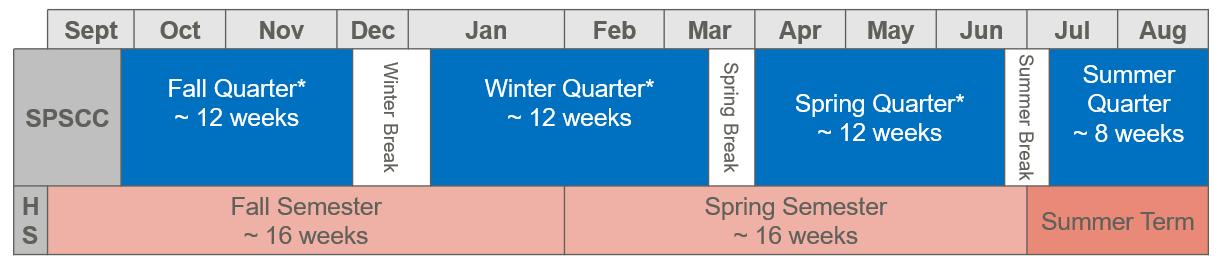
First-semester and year-long courses register with the SPSCC winter quarter. Second-semester courses register with the SPSCC spring quarter. Specific dates and deadlines are located on the SPSCC College in the High School webpage: spscc.edu/admissions/cihs
CiHS Admissions & Registration Process
Step 1: Complete the SPSCC Admissions Application
Any student who will be brand new to SPSCC or has not been actively enrolled in classes at SPSCC for two or more quarters must fill out the admissions application. Students must choose the College in the High School student and degree type Students should apply for the fall quarter of the next academic year. Students also need to use a non-high-school email address. If they do not already have a personal email address set up, this would be the time to create it, as they will need to complete two-factor authentication in order to successfully apply to SPSCC.
The admissions application should be completed during high school registration for classes for the next academic year. This generally takes place at the end of January or the beginning of February at most high schools. This is an important first step; if a student does not have an active
college application, they cannot complete placement (some CiHS courses have a prerequisite) and will not be able to be enrolled the following fall.
Due to the nature of high school course scheduling, students will not know if they have been put in a CiHS class section until right before the new school year starts. Students should move through the CiHS admissions process to ensure that if they do get a seat, they are ready to be registered for college credit.
If a student was already enrolled with SPSCC during the current academic year for CiHS, they do not need to reapply. SPSCC will roll over their student account for the next academic year, and they only need to meet the prerequisite (if required for the class they want to enroll in) and complete the Registration Request.
Step 2: Activate Your Student Accounts
Once your admissions application has been processed, you will need to activate your SPSCC student accounts. There are two accounts: your ctcLink account and your ClipperID (SPSCC email). These accounts give you access to resources and support at SPSCC, including the ability to view your unofficial college transcript once you complete your classes.
Step 3: Meet College Course Prerequisites
If you are taking a CiHS class in Math, English, or some higher-level Natural Science courses, there are prerequisites for those classes that you must meet before we can enroll you. Sometimes this can be met by completing high school coursework or submitting high school test scores; sometimes this needs to be met by taking a placement exam at SPSCC. You cannot enroll in a CiHS course if you have not met the prerequisite. Please work with your High School Counselor and the SPSCC Assessment Office to ensure you have met the needed prerequisites. Prerequisites must be met BEFORE the CiHS course begins. Students can submit their documentation or take the necessary placement test in the spring or summer prior to the course starting.
Specific prerequisite information is located on the SPSCC College in the High School webpage: spscc.edu/admissions/cihs
Step 4: Submit your Registration Request
All students must submit a Registration Request for each CiHS course they are enrolling in for the academic year. This form is available online on the SPSCC CiHS Admissions webpage. The Registration Request opens in September each new academic year.
Students must complete Steps 1 to 3 before the first semester in order to complete Step 4 and enroll for college credit in a CiHS course with SPSCC that has a prerequisite. For courses without a prerequisite, admission is preferred to be completed before the first semester, but it can be completed within the first few weeks of the semester if needed.
Meeting Prerequisite for CiHS Classes
For full and detailed information about placement at SPSCC, please visit the SPSCC Placement Options webpage: spscc.edu/admissions/placement
For many prerequisites, there is high school coursework completion that can be used for placement. When evaluating a high school transcript, we average the grades for the first and second semesters to get the grade we use to determine placement potential. Students must have a “B” averaged grade
or better in order for the course completion to be used for placement. The chart below shows how SPSCC calculates averaged grade results. The result is rounded to two decimal places. A result falling in between two values defaults to the lower value (Ex: 3.45 falls between a B+ and an A-. The averaged grade would be a B+)
If a student has only completed one semester of a course, it cannot be used for placement even if the grade is above a “B” because they do not have a full 1.0 HS credit earned in that course.
Calculate Grade Average
Take the first grade point value, add it to the second grade point value, and then divide by 2 to get the averaged grade point value. This then corresponds to the averaged letter grade.
Ex: First semester, a student got an A- (3.67), and second semester they got a B- (2.67)
3.67 + 2.67 = 6.34 \ 2 = 3.17 This would be a “B” averaged grade and passing to use for placement.
SPSCC can also use scores on some common high school exams for placement in English and math as well. The full reference for high school placement documents can be found on the SPSCC CiHS webpage
There are time limits on how long a high school course or score can be used for placement:
High School Courses Tests Time Limits for Placement
Bridge 2 College Math 2 yrs from date completed
Bridge 2 College English 3 yrs from date completed
HS Math Course Completion 2 yrs from date completed
HS English Course Completion 3 yrs from date completed
HS Chemistry Course Completion 3 yrs from date completed
Smarter Balance 10th Math 2 yrs from 10th grade completion
Smarter Balance 10th English 3 yrs from graduation
WA State MATH Agreement 2 yrs from 10th grade completion
WA State English Agreement 3 yrs from graduation
If a student does not have applicable high school course completion or test scores that can be used for placement, they must complete a placement exam.
English: Students will complete the English Guided Self Placement (GSP). They will be given a placement recommendation as soon as they complete the GSP. The GSP is not proctored and can be completed after a student has applied to SPSCC and activated their student accounts.
Math: Students must complete and pass a WAMAP exam in the content area. Descriptions of the exams, as well as information on how to schedule the proctored exam and access to study guides is available on the SPSCC Placement Options webpage
SPSCC Student Policies
Adding, Dropping & Withdrawing from CiHS Classes
Adding Courses
Students can enroll in CiHS courses during open registration for college credit. Before enrolling, students must have met the prerequisite for the course, if there is one. Courses without prerequisites are open to any student at the high school. Once the registration window closes, students in a CIHS course who did not complete registration will take the course only for high school credit.
If a student moves into a CiHS classroom after the registration window, they are not able to apply and register for college credit. They will still be able to take the course for high school credit and will receive the same college-level instruction as all other students in the class.
Dropping & Withdrawing
The student, high school instructor, or high school CiHS coordinator can request a course drop or withdrawal via the CiHS Drop Request form online. All requests must be made by the deadlines listed on the CiHS webpage.
Parents cannot request a drop or withdrawal for their student.
At the time a student is dropped or withdrawn from the college enrollment, they revert to taking the course only for high school credit, though they will still be doing the same college-level work. If the student does not wish to be enrolled in the course for high school credit, they must follow through with their high school as to the appropriate way to officially unenroll from the class.
Exception to Withdraw: Students may request an exception after the last day to withdraw only when the circumstance for the request is due to one of the following:
• Student is moving and/or withdrawing from the high school
• Student is suspended from the high school and not allowed access to the high school campus through the end of the semester/academic year.
• Circumstance is due to extended illness, death of an immediate family member, military service, hardship, or when there is documented evidence of institutional error.
• Circumstance is due to a health pandemic or natural disaster forcing the closure of the high school for more than two weeks.
If an exception to withdraw is approved, the student will receive a “W” on their transcript.
Parent Access to Student Records
Dual credit students enrolled in the CTE Dual Credit, CiHS, and Running Start are considered regular college students and are protected by the Family Educational Rights and Privacy
Act (FERPA). Parents and caregivers do not have access to their students' grades, class schedule, and other protected information from SPSCC.
SPSCC can only provide this information to a parent or caregiver if the student has given the college permission or the parent can show the named student as a dependent in their care via a Parental Affidavit of Dependency.
Release of Records
Students may give parents or caregivers permission to view this information by submitting the Release of Records form in person with a photo ID at the SPSCC One Stop (Olympia Campus, Building 22). They can also email the form with a copy of their photo ID to enroll@spscc.edu. The Release of Records or Parental Affidavit gives parents access through the Enrollment Services Department to:
• Student Grades
• Student Account Balances
• Student Unofficial Transcripts
It does not give the parents access to classroom information (attendance, assignment progress, participation) and does not allow a parent to meet, call, or virtual chat with a faculty member or other college staff member without the student present. A parent cannot enroll or drop their student from classes or request exceptions to enrollment and academic policies.
Statement of Student Rights
As members of the academic community, students are encouraged to develop the capacity for critical judgment and to engage in an independent search for truth. Freedom to teach and freedom to learn are inseparable facets of academic freedom. The freedom to learn depends upon appropriate opportunities and conditions in the classroom, on the campus, and in the larger community. Students should exercise their freedom with responsibility. The responsibility to secure and to respect general conditions conducive to the freedom to learn is shared by all members of the college community.
CiHS students have the same rights and responsibilities as other enrolled SPSCC students. The full SPSCC Student Handbook is available on the SPSCC website.
Student Misconduct
Admissions to the college carries with it the expectation that students will conduct themselves as responsible members of the college community, that they will comply with the rules and regulations of the college, maintain high standards of integrity and honesty, respect the rights, privileges, and property of other members of the college community, and will not interfere with legitimate college affairs.
The college may impose disciplinary sanctions against a student who commits, attempts to commit, aids, abets, incites, encourages, or assists another person to commit an act(s) of misconduct Full descriptions of these violations and disciplinary proceedings are available in the SPSCC Student Handbook
Plagiarism Policy
Plagiarism is using someone else’s words, media, creations, innovations, or ideas without specific attribution. This may be intentional or unintentional. By submitting work for credit, the student claims the work is original unless otherwise acknowledged.
Learning to properly attribute credit for ideas is part of the educational process; therefore, the college shall provide resources to students so that they will be able to avoid citation errors. Plagiarism is a serious academic offense and may result in academic penalties or disciplinary action as outlined in the Code of Student Rights and Responsibilities.
Use of Artificial Intelligence (AI)
Artificial Intelligence (AI) should be used responsibly, ethically, and transparently in accordance with college policies to support curricular innovation, enhance class instruction, and improve the efficiency of college operations. Policy objectives are to promote student success, ensure ethical compliance, improve workload efficiencies, encourage innovation, and increase AI literacy, all in alignment with SPSCC’s mission, vision, and Strategic Plan.
When used for instructional purposes, AI tools must align with the college's educational goals and enhance student learning outcomes. AI may be used in courses under the guidance of the professor teaching the class. Faculty should be transparent about the use of AI in their classroom, AI data safety, and how student work will be used. AI tools should be used to enrich the academic journey by providing diverse and interactive learning opportunities. Expectations for students’ use of AI in their work will be outlined in the course syllabus. Inappropriate use of AI will be governed by the academic dishonesty policy, as outlined in the SPSCC Student Code of Student Rights and Responsibilities and WAC 132X-60-090.
Grade Appeals
In the case of a grade appeal, the student is responsible for reaching out to the Dual Credit Office at SPSCC, which will walk the student through the Grade Appeals Process. The Dual Credit Office works directly with the CiHS Faculty Coordinator and Dean of Natural and Applied Science, who oversee the instructional aspects of the CiHS program.
Credits & Transcripts
How does CiHS credit transfer to other colleges/universities?
College credit earned in CiHS articulated classes is expected to be highly transferable to other colleges and universities throughout the United States. However, it is up to each receiving institution how that credit may be accepted and used as part of the admission process. When sending your transcript to colleges and universities for evaluation, you must send the official record for credit award. Unofficial transcripts are generally used for admissions applications and advising meetings for initial credit review. Students may also need to submit official transcripts for job applications or military service recruitment.
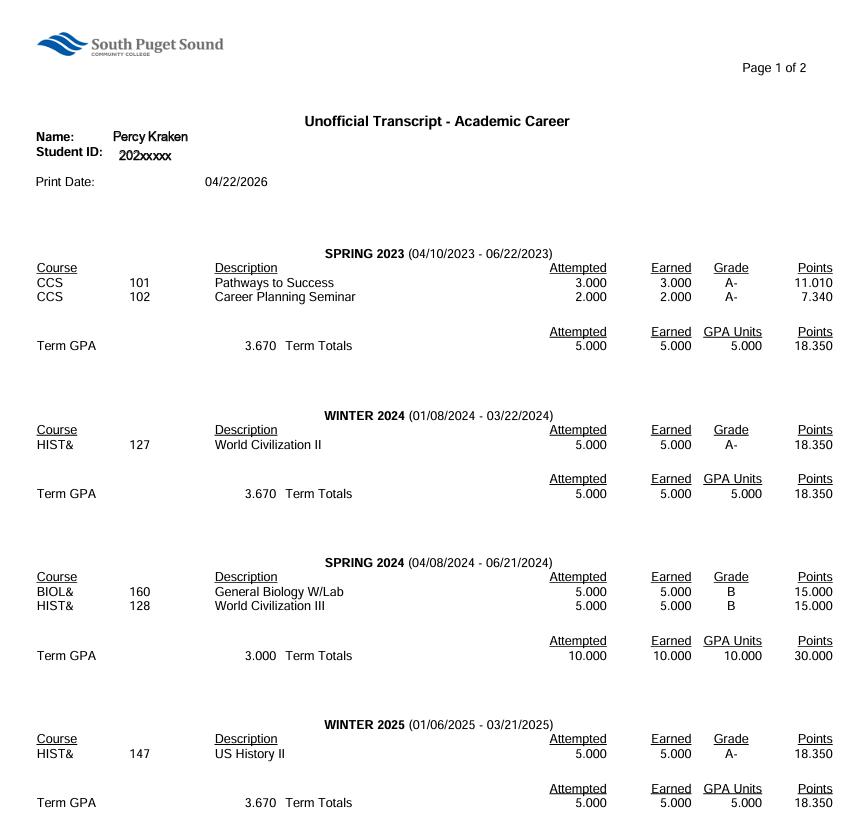
Example SPSCC Transcript
The SPSCC transcript for a CiHS student looks exactly the same as any other SPSCC student. There is nothing on the transcript to show that the courses completed were part of the CiHS program. The high school transcript record will notate credit earned through CiHS.
Requesting an SPSCC Transcript
Courses completed for college credit through SPSCC will be transcribed to an official SPSCC transcript for the student of record. Official transcripts are ordered online through Parchment. There is a cost for official transcripts. Unofficial transcripts can be viewed for free by students in the ctcLink student portal.
SPSCC Dual Credit Programs Support Information
Academic Support for CiHS Students
CiHS students are fully enrolled college students. This gives the same access to support and resources as the rest of our student population! All services and supports at SPSCC are FREE to students, and many have both in-person and virtual options.
Support is put into three main categories at SPSCC:
1. Academic Support: This is support for your classes, including Learning Support Services (tutoring centers), Library, Advising, and Disability support.
2. Personal Support: This is support for you as a person, including the Food Pantry, emergency shelter/homelessness support, and childcare support.
3. Technical Support: This is support for the technology we use at SPSCC, including troubleshooting accessing your online SPSCC accounts like ctcLink and email, and using Canvas, which is our online learning platform.
Disability Accommodations for CiHS Students
SPSCC has an institutional commitment to providing equal educational opportunities for qualified students with disabilities in accordance with state and federal laws and regulations, including the Americans with Disabilities Act of 1990 (ADA), Section 504 of the Rehabilitation Act of 1973, and the Revised Code of Washington: Students with Disabilities – Core Services (RCW 28B.10.912), and Students with Disabilities – Accommodations (RCW 28B.10.914).
For students dually enrolled at the high school and the college, we cannot directly use the accommodations listed in a high school IEP or 504 plan. If a student needs accommodation for their CiHS course, the CiHS Instructor will work directly with the SPSCC Disability & Access Services office to create an accommodation plan. The college Access Services Office has the authority to determine if any of the accommodations present in a student’s IEP or 504 plan create a fundamental change or reduce the standards of a college-level course.
Depending on the nature of your disability and how it impacts your educational experience, services and accommodations provided on an individually determined basis may include:
• Textbooks in an alternative format
• Note takers
• Readers and/or scribes for exams
• Braille text or e-text
• Use of tape recorders
• Large print text and handouts
• Extended time on exams
• Sign language interpreter
• Use of adaptive equipment/assistive technology
• Preferential seating (e.g. front of the classroom, ergonomic chair)
• Real-time captioning
Services not provided by Access Services include:
• Tutoring/individual instruction
• Personal aides or attendants
• Personal devices or equipment (e.g. eyeglasses, wheelchairs, hearing aids, guide animals, etc.)
• Diagnostic testing for a Learning Disability
• Transportation services
The Washington Association of Postsecondary Education and Disability (WAPED) is an organization of community and technical college and university disability service providers in Washington. The WAPED website provides useful resources for students with accommodations transitioning from high school to post-secondary education.
Online Resources
There are many resources we have referenced throughout this handbook that we wanted to gather in one place to help you navigate your CiHS Experience!
SPSCC CiHS Admissions spscc.edu/admissions/cihs
SPSCC Webpage spscc.edu
College in the High School FAQ sbctc.edu/becoming-a-student/high-school/dual-creditstudent.aspx
SPSCC Student Handbook spscc.edu/admissions/student-rights
Washington 45 sbctc.edu/colleges-staff/programs-services/transfer/washington45
SPSCC Placement spscc.edu/admissions/placement FERPA studentprivacy.ed.gov/ferpa
Academic Supports spscc.edu/services-support/academic
Personal Supports spscc.edu/services-support/personal
Technology Supports spscc.edu/services-support/tech-support
Grade Appeal spscc.edu/services-support/concerns-reporting
Disability & Access Services spscc.edu/services-support/access
SPSCC Transcripts spscc.edu/services-support/transcripts
Dual Credit Programs Contact Information
If at any time a prospective or currently enrolled CiHS student needs help or support, please reach out to the SPSCC Dual Credit Programs Office:
Email: dualcredit@spscc.edu
Phone: 360-596-5440
Webpage: https://spscc.edu/admissions/cihs
Nondiscrimination Statement
The college does not discriminate on the basis of race, color, national origin, religion, sex, disability, honorably discharged veteran or military status, sexual orientation, or age in its programs and activities. The following person has been designated to handle inquiries regarding the nondiscrimination policies and Title IX compliance inquiries:
Samantha Dotson
Executive Director of Human Resources 2011 Mottman Rd SW Olympia, WA, 98512
360-596-5361
SPSCC publications are available in alternate formats upon request by contacting Access Services at 360-596-5306 or access.services@spscc.edu For additional information and languages, visit SPSCC’s Nondiscrimination Statement webpage