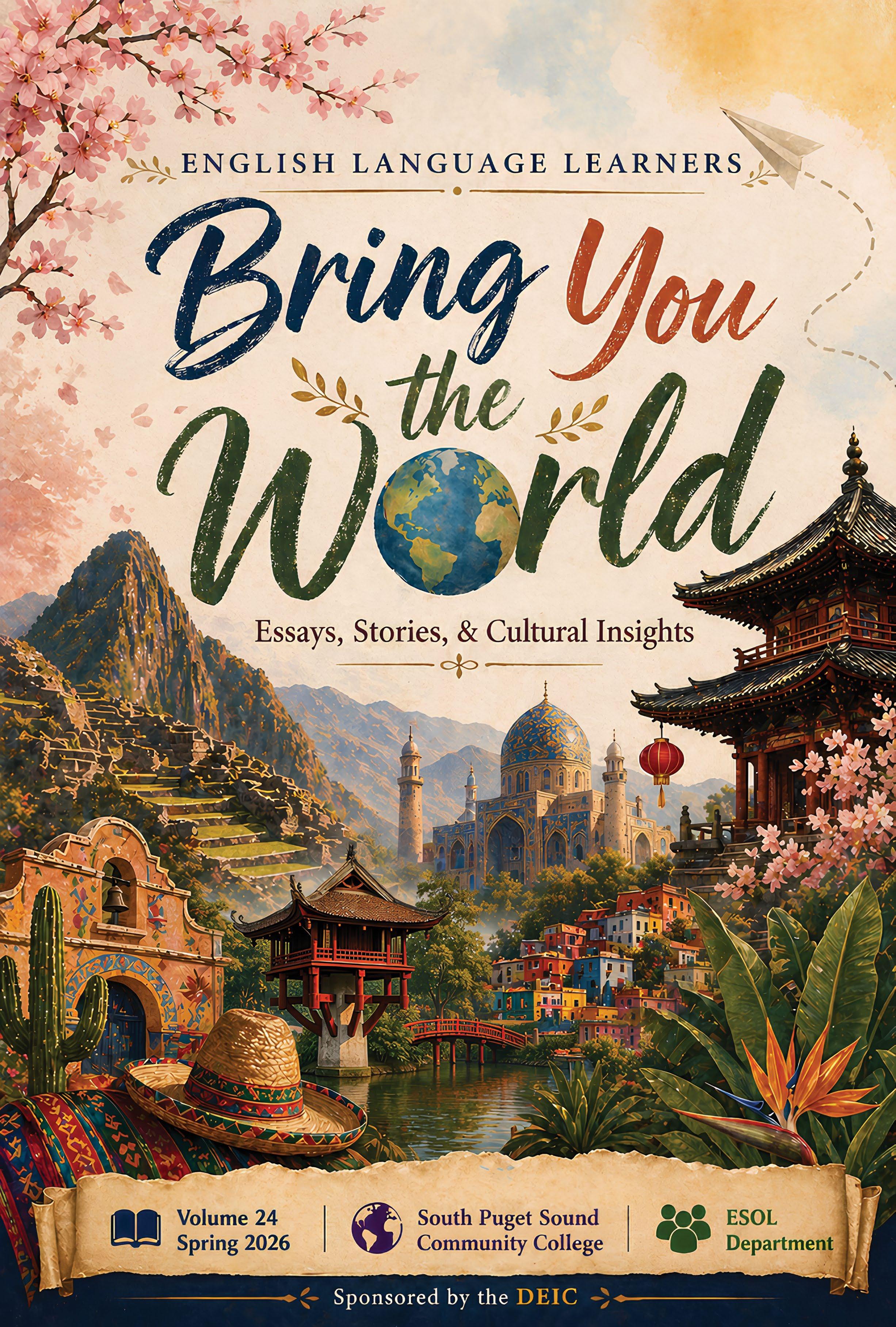





Volume 24

Spring 2026
English for Speakers of Other Languages (ESOL) Department
Sponsored by the Diversity, Equity and Inclusion Center (DEIC)
Dear Reader,
The students of the English for Speakers of Other Languages and Intensive English programs at South Puget Sound Community College hail from all corners of the world. Though each person is unique, they are united in the experience of making a new home in the United States. The community they create in their pursuit of language learning is founded on a connection between people from all different walks of life, and this in turn enriches and strengthens our society.
The teachers of these programs are honored to be part of the lives of such thoughtful, brave and determined students. In their stories, it’s our wish that you find inspiration and hope even in the most challenging of times.
135 students from 31 countries have shared their stories and essays here. The contributions are organized alphabetically by country of origin. Student biographies are listed in the About the Authors section at the end of the book.
Students of the following IE and ESOL instructors contributed to this volume:
Kristen Blegen Bouyer
Geoff Dugwyler
Andrea Long
Melissa McLaren
Everett Morrison
Julia Richardson
Emilia Snow
Chelsea Tran
Chris Wettstein
Heather Williams
Julie Williamson
Editor: Geoff Dugwyler
Cover Illustration: Chi Bui
A special thanks to the Diversity, Equity and Inclusion Center (DEIC) for sponsoring this publication.
Commenting on the diversity of people and beliefs that make up the United States, former U.S. President (1977-81) and 2002 Nobel Peace Prize recipient Jimmy Carter said:
“Wehavebecomenotameltingpotbutabeautifulmosaic.”
By Laila Ahmadi
My country was the best place to live from my childhood until I grew up. Things that I miss are food, clothes, weather, culture, religion and family values. I miss my mom and my dad every day. It is hard for me to live in the US. I lived in my country for a long time. I would like to see my family again. I hope one day it will happen.
MY BIOGRAPHY
By Sharifa Ahmadi
My name is Sharifa. I am from Afghanistan. I speak Dari and English. I came to the United States in 2024. I live with my family. I am a student now. I am studying English at SPSCC right now. I like learning new things and improving my English.
By Azim Azimullah
The existence of differences between humans and societies is only for recognition. In the world there are many kinds of cultures, religions and colors. I want to write about the three aspects of food, communication, and travel. These are the most different parts of culture of the American people compared to my home country of Afghanistan.
American people have different kinds of foods; they have a lot of restaurants with different kinds of menus. American people eat a lot of meat like beef, chicken, and pork. They usually go to restaurants for dinner or lunch, and they go with friends and family. Many Americans eat a lot of fast food. The famous fast foods in world are here like McDonalds, KFC, and Burger King. However, people in Afghanistan cook foods at home and eat it together with family members. People in Afghanistan rarely go to restaurants to eat. Afghan people have different kinds of food too, like bollani, ashak, and kabab. These are the famous foods in Afghanistan. We also have similarities. We are eating a lot of meat like American people; we also do BBQ when all family is together.
Afghan people and American people have a lot of differences in communication. People in America speak more directly than people in Afghanistan. If American people do not want something, they often directly say no. In my country people try not to offend others and respectful expressions and formal introductory topics are common.
Personal space is so important in America. But in Afghanistan, people usually become socially and closer more quickly. Being on time is very important in America so people usually schedule meetings or visits in advance. But people in Afghanistan are more flexible. Visiting friends and relatives without planning can be normal. Generally, communication is different in the USA and in my home country. Travel is more common in the USA than Afghanistan. In America many people travel for vacation, relaxation, and personal experiences. Traveling is often considered part of personal growth and lifestyle, like road trips and camping. In Afghanistan travel is more connected to family, weddings, and cultural events. American people travel solo; many people travel alone for freedom. In my country, people travel with family or friends. Many people in America save money for travel because traveling is viewed as an investment in life experiences. But in Afghanistan, people prioritize family responsibilities. In conclusion, American and Afghan cultures are different in food, communication, and travel. American food is often fast and simple, but Afghan food is more traditional and family centered. In communication, Americans usually speak directly and value personal space, but people in Afghanistan speak more friendly and closely with others. In travel, Americans enjoy adventure, camping, and personal experiences, but Afghans usually travel more with family and friends for social reasons. Even though these cultures are different, both cultures have important values and traditions that make them unique.
By Azizeh
Afghanistan is very beautiful and has four seasons. Each season has delicious fruits and is very green with great weather.
By Mirian Fernandez
I moved to the United States in 2023. I live in Lacey with my husband Renan and my daughter Zoe, who is four years old. I worked in my home country in the hospital. I am a nurse. Now, I work at a warehouse. It is hard to live in the United States because it is difficult working, studying, and taking care of my daughter. When I’m not working, I like to share my free time with my daughter. I also like to exercise and listen to music.
By Lenny L.
My name is Lenny Lizite. I’m from Bolivia. The Salar de Uyuni is a tourist destination in my country. The Salar de Uyuni is the largest salt desert in the world. During the dry season, many tourists take surreal photos. And they record videos. During the rainy season, the Salar de Uyuni looks like a huge mirror. The sky and clouds are reflected on the Salar with perfect clarity. It gives me the feeling of walking in the sky. At night you can enjoy a beautiful view of all the stars. People from different countries visit the Salar the Uyuni.
By Marina Zurita
I came from Bolivia to Olympia nine years ago. I am married and I have three children, one boy and two daughters. Actually, I am a housekeeper, but my goal is to go to the level 5-6 in English Class. After that, I want to study to have a different career. The life in the USA is a little hard. The language is a big problem for me. It is stressful when no one can speak my language at the hospital or at my children’s school. Now, my goal is learning English.
MY TRUE STORY
By Anonymous
I didn’t understand until I kept asking people in my community if I was her child or not because my mom seemed to hate me and beat me all the time. I was so hopeless and I even tried to kill myself, but I didn’t die. I thought that I couldn’t go on like this in my life. After that, all my sons had visas to come to the United States. At that time, I was really sad and hopeless because I would never see my sons again. But fortunately, what I always wished for has come true because I also have visa to come to the United States with my husband and three sons. I was able to do it. I was really happy because I was able to fulfill my future by coming to the United States. My dream was successful. I will work hard and continue my studies because my dream is to become a fashion designer. When I came to the United States, I had a lot of hope. I was really happy with my studies and enjoyed my teachers and class. They cared about me in a way that I had never experienced before. Being in the United States gave me hope in life again.
MY STORY IN CAMBODIA
By Phearom Sirey Kong
My name is Phearom Kong, and I’m from Cambodia. Phnom Penh is the capital city of Cambodia. It is a beautiful city with many people, markets, and temples. I love my country because the people are kind and the food is very delicious.
By Lima
Every year, Happy Khmer New Year is a special day for the people of Cambodia. Happy Khmer New Year lasts three days. On the first day, every house holds a ceremony to welcome the New Year’s angel. We start cooking early in the morning to make food to give to the monks. We wear traditional clothes to go to the pagoda. On the second day, we go to play traditional games at the pagoda. For the last day, every house gathers with relatives to have a party. We grill meat and cook many dishes together. We sing and dance happily. All people in Cambodia have a lot of fun every year.
By Rortos Rovech
Hello. My name is Rortos. I am from Cambodia. I have 5 sisters. Their names are Hafer, Khodijas, Mariyom, Fatimas, and Aisas. They are beautiful and smart. I love them so much, and I am happy with my family. We love to have parties and eat a lot. I want to learn more English, and we want to return to Cambodia because we love our country.
By Sakina
This is my story of moving to the United States. I moved to America. I had one baby. My baby’s name is Halim. No English, no job. It was hard for me. I didn’t know how to drive. I didn’t know how to cook. I didn’t know how to do anything. I needed to learn step one, step two. Even people, I didn’t know them either. And now I have three children. I know how to take care of them not like before. I know how to drive the car. I know more people and I speak English better than before. In America teach people how to learn and how to do everything by themselves. I like to live in the United States because I learn more and more from here!
By Juan Beltran Mancilla
Hello everyone. I’m from Chile. I live in Olympia now, and this is my experience learning English at SPSCC. I like to think for myself, and studying helps me with that. I speak Spanish, my native language. Spanish is a beautiful language. I’ve studied all my life, and I’ve thought all my life, but in Spanish. Today, I study English here at SPSCC. I like to study. But studying English here in the USA is very different and not easy at all. My main problem is pronunciation. Writing, reading, listening, and speaking are all challenges. The sounds of words are different, very different. But the biggest challenge is thinking in English without translating.
By Danxia Huang
My name is Danxia and I am from China. I want to talk about women s worth. My mom is a housewife. She took care of me and my two brothers by herself because my dad worked in another city to earn money. Our family started living together when I was nine years old. Even now my mom is still very busy taking care of the family. She often complained about her life, but nobody really cared. One day she complained that she had given up a great deal to take care of us. I said, Why don t you work? I don t need your care.” After that my mom didn’t cook for three days.
I realized how stupid I was and how much I had hurt my mother s feelings. She just needed someone to care about her and give her emotional support. She liked cooking and taking care of children, but she also needed me and my brothers to say a few caring words when she was tired. She hoped that what she did for the family was valuable. I still feel guilty when I think about it now that I have grown up.
More and more Chinese women are working now because they want to find their own value in life. In my opinion, doing what you want is worth it. If you enjoy cooking or taking care of children, being a housewife is also a great job. As children we should never take our mother s love for granted. We need to express our love and appreciation for our moms.
By Xianwen Liang
My name is Xianwen Xiang. I am from China. Now I live with my husband in Lacey, WA. We are the fusion of Chinese and American culture. My country and the United States have many of the same and different customs. One is religious freedom. People in both countries can enjoy the freedom of religious belief at the same time.
There are many differences between the two countries in art. China has traditional Peking opera, colorful facial masks and the traditional musical instrument erhu. America has its own unique art forms that are quite different from Chinese traditional art. In terms of food culture, China is famous for tea culture and people like eating hot pot. In contrast, the United States is known for coffee culture and pizza is one of its representative foods.
By FeiFei Liu
In my country many people interested in basketball. Some people like to play basketball at school. Some boys like to play during Physical Education class. But some girls like to look. My friends like to watch games on TV. They celebrate together, stay up, and eat some food. But, in my country, some people are not tall enough. They need to be 1.8m or taller. They want to play, but because they are too short, it is extremely difficult for them.
By Ma
My name is Ma. I am from China. Chinese people are extremely fond of food. I like making dumplings. Beijing is China’s capital. It is a beautiful city.
By Hongjun Tian
I miss many things about China. I miss my family and my mom’s cooking. I also miss the traditional festivals of China and the childhood friends I used to play with. Seattle reminds me of home.
By Cindy Wang
Learning English as an English Language Learner has been an important experience in my life. When I first came to the United States, I felt nervous because English was difficult for me. I could not understand everything people said, and speaking English made me shy. Sometimes I worried about making mistakes in class. However, I continued practicing listening, reading, and talking with other people every day. My teachers and classmates also helped me a lot. Over time, I became more confident and improved my English skills. Although learning a new language is not easy, I am proud of myself because I continue to learn and grow every day.
By Fei Wang
I miss many things about China. I miss my family and my mom’s cooking. I also miss the traditional festivals of China and the childhood friends I used to play with. Seattle reminds me of home.
By Qiong Xie
The Chinese New Year has some special customs. Every year, our family gets together to celebrate the arrival of the new year. We like to make a lot of food, have dinner, watch TV, and pay new year’s greetings to our elders. Usually this time, our parents would send us a little money to encourage us to study hard. In the new year, we attach great importance to keeping our bodies clean and dressing in the new year. When the old year gives way to the new, we usually set off firecrackers to celebrate the beginning of a new year and to send away bad luck. During the new year, we visit relatives and friends and go out to attend various lion drumming performances and lantern festivals as well as taste local snacks. I miss the reunion during the Chinese New Year. The Chinese New Year is my favorite and most important festival.
By Joy Yang
I’m from China. There are many differences between Eastern and Western cultures, especially in terms of money. Before I was 30, I had no idea what a credit card was, but nowadays in China, everyone uses WeChat pay. When going shopping, there’s no need to carry cash or cards. Just having a phone is enough. There’s no need to tip in the restaurant. Sometimes, they even bargain to get the change off. It’s not because they have no money, but just a habit. When buying a house or car, people like to pay in cash, and they prefer to pay in full at one time. Because they are afraid of bank interest.
By Anonymous
I moved to the U.S. on January 25, 2023. We arrived in Miami with my parents and my sisters. When we arrived, everything was very beautiful. My grandmother welcomed us, but she had chosen a twobedroom apartment for $3,000, and my entire family had to sleep in a single room; it was uncomfortable. As the days went by, my father began working at Doodahs, however, when rent day arrived, the cost was so high that his earnings weren’t enough to cover it. Sometimes, I would work alongside him until 4 am. My parents couldn’t keep up with the expenses, so we moved to a much more affordable place, but even then, they still couldn’t make ends meet. Towards the end of the year, my dad wanted to move back to Colombia. He spoke with his cousin and explained the situation to her. She said, “Move to Olympia, I’ll help you out. I promise it will be better.” So, in December, we traveled for over six days by car from Miami to Olympia. Now we are happy. It was a huge challenge, and we faced some tough times, but we pulled through together and moved forward as a united family.
By Aleinis Yulieth Florez Balmaceda
I miss many things about Colombia. I miss the happy people in the street and the gastronomy. I also miss dance and culture and friends. The Colombian restaurant in Tacoma and the Latina supermarket in Lacey remind me of home.
By Ereida Florez Balmaceda
I miss many things about Colombia. I miss my family and my friends. I also miss dancing, my fish and the joy of the people. The Colombian restaurant in Tacoma and the supermarket in Lacey remind me of home.
By Shareth Osorio
I will never forget my last day in Colombia. Before that day, I did not think about it too much, and I did not realize I was actually leaving. But when I started packing my clothes, I could not stop crying. In that moment, I understood that my dream was real. I felt like I was putting my whole life inside a suitcase, and I had many different feelings. On one side, I was very happy because I worked hard to come to the United States, learn English, and see new places. On the other side, it was very sad to leave my family, my friends, and my country for a long time.
While I was thinking about all of this, my mom called me from the kitchen, “Shareth, lunch is ready! Come and eat, it is delicious.” Hearing her voice made me feel very sad because I knew it was the last meal she would cook for me in a long time. After that, I finished packing and my family took me to the airport. No one tells you how hard it is to say goodbye to the people you love.
When it was time to go to the plane, I gave my mom a big hug and I cried. I told her that I loved her and that I was going to miss her so much, but words were not enough. When I walked away, I looked back one last time to wave goodbye. It was one of the hardest moments of my life. In that goodbye, I realized that I had everything in my suitcase, but at the same time, I had nothing.
By Lucia Parra
In my culture, it is really important to celebrate life, the day when we arrive in this amazing and beautiful world. The birthday is one of the most significant days for us. In some places, when we are children or very young, people crack eggs on the birthday person’s head. It is fun and uncomfortable at the same time. In general, we do our best to show our love for the people who are most important in our lives. For example, we buy or make a cake and put candles on it, one candle for each year we have lived. We also often have a big party with relatives and friends where we dance and sing until dawn. We take many pictures and videos and pets are welcome. In fact, we celebrate our pets too. We prepare a special meal and give our loved ones presents, make phone calls and send greeting messages. We really hope it will be one of the best days of the year. Every new year of life is an opportunity to be grateful and happy for our existence.
THINGS I MISS ABOUT MY COUNTRIES
By Adrianna Nzale
I miss many things about Congo. I miss my children in Uganda. I also miss my family and the food. My children in the United States remind me of home.
MY MEMORIES OF ECUADOR
By Cinthya Paola Cambindo
I miss many things about Ecuador. I miss my country’s food and the people. I also miss Sunday lunch with my family. The green plantains in the supermarket remind me of home.
By Anonymous
I was born in El Salvador. I lived in El Salvador for 37 years. I am happily married, and we have some beautiful children. We had to leave our country because of the gangs. We had to leave many things behind, family and friends. My family and I have been living in the United States for three years. At first, it wasn’t easy at all regarding the language, and many things were different from those in our country. I miss many things about my country, but my family’s peace of mind and happiness are worth more. My experience learning English has been wonderful, thanks to a teacher who has a passion for teaching. My dream is to be a teacher. My family and I have visited very beautiful shops and places that this state has. My life living in Lacey has been very lovely for us. We have friends, and we have adapted to everything.
By Evelyn Gonzalez
I’m from El Salvador, specifically from Sensuntepeque City. People of Sensuntepeque celebrate so many customs and holidays. For example, during Holy Week people design a carpet made of sea salt. They draw and paint images about Jesus on the streets with the salt. This is a Catholic custom and we celebrate it on Good Friday.
Another celebration is Independence Day, September 15. Long before September 15, schools choose students to be in the band, girls to dance (like cheerleaders) and who will carry the flag of El Salvador. They prepare for four months. On the 15th of September all schools have students march with bands and cheerleaders. They play different types of music like bachata, salsa, etc. They go marching through many streets to the city and in the afternoon, they do a show with music and dance.
By Carlos Herrera
I miss many things about El Salvador. I miss my family and my friends and the food. I also miss my two dogs and my cousins. The restaurant in Lacey and the store in Lacey Los Amigos remind me of home.
By Marinse
My name is Marinse. I am from El Salvador, a country that is characterized by having beaches, folk music, its tropical climate, its loving people, and their delicious food, especially the tropical dish, pupusas. My favorite holiday is September 15.
By Miguel Angel Nquema Mba Obono
I miss many things about Equatorial Guinea. I miss my family and the food. I also miss the music of my country, my friends, siblings and food. Studying English at SPSCC reminds me of home.
By Tito Nzo Obono
One cultural difference I have noticed since I moved to the United States is the idea of family. First, I would like to talk about how culturally diverse families are in the U.S. The reason I say this is because, within the same family, you can find people whose backgrounds are from countries such as Japan, Venezuela, or Nigeria. This is something very common in the United States, but not where I come from. In my country, the most common situation is people from different ethnic groups having families together. For example, I am Fang and my wife could be Bubi. These are two different ethnic groups, but both people were born and raised in the same country.
Another cultural difference is the way parents raise their children. In the United States, once a person turns 18 years old, they are considered adults and are expected to become independent. Many young people move out of their parents’ homes, start working, or go to college by themselves. Where I come from, things are usually different. Even if you are older, you may continue living with your parents until you have a stable job, enough money, and the ability to support yourself. Family support is considered very important, and parents often continue helping their children for many years.
In addition, I have noticed that American culture places a strong value on individual freedom and independence, while my culture focuses more on family unity and collective support. Neither system is wrong; they are simply different ways of living and understanding family responsibilities.
In conclusion, it has been a wonderful experience to learn about a culture that is different from mine. Living in the United States has helped me grow as a person, gain more experience in my daily life, and better understand how people from different cultures see family and independence.
By Natsenet
On my first day in America, when I got to the U.S. with my children at a hotel the weather was very cold and snowy. It was difficult for me and my children and we had no friends and we didn’t know English at all. After a few days we got a nice, temporary home for one month. After that, we got a new apartment and now we are happy. Now I have a job at a hotel as a housekeeper and my manager is very nice and friendly. My co-workers are also nice. I am very happy and I am learning English. My teacher and my classmates are very nice and friendly, so I am happy. GOD bless America and Eritrea.
By Yafiet Tekeste
My first day in the U.S. was very cold. After three months, I started a job. Soon after, I got to go on a vacation to Oregon. I was very excited because it was my first trip in the USA. I am learning a lot of things and that views in America are similar to Eritrea because many people like sports, music, and animals. America is the “Land of Opportunity” for education and work. I like that there are more different kinds of people living in America coming from different cultures with different foods and different ways of dressing.
By Yaniet Tekeste
My first day in America was difficult for me and my family because we didn’t have any friends here. We stayed in a hotel for three days. After that, some volunteers came to help us. They asked me and my family to stay at their house, and we decided to stay there for one month. The volunteers taught us about America culture and how to find a house for rent and how to use bus and go shopping. It was different from my country. I had an appointment at Immigration and didn’t know how to do it. I asked my lawyer what I could do. Now life in America is very nice. Everything is going well. I started a job and English classes.
By Yosan Tekeste
When I write about cultural differences in marriage, I want to show that every culture is beautiful in its own way. When I came to the United States I noticed big cultural differences in many ways, one of them is marriage. The cultural differences between the United States and Eritrea include how people choose partners, involve family, and follow traditions.
Choosing a partner is very difficult in Eritrea culture because family and tradition are strongly involved. When someone wants to get married, they are often expected to choose a partner from the same country, religion, or culture. Family opinions are very important in Eritrea. However, in the United States, it is more common for people to choose their partners independently. People usually make their own decisions about marriage without as much family involvement. Family involvement in marriage is very common in Eritrea. People often get involved in their children’s choice, or they choose for them. When children become adults, families start looking for partners for their children. However, in the United States, it is very normal for individuals to choose for themselves.
Traditional marriage in Eritrea culture is a vibrant, communityfocused celebration that unites two families rather than just two individuals. Spanning multiple days, it features an elaborate proposal, traditional gifts, the melse (cultural reception), and energetic communal dancing to ancestral songs. In contrast, American culture is more individual focused.
In conclusion, the United States and Eritrea have different marriage traditions and cultural values. These differences can be seen in how people choose their partner, how much families are involved, and how weddings are celebrated. Finally, I noticed every culture is beautiful in its own way.
By Sisay Woldu
When I came to United States, everything was new to me. My first month was difficult because I did not understand English very well. People spoke fast, and I felt confused. The culture and food are different. School and work are also different. At work, I did not talk much. I was quiet during break time, and I listened carefully to understand new words. Sometimes it was hard to understand, but I tried my best. Sometimes I ask my teachers questions. I practiced English every day at school, at work and at home. Little by little, I learned more English. Slowly, I started to understand better. Now I feel more confident. I can understand English better than before. I still make mistakes, but I do not stop trying. I am still learning English, and I do not give up.
By Luis Alay
My name is Luis. I am from Guatemala. I have been living here in the United States for two years. I arrived in the U.S. in May 2024. It was a very special day for me because it was my birthday. I was overjoyed by the gift God had in store for me and my entire family.
Back in Guatemala, I was someone who fought tirelessly to uphold justice in my country. I worked as a police investigator for 14 years, and I take great satisfaction in knowing that I was able to reunite families who had been kidnapped by individuals who preyed on society. I also carry the experience of survival with me. While performing my duties and saving several lives, I was ambushed by a group of assailants. The ensuing severe injuries ultimately led to the complete amputation of my right leg. It was the saddest day I have ever lived through. However, I know that if I am still alive today, it is because God has a purpose for my life.
Furthermore, when I first arrived in the United States, things were quite difficult due to the language barrier, specifically the challenge of understanding English. Also, there was the need to adapt to new cultural norms that differ greatly from those of my home country. Now, I have come to know and appreciate this beautiful country much better. I strive every day to build a meaningful life for myself and to continue improving my English language skills.
By Juana
In my country I like music and dances. The food is delicious because it is organic and fresh. Everything is fresh the eggs, the fruit, and even the water tastes better. When I first came to Washington, I lived in Shelton for 10 years. Then I moved to Olympia in 2018. I liked living in Olympia. Then, I moved to Tumwater. I like Tumwater because it is quiet and safe.
By Antelma Mendoza
My experience relates to moving to the U.S. and how I adapted to a new environment. One challenge that I faced was that when I met new people from another country who spoke different languages, I could not understand them. When I asked something or asked questions about something that I needed, I had trouble because my first language is Mam, which is a language that is close to Spanish. I had to figure out where I could learn English, but first I had to practice my Spanish with people who speak Spanish. Those people helped me to find SPSCC. In the U.S. it is very important to adapt to a new environment and follow the rules that the people have in the U.S. Speaking English is the most important thing to learn in the U.S. because it is the language that the people speak wherever.
By Kleidy Rodriguez
I am from Guatemala City. I’m married, I have three children, two girls and a boy. I have a dog and lots of fish in a fish tank. I like family movies so I can share them with my children and husband. Guatemala is a very beautiful country; everyone calls it “the land of eternal Spring” because it has beautiful tourist destinations such as beaches, volcanoes, and lakes. It is visited by many tourists. Antigua, Guatemala is also very crowded because of its beautiful views.
The traditional food of my country is very delicious. There are several typical dishes such as pepian, cakik, chicken in cream, and handmade corn tortillas. The most special date is September 15th, as that’s the day we celebrate our independence. Personally, for me, the most special days are Mother’s Day and Children’s Day. It’s a tradition for schools to hold activities and pamper mothers and our children. Guatemala is a country where everyone treats people with great respect. Our past instilled in us many good things that many of us still practice today. I miss my family, like my mom, siblings, and grandma, but I know that one day God will allow me to see them again. I love Guatemala.
By Mykol Tunay
As far as I can remember, it was hard for me to have to leave from the state that watched me grow. I have good and bad memories from L.A. But I think that’s normal. I came here hoping my life would change for the better. So far it isn’t easy to handle the drastic changes, but I learned to be resilient over the years. Even though I have a disability I try to move forward. Life itself is never easy, especially when moving to a different state when I don’t know how to get around nor know anyone. I have faith that great things are yet to come. I firmly believe in the saying that the impossible is always possible!!
COUNTRY
By Angel Villalta
I miss many things about Guatemala. I miss my country’s good food. I also miss my family and my beautiful fish. The supermarket with fresh food and the Guatemalan restaurant in Shelton reminds me of home.
MY COUNTRY
By Saintena Jean
My favorite food is fish, chicken and macaroni gratin.
MY NEW LIFE IN WASHINGTON
By Lifrand M.
I moved to Washington with my sister. It was a big change for me. This place is very different. I learn English every day. Sometimes it is hard, but I try very hard. I want to speak English well. In Washington, I find new friends and new work. I feel happy and hope for a better life. This is my story.
By Samuel Maradiaga
Hi, my name is Samuel Maradiaga. I’m from Honduras. My history is no different from that of others who live here in a country not our own. Effort and dedication are what sets us apart. Enthusiasm, courage, kindness, and faith are the qualities that have sustained us here for so long, and that is what distinguishes us from the rest. I know that some of us have fared well and have been here for years, yet others have faced hardships, and despite that, here we remain. That too, is what makes us different. Keep going. Do not give up. Remember, your journey has only just begun.
By
Edil Ponce
I miss many things about Honduras. I miss my family, my culture and food. I also miss my house and receiving the new year with my family. The Honduran restaurant in Tacoma reminds me of home.
By Gabriella Beckwith
I am 56 years old, so it is obvious that moving to the USA was not the first challenge in my life. Moreover, this was the first time I had to deal with all situations, in another language. In my mother tongue, I am confident and fluent. I can explain myself clearly and precisely. Here, in America, I am a bird with a broken wing. I still struggle. I use the English language how I can, but I know, I make a lot of mistakes. I must tell you a short story that opened my eyes. Somebody once asked me one “yes or no” question, and I answered with a simple “yes.” The next question of this person was, “where are you from?” Then I accepted that my immigrant status is obvious. My accent, even a simple “Yes,” betrays me. But despite all my mistakes, during these four years, nobody wanted to humiliate me. Not once. Never. How was I met? I was met with curiosity. Because of my obvious accent, most people would like to know where I came from. If we have time, I invite them to a short game. They can guess three times, then I tell them, and in the end, we have a good laugh, because they barely heard about Hungary. We could say I am lucky, because most of the time I meet kind people. But I am sure it is not luck; it is a wonderful, amazing society. Here you are accepted, helped, and free to smile. Here your kindness is not a weakness; your hard work is appreciated. I have rarely seen anything like this before. This society, their kindness helps me to work harder on my English, because I do not want to disappoint them. I know that there are all kinds of people everywhere. Kind, rude, soft-hearted, mean... What matters is in what proportion.
By Gulzhakhan Manapkyzy
Hi guys, my real name is Gulzhakhan, but please call me Gulya. I am from Kazakhstan. In Kazakhstan, I was a primary school teacher and I also worked in a school for sign language. Now, I live with family at my daughter’s home in Lacey. My nationality is Kazakh. I cook our traditional Beshbarmak food for my family. I love our holidays: Nauryz, Ramadan, and New Year. I enjoy spending time with my grandchildren. I moved to the U.S. in 2024. I am interested in living in the U.S. because there are multilingual people here. I have been studying at SPSCC since 2024 and continue to receive a high-quality education. I can confidently recommend my college to others. My excellent teachers: Mr. Geoff, Ms. Melissa, and Ms. Carol, thank you for your hard work! I feel comfortable and happy in the U.S. It is a good country because anyone can study here and there is no age limit to education.
By Oxana Wilson
It has been about five years since I moved to the United States. I will always remember the people who became very important for me at the beginning of my life here.
I remember very well my first day in the ESL class at Centralia Community College. I didn’t know anybody and worried a lot. But my first teachers, Lisa and Maria, were so supportive and kind to me. They met me warmly and helped me feel more confident.
In this class I met my first friend Monica. We attended the college events together and talked after classes. One day she even invited me on her birthday party, where her other friends and family were. That meant a lot for me because I often felt lonely in a new country. Later, I moved to Olympia and enrolled at SPSCC in ESOL classes. There I met again the wonderful teachers Julie and Chris. I truly appreciate them, because they are more than just English teachers. I get a lot of support and motivation to start my second education in the United States. In those classes I also have found the good friends with whom we share support and help.
As a person from sunny Almaty, I wish to everyone who is just starting their new way in this country: do not be afraid! Everything will work out. Sometimes just one kind teacher or one good friend can change your life more than you expect!
By Neyvi Aceves
Respect for older people is very important in many cultures, but every country shows it in different ways. In my experience, one cultural difference between Mexico, my home country, and the United States, where I now live, is how individuals show respect to older people. Living in both cultures has helped me to understand that respect can look different depending on the values and traditions that people grow up with. Behavior, communication style, and family relationships are some of the main ways both cultures show respect to older adults.
To begin with, one aspect that I have noticed between Mexico and the USA is behavior around older people. In Mexico, I grew up seeing younger people help older adults and greet them first. For example, we offer our seats to the oldest or help grandparents with things without being asked. In the USA, I have noticed that respect for older people is shown in a more independent way because older people often do things by themselves, while younger people interact with them more casually. I think this is because independence is more common in America.
Another aspect is communication style with older people. In Mexico, I learned that when I speak with older people, I have to be polite and use formal words like “usted,” and Señora and Señor, which mean Mrs./Miss and Mr. I always listen carefully and never interrupt my grandparents or adults. On the other hand, I observed in the United States that communication with older people is more casual and relaxed. Younger people speak to adults in a less formal way or call them by their first names. Based on my personal experience, when I first came to the USA I felt unsure about how to interact with old people. In Mexico, I usually do not speak to older people informally or call them by “you” or by their first names because it can seem disrespectful. In my case one thing I still do is that I prefer to call my teacher Miss Julie instead of using only her first name because using titles feels more respectful to me.
Additionally, another aspect regarding Mexico and the United States is family relationships. I grew up in a culture where grandparents and older adults are highly respected within the family. We usually have close and respectful communication with older adults because their opinions are very valuable to us. Relationships with
grandparents are often very close, and many grandparents live with their families. Younger family members also help take care of them as a way to show love and respect. In contrast, in the United States, I have seen that many families show respect by giving older adults more independence and personal space, respecting their own decisions and privacy but still taking care of them.
In conclusion, growing up with Mexican traditions while living in the United States has given me a different perspective of the ways of how people show respect to older adults. From living in both cultures, behavior, communication style, and family relationships can be very different aspects in both cultures, but respect for older people is still important in each one.
By Israel Alonso
On September 15 Mexicans celebrate their Independence Day. They celebrate in the night with typical food, live events, and fireworks. Everybody goes to the zocalo in the center of the city wearing clothes with the colors of the flag. People sell typical food and drinks of Mexico such as tostadas, molotes and aguas frescas. There are many live events in the zocalo. There is live music, traditional folk dancing, and street performances. At 11:30 pm the government says “VIVA MEXICO.” After that, people like watching the big fireworks show. Families enjoy getting together to celebrate Independence Day in Mexico.
By Alberto Avila
I’m from Mexico. This story is about me from when I was a little boy. From a very young age, I learned to work to help my parents get ahead. They had a barbacoa business, and I had to prepare it so they could continue selling. When I left Mexico, I felt very bad about leaving my parents without my support. And to this day since I left Mexico, I haven’t returned. I miss my town.
By Marcos Ayala
I miss many things about Mexico. I miss my country and special days. This month I remember the Day of the Cross in my country. Apaches dancing reminds me of home.
By Carlos C.
I moved to the United States because I wanted work, money, and to have a better life. I wanted to help my family because in Mexico, it is difficult.
The USA is a lovely place to be, if you are here to earn money. I have my car. I like to work. I like to study English and I like the food.
By Ma Guadelupe Ceja Rangel
In the year 1990 my family count was 4 people my husband, two daughters and, of course, me. That year, we made the decision to migrate to the USA to find a better form of life. We traveled with the coyotes and walked over the hill all night. We traveled with more people with the same situation. At a certain moment, we saw the Border Patrol truck and we had to be silent. We were afraid. Finally, they left and everything ended well. One year later, Yury was born, and 21 years later I was able to legalize my status. Now I have a good job and can make more money. Thank you for your attention.
By Wendy Cruz
I am from Guadalajara, Mexico. In my country, before your wedding the parents of the men go to the house of the parents of the women to bring presents like food, drinks, clothes, shoes, and two turkeys. On the day of your wedding the two families make the food for everyone. Sometimes they need to make two or three different foods each. All members of the families need to decorate the reception place and the church. Sometimes the party lasts for three or four days!
By Rosie D.
Would you like to know what Mexican traditions and customs are like compared with the tradition and customs of other countries? Mexicans have many customs that are very different from other countries. The Mexican culture is made up of traditions of the Aztec and Mayas indigenous mixture with Europeans. Mexican customs and culture are characterized for their vibrant and colorful festivities and emotive beliefs by the religion, the music, the gastronomy, and the union of the family. Some traditions that stand out the most for their significance are the Day of the Dead (or All Saints’ Day), Virgin of
Guadalupe. and Posadas. Those traditions are some of the most popular and important customs and festivities for Mexican families.
One deeply rooted tradition in Mexico is the Day of the Dead, or All Saints’ Day. This tradition is a celebration that blends pre-Hispanic beliefs. Day of the Dead is on November 1st and 2nd. These days we celebrate loved ones who have departed from this earthly world with joy and color. Some Mexican families gather to honor and pray for the souls of their dead. Before that they created altars which represent a sacred portal connecting the world of living with that of the dead according to the believer. In the altar, people put photos of the deceased and elements like salt, water, candles, incense and it is adorned with cempasuchil flowers and ‘Papel picado’ also offering food, bread, fruit and beverages. Above all, they prepare the favorite foods and drinks of those who have already passed away because in our customs we believe that they will return from the afterlife to live together temporarily with the living and dialogue and celebrate. On the other hand, there are massive parades and some people characterize La Catrina (elegant bony) as a skull. La Catrina represents death in an elegant and sophisticated manner and symbolizes, in satire and a social way, equality in the face of the death. La Catrina also is iconic and cultural heritage of Mexico. Day of the Dead is commemorative act and respect for dead and living. Another popular tradition among Catholics is Virgin of Guadalupe Day (La Morenita del Tepeyac). This festivity is celebrated every 12 of December and has been celebrated year after year for almost 500 years. On that day of Guadalupe, the Mariachi plays and sings praises in her honor. The tribute starts at six in the morning with the first Mass and continues throughout the day long. The image of the La Morenita (The Brunette) is the mother of Jesus according to Catholic believers and named the mother of Latin Americans too. Virgin of Guadalupe represents the pre-Hispanic world and the Cristian faith together with the culture between indigenous and Spanish. The Virgin of Guadalupe appeared to an indigenous man named Juan Diego, and the image of saint was imprinted upon his ayate (coarse agave fiber cloth). Eventually, devotion to Guadalupana has been a big custom celebration and is one of the most important religious festivities among believing Christian. Every year thousands of pilgrims come from different states of Mexico and other places of the world to the Basilica of Guadalupe to venerate or give thanks for the miracles received. This is a beautiful Catholic tradition that symbolizes the unity family the faith and hope. This tradition has been passed on to the news generations, so that they do not forget their mestizo root.
In addition, another of popular tradition in Mexico are The Posadas. The Posadas are celebrated nine days before Christmas Eve; it is to welcome the birth of Jesus. According to catholic traditions the Posadas are a recreation of the journey that Mary and Joseph made in search of refuge before the birth of the child Jesus. During the days of the Posadas a couple of people dress up as Joseph and Maria and go with the crowd in procession to different houses seeking shelter. Then they go to church, praying, singing Christmas carols, and carrying lit candles. When they finish the tour, some people enter the church, while others wait outside to ask to go in it and afterwards everyone attends Mass. Then all the participants enjoy a grand banquet featuring traditional Mexican food like pozole, tamales, tostadas, tacos, salads and hot drinks such as ponche, atole and hot chocolate and for dessert bread, buñuelos and churros. After everyone finishes eating, all the participants form a circle to watch or to break the traditional piñata with seven points which symbolizes the struggle against sin and the victory of the good over evil. The Posadas is a beautiful Mexican tradition that gathers thousands of families to enjoy the Christmas spirit.
In summary those celebrations such as the Day of the Dead, or All Saints’ Day, Virgin of Guadalupe, the Posadas, are some of the most important Mexican traditions for Spanish families because their traditions are rich in history, culture and diversity. The traditions have been passed down from generation to generation because the customs are very important for Mexican families as a symbol of national identity.
By Daysi
My name is Daysi. I am from Mexico. My favorite food is pozole. Ixtapa Zihuatanejo is beautiful. I like Mariachi music. My favorite holiday is December 12. We celebrate the Virgin of Guadalupe.
By Alexis Duarte
I can remember when I decided to move to another country. It was hard because I didn’t have any family here, only friends and a boyfriend. I see that the main challenges I faced were not seeing my parents and starting a life in another country with a different language and another culture. When I began to adapt to this new beginning, I started to turn on the language and although I have not mastered it 100%, I’m satisfied with what I have learned.
MY COUNTRY
By Eduardo
My name is Eduardo. I am from Mexico. I like classical music. I like to eat grilled steak tacos. The holiday season in my country is fun. I like hot climates. Black shirts are my favorite.
MY LITTLE STORY
By Adrian I.
This is my little story. I am from Mexico. I was born in Arcelia, a city in Guerrero state. Arcelia is a place where the water is very hot and men wear hats and ride horses. 15 years later, I moved to Veracruz state with my grandmother. The town’s name is Misantla and the people in Misantla are very nice. There, I had my first girlfriend and my daughter was born. Finally in 2024, I took a trip to Chicago for work and one year later, I moved to Olympia, Washington. Here, I feel good.
MY COUNTRY
By Jose
My name is Jose. I am from Mexico. My favorite food is tamales. I like Acapulco. I like bandas music. My city is in Guerrero. The weather is cold.
By Maria L.
I came from Mexico City. My dream is to be a nurse and speak English fluently. My job was at a ceramics company. I worked all day. Then I went to the market to buy food for my children and started cooking and cleaning my home. I washed the clothes, watered my flowers and then I went to bed. I miss my aunt and my cousin.
MY STORY
By Veronica L.
Hello, my name is Veronica. I have been in the USA for 16 years. It is very difficult for me because I don’t speak English. Life is more difficult for me, but it is better in the USA. It’s very beautiful here, I like the food and the parks, and I like to live in Olympia, Washington. In Mexico, life is difficult because we don’t have work. That’s why I’m here in the USA.
By Lizbeth
Discovering a new culture can be hard to adapt to. It is also likely that we will change our views of our own cultures. When I moved to France it was very difficult for me to adapt to French communication culture. French people are too honest, to the point that some people like me, a Latino, find them rude. But the reality is that as Latinos, we have trouble being honest. Here is clear example: If someone throws a party and invites Latinos, we tend to respond in a very particular way like: “I’m not entirely sure if I’ll be able to make it, because my mom needs help with something very important to her; regardless, I’ll do my best to be there.” In reality, we know we won’t be going, but we feel it would be impolite to simply say, “I can’t. Sorry.”
We always create a long story, this is very different from French people, who haven’t any problem being honest and saying: “Sorry, I can’t, maybe next time” and end of the story. Now, when I talk with Latinos, I feel disappointed when they create a long story to avoid the truth. I realize that not being honest makes me lose time. So, learning about another culture can help us improve ourselves. Even if adapting to a new culture can be complicated, it can be a great value in our lives.
By Mirella Macias
I am from Guadalajara, Jalisco, Mexico. My favorite foods from my country are pozole and tacos. My favorite holidays are Christmas and New Year’s because my family is together and there are many parties. My first day in the U.S. was in 2017 when I was 30 years old. I arrived with my with husband and daughter in winter. For me, the culture in this country is different because people are always working and the time goes fast. I have two more children who were born here. I do like it here because I am with my family.
By Daniela Moreno
My name is Daniela. I’m from Mexico. I like mariachi music. The weather is hot. My favorite day is Mother’s Day. Mexicans are very friendly. The food is delicious, like pozole, tacos and enchiladas.
By Ana Nunez
In my town in Mexico there are many traditions, and one of my favorites is on May 4th. It is a religious tradition. On this day, in the Catholic religion, we celebrate Santa Monica. The people go to mass
at the church. At the church they do a traditional religious dance and hand out gifts to the audience. All of my family participates in the dance. Afterwards, everyone goes to eat at the organizer’s house (mayordomos). At night there is a fair, fireworks, and dancing. I love this tradition, because the people spend time together and have fun.
By Saydeli Orihuela Castaneda
Definitely immigrating to USA has been one of the most difficult decisions in my entire life. I still, in my mind, remember the eyes of my Dad. He was so sad and disagreed a little. He is an old man, and he is always thinking that it was the last day to see me. Honestly, I do not think like that. I believe in God and know that God will help me join with him and my mom again. Life in USA is a kind of balancing between your heart and your brain, I must admit sometimes I am very anxious but then I go back to the real life. I understand this story is very common with almost all immigrants. It’s hard, is lonely and the system is made to be independent in many ways.
By Tomas Perete Lopez
My name is Tomas Perete. I live in Olympia WA. I arrived in the U.S. three years ago in 2023. Most of my family still lives in Mexico my mother, three sisters, and one brother. I miss them. My father lives in Elma, WA. Right now, my work is in the construction of wood buildings. In Mexico, I worked in the propane industry. It is not easy living in the U.S. because I don’t speak English well, but I’m currently studying English at South Puget Sound Community College so I can improve.
By Erika Perez Moya
In Mexico, Day of the Dead is a beautiful traditional celebration. On November 1 it is Day of the Innocents and dedicated to children who have passed. November 2 is dedicated to deceased adult, friends and family member who have died. On October 28 we create altars in our houses with photos, food, personal things of our families, and pets. On this beautiful day my family gathers to remember those who are no longer with us. In conclusion, we celebrate this beautiful tradition in our country every year.
By Fernando R.
Here is my story of moving to the United States. Life has given me many surprises. I could never imagine when I was a boy that I would come to the United States. My life in Mexico wasn’t easy, but I was happy with all my family. Now I understand many things. Everything here is very different: the laws, language, work, people, culture, music, and food. I have my son and my wife. It is difficult for us because we only have time to relax in the evenings and on the weekends. We try to do things to have a good and better life. I love Mexico and I hope sometime to achieve my dreams, but also to have my family together.
By Yesica Y. Ramirez Flores
My name is Yesica Ramirez. I am from Oaxaca, Mexico, and now I live in the United States. In my experience, one cultural difference between the United States and Mexico is street food at night. In Mexico, I enjoyed going out with my family to eat tacos, corn, churros, and other foods from street at night. It was a very special time because we could talk and spend time together while eating. In Mexico, you can buy street food at any time during the night because it’s always available. However, in the United States, when I have tried to buy food at night, many places were always closed. Sometimes, they only sell tacos and not corn, or other snacks like in Mexico. Although both countries sell the same foods or snacks, sometimes they don’t have the same feeling of tradition and love like the original food. I miss my country a lot.
By José Rubio
I was born in México and have been here in the United States since 2022. I arrived in the state of Washington with absolutely no one, neither family nor friends. I came to the country to escape violence, and my arrival in this state was a rather strange, curious, and risky experience. During my journey here, I met a family I had never seen before. They told me there was plenty of work in this area and offered to let me stay at their home for a few days while I looked for a job and a place to live. In México, I worked as both a lawyer and a teacher. Yet even so, I am happy here. I enrolled in English classes through the ESOL program, where I was assigned an instructor named Heather Williams. She is an excellent teacher. My dream here is to build a career as a teacher or to become a court interpreter for Spanish speakers.
By Roberto Sanchez
When I was a teenager my dream was to come to the United States, but I thought it was very difficult and expensive. Then, I had the opportunity to come and visit many places in this great country, and the people treated me very well. But, it was a complete change, because the customs and culture were different, also the food was different, but little by little I have adapted. Now, I am 61 years old and live here! I have visited several very beautiful towns, lakes, rivers, and mountains. In general, the nature of this great state is incredible and I like it very much. I hope to know more states and can I continue enjoying the hospitality that this country has extended me. I want to learn English and communicate with everyone. I hope my family will come to visit me. Thank you for your hospitality.
By Sergio Suarez
My first day in the United States was in 2007 when I was 17 years old, and my experience on the first day was a little hard because I didn’t know anything about the U.S. I didn’t know the language or the culture. Sometimes when I went to the stores it was difficult because people didn’t understand my language. My brother was working on a farm, and he found a job on a farm for me, too.
By Reyna Judith Tzompaxtle Tecpile
I miss many things about Mexico. I miss my mom’s cooking. I miss the gatherings at my grandmother’s house. I also miss the parties. The Stories of Guatemala store in Shelton where I’m going to buy food and sweets from my country reminds me of home.
By Battuvshin Nergui
Life is different in every country. In the United States, people are always busy and rushing. In Mongolia, life is slow and relaxed. Americans care a lot about time and plans. In this essay, I will talk about three differences between Mongolia and the USA. These differences are work, travel, and friends.
First, work life is different. In the United States, people follow strict rules. Workers go to work on time and work very fast. In Mongolia, work is more relaxed. People take breaks to talk with coworkers. They also help their family during the day. Work shows a big difference between the two countries.
Second, travel shows how fast life moves. In America, people drive fast cars on big highways. They check the bus times and always look at their watches. In Mongolia, travel is about patience. The traffic in Ulaanbaatar is slow, and countryside trips take many hours. Mongolian people learn to wait and do not rush.
Third, social life is different. In the U.S., people plan meetings weeks before. They also say goodbye at a specific time. In Mongolia, social life is free. Friends and family visit each other without calling first. They sit, eat, and talk for many hours because they love to be together.
In conclusion, life in the USA is faster than in Mongolia. This is true for work, travel, and friends. The American way is good for fast work, but the Mongolian way is good for relaxing. I want to learn from both cultures. I want to work hard but also enjoy my free time.
By Anonymous
In Morocco and the United States, people celebrate holidays in different ways, especially in food, clothing, and gifts.
In Morocco, during Eid al Fitr and Eid al-Adha, families prepare traditional meals like Bastila, couscous, tagine, and sweets such as chebakia. People also share food with family, neighbors, and poor people. In the United States, people eat different special foods during holidays. For example, on Thanksgiving, families eat turkey, mashed potatoes, and pumpkin pie. Food is an important part of celebrations in both countries, but the types of meals are different.
In Morocco, people often wear traditional clothes during religious holidays. Men wear djellaba and women wear kaftan or takchita, especially for Eid celebrations. In the United States, people usually wear modern clothes during holidays, but sometimes they dress in special outfits for events like Christmas or Halloween. Clothing in Morocco is more traditional, while in the USA it is more casual.
In Morocco, during Eid al Fitr, children receive money called “Eidiya” from family members. Families also visit each other and spend time together. In the United States, people exchange gifts during Christmas and other holidays. They also decorate houses and celebrate with parties and family gatherings. Both countries enjoy giving and receiving gifts, but the traditions are different.
In conclusion, Morocco and the United States have different holiday traditions, but both cultures value family, sharing, and happiness.
UNTITLED
By Anonymous
I am from Nicaragua. It would be nice to go to Granada to eat enchiladas and enjoy the beautiful views of the landscape, be with people, to go riding, and visit the islands. In my country, it is celebrated on December 24th and 31st by setting off fireworks and burning a doll.
Dance is another beautiful way to interact with locals and tourists from all over the world. I miss spending time with my family.
By Anonymous
I am from Nicaragua, a small country in the heart of Central America. We really like a dish that his name is gallopinto. Its main ingredients are beans and fried rice.
My family is mainly a musical family and always before we started to practice music, always grandma served a plate of gallopinto to everyone, accompanied by a good coffee.
UNTITLED
By
Leonardo Gomez Perez
I moved to the U.S. in September 2024 from Nicaragua. Now, I live in Olympia. I live with my wife and children. In my country, I worked in information technology (IT). Now, I work in Logistics in Lacey. It is easy because I have experience working. In my free time I watch TV at home. I am interested in learning and improving my English since I live in the U.S.
By Veronica O.
Hello, my name is Veronica. I am studying at SPSCC and my teacher’s name is Emilia. My experience with her and with the new language has been difficult at first, because it has been very difficult for me to learn English. I have been able to learn a great deal recently. She is a very good teacher. She is very patient, sweet and highly professional.
By Ghazala Yasmin Chaudhry
My name is Ghazala Yasmin Chaudhry. I am from Pakistan. Pakistan is a beautiful country in south Asia. I love my country and I want to tell you about some great places to visit there. Lahore is very famous city in Punjab. It has old mosques and historic buildings. The food in Lahore is also very delicious. Swat Valley is another beautiful place. It has green mountains and clean rivers. People call it the Switzerland of Pakistan. Hunza Valley is in the north of Pakistan. It has very tall mountains and amazing views. Many tourists visit this place every year. Pakistan is a wonderful country. It has history, nature, and beautiful scenery. I hope one day you can visit Pakistan and see its beauty.
By Laura Abraham Rest
When I was a teenager, I had my first baby. Her father had to come to live to the United States because his family lived here many years ago. We had an agreement; I would have Brunella, our daughter, during her childhood, and he would have her when she got out of school. When the time came up, her sisters, my husband and I couldn’t just leave her with her father and decided to move the whole family. My first challenge was the language; I’m a very shy person and don’t feel comfortable doing something that I’m not able to handle. English was my first barrier and challenge. That’s why I promised myself to be fluent in English someday. My circumstances have changed 180 degrees, and I had to learn new ways to communicate with others. I had to adapt to new customs, food, and people. We had to leave our comfort zone, flow, and grow. Now here we are, taking on new challenges ourselves, with no help and no family, nothing but a big plan and complete consciousness that we’ll achieve huge things.
By Cristian Guerra
Have you ever thought about how different life is in other countries? The difference between Peru and the United States is way bigger than just speaking English or Spanish. It is all about how people act every day. American people care a lot about having their own space and following strict rules, but Peruvian people love being close to everyone and being relaxed, so they have big differences in making friends, family life, and dating.
First, hanging out with friends and time are very different in both places. In the USA, people think time is super important, so they make plans weeks before and you cannot be late. In contrast, time in Peru is way more relaxed, so being a bit late is fine and plans just happen at the last minute. Personal space is a big deal too. While Americans do not like people getting too close and just wave or shake hands, Peruvians are super friendly and always give big hugs or a kiss on the cheek.
Second, family life and moving out of the house is another huge change. In the USA, it is a big deal when kids leave their parents’ house around 18 or 20 years old to go to college or get a job. On the other hand, families in Peru stay together for a long time, so it is totally normal to live with your mom and dad even when you are 25 or 30 until you get married. This means Peruvian kids always have their family around to help them. However, American kids have to pay their own bills and take care of themselves much faster than kids in Peru.
Third, these ideas change how people do normal things like parties and dating. For example, if you go to a barbecue in the USA, you have to bring your own drinks and you always have to leave a tip at restaurants. Conversely, a Peruvian host gives you all the food and drinks for free, and tipping is only if the waiter was amazing. Dating is also a funny game because Americans can go out with different people at the same time before they say they are boyfriend and girlfriend. Meanwhile, if you go out with someone a lot in Peru, everyone thinks you are a real couple right away.
In conclusion, the big differences between Peru and the USA are easy to see in their friendships, families, and dating rules. These three things show that what is normal for you can look super weird to someone else. In my opinion, no country is better than the other because they just have different styles. In the end, learning these little things is the best way to live in a new place without getting confused.
By Manuel Minaya
My first day in Olympia was all new. The people are very gentle, very nice. Many trees and very cold. I’m warm but here, I’m very, very cold. I found a job quickly. I came to the USA in 2022 only. My wife and my children live in Perú. It’s strange to my family, life in USA is different. The language is very difficult, but I want to learn. Also, I want a new job, know more people, and learn different cultures. My day off I go to Capital Mall for a walk.
By Fiorella V.
Something I miss from my country is celebrating birthdays. In my country, my family and friends often came to my house. My aunt would come to my house, we would dance and we would stay up late eating. I have not had a birthday like that since I left. I also miss going out at any time with my friends. In my country, I could visit my aunt or go out to eat at midnight and always find taxis. Here, everything closes early and the streets are empty. Living here gave me new opportunities, but sometimes I remember the music, the food, and my aunt’s laughter. I hope someday I can celebrate my birthday at home again, with everyone together. Now I am learning to celebrate in new ways. My friends and family here try to make my birthdays special. But I still dream of showing them my country. I want them to meet my aunt, eat my country’s food, and dance with us until midnight. Living in a new country taught me that home is not just a place.
By Marie Jo O’Neill
When I came to the USA, I didn’t know how to speak fluent English, and I didn’t understand some languages. I was terrified, so I stayed silent. Language is important to me because I think it is important to express my feelings. Language is also important for relationships. You need language to communicate with people. For example, you can use communication to connect, negotiate, and socialize. My advice to people who move to a new country is to be confident and practice daily. Accept mistakes as a part of the learning process. Do not be afraid to make errors. Continue achieving your big dreams. Don’t give up and never surrender.
By Darren Peleño
Did you know that Philippines is considered the largest Catholic country in Asia? Based on 2020 census data approximately 78.8% of its population identifies as Catholic and that’s about 86 million people sharing the same faith. You might be wondering how did a country in Maritime Southeast Asia become Catholic? The answer is due to Spanish colonization from 1565 to 1898. When the conquistadors reached the Philippines, they used Catholicism to rule and unify the country for over 333 years. As a Filipino immigrant, I was amazed to see different variations of the catholic churches here in America, from Irish Catholics, Greek, Italian, German, Polish, Hispanic and Latino (which I find a lot of similarities to Filipino Catholics) and so on and so forth. But three characteristics that stood out the most in how Philippine Catholicism differs from the United States. These are the differences in practices, architectural style and societal role.
To begin with, what makes Filipino Catholic unique is the integration of old indigenous beliefs with Christianity. Some of us, including my mom’s side of the family who are from the island of Camandag believes in “Anito” which means deities or ancestor spirits who we believe still exist with us as guardians and protectors. We also have what we call “Agimat” or “Anting anting.” These are amulets crafted from animal bones, wood or dried aromatics covered in cloth pouch. These things are charged with magical chants and prayers and are used as lucky charms or to counter evil spirits and curses. In my family, my aunt makes these during Holy Week especially Good Friday, to protect us from demons or non-physical beings. On the other hand,
I have noticed that here in America Catholic religion is very straight forward. It’s as easy as going to mass on Sundays, understanding the scripture, doing activity work such as social services like charities which I find very communal. I was told that historically, American Catholics often stick to their own ethnic parishes. For example, my father-in-law who was born in late 40’s and an Irish descent mentioned that growing up his family only attend an Irish Catholic parish. If you’re Italian, you go to Italian church, if you are Greek, you go to Greek church, if you are Polish you go to Polish church. Everyone must stick with their own group which I find very interesting from someone who is not from here. In my country you can go to any Catholic church and still will be welcomed, but I have also learned that things have changed and it’s not the norm for most American Catholics overall today.
Another significant difference is the architectural style. Here in America, I’ve observed that the churches here are built so tall. When I was in Massachusetts, I saw gothic style catholic churches that are designed with pointing spires and arches, they look like giant cones with very intricate patterns designed around them. You can tell that they put so much time and effort into building those beautiful churches. They are undeniably a work of art. I have also noticed that there is a lot more painted art interiors in these churches compared to my country. In Philippines we put more sculptures and statues to represent our saints and religious figures. A lot of our old churches in Philippines are built in Spanish colonial style era, the walls are made with bricks while the main altar is made of wood (some of the altars often show Chinese influence through ornaments and craftmanship). You can see some of the churches have tall gates as well as the main entrance and there’s always an open space in front or on the side so vendors can sell merchandise like rosaries, candles, prayer cards and some tasty snacks or street food.
The third thing that makes Philippine Catholics vary with US is societal role. 80% of Filipinos are Catholic, making it the dominant religion in the country. It shapes our family structure, public schools and even our politics. The positive thing about this is that it teaches us to be disciplined, resilient, to care for one another and exist with shared community. We thrive even though we are faced with obstacles, we find beauty in struggles, and we always make sure that family comes first. However, it also plays a role in influencing our government and laws such as banning divorce and abortions (which makes it the world’s strictest bans) blocking contraceptive reforms and prohibits same sex marriage. In contrast, here in America Catholicism is more about individualism and there is a separation
between church and state. A lot of American Catholics sometimes exercise their own judgment over church teachings. The church follows the same values of what it is like to be Catholic but at the same time they support progressive ideas and equality for people and not denying them their rights as citizens. Furthermore, the church does not dictate or control the laws which keeps the government to not be designed and biased to one specific religion.
In conclusion, both countries share the same principle and morals but differ in traditional and cultural sense. Philippines still experience the remnant of colonization and that manifest through our catholic faith while Americans are often open to changing norms to better ensure equality for their people. I have also learned that it’s okay to question your religion because that means you are aware of the good and bad sides of it. It also opens doors for reformation whether its practices, societal role or even its architecture. But at the same time understanding that our faith gives us sanctuary, community and structure to help us improve our daily lives.
By Elena Alipova
I moved to a new place, but I still miss three important things about my country: my social circle, my yoga practice, and the traditional banya. First, I really miss my parents, my friends, and my ex-coworkers because their company always makes me happy. Second, I miss my regular yoga practice, which helped me stay healthy and calm. Finally, I miss the traditional banya because it was a great way to relax and feel fresh. After a good session with a fresh birch venik, you feel like a completely new person. In conclusion, while I’m beginning a new life in Olympia, I will always love and miss my people and activities from my home.
By Dasha Smirnova
Hello everyone! My name is Dasha, and I moved to the USA a year and a half ago from Russia. I want to tell you about my life and the problems I found here.
The hardest thing for me is find a job. I’ve started looking for a job in my first month here. I send many applications, but companies always say no. I think it would be easier if I had a car, and I could drive to different city, but I don’t have. Many people with who I talked to agree that is very difficult to find a job here.
I really miss my home country but I like living here also. In the beginning, everything was completely different, and I wanted to go back. I think many people feeling the same way that I do, but for now for me it is easier. Now, I am happy live here and I know that I can build a good life and future in this country.
MY STORY IN MY COUNTRY: UNDEREDUCATED
By Sebaha Osman
My country, Somalia, doesn’t have many educational opportunities because there was a civil war for many years. Many people did not go to the places of education, like the government schools. When the country doesn’t have public schools, many children don’t learn anymore. The students in my country have life problems, so that is why most of the people don’t have opportunities and are uneducated. The problem is increasing.
DIFFERENT SCHOOL SYSTEMS
By Anonymous
School systems are very different in different countries. Korean and American schools are different in many ways. Students in Korea usually study for longer hours, while students in the United States have more free time. These differences can be seen in study time, teaching styles, and student activities. First, students in Korea usually study for many hours every day. Many students study about 9 to 10 hours a day and go to private academies after school. Korean schools also focus more on tests and exam scores. In the United States, students usually finish school earlier and have more free time for hobbies. American schools also have more discussion-style classes. Second, teaching styles are different in Korea and the United States. Korean schools usually focus more on listening to the teacher and memorizing information. In many American schools, students share their opinions in class discussions. American teachers also encourage creativity and group activities. Third, student activities are different. American students join clubs, sports, and volunteer activities after school. Korean students spend more time studying or attending private academies. American students may have more chances to enjoy hobbies and social activities. In conclusion, Korean and American schools are different in study time, teaching styles, and
student activities. Both school systems have advantages and disadvantages, and students can learn valuable things from each system.
By Young Ouk Bang
I came to the United States with my husband 20 years ago. He was an international student at that time, and I was here to live with him. There weren’t big differences in my life even though I moved to another country because my life was involved in the Korean community. Like other Korean international students’ wives, my life also went on the same way, such as after graduating from a school, getting a job, getting a green card and giving birth to children. My life was flowing like a river that flowed in a fixed route.
Unfortunately, there were big waterspouts in my life; my husband’s unemployment and enlistment in the army. These two events totally took me into the deep and dark river. He sent his resumes a lot and there were not any responses for the interviews. This hardship lasted many months, and he decided to join the army. From that moment, my life flowed like a river that I didn’t know where it was going, bumping from place to place.
My family moved to Louisiana after finishing his army training. Then he was deployed to Afghanistan as soon as we moved to a new house. I got depressed and didn’t know what to do with my children. Also, I had a hard time worrying about my husband’s safety day by day until he came back home from the battlefield. On the other hand, I tried to do my best to adapt to a new environment. It was not only studying English with my children, but also, I volunteered at my children’s school, military facilities and local foodbanks. I did these works continuously whenever my family moved to other places. As an introverted person who has a language barrier, talking and working with other people was a big challenge. Sometimes I got into embarrassing situations or people misunderstood me. Otherwise, I had an open mind to understand others who were different from me through my embarrassing experiences and felt proud of myself for becoming a member of the community.
Two years ago, there was a point where my life changed again. It was my husband’s retirement from the army. Like a river, my life is flowing more gently and calm as if it is heading to the big ocean. As an immigrant, many things that seem simple and easy to people who were born and grew up here are big challenges to me. Even though I’m still learning how to deal with them, I want to help people who are in difficult situations like me.
By Juyeon H.
I miss taking the subway and getting appointments and examination results quickly. I also miss the delivery service at the convenience store close to home. There are many delicious restaurants and bakeries in Korea. Also, I miss the shopping and being able to walk home safely at night.
By J
I do not think I am in a position to give advice to others. However, I have lived in the United States for a long time and sometimes I think my life could have been better if I had made different choices. That is why I would like to share my experience.
One of my biggest regrets is choosing work instead of school. When I first came to the United States, I had to start working right away. I kept telling myself that I needed to go back to school later when my situation became better. But after some time, I started thinking and asking myself, “I already have a bachelor’s degree. Do I really need to go to school again here?” I answered “No.” Sometimes I think if I had gone to school earlier, I would have given myself more and better choices in life.
Another thing I regret is being afraid of English. I was shy and embarrassed about my English, so I spent a lot of time hiding and it made me feel anxious all the time. Also, I couldn’t speak up well for myself because of my lack of English. I think I lost many opportunities because I was afraid of being embarrassed.
These are some of things I regret the most about my life in the United States. I wrote this because I hope someone who wants to move to another country will not make the same mistakes. If I could go back to that time, I would tell myself that some things should be done at the right time. When too much time passes everything becomes much harder.
By Hani J.
My name is Hani. I’m from Korea. A few years ago, I traveled to the USA where I met my husband. After my trip, I went back to Korea, but we kept talking to each other. Later, we decided to get married. Now, I live together in the USA with my family.
I cook my family’s food every day. My family likes Korean food. I usually go to Safeway because it’s near.
Sometimes we go travelling. In January, we went to Cancun. We had a great time in Cancun. Also, sometimes we go to Portland. We play in the hotel swimming pool, eat delicious food, and go to the new park.
Life in the USA is very different from life in Korea, but I am very happy to live with my loving husband and son. I am studying English to have a happier life here.
By Induk L.
In 2006 (twenty years ago), I sent my two daughters to America for their studies because Korean education was in fierce competition. You know, Korea is a very small country. I wanted to give them more opportunities in the world.
They studied at university and at graduate school. Even though they have master’s degrees, they work hard and study to reach their goals. I moved to America at the end of 2020 with my wife in order to live near our daughters. We wanted to make our second life here. We will make more happy memories with our daughters and enjoy the amazing nature in America.
By Suji Lee
South Koreans and Americans drink coffee. South Korea and the United States have different languages. South Koreans and Americans play different sports. They play soccer and baseball. South Koreans eat rice and kimchi. Americans eat potato salad and hamburgers. South Korea and the United States have different cultures.
By Tarek Aldagher
Syria and the United States are different. In Syria, families spend more time together. In the United States, people are very busy. I am learning English now, and I am happy to live in America.
By Nisrine Al Farekh
My name is Nisrine. I am a Syrian woman. I was born in 1982. I was raised in Damascus where I spent most of my life. I’ve been married since 2000 and now I have four children, Alhamdulillah (praise be to God)! In 2011, a civil war took place in Syria after the Syrian people protested in the streets for their revolution and freedom from the bad regime. The regime started bombing our cities, villages and homes. They started killing us in the streets just because we wanted freedom. Military planes started destroying our houses and murdering our people. In one day, the bad regime killed more than 2,000 people in my city. In almost 14 years, there have been more than a million people killed in Syria. This includes children, women and old people. Also, more than 200,000 people were hidden in the prisons and no one knows anything about them. One of the 1 million people killed was my brother Wesam and one of the 200K people hidden in prisons was my brother Kamal.
Wesam went to help a family go out of the war zone by driving them to another place with his friend. When we was coming back, a bomb came down on a mosque nearby his car. Bomb fragments hit him in the main nerve in his neck while he was driving and killed him right away. Kamal was going to the dentist to get treatment for his teeth and he was stopped at a military barrier. They took him to a place, but we don’t know where. He was reported dead when his wife and son asked about him, but we never got him or saw his body. Both of my brothers were normal people just like any one of us here, but the bad regime didn’t differentiate between people. They kill anybody. During the war, the regime has displaced more than 15 million people from Syria. My family of 13 people escaped from Syria to Lebanon for a safer life. After living in Lebanon for about 10 years, the Lebanese government started kicking Syrians out back to Syria, where they would be captured, disappeared in the prisons or killed at the border by the bad Syrian regime. Finally, 3 years ago we had the golden opportunity to go to a safer and better place, which is the
U.S.A, where we are now. This place appreciated us and we appreciate it and its people, as well as the kindness they show us. Good news I want to share is that the bad Syrian regime fell in 2024 and Syria became free from the bad rulers. It’s still a bit hard to live there for many reasons, but the bombing and killing are gone forever, hopefully.
By Lara Doumit
In recent years, Syria has become widely recognized because of the devastating war that has continued for fifteen years and still affects the country today. However, many people do not know that Syria is home to some of the oldest historical and archaeological sites in the world.
Damascus, the capital of Syria, is considered the oldest inhabited capital in human history and its history dates back more than 4,500 years. Damascus flourished because the Silk Road passes through it, making it an important center for trade and cultural exchange. If you ever visit Damascus, one place you must see is the Old City of Damascus. While walking through its ancient alleys, surrounded by historical churches and mosques Such as Saint Paul Church and Umayyad Mosque, you can smell the fragrance of jasmine, Damascus is often called the “City of Jasmine.” You can also enjoy the smell of delicious pastries, as the city is also famous for its delicious traditional sweets, especially baklava and sesame cookies called barazek.
Another important city should be visited in Syria is Palmyra. It is one of the most famous ancient cities in the world. Its history dates back more than 4,000 years. Palmyra was a powerful city in the Syrian desert and an important stop on ancient trade routes, which made it a major center for commerce and culture. It reached its peak during the 3rd century AD under the rule of Queen Zenobia who is the one of the most famous historical figures in the Syrian history. Palmyra is known for its magnificent ruins, including grand temples, columns, and ancient streets, and it remains a symbol of Syria’s rich and powerful past.
The Syrian coast on the Mediterranean Sea is a destination that should not be missed. The Syrian coastline stretches along the Mediterranean and it is known for its stunning natural views, mild climate, and historical port cities like Lattakia and Tartous. The Mediterranean Sea has always been one of the most important seas in human history. In ancient times, this region was closely connected to the Phoenician civilization, one of the greatest maritime cultures in history. Phoenicians were known for spreading trade, and developing
alphabets. Visiting the Syrian Coast offers a mix of natural beauty and deep historical heritage, where the blue waters of the Mediterranean meet the legacy of ancient Phoenician civilization.
In conclusion, Syria is not just another country in the world; it is a land with rich history and deep cultural heritage. It is a place where ancient civilizations, beautiful nature, and unique traditions come together, making it one of the most fascinating countries to explore.
By Eiman Obid
I miss many things about Syria. I miss my country’s good food. I also miss my family. I miss my mother, father, my siblings and my friends. My country reminds me of the beautiful places and kind people.
By Joseph Salam
My name is Joseph Salam. I’m from Syria. I speak Arabic. I’m 40 years old. I have two children, Fouad and David. My children are very cute. I’m divorced. We came to United States on February 29, 2024. I’m working as a packer. My hobbies are playing chess and mechanical work. I study English because I need a better job, better life. When we came to United States, we felt great happiness. We lived in Lebanon for 14 years. I love traveling, hunting, and camping.
By Narisadee Amendolare
Songkarn Festival is Thai New Year and is a national holiday in Thailand. It is traditionally celebrated by visiting temples and water splashing. It happens April 13-15 of every year. Most people wear colorful floral shirts and have fun splashing water and putting powder on their faces. It is a holiday, and people go home to visit their families. They also make merit by offering to Buddhist monks. During Songkran families gather. Almost every family pours water into the hands of their parents to give blessings, wishing for a life with happiness and good luck forever. Both Thai and foreigners enjoy the popular Thai foods, spicy Som Tum (papaya salad), Pad Thai and mango sticky rice, which are perfect and delicious. The Thai Street food is grilled chicken with sticky rice which is a popular easy-to-eat street food served only 24 hours all night. Songkran is the traditional Thai New Year’s festival celebrated with water splashing and merit-making. Most people happily spend time with their family members on Songkran Day.
By Duenphen S. Painter
One important value of Thai culture that is an essential part of in my daily life is showing respect and gratitude to parents and elders who raised me. There are three traditional ways Thai families honor and respect elders based on my experience. First, we need to take good care of our parents or grandparents and help them with their daily activities. For example, I usually make warm herbal tea for my grandparents every morning because they love to drink warm tea; it makes them feel healthy. Second, the elders in the family are important people that we need to respect and listen to. When I have problems with work or with my son’s school, the first people I trust are my grandparents and parents. They have good advice all the time. Next, we always show our respect with polite manners in the house and in public. One example is during every meal at home, my parents and I always let my grandparents eat their food first and we take care of them until they finish eating. Most of the time, we politely say, “Wai” every time we want to go somewhere without them. “Wai” is a traditional Thai greeting to show respect, and we say it to show love and gratitude to our elders. Overall, previous generations are people who took care of me and gave me the life that I have today. In my culture, helping with chores, cooking food, and taking elders out for
activities are ways to show gratitude and respect. We also show good examples for the children in our family.
By Punnisa Rotrattanathara
Have you ever noticed that people live differently depending on their culture and country? In Thailand, people are often close to their neighbors and family members. In America, people usually value independence and private space more. Although Thailand and America are both good places to live, people live differently in neighbor relationships, housing style, and privacy.
One major difference between Thailand and America is neighbor relationships. In Thailand, neighbors usually know each other well. In many neighborhoods, people open their doors in the morning to welcome a new day and only close them at night or when nobody is home. Neighbors often come outside to talk and ask about each other’s daily lives. People also help each other in many ways. For example, neighbors can watch each other’s houses or help take care of family members. If children go to the same school, parents may ask neighbors to take their children to school together. This shows that Thai neighborhood is usually friendly and close. Many Americans don’t know their neighbors and neighbors should mind their own business. Another difference between housing styles in Thailand and America is the house design and building system. In America, houses are usually larger and divided into separate rooms. The kitchen is often in the center of the house or near the living room. In Thailand, many houses have the kitchen outside or at the back of the house. American homes usually have a backyard, and homeowners often pay maintenance fees for the neighborhood. The process of building a house in America is also more complicated. After construction, the house must pass a government inspection before people can move in. In Thailand, people can move into the house after it is finished. They only need to register for a house number and apply for electricity and water services.
A third difference between Thailand and America is privacy. In Thailand, neighbors and family members are usually close and often spend time together. People may ask personal questions, for example, “What do you do for work?” “What is your salary?” “When are you getting married?” or “How old are you?” because they care about each other. In America, people value privacy more. They usually respect personal space and do not ask many personal questions. Many Americans also like living independently and spending time alone.
In conclusion, residential life in Thailand and America is different in terms of relationships with neighbors, housing styles, and privacy. These are only some parts of the differences between the two countries. There are also many other differences in culture and the environment. However, all of these differences show how people adapt their lifestyles to fit the society and environment of each country.
By Phanumat Strauss
I miss many things about Thailand. I miss my family and friends. I also miss my son and my daughter and family. I miss my grandmother and the food of Thailand. Memories of my salon in Thailand remind me of home.
By Kwanjai Wutthimanop
I’m from Bangkok, Thailand. We have beautiful beaches, white sand, with blue water. We have beautiful temples. We have a lot of Thai street food. We have 7-11 stores on every street which open 24 hours. 7-11 has everything you need: snacks, food, drinks, beer, soap, and Thai beauty brands. I like to go to mall. I go shopping, eat, and watch movies. I go to hang out with my friends at the bar. In April, we have Songkran festival. We go out and play with water all day and there are concerts from singers and rappers. I want to welcome everyone to visit my country.
By Yuliia B.
Is it as interesting for you as it is for me to get to know a new country and notice the differences in cultures, traditions, communication, and upbringing? After arriving in the United States, the differences between Ukrainian and U.S. schools became especially noticeable to me. Schools in both countries have their own approaches to teaching and educating responsible citizens who respect others and contribute to their country. In this essay, I will compare three aspects of schools in Ukraine and the United States: approaches to learning, communication with teachers, and extracurricular activities.
The first aspect is the approach to learning. It is believed that Ukrainian schools provide deeper academic knowledge, especially in mathematics and the natural sciences. American schools are more focused on socialization, the development of critical thinking, and practical life skills. In Ukrainian schools, children study a large amount of theoretical material. Much attention is paid to rules, dates, and the study of complex subjects such as algebra and organic chemistry. Ukrainian graduates usually have a strong foundation in exact sciences such as mathematics and physics. In American schools, learning is more focused on helping students apply knowledge in real life. Instead of memorizing a paragraph, students often conduct research, create models, or give presentations. This approach helps develop confidence and communication skills. While Ukrainian schools prepare well-educated students with broad academic knowledge, American schools prepare citizens who know how to present themselves, work in a team, and make independent decisions.
The second aspect is communication with teachers. In American schools, children usually have more freedom of choice and less control from parents and teachers. Teachers encourage students to express their own opinions. In Ukrainian schools, on the contrary, there is a stronger emphasis on discipline and academic responsibility. Ukrainian children often do what is required rather than what they personally want to do. In American schools, students usually communicate with teachers more freely and informally, while in Ukrainian schools communication is generally more formal. Ukrainian students are expected to follow rules of behavior at school and maintain discipline in the classroom.
The last aspect is extracurricular activities. In American schools, there is a wide variety of sports and extracurricular programs. School stadiums often look like professional sports facilities. If a student performs well on a school team, they may receive a scholarship to study at a university. In Ukrainian schools, physical education is usually considered a general subject aimed at maintaining students ’ health. Sports clubs and teams in most cases exist separately from the school system.
In conclusion, Ukrainian and American schools differ in many ways, but both systems have their own strengths. Ukrainian schools provide strong academic knowledge and a solid foundation in theoretical subjects, while American schools focus more on practical skills, creativity, and personal development. Communication with teachers also varies, as well as opportunities for extracurricular activities. Despite these differences, both educational systems aim to prepare students for the future and help them become responsible, successful members of society.
By Nataliia Buriak
My name is Nataliia Buriak. I am from Ukraine. The reason why I came to the United States is to have a safe life and a better future. It was not possible to live in peace in my country because of the war. I came here with family for a chance to live a better life and get support. I want to try new experiences and gain more knowledge. I am grateful for opportunities that the United States has given us and can give.
By Kateryna Okhmat
My name is Kateryna Okhmat. I am from Ukraine, but due to the war I moved to the U.S. to the city of Centralia in the state of Washington. Here I am surrounded by beautiful nature similar to my country. I dream of returning home when the war is over. Meanwhile, I keep my connection to my culture. One of my favorite holidays is Ivan Kupala. This ancient Ukrainian holiday is celebrated on the night of July 6th. People gather by rivers and lakes, light bonfires, weave wreaths from flowers and jump over the fire to purify themselves. It is believed that on this night one can find the fern flower, which brings good luck.
By Iryna Zavrazhnova
There are many cultural differences between Ukraine and the United States especially in every day social interaction. Some differences are small, but they can be very important in communication. I’d like to compare three aspects of culture: greetings, eye contact, and touching. These elements show how people connect in each culture.
One important difference between Ukrainian and American culture is greetings. In Ukraine, people usually don’t start conversations with strangers. It may look uncomfortable if someone suddenly begins talking to a person they don’t know. However, in the United States this is very common. Americans often smile, say hello, and start small talk with strangers in public places. I really like this habit because it feels friendly and warm. In Ukraine, I worked as a dentist and talked face-toface with many patients every day. I have always enjoyed communication, so American small talk feels so natural for me. I appreciate the opportunity to give and receive kindness even from strangers.
Eye contact is my favorite type of social interaction. In Ukraine, eye contact can be very meaningful. Sometimes people can understand each other without words. For example, in a large group, you can look at someone and feel support. This silent communication creates a strong connection. In the United States, eye contact is also important. It helps me integrate into American society quickly. I especially notice this when I cross the street and a driver stops for me. I can see in their eyes that they are letting me go. These small moments of eye contact make me feel safe and respected.
The third aspect is touching. In this case, Ukraine and the United States are quite similar. In both cultures physical touch is usually intended for close people, such as family or friends. Hugging and touching are common between people who know each other well. However, touching strangers is not appropriate in either country. For me, touching is something personal and should only happen in close relationships.
In conclusion, Ukraine and the United States have some differences and some similarities. Greetings are more open in the United States. Eye contact gives me silent support in both places. Touch is similar and is mostly for close people. In my opinion, understanding these differences helps people live and communicate better. Living in the United States has taught me new ways to connect with people while keeping the warm communication style I love from Ukrainian background.
By Anonymous
On my first day of English class, I didn’t understand what anyone was saying. It felt just like being a child who couldn’t speak. Everything has to be learned all over again from scratch. But now, I can hear what people are saying and understand a little bit. I’m very happy. My job is doing nails.
By Anonymous
I am from Vietnam. I speak Vietnamese. I drove tourist boats in my home country. I came to the United States in 2023 on an airplane. I live in Lacey. I work at Safeway. I am married. I do not have any children. I like to stay home and cook.
By Anonymous
I miss Vietnam. My sister sponsored me and my family. I like learning English very much. I like shopping in the U.S more than shopping in Vietnam. I’m not working now. I’m at home.
By Maria Gabriela Aubin
There are many cultural differences between the U.S.A. and Venezuela. One difference that stands out the most is time, specifically time spent at friends and relatives’ houses, unannounced visits and arrival time or punctuality. Some people would say, time is the same everywhere but I want to show the cultural difference with time. I come from Venezuela and I only have two years in the United States, and I will explain the three major differences with time.
My first and big difference started when I visited friends or relatives here. They asked me to come in a block of time. I was expected to arrive on time, and this was different than my idea. I had a specific hour to leave. I could not leave when desired.
The second difference I noticed was when I stopped by a friend’s house unannounced. They did not even invite me inside. It was quite different with my traditions because no matter the time of day you are welcome in our homes.
The third difference is about punctuality. While in Venezuela, the people usually expect you to arrive at least an hour late after the
invited time. Then after arriving, you don’t have to leave at a certain time. If you are having a very good time in my country, people are even expected to sleep over at the house. It will cause a funny situation when the guests are sleeping with borrowed pajamas and improvised beds. Why does all of this matter? Here in the United States, I realized that arriving an hour late is bad manners, but in my country it is the opposite. Bad manners is when you arrive on time. This third difference was shocking to me at first and it took almost a couple of months to understand.
In conclusion, both people might feel nervous when they don’t understand the culture of the country, like my husband being very anxious when arriving late in Venezuela. Where one lives without a doubt gives each person something very special to learn and to be able to share with others and is an important aspect of life. Both are correct and now I understand between these two cultures and how wonderful they are.
By Nathalia Lugo
My name is Nathalia Lugo, and I am from Venezuela. When I was little, I had a very fun experience visiting the Monkey Festival in Caicara with my family. We traveled from Anaco in Anzoátegui state, to Caicara by car, and my dad was the one driving. The trip lasted a few hours, but it felt very exciting because my mom, my sibling, and I went together laughing, listening to music, and enjoying the road. Along the way, we watched the sunset, took photos, and bought snacks. We also brought souvenirs like fridge magnets and toys. When we finally arrived, everything was full of joy and fun chaos. The festival was full of music, colors, and laughter. People danced in the streets, painted their faces, and got their clothes messy without worrying, as part of the fun. There were also people dressed up as monkeys because of the festival theme, which made it even more funny and unique. In addition, they sold little monkey stuffed toys as souvenirs, and there were traditional dances everywhere. For example, the Baile del Mono de Caicara is a very well-known cultural tradition in Venezuela that is celebrated every December 28. I have very happy and fun memories of those trips with my family.
By Alivis P.
Food is an important part of every culture, and it can show many differences between countries. Since moving from Venezuela to the United States, I have noticed many differences in the way people eat
and prepared food. In the United States many people eat fast food or processed food because it is fast. However, Venezuelan food is usually homemade and prepared with fresh ingredients. Food habits in Venezuela and the United States show significant differences in three aspects: cooking styles, types of food, and health and nutrition.
In Venezuela, people usually cook at home, families prepare food from fresh ingredients and take time to make traditional meals like arepas and empanadas. In the United States, many people are busy, so they often eat fast food or frozen food. As a result, cooking at home is less common in daily life compared to Venezuela.
The types of food in both countries are also very different. Venezuelan cuisine includes dishes like arepas, Pabellon criollo, which are based on corn, rice, meat, beans and plantains. In the United States, common foods include hamburgers, fries and pizza. These foods are often processed and easy to prepare, while in Venezuela food is more homemade.
Food habits are also different in health. Venezuelan food is usually fresher and more natural because it is homemade. Many families cook with fresh vegetables, rice, beans, and meat in place of processed ingredients. Homemade meals also contain fewer artificial ingredients. In the United States fast food can have a lot fat, sugar and salt. Eating too much fast food can be unhealthy.
In conclusion, food habits in Venezuela and the United States are very different. In Venezuela, I usually ate a homemade lunch with soup, a main dish and natural juice every day. After moving to the United States, I eat more fast food and frozen meals because life is busier and food is more convenient.
By Joselyn Rodriguez
Christmas is a very important holiday for my family and me. It was a time when all the family members who lived far away would gather in one place. That very special place was my grandmother’s house. Then, on Christmas Eve we had a grand dinner, and we all had the opportunity to wear new clothes chosen specifically for the occasion. We prepared a traditional Christmas dish. Besides that, we played a game in which everyone received gifts. In conclusion, I remember these moments with such beautiful memories together.
By Anonymous
I’m from Viet Nam. It’s a big country. I lived in Dong Nai city. My city is very beautiful. There are some very famous types of fruit.
By Chi Bui
Before coming to America, I always dreamed of flying high and far away, going to a new country and experiencing new things. But after going far enough, I wanted to go back. America is truly a developed country; the people here are very friendly and open. I feel more confident expressing my opinion, even though my English is not very good. People always treat each other fairly and politely, but because of that, I miss the love, care, and close neighborly relationship in my hometown even more.
Most of all, I miss my family in Vietnam. I had the opportunity to return to Vietnam in the winter to celebrate Lunar New Year with my family, but I didn’t spend much time with my parents. I think they are very sad and I also feel extremely sorry about that. After returning to America, I could only see them through my phone screen. Even so, I can still feel how much they really worry about my life here. They often ask about me and send Vietnamese food, so I don’t miss home so much. They always encouraged me to keep moving forward and told me that I was capable of doing more than I thought.
Before, I used to believe that anywhere could be home. But now, for me, as long as my parents are still there, that place will forever be home.
By Vinh Chau
I moved to the United States six years ago. Since my first day in the U.S. I have lived in Olympia. I am studying English at SPSCC. It is difficult to speak, listen, and write English, but I will improve and learn it. On the weekends, I like going fishing with my son. My country has Women’s Day and Children’s Day. My country has many delicious foods, but I like to eat rice balls and seafood hot pot.
By Xuan Mai Le
I miss many things about Vietnam. I miss my family and friends. I also miss my country’s good food and Lunar New Year in Vietnam. Listening to music from my country reminds me of home.
By Bach Luu
My first day in the United States was in May 2025. I came with my son. Now, I am living in Olympia. I’ve worked at Thuy’s restaurant since November 2025. I learn English at SPSCC from Monday to Thursday and Friday through Sunday I work.
By Vy Ngo
Change on the journey is always an important part of life, and everyone has a different experience with it. I am Vy. I have been living in the U.S. for 1 year. As an ESL student from Vietnam living in Washington, I have faced many changes related to this topic. Looking back, my personal journey has gone through three stages: The period spent in preparing to move to the U.S., then my first time living in America, finally my time studying at SPSCC.
To begin with, the period spent in preparing to move to the U.S. Honestly, it was only a week before my Visa interview that I realized I had to go in for an interview. In addition, when I knew that I had received my Visa, I just had only a week left to throw a farewell party for my friends and tell them about my move to the U.S. That’s why only my close friends knew I moved to the U.S. Other friends didn’t know about me moving to the U.S. Before the day I went to the airport, my close friends and I were so sad. They gave me good advice and delicious sushi meals. Now, I really miss them. Although they are not by my side anymore, whenever I experience stress and call them, they usually listen and support me. To sum up, I have some good friends in Vietnam. They helped me realize that I don’t have to face everything alone.
The second stage is my first time living in America. When I first arrived in the U.S., my younger sister and I lived with our aunt. My aunt is quite particular; perhaps she has mild OCD whereas I am someone who doesn’t tend to pay much attention to the details of my environment. Although my aunt and I had some minor disagreements at first, everything is fine now. I am deeply grateful to her. At that time, I felt very insecure about my English skills; however, things began to change significantly once I enrolled at SPSCC.
The final stage is my time studying at SPSCC. To be honest, during my first quarter, I felt very confused and shy about speaking English. I
didn’t talk to anyone and simply sat by myself. Now, however, I have become more outgoing and have grown accustomed to the environment here; I am able to converse with everyone. This transformation is largely thanks to the teachers in my ESL class who are all incredibly friendly and always ready to assist me and other students whenever we face difficulties and also thanks to my ESL classmates, who are very kind and easy to talk to. Overall, I really like this place and the people here.
In conclusion, my journey began with the period spent in preparing to move to the U.S., next my first time living in America, finally my time studying at SPSCC. Although I sometimes feel lost, these experiences make me feel that I am improving as a person. We cannot change the past, but we can create the future. Let us try hard to move forward and better ourselves.
By Thi Nguyen
When I moved to the US, I faced many challenges. One of the biggest difficulties was speaking English. Even though I had studied English before, I felt nervous and not confident. I made a mistake the first time I went to the shopping mall. I asked for the clothes when I wanted to buy them. Speaking clumsy English made the salesperson misunderstand what I was saying. I felt embarrassed when forming sentences. Another difficulty was adapting to a new culture. I felt lonely and missed my hometown, friends and familiar food. However, I signed up at SPSCC to study English and learned new things. I could communicate and study. My family and friends encouraged me to keep going. Over time, I became more confident and independent. Thanks to my experiences, I learned to be patient, stronger, and open to new opportunities.
By Phuong
My name is Phuong. I am from Viet Nam. I live in the city of Tumwater. There is a park with a waterfall. (I really enjoy the fresh air here.) For fresh air you need to learn very young. The people here are very good protecting the environment. I admire you very much.
By SunHeng Tang
Moving to the United States was a big challenge to me. I met the language barrier and struggled to adapt to the new environment.
Although I learned English in Vietnam, I still could not understand what people said. That made me decide to study English again. I not only faced the language barrier but also the new weather. I had to get used to wearing thick clothes instead of summer clothes. Luckily, I got over everything.
By Thi Anh Thu Tang
Have you ever felt like you lost faith in yourself and no longer knew how to move forward? I experienced that feeling after I graduated from high school in 2014. I was accepted into the Nursing program at Can Tho College, but because of difficult family circumstances, I had to give up my chance to attend university. At only eighteen years old, I believed my future had already ended. For months, I felt hopeless, and my confidence disappeared little by little.
At that difficult time, my cousin introduced me to a volunteer program called “Green Summer.” He hoped the trip would help me overcome my sadness and find new motivation. Our team spent thirty days in Truong Long Hoa Commune, a poor rural area in Tra Vinh Province, helping local residents and learning about their lives. That journey became a turning point, slowly restoring my confidence and teaching me the value of perseverance.
Before arriving there, I had never seen such hardship. On the first day, my team of 30 volunteers traveled together, excitedly laughing and talking on the bus. But everything changed when we reached the small thatched-roof house where we would live for the next month. The house had an earthen floor, simple bamboo beds, and only a few cooking supplies. Mosquitoes filled the night air, and the heat was overwhelming. Looking around at the poor conditions, I felt shocked and heartbroken. That first night, I could barely sleep.
A few days later, while delivering health leaflets to villagers under the burning heat, I noticed an elderly farmer resting alone beneath a banyan tree. I offered him some water and bread, and we began talking. As we spoke, I shared my fears about my future and my unfinished education. His words stayed with me forever. He told me that I was still young and that life was long. He said that even if I failed or fell behind, I could always get back up and keep moving forward. Then he pointed to the rice fields around us and said that no matter how strong the wind or rain became, the rice plants still reached upward toward the sunlight.
Those simple words awakened something inside me. For the first time in months, I believed that my future was not over.
Near the end of the trip, my team organized a small event for local children. We played games and asked them to share their dreams for the future. Many children said they wanted to become doctors, teachers, or police officers. Then a ten-year-old boy stood up and said his biggest dream was simply to attend university one day so he could take care of his parents. His words deeply moved me. If a child living in poverty could hold onto such hope and determination, then why was I giving up on my own dream?
Eleven years have passed since that life-changing journey. I eventually came to the United States and finally returned to college to continue the education I once believed I had lost forever. Today, I stand stronger and more confident because of the lessons I learned during those thirty days. That experience taught me that dreams do not disappear with time. As long as we keep believing in ourselves and continue moving forward, it is never too late to begin again.
By Ngoc Tran
My home country is Vietnam. Vietnam is special to me because I was born there. It has rice fields, rivers, mountains, villages, and big cities. I miss the food, the language, and my culture. I also miss how families stay close to each other.
Now I live in the U.S. Life here is different from Vietnam, but it gives me many good chances. There are schools, jobs, and many ways to build a better future. People come from many countries, so I can learn about different cultures. Living here helps me become more independent and responsible.
Vietnam and the U.S. have some things that are the same. People in both countries work hard for their families. Parents care about education because they want their children to have a good life. Food is also important in both countries. Both countries are important to me. Vietnam is where I came from, and the U.S. is where I keep growing.
Abraham Rest, Laura Laura is from Lima, Perú. She lived in Tukwila until February 2026 when she moved to Olympia. She’s happily married, and the mother of three daughters and two furry kids. She enjoys reading, baking, and going to the gym in her free time.
Aceves, Neyvi Neyvi is from Mexico, but she loves living in Washington because she enjoys the cold weather and the beautiful green landscapes. Music is a very important part of her life, and one of her favorite moments is when her grandma visits from Mexico. She loves spending time with her and making special memories together.
Ahmadi, Laila Laila lives in Olympia. She is a home care aide. She likes cooking and shopping. She has been studying English since January. She has lived in the US for one year. She wants to improve her English and support her family in the future.
Ahmadi, Sharifa Sharifa is from Afghanistan. Now, she lives in Lacey, Washington. Her favorite food is Kabuli pulao. In her free time, she likes to walk and spend time with her children.
Al Farekh, Nisrine Nisrine is from Syria. Now, she lives in Olympia. Her favorite food is falafel. In her free time, she cooks for her family and friends, does homework and watches TV.
Alay, Luis Luis is from Guatemala. He lives in Yelm. His favorite food is garnachas. In his free time, he likes to play soccer with his daughter.
Aldagher, Tarek Tarek is a husband and father from Syria. He works hard and studies English.
Alipova, Elena Elena was born and raised in Russia. She arrived in America two years ago. Now, she lives in Olympia. Elena has studied English since April 2025, and she has continued studying English. She studies English at SPSCC four times a week. Also, she takes extra classes such as math, communication, and grammar.
Alonso, Israel Israel was born in Puebla, Mexico. He moved to the United States in 1997. He lives in Dupont, WA. He has worked in construction for twenty-nine years building houses and commercial buildings.
Amendolare, Narisadee Narisadee is from Thailand. She came to the United States in 2024, and she got married on March 26, 2024. She lives in Olympia now. She has been studying English at SPSCC for 2 years. She works as a housekeeper at a hotel in Lacey. She loves her work. In the future, she wants to work at a hospital.
Aubin, Maria Gabriela Gabriela is from Venezuela and has been in Olympia for two years now. She shares her time between Olympia and Costa Rica. She enjoys doing long walks and hiking.
Avila, Alberto Alberto is from Mexico. Since he left Mexico, he has been living with his family. He works as a dishwasher at The Happy Teriyaki in Olympia, Washington.
Ayala, Marcos Marcos lives in Lacey, Washington. He likes to dance to music and work as a DJ. He has been studying English for three months. He has lived in the United States for 25 years.
Azimullah, Azim Azim has been living in Lacey since 2024. He has been studying English for one year. He likes tennis, soccer, cooking and learning new things.
Azizeh Azizeh is from Afghanistan. She likes shopping.
B., Yuliia Yuliia has been living in Tenino with her family since 2024. She has been studying English at SPSCC for one year. She really likes to travel. She especially loves admiring the beautiful nature of the mountains.
Bang, Young Ouk Young Ouk came to the United States 20 years ago from South Korea. She is the mother of two children and has lived in Olympia since 2017. She has been studying English since she was a middle school student. She goes to SPSCC to study English. She likes playing games in her free time. She especially loves Animal Crossing and Genshin Impact.
Beckwith, Gabriella Gabriella is from Hungary and now she lives in Olympia WA. She is 55 years old. She works in a local hospital as a CNA. She loves hiking, gardening, and exploring new places. She has been in the U.S. for four years.
Beltran Mancilla, Juan Juan is from Chile and has lived for a year in Olympia. He’s a philosophy teacher. He plays chess, writes, reads, and listens to music in English and Spanish. He has studied English for five quarters.
Bui, Chi Chi is from Vietnam. She has lived in Lacey since 2025. She has been studying at SPSCC for 1 year. She enjoys watching movies, hanging out with her friends and studying at Lacey Timberland Library.
Buriak, Nataliia Nataliia is from the small town of Pereyslav, Ukraine that is famous for a lot of museums. She lives in the United States now, in the wonderful city of Lacey. Every day she tries to improve her English skills. In her free time, she spends time with her family, listens to music, and watches English movies. She also has a new hobby in the USA. It is gardening. She likes it.
C., Carlos Carlos lives in Lacey. He works in construction. He likes to travel and he studies English because he needs it at work.
Cambindo, Cinthya Paola Cinthya lives in Tacoma, Washington. She likes to go to school and do volunteer work. She has been studying English for two months. She has lived in the United States for one year and five months.
Ceja Rangel, Ma Guadelupe Lupe is from Mexico. She moved to the U.S. in 1990.
Chau, Vinh Vinh is from Vietnam and lives in Olympia. He works at a packaging factory. He has lived in the U.S. for six years and has been studying English for six months. In his free time, he likes to go fishing.
Chaudhry, Ghazala Yasmin Ghazala lives in Lacey. She is a home care aide. She likes singing and cooking. She moved to the U.S.A in 2024.
Cruz, Wendy Wendy is from Mexico. She lives in Olympia and works at Wilcox Farms as an egg packer. She has lived in the U.S. for six years and has been studying English for one year. She enjoys playing basketball in her free time.
D., Rosie Rosie is from Jalisco Mexico. She has been living in Washington since 2016. She is a dressmaker and she loves teaching sewing. In her free time, she spends time with her family and she enjoys nature.
Daysi Daysi is from Mexico. She likes to watch movies. She is a mom.
Doumit, Lara Lara is from Damascus, Syria. She has been living with her sister’s family in Olympia since Sep 2026. She enjoys decorating, painting, going to the gym, and lifting weights.
Duarte, Alexis Alex is from Mexico. He has lived in Olympia since 2022. He doesn’t have family here. He enjoys going to Seattle with friends, and sometimes they go to bars.
Eduardo Eduardo is from Guadalupe, Mexico. He likes to cook. He is a chef.
Fernandez, Mirian — Mirian is from Bolivia and has lived in the U.S. for three years and has been studying English for one year. She currently works at a warehouse. In her free time, she enjoys shopping and listening to music.
Florez Balmaceda, Aleinis Yulieth Aleinis lives in Olympia, Washington. She likes to go to work and daycare and likes flowers. She has been studying English for six months. She has lived in the United States for two years.
Florez Balmaceda, Ereida Ereida lives in Lacey, Washington. She likes to work in tranquility. She feels that this country is very safe for her and her family. She has been studying English for six months. She has lived in the United States for two years and seven months.
Gomez, Leonardo Leonardo is from Nicaragua and has lived in the U.S. for 1.5 years. He has been studying English for one year. He currently works in Logistics. In his free time, he enjoys watching television and shopping.
Gonzalez, Evelyn Evelyn is from El Salvador. She has lived in the U.S. for 3 months and this is her first quarter in ESOL. She lives in Olympia and isn’t working at the moment. She likes to explore new places and meet new people. She also enjoys playing basketball.
Guerra, Cristian Cristian has been living in Olympia since 2022. He has been working in his online business. He loves reading and spending time with his family and friends.
H., Juyeon Juyeon lives in Lacey. She likes traveling. She has been living in the U.S. for six years.
Herrera, Carlos Carlos lives in Lacey, Washington. He likes to go to school and work. He has been studying English for six months. He has lived in the United States for two years and seven months.
Huang, Danxia Danxia is from China. She lives in Lacey, Washington. His favorite food is hot pot. In her free time, she likes to play with her cat and watch TV shows.
I., Adrian Adrian lives in Olympia with his brother and sister-in-law. He works as a custodian in a health clinic. He likes to drive. He has spent two months studying English.
J J is a mother and wife from Korea who hopes to return to school later in life.
J., Hani — Hani lives in Yelm. She likes to travel. She doesn’t have a job because her son is young. She tries to study English a little every day.
Jean, Saintena Saintena is from Haiti. She likes to work. She is a technician.
Jose Jose is from Mexico. He likes playing basketball.
Juana Juana is from Guatemala. English is her third language. She lives in Tumwater and works as a caregiver.
Kong, Phearom Sirey Phearom has been studying English at SPSCC for 2 years. He lives in Lacey, Washington. In his free time, he enjoys watching movies and matches.
L., Induk Induk lives in Lacey. He works at a Korean company as a driver. He likes playing golf, hiking, and enjoying nature in WA. He has been learning English since April of this year at SPSCC.
L., Lenny — Lenny is from Bolivia. She began to study at SPSCC in January. She came to Washington in July 2025. She visited Mount Ranier in the spring. She likes hiking and visiting tourist attractions. She likes Washington for its beautiful landscape. She is thinking about being a dental assistant in the future.
L., Maria Maria has two daughters and two sons. She lives in Lacey.
L., Veronica Veronica is a mother of three children. She cleans offices for her work. She goes to school at SPSCC and learns English because she wants a better job.
Le, Xuan Mai Xuan Mai lives in Lacey, Washington. She likes to listen to music and likes the food here. She has been studying English for two months. She has lived in the United States for five months.
Lee, Suji Suji is from South Korea. She lives in Olympia. Her favorite food is spicy stir-fried pork.
Liang, Xianwen Wenwen is from China. Now she lives with her husband in Lacey, WA. Her favorite foods are noodles and dumplings. In her free time, she likes to make fresh food.
Lima Lima lives in Lacey, WA. She moved from Cambodia three years ago. She wants to learn to drive and is studying to get a job. She plans to study hard to accomplish her goals.
Liu, FeiFei FeiFei is from China. She lives in Olympia. She came to United States two years ago. She is studying English at SPSCC. She likes to walk and watch TV. In her free time, she likes to cook food with her family.
Lizbeth Lizbeth is from Tabasco, Mexico. She lived almost her whole life there. When she was 25 years old she moved to France, where she lived for almost four years. For now, she has been living in the United States since December 2024. She has also been learning English and the American culture since that time.
Lugo, Nathalia Nathalia is from Venezuela. She is a student at SPSCC. Nathalia enjoys traveling and likes to study and learn about new places.
Luu, Bach Bach is from Vietnam and lives in Olympia. He has lived in the U.S. for one year and has been studying English for the same amount of time. He works in a Vietnamese restaurant and likes to travel in his free time.
M., Lifrand Lifrand lives in Washington and works at a clothing store. He has lived in the United States for around 1 ½ years.
Ma Ma is from China. She likes cooking. She is a kindergarten teacher in China. She likes children. She plays games with the children. She likes her work.
Macias, Mirella Mirella is from Mexico and lives in Olympia with her husband and children.
Manapkyzy, Gulzhakhan Gulya is from Kazakhstan and lives in Lacey. She is a retired teacher. In her free time, she enjoys sewing and knitting. She stays active by doing yoga, Pilates, and swimming. She has been studying English for two years and has lived in the U.S. for the same amount of time.
Maradiaga, Samuel Samuel is from Honduras. Now, he lives in Washington and is studying English. His favorite food is chicken and fries.
Marinse Marinse is from El Salvador. She likes to watch movies, cook, and listen to music.
Mba Obono, Miguel Angel Nquema Miguel lives in Washington. He likes to play the guitar. He has been studying English for two quarters at SPSCC. He has lived in the United States for nine months.
Mendoza, Antelma Antelma is from Guatemala. She has lived here for 18 years. Antelma has a family of five, and she enjoys cleaning or watching T.V.
Minaya, Manuel Manuel lives in Olympia. He works in a warehouse and likes to cook. He has studied English for one year and has lived in the United States for three years.
Moreno, Daniela Daniela is from Mexico. She likes music. She is a student.
Natsenet Natsenet is from Eritrea and lives in Olympia. She works in a hotel. In her free time, she enjoys cooking and reading.
Nergui, Battuvshin Battuvshin is from Mongolia. He has lived in Olympia since 2025. He enjoys hiking and wrestling.
Ngo, Vy Vy has been living in the U.S for 1 year. Now, she’s living in Olympia. She really likes watching movies. Sometimes, she goes out with her friends. They go shopping and drink boba tea or eat sushi in a Japanese restaurant. She really loves her life in Olympia.
Nguyen, Thi Thi is from Vietnam. She enjoys reading financial books and watching funny movies. She also cooks delicious meals such as pho and broken rice with pork for her family. When she has free time, she often goes out for coffee with her daughter. Thi moved to the US in 2023 and loves the fresh air in Olympia, where she currently lives. She likes her English class at SPSCC, where she is improving her English skills.
Nunez, Ana Ana is from Mexico and lives in Olympia. She has lived in the U.S. for seven years and has been studying English for a year and a half. She is a house cleaner. She enjoys dancing and listening to music.
Nzale, Adrianna Adrianna lives in Olympia, Washington. She likes to garden and cook sometimes. She has been studying English for two months. She has lived in the United States for nine years.
O., Veronica Veronica is from Nicaragua and Costa Rica. She loves her people, her culture, and her traditions. She likes to cook and studies English at SPSCC. She loves Christian music. She lives in Olympia, Washington with her family and has three children with her husband.
O’Neill, Marie Jo Marie Jo is from the Philippines. She has lived in Olympia since 2024. She has also gone to school at SPSCC since 2024. She enjoys working and traveling.
Obid, Eiman Eiman lives in Lacey. She likes the weather and likes to go for walks. She has been studying English for two months. She has lived in the United States for a year and a half.
Obono, Tito Nzo Tito came to the United States on December 27, 2023. He has lived in a few cities and states: Houston, Mississippi, Atlanta, back to Houston and after living there for a while, he moved to Washington.
Okhmat, Kateryna Kateryna is from Ukraine. She lives in Centralia right now with her husband and daughter. Her favorite food is sushi.
Orihuela Castaneda, Saydeli Saydeli has been living in the USA since December 2024. She is from Mexico and enjoys walking in nature with her girls. Saydeli has been studying English for about 1 year.
Osman, Sebaha Sebaha is from Somalia. She wants to continue learning English and become a doctor.
Osorio, Shareth Shareth is 21 years old. She is from Colombia and has lived here for 8 months already. She enjoys cooking, reading and hiking in her free time.
P., Alivis Alivis has been living the United States since 2018. She moved to Olympia in September 2025. She loves visiting new places, learning about other cultures and spending time with her family.
Painter, Duenphen S. Duenphen is from Thailand. She has lived in America for over 15 years. She has been studying at SPSCC since January 2026. She lives with her family in Lacey. In her free time, she enjoys acrylic painting, rock painting, sewing, crafting, taking photos, gardening, growing vegetables, and meditating.
Parra, Lucia Lucia is from Bogota, Colombia. She has lived in Bogota since birth. She is the youngest of three siblings. She enjoys traveling around the world.
Peleño, Darren Darren is from Pampanga, Philippines, the culinary capital of the country. He moved to the United States in May 2016 for better opportunities and to support his family back home. Darren has been living in Olympia, Washington, ever since. He works as a night custodian in Timberline High School. He enjoys listening
to music, playing in a band, cooking, going for nice walks in the park, and spending quality time with his wife.
Perete Lopez, Tomas Tomas is from Mexico and lives in Olympia. He has lived in the U.S. for three years. This is his first quarter studying English. He works in construction and enjoys running in his free time.
Perez Moya, Erika Erika is from Mexicali in Baja California, Mexico. She works as a caregiver, and she is a hairstylist too. She has been a student at SPSCC since January 2026. She has been living in Lacey for five years and enjoys reading books, coloring books, hiking, and camping with her family. She loves living in Washington.
Phuong Phuong is from Viet Nam. She lives in Tumwater. She likes to cook. She is a babysitter.
Ponce, Edil Edil lives in Olympia, Washington. He likes to go to school and do volunteer work. He has been studying English for two months. He has lived in the United States for three years.
R., Fernando Fernando lives in Lacey. He likes to work and to be with his family. He has been studying English for 3 months and has lived in the United States for 10 years.
Ramirez Flores, Yesica Y. Yesica is from Mexico. She lives in Elma. She doesn’t work right now. In her free time, she likes to sing and watch movies. She has been in the USA for 3 and a half years.
Rodriguez, Joselyn Joselyn is from Venezuela. She was born in Maracay in 1993. She immigrated to Ecuador in 2021 with her family. After that, she had a difficult situation in her country. Then she moved to the United States in December 2023. She enjoys staying with her family and she likes getting to know places here. Right now, she studies English at SPSCC. She wants to be a medical assistant.
Rodriguez, Kleidy
Kleidy is from Guatemala and lives in Olympia. She has lived in the U.S. for a year and a half and has been studying English for the same amount of time. She cleans houses and offices for a living. She enjoys going for walks, listening to music, reading, and cooking.
Rotrattanathara, Punnisa Punnisa is from Thailand and now lives in Lacey WA. She’s 32 years old. She likes to read books. She has been studying English for two years. She studies English because
she wants to communicate with people and get a good job. She has been in the U.S. for 2 years and 7 months.
Rovech, Rortos Rortos is from Cambodia. She wants to improve her English and become a teacher. She enjoys flowers and going to school.
Rubio, José — José lives in Lacey. He’s a manager at a Mexican store. He enjoys traveling and going on road trips. This is his third quarter studying at SPSCC. He has been living in the United States for three and a half years.
Sakina Sakina lives in Lacey. She works at Applebee’s. She likes shopping when she has a day off. Sakina has been studying English about nine months and has lived in the United States for almost sixteen years. Her life in the U.S. is very busy with her children and job but she likes living here.
Salam, Joseph Joseph is from Syria. He lives in Olympia and works in Tacoma. He would like to get a better job. He’s been studying English for almost one year. He came to the United States on February 29, 2024. His hobbies are playing chess, camping, and hunting.
Sanchez, Roberto Roberto is from Mexico and lives in Yelm. He works in construction. He has lived in the U.S. for two years and this is his first quarter as an ESOL student. He likes to go for walks, read, watch movies, and go out with his daughter to explore new places.
Smirnova, Dasha Dasha lives in Shelton in a mountain valley and has a river behind her house. She loves to paint and to spend time with friends. Dasha has been living in the United States for one and a half years. She started studying English seriously one year ago in ESOL classes. Before that, Dasha had English at school but was too lazy to study.
Strauss, Phanumat Phanumat lives in Olympia. She likes to go to school and work. She has been studying English for seven months. She has lived in the United States for five years.
Suarez, Sergio Sergio is from Mexico and lives in Yelm. He has worked in construction but is currently a full-time student. He likes to go for walks, spend time with his family, and study.
Tang, SunHeng SunHeng lives in Olympia. He’s an Uber driver. He likes going fishing with his family on the weekends. He has lived in the United States for over two years and has been studying English for two years.
Tang, Thi Anh Thu Thu currently lives in Tumwater, near SPSCC where she moved to make school more convenient. She has lived in the United States for over one year. She started learning English by herself when she was 19 and living in Vietnam. And, since then she has developed a strong passion for foreign languages and learning about other cultures.
Tekeste, Yafiet Yafiet is from Eritrea and lives in Olympia. He works at night doing housekeeping. He has lived in the U.S. for one year and has been studying English for about the same amount of time. He would like to travel and see the entire country someday.
Tekeste, Yaniet Yaniet lives in Olympia with her family. She works as a housekeeper in a hotel. She has been studying English for one year. She has lived in the United States for one year and 7 months.
Tekeste, Yosan Yosan is from Eritrea. She has lived here for one year and seven months. Yosan has a family of seven, including two sisters and two brothers. In her free time, she enjoys hiking.
Tian, Hongjun Hongjun lives in Olympia, Washington. He likes to go to school and work. He has been studying English for six months.
Tran, Ngoc Ngoc is from Vietnam. Now, she lives in Olympia, Washington. Her favorite food is spring rolls. In her free time, she likes to cook and go shopping with her family.
Tunay, Maykol Maykol lives in Lacey. He’s currently looking for a job. He loves nature, yoga, and meditation. He’s a performer, and music and fashion are his passion. He’s lived in the USA since he was eight years old.
Tzompaxtle Tecpile, Reyna Judith Reyna lives in Lacey. She likes to go to work and likes to walk in the park. She has been studying English for six months. She has lived in the United States for three years.
V., Fiorella Fiorella lives in Lacey. She likes to dance and has three children.
Villalta, Angel Angel lives in Olympia, Washington. He likes to go to school and work. He has been studying English for six months.
Wang, Cindy Cindy is from China. She has lived in Tacoma for two years. She likes to go hiking in her free time. She likes to cook food and watch TV. She studies English at SPSCC. This year she wants to take a math class too.
Wang, Fei Fei lives in Olympia, Washington. She likes to go shopping and learn about different cultures. She has been studying English for two months. She has lived in the United States for three years.
Wilson, Oxana Oxana is from Kazakhstan. She came to the U.S. in 2021. She likes spending time with her family, walking her dogs on long trails, and paddleboarding.
Woldu, Sisay Sisay lives in Tumwater WA. He is a truck driver. He likes to watch movies and visit new places. He has been studying English for 3 quarters. He has lived in the United States since 2014.
Wutthimanop, Kwanjai Kwanjai is from Bangkok, Thailand. She came to the United States in August 2025. She lives in Lacey with her husband. She’s been studying English for five months.
Xie, Qiong Qiong is from China. She has lived in Olympia since August 2024. She is studying English Level 4 at SPSCC. She has so much homework every day. She studies hard. She wants to study until Level 6 because she wants to look for a good job, and a professional certification is very important for her.
Yang, Joy Joy lives in Olympia. She is a caregiver. She likes reading and playing the guzheng. She has been studying English for 3 years. She has lived in the United Staes for 7 years.
Zavrazhnova, Iryna Iryna has been living in Olympia since 2022. She has been learning English at SPSCC since January 2023. She loves reading, watching news, cooking and spending time with her son whose name is Ivan, whom she loves the most of all.
Zurita, Marina Marina is from Bolivia. She came to Olympia nine years ago. She is married and has three children, one boy and two girls. She currently works as a housekeeper.