

EXCLUSIVELY AT






EXCLUSIVELY AT
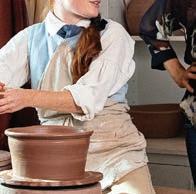
Last spring, on a trip to Seagrove in central North Carolina, I visited the studio of Ben Owen III, arguably our state’s foremost ceramic artist. Ben’s family has lived here since the 1700s — his grandfather, Ben Owen Sr., was a master potter.
While his grandfather used a mule-driven mixer to refine the clay he worked with, Ben’s sprawling studio just outside of Seagrove is far more sophisticated, with multiple kilns, custom machinery and a showroom housing his exquisite finished works.
Our group watched intently as Ben sat down at the wheel and shared his story while — in under 10 minutes, I kid you not — turning a shapeless lump of clay into a graceful, perfectly formed 18-inch vase.
As we viewed completed works from his crystalline series, Ben described his strategy in getting those magnificent, nature-inspired glazes just right — finding the “sweet spot” in firing the kiln. He compared it to a sunset — that elusive moment just before the fiery orb sinks below the horizon. You have to catch it at just the right time.
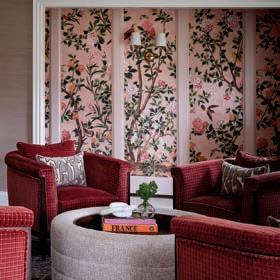
In our annual Fall Arts Preview on page 67, contributor Page Leggett takes the guesswork out of deciding which concerts, musicals, comedians and museum shows to see this fall — or at least narrows down the list of worthy events.
Here’s one more for your calendar: On Sept. 26, consider spending a Saturday afternoon on the lawn of Mint Museum Randolph for the 20th annual Potter’s Market at the Mint. You can purchase (or just window shop) works by Owen and about 50 other ceramic artists from across North Carolina.

To celebrate its 20th year, the market will host a special guest speaker and judge, internationally renowned Pueblo ceramic artist Virgil Ortiz. The New Mexico ceramicist is also a jeweler, fashion designer and video artist.
His edgy, contemporary works might challenge what you
think you know about Indigenous art, and he’s had high-profile collaborations with fashion designer Donna Karan, Parasoleil architectural products and The Rockwell Museum, among others.


by artist Kyle Mosher (page 26)

Only a true master of the craft can understand the subtlety of a process like that.
Whatever your jam — comedy, visual art, dance or music — it’s happening here this fall. We’ll see you around town! SP




























18 | people
SouthPark sit-down: Delano Little
24 | arts
Painter Paige Adair relishes porch time
26 | design
Charlotte artist Kyle Mosher hits his stride, his career shaped by curiosity, risk and reinvention.
32 | dance
Charlotte Ballet’s resident choreographer Mthuthuzali November can’t stop creating.
38 | interiors
A soothing primary bath retreat designed by Anne Buresh
42 | cuisine
Tale of the plate: Wafu pasta by Shari Robins of Sharigato
46 | culture
Charlotte Museum of Nature promises to be worth the wait.
48 | explore Staycations: Check in for a luxury stay in the Queen City.
54 | around town
What’s new and coming soon in the Queen City
54 | happenings
August calendar of events
59 | bookshelf
August’s new releases
60 | state of mind
The good, the bad and the laughable
62 | simple life
Hare, there and everywhere
108 | swirl
Parties, fundraisers and events around Charlotte
112 | crowning moments
What a sold-out event reveals about culture, work and a generation rethinking success
67 | The good ol’ days by Page Leggett
Fall arts preview: This season, nostalgia rules Charlotte’s cultural landscape
78 | If walls could talk by Michael J. Solender photographs by Richard Israel
A Broadway backstage tradition endures at Charlotte’s Belk Theater, where a cinderblock corridor is an archive of touring theater history.
84 | Space craft by Kay West photographs by Dustin and Susie Peck Bird Dog Interiors makes every inch count in a Myers Park remodel.
90 | Beyond the blue by Michael J. Solender Curaçao’s color-drenched Caribbean remix
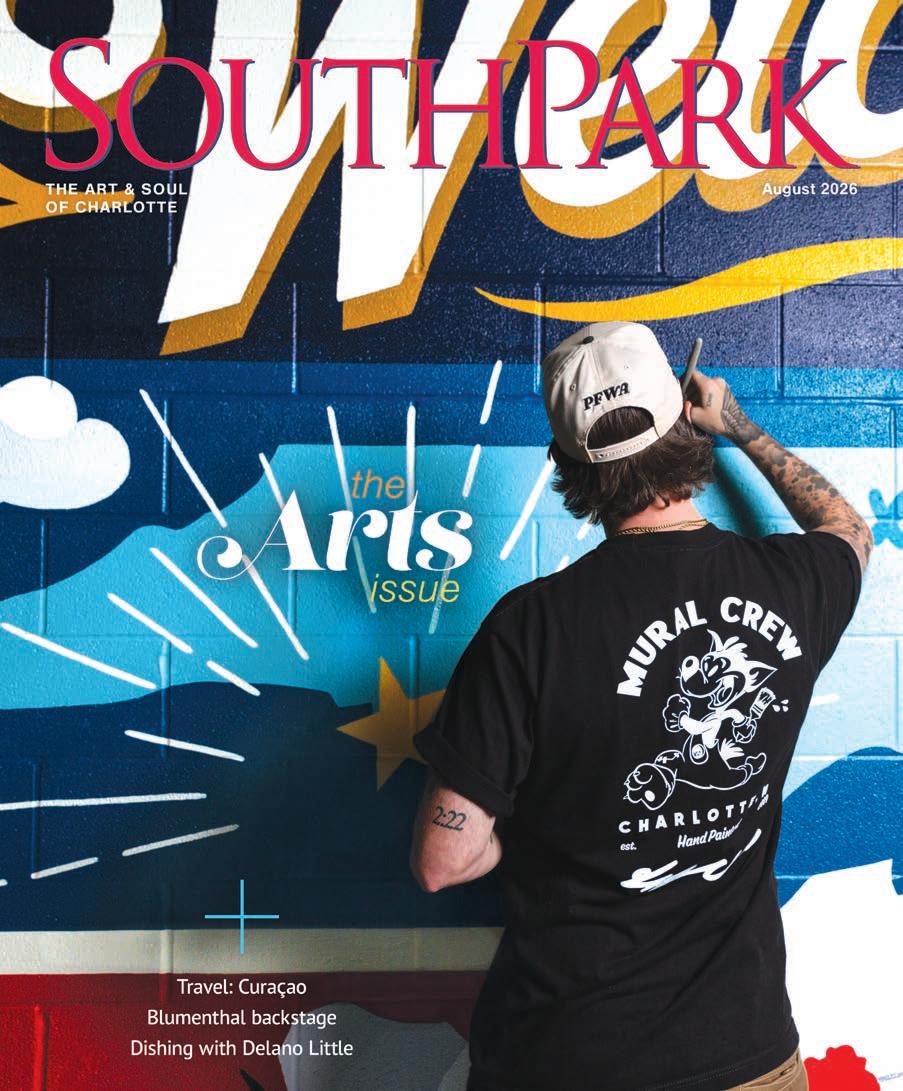
ABOUT THE COVER:
Mural artist Kyle Mosher (page 26), photograph by Justin Driscoll





















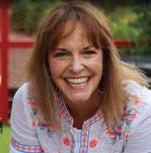

Natalie Dick has built her career telling stories that inform, inspire and connect people. A lifelong news junkie, she spent more than 20 years as a reporter and anchor at television stations across the Southeast, including WBTV and WCNC Charlotte. An Emmy and Telly Award-winning journalist, she later led communications for the Charlotte Chamber for a decade. Off the clock, she loves traveling, running, discovering live music and cheering on the Tar Heels.












Asha Ellison is a Charlotte-based writer, media specialist and storyteller dedicated to capturing the city’s heartbeat and beyond. With a deep passion for the arts, travel and global food culture, she specializes in amplifying local voices and culinary talent. Whether she’s documenting the latest restaurant openings, exploring new destinations, dreaming up her next staycation or highlighting cultural events, Asha leverages her media expertise to connect communities and inspire readers through engaging, colorful narratives.






Amanda Lea is a Charlotte-based writer who enjoys helping people share their stories. “What stayed with me after interviewing artist Kyle Mosher (page 26) was how curiosity, more than certainty, has guided his career. It’s a good reminder that we don’t have to have everything figured out to keep moving forward.”










people, places, things
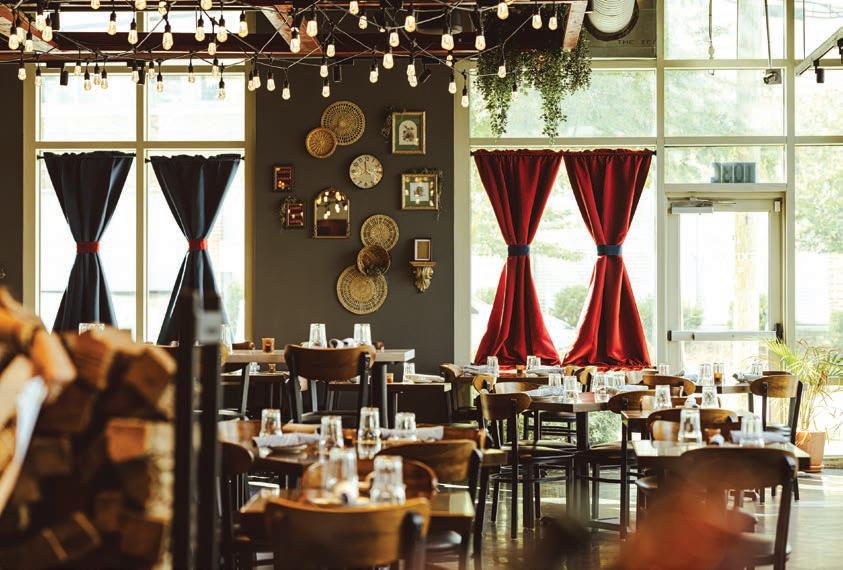
Ardente Kitchen is now open at 500 East Morehead St., in the former Capishe space. Owners Raffaele and Madison Patrizi created a warm, cozy vibe similar to their SouthPark spot, Mano Bella Artisan Foods, in the new Dilworth restaurant. The couple sought to evoke the feel of neighborhood trattorias in Raffaele’s native Italy. Handmade pastas and wood-fired pizzas are crafted with premium ingredients from local farms and imported from Italy. Pro tip: Ardente’s burrata pizza paired with a cool Hugo Spritz just might be the perfect summer supper. ardentekitchen.com SP
The retired WBTV sports director channels his inner Barry Manilow and shares his love of food.
by Natalie Dick | photographs by Richard Israel
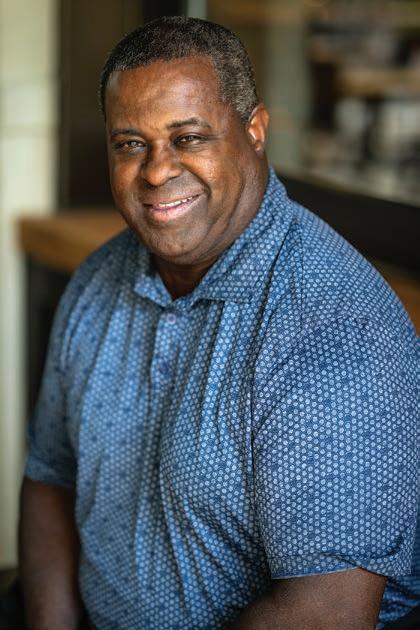
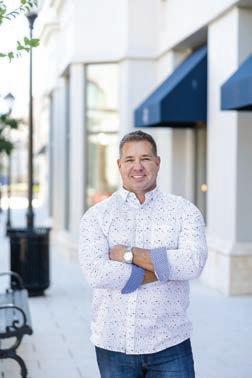
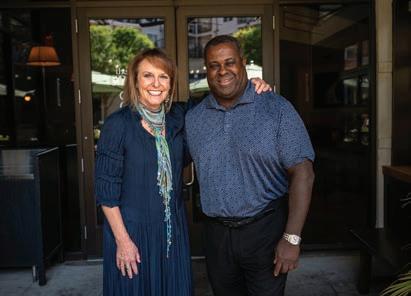
Delano Little always dreamed of becoming a Major League Baseball player. A wicked quick sprinter and solid third baseman, he had one major weakness: “I couldn’t hit a curveball,” Little says, laughing and flashing his familiar smile as we enjoy lunch at his newest culinary venture, The Craic (pronounced “crack”), an Irish-inspired gastropub in the heart of SouthPark. Open since April, the restaurant is co-owned by Little, business partner Chris Healy and general manager Parker Starre.
“The name is Gaelic for good times, lively conversation and genuine connection,” he explains. “We want this to be a warm and inviting gathering spot for everyone.”
Little embodies The Craic’s vibe: unpretentious, jovial and energetic with a charismatic ease. While he may not have made it to the big leagues on the baseball diamond, his star status continues to shine brightly in the Queen City. Almost eight years after retiring from WBTV, the Emmy-winning journalist still holds the title of Charlotte’s longest on-air sports anchor as he’s settled into a burgeoning career as an entrepreneur.
I first met Little when I worked alongside him as a news reporter back in the late ’90s. We even traveled to San Antonio together to cover the 1998 Men’s NCAA Final Four. Though we’ve bumped into each other over the years, this was our first proper reunion since both being “BTVers.” I left our lunch grateful for the chance to get to know him better and eager to return to The Craic for another visit.
The youngest of three boys, Little was born in Newport News, Virginia, where his father was based at Fort Eustis, but spent most of his youth moving between Georgia and Colorado for his dad’s Army assignments.
“I come from a long line of military people,” he says. “You could say we are ‘disciplined.’” His brothers followed in their dad’s footsteps, serving long military careers in the U.S. Army and Air Force. But Little’s passion was athletics, and football was his strongest sport. So, when Georgia Southern University offered him a scholarship and the
chance to help rebuild the football program under legendary former University of Georgia defensive coach Erk Russell, Little jumped at the opportunity. That, despite another secret, compelling offer.
“I got a letter from West Point inviting me to come for a visit and potentially play football,” he shares. “The problem was, Georgia Southern had already approached me and convinced me that they were going to win a national championship before I graduated … I believed it and totally bought into it.”
The recruiters’ forecast came true not once but twice, with back-to-back championship wins. Little wrapped up his football career as a wide receiver on the 1985 and 1986 Georgia Southern NCAA National Championship teams.
“My mother found out about the letter later,” he says with a chuckle. “Needless to say, she wasn’t happy about it, but I think things worked out OK.”
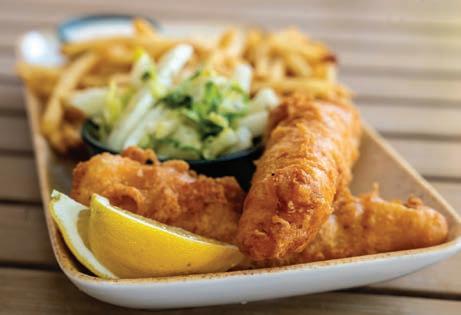
Fish & Chips:
Beer-battered fish, fries, jicama slaw, tartar sauce and lemon
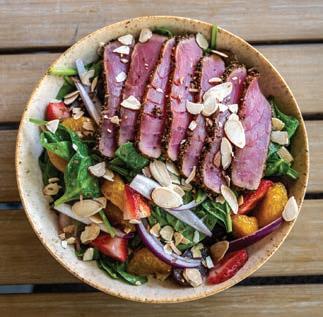
Spinach Salad:
Peppered tuna, spinach, strawberries, grapes, mandarin oranges, red onion and toasted almonds with balsamic dressing
As much as football meant to Little, earning his degree was equally important. When he enrolled at Georgia Southern, he planned to study medicine, with hopes of becoming a cardiologist if the NFL wasn’t in his future.
That future took an unexpected turn during his senior year, when Savannah sportscaster Bill Edwards of WJCL-TV saw something in him beyond the football field.
“We had gotten to know each other in the locker room, where he often came to me for postgame interviews,” Little recalls. “One day, he asked what I planned to do after graduation. He told me I should consider broadcasting and invited me to intern with him.”
Little accepted the offer, viewing it as a practical backup plan while he pursued professional football.
“I tried out with the Atlanta Falcons,” he says. “Unfortunately, I became severely dehydrated during the workout and didn’t perform as well as I could have.”
That disappointment became the beginning of his journey to a 30-plus-year broadcast career. At WJCL, Little quickly progressed from intern to news reporter to sports reporter. When Edwards was promoted to evening news anchor, Little stepped into the weekend sports anchor role — all in under two years.
“The very first interview I ever did was with Sugar Ray Leonard. He was training in Hilton Head to get ready for a big rematch fight
with Marvelous Marvin Hagler,” Little recalls. “I was still an intern, and Bill encouraged me to approach him. So, I walked up and said, ‘Mr. Leonard, do you mind if I interview you?’ He said, ‘Absolutely son! Let’s sit down and talk.’ I was thrilled.”
After his first “big” interview, he was hooked. His personal experience as a multisport athlete and his innate curiosity gave him the confidence to “get the story.” Little also had a certain something that made him stand out: He was so darn likable.
Paul Cameron spotted the up-and-comer in 1989 and invited Little to interview for a sports photographer job at WBTV.
“Paul wanted to know that I could cover NASCAR, so he took me to Charlotte Motor Speedway, where I met Rick Hendrick, and we rode around the track in one of his Lexuses. I also shot a Charlotte Knights game.”
The job came at a pivotal time in Charlotte sports. During Little’s 29-year tenure, he covered the arrival of the Carolina Panthers and Charlotte Bobcats (now Hornets), two Super Bowls, the 2011 NFL Draft in New York City, multiple NCAA tournaments, the Charlotte Knights’ move to uptown Charlotte and the Hornets’ NBA playoff games. Six years after joining WBTV, Little had a déjà vu moment.
“Paul was offered the main news anchor role, and I was promoted to sports director,” he says. “To have my boss at WJCL and WBTV move to news, providing me a path to assume the sports desk — that just doesn’t happen often. I was very lucky, but I worked hard, too.”
Little’s impact has been felt in the community, on and off the TV screen. He started a foundation providing scholarships for local high-school students and supports numerous charities. His
Favorite teams: Anything Charlotte and the Carolinas, of course! I’m also a huge Atlanta Braves fan. That said, I would love to see Charlotte get a Major League Baseball team.
Any regrets? Not starting to play golf sooner. I really enjoy it, and I’ve been fortunate over the years to have covered or played with a lot of cool people like Tiger Woods, Lee Trevino and Arnold Palmer. How did the nickname “D-Man” come about? One of my coanchors said it one day, and it just stuck.
People would be surprised I … Eat my main meal and dessert at the same time. Sometimes dessert first!
How would you most like to be remembered? As someone who inspired others and lifted them up.
personal favorite is Dancing with the Stars of Charlotte, in which he competed in 2012 to benefit the YMCA of Greater Charlotte. While Little and his professional partner, Darinka Divljak, didn’t win the local competition, they went on to compete on the Pro-Am circuit for several years. Little’s still known to show off his moves when the moment is right.
He also dabbles on the piano and is a major music lover with an appreciation for diverse genres.
“I’m probably the only Black guy that likes Barry Manilow,” he quips. “I love Elton John; I’m a huge George Strait fan. I’ve seen Rod Stewart, R.E.M., Dolly Parton and Luther Vandross in concert. I wish I could have seen The Carpenters.”
When I ask about his most memorable interviews, his face lights up as he recalls being the only sports reporter to report live from the locker room immediately after the Hornets’ first playoff win over the Boston Celtics.
“Alonzo Mourning had just hit a 20-foot buzzer-beater shot to clinch the victory. The city was electric with excitement,” he recalls. “One of our engineers had suggested putting a live unit inside the


locker room in addition to the courtside for postgame interviews. None of the other stations did that, so when the game ended right around 11 p.m., I was the only person able to interview Alonzo and the other players.”
While Little treasured his time at WBTV, all good things must come to an end. Before his departure in 2018, uncertainty surrounded the onair talents’ futures after Gray Media’s purchase of the station, and Little was beginning to feel burned out.
“I experienced everything I could have as a sportscaster at the local level. I think I had grown tired and wasn’t as aggressive as I used to be, and it was time for me to leave. If it’s not thrilling you anymore, it’s time to get out of it,” he says.
Privately, Little had begun to whet his appetite in Charlotte’s growing restaurant and music scene, investing in Davidson Street Public House in NoDa and The Gin Mill and Amos’ in South End.
“I was halfway with my foot out the door,” he says. “Chris (Healy) and I were already on the hunt for a location uptown for our first restaurant, The Public House.”
Putting people at ease is what Little has always done best. That, along with his desire to please the public, is the perfect combination for his newest challenge as co-owner of The Craic.
“In many ways, I’m using the same skills I did when I was in TV. I’m still communicating with people,” Little says with a grin. “That’s what it’s all about.”
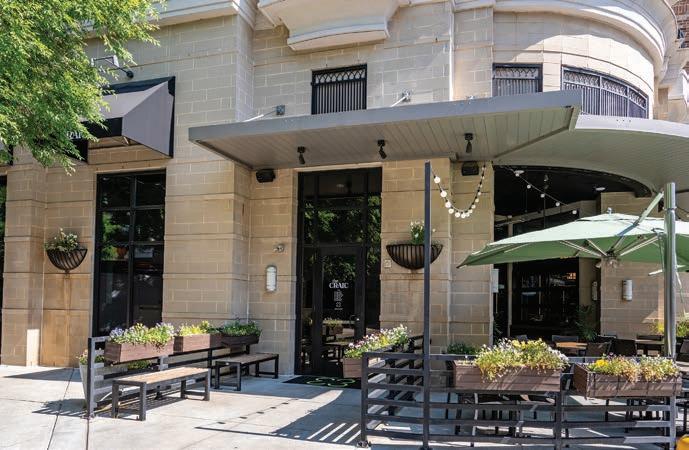
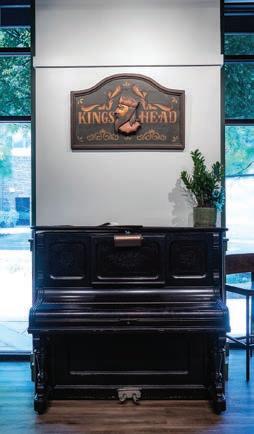
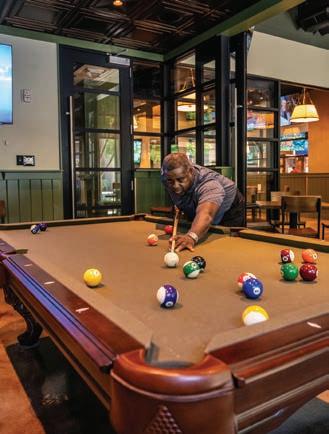
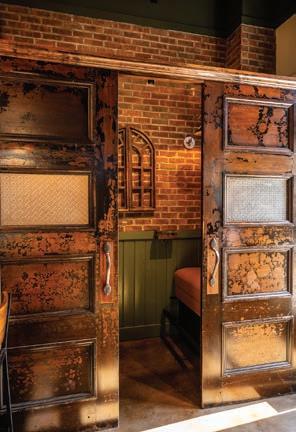
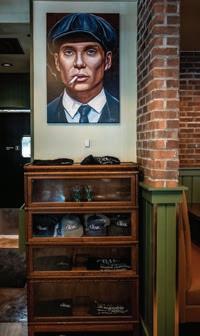
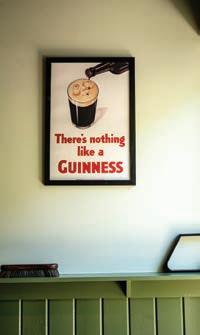
Housed in the former Rusty Bucket spot at Sharon Square, The Craic is warm and inviting. Guinness posters hang on the walls, an old upright piano sits outside the pool room and there’s a “snug” on the back side of the main bar for guests seeking extra privacy.
“No Irish-themed pub would be complete without one of these,” Little jokes as he shows me a sign above the back door alluding to an “Irish goodbye.”
The menu at The Craic mirrors the vibe: comfort food with hearty helpings. There are the obligatory fish and chips, savory shepherd’s pie croquettes and handheld sandwiches, as well as chef specialties including short-rib pot roast and a bowl of rosemary-and-butter sauteed vegetables for non-meat-eaters. We sampled the salmon benny and spinach salad with peppered tuna, topping off our meal with a homemade brownie and vanilla ice cream rolled in toasted coconut.
“It’s not just about the food,” Little tells me. “We want to be a part of the community. That’s important to us.”
He pauses and silently reflects on all his accomplishments before circling back to the college football motto he still lives by:
“Do right and always remember who you are and who you represent.”
He didn’t make it to West Point, but I’m pretty sure he’s made his mother proud. SP
VIDEO EXTRA: What does Little see as Charlotte’s next big thing? Scan the QR to find out.















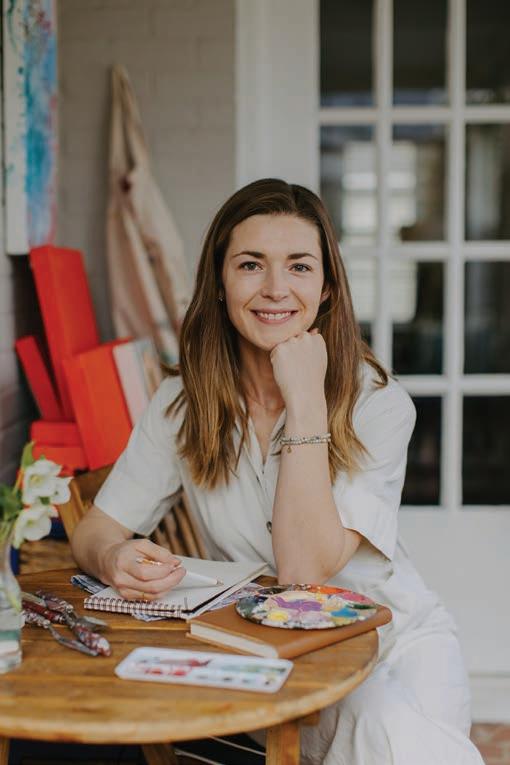
Don’t be surprised to find Paige Adair on her front porch in Chantilly with an art easel, paints and brushes. It’s a creative space that feels just right in this season of life.
by Sharon Smith
The act of picking up a paintbrush feels grounding to Paige Adair — even more so when she hears the birds or notices a shift in the sunlight.
“I love the informal aspect of being connected to nature,” Adair says. She doesn’t mind breaking a sweat on a hot summer afternoon, or bundling up in a cozy sweater and beanie when cooler weather settles in.
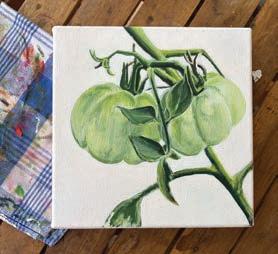
That sense of presence is woven into her newest series, Homegrown, which takes inspiration from her own backyard and farmers markets. For her, capturing how a strawberry or tomato ripens is a meditation on the quiet, patient work of tending to her own life.
While the little girl in her always enjoyed painting, it took a back seat as life got busy. After earning a fine arts degree at the University of Georgia, she carved out a career in corporate interior design.
“I would do little watercolor sketches here and there — like my wedding invites — but it wasn’t until Covid hit and I had an abundance of free time [to start painting again],” she says.
Adair was also navigating profound heartache.
“I was grieving the loss of our first baby, and it was so cathartic.” Back then, Adair says her only art critics were neighbors walking their dogs, the postal carriers or delivery workers. Painting offered connection.
Not long after, she needed that sacred space again.
“I lost both of my parents when my daughter was 9 months old, so I kept painting.”
Now with two young daughters, she still relishes porch time — those stolen moments between naps or after early bedtimes when she can step outside and create.
“When life feels hard, I pick up a paintbrush and get back to something simple and beautiful like a tomato, or the first daffodils of spring.”
Adair finds healing in these porch sessions — sweet memories and humor, too.
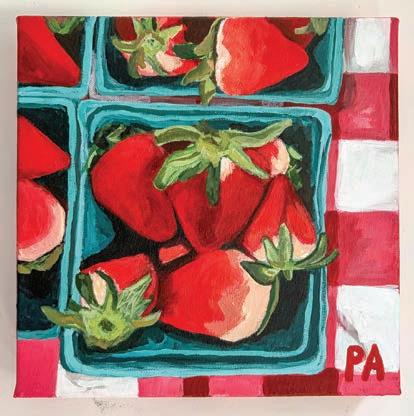
Her favorite in her new collection is “Southern Spring,” a nod to her great-grandmother’s kitchen, covered in strawberries.
“She had strawberry wallpaper and china, and giant strawberry canisters that usually held little tea biscuits that she made from scratch,” Adair recalls. “I think of her every time I see those first strawberries at the farmers market. My girls and I giggle and eat them straight from the carton with the juice dripping down our chins.”
For her next series, Paige feels a tug toward coastal-inspired paintings. She’ll call it Low Tide Treasures — inspired by family time this summer in Cape Cod and beach walks with the girls.
Simple pleasures — perfect for porch painting. SP


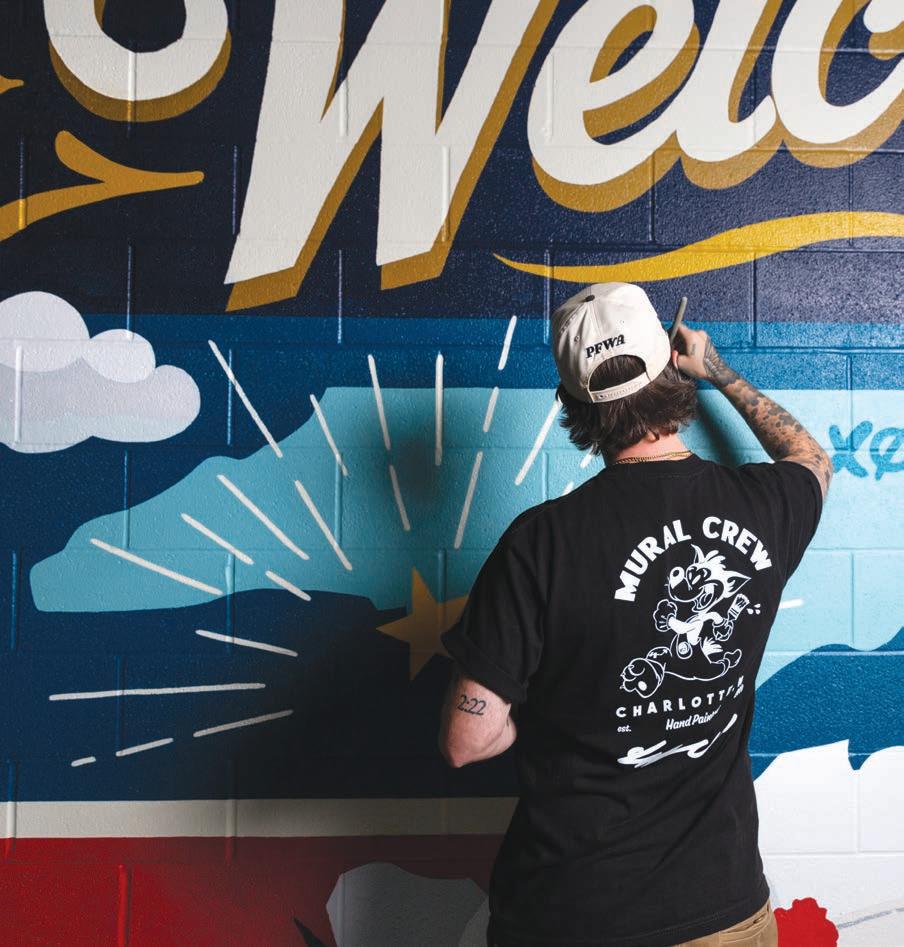

Charlotte artist Kyle Mosher hits his stride, his career shaped by curiosity, risk and reinvention.
by Amanda Lea | photographs by Justin Driscoll
Inside the newly renovated lobby of the Renaissance Charlotte SouthPark Hotel, Charlotte artist Kyle Mosher’s newest mural stretches across two adjoining walls, offering guests a vibrant introduction to the city. A cardinal anchors one composition in layered blues, mauves and creams, while a black panther emerges from abstract shapes and line work.
The colors echo the patterned chairs that inspired the palette, but the imagery takes the viewer deeper into local lore: The outline of Queen Charlotte rising on the left, a biplane cutting through the sky, dogwoods in bloom, and a hive of hornets, a nod to the city’s historic nickname. Thomas Sayre’s Grandiflora sculpture, known locally as the “onion rings,” appears along the bottom edge.
Layered and symbolic, the SouthPark mural blends Mosher’s background in design, branding and illustration into a visual love letter to Charlotte.
“I love working with design teams, taking brand guidelines and funneling it all into the wall,” Mosher says. “I get to merge everything I’ve done and watch it come together in real time.”
Like his other works across Charlotte, the mural is built on discovery, a theme that mirrors Mosher’s own path. Rather than settling into one style or direction, his career has unfolded through a series of intentional shifts — guided by an openness to follow what feels true.
“My life so far has been a series of calculated pivots,” he says.
Mosher’s path has not been linear. He spent his childhood moving between his mother’s home in Canada and his father’s in New Hampshire. Hockey shaped much of

his identity during those years, but a series of injuries eventually forced him to step away. It was heartbreaking at the time, but Mosher eventually realized it created space for something new.
“Most of my life had been dictated by my parents and centered around hockey,” he says. “I was resentful for a long time, but now I’m grateful. I was able to reclaim my life and what I’m meant to do.”
Without the sport, he drifted through a handful of jobs while trying to find direction. Eventually, he began to realize his future was in creative work. He earned an art degree and lined up a job at an agency in New York City.
In 2013, a major shoulder injury forced Mosher to change his path again. The specialist he needed was in Charlotte, where his mother had relocated, and she offered him a place to recover after surgery. What started as a temporary stay became permanent.
Mosher’s first few years in the Queen City were marked by financial uncertainty and the challenge of building a life from scratch.
“It’s easy to connect the dots looking back and seeing how things ended up working out,” he says. “But at the time, it was a struggle just to pay my bills. I was getting eviction notices and sleeping in my car.”
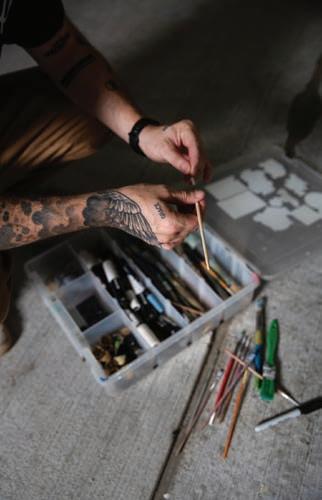
Even then, he remained committed to building a career as an artist. Years before he landed his first mural commission, Mosher pieced together income through illustration, freelance design, and brand and licensing work, while spending countless hours developing his own artistic voice. He experimented with collage and began exploring the layered, vector-driven style that would eventually define much of his work.
“I was just doing whatever it took to get by,” he says. “There was no Plan B. I was committed to making my craft my career.”







Tryon Medical Partners® welcomes Joshua B. Eickstaedt, MD, FAAD, to our growing Dermatology team.
Dr. Eickstaedt specializes in Mohs micrographic surgery — the highly effective same-day procedure to completely remove skin cancer.
If you have skin cancer and are interested in, or are on a wait list for Mohs surgery, Tryon may be able to help.
Referrals may be faxed to 833 455 4663.
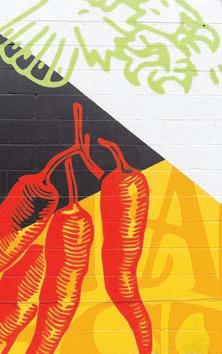


Those early years in Charlotte became the foundation for the work Mosher has built since. In 2017, his first commissioned mural inside the gym of a NoDa apartment complex offered a meaningful foothold.
As the projects grew in scale, so did Mosher’s understanding of what it meant to build a life as a working artist. Long before personal branding became commonplace, he was building his own website, selling sneakers online and teaching himself emerging digital platforms. He was drawn to the idea of being completely vertical, owning every part of the process from creation to connection.
That entrepreneurial mindset still shapes the way he approaches his work, balancing intuition with discipline and creative freedom with professional responsibility.
“Every day you straddle the line as an artist between debilitating self-doubt and a grandiose feeling of confidence,” he says. “You have to figure out a way for your work to honor the space and the client and stay true to your own brand.”
Over time, that same mindset guided the progression of his style, from hand-cut collage and mixed media to the graphic, illustrative approach he is known for today. The shift wasn’t driven by trends. It was driven by alignment.
“When something stops being authentic, I have to recalibrate and return to what feels right,” he says. That recalibration helped Mosher find something many artists spend a lifetime chasing: a distinct voice.
“You’ll never find your voice as an artist if you don’t know who you are as a person,” he says. “You need to have a perspective. Know what you’re trying to say.”
Today, murals remain a significant part of his work, but they’re no longer the whole story. Mosher and his team also work with a range of clients to create installations, merchandise and experiential projects. Recent design work includes a custom Porsche-inspired art piece for a Charlotte Hornets event celebrating rapper Don Toliver and collectible hats and pins for Major League Soccer’s All-Star Week in Charlotte. An upcoming installation for Continental Tire will push his work in a new direction, incorporating sculptural elements and deconstructed tire materials.
Outside of client work, Mosher carves out time in the studio for personal projects and a print series that function as both creative outlet and ground for experimentation. From still life to portraits, the pieces give him space to move his practice forward and explore ideas that might not fit within commissioned work.
That balance has become central to his evolution. After more than a decade as a professional artist, Mosher has learned to expect that growth and challenge often arrive together.
“No matter where you’re at, you’re always learning and being humbled,” he says. “New levels, new devils. You conquer one thing, and another one pops up.”
Like the SouthPark mural, Mosher’s journey is a study in layers. Not sudden reinventions, but deliberate decisions built on one another. Charlotte gave him the space to make those shifts. It’s where he learned to trust his instincts, sharpen his voice and keep moving toward the work that feels most like him.
You can see that evolution on the wall — textured, intentional and rooted in the city that helped shape him. It’s a reminder that discovery isn’t a moment. It’s a way of moving through the world. SP
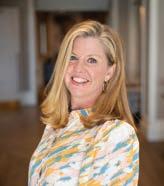





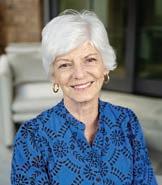
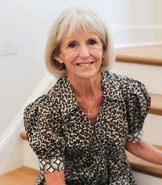
From the traditional African street dance of his youth to the Royal Ballet, Charlotte Ballet’s resident choreographer Mthuthuzeli November can’t stop creating.
By Vanessa Infanzon
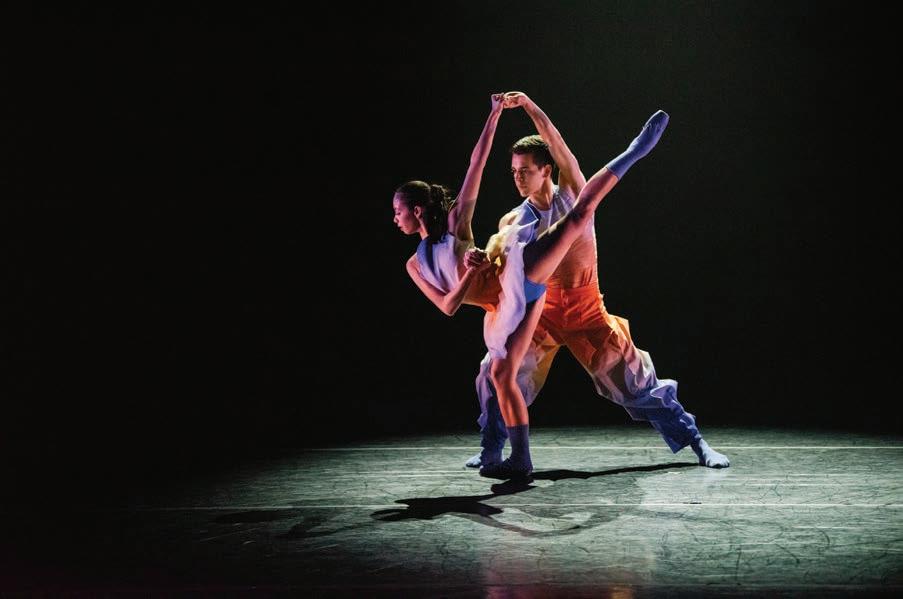
As a child, Mthuthuzeli November, resident choreographer at Charlotte Ballet, and his siblings performed traditional street dance representing South African and other African cultural traditions in Zolani, a town 125 miles from Cape Town.
“In my community, we were always known as ‘the dancers,’” says November (whose first name is pronounced em-tu-tu-zoli). “I was introduced to ballet at the age of 15 by an English woman, Fiona Sargeant.”
Sargeant was sent to Zolani through Dance For All, a nonprofit outreach program in Cape Town. Two of November’s brothers joined the dance classes first; with talk of pliés and tendus, they eventually convinced November to join them. Sargeant asked him to teach the class a few movements from his street dance, adding ballet steps in between.
“I started going back to help the kids with the choreograph that I made for them,” he says. “It just became a routine, and the next thing I knew, I was doing ballet.”
November won Best Contemporary Work in 2012 and 2014 at the South African International Ballet Competition and the Emerging Artist Award in 2014 from Klein Karoo Nasionale Kunstefees, South Africa’s premier Afrikaans-language arts festival. He danced with London’s Ballet Black from 2015 to 2023.
Mthuthuzeli November
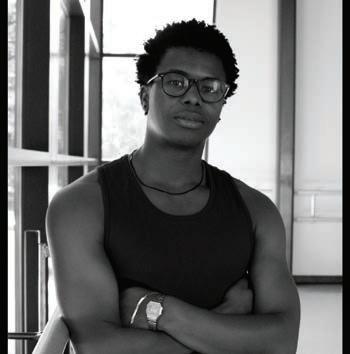
In 2023, he turned his focus to choreography full time. Royal Ballet, Paris Opera Ballet, English National Ballet, Washington Ballet and Northern Ballet have commissioned November’s work. In 2025, he earned the Benois de la Danse Award for Best Choreography, an international prize awarded annually to outstanding choreographers.







This year, November is creating new ballets for the Cincinnati Ballet; Joburg Ballet in Johannesburg, South Africa; and Staatstheater Nürnberg Ballet in Germany.
After meeting Alejandro Cerrudo, Charlotte Ballet’s artistic director, November began collaborating with the company in 2023. As resident choreographer, he shares ideas for new works, tries out creative ideas and offers his voice to the team.
Although November lives in London, his ballet “home” is Charlotte.
“I didn’t know what to expect when I came to Charlotte,” he says. “There was this natural sense of community and friendship and understanding. For some reason, I didn’t feel like I had to express myself in any other way than who I am. Everything in the world aligned so well.”
The first piece November created for Charlotte Ballet was From Africa With Love, which premiered in fall 2023 and the company will perform again Oct. 2–17 as part of its Black Box Series. While developing the piece, he reflected on his youth and the long drives he took with his father past ostrich farms.
“Ostriches are some of the fastest birds and some of the strangest birds,” he explains. “My movement was inspired by that. I wanted to do something that felt really athletic.”
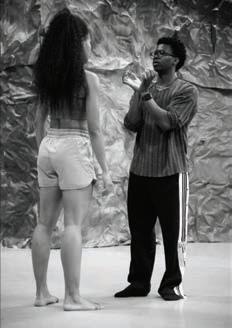
But it was the connection November felt with the Charlotte Ballet dancers that motivated him to pull together the music and movements. He wanted the African dance performance to immerse audiences in a range of emotions, from joy to sadness.
“The piece really started to feel like it was about sharing love to each other,” he says. “It became a love letter to them.”
November also composed the music in From Africa With Love, an unusual move for a choreographer. As much as he can, he makes his own music for his works. He views it as an important part of the process.
“This involves a lot of voice and a lot of percussion,” he says. “My music is both an exploration of African drums and rhythms, voices and expressions, and how that world fits with Western-known musical instruments such as cellos and violins.” SP
Charlotte Ballet’s 2026/2027 season opens on Oct. 2 with November’s From Africa With Love, Cerrudo’s Dos y Dos y Dos and a new work by FLOCK, a touring contemporary dance company. The schedule continues through May with performances including Nutcracker and Alice in Wonderland. For more information, visit charlotteballet.org.

LIFE HAS A FUNNY WAY OF TESTING US.
Plans change. Challenges show up uninvited. The path forward isn’t always clear. But over time, we’ve learned that growth doesn’t come from avoiding obstacles—it comes from moving through them.
As parents, business owners, and partners in life, Tanner and Roni Bazemore know that success isn’t built in a single moment. It’s built through consistency. Through showing up when things are hard. Through taking the next step when you don’t have all the answers.
Nobody finds balance by never falling out of it. Strength isn’t built when everything goes according to plan. The practice is returning—again and again—to your breath, your focus, and your purpose.
That philosophy continues to shape Y2 Yoga. Whether students are stepping into their first class or their thousandth, they’re reminded that progress isn’t about perfection. It’s about showing up.
The future has a way of surprising us. New opportunities often arrive where we least expect them. Until then, we’ll keep doing what we’ve always done: helping people become stronger, more resilient, and more confident—one breath, one class, and one challenge (studio) at a time.






















Interior designer
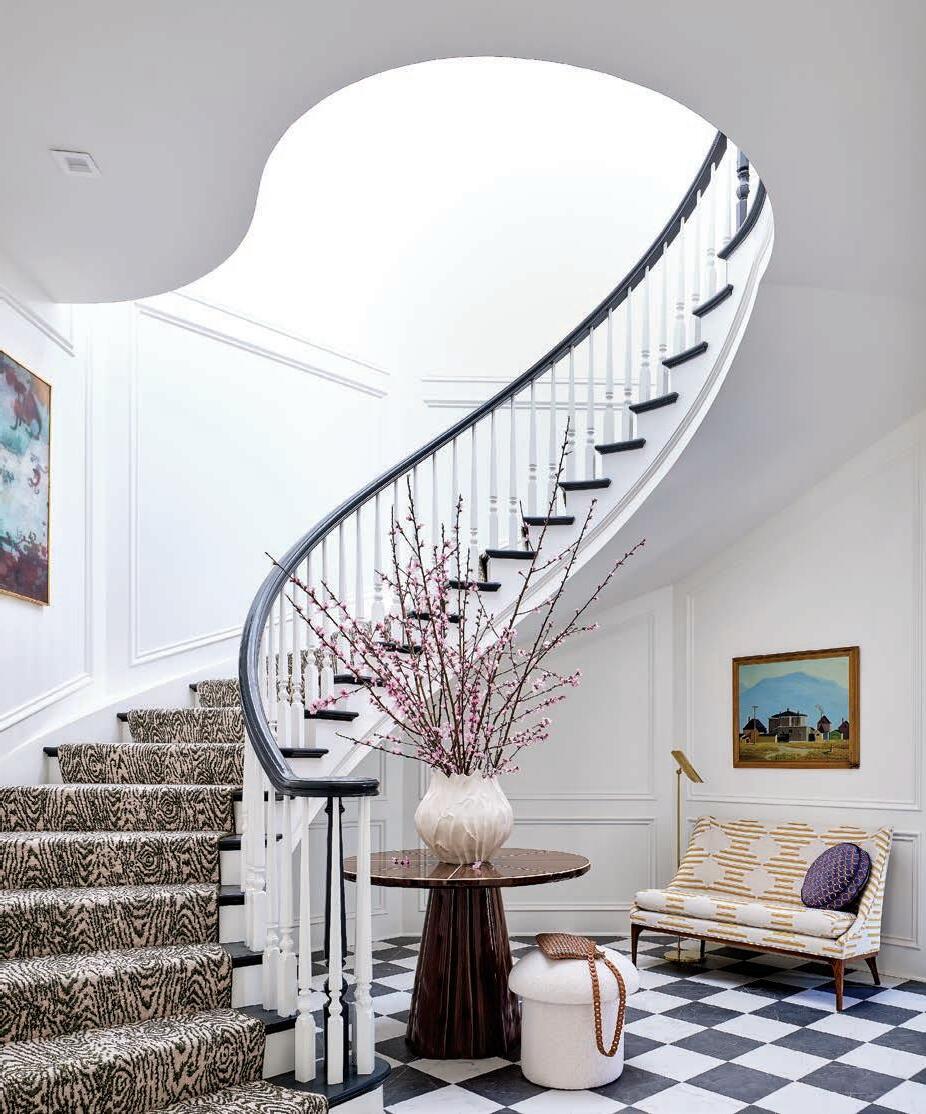
Anne Buresh designs a soothing primary-bath retreat with spa-like amenities and a timeless, elegant feel.
by Cathy Martin
photographs by Katy Perry
After more than a decade in their Waxhaw home, Anne Buresh’s clients were ready for more than a simple update to their primary bath. They envisioned a warm and welcoming retreat with a refined, timeless feel — a place to slow down and relax rather than rush to get ready for the day.
The couple loved their neighborhood and home overlooking the golf course at Longview Country Club. While the bathroom was plenty big, the finishes were dated and the footprint — with an oversized bathtub smack in the middle of the room — wasn’t the most practical.
Reimagining the floor plan opened new possibilities for how the space could be utilized.
“Sometimes the most impactful part of a renovation isn’t what you add, it’s rethinking how a space functions,” says Buresh, founder and principal designer at Anne Buresh Interior Design.





“That transformation allowed us to create a true spa-like retreat.”
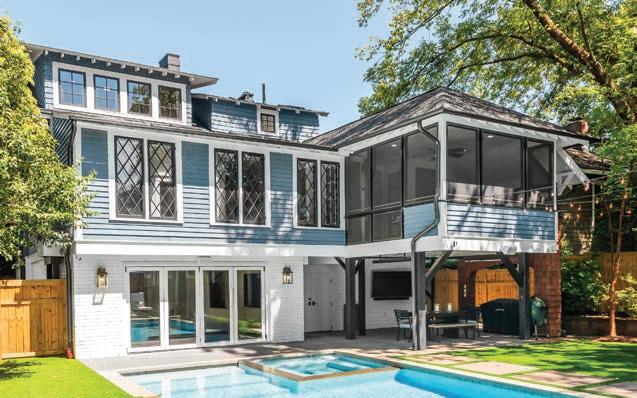
A former closet became a spacious steam shower, and a curved alcove that previously housed a large walk-in shower now envelops a luxurious soaking tub, with plenty of natural light and verdant golf-course views. Warm walnut cabinets topped with stone countertops, polished-nickel fixtures from Ferguson and a showstopping waterfall, blown-glass chandelier bring an elegant sophistication to the space.
“We selected materials that feel timeless rather than trend-driven, ensuring the room would remain beautiful for years to come,” Buresh says.
Thoughtful details beyond what the eye can see — heated floors, towel warmers, custom concealed storage and hidden electrical outlets — add another layer of quiet luxury.
“[The homeowners] also wanted comfortable seating that encouraged them to slow down and enjoy the space,” Buresh adds. A dusty-blue upholstered vanity chair and custom ottoman complement the natural wood and stone finishes while bringing softness to the space.
“Rather than simply replacing finishes, we completely reconsidered how the homeowners would experience the room each day,” Buresh says. “Every decision was made to create a sense of calm, comfort and understated luxury.” SP







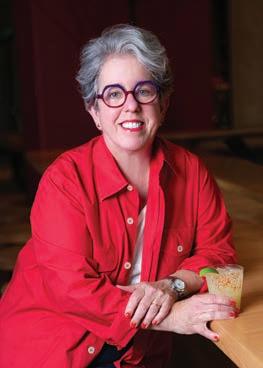
Some would say a good chef is one with impeccable technique, achieved through formal education and years of training and experience. Others might argue what makes a chef remarkable is the ability to bring people to the table. For Shari Lynne Robins, a 30-year-plus culinary veteran and chef/owner of Charlotte restaurant Sharigato, the answer lies somewhere in the middle.
















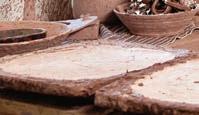







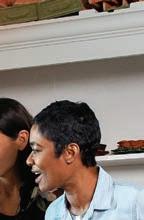
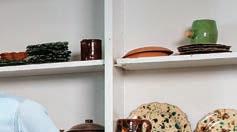

































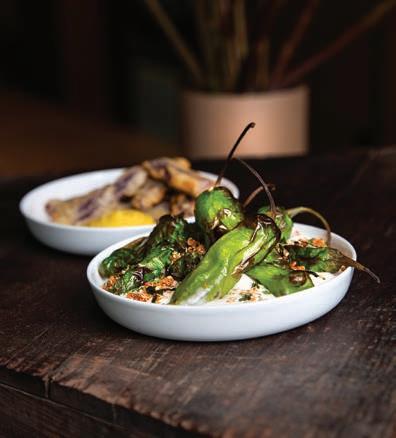
A native of Westchester, New York, Robins has spent decades navigating the ins and outs of kitchens from coast to coast. From the saute of vegetables to the simmer of a broth, the opening of a Los Angeles mini-market to a career in food-product development, Robins was made for it.
“Being a chef was always my trajectory,” she says, recalling the bake-off she won in the third grade. “I made our housekeeper’s recipe for a sour-cream pound cake, and all the judges — who were school janitors — loved it,” she adds. “I used an old Hamilton Beach mixer that they don’t even make anymore. I still have it, and use it only when I want to make that pound cake.”
Robins’ story is one of tenacity and versatility. At age 12, she made and sold sandwiches at the New York City salon her mother patronized. She’d gather various breads from local bakeries to complement her egg- or tuna-salad sandwiches or stand up to the weight of Italian deli meats. In the ’80s, inspired by her culinary icons Julia Child, Jacques Pépin and Graham Kerr (aka The Galloping Gourmet), Robins briefly traded East Coast living for California.
There, she worked at the second-ever Cheesecake Factory in Marina Del Rey — then a high-volume, scratch kitchen that taught her about grit and determination. As she awaited news of her acceptance to New York’s Culinary Institute of America, Robins kicked off a dynamic career that would introduce her to various aspects of the industry.
“After I graduated with my degree in hospitality management, I had an externship with Jonathan Waxman, who is known for bringing Californian cuisine to [New York City]; worked for [veteran NY chef] Larry Forgione; and then went on to work for Sarah Moulton of Gourmet magazine.” Under Moulton, Robins discovered a love for food science. After creating dishes for funders and advertisers in the publication’s kitchen, she moved on to developing

products for Trader Joe’s and Aldi.
“I knew I’d found my calling,” Robins recalls. “I’m a technical person who loves science, and I’m really geeky about food.”
Robins eventually moved to Charlotte for a corporate role in culinary innovation, but a layoff in 2023 left her unemployed at age 59. She and her wife decided to root themselves in the Queen City.
“We’d built a community of friends and neighbors along with our dream house,” Robins says. “We weren’t moving again.”
After a few dead-end interviews and calls to open her own restaurant, Robins created Sharigato, a cozy, 24-seat hand-roll bar that also offers premium comfort dishes like miso soup and ube tempura fries. It’s a casual hangout that Robins says falls somewhere in the middle between the city’s neighborhood dives and high-end restaurants.
The Optimist Park eatery blends her corporate manufacturing expertise with her passion to carve out a niche in Charlotte’s blossoming restaurant culture.
Robins calls her style “affordable glamour,” and her approach to food remains deeply personal. Take her wafu pasta recipe, for example. It’s a comforting fusion dish that marries Italian spaghetti with Japanese umami. The dish, which is not sold at Sharigato, mirrors her own eclectic culinary journey.
“I’m that dish — I’m wafu,” Robins says. “I love Japanese food, and I’m comfortable and familiar with the country and the culture. No, I’m not Asian, but the dish expresses all the things that have inspired me.” SP
To experience what Robins is cooking up these days, visit Sharigato at 420 E. 22nd St. To create her wafu pasta at home, scan the QR code for the recipe.





There’s a lot to do at The Cypress, but it has nothing to do with yardwork. Because every home — from condo to cottage — comes with a remarkable feature: All-inclusive maintenance.
From mowing your lawn to fixing your washer to laundering your linens, we get it done. Which leaves you with more time to make time for yourself.
At this most important time of your life. Spend your retirement on social activities, gourmet dining and numerous self-enrichment programs, or honing your volley or drop serve.
What we can’t do for you is schedule your get acquainted tour. You just have to take the first shot.
Schedule a tour today.
704.714.5500
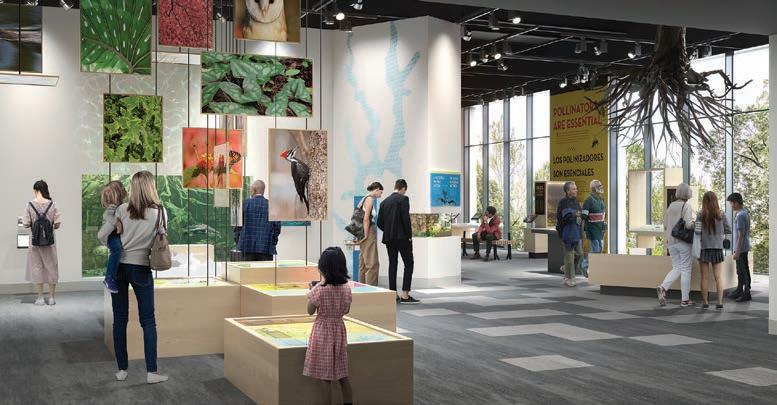

You may be able to tell how long someone’s lived in Charlotte by what they call the Myers Park museum dedicated to turtles, frogs, birds and trees.
People who have lived in Charlotte since the early 1950s may still know the place by its original name — the Children’s Nature Museum. I grew up in Charlotte, and my family spent considerable time at what was called, in the 1970s and ’80s, The Nature Museum. Newer Charlotteans may know it only by the name it took on in 2016 — Discovery Place Nature.
It’s had three names over the decades, but only one building adjacent to Freedom Park on Sterling Road. That’s about to change.
The museum’s new beginning started with an ending. Discovery Place Nature — a public-private partnership between Mecklenburg County (which owns the property and facility) and the nonprofit Discovery Place (which operates it) — closed its doors on Jan. 31, 2024, and the old building was razed that March to make way for a larger, state-of-the-art space.
To borrow a metaphor from nature, it’s like a cocooned caterpillar emerging as a butterfly. Unlike a butterfly, though — which emerges from its cocoon in 10 to 14 days — the opening date for the newly rebranded Charlotte Museum of Nature is a moving tar-
A new Charlotte Museum of Nature is coming. It promises to be worth the wait. by Page Leggett
get. It was originally expected to open in spring 2026, but for now, museum officials aren’t sharing an updated timeline.
When the museum opened in 1951, it was the Southeast’s first nature museum. Rachel Cusick, Discovery Place’s new chief advancement officer, already understands what the museum has meant to Charlotte. The self-described “museum nerd” is a recent transplant from northern California, where she worked at the California Academy of Sciences.
“As beloved as the old Nature Museum was, we weren’t able to bring the facility to the standard required for the Association of Zoos and Aquariums, which is the highest standard for animal care,” she says.
The new facility is designed to meet those standards, and Cusick hopes to earn AZA certification. One way to reach that goal is to prioritize the safety and comfort of animal residents. At AZA facilities, animals live in environments that mirror those they’d live in in the wild.
The new Charlotte Museum of Nature will allow humans to get “nose to nose” with freshwater fish, reptiles, amphibians and in-
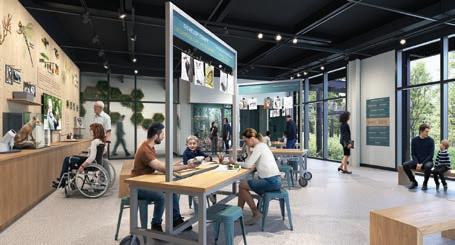

sects. That’s especially important for young children, Cusick says: “It builds empathy and makes us more compassionate humans.”
Some habitats don’t just mirror the wild; they’ll be in the wild. The “Frog Bog,” for instance, is a picturesque small pond with floral aquatic plants that provide cover for tadpoles and frogs. Museum officials describe it as the museum’s “front yard.”
Cusick and some of her teammates were reminded just how wild our urban habitat is when staff from the Carolina Raptor Center visited the site to release a rehabilitated hawk.
“The next thing you know, here comes another hawk,” she says. “They looked at each other and then began flying together.”
People got to witness a sky dance — right in the middle of an area crowded with humans.
All the species represented at the museum are native to the Piedmont Carolinas. In addition to hawks and frogs, they include owls, honeybees, snapping turtles, alligators and — destined to become a favorite — North American river otters.
“Moving animals to Charlotte will happen within the AZA framework,” Cusick says. “We’ll work with other accredited facilities and ensure they’re responsibly sourced.”
Discovery Place’s new chief science officer is another Charlotte newcomer. Lisa Hoopes, most recently with the Georgia Aquarium in Atlanta, grew up in Michigan camping and catching frogs. She has a Ph.D. in wildlife and fisheries science; sharks are her specialty.
Ultimately, the museum will have its own on-site director. That person and his or her staff will work in an enviable environment. The new museum, designed by Liollio Architecture and Hood
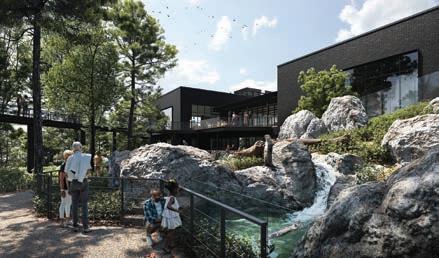
Design Studio and built by Rodgers Builders, will be reoriented toward Freedom Park and the Little Sugar Creek Greenway.
“We flipped the whole thing around,” Cusick says. “The museum’s front door faces the park, and we hope visitors will stumble on it and decide to wander in.” The dark brick exterior was designed with a relief pattern inspired by the Catawba River Basin that “wraps around the front of the building and sneaks inside, too,” Cusick says. Bird-safe windows are designed to prevent the creatures from seeing their reflection and flying into the glass.
The Tree Canopy Walk promises to bring people back for repeat visits. The attraction soars between 20 and 40 feet above the forest floor and weaves 590 linear feet (the combined length of two football fields) through the tree canopy.
Two features along its elevated walkway — the Climber and the Nest — offer unique vantage points from which to cloud gaze or take in skyline views. And it’s ADA-compliant, so it can be enjoyed by all.
All Discovery Place museums are known for hands-on exhibits, and the Charlotte Museum of Nature will offer many.
“In a traditional museum, it’s ‘Please don’t touch,’” Cusick says. “But in our Naturalist Lab, it’s more like, ‘Please touch.’”
Thanks to county funding, school field trips will resume once the museum opens. Educational series like bird-watching and stargazing are designed to appeal to adults, as well.
Though the museum seems likely to become a tourist destination, it was designed with locals in mind.
“First and foremost, it’s for our community,” Cusick says. “We sought input from the community to understand what was needed in this space so that all feel welcome here. We want this building to be something meaningful and long-lasting.” SP
Stay in the know: Keep up with construction progress on the new Charlotte Museum of Nature at charlottenature.org.

It’s time to check in for a luxury stay in the Queen City.
by Asha Ellison
An alarm clock sounds in your dreams, abruptly pulling you from your slumber. You reach up to remove your sleep mask and exhale a heavy sigh of relief. There are no active alarms here — you’re on vacation. It was only your imagination.
Summer is winding down. And though visions of school-pickup lines, work projects and mundane tasks that add to a busy life dance in your head, you pull yourself back to the current moment. Sprawled out in the middle of a bed you didn’t have to share, you’re reminded that you’ve just settled in for a much-needed summer retreat. The only decision you have to make this morning is: Will you indulge in breakfast in bed or slip on something breezy and head to the hotel restaurant for brunch?
There’s Grand Marnier French toast with fresh berries waiting for you in Gallery Restaurant at The Ballantyne. In IRO Bar & Lounge at the Hyatt Centric SouthPark, you could finally crack open that


romance novel you’ve been meaning to get around to reading while noshing on loaded avocado toast with soft-poached eggs. Or, you could stay just where you are: wrapped in the comfortable robe that comes standard in your uptown Charlotte suite at The Ivey’s Hotel. You remembered to request room service before calling it a night: Pancakes, a mixed-berry fruit bowl and a hot cup of coffee are already on the way.
When it comes to planning a staycation in the Queen City, you have options. The Ballantyne, Hyatt Centric SouthPark and Ivey’s are some of Charlotte’s strongest contenders for a sweet escape. Whether you crave rejuvenation, relaxation or some much-desired alone time, consult this guide to uncover what makes each of these stays remarkable.



The Ballantyne, A Luxury Collection Hotel 10000 Ballantyne Commons Parkway
If your idea of a vacation involves sheer indulgence, lush green spaces and never having to lift a finger, the crown jewel of south Charlotte will serve you well. Since it opened in 2001, The Ballantyne Hotel has been an institution of elite hospitality, recently earning a prestigious Gold Badge in the U.S. News & World Report travel rankings alongside Forbes Travel Guide Recommended honors. From the luminous, linked-circle chandelier in the hotel lobby — a sophisticated nod to North Carolina’s aviation history — to its regal, emerald furnishings, The Ballantyne is the ultimate retreat for families or individuals seeking opulence and world-class wellness.
Even the hotel’s backyard has leveled up, with the former golf course recently transformed into the lush Stream Park that directly connects to a scenic Carolina Thread Trail. Just steps beyond the park, you’ll find yourself at The Bowl, a vibrant destination for live music, exceptional food and family entertainment. For fitness enthusiasts, the resort boasts a fully-equipped athletic center complete with Peloton bikes.
What I love: The Spa at Ballantyne is a premier wellness destination in the city. By booking a treatment or service, spa guests are granted daylong access to the indoor and outdoor pools, fitness facilities, and tranquil lounges. Guests can enjoy custom massages, body wraps, nail and hair services, and advanced skin-care treatments like the HydraFacial. After a day of pampering, you’ll want to make your way to the stunning Gallery Restaurant. It’s an absolute must-visit for a steak dinner or a leisurely weekend brunch.
While you’re there: Play an interactive game of virtual golf at Dunbar Social. Bringing a sleek new energy to the hotel, the entertainment venue, which opened in October 2025, spans an impressive 9,200 square feet and seamlessly blends elevated social dining with high-tech sports entertainment. Dunbar Social holds the distinction of being the very first concept of its kind to operate within a North Carolina hotel. Whether you aim for a perfect swing in one of the simulator bays or relax at the bar with craft cocktails and curated bites, Dunbar Social offers a sophisticated-yet-playful experience right in the heart of Ballantyne.
$$$: $350–650+ a night; valet and convenient on-site self-parking are available.



Hyatt Centric Charlotte SouthPark 3100 Apex Drive
Built for upscale-yet-efficient luxury, the Hyatt Centric SouthPark is designed for the trendsetter who wants to remain close to the city’s finest shopping and elite dining. This brilliant property is a darling of the hospitality industry, having recently been named a Hyatt Hotel of the Year, a TripAdvisor Travelers’ Choice pick and one of U.S. News & World Report’s Best Hotels. It acts as a stylish, modern base for guests who find relaxation in a perfectly-tailored shopping or culinary itinerary.
Located just steps from the Phillips Place open-air shopping center and SouthPark Mall, this hotel makes for a pleasing stay in the Queen City’s most elegant retail district. The aesthetic inside is crisp, contemporary and distinctly upscale. Even the fitness center treats you to gorgeous, sweeping views of the surrounding SouthPark neighborhood as you log your morning miles.
What I love: You don’t have to leave the property to find good food — unless you want to! Savor wood-fired flavors on the rooftop patio at Mizu, or grab a casual bite at IRO Bar & Lounge. If you do wander outside, you’ll be flanked by neighborhood darlings like Steak 48 and Calle Sol. And should you decide that you need a massage or a facial after shopping till you drop, Palestra Spa & Studio is directly adjacent to the hotel.
While you’re there: Watch the sunset over SouthPark and end your evening with a nightcap at IRO. You deserve a little treat.
$$$: $180–320+ a night; valet and self-parking options are available.


The Ivey’s Hotel
127 North Tryon St.
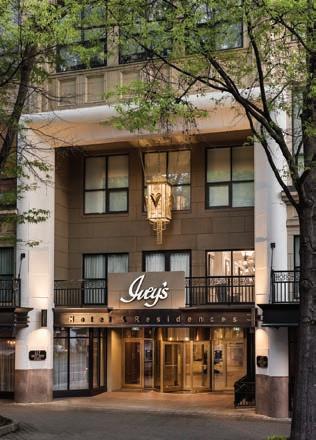
For nearly a decade, this boutique hotel has occupied the iconic 1920s J.B. Ivey & Co. department-store building. Transformed into a 47-room, 4-star stay, The Ivey’s delivers Parisian glamour in the heart of the center city and is consistently recognized as a AAA Four Diamond destination. With its enchanting corridors and twinkling chandeliers, the hotel is tailor-made for the urban romantic — someone who wants to find peace of mind while keeping the thrills and wonder of uptown in reach.
And though you are steps from the city’s theaters and museums, guest rooms at The Ivey’s feature high-tech, soundproof windows designed to keep the busy street sounds exactly where they belong: outside. You can get your fitness on with 24-hour access to the hotel’s 1,500-square-foot fitness center, equipped with Cybex treadmills, Octane ellipticals, a Peloton bike, Hoist strength machines
and a dedicated yoga stretch zone.
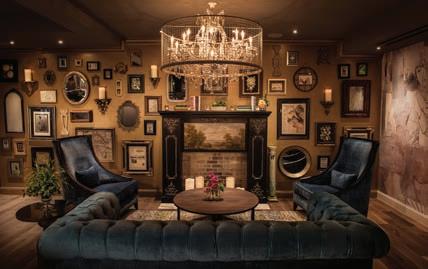
What I love: The Library Lounge. This exclusive space is not accessible to the public and is the perfect spot to read a book, wrap up some creative writing or sip a bespoke cocktail. When you are ready for a full meal, Sophia’s Lounge provides daily breakfast and a sumptuous dinner menu served seven days a week.
While you’re there: Take advantage of the concierge services to secure theater tickets or private transportation. Spend a rainy evening tucked away in a corner of The Library Lounge with a glass of wine, completely disconnected from the bustling streets below.
$$$: $280–500+ a night; parking is valet only.
Whether you’re seeking the feeling of an international escape, wish to shop the day away or steal a few sweet moments for yourself, these 4-star accommodations will take you there. To head into fall feeling perfectly pampered, consider these stays a boarding pass to world-class relaxation. SP









Carrigan Farms in Mooresville now offers a pick-your-own flower field for creating custom bouquets. Reservations start at $15/person and are available at carriganfarms.com. Ernesta, a custom-sized rug company founded by former Peloton executives, opened a showroom at Atherton Mill in South End. Strong Pilates will open a 3,000-square-foot studio this fall at Sharon Square in SouthPark.
maman

French bakery and cafe maman opened at 1711 Commonwealth Avenue in Plaza Midwood and at Atherton Mill in South End. The New York-born concept offers salads, sandwiches and baked goods with vintage decor inspired by the South of France. Omakase Experience by PrimeFish unveiled a new interior design with custom millwork, shoji-inspired details, a new oak counter and more.
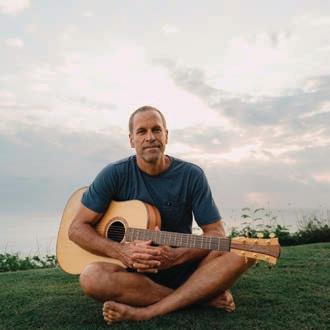
Jack Johnson
We’re going back to the early aughts and feeling a little country.
The Fray with Dashboard
Confessional
Aug. 7
Skyla Credit Union Amphitheatre
Tim McGraw
Aug. 14
For more arts events, check out our Fall Arts Preview on page 67.
The Princess Bride: An Inconceivable Evening with Cary Elwes
Aug. 2
The actor, known for his iconic role in The Princess Bride, shares behindthe-scenes insights from the film at Ovens Auditorium.
In Pour Taste
Aug. 1–16
After sellout shows this spring, the comedians are back at Blume Studios with a wine expert to guide the audience through five tastings and plenty of jokes along the way.
& Juliet
Aug. 11–16
This funny and clever musical flips the script on the classic love story: What would happen next if Juliet didn’t end it all over Romeo? See how she ditches the famous ending for a fresh beginning, at Belk Theater.
Liz Nielsen: Auric
Aug. 5–Sept. 12
The experimental photographer redefines tradition through innovation in the darkroom. The exhibit at SOCO
Truliant Amphitheater
American Aquarium
Aug. 15
Neighborhood Theatre
Luke Bryan
Aug. 22
Truliant Amphitheater
Jack Johnson with Lake Street Dive
Aug. 23
Truliant Amphitheater
Gallery highlights chromogenic photograms Nielsen creates without ever using a camera.
Piece by Piece
Aug. 5–31
This exhibition at Anne Neilson Fine Art highlights the works of Dusty Griffith, Veronica Davila, Katherine Houston, Adele Dillon and Brenda Bogart. Each piece demonstrates the beauty of process and patience — and how a powerful work of art comes to be, one element at a time.
Nikki Glaser: The Stunning Tour Aug. 20–21
The no-holds-barred, award-winning host and podcaster brings her shockingly honest comedy to Ovens Auditorium.
Panthers vs. Texans Aug. 28
Football returns to BofA Stadium as the Carolina Panthers take on the Houston Texans in their first preseason home game. SP
Scan the QR code on your mobile device to stay updated on events at southparkmagazine.com.








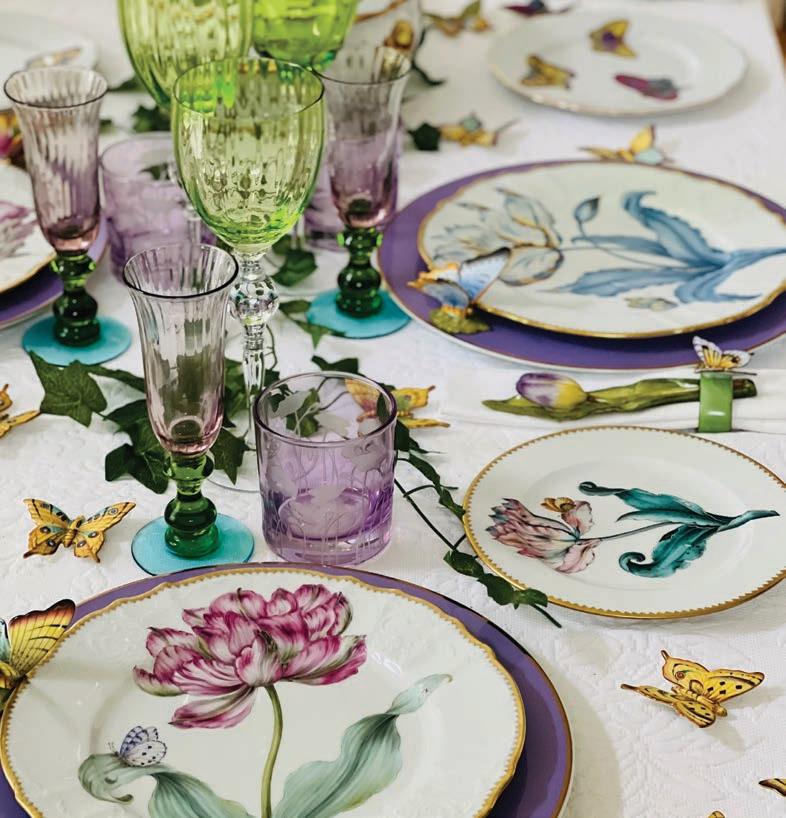



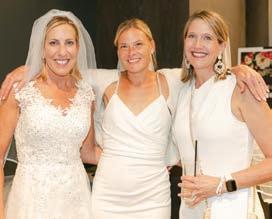



22nd of October 2026


A women’s fundraiser like no other benefiting The Go Jen Go Foundation. TICKETS + SPONSORSHIPS + INFO
compiled by Sally Brewster
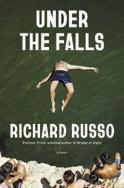
Under the Falls by Richard Russo
When Tyler Sinclair left Stone Mountain at 18, he had no plans of returning. With only a duffel bag full of clothes, a few bucks stolen from his father’s dresser and a guitar, his most prized possession, Tyler disappeared without so much as a goodbye. Eighteen years later, Tyler, now the frontman of a famous band aptly named Stone Mountain, finds himself returning to his hometown for a one-nightonly benefit concert to support his old friend, Doc, who lost feeling in his legs following a childhood accident. As Tyler ascends the mountain, memories of his childhood come rushing back — memories of his abusive father and despondent mother, of the friends he left behind — and he quickly learns that, for many people on Stone Mountain, the past does not feel like so long ago, and not everyone has been eagerly awaiting Tyler’s return.
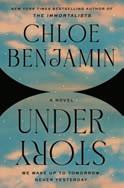
Under Story by Chloe Benjamin
At the edge of the world, biologist Laurel Salter is hiding from everything she’s ever known. For 10 hours a day, six days per week, she works as a dishwasher at McMurdo Station, an isolated research base in Antarctica. She tells no one that before she arrived, she was a renowned young scientist with a promising career and a family. But even in this remote outpost, Laurel can’t escape her past. When a strange light appears across the ice and draws a group of physicists to McMurdo, her former husband, Eli, won’t be far behind. Laurel is captivated by the Arc: its surreal glow; the way it seems almost alive. And though Eli is reluctant to test her wildest theory, Laurel is convinced that the Arc leads down a rabbit hole and into a world they can barely imagine. Can she persuade him to risk everything to fix the burden that hangs between them — to turn back the clock and live their story a second time?
The Rise and Fall of the Artificial State by Jill Lepore
Inspired by Hannah Arendt’s The Origins of Totalitarianism, which argued in 1951 that the machinery of modern life was reshaping the very fundamentals of human existence, Lepore, profoundly disturbed by the technology revolution and by the soulless inundation of artificial intelligence, unfurls a new history for our
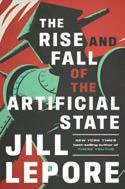
own 21st century. With Orwellian overtones, The Rise and Fall of the Artificial State demonstrates how technology has corroded global democracy, leading to the destruction of both human community and capacity for self-government. Especially sobering with this proliferation of “dizzying, ever-changing schemes, prophesies, and predictions” is that the Artificial State has come at the expense of the natural world, leading to catastrophic loss of wildlife habitat and biodiversity. Despite its abundance of dire facts, Lepore’s book is not a funeral dirge; rather, it’s an inspiring wake-up call, which demonstrates that nothing about the Artificial State was inevitable. It can, Lepore asserts, be dismantled. Other heinous systems, like feudalism, fascism and slavery, have also been dismantled, but disassembly requires identifying the parts, tracing the sources. It requires telling a new history.
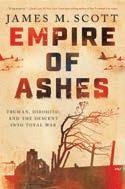
Empire of Ashes: Truman, Hirohito, and the Descent into Total War by James M. Scott
At 9:15 a.m. on August 6, 1945, an American bomber pierced the skies over the Japanese city of Hiroshima. The single bomb it dropped unleashed an atomic hurricane that toppled homes, vaporized birds in flight and carbonized humans. Three days later, a second bomb flattened the port city of Nagasaki. In the span of a mere 75 hours, the United States — a nation once morally opposed to the bombing of civilians — killed 120,000 men, women and children, dooming tens of thousands more to agonizing death in the weeks and months ahead. Empire of Ashes explores the final brutal months of the war in the Pacific, featuring the voices of never-before-heard victims of the atomic bombs. Through interviews with survivors and accounts gleaned from Japanese sources, Scott combines the attacks’ heart-wrenching details with their causes and consequences. Scott also delves into the political maneuvering in Washington and Tokyo between two seemingly unlikely leaders — President Harry S. Truman and Emperor Hirohito — that led to unprecedented violence and, eventually, surrender. SP
Sally Brewster is the proprietor of Park Road Books, 4139 Park Road, parkroadbooks.com.
The good, the bad and the laughable by
Tommy Tomlinson
This time of year provides one of the great pleasures in life: the golf nap.
I’m not much of a fan of watching golf on TV. I’m a huge fan of falling asleep in the middle of the final round of the Zero Turn Radius Lawn Mower Open or whatever the PGA Tour happens to be running on a given weekend.
The long stretches of quiet … the reverent tones of the announcers … the polite applause from the crowd … they’re better than melatonin washed down with warm milk. When I go down for a golf nap, sometimes I dream of my real-life golf adventures. Not that I was a good golfer. Never broke 100 in my life. But I do have a few stories.
I’m just going to come right out and say this one, even though it will sting every real golf lover like a chest hair wax: I played Augusta National, home of the Masters.
If you are not a golf fan, this is sort of like saying I stowed away in an Apollo capsule and walked around on the moon. Mortals are not supposed to do such things. You basically don’t get to play Augusta National unless you are: 1. a pro golfer; 2. a billionaire; or 3. if you know a 1 or a 2.
• Our playing partners accidentally put their cart into a power slide on a wet patch of grass on No. 10. If the course superintendent had spotted them, we might still be serving time.
Except … every year the club has a media day — or used to — where the shlubs who cover the tournament get to play. I’m told it’s a lot tougher to get an invitation now. But in the mid-’80s, if you worked for the Augusta paper — which I did — you got in.
Here are the lights, high and low:
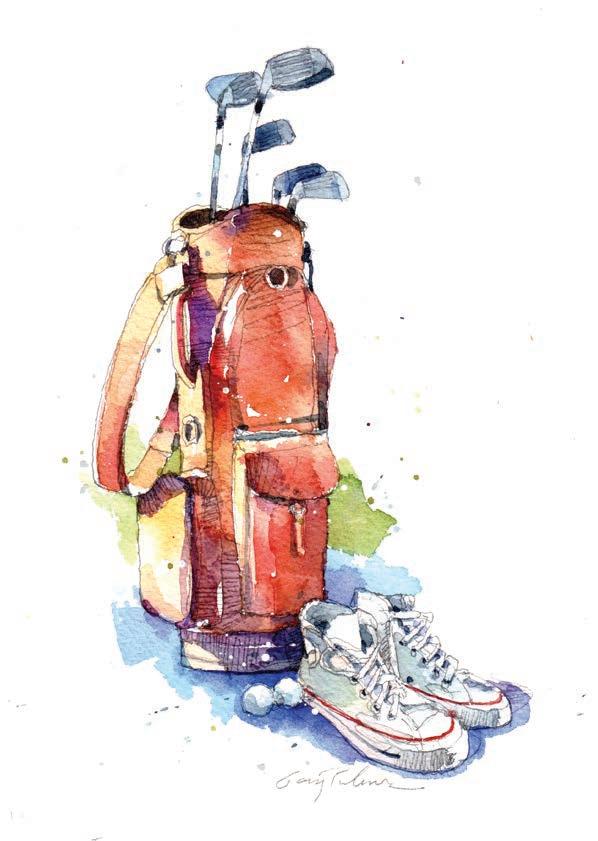
• I played with a set of mismatched clubs and wore a pair of Converse high-tops.
• I carded a tidy 13 on No. 12, the short par-3 famously known as one of the thorniest holes in golf. You know one way to make it thorny? Knock four balls into Rae’s Creek.
• My final score was 118, a tidy 46-over.
• However! I parred No. 16, the par-3 where Tiger Woods holed his famous chip in 2005. Almost birdied it myself. (I told you there was a highlight.)
Believe it or not, that was not my most stressful day of golf. My
most stressful day of golf was a few years later, in 1992, when I followed through on a pitch I made to my editors at the Charlotte Observer: What if I played all the miniature golf courses in Myrtle Beach in one day?
It soon became clear that, barring teleportation, there was no way to play all the courses in the Myrtle Beach area in a day — there were more than 60 back then. So I restricted my playing area to within 10 miles of the old Myrtle Beach Pavilion. That still left 16 sites, some with more than one course. It took 14 hours — which included drive time between the courses, occasional pee breaks, and waiting for two preteen boys who were in front of me at one course and argued after every single hole. Not that I still think about them or anything.
I played 369 holes in 851 strokes. On the last course, I ended up playing with three French tourists. There was no possible way I could explain to them what I was doing.
to punch me. (He didn’t.) I watched a friend get so mad he threw his 5-iron up in a tree, then got his 6-iron stuck up there trying to knock it out.
But my playing career ended on a midweek morning at the old Renaissance Park course in Charlotte, now called the Harry L. Jones Sr. Course. I was playing with some friends who were way better than me. Their drives found the fairway. My drives found the rough and the woods and the out-of-bounds markers. At one point, I drove my cart across the fairway to track down a wayward shot, and a groundskeeper on a tractor roared over to yell at me for driving off the cart path. (Some courses let you stray from the path, others don’t; I hadn’t known the rules for this course.) He said he had a good mind to throw me out. I have enough stress in my life. I don’t need to get hollered at on a golf course by a guy in a John Deere hat.

I had a few other notable moments in my golfing life. I snaphooked a drive onto a cart path one time, and the ball rolled halfway to the next county, a good 500 yards, like that scene in Tin Cup when Don Johnson wins Kevin Costner’s car. I had to shake hands on the first tee of a tournament with a guy who, for reasons too convoluted to go into here, I was pretty sure was going
A few holes later, I hit my best drive of the day — right down the middle. I don’t think I mentioned that one of the features of this particular course is the large boulders in some of the fairways. My shot hit one of those boulders as square as if I’d aimed it there. The ball rolled halfway back to me. My friends tried, and failed, not to laugh.
In that moment, I could hear the golf gods speaking.
Put down the clubs, they said. Go home and have a nap SP

Hare, there and everywhere by
Jim Dodson
Is there anything nicer than a summer evening after a surprise rain shower cools off the world?
I think not. Of course, being in the “evening of life” myself, I am perhaps not an entirely objective source on the matter.
On the other hand, Homer’s grandkids seem to agree with me. Homer is the rabbit that has made my yard his home for several years. Or, at least, that’s what I nicknamed him.
I was sitting here quietly by myself moments ago beneath Old George, our elderly maple tree at the garden’s edge, enjoying the cooler air and an evening drink, when they suddenly appeared — three young rabbits racing directly past me into the front yard, chasing, tumbling and hopping joyfully over each other like a circus troupe of acrobats entering the center ring. I watched them race around until they settled down to nibble grass in the newest section of the yard.
I call them Homer’s grandkids because young kits appear every spring from the burrow where they reside beneath an ancient oak stump near my east garden gate. I have no idea if Homer was the original patriarch (or, for that matter, matriarch) of the burrow, but a decade or so ago he captured our affections by showing up every morning and evening like clockwork to hang out with our old, gray tiger cat, Boo Radley. The two would often sit together in the garden as evening fell, watching the day’s peaceful end. Theirs was an improbable “friendship” that went on for several years until Boo passed on and Homer went, well, wherever aging eastern cottontail rabbits go. I was inspired to write a whimsical book for my own grandkids, wondering at the time if I would ever have some. My artist friend, Harry Blair, drew the illustrations.
Growing up in this very neighborhood, I have a keen boyhood memory of the abundant rabbits in the yards and gardens half a century ago. They clearly preceded humans, and will likely outlive us all.
My mom, a dedicated gardener, liked to say that we were the “newcomers to Rabbit Land,” hence their natural “nibbling rights” in a special section of her backyard garden she set aside for them. She planted things rabbits love to eat — snapdragons, morning glories, daisies and black-eyed Susans — thereby keeping them away from her beloved peony border and roses. Decades later, I adopted a version of her strategy when I built my woodland garden in Maine and included a huge patch of hosta plants at the back of our property, designed to keep the whitetail deer out of my flower beds. It worked like a charm.
Like my mom, I find something comforting and even magical about our neighborhood rabbits. They’re all around us and simply part of daily life here, a reminder that nature is never far away. On an average morning or evening walk around the block, you’re liable to see at least a couple dozen of them feeding peacefully in yards or resting under shrubs, escaping the heat of a long summer day.
I’m sure part of my affection for them stems from growing up in a generation of kids weaned on Beatrix Potter’s beloved The Tale of Peter Rabbit, the classic 1902 children’s book about a mischievous young rabbit who disobeys his mother and gets into big trouble in Mr. McGregor’s vegetable garden. It ends with Peter making a wild escape during which he loses his clothes and is put to bed with chamomile tea while his sisters, Flopsy, Mopsy and Cottontail, enjoy a nice supper. It was a fable meant to remind young ones

to always mind their mama. I still own my childhood copy, which I plan to soon pass along to my new granddaughter, June Bug. The wee book on Homer and Boo will soon follow.
Another book that will wend its way to her is a beautifully illustrated first edition of Richard Adams’ Watership Down, an allegorical adventure story about a group of brave rabbits who set off to find a safe haven after their warren is slated for destruction and development.
Critics uniformly hailed Watership Down as a modern classic by comparing its epic motifs of spiritual faith, flight and survival to Homer’s Odyssey and Virgil’s The Aeneid. Adams himself described it merely as simple tales he improvised during a long family road trip to entertain his young daughters. They pestered him to write down the story, which he eventually did. Rejected by seven major publishing houses before London-based, independent press Rex Collings published it in 1972. Watership Down quickly became a runaway bestseller in both Britain and America.
I read it the summer before my sophomore year in college and still rank it among my favorite books.
It’s no surprise that rabbits have a magical presence across mythology and human culture. The science, lore, mystery and magic of what some believe to be the world’s most misunderstood herbivore have been an integral part of our own evolution as a species.
Rabbits, either hunted or raised domestically, have been revered
for ages for their meat and fur. They are also held in high regard for their prodigious reproductive abilities — averaging four to 12 kits per year. Rabbits reportedly flourish on every continent save for Antarctica.
Seen around the world as symbols of fertility, cunning and innocence, they also appear in the mythology of nearly every human society, from ancient Aztec to Asian. Native American peoples regarded the “Great Rabbit” to be the creator of the world. The rabbit is also one of the 12 celestial animals of the Chinese zodiac, where it is the symbol of longevity, peace and prosperity. Someone born under the sign of the rabbit is believed to be vigilant, witty, quick-minded and ingenious.
In Western society, the Easter Bunny evolved from German folklore. It joins Br’er Rabbit, Alice’s White Rabbit and the immortal Bugs Bunny as iconic figure in our narrative lore. In his unpublished memoirs, Bugs’ creator, Friz Freleng, claimed to have modeled Bugs Bunny on Clark Gable’s wily, fast-talking character in the 1934 hit comedy film It Happened One Night.
This may explain why my neighbors seem to share my affinity for our ever-present rabbits.
Life in Rabbit Land is good.
In a current world that lately seems out of balance and frequently beyond our daily comprehension, the presence of peaceful cottontails at dawn and dusk reminds us of life’s beauty, brevity and sweet hope of renewal. SP









NOV. 3 - 8, 2026
JUNE 15 - 20, 2027
FEB. 9 - 14, 2027

AUG. 10 - 15, 2027
MAR. 16 - 28, 2027
JULY 7 - 18, 2027
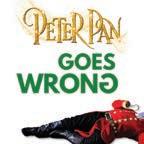
APR. 20 - MAY 2, 2027

SEPT. 7 - 12, 2027
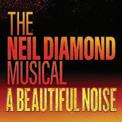
NOV. 27 - 29, 2026


MAY. 7 - 9, 2027
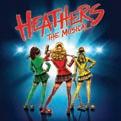
29 - JULY 4, 2027
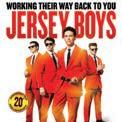
30 - AUG. 1, 2027
24 - 29, 2027
Drake as Ali
This fall, nostalgia rules Charlotte’s cultural landscape by Page Leggett
It’s probably sheer happenstance that several events we’re looking forward to this fall harken back to less turbulent times. Or could it be that we’re all looking for a balm? (And that Charlotte arts organizations are delivering.)
Whether by coincidence or concerted effort, we can take comfort in seeing musicians we’ve loved for decades (James Taylor, Blues Traveler, Indigo Girls), paying tribute to those we’ve loved and lost (Tina Turner, Elvis Presley) or revisiting the indefatigable East German immigrant, Hedwig, who won’t give up on her dreams, no matter how much rejection she faces. If laughter is good medicine, consider Hasan Minhaj and Ronny Chieng (sharing a stage) and John Mulaney (solo) as inoculation against tough times. For good measure, catch Landon Bryant and Mary Ryan Brown sharing their funny observations about Southern culture and colloquialisms.
In December, we’ll share our picks for the holiday season and look ahead to what’s on tap in January and February. Until then, enjoy the cooler days — they’ll be here, eventually — and the warmth of nostalgia.
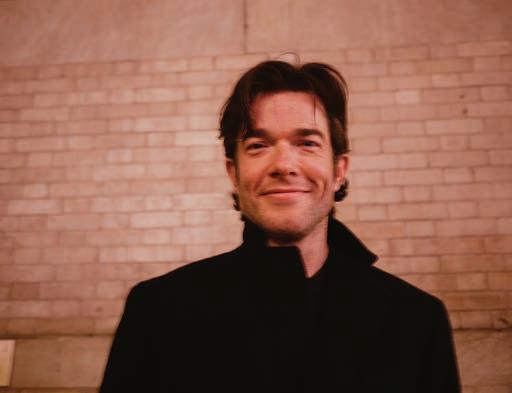
John Mulaney: Mister Whatever, Ovens Auditorium, Aug. 7–8
The Chicago native got an early start in sketch comedy; he was just 7 when he joined the children’s sketch group, “The Rugrats,” in his hometown. At Georgetown University, he joined the school’s improv group and met Mike Birbiglia and Nick Kroll. All three have become kings of comedy, with Mulaney reaching what may be the pinnacle: SNL writer and, later, recurring host. His current tour finds him dishing on his new life as a now-sober husband and father. Mulaney’s self-deprecating schtick is wildly popular, whether he’s riffing on rehab or his mother-
in-law. More info at boplex.com; tickets at ticketmaster.com.
Million Dollar Quartet, Cain Center for the Arts (co-production with Davidson Community Players), Aug. 8–23
On one glorious night in 1956, four not-yetfamous musicians gathered at Memphis’ Sun Records for an impromptu jam session. Before fame led to addiction, rocky marriages and inflated egos, Carl Perkins, Jerry Lee Lewis, Johnny Cash and Elvis Presley — who was only 21 at the time — just enjoyed making music. The recording from that night wasn’t released in the U.S. until 1990. Twenty years after that, a dramatized version of their meeting, Million Dollar Quartet, opened on Broadway. Featuring “Blue Suede Shoes,” “Walk the Line,” “Great Balls of Fire,” and more, this jukebox musical commemorates the only time these four legends played together. If you haven’t visited the spectacular Cain Center in Cornelius, this show makes a stellar introduction. cainarts.org









Mumford & Sons: Prizefighter tour, Spectrum Center, Aug. 9
The folk-rock band formed in London in December 2007. Less than four years later, frontman Marcus Mumford and his mates performed at the Grammy Awards with Bob Dylan and the Avett Brothers, catapulting them to fame in the U.S. Two years later — in 2013 — Babel (their second album), won the Grammy for Album of the Year. It was a meteoric rise, but these guys — all multiinstrumentalists — have talent to spare. At their high-energy live shows, they’ll often switch instruments mid-set. More info at spectrumcentercharlotte.com; tickets at ticketmaster.com.
Sovereignty, Three Bone Theatre, Aug. 21–Sept. 6
In her 2018 play, Mary Kathryn Nagle — lawyer, playwright and descendant of 19thcentury Cherokee leaders — tackles both her own family’s complicated history and one of the most shameful episodes in American history. As a lawyer, Nagle’s interests include tribal sovereignty and violence against women, and both issues are at the heart of her play. Nagle’s Cherokee ancestors played a role in the U.S. government’s forced displacement of about 60,000 Native Americans, known as the “Trail of Tears.” They sold out their own people when they signed the treaty that transferred Cherokee land in Georgia to the United States. Sovereignty juxtaposes systemic violence against an entire

ethnic group with violence against women and shifts between 1835, when the Cherokee Nation was forced from their Georgia home and sent to what’s now Oklahoma, and the present. threebonetheatre.com
Hasan Hates Ronny/Ronny Hates Hasan, Aug. 23, Belk Theater
Just reading the promo makes me chuckle: “During these divided times, many people believe that open dialogue and discourse are the only tools to mend a wounded nation. Comedians Hasan Minhaj and Ronny Chieng believe the opposite: Hatred is the answer.”
Minhaj, the son of Indian Muslim parents, and Chieng, whose family immigrated to the U.S. from Malaysia, despise each other, according to the press release. They have a beef with America, too — they promise to gripe at each other about everything from the economy to immigration and from dating to the race war they say is imminent. The performance that’s “not a call for peace” … but “for pettiness” sounds a lot like Festivus, the Yuletide anticelebration made famous by a 1997 Seinfeld episode. Let the airing of grievances begin! blumenthalarts.org


Blues Traveler, Skyla Credit Union Amphitheater, Aug. 29
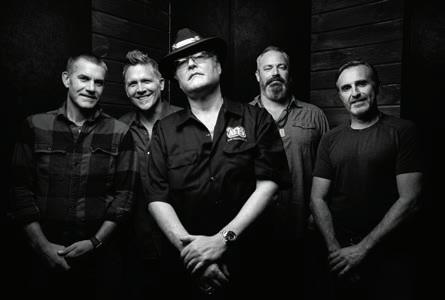
Some fans used to go see the jam band from Princeton, New Jersey, anytime they came through town. They worried it might be their last chance to see lead singer John Popper, who has struggled with his weight since childhood. But after a 1999 heart attack, Popper had gastric bypass surgery, lost over 200 pounds and started living a healthier life. Popper picked up the harmonica in high school after being inspired by the Blues Brothers. He’s now considered a virtuoso of the instrument. Also on the bill: Gin Blossoms and Spin Doctors. It’s the ’90s all over again! More info at skylaamp.com; tickets at ticketmaster.com.
Hell’s Kitchen, part of Blumenthal Arts’ PNC Broadway Lights Series, Belk Theater, Sept. 8–13
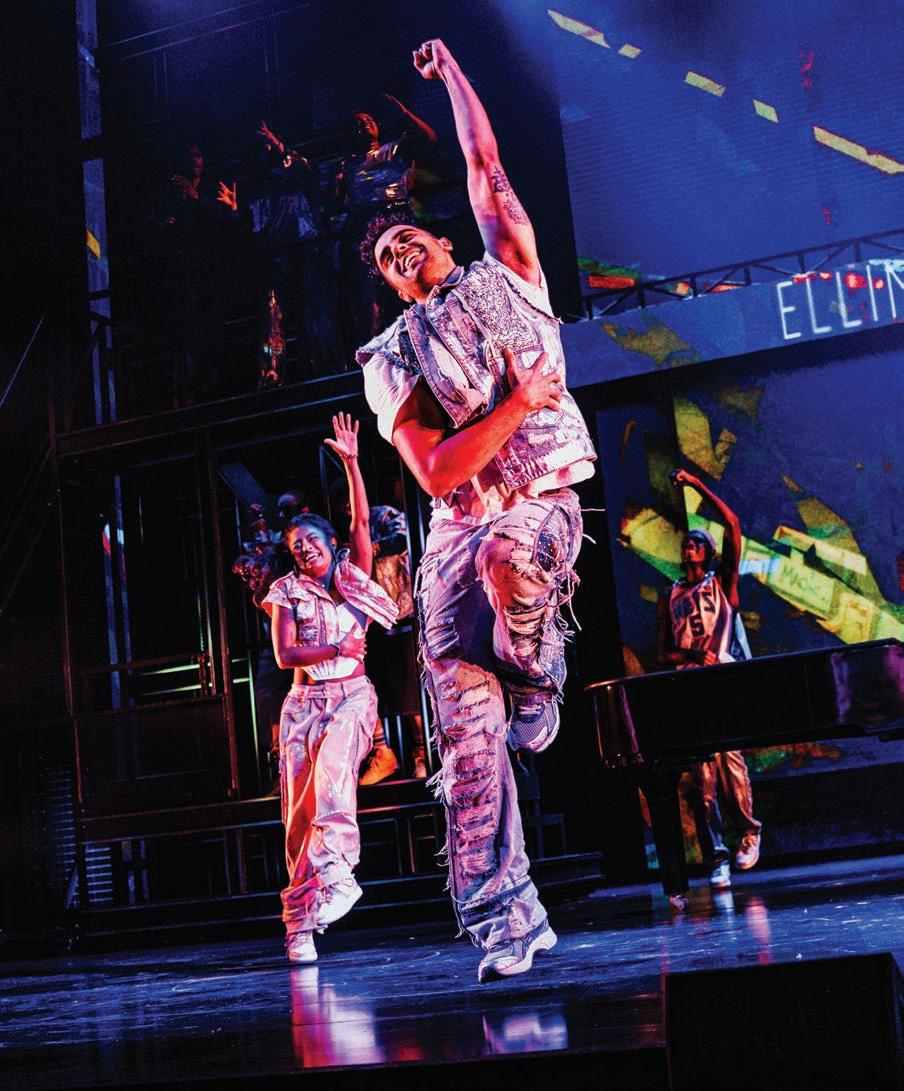
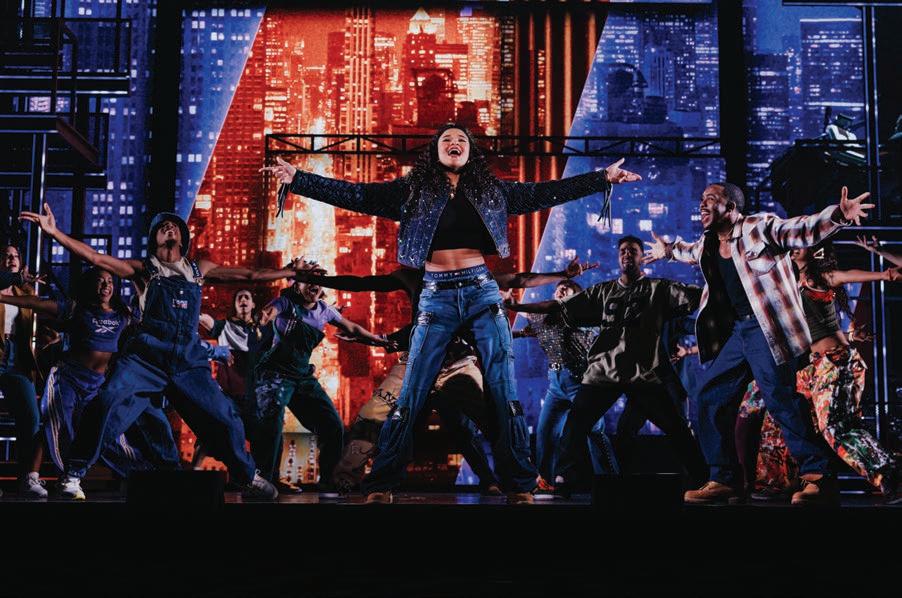
Alicia Keys grew up in the ’90s in Manhattan’s Hell’s Kitchen neighborhood — within spitting distance of Broadway. So did Ali, the heroine of Hell’s Kitchen, the hit Broadway jukebox musical featuring Keys’ music and largely inspired by her life. Ali’s overprotective single mother doesn’t like the street musicians who have become her friends and forces her to break away from them. But, at 17, Ali wants her independence. Her passion for the piano, coupled with the support of a musical mentor, help her navigate her way to adulthood. Hell’s Kitchen, the neighborhood, is practically its own character in this Tony Award-winning musical. Keys’ hits are mixed with new songs written just for the show, and the raw, high-energy choreography draws heavily from street-dance styles you might see on
a Manhattan sidewalk. blumenthalarts.org
James Taylor, Truliant Amphitheater, Sept. 13
He’s a national treasure, but North Carolina gets to claim him as a native son. And he’s given us what really should be North Carolina’s official state anthem. Instead, that distinction goes to William Gaston, the late N.C. Supreme Court justice who wrote the song containing this lyric: “Plain and artless her sons, but whose doors open faster/At the knock of a stranger, or the tale of disaster?”
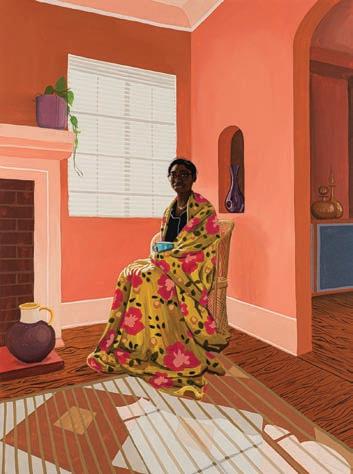
The original JT (before Justin Timberlake) wrote “Carolina in My Mind” while recording in London — in the same studio where the Beatles were recording! — and feeling homesick for the place he grew up. Taylor was nominated for his first Grammy in 1971 and has won several, most recently in 2021 for his album American Standard. His voice is still like a sunny day you thought would never end. More info at truliantamp.com; tickets at ticketmaster.com.
Come From Away, Theatre Charlotte, Sept. 11–Oct. 4
Countless stories of heartbreak and heroism came out of 9/11, a horrific day, but also a day in which the whole world was seemingly on America’s side. Some of the day’s most remarkable stories happened 1,500 miles away from lower Manhattan in tiny Gander, Newfoundland. That’s where all 7,000
passengers aboard U.S.-bound flights were diverted and, temporarily, nearly doubled the town’s population. Gander didn’t have enough hotel rooms for all that unexpected company. So, townspeople opened their homes and hearts to the weary bunch. Irene Sankoff and David Hein, who wrote the book, music and lyrics for the Tony Award-winning musical, highlighted a handful of the most poignant. Come From Away reminds us that, on a day that showed us the worst humanity is capable of, the residents of Gander showed us the best. theatrecharlotte.org
Corey Pemberton: Living Well at Mint Museum Uptown, Sept. 19–Jan. 31, 2027
L.A.-based Corey Pemberton grew up outside D.C. in Reston, Virginia. He said in Garden & Gun that, being mixed-race, he never felt white enough for the white kids at his school. He sought refuge in art. After college, he trained at North Carolina’s famed Penland School of Craft, where he added painting
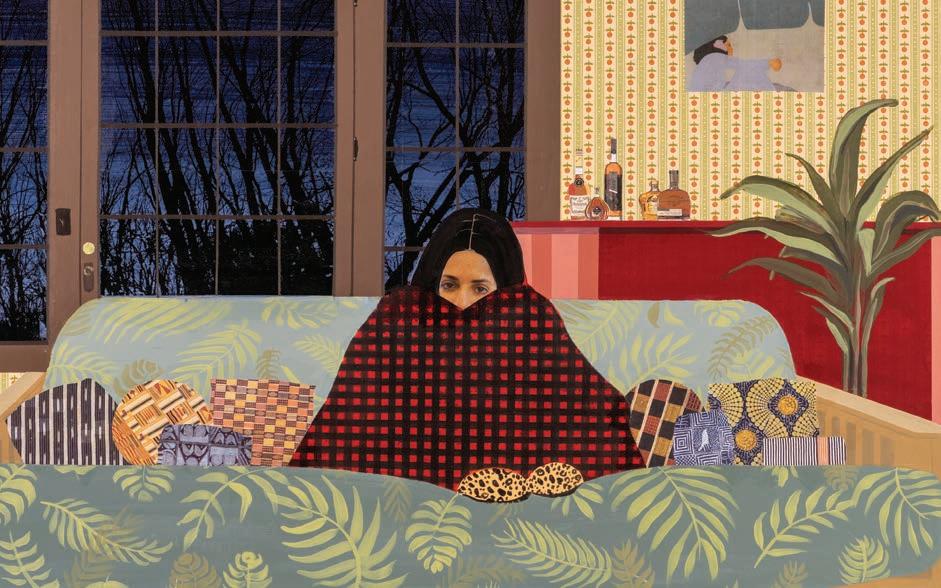

to his extensive repertoire. He says his art celebrates the mundane. Pemberton told G&G: “Black, brown and queer people are often depicted in art in moments of trauma or being extraordinary. A lot of people don’t realize what a privilege it is to be ordinary.”
Corey Pemberton: Living Well includes more than 70 works by the multimedia artist, including paintings, collage, glass, quilts and fiber. In conjunction with the Mint exhibition, SOCO Gallery and Toshkova Fine Art Advisory + Gallery will present a joint solo exhibition of Pemberton’s face jugs and blown glass (SOCO) and portraits (TFAA). mintmuseum.org
Lucy Kaplansky, The Evening Muse, Sept. 24
There must be only a small subset of professional musicians who also earned Ph.D.s. Kaplansky is among them. She got her start singing in New York folk clubs (where she often shared billing with her pal, Shawn Colvin) before earning a doctorate in psychology. NPR called her 2012 album Reunion “a master class in making the personal universal.” Her version of Roxy Music’s “More than This” has been streamed over 12 million times on Spotify, but she’s best known for writing and performing her own songs. She’s written about her mom and dad, her husband and daughter and, in “Keeping Time,” about the Greenwich Village neighbor (“a movie star father” with a “strawberry blond family”) she used to see walking his kids to school. That song was her tribute to the late Philip Seymour Hoffman. eveningmuse.com
Making an Impression: Pioneering Latin American Printmakers, Bechtler Museum
of Modern Art, Sept. 26–Feb. 1, 2027
Printmaking, according to Todd Smith, the Bechtler’s executive director, is “one of the most inventive and forwardlooking mediums of our time.” This major exhibition, produced by Bechtler Curator Katia Zavistovski, helps make that case. The four artists represented — Rufino Tamayo (Mexican, 1899–1991), Jesús Rafael Soto (Venezuelan, 1923–2005), Regina Silveira (Brazilian, born 1939) and Analia Saban (Argentinian, born 1980) — highlight the importance of Latin American artists in pushing the boundaries of printmaking. Silveira, for instance, began her art career in the 1970s during Brazil’s military dictatorship. Her response? Subversive ephemeral art in the form of pamphlets and other “mail art.” Don’t confuse what these artists do with the kind of mass-produced posters you taped to the wall of your college dorm room. Their work is represented in the collections of some of the top museums in the world, including MoMA in New York, The Tate in London and Paris’ Centre Pompidou. bechtler.org
Southern Nights Comedy Tour: Landon Bryant and Mary Ryan Brown, The Comedy Zone, Oct. 13
Landon Bryant is a bestselling author (Bless Your Heart: A Field Guide to All Things Southern) and social-media star (@landontalks on Instagram) whose observations about Southern life and lexicon have earned him legions of fans well beyond the South. The Laurel, Mississippi, native
Analia Saban, Combo Television Unit (One-Continuous Line), 2016, 1-color aquatint, edition of 18, 54 ½ x 41 ½ inches. Courtesy of Gemini G.E.L. Bechtler Museum of Modern Art.
and art teacher by training is a natural storyteller. When his wife grew tired of being an audience of one, she suggested he take his observational humor to the internet. Jennifer Garner and Chrissy Teigen were early adopters, and their fans quickly became his fans, too. For non-Southerners, he helps clarify expressions like “fixin’ to” and “might could.” Bryant’s fellow Mississippian, Mary Ryan Brown, has made Southern culture the centerpiece of her stand-up act and online videos. (Some of her best work involves acting out things Southern mothers might say; her Instagram videos often show her correcting her imaginary daughter, “Taffeta Chiffon.”) Will you bust a gut from laughing? You might could. cltcomedyzone.com
The Music of Tina Turner, Charlotte Symphony Orchestra, Oct. 16–17
Little Anna Mae Bullock from Nutbush, Tennessee, grew up to be the Queen of Rock ’n’ Roll. She had a powerful voice and a stage presence to match. The CSO will give the queen her due when they perform hits ranging from “Proud Mary” to “What’s Love Got to Do with It?” to “Son of a Preacher Man.” The instrumentalists will be joined by vocalists LaKisha Jones, Nova Payton and Armando Imagines in a tribute to an icon who was simply, “The Best.” charlottesymphony.org
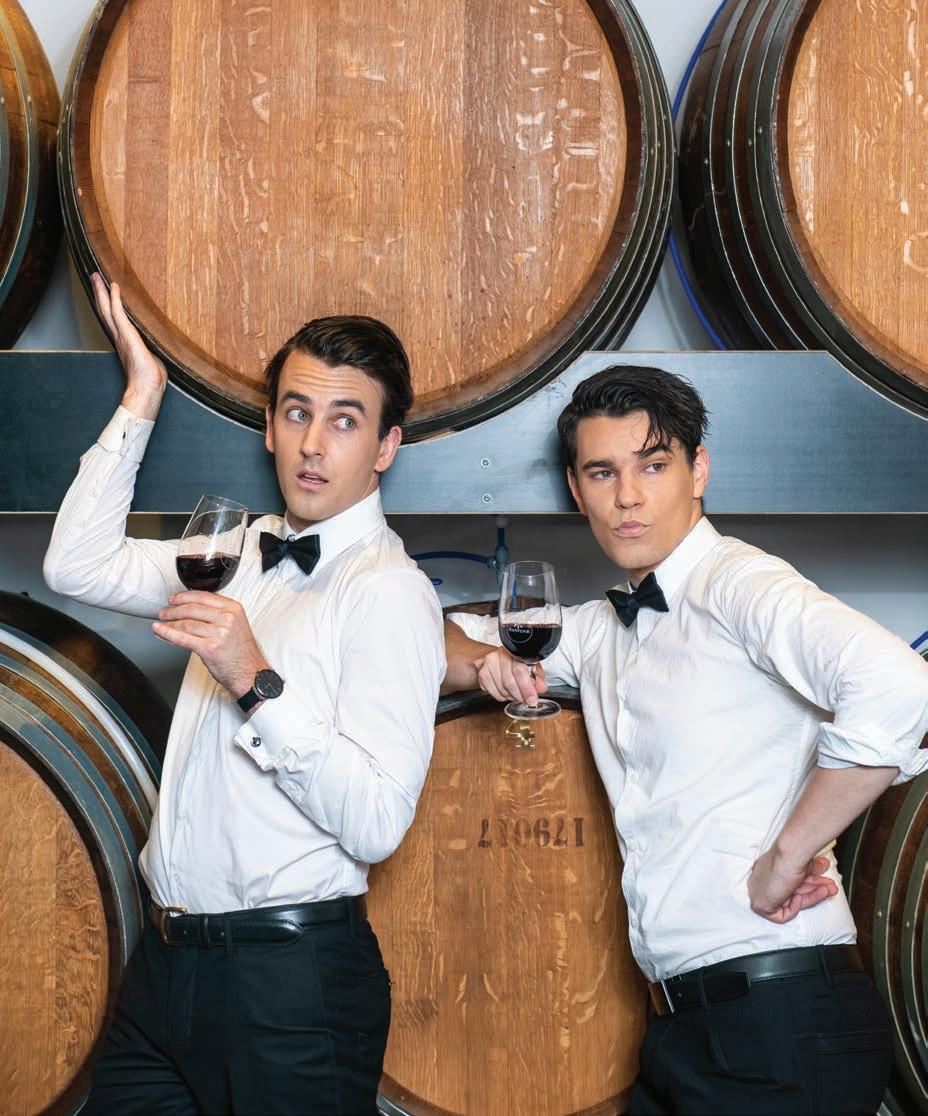

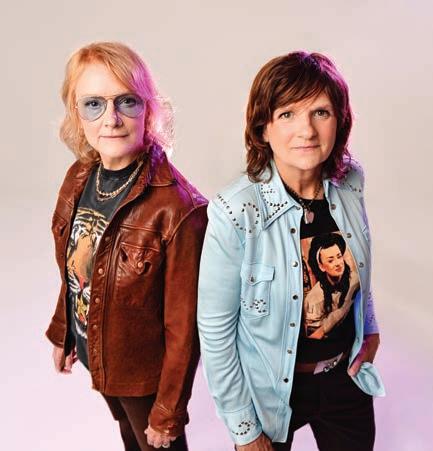
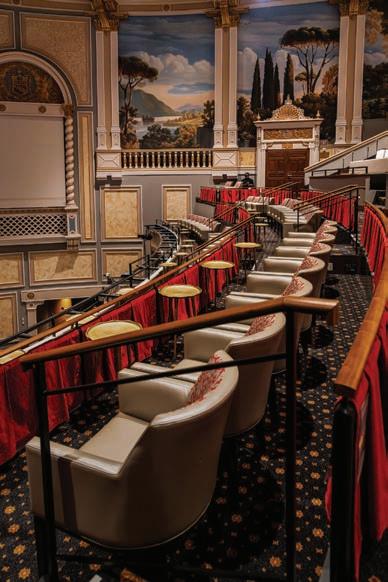
Trampled by Turtles, TD Amp Ballantyne, Oct. 17
Dave Simonett and his bandmates from Duluth, Minnesota, have proven that bluegrass can have major crossover appeal. But their brand of bluegrass may have less in common with Bill Monroe and more with Bruce Springsteen (whose “I’m Going’ Down” TBT covered in 2014 on a tribute album to The Boss). TBT has one of the best origin stories of any band working today. After Simonett’s electric guitar and musical equipment were stolen out of his car, he was left with only an acoustic guitar. Since he could no longer play rock music, at least in the near term, he decided he may as well enter the folk scene. He found a fiddler, an upright bass player and two guys who could play banjo and mandolin. And together, they accidentally became one of, if not the, most successful alt-bluegrass bands in the U.S. ampballantyne.com
Indigo Girls, Knight Theater, Oct. 27
It’s been 37 years since the Indigo Girls released their eponymous debut album. It sold over 2 million copies, and some of us may have played the cassette-tape version about that many times. Emily Saliers and Amy Ray met in elementary school and formed their folk duo while students at Emory University. Critics have chided them for writing overly earnest lyrics, but in an

age when billionaires care less and less about philanthropy, it’s kind of nice to hear two longtime activists sing about helping someone else: “I gotta get out of bed, get a hammer and a nail/Learn how to use my hands — not just my head … I know a refuge never grows/From a chin in a hand in a thoughtful pose/Gotta tend the earth if you want a rose.” The “girls,” now in their early 60s, have sold over 15 million records and amassed a devoted following. If you like musicians to stay out of politics, this isn’t the show for you. But those of us looking for hope — and a sense of nostalgia — will be in the audience once again, singing “Kid Fears” and “Closer to Fine” like it’s 1989. blumenthalarts.org
John Cameron Mitchell: Hedwig 25th Anniversary Movie Tour, The Fillmore, Oct. 27
Hedwig, the tragicomic character created by John Cameron Mitchell for his 2001 cult classic film, Hedwig and the Angry Inch, is as unlikely a heroine as any to grace the
silver screen. The East German aspiring glam rocker (born Hansel) survives botched gender reassignment surgery, escapes the communist regime and tours the U.S. with her band. But while Hedwig is playing decidedly D-list venues like mall food courts, her former protégé, Tommy Gnosis, plays sold-out arenas after stealing Hedwig’s songs. The movie was an unlikely hit when it premiered at Sundance. Next came a hit off-Broadway musical and then a Broadway phenomenon that won a Tony Award for Best Revival of a Musical. To celebrate the movie’s 25th anniversary, Mitchell is touring the U.S. with his film, now being shown in ultra-highdefinition, and sharing behind-the-scenes stories. Learn more at hedwig25.com; buy tickets at fillmorenc.com.
Elegies: A Song Cycle, by QC Concerts, The Long Room, Nov. 13–14
William Finn (who composed Falsettos) wrote
this musical revue in memory of people and pets he had loved and lost, including friends — several who died of AIDS — and in memory of some people he’d never met: the victims of 9/11. The show, consisting of 19 pieces that explore love, loss, death and grief, premiered at Lincoln Center in 2003. Since then, it’s become a favorite among regional theater companies, as it requires only five singers and a piano. As a non-linear “song cycle” (and not a traditional narrative musical), it jumps back and forth in time through Finn’s life rather than following a chronological timeline. Given the subject matter, the tone is melancholy. But there are light, even funny, moments, too. qcconcerts.com
Amelia Earhart, Children’s Theatre of Charlotte, Nov. 14
This historical drama by Kathryn Schultz Miller explores the life and legacy of America’s most famous aviatrix via a reporter who’s determined to find out what happened to her. It’s a premise that hooks the audience immediately and propels the story along as it

Escape to the galleries at Harvey B. Gantt Center for African-American Arts + Culture. Experience works by internationally acclaimed artists and discover handcrafted treasures fashioned by local artisans.


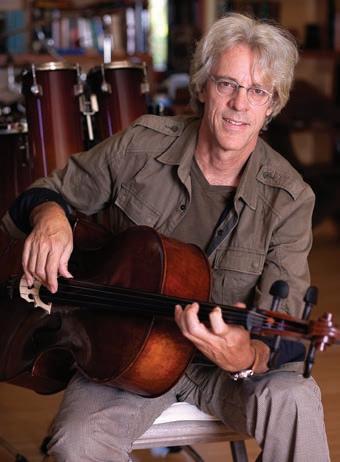
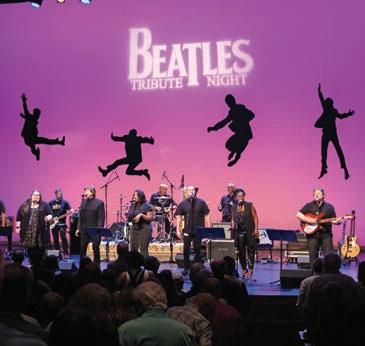


alternates between the sensational headlines about the still-unsolved mystery and Earhart’s own memories of her life on land and among the clouds. The one-act play is a kid-friendly 60 minutes. ctcharlotte.org
Stewart Copeland: Have I Said Too Much?, Carolina Theatre, Nov. 22
The two members of The Police who aren’t Sting took a backseat to their front man. But I always thought Stewart Copeland, the band’s drummer, was the cute one. Most everyone knows that Sting (Gordon Sumner) taught grade-school English and music before becoming a rock legend. But Copeland’s life might be even more interesting. He was born in Alexandria, Virginia, to a British archaeologist mum and an American father who was a spy and founding member of the CIA. Copeland grew up in Egypt and didn’t pick up the drums until after college, so his ranking in Rolling Stone as the 10th best drummer of all time is quite an accomplishment. After The Police broke up, Copeland became a composer, scoring movies (Wall Street), TV shows (“The Equalizer”) and video games. But he’s not playing music on this spoken-word tour. He’s sharing stories, photos and videos. Having lived a life this colorful, he’s got a lot to say. thecarolina.com SP
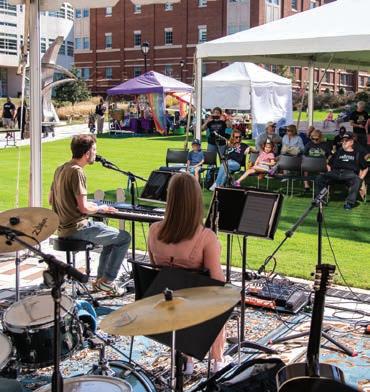


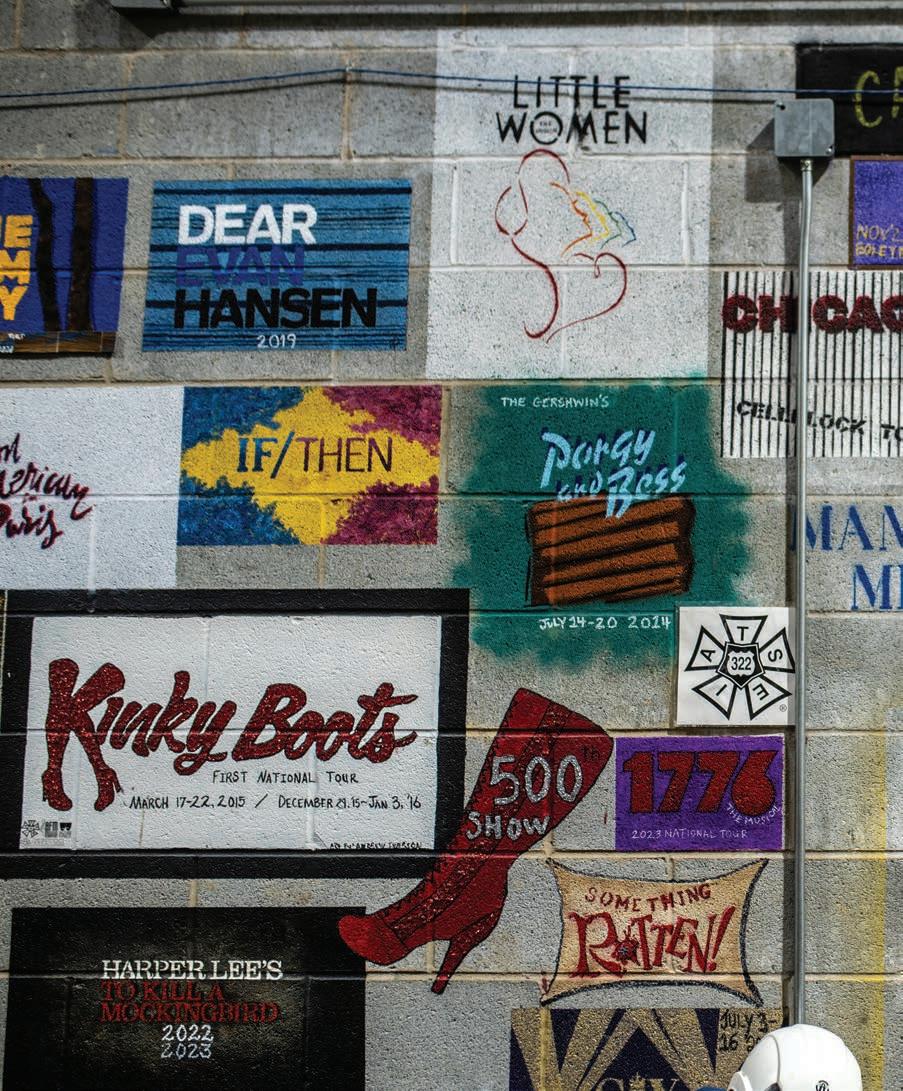

A Broadway backstage tradition endures at Charlotte’s Belk Theater, where a cinderblock corridor is an archive of touring theater history. by Michael J. Solender photographs by Richard Israel
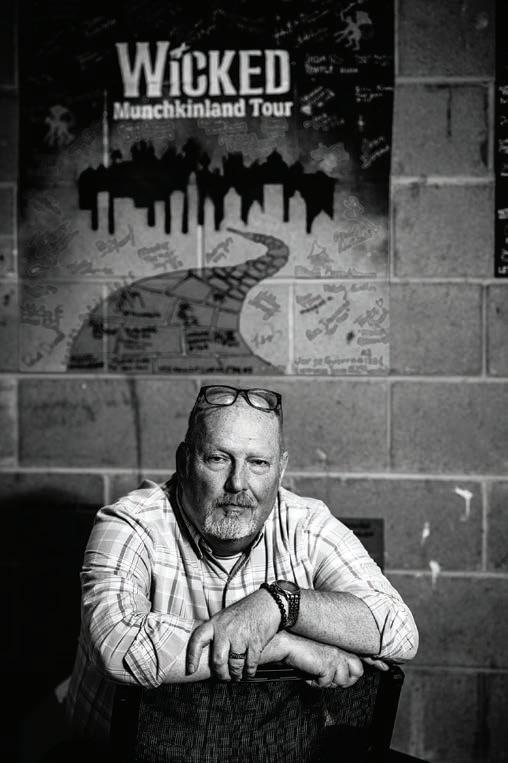
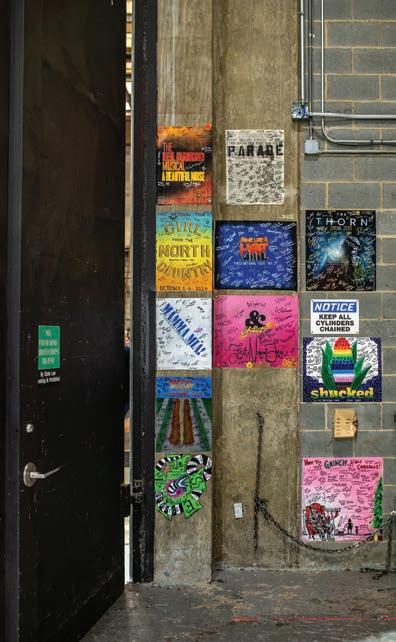
At Charlotte’s Belk Theater, Broadway touring productions don’t begin on stage. They start at the stage door, where cast and crew arrive and make an early stop at an unassuming stretch of cinderblock wall that, over time, has become an informal showcase.
Part time capsule, part signature, the walls backstage at the Belk are a living record of Broadway in motion.
Just beyond the loading dock, amid stage dollies, ladders and prop kits, dozens of colorful show tags — graphic logos like those adorning Playbills, posters and other marketing materials — line the walls. These mini murals, typically signed by members of the cast and road crew, have evolved into an insider ritual of touring productions, decorating hidden backstage spaces in theaters across the country.
According to The Legacy, a theatrical publication from Pennsylvania’s M.S. Hershey Foundation, there’s no definitive origin story behind the practice. Yet many trace it to the mid-1980s at the historic Hershey Theatre, where lighting technicians working touring productions
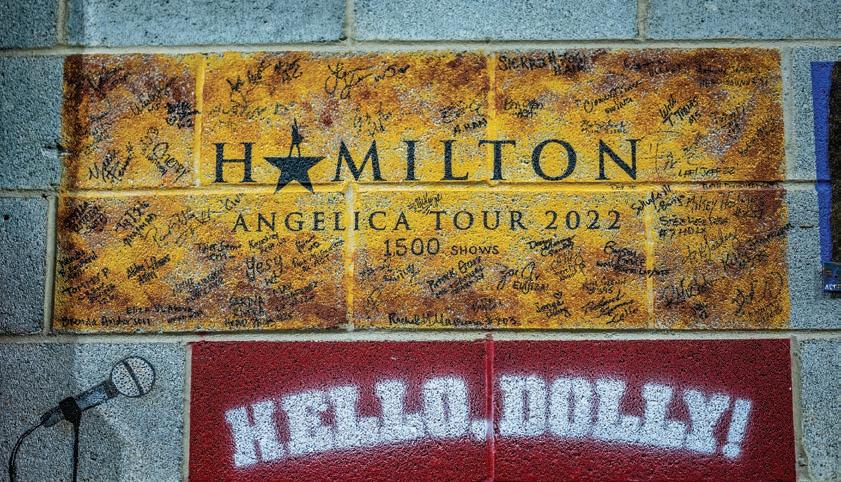
began signing, or “tagging,” the walls of the tiny projection booth. Over time, stagehands and cast members added their own signatures. Decades later, barely an inch of blank wall remains.
“The cast and crew of these shows love arriving at the loading dock and seeing all the tags,” says Tommy Cantrell, director of front of house operations at Blumenthal Arts. “They look for productions they may have been in previously and scout out the shows featuring their friends and castmates. It’s a fun tradition for them.”
For Belk staff, the tradition has become part of the theater’s own backstage identity.
Belk Theater opened in 1992, and Broadway shows, along with their tags, came shortly thereafter. Cantrell estimates there are more than 200 tags here, from Porgy and Bess, Mamma Mia!, The Lion King and Chicago to 1776, Funny Girl, Dear Evan Hansen and To Kill a Mockingbird.
“It makes me proud to know that these shows want to put a tag on these walls,” says Cantrell, who has worked at Blumenthal for more than 25 years. “Sometimes I’m here by myself and just come back through and look.”
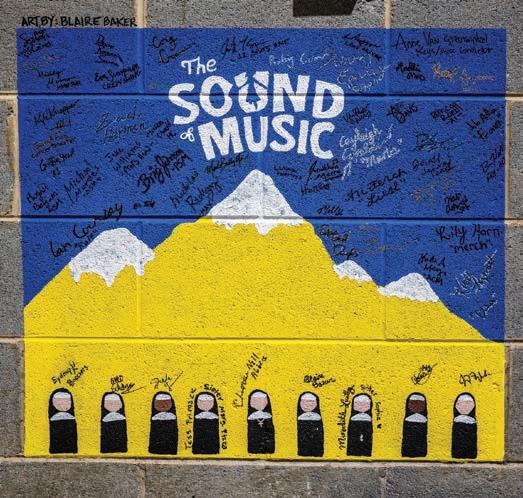
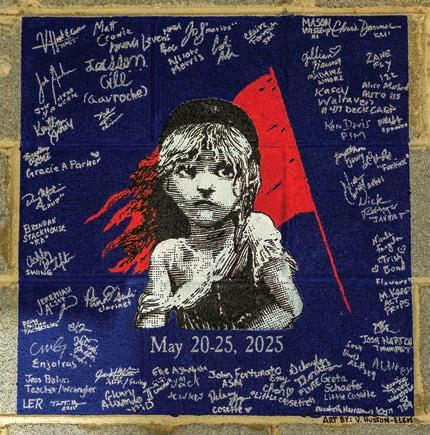
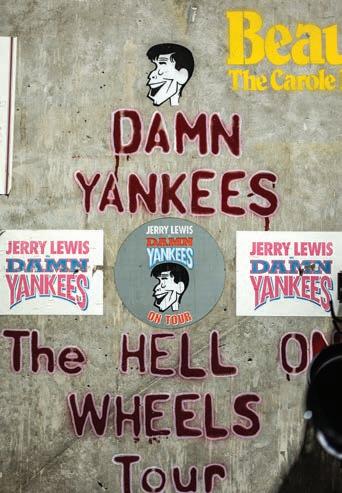
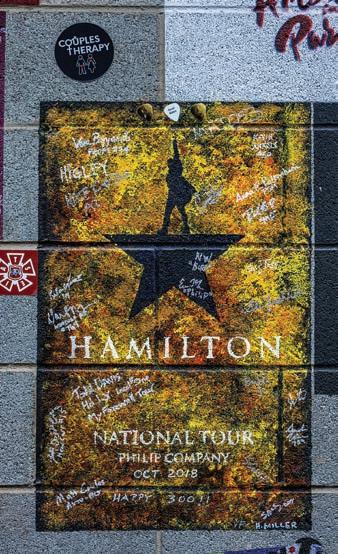
Each tag is hand-painted, though some are fashioned using stencils, Cantrell says. Typically, the tags are painted by the prop departments that accompany the tour, yet it’s not uncommon for other artistic cast or crew members to take the lead or collaborate in the tagmaking. Many are unique for each stop and as individual as each performance.
“They’ve gotten larger over time to allow for cast signings,” Cantrell notes, citing the recent addition of an oversized tag for the 2026 production of MJ the Musical. “Some of the earlier ones don’t have the signatures.”
For touring productions, the tags serve as a marker of ownership and belonging, something cast and crew members want preserved.
While picking his favorite tags is a challenge for Cantrell, he does point with pride to Camelot (2004) with Robert Goulet as King Arthur, Hello, Dolly! (2019) with Betty Buckley in the lead role, Peter Pan (2005) with Cathy Rigby and Jerry Lewis in Damn Yankees (1996).
But the tags carry stories the programs never tell. When Aladdin stopped in Charlotte in 2019, the company marked 1,001 performances of the touring
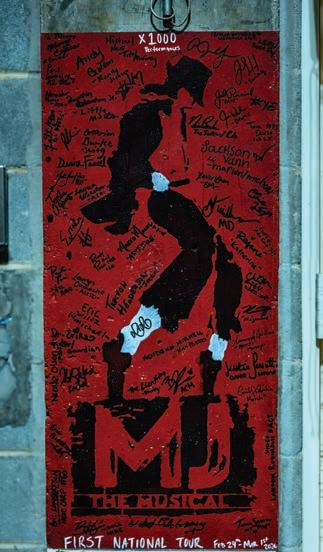
show — a nod to the song “One Jump Ahead” and the oft-cited 1,001 Arabian Nights — by presenting a $1,001 check to local drama teacher Nicole DePietro and with a celebratory backstage party.
During a 2025 run of The Sound of Music, Cantrell recalls catching a group of performers, still in costume as nuns, on their hands and knees painting their own likenesses into the design. And for the Wicked 2025 tour, the crew incorporated each host city into its artwork, with Charlotte’s skyline proudly rendered in the Belk’s version.
Then there’s Swing!. The musical was set to start on Tuesday, Sept. 11, 2001, the same day as the al-Qaeda terrorist attacks on America. It didn’t. It opened the following night instead, the only time that Cantrell recalls a performance has ever been canceled at the Belk. “That tag is a reminder,” Cantrell says quietly.
Hundreds of performers’ names frame the colorful graphic images, and while some of the paint is faded or slightly chipped, the memories remain. Part time capsule, part signature, the walls backstage at the Belk are a living record of Broadway in motion.
The spectacle happens out front. But there’s another show backstage, one Broadway keeps for itself. SP
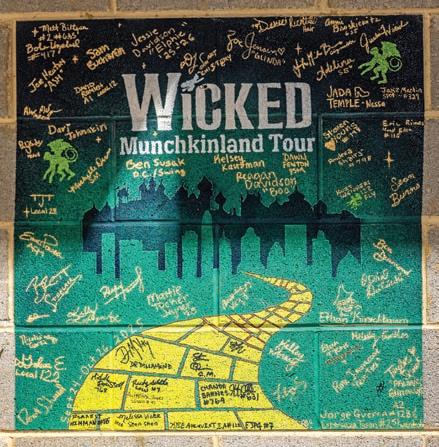
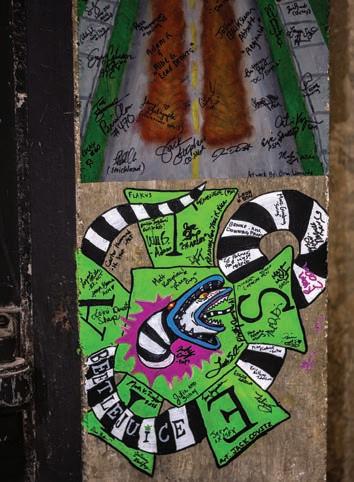
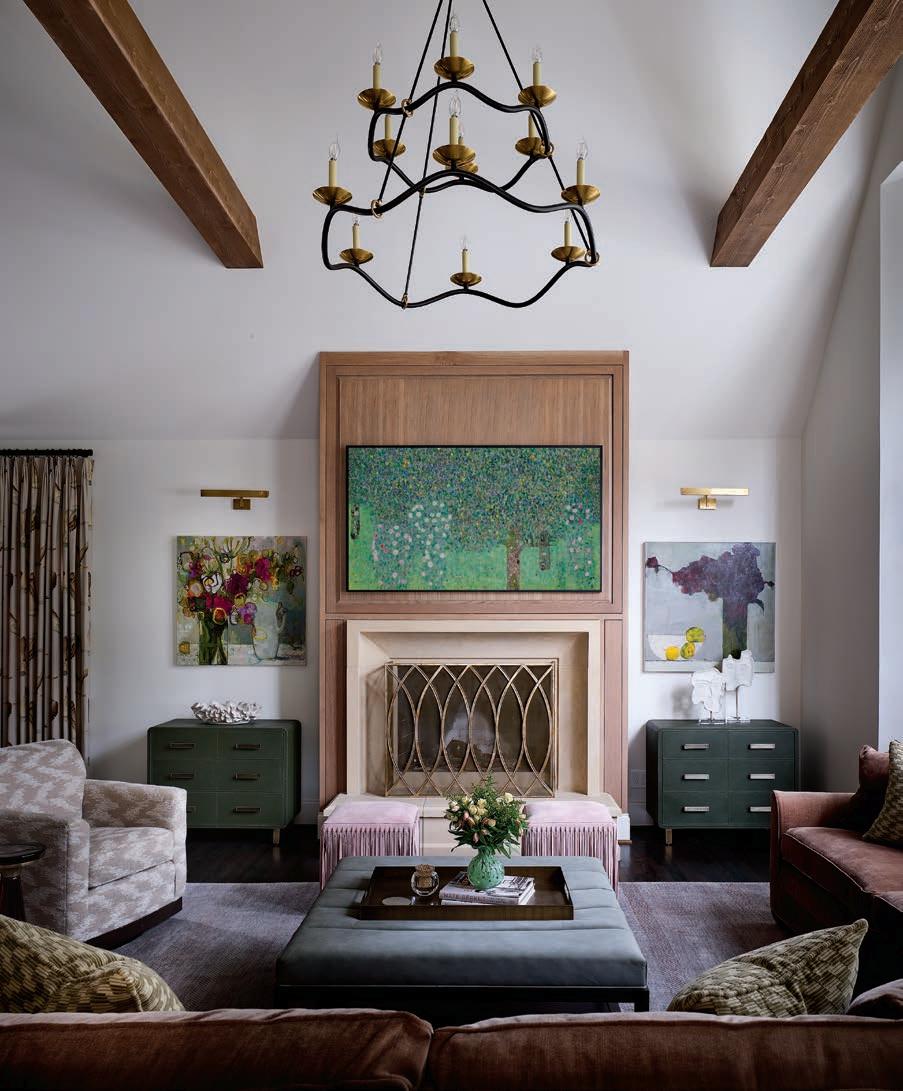
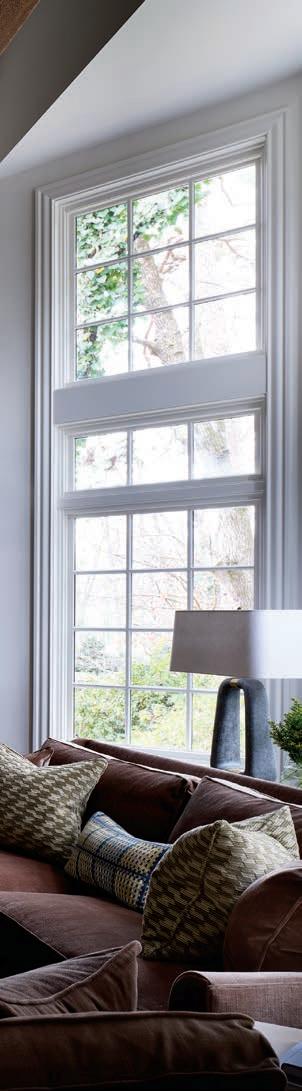
Bird Dog Interiors makes every inch count in this Myers Park remodel. by Kay West photographs by Dustin and Susie Peck

There are aesthetic delights around every corner and through every doorway of the two-story Tudorstyle home in Myers Park where Bird Dog Interiors worked their magic — from a dreamy powder room with a floating marble sink to the sublime sanctuary of the primary suite.
Every item — custom pillows to furniture, lighting to linens, glass-and-steel doors to mosaic tiled floors — was intentionally selected for its place and purpose in the overall scheme of the home.
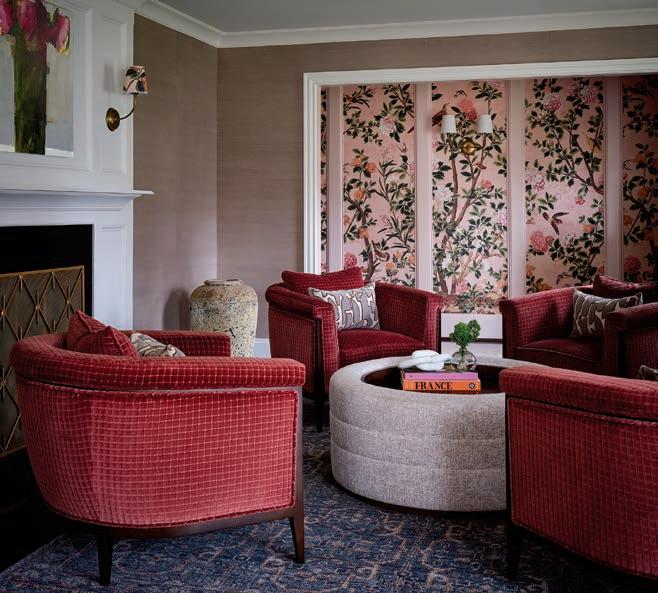

Bird Dog designers and founders Eric Ennis and Jennie Cook-Harper had worked with the client on other projects and homes, so there was already a deep well of trust, imperative for the ambitious renovation.
“They purchased the home, then brought us in to reconfigure the existing space to fit their family of five and very active lifestyle,” Ennis explains. “We got to be really creative with the rooms and spaces that were there and cut into the niches of the Tudor.”
All the family bedrooms are on the second floor, where a laundry room large enough for two washers and two dryers was carved out from half of a media/game room. The other half became a fourth upstairs bedroom so each of the three sons could have their own room. A linen closet was converted to a fourth full bath.
On the first level, another closet tucked under the staircase was reimagined as a 250-bottle wine room, chilled to the perfect temperature and accessed by a custom arched steel-and-glass door by Sightline.
“The prepping and insulating were done from the crawl space,” notes Ennis. “We worked with builder Lake Carter with Hudson
Homes, and he was truly the ‘yes we can’ man. If we dreamed it, they could do it.”
Paneling was removed from the low kitchen ceiling to raise the height and better suit the father of the family, who is quite tall. A small, square island and separate breakfast table were traded for a long island with storage on one end and stools on the other. The island is topped with quartzite, while the perimeter counter and backsplash is a soapstone with a green-grey undertone. The hood over the Wolf range is clad in lightweight plaster, with two alabaster and brass wall sconces from Visual Comfort flanking it.
In addition to making negative spaces functional, the client had a more enigmatic request.
“She wanted us to push her out of her comfort zone,” CookHarper says. “The last house we did for her was very modern, very sleek, and she tends to lean that way. This house is a Tudor style, and while we don’t love to fight the style of a house, we didn’t want dark and traditional.”
Floors throughout the home were dark-stained red oak, so brightening was achieved through paint, wallpaper, lighting and

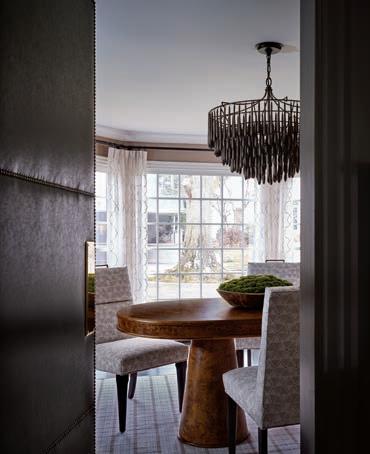
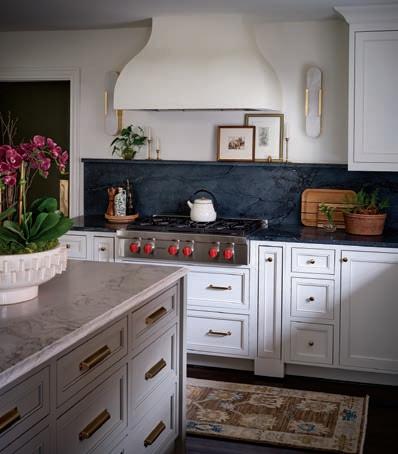

materials. Sherwin-Williams Pearly White creates a canvas for two Lisa Noonis paintings from Anne Neilson Fine Art on either side of the fireplace, where the existing river-rock surround was replaced with light wood paneling and a cast-stone mantel and hearth.
The sitting and dining room walls are sheathed in taupe grass cloth; a Visual Comfort chandelier with sculptural teardrops in a metallic finish warmly illuminates a stunning Made Goods burl-wood table.
Every pattern of wallpaper, from the whimsical peony pink floral by Thibaut in the entry hall to the lagoon-like immersion by Little Greene in the powder room — evokes a mood.
The four-month project was completed just in time for the family to gather round the table for Thanksgiving dinner. Staying on point through the very last detail, Bird Dog left chocolate turkeys on everyone’s pillows when the install was finished. SP





Curaçao’s color-drenched Caribbean remix by Michael J. Solender
Just an hour after stepping off my four-hour nonstop flight from Charlotte into Curaçao, I’m floating on my back in the warm Caribbean Sea, bobbing like a cork just offshore from my temporary home, the Renaissance Wind Creek Curaçao Resort.
There would be time for exploring later. For now, it was the chill factor I’d come for. And Curaçao, one of the Dutch Caribbean’s ABC Islands alongside Aruba and Bonaire, was delivering.
What ultimately distinguishes Curaçao isn’t simply her beaches. The island offers a Caribbean experience layered with Dutch colonial architecture, a diverse arts community, walkable historic neighborhoods and a culinary scene shaped by global influences. Here, pastel-colored waterfront buildings give way to mural-covered alleyways, neighborhood cocktail bars, contemporary galleries and
bistros where Caribbean flavors mingle with European, African and Asian traditions.
Set beside historic Rif Fort, the 19th-century stronghold built to protect the entrance to Sint Anna Bay, the Renaissance Wind Creek pairs waterfront relaxation with easy access to the lively cultural districts of Willemstad, Curaçao’s capital and largest city. Today, the restored fort houses boutiques and cafés, while the resort itself features an infinity pool, private beach, casino and multiple restaurants.
Curaçao’s most dynamic neighborhoods are also nearby. In Otrobanda (“the other side”), bright murals spill across coral-
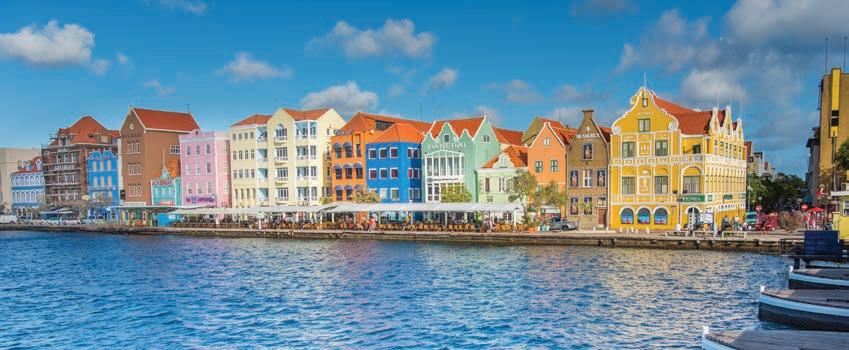
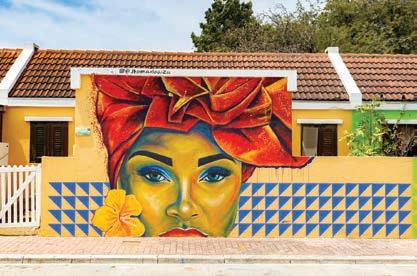

stone facades and sculpture-filled courtyards. Across the harbor in Pietermaai, restored Dutch colonial buildings house cocktail lounges, live-music venues and some of the island’s most soughtafter restaurants.
Midway through my visit, I traded Willemstad’s buzzy flow for the quieter southwestern coast at Coral Estate Rentals’ Cape Marie Luxury Apartments near the village of Sint Willibrordus. The gated seaside community offers a more private experience, with expansive ocean views, easy access to snorkeling and diving sites, and a slower rhythm.
To best understand Curaçao, it helps to begin on foot.
A 90-minute walking tour around Willemstad’s harbor quickly reveals why the city earned UNESCO World Heritage status in 1997. One of only a handful of Caribbean capitals with that distinction,
Willemstad blends a traditional Dutch colonial look with distinctly Caribbean color and energy.
Many of the city’s buildings are constructed from coral stone, a fossilized sedimentary rock often covered in plaster or whitewash; some have become canvases for vivid murals and street art installations.
We crossed the Queen Emma Bridge, a floating pedestrian span known locally as the “Swinging Old Lady.” Resting atop 16 pontoons, the late-19th century bridge swings open regularly to allow ships to pass through Sint Anna Bay.
In the Punda district, I visited the Mikvé Israel-Emanuel Synagogue, consecrated in 1732 and recognized as the oldest continuously operating synagogue in the Western Hemisphere. Adjacent, the recently opened Jewish Museum of Curaçao shares stories of Jewish migration, trade and community life on the island through ceremonial silver, Torah ornaments and centuries-old marriage contracts.
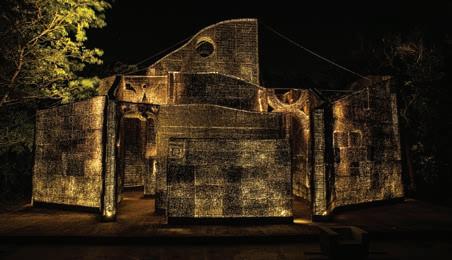
Later that evening, island tuk-tuks — motorized three-wheelers that sit somewhere between a scooter and a souped-up golf cart — whisked my group through Willemstad for an informal neighborhood bar crawl.
Our first stop was Netto Bar, an ultra-casual neighborhood institution in Otrobanda since 1954. Tiny, scrappy and packed with character, the bar remains a favorite gathering place for local soccer fans. Guests here have included members of the Blue Wave (Curaçao’s World Cup-bound team), the late soccer great Pelé and even the Queen of the Netherlands. I sampled its famous Rom Berde (“Green Rum”), a potent housemade spirit infused with anise and botanicals. Medicinal and wildly herbal, it’s clearly an acquired taste.
From there, we headed to Pietermaai, a nightlife district where restored colonial buildings pulse with pubs, music venues and openair dining. At BKLYN, a stylish gastro bar, spicy edamame and rum-forward cocktails set the tone for the evening.
Dinner at Caleo Crudos y Parrilla was a highlight of the trip. Along a lively plaza, fresh crudo and marinated seafood dishes paired beautifully with wood-fired octopus, fish and grilled meats. Several other meals on the island stood out. At Culinary Beach Restaurant at Baoase Luxury Resort, a multicourse seafood-focused meal unfolded beside the water, blending Caribbean ingredients with a refined French technique. Another day, breakfast at Serka Tanchi felt more like eating in my auntie’s home than a restaurant, complete with Caribbean-style chicken and waffles served in a relaxed living-room setting.
With only four full days on the island, I packed in as much exploration as possible.
A half-day sailing excursion with Maxie Sailing Curaçao carried us from Seru Boca Marina into open water aboard a 48-foot yacht captained by skipper Norbert and his first mate, Hilde. Between steady winds, chilled drinks and Hilde’s exceptional pickled

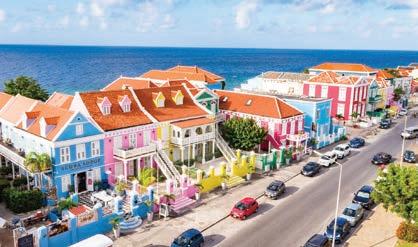
shrimp, the midmorning sail struck an ideal balance between relaxed and indulgent.
Contemporary art and lush gardens weave across the grounds at Landhuis Bloemhof, the former home and studio of Curaçaoan writer and sculptor May Henriquez. Nearby, Dutch artist Herman van Bergen’s Cathedral of Thorns is one of the island’s most striking installations — an open-air labyrinth constructed entirely from thorny acacia branches over more than a decade in the years following 9/11. The structure houses works by other artists in its interior niches.
One of the more unexpected experiences came at Lionfish Caribbean, where invasive lionfish are transformed into sustainable jewelry. During a workshop, I learned how local divers help control the species’ population while artisans repurpose the fish into earrings and other handmade pieces. The lionfish-and-chips served afterward was surprisingly tasty.
I ended my stay at Playa Kalki on the island’s western shore. While stronger swimmers in my group headed out on a guided dive excursion, I spent the afternoon snorkeling in remarkably clear water before retreating to a beach cabana beneath the palms.
Curaçao ultimately feels less like a conventional Caribbean getaway and more like a cultural crossroads, where beach days coexist naturally with contemporary art, Dutch architecture and a layered culinary scene shaped over centuries. SP
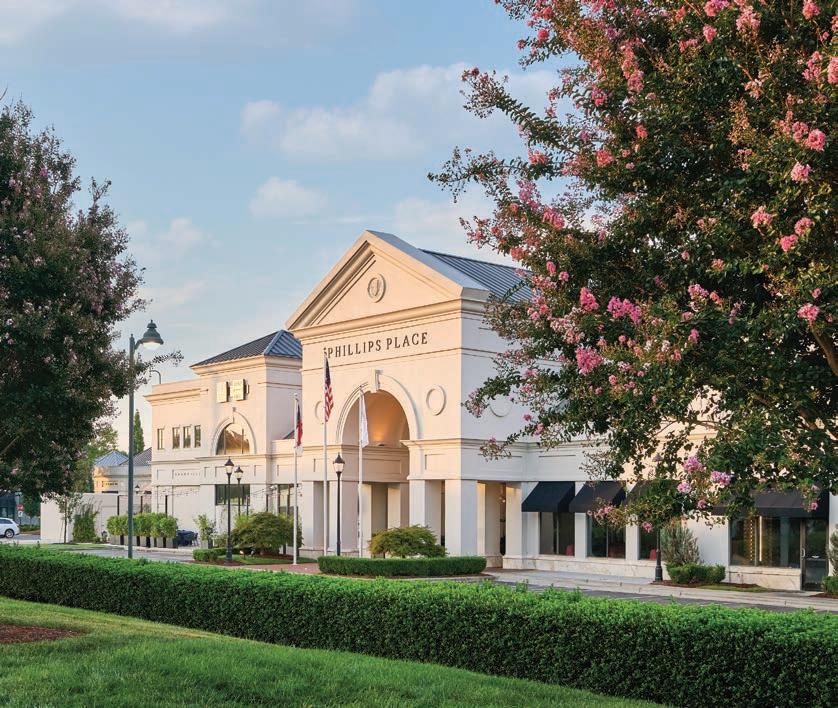
Senior living in Charlotte is about so much more than finding your next home — it’s about finding your people. Here, neighbors become friends, calendars fill with shared experiences and every day brings new opportunities to connect, learn and enjoy life in a community. Whether you’re looking for an active, independent lifestyle or the added comfort of personalized support, our senior living partners offer an array of next steps designed to help you thrive. Beyond choosing where to call home, our partners are here to help with all aspects of transition. From moving management and telehealth services to finding that perfect residence, each of these experts and communities provides the opportunity to embrace the future with confidence.
The Cypress | Whissette Wright | Connery on Providence | The Sharon at SouthPark Erickson Senior Living | Next Chapter Home Group | The Village on Morehead Get CareBridge RX | Blue Star Move Management | Prime Senior Placement | The Magnolia





Welcome to The Cypress, where retirement opens the door to more of what you love.
Retirement isn’t about slowing down — it’s about finally having the freedom to spend your days exactly the way you choose.
Picture mornings spent strolling along our scenic lake beneath the Carolina sunshine, afternoons filled with friendly pickleball matches, mahjong games, fitness classes or shopping excursions, and evenings spent gathering with neighbors over an elegant wine dinner or a casual meal at the Copper Grille. Whether it’s a leisurely Sunday brunch or a special night out with friends, every day at The Cypress is an invitation to stay active, discover new passions, make meaningful friendships and embrace the vibrant lifestyle you’ve worked so hard to achieve.
Life here is as effortless as it is rewarding. Unlike many retirement communities, members at The Cypress own their homes, enjoying the benefits of equity and appreciation while we take care of the rest. From maintenance and repairs — even changing the light bulbs — to weekly housekeeping and linen service, we handle the everyday details so you can spend more time doing what you love. Complimentary transportation throughout campus, as well as to grocery stores and medical appointments, plus home-delivered meals, make daily living even easier. Here, you’ll find more than beautiful homes and exceptional amenities — you’ll discover a welcoming community where neighbors become friends, life is filled with possibility and retirement feels anything but ordinary. And with The Stewart Health Center conveniently located on campus, you’ll enjoy the confidence of knowing a full continuum of care is available should your needs ever change.
At The Cypress, the lifestyle you’ve imagined becomes the life you live.


There is no handbook for helping a parent transition into the next stage of life. One day, everything feels manageable. The next, families are researching senior communities, coordinating home repairs, scheduling movers, speaking with attorneys and trying to make decisions that carry both emotional and financial weight.
A Charlotte resident for more than 30 years, Whissette Wright helps families navigate major life transitions with the experience and compassion of having watched it in her own mother, for her father. As the founder of Whissette Wright Signature Advisory Group, she combines her experience as a licensed North Carolina and South Carolina Realtor with her designation as a Certified Senior Transition Specialist to provide something many families don’t realize they need until they’re in the middle of it: a trusted guide.
Rather than sending families home with a list of communities to research on their own, Wright does the work before the conversation even begins. Wright provides a true concierge service fueled by having personally toured senior-living communities throughout the SouthPark and Ballantyne areas, meeting with leadership teams and
learning the differences between care levels, amenities and pricing so that she can present families with a carefully curated short list based on their unique needs.
Over the years, Wright has built a trusted network of professionals — from senior move managers and estate-sale specialists to organizers, movers, cleaners and contractors — allowing families to move forward without spending countless hours searching for reliable resources. If selling a longtime family home is part of the plan, she also guides clients through that process, ensuring every piece of the transition works together.
Wright understands how quickly adult children can find themselves juggling careers, children and caregiving responsibilities all at once. She believes one of the greatest gifts she can offer is helping families realize they don’t have to shoulder every decision alone.
Equally important is making sure older adults remain active participants
throughout the process whenever possible. Whether it’s discussing where they’ll live next or deciding which treasured belongings will accompany them, Wright believes preserving a person’s voice and dignity is just as important as finding the right residence.
Every family’s journey begins with a conversation. By truly walking alongside families, asking thoughtful questions and understanding the motivations behind the move, Wright develops a personalized roadmap that reflects each client’s priorities, timeline and goals. The result is a transition plan designed specifically for them.
For Wright, this process is about far more than finding the next address. It’s about helping families make informed decisions so that by move-in day, the whole family feels not only supported, but excited about their next season of life.





At Connery on Providence, 55+ living is redefined. Here, residents step into a season of life that is fresh, fulfilling and rooted in connection. At the heart of Connery are the meaningful relationships formed among neighbors. Here, you can expect seats to be saved, waves from across the courtyard and invitations to breakfast or coffee.
Life at Connery is shaped by personal choice. Residents can choose from a full calendar of events, clubs and social activities designed to appeal to a wide range of interests. From weekly favorites like Wine Down Wednesday, mahjong, poker, Pilates, water aerobics, bingo, movie screenings, line dancing, crafting and meditation to organized group outings for lunch and local experiences, there is always something happening that encourages residents to stay active and connected. Every program and visiting vendor is thoughtfully selected with residents in mind, ensuring experiences that are engaging, high-quality and relevant to their lifestyle. The result is a welcoming social environment where it is easy to try something new, build lasting friendships and stay involved in a vibrant, energetic community.
Beyond scheduled activities, Connery also brings in professional speakers, senior-focused experts and educational resources that support lifelong learning and personal growth. Residents have access to programming tailored to their individual interests and needs, whether that means learning a new skill, exploring wellness topics or receiving guidance on the issues that matter most to aging well. This combination of engaging activities, expert-led education and personalized resources creates a well-rounded approach to wellness that helps residents live informed, balanced lives.
The apartment rentals at Connery on Providence are thoughtfully designed with the features today’s active adults want most, offering open, stylish spaces that are both functional and low-maintenance. Step outside your door to indulge in a community designed for both relaxation and recreation. Enjoy an impressive collection of resort-style amenities, including a sparkling saltwater pool, a tranquil Serenity Spa complete with a sauna and indoor spa, pickleball courts, a fully equipped game room and a community garden with raised garden beds.
Connery on Providence also offers future residents a unique way to experience the lifestyle before making a commitment. Through its on-site hospitality suite, prospective residents can enjoy a stay in a fully furnished residence for an evening or weekend, giving them an authentic feel for daily life within the community. Schedule your stay today and discover what it feels like to call Connery on Providence home.




A vibrant future takes shape at The Sharon
Life at The Sharon at SouthPark is about more than choosing a place to live. It is about embracing a lifestyle centered on connection, wellness and continued growth. Situated on a vibrant 28-acre campus in the heart of SouthPark, The Sharon offers beautifully designed residences, exceptional dining, engaging programs and thoughtfully landscaped outdoor spaces, all within moments of Charlotte’s premier shopping, dining and cultural destinations.
As demand for The Sharon’s distinctive independent living experience continues to grow, the community is preparing to break ground in August 2026 on Belmore, a new independent living residence that will bring an exciting addition to the campus. Interest in Belmore has exceeded expectations, and presales have been so successful that The Sharon is now accepting waitlist applications.
Designed with comfort and elegance in mind, Belmore will feature spacious two-bedroom-plus-den apartment homes ranging from approximately 1,700 to 2,600 square feet. Residences will include hardwood flooring throughout living areas, quartz countertops, porcelain tile baths, expansive windows, balconies and ceilings of at least nine feet in the main living spaces. A covered parking garage will provide convenience for residents. The first floor will also include a curated collection of office, retail and restaurant spaces, creating opportunities to gather, socialize and enjoy services just steps from home.

Targeted to open in the second quarter of 2029, Belmore will be connected to The Sharon’s planned Center for Vibrant Living, a transformative wellness destination also scheduled to open in the second quarter of 2029. The enclosed climate-controlled connection will allow residents to move comfortably between buildings regardless of weather conditions while strengthening the sense of community across the campus. Plans for the Center for Vibrant Living include an indoor swimming pool with lap lanes and a lazy river designed for exercise and relaxation, two large fitness studios, a dedicated floor with state-of-the-art exercise equipment, and both indoor and outdoor walking tracks.
“The enthusiasm we’ve seen for Belmore has been remarkable,” says Ann Marie Ladis, director of sales and marketing. “People are excited about the opportunity to be part of a community that continues to invest in wellness, connection and exceptional living experiences.”
Belmore and the Center for Vibrant Living reflect The Sharon’s ongoing commitment to helping residents live with joy, purpose and well-being.
Windsor Run® has everything you need for vibrant senior living.
• Gain time and freedom from house maintenance.
• Enjoy stylish residences and on-site amenities.
• Benefit from a safety net of on-site support.






When one life chapter closes and another opens, where do you turn for help? Next Chapter Home Group steps in when you are facing life’s most challenging transitions. Founded by Todd and Margaret Johnson, REALTORS® and Senior Real Estate Specialists®, the team operates on the belief that no one should have to navigate the challenges of where, what and when, alone.
Working with senior adults living in communities, Margaret noticed firsthand as seniors experienced increased stress levels and higher probabilities of health and cognitive issues as they tried to manage details independently. Next Chapter Home Group was established to guide and support seniors and their families through the process of selling real estate and relocating with dignity and minimal stress.
The team’s first and most important step is to listen. They want to understand the circumstances prompting the move as well as each client’s hopes for life in the years ahead. Whether someone is downsizing, relocating closer to family or searching for a home better suited for aging in place, every recommendation begins with those conversations.
One of the biggest misconceptions about downsizing, the couple says, is that it represents an ending. Instead, they see it as an opportunity for growth and freedom, a chance to simplify, let go of unnecessary burdens, and create space for new experiences, friendships and purpose. Next Chapter Home Group partners with clients, walking alongside seniors and their families with compassion and expertise, making sure every next chapter opens with success.


Enjoy a premier address near the heritage neighborhoods of Dilworth, Myers Park and Eastover. e Village on Morehead’s location has been carefully selected to ensure convenient access to cultural activities, ne dining, shopping, service providers, medical facilities, private clubs, places of worship and area attractions.
e standard for luxury
Retiring in our community o ers impressive, spacious residential apartments, oor-to-ceiling windows and expansive terraces that create a heightened level of indoor-outdoor living. Spaces are designed for entertaining, tness and relaxation, supported by a dedicated team that provides a secure, lock-and-leave lifestyle for members.
Dining is one of the centerpieces of everyone’s day. We o er three thoughtfully designed options: e Morehead Grille, e Cashiers Café and e Cardinal Lounge. Enjoy a wide selection of heart-healthy, quality-ingredient meals that keep you satis ed with every bite. For daily activities, e Village on Morehead o ers plentiful and enriching activities, from board games or bridge, wine tastings, tness classes or even a night at the theater.
Concierge Care at e Village on Morehead elevates wellness by bringing trusted health partners directly to residents. rough our partnership with Bayada Home Health, residents enjoy convenient, private on-site services including personal care, therapy, nursing and companionship. Equity Health provides in-home primary care led by nurse practitioners, o ering personalized medical visits, chronic disease management and preventive care. OnSite Dermatology delivers on-location skin cancer screenings and dermatologic services, reducing the need for o -site appointments. e team at Cannon Pharmacy ensures fast, accurate prescriptions and dependable medication support, while Caregiving Corner o ers expert guidance, resources and support to help residents and families navigate care decisions with dignity and con dence.
When you say yes to e Village on Morehead, you say yes to living an active retirement life. Visit us today to discover home.











•
•
•
• Review supplements for interactions
• Coordinate with your physicians
• Prepare for assisted living or home transitions
• Give caregivers confidence and peace of mind








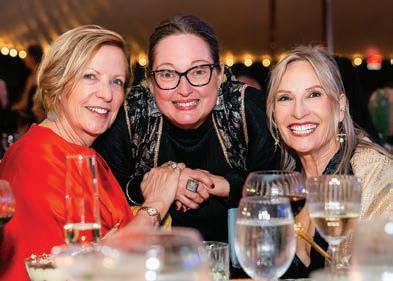
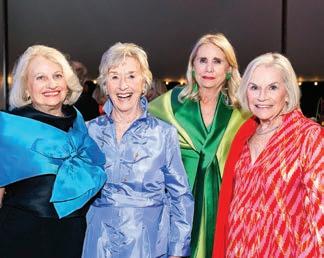

benefiting Mint Annual Fund
Mint Museum Randolph April 25
The Mint’s signature event celebrated Caravaggio | Revolution: Baroque Masterpieces from the Roberto Longhi Foundation, an exhibition highlighting one of the most influential figures in Western art. Mary Lou Babb, Beverly Hance, Jo Ann Peer and Pat Rodgers chaired the event.
photographs by Adam Eugene Photo
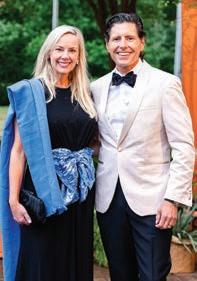

A monthly guide to Charlotte’s parties and galas
benefiting Speedway Children’s Charities Ten Tenths Motor Club
May 20
This sold-out evening raised nearly $2 million and had an auction filled with collectibles like a guitar signed by Eric Church. Grammy Award-winning The Band Perry closed out the night with a performance that got everyone to their feet.
photographs by Daniel Coston
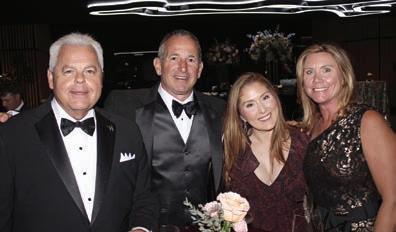
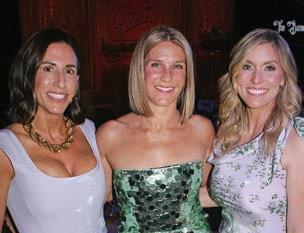
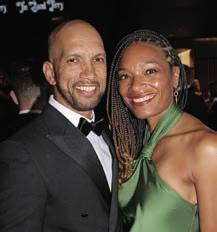
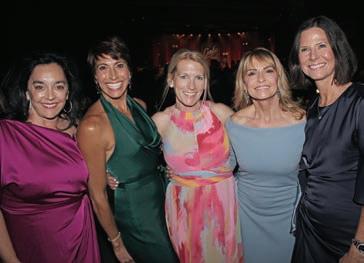




A monthly guide to Charlotte’s parties and galas
benefiting St. Jude Children’s Research Hospital The Revelry North End May 9
This festive evening included celebrity chefs, live and silent auctions, dancing and signature cocktails — all to benefit the lifesaving mission of St. Jude.
photographs by Daniel Coston

presented by Blumenthal Arts Belk Theater May 17
This celebration of local highschool musical theater saw top honors go to Weddington High School (Tier 1) for Legally Blonde: The Musical. Harold Garcia of North Lincoln High School and Anna Jernigan of Carmel Christian won top acting awards.
photographs by Daniel Coston
A monthly guide to Charlotte’s parties and galas
benefiting BraveWorks Legion Brewing SouthPark
June 6
This casual gathering brought community together to support the nonprofit that helps women develop skills to overcome trauma and injustice. The afternoon included a DJ, comedy, light refreshments and a marketplace filled with pieces made by BraveWorks artisans.
photographs by Daniel Coston
benefiting Nourish Up
May 20
Hundreds of supporters attended this annual luncheon held at the nonprofit’s office. Lady Gamecocks basketball coach and bestselling author Dawn Staley led a fun and incisive conversation about life and supporting our community.
photographs by Daniel Coston

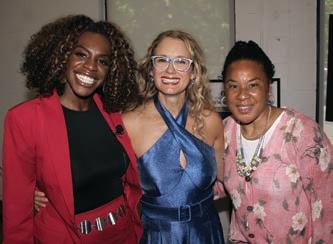
What a sold-out event reveals about culture, work and a generation rethinking success by
Taylor Bowler
Two years ago, Molly Grantham rolled out the first of three Bet On Yourself summits she’s hosted (so far). I’ve been fortunate to attend two of them. Each one was like an invigorating shot in the arm.
The high-energy gatherings motivate people — mostly women — to think bigger, take more risks and stop waiting for permission. Part networking event, part career reset, the summits feature powerhouse speakers and practical advice with the kind of momentum that follows you long after you leave the room.
It’s no great mystery why Molly’s sold-out summits land so well. She’s obviously a big draw. The four-time Emmy winner who spent 20 years at WBTV anchoring the evening news has launched an even bigger career as an author, entrepreneur and keynote speaker. But beyond her visibility, I think she’s tapped into something deeper: a widespread sense of professional uncertainty and disconnection, not just in Charlotte, but everywhere.
As a geriatric millennial (a term I did not coin, though it feels both insulting and accurate) who has lived through multiple “once-in-a-generation” disruptions, this hits home. I suspect I speak for much of the cohort when I say: We are tired. We’re looking for any indication that purpose-driven work is within reach.
work over a higher salary. While no official count exists, a 2024 Innovate Charlotte report suggests more than half of the city’s startups and small businesses are likely millennial-led. This tells me my generation remains willing to take professional risks when it’s tied to autonomy and purpose.
Bet On Yourself 3.0, held in late April, cracked open the same feeling of possibility.
The panelists included a co-owner of the Savannah Bananas, the founder of the BrainTrust women’s networking collective, an executive coach, a board-certified physician and a restaurant server-turned-singer with a voice that brought audience members to tears. Every time one of them discussed a hard-won professional goal, my internal monologue said, Hell yes. There’s something deeply satisfying about watching people who play the long game get their moment.

It’s the same reason I love a Hollywood awards show. Sure, I adore watching celebrities in absurdly expensive outfits stroke each other’s egos for three hours. But what really gets me is a great acceptance speech from someone I’ve been rooting for. Maybe it’s the art-school kid in me, but I’ll always have a soft spot for anyone brave enough to pursue a career with no guaranteed payoff. They hear a hundred “nos” before they ever get a yes.
Growing up, we were told we could be anything, but the world we’ve inherited has repeatedly let us down. We witnessed 9/11 as teenagers, entered the workforce during the Great Recession, got priced out of the housing market, parented through a global pandemic and continue to adapt to new technologies as we wonder if (when?) AI will replace us.
Betting on yourself in this climate is risky, both mentally and financially. But these summits are proof that the impulse to do it anyway is still very real.
Nearly 60% of millennials say they would prioritize meaningful
That, to me, is the best part of these summits. When I see a glimmer of myself in someone who has taken a big swing and think, They deserve every good thing coming to them. And so do I.
Molly ended the summit with the unveiling of The Wave, a new app she built to help her Bet On Yourself community find their people and fuel their next move. By the time I left, 200 people had already signed up. As of this writing, that number has more than doubled.
All of this leaves me hopeful that Charlotte is a city betting on itself, and even in a world shaped by uncertainty, there are still plenty of opportunities to stand out. SP


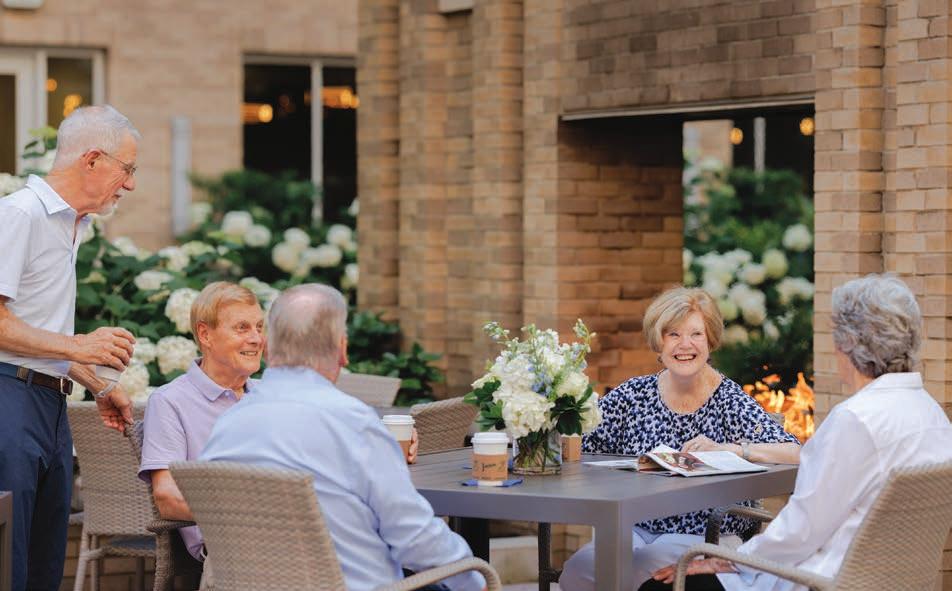
Here, you are surrounded by the bene ts of living among the heritage neighborhoods of Dilworth, Eastover and Myers Park, as well as Charlotte’s leading cultural attractions, shopping, dining and world-class healthcare institutions, including highly rated Atrium Health and Novant Health facilities. e community’s impeccable nishes, elevated level of service, exceptional dining, vibrant social calendar and resort-style amenities make e Village on Morehead a premier address in Charlotte.