2026 SFER Highlights FINAL

Page 1


March 1, 2026

SOUTH FLORIDA ENVIRONMENTAL REPORT 2026

WATER YEAR 2025 (MAY 1, 2024–APRIL 30, 2025) FISCAL YEAR 2025 (OCTOBER 1, 2024–SEPTEMBER 30, 2025)

HIGHLIGHTS

The South Florida Environmental Report (SFER) documents an important year of restoration, scientific and engineering accomplishments in the Kissimmee Basin, Lake Okeechobee, Everglades and South Florida coastal areas. The report also provides extensive peer reviewed research summaries, data analyses, financial updates and a searchable database of environmental projects. The report covers environmental information for Water Year 2025 (WY2025; May 1, 2024–April 30, 2025) and project budgetary and construction information for the South Florida Water Management District (SFWMD or District) for Fiscal Year 2025 (FY2025; October 1, 2024 –September 30, 2025). This year’s SFER Highlights also cover the many achievements and progress made over the past seven years in accelerating key water quality improvements and Everglades restoration projects, in line with the Executive Order 19-12 Achieving More Now for Florida’s Environment, January 2019, Executive Order 23-06 Achieving Even More Now for Florida’s Environment, January 2023, and the Landmark Agreement, July 2025. The full report is available at SFWMD.gov/SFER.

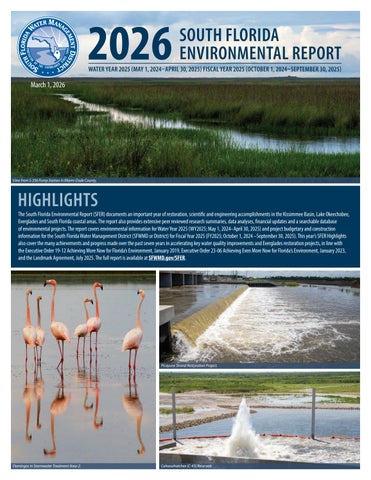
Caloosahatchee (C-43) Reservoir.
Flamingos in Stormwater Treatment Area-2.
View from S-356 Pump Station in Miami-Dade County.
Picayune Strand Restoration Project.

2026 SOUTH FLORIDA ENVIRONMENTAL REPORT

GETTING THE JOB DONE MAJOR CERP PROJECT CALOOSAHATCHEE (C-43) RESERVOIR

The official opening of the Caloosahatchee (C-43) Reservoir in Hendry County, one of the most significant Everglades restoration projects in Florida’s history, took place on July 15, 2025.

Governor Ron DeSantis along with many local, state and federal leaders celebrated the start-up of the 10,000-acre reservoir that will improve water quality, protect coastal ecosystems, and expand Florida’s water storage capacity.

The C-43 Reservoir will hold 55 billion gallons of water and reduce harmful flows of water to the Caloosahatchee Estuary from Lake Okeechobee and the local watershed during the wet season and provide beneficial freshwater flows to the estuary during the dry season. This project is a key component of the joint state-federal Comprehensive Everglades Restoration Plan (CERP) to restore the environment and make our water resources more resilient.

“During my time as governor, we have set new records for investing in conservation, water quality improvements, and Everglades restoration. Today, I was proud to announce the opening of one of the most consequential Everglades restoration projects that Florida has ever undertaken: the Caloosahatchee (C-43) Reservoir,” said Governor Ron DeSantis. “This project will have an impact far beyond the Caloosahatchee. The C-43 Reservoir is a landmark achievement in our broader mission to restore the Everglades, expand Florida’s water storage capacity, and leave this state better to God than we found it.”

of Dam Embankments PROJECT

Store excess freshwater from the local watershed and Lake Okeechobee before it can reach the downstream estuary

Help sustain a healthy nursery for fish in the estuary

Enhance the resiliency of our water resources

PUMP STATION

The S-470 Pump Station is capable of moving more than 650,000 gallons of water per minute from the Caloosahatchee River into the reservoir using four large pumps

Celebrating the completion of the Caloosahatchee (C-43) Reservoir on July 15, 2025. L-R: SFWMD Governing Board Members Jay Steinle, “Alligator Ron" Bergeron and Charlette Roman; Florida Senate President Ben Albritton; Gov. Ron DeSantis; First Lady Casey DeSantis; DEP Secretary Alexis Lambert; SFWMD Executive Director Drew Bartlett; SFWMD Governing Board Chair Chauncey Goss; SFWMD Governing Board Members Ben Butler and Thomas Hurley.
Governor Ron DeSantis at the Caloosahatchee (C-43) Reservoir Ribbon Cutting.
Florida Senate President Ben Albritton at the Caloosahatchee (C-43) Reservoir Ribbon Cutting.
DEP Secretary Alexis Lambert at the Caloosahatchee (C-43) Reservoir Ribbon Cutting.
This means that both the east coast and the west coast of Florida have major water storage projects.
Caloosahatchee (C-43) Reservoir.

2026 SOUTH FLORIDA ENVIRONMENTAL

GETTING THE JOB DONE MAJOR CERP PROJECT BISCAYNE BAY COASTAL WETLANDS

The South Florida Water Management District and the U.S. Army Corps of Engineers along with many federal, state and local officials celebrated the completion of the Biscayne Bay Coastal Wetlands Project. This project improves the health of Biscayne Bay and aids in wetland rehydration — building coastal resiliency and improving water quality in this area of Miami-Dade County.

The Biscayne Bay Coastal Wetlands Project is part of the larger Comprehensive Everglades Restoration Plan (CERP) that aims to restore the quality, quantity, timing and distribution of water within the Greater Everglades Ecosystem. The Biscayne Bay Coastal Wetlands Project includes three components: Deering Estate, L-31E Flow Way and Cutler Wetlands. All components of the Biscayne Bay Coastal Wetlands Project are now finished.

The project includes features in three areas:

u DEERING ESTATE (status: completed and operational)

An extension of the C-100 Spur Canal (under Old Cutler Road) runs fresh water to a new spreader structure, creating a wetland feature that feeds fresh water to existing wetlands and Biscayne Bay. This project component rehydrates the historical sloughs of Deering Estate, restoring a more natural freshwater flow regime.

u CUTLER WETLANDS (status: completion of construction)

The features in this project component culminate in spreader canals to hydrate existing wetlands.

u L-31 EAST FLOW WAY (status: completion of construction)

This project component hydrates existing wetlands east of the L-31 East Levee and Borrow Canal using a system of pumps and flap gated riser culverts to deliver water from the C-102 and C-103 canals more gradually through the wetlands to the coast. Pumps and a spreader system hydrate freshwater wetlands south of Canal C-103.

This project restores freshwater flows to southern Biscayne Bay and Biscayne National Park while improving salinity distribution near the shore. It also restores historical freshwater wetland habitat adjacent to the Bay, which acts like a sponge, soaking up water in the wet season and slowly releasing it in a more natural pattern.

Re-establishing productive nearshore habitat also supports nursery habitat for key marine wildlife including shrimp, shellfish and fish. The project will also deliver freshwater from the C-1 Canal to slowly rehydrate coastal wetlands instead of harmfully discharging it directly into the bay.

“Biscayne Bay is not only an environmental jewel, it’s the economic linchpin of our community and an iconic water body of enormous significance for millions of Floridians. I grew up loving just the sight of Biscayne Bay, and now I'm proud to be a part of a great team protecting and restoring it. It comes with a great source of pride to see the Biscayne Bay Coastal Wetlands Project reach the finish line,” said South Florida Water Management District Governing Board Vice-Chair Scott Wagner. “Thanks to the unprecedented and unyielding support from Governor Ron DeSantis, the Florida Legislature, all of our stakeholders — and of course the District’s hard-working staff — this project will enhance our environmental treasure and economic engine for Miami, coming online to critically improve the health of Biscayne Bay. With the leadership of our Governor, the Legislature and the District, we will continue historic progress and momentum to harmonize the growth of our community with the conservation and protection of our natural resources and waterways.”

Supporting the health of Biscayne Bay remains a priority for the South Florida Water Management District. In partnership with the Florida Department of Environmental Protection, the South Florida Water Management District also works to reduce litter and debris from reaching the bay through the regional canal system.

Additional restoration efforts are being planned within the Comprehensive Everglades Restoration Plan in the Biscayne Bay and Southeastern Everglades Ecosystem Restoration (BBSEER) Project in partnership with the U.S. Army Corps of Engineers.

PROJECT BENEFITS

Reestablishes connectivity between freshwater and saltwater wetlands

Improves salinity regimes across coastal habitat

Minimizes damaging point source (canal) discharges to the bay

Delivers fresh water to historical tidal creeks

Hydrates areas susceptible to hypersaline conditions during extended dry periods

Helps to build coastal resilience to storms and rising sea levels

SFWMD Vice-Chair Scott Wagner at the Biscayne Bay Coastal Wetlands Project Ribbon Cutting.
Woodstorks, roseate spoonbills and green sea turtles are just some of the wildlife in the habitats of freshwater wetlands (sawgrass marsh), saltwater wetlands (mangrove forests) and the nearshore seagrass meadows.
Woodstorks.
Roseate spoonbills. Green sea turtle.
Celebrating the completion of the Biscayne Bay Coastal Wetlands Project on December 9, 2025. L-R: SFWMD Governing Board Members Ben Butler and Thomas Hurley; Biscayne Bay National Park Superintendent Sarah Hopson; SFWMD Executive Director Drew Bartlett; Former SFWMD Governing Board Member Irela Bague; SFWMD Vice-Chair Scott Wagner; SFWMD Chair Chauncey Goss; USACE Col. Brandon Bowman; Cutler Bay Mayor Tim Meerbott; Everglades Foundation CEO Eric Eikenberg.

2026 SOUTH FLORIDA ENVIRONMENTAL REPORT – Highlights

GETTING THE JOB DONE

MAJOR CERP PROJECT PICAYUNE STRAND RESTORATION PROJECT

The South Florida Water Management District, the U.S. Army Corps of Engineers and the Florida Department of Environmental Protection along with many other federal, state and local officials, partners and stakeholders celebrated the completion of the Picayune Strand Restoration Project in Collier County.

Spanning 55,000 acres between Alligator Alley and Tamiami Trail in Southwest Florida, this restoration project is the result of years of collaboration among U.S. Army Corps of Engineers and the South Florida Water Management District, as well as many local, state, and federal partners. Through the removal of 260 miles of roads and plugging 48 miles of canals, the project has successfully restored the natural flow of water to the region, revitalizing wetlands and improving overall water quality.

In the 1960s, more than 85 square miles of wetlands in Collier County was drained for a failed real estate development called Southern Golden Gate Estates. Road construction and canal excavations severely impacted the area, reducing aquifer storage, increasing freshwater discharges to estuaries in the Ten Thousand Islands, disrupting native plant communities, and increasing the frequency of wildfires.

This project will improve flows of water into Collier Seminole State Park, Ten Thousand Islands National Wildlife Refuge and the Rookery Bay National Estuarine Research Reserve.

“Historic Achievement. Monumental Day. Collaboration at its finest! We have worked for decades to get to the finish line of this vital Everglades restoration project,” said Charlette Roman, South Florida Water Management District Governing Board Member and Chair of the Big Cypress Basin. “I am enormously grateful to every single person who worked on this project every step of the way. The momentum we have seen under the leadership of Governor Ron DeSantis is truly amazing. In recent years, we have seen many large-scale projects come on-line, with more in the works. Only by working together with the U.S. Army Corps of Engineers and all of our federal, state and local partners and stakeholders can we accomplish these monumental feats of engineering, planning and construction. I am so proud to be a part of the critical effort to restore America’s Everglades and can finally say, we completed the Picayune Strand Restoration Project!”

The Picayune Strand Restoration Project restores surface water flow to these vital wetlands and supports numerous environmental benefits including:

u RESTORATION OF WETLANDS that are already making a significant contribution to the landscape of Southwest Florida

u RESTORES AND ENHANCES HABITAT for fish and wildlife including the Florida Panther

u REDUCES DRAINAGE of adjacent sensitive ecosystems

u IMPRO VES AQUIFER RECHARGE to protect underground water supplies and prevent saltwater intrusions

u REDUCES FRESHWATER RELEASES to improve health of downstream estuaries

u PRO VIDES LONG-TERM BENEFITS will ensure that the region’s natural resources are safeguarded for generations to come

The Picayune Strand Restoration Project is a partnership between the U.S. Army Corps of Engineers and the South Florida Water Management District. In 2009, it was the first Project Partnership Agreement that the U.S. Army Corps of Engineers executed with the South Florida Water Management District as part of the Comprehensive Everglades Restoration Plan.

CERP projects are coming online at a historic pace and significant progress continues to be made to implement projects that support the ecological health of Florida’s unique ecosystem.

Celebrating the completion of the Picayune Strand Restoration Project on January 28, 2026. L-R: SFWMD Executive Director Drew Bartlett; USACE Jacksonville District Commander Brandon Bowman; Conservancy of Southwest Florida President and CEO Rob Moher; SFWMD Governing Board Chairman Chauncey Goss; SFWMD Governing Board Member and Chair of the Big Cypress Basin Charlette Roman; U.S. Rep. Mario Diaz-Balart; Assistant Secretary of the Army for Civil Works Adam Telle; DEP Secretary Alexis Lambert; SFWMD Governing Board Member "Alligator Ron" Bergeron; USACE Major General Jason Kelly; SFWMD Governing Board Member Ben Butler and USACE Jacksonville District Major Cory Bell.
SFWMD Governing Board Member and Chair of the Big Cypress Basin Charlette Roman at the Picayune Strand Restoration Project Ribbon Cutting.
Turning on the pumps at the Picayune Strand Restoration Project.

ACCELERATING EVERGLADES RESTORATION

LANDMARK EAA RESERVOIR AGREEMENT SIGNED BY GOVERNOR RON DESANTIS

SUCCESSES SINCE THE AGREEMENT WAS SIGNED:

State of Florida groundbreaking of the Blue Shanty Flow Way, a crucial component of Everglades restoration in September 2025.

U.S. Army Corps of Engineers ribbon cutting to celebrate the completion of the inflow/outflow canal and the seepage canal at the EAA Reservoir Project in September 2025.

State of Florida groundbreaking of the new inflow pump station at the EAA Reservoir Project in November 2025.

CERP Framework - Implementing the agreement between the Department of the Army, Florida Department of Environmental Protection, and South Florida Water Management District regarding the Comprehensive Everglades Restoration Plan.

This agreement reflects a shared commitment between the State of Florida and the Department of the Army to get the job done and done right!

Governor Ron DeSantis announced that the State of Florida and the U.S. Department of the Army reached a landmark agreement to accelerate Everglades restoration, including the “crown jewel” of Everglades restoration – Everglades Agricultural Area (EAA) Reservoir.

The EAA Reservoir, located south of Lake Okeechobee, will store over 78 billion gallons of water – larger than Manhattan – and deliver up to 470 billion gallons of clean water annually to the Everglades and Florida Bay. It also supports the Biscayne Aquifer, the primary source of drinking water for South Florida.

For decades, Florida’s water system was altered to prevent flooding, but at the cost of cutting off the natural flow of water to the Everglades. This project is designed to correct that – redirecting water south, restoring ecosystems, and significantly reducing harmful discharges to the Caloosahatchee and St. Lucie estuaries.

The new landmark agreement will:

u ACCELERATE THE EAA RESERVOIR’S CONSTRUCTION TIMELINE by five years—from 2034 to 2029.

u AUTHORIZE FLORIDA TO CONSTRUCT THE INFLOW PUMP STATION, along with other supporting features, enabling the U.S. Army Corps of Engineers to focus on the main reservoir basin at the EAA Reservoir Project.

u ALLOW FLORIDA TO ASSUME RESPONSIBILITY FOR THE BLUE SHANTY FLOW WAY, a vital system to deliver clean water south across the Tamiami Trail and into Florida Bay.

u ENABLE FLORIDA TO MANAGE FUTURE CERP PROJECTS, through expedited permitting and updated federal memoranda of understanding.

u CUT FEDERAL RED TAPE and redirect resources to fast-track critical restoration efforts.

Since taking office, Governor DeSantis has made restoring the Everglades and improving water quality a cornerstone of his administration. On his second day in office, he issued Executive Order 19-12, which committed $2.5 billion over four years for water quality and Everglades projects. That goal was exceeded in his first term, with $3.3 billion invested—more than the previous 12 years combined.

In his second term, Governor DeSantis continued this momentum. With $1.4 billion included in this year’s FY 2025-26 Budget, the state has now committed $4.6 billion in the first three years of the term, putting Florida on pace to exceed his $3.5 billion second-term goal. Altogether, nearly $8 billion has been invested since 2019 in Everglades restoration and water quality.

Celebrating the groundbreaking of the Blue Shanty Flow Way on September 10, 2025. L-R: SFWMD Governing Board Members Ben Butler, Thomas Hurley and “Alligator Ron" Bergeron; SFWMD Executive Director Drew Bartlett; Gov. Ron DeSantis; USACE Major General Jason Kelly; DEP Secretary Alexis Lambert; SFWMD Governing Board Member Charlette Roman.
Signing of the Landmark EAA Reservoir Agreement with the U.S. Department of the Army on July 18, 2025. L-R: DEP Secretary Alexis Lambert; SFWMD Governing Board Members Ben Butler, Charlette Roman and “Alligator Ron” Bergeron; Everglades Trust CEO Anna Upton; Gov. Ron DeSantis; Rep. William “Bill” Conerly; Bonefish & Tarpon Trust Vice-President Kellie Ralston; USACE Major General Kimberly Colloton; Acting Assistant Secretary of the Army (Civil Works) Lee Forsgren; USACE Jacksonville District Commander Brandon Bowman; SFWMD Executive Director Drew Bartlett.
EAA Reservoir Project Inflow Pump Station Groundbreaking on November 6, 2025. L-R: USACE Jacksonville District Commander Brandon Bowman; SFWMD Governing Board Members Jay Steinle, Robert Spottswood, Jr. and “Alligator Ron” Bergeron; DEP Secretary Alexis Lambert; SFWMD Governing Board Chairman Chauncey Goss; Gov. Ron DeSantis; Everglades Trust CEO Anna Upton; SFWMD Executive Director Drew Bartlett; SFWMD Governing Board Members Charlette Roman and Ben Butler.

2026 SOUTH FLORIDA ENVIRONMENTAL

EVERGLADES RESTORATION PROJECTS

Governor Ron DeSantis at the “Restoring the Everglades” press conference on April 22, 2025.

Assistant Secretary of the Army for Civil Works Adam Telle at the completion of the Picayune Strand Restoration Project on January 28, 2026. 4

Celebrating the Lake Hicpochee Phase II Groundbreaking on October 21, 2025. L-R: City of LaBelle Commissioner Bobbie Spratt; City of LaBelle Commissioner Jackie Ratica; Glades County Commissioner Hattie Taylor; SFWMD Governing Board Member Ben Butler; Glades County Chairman Tim Stanle; SFWMD Governing Board Member Charlette Roman; SFWMD Executive Director Drew Bartlett; Audubon Florida Paul Gray; Glades County Commissioner Jeff Barnes; Glades County Commissioner Jeff Patterson; DEP Deputy Secretary Adam Blalock; Glades County School Board Member Kimberly Clement. EAA 10A Ribbon Cutting on September 23, 2025. L-R: USACE Jacksonville District EAA Area Engineer Juan Sanchez Bulted; SFWMD Governing Board Member Robert Spottswood Jr.; SFWMD Governing Board Chairman Chauncey Goss; SFWMD Governing Board Member Charlette Roman; USACE Director of Engineering and Construction Thomas Smith; SFWMD Executive Director Drew Bartlett; USACE Special Assistant to the Assistant Secretary of the Army for
Construction Dr. Larry McCallister; DEP Deputy Secretary Adam Blalock; USACE Jacksonville District Major Cory Bell.

FLAMINGOS IN FLORIDA BAY

Everglades restoration ensures more natural flows into and through the Everglades.

The State of Florida’s efforts to restore America’s Everglades and our ecosystems are working. The flamingos pictured above are very pink which suggests that they are getting the essential nutrients they need while feeding in Florida Bay, which means that the bay is a suitable foraging habitat for them.

The illustration below represents the end of the wet season water depths in two key locations, Shark River Slough and Taylor Slough, demonstrating that restoration projects and operations work well together to nourish the Everglades and send water south to support the health of Florida Bay.

Balancing Salinity Levels in Florida Bay

EVERGLADES

RESTORATION

IS WORKING TO PROTECT SOUTH FLORIDA’S WATER RESOURCES

Recent data demonstrate that Everglades restoration is working, proving increased investments and continued momentum are successfully ensuring more natural flows through the Everglades and more balanced salinity levels in Florida Bay.

WHILE THE EVERGLADES IS THE “RIVER OF GRASS” FLORIDA BAY IS THE “MEADOW OF GRASS”

The seagrass meadows of Florida Bay make up the largest continuous seagrass bed on Earth. Along with the mangrove forests lining the coast, these seagrass meadows are the reason Florida Bay can support such a great diversity and quantity of life. Every time Florida Bay experiences an extreme hypersalinity event, seagrass dies. Most of the issues in Florida Bay are tied to out-of-balance salinity.

Everglades restoration is working to prevent high salinity and protect seagrass by restoring freshwater flow into the Everglades. Right now, we are experiencing more balanced salinity levels in the eastern and central portions of Florida Bay where we have focused a majority of our efforts.

In the five years since the Combined Operational Plan was implemented, water flow increased into Everglades National Park during the dry season, a time when the park often receives little freshwater.

Adequate freshwater inflow from the Everglades coupled with rainfall is important to maintaining a delicate-yet-critical salinity balance in Florida Bay, which safeguards the health of vital seagrasses. The result of this additional freshwater helps prevent hypersalinity events.

Flamingos in Florida Bay.
Florida Bay, Everglades National Park.

CLEAN WATER FOR THE EVERGLADES

Everglades Stormwater Treatment Areas (STAs) are large, constructed wetlands with emergent and aquatic plants that remove and store nutrients.

Water Year 2025 Performance

In Water Year 2025 (WY2025; May 1, 2024–April 30, 2025), the Everglades STAs treated over 1.2 million acre-feet of water and retained 188 metric tons of total phosphorus (TP), resulting in an 81% total phosphorus load reduction, with an outflow flow-weighted mean total phosphorus concentration of 29 micrograms per liter (µg/L). Over a quarter of the inflow, 344,600 acre-feet, came from Lake Okeechobee.

Significant Water Quality Improvement in the Everglades

For Water Year 2025, more than 98% of the Everglades Protection Area achieved phosphorous levels meeting state water quality standards (≤10 parts per billion), marking one of the best results on record. (See WY2005 and WY2025 figures on the right).

Over the past 31 years, the Everglades STAs have treated nearly 29 million acre-feet of water (approximately 9.4 trillion gallons) and retained 3,721 metric tons of total phosphorus with a 78% total phosphorus load reduction. (See figure below).

WY 2005

THE ROLE OF VEGETATION

The plants remove and store nutrients such as phosphorus that are found in stormwater runoff before it is moved out of the STA and into the Everglades. South Florida Water Management District has built 64,000 acres of STAs to restore Everglades water quality.

Helps slow down flow. Provides surface for periphyton/ microbial colonization and activity. Nutrients are retained through uptake, settling and burial. Provides nutrient storage.

WY 2025

WHY FLORIDA BUILT STAs

STAs remove excess nutrients in the water, such as fertilizer, through plant growth and accumulation of dead plant material in the soil. These excess nutrients, if not removed, can cause undesirable plants such as cattails to grow in the Everglades, crowding out native wetland plants and degrading the ecosystem. Nutrient concentrations, particularly phosphorus, were naturally ultra-low in the Everglades. The STAs have dramatically reduced the concentrations of phosphorus in Everglades-bound water.

STAs are continually monitored and maintained to maximize water treatment capacity.

The South Florida Water Management District has also constructed storage features called flow equalization basins (FEBs) that further optimize the ability of Everglades STAs to treat water.

STA SUCCESSES TO DATE (AS OF 2025)

Everglades STAs have treated approximately 29 million acre-feet of water or 9.4 trillion gallons

Retained 3,700 metric tons of total phosphorus

77.8% total phosphorus load reduction

2026 SOUTH FLORIDA ENVIRONMENTAL REPORT –

25TH ANNIVERSARY OF THE COMPREHENSIVE EVERGLADES RESTORATION PLAN

In December 2025, the South Florida Water Management District celebrated the 25th anniversary of the Comprehensive Everglades Restoration Plan (CERP).

Incredible progress has been made transforming how water moves across South Florida. America’s most ambitious ecosystem restoration plan, CERP was signed into law in 2000. Generations of scientists, engineers, stakeholders and leaders have worked to protect this one-of-a-kind ecosystem and advance Everglades projects.

The South Florida Water Management District and the U.S. Army Corps of Engineers have accomplished monumental feats of engineering, planning and construction on some of the most complex infrastructure projects on Earth. CERP laid out a long-term, science driven strategy to restore and protect the region’s water resources by improving the quantity, quality, timing and distribution of water throughout the Greater Everglades Ecosystem.

The unprecedented momentum is because of the bipartisan support of generations of lawmakers at the state and federal level.

With new reservoirs, treatment wetlands and coastal improvements underway across the region, CERP is proving to be a huge success, with more project benefits expected as additional projects are completed and begin to operate.

With major projects moving through construction and a fully developed restoration pathway in place, the momentum behind CERP has never been stronger.

These projects are already rendering benefits for people and the environment:

u THE C-43 RESERVOIR will hold 55 billion gallons of water and reduce harmful flows of water to the Caloosahatchee Estuary from Lake Okeechobee and the local watershed during the wet season and provide beneficial freshwater flows to the estuary during the dry season.

u THE C-44 RESERVOIR AND STORMWATER TREATMENT AREA captures local runoff from the C-44 Basin, reducing average annual total nutrient loads and improving the salinity regimen for the St. Lucie River Estuary and the southern portion of the Indian River Lagoon. The reservoir and STA provide a total 60,500 acre-feet of new water storage, between the 50,600 acre-feet in the reservoir and 9,900 acre-feet in the STA, and 6,300 acres of new wetlands.

u THE PICAYUNE STRAND RESTORATION PROJECT is restoring over 55,000 acres of land. Restoration benefits are being observed in areas that have been rehydrated such as the reestablishment of native plant communities and animals returning to the area, including wood storks and the endangered Florida panther.

u THE BISCAYNE BAY COASTAL WETLANDS PROJECT has numerous restoration benefits that are already being observed. Red mangroves and sawgrass are repopulating their historic regions, and there is an increased abundance of amphibians, invertebrates, fish, and numerous bird species. As freshwater is more spread out from canals to the wetlands to the bay, nearshore salinity levels are returning to optimum estuarine ranges.

u MODIFIED WATER DELIVERIES, TAMIAMI TRAIL NEXT STEPS PHASE I, AND THE C-111 SPREADER CANAL WESTERN PROJECT are improving hydrology in the southern portion of the Everglades. These projects are working together through their operations (i.e., Combined Operational Plan) to rehydrate Shark River Slough and Taylor Slough and, along with increased rainfall, are the cause of reductions in sustained hyper salinities in Florida Bay and improved submerged aquatic vegetation.

C-44 Reservoir and Stormwater Treatment Area.
Highlighting the 25th Anniversary of the Comprehensive Everglades Restoration Plan at the South Florida Water Management District’s December 2025 Governing Board Meeting.

RECOVER RESTORATION, COORDINATION, VERIFICATION

Three Major Missions

Restoration, Coordination, Verification (RECOVER) is an interdisciplinary collaboration of agencies, tribes, and institutions that conducts scientific and technical evaluations and assessments to improve the ability of the Comprehensive Everglades Restoration Plan (CERP) to restore, preserve, and protect the South Florida ecosystem while providing for the region’s other water-related needs.

RECOVER applies a system-wide perspective to the planning and implementation of CERP, and communicates and coordinates the results of these evaluations and assessments to managers, decision makers, and the public.

RECOVER plays a critical role in organizing and coordinating the many components of the CERP.

u EVALUATION

Evaluate the performance of project and program plans and designs using numerical modeling and other tools to ensure that they are fully linked to the system-wide goals and purposes of the CERP.

u ASSESSMENT

Develop and implement an appropriate ecological monitoring program to establish pre-restoration environmental conditions and track and define ecological response as restoration progresses. Provide the system-wide science perspective necessary to ensure that projects meet intended objectives and guide planning and operations to maximize benefits to the natural system.

u PL ANNING AND INTEGRATION

Identify and provide analyses regarding potential improvements in the design and operation of the CERP, consistent with the CERP objectives. Strive for consensus regarding scientific and technical aspects of the CERP.

To evaluate and assess progress toward CERP restoration goals, RECOVER uses a suite of performance measures that reflect various aspects of natural and human systems affected by CERP.

During CERP planning, performance measures are used to determine the degree to which restoration plans are likely to meet restoration objectives (Evaluation), as well as to determine if implemented plans have met restoration objectives (Assessment).

RECOVER updated a subset of performance measures to encompass new science and modeling. Examples include protection of the Biscayne aquifer from saltwater intrusion; and wading birds, tree islands, and slough vegetation in the Greater Everglades.

RECOVER is also developing new tools for determining salinity in Florida Bay and wading bird foraging in Lake Okeechobee. These new tools will be incorporated into new or existing performance measures to inform Evaluation methods and restoration targets, further promoting CERP success.

RECOVER Regional Modules

Regional modules provide a system for organizing similar landscapes and restoration options:

RECOVER REGIONAL MODULES MAP

u NOR THERN ESTUARIES: St. Lucie Estuary, Southern Indian River Lagoon, Loxahatchee Estuary, and Caloosahatchee Estuary

u L AKE OKEECHOBEE: Littoral, nearshore, and pelagic ecological zones of the lake

u GREATER EVERGLADES: Water Conservation Areas and Everglades National Park

u SOUTHERN COASTAL SYSTEMS: Florida Bay, Biscayne Bay, and southwest Florida coast

u SOUTHWEST FLORIDA: Big Cypress Basin and southwest Florida coast

Restoration Starts With Reliable Data

Long-term oyster monitoring in several South Florida estuaries helps us assess the broader restoration goals in the region.

In February 2026, a new plan was approved to conduct surveys of oyster resources and benthic habitat in the Caloosahatchee, Loxahatchee and St. Lucie estuaries.

The eastern oyster is a key biological indicator species.

By delivering consistent surveys and mapping of this important habitat, we are ensuring our restoration strategies are guided by sound science and data.

Eastern oyster and blue crab.
Eastern oysters.

UNDERSCORING THE NEED FOR WATER STORAGE IN SOUTH FLORIDA

Dry conditions in South Florida highlight another reason to continue developing the storage components of the Comprehensive Everglades Restoration Plan.

The completion of storage features, like the C-43 and C-44 reservoirs and acceleration of the EAA Reservoir to 2029, provide the ability to store water in the wet season and hold it for times like these, when the rains don’t come.

These features make water available for beneficial use longer into the dry season and provide insurance against drier conditions like those we are experiencing now.

Replacing lost landscape storage to preserve water availability into the dry season and allowing more natural fluctuations in lake levels are why completion of storage features is so vital to the overall system health and resilience.

Rather than an abundance of water, we are experiencing broad, system-wide dryness. Every drop of water matters, and we are working closely with the U.S. Army Corps of Engineers to manage the system with precision and unity.

Conserving Water Throughout the South Florida Water Management District

This strategy reflects our commitment to meeting human needs, while working toward ecological health and long-term system stability.

The South Florida Water Management District and the U.S. Army Corps of Engineers are closely monitoring all relevant indicators: community needs for sustained water supply, Lake Okeechobee’s recession rate, regional rainfall projections, salinity conditions in the upper Caloosahatchee, and water levels in critical areas such as northern Water Conservation Area 3A. These factors guide our water management decisions.

The South Florida Water Management District continues to navigate this dry season with our partner agencies, tribal nations, local governments, environmental organizations, agricultural communities and the millions of Floridians who depend on this system.

Low Lake Okeechobee Level Plan

The Low Lake Okeechobee Level Plan provides opportunities for the advancement of environmental enhancement, water supply, and navigational improvement projects. Some of the projects include sediment removal which will restore 200 acres of Lake Okeechobee to its natural sandy bottom. This will increase the abundance and diversity of native plants. In addition, 200 acres of vegetation and muck will also be removed from Lake Okeechobee.

OTHER PROJECTS INCLUDE:

Boat lock improvement projects

Planting native vegetation

Managing invasive plants such as Brazilian Pepper and Wright’s Nutrush

Prescribed burns

Debris removal

The South Florida Water Management District actively communicates our plans to handle water supply concerns during this dry season with local stakeholders and partners.
Sediment removal.
Planting native vegetation.
Prescribed burns.
Conserving water.
Invasive plant management.

2026 SOUTH FLORIDA ENVIRONMENTAL REPORT

DISPERSED WATER MANAGEMENT PROJECTS

El Maximo Ranch Project

The South Florida Water Management District, Florida Department of Environmental Protection, Florida Department of Agriculture and Consumer Services and Garcia Land Management, LLC, celebrated the completion of the El Maximo Ranch Project in Osceola County on December 16, 2024.

This regional water quality improvement effort is expected to store 2,500 acre-feet of water per year and anticipated to remove over 2 metric tons of total phosphorus and 7 metric tons of total nitrogen annually before it reaches Lake Okeechobee. The project diverts water from the Kissimmee River and Blanket Bay Slough for treatment on approximately 7,000 acres of privately-owned land. It consists of four pump stations, 19 water control structures and more than 27 miles of berms.

Partin Family Ranch Project

The South Florida Water Management District and Doc Partin Ranch, Inc. celebrated the completion of the Partin Family Ranch Project in Osceola County on September 16, 2024.

The project was designed to store approximately 4,270 acre-feet of water per year and remove 0.4 metric tons of total phosphorus and 5 metric tons of total nitrogen per year. The project spans over 3,000 acres and is located in an area that has experienced heavy flooding during major weather events in the past. It is situated to provide relief for the local system during future high rainfall events. By retaining direct rainfall and stormwater runoff, the project prevents excess water from entering Lake Okeechobee through the regional canal system.

In WY2025, the project stored approximately 4,270 acre-feet and removed approximately 0.3 metric tons of total phosphorus and 8 metric tons of total nitrogen.

Four Corners Rapid Infiltration Project

The South Florida Water Management District, Florida Department of Environmental Protection, Florida Department of Agriculture and Consumer Services, and ALJO Groves, L.C., celebrated the completion of the Four Corners Rapid Infiltration Project in Lee County on July 25, 2023. The project stores excess water from the local watershed to help support the balance of fresh and salt water in the Caloosahatchee Estuary. It increases water and nutrient retention by operating a 22-acre rapid infiltration area, 97-acre seepage area, 3 inflow pump stations and associated water control structures and ditch improvements. In WY2025, the project stored approximately 24,708 acre-feet and removed approximately 5 metric tons of total phosphorus and 38 metric tons of total nitrogen.

The South Florida Water Management District’s continued commitment to proactively manage the regional water management system incorporates partnerships with private landowners to operate Dispersed Water Management projects including the El Maximo Ranch, Partin Family Ranch, Four Corners Rapid Infiltration, Scott Water Farm, Bluefield Grove Water Farm, and Brighton Valley Dispersed Water Management projects. These projects provide water storage on private property by holding stormwater or even pulling excess water from a regional canal system. In addition, these projects also help improve water quality and enhance plant and wildlife habitat. All six projects below plus an additional 22 projects are complete and operational. These projects collectively provided an estimated dynamic storage volume of 192,521 acre-feet during WY2025.

Scott Water Farm Project

This project is a joint effort between the South Florida Water Management District, Florida Department of Environmental Protection, Florida Department of Agriculture and Consumer Services, and Evans Properties, Inc. The South Florida Water Management District and Evans Properties, Inc., along with many state and local partners, celebrated the completion of the Scott Water Farm in Indian River and Okeechobee counties on February 11, 2022.

The project was designed to store more than 29,000 acre-feet per year of local stormwater runoff and remove approximately 3 metric tons of phosphorus and 14 metric tons of nitrogen annually to reduce harmful estuary discharges. The water farm retains onsite rainfall and pump water from the C-25 Canal and stores it on approximately 7,500 acres of privately-owned land.

Since its launch of operations 5 years ago, the project continues to show improved results. In WY2025, the project stored more than 29,000 acre-feet and removed approximately 9 metric tons of total phosphorus and 50 metric tons of total nitrogen.

Bluefield Grove Water Farm Project

The South Florida Water Management District and Evans Properties, Inc. celebrated the completion of the Bluefield Grove Water Farm in St. Lucie County on August 18, 2021.

The project was designed to capture more than 28,000 acre-feet per year of regional stormwater and remove approximately 5 metric tons of phosphorus and 25 metric tons of nitrogen annually before it enters the St. Lucie Estuary. This 6,100-acre water farm pumps excess water from the C-23 Canal.

Since its launch of operations 5 years ago, the project continues to show improved results. In WY2025, the project stored approximately 27,176 acre-feet and removed approximately 11 metric tons of total phosphorus and 53 metric tons of total nitrogen.

Brighton Valley Dispersed Water Management Project

The South Florida Water Management District and Lykes Bros. Inc. celebrated the completion of the Brighton Valley Dispersed Water Management Project in Highlands County on September 17, 2020.

This 8,100-acre project pumps excess water from the C-41A Canal and was designed to store more than 11,500 acre-feet of water per year and remove approximately 3 metric tons of phosphorus and 27 metric tons of nitrogen annually before it enters Lake Okeechobee.

Since its launch of operations 6 years ago, the project continues to show improved results. In WY2025, the project stored approximately 38,402 acre-feet and removed 4 metric tons of total phosphorus and 85 metric tons of total nitrogen.

Partin Family Ranch Dispersed Water Storage and Management Project.

THE KISSIMMEE RIVER RESTORATION PROJECT

Supporting The Goals Of One Of The Largest Restoration Projects In History…

Construction on the Kissimmee River Restoration Project was completed in 2021, making it one of the largest successful restoration projects in history. This monumental restoration effort has reestablished the physical form of the Kissimmee River and floodplain, will restore over 40 square miles of river and associated floodplain wetlands and provide intermittent inundation of 25,000 acres of the river’s floodplain.

The Kissimmee River and its Upper Chain of Lakes forms the headwaters of the Everglades, and the Kissimmee River Restoration Project is vital to restoring the Greater Everglades ecosystem.

The historic Kissimmee River once meandered for 103 miles. Its floodplain, reaching up to two miles wide, was inundated for long periods by heavy seasonal rains. Recurring and prolonged flooding resulted in congressional authorization of the Central and Southern Florida Project, which included channelizing the Kissimmee River and floodplain.

Construction of the C-38 Canal achieved flood reduction benefits, but it also harmed the river-floodplain ecosystem. The decline of the ecosystem spurred federal, state and local partnerships to embark on one of the world’s largest riverine restoration efforts: the Kissimmee River Restoration Project.

Kissimmee River Headwaters Revitalization Schedule (HRS)

The completion of construction for the Kissimmee River Restoration Project in 2021 set the stage for gradual implementation of the new HRS, which regulates water levels in the Kissimmee River. The Kissimmee River HRS is the last piece of the Kissimmee River Restoration Project, which was jointly developed and constructed by the U.S. Army Corps of Engineers and the South Florida Water Management District over the last 30 years.

The HRS will be implemented in phases to hold more water in Lakes Kissimmee, Cypress and Hatchineha to allow historic flows to the Kissimmee River while maintaining the same level of flood protection. Intensive monitoring will occur to assess the affects of modifying water levels. Phased updates to the management plan will allow successively higher stages in the Headwaters Lakes (Lakes Kissimmee, Cypress, and Hatchineha) until approximately 2027, when the HRS will be fully implemented.

The objective of the HRS is to provide sufficient water storage to reestablish historical (pre-channelization) flow patterns to the Kissimmee River through the increased flow capacity for the S-65 structure. The higher stages allowed by the schedule are also expected to improve littoral zone habitat in the lakes.

HRS Increment 1 Details:

u INCREMENT 1 is the first phase of the HRS.

u PROPOSED AS A DEVIATION to the Interim Regulation Schedule.

u DE VELOPMENT STARTED IN 2021 and was approved and implemented in August 2024.

u INCREMENT 1 raises the regulation schedule elevation approximately 0.5 feet higher than the interim regulation schedule in summer and winter.

u INCREMENT 1 will remain in effect until a subsequent increment is implemented, or upon implementation of the full Headwaters Revitalization Schedule.

Kissimmee River Restoration Project.

2026 SOUTH FLORIDA ENVIRONMENTAL

SOUTH FLORIDA’S AGING FLOOD CONTROL INFRASTRUCTURE

The South Florida Water Management District is highlighting our continued commitment to ensuring the regional flood control and water management system operates smoothly and efficiently to safeguard our water resources – now and for future generations.

The South Florida Water Management District operates and maintains one of the largest flood control and water management systems in the world. South Florida’s regional system of canals, levees, pump stations and other important water management infrastructure is key to protecting water supplies and providing flood control for over 9 million people throughout the region.

Moving water to meet varying conditions and needs is essential to sustaining Central and Southern Florida's people, economy and our environment.

Using state-of-the-art technology, South Florida Water Management District water managers monitor the weather around the clock to determine the optimal operation of hundreds of control structures located from Orlando to the Florida Keys.

Our dedicated team of employees is working every day to manage and maintain:

2,175+ miles of canals

2,130+ miles of levees/berms

936+ water control structures

620+ project culverts

98 pump stations

About 3,537 hydrological monitoring stations at more than 687 flow sites, including 201 rain gauges and 22 weather stations.

Investing In The Future

The South Florida Water Management District uses cuttingedge technology and science to assess the status of its infrastructure, prioritize long-term needs, and develop adaptation strategies to help ensure the resiliency of the regional flood control and water management system.

The South Florida Water Management District continues to make significant infrastructure adaptation investments to carry out its mission of safeguarding and restoring South Florida’s water resources and ecosystems, protecting communities from flooding, and ensuring an adequate water supply for all of South Florida’s needs.

Some Flood Control Infrastructure is Already Unable to Operate Under Certain Conditions

A LOOK BACK

In 1948, the U.S. Congress adopted legislation creating the Central and Southern Florida (C&SF) Project, the largest civil works project in the country. Construction began the next year and continued over 20 years as the U.S. Army Corps of Engineers built the massive flood control plumbing system stretching from just south of Orlando to Florida Bay.

On June 2, 1949, under Florida Governor Fuller Warren, the Florida State Legislature created the Central and Southern Florida Flood Control District, the predecessor agency to the South Florida Water Management District, to manage the C&SF Project.

Many existing flood control structures rely on gravity to drain communities and move water through canals to the ocean. When the sea level is higher than the canal level, water is unable to drain out through these gravity-driven structures. If water cannot drain, communities will flood. Infrastructure investments and pump improvements are needed to continue to effectively and efficiently move water away from communities and provide flood protection.

First Governing Board Taking the Oath in 1949.
Modern Day S-5A Pump Station.
Moving One of the Engines into the S-5A Pump Station in 1954.

ENHANCING RECREATIONAL OPPORTUNITIES

The South Florida Water Management District is the steward for more than 1 million acres of public lands. Over the years, we’ve taken great strides to expand public recreational opportunities on land purchased with public dollars – and it keeps getting better.

Each year we take steps to enhance and expand recreational use of all District-owned property throughout our 16-county region. Activities at each location are compatible with natural resources protection and intended land use priorities.

We invite you to explore recreational opportunities on your public lands. Visit SFWMD.gov/Recreation and you will find a comprehensive listing of lands available for public use and access – as well as maps, descriptions, suggested outings, driving directions and contact information for each location.

Shingle Creek

Upper Reedy Creek: Intercession City

Lake Marion Creek Wildlife Management Area: Torrelli South, Horse Creek, Huckleberry Island, Snell Creek, Baker Dairy and Lake Marion

KISSIMMEE CHAIN OF LAKES WILDLIFE MANAGEMENT AREA:

Gardner-Cobb Marsh and Cypress Lake

Rough Island and Johnson Island

Catfish Creek, Rolling Meadows, Lake Hatchineha, C-37 and Drasdo

Lake Kissimmee Islands, West Shore and East Shore

KISSIMMEE RIVER PUBLIC USE AREA:

KICCO Wildlife Management Area and Blanket Bay Slough

Oak Creek, No Name Slough, Starvation Slough, Boney Marsh, Bluff Hammock

Hickory Hammock and Istokpoga Canal Boat Ramp Area

MICCO Landing, Fort Basinger, Turkey Hammock, Cornwell Marsh and 4E’s

Chandler Slough, Seaboard, Yates, Telex, S-65D Boat Ramp

Paradise Run and S-65E Impoundment

STORMWATER TREATMENT AREAS:

Taylor Creek Stormwater Treatment Area (STA) and Grassy Island (East Side)

Nubbin Slough Stormwater Treatment Area (STA)

Ten Mile Creek Water Preserve Area

Lakeside Ranch Stormwater Treatment Area (STA)

Allapattah Flats Wildlife Management Area

C-44 Stormwater Treatment Area (STA)

DuPuis Wildlife and Environmental Area

John C. and Mariana Jones/Hungryland Wildlife and Environmental Area

Loxahatchee River/Cypress Creek Management Area

Stormwater Treatment Area 1 West (STA-1W) Public Small Game Hunting Area

Stormwater Treatment Area 1 East (STA-1E)

A-1 Flow Equalization Basin (A-1 FEB) Public Small Game Hunting Area

Stormwater Treatment Area 3/4 East (STA-3/4) and Harold A. Campbell

Public Use Area

Fran Reich Preserve – Site 1

WEST COAST MANAGEMENT REGION

Corkscrew Regional Ecosystem Watershed (CREW) Wildlife and Environment Area: CREW Marsh, Cypress Dome, Bird Rookery Swamp and Flint Pen Strand

Stormwater Treatment Area 5/6 (STA-5/6) Public Small Game Hunting Area

Green Heart of the Everglades

EVERGLADES MANAGEMENT REGION

Biscayne Bay Coastal Wetlands

Frog Pond and Rocky Glades Public Small Game Hunting Areas

Southern Glades Wildlife and Environmental Area

UPPER LAKES MANAGEMENT REGION KISSIMMEE/OKEECHOBEE MANAGEMENT REGION
EAST COAST MANAGEMENT REGION
Kayaking and fishing in the A-1 Flow Equalization Basin.

PROTECTING OUR ENVIRONMENT BY MANAGING INVASIVE PLANTS

The effective control of invasive plants is an important part of the South Florida Water Management District’s mission and our continued ability to protect Central and Southern Florida’s natural resources.

Invasive plants are damaging to Central and Southern Florida’s ecosystems. They often result in the loss of habitat for native flora and fauna, change how water flows across the landscape, shift natural fire conditions, and degrade public lands. Floating and submerged vegetation can also clog waterways and water control structures that move water for flood protection.

To protect communities from flooding and to preserve our natural ecology, the South Florida Water Management District works to manage nuisance and invasive species across Central and Southern Florida. Using an “integrated pest management” or IPM approach includes the following:

Prescribed burns

Hydrologic restoration

Physical (mechanical) removal

Selective herbicide application

Other natural predators (biocontrol) like Lygodium moth

The use of the IPM approach provides better results than any one method could achieve on its own.

INVASIVE PLANT CONTROL IS A BIG PART OF EVERGLADES RESTORATION

The South Florida Water Management District has initiated several major restoration projects via removal of invasive plants including the following:

Picayune Strand Restoration Project

Loxahatchee National Wildlife Refuge

Sam Jones - Abiaki Prairie Mitigation Project

The South Florida Water Management District has one of the nation’s largest invasive plant management programs. Over 80 species of non-native, invasive plants, including Brazilian pepper, melaleuca trees and aquatic vegetation such as hydrilla and water hyacinth, are a priority for control in South Florida. Successfully combating these invasive species is critically important to the South Florida Water Management District’s strategic goals on advancing Everglades restoration and improving water quality.

Integrated

Pest Management Proves Effective at Managing Invasive Species: A Case Study on Melaleuca

For over 30 years, South Florida Water Management District’s melaleuca management program has systemically cleared invasive melaleuca from Lake Okeechobee and the Everglades, and land managers are able to maintain these areas with very low melaleuca presence year after year.

The success of this program is largely attributed to sustained funding, close inter-agency coordination and a lot of dedication – all of which contribute to the sharing of new information and technology, improved regional strategic planning and increased public awareness to maintain and protect our public lands.

South Florida Water Management District scientist studying effects of the Neomusotima Moth Larva on Lygodium (Old World Climbing Fern).
Melaleuca Infested – 1993.

NORTHERN EVERGLADES AND ESTUARIES PROTECTION PROGRAM (NEEPP)

NEEPP promotes a comprehensive approach to protect the Lake Okeechobee Watershed, St. Lucie River Watershed and Caloosahatchee River Watershed

Using a combination of research, monitoring, source controls and construction projects, the NEEPP works to restore and protect surface water resources by addressing water quality and storage in the natural system.

The Coordinating Agencies are jointly responsible for implementing NEEPP, each with specific areas of responsibility.

The Florida Department of Environmental Protection (DEP) is the lead on water quality protection measures through the Basin Management Action Plans (BMAPs).

The South Florida Water Management District (SFWMD) is the lead on hydrologic improvements pursuant to the watershed protection programs.

The Florida Department of Agriculture and Consumer Services (FDACS) is the lead on agricultural interim measures, best management practices (BMPs), and other measures.

NEEPP requires the watershed protection programs to improve the quality, quantity, timing and distribution of water in the Northern Everglades ecosystem. The programs are watershed specific and comprised of research and monitoring, development and implementation of BMPs, refinement of existing regulations, and structural and nonstructural projects. They are driven by DEP’s BMAPs and integrated with DEP and FDACS programs to control nutrient sources at the local, subregional, and regional levels.

BASIN MANAGEMENT ACTION PLAN (BMAP) UPDATES SHOW ONGOING PROGRESS

Progress continues on the DEP BMAPs designed to implement nutrient reductions established by the Total Maximum Daily Loads (TMDLs) for the Northern Everglades watersheds (see graph below). The 2024 Statewide Annual Report on Total Maximum Daily Loads, Basin Management Action Plans, Minimum Flows or Minimum Water Levels, and Recovery or Prevention Strategies details progress made through December 31, 2024 on implementation of the Northern Everglades BMAPs. Overall, 598 projects by all entities and the Coordinating Agencies were completed and 370 projects were ongoing, underway or planned.

PROTECTION PLAN HIGHLIGHTS FOR THE NORTHERN EVERGLADES WATERSHEDS

Progress Towards Water Quality and Storage Goals

A total of 40 South Florida Water Management District projects in the Lake Okeechobee Watershed, the St. Lucie River Watershed, and the Caloosahatchee River Watershed were operational in WY2025 that provided approximately:

192,521 acre-feet of dynamic storage

59 metric tons of total phosphorus retention

447 metric tons of total nitrogen retention

Implementation of the Agricultural Non-Point Source Program

FDACS continues to collaborate with agricultural producers to implement BMPs for nutrient reduction, irrigation management, and protection of water resources both statewide and across the Northern Everglades region.

As of February 28, 2025, FDACS enrolled a total of 2,165,500 agricultural acres in the Northern Everglades watersheds. The percent of agricultural lands located within the Northern Everglades BMAPs and enrollment information is summarized in the graphic below.

STATUS OF AGRICULTURAL LANDS WITHIN THE NEEPP BOUNDARY

FDACS worked with stakeholders to update nine of the existing agricultural BMP manuals and develop a new BMP manual for small farms and specialty livestock.

As of March 2025, all 10 manuals were adopted by rule. Collectively, these manuals reflect advancements in agricultural science, water quality research, and on-the-ground practices.

American oystercatcher on Bird Island, Caloosahatchee Estuary.

LAKE OKEECHOBEE WATERSHED PROTECTION PLAN

Annual Update on Progress Towards Water Quality and Storage Goals

The Florida Department of Environmental Protection (DEP) identified Lake Okeechobee as an impaired water body and, subsequently, established a total phosphorus total maximum daily load (TMDL) of 140 metric tons per year. The 140 metric tons per year of total phosphorus includes 35 metric tons per year estimated atmospheric deposition and 105 metric tons per year allocated to the contributing watershed.

In support of the Northern Everglades Basin Management Action Plans (BMAPs), NEEPP legislation directs the South Florida Water Management District, in cooperation with the other Coordinating Agencies (DEP and the Florida Department of Agriculture and Consumer Services) to complete Watershed Protection Plans for each of the three Northern Everglades watersheds. These plans are science-driven plans to improve the quality, quantity, timing, and distribution of surface water in the Northern Everglades ecosystems.

Total flow into Lake Okeechobee was 1.68 million acre-feet in WY2025, which was lower than the most recent 5-year average value of 2.06 million acre-feet. Total phosphorus loading into Lake Okeechobee was 337 metric tons, the third lowest of the last 10 years. This was a 13% decrease from WY2024 and lower than both the 10-year and 5-year average total phosphorus loads.

Total nitrogen loading into Lake Okeechobee was 4,868 metric tons, which was approximately 8% lower than WY2024. And notably, the 5-year moving average total nitrogen load to the lake has been lower for the last two years than any time since the mid-1990s.

Restoration Efforts Promote In-Lake Vegetation

From the summer of 2024 to the summer of 2025, the South Florida Water Management District conducted an innovative, one-year pilot study to test whether temporary turbidity controls could improve water clarity by helping to promote the recovery of Submerged Aquatic Vegetation (SAV).

The specially designed floating turbidity curtains were strategically positioned to reduce wave energy and suspended solids within two shoreline areas.

INSIDE THE CURTAINS:

Clearer water, more light reestablish new vegetation.

OUTSIDE THE CURTAINS:

More solids, less light weaker recovery after severe storms.

The purpose of this pilot study was to inform future, in-lake restoration efforts that can help reestablish desirable SAV in nearshore regions of the marsh.

Jumpstarting the Growth of Submerged Aquatic Vegetation

The South Florida Water Management District and the Florida Fish and Wildlife Conservation Commission (FWC) worked together to help restore habitat in Fisheating Bay and planted 1,000 eelgrass, 7,500 Kissimmee grass, and 22,000 bulrush. These plantings helped jumpstart and protect the growth of SAV in the lake during the growing season. FWC also planted nearly 400 native trees around islands in the bay to enhance wading bird habitat.

SAV improves water quality, provides ecological benefits, and contributes to both the well-bring of wildlife and the overall health of the environment.

PROTECTING THE LAKE OKEECHOBEE WATERSHED

The Northern Everglades and Estuaries Protection Program (NEEPP) promotes a comprehensive approach to protect the Lake Okeechobee Watershed.

22 Coordinating Agency projects in the Lake Okeechobee Watershed were operational in WY2025 and provided approximately:

Over 95,000 acre-feet of dynamic storage

More than 28 metric tons of total phosphorus retention

More than 265 metric tons of total nitrogen retention sss

Lake Okeechobee turbidity curtain pilot study.
Staff planting eelgrass to help restore habitat in Fisheating Bay.
Coordinating agency projects in the Lake Okeechobee Watershed.

2026 SOUTH FLORIDA ENVIRONMENTAL REPORT – Highlights

ST. LUCIE RIVER WATERSHED PROTECTION PLAN

Annual Update on Progress Towards Water Quality and Storage Goals

The Florida Department of Environmental Protection (DEP) identified the St. Lucie Estuary as an impaired water body and, subsequently, established total maximum daily loads (TMDLs) that set concentration targets of 0.72 milligrams per liter of total nitrogen and 81 micrograms per liter of total phosphorus as measured at the Roosevelt Bridge compliance point in the St. Lucie Estuary. The nutrient total maximum daily loads do not specify a compliance calculation; however, the St. Lucie River and Estuary Basin Management Action Plan (BMAP) calculates compliance using a 5-year rolling average of total nitrogen and total phosphorus concentration data from the Roosevelt Bridge.

In support of the Northern Everglades BMAPs, NEEPP legislation directs the South Florida Water Management District, in cooperation with the other Coordinating Agencies (DEP and the Florida Department of Agriculture and Consumer Services) to complete Watershed Protection Plans for each of the three Northern Everglades watersheds. These plans are science-driven plans to improve the quality, quantity, timing, and distribution of surface water in the Northern Everglades ecosystems.

The St. Lucie River Watershed total nitrogen loading was 1,266 metric tons in WY2025, approximately 47 percent higher than WY2024 and bringing the 5-year average to 1,091 metric tons per year.

The St. Lucie River Watershed total phosphorus loading was 190 metric tons in WY2025, approximately 60 percent higher than WY2024 and bringing the 5-year average to 179 metric tons per year.

Seven Water Quality Improvement Projects Completed

In 2020, Governor DeSantis and the Florida Legislature provided $25 million for water quality improvement projects to benefit the Indian River Lagoon/St. Lucie River Watershed area. Notably, this was the first suite of projects launched under the Indian River Lagoon Water Quality Grant Program. The South Florida Water Management District and St. John’s River Water Management District evaluated and the Florida Department of Environmental Protection awarded nine water quality improvement projects – with stormwater retention, structure retrofit, erosion control, stormwater treatment, septic to sewer conversion, and research benefits – to maximize water quality improvements and reduce nutrients in this area as part of the state’s BMAP efforts.

Marking the 5-year milestone since the grant program was first launched, construction has now been completed for seven water quality improvement projects. Construction of the remaining two projects – Martin County’s Old Palm City and St. Lucie County’s North Hutchinson Island Septic to Sewer projects –are slated to be completed by 2026 and 2028, respectively. Collectively, these projects have an estimated nutrient reduction benefit of 306 metric tons of total nitrogen and 39 metric tons of total phosphorus and a water quantity benefit of 19,622 acre-feet.

PROTECTING THE ST. LUCIE RIVER WATERSHED

The Northern Everglades and Estuaries Protection Program (NEEPP) promotes a comprehensive approach to protect the St. Lucie River Watershed. 14 Coordinating Agency projects in the St. Lucie River Watershed were operational in WY2025 and provided approximately:

Over 71,000 acre-feet of dynamic storage

More than 21 metric tons of total phosphorus retention

More than 127 metric tons of total nitrogen retention

Coordinating agency projects in the St. Lucie River Watershed.
ST. LUCIE RIVER WATERSHED TOTAL NITROGEN LOADINGST. LUCIE RIVER WATERSHED TOTAL PHOSPHORUS LOADING

CALOOSAHATCHEE RIVER WATERSHED PROTECTION PLAN

Annual Update on Progress Towards Water Quality and Storage Goals

The Florida Department of Environmental Protection (DEP) identified the Caloosahatchee Estuary as impaired for dissolved oxygen and nutrients in 2005 and, subsequently, established a total nitrogen total maximum daily load (TMDL) in 2009. In 2019, DEP also adopted TMDLs for five tributaries (S-4 Basin, C-19 Canal, Lake Hicpochee, Long Hammock Creek, and Townsend Canal), which were subsequently incorporated into the updated Caloosahatchee River and Estuary Basin Management Action Plan (BMAP) in February 2020. The total nitrogen BMAP compliance load for the Caloosahatchee Estuary is 1,383 metric tons per year.

In support of the Northern Everglades BMAPs, NEEPP legislation directs the South Florida Water Management District, in cooperation with the other Coordinating Agencies (DEP and the Florida Department of Agriculture and Consumer Services) to complete Watershed Protection Plans for each of the three Northern Everglades watersheds. These plans are science-driven plans to improve the quality, quantity, timing, and distribution of surface water in the Northern Everglades ecosystems.

The Caloosahatchee River Watershed total nitrogen loading was 2,521 metric tons in WY2025, approximately 11 percent higher that WY2024 and bringing the 5-year average to 2,355 metric tons per year.

PROTECTING THE CALOOSAHATCHEE RIVER WATERSHED

The Northern Everglades and Estuaries Protection Program (NEEPP) promotes a comprehensive approach to protect the Caloosahatchee River Watershed. Four Coordinating Agency projects in the Caloosahatchee River Watershed were operational in WY2025 and provided approximately:

Over 26,000 acre-feet of dynamic storage

More than 7 metric tons of total phosphorus retention

More than 53 metric tons of total nitrogen retention

Caloosahatchee Water Quality Improvement Grant Projects

In January 2024, Governor Ron DeSantis and the Florida Legislature approved over $30 million for water quality improvement projects that benefit the Caloosahatchee River and Estuary. Subsequently, in March 2025, the South Florida Water Management District Governing Board authorized entering into new agreements with grant-eligible local governments for three Caloosahatchee River Water Quality Improvement Grant projects –Lee County’s Palm Creek Lower Filter Marsh and Bob Janes Preserve projects, and Lehigh Acres Municipal Services Improvement District’s Frank Mann Preserve Project – with construction planned for completion in 2027 and 2028, respectively.

Key solutions for reducing harmful Lake Okeechobee discharges include completing Everglades restoration projects and reducing nutrient levels in Lake Okeechobee. Advancing solutions that reduce threats from both watershed runoff and Lake Okeechobee discharges will provide the greatest protection to Southwest Florida’s coastal ecosystems and the people and wildlife calling them home.

Importantly, these projects will assist in meeting the state’s total maximum daily load goal for total nitrogen, and provide water storage and treatment, flood protection, aquifer recharge, and water quality benefits for the Caloosahatchee River Estuary.

Caloosahatchee River Estuary.
Coordinating agency projects in the Caloosahatchee River Watershed.

2026 SOUTH FLORIDA ENVIRONMENTAL

Ron DeSantis, Governor

SFWMD Governing Board

Chauncey Goss, Chairman

Scott Wagner, Vice Chairman

Ron Bergeron Sr.

Ben Butler

Thomas Hurley

Charlie E. Martinez

Charlette Roman

Robert Spottswood, Jr.

Jay Steinle

Alexis A. Lambert, Secretary

Florida Department of Environmental Protection

REQUIRED REPORTING FULFILLED BY 2026 SFER

The Florida Statutes (F.S.) contain specific reporting requirements that the SFER fulfills.

Consolidated Water Management District Annual Report

373.036(7), F.S., requires a consolidated report on the management of water resources be submitted annually. The 2026 SFER fulfills this requirement for the South Florida Water Management District (SFWMD).

Volume I

• Chapters 3, 4, 5A, 5B, 5C, 6, and 7 and associated appendices provide an update on Everglades progress.

• Chapters 8A, 8B, 8C, and 8D and associated appendices provide the Northern Everglades and Estuaries Protection Program Annual Progress Report and Annual Watershed Protection Plan Updates.

Volume II provides an annual update on project status during Fiscal Year 2025 and planning for Fiscal Year 2026 for 10 annual reports required of all water management districts s well as a Comprehensive Everglades Restoration Plan (CERP) annual report and an Everglades Trust Fund expenditures report.

Volume III of the 2026 SFER provides an annual update on environmental restoration projects to comply with permits issued by DEP. Currently, annual updates are provided for eight projects under construction, 17 projects in operation, and four projects in operation that also had a phase or component under construction during the water year.

SFWMD Executive Management

Drew Bartlett, Executive Director

John Mitnik, Asst. Executive Director & Chief Engineer

Jennifer Smith, Chief of Staff

Jill Creech, Regulation Director

Lucine Dadrian, Engineering, Construction & Modeling Director

Maricruz Fincher, General Counsel

Candida Heater, Administrative Services Director

Lisa Koehler, Big Cypress Basin Administrator

Dr. Carolina Maran, Flood Control & Water Supply Planning Director

Jill Margolius, Communications Director

Akin Owosina, Chief Information Officer

Libby Pigman, External Affairs Director

Jennifer Reynolds, Ecosystem Restoration Director

Rich Virgil, Field Operations Director

Learn more about Everglades restoration projects in South Florida by signing up for the District’s emails. Visit SFWMD.gov and click on “Subscribe for Email Updates.”

with

FL 33406 SFWMD.gov

Turn static files into dynamic content formats.

Create a flipbook
2026 SFER Highlights FINAL by South Florida Water Management District - Issuu