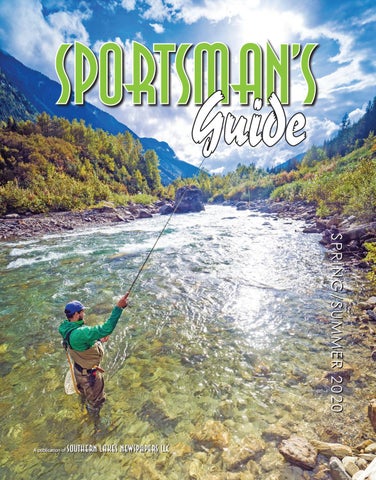
Sportsman’s Guide
SP R I N G/SU MM ER 2020
A publication of
Southern Lakes Newspapers LLC
2020 SPRING/SUMMER SPORTSMAN’S GUIDE
CHECK US OUT!
From lures to lighting, paddleboards to powertools, you’ll find it all at Fleet Farm.
10 OFF
$ 3481
a purchase of $50 or more
April 11 – June 13, 2020 Use code 20WISPORT10 to buy online and pick up in store.
Limit 1 offer per customer, per visit. No photocopies or facsimiles will be accepted. Coupon must be presented at the time of purchase and must be surrendered upon redemption. Total purchase must reach $50 or more before state and local taxes. No adjustments to prior purchases. Returns will be credited as purchase price less the discount, and discount will be forfeited. Cannot be used in conjunction with Buy Get offer, or other coupons. Not redeemable on fuel, lottery tickets, tobacco, alcohol, gift cards, tickets, permits, registrations, licenses, warranties, Carhartt®, Striker®, YETI®, or Weber® items. Other exclusions may apply. See store for details. 370634
2
2020 SPRING/SUMMER SPORTSMAN’S GUIDE
370637
3
2020 SPRING/SUMMER SPORTSMAN’S GUIDE
Buddy up for safety when adventuring outdoors
4
The buddy system is a popular and effective safety measure. The “buddy system” involves teaming up with a partner to prevent the safety risks of being alone. Both parties are then responsible for ensuring the other person’s safety. The buddy system is effective in various situations. For example, someone who works in a remote location or with hazardous substances can benefit from having a teammate nearby in the event something goes awry. That buddy can then call for help or even administer help on his or her own. Office fire evacuation plans often pair employees up so that each is responsible for making sure the other has evacuated and reached safety. In that instance, the buddy system reduces confusion and makes for a
more organized system. The buddy system also may be utilized in emergencies or instances when there is increased risk for injury, such as during a natural disaster or while engaging in certain risky activities. The Centers for Disease Control and Prevention says that buddies can each look out for hazardous conditions, safety demands and stressors. Buddies can be utilized when a person is swimming, surfing, hiking, biking, or camping in the wilderness. Many schools also utilize buddy systems so that students are never alone. This is handy during school trips or when students are not on campus. The buddy system helps instill a sense of responsibility. Buddies help make sure their partners get back on the bus
and are accounted for when there may not be enough adult chaperones. Children who walk home from school or wait at a bus stop may be paired with a buddy for increased safety against strangers and other hazards. The Holts Summit Police Department in Missouri says that a child alone could become a much easier target if a predator drove by than if a child were with a buddy or in a group. Buddies can be a friend, an older sibling or an adult approved by parents or guardians. Buddies also may be friends who are asked along when another wants to enjoy a night out on the town or use a rideshare or taxi service, but wants to minimize the risks that could arise if he or she goes it alone. (METRO CREATIVE)
SPRING-SUMMER 2020
Sportsman ’des G ui
FOR ADVERTISING OPPORTUNITIES:
Call (262) 725-7701 ext. 134 or email vicki@southernlakes newspapers.com
A publication of
Southern Lakes Newspapers 1102 Ann St., Delavan, WI 53115
Editor...............................................Tracy Ouellette Page Design.......................................Jen DeGroot Creative Director.................................Heidi Schulz Advertising Director...................Vicki Vanderwerff
STOCK PHOTO Sportsman’s Guide
Using the buddy system can make various situations safer than going it alone, even for adults
STOCK PHOTO Sportsman’s Guide
Motorcyclists will be taking to the roads in increasing numbers, and safety should be their top priority.
How motorcycle riders can stay safe 4,985 in 2018, marking an almost 5 percent decrease from their most recent study on motorcycling fatalities. Continuing to be safe, and educating oneself about motorcycle safety – whether you are a rider or someone sharing the road – can continue to keep injuries and accidents low.
Wear protective gear The NHTSA says the right helmet can mean the difference between life and death. From shape to style to fit, riders can work with helmet companies and outfitters to find the right helmet for them. Long pants, eye protection, riding gloves, and a waterproof jacket also make for effective and protective gear.
Take a class Novices would be wise to enroll in classes to go over motorcycling basics and safety guidelines that can keep them alive and well on the
road. Check with your local motor vehicle commission or driving schools about classes that may be available.
Avoid blind spots Motorcycles are difficult to see on the road. Try to stay out of vehicles’ blind spots as much as possible and maintain safe distances between your bike and others on the road.
Make yourself visible Wear something bright or use reflective or nylon tape and mesh to make yourself more visible to fellow motorists.
Never ride tired or intoxicated Fatigue and/or alcohol reduces reaction time and could find you making costly mistakes that put your life in danger.
Share the road responsibly Drivers of cars and trucks need to be diligent in keeping their eyes and ears open for motorcycle riders, allowing them a wide berth.
2020 SPRING/SUMMER SPORTSMAN’S GUIDE
Warm weather and road trips often go hand-in-hand, and spring and summer are prime seasons for motorcycle riders to get out on the highway. Motorcycle riders are at an extreme disadvantage when sharing the road with cars and trucks. In the event of a collision, motorcycle riders can be seriously injured and are far less protected than those in a car or truck. The latest data indicates motorcyclists are about 28 times as likely as passenger car occupants to die in a motor vehicle crash, states the National Highway Traffic Safety Administration. Motorcycle riders face greater hazards from debris on the road or other road conditions. Despite all this, the NHTSA says the number of motorcyclists killed in crashes dropped to
(METRO CREATIVE)
5
Teach them to fish How to make the most of kids’ first angling experience
Fishing provides a great way for parents to bond with their children in the great outdoors. The value of first impressions has been welldocumented, and parents who want their kids to inherit a love of fishing can take the following factors into consideration so their youngsters’ first fishing trips are successful. Fishing need not be an expensive hobby, but the costs can add up. Parents who are not sure if their kids will embrace fishing should look into local programs. Many towns, especially those with reputations for fishing, host free family fishing events. These events give parents an opportunity to see if their kids enjoy fishing before they buy them gear. Any fisherman would love to snag a trophy fish such as a largemouth bass on his or her first trip. And while that’s possible, it’s unlikely, especially for youngsters. Such fish tend to be difficult to catch, even for seasoned fishermen. When taking kids fishing for the first time, fish for something that’s somewhat
Fishing is a family friendly activity that youngsters can enjoy from the moment they first pick up a rod. STOCK PHOTO Sportsman’s Guide
simple to catch and capable of being caught throughout the day. If you aren’t familiar with your local rivers or lakes, visit a local outdoors store and ask for advice about which local bodies of water are home to fish that kids might be able to snag. Though it’s not imperative that kids catch a fish on their first trip, doing so might
make them more enthusiastic about their next trip. However, if the focus is on catching fish, kids might grow discouraged and not want to come back if they don’t catch anything on their first trip. Focus on the fun everyone is having rather than the fish they are (or aren’t) catching. (METRO CREATIVE)
BURTNESS
Chevrolet
BUICK
2020 SPRING/SUMMER SPORTSMAN’S GUIDE
GMC
6
1389 West Main St., Whitewater, WI 53190
Your Spring Vehicle Shopping Headquarters
1421 West Main St., Whitewater, WI 53190
WHEN THE PRODUCTS ARE SIMILAR IT’S THE DEALER THAT MAKES THE DIFFERENCE 262-473-2522 • 262-473-3072 www.driveburtness.com
370638
Licenses, stamps, tags needed for all anglers older than 16
older need a nonresident fishing license to fish in Wisconsin waters with hook and line. Nonresidents need a fishing license to take rough fish by hand, hook and line, or to spear fish where allowed. Nonresidents of any age need a fishing license to take smelt, spear fish, or to take rough fish Wisconsin residents who are 16 years old and minnows using nets, traps, and seines or older need a fishing license to fish in any of legal size. Nonresidents may not sell waters of the state. Residents need a fishing minnows or smelt. The DNR’s Guide to license to take rough fish by hand, hook and Wisconsin Spearing, Netting, and Bait line or to spear fish where allowed. Harvest Regulations has more information Residents do not need a fishing license and lists all the regulations. to take smelt, rough fish, or minnows Fishing licenses are sold online at dnr. with nets, traps, and seines of legal size. wi.gov. The Wisconsin Department of Natural Groups of disabled persons on fishing Resource’s Guide to Wisconsin Spearing, excursions conducted by nonprofit Netting, and Bait Harvest Regulations has organizations may not need fishing licenses. more information on additional regulations. See FISHING, Page 8 Nonresidents who are 16 years old or
Free Fishing Weekend set June 6 and 7 At press time the Wisconsin Department of Natural Resources was not scheduling Free Fishing Weekend events, because of the uncertainty of when the social distancing advisory would end. Anglers can still venture out for fresh air and to wet a line in their own community on Free Fishing Weekend. The DNR advises anglers to measure the length of their fishing pole and use it as a friendly guide to maintain a distance of 6 feet from the nearest angler or passerby. All the waters of the state will be open to free fishing; however, all usual regulations will be in force.
TOP: Opening day for general inland fishing is May 2 in Wisconsin. Social distancing is likely to still be in effect in the beginning of May and the Department of Natural Resources advised anglers to remember to stay 6 feet apart from one another. PAGE 8: Get the tackle box stocked and the fishing poles strung, the local lakes will be teaming with anglers soon and you don’t want to miss out on the fun. STOCK PHOTOS Sportsman’s Guide
2020 SPRING/SUMMER SPORTSMAN’S GUIDE
Grab the fishing poles and tackle – it’s time to fish!
7
2020-21
fishing seasons Opening day for Wisconsin fishing is traditionally the first Saturday in May. Hook-and-line fishing for many species of fish on many Wisconsin waters begins on that day. However, to better manage Wisconsin fisheries, season dates are often specific to the species of fish as well as the water body. For a complete listing of all Wisconsin’s fishing seasons, visit drn.wi.gov. Early inland trout (catch and release) Jan. 4 (5 a.m.) to May 1 General inland trout May 2 (5 a.m.) to Oct. 15 General inland fishing May 2 to March 7, 2021 Largemouth bass northern zone harvest May 2 to March 7, 2021 Smallmouth bass northern zone harvest June 20 to March 7, 2021 Large and smallmouth bass southern zone harvest May 2 to March 7, 2021
2020 SPRING/SUMMER SPORTSMAN’S GUIDE
Large and smallmouth bass catch and release At all other times of the year.
8
Musky - northern zone May 23 to Dec. 31 Musky - southern zone May 2 to Dec. 31 Northern pike May 2 to March 7, 2021 Walleye May 2 to March 7, 2021 Lake sturgeon Sept. 5 to Sept. 30 (hook-and-line) Free fishing weekends June 6 and 7
• Fishing
(Continued from page 7)
All annual licenses are valid from date of purchase through March 31, 2021.
Licenses • Resident individual (annual) fishing license, $20. • Fishing, first-time buyer, $5. • Resident one-day fishing license, $8 – In the event the angler purchases an annual fishing license later in the same license year, the cost of the one-day license will apply towards the purchase of the annual fishing license. • Resident combination (spousal) license, $31 – Issued to a legally married husband and wife who meet residency requirements. • Resident sports license $60 – This license allows for fishing and hunting of small game and gun deer. (Nonresident fee, $275) • Resident junior sports license (10 to 17 years old), $35 – (Nonresident fee, $36) • Resident reduced-rate fishing license, $7 – Required of anglers 16 and 17 years of age and anglers 65 years of age and older. Residents born before 1927 do not need a fishing license. Simply carry proof of age when fishing. Nonresident senior citizens must purchase a regular nonresident license. • Resident conservation patron license, $165 – This license serves as a substitute for separate licenses and stamps for annual fishing, inland trout fishing, Great Lakes trout and salmon fishing, hook and line lake sturgeon harvest, hunting small game, turkey, pheasant, deer, waterfowl, archer hunting, and trapping (trapping for residents and qualified nonresidents only). You also receive an admission sticker for state parks, state forests and state trails, and a one-year subscription to Wisconsin
Natural Resources magazine. (Nonresident fee $600) • Resident junior conservation patron license (10–17 years old), $75 – (Nonresident fee $77) • Resident annual fishing licenses for the disabled, $7 – Anglers must provide one of the following as proof: Social Security Disability Award Notice issued within the past year, Letter from Social Security Administration advising the customer is currently receiving disability benefits, Letter or Notice of Railroad Retirement Disability, or signed statement from a licensed physician or optometrist indicating that the customer’s sight is impaired to the degree that he/she cannot read ordinary newspaper print with or without corrective glasses. Discount applies to resident fishing license only. Disabled nonresidents need to buy a regular nonresident license. • Resident annual disabled veteran’s fishing license, $3 – Veterans must provide one of the following as proof: Veteran’s Disability Award Letter showing benefits are being paid for a disability of 70 percent or more, or Letter from Veterans Administration that indicates customer is receiving benefits for a service-related disability of 70 percent or more. Nonresident disabled veterans must purchase a regular nonresident license. • Free annual resident armed forces fishing license for members of the U.S. armed forces who exhibit proof that they are in active service with the armed forces and that they are a resident on furlough or leave (includes the inland trout and Great Lakes salmon stamps). • Nonresident individual (annual) fishing license, $50 • Nonresident one-day fishing license, $10 – In the event the angler purchases
Lake Sturgeon Harvest Tag, $20 – Anglers who intend to harvest a lake sturgeon must purchase this tag first, regardless of age or need for a fishing license. Harvest tags are available for either inland waters or Wisconsin/Michigan boundary waters. A fishing license is required to fish for sturgeon (unless you are exempt), but a harvest tag is not required for catch and release sturgeon fishing (Nonresident fee $50) For more information, visit dnr.wi.gov.
2020 SPRING/SUMMER SPORTSMAN’S GUIDE
license entitles a resident or nonresident to fish the outlying waters of Lake Superior, Lake Michigan, and Green Bay, as well as Lake Michigan and Green Bay tributaries upstream to the first dam or lake. License includes the Great Lakes Trout and Salmon stamp privilege. • Two-day Inland Lake Trout Fishing License (residents only), $14 – This license authorizes fishing for trout on inland lakes. A trout stamp is not required • Hook and Line
STOCK PHOT OS Sportsman’ s Guide
an annual fishing license later in the same license year, the cost of the one-day license will apply towards the purchase of the annual fishing license. • Nonresident 4-day individual license, $24 • Nonresident 15-day individual license, $28 • Nonresident 15-day family license, $40 – Includes children 16-17 years old (Note: Family licenses do not include grandchildren ages 16 to 17 years old). • Nonresident annual family license, $65 – Includes children 16 and 17 years old (Note: Family licenses do not include grandchildren ages 16 and 17 years old). • Annual Inland Trout Stamp Privilege (residents and nonresidents), $10 – See the Guide to Wisconsin Trout Fishing Regulations for license restrictions. Required in addition to your fishing license to fish trout on tributaries to Lake Superior and all inland waters, except Green Bay and Lake Michigan tributaries up to the first dam or lake. • Annual Great Lakes Trout and Salmon Stamp Privilege (residents and nonresidents), $10 – Required in addition to your fishing license to fish trout or salmon on Lake Superior, Lake Michigan, Green Bay and the tributaries of Lake Michigan and Green Bay up to the first dam or lake. • Two-day Sports fishing license for residents and nonresidents, $14 – This
9
How to find the right bike helmet
10
Consumer Product Safety Commission standards. Helmets sold in the U.S. are typically CPSC-endorsed. The following are some features cyclists should consider before buying bike helmets.
Size High-end helmets tend to come in multiple sizes that offer a secure and comfortable fit. Many other helmets have a universal sizing ring that fits a wide array of head sizes, according to Eastern Mountain Sports.
Style Helmets come in different shapes and styles. Experiment with helmet shapes to find a style that fits the shape of your own head well.
Placement The helmet should be worn horizontally on the head, and shouldn’t be tipped forward or backward. Experts say the front rim should end around an inch above the eyebrows. The helmet should not be too tight, yet not loose enough to move around easily.
Bike helmets are an important component of cycling safety that can prevent head injuries. STOCK PHOTO Sportsman’s Guide
Extra safety Doctors now know that something called rotational forces can contribute to brain injury. This means there is a violent stopping that causes the head to be interrupted out of synchrony with the movement of the neck, torso and other lower limbs. Multi-directional Impact Protection System, WaveCel and Shearing Pads Inside technology help address rotational forces. (METRO CREATIVE)
370639
2020 SPRING/SUMMER SPORTSMAN’S GUIDE
Cycling is a great way to get necessary exercise in an environmentally friendly way, all while enjoying the great outdoors. Safety should be a priority when cycling, and helmets are an essential component of cycling safety. The American Association of Neurological Surgeons says cycling is the single largest contributor to head injuries treated in American hospital emergency rooms. The Bicycle Helmet Safety Institute advises that almost three-quarters of fatal crashes in 2018 involved a head injury. Nearly all cyclists who died were not wearing a helmet. The first step toward safety is selecting a helmet especially designed for cycling, as there also are helmets geared for kayaking, rock climbing, skiing, and skateboarding. Consumer Reports suggests evaluating helmets on key features: ventilation, fit adjustments, ease of use, and of course, impact injury prevention. A helmet that is not properly fitted or comfortable cannot do its job effectively, especially if it prompts a rider not to wear it. Riders can research Consumer Reports ratings and look for helmets that meet
Some useful tips for RV beginners
Budget for all expenses It can be tempting to overspend on the RV itself, but buyers should factor in other expenses like hoses, wheel chocks, levelers, navigation systems, campsite fees, and more.
Consider the RV’s size Buy the smallest RV that is comfortable. Doing so opens up more options regarding places to stay. In addition, small RVs are morely easily maneuvered on the road than large ones, especially for novices.
Add time to your ETAs The estimated time for trips that popular map and navigation software provide are customized to average car speeds. RVs generally move more slowly than cars, so allow for more time to arrive at your destination. This is an important consideration if you need to be at a campground by a certain time.
Save condiment packages When visiting restaurants and carryout places, save any unused condiment packets,
napkins and packages of disposable cutlery. These items take up much less room than full-sized packages, and space inside RVs is often at a premium.
Invest in storage boxes Store belongings neatly and cleanly in plastic storage containers. Choose uniformly shaped and sized bins, which are more easily stacked and stored than bins of varying sizes.
Pack a paper map Navigation services that are powered by satellite or cell phone signals may not be available in inclement weather or when traveling through mountain ranges. Paper maps can fill the void and keep you on track.
Check towing capacity Make sure you do not exceed the manufacturer-recommended towing capacity. This is usually found on a sticker in the driver’s door. Overloading the vehicle can cause transmission issues and/ or burn out engines. (METRO CREATIVE)
RVs can be a fun and relaxing way to travel, and novices can make such trips more enjoyable by following a few tips from seasoned road trippers.
2020 SPRING/SUMMER SPORTSMAN’S GUIDE
oad trips are a unique way to travel that afford travelers the freedom to stop and take in sights and scenery on their own time. Traveling the highways and back roads gives people a chance to slow down and really enjoy an adventure. Such trips can be made even more special by traveling in recreational vehicles, often referred to as “RVs.” The RV industry has been consistently growing for years. The Recreational Vehicle Industry Association says the RV industry creates $50 billion in economic impact in the United States, with roughly 23,000 businesses currently in operation. More than 504 RVs were shipped in 2017, and in Canada the industry is responsible for more than $7 billion in retail sales, states RVIA and Statista. Roughly 40 million Americans go RV camping each year, and millennials make up approximately 38 percent of campers, according to a report from CNBC. New RV enthusiasts are getting on the road every day, and such travelers can benefit from the wisdom and experience of those who have blazed trails before them.
STOCK PHOTO Sportsman’s Guide
11
Outdoor adventures still allowed EXPLORING SAFELY AMID CORONAVIRUS SHUT DOWN
By Jason Arndt
2020 SPRING/SUMMER SPORTSMAN’S GUIDE
STAFF WRITER
12
The COVID-19 pandemic has left millions of Americans at home, including residents of Wisconsin, which has limited social opportunities to stop the spread of new coronavirus. Coronavirus, which has grown both locally and nationally, have shut down schools, non-essential businesses and caused disruptions in daily lives. The growing pandemic resulted in Gov. Tony Evers issuing a Safer-at-Home directive March 24 and effective for at least 30 days. “I know the COVID-19 outbreak has been difficult and has disrupted the lives of people across the state,” Evers said. “Issuing a Safer-atHome order isn’t something I thought we’d have to do and it’s not something I take lightly, but here’s the bottom line: folks need to start taking this seriously. “Each and every one of us has to do our part to help slow the spread of COVID-19 so we can flatten the curve to ensure our doctors, nurses, and health care workers have the opportunity to do their important work. Let’s all do our part and work together.” The Safer-at-Home order allows essential
See ADVENTURES, Page 13 FROM TOP: Katie Grabarec jogs along one of many trails April 1 at Silver Lake Park in western Kenosha County. People using the trails are advised to practice social distancing by staying at least 6 feet apart from others; A seagull makes a landing along the lakeshore at Samuel Myers in the City of Racine April 2. OPPOSITE: Southern Lakes Newspapers’ staff writer Jason Arndt explores the Southside Historic District along the Lake Michigan lakefront in his hometown of Racine. JASON ARNDT PHOTOS Sportsman’s Guide
• Adventures
(Continued from page 12)
businesses to continue operations such as medical care facilities, gas stations, grocery stores, critical infrastructure projects, pharmacies, auto repair shops, banking institutions, laundry businesses, hardware stores. Additionally, people must limit non-essential travel, not gather in groups larger than 10, maintain social distancing of at least six feet along with frequent hand washing and other recommendations by the Centers for Disease Control. State officials have asked people to limit social interaction to the same five people to stop the spread. However, people can still experience nature, as long as these activities involve members of the same household and follow social distancing guidelines. “Nothing in this order prohibits the gathering of a single house-hold or living unit,” the Safer-at-Home order states. Evers indicated people are still allowed to take their dog for a walk around the neighborhood. “You can still get out and walk the dogs – it’s good exercise and it’s good for everyone’s mental health – but please don’t take any other unnecessary trips, and limit your travel to essential needs like going to the doctor, grabbing groceries, or getting medication,” he wrote in a statement before issuing the order.
Flying solo and keeping my distance
By Jason Arndt STAFF WRITER
As a Racinian and following suggested guidelines, I decided to explore nature in my own backyard, which is the Lake Michigan shoreline on the city’s south side. I visited several parks and historical sites in the City of Racine. The lakeshore near the Carre Hogle Park, 1645 Main St., offers a secluded spot for anyone looking for fresh air while exploring the Southside Historic District. The Southside Historic District was added the National Register of Historic Places in 1977 and consists of the state’s highest concentration of grand historic houses dating from 1842 to 1942. The 42-block historic district offers a variety of homes from the Greek Revival and Victorian periods. Since this is one of my favorite spots to capture fresh air, I often see people following social distancing guidelines anyways, and rarely find large groups consisting of five or more people. A few blocks north lies the Laurel Salton Clark Memorial Fountain near Monument Square and Festival Hall. Clark, a former astronaut, lost her life while returning to Earth during a NASA mission. The parks in the City of Racine have a lot to offer in the way of history and beauty.
While both state and some county officials have encouraged fresh air, as long as people adhere to proper guidelines and follow all rules, the state Department of Natural Resources closed state parks, trails and forests to the public on April 10. Because of “unprecedented crowds, litter, vandalism and the need to protect the health and safety of our visitors and staff,” the DNR stated Gov. Evers the closing of the parks. In the Southeast Region, this included the closing of Big Foot Beach State Park, Harrington Beach State Park, Havenwoods State Forest, Kohler-Andrae State Park, Kettle Moraine State Forest Lapham Peak, Loew Lake, Mukwonago River, Northern Unit, Pike Lake, Southern Unit, Lakeshore State Park and Richard Bong State Recreational Area. “We know there are benefits to getting outdoors. By not doing this would put people’s lives at risk,” said DNR Secretary Preston D. Cole at the time of the closings. “With the weather warming we are seeing increases in visitors and a myriad of challenges surrounding social distancing. In order to the protect the public, this is a necessary step.” Although the Safer at Home order recognizes outdoor activity as an essential activity, people wishing to take a break outdoors are advised by public health officials to exercise in your local neighborhoods and maintain a social distance of 6 feet or more. On the county level, parks in both Kenosha and Racine remain open while golf courses have been shutdown as of early April. Racine County Executive Jonathan Delagrave stressed following guidelines are important while exploring county parks and trails. “These new guidelines seek to strike a balance between protecting public health and safety while
See ADVENTURES, Page 14
2020 SPRING/SUMMER SPORTSMAN’S GUIDE
Fresh air encouraged, with limits
13
• Adventures
2020 SPRING/SUMMER SPORTSMAN’S GUIDE
(Continued from page 13)
recognizing the value of being outdoors, especially with spring upon us and warmer weather on the horizon,” he wrote in a news release. “The public should enjoy walks or hikes in parks while maintaining strict social distancing and proper personal hygiene.” Playgrounds, however, remain closed as part of the Safer-at-Home order with most, if not all, municipalities reportedly advising residents the equipment has not been sanitized and cleaned. The Kenosha County Parks Department reportedly has some of its venues still open to the public, including Silver Lake Park. Silver Lake Park, like other venues, offers multiple trails, public fishing spots, and places for people to run and hike with family members. Matthew Collins, Kenosha County Parks Director, said the parks remain accessible. “All of our parks as of now are open and accessible,” he said. “People are definitely using the parks, but they are respecting social distancing.” Collins said people should follow the parks department on Facebook for updates and ideas for family outings and lesson plans. “While we’re working from home and the kids are not in school, our parks are a great, safe way to get out and get some fresh air.” Because of the rapidly changing situation with the COVID-19 response at press time, we recommend you check to see if a park is open before heading out. FROM TOP: Silver Lake Park in Kenosha County remains open under specific conditions amid the COVID-19 pandemic and consists of several trails; Overlooking Carre Hogle Park in the City of Racine, a boat sits on Lake Michigan. JASON ARNDT Sportsman’s Guide
14
Hitting the links drive the ball further. Right-handed players will keep the right foot anchored, and lefties will do the opposite. Do not lift your foot prematurely; otherwise, you can lose power and distance.
Warmer weather sends scores of golfers to their favorite courses each and every day. Golf is a challenging pastime, but a few pointers can help golfers hone their short games, long games and everything in between.
Identify your weaknesses
Choose the right clubs There is more to selecting clubs than pulling any old iron out of your golf bag and whacking away. Wind, hazards and obstructions in landing areas should influence your decision of which club to use. Novice golfers may want to rely on their caddies to make club recommendations, and as they become more confident in their abilities they can start to make their own choices.
Anchor your feet Anchor your foot behind the ball to
As with any hobby, identifying those areas that need the most work can help you become a better golfer. Keep track of each shot you take, and then look at the results to see which areas of your game need the most work.
Fix your alignment Align your shots by assessing the target from behind the ball. Then set the clubface behind the golf ball and align it with the target before you enter your stance.
Use your torso for power The torso is essential to a solid swing. Practice rotating from your core to control your backswing and then maintain the same spine angle and posture on the downswing.
Use the wind Not every golf game will be played in perfect weather. A good player knows how to make adjustments for the wind depending on the shot. Use the wind to your advantage when you can, and adjust your swing when hitting into the wind.
Become a better chipper Many players put so much emphasis on their backswings and putt shots that they fail to devote any practice to chips. All shots are important for golfers trying to shed strokes off of their scores.
Keep fit Maintaining or improving your physical strength and overall health can help your golf game. Exercise and eat right, and you will have more endurance on the links. (METRO CREATIVE)
Improving your golf game takes some commitment and effort, but it’s worth it when you’re out on the green. STOCK PHOTO Sportsman’s Guide
2020 SPRING/SUMMER SPORTSMAN’S GUIDE
Ways to improve your golf game
15
Whether You Need A New Weber Charcoal or Gas Grill
Reineman’s Wil Soon Have You Cooking! 20 lb. Premium Hardwood Charcoal Briquettes
Spirit II® E210 LP Gas Grill
Rapidfire® Chimney Starter Quick and convenient way to light charcoal. Two handle design for more control. Model #7416
Stainless Steel Vegetable Basket
• 26,500 BTUs • 360 sq. in cooking space • 2 stainless steel burners • Porcelain-enameled cast-iron grates • 90 sq. in. warming rack • Left fold-down side table
Red Black Ivory Sapphire
Genesis® II E-315 LP Gas Grill
Stainless Steel Grill Pan For fish, vegetables or fruit
Rib & Roast Holder
Holds up to 5 rib racks at a time.
10 pk. Aluminum Drip Pan Liners
• 39,000 BTU burners • 3 stainless steel burners • 315 sq. in cooking area • 156 sq. in. Tuck-Away™ warming rack • Porcelain enamel cast iron cooking grates • Enclosed cabinet with painted steel doors
Jumbo Joe® Charcoal Grill
Copper Black
8-1/2 6-in. foil liners for catch pan on Weber Q, Spirit or Genesis grills.
Performer® 22 in. Deluxe Charcoal Grill
3 pc. Stainless Steel BBQ Tool Set Stainless steel set includes spatula, fork and locking tongs.
Weber® 21 in. T-Brush Stainless steel bristles.
Instant-Read Digital Thermometer
2020 SPRING/SUMMER SPORTSMAN’S GUIDE
Reads temperature in about 15 seconds. Auto shutoff after 10 minutes no activity.
Black • Copper Crimson
2-pk. Cedar Plank
Original Kettle® 22 in. Premium Charcoal Grill
Q Portable 1200 Gas Grill • 8,500 BTUs • 189 sq. in. cooking space • Built-in lid thermometer • 2 large fold-out tables Titanium • Black • Blue • Green • Orange • Red
• 363 sq. in. cooking area • Gourmet BBQ system • Hinged grate • Built-in lid thermometer • One-Touch® cleaning system • Porcelain-enameled lid and bowl
Full Line of Weber Grills, Accessories and Parts Now In Stock VISIT OUR WEBSITE:
www.reinemans.com BEHIND EVERY PROJECT IS A
Copper Crimson Black Green
• 363 sq. in. cooking space • Electronic Touch-N-Go™ gas ignition system • LCD cook timer • Charcoal holder • Char-Bin™storage container • Tuck-Away™ lid holder • Built-in lid thermometer • Lid handle with heat shield • Two 8-in. wheels, 2 casters
350 cu. in. Wood Chunks
Choose hickory, mesquite, cherry, apple or pecan. 192 cu. in. Wood Chips
• 240 sq. in. cooking area • Tuck-Away™ lid holder • Aluminum vents and ash catcher
BURLINGTON
417 Milwaukee Ave. reinemanstvburl@truevalue.net
phone: (262) 763-3577 fax: (262) 763-1853 Mon. - Sat.. 8 a.m. - 6 p.m. Sun. 9 a.m. - 32
PADDOCK LAKE 24708 75th St., Rt. 50
(262) 843-2422 Mon. - Fri. 8 a.m. - 6 p.m. Sat. 8 a.m. - 5 p.m. Sun. 9 a.m. - 3 p.m. 370636
16