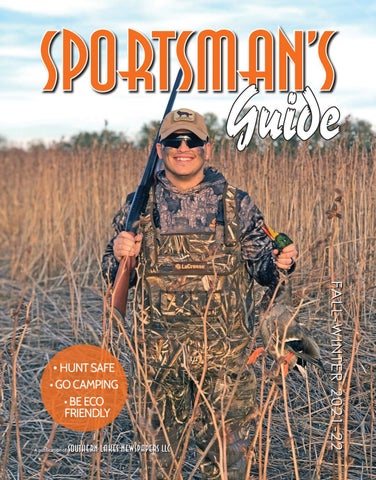
Sportsman’s
Guide
• GO CAMPING • BE ECO FRIENDLY A publication of
Southern Lakes Newspapers LLC
FA LL- WI NTER 2021- 22
• HUNT SAFE
402116 fleet farm group
C
M
M
Y
Y
CM
CM
MY
MY
CY
CY
CMY
CMY
K
SAVE DURING
K
NOV NOV 12 12thth--20 20tHtH 2021-22 FALL/WINTER SPORTSMAN’S GUIDE
C
2
10 OFF 10
$$
an an$in-store in-storepurchase purchase of $50 or more of 50 or more Offer good September 22 - November 24, 2021 Offer good September 22 - November 24, 2021
Use code SPRTSMN212 to buy online and pick up in store.
SPRTSMN212
code buy andandpick up inuponstore. Limit 1 offer per customer,Use per visit. No photocopies or facsimiles will be accepted. Couponto must be presentedonline at the time of purchase must be surrendered $ redemption. Total purchase must reach 50 or more before state and local taxes. No adjustments to prior purchases. Returns will be credited as purchase price less the Limit 1 offer per customer, per visit. No photocopies or facsimiles will be accepted. Coupon must be presented at the time of purchase and must be surrendered upon discount,Total and discount be forfeited. be before used instate conjunction withtaxes. Buy Get offer, or other tocoupons. Not redeemable fuel,belottery tickets, tobacco, alcohol, giftthe redemption. purchasewill must reach $50Cannot or more and local No adjustments prior purchases. Returnsonwill credited as purchase price less ® ® ® ® cards, and tickets, permits, licenses, warranties, Carharttwith , Striker YETI or, other or Weber Other exclusions apply. Seetobacco, store foralcohol, details.gift discount, discount will beregistrations, forfeited. Cannot be used in conjunction Buy Get, offer, coupons.items. Not redeemable on fuel,may lottery tickets, cards, tickets, permits, registrations, licenses, warranties, Carhartt®, Striker®, YETI®, or Weber® items. Other exclusions may apply. See store for details.
Visit us at 1516 Geneva St., Delavan, WI Visit us at 1516 Geneva St., Delavan, WI
3724
3724
402116
Simple safety protocols that can protect hunters Hunting is big business in North America. In 2017, more than 15 million people hunted in the United States. The National Shooting Sports Foundation reports that sportsmen and women contribute nearly $9.4 million to the economy every day. Millions of hunters take to forests and fields every year. All hunters, whether old pros or newbies, can benefit from revisiting some safety procedures before their first outing this season.
• Weather Weathershould be a consideration
• Firearm Firearm safety safety is a critical component
of safe hunting. Hunters use rifles, shotguns and other firearms. Each gun is different, so hunters need to familiarize themselves with new firearms before using them. The following are some additional firearm safety tips, courtesy of State Farm Insurance and Southern Land Exchange. • Always treat a firearm as if it is loaded; • Keep your finger off the trigger until ready to shoot; • Only point at what you plan to shoot; • Clearly identify your target and what is beyond it; • Fire within the zone-of-fire, which is the 45-degree area directly in front of each hunter;
Seasoned hunters and novices alike can benefit from revisiting some safety procedures before their first outing this season. STOCK PHOTO Sportsman’s Guide
• Firearm chambers should be emptied when guns are not in use; • Use appropriate ammunition; • Never modify or alter the gun; • Never cross a fence, jump a ditch or climb a tree with a loaded gun; and • Never rely on a gun’s safety.
• Hunters Additional safety tips should always let others know
where they will be when leaving in the morning. If something should happen, people back home can alert authorities if something goes awry. Always check equipment and maintain
FALL-WINTER 2021-22
Sportsman ’des G ui
it properly. Equipment should include gear colored in hunter’s orange. That extends to dogs if they are accompanying hunters on a trip. This makes hunters more visible to other hunters. Also, carry a first aid kit, a charged mobile phone or a satellite phone to maintain contact with others in case of emergencies. These are just some of the safety protocols that should be followed when hunting. Non-hunters should exercise caution during hunting seasons, particularly when entering forests and areas that hunters frequent. (METRO CREATIVE)
A publication of
FOR ADVERTISING OPPORTUNITIES:
Call (262) 725-7701 ext. 134 or email vicki@southernlakes newspapers.com
Southern Lakes Newspapers 1102 Ann St., Delavan, WI 53115
Editor...............................................Tracy Ouellette Page Design.......................................Jen DeGroot Creative Director.................................Heidi Schulz Advertising Director...................Vicki Vanderwerff
2021-22 FALL/WINTER SPORTSMAN’S GUIDE
whenever people spend a significant amount of time outdoors. Hunters typically leave before dawn and arrive home after dusk. Hypothermia is a very real risk for hunters who may be out in snow or wet conditions. It’s possible to get hypothermia by overdressing as well. Sweating and then being exposed to dropping temperatures puts people at risk for hypothermia. Hunters should dress in layers with moisture-wicking materials and a waterrepellant outer layer. In addition, check the weather forecast before heading out as a last second precautionary measure.
3
Using natural resources responsibly
Conservation connects hunters to the land 2021-22 FALL/WINTER SPORTSMAN’S GUIDE
By Tracy Ouellette EDITOR
Talk to just about any deer hunter and one of the things they are passionate about is wildlife conservation. “So many people think that hunters are into conservation because it provides more targets for them, and while that’s certainly an incentive, it’s not the reason,” said Jeff Pritzl, Wisconsin Department of Natural Resources deer program specialist. “Conservation is the wise use of our resources and wildlife. The ultimate goal
of conservation is for humans to live in harmony with the landscape and to do that, you have to be connected to the land.” Noah Wishau, 38, is an avid outdoorsman, enjoying fishing, hunting and hiking in the state. “I was raised a sportsman,” Wishau said. “I followed my dad outside for as long as I can remember. I started hunting at 12 or so and I was fishing way before that. During deer season I remember following dad out into the field or sitting in a tree stand without a weapon, just watching.” Wishau is an attorney who lives in Waterford with his wife, Beth, and their children, Tess, 8, and Holt, 5. Getting outside with the kids and enjoying the state’s natural resources is one of his greatest pleasures in life. “The like to fish and I even take them
Noah Wishau (left) and his dad, Jeff Wishau, show off the deer they shot during the 2010 gun season. Noah credits his dad for his love of wildlife and outdoor activities and is teaching his own children the benefits of conservation. SUBMITTED PHOTO Sportsman’s Guide
4
out during hunting season just to watch,” he said. “I only take them out when the weather’s not too cold, you don’t want them to be miserable, so it’s usually bow season.” Pritzl said hunting and fishing is often passed down in families, creating new conservationists in each generation. “Again, it’s that connection to the land that’s being passed down,” he said. “As a hunter you tend to value wildlife more,” Wishau said. “It’s not just about killing and every hunter will tell you that. In order to do what we do, you have to have wildlife and to have wildlife you have to conserve the land. Yes, a lot of deer are shot each year, but you have to have that in order for the animals to continue to thrive.” Culling the herd helps keep the deer population healthy, but it is a balancing act.
Emotions of the kill Wishau said he got his first deer the first year he was able to hunt with a weapon, at the age of 12 and while he was, of course, excited to bag his first deer, the kill came
with complicated emotions that he still experiences today. “It’s a heavy thing to kill an animal,” Wishau said. “It’s kind of the same way with every deer, this mix of emotions that hit you. You have the excitement and joy of it mixed with the sadness because an animal died. The joy comes from knowing you’re going to be able to eat it and make good use of it and you’re helping cull the herd and keep the other deer healthy, but there is still sadness. We eat venison three to four times a week, it nourishes my family but there is still that mix of emotion that I don’t think you can explain to someone who’s not a hunter.” Pritzl said in recent years there has been a real growth and appreciation in a direct
connection to the land in relationship to the food on the table. “People want to know where their food is coming from and want sustainability,” he said. “Outdoor activities have a positive impact on our wellness and it’s great to see people embracing it.”
Funding conservation Deer hunting is a big money maker
in the state through the DNR licensing and fees, which is then re-invested into conservation and preservation efforts, Pritzl said. “The revenue generated by deer hunters provide money for way more than the
Tess (left) and her brother, Holt, are all decked out in blaze orange while they accompany their dad, Noah Wishau during hunting season. SUBMITTED PHOTO Sportsman’s Guide
• CONTINUED ON PAGE 6
2021-22 FALL/WINTER SPORTSMAN’S GUIDE
Pritzl said. “When hunting isn’t successful, where there are situations where not enough animals have been harvested, especially in Northern Wisconsin, the herd can come out of the winter less healthy than before. “On the other side of that is when wildlife is really healthy it can be in conflict with people and do a lot of damage. Hunting is one means of keeping the population in balance.”
5
CONSERVATION • CONTINUED FROM PAGE 5
health of the deer population,” he said. “Fishing and game laws, environmental protection laws, customer service staff are all funded through the money generated from hunting. We have a relatively small population of hunters in the state, maybe 20% or so, but the other 80% percent of Wisconsinites benefit from these efforts.” Pritzl added that hunters often join conservation organizations to help fund other conservation activities in the state. “They’re very active in that community,” he said. Preserving natural habitats and wetland areas are often a priority for hunters and anglers, Wishau said. “Most hunters and fishermen understand the licensing dollars go to conservation,” he said. “We’re trying to preserve the land so we can continue to benefit from it. “Every generation has a new conservation issue,” Wishau added. “Hunters know the importance of good policy regarding the environment so they will continue to have a place to hunt.” Tess Wishau shows off her catch while brother, Holt, patiently waits for a hit.
6
403209
2021-22 FALL/WINTER SPORTSMAN’S GUIDE
SUBMITTED PHOTO Sportsman’s Guide
Wisconsin resident license costs
Effective dates
All hunting licenses are effective immediately after purchase and with the opening of the specific seasons. Gun and archery deer licenses may be purchased before and during any open deer season. All 2021 deer hunting licenses expired on March 31, 2022.
Hunter education requirements
Persons born on or after Jan. 1, 1973, must present their Wisconsin Hunter Education certificate or proof of a hunter safety course recognized by the Wisconsin Department of Natural Resources from another state, province or country), previous year’s Wisconsin hunting license, or proof of successful completion of basic training in the U.S. Armed Forces, Reserves or National Guard to purchase any hunting license. A certificate of successful completion of a Bow Hunter Education Course can be used to purchase an archery license. For course information, visit the website at dnr.wi.gov.
Hunting requires patience, dedication and essential gear. With the right supplies, a hunting venture is that much more enjoyable.
Time to suit up STOCK PHOTO Sportsman’s Guide
MUST-HAVE HUNTING GEAR Hunting is popular throughout North America. The U.S. Fish and Wildlife Service said that 40 percent of the population of the United States ages 16 and older participated in wildlife-related activities in 2016, the most recent year for data. Hunting also is popular in Canada, where it’s difficult to paint a picture of that popularity because hunting is regulated at the provincial level. However, Wild Alberta reports that, in 2020, there were 151,724 resident hunters in Alberta alone. As is the case with many hobbies and pastimes, hunting requires some unique gear. Hunters need to bring some essential gear along on each trip to ensure their
White-Tailed Deer 2021-22 seasons Bow • Sept. 18 to Jan. 9, 2022 Metro Sub-units only Sept. 18 to Jan. 31, 2022 Gun • Nov. 20 to 28 Hunters with disabilities Oct. 2 to 10 Muzzleloader • Nov. 29 to Dec. 8 Youth Deer Hunt • Oct. 9 and 10 Statewide Antlerless Hunt • Dec. 9 to 12 Antlerless-only Holiday Hunt Dec. 24 to Jan. 1, 2022
safety, while other gear and gadgets are all about convenience.
Proper clothing
Hunting clothing comes in two main varieties: camouflage and blaze orange. Camo patterns mimic real-life foliage or use a digital pattern of natural colors to trick the animals’ eyes, preventing them from detecting the hunters’ outlines. Blaze orange hunting gear, from coats to hats to coveralls, is designed to make hunters visible to other hunters. Some game, like whitetail deer, cannot detect the orange color spectrum, so hunters need not worry that they will be compromising their hunting efforts. Depending on the hunting area and its specific regulations, camo or orange clothing will be required. Hunting clothing also should be comfortable for the weather and the conditions. Waterproof or waterresistant clothing can protect hunters from the elements as well. In cold climates, layer up and wear insulated materials.
Weapon and ammo
Hunters should always look for ammunition details for the animals they will be hunting so they choose the correct weapon and ammunition type. Weapons should be maintained and cleaned for safety, and all hunters should consider taking a course in the proper handling of weapons. • CONTINUED ON PAGE 11
2021-22 FALL/WINTER SPORTSMAN’S GUIDE
Conservation Patron...................................... $165 Conservation Patron Junior (age 12 to 17).....$75 Sports................................................................$60 Sports Junior (age 12 to 17).............................$35 (Includes general fishing, small game, deer with firearm.) Gun deer................................ $24 (new buyer $5) Archery.................................. $24 (new buyer $5) Junior Gun Deer (age 12-17)...........................$20 Junior Archery (age 12-17)..............................$20 Herd Control Antlerless Deer Carcass Tag.........................One free with license Additional Herd Control Antlerless Deer Carcass Tag..............................$5 Unit Specific Antlerless Deer Carcass Tag.............................................$12
7
Guided Spring - Snow Goose Hunts Arkansas, South Dakota, North Dakota
February - April
2021-22 FALL/WINTER SPORTSMAN’S GUIDE
Visit DucksRDown.com
8
Guided Duck and Goose Hunting Northern Illinois, Wisconsin, North Dakota
September - January Visit DucksRDown.com 403092
Hunters are encouraged to take a hunter safety course to brush up on their knowledge and skills before heading out into the field. The Wisconsin Department of Natural Resources offers in-person and online classes. STOCK PHOTO Sportsman’s Guide
State encourages hunters to take safety courses
The Wisconsin Department of Natural Resources encourages all hunters to complete a safety course before enjoying Wisconsin’s fields and forests this hunting season. By completing a hunter safety course or quick skills refresh, a hunter can play a vital role in keeping Wisconsin a safe place to hunt, according to the DNR. More than 20,000 people take hunter education courses in Wisconsin each year. Anyone born on or after Jan. 1, 1973, must have a hunter education certification to purchase a hunting license unless hunting under the Mentored Hunting Law. “It’s easy and exciting to become involved in this outdoor activity,” the DNR said in a news release. Now through Oct. 1, hunters of all ages may complete their safety course online or in-person. Here are the ways to get a hunter education certification: Online students should expect to spend multiple hours online studying and completing the course modules. A passing score on the final exam is necessary to be certified. The online course is best for someone experienced with handling firearms safely or who has access to a reliable mentor. If a hands-on method is a hunter’s preference, there are two other ways to complete and strengthen safety skills, according to the DNR.
ONLINE ONLY Course participants spend multiple hours studying and completing modules online. A passing score on the final exam is necessary to be certified. This option is a great fit for students that have a connection/mentorship within the shooting sports to help establish and strengthen their skills and lessons learned. All ages are welcome. ONLINE AND FIELD DAY This training allows you to complete training both online and in-person with one day of training with a certified instructor. This class is a good fit for a person who has handled firearms or is planning to hunt with someone with more experience to learn from. During this class, there are 4 to 8 hours of gun handling opportunities. All age groups are welcome. TRADITIONAL CLASS This training offers a more hands-on approach to working with a certified instructor over a few days. Most students and families enjoy this option because they can do it right in their community. This option provides students with opportunities to handle hunting equipment, learn about safe hunting practices, shooting and many other topics. In-person feedback from instructors at this venue also enhances student learning. All age groups are welcome. For more information on course options, links to enroll and cost, visit the DNR website at dnr.wi.gov.
Hunters and non-hunters alike are familiar with bright orange coats, hats, vests, and other gear that is worn during hunting season. Even though it seems counterintuitive to wear “blaze orange” in the fields or woods for fear that animals may spot you, hunters need not worry so much. Deer typically cannot recognize blaze orange attire designed to make hunters visible to other people. According to researchers at the University of Georgia, a combination of factors make deer less likely to be startled by blaze orange. Deer have less binocular overlap than humans. Binocular overlap (the area that both eyes view at the same time) allows focus on a single point and enables depth perception. Deer must shift their heads much more than humans to gain a good three-dimensional perspective of an object. Deer also have fewer cones in their retinas compared to humans. Cones are photoreceptors that enable color vision and distinguish fine details. Furthermore, deer cannot readily perceive longer wavelengths of color, so oranges and reds appear more like brown or gray to them. However, deer can see blue colors more easily, so hunters may want to avoid blue jeans paired with their orange gear. (METRO CREATIVE)
2021-22 FALL/WINTER SPORTSMAN’S GUIDE
Did you know?
9
Protect your favorite waterfowl hunting areas Take these steps to stop the spread of invasive species
The Wisconsin Department of Natural Resources is asking waterfowl hunters to help prevent the spread of aquatic invasive species this fall. Invasive species are nonnative plants, animals and diseases that cause great ecological, environmental or economic harm. Some have already been found in Wisconsin, while others pose a large risk of surviving and causing problems if they are introduced and become established here. Just a few minutes of preventative action can help preserve and protect hunting lands for generations to come. Before launching into and leaving a waterbody, waterfowl hunters should: • Inspect waders, boats, trailers, motors and hunting equipment, including boots, blinds and dogs; • Remove all plants, animals and mud to the best of their ability; • Drain all water from decoys, boats, motors, livewells and other hunting equipment; • Remove all seed heads and roots when using vegetation for duck blinds; and Just a few minutes of preventative action can help preserve and protect hunting lands for generations to come.
Family Owned and Operated Since 1975
WISCONSIN DNR PHOTO Sportsman’s Guide
• Never move plants or live animals, such as snails, away from a water body. In addition, the DNR and UW Madison Extension AIS Program often team up with the Wisconsin Waterfowl Association, Ducks Unlimited and other partners to place boot brush stations at access points near lake and river launches as well as some walk-in sites. If you are an organization interested in building and setting up your own boot brush stations, contact DNRAISinfo@wisconsin.gov for more information. Thank you to every hunter who follows the recommended prevention steps. Doing so before you leave the boat launch is keeping your favorite hunting spot safe and accessible for years to come. For more information about aquatic invasive species, including where they are prohibited and restricted in Wisconsin, visit dnr.wi.gov.
2021-22 FALL/WINTER SPORTSMAN’S GUIDE
Celebrate Oktoberfest Lake Geneva’s Largest Liquor Store!
10
Firearms Ammunition Live Bait & Tackle
VOTED BEST LIQUOR STORE 7 Years Running by
Full Beer, Wine & Liquor Premium Cigars Catering for Weddings or Any Special Event
524 Broad Street Lake Geneva, WI 262-248-6407
www.brunosliquor.com Open 7 Days 9am to 9pm
403208
SPORTING GOODS 262 725-7007
3542 State Road 50 Delavan, WI 53115 www.Lakesidebait.com
380750
DNR announces stamp design contest winners
SUIT UP
The winning artwork for the 2022 pheasant stamp design category was submitted by Mark Kanitz of Markesan. PHOTO COURTESY OF MARK KANITZ Sportsman’s Guide
The 2022 turkey stamp design winner is Robert Metropulous of Arbor Vitae. PHOTO COURTESY OF MARK KANITZ Sportsman’s Guide
• CONTINUED FROM PAGE 7
Knife
Knives are a staple for every hunting trip and can be used for multiple purposes. Most hunters prefer a dedicated knife for field dressing the animal.
Legal documents
Hunters should always carry their hunting licenses and have game tags on hand to mark their kills appropriately.
Calls and scents
won the waterfowl design category with a lifelike painting of a northern shoveler at rest in the water. Kuether studied this bird rarely seen in Wisconsin by spending many hours at Horicon Marsh and the Green Bay Wildlife Sanctuary. Robert Leum of Holmen won second place in the turkey design category and third place in both the pheasant and waterfowl categories. Robert Andrea of Spooner won second place in the pheasant design category and Jon Rickaby of Suamico won second place in the waterfowl design category. Robert Wilkins of Kiel won third place in the wild turkey design category. This year a total of 34 pieces were submitted for judging on Aug. 28 at the Wisconsin Waterfowl Expo in Oshkosh. This year’s judges were Bruce Urban from the Wisconsin Waterfowl Association, John Motoviloff from National Wild Turkey Federation and Cody Kamrowski from Pheasants Forever. An electronic “stamp approval” is printed on the licenses of wild turkey, pheasant and waterfowl hunters at the time of purchase. Customers will not receive an actual stamp except upon request. To obtain a physical copy of a stamp, visit the DNR’s wildlife and fish collector stamps webpage at dnr.wi.gov. For more information about Wisconsin wildlife stamps, visit the DNR webpage.
It may be possible to lure
game closer with special calls or scents.
Binoculars
While one may be able to use the scope on a weapon to spot game, binoculars are more efficient.
First aid kit and other safety gear
Hunters should stock a first aid kit, emergency phone, water and snacks to stay hydrated and fed, and a foldable paper map in the event cell phone signals fade or prove unreliable. (METRO CREATIVE)
Brian Kuether, Greenfield, is the 2022 waterfowl stamp design winner. PHOTO COURTESY OF MARK KANITZ Sportsman’s Guide
2021-22 FALL/WINTER SPORTSMAN’S GUIDE
The Wisconsin Department of Natural Resources recently announced the winners of the 2022 Wisconsin Wild Turkey, Waterfowl and Pheasant stamp design contest. Local Wisconsin artists compete annually for the opportunity to have their artwork featured on the Wisconsin wild turkey, waterfowl and pheasant stamps available for purchase through Go Wild and license agents. Sales of wild turkey, waterfowl and pheasant stamps enable hunters, conservationists and stamp collectors to support wildlife and habitat management, restoration and conservation around the state. Hunters are required to purchase stamps to harvest these game birds. Robert Metropulous of Arbor Vitae won first place in this year’s wild turkey stamp category with a painting featuring a tom turkey displaying for a hen decoy. Metropulous, a past winner of the waterfowl and pheasant stamp design contest categories, has painted for decades having first learned his lifelong passion from his mother. Mark Kanitz of Markesan took first place in the pheasant design category having credited the many years of hunting and outdoor recreation as inspiration for his submission, which depicts a rooster and hen pheasant in front of a snowy farm scene. Brian Kuether of Greenfield
11
How to choose the best campsite
Millions of people enjoy camping every year. Data from the KOA 2021 North American Camping Report indicates there were more than 94.5 million camper households throughout North America in 2020. As the world confronted the COVID-19 pandemic, North American campers took to camping in droves and intended to continue camping trips throughout 2021. While there are many different lessons novice campers must learn, one of the more important should include identifying what makes a good campsite. The choice of campsite is an important part of the camping experience. In fact, where a tent gets pitched can easily make or break a trip. A new study in the Journal of Environmental Management says the biggest factors price and the availability of electricity are significant priorities for campers looking for a campsite. However, many other factors should be considered when choosing a campsite.
Stay near water
Being close to water means not having to carry it far for cleaning, cooking and other needs. Try to stay roughly 200 feet away from a water source, as it’s important to remember that water also will attract animals.
2021-22 FALL/WINTER SPORTSMAN’S GUIDE
Search for flat ground
12
It’s more comfortable and safer to pitch a tent on level ground. Make sure there are no rocks or other items under the tent that can compromise comfort. Avoid areas at the base of hills that can become giant puddles in the event of a rainstorm.
Check around for hazards
Before pitching a tent, check the area for dead branches on trees and make sure that nothing will crash down while you are asleep. Boulders may come loose and roll down hills, so areas vulnerable to falling rock also should be avoided. Make sure the campsite is not • CONTINUED ON PAGE 13
Check out some of the new camping products on the market, which can make your outdoor accommodations more comfortable. STOCK PHOTO Sportsman’s Guide
Products that make camping more convenient and fun Perhaps no experience connects people with nature in quite the same way as camping. Various activities, including hiking, fishing and kayaking, afford people a chance to experience the great outdoors. But there’s just something about spending all day in nature and then sleeping under the stars that sets camping apart from other outdoor activities. Modern campers use many of the same products that have been popular for decades if not longer to make their camping experiences enjoyable. Tents, compasses and cooking equipment are all as necessary today as they were years ago. But various products are now available to add a new twist to camping excursions without taking away the old school charm of spending a few days and nights in nature.
Inflatable hammock
Comfort and camping don’t always go hand in hand. But inflatable hammocks allows campers to tote along a touch of backyard relaxation on their next camping trip. Inflatable hammocks are typically resistant to rips and tears and can be easily inflated. Some may remain inflated for as long as eight hours, which is more than enough time to catch an afternoon nap at the campsite.
Foldable kayak
A foldable kayak is tailor-made for campers who love to go kayaking but don’t necessarily want to lug their kayaks around. Compact and easily packed, foldable kayaks are typically lightweight and some can even be checked on a plane. That’s ideal for campers who are flying to an exotic camping destination but don’t want to pay to rent a kayak.
Tree tent
Veteran campers know that finding flat ground on which to set up a tent is vital to a comfortable night’s rest. Such campers also know that flat ground isn’t alway so easy to find. Tree tents take flat ground out of the equation, making them an ideal accessory for campers who want to set up their campsites along the banks of rivers during canoeing and kayaking trips.
Portable pressurized shower
A portable pressurized shower can make it easy for campers to quickly wash dirt and sand off their bodies and keep their camping dishes clean. Portable pressurized showers can be refilled at nearby water sources, and are typically lightweight and easily inflated, making them a non-intrusive accessory to add to your camping supplies list. (METRO CREATIVE)
Campfire cooking can be taken to a more flavorful level with a few simple tricks. STOCK PHOTO Sportsman’s Guide
How to be a GREAT CAMPSITE COOK
Create a menu
No one wants to take a spice rack with them into the woods. But that doesn’t mean campfire cooking has to lack seasoning and other special touches that are easy to add when cooking at home. Make meal planning part of your pre-trip preparation. Measure out ingredients ahead of time and store spices and other items in their own sealed and labeled ziplock bags.
Pack fresh ingredients
Fresh ingredients like garlic cloves can be brought along without taking up much space. Vegetable lovers can chop their
greens the night before their trip and store individual servings in their own labeled ziplock bags to ensure fireside meals are as nutritious as they are delicious.
Bring small tools
Small cooking tools that won’t take up much space can be brought along to up the flavor factor even more. For example, a garlic press is about the size of a screwdriver and can be used to peel, crush and mince fresh cloves. The garlic can then be added to the pan in which you’re sautéing some fresh vegetables for some instant, easily created flavor. Another small and handy tool to take along is a portable digital food thermometer. This can ensure meats and
CAMPSITE
poultry are cooked to perfection, helping campers enjoy foods that don’t dry out over the flame.
Don’t forget foil
It’s easily overlooked, but aluminum foil is a useful commodity for a campfire cook. Campfire cooking surfaces may not be large enough to prepare every camper’s food all at once, forcing cooks to cook courses or sides one at a time. Aluminum foil can keep cooked foods hot while the rest of the meal is still over the flame. Foil also can be used as a way to cook foods like vegetables over a flame without causing them to wither or dry out. (METRO CREATIVE)
• CONTINUED FROM PAGE 12
located by insect or animal nests.
Look for natural shade
A good campsite should keep campers from being exposed to too much sun between the hours of 12 p.m. and 3 pm. Prolonged exposure to sunlight can make it too hot and camping equipment may degrade from UV rays. String up a tarp or use a pop-up canopy if there’s no natural shade.
Find a measure of privacy
Camping is about getting away from the hustle and bustle, which can be hard when you’re too close to other people. Look for a campsite that offers space to set up a tent and camping equipment without being right on top of other campers. However, if you like the camaraderie of being around other people, then by all means camp close to others.
(METRO CREATIVE)
2021-22 FALL/WINTER SPORTSMAN’S GUIDE
Nature enthusiasts often cherish the time they get to spend around a campfire. Whether you’re telling scary stories, having a few drinks after a long hike or just relaxing and gazing up at a starry sky, time spent around a campfire is a unique experience that can make for an ideal getaway from the hustle and bustle of daily life. There’s much campers can do around a campfire, and that includes cooking. Campfire cooking may not require campers to learn advanced techniques practiced by their favorite celebrity chefs. However, there are a few tricks campers can try as they attempt to create a well-balanced, nutritious and delicious campfire meal.
13
Leave no trace Nature lovers should do their best to minimize their impact on their natural surroundings, which can help protect these spaces for years to come. STOCK PHOTO Sportsman’s Guide
2021-22 FALL/WINTER SPORTSMAN’S GUIDE
Make minimal impact when enjoying the great outdoors
14
Protecting the environment and living by the principles of leaving no trace behind may seem insignificant until a person considers the combined effects of millions of people traveling to the same outdoor points of interest. Over time, simply walking or moving through wild areas can degrade natural surroundings. The U.S. National Park Service reminds nature lovers that everyone has a role in protecting wild spaces. Park visitors should be conscious of how their behaviors affect animals, plants, ecosystems, and even other people. The concept of the Leave No Trace program is comprised of seven principles. These can serve as a starting off point of reference when taking part in outdoor activities. Leave No Trace courses are available nationwide. Here’s a look at the seven principles.
Plan ahead and prepare
Planning ahead helps outdoor enthusiasts accomplish their goals safely and with preserving natural resources in mind. Knowing regulations, visiting in small
groups, scheduling trips to avoid busy times of year, and thinking about ways to minimize damage should all be part of the planning process.
Travel and camp on durable surfaces
Durable surfaces are those designed to be used as maintained trails and campsites. They include gravel, rock, dry grasses, and snow. Visitors should avoid walking on natural vegetation and trailblazing. Stick to existing trails and campsites.
Properly dispose of waste
“Carry in/carry out” means trash should be packed up and disposed of in proper receptacles. In addition, inspect surroundings for spilled food or litter. Waste also applies to waste water and human waste. Proper disposal of waste water can help prevent contamination of the ground and natural water surfaces. Learn how to properly handle waste based on the site you will be visiting.
Leave what you find
Do not take vegetation or other structures
from natural areas. Avoid digging or modifying sites. Also, do not touch cultural or historical structures and artifacts.
Minimize campfires
When fires are needed, use established fire rings, pans or mound fires. Consider using a lightweight camp stove for cooking and a lantern for illumination. Keep fires small and only use downed and dead wood.
Respect wildlife
Outdoor enthusiasts should never feed or approach wild animals; observe from a distance. Control pets or leave them at home if they will disturb animals. Avoid visiting certain areas during mating and nesting seasons.
Be considerate of others
You will not be the only person trying to enjoy nature. Therefore, keep voices and other noises low. Camp quietly and let the sounds of nature prevail. Maintain distance from other campsites and groups. Try to blend into the surroundings as much as possible. (METRO CREATIVE)
Stay safe on the trails by using caution on hills and uneven terrain and following safety best practices. ISTOCK.COM/BERNARDBODO Sportsman’s Guide
The Wisconsin Department of Natural Resources reminds operators of all-terrain vehicles and utility terrain vehicles to think smart before they start during latesummer and fall outings. When enjoying off-road rides and adventures, wearing a helmet and seat belt, monitoring speed and using caution on hills and uneven terrain could save your life. As of Aug. 20, 26 people have died in ATV/UTV crashes. Most crash victims were not wearing seat belts or helmets. “As we enjoy those latesummer rides and get ready for fall excursions, it’s important to use caution and wear protective gear,” said Lt. Martin R. Stone, DNR Off-
Highway Vehicle Administrator. “Rollover crashes have caused nearly half of the ATV/UTV fatalities in Wisconsin in 2021. Monitoring speed and using caution on rough terrain is critical; some terrain in Wisconsin is too steep for ATVs and UTVs.” The state recommends riders follow a few simple tips for a safe drive, which includes refraining from alcohol or drug consumption before taking a ride, wearing a seat belt and DOT-approved helmet, wearing protective clothing such as eye protection, gloves, long pants and long-sleeved shirt. Meanwhile, the state also recommends riders keep their speed in check for the terrain and
visibility conditions. ATV and UTV operators born on or after Jan. 1, 1988, who are at least 12 years old for an ATV (and at least 16 years old for UTV) must complete an ATV safety certification course to operate in Wisconsin (exception: on private property owned by operator’s immediate family). Wisconsin law requires every operator involved in a crash incident to report the incident without delay to law enforcement officials. In addition, within 10 days of the incident, the operator must submit a written report to the DNR. For more information, visit dnr. wi.gov.
2021-22 FALL/WINTER SPORTSMAN’S GUIDE
State reiterates safety while operating ATVs
15
Whether You Need A New Weber Charcoal or Gas Grill
Reineman’s Will Soon Have You Cooking! Spirit II® E210 LP Gas Grill
• 26,500 BTUs • 360 sq. in cooking space • 2 stainless steel burners • Porcelain-enameled cast-iron grates • 90 sq. in. warming rack • Left fold-down side table
Rapidfire® Chimney Starter Quick and convenient way to light charcoal. Two handle design for more control. Model #7416
Rib & Roast Holder
Holds up to 5 rib racks at a time.
10 pk. Aluminum Drip Pan Liners 8-1/2 6-in. foil liners for catch pan on Weber Q, Spirit or Genesis grills.
3 pc. Stainless Steel BBQ Tool Set
Genesis® II E-315 LP Gas Grill
• 39,000 BTU burners • 3 stainless steel burners • 315 sq. in cooking area • 156 sq. in. Tuck-Away™ warming rack • Porcelain enamel cast iron cooking grates • Enclosed cabinet with painted steel doors
Stainless steel set includes spatula, fork and locking tongs.
• 363 sq. in. cooking space • Electronic Touch-N-Go™ gas ignition system • LCD cook timer • Charcoal holder • Char-Bin™storage container • Tuck-Away™ lid holder • Built-in lid thermometer • Lid handle with heat shield • Two 8-in. wheels, 2 casters
Stainless steel bristles.
Instant-Read Digital Thermometer
Reads temperature in about 15 seconds. Auto shutoff after 10 minutes no activity.
Q Portable 1200 Gas Grill • 8,500 BTUs • 189 sq. in. cooking space • Built-in lid thermometer • 2 large fold-out tables
350 cu. in. Wood Chunks
2-pk. Cedar Plank
Original Kettle® 22 in. Premium Charcoal Grill • 363 sq. in. cooking area • Gourmet BBQ system • Hinged grate • Built-in lid thermometer • One-Touch® cleaning system • Porcelain-enameled lid and bowl
Full Line of Weber Grills, Accessories and Parts Now In Stock See Store For Grill Options VISIT OUR WEBSITE:
www.reinemans.com BEHIND EVERY PROJECT IS A
• 240 sq. in. cooking area • Tuck-Away™ lid holder • Aluminum vents and ash catcher
Performer® 22 in. Deluxe Charcoal Grill
Weber® 21 in. T-Brush
Choose hickory, mesquite, cherry, apple or pecan. 192 cu. in. Wood Chips
Jumbo Joe® Charcoal Grill
BURLINGTON
417 Milwaukee Ave. reinemanstvburl@truevalue.net
phone: (262) 763-3577 fax: (262) 763-1853 Mon.-Fri. 7:00 a.m. - 7:00 p.m. Sat. 7:00 a.m.-6:00 p.m. Sun. 9:00 a.m. - 3:00 p.m.
PADDOCK LAKE 24708 75th St., Rt. 50
(262) 843-2422 Mon.-Fri. 8:00 a.m. - 7:00 p.m. Sat. 8:00 a.m.-5:00 p.m. Sun. 9:00 a.m. - 3:00 p.m.
403210